08 April 2018

Dictionary app Reverso learns new tricks


Dictionary app Reverso is getting new features with its 8.0 update. There are new exercices and games to help you learn new words. Reverso also now has an integrated thesaurus.

Reverso is one of the biggest dictionary players out there. It now has over 40 million unique visitors on its website and app every month. It’s a weird industry because a significant part of the traffic on those reference websites comes from search engines. And Google Translate is quite dominant as well.

So how do you go beyond search engine optimization? Reverso has been building many different services to become your go-to destination when it comes to your language needs. For instance, you can translate a word or a sentence and find contextual examples. You can access verb conjugation, translate big chunks of text, access traditional dictionaries and more.

More interestingly, the company has been focused on language learning for its mobile app. Every time you search for something, you can add a word to your phrasebook. After that, you can then go through your phrasebook with a quiz to learn those words.

Your data will get synced across multiple devices as long as you’re logged in. You could install Reverso’s Chrome extension to add words to the mobile app for instance.

If you don’t have time to add words yourself, the company is also putting together lists of not-so-simple-but-generally-useful words. The idea is that you could be learning new words when you’re waiting in line instead of wasting time scrolling through feeds.

In addition to those new exercices, Reverso now has an integrated thesaurus. You can search for a word and tap the tiny “S” in the corner to access related words. The company has been crunching all its translations to put this together. Chances are that two words that have the same translation in multiple languages probably mean the same thing.

Reverso isn’t necessarily reinventing the wheel with all those services. But there’s an advantage in having the same company run all of those services. You can jump from one service to another, add words from multiple scenarios and more.


Read Full Article

Robo Wunderkind wants to build the Lego Mindstorms for everyone


Lego Mindstorms have paved the way for many programmable toys. And Austrian startup Robo Wunderkind is building a new kind of Lego-like programmable kit. The startup first launched on the TechCrunch Disrupt stage and just raised $1.2 million (€1 million) from SOSV, Austrian Federal Promotional Bank and multiple business angels.

Compared to many programmable toys out there, Robo Wunderkind is still a Lego-like building kit. This is key as too many toys forget that it’s fun to build something with a few bricks.

Robo Wunderkind also has special blocks to turn your dumb robot into a connected one. In addition to the usual sensors, such as proximity sensors, motion detectors and light sensors, the company also has some more sophisticated ones. You can put a tiny camera in your construction, use an IR blaster and receiver and program a tiny LED screen.

But the best part is that Robo Wunderkind also sells Lego adapters so that you can put together a sophisticated robot that uses both Lego bricks and Robo Wunderkind modules.

[gallery ids="1618497,1618499,1618500,1618501,1618502,1618503,1618504,1618505,1618506"]

The company has two different apps in the store. The first one called Robo Live lets you control your robot in real time. The other one Robo Code has a brand new user interface and now detects the blocks you’re currently using.

Robo Code is where Robo Wunderkind shines because you can put together simple algorithms by arranging virtual blocks in the iPad app. It’s a good way to introduce a kid to conditional statements and loops.

You won’t build a robot as sophisticated as a robot built using Lego Mindstorms. But Robo Wunderkind seems more accessible and good way to try robotics before switching to Arduino and Raspberry Pi when your kid grows up.

The company successfully raised a little less than $250,000 on Kickstarter back in 2015. You can now buy a starter kit for $250. Advanced and professional kits will also be available soon.


Read Full Article

RSS is undead


RSS died. Whether you blame Feedburner, or Google Reader, or Digg Reader last month, or any number of other product failures over the years, the humble protocol has managed to keep on trudging along despite all evidence that it is dead, dead, dead.

Now, with Facebook’s scandal over Cambridge Analytica, there is a whole new wave of commentators calling for RSS to be resuscitated. Brian Barrett at Wired said a week ago that “… anyone weary of black-box algorithms controlling what you see online at least has a respite, one that’s been there all along but has often gone ignored. Tired of Twitter? Facebook fatigued? It’s time to head back to RSS.”

Let’s be clear: RSS isn’t coming back alive so much as it is officially entering its undead phase.

Don’t get me wrong, I love RSS. At its core, it is a beautiful manifestation of some of the most visionary principles of the internet, namely transparency and openness. The protocol really is simple and human-readable. It feels like how the internet was originally designed with static, full-text articles in HTML. Perhaps most importantly, it is decentralized, with no power structure trying to stuff other content in front of your face.

It’s wonderfully idealistic, but the reality of RSS is that it lacks the features required by nearly every actor in the modern content ecosystem, and I would strongly suspect that its return is not forthcoming.

Now, it is important before diving in here to separate out RSS the protocol from RSS readers, the software that interprets that protocol. While some of the challenges facing this technology are reader-centric and therefore fixable with better product design, many of these challenges are ultimately problems with the underlying protocol itself.

Let’s start with users. I, as a journalist, love having hundreds of RSS feeds organized in chronological order allowing me to see every single news story published in my areas of interest. This use case though is a minuscule fraction of all users, who aren’t paid to report on the news comprehensively. Instead, users want personalization and prioritization — they want a feed or stream that shows them the most important content first, since they are busy and lack the time to digest enormous sums of content.

To get a flavor of this, try subscribing to the published headlines RSS feed of a major newspaper like the Washington Post, which publishes roughly 1,200 stories a day. Seriously, try it. It’s an exhausting experience wading through articles from the style and food sections just to run into the latest update on troop movements in the Middle East.

Some sites try to get around this by offering an almost array of RSS feeds built around keywords. Yet, stories are almost always assigned more than one keyword, and keyword selection can vary tremendously in quality across sites. Now, I see duplicate stories and still manage to miss other stories I wanted to see.

Ultimately, all of media is prioritization — every site, every newspaper, every broadcast has editors involved in determining what is the hierarchy of information to be presented to users. Somehow, RSS (at least in its current incarnation) never understood that. This is both a failure of the readers themselves, but also of the protocol, which never forced publishers to provide signals on what was most and least important.

Another enormous challenge is discovery and curation. How exactly do you find good RSS feeds? Once you have found them, how do you group and prune them over time to maximize signal? Curation is one of the biggest on-boarding challenges of social networks like Twitter and Reddit, which has prevented both from reaching the stratospheric numbers of Facebook. The cold start problem with RSS is perhaps its greatest failing today, although could potentially be solved by better RSS reader software without protocol changes.

RSS’ true failings though are on the publisher side, with the most obvious issue being analytics. RSS doesn’t allow publishers to track user behavior. It’s nearly impossible to get a sense of how many RSS subscribers there are, due to the way that RSS readers cache feeds. No one knows how much time someone reads an article, or whether they opened an article at all. In this way, RSS shares a similar product design problem with podcasting, in that user behavior is essentially a black box.

For some users, that lack of analytics is a privacy boon. The reality though is that the modern internet content economy is built around advertising, and while I push for subscriptions all the time, such an economy still looks very distant. Analytics increases revenues from advertising, and that means it is critical for companies to have those trackers in place if they want a chance to make it in the competitive media environment.

RSS also offers very few opportunities for branding content effectively. Given that the brand equity for media today is so important, losing your logo, colors, and fonts on an article is an effective way to kill enterprise value. This issue isn’t unique to RSS — it has affected Google’s AMP project as well as Facebook Instant Articles. Brands want users to know that the brand wrote something, and they aren’t going to use technologies that strip out what they consider to be a business critical part of their user experience.

These are just some of the product issues with RSS, and together they ensure that the protocol will never reach the ubiquity required to supplant centralized tech corporations. So, what are we to do then if we want a path away from Facebook’s hegemony?

I think the solution is a set of improvements. RSS as a protocol needs to be expanded so that it can offer more data around prioritization as well as other signals critical to making the technology more effective at the reader layer. This isn’t just about updating the protocol, but also about updating all of the content management systems that publish an RSS feed to take advantage of those features.

That leads to the most significant challenge — solving RSS as business model. There needs to be some sort of a commerce layer around feeds, so that there is an incentive to improve and optimize the RSS experience. I would gladly pay money for an Amazon Prime-like subscription where I can get unlimited text-only feeds from a bunch of a major news sources at a reasonable price. It would also allow me to get my privacy back to boot.

Next, RSS readers need to get a lot smarter about marketing and on-boarding. They need to actively guide users to find where the best content is, and help them curate their feeds with algorithms (with some settings so that users like me can turn it off). These apps could be written in such a way that the feeds are built using local machine learning models, to maximize privacy.

Do I think such a solution will become ubiquitous? No, I don’t, and certainly not in the decentralized way that many would hope for. I don’t think users actually, truly care about privacy (Facebook has been stealing it for years — has that stopped its growth at all?) and they certainly aren’t news junkies either. But with the right business model in place, there could be enough users to make such a renewed approach to streams viable for companies, and that is ultimately the critical ingredient you need to have for a fresh news economy to surface and for RSS to come back to life.


Read Full Article

Snapchat brings back chronological Stories feed for some


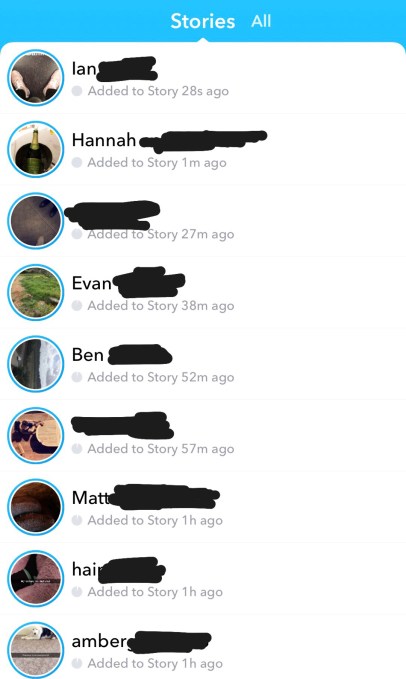
Snapchat has undone its controversial redesign’s most significant change in an update to some users today. A tab that shows Stories in reverse chronological order, replacing the redesign’s algorithmically sorted feed for many people.

We’ve reached out to Snap Inc and haven’t heard back.

Showing the most recent Stories first makes them predictable and coherent to browse. It helps you see what’s going on with friends right now. That could be helpful if you wanted to find out which friends were free to hang out or if there’s a party you could join.

Users are seeing the reverse chronological Stories feed in both the design where there’s just Stories and All tabs, as well as the design where there’s separate Stories and Chat tabs.

Snapchat has now re-added a chronological Stories feed

But reverse chronological order heavily prioritizes people who post frequently, which can bury your best friends. Snapchat’s move towards algorithmic ranking in its big redesign ensured that people you watched Stories from or chatted with most showed up at the top so you’d be less likely to miss their content. That’s similar to how Facebook’s feed worked for a long time, and how Instagram started ranking its feed two years ago. By moving social media stars and brands that don’t follow you back over to the Discover section as part of the redesign, there’s less noise in the chronological Stories list, so it works better than it did a year ago.

Switching to algorithmic sorting has helped Instagram and Twitter boost growth, which is likely why Snapchat made it part of the redesign. The company had seen daily active user growth sag from 17 percent to under 3 per quarter after the launch of Facebook’s Snapchat clone Instagram Stories. Snapchat saw growth improve after starting to roll out the algorithm-powered redesign in Q4 2017.

For the most hardcore Snapchat users who check it constantly, today’s update has been met with joy and gratitude. They were likely to see their closest friends’ posts no matter when or how infrequently they posted.

But ditching the algorithm could make it tougher for newer and less consistent Snapchat users who want to pop in and see the most relevant content instead of having to sort through distant acquaintances. That could inhibit growth. Essentially, Snapchat might have to decide between preferencing it’s most engaged and loyal users, or aiming to add more casual users.


Read Full Article

07 April 2018

Senator warns Facebook better shape up or get ‘broken up’


In the run-up to Mark Zuckerberg’s first appearance before Congress, Oregon Senator Ron Wyden issued a warning to the company about what it can expect from lawmakers if it doesn’t radically alter course.

“Mr. Zuckerberg is going to have a couple of very unpleasant days before Congress next week and that’s the place to start,” Wyden said at the TechFestNW conference in his home state of Oregon on Friday.

“There are going to be people who are going to say Facebook ought to be broken up. There have been a number of proposals and ideas for doing it and I think unless [Zuckerberg] finds a way to honor the promise he made several years ago, he’s gonna have a law on his hands.”

The Senator added that he would support such a law.

For Wyden, concealing the truth about data sharing in the fine print is a deceptive practice that’s gone on too long.

“I think we got to establish a principle once and for all that you own your data, period,” Wyden said.

“What does that mean in the real world? It’s not enough for a company to bury some technical lingo in their [terms of service]… It’s not enough to have some convoluted process for opting out.”

While that might have been wishful thinking two weeks ago, the Oregon lawmaker believes that Facebook’s most recent scandal has creating the perfect opportunity for privacy reform.

“If there is a grassroots uprising about the issue of who owns user data, we can get it passed,” Wyden said, citing other pieces of bipartisan legislation that once seemed like a long-shot.

Wyden, one of the loudest digital privacy champions in Congress, wants the public to use Facebook’s Cambridge Analytica debacle to demand that social networks obtain “explicit consent” from users before sharing their personal data with anyone — including advertisers.

“It’s real basic. You have to give the okay for them to do anything with your data,” Wyden said.

Zuckerberg is slated to appear before the Senate’s commerce and judiciary committees on Tuesday and the House energy and commerce committee the following day.

To date, Facebook has always successfully squirmed out of seeing its chief executive with his right hand raised. This time, as pressure mounted from legislators, investors, advertisers and the public alike, the company conceded. The set of hearings is widely expected to be a milestone event in big tech’s reluctant shuffle toward getting its wings clipped in Congress.

Unfortunately for Facebook, its corporate willful ignorance around protecting user data echoes other recent privacy catastrophes — a context that won’t do it any favors.

“The reason that Facebook is in hot water is essentially the same reason that Equifax is in hot water,” Wyden said. “These companies have not gotten their heads around the idea that the data they collect is more than just their property.”


Read Full Article

Facebook reportedly suspends AggregateIQ over connection to improper data-sharing


AggregateIQ, a Canadian advertising tech and audience intelligence company, has been suspended by Facebook for allegedly being closely connected with SCL, the parent company of Cambridge Analytica, reported the National Observer.

News broke late last month that AIQ, which was deeply involved with (and handsomely paid by) pro-Leave Brexit groups, was not the independent Canadian data broker it claimed to be. Christopher Wylie, the whistleblower who blew the lid off the Cambridge Analytica story, explained it candidly to The Guardian:

Essentially it was set up as a Canadian entity for people who wanted to work on SCL projects who didn’t want to move to London. That’s how AIQ got started: originally to service SCL and Cambridge Analytica projects.

AIQ has maintained that it has operated independently. Dogged denials appear on its webpage:

AggregateIQ has never been and is not a part of Cambridge Analytica or SCL. Aggregate IQ has never entered into a contract with Cambridge Analytica. Chris Wylie has never been employed by AggregateIQ. AggregateIQ has never managed, nor did we ever have access to, any Facebook data or database allegedly obtained improperly by Cambridge Analytica.

But the reporting in the Guardian makes these claims hard to take seriously. For instance, a founding member was listed on Cambridge Analytica’s website as working at “SCL Canada,” the company had no website or phone number of its own for some time, and until 2016, AIQ’s only client was Cambridge Analytica. It really looks as if AIQ is simply a Canadian shell under which operations could be said to be performed independent of CA and SCL.

Whatever the nature of the connection, it was convincing enough for Facebook to put them in the same bucket. The company said in a statement to the National Observer:

In light of recent reports that AggregateIQ may be affiliated with SCL and may, as a result, have improperly received (Facebook) user data, we have added them to the list of entities we have suspended from our platform while we investigate.

That will put a damper on SCL Canada’s work for a bit — it’s hard to do social media targeting work when you’re not allowed on the premises of the biggest social network of them all. Note that no specific wrongdoing on AIQ’s part is suggested — it’s enough that it may be affiliated with SCL and as such may have had access to the dirty data.

I’ve asked both companies for confirmation and will update this post if I hear back.


Read Full Article

Massterly aims to be the first full-service autonomous marine shipping company


Logistics may not be the most exciting application of autonomous vehicles, but it’s definitely one of the most important. And the marine shipping industry — one of the oldest industries in the world, you can imagine — is ready for it. Or at least two major Norwegian shipping companies are: they’re building an autonomous shipping venture called Massterly from the ground up.

“Massterly” isn’t just a pun on mass; “Maritime Autonomous Surface Ship” is the term Wilhelmson and Kongsberg coined to describe the self-captaining boats that will ply the seas of tomorrow.

These companies, with “a combined 360 years of experience” as their video put it, are trying to get the jump on the next phase of shipping, starting with creating the world’s first fully electric and autonomous container ship, the Yara Birkeland. It’s a modest vessel by shipping terms — 250 feet long and capable of carrying 120 containers according to the concept — but will be capable of loading, navigating, and unloading without a crew

(One assumes there will be some people on board or nearby to intervene if anything goes wrong, of course. Why else would there be railings up front?)


Each has major radar and lidar units, visible light and IR cameras, satellite connectivity, and so on.

Control centers will be on land, where the ships will be administered much like air traffic, and ships can be taken over for manual intervention if necessary.

At first there will be limited trials, naturally: the Yara Birkeland will stay within 12 nautical miles of the Norwegian coast, shuttling between Larvik, Brevik, and Herøya. It’ll only be going 6 knots — so don’t expect it to make any overnight deliveries.

“As a world-leading maritime nation, Norway has taken a position at the forefront in developing autonomous ships,” said Wilhelmson group CEO Thomas Wilhelmson in a press release. “We take the next step on this journey by establishing infrastructure and services to design and operate vessels, as well as advanced logistics solutions associated with maritime autonomous operations. Massterly will reduce costs at all levels and be applicable to all companies that have a transport need.”

The Yara Birkeland is expected to be seaworthy by 2020, though Massterly should be operating as a company by the end of the year.


Read Full Article

Twitter delays API change that could break Tweetbot, Twitterific, etc.


This morning, the developers of third-party Twitter clients Tweetbot, Twitterific, Tweetings and Talon banded together to highlight upcoming API changes that could potentially break the way their apps work. As you might expect, their collective user base — a base largely made up of folks who need more out of their Twitter app than the official one offers (or folks who, you know, just want a native Mac app after Twitter killed the official one) — got loud.

In response, Twitter has just announced plans to delay the API change for the time being.

Originally scheduled for June 19th, 2018, the API change would see Twitter’s “streaming” API replaced with its new “Account Activity” API.

The problem? The aforementioned developers point out that, with just two months before the change was set to be made, they and other third-party devs hadn’t gotten access to the new API — and changes like this take time to implement correctly.

Meanwhile, even once implemented, the new API seems to have limitations that could keep these apps from working as they do today, potentially breaking things like push notifications and automatic timeline refreshes. You can read the developer group’s breakdown here.

Twitter isn’t giving a new date for when it expects to retire the streaming API, but says that it’ll give “at least 90 days notice.”


Read Full Article

The 10 Best Programming Games to Test and Build Your Coding Skills


best-programming-games

Programming is fun once you’re confident and know what you’re doing, but getting to that point can be a grueling experience. Which is why, in between classes and lectures and tutorials, you should set aside time to play these programming games and challenges. Not only do they serve as fun breaks, but you’ll learn faster and retain more info thanks to the hands-on practice and experience. 1. Robocode Robocode is a complex programming game where you code robot tanks that fight against each other. Your job is to write the artificial intelligence that drives your robots to success—using real languages like Java,...

Read the full article: The 10 Best Programming Games to Test and Build Your Coding Skills


Read Full Article

How to Take Perfect Noise-Free Photos Every Time


noise-free-photography

Image noise is a problem every photographer has to deal with. Those tiny dots of color or grain can spoil even the most perfectly composed image, and sometimes it seems unavoidable. So what can you do? Whether you want to fix it in-camera, or are happy to dive into Lightroom or Photoshop, there are several things you can do to eliminate noise. And that will help you take sharper photos. Read on for a noise-free future. 1. Shoot at Low ISO Noise is most commonly introduced into a photo when the camera sensor’s sensitivity is pushed beyond a level its...

Read the full article: How to Take Perfect Noise-Free Photos Every Time


Read Full Article

Under a millimeter wide and powered by light, these tiny cameras could hide almost anywhere


As if there weren’t already cameras enough in this world, researchers created a new type that is both microscopic and self-powered, making it possible to embed just about anywhere and have it work perpetually. It’s undoubtedly cool technology, but it’s probably also going to cause a spike in tinfoil sales.

Engineers have previously investigated the possibility of having a camera sensor power itself with the same light that falls on it. After all, it’s basically just two different functions of a photovoltaic cell — one stores the energy that falls on it while the other records how much energy fell on it.

The problem is that if you have a cell doing one thing, it can’t do the other. So if you want to have a sensor of a certain size, you have to dedicate a certain amount of that real estate to collecting power, or else swap the cells rapidly between performing the two tasks.

Euisik Yoon and postdoc Sung-Yun Park at the University of Michigan came up with a solution that avoids both these problems. It turns out that photosensitive diodes aren’t totally opaque — in fact, quite a lot of light passes right through them. So putting the solar cell under the image sensor doesn’t actually deprive it of light.

That breakthrough led to the creation of this “simultaneous imaging and energy harvesting” sensor, which does what it says on the tin.

The prototype sensor they built is less than a square millimeter, and fully self-powered in sunlight. It captured images at up to 15 frames per second of pretty reasonable quality:

The Benjamin on the left is at 7 frames per second, and on the right is 15.

In the paper, the researchers point out that they could easily produce better images with a few tweaks to the sensor, and Park tells IEEE Spectrum that the power consumption of the chip is also not optimized — so it could also operate at higher framerates or lower lighting levels.

Ultimately the sensor could be essentially a nearly invisible camera that operates forever with no need for a battery or even wireless power. Sounds great!

In order for this to be a successful spy camera, of course, it needs more than just an imaging component — a storage and transmission medium are necessary for any camera to be useful. But microscopic versions of those are also in development, so putting them together is just a matter of time and effort.

The team published their work this week in the journal IEEE Electron Device Letters.


Read Full Article

The 7 Best Online RAR Extractors


best-online-rar-extractors

Chances are you’ll come across a compressed file sooner or later. While ZIP is a common format that Windows can extract on its own, the also-popular RAR usually requires dedicated software. While you can easily extract RAR archives with desktop software, sometimes you don’t want to or can’t install anything. That’s where online RAR extractors come in. 1. B1 Online Archiver This straightforward website supports dozens of archive formats. Click the big blue button to upload a file, then wait for it to upload and extract. You’ll then see a list of files inside the archive. Click one to download...

Read the full article: The 7 Best Online RAR Extractors


Read Full Article

Facebook demands ID verification for big Pages, “issue” ad buyers


Facebook is looking to self-police by implementing parts of the proposed Honest Ads Act before the government tries to regulate it. To fight fake news and election interference, Facebook will require the admins of popular Facebook Pages and advertisers buying political or “issue” ads on “debated topics of national legislative importance” like education or abortion to verify their identity and location. Those that refuse, are found to be fraudulent, or are trying to influence foreign elections will have their Pages prevented from posting to the News Feed or their ads blocked.

Meanwhile, Facebook plans to use this information to append a “Political Ad” label and “Paid for by” information to all election, politics, and issue ads. Facebook started the verification process this week, users in the U.S. will start seeing the labels and buyer info later this spring, and Facebook will expand the effort to ads around the world in the coming months.

“These steps by themselves won’t stop all people trying to game the system. But they will make it a lot harder for anyone to do what the Russians did during the 2016 election and use fake accounts and pages to run ads” CEO Mark Zuckerberg wrote on Facebook. “Election interference is a problem that’s bigger than any one platform, and that’s why we support the Honest Ads Act. This will help raise the bar for all political advertising online.” You can see his full post below.

The move follows Twitter’s November announcement that it too would label political ads and show who they were bought by.

Twitter’s mockup for its “Political” ad labels and “paid for by” information

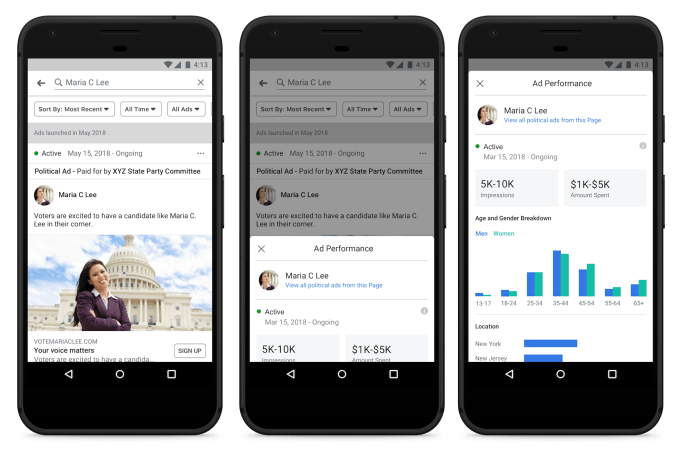
Facebook also gave a timeline for releasing both its tools for viewing all ads run by Pages, and to create a Political Ad Archive. A searchable index of all ads with the “political” label, including their images, text, target demographics, and how much was spent on them will launch in June and keep ads visible for four years after they run. Meanwhile, the Vew Ads tool that’s been testing in Canada will roll out globally in June so users can see any ad run by a Page, not just those targeted to them.

Facebook announced in October it would require documentation from election advertisers and label their ads, but now is applying those requirements to a much wider swath of ads that deal with big issues impacted by politics. That could protect users from disinformation and divisive content not just during elections, but any time bad actors are trying to drive wedges into society. Facebook wouldn’t reveal the threshhold of followers that will trigger Pages needing verification but confirmed it will not apply to small-to-medium size businesses.

By self-regulating, Facebook may be able to take the wind out calls for new laws that apply buyer disclosure rules on TV and other traditional media ads to online ads. Zuckerberg will testify before the U.S. Senate Judiciary and Commerce committees on April 10, as well as the House Energy and Commerce Committee on April 11. Having today’s announcement to point to could give him more protection against criticism during the hearings.

With important elections coming up in the US, Mexico, Brazil, India, Pakistan and more countries in the next year, one…

Posted by Mark Zuckerberg on Friday, April 6, 2018

For more on Facebook’s recent troubles, check out our feature stories:


Read Full Article

06 April 2018

Twitter will publicize rules around abuse to test if behavior changes


As part of Twitter’s efforts to rid its platform of abuse and hate, the company is teaming up with researchers Susan Benesch, a faculty associate at the Berkman Klein Center for Internet & Society at Harvard University, and J. Nathan Matias, a post-doc research associate at Princeton University, to study online abuse. Today, Twitter is going to start testing an idea that if it shows people its rules, behavior will improve.

“In an experiment starting today, Twitter is publicizing its rules, to test whether this improves civility,” Benesch and Matias wrote on Medium. “We proposed this idea to Twitter and designed an experiment to evaluate it.”

The idea is that by showing people the rules, their behavior will improve on the platform. The researchers point to evidence of when institutions clearly publish rules, people are more likely to follow them.

The researchers assure the privacy of Twitter users will be protected. For example, Twitter will only provide anonymized, aggregated information.

“Since we will not receive identifying information on any individual person or Twitter account, we cannot and will not mention anyone or their Tweets in our publications,” the researchers wrote.

Last month, Twitter began soliciting proposals from the public to help the social network capture, measure and evaluate healthy interactions on the platform. This was part of Twitter’s commitment “to help increase the collective health, openness, and civility of public conversation,” Twitter CEO Jack Dorsey said in a tweet.

It’s not clear how widespread the test will be. I’ve reached out to Twitter and will update this story if I learn more. In the meantime, holler at me (megan@techcrunch.com) if these rules show up for you.


Read Full Article

Facebook demands ID verification for big Pages, “issue” ad buyers


Facebook is looking to self-police by implementing parts of the proposed Honest Ads Act before the government tries to regulate it. To fight fake news and election interference, Facebook will require the admins of popular Facebook Pages and advertisers buying political or “issue” ads on “debated topics of national legislative importance” like education or abortion to verify their identity and location. Those that refuse, are found to be fraudulent, or are trying to influence foreign elections will have their Pages prevented from posting to the News Feed or their ads blocked.

Meanwhile, Facebook plans to use this information to append a “Political Ad” label and “Paid for by” information to all election, politics, and issue ads. Users can report any ads they think are missing the label, and Facebook will show if a Page has changed its name to thwart deception. Facebook started the verification process this week, users in the U.S. will start seeing the labels and buyer info later this spring, and Facebook will expand the effort to ads around the world in the coming months.

Overall, it’s a smart start that comes way too late. As soon as Facebook started heavily promoting its ability to run influential election ads, it should have voluntarily adopted similar verification and labeling rules as traditional media. Instead, it was so focused on connecting people to politics, it disregarded how the connection could be perverted to power mass disinformation and destabilization campaigns.

“These steps by themselves won’t stop all people trying to game the system. But they will make it a lot harder for anyone to do what the Russians did during the 2016 election and use fake accounts and pages to run ads” CEO Mark Zuckerberg wrote on Facebook. “Election interference is a problem that’s bigger than any one platform, and that’s why we support the Honest Ads Act. This will help raise the bar for all political advertising online.” You can see his full post below.

The move follows Twitter’s November announcement that it too would label political ads and show who they were bought by.

Twitter’s mockup for its “Political” ad labels and “paid for by” information

Facebook also gave a timeline for releasing both its tools for viewing all ads run by Pages, and to create a Political Ad Archive. A searchable index of all ads with the “political” label, including their images, text, target demographics, and how much was spent on them will launch in June and keep ads visible for four years after they run. Meanwhile, the Vew Ads tool that’s been testing in Canada will roll out globally in June so users can see any ad run by a Page, not just those targeted to them.

Facebook announced in October it would require documentation from election advertisers and label their ads, but now is applying those requirements to a much wider swath of ads that deal with big issues impacted by politics. That could protect users from disinformation and divisive content not just during elections, but any time bad actors are trying to drive wedges into society. Facebook wouldn’t reveal the threshhold of followers that will trigger Pages needing verification but confirmed it will not apply to small-to-medium size businesses.

By self-regulating, Facebook may be able to take the wind out calls for new laws that apply buyer disclosure rules on TV and other traditional media ads to online ads. Zuckerberg will testify before the U.S. Senate Judiciary and Commerce committees on April 10, as well as the House Energy and Commerce Committee on April 11. Having today’s announcement to point to could give him more protection against criticism during the hearings, though congress will surely want to know why these safeguards hadn’t been in place already.

With important elections coming up in the US, Mexico, Brazil, India, Pakistan and more countries in the next year, one…

Posted by Mark Zuckerberg on Friday, April 6, 2018

For more on Facebook’s recent troubles, check out our feature stories:


Read Full Article

How to Transfer Data From Your Computer to Phone Quickly


transfer-from-computer-smartphone

Your desktop computer and phone are two things you use every day. The latter is smaller and portable compared to the other but can’t hold everything your computer does. So, what do you do to transfer stuff from your computer to your phone? Here are six ways you can take your computer files with you wherever you go. 1. Save Material to Evernote, Then Access It by Phone Many people think of Evernote as only a note-taking application. However, you can save images, cool websites you find online, emails, and more. Evernote has drag-and-drop functionality that simplifies adding content front...

Read the full article: How to Transfer Data From Your Computer to Phone Quickly


Read Full Article

How to Convert MBR to GPT Without Losing Data in Windows


convert-mbr-gpt

How many hard drives does your system have? One? Three? Ten? Regardless of how many drives you have, they all need one thing to keep track of what’s on the drive: a partition table. The partition table describes the partitions (sections) of the drive and helps your system find the files you need. Your Windows system uses a master boot record (MBR) or GUID Partition Table (GPT) depending on the age, operating system, and your system firmware. Sometimes it is necessary to switch between MBR and GPT, but to do that you need to wipe your drive first. Using traditional...

Read the full article: How to Convert MBR to GPT Without Losing Data in Windows


Read Full Article

Facebook plans to let everyone unsend messages, won’t let Zuckerberg until then


TechCrunch reported last night that Facebook retracted Facebook messages sent by Mark Zuckerberg and other executives from their recipients’ inboxes. That’s an ability normal Facebook users don’t have. But now Facebook tells me it plans to make an “unsend” feature available to all users in several months, and has already been considering how to build this product. Until the unsend feature is released for everyone, Facebook says it won’t unsend or retract any more of Zuckerberg’s messages.

The retractions of the CEO’s chats were never previously disclosed until Facebook confirmed the news to TechCrunch last night after we reported having email receipt evidence of messages that have since disappeared. Many users are seeing that as a breach of trust.

For the full story on Zuckerberg’s disappearing messages, check out our feature story:

To recap, now six sources confirm that Facebook messages they had received from Mark Zuckerberg had disappeared from their inboxes. When we told Facebook we had an email receipt proving the retractions,  Facebook gave TechCrunch this statement: “After Sony Pictures’ emails were hacked in 2014 we made a number of changes to protect our executives’ communications. These included limiting the retention period for Mark’s messages in Messenger. We did so in full compliance with our legal obligations to preserve messages.”

But tampering with users’ inboxes without disclosure has struck many users a violation of Facebook’s power. Many asked why Zuckerberg and other executives had access to functionality not offered to regular users.

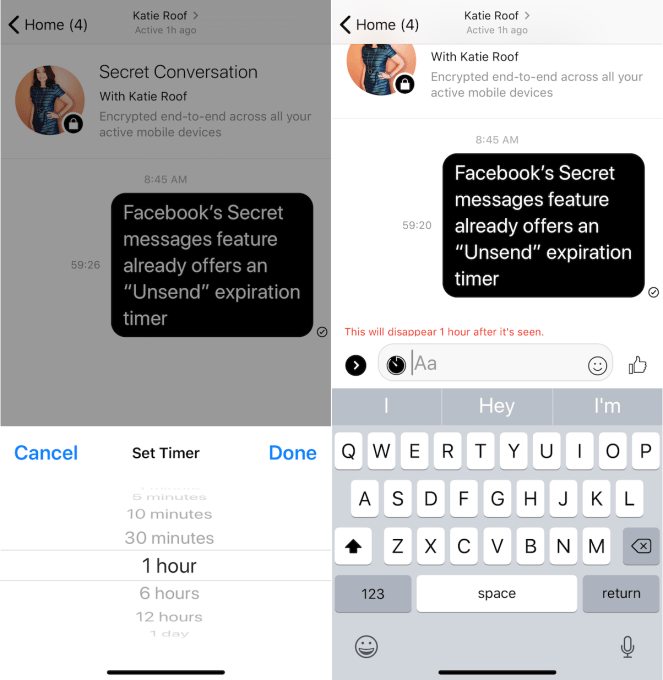
Facebook encrypted “Secret” messaging feature includes an Unsend option with an expiration timer. But Zuckerberg and other executives didn’t use this, and instead had their permanent messages specially retracted.

Facebook tells TechCrunch is hasn’t finalized exactly how the unsend feature will work. A Facebook Messenger spokesperson tells me only possible option is an expiration timer users can set on messages. When the timer runs out, the message would disappear from both their and the recipients’ inboxes. They tell me this is similar to how retractions of Zuckerberg’s messages work.

Facebook already offers a “Secret” encrypted messaging feature that includes an Unsend expiration timer. But this can’t be used in existing traditional Facebook message threads, and instead users have to launch a separate “Secret” conversation. Zuckerberg and other executives weren’t using this feature, and instead had their permanant, non-“Secret” messages retracted. Instagram also offers an Unsend option in its Direct messaging feature, but warns that while it can retract sent messages, the recipient may have already read them.

But in the coming months, Facebook will bring either this expiration timer or another way to Unsend messages to all Messenger threads. Facebook didn’t have details about whether recipients would be notified when a message was unsent and retracted from their inboxes.

Beyond the dubious ethics of Facebook manipulating users’ private messaging threads without consent or disclosure, Zuckerberg and other executives, there’s the question of whether and unsend feature is good for Facebook at all. It could make users more willing to share vulnerable, sensitive, or confidential professional messages. But it also might make users paranoid that messages they receive could disappear, leading to anxious screenshotting. It could also lead to abuse if users think they can send offensive content then have it retracted shortly after it’s seen.

Facebook could have announced plans for the Unsend feature at any time. It could have disclosed the retractions of Zuckerberg’s messages at any time. But waiting until it was confronted with evidence of the deletions and public backlash shows Facebook is only being transparent with users when forced.

If you have more info on this situation, including evidence of messages from other Facebook executives disappearing, please contact this article’s author Josh Constine via open Twitter DMs, josh@techcrunch.com, or encrypted Signal chat at (585)750-5674.

For more on Facebook’s recent struggles, read our feature pieces:


Read Full Article

Squarespace vs. WordPress: 7 Differences That May Surprise You


squarespace-vs-wordpress

In the worlds of web hosting and site building, there are few names bigger than WordPress and Squarespace. Both are popular choices that offer a lot of functionality. So how do you decide which to use? Why Squarespace vs. WordPress Isn’t a Fair Fight When comparing Squarespace and WordPress, it’s important to remember that the two have somewhat different purposes. As we’ll see, Squarespace offers highly packaged solutions for hosting sites on their own servers. WordPress, on the other hand, is a content management system that can be used on WP’s servers or downloaded and used on your own (or...

Read the full article: Squarespace vs. WordPress: 7 Differences That May Surprise You


Read Full Article

8 Ways Linux Is Taking Over the World


linux-take-over-world

Linux doesn’t only run on home computers. You will also find it in some much more exciting pieces of kit. It’s particularly common where the proprietary nature of Windows and macOS is not suitable. Let’s take a closer look at some of the most unusual ways people and companies around the world have used Linux. 1. Large Hadron Collider The Large Hadron Collider (LHC) is the world’s largest and most powerful particle accelerator. It’s a 17-mile long circular tube that’s buried 175 meters below the French-Swiss border near Geneva. It’s common knowledge that the facility has been resounding success from...

Read the full article: 8 Ways Linux Is Taking Over the World


Read Full Article