Everyone wants more bandwidth from the skies, but it takes a lot of testing to turn laboratory research projects into real-world performant infrastructure. A number of new technologies, sometimes placed under the banner of “5G” and sometimes not, is embarking on that transition and being deployed in real-world scenarios.
Those research trials are crucial for productizing these technologies, and ultimately, delivering consumers better wireless broadband options.
We’ve talked a bit about one of those testbeds called COSMOS up in northern Manhattan near Columbia University, which is pioneering 5G technologies within a dense urban environment. The same National Science Foundation-funded research group that financed that project, the Platforms for Advanced Wireless Research program (PAWR), has now selected two finalists for its fourth location, which has a specific focus on rural infrastructure.
Research teams in Ames, Iowa affiliated with the Iowa State University and Lincoln, Nebraska affiliated with the University of Nebraska-Lincoln each won $300,000 grants to accelerate their planning for the testbeds. Those teams will use the grants to optimize their proposals, with one expected to receive the final full grant next year.
The goal for this latest testbed is to find next-generation wireless technology stacks that can deliver cheaper and better bandwidth to rural America, areas of the country that are not well-served by traditional cable and fiber networks nor current wireless cell tower coverage.
Whoever wins will join the existing three wireless testbeds in New York City, Salt Lake City, and the Research Triangle in North Carolina.
PAWR itself is a joint public-private initiative with $100 million in funding to accelerate America’s frontier wireless innovation. It’s co-led by US Ignite, a NSF run initiative to bring smart city ideas to fruition, and Northeastern University.
The Americans with Disabilities Act of 1990 paved the way for decades of incremental changes to the way buildings, businesses, and laws accommodate people with a wide variety of disabilities. At 30 years old this week, the law’s effect on tech has been profound, but there’s still a lot of work to do.
The ADA originally applied mainly to things like buildings and government resources, but over the years (and with improvements and amendments) came to be much broader than that. As home computers, the web, and eventually apps became popular, they too became subject to ADA requirements — though to what extent is still a matter under debate.
I asked a few of the most prominent companies and advocacy organizations what they think about how tech has improved the everyday lives of people with disabilities, and where it has so far fallen short.
Those who responded had the most to say about how tech has helped, of course, but also offered suggestions (and recriminations) for an industry that has in some ways only recently begun to truly include people with disabilities in its processes — and in many ways has yet to do so.
Claire Stanley, Advocacy and Outreach Specialist at the American Council for the Blind
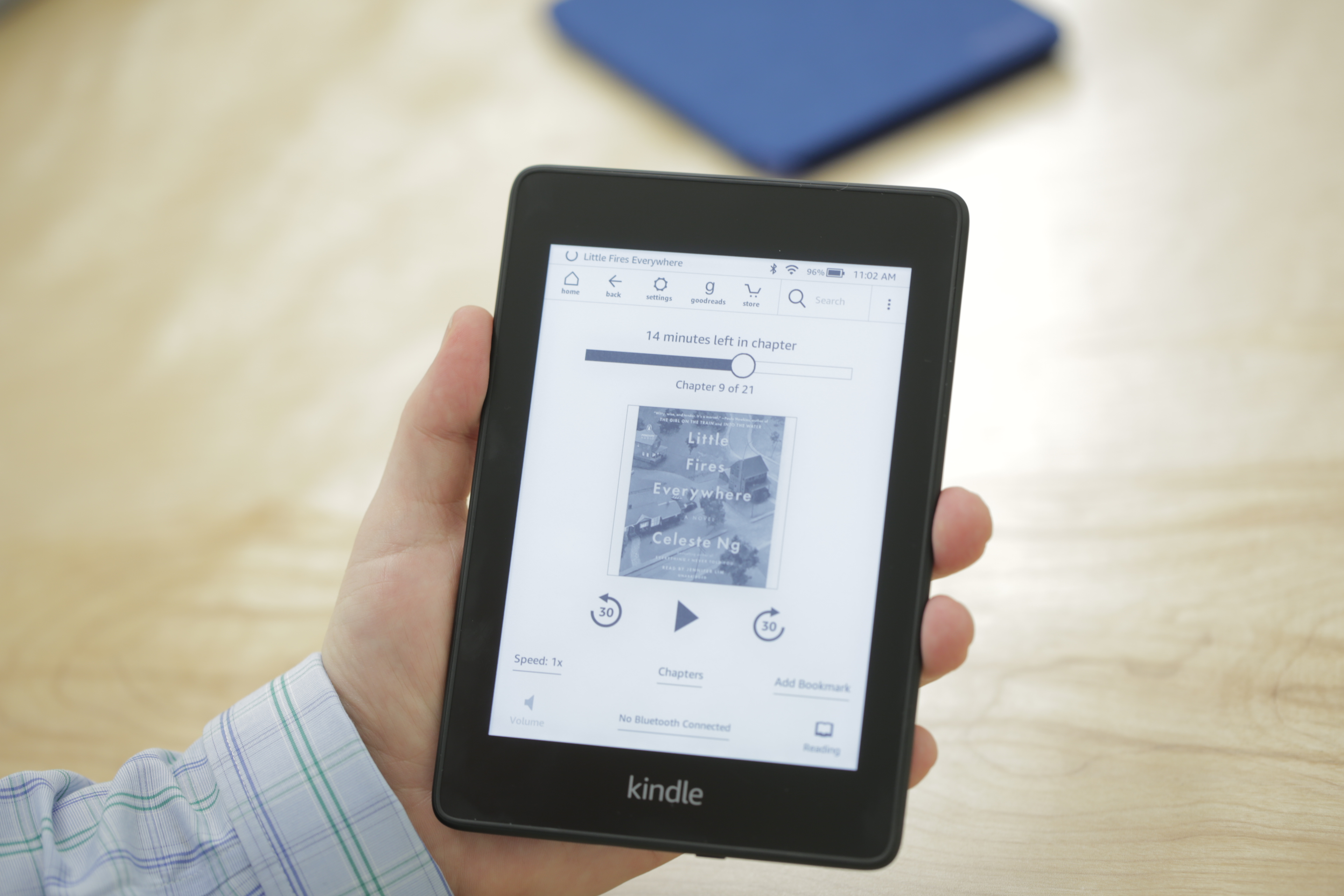
“Tech has opened the door to so many things,” said Stanley. “Books, for instance — 10 years ago to get a book you might have to wait for the Library of Congress to convert it to audio. Now, because of Kindles and e-readers, the day a book comes out I can buy it. Access is a lot faster than it once was.”
“The ability to do certain things in the workplace, too. The caveat is, people don’t always design software to work with accessibility technology. Designing with screen readers in mind can be very helpful, but if they don’t, that opens up whole new problems,” she said.
“Companies just don’t think about accessibility, so they design a product that’s totally inaccessible to screen readers. To my understanding, if you design it right from the get go it should be easy to make it compatible. There are the WCAG standards — if programmers took even a cursory glance at these, they’d be like, oh I get it!,” said Stanley. “And I’ve heard from a lot of people that when you make something accessible to the blind it makes it better for everybody.”
That’s exactly the problem that Fable intends to alleviate by providing software testers with various disabilities as a service to companies that may not have thought that far ahead in their QA process.
New devices and services are also changing the landscape for blind folks:
“Braille literacy is going down because people are turning to audio synthesizers — but new designs of braille readers are coming out, and they’re getting cheaper. I have mine right next to me,” said Stanley.
Of course for the deaf-blind community braille is still indispensable. One dad hoping to teach his daughter braille recently built his own inexpensive braille education device — not something you were likely to do 20 years ago.
“And Aira is an app that has been around for about four years – basically, though video from your phone, a person on the other end can answer questions and identify things. I use it all the time. They’re starting to integrate AI to do some simple things like read signs,” Stanley said.
“We’ve also been working a lot in the autonomous vehicle space. That will open up a lot of doors, and not just for blind people, but people with other disabilities, the elderly, children,” she added. “I know we have a long way to go, but we’ve been fortunate enough to be at the table with companies and Congress when we’re talking about what making an autonomous vehicle accessible looks like.”
Eve Andersson, Director of Accessibility at Google
“To me, one of the most notable tech advances has been changes in captioning technology. About two years after I started at Google, in 2009, we introduced automatic captioning on YouTube using AI. Then 8 years later, we introduced the ability to caption sound effects (laughter, music, applause, etc) to make video content even more accessible,” said Andersson.
She pointed out that although captions were originally made with accessibility for deaf and hard of hearing users, they quickly became helpful for many other users who wanted to be able to watch videos on mute, in other languages, and so on.
“Programming computers to be able to understand and display or translate language is allowing for so many more advances that benefit everyone. For example, speech recognition and voice assistants have made it possible to have the speech to text features that we have today, like voice typing in Google Docs or dictation in Chrome OS,” she said.
Live transcribe is another feature that tech has enabled, letting hearing impaired people follow in-person communications live.
“Before the ADA, some parts of the physical world remained inaccessible to people who are blind or low-vision,” Andersson said. “Today, you can find braille under almost all signs in the United States, which paved the way for us to create products like Google BrailleBack and the TalkBack braille keyboard, which both allow braille users to gain the information they need and communicate effectively with the world around them. In addition, the spirit of ADA in making the physical world accessible to people with disabilities is what inspired innovations like Lookout, an app that helps people who are blind or low-vision identify the world around them.”
“One area that we’re thinking about more and more is how to leverage technology to be more helpful for people with cognitive disabilities. This is an incredibly diverse space spanning many different needs, but it remains largely unexplored,” she said. “Action blocks” in Android are an early effort to address it, simplifying multi-step processes into single buttons. But the team is looking into larger scale improvements to help out those who have trouble using a smart device out of the box.
“As an industry, we need to work to ensure that people with disabilities – from employees to consultants to users – are always included in the process of developing a product, research area, or initiative from the very beginning,” she said. “People with disabilities or who have family members with disabilities on my team bring their experiences to the table and we make better products as a result.”
Sarah Herrlinger, Director of Global Accessibility Policy at Apple
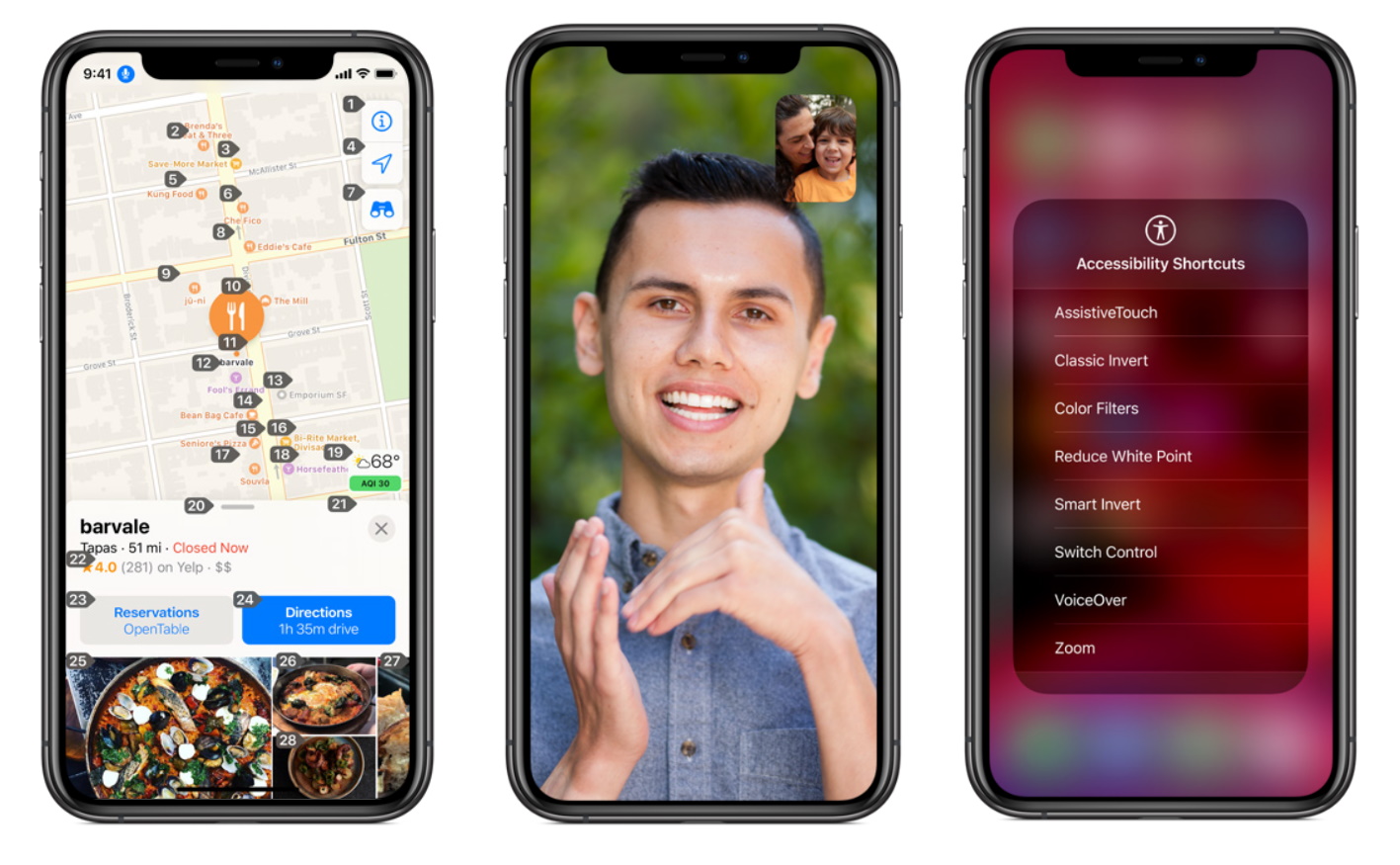
“It’s fundamentally about culture,” said Herrlinger. “From the beginning Apple has always believed accessibility is a human right and this core value is still evident in everything we design today.”
Though somewhat general of a statement, Apple has the history to back it up. The company has famously been ahead of others on the accessibility curve for decades. TechCrunch columnist Steve Aquino has documentedthese efforts over the years, summing many up in this feature.
Image Credits: Apple
The iPhone, being Apple’s flagship product since its introduction, has also been its main platform for accessibility.
“The historical impact of iPhone as a mainstream consumer product is well documented. What is less understood though is how life changing iPhone and our other products have been for disability communities,” said Herrlinger. “Over time iPhone has become the most powerful and popular assistive device ever. It broke the mold of previous thinking because it showed accessibility could in fact be seamlessly built into a device that all people can use universally.”
The feature that has been helpful to the most people is likely VoiceOver, which intelligently reads off the contents of the screen in a way that allows blind users to navigate the OS easily. One such user posted her experience recently, racking up millions of views:
I thought I would share how I, as someone who is visually impaired use my iPhone.pic.twitter.com/wPI9smOIq0
As for where the tech industry has room to grow, Herrlinger said: “Representation and inclusion are critical. We believe in the mantra of many within disability communities: ‘Nothing about us without us.’ We started a dedicated accessibility team in 1985, but like all things on inclusion — accessibility should be everyone’s job at Apple.”
Melissa Malzkuhn, Founder & Creative Director, Motion Light Lab at Gallaudet University
“If not for the laws in place to safeguard our access, no one would implement them,” Malzkuhn said frankly. “The ADA really helped push greater access, but we also saw a lot of change in how people think, and what is considered socially responsible. More and more people now see that their use of social media comes with a sense of social responsibility to make their posts accessible. We would like to see that social accountability with all individuals, and with all companies, big and small.”
Gallaudet is a university that aims to be “barrier-free for deaf and hard of hearing students,” providing a huge amount of resources and instruction for that community. Many of the technologies its staff has used for years have seen major improvements as mainstream users have flocked to virtual meetings and the like and found them wanting.
Image Credits: Microsoft
“We have more video meeting options than ever, and they continue to improve. We also have seen a constant improvement in our experience with video relay services,” Malzkuhn said. She also cited voice-to-text as having improved a lot and provided serious utility; Gallaudet’s Technology Access Program has worked with Google’s Live Transcribe.
“Language-mapping processing, and the early pioneering work on gesture and sign recognition is exciting,” she added, though the latter is still a ways from practical use. She was unsparing in her criticism of the many attempts at smart gloves, however: “Enough with the sign language gloves. It reinforces a bigger ideology: Give deaf people something to wear and our communication issues will go away. It is not about putting the burden of communication on one group of people.”
“I would say that the Apple iPad has revolutionized how we look at the experience of reading for deaf children. In the Motion Light Lab here at Gallaudet University, we have created bilingual storybook apps, intersecting both ASL videos and written text on the same interface,” she said. “But technology will never replace the humanity in all of us. All it takes are attitudes and the willingness to communicate, regardless of technology. Learning a bit of sign language goes a long way.”
Malzkuhn emphasized the value of inclusion and chastised companies that fail to take even elementary steps in hiring and process.
“Companies that hire Deaf people have it right. Companies that focus on inclusive design and accessibility as an important and ‘non-negotiable’ aspect in product design also have it right. Their products are invariably superior to inaccessible products,” she said, while those who do not are guilty of “a serious omission. Many companies strive to create products to ‘help’ our lives, but if we are not in the room in the first place, and if we do not have a seat at the table, that is not helpful. Inclusive design starts with an inclusive team.”
Investors need to look at startups focused on accessibility and deafness as well. Like any growing community, they need funding and mentorship.
Malzkuhn also wanted to make sure that companies are thinking about the deaf and hard of hearing not just as consumers of an end product, but full-fledged users.
“That is a driving force in my work — we need to always give tools so anyone can design technology. We need to ensure that we have the responsibility of training, teaching, and making those accessible so we develop and cultivate the next generation of young deaf people who design and construct, who are architects of systems, who can program systems, as well as being end users of technology.”
Jenny Lay-Flurrie, Chief Accessibility Officer at Microsoft
“On a personal level, the ADA drove a new bar of awareness and provision of captioning, interpreting which are both invaluable to me in the workplace, home, and navigating crucial life needs like medical care,” said Lay-Flurrie. “Technology can unlock solutions that can help empower people with disabilities in the spirit of the ADA and lead to greater innovations for everyone. To enable transformative change accessibility needs to be a priority.”
Like Google’s Eve Andersson, Lay-Flurrie highlighted captioning as a major recent advance.
“Captioning, like many other aspects of accessibility is increasingly woven into the fabric of what we do,” she said. “Captioning has evolved so much in the last 30 years, and accelerated as a result of AI and ML in the last 5. Teams now has AI captioning integrated and we have seen the impact of that during COVID with Teams Captioning usage up 30x from a few months prior.”
“Accessibility has also diversified – with technologies like Seeing AI, Learning Tools, and the Xbox Adaptive Controller as Microsoft focuses on inclusive design, building with and for people with disabilities in these instances, creating breakthrough technologies for blind/low vision, dyslexia and mobility,” she said.
The Adaptive Controller was one of the best hardware surprises of recent years — a device for playing games and interacting with computers and consoles that’s hyper-compatible and clearly the result of immense effort and expenditure.
It’s an example of one of the “doors that remain closed and need to be opened, vehemently and with speed,” as Lay-Flurrie put it. “Seeing AI is a great lens on what is possible here, and I get excited to think about what AI/ML, as well as AR can do across the spectrum of disability. Additionally, we believe that AI can help unlock solutions to some of the biggest challenges people with disabilities face, which is why the AI for Accessibility program plays a crucial role in how Microsoft is working to drive inclusive innovation.”
Lay-Flurrie had a good deal to say on how to integrate inclusivity into a company’s processes — and with good reason, seeing as Microsoft has been a leader on these issues for years.
“Accessibility isn’t optional. It must be part of your business, ecosystem and managed/measured,” she said. “It starts with people and we have really focused on how we build an inclusive culture, pipeline of talent. Though we are still continuing to grow and learn, have also taken steps to share our learnings with other organizations through resources like the Autism Hiring Playbook, Accessibility at a Glance training resources, the Supported Employment Program Toolkit, and the Inclusive Design Toolkit.”
“We realize that each organization has its own pace and starting point. The first step is to recognize the need to design for accessibility,” she continued. “It’s particularly important to evaluate the maturity of a product development lifecycle through the lens of accessibility and look to build in assistive features from the start, not bolted on later in the process. But there is more to do here. Until then, my mantra stands – if you don’t know its accessible, its not.”
Mike Shebanek, Head of Accessibility at Facebook
“The portability, ease of use, affordability, and built-in accessibility of smartphones has allowed people with disabilities to be more connected, more mobile and more independent than anyone thought possible thirty years ago,” said Shebanek. “The rise of voice technologies like speech synthesis, speech recognition, and voice control of devices has also radically improved the lives of people with disabilities.”
“Facebook created React Native, and made it open source, so that developers can create accessible mobile apps. We’ve also helped set global digital standards for web accessibility that enable everyone to enjoy a more accessible Internet,” he continued.
Like the others, he suggests that tech companies need to consider accessibility needs and methods early on, and increase the numbers of people with disabilities in the development and testing process.
Machine learning is helping address some major obstacles in a more automated way: “we’re using it at Facebook to power automatic video captioning and create automatic Alt-Text to provide spoken descriptions of photographs to people who are blind,” said Shebanek. “But these are only recent innovations and the industry has barely begun to scratch the service of what’s possible in the next 30 years as we begin to thoughtfully address the needs of people with disabilities.”
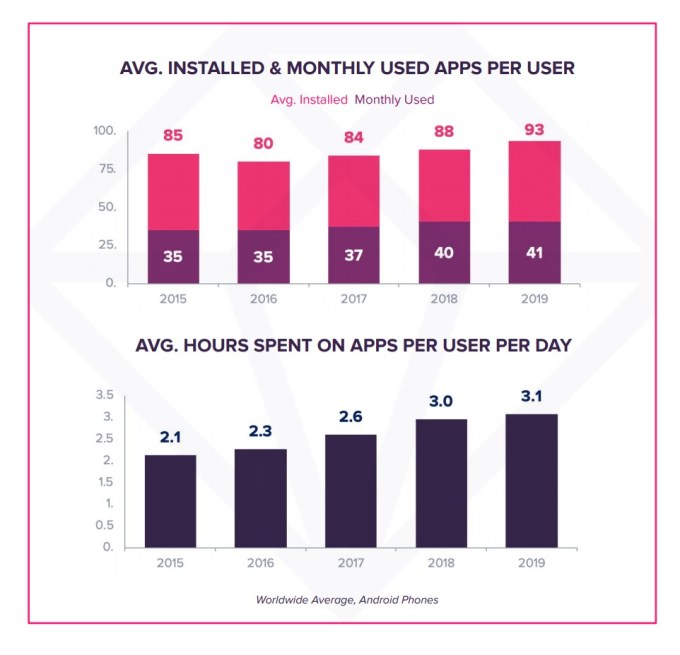
Mobile consumers are downloading and using more apps than ever before. According to recent data from App Annie, mobile users now have 93 apps on their phone as of the end of 2019, up from 85 apps at the end of 2015. They also now use around 41 apps per month, up from 35 in 2015. Related to this increase, users are now also spending more hours per day using apps. Worldwide, daily time spent in apps has grown to 3.1 hours per day in 2019, up from 2.1 hours per day in 2015, for instance.
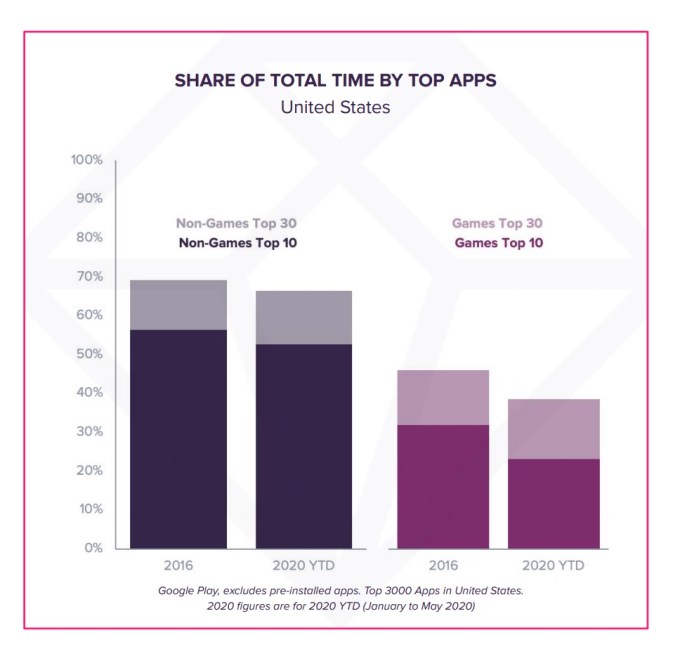
But with that growth has also come increased diversity among the top apps, the report found. That means top apps now make up a smaller proportion of consumers’ total time spent in apps, compared with five years ago.
Image Credits: App Annie
It’s worth noting that this report was commissioned by Facebook, App Annie says, with a goal of offering a more detailed look at the evolving app ecosystem over the past five years. The report aims to determine how growth is playing out in terms of popular app categories, among the top publishers, and how quickly newly successful apps are achieving sizable growth.
Facebook, in the past, had generated this sort of market research data first-hand by way of its Onavo VPN application — now shuttered over privacy concerns — and other similar efforts.
Turning to App Annie’s data team is just a new way for the company to get at the same sort of data.
App Annie’s market analysis, in part, is similarly derived by way of third-party apps. The company acquired Distimo in 2014, and as of 2016 has run the VPN app Phone Guardian under the Distimo brand. It also acquired Mobidia in 2015 and has operated My Data Manager (now on the App Store under Distimo). Both apps disclose their relationship with App Annie and explain that the apps are used for market research purposes, with specific examples of the type of data collected.
The new report’s findings may not be all good news for Facebook and other top app publishers. As the app economy evolved, users now have more places to spend time on mobile.
Image Credits: App Annie
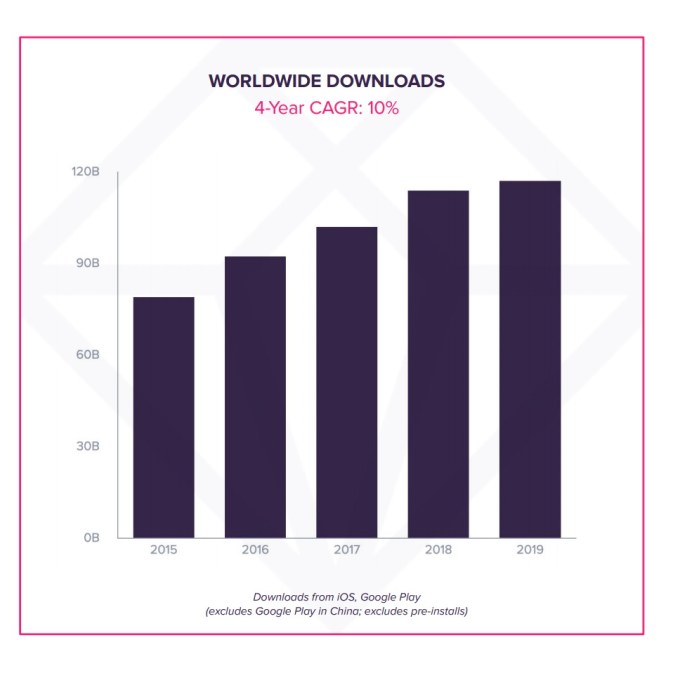
Over the past five years, worldwide downloads continued to grow to reach a record of 120 billion in 2019, with several key countries now driving growth including India (10% year-over-year growth in 2019), Brazil (9%), Indonesia (8%) and Russia (7%).
Downloads in mature economies also hit record levels in 2019, including the U.S. (12.3B), Japan (2.5B), U.K. (2.1B), South Korea (2B), Germany (1.9B), and France (1.9B).
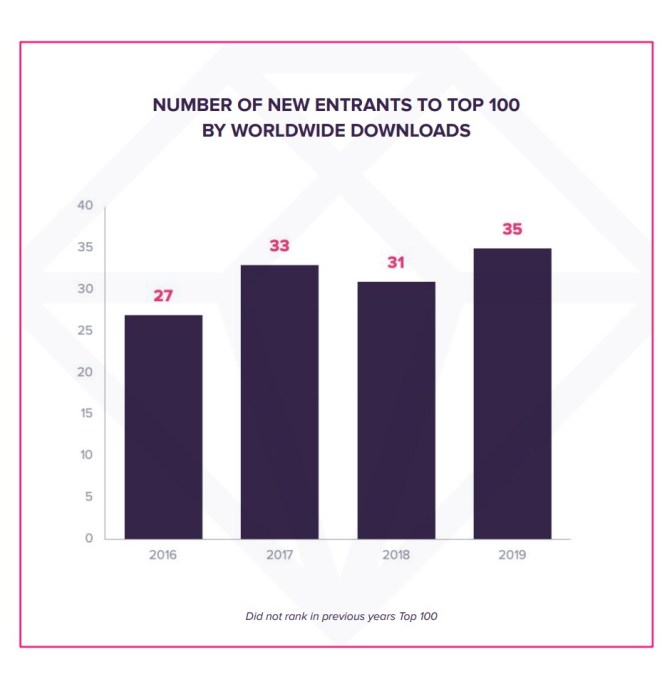
As users grew their time in app to 3.1 hours per day, they also began to use more of a variety of apps. According to the report, 35 of the top 100 apps were new entrants in 2019, up from 27 in 2016 across categories that included social, photography, video, communications, entertainment, and more.
Image Credits: App Annie
This is likely worrisome data for top app publishers, like Facebook, which has for years maintained a suite of top apps including not only its flagship app, but also Instagram, Messenger, and WhatsApp. As the competitive pressure increases, these top apps make up a smaller proportion of the time spent on mobile devices as users have grown more comfortable trying out newcomers — particularly across gaming, entertainment, and video categories.
The top 30 non-game apps accounted for 69.4% of U.S. users’ total time spent in 2016 among non-games. That dropped to 65.5% in 2019, a nearly 4% decline. Among games, the share fell from 49% to 39%, a 10% drop. (This data was sourced from Google Play in the U.S.)
Image Credits: App Annie
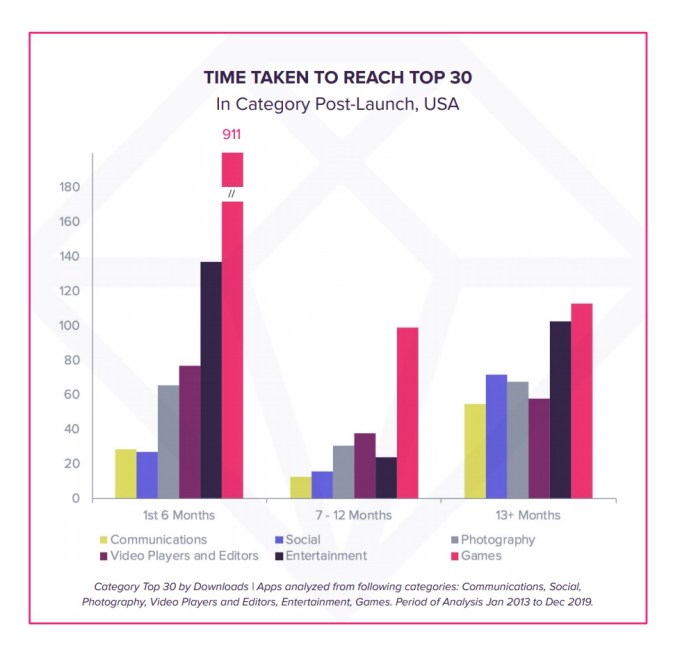
Not only are consumers more open to trying new apps, the report found that new apps can also quickly achieve app store success. In the U.S., for example, over 60% of apps are able to reach their category’s Top 30 in their first 6 months.
This is aided by larger initial marketing pushes as well as improvements in terms of consumer’s devices themselves — like more storage and processing power, which encourages more downloads.
Image Credits: App Annie
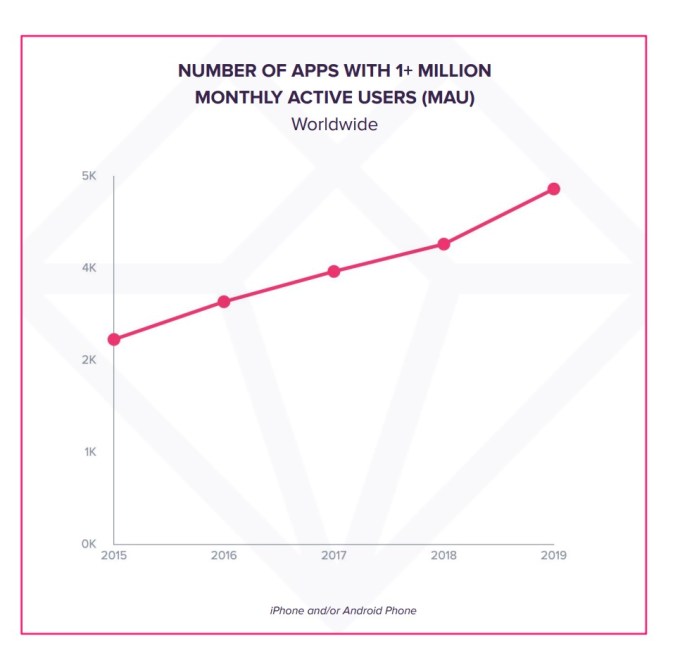
There are also more apps than ever before capable of achieving the once milestone metric of 1 million monthly active users (MAUs). In 2019, over 4,600 apps saw 1 million MAUs, including those outside of social and communications like Netflix, Roku, Disney, CBS, Amazon, Alibaba, Walmart, Target, PayPal, Venmo, Chase, Capital One, Uber, DoorDash, McDonald’s, and Starbucks.
Image Credits:
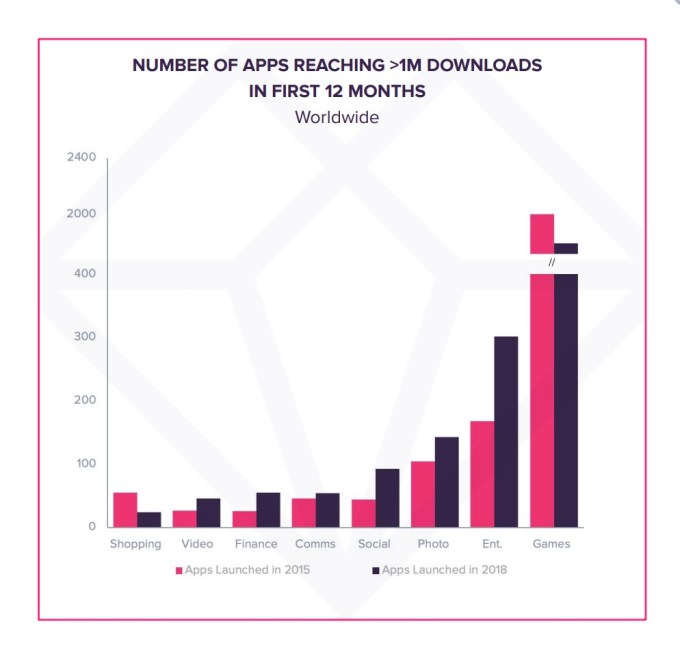
Apps are also achieving the 1 million downloads milestones more quickly, in data analyzed from 2015 to 2018. In the video, finance, communications, social, photo, and entertainment categories, 67% of apps achieved the 1 million downloads milestone within their first 12 months, App Annie says.
Image Credits: App Annie
Because of the increases, there’s now a lot of overlap in between top apps. Today, mobile consumers will often choose and use multiple apps within and across categories to address similar needs, including on social, the report found.
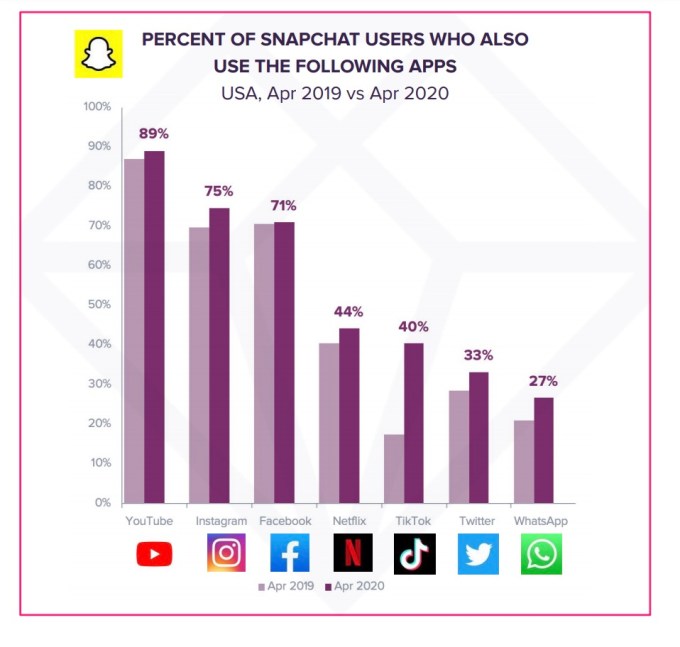
For example, 89% of Snapchat’s users also used YouTube in April 2020 in the U.S., and 75% also used Instagram.
Image Credits: App Annie
TikTok saw the greatest year-over-year increase in cross-app usage of Snapchat, rising from 17% in April 2019 to April 2020 — an indication of how much it has captured the youth demographic.
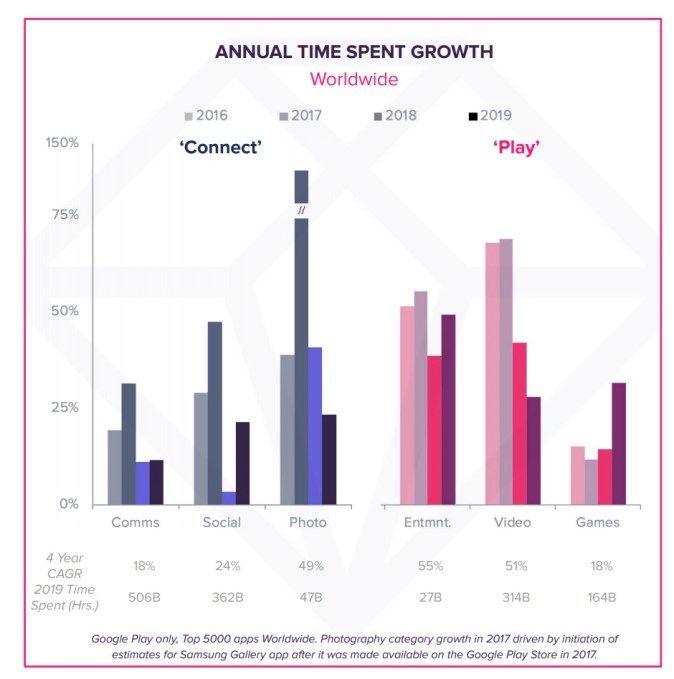
Meanwhile, video apps and gaming are taking up more of users’ time spent in apps. This broad category of “play”-focused apps accounted for 22% of the growth in time spent in apps in 2019.
Image Credits: App Annie
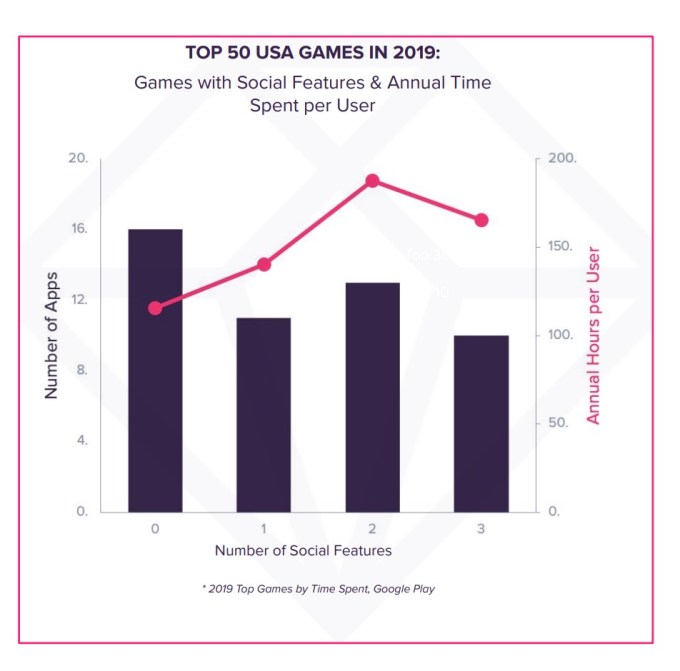
Plus, top gaming apps are also implementing social features, including Top 50 games like Fortnite, Clash of Clans, Call of Duty: Mobile, Township, Star Wars: Galaxy of Heroes, New Yahtzee With Buddies, Golf Clash, and Slotomania, for example.
More than two-thirds of the Top 50 games have added at least one social feature, whether that’s inviting friend to play, social assists for progressing, guilds or clans, or in-app chat. This, in turn, has led to players spending more time in games as they can connect with friends there.
Image Credits: App Annie
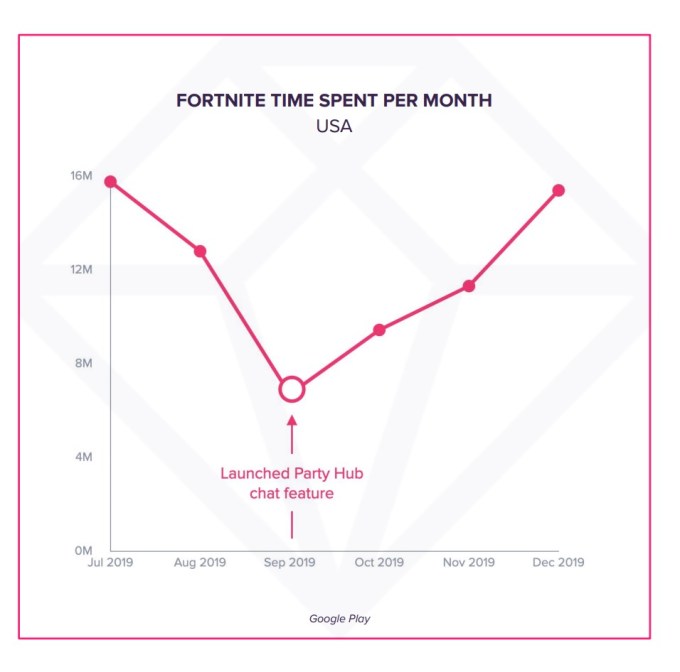
Fortnite, as one key example of this trend, rolled out Party Hub based on its acquired Houseparty technology, in September 2019. In the three months after the rollout, time spent in Fortnite grew 130%.
Image Credits: App Annie
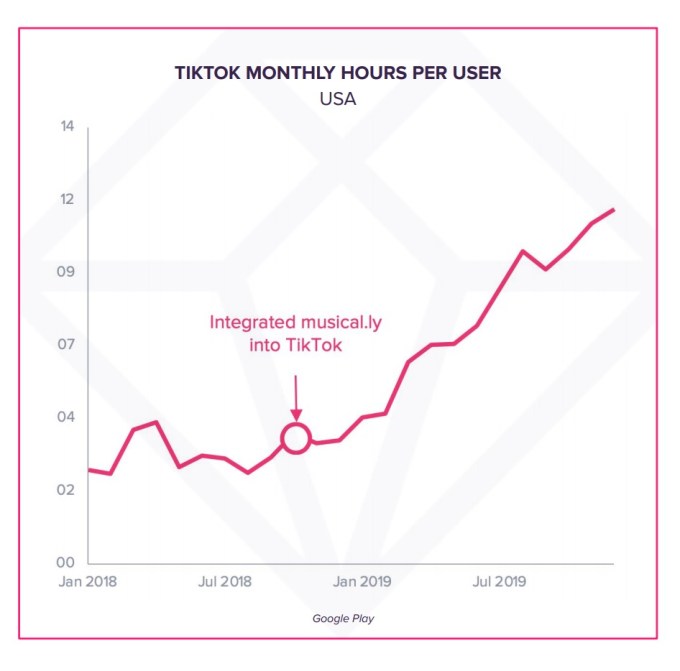
Outside of games, TikTok has risen by blending elements of top categories like social, video and entertainment. After merging with Musical.ly, it has rapidly rolled out more video editing features and increased ad spend aggressively to grow its user base and drive engagement. By December 2019, U.S. users were spending 16 hours, 20 minutes in the app per month, on average, up from 5 hours, 4 minutes in August 2018.
Image Credits: App Annie (note above chart only showcases Google Play data)
The full report also delves into country-by-country breakdowns but, overall, found that most countries saw record downloads in 2019 and similar trends in terms of app usage frequency increases and time spent.
One notable point of comparison is that U.S. users have more apps installed than in other markets (97 vs. 93), but tend to use fewer apps compared with worldwide trends (36 vs. 41). They also spend slightly fewer hours per day in apps, on average, than the worldwide average at 2.7 hours versus 3.1 hours.
“This report shows that the app industry is more competitive today than ever. New companies are succeeding with innovative apps that meet needs people might not even know they have,” said Ime Archibong, Head of Facebook’s New Product Experimentation team, an internal team at Facebook looking to find new models for social apps. “All of this choice and competition fuels innovation, and that’s the heart of our work at Facebook,” he added.
App Annie’s report is available upon request here.
Following earlier reporting, Google has confirmed that it will continue to allow employees to work from home through the end of June of next year. The company told TechCrunch that Sundar Pichai announced the plan in an email sent to staff earlier today.
“To give employees the ability to plan ahead, we are extending our global voluntary work from home option through June 30, 2021 for roles that don’t need to be in the office,” the CEO wrote.
The move marks the company’s most aggressive extension of its remote work policy to date. Like many other tech companies, it appeared cautiously optimistic that things might return to normal after a couple of months. Lately, however, it’s clear that the threat of the COVID-19 pandemic won’t be going away any time soon.
Back in May, Pichai outlined plans to allow a small number of employees to return to various offices this month, all while maintaining social distancing and keeping buildings at around 10% occupancy. Thatsame month, Twitter sent a memo noting that staff would be able to continue working from home on a permanent basis.
Depending on how long the pandemic continues to rage on, it seems reasonable to expect that even the largest tech corporations are rethinking their approach to remote work.
A rare public showdown between Congress and the CEOs of tech’s biggest companies is still on track after being postponed last week. The House Judiciary Committee hearing, originally set for Monday, will now take place Wednesday, July 29 at 12 PM Eastern Time. The date was changed in light of the death of the civil rights leader and Georgia Representative John Lewis, who will be honored in a ceremony Monday in the Capitol building.
Any hearing that manages to drag a single tech CEO to Washington, D.C. — even virtually, in this case — is notable, and Wednesday’s hearing will hear testimony from four of them. In the hearing, Amazon’s Jeff Bezos, Apple’s Tim Cook, Google’s Sundar Pichai and Mark Zuckerberg of Facebook will all face questions about their company practices and concerns that anti-competitive behavior is impacting some of tech’s key markets for the worse.
The hearing is the latest chapter in the House Judiciary Antitrust Subcommittee’s ongoing antitrust investigation targeting many of tech’s largest, most powerful companies that was first announced last year.
“Since last June, the Subcommittee has been investigating the dominance of a small number of digital platforms and the adequacy of existing antitrust laws and enforcement,” House Judiciary Committee Chairman Jerrold Nadler and Antitrust Subcommittee Chairman David Cicilline said in a joint statement.
“Given the central role these corporations play in the lives of the American people, it is critical that their CEOs are forthcoming. As we have said from the start, their testimony is essential for us to complete this investigation.”
We’ll be following the hearing closely on Wednesday. If you stumble onto this page the day of, the link below should provide a reliable stream.
Smart assistants are sensitive to their wake words, but who among us doesn’t trigger the smart speakers in their house with alarming frequency? Add in some heavily detailed privacy mishaps and a general feeling of distrust and there’s plenty of reason you might want to silence your smart speaker occasionally.
A new device promises to do just that, placing a check on your Amazon Echo’s always-on microphones through ultrasonic jamming. The gadget, dubbed Alexagate, is the latest drop from hype-as-a-service startup MSCHF. Last month, the startup announced a partnership with YouTuber MrBeast and an app where users could win big bucks as long as they kept their finger on their phone. The contest ended with multiple winners as the competition stretched from hours into days.
Image Credits: Lucas Matney
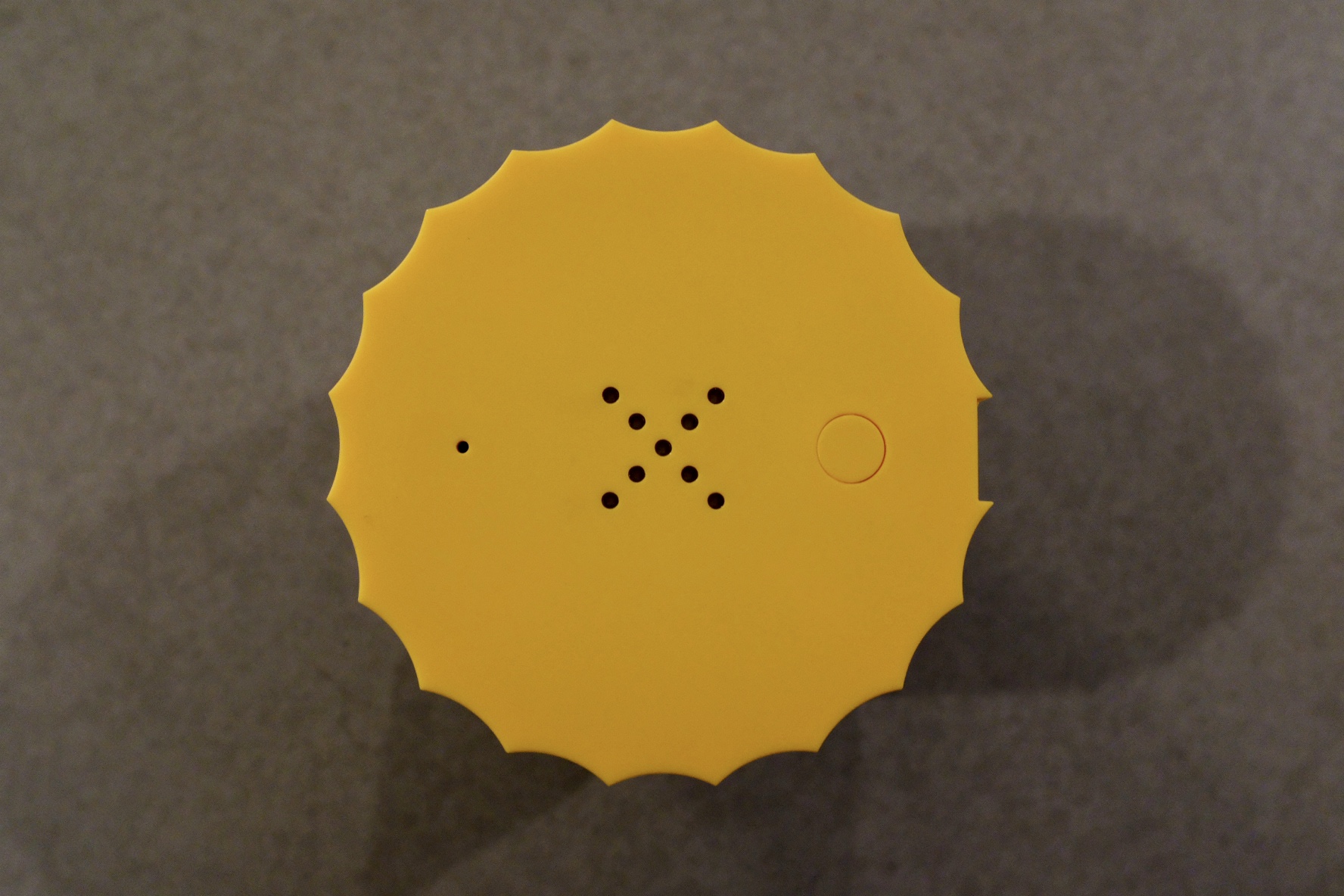
Alexagate is a product for the times, encapsulating a lot of public and private fears about big tech. The device, which took over a year of planning to come to life, is a novelty item, but it does work and it required real engineering to build. The device features seven individual ultrasonic speakers that are arranged to jam the speakers on Echo devices by overwhelming them with sound so they can’t hear anything else. A flippable plastic interface allows the Alexagate to fit seamlessly to most of the Echo devices out there.
In my own experiments, the device does exactly what it says, jamming Alexa when it’s turned on. If you do want to use your smart speaker, you can clap and deactivate the Alexagate, allowing “Hey Alexa” to get a response from the Amazon smart speaker.
It was designed specifically for Amazon Echo devices, though MSCHF creative director Kevin Wiesner says they chose Amazon largely because their speakers were the most common. Nevertheless, when you open the box, you’re hit with a product guide featuring the title “BYE BYE BEZOS,” indicating that the device is in some ways meant to stick it to the world’s richest man.
The product’s manifesto page sows seeds of doubt around whether big tech is listening into user conversations. “Perhaps you don’t subscribe to the notion that Facebook always listens through your phone’s mic, but ask yourself at least this in all honesty: Do you think the Echo ‘mute’ button really does anything?”
It’s a tantalizing line, but sits at odds with what security researchers have found about these hardware kill switches, which do indeed work by cutting power directly to the device’s microphones. The fact is that these ideas take off because people generally don’t trust a Facebook or Amazon to approach their privacy responsibly. This idea was central to the creation of the device, Wiesner says.
“So, the guideline that we set for ourselves internally when we’re coming up with physical products ideas is objects that have a point of view.” Wiesner told TechCrunch in an interview. “You’re gonna put this in your living room and, in some ways, it’s almost like a virtue signal to someone who comes into your house and sees it on your end table. It’s ostentatious privacy, in that sense because it is kind of like supposed to start a discussion of what it means to have a smart device and what you’re giving up for it for that.”
Smart speakers are far from essential devices, so the argument for users who might “need” something like this might boil down to calls for them to just unplug their Echo and live without the mild conveniences it provides. Though it’s a functional device, the Alexagate is more focused on the themes its creation stands behind. In a lot of ways, products from huge tech companies are becoming unavoidable and it’s not wrong for users to like some things about them and wish that they could avoid other elements of the products.
Image Credits: Lucas Matney
It’s an argument used by decentralization advocates who want the freedom to hack around with a company’s products that they use so that they can tailor them for exactly what they want. In Alexagate’s instance, users might want the convenience of a smart speaker but want the checks and balance of an external company verifying that it can’t hear a thing.
MSCHF’s Alexagate device is available now on their website for $99. It doesn’t appear to be available for purchase on Amazon quite yet.
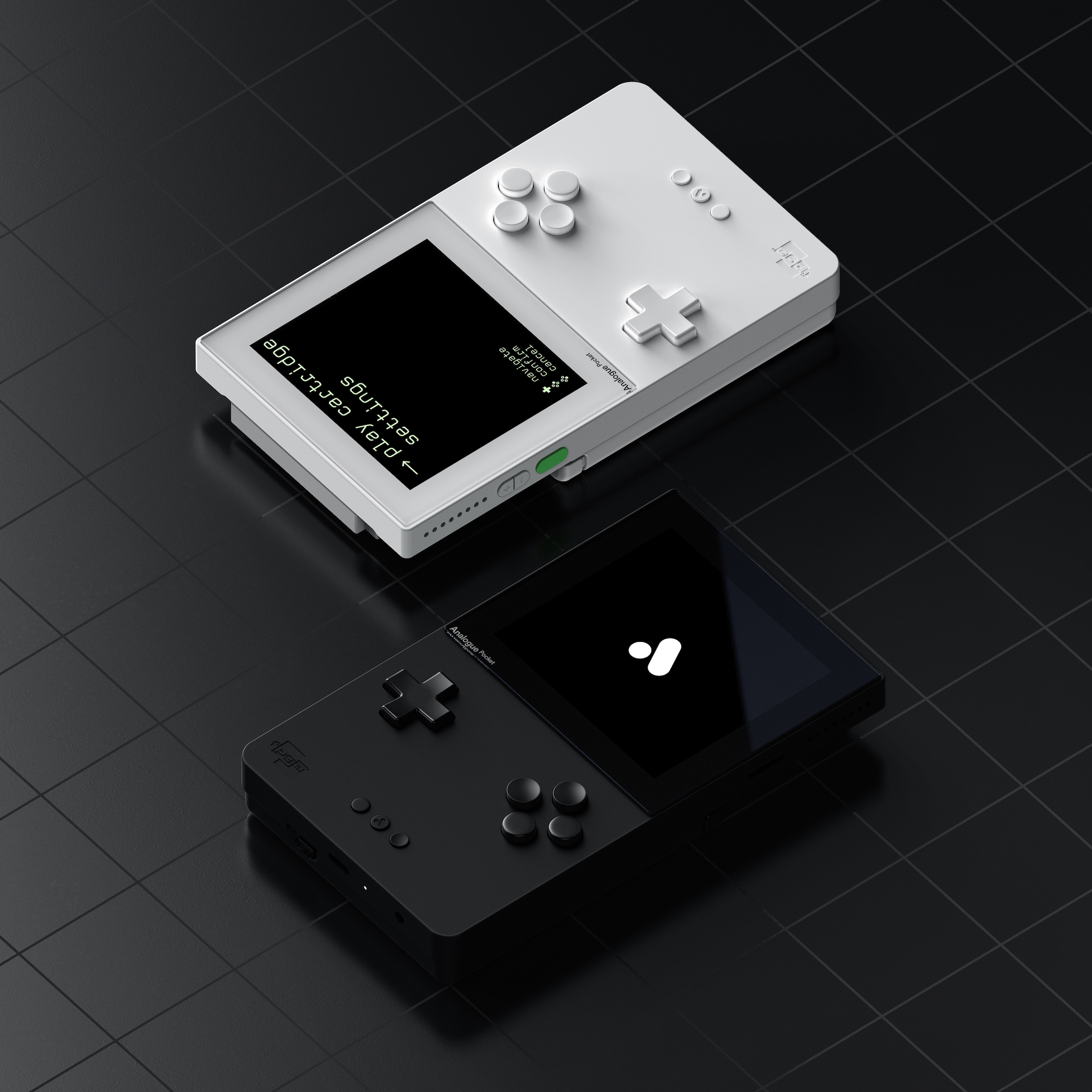
Analogue has repeatedly proven that it’s the gold standard when it comes to retro gaming, delivering extremely faithful, but modern hardware to play original NES, SNES, Sega cartridges and more. The company revealed its forthcoming Analogue Pocket last October, and now it’s about to kick off pre-orders for the portable classic console, which can play Game Boy, Game Boy Color and Game Boy Advance games out of the box, and works with even more classic handheld game systems via adapters.
The Analogue Pocket will be available to pre-order for $199.99 on August 3, starting at 8 AM PST (11 AM EST). The actual ship date is quite a while after that, however: Analogue estimates that the hardware should actually start to be delivered to customers in May, 2021. That’s due to “the unfortunate global state of affairs and supply chain challenges outside of our control,” according to the company, and they’re hardly the only indie hardware outfit feeling the pinch of the ongoing COVID-19 pandemic and its impact on tech suppliers.
Image Credits: Analogue
The good news is that so long as you’re patient, the Pocket will almost certainly deliver the goods. Analogue isn’t new to this, having successfully shipped multiple products in the past, including the Nt mini, the Super Nt and the Mega Sg. Each of these more than delivered on their promises, offering fantastic performance in bringing classic games to modern TVs and displays – without relying on emulation.
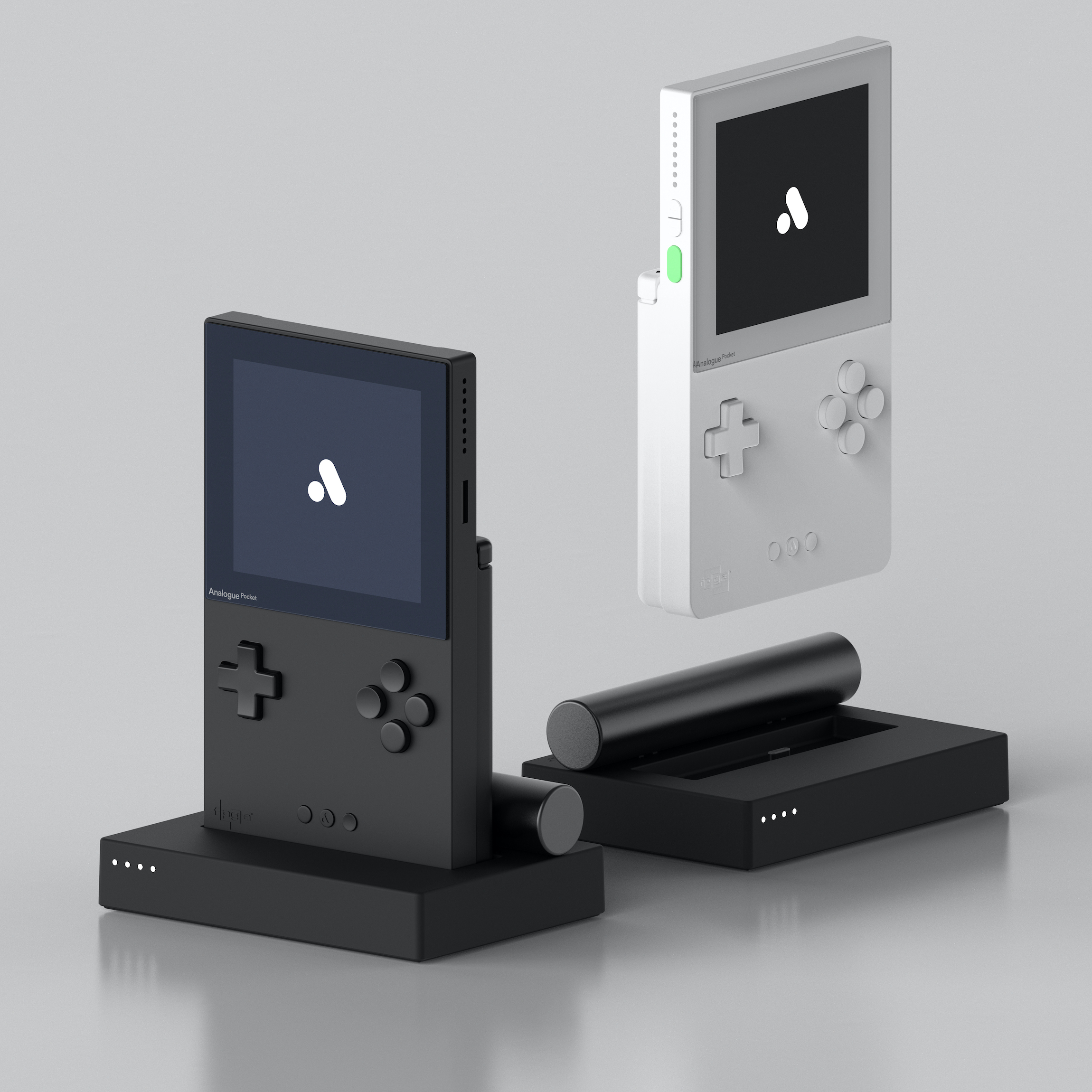
Analogue Pocket has changed a bit since it was originally introduced last year, with the start and select button relocated to the base of the front of the device, a design change designed for “optimal comfort” according to the company. The Dock that you can use to connect the Pocket to your TV for a big-screen gaming experience also now features a recessed USB-C port to make the connection more stable.
True to form in terms of combining classic gameplay with modern conveniences, Analogue has designed Pocket with a sleep and wake function that’s much more like what you’d expect from today’s smartphones and tablet: Press the power button once and the console enters a low-power suspended state – press it again and it wakes to right where you left off. That’s an awesome perk for games that often lack their own internal save mechanisms.
Image Credits: Analogue
The Analogue Dock ($99.99) can support up to four controllers at once, using either wired, Bluetooth or 2.4ghz wireless connectivity. You can also use separately available multilink cables to connect up to four Pockets for local multiplayer action.
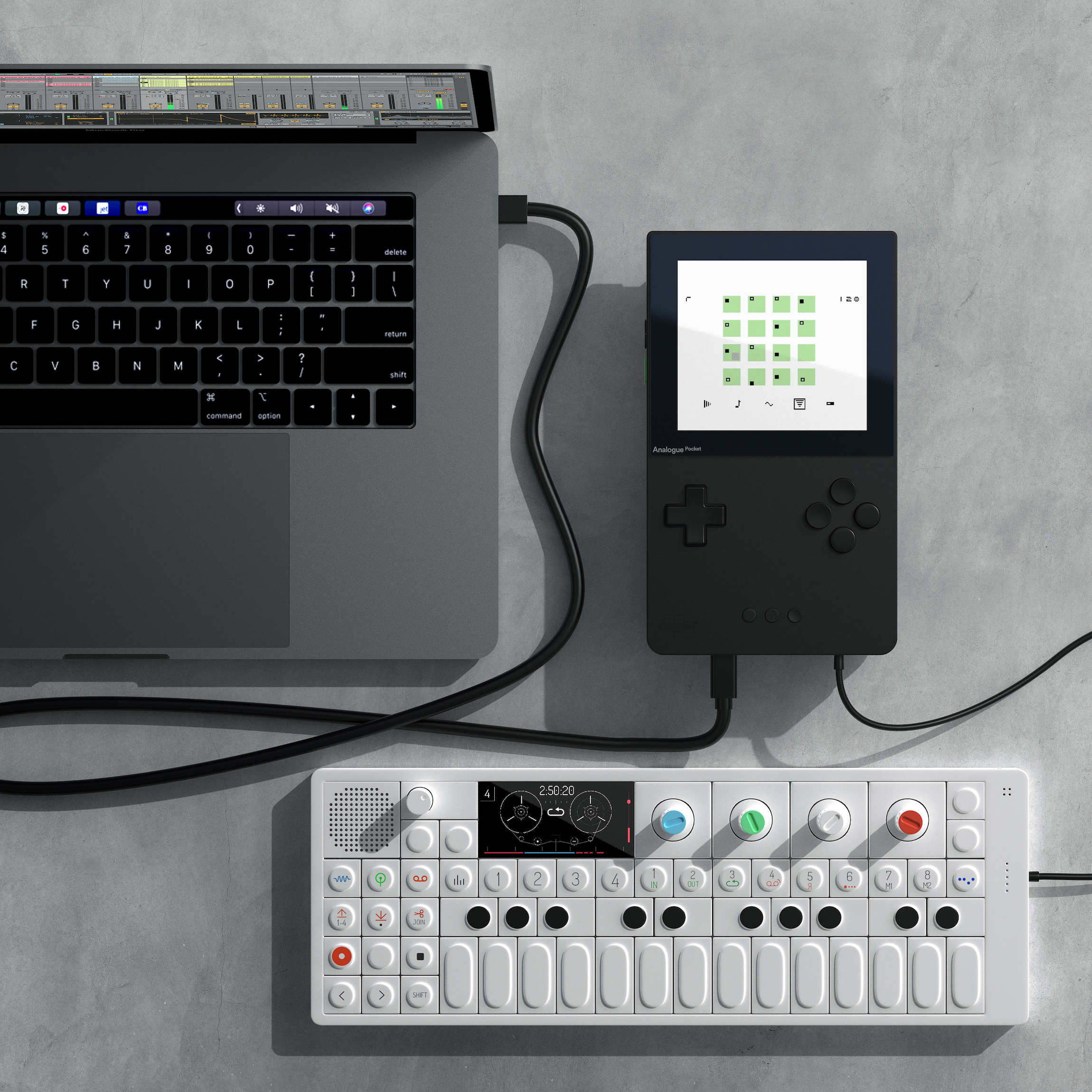
Analogue is also offering a range of other accessories for the Pocket, including a transparent hard case for storage and transportation, a USB-C fast-charging power brick, adapters to provide compatibility with Game Gear, Neo Geo Pocket Color and Atari Lynx games, and MIDI and Analog sync cables for connecting to Mac, PC and music peripherals for use with the company’s Nanoloop music creation software.
Image Credits: Analogue
The company has also revealed some new software features for the Pocket, including ‘Original Display Modes’ which provides faithful representations of the displays (quirks and all) of the original hardware consoles these games where available for. The display itself is made of Gorilla Glass for extra resilience, and offers variable refresh rates and 360-degree custom rotation control.
Analogue Pocket has a 4,300 mAh built-in rechargeable battery that offers between 6 and 10 hours of play time, and over 10 hours of sleep when not in active use.
This definitely looks like Analogue’s most impressive product yet, and one that will be truly amazing for portable console gaming.
I’ve been following consumer audio electronics company Nura with great interest for a few years now — the Melbourne-based startup was one of the first companies I met with after starting with TechCrunch. At the time, its first prototype was a big mess of circuits and wires — the sort of thing you could never imagine shrunk down into a reasonably-sized consumer device.
Nura managed, of course. And the final product looked and sounded great; hell, even the box was nice. If I’m lucky, I see a consumer hardware product once or twice a year that seems reasonably capable of disrupting an industry, and Nura’s custom sound profiles fit that bill. But the company was unique for another reason. A graduate of the HAX accelerator, the startup announced NuraNow roughly this time last year.
Hardware as a service (HaaS) has been a popular concept in the IT/enterprise space for some time, but it’s still fairly uncommon in the consumer category. For one thing: a hardware subscription presents a new paradigm for thinking about purchases. And that is a big lift in a country like the U.S., which spent years weaning consumers off contract-based smartphones.
That Nura jumped at the chance shouldn’t be a big surprise. Backers HAX/SOSV have been proponents of the model for some time now. I’ve visited their Shenzhen offices a few times, and the topic of HaaS always seems to come up.
In a recent email exchange, General Partner Duncan Turner described HaaS as “a great way to keep in contact with your customers and up sell them on new features. Most importantly, for start-ups, recurring revenue is critical for scaling a business with venture capital (and will help appeal to a broad set of investors). HaaS often has a low churn (as easier to put onto long-term contracts).”
Around the world, there’s a growing awareness of environmental issues. From climate change to single-use plastics, the impact we have on the planet is becoming more evident.
While some of this is beyond our means to influence directly, we can make alternative purchasing choices. Switching standard products for ethical or eco-friendly substitutions is a great place to start, particularly for eco-friendly office supplies.
If you’re looking to invest in green items for your home office, we’ve found some of the best sustainable products available today.
By some estimates, households and workplaces in the US throw away 1.6 billion plastic pens each year. Disposable products tend to appear cheaper than long-lasting alternatives. However, they are often made from non-recyclable, virgin (as in, not recycled) plastics. In short order, these items find their way to landfill sites across the country.
The Original Paper Pen is a sustainable alternative to cheap plastic pens. The Paper Pen is made from recyclable and biodegradable paper. There is a choice of fine or broad tip, while the nib is made of brass for ease of use. The ink is stored in a traditional plastic cartridge. However, the Paper Pen still represents a 70 percent reduction in plastic compared to the widely-used alternatives.
The company behind the writing instrument, Paper Pens Co., is based in Australia, although worldwide shipping is available. Traditional shipping could undermine the company’s ethics, but all shipping is guaranteed to be carbon neutral.
One of the most critical measures of a healthy work environment is air quality. While many offices and workspaces have air conditioning, that doesn’t always mean that the air is clean. Tracking your exposure throughout the day helps you make better decisions about when to perform specific tasks and separate interventions that work and those that don’t.
To keep track of your exposure to pollutants, consider the Plume Labs Flow 2 portable air quality monitor. This Bluetooth-enabled tracker uses multiple sensors to assess the cleanliness of the environment around you. A touch-enabled button on the front activates color-coded LEDs on the front, allowing you to judge the air quality quickly.
Syncing the Plume Labs Flow 2 with the companion smartphone app allows you to track exposure over time. The results can be viewed as an overall air quality index or particulate (PM1, PM2.5, PM10, NO2, and VOC). By maintaining a cleaner environment, other areas like health, well-being, and office maintenance will likely improve.
If you’ve been searching for an eco-friendly office coffee machine, the truth is, there isn’t one. The materials, components, manufacture, and distribution of these machines come at an environmental cost. However, if you currently rely solely on takeout coffee, then using a machine at work means you can control the beans’ standard and reduce waste on items like disposable cups.
That said, you can minimize the impact of your daily coffee routine. Opting to brew your coffee manually using hot water and a French press significantly reduces your coffee’s energy requirement, components, and cost. The Bodum Chambord is an eight-cup French press ensuring energy-efficient brewing. The container is made of glass while the fixings, handle, and press are made from synthetic materials.
It’s always worth keeping in mind where your coffee is from and the supply chain’s ethics. Manually brewing your drinks gives you greater control over the coffee source, allowing you to choose an ethical, environmentally-conscious brand rather than accepting whatever is in the office or your local coffee shop uses.
Continuing with the coffee theme, disposable takeaway cups cause a huge environmental issue. The single-use nature of the containers makes them wasteful in any case. You’ll have noticed that most are made of cardboard. However, they can’t be recycled. To prevent spillage and leaks, the interior is often coated in a plastic film.
Rather than adding to the tally of coffee cups heading to landfills, purchase your own reusable coffee cup. One of the most popular eco-friendly options is the KeepCup Brew Cork Black. The brand is notable for being one of the first to develop containers that fit most barista-style coffee machines.
The Brew Cork Black is a premium variant of the company’s original offering. The cork grip makes the cup easy to handle, while the shaped glass vessel allows for easy pouring. The containers are machine washable, and the tops are interchangeable. KeepCup also offers custom-branded editions, should you want to invest in a set for the office.
In the post-pandemic age, all offices, even remote-working home offices, will need to pay close attention to their cleaning regimes. While many believe that the only way to combat bacteria is through harsh chemical cleaners, there’s an alternative.
The eco-friendly cleaning supplies producer, method, has a range of sprays, wipes, and surface cleaners that sterilize your workspace while minimizing the impact on the environment.
If you need a multipurpose cleaning wipe for the office, consider the method All-Purpose Lavender Wipes. These fragranced disposable wipes are biodegradable, not tested on animals, and ideal for wiping down keywords, mice, and other shared equipment.
6. Refurbished Computers
Image Credit: Ashkan Forouzani/Unsplash
Although it’s a consideration for most consumers, there are very few sustainable or eco-friendly computers. In fact, UK-based publication Ethical Consumer doesn’t even list any laptop available today as a Best Buy. Desktop computers and laptops, like all electronics, have incredibly complex supply chains fraught with environmental issues and human rights abuses.
As such, it’s hard to recommend any computer or eco-friendly computer mouse. However, you do still have options. The best way to create a sustainable home office is to buy second-hand computing equipment. In most cases, it’s possible to find high-end refurbished items at a significant discount. This helps you boost your environmental credentials while also saving money.
Before investing, make a note of your requirements, the types of programs you are likely to use, and any hardware constraints. Then locate a second-hand item that fits the brief. You’ll also be able to increase your electronic equipment’s lifespan by choosing an easily repairable and upgradeable computer or laptop.
The Best Eco-Friendly Products for Your Needs
As more of us become aware of our purchases’ environmental and ethical implications, it’s natural to want to switch to more eco-friendly and sustainable alternatives. Fortunately, there are plenty of eco-friendly home office supplies out there to get you started.
However, there are other changes you can make, as well. Instead of upgrading to the latest flagship smartphone, consider an ethical alternative. To find out more, check out our review of the Fairphone 3 ethical smartphone.
If you’ve spent any time online, you will have seen a hashtag. In fact, you might have seen them in commercials on TV, on billboards, or spoken out loud too. Which may have prompted you to ask, what is a hashtag?
If so, you’ve come to the right place. We’re going to explain what a hashtag is, where hashtags originated, and how to use hashtags correctly. When you reach the end of this article you’ll be a hashtag master!
What Is a Hashtag?
A hashtag is used primarily on social network sites like Twitter, Instagram, Facebook, Pinterest, and LinkedIn. Most of the top social media sites use them in one way or another.
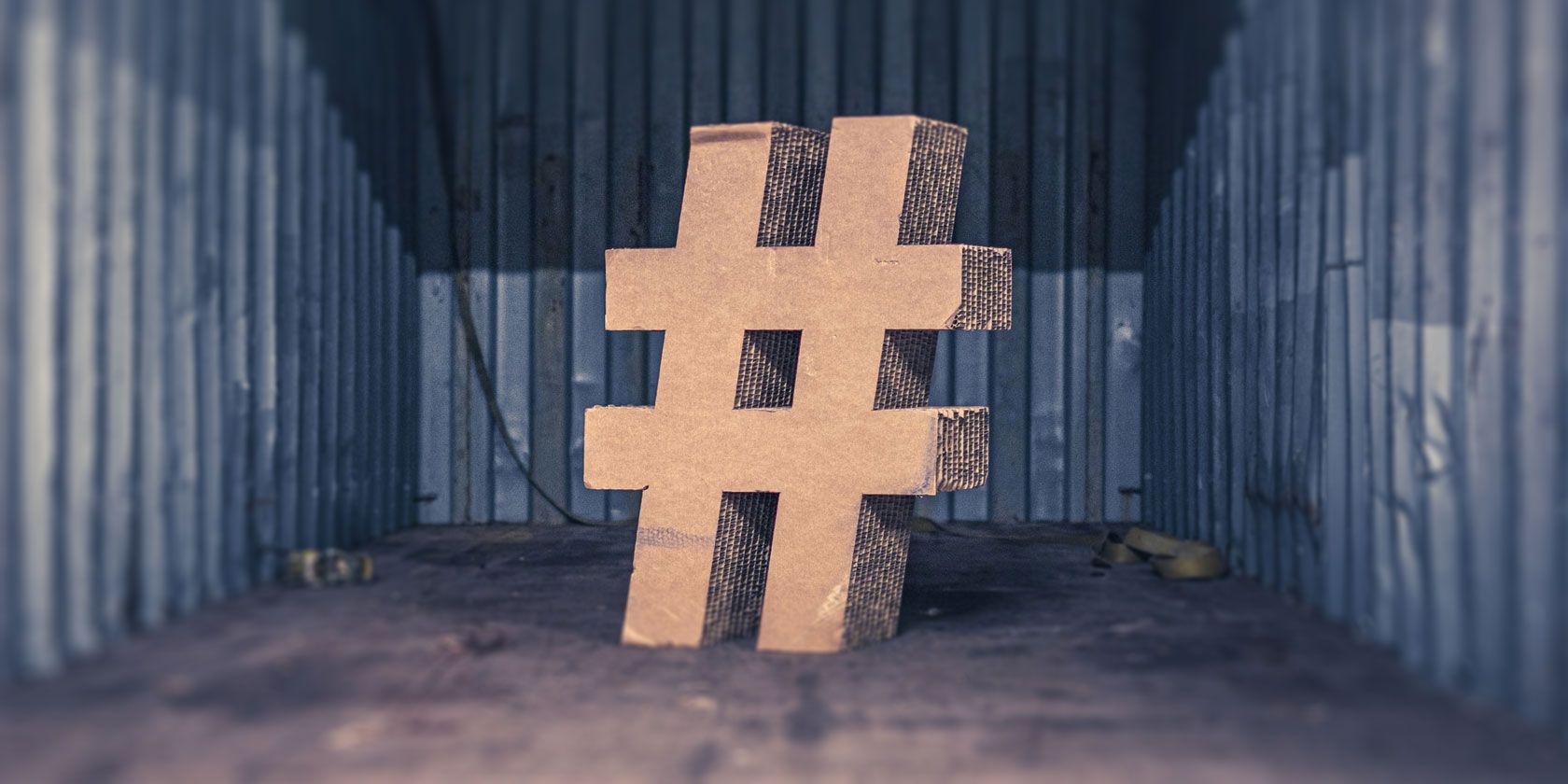
A word or phrase that has the hash symbol (#) in front of it, to show that it is the topic of a message on social media.
Using a hashtag is a way to mark your message as belonging to a topic or theme. Other people can then search for this hashtag to find messages about something that interests them. A hashtag is often hyperlinked, so you can click it and be taken directly to those search results.
A hashtag is formatted by a # sign followed by text. The # symbol itself is sometimes called a hashtag, but the two aren’t the same. The # symbol is actually called a number sign, pound sign, octothorpe, or hash. Its usage varies by country, but it is often used alongside ordinal numbers or as a symbol for the pound as a unit of weight.
As such, the term hashtag primarily has purpose online on social networks. Here’s an example of a hashtag being used on Twitter:
#BlackLivesMatter is happening on Twitter. We’ve created a new Topic that highlights conversations about the movement and includes Tweets from organizations and activists.
If you’re interested on his detailed thoughts, check out his Factory Joe blog post from 2007.
At that point, he floated the phrase “tag channels” rather than the now-ubiquitous “hashtag”. That’s because the # sign already had a specific meaning online. Internet Relay Chat (IRC), a form of text-based live messaging, is split into different chat rooms (or “channels”) that are preceded by the # sign. For example, you could have different channels like #animals and #food.
The name hashtag came from Stowe Boyd, in his blog post response to Chris. However, despite all of this happening in 2007, hashtags didn’t immediately take off.
It wasn’t until events like the 2007 San Diego forest fires and the 2009-2010 Iranian election protests that hashtags started to gain traction. In 2009, Twitter began linking hyperlinks to the search results, and in 2010 Twitter started to display popular hashtags on its homepage.
From there the hashtag only grew, expanding from Twitter and spreading to many other websites and services.
Anyone has the power to create a new hashtag. And they’re used by individuals and businesses alike. Simply type the # sign, followed by a word or phrase, and your hashtag is done. If someone else has used the same hashtag previously, your post will appear alongside those when people search for that hashtag.
There are some rules you should follow to ensure your hashtag displays and functions correctly:
A hashtag should always begin with the # symbol. If it’s not the first thing in your message, ensure there’s a space beforehand. For example, “I love tech #makeuseof” is good, while “I love tech#makeuseof” is not.
Don’t use punctuation, special characters or spaces in a hashtag because it won’t work. For example, “I love tech #make use of” would only hashtag the word “make”.
You can use capital letters in a hashtag, but this is only for readability. For example, both #makeuseof and #MakeUseOf are the same hashtag.
Each service will also have its own rules on using hashtags. For example, Instagram only allows up to 30 hashtags on a post. There are also unwritten social network rules, such as do keep the hashtags specific, don’t overload your post with them, don’t use irrelevant ones, and don’t be vulgar.
When to Use a Hashtag
You can use a hashtag whenever you want. There’s nothing to stop you—type a # sign followed by some text and you’ve created a hashtag.
Using Hashtags for Events
Generally, the best use of a hashtag is when you want to create or join a discussion around a specific topic. Let’s say your local town of Springfield is having a fun run. You could put a message on social media like:
Best of luck to my friend Homer today! As long as you get across the finish line, that’s all that matters. #SpringfieldFunRun
Other people could then use the same #SpringfieldFunRun hashtag. Then, when others click that hashtag or search for it, they will see all the messages related to that event.
Using Hashtags for Businesses
Equally, hashtags can be used on a global level by businesses. Here’s an example from the Star Wars Twitter account, which used multiple hashtags to promote The Mandalorian on Disney Plus:
You might also notice hashtags appear offline in all sorts of places, like movie trailers, billboards, and TV commercials. That’s because these businesses want you to go online, discuss their product or service, and use the hashtag to create a buzz.
Using Hashtags for Comedy
Hashtags can also be used ironically or sarcastically. This is often when the user isn’t interested in grouping their message to a discussion, but instead trying to be funny. For example:
Just ate a huge cake all to myself. I feel great! #DietStartsNow
This comedic application of the hashtag also applies when it’s spoken out loud because, obviously, the group and search functionality of a hashtag isn’t possible to achieve in speech.
Using Hashtags for Causes
Some hashtags have transcended their online origin. This can be seen in the phrase “Je suis Charlie”, meaning “I am Charlie”, which was a slogan created to show solidarity after the shootings at the Charlie Hebdo magazine in 2015.
The statement began as #jesuischarlie on Twitter before being used in music, cartoons, and newspapers. The hashtag then morphed into the more general #jesuis, which was used globally as a sign of alignment to different causes.
Use Hashtags to Get Noticed on Social Media
Now you know what a hashtag is, how the term originated, and how to use hashtags. So get out there and start using hashtags to your heart’s content!
Hashtags are also a good way to get noticed on social media. For more tips, our guide will help you get noticed on Instagram.


 (@Kristy_Viers)