22 September 2020

Daily Crunch: This TikTok deal is pretty confusing


Companies send out conflicting messages about the TikTok deal, Microsoft acquires a gaming giant and the WeChat ban is temporarily blocked. This is your Daily Crunch for September 21, 2020.

The big story: This TikTok deal is pretty confusing

This keeps getting more confusing. Apparently TikTok’s parent company ByteDance has reached a deal with Walmart and Oracle that will allow the Chinese social media app to continue operating in the United States, and the deal has been approved by Donald Trump. But it’s hard to tell exactly what this agreement entails.

ByteDance said it would retain 80% control of TikTok, while selling 20% of the company to Walmart and Oracle as “commercial partner” and “trusted technology partner,” respectively. However, Oracle released a seemingly conflicting statement, claiming that Americans will have majority ownership and “ByteDance will have no ownership in TikTok Global.”

So what’s going on here? We’re trying to figure it out.

The tech giants

Microsoft set to acquire Bethesda parent ZeniMax for $7.5B — ZeniMax owns some of the biggest publishers in gaming, including Bethesda Game Studios, id Software, ZeniMax Online Studios, Arkane, MachineGames, Tango Gameworks, Alpha Dog and Roundhouse Studios.

Trump administration’s WeChat ban is blocked by US district court — More news about the Trump administration’s efforts to ban some high-profile Chinese apps: A district court judge in San Francisco has temporarily stayed the nationwide ban on WeChat.

Nikola’s chairman steps down, stock crashes following allegations of fraud — This comes in the wake of a report from a noted short-seller accusing the electric truck company of fraud.

Startups, funding and venture capital

With $100M in funding, Playco is already a mobile gaming unicorn — Playco is a new mobile gaming startup created by Game Closure co-founder Michael Carter and Zynga co-founder Justin Waldron.

Indian mobile gaming platform Mobile Premier League raises $90 million — Mobile Premier League operates a pure-play gaming platform that hosts a range of tournaments.

A meeting room of one’s own: Three VCs discuss breaking out of big firms to start their own gigs — We talked to Construct Capital’s Dayna Grayson, Renegade Partners’ Renata Quintini and Plexo Capital’s Lo Toney.

Advice and analysis from Extra Crunch

Edtech investors are panning for gold — At Disrupt, investors told us how they separate the gold from the dust.

Despite slowdowns, pandemic accelerates shifts in hardware manufacturing — China continues to be the dominant global force, but the price of labor and political uncertainty has led many companies to begin looking elsewhere.

The Peloton effect — Alex Wilhelm examines the latest VC activity in connected fitness.

(Reminder: Extra Crunch is our subscription membership program, which aims to democratize information about startups. You can sign up here.)

Everything else

Ireland’s data watchdog slammed for letting adtech carry on ‘biggest breach of all time’ — The Irish Council for Civil Liberties is putting more pressure on the country’s data watchdog to take enforcement action.

Pandemic accelerated cord cutting, making 2020 the worst-ever year for pay TV — According to new research from eMarketer, the cable, satellite and telecom TV industry is on track to lose the most subscribers ever.

Original Content podcast: ‘Wireless’ shows off Quibi’s Turnstyle technology — I interviewed the director of the new Quibi series.

The Daily Crunch is TechCrunch’s roundup of our biggest and most important stories. If you’d like to get this delivered to your inbox every day at around 3pm Pacific, you can subscribe here.


Read Full Article

Twitter and Zoom’s algorithmic bias issues


Both Zoom and Twitter found themselves under fire this weekend for their respective issues with algorithmic bias. On Zoom, it’s an issue with the video conferencing service’s virtual backgrounds and on Twitter, it’s an issue with the site’s photo cropping tool.

It started when Ph.D. student Colin Madland tweeted about a Black faculty member’s issues with Zoom. According to Madland, whenever said faculty member would use a virtual background, Zoom would remove his head.

“We have reached out directly to the user to investigate this issue,” a Zoom spokesperson told TechCrunch. “We’re committed to providing a platform that is inclusive for all.”


When discussing that issue on Twitter, however, the problems with algorithmic bias compounded when Twitter’s mobile app defaulted to only showing the image of Madland, the white guy, in preview.

“Our team did test for bias before shipping the model and did not find evidence of racial or gender bias in our testing,” a Twitter spokesperson said in a statement to TechCrunch. “But it’s clear from these examples that we’ve got more analysis to do. We’ll continue to share what we learn, what actions we take, and will open source our analysis so others can review and replicate.”

Twitter pointed to a tweet from its chief design officer, Dantley Davis, who ran some of his own experiments. Davis posited Madland’s facial hair affected the result, so he removed his facial hair and the Black faculty member appeared in the cropped preview. In a later tweet, Davis said he’s “as irritated about this as everyone else. However, I’m in a position to fix it and I will.”

Twitter also pointed to an independent analysis from Vinay Prabhu, chief scientist at Carnegie Mellon. In his experiment, he sought to see if “the cropping bias is real.”

In response to the experiment, Twitter CTO Parag Agrawal said addressing the question of whether cropping bias is real is “a very important question.” In short, sometimes Twitter does crop out Black people and sometimes it doesn’t. But the fact that Twitter does it at all, even once, is enough for it to be problematic.

It also speaks to the bigger issue of the prevalence of bad algorithms. These same types of algorithms are what leads to biased arrests and imprisonment of Black people. They’re also the same kind of algorithms that Google used to label photos of Black people as gorillas and that Microsoft’s Tay bot used to become a white supremacist.


Read Full Article

Hailing a self-driving taxi when blind. Learn how Waymo answers that challenge at Sight Tech Global


Imagine yourself unable to see well enough to drive, and how that would change your life. I witness that scenario every day at home with my wife, who is legally blind, and a very busy person. She reveres Uber and Lyft because they provided her with the still remarkable option to get up and go whenever she wants, wherever she wants.  So imagine her excitement a year ago when she was treated to a brief ride in a self-driving Waymo taxi. The safety driver asked my wife to buckle up and hit the “start” button. Yes, exactly! Where is that start button?

We all had a chuckle because the point of the excursion was to talk about Waymo’s commitment to accessibility in the development of self-driving taxis, which are already in service in Phoenix. Waymo is working closely with the Foundation for Blind Children (FBC) in Phoenix to get feedback on the experience, and also consulting with The Lighthouse for the Blind in San Francisco. We are delighted to announce that Waymo’s work on accessibility will be featured at Sight Tech Global, which is a virtual event (December 2-3) focused on how AI-related technologies will influence assistive technology and accessibility in the years ahead. Attendance is free and registration is open.

Joining the Waymo accessibility session are three key figures helping to guide Waymo’s work. Clement Wright is the Waymo product manager responsible for Waymo’s user experience and accessibility efforts. His focus is on ensuring all Waymo riders, including those with disabilities, can enjoy safe, comfortable and convenient rides in Waymo’s fully driverless service. Marc Ashton is CEO, Foundation for Blind Children, which is a Phoenix-based and nationally recognized leader in the education of blind children. Ashton’s son is blind, which led to his interest in the field and in 2007 to the role of CEO. Bryan Bashin is the CEO of Lighthouse for the Blind in San Francisco, which offers education, training, advocacy and community for blind individuals in California and around the world. Blind since college, Bashin has dedicated much of his career to advocating for equality, access, training and mentorship for individuals who are blind or low vision. 

Waymo’s quest for a highly accessible, self-driving ride is no easy challenge. “Today, ride-hailing and taxi drivers fulfill certain duties outside of strictly driving the car,” says Wright. “They may roll down the window at pickup to speak to a rider and help them find the car. One of our largest challenges as we work to build the Waymo Driver is ensuring that we understand all of the rider’s additional needs without a human driver in the car.”

The Waymo team has worked with adult members of the FBC to get feedback on the mobile app used to summon a Waymo taxi, for example, by using the way-finding mechanism of honking the taxi’s horn through the app. “Time and again,” says Wright, “we’ve seen that a feature built to help a specific group of people, the visually impaired for example, is actually very helpful for the rest of our rider base as well. This has led us to a broader focus on inclusive design — looking at specific rider’s needs to understand key challenges, and then building solutions that help everyone.” 

Autonomous vehicles have the potential to help people with disabilities, including the 1.3 million Americans who are legally blind, get where they need to go safely and efficiently.  We will dive into how Waymo accounts for accessibility throughout its product development cycle and explore the critical role that feedback, from both blind and low-vision users, as well as partner organizations who represent those groups, plays in that process. Join us at Sight Tech Global on December 2-3 to join the session.  Get your free pass now.

Sight Tech Global welcomes sponsors. Current sponsors include Verizon Media, Google, Waymo, Mojo Vision and Wells Fargo. The event is organized by volunteers and all proceeds from the event benefit The Vista Center for the Blind and Visually Impaired in Silicon Valley.


Read Full Article

This Week in Apps: iOS 14’s surprise arrival, Apple’s app bundle, TikTok & WeChat banned from app stores Sunday


Welcome back to This Week in Apps, the TechCrunch series that recaps the latest OS news, the applications they support and the money that flows through it all.

The app industry is as hot as ever, with a record 204 billion downloads and $120 billion in consumer spending in 2019. People are now spending three hours and 40 minutes per day using apps, rivaling TV. Apps aren’t just a way to pass idle hours — they’re a big business. In 2019, mobile-first companies had a combined $544 billion valuation, 6.5x higher than those without a mobile focus.

In this series, we help you keep up with the latest news from the world of apps, delivered on a weekly basis.

Top Stories

How iOS 14 and Apple’s other new plans impact apps

At Apple’s hardware event this week, the company announced a new Apple Watch Series 6, an Apple Watch SE, an eighth-generation iPad and a new iPad Air, among other things.

But the bigger news for app makers was the surprise release of iOS 14. Typically, developers are given a much longer heads-up and at least have the updated version of their developer tools well before the actual iOS launch day. This year, however, Apple shocked app developers with an announcement during its live event that its new software platforms, iOS 14, iPadOS 14, watchOS 7 and tvOS 14, would arrive in less than 24 hours.

The move was a low blow from Apple at a time when its developer community was already feeling disrespected by Apple’s tougher stance on the use of in-app purchases and increase in capricious app rejections, not to mention the language Apple used to describe their contributions to iPhone’s success in Apple’s lawsuit with Epic Games.

But now iOS 14 is here, and with it comes a radical change to how apps are presented and used on iPhone.

App Clips will allow users to launch “mini app” experiences when a full app download isn’t needed, like in the case of needing to pay at a parking meter using a native app. Widgets will allow developers to increase their presence on the home screen, potentially increasing their importance to their most loyal users. But on the flip side, infrequently used apps may now be abandoned in the new App Library.

Any app that doesn’t get a home screen spot in the new version of iOS either as an app icon or widget may soon find that its MAUs and DAUs decline after users upgrade to iOS 14.

Being relegated to the App Library is the equivalent of being stuck inside a folder on the back screen — out of sight and forgotten. App developers who suspect they haven’t made the cut in the big iOS redesign will need to make clever use of push notifications to rekindle their relationship with users. But this, too, is a fine line. Too many notifications or pushing low-value notifications will see users turning to other iOS tools — like the option to easily silence or switch off notifications entirely for the app in question. And then, without any visibility or a way to connect, the app will be truly forgotten.

Apple also challenged the entire fitness app industry with its launch of a Fitness+ subscription service. Wall Street investors weren’t too worried about the long-term potential impact to top brands, like Peloton and Fitbit. But these companies are not necessarily representative of the smaller fitness app maker. For $10 per month or just $80 per year, Apple is offering a home gym membership of sorts, with deep integrations with Apple Watch. Fitness+ offers workouts and instructions set to music that can be used across Apple devices. Because it’s from Apple, the workouts will also correctly sync to the Apple Watch for accurate recording of various workout metrics, like calories burned, pace or distance, for example.

The service is also being bundled in Apple’s new Apple One subscription in the upper tier, which may appeal to Apple’s current subscribers looking to save money by paying for an all-in-one service instead of individual apps. And what could a fitness app maker do to compete with this? Or a music app, for that matter? Third-parties don’t typically have the option to get bundled into a high-value package alongside other top apps from unrelated industries, unless the company goes out and forges those deals itself — like Spotify once did with Hulu.

Given that Apple is still being investigated over antitrust issues, it’s rather bold to launch a bundle deal like this while continuing to commission its competitors — rivals who have no other means of reaching iPhone’s audience outside the App Store.

Another new Apple service puts family tracking apps on notice. Though apps like Life360 have become must-have tools in the helicopter parent era, Apple’s new Family Setup aims to transform the kid-tracking industry by taking a different tactic: it’s for families who aren’t buying kids an iPhone just yet. Instead, Apple will lure new customers by making its Apple Watch — and specifically, the more affordable Apple Watch SE — kids’ first Apple device.

Kids get to use Apple Watch’s key features, like Emergency SOS, Maps, Siri, Alarms, Memoji, Apple Pay, and more, while parents get to restrict who the child can call or text. By the time the child upgrades to iPhone and the wider world of apps that comes with it, families may see no need for a third-party alternative for family safety. That means kid trackers will need to upgrade their offerings to include features that Apple doesn’t, like Life360 does with its driving features, like crash detection or weekly driver reports, for instance.

Continuing chaos around the TikTok ban

There is nothing straightforward about the TikTok ban. Like much of the Executive Order activity coming from the current administration, a broad order is issued but the details are left to be worked out on the fly, leading to chaos.

In the case of the TikTok deal and the app’s potential ban in the U.S., at the beginning of this week we learned China would rather see TikTok banned than forced into a sale, and that neither Oracle nor Microsoft would get to acquire TikTok’s U.S. business. Microsoft was said to have apparently pissed off TikTok owner ByteDance by calling the app a security risk and was cut out of the deal. Later in the week, Oracle put out a press release saying it would be the technology partner for TikTok, and Walmart separately claimed to still be involved.

Oh, and it seems Instagram founder and former CEO Kevin Systrom was approached for the TikTok CEO job at one point. Lord.

So what’s happening now? The U.S. government and ByteDance continue to negotiate on specific terms. As of late, the U.S. wants Oracle to agree to review TikTok source code for backdoors, ByteDance to create a new organization for its U.S. operations with a board approved by the U.S. government and for there to be a license agreement for TikTok’s algorithms. As TechCrunch reported, these terms beg the question as to how TikTok could possibly continue to refine its algorithms in real time without access to U.S. TikTok user data, or when it has to rebuild its infrastructure on Oracle, separated from a core product being developed elsewhere. But nevertheless, reports claim ByteDance has agreed to the government’s terms and also plans to IPO TikTok’s global business.

On Friday, the Commerce Dept. announced the details of how it plans to enforce a shutdown, saying that both TikTok and WeChat, the other Chinese app impacted by the ban, would no longer be distributed on U.S. app stores as of September 20. But TikTok gets an extension that allows it to still operate until November 12 as the parties attempt to hammer out the complicated deal. That deadline means the app will continue to work through the U.S. elections, based on how the terms are spelled out now. But those could change at any time, given the chaotic nature of how this potential ban has progressed so far.

Despite being one of TikTok’s chief rivals, Instagram — which recently copied TikTok with its own feature, Reels — has come out against the ban. Instagram head Adam Mosseri said a U.S. ban of the app would be bad for the internet more broadly, including companies like Facebook and Instagram. TikTok interim CEO  Vanessa Pappas then publicly asked him for help with its litigation.

By the time you read this, several more updates about the TikTok deal may have been released. Stay tuned.

Weekly News

  • U.S. government scrutinizes Epic and Riot Games’ deals with Tencent. First TikTok and WeChat, then the full slate of Chinese investment in tech? The TikTok-Oracle partnership isn’t even a done deal yet, but the U.S. government is moving on to its next targets. The Committee on Foreign Investment in the United States (CFIUS) has now sent letters to Epic, Riot and other gaming companies to inquire about how they’re handling U.S. users’ personal data due to their ties with China’s Tencent. The Chinese giant has made over 300 investments, including those in many of the top gaming companies worldwide. (Jenny Leonard, Saleha Mohsin and David McLaughlin/Bloomberg)
  • Google bans stalkerware from Play Store. Apps that allow a user to track someone’s location, movement, phone calls or messages, and record other apps’ activity — a category broadly known as “stalkerware” — are marketed toward people looking to track cheating spouses or spy on their kids. Google has hosted hundreds of these apps to date. This week, the company updated its Developer Program Policy to specify that any apps of this nature have to inform the end user or gain consent and show a persistent notification that their actions are being tracked. The updated policy also added other new restrictions, including on misrepresentation and gambling. (Catalin Cimpanu/ZDNet)
  • Tinder relaunches Swipe Night, its in-app interactive video series, in the U.S. on September 12. Tinder claims the pandemic has not heavily impacted its business. But the company is working to add video dating and is readying another run of a video series in its app — indications that the primary focus for Tinder these days is not on helping users make real-life connections. (Tinder)
  • Google banned India’s Paytm from Play Store for gambling violations. Paytm is India’s most valuable startup and claims over 50M MAUs. Its app, a rival to Google Play, was removed from the Play Store in India this week. Paytm is accused of repeatedly violating Play Store’s policies around gambling. The app had recently launched “Paytm Cricket League,” which Google believed to be in violation of its newly updated policies around gambling apps. The app returned to the store in a few hours. (Manish Singh/TechCrunch)
  • YouTube launches a TikTok rival, Shorts. YouTube this week launched a new short-form video experience called YouTube Shorts. The feature will allow users, initially in India, to upload 15-second or less short-form videos using a new set of creator tools, including a multi-segment camera, similar to TikTok, speed controls and a timer and a countdown feature. The videos can also be set to music, thanks to YouTube’s access to a large library of songs that it says will continue to grow over time. (Sarah Perez/TechCrunch)
  • Apple calls Epic Games a bully in latest court filing. Apple attacked the game maker, saying Epic follows a “strategy of coercing platforms for its own gain.” Pot, meet kettle. (Stephen Warwick/iMore)
  • Facebook Messenger adds “Watch Together.” Facebook joins the co-viewing trend with the launch of a new feature that lets up to eight friends in a Messenger video call or up to 50 in Messenger Room watch video content together via Facebook Watch integrations. (Sarah Perez/TechCrunch)
  • Summer sent travel apps consumer spend up 30%. Despite the pandemic, consumer global spend in travel apps indicate there was 30% growth in travel apps during summer months, compared with the three months prior. Still, those prior months were at the height of the lockdown, when almost no one was going anywhere. So this may not be as rosy a picture of a recovery as you’d think. (Lexi Sydow/App Annie)
  • Triller capitalizes on TikTok drama to onboard influencers. At TechCrunch Disrupt, Triller CEO Mike Lu talked about recent high-profile additions, including influencers and public figures like TikTok star Charli D’Amelio and family, Addison Rae, and even Trump. (Sarah Perez/TechCrunch)
  • iOS 14 bug resets Mail and Safari as the default apps. A bug you say? Okay, I believe you. (Chance Miller/9to5Mac)

Suggested Reading

  • Addicted to losing: How casino-like apps have drained people of millions, by Cyrus Farivar, NBC News. The story delves into the casino app industry, which is almost entirely unregulated. The story features interviews with 21 people who got hooked on these apps and lost significant sums of money.
  • In-App Purchase Rules, by Marco Arment, Marco.org. In a blog post, Arment highlights how convoluted Apple’s IAP rules have become by listing out all the exceptions Apple has carved out for itself over the years as it attempts to justify its right to collect from all IAPs.

Funding and M&A

Downloads

Aviary
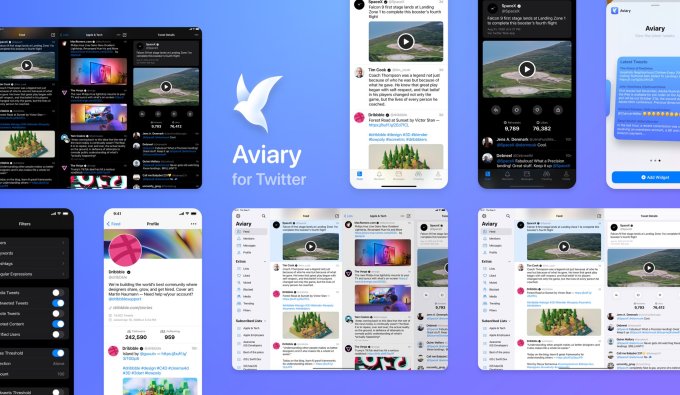
Image Credits: Aviary (widget shown in top right)

Aviary’s recently launched Twitter app ($4.99) is ready for iOS 14, with home screen widgets and support for multiple columns on iPad.

Color Widgets
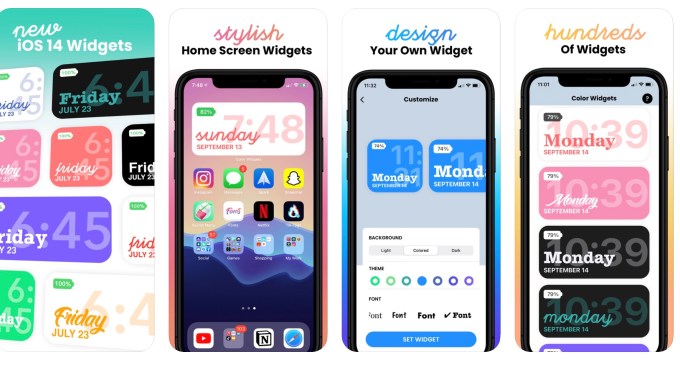
Image Credits: Color Widgets

A simple app is No. 1 on the (non-game) App Store because, clearly, iOS users were ready for widgets. The Color Widgets app lets you pick a color, font and theme for a basic widget that displays the date, day of the week, time and battery level. Isn’t that pretty?



Read Full Article

Human Capital: The Black founder’s burden


Welcome back to Human Capital, where we unpack all-things diversity, inclusion and labor in tech. This week, we’re looking at Google’s internal message board problem, as well as some highlights from TechCrunch Disrupt, where I had the pleasure of chatting with actress, producer and tech investor Kerry Washington about her investment strategy and her thoughts on The Wing’s internal turmoil.

Later, we’ll also highlight some other gems from Disrupt speakers on imposter syndrome, representation syndrome, the hidden burden of being a Black founder, and the importance of encouraging other Black and brown folks to enter this industry and stay.

Also, Human Capital will soon be available as a weekly newsletter. You can sign up here.

Google’s internal message board problem

Google found itself asking employees to be more active in moderating some of the internal message boards, according to CNBC. The issue is that Google has reportedly seen more posts being flagged for racism or abuse on its message boards. Some of these posts reportedly reinforce negative racial stereotypes, use harmful gendered phrases of insult Google employees based on their nationality. Here’s a snippet from Google’s internal blog, via CNBC:

“Our world is going to get more complicated as the year continues,” the team stated in the internal blog. “Tensions continue specifically for our Black+ community with Black Lives Matter, and our Asian Googlers with coronavirus and China/Hong Kong. All of this is compounded by the additional stress of working from home, social isolation, and caregiver responsibilities — to name a few. This new world creates urgency to keep work a welcoming place.”

Yes, tough conversations are the theme of the year. But we also know Google has had issues with employees before. You may remember James Damore, the now former Google employee who sent around an anti-diversity manifesto back in 2017. Google ultimately fired Damore that same month.

We reached out to Google for comment but have not heard back.

Kerry Washington on The Wing scandal

At TechCrunch Disrupt, I had the pleasure of virtually interviewing Kerry Washington, best known for her work in Hollywood as the lead actress on “Scandal” and “Little Fires Everywhere.” But she’s also invested in a handful of tech companies, including Community, Byte and The Wing. The Wing, however, went through some turmoil earlier this year. Employees alleged mistreatment of Black and brown workers, which ultimately led to The Wing CEO Audrey Gelman’s resignation.

“Well, you know, I’m not new to scandal, so there’s that,” Washington told me in response to a question about her reaction to the news. “I was and I am really deeply still inspired by the original vision of the company. And, I think like a lot of companies in this time, because of the several pandemics that we’re facing, whether it’s our awareness around racial injustice, or COVID, lots of people are in a moment of recalibration and self-reflection. So I think that there is incredible space to improve the dynamics. And as somebody who’s an investor, as a woman of color, it’s important to me that there is increased transparency and also accountability.”

Over the past few months, Washington said her role as an investor has been “really just supporting leadership in this transition,” as well as expressing to those leaders a “deep desire” for transparency and accountability.

On imposter syndrome and representation 

Also at Disrupt, my homegirl Kirsten Korosec led a wonderful conversation with Phaedra Ellis-Lamkins of PromisePay and Jessica Matthews of Uncharted Power, two Black female founders, about how they both successfully pivoted their companies while navigating the pressures that come with being an underrepresented founder in Silicon Valley.

Phaedra Ellis-Lamkins, founder and CEO at PromisePay:

It feels like tech has failed so significantly in investing in people they don’t know and missed out in growing companies because of that. So I think our obligation is to help make sure that we are not the only ones.

Jessica Matthews, founder and CEO at Uncharted Power:

It’s not imposter syndrome, it’s representation syndrome because I feel the exact same way. When we raised our Series A, the immediate thing I thought was, ‘Oh, man. I can not lose these people’s money.’ This is huge and if we don’t work, it’s not even about us, it’s about every other person who looks like me.

Michael Seibel on the Black founder experience

In a panel on the Black founder experience at Disrupt, Y Combinator CEO Michael Seibel spoke about a “hidden burden” for underrepresented founders.

“I think that there’s so much deserved activism around access to this world for underrepresented founders, that I feel as though there’s like, more pressure to succeed, in a weird way,” he said. “And I think that can be helpful to a point, but I think that it can be challenging. I also think that there’s so much emphasis around the toxicity in the technology world that a lot of really talented people believe it’s horrible, like believe that our world looks like Jim Crow South. And so therefore they shouldn’t even step any foot into it where like, I would challenge anyone trying to be successful in any industry to be able to avoid the types of problems that exists in the technology industry, if they come from an underrepresented background. So I don’t think the environment’s significantly different in our world than other worlds. I think that the environment is hard. You know, there is bias if you’re underrepresented, across the board, no matter what industry you go to. So if you’re gonna be successful, you’re going to figure out a way to get around it.”

But that’s not to say you’ll have to figure it out on your own, Seibel said. He pointed to how there are people who are willing and able to help. That includes him and the many other Black founders present in Silicon Valley.

“But if we somehow scare talented people away from this world, we won’t ever fix this world,” he said. “And we won’t ever, even more importantly than fixing this world, there’ll be huge swaths of the world that don’t have products and services that they deserve and that they need. And so I think we have to be careful to make sure we communicate that opportunities exist here. And that if you’re trying to be a high powered lawyer, or if you’re trying to be, you know, a top banker, you’re gonna go through the same bullshit. Like, different industries, same bullshit. So if you’re trying to make an impact in the world, strap in. If you’re an underrepresented founder, you’re gonna have to deal with these issues, no matter where you do it.”


Don’t miss


Read Full Article

Advancing NLP with Efficient Projection-Based Model Architectures


Deep neural networks have radically transformed natural language processing (NLP) in the last decade, primarily through their application in data centers using specialized hardware. However, issues such as preserving user privacy, eliminating network latency, enabling offline functionality, and reducing operation costs have rapidly spurred the development of NLP models that can be run on-device rather than in data centers. Yet mobile devices have limited memory and processing power, which requires models running on them to be small and efficient — without compromising quality.

Last year, we published a neural architecture called PRADO, which at the time achieved state-of-the-art performance on many text classification problems, using a model with less than 200K parameters. While most models use a fixed number of parameters per token, the PRADO model used a network structure that required extremely few parameters to learn the most relevant or useful tokens for the task.

Today we describe a new extension to the model, called pQRNN, which advances the state of the art for NLP performance with a minimal model size. The novelty of pQRNN is in how it combines a simple projection operation with a quasi-RNN encoder for fast, parallel processing. We show that the pQRNN model is able to achieve BERT-level performance on a text classification task with orders of magnitude fewer number of parameters.

What Makes PRADO Work?
When developed a year ago, PRADO exploited NLP domain-specific knowledge on text segmentation to reduce the model size and improve the performance. Normally, the text input to NLP models is first processed into a form that is suitable for the neural network, by segmenting text into pieces (tokens) that correspond to values in a predefined universal dictionary (a list of all possible tokens). The neural network then uniquely identifies each segment using a trainable parameter vector, which comprises the embedding table. However, the way in which text is segmented has a significant impact on the model performance, size, and latency. The figure below shows the spectrum of approaches used by the NLP community and their pros and cons.

Since the number of text segments is such an important parameter for model performance and compression, it raises the question of whether or not an NLP model needs to be able to distinctly identify every possible text segment. To answer this question we look at the inherent complexity of NLP tasks.

Only a few NLP tasks (e.g., language models and machine translation) need to know subtle differences between text segments and thus need to be capable of uniquely identifying all possible text segments. In contrast, the majority of other tasks can be solved by knowing a small subset of these segments. Furthermore, this subset of task-relevant segments will likely not be the most frequent, as a significant fraction of segments will undoubtedly be dedicated to articles, such as a, an, the, etc., which for many tasks are not necessarily critical. Hence, allowing the network to determine the most relevant segments for a given task results in better performance. In addition, the network does not need to be able to uniquely identify these segments, but only needs to recognize clusters of text segments. For example, a sentiment classifier just needs to know segment clusters that are strongly correlated to the sentiment in the text.

Leveraging these insights, PRADO was designed to learn clusters of text segments from words rather than word pieces or characters, which enabled it to achieve good performance on low-complexity NLP tasks. Since word units are more meaningful, and yet the most relevant words for most tasks are reasonably small, many fewer model parameters are needed to learn such a reduced subset of relevant word clusters.

Improving PRADO
Building on the success of PRADO, we developed an improved NLP model, called pQRNN. This model is composed of three building blocks, a projection operator that converts tokens in text to a sequence of ternary vectors, a dense bottleneck layer and a stack of QRNN encoders.

The implementation of the projection layer in pQRNN is identical to that used in PRADO and helps the model learn the most relevant tokens without a fixed set of parameters to define them. It first fingerprints the tokens in the text and converts it to a ternary feature vector using a simple mapping function. This results in a ternary vector sequence with a balanced symmetric distribution that uniquely represents the text. This representation is not directly useful since it does not have any information needed to solve the task of interest and the network has no control over this representation. We combine it with a dense bottleneck layer to allow the network to learn a per word representation that is relevant for the task at hand. The representation resulting from the bottleneck layer still does not take the context of the word into account. We learn a contextual representation by using a stack of bidirectional QRNN encoders. The result is a network that is capable of learning a contextual representation from just text input without employing any kind of preprocessing.

Performance
We evaluated pQRNN on the civil_comments dataset and compared it with the BERT model on the same task. Simply because the model size is proportional to the number of parameters, pQRNN is much smaller than BERT. But in addition, pQRNN is quantized, further reducing the model size by a factor of 4x. The public pretrained version of BERT performed poorly on the task hence the comparison is done to a BERT version that is pretrained on several different relevant multilingual data sources to achieve the best possible performance.

We capture the area under the curve (AUC) for the two models. Without any kind of pre-training and just trained on the supervised data, the AUC for pQRNN is 0.963 using 1.3 million quantized (8-bit) parameters. With pre-training on several different data sources and fine-tuning on the supervised data, the BERT model gets 0.976 AUC using 110 million floating point parameters.

Conclusion
Using our previous generation model PRADO, we have demonstrated how it can be used as the foundation for the next generation of state-of-the-art light-weight text classification models. We present one such model, pQRNN, and show that this new architecture can nearly achieve BERT-level performance, despite using 300x fewer parameters and being trained on only the supervised data. To stimulate further research in this area, we have open-sourced the PRADO model and encourage the community to use it as a jumping off point for new model architectures.

Acknowledgements
We thank Yicheng Fan, Márius Šajgalík, Peter Young and Arun Kandoor for contributing to the open sourcing effort and helping improve the models. We would also like to thank Amarnag Subramanya, Ashwini Venkatesh, Benoit Jacob, Catherine Wah, Dana Movshovitz-Attias, Dang Hien, Dmitry Kalenichenko, Edgar Gonzàlez i Pellicer, Edward Li, Erik Vee, Evgeny Livshits, Gaurav Nemade, Jeffrey Soren, Jeongwoo Ko, Julia Proskurnia, Rushin Shah, Shirin Badiezadegan, Sidharth KV, Victor Cărbune and the Learn2Compress team for their support. We would like to thank Andrew Tomkins and Patrick Mcgregor for sponsoring this research project.


Indian mobile gaming platform Mobile Premier League raises $90 million


Mobile Premier League (MPL) has raised $90 million in a new financing round as the two-year-old Bangalore-based esports and mobile gaming platform demonstrates fast-growth and looks to expand outside of India.

SIG, early-stage tech investor RTP Global and MDI Ventures led MPL’s $90 million Series C financing round, with participation from existing investors Sequoia India, Go-Ventures and Base Partners. Times Internet is also an early investor in MPL. The new investment brings MPL’s to-date raise to $130.5 million. It was valued between $375 million to $400 million pre-money, according to a person familiar with the matter.

MPL operates a pure-play gaming platform that hosts a range of tournaments. The app, which has amassed more than 60 million users, also serves as a publishing platform for other gaming firms. MPL, which does not develop games of its own, hosts about 70 games across multiple sports on the app today.

The Bangalore-based startup also offers fantasy sports, a segment that has taken off in many parts of India in recent years.

Because fantasy sports is only one part of the business, the coronavirus outbreak that has shut most real-world matches has not impeded the startup’s growth in recent months. The startup claimed it has grown four times since March this year, and more than 2 billion cash transactions have been recorded on the app to date.

“We’re competing with battle-hardened, decade old companies with much, much deeper pockets but it’s incredible what the young team has achieved over the past couple of years. When we were on the Play Store, a couple of years back, MPL was the fastest app to reach a 1M DAU ever in India!” tweeted Abhishek Madhavan, SVP of Marketing at MPL. “We signed Virat Kohli (pictured above), when we were a 3-month old company! When we got out of the Play Store, we were told growth will be very very hard to come by, every single marketing metric would fall.”

Sai Srinivas, co-founder and chief executive of Mobile Premier League, told TechCrunch in an interview that the new financing round validates that esports is here to stay and it is beginning to see its e-commerce moment.

“I believe that esports will be inducted by the Olympics way before than cricket does. And the market cap of esports will most probably will exceed those of all physical sports combined in the next 10 years,” he said.

“Even in an environment as challenging as the current one, we are impressed with the success and accessibility of the platform concept – giving users a unique variety of experiences and social interaction. MPL’s track record speaks for itself, so we’re excited to support the team as they grow and expand,” said Galina Chifina, managing partner at RTP Global, in a statement.

But since an aspect of MPL is about fantasy sports, its app is not available on the Google Play Store. Google Play Store prohibits online casinos, and other kinds of betting, a guideline Google reiterated last week as it pulled Indian financial services platform Paytm from the app store for eight hours. Srinivas declined to comment on Google and Paytm’s episode.

The startup plans to expand outside of India in the following months, said Srinivas. He did not name the new markets, but suggested that India’s neighboring countries as well as Japan and South Korea will likely be part of it.

The startup also plans to expand its gaming catalog and offer more marketing support to third-party developers, who currently either sell licenses to MPL or work through a revenue-sharing agreement with the Indian startup.


Read Full Article

TikTok fact checks: US IPO, Chinese ownership, $5B in taxes


There is no shortage of speculation and reports around TikTok’s future in the U.S. Amid a swirl of rumors, TikTok’s Chinese parent ByteDance issued a statement (in Chinese) on Monday morning, bringing clarity to its ongoing deal that has captured global attention over the past few weeks.

ByteDance is still the owner

China’s ByteDance confirms it will retain an 80% stake in TikTok after selling a total of 20% to Oracle, its “trusted technology partner,” and Walmart, its “commercial partner.”

But the arrangement doesn’t address the core of many observers’ worries, as my colleague Jonathan Shieber argued: “The deal benefits everyone except U.S. consumers and people who have actual security concerns about TikTok’s algorithms and the ways they can be used to influence opinion in the U.S.”

Sitting on TikTok’s board are ByteDance’s current members, all non-Chinese except ByteDance founder Zhang Yiming. Walmart CEO Doug McMillon is the latest addition to the board.

TikTok seeks US IPO

TikTok confirms it’s seeking an initial public offering in the U.S. in an effort to “further enhance corporate governance and transparency.”

Clearly, the video app hopes an IPO, which will expose it to more public scrutiny, could allay fears over the alleged national security threat attached to its Chinese origin.

Notably, ByteDance refers to the video app as “TikTok Global” in the statement, suggesting the app won’t be split into a U.S. unit and the rest of the world. TikTok claims nearly 700 million monthly users around the globe, as revealed in a court document; 100 million of the users are based in the U.S., where its current headquarters is located.

No algorithm transfer

In line with previous reports, ByteDance won’t be handing over TikTok’s algorithms or technologies to Oracle. Instead, the American database giant will gain the authority to perform security checks on “TikTok’s U.S. source codes.”

“Revealing source codes is a universal solution to data security challenges posed to multinational corporations,” ByteDance said, attempting to equate its decision to Microsoft’s Transparency Center in China as well as a similar facility Cisco set up in Bonn, Germany.

It’s still unclear how Oracle’s role as a code inspector and user data host will resolve concerns around Beijing’s possible tinkering of TikTok’s content black box.

$5 billion tax dollars

ByteDance estimates that TikTok will pay to the U.S. Treasury in the coming years a total of $5 billion in income tax and other tax dollars incurred in business. Nonetheless, the final figure is contingent on TikTok’s “actual business performance and the U.S. tax structure,” the parent said, stressing that the tax money has “nothing to do with the ongoing deal.”

Educational commitment

In response to reports claiming TikTok will be setting up a $5 billion education fund in the U.S., ByteDance said it was not aware of such a plan but has consistently devoted effort to education, including working with its “partners and shareholders” to design online classes powered by artificial intelligence and videos.

In China, ByteDance’s incursion into education has been widely reported. Aside from proprietary products like the English-learning platform Gogokid, the company also invested in a range of outside players, including Minerva, the venture-backed institution challenging traditional higher education.


Read Full Article

21 September 2020

Facebook’s new Rights Manager tool lets creators protect their photos, including those embedded elsewhere


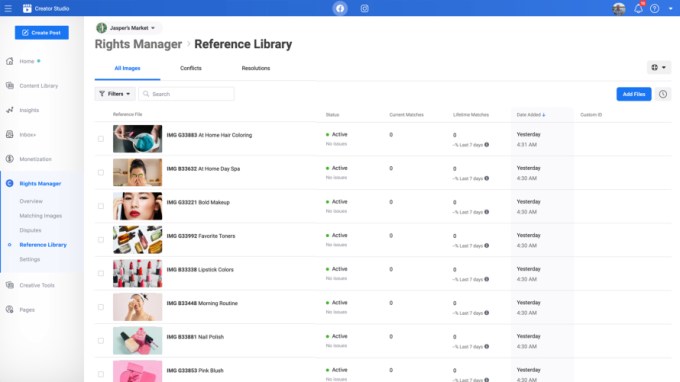
Facebook today is introducing a new tool that will allow rights holders to protect and manage their photos across both Facebook and Instagram. With the newly launched “Rights Manager for Images,” Facebook is offering creators and publishers access to content matching technology similar to what it introduced in 2016 to combat stolen videos. The new feature, which is available in Facebook’s Creator Studio, will allow rights owners to assert control over their intellectual property across Facebook and Instagram, including when the image is embedded on an external website.

As with Facebook’s existing Rights Manager for video content, creators who want to assert their control over their images will have to provide Facebook with a copy of the images they want to protect as well as a CSV file with image metadata, as a first step. These are uploaded to a reference library that Rights Manager uses to locate matches across both Facebook and Instagram.

The creator doesn’t have to publicly post their images on Facebook or Instagram for this process to work.

When matching content is found on a Page or a profile, the rights holder can choose whether to simply monitor the content, block its use through a takedown request, or attribute credit to themselves via an ownership link. Creators can also choose whether or not they want their ownership to apply worldwide or only in certain geographic locations.

Image Credits:

The new feature is designed more for those who maintain a large catalog of images or who post new content on a regular basis. For individuals who only occasionally encounter issues around misuse of their images, Facebook offers an IP reporting form instead, which even allows users to report more than one piece of matching content at a time.

The topic of who has the rights to use a photo that’s been posted on Facebook, and in particular, the image-heavy site Instagram, has become more controversial in recent months.

Many had long believed that embedding an Instagram post on their own website was a perfectly legal use case. But when Newsweek asked to feature a photographer’s image and they declined, the publication ran it as an embed, which then opened them up to a copyright lawsuit, filed this summer.

Newsweek had assumed the embed was legally permissible, given that Mashable recently won a similar copyright case in the recent past. But following the Newsweek case, Instagram clarified that its embedding feature didn’t include a license — if someone wanted to use the photo, they would need to ensure they had the proper license to do so. That bit of information came as something of a surprise and the case with Mashable was reopened as a result.

Until now, photographers had limited means of protecting their content across Facebook’s platforms. They could only take actions like enabling or disabling embedding entirely or making their account private, for example, to ensure their content wasn’t used and distributed without their permission. Of course, neither solution was ideal for a photographer trying to gain exposure and grow their career.

The Rights Manager for Images will now allow them a third option, as it’s capable of finding and matching images that have been used as embeds. At that point, the creator could choose to monitor, block or or allow the image as they choose, a Facebook spokesperson told TechCrunch.

Facebook says access to the new Rights Manager for Images will be opened up initially those who apply here.


Read Full Article

Microsoft commits to putting more water than it consumes back into the ecosystems where it operates by 2030


One good trend in 2020 has been large technology companies almost falling over one another to make ever-bolder commitments regarding their ecological impact. A cynic might argue that just doing without most of the things they make could have a much greater impact, but Microsoft is the latest to make a commitment that not only focuses on minimizing its impact, but actually on reversing it. The Windows-maker has committed to achieving a net positive water footprint by 2030, by which it means it wants to be contributing more energy back into environment in the places it operates than it is drawing out, as measured across all “basins” that span its footprint.

Microsoft hopes to achieve this goal through two main types of initiatives: First, it’ll be reducing the “intensity” of its water use across its operations, as measured by the amount of water used per megawatt of energy consumed by the company. Second, it will also be looking to actually replenish water in the areas of the world where Microsoft operations are located in “water-stressed” regions, through efforts like investment in area wetland restoration, or the removal and replacement of certain surfaces, including asphalt, which are not water-permeable and therefore prevent water from natural sources like rainfall from being absorbed back into a region’s overall available basin.

The company says that how much water it will return will vary, and depend on how much Microsoft consumes in each region, as well as how much the local basin is under duress in terms of overall consumption. Microsoft isn’t going to rely solely on external sources for this info, however: It plans to put its artificial intelligence technology to work to provide better information around what areas are under stress in terms of water usage, and where optimization projects would have the greatest impact. It’s already working towards these goals with a number of industry groups, including The Freshwater Trust.

Microsoft has made a number of commitments towards improving its global ecological impact, including a commitment from earlier this year to become ‘carbon negative’ by 2030. Meanwhile, Apple said in July that its products, including the supply chains that produce them, will be net carbon neutral by 2030, while Google made a commitment just last week to use only energy from carbon-free sources by that same year.


Read Full Article

Why I fight for climate justice | Xiye Bastida

Why I fight for climate justice | Xiye Bastida

In a deeply moving letter to her grandmother, Xiye Bastida reflects on what led her to become a leading voice for global climate activism -- from mobilizing school climate strikes to speaking at the United Nations Climate Summit alongside Greta Thunberg -- and traces her resolve, resilience and profound love of the earth to the values passed down to her. "Thank you for inviting me to love the world since the moment I was born," she says.

https://ift.tt/3kBj19B

Click this link to view the TED Talk