01 September 2020

Bambuser raises $45M after shifting focus to live video shopping


Bambuser is a name that you may not have heard in a while, but the Stockholm-headquartered company is announcing today that it’s raised $45 million in new funding this year, with $34.5 million of that amount raised during the pandemic.

Bambuser’s history goes back more than a decade (the first TechCrunch coverage appeared in 2008). CEO Maryam Ghahremani told me that the founders’ idea — using smartphones to stream live video journalism — made them “very, very much ahead of their time.”

However, being ahead of your time isn’t always a good thing, and Ghahremani that the company has also struggled with having “too little capital” (although it publicly listed on Nasdaq First North in 2017) and also with turning its technology into a great product and a scalable business model.

So Ghahremani was brought on to change all that two years ago. She told me she soon saw an opportunity in the growth of live video shopping, particularly in China, with potential clients starting to ask whether Bambuser had any products for this. It didn’t at the time, but it quickly shifted focus and launched its first live video shopping products last fall.

“We didn’t plan for the pandemic to hit the world,” Gharemani said. “We started this because we believe that this is going to be the future of retail.”

At the same time, she suggested that the pandemic — and the resulting shutdowns and struggles of brick-and-mortar retail — have accelerated the transition, giving Bambuser’s business a big boost. The company’s offering has been used by brands including H&M, Motivi, Moda Operandi, Frame, LUISAVIAROMA and Showfields, and it says that in Q2, net sales were up 669% year-over-year.

Bambuser CEO Maryan Ghahremani

Bambuser CEO Maryan Ghahremani

While e-commerce and social media platforms are expanding their support in this area, Gharemani said brands are turning to Bambuser because they want to offer this live shopping experience while still owning the brand experience, the customer data and the transaction itself.

She also emphasized that Bambuser is focused on being a business-to-business product, rather than a consumer shopping platform.

“We are trying to create not another Instagram or Facebook or marketplace, because we believe other [companies] are already doing that,” she said. “We’re not even interested in going into that battle. What we’re trying to do, what we need to do is help the larger brands.”

Participants in the new funding include Consensus Asset Management, Handelsbanken, Harmony Partners, Lancelot Asset Management, Tenth Avenue Holdings and TIN Fonder.

Among other things, Gharemani said she’d hoped to create a physical presence in the United States earlier this year, but those plans were delayed by the pandemic. Still, she’s now planning to open a New York office this quarter. And in the meantime, the U.S. has already become the company’s largest market.


Read Full Article

Facebook touts beefed up hate speech detection ahead of Myanmar election


Facebook has offered a little detail on extra steps it’s taking to improve its ability to detect and remove hate speech and election disinformation ahead of Myanmar’s election. A general election is scheduled to take place in the country on November 8, 2020.

The announcement comes close to two years after the company admitted a catastrophic failure to prevent its platform from being weaponized to foment division and incite violence against the country’s Rohingya minority.

Facebook says now that it has expanded its misinformation policy with the aim of combating voter suppression and will now remove information “that could lead to voter suppression or damage the integrity of the electoral process” — giving the example of a post that falsely claims a candidate is a Bengali, not a Myanmar citizen, and thus ineligible to stand.

“Working with local partners, between now and November 22, we will remove verifiable misinformation and unverifiable rumors that are assessed as having the potential to suppress the vote or damage the integrity of the electoral process,” it writes.

Facebook says it’s working with three fact-checking organizations in the country — namely: BOOM, AFP Fact Check and Fact Crescendo — after introducing a fact-checking program there in March.

In March 2018 the United Nations warned that Facebook’s platform was being abused to spread hate speech and whip up ethnic violence in Myanmar. By November of that year the tech giant was forced to admit it had not stopped its platform from being repurposed as a tool to drive genocide, after a damning independent investigation slammed its impact on human rights.

On hate speech, which Facebook admits could suppress the vote in addition to leading to what it describes as “imminent, offline harm” (aka violence), the tech giant claims to have invested “significantly” in “proactive detection technologies” that it says help it “catch violating content more quickly”, albeit without quantifying the size of its investment nor providing further details. It only notes that it “also” uses AI to “proactively identify hate speech in 45 languages, including Burmese”.

Facebook’s blog post offers a metric to imply progress — with the company stating that in Q2 2020 it took action against 280,000 pieces of content in Myanmar for violations of its Community Standards prohibiting hate speech, of which 97.8% were detected proactively by its systems before the content was reported to it.

“This is up significantly from Q1 2020, when we took action against 51,000 pieces of content for hate speech violations, detecting 83% proactively,” it adds.

However without greater visibility into the content Facebook’s platform is amplifying, including country-specific factors such as whether hate speech posting is increasing in Myanmar as the election gets closer, it’s not possible to understand what volume of hate speech is passing under the radar of Facebook’s detection systems and reaching local eyeballs.

In a more clearly detailed development, Facebook notes that since August, electoral, issue and political ads in Myanmar have had to display a ‘paid for by’ disclosure label. Such ads are also stored in a searchable Ad Library for seven years — in an expansion of the self-styled ‘political ads transparency measures’ Facebook launched more than two years ago in the US and other western markets.

Facebook also says it’s working with two local partners to verify the official national Facebook Pages of political parties in Myanmar. “So far, more than 40 political parties have been given a verified badge,” it writes. “This provides a blue tick on the Facebook Page of a party and makes it easier for users to differentiate a real, official political party page from unofficial pages, which is important during an election campaign period.”

Another recent change it flags is an ‘image context reshare’ product, which launched in June — which Facebook says alerts a user when they attempt to share a image that’s more than a year old and could be “potentially harmful or misleading” (such as an image that “may come close to violating Facebook’s guidelines on violent content”).

“Out-of-context images are often used to deceive, confuse and cause harm. With this product, users will be shown a message when they attempt to share specific types of images, including photos that are over a year old and that may come close to violating Facebook’s guidelines on violent content. We warn people that the image they are about to share could be harmful or misleading will be triggered using a combination of artificial intelligence (AI) and human review,” it writes without offering any specific examples.

Another change it notes is the application of a limit on message forwarding to five recipients which Facebook introduced in Sri Lanka back in June 2019.

“These limits are a proven method of slowing the spread of viral misinformation that has the potential to cause real world harm. This safety feature is available in Myanmar and, over the course of the next few weeks, we will be making it available to Messenger users worldwide,” it writes.

On coordinated election interference, the tech giant has nothing of substance to share — beyond its customary claim that it’s “constantly working to find and stop coordinated campaigns that seek to manipulate public debate across our apps”, including groups seeking to do so ahead of a major election.

“Since 2018, we’ve identified and disrupted six networks engaging in Coordinated Inauthentic Behavior in Myanmar. These networks of accounts, Pages and Groups were masking their identities to mislead people about who they were and what they were doing by manipulating public discourse and misleading people about the origins of content,” it adds.

In summing up the changes, Facebook says it’s “built a team that is dedicated to Myanmar”, which it notes includes people “who spend significant time on the ground working with civil society partners who are advocating on a range of human and digital rights issues across Myanmar’s diverse, multi-ethnic society” — though clearly this team is not operating out of Myanmar.

It further claims engagement with key regional stakeholders will ensure Facebook’s business is “responsive to local needs” — something the company demonstrably failed on back in 2018.

“We remain committed to advancing the social and economic benefits of Facebook in Myanmar. Although we know that this work will continue beyond November, we acknowledge that Myanmar’s 2020 general election will be an important marker along the journey,” Facebook adds.

There’s no mention in its blog post of accusations that Facebook is actively obstructing an investigation into genocide in Myanmar.

Earlier this month, Time reported that Facebook is using US law to try to block a request for information related to Myanmar military officials’ use of its platforms by the West African nation, The Gambia.

“Facebook said the request is ‘extraordinarily broad’, as well as ‘unduly intrusive or burdensome’. Calling on the U.S. District Court for the District of Columbia to reject the application, the social media giant says The Gambia fails to ‘identify accounts with sufficient specificity’,” Time reported.

“The Gambia was actually quite specific, going so far as to name 17 officials, two military units and dozens of pages and accounts,” it added.

“Facebook also takes issue with the fact that The Gambia is seeking information dating back to 2012, evidently failing to recognize two similar waves of atrocities against Rohingya that year, and that genocidal intent isn’t spontaneous, but builds over time.”

In another recent development, Facebook has been accused of bending its hate speech policies to ignore inflammatory posts made against Rohingya Muslim immigrants by Hindu nationalist individuals and groups.

The Wall Street Journal reported last month that Facebook’s top public-policy executive in India, Ankhi Das, opposed applying its hate speech rules to T. Raja Singh, a member of Indian Prime Minister Narendra Modi’s Hindu nationalist party, along with at least three other Hindu nationalist individuals and groups flagged internally for promoting or participating in violence — citing sourcing from current and former Facebook employees.


Read Full Article

Facebook threatens to block news sharing in Australia as it lobbies against revenue share law


Adtech giant and self-styled ‘free speech champion’, Facebook, has threatened to pull the plug on the public sharing of news content on Facebook and Instagram in Australia.

The aggressive threat is Facebook’s attempt to lobby against a government plan that will require it and Google to share revenue with regional news media to recompense publishers for distributing and monetizing professionally produced content on their platforms.

Consultation on a draft of the mandatory code — which Australia’s lawmakers say is intended to address “acute bargaining power imbalances” between local news businesses and the adtech duopoly — closed on August 28, with a final version expected imminently from Australia’s Competition and Consumer Commission (ACCC) and then due to be put before parliament.

Facebook’s threat thus looks timed to turn the heat up on lawmakers as they’re about to debate the details of the code. However dangling the prospect of blocking professionally produced news in an attempt to thwart a law change that’s not in its commercial interests will do nothing to reduce lawmakers’ concerns about the level of market power being wielded by tech giants.

Last month Google also warned that if Australia goes ahead with the plan then the quality of regional search results and YouTube recommendations will suffer — becoming “less relevant and helpful” if the law goes into effect.

Both platform giants are essentially saying that unless the bulk of professional reportage can be freely distributed on their platforms, leaving them free to monetize it via serving ads and through the acquisition of associated user data, then unverified user generated content will be left to fill the gap.

The clear implication is that lower grade content — and potentially democracy-denting disinformation — will be left to thrive. Or, in plainer language, the threat boils down to: Give us your journalism for free or watch your society pay the price as our platforms plug the information gap with any old clickbait.

“The ACCC presumes that Facebook benefits most in its relationship with publishers, when in fact the reverse is true. News represents a fraction of what people see in their News Feed and is not a significant source of revenue for us. Still, we recognize that news provides a vitally important role in society and democracy, which is why we offer free tools and training to help media companies reach an audience many times larger than they have previously,” writes Facebook in the same blog post where it threatens — as a ‘last choice’ — to pull the plug on content it describes as playing “a vitally important role in society and democracy” because it doesn’t want to have to pay for it.

Facebook’s calculus is clearly elevating its own commercial interests above free speech. And indeed above democracy and society. Yet the tech giant’s go-to defence for not removing all sorts of toxic disinformation and/or hateful, abusive content — or indeed lying political ads — from circulating on its platform is a claim that it’s defending ‘free speech’. So this is a specially rank, two-faced kind of platform hypocrisy on display.

Last year the comic Sacha Baron Cohen slammed Facebook’s modus operandi as “ideological imperialism” — warning then that unaccountable Silicon Valley ‘robber barons’ are “acting like they’re above the reach of law”. Well, Australians are now getting a glimpse of what happens when the mask further slips.

The ACCC has responded to Facebook’s flex with a steely statement of its own, attributed to chair Rod Sims.

“Facebook’s threat today to prevent any sharing of news on its services in Australia is ill-timed and misconceived,” he writes. “The draft media bargaining code aims to ensure Australian news businesses, including independent, community and regional media, can get a seat at the table for fair negotiations with Facebook and Google.”

“Facebook already pays some media for news content. The code simply aims to bring fairness and transparency to Facebook and Google’s relationships with Australian news media businesses,” he adds.

“As the ACCC and the Government work to finalise the draft legislation, we hope all parties will engage in constructive discussions.”

A similar battle is playing out in France over Google News, following a recent pan-EU law change which extended copyright to news snippets. France has been at the forefront of implementing the change in national law — and Google has responded by changing how it displays news media content in Google News in the country, switching to showing headlines and URLs only (so removing snippets).

However earlier this year France’s competition watchdog slapped down the tactic — saying Google’s unilateral withdrawal of snippets to deny payment to publishers is likely to constitute an abuse of a dominant market position, which it asserted “seriously and immediately damaged the press sector.”

Google’s share of the search market in Europe remains massively dominant — with the tech giant taking greater than 90% marketshare. (Something that underpins a number of regional antitrust enforcements against various aspects of its business.)

In Australia, Facebook’s position as a news distributor appears to be less strong, with the ACCC citing the University of Canberra’s 2020 Digital News Report which found that 39% of Australians use Facebook for general news, and 49% use Facebook for news about COVID-19.

However information and disinformation do not distribute equally, with plenty of studies indicating a faster spread for fake news — which suggests Facebook’s platform power to distribute bullshit is far greater than its role in informing societies by spreading bona fide news. That in turn makes its threat to block genuine reportage an antisocial weaponization of its dominance of social media.


Read Full Article

Apple alum’s jobs app for India’s workers secures $8 million


Javed, a middle-aged man, worked as a driver before losing that job earlier this year as coronavirus spread across India, prompting New Delhi to enforce a nationwide lockdown and temporarily curb several business activities.

There are millions of people like Javed in India today who have lost their livelihood in recent months. They are low-skilled workers and are currently struggling to secure another job.

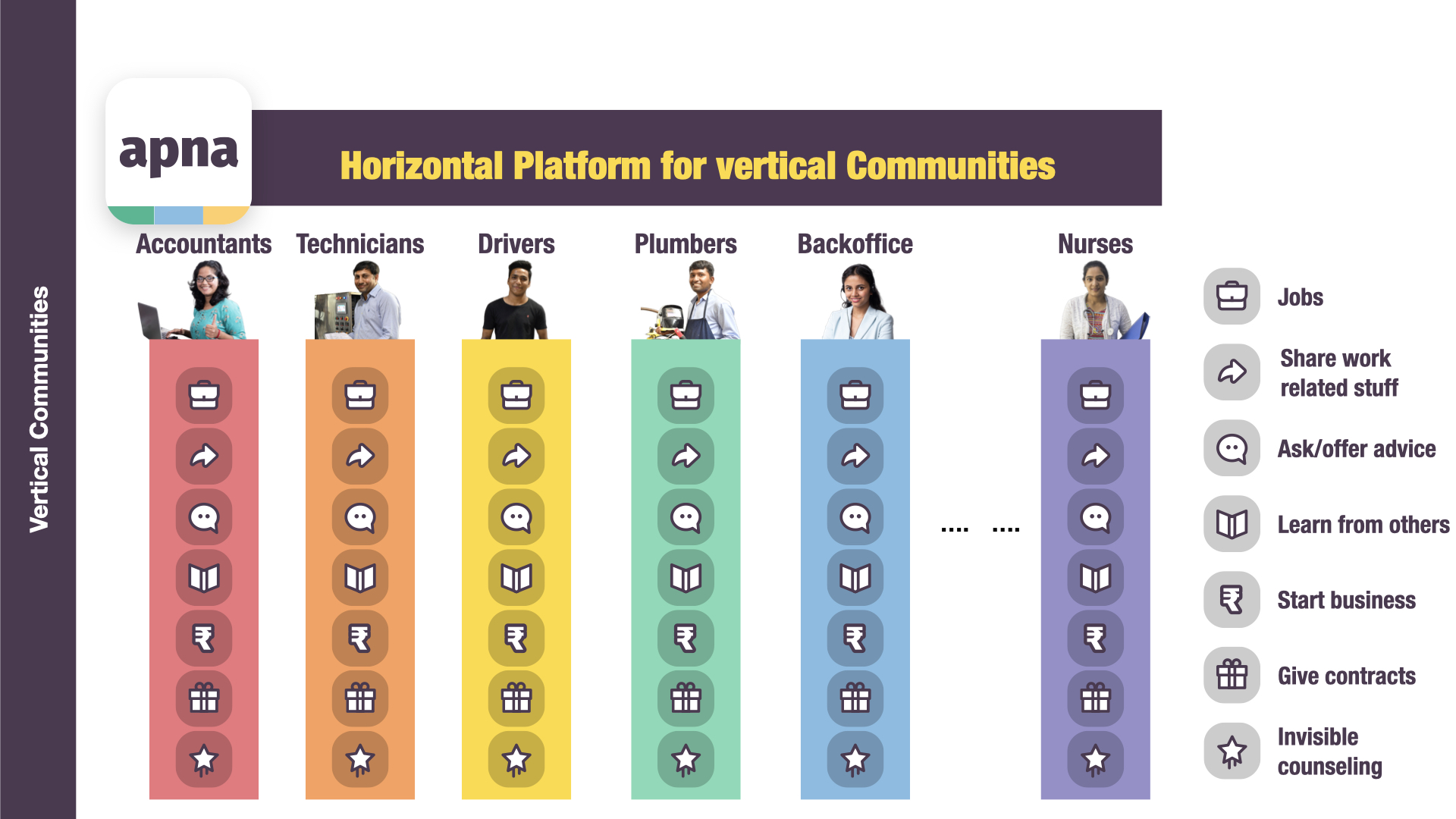
An Apple alum thinks he can help. Through his app startup Apna, Nirmit Parikh is helping India’s workers learn new skills, connect with one another, and find jobs.

Parikh’s app is already changing lives. Javed, who could barely speak a few words in English before, recently posted a video on Apna app where he talked about his new job — processing raisins — in English.

In less than one year of its existence, Apna app — available on Android — has amassed over 1.2 million users.

The startup announced on Tuesday it has raised $8 million in its Series A financing round led by Lightspeed India and Sequoia Capital India. Greenoaks Capital and Rocketship VC also participated in the round.

In an interview with TechCrunch last week, Parikh said that these workers lack an organized community. “They are daily-wage workers. They rely on their friends to find jobs. This makes the prospects of them finding a job very difficult,” he said.

Apna app comprises of vertical communities for skilled professionals like carpenters, painters, field sales agents and many others.

“The most powerful thing for me about Apna is its communities — I’ve seen people help each other start a business, learn a new language or find a gig! Communities harbinger trust and make the model infinitely scalable,” said Vaibhav Agrawal, a Partner at Lightspeed India, in a statement.

The other issue they struggle with is their skillset. “An electrician would end up working decades doing the same job. If only they had access to upskilling courses — and just knew how beneficial it could be to them — they would stand to broaden their scope of work and significantly increase their earnings,” said Parikh.

Apna is addressing this gap in multiple ways. In addition to establishing a community, and rolling out upskilling courses, the startup allows users — most of whom are first time internet users — easily generate a virtual business card. The startup then shares these profiles with potential employers.

In the last one month, Parikh said Apna has facilitated more than 1 million job interviews — up more than 3X month-on-month. During the same period, more than 3 million professional conversations have occurred on the platform.

Parikh said he plans to use the fresh capital to expand its offerings, and help users launch their own businesses. He also plans to expand Apna outside of India.

There are over 250 million blue and grey collar workers in India and providing them meaningful employment opportunities is one of the biggest challenges in our country, said Harshjit Sethi, Principal at Sequoia Capital India, in a statement.

“With internet usage in this demographic growing rapidly, further catalysed by the Jio effect, apps such as Apna can play a meaningful role in democratizing access to employment and skilling. Apna has built a unique product where users quickly come together in professional communities, an unmet need so far,” he added.

A handful of other players are also looking for ways to help. Last month, Google rolled out a feature in its search engine in India that allows users to create their virtual business card. The Android-maker also launched its jobs app Kormo in the country.


Read Full Article

5 Tips for Designing the Perfect Casino App


Casinos have been a great source of entertainment for ages now. Over the years, they have been evolving, adding more and more exciting features to make themselves better and provide better gambling experiences to the users. It has resulted in numerous casino apps being available in the market. Each of these apps strives to be […]

The post 5 Tips for Designing the Perfect Casino App appeared first on ALL TECH BUZZ.


Top Tele-health trends in 2020


The ongoing pandemic and the scenario of lockdown forced people to stay home and people focused more on health and immunity. Fitness and wellness became the most important priorities for all. As fitness and wellness became the talk of the town it provided business owners with an opportunity to create an app that focuses on […]

The post Top Tele-health trends in 2020 appeared first on ALL TECH BUZZ.


Is It Safe to Use Cryptocurrencies to Play Online Casino Games?


  In the beginning, cryptocurrencies were a preserve for tech-savvy individuals. Today, the virtual world has welcomed crowds of new investors who are embracing cryptocurrencies and moving away from traditional exchanges. It’s even possible to play casino online games using cryptocurrencies. What is Cryptocurrency? Cryptocurrency is a type of virtual or digital currency. It utilizes […]

The post Is It Safe to Use Cryptocurrencies to Play Online Casino Games? appeared first on ALL TECH BUZZ.


How to Search Google Images by the Exact Size


Google Images earlier offered a useful “search by size” option in advanced search to help you find logos, wallpapers and other images on the Internet by their exact size (or resolution).

For instance, you could limit your search for landscape photographs to image files that were at least 10 Megapixels in size. Or, if you are were using Google Image search to find wallpapers for the desktop, you could specify the image resolution as 1920x1080 pixels and Google would only return large images with those exact dimensions.

Google Image Search by Size

The “exact size” search option is no longer available in Google Image Search but you can still limit your image searches to a particular size by using the secret imagesize search operator in the query itself.

Here’s how.

Go to images.google.com and enter the search terms as before. Then append imagesize:WIDTHxHEIGHT to your query and hit Enter. Google Images will remove the operator from the query but the results will only display images that match the specified size.

The search by size operators works on the mobile version of Google as well so you may use the simple trick to find that perfect size wallpaper for your phone.

More Search Tricks

You an also use search operators in Gmail, Google Drive, YouTube and Twitter to easily find stuff you’re looking for.


Twitter flags Republican leader’s video as ‘manipulated’ for altering disabled activist’s words


Twitter flagged an inflammatory video by House Republican Whip Steve Scalise on Sunday for altering footage of a conversation between progressive activist Ady Barkan and Joe Biden. The video is now labeled as “manipulated media” in a tweet from Scalise, though remains online.

The inflammatory video pulls in out-of-context quotes from a number of Democrats and activists, but appears to have crossed a line by altering Barkan’s words from a portion of the conversation about policing reform. Barkan, who has ALS, speaks with an assistive eye-tracking device.

“These are not my words. I have lost my ability to speak, but not my agency or my thoughts,” Barkan tweeted in response, adding “…You owe the entire disability community an apology.”

In the video excerpt, taken from a longer conversation about policing and social services, Barkan appears to say “Do we agree that we can redirect some of the funding for police?” In reality, Barkan interrupted Biden during the conversation to ask “Do we agree that we can redirect some of the funding?”

In the video, Barkan’s altered sentence is followed by a dramatic black background stamped with the words “No police. Mob rule. Total chaos. Coming to a town near you?” Those ominous warnings are followed by a logo for Scalise’s reelection campaign.

The addition of the two words, falsely rendered in Barkan’s voice, don’t significantly change the meaning of his question, but the edit still crossed a line. A Twitter spokesperson confirmed that the tweet violated the company’s policy for “synthetic and manipulated media,” though did not specify which part of the video broke the rules.

The synthetic and manipulated media policy states that Twitter “may label Tweets containing synthetic and manipulated media to help people understand their authenticity and to provide additional context.” In the policy, Twitter explains specifically that “new video frames, overdubbed audio” and other edits count as deceptive and significant manipulation.


Read Full Article

Dorian raises $3.1M for its no-code, interactive storytelling platform


With Dorian, co-founder and CEO Julia Palatovska said she’s hoping to empower fiction writers and other storytellers to create their own games.

The startup is announcing that it has raised $3.15 million in seed funding led by March Capital Partners, with participation from VGames, Konvoy Ventures, London Venture Partners, Michael Chow (co-creator of the Twitch series “Artificial”), Andover Ventures and talent management company Night Media.

Palatskova previously worked in gaming as the head of business development at G5 Entertainment, and she said she’d also become entranced by narrative games and interactive fiction. And while there are existing interactive fiction platforms, she saw “an opportunity that I felt was missing,” particularly in the fact that those platforms are “entirely single player, with no opportunity to play and collaborate with other people.”

So she gave me a quick tour of the Dorian platform, showing me how, without coding, a writer can essentially design characters and backgrounds by choosing from a variety of visual assets (and they’ll eventually be able to upload assets of their own), while using a flowchart-style interface to allow the writer to connect different scenes in the story and create player choices. And as Palatskova noted, you can also collaborate on a story in real time with other writers.

“In terms of writer productivity, I would say there is almost no difference between creating interactive fiction on our engine and just writing fiction,” she said.

Dorian Gunmen Scene

Image Credits: Dorian

From what I could see, the resulting games look similar to what you’d find on platforms like Pocket Gems’ Episode, where there aren’t a lot of technical bells and whistles, so the story, dialogue and character choices move to the forefront.

When I brought up the open source game creation software Twine, Palatskova said Twine is “just a tool.”

“We want to be more like Roblox, both the tools and the distribution,” she said.

In other words, writers use Dorian to create interactive stories, but they also publish those stories using the Dorian app. (The writer still owns the resulting intellectual property.) Palatskova noted that Dorian also provides detailed analytics on how readers are responding, which is helpful not just for creating stories, but also for monetizing via premium story choices.

In fact, Dorian says that in early tests involving around 50,000 players, writers were able to improve monetization by 70% after only one or two iterations. And Palatskova noted that with Dorian’s games — unlike an interactive film such as “Black Mirror: Bandersnatch” —”It’s fast and easy to test multiple branches.”

Dorian is currently invite-only, but the plan is to launch more broadly later this year. Palatskova is recruiting writers with and without gaming experience, but she also expects plenty of successful contributions to come from complete novices. She wants Dorian to be “a completely open platform, like Roblox or Twitch for writers.”

“Dorian’s success in creating an interactive platform that values storytelling while prioritizing monetization for its writers is a game-changer,” said March Capital’s Gregory Milken in a statement. “Julia and her team are creating a community that is primed to capture the attention of today’s influential but underrepresented audiences of diverse content creators.”


Read Full Article

31 August 2020

Facebook partially documents its content recommendation system


Algorithmic recommendation systems on social media sites like YouTube, Facebook and Twitter, have shouldered much of the blame for the spread of misinformation, propaganda, hate speech, conspiracy theories and other harmful content. Facebook, in particular, has come under fire in recent days for allowing QAnon conspiracy groups to thrive on its platform and for helping militia groups to scale membership. Today, Facebook is attempting to combat claims that its recommendation systems are at any way at fault for how people are exposed to troubling, objectionable, dangerous, misleading, and untruthful content.

The company has, for the first time, made public how its content recommendation guidelines work.

In new documentation available in Facebook’s Help Center and Instagram’s Help Center, the company details how Facebook and Instagram’s algorithms work to filter out content, accounts, Pages, Groups and Events from its recommendations.

Currently, Facebook’s Suggestions may appear as Pages You May Like, “Suggested For You” posts in News Feed, People You May Know, or Groups You Should Join. Instagram’s suggestions are found within Instagram Explore, Accounts You May Like, and IGTV Discover.

The company says Facebook’s existing guidelines have been in place since 2016 under a strategy it references as “remove, reduce, and inform.” This strategy focuses on removing content that violates Facebook’s Community Standards, reducing the spread of problematic content that does not violate its standards, and informing people with additional information so they can choose what to click, read or share, Facebook explains.

The Recommendation Guidelines typically fall under Facebook’s efforts in the “reduce” area, and are designed to maintain a higher standard than Facebook’s Community Standards, because they push users to follow new accounts, groups, Pages and the like.

Facebook, in the new documentation, details five key categories that are not eligible for recommendations. Instagram’s guidelines are similar. However, the documentation offers no deep insight into how Facebook actually chooses how it chooses what to recommend to a given user. That’s a key piece to understanding recommendation technology, and one Facebook intentionally left out.

One obvious category of content that many not be eligible for recommendation includes those that would impede Facebook’s “ability to foster a safe community,” such as content focused on self-harm, suicide, eating disorders, violence, sexually explicit, regulated content like tobacco or drugs, content shared by non-recommendable accounts or entities.

Facebook also claims to not recommend sensitive or low-quality content, content users frequently say they dislike, and content associated with low-quality publishings. These further categories include things like clickbait, deceptive business models, payday loans, products making exaggerated health claims or offering “miracle cures,” content promoting cosmetic procedures, contest, giveaways, engagement bait, unoriginal content stolen from another source, content from websites that get a disproportionate number of clicks from Facebook versus other places on the web, news that doesn’t include transparent information about the authorship or staff.

In addition, Facebook claims it won’t recommend fake or misleading content, like those making claims found false by independent fact checkers, vaccine-related misinformation, and content promoting the use of fraudulent documents.

It says it will also “try” not to recommend accounts or entities that recently violated Community Standards, shared content Facebook tries to not recommend, posts vaccine-related misinformation, has engaged in purchasing “Likes,” has been banned from running ads, posted false information, or are associated with movements tied to violence.

The latter claim, of course, follows recent news that a Kenosha militia Facebook Event remained on the platform after being flagged 455 times after its creation, and had been cleared by 4 moderators as non-violating content. The associated Page had issued a “calls to arms” and hosted comments about people asking what types of weapons to bring. Ultimately, two people were killed and a third was injured at protests in Kenosha, Wisconsin when a 17-year old armed with an AR-15-style rifle broke curfew, crossed state lines, and shot at protestors.

Given Facebook’s track record, it’s worth considering how well Facebook is capable of abiding by its own stated guidelines. Plenty of people have found their way to what should be ineligible content, like conspiracy theories, dangerous health content, COVID-19 misinformation and more by clicking through on suggestions at times when the guidelines failed. QAnon grew through Facebook recommendations, it’s been reported.

It’s also worth noting, there are many gray areas that guidelines like these fail to cover.

Militia groups and conspiracy theories are only a couple examples. Amid the pandemic, U.S. users who disagreed with government guidelines on business closures can easily find themselves pointed towards various “reopen” groups where members don’t just discuss politics, but openly brag about not wearing masks in public or even when required to do so at their workplace. They offer tips on how to get away with not wearing masks, and celebrate their successes with selfies. These groups may not technically break rules by their description alone, but encourage behavior that constitutes a threat to public health.

Meanwhile, even if Facebook doesn’t directly recommend a group, a quick search for a topic will direct you to what would otherwise be ineligible content within Facebook’s recommendation system.

For instance, a quick search for the word “vaccines,” currently suggests a number of groups focused on vaccine injuries, alternative cures, and general anti-vax content. These even outnumber the pro-vax content. At a time when the world’s scientists are trying to develop protection against the novel coronavirus in the form of a vaccine, allowing anti-vaxxers a massive public forum to spread their ideas is just one example of how Facebook is enabling the spread of ideas that may ultimately become a global public health threat.

The more complicated question, however, is where does Facebook draw the line in terms of policing users having these discussions versus favoring an environment that supports free speech? With few government regulations in place, Facebook ultimately gets to make this decision for itself.

Recommendations are only a part of Facebook’s overall engagement system, and one that’s often blamed for directing users to harmful content. But much of the harmful content that users find could be those groups and Pages that show up at top of Facebook search results when users turn to Facebook for general information on a topic. Facebook’s search engine favors engagement and activity — like how many members a group has or how often users post — not how close its content aligns with accepted truths or medical guidelines.

Facebook’s search algorithms aren’t being similarly documented in as much detail.


Read Full Article

Nature, folklore and serendipitous photo collaborations | Riitta Ikonen, Karoline Hjorth

Nature, folklore and serendipitous photo collaborations | Riitta Ikonen, Karoline Hjorth

Inspired by Nordic folklore, artists Karoline Hjorth and Riitta Ikonen collaborate with local elders -- farmers, fishermen, cosmologists and more -- to create richly imaginative portraits that explore humanity's connection to nature. Discover their serendipitous artistic practice as they share a selection of fantastical imagery where nature and myth intersect to awaken a sense of wonder.

https://ift.tt/3ly5wZz

Click this link to view the TED Talk

Hurricane Hunters


Hurricane Hunters

Lenovo’s Smart Clock Essential is less smart by design


The Smart Clock Essential really blurs smart display lines. Aesthetics aside, Lenovo’s news device probably has more in common with the Echo Dot with Clock than it does the company’s first generation Smart Clock. In fact, at $50, it’s actually $10 less expensive than Amazon’s offering.

Essentially the Essential is a Google Assistant smart speaker with a digital display. Which really makes you wonder what qualifies as “essential” these days. It shows the time and the weather on its LED, but offers none of the kind of touch interaction you’ve come to expect from the form factor. There are still buttons that can be used to set the alarm and “a built-in light that helps you walk around without bumping into things,” which fair enough.

But at the end of the day, it’s more akin to the Google Home Mini than the Nest Hub. And like the former, it’s priced so you can buy a bunch of them to and stick them at various spots throughout your house. There’s a 3W speaker, which is built more for alarm sounds than casual listening, though like other Google Assistant speakers, it can be paired as part of a group. Oh, and like the original Smart Clock, there’s a USB port on board for charging devices while you sleep.

Honestly, that $50 price point is really the biggest seller here, but it’s nice to see hardware makers like Lenovo playing around with the form factor a bit, as voice enabled device take up an increasing amount of real estate on our kitchen counters and bedside tables. Honestly, after testing the original Smart Clock, I’m not sure I want or need more functionality than Lenovo’s offering up here next to my bed.

It’s set to hit retail next month. Just don’t call it a smart display.


Read Full Article

Google launches Google Kids Space, a ‘kids mode’ feature for Android, initially on Lenovo tablets


Streaming services have built-in kids’ profiles, so why not devices? Google today is responding to parents’ demand for a better way for their children to interact with technology with the launch of the new “Google Kids Space,” a dedicated kids mode on Android tablets which will aggregate apps, books, and videos for kids to enjoy and learn from. The feature will launch first on the Lenovo Smart Tab M10 HD Gen 2, but Google aims to bring Kids Space to more devices in time.

The concept is somewhat similar to Amazon’s FreeTime, Amazon’s own well-built system for parental controls and access to approved and curated children’s’ apps and media. But in Google’s case, its new kids’ mode is building on top of the company’s earlier efforts focused on designing a safer, more controlled Android experience for families with children.

These efforts began with Family Link, a series of parental control features that’s now built into the Android OS. Family Link already allows parents to set screen time limits, engage content safety filters, set privacy controls, and more. Google then expanded into kids’ app curation with the launch of a Kids tab in Google Play where it can showcase “teacher-approved” mobile apps and games.

Image Credits: Google

The new Kids Space leverages Google’s earlier work in evaluating Android apps for its “Play” tab, and has expanded its curation to now include other types of quality content. For example, Google worked with publishers to make popular children’s books free of charge in Kids Space, and at launch offers over 400 free books in the “Read” tab for users in the U.S.

In the Kids Space’ “Watch” and “Make” tabs, Google is pulling in creative content from YouTube Kids that encourage off-screen activities.

Image Credits: Google

The feature is ultimately meant to be a selling point for Android devices and a way to lock families into the Google ecosystem. This differentiates it from Amazon’s FreeTime, which only partially has this aim. Amazon’s FreeTime is largely meant to a subscription offering, and it’s one that works across platforms — including Amazon devices like Fire tablets and Echo smart speakers, but also on iOS and Android devices. Google’s Kids Space, meanwhile, is only designed for Android.

Google Kids Space is initially available on on the Lenovo Tab M10 HD Gen 2. The company said it worked with Lenovo to ease the setup process for parents and to ensure that Kids Space is a pre-loaded feature. Google says it aims to bring Kids Mode to more Android tablets soon.


Read Full Article

Google Apps Script for Developers


Google Apps Script makes it is easy for you to integrate data and functionality from Gmail, Google Drive, Google Maps, YouTube, and most other Google APIs. Apps Script is JavaScript under the hood so you don’t have to learn a new language and you don’t have to manage any servers since all your code runs on the Google Cloud, not your browser.

In this video tutorial, you’ll learn how to develop Google Apps Script projects locally on your computer inside Visual Studio Code. You can write your code in modern JavaScript, neatly organized in modules, and the build environment will use Babel and Webpack to transform your code into a version of JavaScript that is compatible with Apps Script.

Modern Development with Google Apps Script

There are quite a few advantages with having a local development environment vis-a-vis writing code in the Apps Script Cloud IDE.

  1. You can write code with ES6 Classes, Arrow Functions, Modules, Destructing and use all the other modern JavaScript features.
  2. The development experience inside VS Code is unmatched and tools like ESLint and Prettier make it easier for you to catch errors early in the development.
  3. The build and deployment process can be completely automated with npm scripts and CLASP, Google’s command line utility for Apps Script.
  4. VS Code has built-in support for Git and integrates with source control providers like Github and Gitlab. It is therefore easier to track changes and restore previous versions of the code.
  5. You can quickly integrate JavaScript libraries like LoDash, Moment, Underscore and any of the NPM packages into your code.
  6. You can use modern frameworks like React, Vue.js and Angular to build the HTML frontend that connects to the backend with the Google Script Client API.

Getting Started with the Apps Script Starter

The Starter kit is a boilerplate for quickly getting started with local Apps Script development locally inside VS Code. Open your terminal and run the following commands:

1. Clone the Github repository to a local folder

git clone https://github.com/labnol/apps-script-starter my-project

2. Switch to the project folder

cd my-project

3. Install all the project dependencies and utilities

npm install

4. Connect CLASP to your Google account

npx clasp login

5. Create a new Google Apps Script project in your Google Drive with CLASP

npx clasp create --title "My Project" --rootDir ./dist --type standalone

This command will create a new .clasp.json file in your project folder that links the local folder with your Apps Script project. During build, Webpack will bundle all your code in a single JavaScript file and add it to the ./dist folder that Clasp will push to your Apps Script project.

Next, open the current project folder inside VS Code with the code . command. It includes some sample code but we will start with a blank folder so delete everything that’s inside the src folder.

Inside the src folder, create a new file - email.js - and write a simple arrow function that prints a list of all the email addresses connected to your Gmail account.

apps-script-starter (1).png

Next, create an index.js file (entry point) in the src folder, import the email function that you’ve created inside the email.js file and add it to the global object. This is a requirement of the Webpack plugin for Google Apps Script.

You can also add a function expression to the global object directly, like doGet in the example below.

htmlservice-doget.png

Now that your JavaScript code is ready, open the appsscript.json file in your project folder and modify the oAuthScopes property to only include the scopes that are required by your project.

Next, jump to the command line terminal and run the deploy command to push your code to the Apps Script project.

npm run deploy

If you are deploying the project for the first time, you’ll get a prompt saying “Manifest file has been updated. Do you want to push and overwrite? (y/N)” - say yes.

After the deployment is complete, open the associated script in the browser with the CLASP open command.

npx clasp open

Inside the Apps Script Editor, go to the Run menu and choose the getEmailAddress function from the list. Open the logs and you should see your email addresses in the window.

Then go to the Publish menu, choose Deploy as web app and open the URL in a new browser tab to check the program output. That’s how easy it is to build projects with the Google Apps Script starter kit.

Using Git with Google Apps Script

Create a new repository in Github and make a note of the URL of the new repository. Next, open the terminal and run the following commands to push your Apps Script project to Github.

github-apps-script.png

Also see: Most Useful Google Apps Scripts

The same approach is used by Digital Inspiration for building popular Google add-ons including Gmail Mail Merge, Google Forms Notifications and Document Studio.


How To Disable Google Chrome Automatic Updates In Windows 10


CLICK HERE TO SEE FULL POST

Google Chrome browser automatically downloads and installs updates to keep itself up to date. Auto-updates make sure that you are always running the latest and greatest version of Chrome on your computer. Most Chrome users are happy with the auto-update. However, a small section of users might want to prevent Chrome from automatically updating itself. […]

The post How To Disable Google Chrome Automatic Updates In Windows 10 appeared first on Into Windows. Content from IntoWindows website.


30 August 2020

How to Preserve Formatting of Spreadsheet Cells in Mail Merge


The Mail Merge app merges data from a Google Spreadsheet and sends them as personalized emails. You can format your sheet data in multiple colors, choose different font families, vary the size of your text, include hyperlinks, line breaks and more.

The rich text of spreadsheet cells is internally translated into HTML tags with inline CSS and thus the cell formatting is preserved in the outgoing Gmail messages. Here’s an example:

Rich Text Email in Gmail

If you would like to enable this feature, go to the Add-ons menu in Google Sheets > Mail Merge with Attachments > Configure Mail Merge and check the “Preserve Cell Formatting” option.

You can even format your spreadsheet cells with conditional formatting and the text styles will be retained in mail merge. For instance, you can dynamically color the invoice amount column in red and make it bold if the due date has passed and this value would show up in bold red in the email message as well.

Send Rich Text HTML Emails with Google Sheet

This snippet handles the transformation of rich-text Spreadsheet data to HTML. The functions reads the data from a cell, specified in A1 notation, breaks the rich text into blocks that have the same text styles and translate individual blocks into HTML tags.

const sendRichEmail = () => {
  const cellAddress = 'A1';
  const sheetName = 'Mail Merge';
  const recipient = 'amit@labnol.org';

  const richTextValue = SpreadsheetApp.getActiveSpreadsheet()
    .getSheetByName(sheetName)
    .getRange(cellAddress)
    .getRichTextValue();

  /* Run is a stylized text string used to represent cell text.
     This function transforms the run into HTML with CSS
   */
  const getRunAsHtml = (richTextRun) => {
    const richText = richTextRun.getText();

    // Returns the rendered style of text in a cell.
    const style = richTextRun.getTextStyle();

    // Returns the link URL, or null if there is no link
    // or if there are multiple different links.
    const url = richTextRun.getLinkUrl();

    const styles = {
      color: style.getForegroundColor(),
      'font-family': style.getFontFamily(),
      'font-size': `${style.getFontSize()}pt`,
      'font-weight': style.isBold() ? 'bold' : '',
      'font-style': style.isItalic() ? 'italic' : '',
      'text-decoration': style.isUnderline() ? 'underline' : '',
    };

    // Gets whether or not the cell has strike-through.
    if (style.isStrikethrough()) {
      styles['text-decoration'] = `${styles['text-decoration']} line-through`;
    }

    const css = Object.keys(styles)
      .filter((attr) => styles[attr])
      .map((attr) => [attr, styles[attr]].join(':'))
      .join(';');

    const styledText = `<span style='${css}'>${richText}</span>`;
    return url ? `<a href='${url}'>${styledText}</a>` : styledText;
  };

  /* Returns the Rich Text string split into an array of runs,
  wherein each run is the longest possible
  substring having a consistent text style. */
  const runs = richTextValue.getRuns();

  const htmlBody = runs.map((run) => getRunAsHtml(run)).join('');

  MailApp.sendEmail(recipient, 'Rich HTML Email', '', { htmlBody });
};

Known Limitations

You can format the cells of your Google Spreadsheet in any font family - from the cursive Caveat to the heavy Impact typeface - but if the recipient doesn’t have these fonts installed on their computer, the rendered text in the email would fallback to the default font.

The font colors, font size and text styles (bold, italics, underline) get perfectly transformed into HTML but other properties like background fill colors, borders and text-alignment of the cell are ignored.

Also, if your spreadsheet cells are formatted as dates, the rich text functions may not work.


The Importance of Technology for Slot Machine Games


As soon as you start playing your favorite slot machine games on 918kiss, you become engrossed, forgetting about the technology that underpins these forms of entertainment. Technology makes it possible to create exciting and rewarding gaming experiences, but since the first slot machine was built in the late 1890s, its model remains standard. Modern gaming […]

The post The Importance of Technology for Slot Machine Games appeared first on ALL TECH BUZZ.


Are You Taking Full Advantage of Neon Signs to Promote Your Restaurant Business?


Great signage is a part and parcel of any successful restaurant business. It doesn’t matter whether yours is an upscale brassier that boasts locally sourced ingredients, a cozy, romantic bistro complete with a rotating menu, or any option in between. All this will amount to zilch if you cannot let your hungry customers know that […]

The post Are You Taking Full Advantage of Neon Signs to Promote Your Restaurant Business? appeared first on ALL TECH BUZZ.