19 October 2020

Raspberry Pi Foundation launches Compute Module 4 for industrial users


The Raspberry Pi Foundation is launching a new product today — the Compute Module 4. If you’ve been keeping an eye on the Raspberry Pi releases, you know that the flagship Raspberry Pi 4 was released in June 2019. The Compute Module 4 features the same processor, but packed in a compute module for industrial use cases.

A traditional Raspberry Pi is a single-board computer with a ton of ports sticking out. Compute Modules are somewhat different. Those system-on-module variants are more compact single-board computers without any traditional port.

It lets you create a prototype using a traditional Raspberry Pi, and then order a bunch of Compute Modules to embed in your commercial products. “Over half of the seven million Raspberry Pi units we sell each year go into industrial and commercial applications, from digital signage to thin clients to process automation,” Eben Upton wrote on the Raspberry Pi blog.

Some things are strictly similar between the Raspberry Pi 4 and the Compute Module 4, such as the 64-bit ARM-based processor with VideoCore VI graphics. This is going to represent a huge upgrade for previous Compute Module customers.

In particular, you get much better video performance with 4Kp60 hardware decode for H.265 videos, 1080p60 hardware decode for H.264 videos, 1080p30 hardware encode of H.264 videos. You can also take advantage of the dual HDMI interfaces to connect up to two 4K displays at 60 frames per second.

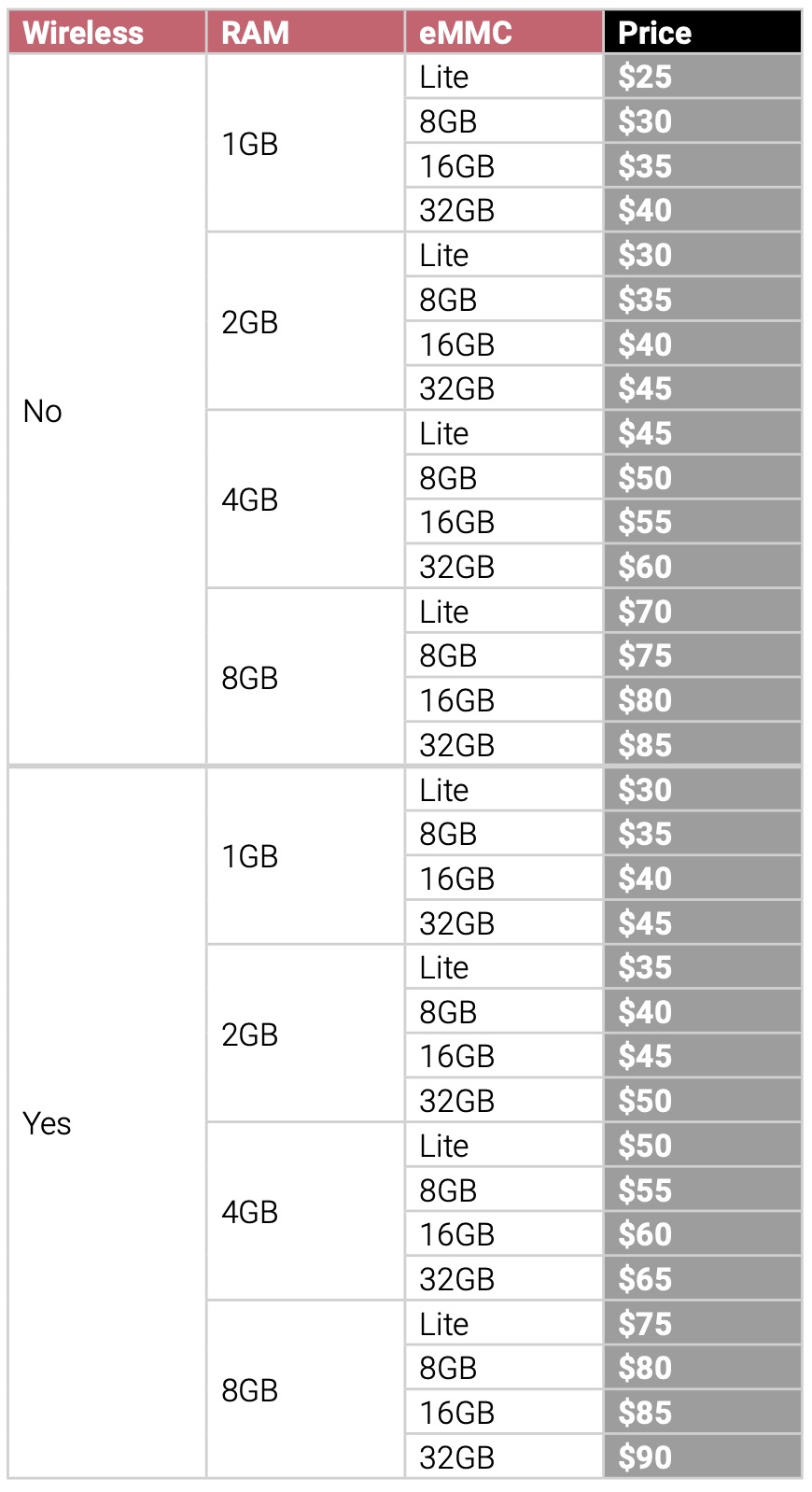
Another big change with the Compute Module 4 is that there are a ton of options. You can choose compute modules with or without wireless technologies (Wi-Fi and Bluetooth), with 1GB, 2GB, 4GB or 8GB of RAM, with 8GB, 16GB or 32GB of eMMC flash storage. There’s also a model without any eMMC flash storage in case you want to use external eMMC or the SD card interface.

You can mix-and-match those specs to keep your costs down at scale. The result is that there are 32 different versions of the Compute Module 4 ranging from $25 (no wireless, 1GB of RAM, ‘Lite’ eMMC) to $90 (wireless, 8GB of RAM, 32GB of eMMC).

The form factor has changed compared to the previous Compute Module, which means that you’ll need a new Compute Module IO Board to take advantage of all the interfaces and start developing. It costs $35.

Image Credits: Raspberry Pi Foundation


Read Full Article

Stitcher’s podcasts arrive on Pandora with acquisition’s completion


SiriusXM today completed its previously announced $325 million acquisition of podcast platform Stitcher from E.W. Scripps, and has now launched Stitcher’s podcasts on Pandora across all tiers of the streaming service. The deal brings top Stitcher titles to Pandora, including Freakonomics Radio, My Favorite Murder, SuperSoul Conversations from the Oprah Winfrey Network, Office Ladies, Conan O’Brien Needs a Friend, Literally! with Rob Lowe, LeVar Burton Reads, and WTF with Marc Maron, among others.

On Pandora, the podcasts will be indexed using the company’s proprietary Podcast Genome Project technology. This system leverages  automated technology — like natural language processing, collaborative filtering, and other machine learning approaches — then combines that with human curation to make personalized recommendations to podcast listeners on Pandora’s app.

The podcasts will also continue to be available in the Stitcher app in North America, the company says.

The Stitcher acquisition brought with it several key assets, including its own mobile listening app, which includes a premium tier of exclusives, and the Midroll Media network for podcast advertising. Stitcher also creates its own original programs and runs multiple content networks, via Earwolf.

That means SirusXM gained thousands of top podcasts with the deal’s closure. The company also now claims it has the “largest addressable audience in North America” across all categories of digital audio, including music, sports, talk, and podcasts thanks to the combination of satellite radio service SiriusXM, streaming app Pandora, and now Stitcher.

The company believes the deal will help it to attract more creators to its platform, thanks to the enhanced production, marketing, and distribution capabilities it offers, following the deal’s close. Advertisers, meanwhile, will be able to more precisely target podcasts for better ad efficiency, and will gain access to improved measurements, says SiriusXM.

In terms of Stitcher’s execs, CEO Erik Diehn will now report to Scott Greenstein, President and Chief Content Officer of SiriusXM, who also oversees content at Pandora. Stitcher’s Chief Revenue Officer, Sarah van Mosel, will report directly to John Trimble, Chief Advertising Revenue Officer of SiriusXM.

“We are deepening our position in podcasting, the fastest-growing sector in digital audio, and with completion of this transaction, our vision is taking shape,” said SiriusXM CEO Jim Meyer, in a statement about the deal’s completion. “With Stitcher and its varied assets, we are now a one-stop shop able to meet the needs of podcast creators, publishers and advertisers, while also providing listeners with access to great shows, series and programming.”

Despite the coronavirus pandemic, which disrupted many consumer trends and accelerated others, podcasting still remains one of the fast-growing digital audio industries. Podcast downloads returned to pre-COVID levels this summer, and Spotify reported that podcast consumption more doubled in Q2 and nearly a quarter (21%) of its active users now listen to podcasts.

Stitcher was not SiriusXM’s first acquisition focused on podcasts or ad technologies. It also bought podcast management platform Simplecast this June, and before that, it acquired AdsWizz for $66.3 million to power Pandora’s advertising efforts.


Read Full Article

Apple launches a U.S.-only music video station, Apple Music TV


Apple is expanding its investment in music with today’s launch of “Apple Music TV.” The new music video station offers a free, 24-hour livestream of popular music videos and other music content, including, exclusive video premieres, curated music video blocks, live shows, fan events, chart countdowns and guest appearances.

The service doesn’t have its own dedicated app, but is instead offered as a new feature within two of Apple’s existing entertainment apps. At launch, you can watch Apple Music TV from within the Browse tab of either the Apple Music app or the Apple TV app. (Accessible via apple.co/AppleMusicTV).

While Apple Music is a paid subscription service, Apple Music TV will be free to users in the U.S., the company says.

To kick off its launch, Apple Music TV today began with a countdown of the top 100 most-streamed songs ever across all of Apple Music, based on U.S. data.,

During brief tests of the new service, we found it to be a fairly basic (if uncensored) experience. The video stream only offered artist and song details at the beginning, instead of as the music played. It also didn’t take advantage of the integration with Apple Music to offer additional features to paying subscribers — like being able to favorite the song or add it to a playlist, for instance.

The stream would stop when the Apple Music app was closed, as it didn’t support background play.

Image Credits: Apple

There also weren’t any on-screen tools to share what you were watching via a social media post. You had to dig to find the “share” button under the three-dot, “more” menu. This would give you a link to tweet, but wouldn’t pre-fill it with text or hashtags, like the artist name or song.

While listening, you could stop the livestream and then return after a short pause. But after a bit, the stream would disconnect and the thumbnail of the paused music video reverts to the placeholder Apple Music TV image. When live, the text and icons will be shown in red. They revert to white when you’ve disconnected, as a visual cue.

Despite its simplicity, Apple Music TV gives Apple an immediate new home for its music-related original content, which over the years has included exclusive interviews, concert films, and more. It also provides Apple with another advantage with it goes to negotiate with artists for their premieres, as it introduces additional platform for reaching an artist’s fans — not only with the premiere itself, but by offering artists blocks of airtime leading up to their next debut that they can use to promote their releases.

The new station can also leverage content produced for the Apple Music 1 (formerly Beats 1) radio station, as it goes about running these promotions.

For example, on Thursday, October 22, Apple Music TV will promote the upcoming release of Bruce Springsteen’s “Letter to You” with music video blocks featuring his greatest videos, plus as exclusive interview with Zane Lowe, and a special livestream fan event.

Fridays, meanwhile, will focus on new music. This Friday, October 23, at 9 AM PT Apple Music TV will showcase two new exclusive video premieres – Joji’s “777” and SAINt JHN’s “Gorgeous.”

Apple Music TV’s biggest advantage, of course, is the fact that it’s freely accessible to millions of Apple device owners.

But it may struggle for traction as it lacks the features that make other livestream fan events or premieres engaging — like group chats or direct interactions with creators.

Instead, it’s more like a traditional TV broadcast — even MTV-like — compared with other online destinations where artists today connect with fans and promote their albums, like YouTube, VEVO, or more recently, Facebook, which just this year launched music videos.

Apple didn’t say if it planned to expand the new station outside the U.S.


Read Full Article

Facebook introduces a new Messenger API with support for Instagram


Following the updates to Instagram and Messenger that delivered cross-app communication and other features, Facebook today announced its Messenger API has also been updated to allow businesses to manage their communications across Instagram, in addition to Messenger.

Before today, businesses could only respond to customer inquiries through the Instagram app and through Facebook’s unified business inbox. This could work for some smaller businesses, but for larger brands with a high volume of messages, it could be difficult to be efficient this way.

The update means businesses will be able to now also integrate Instagram messaging into the applications and workflows they’re already using in-house to manage their Facebook conversations. Specifically, they’ll be able to use rich media — like photos, URL links and more — and work with developers to integrate the API with their product and customer databases to provide the same experience on Instagram as they do today on Messenger.

For example, a business with a CRM system integration would be able to view the customer loyalty information and take that into account when they respond.

Businesses using the API can also manage their Instagram presence, including their Profile, Shops and Stories, Facebook says.

Image Credits: Facebook

The change comes at a time when Instagram is pushing Shopping as a core activity on Instagram, and follows the launch of Instagram shops and visual changes to the app to highlight shopping features.

According to Facebook, daily conversations between people and businesses on Messenger and Instagram combined grew over 40% over the last year.

With the launch of the new API, Facebook is also introducing new features on Instagram that will allow businesses to respond immediately to common questions using automation, while still offering to connect customers to live support, if needed. An alpha test with partner Clarabridge on this feature indicated that client brands improved response rates on Instagram by up to 55% by managing DMs through its platform.

The updated Messenger API is launching into beta testing with businesses like Adidas, Amaro, Glossier, H&M, MagazineLuiza, Michael Kors, Nars, Sephora and TechStyle Fashion Group, among other consumer brands. The beta is also open to a limited number of developer partners. Today, other businesses and developers can join a waitlist to request access to the API post-beta.

Cross-app communication, a key part of the recent Instagram and Messenger update, is not available in the API at launch, however. For now, the messages will appear a brand’s Messenger or Instagram tab depending on where their customers are messaging from. However, Facebook confirmed it plans to “eventually” bring cross-app communication to businesses and developers in a later update.


Read Full Article

Mobile by Peak Design is a new, complete mobile mounting solution for everyday convenience


After a steady stream of successful product launches and Kickstarter campaigns, Peak Design is back with a new one – Mobile by Peak Design. The startup that created a rich ecosystem of photography and packing gear is tackling mobile devices next, and has devices a clever interconnect system that seems to have anticipated Apple’s new MagSafe magnetic phone accessory scheme – but that’s designed for all smartphones and mobile devices.

Similar to Peak Design’s Capture, Anchor and mounting plate system, Mobile by Peak Design offers a way to connect smartphones to all kinds of accessories, including tripods, car mounts, charging stands, bike handlebars and much more. The system is entered around what Peak calls its “SlimLink” connector, which is a clever combo magnetic and physical mounting receiver that you can attach to your phone either with dedicated cases, or a universal sticky-backed accessory. SlimLink then works with both soft-lock and hard-lock accessories, which use either magnets alone (soft) or magnets combined with physical catchments (hard) for varying degrees of stable connection with a line of mounts.

Peak Design is launching on Kickstarter with a crowdfunding campaign, but the product is already designed and produced to a high level of quality. It sent out media samples of a range of products in the Mobile lineup, including a SlimLink universal phone mount, a handlebar mount, the folding tripod, two magnetic/stick-backed universal mounting pads, and an in-car dashboard mount.

I’ve been using these for the past couple of weeks and have found them to be incredibly versatile and convenient. Peak also supplied an iPhone 11 Pro case, but since I’m using an iPhone 11 Pro Max, I just affixed the 3M-backed universal plate directly to my phone using the included sizing and alignment guide. The attachment is incredibly secure, and doesn’t add very much thickness to your phone at all (it basically provides just enough clearance that the iPhone 11 Pro’s camera bump barely clears table surfaces).

The magnetic connection between it and the ‘soft-lock’ mounts is strong enough that I’m never worried about them coming loose – I’ve used the general purpose magnetic mounts on my fridge often, and the phone hasn’t moved. The bike mount, with its additional physical prongs, is rock solid while actually biking around, and the arm on the mount puts the phone is a great position for acting as a navigation device while biking around, in both portrait and landscape orientations.

Peak has really outdone itself with the design of this system, but that is maybe most true when it comes to the tripod. The clever, three-legged folding design is tiny – smaller overall footprint than a credit card, though a bit thicker – and it’s amazing to be able to carry this everywhere in a pocket and have a stable platform for taking time-lapse photos. You can adjust its stability using the included Allen key, too.

The car mount has an adhesive backing for sticking to your dashboard, and fits in the recessed SlimLink slot on the phone mount/case without physically catching. It’s stable and secure in testing, and best of all, Peak has made the adjustable ball that lets you orient your phone just the right amount of stiff that you can move it but it doesn’t require any additional tightening. My one complaint thus far with the universal mount has been that it isn’t compatible with my Nomad Base Station Pro charger, though Peak says it’s testing the accessory with wireless chargers and will advise as to compatibility in future. The Peak Everyday phone case, meanwhile, is compatible with many Qi chargers.

[gallery ids="2062281,2062280,2062277,2062279,2062276,2062275,2062274,2062273,2062272,2062271,2062270,2062269,2062268,2062267,2062266,2062265,2062264,2062263,2062262,2062261,2062260,2062259,2062258,2062256,2062255,2062254,2062253"]

Peak says these designs are subject to change, and of course, MagSafe was a surprise to the company just as it was to the rest of the world. Peak still plans to create iPhone 12 cases for the range, and says that all of its soft-locking accessories will also work with both Apple MagSafe phones, as well as MagSafe cases. Apple MagSafe accessories, like the wallet, will also likewise attach to MagSafe phones.

This could’ve been one of those moments where Apple announces something that renders a competing product obsolete before it even gets to market, but Peak’s Mobile system design actually makes them complimentary – and provides very similar benefits to phones and devices that otherwise would’ve have been able to take advantage of what MagSafe offers.

The Kickstarter campaign launches today, and Peak believes it will be able to ship the Mobile system cases and accessories starting in Spring 2021.


Read Full Article

Google Cloud launches Lending DocAI, its first dedicated mortgage industry tool


Google Cloud today announced the launch of Lending DocAI, its first dedicated service for the mortgage industry. The tool, which is now in preview, is meant to help mortgage companies speed up the process of evaluating a borrower’s income and asset documents, using specialized machine learning models to automate routine document reviews.

Some of this may sound familiar, because, with Document AI, Google Cloud already offers a more general tool for performing OCR over complex documents and then extracting data from those. Lending DocAI is essentially the first vertically specialized Google Cloud service to use this technology.

“Our goal is to give you the right tools to help borrowers and lenders have a better experience and to close mortgage loans in shorter time frames, benefiting all parties involved,” writes Google product manager Sudheera Vanguri. “With Lending DocAI, you will reduce mortgage processing time and costs, streamline data capture, and support regulatory and compliance requirements.”

Google argues that its tool will have speed up the mortgage workflow process and improve the experience for borrowers, too. If you’ve ever gone through the mortgage process, you know how much time it takes to compile all of the necessary documents and how much lag there is before your bank or mortgage broker tells you that everything is in order (or not).

In addition, Google Cloud also argues that this technology can help “reduce risk and enhance compliance posture by leveraging a technology stack (e.g. data access controls and transparency, data residency, customer managed encryption keys) that reduces the risk of implementing an AI strategy.”

In many ways, this new product is a good example for Google Cloud’s current strategy under the leadership of its CEO Thomas Kurian. While it continues to develop a plethora of general services for developers at every level, it now also bundles these together to sell as complete solutions to enterprises in various verticals. That’s where Google Cloud believes it can generate the most benefit for these companies — and hence generate the most revenue. With industry solutions for retailers, telcos, gaming companies and more — and industry partners to help them get up to speed — Kurian and his team believe that they can offer solutions while its competitors focus on offering tools. So far, that strategy seems to be working out alright, with Google Cloud’s revenue growing over 43 percent in the last quarter.


Read Full Article

Pakistan lifts ban on TikTok


Pakistan Telecommunication Authority said on Monday it has lifted the ban on TikTok, 11 days after the South Asian nation’s telecom authority blocked the popular short video app in the country over problematic videos on the platform. The authority, however, warned that TikTok needs to actively moderate content on its app or else it will be permanently blocked in the nation.

The telecom authority said it was lifting the ban after engaging with TikTok’s senior management, which assured it would moderate content in accordance with “societal norms and the laws of Pakistan.” TikTok has about 20 million monthly active users in Pakistan, the authority said.

TikTok’s senior management team has also ensured that it will block users who show a repeated pattern of uploading “unlawful” content, the telecom authority said in a statement.

“The restoration of TikTok is strictly subject to the condition that the platform will not be used for the spread of vulgarity/indecent content & societal values will not be abused. PTA will be constrained to permanently block the application incase said condition is not fulfilled,” the authority warned.

Pakistan banned TikTok in the nation earlier this month and also after issuing a “final” warning to the app in July. In its warning, Pakistan had expressed serious concerns over some videos that were circulating on the platform. The nation said some videos were “immoral,” “obscene” and “vulgar.”

After the ban, TikTok had assured that it would work harder to moderate content and also offered to invest in the country if the ban were to be lifted.

The ban had also raised concerns with some (via Techmeme), who cautioned that the move was Pakistan’s ongoing attempt to enforce a top down censorship in the nation. Earlier this year, Pakistan unveiled some of the world’s most sweeping rules on internet censorship that would have severely impacted American tech firms operating in the nation. But it later retreated the rules after Facebook, Google and Twitter among other firms threatened to leave the nation.

Neighboring nation India has also banned TikTok, among hundreds of other Chinese apps. In case of India, the ban has been enforced over cybersecurity concerns. Prior to the ban, India was TikTok’s biggest market by users outside of China.


Read Full Article

Instagram’s handling of kids’ data is now being probed in the EU


Facebook’s lead data regulator in Europe has opened another two probes into its business empire — both focused on how the Instagram platform processes children’s information.

The action by Ireland’s Data Protection Commission (DPC), reported earlier by the Telegraph, comes more than a year after a US data scientist reported concerns to Instagram that its platform was leaking the contact information of minors. David Stier went on to publish details of his investigation last year — saying Instagram had failed to make changes to prevent minors’ data being accessible.

He found that children who changed their Instagram account settings to a business account had their contact info (such as an email address and phone number) displayed unmasked via the platform — arguing that “millions” of children had had their contact information exposed as a result of how Instagram functions.

Facebook disputes Stier’s characterization of the issue — saying it’s always made it clear that contact info is displayed if people choose to switch to a business account on Instagram.

It also does now let people opt out of having their contact info displayed if they switch to a business account.

Nonetheless, its lead EU regulator has now said it’s identified “potential concerns” relating to how Instagram processes children’s data.

Per the Telegraph’s report the regulator opened the dual inquiries late last month in response to claims the platform had put children at risk of grooming or hacking by revealing their contact details. 

The Irish DPC did not say that but did confirm two new statutory inquiries into Facebook’s processing of children’s data on the fully owned Instagram platform in a statement emailed to TechCrunch in which it notes the photo-sharing platform “is used widely by children in Ireland and across Europe”.

“The DPC has been actively monitoring complaints received from individuals in this area and has identified potential concerns in relation to the processing of children’s personal data on Instagram which require further examination,” it writes.

The regulator’s statement specifies that the first inquiry will examine the legal basis Facebook claims for processing children’s data on the Instagram platform, and also whether or not there are adequate safeguards in place.

Europe’s General Data Protection Regulation (GDPR) includes specific provisions related to the processing of children’s information — with a hard cap set at age 13 for kids to be able to consent to their data being processed. The regulation also creates an expectation of baked in safeguards for kids’ data.

“The DPC will set out to establish whether Facebook has a legal basis for the ongoing processing of children’s personal data and if it employs adequate protections and or restrictions on the Instagram platform for such children,” it says of the first inquiry, adding: “This Inquiry will also consider whether Facebook meets its obligations as a data controller with regard to transparency requirements in its provision of Instagram to children.”

The DPC says the second inquiry will focus on the Instagram profile and account settings — looking at “the appropriateness of these settings for children”.

“Amongst other matters, this Inquiry will explore Facebook’s adherence with the requirements in the GDPR in respect to Data Protection by Design and Default and specifically in relation to Facebook’s responsibility to protect the data protection rights of children as vulnerable persons,” it adds.

In a statement responding to the regulator’s action, a Facebook company spokesperson told us:

We’ve always been clear that when people choose to set up a business account on Instagram, the contact information they shared would be publicly displayed. That’s very different to exposing people’s information. We’ve also made several updates to business accounts since the time of Mr. Stier’s mischaracterisation in 2019, and people can now opt out of including their contact information entirely. We’re in close contact with the IDPC and we’re cooperating with their inquiries.

Breaches of the GDPR can attract sanctions of as much as 4% of the global annual turnover of a data controller — which, in the case of Facebook, means any future fine for violating the regulation could run to multi-billions of euros.

That said, Ireland’s regulator now has around 25 open investigations related to multinational tech companies (aka cross-border GDPR cases) — a backlog that continues to attract criticism over the plodding progress of decisions. Which means the Instagram inquiries are joining the back of a very long queue.

Earlier this summer the DPC submitted its first draft decision on a cross-border GDPR case — related to a 2018 Twitter breach — sending it on to the other EU DPAs for review.

That step has led to a further delay, as the other EU regulators did not unanimously back the DPC’s decision — triggering a dispute mechanisms set out in the GDPR.

In separate news, an investigation of Instagram influencers by the UK’s Competition and Markets Authority found the platform is failing to protect consumers from being misled. The BBC reports that the platform will roll out new tools over the next year including a prompt for influencers to confirm whether they have received incentives to promote a product or service before they are able to publish a post, and new algorithms built to spot potential advertising content.


Read Full Article

How To Install & Uninstall Themes In Microsoft Edge


CLICK HERE TO SEE FULL POST

The Edge Add-ons page currently offers two types of themes for Microsoft Edge browser – themes for Edge and themes for websites. A theme designed for the Edge browser changes the Edge browser’s appearance, whereas a theme intended for website changes the color of websites it is designed for. For example, a dark theme for […]

The post How To Install & Uninstall Themes In Microsoft Edge appeared first on Into Windows. Content from IntoWindows website.


Why Mid Range Budget Phones are Value for Money


As budget-conscious consumers, we grew up with the “try before you buy” purchase behavior. From shoes to now even cars, we were — and sometimes still are — given the option to try out whatever we plan to purchase before we put down the cash. However, that cannot be said about smartphones; we now prefer […]

The post Why Mid Range Budget Phones are Value for Money appeared first on ALL TECH BUZZ.


Working in Tech Even if You Don’t Code


Working in the tech field is a great choice. The demand is high, compensation levels are very competitive, and the benefits are often among the best around. If that sounds appealing, either as a starting point or transitioning mid-career, you may wonder if it is possible without having programming skills. It is very possible to […]

The post Working in Tech Even if You Don’t Code appeared first on ALL TECH BUZZ.


18 October 2020

Everything To Know About Digital Business Cards


Business cards are an essential element in the corporate world—it defines your professional identity, communicates your services, and provides contact information and reachable social accounts. As the corporate world has become increasingly digitized, however, traditional paper business cards have evolved into digital business cards. Many professionals have opted out of business cards completely, relying on […]

The post Everything To Know About Digital Business Cards appeared first on ALL TECH BUZZ.


17 October 2020

How to Request Additional Quota for your YouTube API Project


A UK based organization recently organized an online conference with 300+ participants and each of the attendees were asked to upload a video to a common YouTube channel post the event. The organizers created a YouTube uploader to make it easy for attendees to submit videos but soon ran into the quota issue with YouTube.

Let me explain.

The YouTube API website says that 1600 quota units are required to upload a single video to the YouTube website through the videos.insert method of the YouTube API. Thus, for instance, if you are expecting users to upload 100 videos to your YouTube channel in a single day, your Google Cloud project should have a quota of at least 1600 * 100 = 160,000 units.

The quota limits reset every 24 hours. New Google Cloud projects have lower quota and you’ll have to request YouTube to increase your quota if you are expecting higher number of videos.

Increase your YouTube API Quota

Here’s step by step guide that will help you get your YouTube video uploader, or any other Google Apps Project, approved for higher quota.

Configure Google Cloud Project

1. Go to console.cloud.google.com/projectcreate to create a new Google Cloud Project.

Create Google Cloud Project

2. From the menu, go to APIs and Services and chose OAuth Consent Screen. Set the type as External and click the Create button.

Oauth Consent Screen

3. Give your application a name, then click the Add Scope button and specify the list of OAuth Scopes that your Google Cloud project will require. For the uploader, we require the following Google APIs:

https://www.googleapis.com/auth/youtube.readonly
https://www.googleapis.com/auth/youtube.upload
https://www.googleapis.com/auth/script.external_request
https://www.googleapis.com/auth/script.send_mail
https://www.googleapis.com/auth/userinfo.email

OAuth Consent screen

4. Inside the API and Services section, choose Library, search for the YouTube Data API library and click Enable to enable the library for your project.

Enable YouTube API

5. Click the 3-dot menu in the upper right, choose Project Settings and make a note of the project number of your Google Cloud Project.

Google Cloud Project

Configure Google Apps Script

1. Open your Google Script, go to the Resources menu, choose Cloud Platform project and enter the project number that you have copied in the previous step.

Link Cloud Project with Apps Script

Click the “Set Project” button to link your Google Cloud Project to your Google Apps Script Project.

2. Go back to the Google Cloud project, click the API and Services section, choose Credentials and copy the OAuth client ID to the clipboard.

OAuth Client ID

Request YouTube to Increase Quota

Now that you have all the necessary data, it is time to submit your YouTube project to Google for increasing your API quota. Open this request form and fill the required details.

The API client is the same as the OAuth Client ID that you copied in the previous step. The project number is the same as your Google Cloud Project number. For the “Where can we find the API client” question, you need to provide the link of your YouTube uploader form.

Submit the form and you’ll receive a response from Google Compliance team saying they are conducting an audit.

Thanks for your response to the Quota Request. We will conduct our audit based
on the information you provided. We will notify you if additional information is
needed or when we’ve completed our review. Thank you for your cooperation.

They may have some follow-up questions and once they grant the quota (usual takes 3-4 days), you’ll receive a confirmation.

Your quota extension request has been approved based on the information you
provided and your representation that your use of YouTube API Service are in
full compliance with the YouTube API Services Terms of Service. The total quota
for project 123 is now 500,000 units / day. Please note that the quota extension
has been granted ONLY for the use-case mentioned in your quota extension request
application and we may change your quota based on your actual quota usage as
well as on your continued compliance with the YouTube API Services Terms of
Service at any time.

How to Password Protect Google Documents and PDF files in Google Drive


Introducing PDF toolbox, a new Google Drive addon that lets you password protect PDF files and Google Documents. The app can also help you unlock PDF files that are already protected with a password in your Google Drive.

Watch the video tutorial to get started.

Password Protect PDF Files

To get started, install the PDF toolbox add-on and grant the necessary authorization. The app requires access to the file that you would like to encrypt (or decrypt) and you also have an an option to send the encrypted file as an email attachment to another user.

Next, select any PDF file or Google document in your Google Drive and expand the “Encrypt PDF” section. Enter the output file name (it will also be saved in your Google Drive), provide a password and specify whether the encrypted file should allow printing and comments.

Click the Encrypt button to create a new PDF file that would require a password to open.

Password protect PDF files

The app can secure PDF files as well as Google documents, spreadsheet and presentations. In the case of native Google documents, the file is first converted to a PDF document and then encrypted with the specified password.

Please note that the Google Drive API imposes a limit of 10 MB on the size of PDF files exported from native Google documents. Thus, similar restrictions apply with the toolbox as well.

Unlock PDF files

If you a password-protect PDF file in your Google Drive, you can use the PDF toolbox to remove the password protection. The app will create a new copy of the PDF file in your Drive that will open without requiring a password.

The workflow is similar.

Select any locked PDF in Google Drive and open the PDF toolbox app in the sidebar. Expand the “Decrypt PDF” section and and type the password that was originally used to restrict access to the PDF file.

Click the Decrypt button and, if the password matches, all restrictions would be removed from the file. The unlocked, password-free PDF file would be uploaded to Google Drive as a separate file.

Remove PDF Password

How PDF toolbox works

All files in Google Drive have an export link to download the file in PDF format. The app uses the export URL to fetch the PDF version of a file in Google Cloud storage, encrypts (or decrypts) the file with the PDF library and uploads the processed file to Google Drive of the authorized user.

All downloaded files are instantly removed from the cloud storage after the PDF file has been exported. PDF toolbox is in beta stage and the pricing will be added later this month.

Also see: Remove PDF Passwords with Chrome


Chemist Eggs


Chemist Eggs

Daily Crunch: Twitter walks back New York Post decision


A New York Post story forces social platforms to make (and in Twitter’s case, reverse) some difficult choices, Sony announces a new 3D display and fitness startup Future raises $24 million. This is your Daily Crunch for October 16, 2020.

The big story: Twitter walks back New York Post decision

A recent New York Post story about a cache of emails and other data supposedly originating from a laptop belonging to Joe Biden’s son Hunter looked suspect from the start, and more holes have emerged over time. But it’s also put the big social media platform in an awkward position, as both Facebook and Twitter took steps to limit the ability of users to share the story.

Twitter, in particular, took a more aggressive stance, blocking links to and images of the Post story because it supposedly violated the platform’s “hacked materials policy.” This led to predictable complaints from Republican politicians, and even Twitter’s CEO Jack Dorsey said that blocking links in direct messages without an explanation was “unacceptable.”

As a result, the company said it’s changing the aforementioned hacked materials policy. It will no longer remove hacked content unless it’s been shared directly by hackers or those “acting in direct concert with them.” Otherwise, it will label tweets to provide context. As of today, it’s also allowing users to share links to the Post story.

The tech giants

Sony’s $5,000 3D display (probably) isn’t for you — The company is targeting creative professionals with its new Spatial Reality Display.

EU’s Google-Fitbit antitrust decision deadline pushed into 2021 — EU regulators now have until January 8, 2021 to take a decision.

Startups, funding and venture capital

Elon Musk’s Las Vegas Loop might only carry a fraction of the passengers it promised — Planning files reviewed by TechCrunch seem to show that The Boring Company’s Loop system will not be able to move anywhere near the number of people the company agreed to.

Future raises $24M Series B for its $150/mo workout coaching app amid at-home fitness boom — Future offers a pricey subscription that virtually teams users with a real-life fitness coach.

Lawmatics raises $2.5M to help lawyers market themselves — The San Diego startup is building marketing and CRM software for lawyers.

Advice and analysis from Extra Crunch

How COVID-19 and the resulting recession are impacting female founders — The sharp decline in available capital is slowing the pace at which women are founding new companies in the COVID-19 era.

Startup founders set up hacker homes to recreate Silicon Valley synergy — Hacker homes feel like a nostalgic attempt to recreate some of the synergies COVID-19 wiped out.

Private equity firms can offer enterprise startups a viable exit option — The IPO-or-acquisition question isn’t always an either/or proposition.

(Reminder: Extra Crunch is our subscription membership program, which aims to democratize information about startups. You can sign up here.)

Everything else

FAA streamlines commercial launch rules to keep the rockets flying — With rockets launching in greater numbers and variety, and from more providers, it makes sense to get a bit of the red tape out of the way.

We need universal digital ad transparency now — Fifteen researchers propose a new standard for advertising disclosures.

The Daily Crunch is TechCrunch’s roundup of our biggest and most important stories. If you’d like to get this delivered to your inbox every day at around 3pm Pacific, you can subscribe here.


Read Full Article

Google Assistant, Maps, and Search can now help you figure out where to vote


Election Day approaches! Still not sure where the nearest polling place or ballot drop box is? Google wants to help.

This morning the company rolled out a handful of features across Google Assistant, Google Maps, and Google Search, all meant to kick in when a user seems to be looking for information on voting locations.

On Google Search, for example, a search for “ballot drop boxes near me” will now bring up a dedicated tool for finding just that — punch in the address where you’re registered to vote, and it’ll help you find a drop box or polling place accordingly. The same tool will also pop up when you search for things like “how to find polling place” or “where to vote”, so there’s some flexibility in it.

Or if you’ve got an Assistant-powered device nearby (like a Nest Mini, Nest Hub, or an Android phone), you can say “Hey Google, where do I vote?” and Assistant should be able to figure it out accordingly based on your current location (with Assistant assuming, as it’ll note in its response, that your current location is where you’re registered to vote.)

The Maps integration is a bit more limited, but it gets the job done. Searching for “where do I vote” in the Google Maps mobile app results in a prompt that will toss you into the above web-based Google Search flow. Once you’ve found your location, tapping the “Directions” button will swing you back into the Maps app.

Google says it’s pulling its polling location information from the Voting Information Project as part of a partnership with Democracy Works. The company says they’ll be adding more polling places leading up until Election Day, expecting to have over 200,000 in the system when all is said and done.

Don’t want to get your polling place details from Google, or just want to double check things? There’s always sites like Vote.org (which, if you’re curious, is what Siri recommends when prompted with the “Where do I vote?” question), which also provides info on checking your voter registration status, becoming a poll worker, etc.


Read Full Article

Trump’s latest immigration restrictions are bad news for American workers


I’m an immigrant, and since arriving from India two decades ago I’ve earned a Ph.D., launched two companies, created almost 100 jobs, sold a business to Google and generated a 10x-plus return for my investors.

I’m grateful to have had the chance to live the American dream, becoming a proud American citizen and creating prosperity for others along the way. But here’s the rub: I’m exactly the kind of person that President Trump’s added immigration restrictions that require U.S. companies to offer jobs to U.S. citizens first and narrowing the list of qualifications to make one eligible for the H-1B visa, is designed to keep out of the country.

In tightening the qualifications for H-1B admittances, along with the L visas used by multinationals and the J visas used by some students, the Trump administration is closing the door to economic growth. Study after study shows that the H-1B skilled-worker program creates jobs and drives up earnings for American college grads. In fact, economists say that if we increased H-1B admittances, instead of suspending them, we’d create 1.3 million new jobs and boost GDP by $158 billion by 2045.

Barring people like me will create short-term chaos for tech companies already struggling to hire the people they need. That will slow growth, stifle innovation and reduce job creation. But the lasting impact could be even worse. By making America less welcoming, President Trump’s order will take a toll on American businesses’ ability to attract and retain the world’s brightest young people.

Consider my story. I came to the United States after earning a degree in electrical engineering from the Indian Institute of Technology (IIT), a technical university known as the MIT of India. The year I entered, several hundred thousand people applied for just 10,000 spots, making IIT significantly more selective than the real MIT. Four years later, I graduated and, along with many of the other top performers in my cohort, decided to continue my studies in America.

Back then, it was simply a given that bright young Indians would travel to America to continue their education and seek their fortune. Many of us saw the United States as the pinnacle of technological innovation, and also as a true meritocracy — somewhere that gave immigrants a fair shake, rewarded hard work and let talented young people build a future for themselves.

I was accepted by 10 different colleges, and chose to do a Ph.D. at the University of Illinois because of its top-ranked computer science program. As a grad student, I developed new ways of keeping computer chips from overheating that are now used in server farms all over the world. Later, I put in a stint at McKinsey before launching my own tech startup, an app-testing platform called Appurify, which Google bought and integrated into their Cloud offerings.

I spent a couple of years at Google, but missed building things from scratch, so in 2016 I launched atSpoke, an AI-powered ticketing platform that streamlines IT and HR support. We’ve raised $28 million, hired 60 employees and helped companies including Cloudera, DraftKings and Mapbox create more efficient workplaces and manage the transition to remote working.

Stories like mine aren’t unusual. Moving to a new country takes optimism, ambition and tolerance for risk — all factors that drive many immigrants to start businesses of their own. Immigrants found businesses at twice the rate of the native born, starting about 30% of all new businesses in 2016 and more than half of the country’s billion-dollar unicorn startups. Many now-iconic American brands, including Procter & Gamble, AT&T, Google, Apple, and even Bank of America, were founded by immigrants or their children.

We take it for granted that America is the destination of choice for talented young people, especially those with vital technical skills. But nothing lasts forever. Since I arrived two decades ago, India’s tech scene has blossomed, making it far easier for kids to find opportunities without leaving the country. China, Canada, Australia and Europe are also competing for global talent by making it easier for young immigrants to bring their talent and skills, often including an American education, to join their workforces or start new businesses.

To shutter employment-based visa programs, even temporarily, is to shut out the innovation and entrepreneurialism our economy desperately needs. Worse still, though, doing so makes it harder for the world’s best and brightest young people to believe in the American dream and drives many to seek opportunities elsewhere. The true legacy of Trump’s executive order is that it will be far harder for American businesses to compete for global talent in years to come — and that will ultimately hamper job creation, slow our economy and hurt American workers.


Read Full Article

Engageli comes out of stealth with $14.5M and a new approach to teaching by video remotely


Zoom, Microsoft Teams and Google Meet have become standard tools for teachers who have had to run lessons remotely since the start of the Covid-19 pandemic. But they’re not apps necessarily designed for classrooms, and that fact has opened a gap in the market for those looking to build something more fit to the purpose.

Today, a startup called Engageli is coming out of stealth with a service that it believes fills that need. A video conferencing tool designed from the ground up more as a digital learning platform, with its own unique take on virtual classrooms, Engageli is aiming first at higher education, and it is launching with $14.5 million in seed funding from a Benchmark partner and others.

If that sounds like a large seed round for a startup that is still only in pilot mode (you can contact the company by email to apply to join the pilot), it might be due in part to who is behind Engageli.

The startup is co-founded by Dan Avida, Serge Plotkin, Daphne Koller and Jamie Nacht Farrell. Avida is a general partner at Opus Capital who in the past co-founded (and sold, to NetApp) an enterprise startup called Decru with Plotkin, who himself is a Stanford emeritus professor. Koller is one of the co-founders of Coursera and also an adjunct professor at Stanford. And Farrell is a former executive from another pair of major online learning companies, Trilogy and 2U.

Avida and Koller, as it happens, are also married, and it was observing their kids in the last school year — when they were both in high school (the oldest is now in her first year at UC Berkeley) — that spurred them to start Engageli.

“The idea for this started in March when our two daughters found themselves in ‘Zoom School.’ One of them watched a lot of Netflix, and the other, well, she really improved her high scores in a lot of games,” he said wryly.

The problem, as he and Koller saw it, was that the format didn’t do a good enough job of connecting with individual students, checking in with them to make sure they were paying attention, understanding, and actually interested in what was being taught.

“The reason teachers and schools are using conferencing systems is because that was what was out there,” he said. But, based on the team’s collective experiences across past e-learning efforts at places like Coursera — which built infrastructure to run university courses for mass audiences online — and Trilogy and 2U (which are now one company that covers both online learning for universities and boot camps), “we thought we could build a better system from the ground up.”

Even though the idea was inspired by what the pair saw playing out with their high school-attending children, Engageli made the decision to focus first on higher education because that was where it was getting the most interest from would-be customers to pilot the service. But also, Avida believes that because higher ed not already has a big market for remote learning, it represents a more significant opportunity.

“K-12 schools will eventually go back to normal,” he said, “but we’re of the opinion that higher education will be a blend with more and more online learning,” one of the reasons also for the founding of the likes of Coursera, Trilogy and 2U. “Younger kids need face-to-face contact, but in college, many students are now juggling work, family and studying, and online can be much more convenient.”

Also there is a very practical selling point to providing better tools to university classrooms: “People pay those tuitions to have access to professors and other students, and this is a way to provide that in a remote world,” he said.

[gallery ids="2060568,2060569,2060570"]

As it appears now, Engageli lets teachers build and run both synchronous (live) and asynchronous (recorded) lessons, giving students and teachers the option to catch up or replace a live lesson if necessary.

The startup’s idea is also to make it as easy to integrate into existing workflows as possible: no need to install special desktop or mobile apps, as the platform works in all major browsers, and Avida notes that it’s also designed to integrate with the software systems that many universities are already using to organise their educational content and track students’ progress. (Making the barrier to entry low is not a bad idea also considering that many institutions are already using other products, making them more entrenched and increasing the challenges of getting them to migrate to something else.)

But perhaps Engageli’s most unique feature is how it views the virtual classroom.

The platform lets teachers create “tables” where students sit together in smaller groups, where they can work together. With tables, the idea is that either an instructor — or in the case of large classes as you might get with university seminars, teaching assistants assigned to tables — can engage with students in a more personalised way.

When a class is delivered asynchronously (that is, recorded), it means that students sitting at a table can still partly be involved in a “live” experience where they can talk about the work with others in their groups. The tables are also opened up before a class starts, and students can go from one to the other to chat with others before the class begins.

On top of the tools that Engageli has built to record and consume lessons, it’s also building a set of analytics that lets professors (or their assistants) monitor how well audio and video and working both for themselves as we as for their audience, and also collect other kinds of “engagement” information, which could come in the form of getting people to ask or answer questions or take polls and other interactive media.

Together, these features create better feedback to make sure that everyone is getting as much out of the remote experience as possible.

Education has not always been one of the buzziest areas in the world of startups — it’s been something of a boring cousin to more headline-grabbing segments like social media, or those taking on giants like Amazon and Google.

But the pandemic has thrown a spotlight on the opportunities in the field, both to fill a sudden surge of demand for remote learning tools, and to create more innovative approaches to doing so, as Engageli is doing here.

Just yesterday, Kahoot — a platform for building and using gamified learning apps — raised $215 million from SoftBank; and other recent rounds have included Outschool (which raised $45 million and is now profitable), Homer (raised $50 million from an impressive group of strategic backers), Unacademy (raised $150 million) and the Indian juggernaut Byju’s (most recently picking up $500 million from Silver Lake).

On top of the recent spotlight on education, it’s also been interesting to see the proliferation of startups that are also coming out of the woodwork to provide new takes on videoconferencing.

Last week, a startup called Headroom — also started by already-successful entrepreneurs — launched with an AI-driven alternative to Zoom and the rest providing not just automatic transcriptions of conversations, but automatically generated highlights and insights into how engaging your webinars and other video content really was.

Apps like Headroom and Engageli are just the tip of the iceberg, with other innovative approaches also stepping out and raising significant funding. The big question will be whether they will get much attention and time from would-be customers who are already “happy enough” with what they already use.

But in a tech world that thrives on the concept of disruption and companies creating businesses out of simply being better approaches to entrenched markets, it’s a bet worth making.

“Dan, Serge and Daphne have repeatedly built fast-growing, extremely successful companies. I am so fortunate to be working with them again,” said Alex Balkanski, a partner at Benchmark who is investing individually, in a statement. “Investing in a company linked to education is incredibly important to me on a personal level, and Engageli has the potential to enable a truly transformative learning experience.”

Updated to clarify that Balkanski is investing privately, not through Benchmark.


Read Full Article