05 September 2020

How Do Online Casinos Entice Players To Spend More?


The design and features of online casinos have a systematic function to keep you hooked and spending your money. Some of the strategies these casinos employ are obvious, but there are craftier facets, too. All of it plays on your psychology, making you feel comfortable, important, and positive. Let’s explore some of the tactics that […]

The post How Do Online Casinos Entice Players To Spend More? appeared first on ALL TECH BUZZ.


Daily Crunch: Peloton might expand its product lineup


Peloton’s product lineup is both getting cheaper and more expensive, Nintendo announces a new retro device and Palantir reveals more about its governance plans. This is your Daily Crunch for September 4, 2020.

The big story: Peloton might expand its product lineup

Peloton is preparing to add new products at both ends of its pricing range, according to a report in Bloomberg.

Specifically, it’s planning to add an entry-level treadmill that would retail for less than $3,000, as well as a higher-end bike, called the Bike+, which could serve as a centerpiece for a home gym that also supports strength training and other workouts. Meanwhile, Peloton would also drop the price for its existing bike to under $1,900.

Altogether, this sounds like a smart way to both lower the price of entry while also creating new products for people who don’t feel safe going to the gym (assuming it’s open at all) during the pandemic.

The tech giants

Nintendo is remaking the first portable gaming system it ever built —  For nearly a decade before Nintendo released the iconic Game Boy, it was making the Game & Watch, which it’s now planning to re-release in a limited edition.

WhatsApp reveals six previously undisclosed vulnerabilities on new security site — The vulnerabilities are being reported on a new, dedicated security advisory website.

Google pushes Europe to limit ‘gatekeeper’ platform rulesGoogle has made its pitch to shape the next decades of digital regulation across the European Union.

Startups, funding and venture capital

In amended filing, Palantir admits it won’t have independent board governance for up to a year — Palantir’s model is unique in allowing founders to have a commanding vote even if they were to sell their shares.

Yandex spins out self-driving car unit from its Uber JV, invests $150M into new company — The move comes amid reports that Yandex and Uber were eyeing up an IPO for their joint venture MLU last year.

Teemyco creates virtual offices so you can grab a room and talk with colleagues — The company wants to foster spontaneous interactions and casual collaboration with a room-based interface.

Advice and analysis from Extra Crunch

3 views on the future of geographic-focused funds — Natasha Mascarenhas, Danny Crichton and Alex Wilhelm of the TechCrunch Equity crew discuss the future of geographic-focused funds, given the uptick of remote investing.

Brands that hyper-personalize will win the next decade — Personalizing the experience is a start, but it isn’t the end.

(Reminder: Extra Crunch is our subscription membership program, which aims to democratize information about startups. You can sign up here.)

Everything else

Stocks are selling off again, and SaaS shares are taking the biggest lumps — Stocks, it turns out, can go down, and they can do so very quickly.

Low-cost fitness bands see a resurgence in interest amid the pandemic — While wearable fitness devices saw an uptick in shipments in North America for Q2, the overall dollar amount of the market remained steady, according to new numbers out of Canalys.

NSA’s Anne Neuberger to talk cybersecurity at Disrupt 2020 — Neuberger took the helm at the NSA’s newly created Cybersecurity Directorate a year ago.

The Daily Crunch is TechCrunch’s roundup of our biggest and most important stories. If you’d like to get this delivered to your inbox every day at around 3pm Pacific, you can subscribe here.


Read Full Article

3 Easy Ways to Track A Cell Phone Location


Modern technology has revolutionized everything, things got easy and smarter. If we talk about tracking someone’s phone location, the first thing that comes in our mind is that tracing location can only be done by agencies or different authorities. Tracking down a phone location sounds impossible for a common person because there is a lot […]

The post 3 Easy Ways to Track A Cell Phone Location appeared first on ALL TECH BUZZ.


Local governments that embrace digital services during challenging times can make real change happen


It has been a hard year. We wake up every morning to new developments in the tragedies of the moment spanning a pandemic, the greatest unexpected loss of life since 9/11, national civil unrest, natural disasters and a looming economic collapse.

In the face of these developments, a completely understandable message from government agencies to the public might be: We can’t serve you right now. Please take a number and we’ll get back to you as soon as possible.

But as we know now, this is an unacceptable path to successfully, and proactively, addressing the increasing needs of citizens facing public health risk and economic uncertainty. In fact, in the past few months, Americans have exhibited an unquenchable thirst for fast, effective government services and information. Resident demands of local government and community organizations are rising. Their voices are louder than ever before. People are bringing a new civic experience to the forefront of local governments that’s delivered on their terms — and aligned with growing demand for always-on, 24/7 information and services.

A hallmark of 2020 (so far) has been global developments impacting people at a very local level. For instance, a pandemic sparked a massive shift in American civic engagement around issues like public health and racial equality. The past few months have reinforced what the real power of local government is: To efficiently offer services and information that directly impact people’s lives. For cities and municipalities, the question now becomes: How can local leaders embrace this new era of civic engagement in the world of COVID-19 to deliver digital solutions that help everyone meet the moment?

Build a digital public square for the people

In the United States, the COVID-19 pandemic has literally closed city halls and forced government agencies at all levels to rethink modernizing public sector work to digitally and equitably deliver citizen services. Mayors, city council members and local agency officials, in particular, need to embrace this complex moment in time as an opportunity to cultivate a more vibrant, straightforward, inclusive and participatory municipal experience. One way to do that is to invest in digital tools, technologies and talent that can help local governments develop online civic engagement and citizen service outlets. Platforms that not only offer needed government services, but also prioritize input from residents and encourage community dialogue guided by clarity, trust and accountability.

Service has always been at the core of local government. However, a main challenge facing public sector leaders today is how to transfer critical services online. More specifically, developing online services that allow people who no longer have the luxury of waiting in lines for in-person interactions to remotely register to vote, obtain or renew a permit, report downed power lines and more.

A recommended path toward solution(s): At the end of the day, citizens are consumers. They want around-the-clock access to government services and options for ways to interact with service providers that meet their needs while taking their personal comfort into account. For local government agencies in the midst of digital transformation, building convenience into in-house digital government offerings and solution procurements is crucial. Digital government service solutions must be designed — by agencies or contracted vendors — to be platform and device agnostic (or, at least, interchangeable) on the back end; taking an omnichannel approach that addresses the needs of citizens and agencies through web, mobile, social media and offline options on the front end.

Bring the value of local government home

An increased online presence of community members and remote workers during the pandemic offers municipalities a fresh and cost-effective opportunity to advance local government digital service. Until recently, seemingly table stakes actions like producing photos for identification cards, scanning important documents, digitizing forms and streamlining workflows and case management were only plausible if large government teams had the budget to purchase required technologies separately, then stitch them together. Budget and capacity-constrained communities were largely left in the dark.

The good news is that today’s cloud-based solutions are complete, affordable and scalable to communities of all sizes. The market features solutions that are purpose-built for local governments to integrate with legacy IT systems while transitioning traditionally in-person services to digital interactions. And it’s possible to tap these solutions to fuel America’s new, more active brand of civic engagement and service citizens rapidly.

Further, the advent of accessible and affordable (or free) digital engagement platforms now complements an expanding recognition among American society that truly impactful things can come from government sources. The shift in thinking has produced civic engagement defined not by a sprint to profits, as is the case in the private sector, but by the ability for a representative community to actually influence policy and shape citizen services delivery.

A recommended path toward solution(s): In addition to always-on capabilities, digital government platforms need to be able to deliver goods and services to citizens directly and without friction. Whether accessing a government assistance application or applying for a park permit, citizens want their requests fulfilled without complications or inefficiencies plaguing the process — and going all-virtual or mostly remote during COVID-19 has made this more important than ever. In response, agencies should invest in the creation of digital forums for two-way communication to capture feedback that accurately reflects the demands and needs of the local community at the individual household level.

Boost digital forum accountability and representation moving forward

Today’s elevated energy around civic engagement is a direct result of the pandemic, expanding consumer activism and recent protests against systemic injustice. This confluence of factors offers local governments a fleeting opportunity to move beyond simply observing vocal citizen activity across the country. There’s now an opening to build upon, and actively grow, levels of civic engagement and community trust over time.

It’s now possible for local governments to reach more citizens by expanding their networks of interested subscribers and combat misinformation while keeping every resident informed. Agencies can advance on both fronts by providing civic leaders a two-way forum that encourages them to share progress being made in policy and procedures. After all, interacting with governments should be as simple and transparent for everyone as checking a bank account balance or reordering coffee pods from Amazon.

A recommended path toward solution(s): Municipalities should jump at this chance to really listen to diverse community voices pushing for change — especially as some powerful people in government and society seek to quiet or ignore them. They should consider developing long overdue digital solutions that amplify diverse community voices, deliver critical services and help to inform people broadly. Citizens, for their part, should be able to easily provide feedback, share ideas and voice their pressing needs to public sector officials or representatives who can help residents feel secure, listened to and taken care of. Expanded civic engagement impact entails reaching more people through their preferred channels, whether that’s email, text or snail mail, and establishing a dialogue that converts to action.

I’m confident that local governments throughout the country can rise to today’s unprecedented challenges by providing digital civic engagement outlets built to elevate individual perspectives on policy issues and surface life experiences that, in turn, inform inclusive civic action and real change.


Read Full Article

How ClickFunnels Can Help You Increase Revenue Overnight


Just as any entrepreneur, you are probably eager to see your company blossom into a successful business. But in order for that to happen, you need to pour in countless hours of work, a stellar business strategy to increase sales and a solid marketing plan to attracts more customers. But what if there was a […]

The post How ClickFunnels Can Help You Increase Revenue Overnight appeared first on ALL TECH BUZZ.


University COVID Model


University COVID Model

Media Roundup: Patreon joins unicorn club, Facebook could ban news in Australia, more


Welcome to the very first edition of Extra Crunch’s Media Roundup. Over the past few months, we’ve launched features like Decrypted, Deep Science and The Exchange, which aggregate and analyze the latest news in a given sector, so it seemed overdue to do something similar for media.

The goal is to provide a regular update on what entrepreneurs in the content or advertising business should be thinking about. That doesn’t just mean startup funding — we’ll track the broader landscape, including platform policies that could affect everyone — which is just as important as knowing who’s getting checks.

If you have any thoughts on what you’d like to see included in future roundups, please let me know in the comments below.

Let’s get started.

Facebook may ban news sharing in Australia

This is part of an ongoing dispute between Facebook and the Australian government, which has created a plan that would require Facebook and Google to share revenue with Australian news publishers whose content appears on their services. Both companies have a complicated relationship with the news business, with many publishers both relying on large platforms for traffic while also resenting the fact that those platforms take the vast majority of digital ad revenue.

In an attempt to improve that relationship, Google and Facebook have committed in recent years to investing hundreds of millions of dollars in journalism — and while those efforts are commendable, it’s worth asking whether publishers should be entitled to more by law, not just as a gift.


Read Full Article

04 September 2020

Tinder’s interactive video event ‘Swipe Night’ will launch in international markets this month


Tinder’s “Swipe Night” is going global. The dating app announced today that its interactive video series will be available in Asia and other international markets starting on September 12, giving users another way to connect as they continue to stay at home because of the COVID-19 pandemic.

As in the United States, where “Swipe Night” first launched last October, the international version of “Swipe Night” will be broadcast on the weekend. For audiences outside the U.S., three consecutive episodes are planned, starting with the first one on September 12 from 10 a.m. to midnight, and airing on consecutive Saturdays at the same time.

Similar to Netflix’s “Black Mirror: Bandersnatch” and other interactive entertainment, “Swipe Night” presents viewers with a “choose-your-own-adventure” narrative, but each of its episodes is only seven minutes long and users’ choices are added to their profile, giving them another way to figure out if someone is a good match.

“Swipe Night” is not the first in-app event that Tinder has introduced over the past couple of years to increase user engagement as it competes with other dating apps for younger users. Other examples, held last year before the pandemic, included Spring Break mode and Festival Mode, which helped members in the United States find other people who were headed to the same vacation destinations or events.

Now that COVID-19 has made in-person meetups less safe, “Swipe Night” has become an important part of Tinder’s business strategy as it, and its competitors, focus on organizing more virtual events and hangouts. In today’s announcement, Tinder said during stay-at-home orders and social distancing, 52% more messages have been sent through the app globally, peaking on April 5, and “swipe volume” by users under 25 (or “Gen Z”) increased by 34%.

As a user engagement experiment, “Swipe Night” proved successful enough in the U.S. to warrant a second season even before stay-at-home orders started there. When it launched last fall, Tinder’s monthly usage was climbing, but users were opening the app less on a daily basis. By the time Tinder announced the second season of “Swipe Night” in February, Tinder said millions of users had tuned into the series and matches and conversations had increased by 26% and 12%, respectively.

“When lockdowns began, we saw an immediate increase in our members’ engagement on Tinder, so we know we play an important role in their stay-at-home experience. While the global health crisis continues, we believe ‘Swipe Night’ can bring a welcome change of pace to our members around the world,” said Tinder chief executive officer Jim Lanzone in today’s announcement.

Now Tinder will find out if audiences in the rest of the world, where its competes with a large roster of other dating apps, will respond to “Swipe Night” with the same level of enthusiasm. Tinder doesn’t break down its member numbers by country, but its APAC head of communications Papri Dev told TechCrunch that more than 50% of its members worldwide are Gen Z, the main audience for “Swipe Night,” and storylines are designed to provoke conversations.

“Having a high stakes story such as an apocalyptic themed event, felt like a strong forcing mechanism to make your choices or decisions really count,” she said. “Our members who are stuck at home are hungry for content, and based on what we’ve seen take off on other platforms, people seem to be open to a wide range of tones and topics. So we wanted to make Swipe Night available to our members in Asia, and around the world, as soon as we felt it would be appropriate.”

Content in Asian markets including Korea, Taiwan, Japan, Thailand, Vietnam and Indonesia will have subtitles in local languages.


Read Full Article

4 steps to ending extreme poverty | Shameran Abed

4 steps to ending extreme poverty | Shameran Abed

At least 400 million people worldwide live in ultra-poverty: a state of severe financial and social vulnerability that robs many of hope and dignity. At BRAC, an international development organization focused on fighting poverty, Shameran Abed and his team have developed a sustainable, multi-faceted program that has already helped millions lift themselves out of poverty and create lives full of possibility. Learn more about their audacious plan to partner with governments to bring this life-changing program to an additional 21 million people in the next six years. (This ambitious plan is a part of the Audacious Project, TED's initiative to inspire and fund global change.)

https://ift.tt/32Siysw

Click this link to view the TED Talk

Peloton said to be launching new, cheaper treadmill and higher-end stationary smart bike


Peloton is reportedly getting ready to add to its product lineup with two new products at either end of its pricing spectrum, according to Bloomberg. The workout tech company is planning both a cheaper, entry-level smart treadmill, and a higher-end version of its stationary exercise bike, with an announcement set to take place as early as sometime next week in time for its quarterly financial earnings.

The new products would come alongside a price drop for its existing exercise bike, to a price point under $1,900 according to the report. While the new ‘Bike+’ will retail for more than the current price of the existing model, the price drop will help Peloton stoke the high demand for its products resulting from the closure of gyms and social distancing measures instituted in response to the COVID-19 pandemic.

Peloton’s new ‘Tread’ treadmill will retail for under $3,000, according to Bloomberg’s sources, which is a considerable discount vs. the $4,295 asking price for the existing model. That one will remain on sale as a premium offering, and the new version will reportedly more closely resemble a traditional home treadmill in terms of materials and construction, allowing for the cheaper asking price.

The new, upscale Bike+ model will also reportedly feature a repositionable smart display, which will help it serve as the centerpiece of a more comprehensive home gym that includes strength training and other kinds of guided workouts. Peloton’s hardware products are what helped distinguish it in the exercise market, but it has built another strong business on subscription plans and app-guided workouts, which are available with or without its home gym equipment.

The new treadmill will likely go to market before the upgraded smart bike, in terms of availability, according to the report. Peloton’s main blocker for customer base expansion is probably its relatively high point of entry, in terms of its in-house hardware, so that makes a lot of sense if the company is looking to capitalize on general consumer appetite for at-home fitness solutions during the COVID-19 crisis.


Read Full Article

Qualcomm-powered Chinese XR startup Nreal raises $40 million


Nreal, one of the most-watched mixed reality startups in China, just secured $40 million from a group of high-profile investors in a Series B round that could potentially bring more adoption to its portable augmented headsets.

Kuaishou, the archrival to TikTok’s Chinese version Douyin, led the round, marking yet another video platform to establish links with Nreal following existing investor iQiyi, China’s own Netflix. Like other major video streaming sites around the world, Kuaishou and iQiyi have dabbled in making augmented reality content, and securing a hardware partner will no doubt be instrumental to their early experiments.

Other backers in the round with plentiful industry resources include GP Capital, which counts state-owned financial holding group Shanghai International Group and major Chinese movie studio Hengdian Group as investors; CCEIF Fund, set up by state-owned telecom equipment maker China Electronics Corporation and state-backed investment bank China International Capital Corporation; GL Ventures, the early-stage fund set up by prominent private equity firm Hillhouse Capital; and Sequoia Capital China.

That’s not it. In early 2019, Nreal brought onboard Xiaomi founder’s venture fund Shunwei Capital for its $15 million Series A funding. As I wrote at the time, AR, VR, MR, XR — whichever marketing coinage you prefer — will certainly be a key piece in Xiaomi’s Internet of Things empire. It’s not hard to see the phone titan sourcing smart glasses from Nreal down the road.

The other key partner of Nreal, a three-year-old company, is Qualcomm. The chipmaker has played an active part in China’s 5G rollout, powering major Chinese phone makers’ next-gen handsets. It supplies Nreal with its Snapdragon processors, allowing the startup’s lightweight mixed reality glasses to easily plug into an Android phone.

“Its closer partnership with Qualcomm will allow it to access Qualcomm’s network of customers including telecoms companies,” Seewan Toong, an industry consultant on AR and VR, told TechCrunch.

Indeed, the mixed reality developer has already signed a deal with Japanese telco KDDI and in Korean, it’s working with LG’s cellular carrier LG Uplus Corp.

The latest round brings Nreal’s total raise to more than $70 million and will accelerate mass adoption of its mixed reality technology in the 5G era, the company said.

It remains to be seen how Nreal will live up to its promise, secure users at scale, and move beyond being a mere poster child for tech giants’ mixed reality ambitions. So far its deals with big telcos are in a way reminiscent of that of Magic Leap, which has been in a legal spat with Nreal, though the Chinese company appears to burn through less cash so far. The troubled American company is currently pivoting to relying on enterprise customers after failing to crack the consumer market.

“Nreal is patient and not in a rush to show they can start selling high volume. It’s trying to prove that there’s a user scenario for its technology,” said Toong.


Read Full Article

Google pushes Europe to limit ‘gatekeeper’ platform rules


Google has made its pitch to shape the next decades of digital regulation across the European Union, submitting a 135-page response yesterday to the consultation on the forthcoming Digital Services Act (DSA) — which will update the bloc’s long-standing rules around ecommerce.

The package also looks set to introduce specific rules for so-called “gatekeeper platforms” which wield outsized market power thanks to digital network effects. Hence Mountain View’s dialled-up attention to detail.

The lion’s share of Google’s submission focuses on lobbying against the prospect of ex ante regulation for such platform giants — something the European Commission has nonetheless signalled is front of mind as it looks at how to rein in platform power.

This type of regulation intervention aims to identify competitive problems and shape responses ‘before the event’ via the application of obligations on players who hold significant market power vs after the fact competition enforcement when market harm has been established.

“A blanket approach to ex ante competition regulation could have unintended consequences on user experience as well as multiplying costs for European businesses,” it writes, urging lawmakers to take a long, hard look at existing regulation to see if it’s not able to do the job of ensuring markets are “working properly”.

“Where the evidence shows meaningful gaps, the next step ought to be to consider how one can modernise those existing rules and procedures to address the underlying concerns before turning to consideration of new and distinct regulatory frameworks,” it adds.

If EU lawmakers must go ahead with ex ante regulation of platforms giants, Google — an adtech giant — is especially keen that they do not single out any specific business models. So it definitely wouldn’t be a fan of ex ante regs applied only to surveillance-fuelled ad-targeting platforms. Funny that. 

“The criteria for identifying ‘gatekeeper power’ should be independent of the particular business model that a platform uses, making no distinction as between platforms that operate business models based on advertising, subscriptions, sales commissions, or sales of hardware,” Google writes.

“Digital platforms often operate using different business and monetization strategies, across multiple markets, geographies, and sectors, with varying degrees of competitive strength in each. Regulators should not favor or discriminate against any business, business model, or technology from the outset,” it goes on.

“In certain sectors, the platform may have market power; in others, it may be a new entrant or marginal player. The digital ecosystem is extremely diverse and evolving rapidly and it would be misguided for gatekeeper designations to be evaluated by reference to the position of an entire company or corporate group.”

Nor should lawmakers opt for what Google dubs “an overly simplistic” assessment of what constitutes a gatekeeper — giving the example of number of users as an inadequate way to determine whether a platform giant has significant market power in a given moment. (Relevant: Google market share of search in Europe exceeds 90%.)

“Recent competition enforcement demonstrates the range of platforms that have been found to have market power (e.g., Microsoft, Google, Facebook, Amazon, and Apple) and other platforms may be found to have market power in the future (borne out, for example, by the UK CMA’s investigation into online auction platform services),” it writes. “The gatekeeper assessment should therefore recognize that a range of platforms — operating a range of different business models (e.g., ad-funded, subscription-based, commission-based, hardware sales) — may hold ‘market power’ in different circumstances and vis-à-vis different platform participants.”

The tech giant can also be seen pushing a familiar talking point when its business is accused of profiting, parasitically, off of others’ content — by suggesting that when regulators are assessing whether a platform is a gatekeeper or not by considering the economic dependence of traditional businesses on a limited number of online platforms they should look favorably on those platforms “through which a materially significant proportion of business (e.g. in the form of highly valuable traffic) is channeled”.

But of course it would say that clicks are just as good as all the ad dollars it’s making.

Google is also pushing for regular review of any gatekeeper designations to ensure any obligations keep pace with fast-moving markets and competition shifts (it points to the recent rise of TikTok by way of example).

It also doesn’t want gatekeeper designations to apply universally across all markets — arguing instead they should only apply in the specific market where a platform is “found to have ‘gatekeeper’ power”.

“Large digital platforms tend to operate across multiple markets and sectors, with varying degrees of competitive strength in each,” Google argues, adding that: “Applying ex ante rules outside these markets would create a risk of deterring pro-competitive market entry through excessive regulation, thereby depriving SMEs and consumers of attractive new products.”

That would stand in contrast to the EU’s modus operandi around competition law enforcement — where a business that’s been judged to be dominant in one market (like Google is in search) has what competition chief Margrethe Vestager likes to refer to as a “special responsibility” not to abuse its market power to leverage that advantage in any other market, not only the one it’s been found to hold most of the market power.

At the same time as Google is lobbying for limits on any gatekeeper designations, the tech giant wants to see certain types of rules applied universally to all players. Here it gives the examples of privacy, transparency (such as for fees) and ranking decisions.

Data portability is another area it’s urging rules to be applied industry-wide.

It also wants to see any online ad rules applied universally, not just to gatekeeper platforms. But it’s also very keen for hard limits on any such rules.

“It will be important that any interventions seeking to achieve more transparency and accountability are carefully designed to avoid inadvertently hampering the ability of online advertising tools to deliver the value that publishers and advertisers have come to expect,” the adtech giant writes, lobbying to reduce the amount of transparency and accountability set down in law by invoking claims of privacy risks to user data; threats to commercial IP; and ‘bad actors’ gaming the system if it’s not allowed to continue being (an ad-fraud-tastic) blackbox.

“Consideration of these measures will therefore require the balancing of factors including protection of users’ personal data and partners’ commercially sensitive information, and potential harm to users and competition through disclosure of data signals that allow ‘bad actors’ to game the system, or rivals to copy innovations. We stand ready to engage with the Commission on these issues,” Google intones.

On updating ecommerce rules and liability — which is a stated aim of the DSA plan — Google is cautiously supportive of regulatory changes to reflect what it describes as “the digital transformation of the last two decades”. While pushing to retain core elements of the current e-Commerce Directive regime, including the country-of-origin principle and freedom to provide cross-border digital services. 

For example it wants to see more expansive definitions of digital services, to allow for more specific rules for certain types of businesses — pushing for a move away from the ‘active’ and ‘passive’ hosts distinction for platforms, to enable them to respond more proactively in a content moderation context without inviting liability by doing so, but suggesting hosting services may be better served by retaining the current regime (Article 14 of the e-Commerce Directive).

On liability for illegal content it is lobbying for see clear lines between illegal material and what’s “lawful-but-harmful”.

“Where Member States believe a category of content is sufficiently harmful, their governments may make that content illegal directly, through democratic processes, in a clear and proportionate manner, rather than through back-door regulation of amorphously-defined harms,” it writes.

It also wants the updated law to retain the general prohibition on content monitoring obligations — and downplays the potential of AI to offer any ‘third way’ there.

“While breakthroughs in machine learning and other technology are impressive, the technology is far from perfect, and less accurate on more nuanced or context-dependent content. Their mandated use would be inappropriate, and could lead to restrictions on lawful content and on citizens’ fundamental rights,” Google warns. “The DSA can help prevent risks to fundamental rights by ensuring that companies are not forced to prioritise speed of removal over careful decision-making,” it adds, saying it encounters “many grey-area cases that require appropriate time to evaluate the law and context”.

“We remain concerned about recent laws that enable imposition of large penalties if short, fixed turn-around times are not met,” it goes on, pointing to a recent ruling by the French Constitutional Council which struck down an online hate speech law on freedom of expression grounds.

“Any new standard should safeguard fundamental rights by ensuring an appropriate balance between speed and accuracy of removal,” Google adds.

You can read its full submission — including answers to the Commission’s questionnaire — here.

The Commission’s DSA consultation closes on September 8. EU lawmakers have previously said they will come forward with a draft proposal for the new rules by the end of the year.


Read Full Article

An IPO expert bats back at the narrative that traditional IPOs are for ‘morons’


Lise Buyer has been advising startups on how to go public for the last 13 years through her consultancy, Class V Group. She built the business after working as an investment banker, and then as a director at Google, where she helped architect the company’s famously atypical 2004 IPO.

It’s perhaps because Google’s offering was so misunderstood that Buyer has come to think more highly of traditional IPOs over the years, likening herself to a golf caddie who has “played the course a whole lot of times” and can tell a management team what will happen in different circumstances.

Indeed, while Buyer says she is “paid the same regardless” of whether a team chooses a regular IPO, an auction model, a SPAC or a direct listing, she doesn’t believe the world needs direct listings or SPACs nearly as much as the investors forming them have made it seem. Rather, she thinks the traditional IPO process has been unfairly maligned in recent years, perhaps helped along by an outraged Bill Gurley. (If you somehow missed it, the famed VC began pushing back very publicly on IPOs last year, calling them a “bad joke” that helped enrich banks’ favored clients at the expense of new issuers.)

Certainly, it irks Buyer that companies that choose the traditional route have been made out more recently to be “morons” that are taken advantage of by the investment banks that underwrite their deals.

“It’s so much more nuanced than that,” she says. “It’s a little pathetic that the conversation has evolved the way it has.”

What is it about these discussions that do not ring true to her? Primarily, she says, these first-day “pops” are sanctioned by management teams. “It’s not up to Bill Gurley to choose the right price,” she says. It “isn’t just bankers [who] come in and say, ‘We think you’re worth $40 [per share] you’re going to sell at $20 [per share]. Have have it.” It is “up to the management team, which generally has to think about much more than just day one. Some want a pop, some don’t. It’s their call.”

Buyer points to the videoconferencing company Zoom, whose shares soared 72% on the day of its April IPO last year (and have kept surging through this pandemic). CEO Eric Yuan and the executive suite he’d built “knew the stock was going to jump” and agreed to the stock’s pricing anyway, believes Buyer.  They wanted to set realistic, achievable expectations, rather than begin racing to meet inflated ones.

Management “doesn’t want to be on the hook just because the market is temporarily willing to pay something astronomical — in many cases by people who really don’t understand the fundamentals,” she says. Otherwise, she continues, “when three months later the company comes out with a forecast that doesn’t match [those] crazy expectations, management has to live with that for very long time.”

Similarly, Buyer highlights the software company Bill.com, which saw its shares jump 60% on the day of its IPO this past December.  While there might have been hand-wringing over money left on the table, she thinks it was the right move and one for which the company was quickly rewarded.

“With Bill.com, management knew that demand dramatically outstripped supply and they could have priced that deal significantly higher,” she says. They didn’t raise their shares pricing because they didn’t want to “message anything unusual about Wall Street,” she continues, but also the company already had in mind its secondary stock sale. Indeed, in June, with Bill.com’s business accelerating and its shares ticking upward, management sold a much larger percentage of the company — at a much higher price.

One could argue the company benefited unexpectedly from the pandemic, as have many software businesses. Buyer sees it differently, though. “Because they’d previously established a good rapport and trust with investors with that lower priced IPO, such that they were able to raise so much more money and take less dilution four months later, who’s to say they made a mistake [on opening day], giving the public pension funds a little bit of a jump?”

Whether one of the most highly anticipated IPOs of the year — Airbnb — chooses a traditional path for some of these same reasons should become apparent soon enough. It was reported by Bloomberg just today that the company rebuffed a takeover by the SPAC of hedge fund billionaire Bill Ackman in favor of a traditional IPO.

In the meantime, the accommodations giant is far from alone in having to decide right now on the best way forward for its business.

SPACs in particular are increasingly capturing the imagination of founders and investors alike. Says Buyer of her own clients, “There are folks who were not considering a SPAC six weeks ago who are getting tapped on the shoulder now and are trying to evaluate the specific terms — and the specific trade-offs — of these potential merger-partner-slash acquirers.”

As for direct listings — which have been lauded as a less expensive way to go public and, per an SEC order last week, will enable companies to raise money as they are making that shift — Buyer isn’t exactly on the fence when it comes to these, either.

“With a direct listing that includes a primary raise, it will be interesting to see if the company engages underwriters as opposed to advisors, and therefore if the expenses are lower – or perhaps even higher – than [with] an IPO. It could be either, we just don’t know yet.

“Again,” Buyer adds, “I have no horse in the hunt. I just see this as a solution desperately in search of an actual, as opposed to drummed-up, problem.”

(If you’re interested in hearing this conversation in its entirety, we recorded a podcast of it; you can listen in here.)


Read Full Article

How To Change Focus Mode Background Color/Theme In Office Word


CLICK HERE TO SEE FULL POST

Do you love the Focus mode in the Office Word program? Want to change the Focus mode background color or theme but unable to do so? In this guide, we will see what Focus mode is and how to change its background color. What is Focus mode in Office Word? Focus mode is a built-in […]

The post How To Change Focus Mode Background Color/Theme In Office Word appeared first on Into Windows. Content from IntoWindows website.


What is the Link Between Investors and Tech Development?


The link between investors and tech development is more important than people might first think. In many ways, investors help to drive this sector forward with their money and expertise. Let’s take a look at some of the ways they can help developers and entrepreneurs. The Exchange of Expertise Investments aren’t always strictly about the […]

The post What is the Link Between Investors and Tech Development? appeared first on ALL TECH BUZZ.


Want To Get Into ‘Hardcore’ Gaming? Here’s How:


Amongst all the means of entertainment in the present-day world, gaming stands as one of or the most popular. Whether you are talking about the hugely time-intensive role-playing games or the casual games that are played on mobile devices, every type of gamer will always have something to satisfy their gaming desire. Some enthusiasts own […]

The post Want To Get Into ‘Hardcore’ Gaming? Here’s How: appeared first on ALL TECH BUZZ.


Facebook to warn third-party developers of vulnerable code


Facebook has announced a policy change that will see the company notify third-party developers if it finds a security vulnerability in their code.

Facebook said it “may occasionally find” critical bugs and vulnerabilities in third-party code and systems, in a blog post announcing the change. “When that happens, our priority is to see these issues promptly fixed, while making sure that people impacted are informed so that they can protect themselves by deploying a patch or updating their systems.”

Facebook has previously notified third-party developers of vulnerabilities, but the policy shift formally codifies the company’s policy towards disclosing and revealing security vulnerabilities.

Vulnerability disclosure programs, or VDPs, allow companies to set the rules of engagement for finding and disclosing security bugs. VDPs also help guide the disclosure and publication of vulnerabilities once a bug is fixed. Companies often use a bug bounty to pay hackers who follow the company’s reporting and disclosure rules.

The policy change is not entirely altruistic. Facebook, like many other tech companies, rely on a ton of third-party code and open-source libraries. But by putting the change in writing, it also puts third-party developers on notice if they don’t fix vulnerabilities in a timely fashion.

Casey Ellis, founder and chief technology officer at vulnerability disclosure platform Bugcrowd, said the policy shift was becoming increasingly popular for companies with a “large, user-centric, third-party attack surface,” and echoes similar efforts by Atlassian, Google, and Microsoft.

Facebook said when it finds a vulnerability, it will give third-party developers 21 days to respond to report and 90 days to fix the issues, a widely accepted timeframe to report and remediate security issues. The company says it will make a reasonable effort to find the right contact for reporting a vulnerability including, but not limited to, emailing security reporting emails, filing bugs without confidential details in bug trackers, or filing support tickets. But the company said it reserves the right to disclose sooner if the vulnerability is actively being exploited by hackers, or delay its disclosure if it’s agreed that more time is needed to fix an issue.

Facebook said it will generally sign an non-disclosure agreement (NDA) specific to the security issues it reports.

Katie Moussouris, founder of Luta Security, told TechCrunch that the “devil will be in the details.”

“The test will be the first time they have to pull the trigger and drop a zero-day — with mitigation guidance — on a competitor,” she said, referring to unpatched vulnerabilities where companies have zero days to patch them.

The new policy is focused specifically on how Facebook handles disclosure of issues in third-party code. If researchers find a security vulnerability on Facebook, or within its family of apps, they will continue to report it through the existing Bug Bounty Program.

As part of the policy change, Facebook said it would also disclose vulnerabilities once they are fixed. In a separate blog post, Facebook, which owns WhatsApp, disclosed six vulnerabilities in the messaging app — since fixed.


Read Full Article

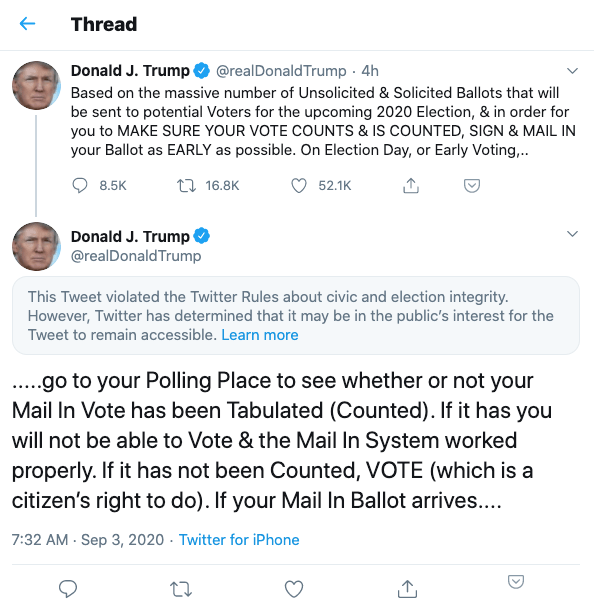
Twitter and Facebook wrestle with Trump telling Americans to vote twice


President Trump’s recent suggestion that North Carolina voters should cast multiple ballots has run afoul of Twitter’s election integrity rules. In a series of tweets Thursday morning, the president elaborated on previous statements in which he encouraged Americans to vote twice to “check” vote-by-mail systems.

Trump made the initial comments in a local television interview Wednesday. “They will vote and then they are going to have to check their vote by going to the poll and voting that way because if it tabulates then they won’t be able to do that,” Trump said.

“So let them send it in, and let them go vote. And if the system is as good as they say it is, then they obviously won’t be able to vote.”

Twitter added a “public interest notice” to two tweets related to those comments Thursday, citing its rules around civic and election integrity. The tweets violated the rules “specifically for encouraging people to engage in a behavior that could undermine the integrity of their individual vote,” according to Twitter spokesperson Nick Pacilio. Twitter has limited the reach of those tweets and restricted its likes, replies and retweets without comment.

Trump’s latest attack on vote-by-mail also crossed a line for Facebook. The company will remove any video of Trump’s recent voting comments that are shared without context or those that support the president’s statements, though it has yet to identify any so far.

“This video violates our policies prohibiting voter fraud and we will remove it unless it is shared to correct the record,” Facebook Policy Communications Director Andy Stone said.

Facebook added its own fact-checking notice to the same statement that Twitter deemed in violation of that platform’s rules. Now, a label at the bottom of Trump’s Facebook post contradicts the president’s suggestion that Americans try to vote twice to make sure “the mail in system worked properly.”

The fact-checking label, which reads “Voting by mail has a long history of trustworthiness in the US and the same is predicted this year,” is more specific than the generic voting info label the platform attaches to other election-related content.

The president’s comments were his latest attempt to cast doubt on the vote-by-mail systems that the U.S. will rely on in November’s election. In recent months, Trump has made many unfounded or outright false claims criticizing the safety of mail-in voting, a system that the U.S. already relies on for absentee voting. As November gets closer, those claims have voting rights organizations concerned.

“While this is a step in the right direction, the fact remains that Facebook refuses to enforce its own Terms of Use where Donald Trump is concerned,” VoteAmerica founder Debra Cleaver said.

“Yesterday, Trump outright urged voters in North Carolina to commit voter fraud. This is part of a larger and dangerous pattern of Trump using social media and other platforms to distribute disinformation, with what appears to be the goal of undermining faith in US elections.”

While the COVID-19 crisis means that more Americans than ever will be using mail-in voting to cast a ballot, the voting method is widely regarded as safe and reliable by experts.

In response to Trump’s remarks, North Carolina’s Board of Elections issued a statement clarifying that voting twice is a Class I felony in the state.

“It is illegal to vote twice in an election,” said Karen Brinson Bell, executive director of the North Carolina State Board of Elections.

“… Attempting to vote twice in an election or soliciting someone to do so also is a violation of North Carolina law.”


Read Full Article

How a wrongful death case can help families financially


Having to deal with the loss of a loved one is never easy. As family members and other loved ones go through a range of emotions as they grieve. In the cases where families are not just having to cope with the reality that their loved one is no longer with them, but their new […]

The post How a wrongful death case can help families financially appeared first on ALL TECH BUZZ.


How to Keep Your Online Gambling Account Secure


Today, the Internet has made it easy to perform day-to-day tasks, like paying off credit card balances or ordering takeout, from the comfort of our own homes in a streamlined and very efficient way. But when we divulge our personal and financial information to a company online, we take a risk, however small, that our details could […]

The post How to Keep Your Online Gambling Account Secure appeared first on ALL TECH BUZZ.