15 August 2020

Facebook pushes back against Apple’s App Store fees


Facebook joined the growing ranks of companies publicly complaining about the 30% fee that Apple collects on payments made through its App Store.

Those complaints came midway through a blog post about the social network’s new feature supporting paid online events. Facebook said that to support struggling businesses, it won’t be collecting any fees on those events, at least for the next year, which means that those businesses keep 100% of payments on the web and on Android.

But Facebook said that won’t be the case on iOS, due to App Store fees, and it took aim at Apple with surprisingly direct language (at least, direct for a corporate blog post):

We asked Apple to reduce its 30% App Store tax or allow us to offer Facebook Pay so we could absorb all costs for businesses struggling during COVID-19. Unfortunately, they dismissed both our requests and SMBs will only be paid 70% of their hard-earned revenue. Because this is complicated, as long as Facebook is waiving its fees, we will make all fees clear in our products.

Facebook Online Events

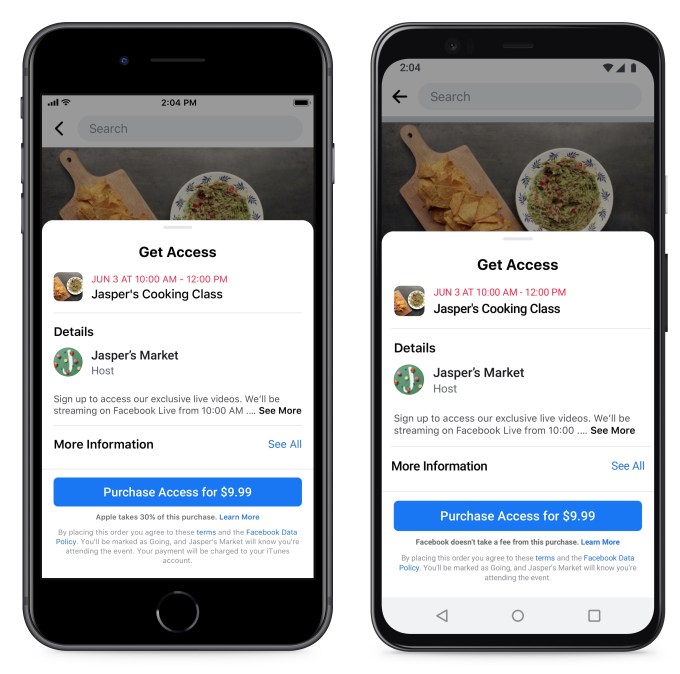
iOS purchase flow on left, Android purchase flow on right

To that end, the post includes screenshots of how the events payment flow will look on iOS and Android. On Android, it says, “Facebook doesn’t take a fee from this purchase,” while on iOS, it says, “Apple takes 30% of this purchase.”

Facebook said this language is included in the app update “which we submitted to Apple today for approval” — suggesting that there’s a possibility that the update won’t be approved.

This comes just about 24 hours after Fortnite was removed from the App Store, after Epic Games introduced direct payments into its hit title. It seemed like Epic was intentionally trying to provoke a fight, with the company quickly announcing a lawsuit against Apple and releasing a short in-game video parodying Apple’s famous 1984 commercial, with Apple cast as the villain. (The game publisher is in a similar battle with Google and Android.)

While Apple’s 30% fee has been around for as long as the App Store itself, the issue came to the forefront earlier this summer after Basecamp got into a public feud with the company over its subscription email app Hey, for which the developer tried to circumvent App Store fees by only accepting subscription payments on its website.

Apple’s Phil Schiller told us at the time that the controversy was not prompting the company to reconsider any of its rules, which he said were designed for a better app experience — to avoid situations where “you download the app and it doesn’t work.”


Read Full Article

Facebook pushes back against Apple’s App Store fees


Facebook joined the growing ranks of companies publicly complaining about the 30% fee that Apple collects on payments made through its App Store.

Those complaints came midway through a blog post about the social network’s new feature supporting paid online events. Facebook said that to support struggling businesses, it won’t be collecting any fees on those events, at least for the next year, which means that those businesses keep 100% of payments on the web and on Android.

But Facebook said that won’t be the case on iOS, due to App Store fees, and it took aim at Apple with surprisingly direct language (at least, direct for a corporate blog post):

We asked Apple to reduce its 30% App Store tax or allow us to offer Facebook Pay so we could absorb all costs for businesses struggling during COVID-19. Unfortunately, they dismissed both our requests and SMBs will only be paid 70% of their hard-earned revenue. Because this is complicated, as long as Facebook is waiving its fees, we will make all fees clear in our products.

Facebook Online Events

iOS purchase flow on left, Android purchase flow on right

To that end, the post includes screenshots of how the events payment flow will look on iOS and Android. On Android, it says, “Facebook doesn’t take a fee from this purchase,” while on iOS, it says, “Apple takes 30% of this purchase.”

Facebook said this language is included in the app update “which we submitted to Apple today for approval” — suggesting that there’s a possibility that the update won’t be approved.

This comes just about 24 hours after Fortnite was removed from the App Store, after Epic Games introduced direct payments into its hit game. It seemed like Epic was intentionally trying to provoke a fight, with the company quickly announcing a lawsuit against Apple and releasing a short in-game video parodying Apple’s famous 1984 commercial, with Apple cast as the villain. (The game publisher is in a similar battle with Google and Android.)

While Apple’s 30% fee has been around for as long as the App Store, the issue came to the forefront earlier this summer after developer Basecamp got into a public feud with the company over its subscription email app Hey. Apple’s Phil Schiller told us at the time that the controversy was not prompting the company to reconsider any of its rules.


Read Full Article

Facebook launches support for paid online events


Businesses will now be able to monetize online events on Facebook, thanks to a new feature that the social network is launching in the United States and 19 other countries today.

In a call with reporters, Head of Facebook App Fidji Simo said that Facebook’s Events feature was designed for in-person events, but with the COVID-19 pandemic and resulting social distancing orders, the company “really quickly pivoted” to supporting online events.

In fact, Simo said that in June of this year, live broadcasts on Facebook Pages doubled compared to the same period in 2019.

Simo also outlined the new feature in a Facebook blog post. Businesses will be able to host larger events through Facebook Live, and the company is also testing the ability to host smaller, more interactive gatherings in Messenger Rooms. The goal is to give business owners the ability to create the event, set the price, promote the event, collect the payment and host the event itself all from one place.

Apparently some of the paid events that  have already been organized during tests with early users include talks, trivia, podcast recordings, boxing matches, cooking classes, meet-and-greets and fitness classes.

Facebook Online Events

iOS purchase flow on left, Android purchase flow on right

“With social distancing mandates still in place, many businesses and creators are bringing their events and services online to connect with existing customers and reach new ones,” Simo wrote. “People are also relying on live video and interactive experiences more when they can’t come together physically.”

Simo said Facebook will not be collecting any fees from paid online events for at least the next year year. So on the web and on Android “in countries where we have rolled out Facebook Pay,” businesses should be able to keep 100% of their online events revenue. That won’t, however, be the case on iOS, and Simo’s blog post includes a surprisingly direct dig at Apple:

We asked Apple to reduce its 30% App Store tax or allow us to offer Facebook Pay so we could absorb all costs for businesses struggling during COVID-19. Unfortunately, they dismissed both our requests and SMBs will only be paid 70% of their hard-earned revenue. Because this is complicated, as long as Facebook is waiving its fees, we will make all fees clear in our products.

To that end, the post also includes an iOS screenshot (“which we submitted to Apple today for approval”) showing that the purchase button will include a small text message saying “Apple takes 30% of this purchase” beneath the purchase button (vs. “Facebook doesn’t take a fee from this purchase” on Android).


Read Full Article

Facebook launches support for paid online events


Businesses will now be able to monetize online events on Facebook, thanks to a new feature that the social network is launching in the United States and 19 other countries today.

In a call with reporters, Head of Facebook App Fidji Sumo said that Facebook’s Events feature was designed for in-person events, but with the COVID-19 pandemic and resulting social distancing orders, the company “really quickly pivoted” to supporting online events.

In fact, Sumo said that in June of this year, live broadcasts on Facebook Pages doubled compared to the same period in 2019.

Sumo also outlined the new feature in a Facebook blog post. Businesses will be able to host larger events through Facebook Live, and the company is also testing the ability to host smaller, more interactive gatherings in Messenger Rooms. The goal is to give business owners the ability to create the event, set the price, promote the event, collect the payment and host the event itself all from one place.

Apparently some of the paid events that  have already been organized during tests with early users include talks, trivia, podcast recordings, boxing matches, cooking classes, meet-and-greets and fitness classes.

Facebook Online Events

iOS purchase flow on left, Android purchase flow on right

“With social distancing mandates still in place, many businesses and creators are bringing their events and services online to connect with existing customers and reach new ones,” Sumo wrote. “People are also relying on live video and interactive experiences more when they can’t come together physically.”

Sumo said Facebook will not be collecting any fees from paid online events for at least the next year year. So on the web and on Android “in countries where we have rolled out Facebook Pay,” businesses should be able to keep 100% of their online events revenue. That won’t, however, be the case on iOS, and Sumo’s blog post includes a surprisingly direct dig at Apple:

We asked Apple to reduce its 30% App Store tax or allow us to offer Facebook Pay so we could absorb all costs for businesses struggling during COVID-19. Unfortunately, they dismissed both our requests and SMBs will only be paid 70% of their hard-earned revenue. Because this is complicated, as long as Facebook is waiving its fees, we will make all fees clear in our products.

To that end, the post also includes an iOS screenshot (“which we submitted to Apple today for approval”) showing that the purchase button will include a small text message saying “Apple takes 30% of this purchase” beneath the purchase button (vs. “Facebook doesn’t take a fee from this purchase” on Android).


Read Full Article

COVID Risk Comfort Zone


COVID Risk Comfort Zone

Warner Music acquires IMGN, a social media publishing platform, for under $100M


It’s a whole new playing field these days for music labels and publishers, and today one of the biggies made an acquisition to help it sharpen up its strategy to better understand what people want to see and hear online today.

Warner Music — with a market cap of $15.4 billion, one of the big three recording giants alongside Universal and Sony and which owns labels like Atlantic, Elektra and others and has a huge roster of artists that includes the likes of Madonna, Ed Sheeran and Linkin Park — is acquiring IMGN Media, a Tel Aviv and New York-based startup that builds and tracks viral social media content in categories like e-sports and gaming, ASMR and entertainment.

IMGN used be called Comedy.com. It widened its remit from simply funny stuff and rebranded in 2017, and according to its site has about 3 billion views per month and has some 40 million subscribers to its content, with some 85% of that classified as “Gen Z and millennials.”

The news caps off several weeks of speculation about the startup. In July, reports in the Israeli press emerged that said IMGN was being circled by Snap for about $180 million; and further to that, a source told us that TikTok was also in the frame, looking at the company at around a price tag of $150 million. In the end, the terms of the acquisition were not disclosed but we understand that the deal was done for just under $100 million.

IMGN was founded in 2015 and had raised about $6 million from a long list of angels and firms including Rhodium, Dot Capital and Prism Venture Management.

The plan will be to keep IMGN independent of Warner, continuing to develop and analyse viral content across a range of platforms, with founder Barak Shragai staying on to lead the team.

Warner, meanwhile, does not plan to use the platform to simply market Warner artists, but to tap it for more insights into where people are going online these days, and what they want to see, so that it can better target its own marketing efforts accordingly.

That’s not to say that the two will not work together at all. Warner became acquainted with the startup because it had been a customer of IMGN’s.

Warner has a history both of investing and acquiring startups, depending on its strategic interests. In July, for example, it took part in a Series B round for Canadian audio mastering startup Landr. Further back, it has acquired the likes of music concert listings platform Songkick and pop culture site Uproxx — which it also uses to help track trends in the world of music and among its target demographics.

IMGN will continue working with other third-party brands under its new owner. Past customers have included Electronic Arts, Burger King and Microsoft. The Microsoft deal was by way of its Mixer live game streaming platform, and the fact that this Twitch competitor was shut down last month says a lot about the state of the market and how precarious an audience can be.

Not just consumer tastes, but companies’ business strategies, shift all the time. Microsoft pulling the plug on Mixer underscores how IMGN itself can quickly lose a customer, pointing to why ownership by WMG can feel more secure. As for Warner — which is traded publicly these days but still majority owned by Access Industries, the holding company controlled by Len Blavatnik — the fact that Mixer is tracking and building content for a range of platforms gives it more of a bird’s-eye view on that bigger picture, rather than simply relying on data from the platforms themselves, or its own research, to figure out what the world wants to see and hear.

“WMG not only offers us greater investment and support, but an entrepreneurial environment to continue growing our business, with the people running our accounts having editorial independence,” said Shragai. “We’re excited to partner with them as we take our company into the future.”

The bigger picture here is that the music industry has evolved well beyond the traditional, analogue world of publishing and selling physical media, where consumers learned about and listened to new artists and songs over the radio and TV (and read about their favorite musicians or genres in magazines).

With the shift to mobile and digital platforms, there’s now a much wider, and quickly-shifting, plethora of places where people discover and listen to music.

And digital platforms themselves — from those focused specifically on audio and music, like Spotify, through to those where music is a side-hustle to continue to capture audience, like Facebook, through to those that are neither but are still huge music destinations, like TikTok — are also getting deeply involved in tracking how tastes are evolving, and where people are going to get their music fix.

So it’s only natural to see labels looking for ways to have more direct access to those insights themselves, bypassing all those platforms — even as they also work with them (and indeed, to help them negotiate better with those platforms, at the end of the day).


Read Full Article

14 August 2020

Travel startups cry foul over what Google’s doing with their data


As the antitrust drumbeat continues to pound on tech giants, with Reuters reporting comments today from the US Justice Department that it’s moving “full-tilt” on an investigation of platform giants including Google parent Alphabet, startups in Europe’s travel sector are dialling up their allegations of anti-competitive behavior against the search giant.

Google has near complete grip on the search market in Europe, with a regional marketshare in excess of 90% according to Statcounter. Unsurprisingly industry sources say a majority of travel bookings start as a Google search — giving the tech giant huge leverage over the coronavirus-hit sector.

More than half a dozen travel startups in Germany are united in a shared complaint that Google is abusing its search dominance in a number of ways they argue are negatively impacting their businesses.

Complaints we’ve heard from multiple sources in online travel range from Google forcing its own data standards on ad partners to Google unfairly extracting partner data to power its own competing products on the cheap.

Startups are limited in how much detail they can provide about Google’s processes on the record because the company requires advertising partners to sign NDAs to access its ad products. But this week German newspaper Handelsblatt reported on antitrust complaints from a number of local startups — including experience booking platform GetYourGuide and vacation rental search engine HomeToGo — who are accusing the tech giant of stealing content and data.

The group is considering filing a cartel complaint against Google, per its report.

We’ve also heard from multiple sources in the European travel sector that Google has exhibited a pattern of trying to secure the rights to travel partners’ content and data through contracts and service agreements.

One source, who did not wish to be identified for fear of retaliation against their business, told us: “Each travel partner has certain specialities in their business model but overall the strategy of Google has been the same: Grab as much data from your partners and build competing products with that data.”

Not ok, Google

This is now a very familiar complaint against Google. Crowdsourced reviews platform Yelp has been accusing the tech giant of stealing content for years. More recently, Genius got creative with a digital watermark that caught Google redhanded scraping lyrics content from its site which it pays to license (but Google does not). As Lily Allen might put it, it’s really not okay.

Last month’s Congressional antitrust subcommittee hearing kicked off with exactly this accusation too — as chair, David Cicilline, barked at Google and Alphabet CEO, Sundar Pichai: “Why does Google steal content from honest businesses?” Pichai dodged the question by claiming he doesn’t agree with the characterization. But for Google and parent Alphabet there’s no dodging the antitrust drumbeat pounding violently in the company’s backyard.

In Europe, Google’s business already has a clutch of antitrust enforcements against it — starting three years ago, in a case which dated back six years at that point, with a record breaking penalty for anti-competitive behavior in how it operated a product search service called Google Shopping. EU enforcements against Android and AdSense swiftly followed. Google is appealing all three decisions, even as it continues to expand its operations in lucrative verticals like travel.

The Commission’s 2017 finding that Google is dominant in the regional search market carried what lawmakers couch as a “special responsibility” to avoid breaching the bloc’s antitrust rules in any market Google plays in. That finding puts the travel sector squarely in the frame, although not yet under formal probe by EU regulators (although they have opened an active probe of Google’s data collection practices, announced last year).

EU regulators are also examining a range of competition concerns over its proposed acquisition of Fitbit, delaying the merger while they consider whether the deal would further entrench Google’s position in the ad market by giving it access to a trove of Fitbit users’ health data that could be used for increased ad personalization.

But so far, on travel, the Commission has been keeping its powder dry.

Yet for around a decade the tech giant has been building out products that directly compete for travel bookings in growth areas like flight search. More recently it’s added hotels, vacation rentals and experiences — bringing its search tool into direct competition with an increasing range of third party booking platforms which, at least in Europe, have no choice but to advertise on Google’s platform to drive customer acquisition.

One key acquisition underpinning Google’s travel ambitions dates back to 2010 — when it shelled out $700M for ITA, a provider of flight information to airlines, travel agencies and online reservation systems. The same year it also picked up travel guide community, Ruba.

Google beat out a consortium of rivals for ITA, including Microsoft, Kayak, Expedia, and Travelport, who relied upon its data to power their own travel products — and had wanted to prevent Google getting its hands on the data.

Back then travel was already a huge segment of search and online commerce. And it’s continued to grow — worth close to $700BN globally in 2018, per eMarkter (although the coronavirus crisis is likely to impact some recent growth projections, even as the public health crisis accelerates the industry’s transition to digital bookings) — all of which gives Google huge incentive to carve itself a bigger and bigger share of the pie. 

This is what Google is aiming to do by building out ad units that cater to travellers’ searches by offering flights, vacation rentals and trip experiences, searchable without needing to leave Google’s platform. 

Google defends this type of expansion by saying it’s just making life easier for the user by putting sought for information even closer to their search query. But competitors contend the choices it’s making are far more insidious. Simply put, they’re better for Google’s bottom line — and will ultimately result in less choice and innovation for consumers — is the core argument. The key contention is Google is only able to do this because it wields vast monopoly power in search which gives it unfair access to travel rivals’ content and data.

It’s certainly notable that Alphabet hasn’t felt the need to shell out to acquire any of the major travel booking platforms since its ITA acquisition. Instead its market might allows it to repackage and monetize rival travel platforms’ data via an expanding array of its own vertical travel search products. 

One of the German consortia of travel startups with a major beef against Google is Berlin-based HomeToGo. The vacation rentals platform confirmed to TechCrunch it has filed an antitrust complaint against the company with the European Commission.

It told us it’s watched with alarm as Google introduced a new ad unit in search results which promotes a vacation rental search and booking experience — displaying property thumbnails, alongside locations and prices plotted on a map — right from insight Google’s platform.
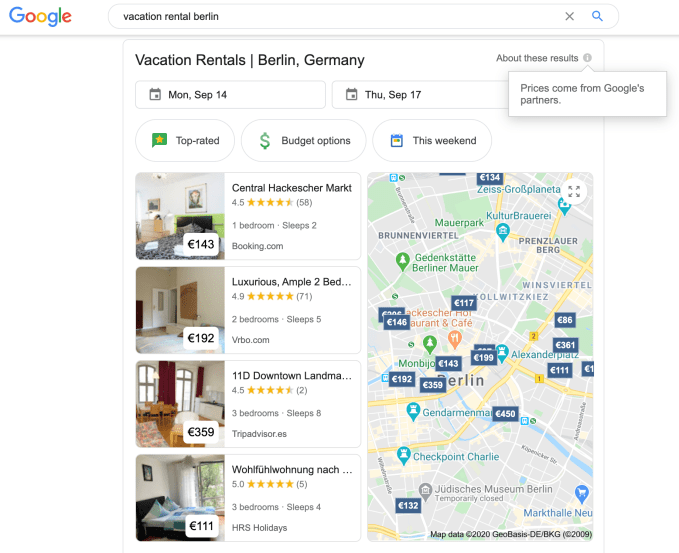
Screengrab showing Google vacation rental ad unit, populated with content from a range of partners

Discussing the complaint, HomeToGo CEO and co-founder, Dr Patrick Andrae, told us: “Due to the monopoly Google has in horizontal search, just by having this kind of access [to the vast majority of European Internet searchers], they’re so top of the funnel that they theoretically can go into any vertical. And with the power of their monopoly they can turn on products there without doing any prior investment in it.

“Anyone else has to work a lot on SEO strategies and these kind of things to slowly go up in the ranking but Google can just snap its fingers and say, basically, tomorrow I want to have a product.”

The complaint is not just that Google has built a competing ad product in vacation rentals but — following what has become a standard colonizing playbook for seemingly any vertical area Google sees is grabbing traffic — its packaging of the competing product is so fully featured and eye-catching that it results in greater prominence for Google’s ad vs organic search results (or indeed paid ad links) where rivals may appear as plain old blue links.

“They create this giant, colorful super CTA [call-to-action], as we call it — this one-box thing — where everything is clickable and leads you into the Google product,” said Andrae. “They explain that it’s better for the user experience but no one ever said that the user wants to have a one-box there from Google. Or why shouldn’t it be a one-box from HomeToGo? Or why shouldn’t it be a one-box in the flight word from Kayak? Or in the hotel world from Trivago? So why is it just the Google product that’s colorful, nice, and showing up?”

Andrae argues that the design of the unit is intended to give the user the impression that “Google has everything there”, on its platform. So, y’know, why go looking elsewhere for a vertical search engine?

He also points out that the special unit is not available to competitors. “You cannot buy it,” he said. “So even if you would like to have this prominent kind of placement you cannot buy that as a third party company. Even if you would like to pay money for it — I’m not talking about being in the product itself, that’s another topic — but just having the same kind of advertisement, because it is what they do — they advertise their own product there for free — and this is our complaint.”

Pay with your data

In 2017, when the Commission slapped Google with the first record-breaking penalty over its search comparison service — finding it had systematically given prominent placement to its own comparison shopping service over and above rival services in organic search results — competition chief Margrethe Vestager disclosed it had also received complaints about Google’s behavior in the travel sector.

Asked about the sector’s concerns now, some three years later, a Commission spokeswoman told us it’s “monitoring the markets concerned” — but declined to comment on any specific gripes.

Here’s another complaint: GetYourGuide, a Berlin based travel startup that’s created a discovery and booking platform for travel tours and experiences, has similar concerns about Google’s designs on travel experience booking — another travel segment the tech giant is moving into via its own eye-catching ad units flogging experiences.

“They want to create experience products now directly on Google search itself, with the aim that ultimately people can book these type of things on Google,” said GetYourGuide CEO and co-founder Johannes Reck. “What Google tries to do now is they try to get [travel startups’] content and our data in order to create new competitive products on Google.”

The startup is unhappy, for example, that a ‘Things to do’ ad product Google shows in its search results doesn’t link to GetYourGuide’s own search page — which would be the equivalent and competing third party product.

“Google will not allow us to link them into our search but only into the details page so the customer sees even less of our brand,” he said. “Or in Maps, for instance, if you go to Eiffel Tower and press to book tickets you don’t see any of GetYourGuide despite us fulfilling that order.”

He also rejects Google’s claim against this sort of complaint that it’s simply ‘doing the right thing for the user’ by not linking them out to the rival platform. “We do know from our data that users convert better and spend more time on our site and have higher engagement rates when we link them into our search and then deeper down into the funnel,” he told TechCrunch. “What Google is saying is not that it serves the user — it serves Google and it serves their profits. Because the deeper down the funnel that you link, the user will either buy or they will bounce back to Google and search for the next product. If you link into searches — if you don’t verticalize as much — then the user will end up in a different ecosystem and might not bounce back to Google.”

“As a partner [of Google] you have limited choice to participate [in its ad products]. You do need to give Google that content and then Google will try to move as many of the customers to them,” Reck added. “I don’t think there ever will be a world where booking.com or Expedia or GetYourGuide will disappear — rather our brands will start to disappear.

“That is something that I think ultimately is bad for the customer and only serves Google, again, because the customer will, in the long run, have no other choice and no other visibility on how he can get to choice than to go through Google because our brands will basically be hidden behind a Google wall. That will turn Google firmly away from what their original mission was… to steer people to the most relevant content on the web… Now they are trying to be completely the opposite; they’re trying to be the Amazon or Alibaba of travel and try to keep and contain people in their ecosystem.”

During the congressional antitrust subcommittee hearing last month Pichai claimed Google faces fierce competition in travel. Again, Reck contends that’s simply not true. “In Europe more than 75% of travellers go to Google to search for travel and all those users are free,” he said. “Everyone else in the travel industry pays Google top dollar… for these queries. Which competition exactly is he referring to?”

“[Pichai] then claimed that they’re not leveraging partners’ content — that’s not accurate. If you look at Google if you want to be in the top results these days you either pay or you give them data so that they can build their own products into search.”

“This dates back ten years now when they acquired ITA software, which is the leading data provider for flights,” Reck added. “They’ve just paved their way into travel. I think their intent is very clear at this point that they have no interest in their partners — or their customers for that matter, who like the choice that’s being offered on Google.”

“What they want to morph into, basically, is to turn Google into the Amazon of travel where everyone else maybe a content provider or a fulfilment agent but the consumer has no choice but to go through Google. I think that is the key intent here. They want to limit consumer choice. And they want to monopolise the space. We don’t want that and we will fight that. And if that means we need to go to the EU Commission to protect our and the customers’ interests then we’ll do that and we’re currently reviewing that option.”

The looming harm for consumers around reduced choice could manifest in poorer customer service, which is an area vertical players tend to focus on — whereas Google, as a platform funnel, does not.

Another German travel startup — Munich-based FlixBus — was also willing to go on the record with concerns about the impact of Google’s market power on the sector, despite not being in the same position as its business is not an aggregator.

Nonetheless, FlixBus Jochen Engert, founder and CEO, called on regional lawmakers to act against what he described as Google’s “systematic abuses” of market dominance.

“We call on the politicians in Germany and the EU to now work for fair competition on the Internet. It must be forbidden that monopolistic companies like Google abuse their market power, especially in times of crisis, and prevent competition for the benefit of the customer due to their dominance,” he told us. “Google systematically abuses its dominant market position to seal off access to customers from competitors and gets away with it time and again. It is only a matter of time before other industries and business models, in addition to travel, hotel and flight bookings, are permanently threatened.

“For FlixMobility [FlixBus’ parent company] as an internationally positioned market leader with its own platform, technology and our unique content, the situation is more relaxed than for smaller start-ups or those which also aggregate content such as Google. Nevertheless, in our opinion Google should be obliged to list and market its own products in search results on an equal footing with comparable offers. Here regulation must not stand by and watch for too long, but must react before Google irretrievably controls customer access and excludes competition.”

GetYourGuide’s Reck expressed hope that German lawmakers might be able to offer more expeditious relief to the sector than the European Commission — whose competition investigations typically grind through the details for years.

“The German government is actually very alert at this point in time,” he said. “They’re currently working on a new competition legislation that they will put in place probably within the next six months. It’s already in the making — and that will also be addressed to exactly that type of behavior of global, quasi-monopolistic platforms crossing the demarcation line, moving into other fields and trying to leverage their monopoly in order to create synergies in adjacent fields and crowd out competition.”

Asked what kind of intervention he would like to see regulators make against Google, Reck suggests its business should be regulated akin to a utility — advocating for controls on data, including around the openness of data, to level the playing field.

Though he also told us he would be supportive of more radical measures, such as breaking Google up. (But, again, he says speed of intervention is of the essence.)

“If you look at all of the data that Google collects, whether that’s consumer reviews, availability from its partners, all of the content from its partners, all of the information that they have through Android, whether that’s geo-specific data, whether that is interests, whether that is contextual information, Google is training their algorithms day and night on this data, no one else can. But we all have to provide data to Google,” he said.

“That’s not a level playing field. We need to think about how we can have a more open data architecture, that obviously is compliant with our data privacy laws but where developers from anywhere can build products based on the Google platform… As a developer in travel it’s currently very hard for me to access any data from Google so I can build better products for consumers. And I think that really needs to change — Google needs to open us for us to create a more vibrant and competitive ecosystem.”

“At a national or EU level we need to have an updated legal code that allows for quick interventions,” Reck added, saying competition enforcement simply can’t carry on at the same pace as for the markets of the past. “Things are moving way too quickly for that. You need to take a completely new approach.

“As Google correctly pointed out consumer prices have fallen but falling consumer prices is the weapon in tech; offering products for free allows you to gain marketshare in order to crowd out competition, which again leaves less choice for the customer so I think we need to think about how we think about tech and platforms in new ways.”

The Commission is currently consulting on whether competition regulators need a new tool to be able to intervene more quickly in digital markets. But there’s more than a trace of irony that its adherence to process means further delay as regulators question whether they need more power to intervene in digital markets to prevent tipping, instead of acting on long-standing complaints of market abuse attached to the 800lb gorilla of Internet search — with its “special responsibility” not to trample on other markets.

Reached for comment on the travel startups’ complaints, a Google spokeswoman sent us this statement:

There are now more ways than ever to find information online, and for travel searches, people can easily choose from an array of specialized sites, like TripAdvisor, Kayak, Expedia and many more. With Google Search, we aim to provide the most helpful and relevant results possible to create the best experience for users around the world and deliver valuable traffic to travel companies.

During the pandemic, we’ve been working hard with our partners in the travel industry to help them protect their businesses and look toward recovery. We launched new tools for airlines so they can better predict consumer demand and plan their routes. For hotels, we expanded our ‘pay per stay’ program globally to shift the risk of cancellation from our partners to us. And we’ve updated our search products so consumers can make informed decisions when planning future travel, further reducing the risk of cancellation.

The company did not respond to our request for a response to claims we heard that it seeks to secure rights to partners’ content and data via contracts and service agreements.

No relief

In another sign of the growing rift between Google and its travel partners in Europe, German startups in the sector banded together to press it for better terms during the coronavirus crisis earlier this year — accusing the tech giant of being inflexible over payments for ads they’d runs before the crisis hit. This meant they were left with a huge hole in their balance sheets after making mass refunds for travellers who could no longer take their planned trip. But the gorilla wasn’t sympathetic, demanding full payment immediately.

Asked what happened after TechCrunch reported on their concerns at the end of April, Reck said Google went silent for a few weeks. But as soon as the travel market started picking up in Germany — and GetYourGuide decided it needed to start advertising on Google again — it reissued the demand for full payment.

GetYourGuide says it was left with no choice but pay, given it needed to be able to run Google ads.

Reck describes the recovery package Google offered after it made the payment as “a Google recovery package” — as it was tied to GetYourGuide spending a large amount on YouTube ads in order to get a small discount.

The offer would recoup only “fraction” of GetYourGuide’s original losses on Google ads during the peak of the COVID-19 crisis, per Reck. “YouTube obviously is not where we lost the money. We lost the money in search where we had high intent customers, Google customers that wanted to come and shop. So that to us was [another] slap in the face,” he added.


Read Full Article

Facebook tests TikTok-style video format on its main app in India


Facebook is going all in on short-form videos. After flirting with the idea in Lasso, a TikTok-clone it tested in select markets, and adding a similar feature called Reels to Instagram recently, the company is exploring a new venue for this TikTok-esque experience: The big blue app.

The company confirmed to TechCrunch that it is testing short-form videos in the Facebook app in India, its biggest market by users. In the current avatar, ‘Short Videos’ has a dedicated section within the news feed. On top of it sits the ‘Create’ button, tapping which prompts Facebook Camera to launch, and users can browse through videos by swiping up.

“We’re always testing new creative tools so we can learn about how people want to express themselves. Short form videos are extremely popular and we are looking at new ways to provide this experience for people to connect, create and share on Facebook,” a Facebook spokesperson told TechCrunch.

Matt Navarra, a social media consultant, first revealed the existence of the new test.

The test comes as Facebook continues to cash in on the absence of TikTok, the ByteDance-owned app that was banned by India in late June, in the country. Facebook launched Reels in India last month weeks before launching it to dozens of additional markets. A source familiar with the matter said the daily engagement of Facebook’s services in India has increased by more than 25% since the ban on TikTok.

Scores of local startups, including Twitter-backed ShareChat and Times Internet’s Gaana and MX Player streaming services, have launched standalone apps or integrated features to replicate the social experience TikTok provided to users in recent weeks. The local apps have claimed to have added tens of million of new users during the period.

YouTube has also rolled out a similar feature, still in testing phase, to more users in India in recent weeks.

Image: TechCrunch

The urgency in Facebook’s attempt to court users with short-form videos comes as TikTok is plotting ways to re-enter the market. ByteDance is engaging with Indian conglomerate Reliance Industries to sell stake in TikTok’s local business, TechCrunch reported earlier this week.


Read Full Article

You will surprise yourself (and other pearls of wisdom) | Daniel Alexander Jones

You will surprise yourself (and other pearls of wisdom) | Daniel Alexander Jones

"Some call me a soul sonic superstar," says Jomama Jones, the alter ego of TED Fellow and theater artist Daniel Alexander Jones. In this stunning talk and performance, Jomama Jones invites us to consider how coming undone can be the first step toward transformation. It's a powerful story of community, growth and renewal -- and how breaking apart can mean breaking open.

https://ift.tt/2XZ6xQi

Click this link to view the TED Talk

How to Distribute Your Music on Streaming Services


distribute-music-streaming

After spending countless hours writing and recording your own music, you’re probably itching to send it out into the world for other people to listen to.

This used to involve burning CDs and selling them at your gigs. But if you want people to find your music in the 21st century, you need to get it on Spotify, Apple Music, and other music streaming services instead.

In this article, we explore the various ways to distribute your music on streaming services.

How to Distribute Your Music on Streaming Services

Apple Music showing new music releases

Most music streaming services don’t deal directly with artists. Which means you need to work with an established distributor to get your music online.

Of course, signed musicians can leave it to their label to sort out the music distribution. But if you’re an unsigned or independent musician, you need to find a music distributor to work with.

Fortunately, there’s a whole host of music distribution services available to use.

Most of these services charge a small fee and put your music on all of the major music streaming services. After doing so, anyone can listen to your music and you can claim payment from the royalties.

How Do Music Distribution Services Work?

CD Baby showing list of music streaming services

Every music distribution service offers a different business model, and we’ll detail all of the options below. But generally speaking, you either pay an upfront fee or give up a percentage of your earnings to get your music on Spotify, Apple Music, iTunes, and every other major music streaming service or digital store.

You then make money from your music through royalties, sales, and streaming payouts.

You should still own all the copyright to your music after signing up for a music distribution service. But make sure you read the terms and conditions yourself to be certain.

Most distributors issue payments at regular periods or after your earnings reach a certain threshold. That said, don’t expect to make big bucks unless you get thousands of streams per month.

On average, a single stream earns you about half a cent, or less.

Music streaming accounting sample

The best distribution services show you a breakdown of where your music is getting played, how often, and on which streaming services.

You only need to sign up with a single distribution service for each musical release. That service should make your music available everywhere, although it may only be for a limited time.

For future releases, feel free to use the same service again or jump ship and try someone else.

What Are the Best Music Distribution Services?

There is an overwhelming selection of digital distribution services to choose from when you’re trying to get your music on Apple Music, Spotify, and other streaming services. To simplify matters, we’ve summarized each of the best options below.

You might notice a couple of popular distribution services missing from this list, namely TuneCore and DittoMusic. While these are both legitimate businesses with plenty of happy customers, there are enough complaints about their services that we didn’t feel comfortable recommending them.

1. CD Baby

CD Baby music distribution header

CD Baby is one of the original digital music distribution services for independent artists. It offers a simple model, in which you pay a one-time fee and give up nine percent of your distribution revenue to upload your music for life.

The fee is $9.95 for a single or $29 for an album. However, you can also choose to pay extra for a Pro release if you want CD Baby to collect extra royalties for you. If your music gets played in a lot of places, this could pay off in the long run.

There is one small catch in that you also need to provide a UPC barcode for each release. If you don’t have one—which will be the case for most people—you can buy a barcode from CD Baby for another small fee.

CD Baby makes your music available on over 150 platforms. You also get access to a professional marketing tool and can even sell physical CDs or vinyls through CD Baby’s website.

2. AWAL

AWAL music distribution header

Short for A World Artists Love, AWAL is the most exclusive service on this list. Rather than offering to distribute anyone’s music, AWAL only caters to growing artists on the verge of success.

If you already have an engaged fanbase on social media, a string of gigs in the calendar, and a manager sketching out your future, then it’s worth sending an application to AWAL to get your music distribution sorted as well.

AWAL doesn’t charge any upfront fees but takes a 15 percent commission on all your digital distribution revenue.

It earns this commission through a range of excellent services: AWAL makes your music available to stream on every major platform; you can view real-time stats for Spotify, Apple Music, and YouTube; and AWAL will go to bat for you to line up film or TV syncs and even project funding.

AWAL even pushes for streaming services to feature your music in promoted playlists. This means you might end up in the Discover playlist when people go looking for new music on Spotify.

3. Amuse

Amuse music distribution header

It’s completely free to get your music on all the major streaming platforms using Amuse. There are no fees and Amuse doesn’t even take any commission from your digital distribution revenue.

This might sound too good to be true, but Amuse makes its money by analyzing streaming trends and using that data to offer premium services or to sign popular new artists to its label.

The premium services include quicker releases, more social media integration, and profile collaborations so that your entire team can access important data.

Access to these tools comes at a cost of $5/month.

Even on the free tier, you can release your music in four weeks by uploading the tracks using the Amuse app. You also get the option to automatically split your digital revenue with anyone else who worked on the songs with you.

If you want to get your music on Spotify or Apple Music without losing any money at all, Amuse is the only option.

4. DistroKid

DistroKid music distribution header

Don’t feel put off by how basic the DistroKid website is, this is a professional music distribution service with a great reputation. It’s part-owned by Spotify, but you can use DistroKid to get your music on Apple Music, iTunes, Amazon, and every other major music streaming service or digital store as well.

To use DistroKid, you need to pay an annual fee of $19.99. This lets you upload unlimited releases throughout the year and DistroKid doesn’t take any of your distribution revenue.

However, if you ever stop paying this fee, DistroKid may remove your music from streaming services and stores in the future.

If you want your music to always remain available, you need to buy the Leave a Legacy add-on. In fact, the main downside to DistroKid is that there are several add-ons that other services already include.

For example, you also need to pay $0.99/year for each song that you want Shazam to recognize. And you need to pay $5/year for DistroKid to collect YouTube revenue for your releases.

If you plan to release a lot of music in a short space of time, this could still be a cost-effective service to use. Otherwise, you’re better off with one of the services above.

Don’t Forget to Claim Your Artist Account

Getting your music on Spotify and Apple Music is only the first step. You should also make sure you claim your artist account with these streaming services to see up-to-date streaming stats for your music.

After claiming an artist account, you can post status updates, upload a profile photo, and edit your artist bio.

Visit artists.spotify.com and artists.apple.com to claim your accounts. You’ll also want to claim your account for any other popular streaming services. Take a look at our list of the best music streaming services for audiophiles to find out where else to look.

Read the full article: How to Distribute Your Music on Streaming Services


Read Full Article

Epic Sues Apple and Google Over Fortnite App Store Ban


fortnite removed

Fortnite is a massively popular game. But that popularity hasn’t stopped both Google and Apple removing Fortnite from their app stores in a dispute over money. And in retaliation, Epic is suing both companies claiming antitrust violations.

Why Apple and Google Removed Fortnite

This all started when Epic decided to get around the App Store and Google Play’s in-app purchasing by using its own payment system. This is in violation of the rules put forth by the two companies.

Essentially, Apple and Google take a 30 percent cut from app creators when a user makes a purchase. By launching its own payment system (which the company rolled out on Thursday), Epic could get around that fee.

A Google spokesperson made a statement to The Verge on the matter:

“The open Android ecosystem lets developers distribute apps through multiple app stores. For game developers who choose to use the Play Store, we have consistent policies that are fair to developers and keep the store safe for users. While Fortnite remains available on Android, we can no longer make it available on Play because it violates our policies. However, we welcome the opportunity to continue our discussions with Epic and bring Fortnite back to Google Play.”

Apple wasn’t silent on the matter either, delivering a lengthy statement to The Verge. The company made it clear that it doesn’t intend to make an exception for Epic, regardless of how big Fortnite is:

“Today, Epic Games took the unfortunate step of violating the App Store guidelines that are applied equally to every developer and designed to keep the store safe for our users. As a result their Fortnite app has been removed from the store. Epic enabled a feature in its app which was not reviewed or approved by Apple, and they did so with the express intent of violating the App Store guidelines regarding in-app payments that apply to every developer who sells digital goods or services.”

To put it simply, Epic broke the rules in an attempt to secure itself a larger cut (and offer a discount to its users). Not thrilled with this, both Apple and Google removed the game from their stores in response.

Epic’s Lawsuit Against Apple and Google

Epic certainly wasn’t just going to sit there and do nothing. First, The Verge reported that Apple was under legal attack from Epic. Just a few hours later, The Verge discovered that the company was coming after Google as well.

There’s a lot to unpack with these lawsuits. Epic claims that Google and Apple are breaking antitrust rules with the way the firms control their application marketplaces.

Epic alleges that Apple has a monopoly in the form of the iPhone, the iOS ecosystem, and the App Store. It also says that Apple places unreasonable restrictions on the distribution of iOS apps.

The Apple case features some pretty interesting claims, and Epic got a little creative with the statements. Here’s one particular example:

“Fast forward to 2020, and Apple has become what it once railed against: the behemoth seeking to control markets, block competition, and stifle innovation.”

As this is the early stages of a legal case, it’s hard to know exactly how this will end. However, the implications could be huge. If the court find that Epic is in the right here, it could completely change how we all access Android and iOS apps. Especially those that offer in-app purchases.

Epic claims it isn’t seeking special treatment. Instead, the company is against the policies both companies use, and is seeking a change for all developers, not just itself.

The company’s Free Fortnite FAQ breaks down the company’s stance:

“We don’t seek a special exception for Epic. We firmly believe Apple’s policies must be changed for all developers. For over a decade, Apple has single-mindedly crafted and proliferated a tangled web of rules and policies to impose a 30% tax on apps while preventing competitors from offering a better deal. That’s around 10x more than what a typical transaction may cost on competing payment processing services such as Visa, Mastercard, and PayPal, which charge rates of 2.5% to 3.5%. When competition is stifled, the customer always loses.”

What Does This All Mean for You?

This is a legal battle between several massive companies.

In the long run, it could have massive implications as far as how the Google Play Store and Apple App Store run. In the short-term, it may affect your ability to play Fortnite on Android and iOS. Epic has published a FAQ breaking down the availability of the game on both platforms.

If you’re on Android, you can still download Fortnite directly. If you already have the game downloaded on iOS, you’ll still be able to play it. However, you won’t be able to update it as new content comes out. As long as you have Season 3’s 13.40 update, you’ll be good to go for a while.

If you can’t play Fortnite right now, have a look at these mobile games that let you explore the world. Especially if you’re still stuck indoors.

Read the full article: Epic Sues Apple and Google Over Fortnite App Store Ban


Read Full Article

How to Delete an Extra Page in Microsoft Word


delete-page-msword

You’ve just finished working on a Microsoft Word document. Upon giving it a quick scan before printing, you notice an extra page has sneaked its way in. No big deal; just delete it, right? Perhaps not. Extra pages can be surprisingly tricky, so let’s learn how to delete a page in Word.

If the standard methods to delete a page fail—what can you do? Today, we’re going to explain how to delete a blank page in Word. Then, we will look at a few solutions you can try if it doesn’t work.

How to Delete a Page in Word: Use the “Go To” Box

Let’s assume you don’t want to spend the next five minutes mashing the backspace button or trying to do some excessively precise mouse-work. You can use the “Go To” search feature in Find and Replace to make the process simple.

On Windows

Go To Search in Microsoft Word

Use these instructions if you’re running Windows:

  1. Click anywhere on the page you want to remove
  2. Press CTRL + G.
  3. The Find and Replace box will appear.
  4. In the left-hand panel, select Page.
  5. In the Enter Page Number field, type \page.
  6. When you’re ready, hit Enter.
  7. The page you want to delete will now be selected
  8. Press the Delete button on your keyboard.

On macOS

The instructions to delete a Word page on macOS are similar:

  1. Click anywhere on the page you want to remove.
  2. Press CTRL + Option + G.
  3. Select Page in the Find and Replace box.
  4. Type \page in the Enter Page Number box.
  5. Press Enter.
  6. Press Delete.

Because both methods rely on Word’s Go To function, you could also use a + or to jump straight to the page in question.

For example, if the page you want to delete is 12 pages above the one you’re currently looking at, typing -12 in the Enter page number box will take you there. This saves you from scrolling through multiple pages of long documents to find the one you want to remove.

Use the Navigation Pane to Delete a Page in Word

navigation pane word

It’s easy to accidentally create a blank page in Word—for instance, pressing the Page Down button will instantly bump you down one page.

If the document has lots of blank pages and your scrolling finger is getting tired, you need to turn to the Navigation Pane. To activate it, go to View > Show and tick the box next to the Navigation Pane option.

A new panel will appear on the left of the screen. By default, it will show any page headers that are in your document. However, if you click on the Pages tab, you and scroll through the thumbnails of the pages.

Clicking on a thumbnail will take you to the page within the document. From there, you can delete it as needed.

Remove a Page in Word: Troubleshooting

It’s not uncommon to see users complaining that they cannot delete a page in Word. The problem appears especially common when the blank page appears at the end of a document, but it could happen anywhere.

How can you fix it?

1. Document Margins

margins in word

An overly large page margin could be stopping you from deleting an extra page in Word. Again, it’s the type of problem you might not even notice if you’d caught a menu button my mistake.

To check, go to Layout > Margins and either choose one of the default options or enter a custom selection.

2. Paragraph Marks

paragraph marks word

If you turn on formatting marks in Word, you’ll be able to see what’s going on with your document.

To enable them, go to Home > Paragraph and click on the Show Paragraph Mark icon. Alternatively, press CTRL + *.

Once enabled, scan the blank page for paragraph marks. If you see any, delete them. Paragraph marks are hidden features in Word and sometimes you have to reveal them to solve any problems in your document.

3. Page Breaks

If your blank page is in the middle of a document rather than at the end, an errant page break is almost certainly to blame.

Turning on the paragraph marks in the method detailed above will also let you see the page breaks. Remove the page breaks and it will help to get rid of the blank page in Word as well.

4. Tables

A quirk of the way Microsoft Word works means that if your document ends with a table, Word will automatically enter a paragraph mark after it. If the table also falls at the bottom of a page, this can force an extra page to be created.

It’s impossible to delete the final mark, but there is a workaround that means you won’t need to adjust the size of the table itself. Just highlight the paragraph mark and change the font size to 1.

If the mark is still there, highlight it with the cursor, right-click, and select Paragraph in the context menu. Click on the Indents and Spacing tab and change all the spacing to zero.

And if somehow the page is still there, you can try hiding the paragraph entirely. Go to Home > Font click on the small arrow in the lower-right corner to open the pop-out menu. Locate the Effects section on the Fonts tab and mark the checkbox next to Hidden.

5. Section Breaks

page setup word

Section breaks are essential to denote the start and end of sections of different formatting within the same document.

As such, if a section break is causing a blank page, proceed with caution. You don’t necessarily want to outright delete it, as doing so could cause major formatting issues elsewhere.

The correct approach is to set the section break to Continuous. To make the change, click just after the break you want to alter, then go to Layout > Page Setup on the ribbon and launch the pop-out menu.

In the layout tab, change the Section start option to Continuous.

6. Printer Settings

If you’re getting blank pages when you print a document, but you don’t see any on-screen, your printer settings are probably to blame.

Covering every printer is beyond the scope of this article, but you should head to your printer’s Preferences page and look for the Separator page option.

Learn More About Microsoft Word

If you’ve learned something new from this article, you’ll love some of our other in-depth coverage of Microsoft Word and Office 365.

To get started, why not discover how to add and format endnotes and footnotes?

Read the full article: How to Delete an Extra Page in Microsoft Word


Read Full Article

Why Do Marriages Fail – Your Guide to Saving It


Many couples struggle to keep their marriage happy and lively. It is a bitter reality. However, happy couples explain that it takes a lot of effort and understanding to make a marriage last. There can be several reasons for a relationship to break or a marriage to fail. But some common ones are not considering […]

The post Why Do Marriages Fail – Your Guide to Saving It appeared first on ALL TECH BUZZ.


Oracle and Salesforce hit with GDPR class action lawsuits over cookie tracking consent


The use of third party cookies for ad tracking and targeting by data broker giants Oracle and Salesforce is the focus of class action style litigation announced today in the UK and the Netherlands.

The suits will argue that mass surveillance of Internet users to carry out real-time bidding ad auctions cannot possibly be compatible with strict EU laws around consent to process personal data.

The litigants believe the collective claims could exceed €10BN, should they eventually prevail in their arguments — though such legal actions can take several years to work their way through the courts.

In the UK, the case may also face some legal hurdles given the lack of an established model for pursuing collective damages in cases relating to data rights. Though there are signs that’s changing.

Non-profit foundation, The Privacy Collective, has filed one case today with the District Court of Amsterdam, accusing the two data broker giants of breaching the EU’s General Data Protection Regulation (GDPR) in their processing and sharing of people’s information via third party tracking cookies and other adtech methods.

The Dutch case, which is being led by law-firm bureau Brandeis, is the biggest-ever class action in The Netherlands related to violation of the GDPR — with the claimant foundation representing the interests of all Dutch citizens whose personal data has been used without their consent and knowledge by Oracle and Salesforce. 

A similar case is due to be filed later this month at the High Court in London England, which will make reference to the GDPR and the UK’s PECR (Privacy of Electronic Communications Regulation) — the latter governing the use of personal data for marketing communications. The case there is being led by law firm Cadwalader

Under GDPR, consent for processing EU citizens’ personal data must be informed, specific and freely given. The regulation also confers rights on individuals around their data — such as the ability to receive a copy of their personal information.

It’s those requirements the litigation is focused on, with the cases set to argue that the tech giants’ third party tracking cookies, BlueKai and Krux — trackers that are hosted on scores of popular websites, such as Amazon, Booking.com, Dropbox, Reddit and Spotify to name a few — along with a number of other tracking techniques are being used to misuse Europeans’ data on a massive scale.

Per Oracle marketing materials, its Data Cloud and BlueKai Marketplace provider partners with access to some 2BN global consumer profiles. (Meanwhile, as we reported in June, BlueKai suffered a data breach that exposed billions of those records to the open web.)

While Salesforce claims its marketing cloud ‘interacts’ with more than 3BN browsers and devices monthly.

Both companies have grown their tracking and targeting capabilities via acquisition for years; Oracle bagging BlueKai in 2014 — and Salesforce snaffling Krux in 2016.


Discussing the lawsuit in a telephone call with TechCrunch, Dr Rebecca Rumbul, class representative and claimant in England & Wales, said: “There is, I think, no way that any normal person can really give informed consent to the way in which their data is going to be processed by the cookies that have been placed by Oracle and Salesforce.

“When you start digging into it there are numerous, fairly pernicious ways in which these cookies can and probably do operate — such as cookie syncing, and the aggregation of personal data — so there’s really, really serious privacy concerns there.”

The real-time-bidding (RTB) process that the pair’s tracking cookies and techniques feed, enabling the background, high velocity trading of profiles of individual web users as they browse in order to run dynamic ad auctions and serve behavioral ads targeting their interests, has, in recent years, been subject to a number of GDPR complaints, including in the UK.

These complaints argue that RTB’s handling of people’s information is a breach of the regulation because it’s inherently insecure to broadcast data to so many other entities — while, conversely, GDPR bakes in a requirement for privacy by design and default.

The UK Information Commissioner’s Office has, meanwhile, accepted for well over a year that adtech has a lawfulness problem. But the regulator has so far sat on its hands, instead of enforcing the law — leaving the complainants dangling. (Last year, Ireland’s DPC opened a formal investigation of Google’s adtech, following a similar complaint, but has yet to issue a single GDPR decision in a cross-border complaint — leading to concerns of an enforcement bottleneck.)

The two lawsuits targeting RTB aren’t focused on the security allegation, per Rumbul, but are mostly concerned with consent and data access rights.

She confirms they opted to litigate rather than trying to try a regulatory complaint route as a way of exercising their rights given the “David vs Goliath” nature of bringing claims against the tech giants in question.

“If I was just one tiny person trying to complaint to Oracle and trying to use the UK Information Commissioner to achieve that… they simply do not have the resources to direct at one complaint from one person against a company like Oracle — in terms of this kind of scale,” Rumbul told TechCrunch.

“In terms of being able to demonstrate harm, that’s quite a lot of work and what you get back in recompense would probably be quite small. It certainly wouldn’t compensate me for the time I would spend on it… Whereas doing it as a representative class action I can represent everyone in the UK that has been affected by this.

“The sums of money then work — in terms of the depths of Oracle’s pockets, the costs of litigation, which are enormous, and the fact that, hopefully, doing it this way, in a very large-scale, very public forum it’s not just about getting money back at the end of it; it’s about trying to achieve more standardized change in the industry.”

“If Salesforce and Oracle are not successful in fighting this then hopefully that send out ripples across the adtech industry as a whole — encouraging those that are using these quite pernicious cookies to change their behaviours,” she added.

The litigation is being funded by Innsworth, a litigation funder which is also funding Walter Merricks’ class action for 46 million consumers against Mastercard in London courts. And the GDPR appears to be helping to change the class action landscape in the UK — as it allows individuals to take private legal action. The framework can also support third parties to bring claims for redress on behalf of individuals. While changes to domestic consumer rights law also appear to be driving class actions.

Commenting in a statement, Ian Garrard, managing director of Innsworth Advisors, said: “The development of class action regimes in the UK and the availability of collective redress in the EU/EEA mean Innsworth can put money to work enabling access to justice for millions of individuals whose personal data has been misused.”

A separate and still ongoing lawsuit in the UK, which is seeking damages from Google on behalf of Safari users whose privacy settings it historically ignored, also looks to have bolstered the prospects of class action style legal actions related to data issues.

While the courts initially tossed the suit last year, the appeals court overturned that ruling — rejecting Google’s argument that UK and EU law requires “proof of causation and consequential damage” in order to bring a claim related to loss of control of data.

The judge said the claimant did not need to prove “pecuniary loss or distress” to recover damages, and also allowed the class to proceed without all the members having the same interest.

Discussing that case, Rumbul suggests a pending final judgement there (likely next year) may have a bearing on whether the lawsuit she’s involved with can be taken forward in the UK.

“I’m very much hoping that the UK judiciary are open to seeing these kind of cases come forward because without these kinds of things as very large class actions it’s almost like closing the door on this whole sphere of litigation. If there’s a legal ruling that says that case can’t go forward and therefore this case can’t go forward I’d be fascinated to understand how the judiciary think we’d have any recourse to these private companies for these kind of actions,” she said.

Asked why the litigation has focused on Oracle and Saleforce, given there are so many firms involved in the adtech pipeline, she said: “I am not saying that they are necessarily the worst or the only companies that are doing this. They are however huge, huge international multimillion-billion dollar companies. And they specifically went out and purchased different bits of adtech software, like BlueKai, in order to bolster their presence in this area — to bolster their own profits.

“This was a strategic business decision that they made to move into this space and become massive players. So in terms of the adtech marketplace they are very, very big players. If they are able to be held to account for this then it will hopefully change the industry as a whole. It will hopefully reduce the places to hide for the other more pernicious cookie manufacturers out there. And obviously they have huge, huge revenues so in terms of targeting people who are doing a lot of harm and that can afford to compensate people these are the right companies to be targeting.”

Rumbul also told us The Privacy Collective is looking to collect stories from web users who feel they have experienced harm related to online tracking.

“There’s plenty of evidence out there to show that how these cookies work means you can have very, very egregious outcomes for people at an individual level,” she added. “Whether that can be related to personal finance, to manipulation of addictive behaviors, whatever, these are all very, very possible — and they cover every aspect of our lives.”

Consumers in England and Wales and the Netherlands are being encouraged to register their support of the actions via The Privacy Collective’s website.

In a statement, Christiaan Alberdingk Thijm, lead lawyer at Brandeis, said: “Your data is being sold off in real-time to the highest bidder, in a flagrant violation of EU data protection regulations. This ad-targeting technology is insidious in that most people are unaware of its impact or the violations of privacy and data rights it entails. Within this adtech environment, Oracle and Salesforce perform activities which violate European privacy rules on a daily basis, but this is the first time they are being held to account. These cases will draw attention to astronomical profits being made from people’s personal information, and the risks to individuals and society of this lack of accountability.”

“Thousands of organisations are processing billions of bid requests each week with at best inconsistent application of adequate technical and organisational measures to secure the data, and with little or no consideration as to the requirements of data protection law about international transfers of personal data. The GDPR gives us the tool to assert individuals’ rights. The class action means we can aggregate the harm done,” added partner Melis Acuner from Cadwalader in another supporting statement.

We reached out to Oracle and Salesforce for comment on the litigation.

Oracle EVP and general counsel, Dorian Daley, said:

The Privacy Collective knowingly filed a meritless action based on deliberate misrepresentations of the facts.  As Oracle previously informed the Privacy Collective, Oracle has no direct role in the real-time bidding process (RTB), has a minimal data footprint in the EU, and has a comprehensive GDPR compliance program. Despite Oracle’s fulsome explanation, the Privacy Collective has decided to pursue its shake-down through litigation filed in bad faith.  Oracle will vigorously defend against these baseless claims.

A spokeswoman for Salesforce sent us this statement:

At Salesforce, Trust is our #1 value and nothing is more important to us than the privacy and security of our corporate customers’ data. We design and build our services with privacy at the forefront, providing our corporate customers with tools to help them comply with their own obligations under applicable privacy laws — including the EU GDPR — to preserve the privacy rights of their own customers.

Salesforce and another Data Management Platform provider, have received a privacy related complaint from a Dutch group called The Privacy Collective. The claim applies to the Salesforce Audience Studio service and does not relate to any other Salesforce service.

Salesforce disagrees with the allegations and intends to demonstrate they are without merit.

Our comprehensive privacy program provides tools to help our customers preserve the privacy rights of their own customers. To read more about the tools we provide our corporate customers and our commitment to privacy, visit salesforce.com/privacy/products/


Read Full Article