Book tour wrap-up
Facebook today announced it’s building its own Ready Player One Oasis. Facebook Horizon is a virtual reality sandbox universe where you can build your own environments and games, play and socialize with friends, or just explore the user generated landscapes. This is Facebook’s take on Second Life.
Launching in early 2020 in closed beta, Facebook Horizon will allow users to design their own diverse avatars and hop between virtual locales through portals called Telepods, watch movies and consume other media with friends, and play multiplayer games together like Wing Strikers. It will also include human guides, known as Horizon Locals, who can give users assistance and protect their safety in the VR world so trolls can’t run rampant.
Users interested in early access can apply for the beta here.

As part of the launch, Facebook will shut down its existing social VR experiences Facebook Spaces and Oculus Rooms on October 25th, leaving a bit of a gap until Horizon launches. Oculus Rooms debuted in 2016 as your decoratable private VR apartment, while Spaces first launched in 2017 to let users chat, watch movies, and take VR selfies with friends. But both felt more like lobby waiting rooms with a few social features that were merely meant as a preamble to full-fledged VR games. In contrast, Horizon is designed to be a destination not a novelty, where users could spend tons of time.
Facebook Horizon will start centralized around a town square. Before people step in, they can choose how they look and what they wear from an expansive and inclusive set of avatar tools. From inside VR, users will be able to use the Horizon World Builder to create gaming arenas, vacation chillspots, and activities to fill them without the need to know how to code.
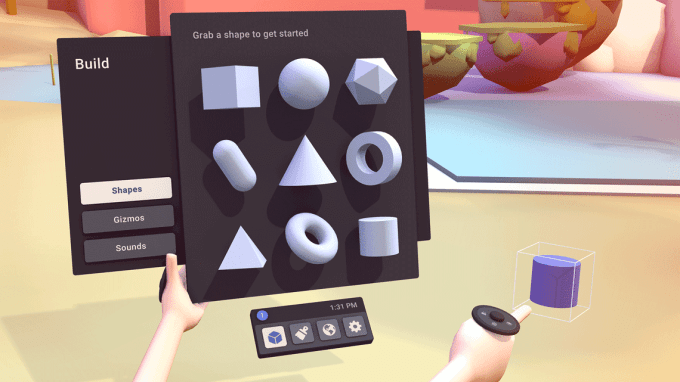
Facebook Horizon lets you build objects from scratch
You could design a tropical island, then invite friends to hang out with you on your virtual private beach. A object creator akin to the Oculus Medium sculpting feature lets you make anything, even a custom t-shirt your avatar could wear. Visual scripting tools let more serious developers create interactive and reactive experiences.
Facebook details is Horizon safety features on its “Citizenship” page that explains that “As citizens of Facebook Horizon, it is all of our responsibility to create a culture that’s respectful and comfortable . . . A Horizon citizen is friendly, inclusive, and curious.” Horizon Locals will wander the VR landscapes to answer questions or aid users if they’re having technical or safety issues. They seem poised to be part customer support, part in-world police.
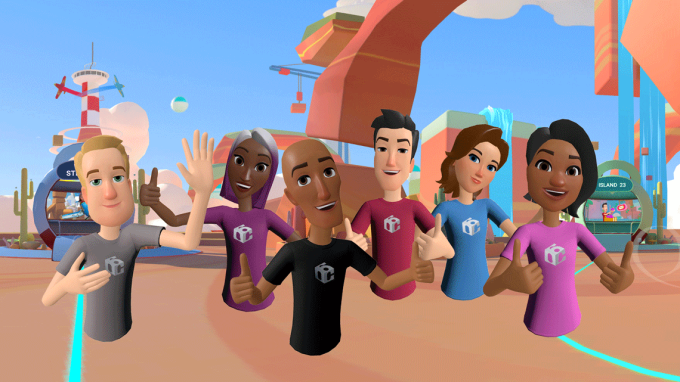
Facebook Horizon will include human Locals who provide safety and technical support
If things get overwhelming, you can tap a shield button to pause and dip into a private space parallel to Horizon. Users can define their personal space boundaries so no one can get in their face or appear to touch them. And traditional tools like muting, blocking, and reporting will all be available. It’s smart that Facebook outlined the community tone and defined these protections.
Facebook CEO Mark Zuckerberg announced Horizon today at the Oculus Connect 6 conference in San Jose. He discussed how “Horizon is going to have this property where it just expands and gets better” as Facebook and the community build more experiences for the VR sandbox.

Facebook lets you build your own islands and other locales in Horizon
Horizon makes perfect sense for a business obsessed with facilitating social interaction while monetized through ad views based on time-spent. It’s easy to imagine Horizon including virtual billboards for brands, Facebook-run shops for buying toys or home furnishings, third-party malls full of branded Nikes or Supreme shirts that score Zuckerberg a revenue cut, or subscriptions to access certain gaming worlds or premium planets to explore.
As Facebook starts to grow stale after 15 years on the market, users are looking for new ways to socialize. Many have already ditched the status updates and smarmy Life Events of Facebook for the pretty pictures of Instagram and silliness of Snapchat. Facebook risked being cast aside if it didn’t build its own VR successor. And by offering a world where users can escape their real lives instead of having to enviously compare them to their friends, Horizon could appeal to those bored or claustrophobic on Facebook.
General Motors is adding Amazon Alexa to the infotainment systems of its Chevrolet, Buick, GMC and Cadillac vehicles in the first half of next year — one of the broadest rollouts of an embedded Alexa Auto experience, the automaker said Wednesday.
The new in-vehicle Amazon Alexa experience will be added through a software update to model 2018 and newer cars, trucks and crossovers with compatible infotainment systems. In other words, customers don’t have to buy a new 2020 Chevy to get the Amazon Alexa feature.
The company made the announcement Wednesday in conjunction with Amazon’s Devices event.
The addition of Amazon’s Alexa follows GM’s announcement in early September that Google will provide in-vehicle voice, navigation and other apps in its Buick, Cadillac, Chevrolet and GMC vehicles starting in 2021.
GM used the Amazon announcement to highlight its ability to use vehicle connectivity and its “updateable” app framework to bring new features in its vehicles. These over-the-air software updates, first popularized by Tesla, have become increasingly important for automakers hoping to retain tech savvy customers who have become used to their constantly improving smartphones.
“GM’s updateable app framework and vehicle connectivity lets us provide customers with new technologies that enhance the ownership experience, even to customers with vehicles that are already on the road,” said Santiago Chamorro, vice president for Global Connected Services, GM. “Bringing the Alexa experience to our vehicles is an example of how we are listening to our customers’ feedback, and offering them the voice technology of their choice.”
The news also shows Amazon’s continued push into the automotive world. Amazon has been moving into the car for a few years now through the integration of Alexa and car-focused delivery services as well as direct investments in startups like Rivian. The ecommerce company launched its Amazon Key service to let customers give delivery drivers access to their house with the help of a compatible keypad on their door and a smart security camera. But in 2018, that service expanded to the car with its Key by Amazon In-Car delivery service.
GM and Volvo were the first participants in the Key by Amazon In-Car delivery service. Ford joined the in-car delivery service in April 2019.
The addition of Amazon Alexa into GM vehicles will let owners use voice commands to check the news, control smart home devices like lights or thermostats, and ask directions to points of interest or nearby restaurants. The Alexa directions feature is integrated with GM’s embedded navigation systems in the vehicle and OnStar Turn-by-Turn navigation using natural language.
GM owners will also be able to ask Alexa to play a specific song, artist, genre, or station, as well as audiobooks or podcasts. Alexa can fulfill the request by bringing up available streaming services.
Today at a special event Amazon unveiled a bevy of new Echo devices including several aimed a bit upmarket. The Echo Studio is Amazon’s answer to the Google Nest Max and Apple HomePod. It’s larger than a normal Echo, supports 3D audio and Dolby Atmos.
The seems to have device five drivers: one, downward facing woofer, front-firing tweeter and three mid-range speakers aimed at different directions. Inside are several microphones that allow the speaker to work like a standard Echo device.
“It is the most innovative speaker we have ever built and has unbelievable sound,” said David Limp, SVP of Devices at Amazon. “It has space, it has clarity, has depth.”
Amazon entered this market last year with the Amazon Echo Link and Echo Link Amp. Both were clearly designed for consumers looking for a better way to bring voice services to existing home audio systems. The Echo Studio enters the same space but in a different way. Consumers looking for better sound with Alexa no longer have to lean on a traditional audio system.
The speaker is supposed to produce improved audio placement by bouncing sound off walls. Like the Apple HomePod, this design allows consumers to get near-surround sound quality from a single speaker — though we’ll have to test the two speakers side-by-side to hear the differences. Also like the HomePod, the Echo Studio suppots stereo pairing, too, allowing two speakers to play the part of left and right speakers.
The Echo Studio joins an ever-increasing amount of Echo speakers. At $199 (and available to pre-order today) the speaker sits just $50 more than an Echo Plus. Or $30 less than two Echo Dots with an Echo Sub. Or, the same price as two $99 Echo speakers that are also capable of stereo virtualization. Amazon has long offered Echo products at various price-points and it seems it’s content on continuing that trend.
At the same event, Amazon also unveiled a new $99 Echo device and a $59 Echo Dot with built in clock called, appropriately, Echo Dot with Clock. The company also announced multilingual support allowing Alexa to respond to multiple languages at once.

Amazon is launching a new generation of Eero router, the first new iteration of Eero hardware since it acquired the company earlier this year. The new router is $99 for one, or available in a three-pack for $249, and is available in the U.S. today and in Europe later this year.
Alongside the new hardware, Amazon has added even more specific voice commands for its routers, including the ability to turn on and off guest Wifi via voice, as well as pause Wifi access for specific devices on the network (Amazon showed off turning off the PlayStation Wifi as one example). These features go above and beyond what’s currently available for third-party devices, but Amazon says it’s also making an API available and that routers from TP-Link, Asus, Linksys and Arris will able to take advantage, as well.

Amazon’s intent with the revised Eero and Alexa commands is to make the whole process of setting up and managing a secure Wifi network super easy for everyone.
The price point on the new Eero is certainly attractive, and more competitive than the previous version, which started at $149 for just a beacon alone, and $199 for the hub. No word yet on specifications for the type of Wifi on board (Amazon didn’t mention Wifi 6, for instance) but we’ll have more info once it’s available.
Amazon is partnering up with Food Network on a new recipe service for its Echo Show line of devices, borne out of the interest it saw in users for recipes and cooking videos on the smart video speaker. The new Food Network Kitchen service, which is launching in October, will be available on phones and tablets, too, and will offer recipe saving and cooking directions – as well as exclusive live and on-demand cooking classes for Echo Show users.
On stage at their Amazon Devices Event in Seattle, Amazon showed off the upcoming service on stage, including a demo featuring an on-demand cooking class with celebrity chef Bobby Flay. It looks likely that you’ll at least get access to on-demand cooking lessons from a range of Food Network talent, since Amazon SVP of Devices Dave Limp also referenced Alton Brown on stage.
You can also ask Alexa for specific guidance at any step of the process, and she’ll provide answers to your clarifying questions.
Limp said that “you’re going to be able to have live classes as well,” which makes it sound like this will be a pretty full-featured competitor to something like what Peloton offers for fitness. Limp added that the live class instructors are still developing and “practising these in the studio,” so we didn’t get a chance to see yet how an actual live class will work on the Echo Show.
He did however have Bobby Flay speak directly about how he feels about the service, and the chef said that he’s excited about it because he “get(s) to be in basically any kitchen in the world, anywhere in the world, and I can teach people anywhere in the world how to cook.” Plus, he noted that it’ll have something like 80,000 recipes on board at launch.
This could be huge for Amazon, especially as it seeks to distinguish itself among the growing number of smart screen devices for use in the home. As it ramps up other efforts around health and fitness, too, this could be a key component.
At its hardware event in Seattle, Amazon today announced that it is launching a new Neural Text to Speech model for its Alexa personal assistant. This new model, which isn’t unlike what some of Amazon’s competitors like Google and Microsoft have launched in the past, uses the latest machine learning techniques to allow the company to build this new model which is meant to be more “emotive and expressive.”
In addition, the company today announced that your Echo can soon sound like Samuel L. Jackson, too. Using the same technology (instead of pre-recorded phrases), Alexa can now mimic celebrity voices, with Jackson’s being the first of them. That Samuel L. Jackson mode also comes in an explicit version.
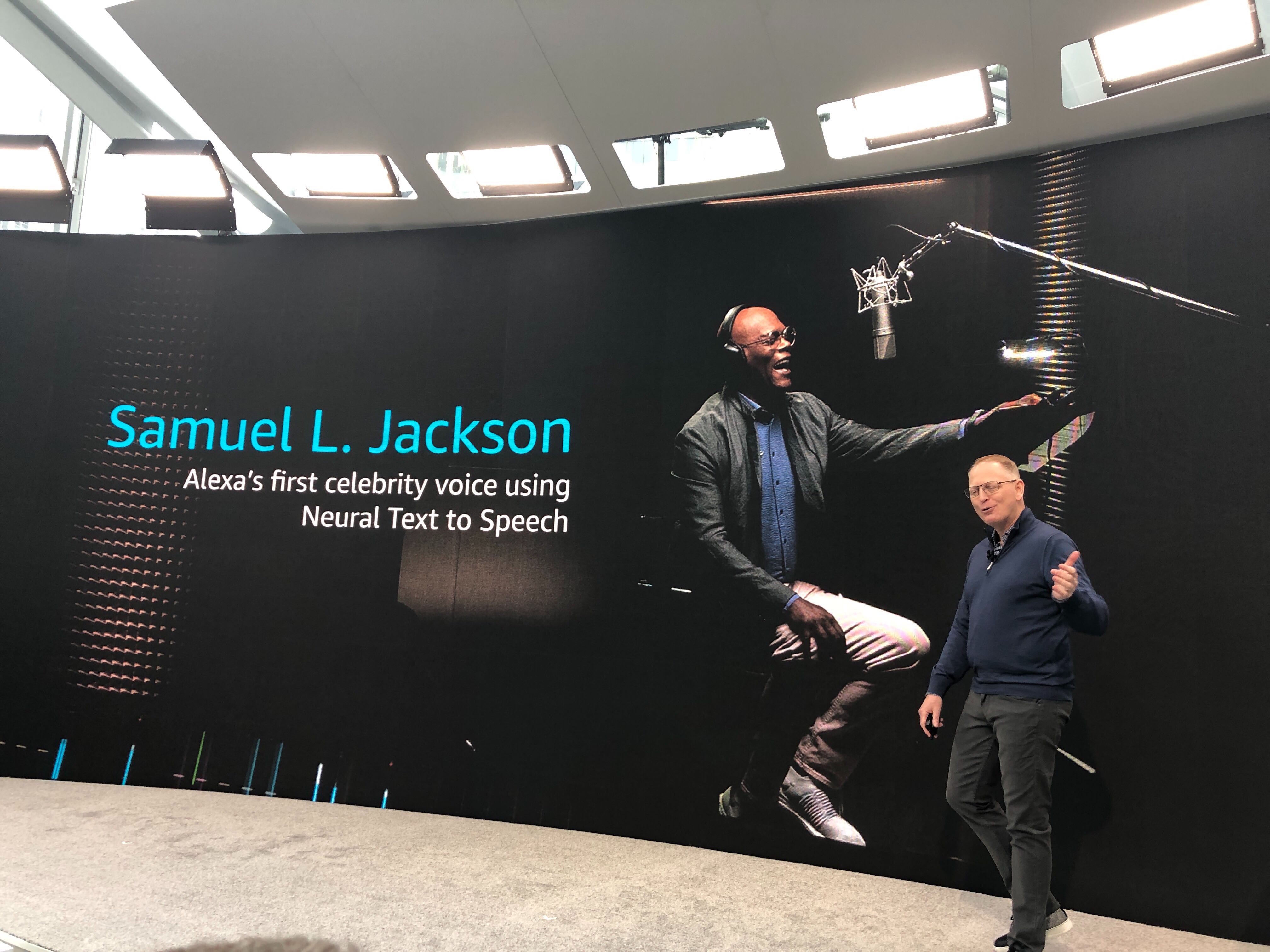
Additional voices will roll out next year, but they won’t be available for free. Instead, they’ll cost $0.99 each (at least at first). It’s a fun gimmick, I guess, but it’s really not much more than that and harkens back to the days of stand-alone GPS units that often had a similar feature.
“The pace of innovation is incredible and what we can do with machine learning really never ceases to amaze me,” Amazon’s Dave Limp said in today’s keynote. “This same neural network technology though gives us a lot more flexibility now in and around what we can do with the Alexa voice.”
At its hardware event in Seattle, Amazon today announced that it is launching a new Neural Text to Speech model for its Alexa personal assistant. This new model, which isn’t unlike what some of Amazon’s competitors like Google and Microsoft have launched in the past, uses the latest machine learning techniques to allow the company to build this new model which is meant to be more “emotive and expressive.”
In addition, the company today announced that your Echo can soon sound like Samuel L. Jackson, too. Using the same technology (instead of pre-recorded phrases), Alexa can now mimic celebrity voices, with Jackson’s being the first of them. That Samuel L. Jackson mode also comes in an explicit version.
Additional voices will roll out next year, but they won’t be available for free. Instead, they’ll cost $0.99 each (at least at first). It’s a fun gimmick, I guess, but it’s really not much more than that and harkens back to the days of stand-alone GPS units that often had a similar feature.
“The pace of innovation is incredible and what we can do with machine learning really never ceases to amaze me,” Amazon’s Dave Limp said in today’s keynote. “This same neural network technology though gives us a lot more flexibility now in and around what we can do with the Alexa voice.”
Today at a special event Amazon unveiled a bevy of new Echo devices including several aimed a bit upmarket. The Echo Studio is Amazon’s answer to the Google Nest Max and Apple HomePod. It’s larger than a normal Echo, supports 3D audio and Dolby Atmos.
The seems to have device five drivers: one, downward facing woofer, front-firing tweeter and three mid-range speakers aimed at different directions. Inside are several microphones that allow the speaker to work like a standard Echo device.
“It is the most innovative speaker we have ever built and has unbelievable sound,” David Limp, SVP of Devices. “It has space, it has clarity, has depth.”
Amazon entered this market last year with the Amazon Echo Link and Echo Link Amp. Both were clearly designed for consumers looking for a better way to bring voice services to existing home audio systems. The Echo Studio enters the same space but in a different way. Consumers looking for better sound with Alexa no longer have to lean on a traditional audio system.
The Echo Studio costs $199 and is available to pre-order today.
Amazon is launching multilingual mode for its Alexa-supporting devices, the company announced today at its Devices event in Seattle. The new multilingual mode will initially be available in the U.S., where it’ll work with English and Spanish; Canada, where it’ll offer French and English support, and Hindi and English in India.
These bilingual modes will mean that households can use their Alexa devices in both languages simultaneously, which is obviously a great feature for families where more than one language is spoken at home. Alexa will switch between languages, and employ new natural-sounded voices modeled using neural network processing to provide more realistic and expressive responses.
This multi-lingual mode is just a start, Amazon says, since Amazon SVP of Devices Dave Limp noted at the event that there are “billions of households around the world that have dual speakers, and sometimes three languages, in a single household,” all of which would benefit from expanded multilingual options.
“Make their metrics your metrics” is one of Flexport CEO Ryan Petersen’s mantras. Sometimes that means building free software for your clients. It can be frustrating aligning your fates with a fellow business if they operate on email, phone, and fax like much of the freight forwarding industry that gets pallets of good across the world from factories to retailer’s floors. So today the new Flexport Platform launches allowing brand clients, their factories, and their Flexport logistics reps to all team up to get stuff where it belongs on time.
The software could further stoke Flexport‘s growth by locking in customers to work with the shipping startup that was valued at $3.2 billion after raising $1 billion from SoftBank in February to bring it to $1.3 billion in funding. Flexport’s revenue was up 95% to $441 million in 2018, Forbes’s Alex Konrad reported. Yet there’s plenty of green field to conquer given even Flexport’s largest competitor Kuehne & Nagel only holds 2.5% market share while the whole freight forwarding industry grows 4% per year.
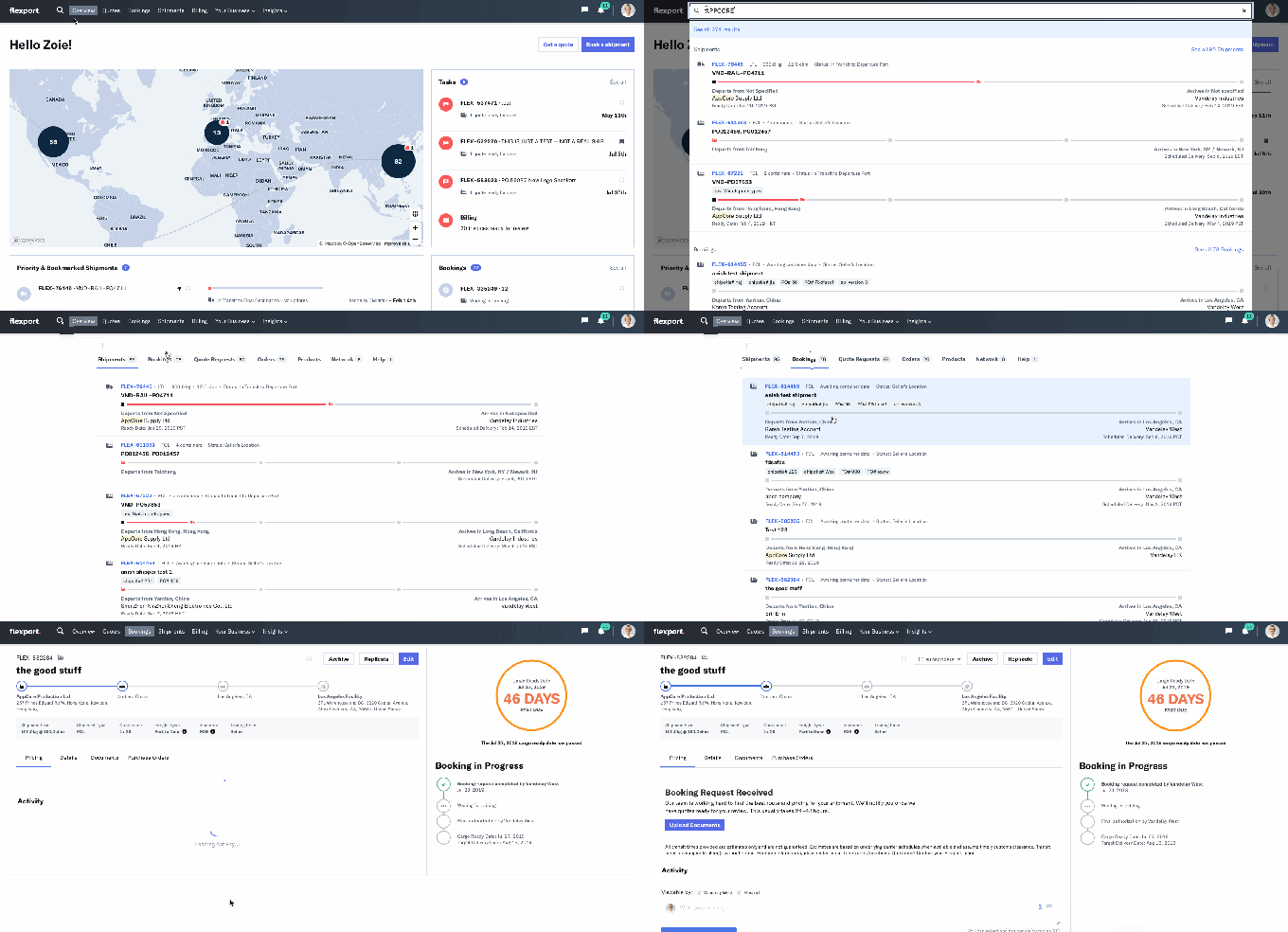
The Flexport Platform lets 10,000 clients like Bombas socks invite their suppliers to collaborate on managing shipments together. An integrated calendar makes shipping timelines clear. A map gives clients a god-view of their freight criss-crossing the globe. Pre-filled forms speed up compliance. Tagging lets users group shipments and filter or search their dashboards, and flag something for extra care — like a pallet of goods critical for a marketing launch event. Collaborators can also sync up via a Facebook Wall style feature, or direct message the team with threaded conversations much like Slack.

Flexport CEO Ryan Petersen
“There’s infinite demand for a job well done” Petersen says about his industry. “The hard part has always been doing a good job.” Taking the confusion out communication scattered across email chains means clients get shipping documentation filled out 50% faster with 4X more accurate data. Flexport is on the tip of the tongue as software eats the world, with antiquated sectors suddenly leveling up.
Petersen saw the inefficiency first-hand growing up running his own import/export and customs business. He part of a wave of entrepreneurs attacking unsexy businesses that the typical Silicon Valley enterprise exec might never stumble across. But three years after we profiled his scrappy company when it had raised just $26 million in funding and had 700 clients, Petersen tells me “We’re trying to retire the word startup.”
It turns out top global brands like Sonos and Klean Kanteen don’t like the second half of “move fast and break things” when those things are boats and planes full of their products. “They want a company that will help them grow, not the fly-by-night startup” Petersen explains. But with competitors trying to chase it and incumbents trying to adopt similar technologies, Flexport must maintain its agility to be subsumed by the pack.
As his company has grown to 1700 employees, he’s dedicated a ton of his time to keeping its culture in check — especially after a certain other logistics giant startup had some uber-painful troubles with workplace toxicity. “You either have too much bureaucracy or not enough process and no one knows what to do. The English language lacks a positive word for bureaucracy — just the right amount of process so people can move quickly”.

That’s meant a ton of personal growth too. Petersen is still enthusiastic, curious, and charmingly rough around the edges, but he carries it all with more dignity and gravity than a few years back. “The only way I get to stay in this role is if I learn faster than anybody else. Being the CEO of a 1700-person company is not something I knew how to do four to five years ago, or even last year” he tells me. “I’ve changed and become more self aware. It’s been really important to take care of myself — sleeping a lot, I quit drinking alcohol, I lost 30 pounds. I feel great.”
With plenty of cash in the bank, industry talent taking it seriously, and new businesses like Flexport Capital freight financing and its cargo insurance offered in partnership with Marsh, the company might not be a startup for long. It looks like a hot candidate for a coming season of IPOs. And while this company has its own plane (the leading entry for the naming contest is ‘Weird Flex But OK’), it’s actually part of its shipping fleet.
DJI announced two new drones and a new initiative to support first responders during natural disasters and recovery missions with drone technologies as it moves to consolidate its position as the leading drone technology provider.
The company hyped its new multispectral drone as the world’s first fully integrated multispectral imaging drone to enable more efficient land management, and the Agras T16, which is a spray drone to apply fertilizers and pesticides to field crops and orchards.
For first responders, the company is working with pre-selected U.S.-based partners to equip state and local public safety agencies with hardware and software from the company. Initially DJI is working with public and volunteer institutions like the Los Angeles Fire Department, the Menlo Park Fire Protection District, Alameda County Sheriff’s Office and the volunteer-based Public Safety Unmanned Response Team North Texas. Companies distributing and managing services include FlyMotion and Axon (which was formerly known as Taser International).
These partnerships are being pursued even as the U.S. military has officially banned the use of DJI drones since 2017 because of security concerns. The military still purchases DJI drones on a case-by-case basis, but there have been a number of red flags raised by U.S. defense and intelligence officials over the potential threat that using Chinese equipment may pose to national security.
“This program builds on DJI’s growing commitment to the public safety industry, as more than 900 public safety organizations across the United States, including the Los Angeles Fire Department, are deploying DJI drones for lifesaving activities,” said Romeo Durscher, director of Public Safety Integration at DJI. “To date, at least 278 people around the world have been rescued from peril by drones, and this program will ensure that many more lives are saved by mitigating the risks to emergency responders on the ground and on the front lines of natural disasters.”
Drone hardware and software distributed through the program will include DJI’s most advanced technologies, including the DJI Matrice 200 series and Mavic 2 Enterprise series drones, accessories and batteries, powerful visual and thermal cameras, DJI’s FlightHub drone fleet management software, and DJI AeroScope for airspace management and unauthorized drone detection and mitigation. In addition, DJI will provide technical support, repair services and on-site manpower to help organizations more effectively and efficiently deploy drone technology in times of need.
“Over the past year DJI has focused on delivering enterprise-grade drone technology that enables some of the most sophisticated businesses and government agencies in America to safely and securely deploy drone technology into their daily operations,” said Mario Rebello, vice president and Americas Regional Manager at DJI. “This year we aim to put our easy-to-use drones in the hands of farmers, agronomists and land stewards to help manage their lands in a more efficient and environmentally friendly way, while also making sure we equip emergency responders with access to the industry’s best tools and support they need to rapidly respond and save lives during natural disasters.”
DJI also took the opportunity to show off its drones as a platform for other technology developers, with FLIR Systems introducing its first multi-gas detector integrated with the DJI Matrice 210 drone for applications in chemical, industrial and environmental monitoring. DJI is allowing for even more development with the creation of a DJI X-Port, a gimbal attachment that allows hardware developers to integrate their own sensors, cameras and arrays. The X-Port features built-in communication APIs, SkyPort integration and a gimbal debugging interface to bring more sensors to market.
Finally, the company introduced new service protection plans like the “Enterprise Shield Basic Renew,” which offers a reduced-price product replacement for a damaged drone within one year of purchase and a “Shield Plus Renew” plan, which offers unlimited product replacements or free repair services within a year for the coverage amount a company purchases.
Juul Labs chief executive Kevin Brown is stepping down from the leadership role in the company making way for a longtime tobacco executive from the company’s largest shareholder, Atria, to take the reins.
The move comes as Juul faces extreme scrutiny from U.S. regulators over the company’s marketing tactics and a possible ban on some of its best-selling products. As part of the announcement today, Juul has agreed to suspend all of its marketing, advertising, and lobbying efforts in the U.S., which were a target for criticism.
The man taking over from Burns is K.C. Crosthwaite, who previously served as the chief growth officer at Altria Group and oversaw the company’s expansion into electronic cigarettes with the launch of its IQOS brand. Crosthwaite also served on the Juul board of directors as an observer.
“I have long believed in a future where adult smokers overwhelmingly choose alternative products like JUUL. That has been this company’s mission since it was founded, and it has taken great strides in that direction,” said Crosthwaite in a statement. “Unfortunately, today that future is at risk due to unacceptable levels of youth usage and eroding public confidence in our industry. Against that backdrop, we must strive to work with regulators, policymakers and other stakeholders, and earn the trust of the societies in which we operate.”
With Burns at the helm, Juul grew from a few hundred employees to over thousands of staff members working in 20 countries around the world. The executive also advocated for raising the legal age of smoking to 21, halted the sale of non-tobacco and non-menthol-flavored Juul pods to brick and . mortar retailers, enhanced online age verification, and discontinued Facebook and Instagram accounts (in the U.S.).
The steps may not be enough to alleviate the concerns of regulators and lawmakers over Juul’s sway over underage e-cigarette users. The company commands roughly 70% of the e-cigarette market for tobacco products and remains the de-facto brand for all vaping (in the same way that Google is the brand for online search).
Juul’s role as a smoking alternative may also be challenged by startups (like Hava Health) that are developing vaporizer technologies for smoking cessation.
“Working at JUUL Labs has been an honor and I still believe the company’s mission of eliminating combustible cigarettes is vitally important. I am very proud of my team’s efforts to lead the industry toward much needed category-wide action to tackle underage usage of these products, which are intended for adult smokers only,” said Brown in a statement. “Since joining JUUL Labs, I have worked non-stop, helping turn a small firm into a worldwide business, so a few weeks ago I decided that now was the right time for me to step down. I am grateful to be able to confidently hand the reins to someone with K.C.’s skill set, which is well-suited to the next phase of the company’s journey.”
Quantum computing is almost ready for prime time, and, according to most experts, now is the time to start learning how to best develop for this new and less than intuitive technology. With multiple vendors like D-Wave, Google, IBM, Microsoft and Rigetti offering commercial and open-source hardware solutions, simulators and other tools, there’s already a lot of fragmentation in this business. QC Ware, which is launching its Forge cloud platform into beta today, wants to become the go-to middleman for accessing the quantum computing hardware and simulators of these vendors.
Forge, which like the rest of QC Ware’s efforts is aimed at enterprise users, will give developers the ability to run their algorithms on a variety of hardware platforms and simulators. The company argues that developers won’t need to have any previous expertise in quantum computing, though having a bit of background surely isn’t going to hurt. From Forge’s user interface, developers will be able to run algorithms for binary optimization, chemistry simulation and machine learning.

“Practical quantum advantage will occur. Most experts agree that it’s a matter of ‘when’ not ‘if.’ The way to pull that horizon closer is by having the user community fully engaged in quantum computing application discovery. The objective of Forge is to allow those users to access the full range of quantum computing resources through a single platform,” said Matt Johnson, CEO, QC Ware. “To assist our customers in that exploration, we are spending all of our cycles working on ways to squeeze as much power as possible out of near-term quantum computers, and to bake those methods into Forge.”
Currently, QC Ware Forge offers access to hardware from D-Wave, as well as open-source simulators running on Google’s and IBM’s clouds, with plans to support a wider variety of platforms in the near future.
Initially, QC Ware also told me that it offered direct access to IBM’s hardware, but that’s not yet the case. “We currently have the integration complete and actively utilized by QC Ware developers and quantum experts,” QC Ware’s head of business development Yianni Gamvros told me. “However, we are still working with IBM to put an agreement in place in order for our end-users to directly access IBM hardware. We expect that to be available in our next major release. For users, this makes it easier for them to deal with the churn. We expect different hardware vendors will lead at different times and that will keep changing every six months. And for our quantum computing hardware vendors, they have a channel partner they can sell through.”
Users who sign up for the beta will receive 30 days of access to the platform and one minute of actual Quantum Computing Time to evaluate the platform.
Mario Kart Tour, Nintendo’s latest mobile game, is now available on iOS for iPhone, iPad and iPod touch. The game, like Nintendo’s other iOS releases, is free-to-play with in-app purchases (in-game currency called ‘rubies’) that you use for upgrades and unlocks.
Players immediately unlock one rider and get a tutorial to start, which introduces you to the Mario Kart Tour driving mechanics, which are slightly different than the ones you’re probably used to if you’ve played Mario Kart games for Nintendo’s various consoles. Specifically, your kart will always be moving forward, so there’s no acceleration to press, and instead you slide your finger side-to-side on the screen to steer left and right, with a tap firing off any items or weapons you might pick up.
High scores earn you points that can be redeemed for in-game unlocks, and the game also features other new mechanics like ‘frenzy mode,’ which gives you a timed period of unlimited item use whenever you pick up three of the same. Special challenges are also new in this mobile iteration, which introduce new ways to win instead of just placing first in a race with other kart drivers. Mario Kart Tour also features online ranking with other mobile players worldwide.
The ‘Tour’ component of the game is also a new twist: Nintendo is mixing courses inspired by real-world cities in with levels that are taken from classic Mario Kart games, and these will be cycling every two weeks for a fresh global tour on a regular basis. In-game characters will also get costume variants that are inspired by these globe-trotting destinations.
Based on Nintendo’s past track record, Mario Kart Tour should be perfectly playable without any in-game purchases, but players may feel that they hit a progression wall pretty quickly without picking up some currency. It’ll be interesting to see how this one fares, given that Apple has just introduced its own Arcade subscription service focused on games that eschew in-app purchase mechanics – including cart racer Sonic Racing, which looks very much like it was once intended to offer similar in-app mechanics before Arcade came along.

Megan Ellis and Christian Cawley catch up to bring you the latest tech news that matters in the Really Useful Podcast, the tech podcast for technophobes.
This week, Megan has details about the launch of the Huawei Mate 30, an Android phone that significantly ships without Google apps. We also find out if your iPhone was hacked by a website, how you can get a free Grand Theft Auto game, and the end of MoviePass.
Plus some educational YouTube channels, Instagram privacy settings, and amazing discounts you can get with a .EDU email address.
What did we talk about this time?
Reckon you could help us reach more people? If you know anyone who would would benefit from some clarity about tech and how to make the most of phones, websites, and computers, share this podcast with them!
They’ll find the Really Useful Podcast on these services:
If you enjoyed this show, don’t forget to subscribe to the Really Useful Podcast today!
Read the full article: Hacked iPhones, Instagram Privacy, Awesome Discounts for Students