05 August 2020

Here are all the things Samsung announced at today’s Unpacked event


Samsung’s first virtual Unpacked ranked somewhere between Microsoft and Apple’s recent events in terms of overall presentation and general awkwardness. The show kicked off seven minutes late, and a number of on-screen presenters certainly tended toward the more…awkward side of things, but overall, it was a decent first virtual event as the company embraces what it’s branded as “The Next Normal.”

Toward the end of the show, mobile head TM Roh noted, “Going forward, 5G and foldable will be the major pillars of Samsung’s future.” 5G is certainly a no-brainer. The event saw the company taking a step toward standardizing the next-gen wireless technology across its flagship mobile devices — as well as making its first appearance on the company’s tablets.

Image Credits: Samsung

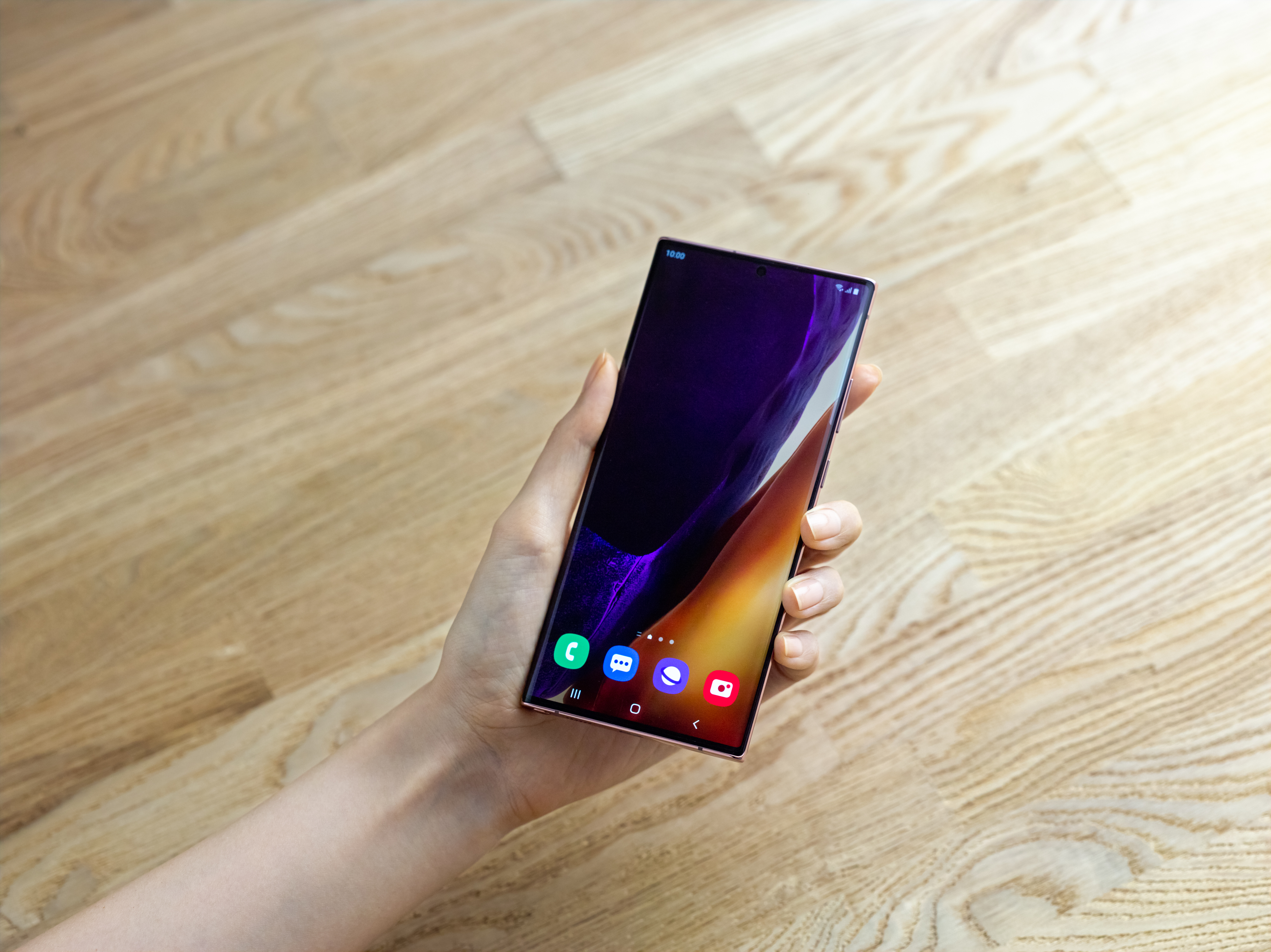
As expected, the big news is the latest version of Samsung’s perennial favorite phablet line. The Note 20 gets 5G for both models and now comes in 6.7 and 6.9-inch models. The Ultra version gets a 120Hz refresh rate along with a hybridized 50x super zoom, using the same technology introduced with the Galaxy S20 earlier this year.

The most unsung addition might be UWB (ultra-wideband), which will enable a number of new features, including close proximity file sharing, a future unlock feature (with partner Assa Abloy) and a find my phone-style feature with an AR element. Xbox head Phil Spencer also made a brief remote cameo to announce Game Pass access, bringing more than 100 streaming titles to the device.

The models start at  $1,000 and $1,300, respectively. They’ll start shipping August 21.

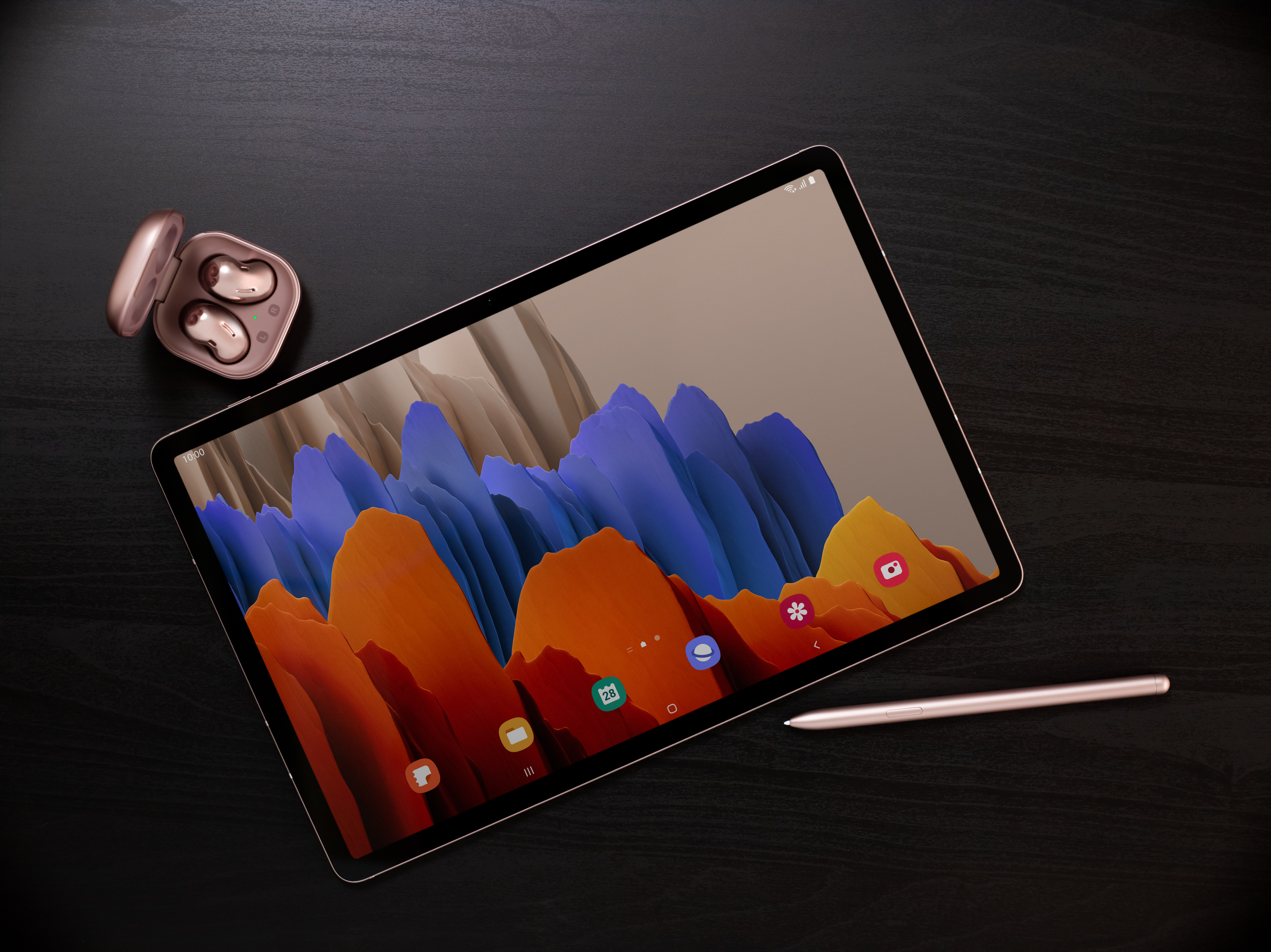
New to the 5G game is the Galaxy Tab series. Samsung says the line includes “the first tablets that support 5G available in the United States.” The S7 and S7+ sport an 11 and 12.4-inch display, respectively, and start at $650 and $850, respectively. No word yet on pricing for the 5G versions.

Image Credits: Samsung

The event included a pair of new wearables. The more exciting of the two is probably the Galaxy Buds Live. Samsung has made consistently solid wireless earbuds, and the latest version finally introduce active noise canceling, along with some cool features like the ability to double as a mic for a connected Note device. The bean Buds are available today for $170.

Image Credits: Samsung

I’d be lying if I said the most exciting part of the Galaxy Watch 3 wasn’t the return of the physical bezel — long the best thing about Samsung’s smartwatches. Also notable is the addition of improved sleep and fitness tracking, along with an ECG monitor, which Samsung announced has just received FDA clearance. The Galaxy Watch 3 runs $400 and $430 for the 41mm and 45mm, respectively. There will also be LTE models, priced at $50 more.

Image Credits: Samsung

As for the foldable side of things, the event also found Samsung announcing its latest foldable, the Galaxy Z Fold 2, with help from superstar boy band, BTS. The focus on the new version mostly revolves around fixing the numerous problems surrounding its predecessor. That includes a new glass reinforcement for the screen and a hinge that sweeps away debris that can fall in and break the screen in the process. More information on the foldable will be announced September 1.


Read Full Article

TikTok updates policies to ban deepfakes, expand fact-checks, and flag election misinfo


As uncertainty swirls around TikTok’s future in the U.S., the company this morning announced new Community Guidelines focused on helping keep misleading and deceptive content off its platform. The new rules aim to better clarify what’s allowed and not allowed on TikTok, broaden the app’s fact-checking partnerships ahead of the U.S. election, and ban the use of “deepfakes” (manipulated content) designed to deceive. In addition, TikTok has added an in-app reporting option for election misinformation. It also claims to have worked with experts, including the Countering Foreign Influence Task Force (CFITF), run by the U.S. Department of Homeland Security (DHS), to help counter the threat of foreign influence on elections.

That latter item is a particularly clever spin on TikTok’s current situation, given that it’s the foreign interference of TikTok itself that the Trump Administration is concerned about, along with the potential security risk that comes from the possibility of China’s authoritarian government collecting massive amounts of data on TikTok’s American users.

TikTok, however, says it has worked with CFITF and other experts to help stop the dangers of foreign influence on U.S. elections. The task force shares insight about possible disinformation campaigns across the industry and connects local election officials with online platforms and law enforcement. TikTok didn’t clarify the extent of its work in this area, but CFITF has only existed since 2018 so these would be fairly recent efforts.

The company also says it’s expanding its relationships with PolitiFact and Lead Stories to fact check potential misinformation related to the 2020 U.S. election. The organizations were previously focused on other fact-checks, like those related to COVID-19 and climate change.

However, fact-check organizations’ ability to actually find and fact-check misleading content can be difficult as much of this content is framed by users as “just my opinion.” A quick search on TikTok this morning for “climate change hoax,” for example, pulled up videos with dissenting user opinions on the topic with no fact-check applied. This isn’t a problem unique to TikTok, of course. Social media platforms in general struggle the line between free speech and misinformation, especially when content goes viral that shares a viewpoint not held by a majority of the scientific or academic community.

TikTok also says today it will roll out an election misinformation option to its in-app reporting feature in the “coming weeks.” But it didn’t offer a clear launch date, despite elections now being months away.

The company says it’s clarifying its policy to ban the use of “synthetic or manipulated content,” too. This will now include deepfakes meant to deceive or distort the truth. The policy continues to be questionably enforced. For example, TikTok easily pulled up the recent viral video that claims to show House Speaker Nancy Pelosi drunk — a video that has been manipulated from the original where she speaks normally. Facebook, by comparison, labeled the video “partly false,” given the digital slowing down of the original video.

None of these problems around fake content or attempts to deceive are unique to TikTok, of course. U.S. companies don’t have things under control, either.

TikTok, in addition, notes it releases Transparency Reports and recently added new Transparency webpage with information for lawmakers and users alike.

Its policy around “coordinated inauthentic behavior,” has also been restated to be clearer, TikTok says.

The new policy reads:

Do not engage in coordinated inauthentic activities (such as the creation of accounts) to exert influence and sway public opinion while misleading individuals, our community or the larger public about the account’s identity, location or purpose

The Trump administration has put the TikTok ban on hold for at least 45 days for now, ostensibly so TikTok could work out a deal with Microsoft. The U.S. government wants the company to spin out its U.S. operations to distance itself from China.

TikTok users, naturally, have their own theories about why Trump is coming down so hard on their prefered social app. Some number of TikTok teens pranked the Trump campaign over the rally in Tulsa, for starters. Other TikTok users pointed out that Trump’s real concern is that TikTok doesn’t allow political ads — and microtargeting voters on Facebook helped Trump win the last election.

These theories are interesting to debate (may not be entirely wrong!), but the reality is that the concerns over TikTok’s connection to China have some bipartisan support.


Read Full Article

Google updates G Suite for mobile with dark mode support, Smart Compose for Docs and more


Google today announced a major update to its mobile G Suite productivity apps.

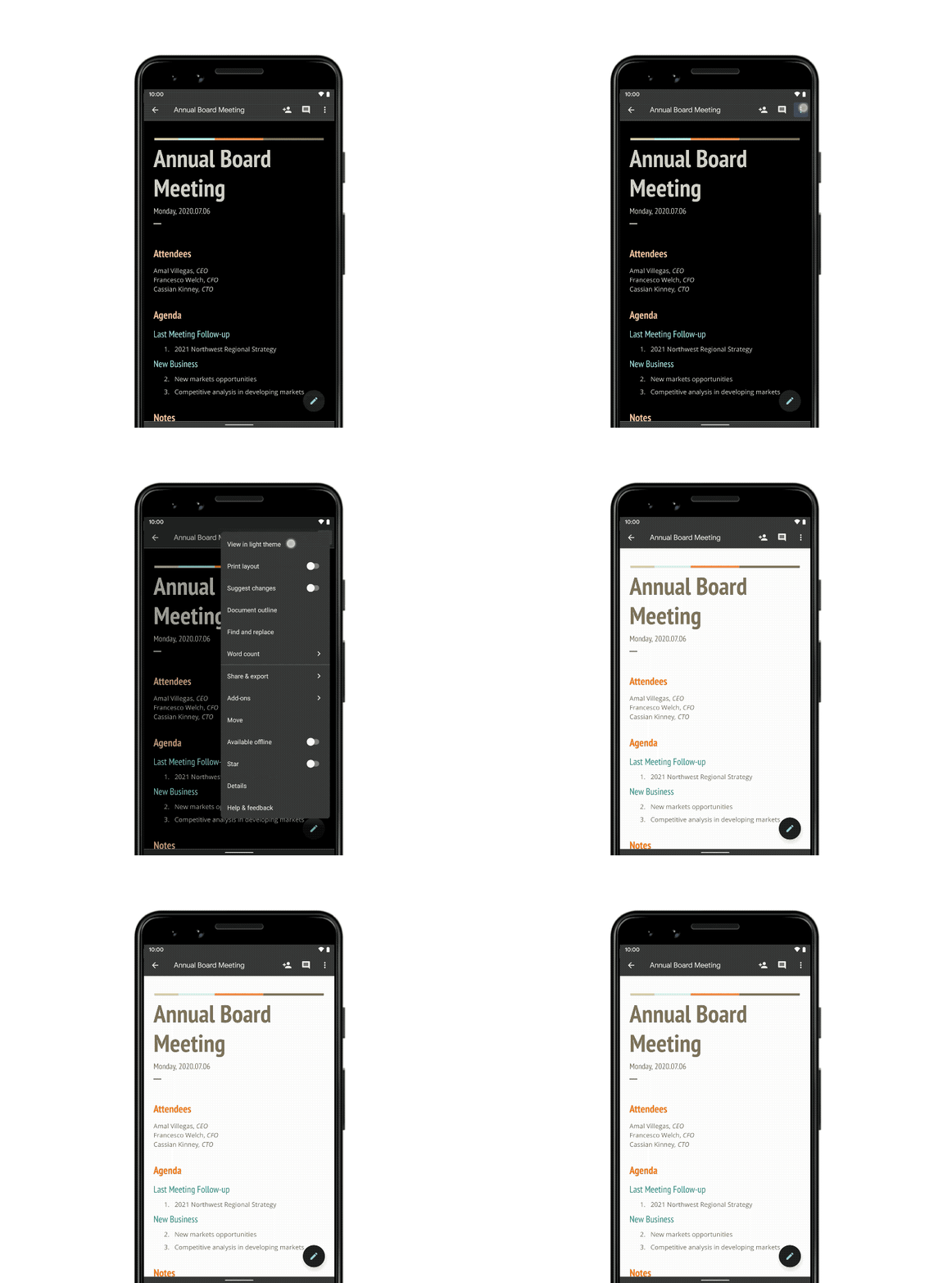
Among these updates are the addition of a dark theme for Docs, Sheets and Slides, as well as the addition of Google’s Smart Compose technology to Docs on mobile and the ability to edit Microsoft Office documents without having to covert them. Other updates include a new vertically scrollable slide viewing experience in Slides, link previews and a new user interface for comments and action items. You can now also respond to comment on your documents directly from Gmail.

For the most part, these new features are now available on Android (or will be in the next few weeks) and then coming to iOS later, though Smart Compose is immediately available for both, while link previews are actually making their debut on iOS, with Android coming later.

Most of these additions simply bring existing desktop features to mobile, which has generally been the way Google has been rolling out new G Suite tools.

The new dark theme will surely get some attention, given that it has been a long time coming and that users now essentially expect this in their mobile apps. Google argues that it won’t just be easier on your eyes but that it can also “keep your battery alive longer” (though only phones with an OLED display will really see a difference there).

Image Credits: Google

You’re likely familiar with Smart Compose at this time, which is already available in Gmail and Docs on the web. Like everywhere else, it’ll try to finish your sentence for you, though given that typing is still more of a hassle on mobile, it’s surely a welcome addition for those who regularly have to write or edit documents on the go.

Even if your business is fully betting on G Suite, chances are somebody will still send you an Office document. On the web, G Suite could already handle these documents without any conversion. This same technology is now coming to mobile as well. It’s a handle feature, though I’m mostly surprised this wasn’t available on mobile before.

As for the rest of the new feature, the one worth calling out is the ability to respond to comments directly from Gmail. Last year, Google rolled out dynamic email on the web. I’m not sure I’ve really seen too many of these dynamic emails — which use AMP to bring dynamic content to your inbox — in the wild, but Google is now using this feature for Docs. “Instead of receiving individual email notifications when you’re mentioned in a comment in Docs, Sheets, or Slides, you’ll now see an up-to-date comment thread in Gmail, and you’ll be able to reply or resolve the comment, directly within the message,” the company explains.


Read Full Article

Google updates G Suite for mobile with dark mode support, Smart Compose for Docs and more


Google today announced a major update to its mobile G Suite productivity apps.

Among these updates are the addition of a dark theme for Docs, Sheets and Slides, as well as the addition of Google’s Smart Compose technology to Docs on mobile and the ability to edit Microsoft Office documents without having to covert them. Other updates include a new vertically scrollable slide viewing experience in Slides, link previews and a new user interface for comments and action items. You can now also respond to comment on your documents directly from Gmail.

For the most part, these new features are now available on Android (or will be in the next few weeks) and then coming to iOS later, though Smart Compose is immediately available for both, while link previews are actually making their debut on iOS, with Android coming later.

Most of these additions simply bring existing desktop features to mobile, which has generally been the way Google has been rolling out new G Suite tools.

The new dark theme will surely get some attention, given that it has been a long time coming and that users now essentially expect this in their mobile apps. Google argues that it won’t just be easier on your eyes but that it can also “keep your battery alive longer” (though only phones with an OLED display will really see a difference there).

Image Credits: Google

You’re likely familiar with Smart Compose at this time, which is already available in Gmail and Docs on the web. Like everywhere else, it’ll try to finish your sentence for you, though given that typing is still more of a hassle on mobile, it’s surely a welcome addition for those who regularly have to write or edit documents on the go.

Even if your business is fully betting on G Suite, chances are somebody will still send you an Office document. On the web, G Suite could already handle these documents without any conversion. This same technology is now coming to mobile as well. It’s a handle feature, though I’m mostly surprised this wasn’t available on mobile before.

As for the rest of the new feature, the one worth calling out is the ability to respond to comments directly from Gmail. Last year, Google rolled out dynamic email on the web. I’m not sure I’ve really seen too many of these dynamic emails — which use AMP to bring dynamic content to your inbox — in the wild, but Google is now using this feature for Docs. “Instead of receiving individual email notifications when you’re mentioned in a comment in Docs, Sheets, or Slides, you’ll now see an up-to-date comment thread in Gmail, and you’ll be able to reply or resolve the comment, directly within the message,” the company explains.


Read Full Article

Here’s the Samsung Galaxy Z Fold 2


Samsung promised five “power devices” for its virtually-only Unpacked event. We already know about the Note 20, Galaxy Watch 3, Tab S7 and Buds Live — so what’s left? We speculated based on an earlier news that the company would debuting a new foldable — the biggest question, however, is whether it would be a rehash of the recently announced Galaxy Z Flip 5G or something else entirely.

Turns out the company is releasing the sequel to its first foldable, the…troubled Galaxy Fold. After a false start or two, the company says it sold one million units of the innovative but overly fragile handset. Announced earlier this year, however, the clamshell-styled Flip was better received, and frankly the foldable Samsung ought to have released in the first place.

With all of that in mind, what lessons has the company applied to the new version of the Fold? For starters, the front displays seemed like something of an afterthought on the original Fold. For the Galaxy Z Fold 2, it expands significantly to 6.2 inches, in addition to the main (foldable) 7.6-inch screen.

The colors will match the new Notes (and the rest of the devices announced today), available in  Mystic Black and Mystic Bronze.

Details are still forthcoming, including how reinforced this version is. The company notes in the press material, “After releasing two foldable devices and listening to user feedback on the most requested upgrades and new features, Samsung unveils the Galaxy Z Fold 2 with meaningful innovations that offer users enhanced refinements and unique foldable user experiences.”

The company appears to not quite be ready to talk about the new foldable beyond these first few details. Instead, it’s promising addition information next month — likely at the press event it has planned in lieu of an appearance at IFA in September. Hopefully we’ll get a chance to play around it then, too. We’ll try to be gentle this time.


Read Full Article

Google Play Music to shut down starting in September, will disappear by December


Google’s plans to wind down its Google Play Music service in favor of the company’s newer YouTube Music have been known for some time. But Google this week has given users a deadline on making the switch. The company says YouTube Music will fully replace Google Play Music in December 2020, at which point Google Play Music users will no longer be able to stream from or otherwise use the Google Play Music app.

Though December is the final deadline for being able to export from the Google Play Music app, your ability to stream from the Google Play Music app will end before then.

In September 2020, users in New Zealand and South Africa will be the first to lose access to stream or use the Google Play Music app. The rest of the world will lose their access in October.

However, Google will continue to make your content available for export through December. Through the transfer tool released in May, Google Play Music users will be able to export their playlists, uploads, purchases, likes and more to YouTube Music. Alternately, users can use the Google Takeout service to export their data and download their purchased and uploaded music.

For those considering making a switch to a rival streaming service, like Spotify, there aren’t official tools available, but there are third-party options, like Soundiiz, TuneMyMusic, MusConv, and others.

Google says it will also be making changes to the Google Play store and Music Manager.

Starting this month, users will no longer be able to make purchases or pre-order music from Google Play Music through Music Manager, nor will they be able to upload and download music.

The company has been preparing YouTube Music in advance of this shift to address complaints Google Play Music users had with earlier versions of the service. This year, Google increased playlist length from 1,000 to 5,000 songs and added support for uploads (up to 100K tracks — 50K more than on Google Play Music). It has also rolled out offline listening, lyrics, and Explore tab for discovery, and a tool for transferring podcast subscriptions and episode progress to Google Podcasts.

YouTube Music offers a variety of playlist options now, too, including collaborative playlists built with friends and new programmed playlists built by editors. Assistive technology now also make personalized suggestions of what to add when you’re building a YouTube Music playlist.

YouTube Music service has expanded its reach across platforms, as well, with support for Android TV, Google Maps (for music while navigating), and via Google Assistant in recent days.

For any user who doesn’t opt to move to YouTube Music, Google says subscriptions will be automatically canceled.

Google’s strategy with music has been overly complicated for some time (not unlike its strategy with messaging and communication apps). When users signed up for YouTube Premium (previously YouTube Red), they’d automatically receive access to Google Play Music, and vice versa. And Google continued to sell YouTube Music as a separate subscription. In other words, Google created a world where it wasn’t only competing against big streaming services like Apple Music, Spotify and Pandora, it was also competing against itself.

Now it’s hoping to shift its streamers to YouTube Music. The idea came about because YouTube for a long time has been a way to access free music, thanks to a deep catalog of officially licensed music videos, live performances and other music content. So why not upsell YouTube’s freeloading music fans on an ad-free, upgraded music experience? That strategy may have worked to some extent, but it’s more recently being challenged. Last week, Facebook announced deals with record labels to make music videos free on its platform, as well. If user behavior shifts as a result, YouTube’s ability to funnel free music fans into a premium product could be impacted, too.


Read Full Article

Samsung’s Galaxy Note 20 ships August 21, starting at $1,000


Samsung promised a lot of gadgets for today’s big Unpacked event — five in all, as a matter of fact. As expected, the big headliners — both figuratively and literally — are the latest additions to the popular Note line.

Also unsurprising is the company’s positioning the Note 20 — along with the rest of today’s new hardware — as  “devices […] that seamlessly integrate to empower consumers navigating a rapidly changing world.” It’s mostly a bit of hyperbole as the company looks to position a pair of pricey flagship phones in the midst of an extraordinarily unprecedented year.

Like the Galaxy S20 before it, Samsung’s skipping 10 full numbers here for the sake of consistency. On a whole, nothing here jumps out as a huge leap in progress, a fact due in no small part to the company’s six-month flagship cycle. There are, however, a number of notable upgrades on-board here, as the company works to retain its position among the bleeding edge of smartphone advances.

Image Credits: Samsung

Samsung was, of course, one of the first company’s to embrace 5G, employing the next-gen technology well before achieving any sort of saturation point. The company has also embraced the budget side of the spectrum with the Galaxy A71 5G. It follows then, the Note line is the company’s “first fully 5G-capable Note,” meaning that the technology is no longer just the realm of the more premium model — and that it utilizes both the Sub-6 and mmWave versions of 5G technology.

Once again, the Note line is divided into two distinct models: this time out, the Note 20 and Note 20 Ultra, starting at $1,000 and $1,300, respectively. Much has been made of Samsung’s attempts to move the devices at a — less than opportune time. The fact of the matter is people aren’t really buying handsets these days. For one thing, lots of people just don’t have the sort of disposable income they did just a year ago. And what money is going to technology is generally being spent on things like PCs, as remote becomes the new norm for office workers.

Image Credits: Samsung

Handsets costing $1,000+ had already become a tough sell in recent years, with an overall market slow down — and recent figures from third-party analysts show that the COVID-19 pandemic hasn’t been kind to Samsung’s sales bottom line.

All of that said, the Note is still very much the standard by which all other phablets are judged. Plenty of other companies have tried and failed to launch competitive pocket productivity devices, and for its nearly decade-long existence, no one has been able to come close to the Galaxy Note.

As is its custom, Samsung continues to press the bounds of screen size on the line. The Note 20 and Note 20 Ultra sport 6.7 and 6.9-inch displays, respectively. Both are up from the 10, which sported a 6.3 and 6.8-inch screen. The Ultra also sports a 120Hz refresh rate.

For the first Samsung launch in recent memory, I can’t tell you what kind of job the company has done keeping the footprint down in spite of an ever-enlarging screen — for reasons that are probably obvious, I haven’t seen or touched the device in person yet. Soon, I’m told.

Image Credits: Samsung

What I can say is that the dimensions have increased, but only by a millimeter or so. And both models have added somewhere between 10-30 grams apiece. The device retains the familiar three-camera array, albeit with a redesigned enclosure. The Note Ultra borrows some key cues from the S20 Ultra. The biggest additions are the 108-megapixel wide-angle and the Space Zoom technology, which brings up to 50x super zoom (only 5x optical) on the Ultra and 30x (3x hybrid optical) on the 20. The Ultra also sports laser auto focus for quicker shots, while the 20 sports a 64-megapixel telephoto. Both models can now shoot video in 8K, as well.

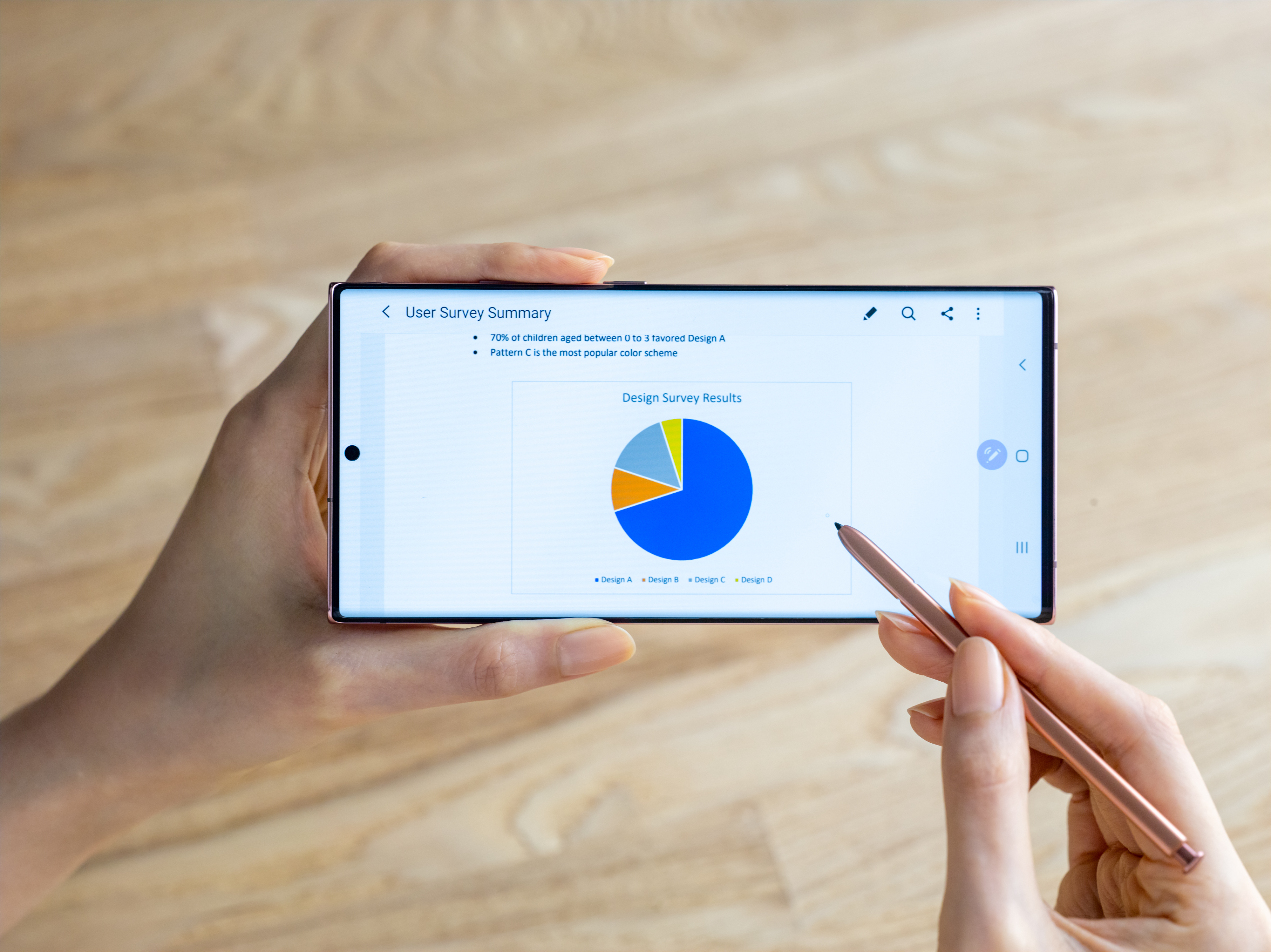
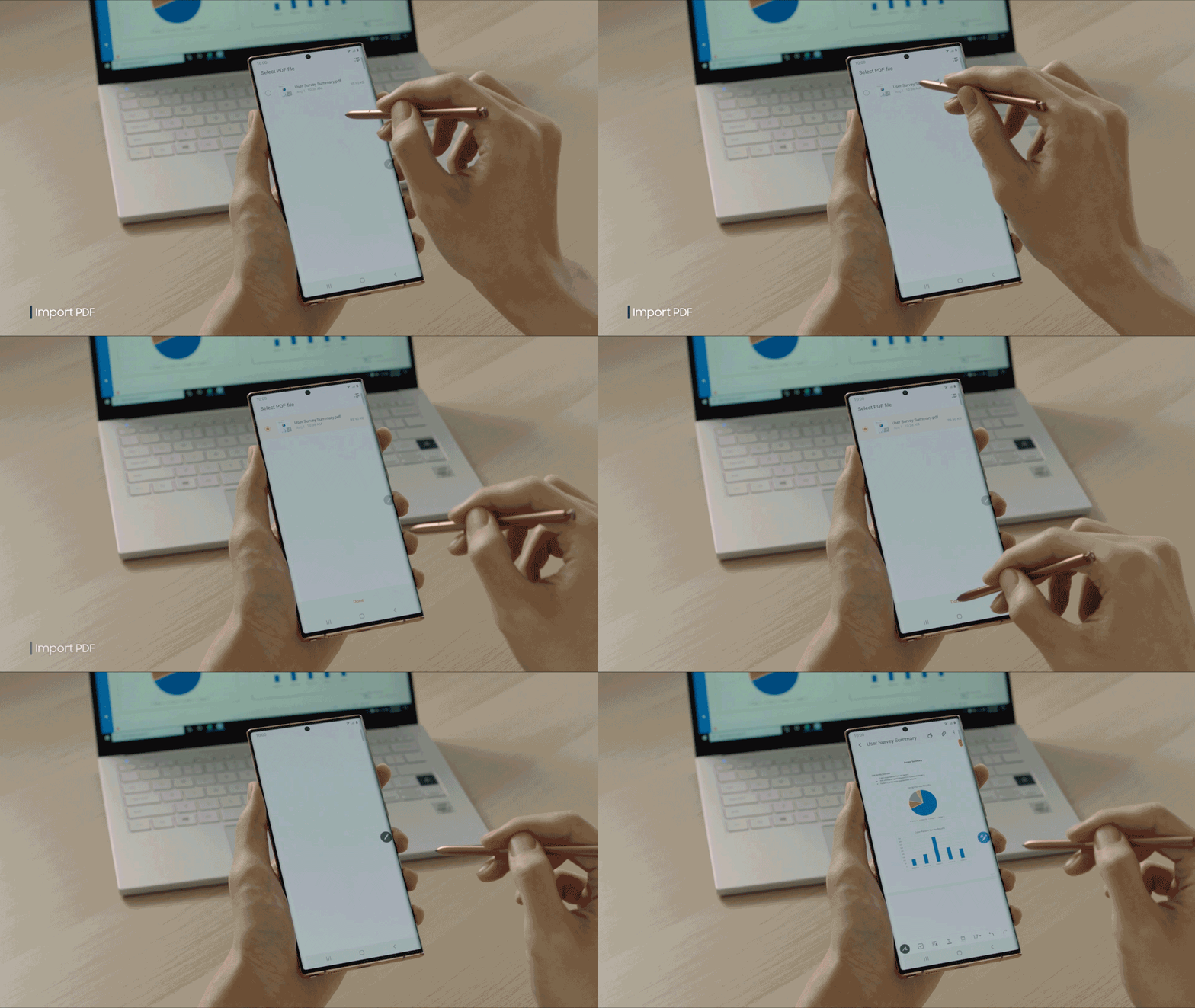
The fan favorite S Pen gets a bunch of updates, including increased precision and responsiveness, along with gesture controls that do things like shoot screenshots or return to the home screen. The stylus can be used as a remote control as well, up to 30 feet, courtesy of Bluetooth Low Energy. The associated Notes app features better cloud syncing and a new recording feature, which associates time stamps with written notes (there’s no live transcription à la Google Recorder, however).

[gallery ids="2026979,2027015,2027014,2027013,2027012,2027011,2027010,2027009,2027008,2027007,2027006,2027005,2027004,2027003,2027002,2027001,2027000,2026999,2026998,2026997,2026996,2026995,2026993,2026992,2026991,2026990,2026989,2026988,2026987,2026986,2026985,2026982,2026981,2026980"]

Samsung and Microsoft have broadened their partnership here. That includes the ability to access Samsung notes and mirror the mobile device on a Windows 10 PC. And mid-next month, the Note 20 will be getting Xbox Game Pass access, with 100+ games, as Samsung looks to position its high-end handsets as more serious mobile gaming devices.

There is, as ever, DeX support, letting users mirror the system to a connected smart TV. In spite of rumors around Samsung’s waning interest with Bixby, the company tells me that the smart assistant “remains consistent” with what has been offered on previous devices. A fun addition also worth pointing out is the ability to pair the new Galaxy Buds Live as microphones for when you’re shooting a subject talking. UWB (ultra-wideband) is another new addition that lets users share files when in close proximity and will double as a digital key at some point down the road.

Image Credits: Samsung

The models are powered by the new Snapdragon 865+. The Ultra ships with 12GB of RAM and either 128GB or 512GB of storage. The Note 20 has 8GB of RAM and 128GB of storage. Their batteries are 4,500mAh and 4,300mAh, respectively. Pre-orders open tomorrow, and they’ll start shipping August 21.


Read Full Article

Instagram Reels launches globally in over 50 countries, including US


Instagram Reels, the company’s significant effort in challenging TikTok on short-form creative content, is launching globally, starting today. The feature is being made available across 50 countries, including the U.S., as TechCrunch had previously reported. The expansion means Reels will now be available in key international markets, such as India, Brazil, France, Germany, the U.K., Japan, Australia, Spain, Mexico, Argentina and several others.

The timing is fortuitous, given TikTok’s uncertain future in the U.S. as the Trump administration weighs either banning the Chinese-owned app entirely or forcing it to sell off its U.S. operations.

However, Facebook’s plans to respond to the TikTok threat were underway well before now.

In late 2018, Facebook launched a TikTok clone called Lasso. The app didn’t take off and was shuttered this year. Though unsuccessful as a standalone product, Lasso represents Facebook’s ability to run what are essentially large-scale beta tests that don’t have to generate revenue. This allows Facebook to collect a sizable amount of user behavioral data that can then be put to use when building new features for flagship apps, like it’s doing with Instagram Reels.

Following Lasso’s tests, Instagram released Reels in Brazil in November 2019, where it was called Cenas, to see how Instagram users would respond to a different sort of mobile video experience.

Those tests steadily expanded outside the U.S. to markets like India and parts of Europe in 2020.

With Reels, Instagram’s goal is not just to capture the now potentially up-for-grabs TikTok audience in the U.S. — it’s to steal them away even if TikTok remains.

Image Credits: Instagram

Today, Instagram caters to a certain kind of creator community that doesn’t always overlap with the younger, Gen Z (and up) user base that’s found a home on TikTok. (And Gen Alpha, if we’re being honest.) Instead, Instagram users either share polished, curated photos to their Feed; publish personal and casual videos in Stories; or share almost YouTube-like creator content to IGTV. Meanwhile, Instagram’s browsing experience hasn’t offered a way to quickly swipe through videos like on TikTok.

Image Credits: Instagram

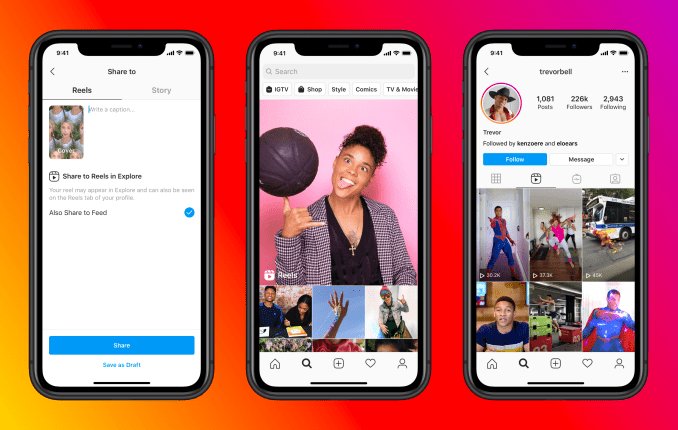
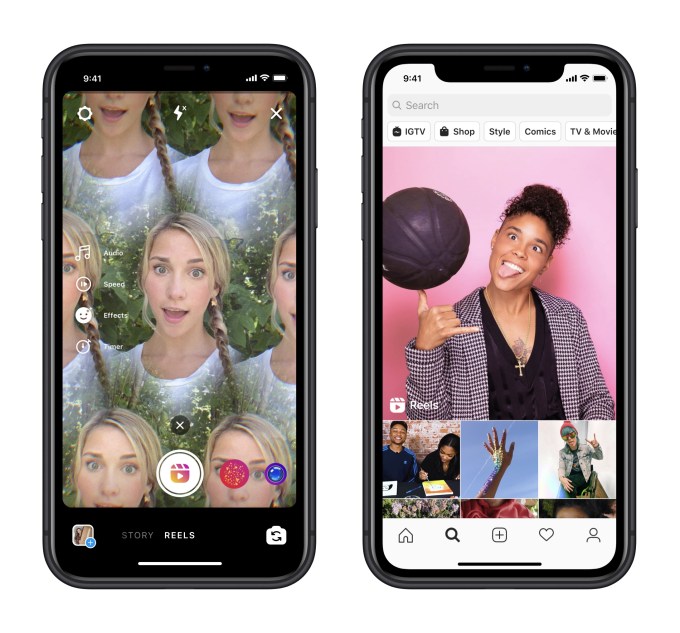
Reels aims to change that. The feature lets users create and publish 15-second videos using a new set of editing tools that include options like AR effects, a countdown timer, a new align tool to line up different takes and, of course, music. Instagram’s deals with major record labels mean users won’t have to wonder if their sound will later be removed due to a rights issue and will offer a variety of musical content right out of the gate.

A comprehensive audio catalog could be a competitive advantage for Reels — not to mention a feature that’s difficult for smaller apps to acquire due to the complicated nature of record label negotiations.

When TikTok users recently descended on rival apps upon news of a potential TikTok ban in the U.S., one of their chief complaints was the lack of good music or popular sounds. Some even republished their favorites under hashtags like #sounds or #TikToksounds in an effort to rebuild TikTok’s catalog via user-generated uploads.

Instagram understood the importance of music — not just editing tools, workflow and discovery — in helping its TikTok competitor thrive. TikTok, after all, has its own record label contracts — though the extent of those deals haven’t been widely published.

“We think it’s really important to honor the rights of the music labels — and that’s one we’ve been working on for years now,” said Instagram head of Product, Vishal Shah. “We’re launching Reels now in countries where we have rights. We think that the catalog is quite deep and it has some unique content that you can’t really find, at that depth, in other platforms. At the same time, we wanted to make sure that all the restrictions that we needed to put in place — whether that was on the country basis or what could people download and use and remix etc. — were all built into the product from from day one. That’s something we’ve been working with the labels on and was an important consideration in the launch,” he added.

What he didn’t mention is that Instagram’s music industry relationships aren’t only with the record labels. The company has deals with other publishers and independents as well, which have been part of the company’s ongoing partnership efforts and strategic negotiations that are helping fuel other Facebook products, like the recent launch of Music Videos. 

Image Credits: Instagram

Using Reels is easy because it’s built into the Instagram Camera that people already know how to use. To create a new Reel, you’ll select the option at the bottom of the Instagram Camera, next to Story. The editing tools then pop up on the left side of the screen, which is where you’ll find the AR effects and other options, like the timer, speed and align features.

Like other Instagram posts, Reels can be saved to Drafts while they’re a work in progress. When ready to go live, Reels can be pushed out across key surfaces in the app — including Stories, Stories with Close Friends only or as a DM. If you have a public Instagram account, you also can publish Reels to the wider Instagram audience, which will discover them within a new space in Explore.

Image Credits: Instagram

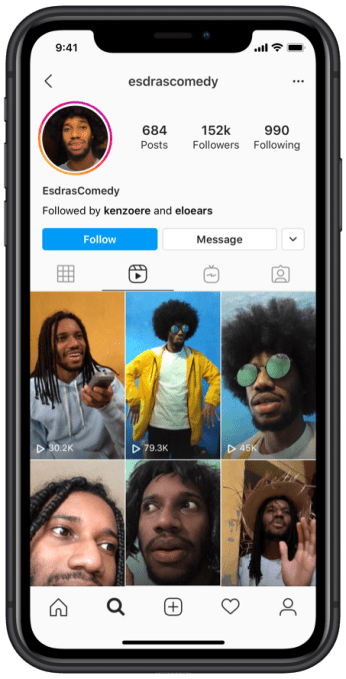
Reels can also be captioned and hashtagged, and friends can be tagged — allowing Instagram to leverage the size and scale of its user base to help the new feature go viral. If Reels are published to Stories, they’ll disappear in 24 hours. Otherwise, Reels will continue to live on in a new tab on users’ profiles.

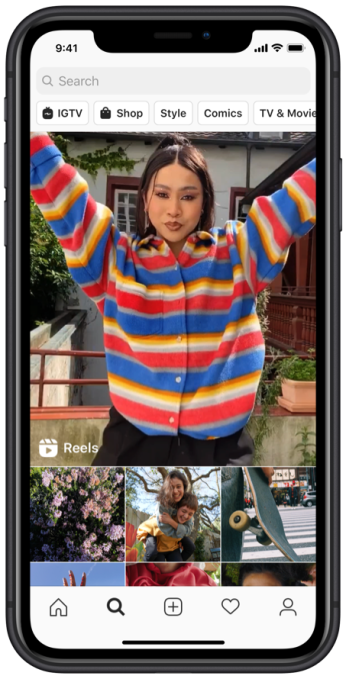
To watch Reels from Explore, users are presented in a vertical feed personalized to your interests, similar to TikTok. “Featured” Reels are those chosen by Instagram to guide users to original content and will be labeled accordingly.

Overall, what Instagram has built isn’t all that differentiated from TikTok. But nor is it a direct clone.

Instead, Instagram has turned the entirety of the TikTok experience into a single feature among many others within its own app. That’s been a formula for success in the past — Instagram Stories is now bigger than all of Snapchat, for instance.

But TikTok has built something that may not be as easily replicated: a community of users who started their social media lives with underage accounts on Musical.ly. They grew up with the app, lived through the TikTok rebranding and now may see no need to switch — unless TikTok actually does disappear.

Or, as my tween put it when a friend told her TikTok wasn’t really going to be banned: “So Instagram built Reels for nothing?”


Read Full Article

Genki’s Covert Dock is the perfect dock for the Nintendo Switch – and other gadgets, too


The Nintendo Switch’s ability to quickly transition from portable to home console is definitely one of its major selling points, but Nintendo’s official dock never really made much sense with the portable nature of the Switch itself. Luckily, third-party accessory maker Genki created the Covert Dock, a device no larger than a smartphone USB charger that easily connects your Switch to any TV. Plus, it actually is a USB charger for all your devices, too.

The basics

The Covert Dock includes a USB Type-C port that’s rated for the Power Delivery 3.0 standard, which means it can charge not only the Switch, but also an iPhone, Android smartphones, the iPad Pro and even a MacBook (though its max output is 30w, so you won’t get full-speed charging for any power-hungry large devices). It also includes a USB-A port, which you can use not only for charging, but also for connecting controllers, microphones, mice, Ethernet adapters, and more to devices connected via USB-C. Finally, there’s an HDMI port, which you can use to connect your Switch (or other devices that support USB-C video out) to your TV or display.

The HDMI port supports a maximum resolution of 1080p at up to 60hz, so it can easily handle the 720p output of the Switch. The Genki Covert Dock also features folding power prongs for maximum portability – and it’s extremely compact, coming in smaller than a MacBook Air charger despite all of its capabilities.

Image Credits: Genki

Genki also provides a set of global power adapters that slide on to the folded prongs for easy travel compatibility, adding to its versatility. There’s also a six-foot USB-C 3.1 charging cable included in the box, so you have everything you need to begin using it right away. When you don’t have an HDMI cable plugged in, it can also power your Switch while you play just like with any other standard USB-C charger.

At $74.99, the Genki Covert Dock actually comes in under the retail price of Nintendo’s official dock set for Switch – and it’s a much more versatile device thanks to its ability to act as a hub for a wide range of devices that support display output over USB-C. Combine that with the travel adapter set, and the Covert Dock is really replacing two or three devices in your bag, rather than just a Switch dock.

Performance

Genki’s Covert Dock feels very sturdy and well-built, not at all like many of the third-party dock alternatives that you can find on Amazon. Inside, it uses Gallium Nitride technology to enable its small size while still making sure it can provide good power output without overheating.

It worked flawlessly both for charging my Switch (and other devices) and for connecting the Switch to my TV. As soon as you plug in an HDMI cable, the Switch behaves just as it would when using the official dock, switching off the built-in display and outputting to the television in HD resolution.

Image Credits: Genki

Ditto with plugging in an iPad Pro, and a MacBook Pro. Both automatically detect the HDMI connection and behave just like they would using any other display adapter.

Users of other third-party Switch display docking solutions might be hesitant to trust another one, given how frequently third-party hardware has led to issues including console bricking. But Genki has a great and thorough explanation of why their dock shouldn’t encounter such issues, and it mostly relates to their proper implementation of the PD 3.0 specification. Over the course of testing on an up-to-date Switch console over a couple of weeks, I definitely haven’t encountered any issues.

Bottom line

If you own a Switch (not the Switch Lite, sadly, since it doesn’t support video out), then there’s no question that you should also own a Genki Covert Dock. It’s the dock that the console should’ve shipped with, since it respects the Switch’s portability and offers a way to connect to a TV that takes up no more space than the Switch USB charger itself.

Even if you don’t own a Switch, the Genki Covert Dock might be something you need – it’s a great way to power an iPad while presenting during a meeting, for instance, and also a fantastic travel charger even when you’re not using the display features. Genki has done a tremendous job of packing a whole lot of versatility into a unique and well-built device, and at a price that’s very reasonable when you consider how many other potential gadgets and dongles it’s replacing.


Read Full Article

How to Download YouTube Playlists in One Click?


YouTube is loaded with versatile content – from cartoons for your kids to educational video tutorials and entertaining clips. Sometimes downloading just one YouTube video is not enough; you’d want to download a whole YouTube playlist or even entire channels. Downloading whole channels and playlists are not just easy to do, it’s also very convenient […]

The post How to Download YouTube Playlists in One Click? appeared first on ALL TECH BUZZ.


Spot Fake Followers to Grow Your Instagram Organically with Combin


If you’ve ever bought fake followers, you have probably noticed the lack of engagement on your Instagram account. The more fake users follow you, the lower your ER is, and thus, Instagram doesn’t rank you enough to recommend your profile to the audience, which might be interested in you. As a brand or an influencer, […]

The post Spot Fake Followers to Grow Your Instagram Organically with Combin appeared first on ALL TECH BUZZ.


How to Use the Jungle Scout Chrome Extension?


Amazon sellers of today have a lot of accessible tools to help them grow their business. These software applications are designed to help them advertise, search, learn about their products, and the business profits of other people. A notable product used mostly by newcomers and power sellers would be the Jungle Scout A Brief Introduction […]

The post How to Use the Jungle Scout Chrome Extension? appeared first on ALL TECH BUZZ.


Amazon inks cloud deal with Airtel in India


Amazon has found a new partner to expand the reach of its cloud services business — AWS — in India, the world’s second largest internet market.

On Wednesday, the e-commerce giant announced it has partnered with Bharti Airtel, the third-largest telecom operator in India with more than 300 million subscribers, to sell a wide-range of AWS offerings under Airtel Cloud brand to small, medium, and large-sized businesses in the country.

The deal could help AWS, which leads the cloud market in India, further expand its dominance in the country. The move follows a similar deal Reliance Jio — India’s largest telecom operator and which has raised more than $20 billion in recent months from Google, Facebook and a roster of other high-profile investors — struck with Microsoft last year to sell cloud services to small businesses. The two announced a 10-year partnership to “serve millions of customers.”

Airtel, which serves over 2,500 large enterprises and more than a million emerging businesses, itself signed a similar cloud deal with Google in January this year. That partnership is still in place, Airtel said.

“AWS brings over 175 services to the table. We pretty much support any workload on the cloud. We have the largest and the most vibrant community of customers,” said Puneet Chandok, President of AWS in India and South Asia, on a call with reporters Wednesday noon.

The two companies, which signed a similar agreement in 2015, will also collaborate on building new services and help existing customers migrate to Airtel Cloud, they said.

Today’s deal illustrates Airtel’s push to build businesses beyond its telecom venture, said Harmeen Mehta, Global CIO and Head of Cloud and Security Business at Airtel, on the call. Last month, Airtel partnered with Verizon — TechCrunch’s parent company — to sell BlueJeans video conferencing service to business customers in India.

Deals with carriers were very common a decade ago in India as tech giants rushed to amass users in the country. Replicating a similar strategy now illustrates the phase of the cloud adoption in the nation.

Nearly half a billion people in India came online last decade. And slowly, small businesses and merchants are also beginning to use digital tools, storage services, and accept online payments.

India has emerged as one of the emerging leading grounds for cloud services. The public cloud services market of the country is estimated to reach $7.1 billion by 2024, according to research firm IDC.


Read Full Article

More thoughts on growing podcasts


We’ve aggregated many of the world’s best growth marketers into one community. Twice a month, we ask them to share their most effective growth tactics, and we compile them into this Growth Report.

This is how you stay up-to-date on growth marketing tactics — with advice that’s hard to find elsewhere.

Our community consists of startup founders and heads of growth. You can participate by joining Demand Curve’s marketing training program or its Slack group.

Without further ado, on to our community’s advice.


More thoughts on growing podcasts

Insights from Harry Morton of Lower Street.

Podcast growth is all about relationships. To increase your listenership, consider partnering with:

  1. Other podcasters. Do an episode swap where you play an episode of your show on theirs, and vice versa. Make sure the two podcasts share similarly minded audiences.
  2. Curators. Every podcast aggregator has someone responsible for curating their featured content. Look them up on LinkedIn. Reach out via email. Be their friend. Send them only your best stuff.
  3. Subscribers. You rise in Apple’s podcast charts (which account for 60% of podcast listenership) by having a subscriber growth spurt in a concentrated period of time (24-48 hours). So, when you release an episode, immediately run your audience promotions aggressively and all at once.

Increasing referral incentives might not increase referrals

Apple’s 27-inch iMac gets a processing and graphics boost


Apple sold a lot of Macs last quarter — a record, in fact, for Q3, jumping a full 21%, year over year. Given the state of the world, with most office workers moving to a remote setup, there’s little surprise the company’s desktop and laptops moved at such an impressive clip. For that reason alone, there’s probably no better time to offer a substantial refresh to the company’s perennial favorite all-in-one.

This morning, Apple took the wraps off the latest version of its 27-inch iMac. The changes are, notably, almost exclusively under the hood, but there are a number of key updates as it eyes its longtime bread and butter creative pro clients that it previously courted with the iMac Pro and Mac Pro.

Top-level changes here include the addition of the 10th-gen Comet Lake processors that Intel revealed back in April. The six and eight-core versions of the chips will come as standard configurations, upgradable all the way up to a 10-core i9, which starts to push into the low-end of iMac Pro territory. Per Apple’s numbers, there’s up to a 65% CPU performance increase on-board, particularly noticeable on creative pro apps like Logic and Final Cut Pro.

Graphics, naturally, are getting a boost, as well, at up to 55% faster than previous models, courtesy of the AMD Radeon Pro 5000 series — similar to what’s currently found on the 16-inch version of the MacBook Pro. The RAM is configurable all the way up to a hardy 128GB of DDR4. SSD storage is finally standard across all iMacs, as well. Here the base is 256GB, configurable up to 8TB. The system also now sports the company’s proprietary T2 security chip, as well as an optional 10GB Ethernet connection.

The display is essentially the same as the previous model, though it now features Apple’s True Tone technology for a more natural color balance based on ambient light in the room. There’s also an option for the nano-texture technology found on Apple’s Pro Display XDR, which promises to reduce glare by better scattering light — a nice upgrade for video editors, especially those now working from home with less than ideal lighting situations. Speaking of remote work, the webcam and mic system have been upgraded. The camera is 1080p, coupled with a similar microphone system as the one found in the 16-inch MacBook, featuring two in the system’s “chin” and one in the back.

Contrary to all of the rumors, there’s no redesign here. While it seems entirely plausible — even likely — that a major one is on the way, you’ll have to wait for that. Ditto for the upcoming in-house ARM-based chips. Apple, of course, previously announced that the transition process would take two years to complete — and that there were still Intel Macs in the pipeline. It remains to be seen, however, if the 27-inch iMac will be the last of its kind of that front.

Apple has also noted that it will continue to support Intel Macs for “years to come,” though it’s easy to imagine plenty of folks simply holding off on an upgrade, unless their needs are more dire. And there are probably a number of people in the latter camp, as well, as the reality of working from home doesn’t appear to be ending any time soon (not, for instance, Google’s recent decision to push things back to next July).

The 27-inch still starts at $1,799 and is available starting today. The iMac Pro, meanwhile, now features a 10-core processor (up from 8) as the default configuration, at the same price of $4,999, while the 21.5-inch line (which offers SSDs across the board, as per the above) starts at $1,099.


Read Full Article

Facebook doubles down on work-from-office with massive NYC lease near Penn Station


We’ve had huge debates about the future of work — are we going to be working from home, working from the office, or perhaps, working from anywhere?

Well, Facebook has put its wager down, and it’s work from office.

In a flurry of articles in the local press overnight, The New York Times and others confirmed that Facebook has secured the main office lease on the James A. Farley Building, located one block south of Penn Station in western Midtown Manhattan. The company’s lease was for 730,000 square feet, which will be added to the company’s existing 2.2 million square feet that includes 770 Broadway, TechCrunch’s nominal NYC headquarters as well as those of our parent company Verizon Media.

The exterior of The James A. Farley Post Office Building. (Photo by Ben Hider/Getty Images)

It’s a statement on the future of the Farley Building, which today is the hub of the Postal Service’s operations in New York. The building has long been central to the schemes for renewing Penn Station, with its gorgeous facade abutting Eighth Avenue that many planners believed could be the locus for a new competitor to Grand Central Station after the original Penn Station was torn down decades ago. After decades of debate, a new Amtrak and Long Island Rail Road passenger hall and platform is planned for opening in 2021.

Facebook joins several other tech companies in the neighborhood. Google’s New York City headquarters is just down the street on Eighth Avenue in Chelsea, which was a similarly massive transaction when Google bought the former Port Authority building in one of the largest real estate deals in New York City history back in 2010. Datadog, one of New York City’s best-performing IPOs, is just up the street on Eighth Avenue in The New York Times headquarters building. Meanwhile, Amazon has its headquarters just a few blocks east.

While certainly a strong indication that New York City’s tech scene remains vibrant, the move is curious, given the tech industry’s broad movement toward remote work over the past few months. Facebook itself has said that it is going to allow remote work well into the future, and also will build more regional hubs in cities like Dallas. From our article in May, “The Facebook CEO estimated that over the course of the next decade, half of the company could be working fully remotely.”

Rumors about Facebook taking the Farley building have persisted since last year, and even Apple was believed to be eyeing the location to expand its … Big Apple presence.

Office space of this size and caliber is hard to find, which is likely why Facebook pulled the trigger now instead of waiting for more information related to the long-term effects of COVID-19 on the future of work. Nonetheless, the company seems clear in its mentality: workers are going to have more space to come into work, perhaps with some more flexible working arrangements on the side.


Read Full Article

Facebook doubles down on work-from-office with massive NYC lease near Penn Station


We’ve had huge debates about the future of work — are we going to be working from home, working from the office, or perhaps, working from anywhere?

Well, Facebook has put its wager down, and it’s work from office.

In a flurry of articles in the local press overnight, The New York Times and others confirmed that Facebook has secured the main office lease on the James A. Farley Building, located one block south of Penn Station in western Midtown Manhattan. The company’s lease was for 730,000 square feet, which will be added to the company’s existing 2.2 million square feet that includes 770 Broadway, TechCrunch’s nominal NYC headquarters as well as those of our parent company Verizon Media.

The exterior of The James A. Farley Post Office Building. (Photo by Ben Hider/Getty Images)

It’s a statement on the future of the Farley Building, which today is the hub of the Postal Service’s operations in New York. The building has long been central to the schemes for renewing Penn Station, with its gorgeous facade abutting Eighth Avenue that many planners believed could be the locus for a new competitor to Grand Central Station after the original Penn Station was torn down decades ago. After decades of debate, a new Amtrak and Long Island Rail Road passenger hall and platform is planned for opening in 2021.

Facebook joins several other tech companies in the neighborhood. Google’s New York City headquarters is just down the street on Eighth Avenue in Chelsea, which was a similarly massive transaction when Google bought the former Port Authority building in one of the largest real estate deals in New York City history back in 2010. Datadog, one of New York City’s best-performing IPOs, is just up the street on Eighth Avenue in The New York Times headquarters building. Meanwhile, Amazon has its headquarters just a few blocks east.

While certainly a strong indication that New York City’s tech scene remains vibrant, the move is curious, given the tech industry’s broad movement toward remote work over the past few months. Facebook itself has said that it is going to allow remote work well into the future, and also will build more regional hubs in cities like Dallas. From our article in May, “The Facebook CEO estimated that over the course of the next decade, half of the company could be working fully remotely.”

Rumors about Facebook taking the Farley building have persisted since last year, and even Apple was believed to be eyeing the location to expand its … Big Apple presence.

Office space of this size and caliber is hard to find, which is likely why Facebook pulled the trigger now instead of waiting for more information related to the long-term effects of COVID-19 on the future of work. Nonetheless, the company seems clear in its mentality: workers are going to have more space to come into work, perhaps with some more flexible working arrangements on the side.


Read Full Article

Parental control app Boomerang repeatedly blocked from Play Store, losing business


Apple isn’t the only one accused of kicking out competitive solutions from its App Store. Google did the same — for over a month at least — or so alleges parental control app maker Boomerang. The company’s product competes with Google’s own Family Link solution for controlling screen time and children’s use of mobile devices. The company claims Google repeatedly removed its application from the Play Store for a variety of issues, including violations of Google’s “Deceptive Behavior Policy” which relates to users’ inability to easily remove the application from their Android device.

The issue itself is complicated and an indication of how poor developer communication processes can make an existing problem worse, leading developers to complain of anti-competitive behaviors.

Like Apple, Google also has a set of rules developers have to agree to in order to publish apps on the Google Play store. The difficulty is that those rules are often haphazardly or unevenly enforced, requests for appeals are met with no replies or automated responses and, at the end of the day, there’s no way for a developer to reach a human and have a real discussion.

You may recall a similar situation involving screen time apps hit a group of screen time app makers last year. Apple then had suddenly removed a host of third-party screen time and parental control apps, shortly after introducing its own Screen Time solution within iOS 12. The company’s move was brought up during last week’s antitrust hearings in Congress, where Apple CEO Tim Cook insisted Apple’s decision was due to the risk to user privacy and security these apps caused.

The case with Boomerang is not that different. A developer gets kicked out of the Play Store and seems to have no way to escalate the appeal to an actual human to discuss the nuances of the situation further.

The Boomerang Ban

For starters, let’s acknowledge that it makes sense that the Play Store would have a policy against apps that are difficult to uninstall, as this would allow for a host of malware, spam and spyware applications to exist and torment users.

However, in the case of a parental control solution, the reality is that parents don’t want their kids to have the option to simply uninstall the program. In fact, Boomerang added the feature based on user feedback from parents.

Google itself puts its Family Link controls behind a parental PIN code and requires parents to sign into to their Google account to remove the child’s account from a device, for instance.

Boomerang’s app required a similar course of action. In “Parent Mode,” parents would toggle a switch that says “prevent app uninstallation” in the app’s Settings to make the protection on the child device non-removable.
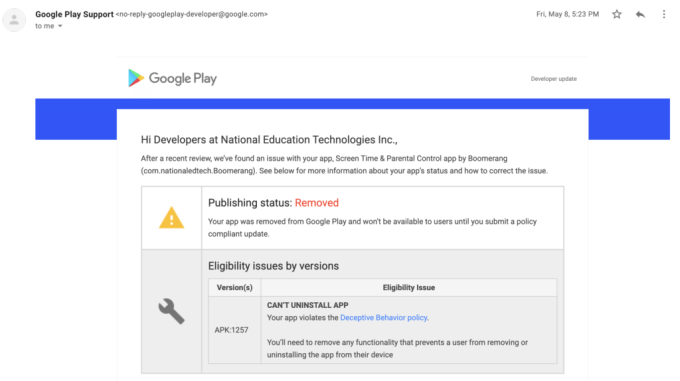
Image Credits: Boomerang

But despite the obvious intended use case here, Boomerang’s app was repeatedly flagged for the same “can’t uninstall app” reason by the Play Store’s app review process when it submitted updates and bug fixes.

This began on May 8th, 2020 and took over a month to resolve. The developer, Justin Payeur, submitted the first appeal on May 11th to test if the ban had just been triggered by Google’s “app review robots.” On May 13th, the app was re-approved without any human response or feedback to the appeals message he had sent to Google.

But then on June 30th, Boomerang was again flagged for the same reason: “can’t uninstall app.” Payeur filed a second appeal, explaining the feature is not on by default — it’s there for parents to use if they choose.

On July 6th, Boomerang had to inform users of the problem, as they had become increasingly frustrated they couldn’t find the app on Google Play. In a customer email that didn’t mince words, Boomerang wrote: “Google has become evil.” Complaints from users said that if the app didn’t offer the “prevent uninstall” feature, it wouldn’t be worth using.

On July 8th, Boomerang received a reply from Google with more information, explaining that Google doesn’t allow apps that change the user’s device settings or features outside the app without user’s knowledge or consent. Specifically, it also cited the app’s use of the “Google Accessibility Services API” in a manner that’s  in violation with the Play Store terms. Google said the app wouldn’t be approved until it remove functionality that prevented a user from removing or uninstalling the app from their device.

This requirement, though rooted in user security, disadvantages parental control apps compared with Google’s own Family Link offering. As Google’s help documentation indicates, removing a child’s account from an Android device requires parents to input a passcode — it can’t simply be uninstalled by the end user (the child).

Boomerang later that day received a second violation notification after it changed the app to be explicitly clear to the end user (the child) that the Device Administrator (a parent) would have permission to control the device, mimicking other apps Boomerang said were still live on Google Play.

After two more days pass with no reply from the Appeals team, Boomerang requested a phone call to discuss. Google sent a brief email, saying it was merging the two active Appeals into one but no other information about the Appeal was provided.

On July 13th, Boomerang was informed Google was still examining the app. The company replied again to explain why a parental control app would have such a feature. The same day, Boomerang was alerted that older versions of its app in its internal testing area in the Play Console were being rejected. These versions were never published live, the company says. The rejections indicated Boomerang was “degrading device security” with its app.

The next day, Boomerang informed its user base that it may have to remove the feature they wanted and emailed Google again to again point out the app now has clear consent included.
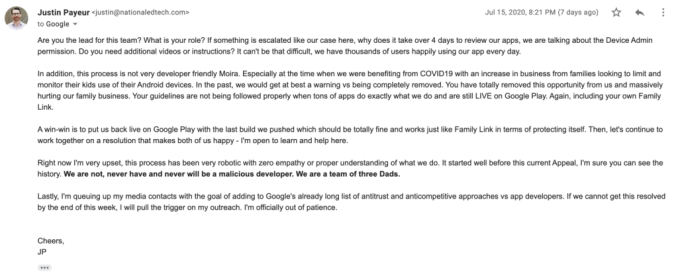
Image Credits: Boomerang; Email complains of “material impact” to business 

Despite not having made any changes, Google informs Boomerang on July 16th it’s in violation of the “Elevated Privilege Abuse” section of the Google Play Malware policy. On July 19th, the company removed the additional app protection feature and on July 21st, Google again rejected the app for the same violation — over a feature that had now been removed.

Despite repeated emails, Boomerang didn’t receive any message from Google until an automated email arrived on July 24th. Again, Google sent no response to the emails where Payeur explains the violating feature had now been removed. Repeated emails through July 30th were also not responded to.

After hearing about Boomerang’s issues, TechCrunch asked Google on July 27th to explain its reasoning.

The company, after a few follow-ups, told TechCrunch on August 3rd that the issues with Boomerang — as later emails to Boomerang had said — were related to how the app implemented its features. Google does not allow apps to engage in “elevated privilege” abuse. And it doesn’t allow apps to abuse the Android Accessibility APIs to interfere with basic operations on a device.

Google also said it doesn’t allow any apps to use the same mechanism Boomerang does, including Google’s own. (Of course, Google’s own apps have the advantage of deep integrations with the Android OS. Developers can’t tap into some sort of “Family Link API,” for example, to gain a similar ability to control a child’s device.)

“We recognize the value of supervision apps in various contexts, and developers are free to create this experience with appropriate safeguards,” a Google spokesperson said.

More broadly, Boomerang’s experience is similar to what iOS parental control apps went through last year. Like those apps, Boomerang too bumped up against a security safeguard meant to protect an entire app store from abusive software. But the blanket rule leaves no wiggle room for exceptions. Google, meanwhile, argues its OS security is not meant to be “worked around” like this. But it has also at the same time offered no official means of interacting with its OS and own screen time/parental control features. Instead, alternative screen time apps have to figure out ways to basically hack the system to even exist in the first place, even though there’s clear consumer demand for their offerings.

Boomerang’s particular case also reveals the complexities involved with of having a business live or die by the whims of an app review process.

It’s easy enough to argue that the developer should have simply removed the feature and moved on, but the developer seemed to believe the feature would be fine — as evidenced by prior approvals and the approval received upon at least one of its appeals. Plus, the developer is incentivized to fight for the feature because it’s something users said they wanted — or rather, what they demanded, to make the app worth paying for.

Had someone from Google just picked up the phone and explained to Boomerang what’s wrong and what alternative methods would be permitted, the case may not have dragged on in such a manner. In the meantime, Boomerang likely lost user trust, and its removal definitely impacted its business in the near-term.

Reached for a follow-up, Payeur expressed continued frustration, despite the app now being re-approved for Play Store distribution.

“It took Google over a month to provide us with this feedback,” he said, referencing the forbidden API usage that was the real problem. “We are currently digesting this”  he said, adding how difficult it was to not be able to talk to Google’s teams to get proper communication and feedback over the past several weeks.

Boomerang has begun collecting the names of other similarly impacted apps, lile Filter Chrome, Minder Parental Control, and Netsanity. The company says other apps can reach out privately to discuss, if they prefer.


Read Full Article