25 March 2020

Online marketplace OfferUp raises $120M, acquires top competitor letgo


OfferUp, a top online and mobile marketplace app, announced this morning it’s raising $120 million in a new round of funding led by competiting marketplace letgo’s majority investor, OLX Group, and others. As a part of the deal, OfferUp will also be acquiring letgo’s classified business, with OLX Group gaining a 40% stake in the newly combined entity.

Other investors in the new round include existing OfferUp backers Andreessen Horowitz and Warburg Pincus. The funds will be put towards continued growth, product innovation, and monetization efforts, OfferUp says.

The round will close with the closing of the acquisition, which is expected to take place sometime in May. To date, OfferUp has raised $380 million.

The acquisition will see two of the largest third-party buying and selling marketplaces — outside of Craigslist, eBay, and Facebook Marketplace, of course — become a more significant threat to the incumbents. Together, the new entity will have more than 20 million monthly active users across the U.S. For consumers, the deal means they’ll no longer have to list in as many apps when looking to unload some household items, electronics, furniture, or whatever else they want to sell.

“My vision for OfferUp has always been to build a company that helps people connect and prosper,” said Nick Huzar, OfferUp CEO, in a statement about the acquisition. “We’re combining the complementary strengths of OfferUp and letgo in order to deliver an even better buying and selling experience for our communities. OLX Group has unparalleled expertise and clear success with growing online marketplace businesses, so they’ll be a great partner as we continue to build the widest, simplest, and most trustworthy experience for our customers.”

OfferUp also acknowledged that mid-pandemic is an odd time to announce such a deal — especially at a time when the COVID-19 outbreak is affecting its own employees, its partners, and the buying and selling community itself. And this will continue for some time.

However, Huzar positions the deal as one that will allow the business to grow, despite the current state of affairs.

“This news helps us to continue to innovate and grow, in spite of these challenging times, and continue to deliver on that promise,” Huzar noted, in a company blog post.

For now, the OfferUp and letgo apps will remain separate experiences and no disruptions to any sales will be made. Consumers will also be able to download both apps to iOS and Android devices for the time being, too.

But soon, both sets of users will gain access to a larger network of buyers and sellers, along with nationwide shipping options, and trust and safety problems. We understand this will involve allowing users of both sets of apps to see more posts and to interact with more buyers and sellers — so some sort of merging of the two networks is at play here. There will be additional changes to improve the user experience for all users in the future, as well, but the company isn’t sharing details on that today.

Letgo is bringing to the table an app with over 100 million worldwide downloads, so there is a potential to reactivate some of the lapsed users who aren’t currently shopping or selling on its marketplace today. The two apps were often neck-and-neck in terms of their app store category rankings, though on iPhone OfferUp has maintained a slight lead. (See App Store and Google Play charts below.)
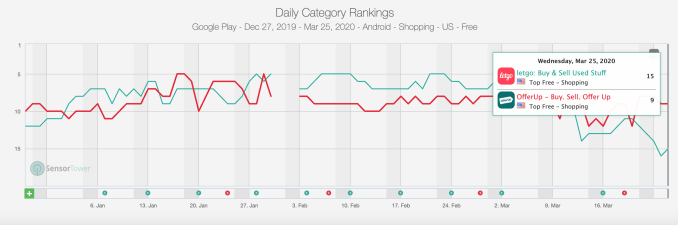
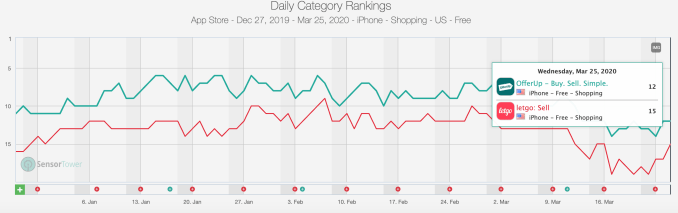
However, letgo’s business outside of North America will be separately owned and operated as part of the OLX Group, the companies said.

“Letgo and OfferUp have always shared the same core vision for how large America’s secondhand economy can become – harnessing tech innovation to bring about an extraordinarily positive impact on consumers’ wallets and also on the environment,” said letgo co-founder Alec Oxenford. “Bringing our apps together moves us much closer to that vision,” he added.

The deal is still subject to regulatory approval. If given, the combined businesses will be operated by OfferUp,  headquartered in Bellevue, Washington. Huzar will continue to be CEO of OfferUp and Chairman of the Board. Oxenford, meanwhile, will join the Board and serve as a senior advisor to OLX Group and Prosus.

Because the deal is still in the process of closing, the companies can’t speak to any team changes, including potential layoffs as a result of overlapping positions or other redundancies, we’re told.


Read Full Article

A Neural Weather Model for Eight-Hour Precipitation Forecasting


Predicting weather from minutes to weeks ahead with high accuracy is a fundamental scientific challenge that can have a wide ranging impact on many aspects of society. Current forecasts employed by many meteorological agencies are based on physical models of the atmosphere that, despite improving substantially over the preceding decades, are inherently constrained by their computational requirements and are sensitive to approximations of the physical laws that govern them. An alternative approach to weather prediction that is able to overcome some of these constraints uses deep neural networks (DNNs): instead of encoding explicit physical laws, DNNs discover patterns in the data and learn complex transformations from inputs to the desired outputs using parallel computation on powerful specialized hardware such as GPUs and TPUs.

Building on our previous research into precipitation nowcasting, we present “MetNet: A Neural Weather Model for Precipitation Forecasting,” a DNN capable of predicting future precipitation at 1 km resolution over 2 minute intervals at timescales up to 8 hours into the future. MetNet outperforms the current state-of-the-art physics-based model in use by NOAA for prediction times up to 7-8 hours ahead and makes a prediction over the entire US in a matter of seconds as opposed to an hour. The inputs to the network are sourced automatically from radar stations and satellite networks without the need for human annotation. The model output is a probability distribution that we use to infer the most likely precipitation rates with associated uncertainties at each geographical region. The figure below provides an example of the network’s predictions over the continental United States.
MetNet model predictions compared to the ground truth as measured by the NOAA multi-radar/multi-sensor system (MRMS). The MetNet model (top) displays the probabilities for 1 mm/hr precipitation predicted from 2 minutes to 480 minutes ahead, whereas the MRMS data (bottom) shows the areas receiving at least 1 mm/hr of precipitation over that same time period.
Neural Weather Model
MetNet does not rely on explicit physical laws describing the dynamics of the atmosphere, but instead learns by backpropagation to forecast the weather directly from observed data. The network uses precipitation estimates derived from ground based radar stations comprising the multi-radar/multi-sensor system (MRMS) and measurements from NOAA’s Geostationary Operational Environmental Satellite system that provides a top down view of clouds in the atmosphere. Both data sources cover the continental US and provide image-like inputs that can be efficiently processed by the network.

The model is executed for every 64 km x 64 km square covering the entire US at 1 km resolution. However, the actual physical coverage of the input data corresponding to each of these output regions is much larger, since it must take into account the possible motion of the clouds and precipitation fields over the time period for which the prediction is made. For example, assuming that clouds move up to 60 km/h, in order to make informed predictions that capture the temporal dynamics of the atmosphere up to 8 hours ahead, the model needs 60 x 8 = 480 km of spatial context in all directions. So, to achieve this level of context, information from a 1024 km x 1024 km area is required for predictions being made on the center 64 km x 64 km patch.
Size of the input patch containing satellite and radar images (large, 1024 x 1024 km square) and of the output predicted radar image (small, 64 x 64 km square).
Because processing a 1024 km x 1024 km area at full resolution requires a significant amount of memory, we use a spatial downsampler that decreases memory consumption by reducing the spatial dimension of the input patch, while also finding and keeping the relevant weather patterns in the input. A temporal encoder (implemented with a convolutional LSTM that is especially well suited for sequences of images) is then applied along the time dimension of the downsampled input data, encoding seven snapshots from the previous 90 minutes of input data, in 15-minute segments. The output of the temporal encoder is then passed to a spatial aggregator, which uses axial self-attention to efficiently capture long range spatial dependencies in the data, with a variable amount of context based on the input target time, to make predictions over the 64 km x 64 km output.

The output of this architecture is a discrete probability distribution estimating the probability of a given rate of precipitation for each square kilometer in the continental United States.
The architecture of the neural weather model, MetNet. The input satellite and radar images first pass through a spatial downsampler to reduce memory consumption. They are then processed by a convolutional LSTM at 15 minute intervals over the 90 minutes of input data. Then axial attention layers are used to make the network see the entirety of the input images.
Results
We evaluate MetNet on a precipitation rate forecasting benchmark and compare the results with two baselines — the NOAA High Resolution Rapid Refresh (HRRR) system, which is the physical weather forecasting model currently operational in the US, and a baseline model that estimates the motion of the precipitation field (i.e., optical flow), a method known to perform well for prediction times less than 2 hours.

A significant advantage of our neural weather model is that it is optimized for dense and parallel computation and well suited for running on specialty hardware (e.g., TPUs). This allows predictions to be made in parallel in a matter of seconds, whether it is for a specific location like New York City or for the entire US, whereas physical models such as HRRR have a runtime of about an hour on a supercomputer.

We quantify the difference in performance between MetNet, HRRR, and the optical flow baseline model in the plot below. Here, we show the performance achieved by the three models, evaluated using the F1-score at a precipitation rate threshold of 1.0 mm/h, which corresponds to light rain. The MetNet neural weather model is able to outperform the NOAA HRRR system at timelines less than 8 hours and is consistently better than the flow-based model.
Performance evaluated in terms of F1-score at 1.0 mm/h precipitation rate (higher is better). The neural weather model (MetNet) outperforms the physics-based model (HRRR) currently operational in the US for timescales up to 8 hours ahead.
Due to the stochastic nature of the atmosphere, the uncertainty about the exact future weather conditions increases with longer prediction times. Because MetNet is a probabilistic model, the uncertainty in the predictions is seen in the visualizations by the growing smoothness of the predictions as the forecast time is extended. In contrast, HRRR does not directly make probabilistic predictions, but instead predicts a single potential future. The figure below compares the output of the MetNet model to that of the HRRR model.
Comparison between the output from MetNet (top) and HRRR (bottom) to ground-truth (middle) as retrieved from the NOAA MRMS system. Notice that while the HRRR model predicts structure that appears to be more similar to that of the ground-truth, the structure predicted may be grossly incorrect.
The predictions from the HRRR physical model look sharper and more structured than that of the MetNet model, but the structure, specifically the exact time and location where the structure is predicted, is less accurate due to uncertainty in the initial conditions and the parameters of the model.
HRRR (left) predicts a single potential future outcome (in red) out of the many possible outcomes, whereas MetNet (right) directly accounts for uncertainty by assigning probabilities over the future outcomes.
A more thorough comparison between the HRRR and MetNet models can be found in the video below:
Future Directions
We are actively researching how to improve global weather forecasting, especially in regions where the impacts of rapid climate change are most profound. While we demonstrate the present MetNet model for the continental US, it could be extended to cover any region for which adequate radar and optical satellite data are available. The work presented here is a small stepping stone in this effort that we hope leads to even greater improvements through future collaboration with the meteorological community.

Acknowledgements
This project was done in collaboration with Lasse Espeholt, Jonathan Heek, Mostafa Dehghani, Avital Oliver, Tim Salimans, Shreya Agrawal and Jason Hickey. We would also like to thank Manoj Kumar, Wendy Shang, Dick Weissenborn, Cenk Gazen, John Burge, Stephen Hoyer, Lak Lakshmanan, Rob Carver, Carla Bromberg and Aaron Bell for useful discussions and Tom Small for help with the visualizations.

Recurring Nightmare


Recurring Nightmare

Mammoth Media launches CatchUp, an app that summarizes the latest news and trending content


A new app called CatchUp might be useful for anyone who’s struggling to keep up with the latest headlines, podcasts and Netflix shows.

CatchUp is the latest offering from Mammoth Media, the startup behind chat fiction app Yarn and social polling app Wishbone. Founder and CEO Benoit Vatere told me that the product started out as a book summary app called Booknotes, but early users kept asking, “Why don’t you summarize more than books?”

So that’s exactly what CatchUp does, recapping the latest news and entertainment topics. The summaries should feel pretty familiar to anyone who’s watched videos on mobile social app — they’re vertically-oriented, broken up into slides, accompanied by text captions and last for just a few minutes.

Vatere told me that the topics are chosen based on what’s trending, either in Mammoth’s apps or more broadly in social media.

For example, when I opened CatchUp morning, I watched a video laying out the basic info around the big topic one everyone’s mind — the coronavirus pandemic. Then I moved onto something lighter, a video breaking down the different streaming services available now.

It sounds like the CatchUp team is moving quickly. Vatere said they should be responsive to trends, creating new videos in just a day or two. At the same time, he said the app should offer a mix of news-y videos that will eventually disappear (“too much content kills retention in the app”) alongside more evergreen content.

CatchUp

Image Credits: Mammoth Media

He emphasized that this is very much an initial version of the app, and that the CatchUp team plans to iterate based on what users respond to. It’s English-only for now but could eventually add other languages. The company’s plans also include introducing monetization later on, starting with advertising and then eventually adding in-app purchases and subscriptions.

Vatere also suggested that while a CatchUp summary should stand on its own, it could also encourage deeper engagement.

“If you’re thinking, everybody is talking about ‘Love is Blind,’ what is this … you can listen for two minutes and understand the dynamic, understand what’s happening,” he said. “Then if it sounds really interesting to you, you can watch it. But if not, now you understand what’s being said.”


Read Full Article

Simple, effective tech to connect communities in crisis | Johanna Figueira

Simple, effective tech to connect communities in crisis | Johanna Figueira

The world is more connected than ever, but some communities are still cut off from vital resources like electricity and health care. In this solution-oriented talk, tech activist Johanna Figueira discusses her work with Code for Venezuela -- a platform that helps Venezuelans gain access to vital information and medical supplies -- and shares ideas for how it could be used as a model to help other communities in need.

Click the above link to download the TED talk.

Track Coronavirus (COVID-19) Cases in India with Google Sheets


The Government of India website has a live dashboard that provides, in near real-time, the number of Coronavirus (COVID-19) cases in various states of India. This is the best resource to get updates around active COVID-19 cases in India.

COVID-19 Tracker for India

The official website provides the current data but if you were to check how the number of confirmed cases increased in India over time, there’s no historic data available. That’s one reason I built the COVID-19 Tracker with Google Sheets.

The tracker scrapes data from the official website every few minutes and uses Sparklines to help you visualize how the coronavirus outbreak is spreading in India over time. The Government has been actively publishing reports since March 10 and all the data can also be accessed through the Google Sheet.

Covid-19 India tracker

COVID-19 Sheets Tracker

COVID-19 JSON API

If you are a developer, I’ve also published the data as a JSON API that will provide you the latest state-wise data of COVID-19 cases as available on the Ministry of Health and Family Welfare website of India.

How the COVID-19 Tracker Works

The Coronavirus Tracker is written in Google Apps Script and it uses time-based triggers to scrape numbers from the mohfw.gov.in website every few minutes.

/**
 * Scrape the homepage of mohfw.gov.in (Ministry of Health, India)
 * website for latest numbers on Coronovirus positive cases in India
 */
const scrapeMOHWebsite = () => {
  const url = 'https://www.mohfw.gov.in/';
  const response = UrlFetchApp.fetch(url);
  const content = response.getContentText();
  return content.replace(/[\r\n]/g, '');
};

Google Apps Script doesn’t support HTML parsers like Cheerio so we had to quickly build one from scratch using regex. It grabs the HTML content of the page, looks for the table tag and then extracts data from individual cells of the table.

If they change the layout of the website, this parser is likely to break.

/**
 * Parse the webpage content and extract numbers from the HTML
 * table that contains statewise data on Covid-19 Cases in India
 */
const getCurrentCovid19Cases = (json = true) => {
  const states = {};
  const html = scrapeMOHWebsite();
  const [table] = html.match(/<div id="cases".+?>(.+)<\/div>/);
  const rows = table.match(/<tr>(.+?)<\/tr>/g);
  rows.forEach((row) => {
    const cells = row
      .match(/<td.+?>(.+?)<\/td>/g)
      .map((cell) => cell.replace(/<.+?>/g, ''));
    const [, stateName, indianNationals, foreignNationals] = cells;
    if (/[a-z\s]/i.test(stateName)) {
      states[stateName] = Number(indianNationals) + Number(foreignNationals);
    }
  });
  return json ? states : JSON.stringify(states);
};

Once we have the data in JSON format, we can easily write to a Google Spreadsheet using Apps Script. The script adds a new column per day while retaining the old data for comparison.

/**
 * Write the parsed data into a new column in Google Sheet
 * All the historic data is also preserved in the sheet.
 */
const writeNewCovid19CasesToSheets = (covid19Cases) => {
  const sheet = SpreadsheetApp.getActiveSpreadsheet().getSheetByName(
    'Dashboard'
  );
  const states = sheet
    .getRange(3, 1, sheet.getLastRow() - 2, 1)
    .getValues()
    .map(([state]) => [covid19Cases[state] || 0]);
  sheet
    .getRange(2, sheet.getLastColumn() + 1, states.length + 1, 1)
    .setValues([[new Date()], ...states.map((count) => [count])]);
};

The COVID-19 tracker in Google Sheets also provides a JSON API that you can use to import data directly in your apps and websites.

To publish a JSON API, we have published the script as a web app with the doGet callback function. The ContentService service returns the raw JSON output whenever an external app invokes the Google script URL.

const doGet = () => {
  const key = 'Covid19India';
  const cache = CacheService.getScriptCache();
  let data = cache.get(key);
  if (data === null) {
    data = getCurrentCovid19Cases(false);
    cache.put(key, data, 21600);
  }
  return ContentService.createTextOutput(data).setMimeType(
    ContentService.MimeType.JSON
  );
};

All the code is open-source and you are free to use in any project.


New crowdsourced COVID-19 symptom map could build a more complete pandemic picture


A new initiative by the Boston Children’s Hospital and Harvard Medical School could provide a new kind of signal for those studying the spread of the coronavirus pandemic across the U.S. The ‘Covid Near You’ map developed by researchers at both organizations, asks individuals to self-report any potential COVID-19 symptoms, as well as if they’ve taken a test, and then maps that activity on a rolling two week basis.

This isn’t a map of confirmed COVID-19 cases – other sources for that information already exist, including Google’s coronavirus map, which uses case numbers and figures provided by the World Health Organization (WHO), and the John Hopkins coronavirus resource center map. These are useful resources, but only reflect confirmed cases based on approved testing, which, especially in the U.S., is limited by testing availability and drastically under-represents the actual spread according to most experts.

New ways of tracking the spread of the virus are needed in order to supplement testing efforts, and while self-reported symptoms are hardly a reliable indicator of actual COVID-19 spread, they are a potential signal or leading indicator that, combined with other data included confirmed cases, can help researchers and medical professionals focus their efforts and gauge the effectiveness of strategies like social distancing meant to slow or stop the spread.

Another recent project, Kinsa’s U.S. health weather map, also relies on crowdsourced data to try to provide a different view of the potential spread of COVID-19. Their information is body temperature, as recorded by their connected smart thermometer hardware, however, which provides a reliable measure of one of the most common symptoms of COVID-19 patients.

Like the ‘Covid Near You’ map, Kinsa’s is not a reliable indicator of confirmed COVID-19 cases, but it is a strong signal that can provide information not available when relying on certified testing. Taken together, self-reported symptoms (especially as more people self-report using this new map), temperature data tied to geolocation, and confirmed cases could provide a much more complete picture of where hotspots are occurring, and the patterns of spread beyond those communities known to be most affected, and those that could be next in the chain of transmission.


Read Full Article

Google Podcasts is finally available on iOS


Just in time for our collective house arrests, Google has unveiled a redesigned version of Podcasts. The revamped version of the app is centered around discovery, broken up into three primary tabs.

There’s Home, which features your current feeds; Explore, which offers up popular and curated shows; and Activity, which offers a deeper dive into listening habits. Honestly, though, the big news here is that the app is finally landing in the iOS App Store.

Launched last summer, the app quickly became the top podcasting app on Android, because, well, Google. There’s been some limited cross-platform availability by way of a browser. Obviously, native app support is much more appealing for iPhone and iPad owners looking to see what kind of alternative Google is offering to Apple’s own popular Podcasts app.

Users’ listening habits on the app will be syncable across platforms by way of the Google Podcasts for Web. The iOS version is available for download starting today. The Android update, meanwhile, will be rolling out to users this week.


Read Full Article

Lockdown Entertainment for Families


family-friendly-podcasts

Engaging in self-isolation or national lockdown is not easy. If you have children, things are even tougher. Fortunately various tech companies are here to help. Christian Cawley and Gavin Philips look at the latest developments, from free Amazon Prime and Audible to top YouTube channels for 24/7 entertainment.

We also have some thoughts on enforced home schooling (as opposed to the planned variety).

Really Useful Podcast Season 5 Episode 8 Shownotes

We start off this week looking at how Big Tech is helping families deal with the unscheduled school holidays happening across the Northern Hemisphere

We’ve got some personal ideas on how to cope with lockdown as a family and as individuals, too.

This week, MakeUseOf is giving away an awesome customizable electronic pixel art backpack

You can leave a review on Apple Podcasts to help us reach more listeners. You’ll find us on:

See you next week for the final show of the current run.

Read the full article: Lockdown Entertainment for Families


Read Full Article

How to be your best self in times of crisis | Susan David

How to be your best self in times of crisis | Susan David

"Life's beauty is inseparable from its fragility," says psychologist Susan David. In a special virtual conversation with head of TED Chris Anderson and current affairs curator Whitney Pennington Rodgers, she shares wisdom on how to build resilience, courage and joy in the midst of the coronavirus pandemic. Responding to listeners' questions from across the globe, she offers ways to talk to your children about their emotions, keep focus during the crisis and help those working on the front lines.

Click the above link to download the TED talk.

24 March 2020

Flexport, Arnold Schwarzenegger, and others launch a fund to get supplies to frontline responders


There’s a global shortage of available protective equipment (PPE) and medical supplies for use by frontline responders working to fight the spread of the novel coronavirus, and the Frontline Responders Fund wants to channel donations to help address that shortage. The fund, which is seeking public donations via GoFundMe, will use all proceeds to cover the costs of transportation of these crucial supplies to the hospitals, clinics and public agencies that need them most.

Flexport is facilitating the deliveries via their supply chain management platform and services, and are receiving donations via their grant making partner Charities Add Foundation of America (CAF), which facilitates the acceptance of charitable donations for Flexport.org, Flexport’s NGO for social good projects.

Already, Flexport has been taking steps to get equipment where it’s needed most: last week, it got 60,000 surgical masks, 34,000 gloves, 2,000 surgical gowns and 50 thermometers from MedShare to San Francisco’s Department of Public Health. But the organization wants to do more, both for SF and for other cites in that are looking for ways to shore up their own supplies.

“My neighbor is on the board of supervisors and she told me the city really needed help,” Petersen said via email earlier this week. “Naturally our team stepped in and applied our knowledge of supply chains and logistics plus a long standing partnership with MedShare.org to get them PPE quickly. Now we’re scaling that effort to get more supplies for SF as well as other cities and hospitals that are also in desperate need.”

The funds made available through this fundraising effort will go to securing not only PPE, but also “testing kits, thermometers, ventilators and medicines,” according to the project’s GoFundMe page, based on what medical service providers deem to be highest priority in terms of need.

Petersen says that effectively all of his time now is focused on logistics to support these ongoing efforts, and it looks like it’ll remain that way for the foreseeable future.

Other organizations, including Apple, and now SoftBank, have been donating large volumes of N95 respirators, a key piece of frontline protective equipment. Flexport’s work could facilitate continued supply, leveraging their supply chain relationships, to ensure that equipment makes its way to frontline staff as fast as it’s able to be produced.

Donations can be made directly through the fund’s GoFundMe page, and the total raised is sitting at just under $3 million as of this writing – helped in large part by sizeable donations from Silicon Valley leaders including Paul Graham, Jack Dorsey and Ron Conway, as well as celebrities including Edward Norton and Arnold Schwarzenegger.


Read Full Article

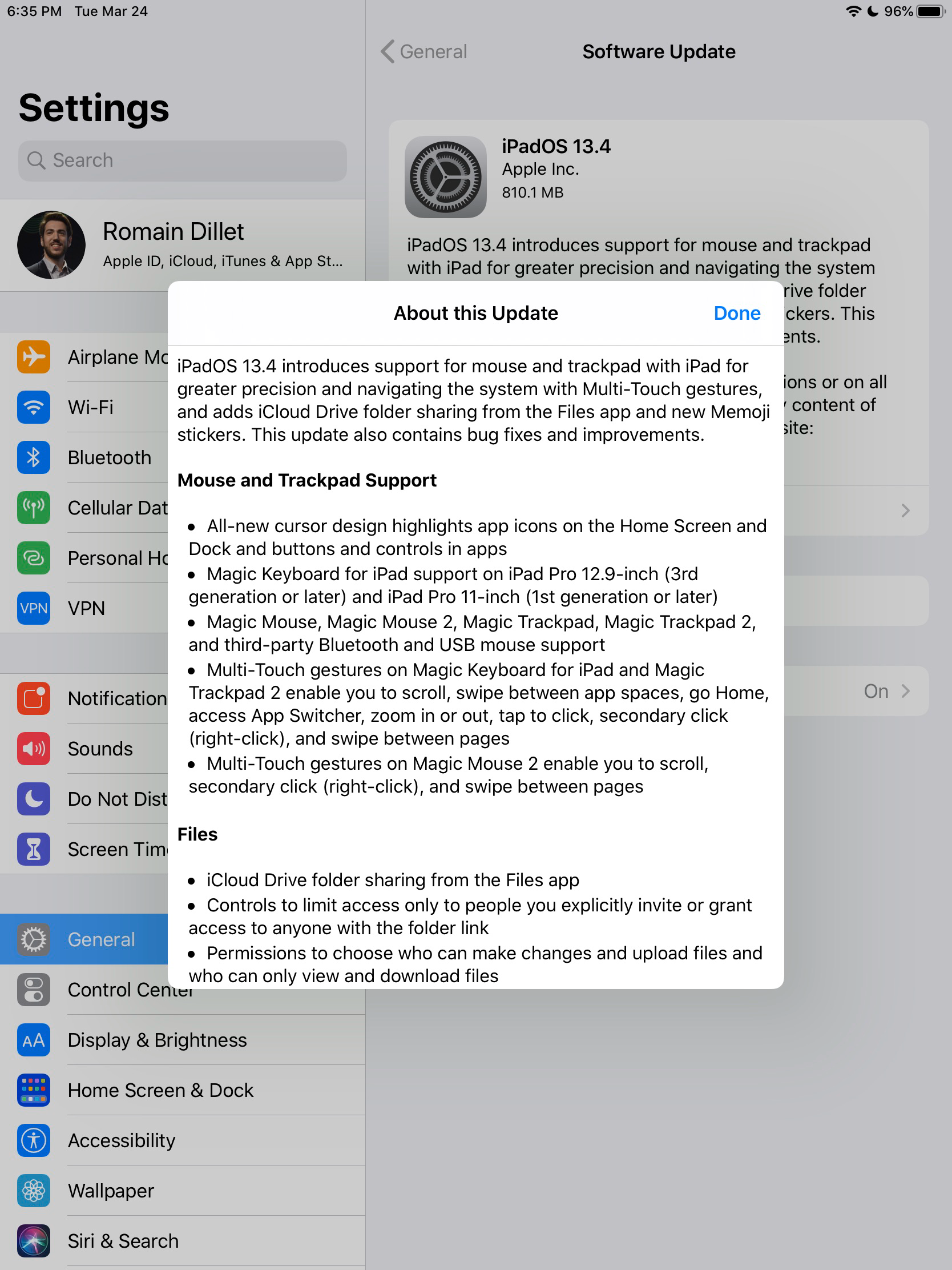
Apple releases iOS and iPadOS 13.4 with trackpad support


Apple has released software updates for the iPhone, the iPad, the Apple Watch, the Apple TV and the Mac. The biggest changes are on the iPad. Starting today, you can pair a mouse or trackpad with your iPad and use it to move a cursor on the display.

Apple unveiled trackpad support for iPadOS when it announced the new iPad Pro last week. While the company plans to sell a new Magic Keyboard with a built-in trackpad, you don’t need to buy a new iPad or accessory to access the feature.

When you pair a trackpad and start using it, Apple displays a rounded cursor on the screen. The cursor changes depending on what you’re hovering over. The cursor disappears and highlights the button you’re about to activate. It looks a bit like moving from one icon to another on the Apple TV.

If you’re moving a text cursor for instance, it becomes a vertical bar. If you’re resizing a text zone in a Pages document, it becomes two arrows. If you’re using a trackpad, iPadOS supports gestures that let you switch between apps, open the app switcher and activate the Dock or Control Center.

In addition to trackpad support, iOS and iPadOS 13.4 add a handful of features. You can share an iCloud Drive folder with another iCloud user — it works pretty much like a shared Dropbox folder.

There are nine new Memoji stickers, such as smiling face with hearts, hands pressed together and party face. Apple has tweaked buttons to archive/delete, move, reply and compose and email in the Mail app.

Additionally, Apple added the ability to release a single app binary on all App Stores, including the iOS and Mac App Store. It means that developers can release a paid app on the Mac and the iPhone — and you only have to buy it once.

macOS 10.15.4 adds Screen Time Communication Limits, a feature that already exists on iOS. It lets you set limits on Messages and FaceTime calls.

When it comes to watchOS, version 6.2 adds ECG support for users in Chile, New Zealand and Turkey. Apple now lets developers provide in-app purchases for Apple Watch apps as well.

All updates also include bug fixes and security patches. Head over to the Settings app on your devices to download and update your devices if you haven’t enabled automatic software updates.


Read Full Article

Pinterest launches a ‘Today’ tab featuring daily recommendations and trending topics


The COVID-19 outbreak has led to record Pinterest usage as people stuck at home increased their searches for things like lesson plans, kids’ crafts, new recipes, and gardening ideas. Last weekend, for example, Pinterest saw more searches and saves globally than any other weekend in its history. And in the U.S., it saw record numbers of Pin sharing, as messages from the “Send a Pin” feature jumped 34%. In light of the increased demand, Pinterest has moved up the launch of its Today tab — a new feature designed to offer a source of daily inspiration.

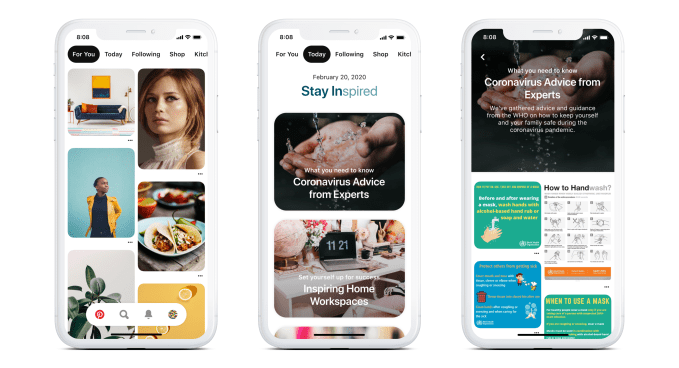
The Today tab will feature curated topics and trending Pins, making it easier to explore timely ideas, Pinterest explains. That means, right now, you might find something like “Inspiring Work from Home Workspaces” rather than one focused on vacation ideas, for instance.

At launch, the Today section is pulling from trending searches — like kid-friendly baking ideas, self-care tips, family-favorite movies, and comfort food recipes, among other things. These recommendations will be curated by Pinterest’s team, but further down the road, some may come from guest editors.

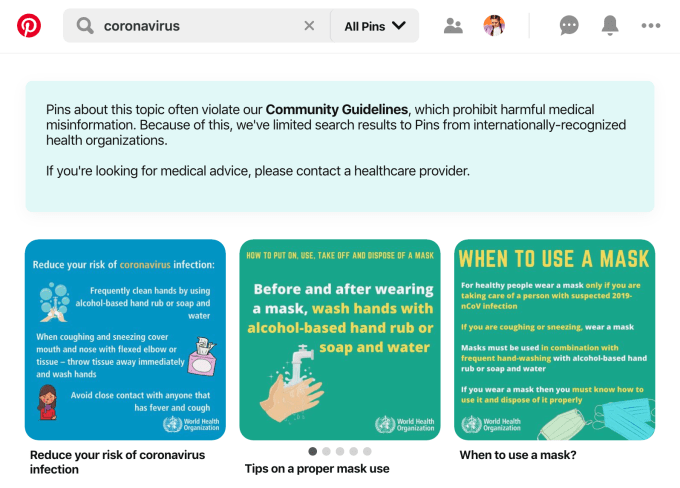
The company will also soon use the Today tab to offer expert information from the World Health Organization (WHO) and Centers for Disease Control (CDC) on topics like handwashing, mask usage, and other safety tips, during the coronavirus pandemic.

The Today tab will be found at the top of your Home Feed on the app on both iOS and Android in the U.S. and U.K. As it’s just now rolling out, you may not see it right away — but should soon. The plan is to bring it to more countries in time.

Some of the more active countries include France, Spain, and Germany, which all saw record rates of user engagement last weekend. France also saw a 30% month-over-month increase in saves, Pinterest says. While Pinterest didn’t offer a timeline for its next countries to get the new tab, these would be likely candidates.

In addition to the Today tab, Pinterest is also now rolling out what it’s calling “compassionate searches” on the web.

That means when you search for terms like “stress relief” or “calming quotes,” you’ll see options that point you to a collection of well-being activities designed to help you relax that come from expert sources.

Pinterest also says it’s prohibiting ads claiming to offer COVID-19 cures and treatments, or those looking to exploit the crisis. Instead, it has a banner across the site directing users to WHO facts and offers an easy way to report health misinformation on Pins. The company says all misinformation on COVID-19 is removed as it’s in violation of its health misinformation policy, established in 2017.

The Today tab on mobile apps and compassionate search on the web are rolling out today in the U.S. and U.K., with more countries to follow.


Read Full Article

Watchworthy’s personalized TV recommendation app will help you find your next binge


Ranker, an online publisher that turns crowdsourced lists and fan-rankings into a data business, is now turning its attention to the world of streaming services. The company this week launched a new app, Watchworthy, that helps you find something new to watch across TV networks and over 200 streaming services like Netflix, Hulu, Prime Video, Apple TV+, and many more.

Ranker, as you may already know, is the website that always pops up in search results when you’re looking for some sort of “best of” round-up — whether that’s in entertainment, music, sports, culture, history or across other topics. On the site, online visitors can vote on their favorites in categories as broad as the “best hip-hop artists” or as niche as the “best coconut oil brands.”

Ranker’s TV lists are among its more popular categories and one that makes the most sense for turning into an app. And right now, everyone is looking for something new to watch as we’re stuck indoors due to the COVID-19 health crisis.

While there are already a number of apps promising to offer TV recommendations — like Reelgood, TV Time, Yidio, and JustWatch, for example —  Watchworthy’s advantage is Ranker’s data powering its recommendations. Its machine-learning platform applies first-party correlation data it has amassed over a decade from one billion votes on Ranker.com. As the company explains, this makes its data more “statistically relevant.”

For example, its data indicates that “Better Call Saul” fans tend to like other gritty, dark dramas like “House of Cards,” “Ray Donovan,” and “True Detective” but also more cerebral comedies like “Nathan for You” and “High Maintenance.”

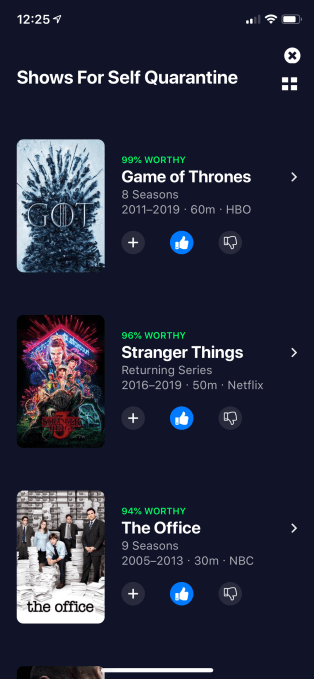
To figure out what sort of TV programs interest you, Watchworthy at first launch jumps you into a rating experience to provide it with your data. In 60 seconds, you fly through a ratings feature that uses a Tinder-like interface where a right swipe is a “like” and a left swipe is a “dislike” (and up is “not sure”). After you thumbs up and down a selection of shows, you can begin to browse your recommendations.

In my test, this initial set of recommendations was already above average compared with some of the other apps I’ve tried. Your mileage may vary, of course, as it’s a highly personalized experience. Watchworthy may not have offered dozens of precise matches to my tastes at first, but it did remind me of several shows I had seen in passing and thought at some point I might like to try, as well as a few new discoveries.


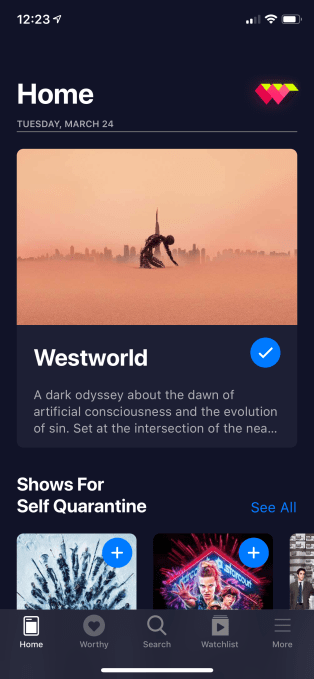
Its suggestions are ranked by a “worthy” score that indicates the likelihood that the show is worthy of your time. You can also filter the list of recommendations by service, genre, runtime, and MPAA ratings.

The app got a little better after spending a little more time to like and dislike more shows and to personalize it as to which streaming services I was using. This allowed me to integrate recommendations from more sources — like HBO, Apple TV+, Disney+, Showtime, and others.

However, I did get to the point where liking and disliking didn’t refine my recommendations further, so there is a limit to what Watchworthy can do. I also found the app to be a little lacking on the reality and nonfiction side of things. It tended to push recommendations of scripted shows, despite my having “liked” shows such as “The Great British Bake Off,” “Windy City Rehab,” and “Queer Eye,” among others.

As you find shows you like in the app’s recommendations, you can add them to the universal watchlist in the app for easy access.


You can also create an account to save your data. Watchworthy at launch supports Apple’s private sign-in option, as well as Google, Facebook, and email.

The homepage of the app also integrates Ranker’s existing TV lists. The website has over 50,000 of these, but the app isn’t an endless scroll. Instead, it updates the home page with relevant, timely content. For example, today’s lists include “Shows for Self Quarantine,” “Shows to Distract You,” “Funniest Shows on Netflix,” “Best Family Shows on Amazon Prime,” and other round-ups.

The new app serves not only as a discovery tool for TV viewers, cord-cutters, and binge-watchers, but also as fuel for Ranker’s data collection business. Ranker licenses its data and insights to third-parties, like marketers, advertisers, researchers, developers, and service providers. However, its data isn’t focused on demographics so much as it is on “psychographics” — meaning, your tastes. Ranker isn’t asking you for private information, only what you like.

In a way, Watchworthy serves as a demo app of what can be done with Ranker’s psychographic insights, in this case, for TV viewers. But the same sort of system could be built for other categories, like music, cooking, film, travel, and more.

The company says this year it will also make its Watchworthy app available to connected devices, like Roku, Apple TV, and Amazon Fire TV. It also plans to add movie recommendations and shared watchlists.

Watchworthy is a free download on iOS with Android to come. On any mobile device, it works from watchworthy.app.


Read Full Article

Facebook in talks to acquire stake in top Indian telco Reliance Jio, report says


Reliance Jio, a three-and-a-half-year-old subsidiary of India’s most valued firm Reliance Industries, may have attracted the attention of an American giant: Facebook.

The social conglomerate is in talks to acquire a 10% stake in the Indian telecom operator, the Financial Times reported Tuesday. The size of the deal, the paper said, was in “multi-billion dollars.”

Analysts at Bernstein value Jio at more than $60 billion. Mukesh Ambani, India’s richest man who runs Reliance Industries, has poured over $25 billion into Reliance Jio over the years.

Reliance Jio, which began its commercial operation in the second half of 2016, upended the local telecom market by offering bulk of 4G data and free voice calls for six months.

The telco kickstarted a price war that saw local network providers Vodafone and Airtel quickly move to revise their data plans and mobile tariffs. But they struggled to match the offerings of Jio, which has amassed over 370 million subscribers to become the top telecom operator in the country.

Reaching those users might interest Facebook, which attempted and failed to expand its free internet initiative, Free Basics, in India. (The company has since expanded Express Wi-Fi to India — though its potential and scale remains comparatively small.)

Reliance Jio also owns a suite of services including music streaming service JioSaavn, on-demand live television service JioTV and payments service JioPay.

Earlier this year, Reliance Industries announced JioMart, a joint venture between Reliance Jio and Reliance Retail, the nation’s largest retail chain, to soft-launch an e-commerce business.

In recent quarters, Facebook, which is beginning to see competition from ByteDance’s TikTok in India, has started to take interest in local startups. Last year, the firm made an investment in social commerce Meesho; and last month, it wrote a check to edtech startup Unacademy.

Ajit Mohan, VP and managing director of Facebook India, told TechCrunch in an interview last year that the company was open to engaging with startups that are building solutions for the Indian market for more investing opportunities. “Wherever we believe there is opportunity beyond the work we do today, we are open to exploring further investment deals,” he said.

Facebook declined to comment, and Reliance Jio did not immediately respond.


Read Full Article

Google’s travel search now highlights travel advisories and airline cancellation policies


Google today announced a small but important addition to its travel search site on both mobile and desktop.

When you search for flights, hotels and activities, the site will now highlight active travel advisories for your destination. In addition, now that most airlines have changed their flight change and cancellation policies in light of the current COVID-19 pandemic, Google has added a direct link to your airline’s policies to the flight results page, too.

These are obviously minor changes but sadly necessary ones. And while everybody is likely aware of the State Department’s current Level 4 ‘Do Not Travel‘ advisory, at some point in the next few months, we’ll get to a point where those advisories will change for some regions while they may still be in place for others.

As for the airlines, it’s worth noting how much their response to the coronavirus pandemic is still in flux. A number of companies have now extended their cancellation policies to cover all flights booked for May, for example. And while most airlines are still operating at least a limited flight schedule for the time being, that could easily change in the coming weeks as the industry tries to grapple with the fallout of this crisis.

To keep up with the policy changes across airlines, Google also published a new document on its help center with links to all of these policies for most major airlines, too.


Read Full Article

Survey shows growth in podcasts and voice assistants, little change in streaming


A new annual survey taken before the current COVID-19 crisis led to restrictions of movement in much of the U.S. suggests good news for Amazon, Facebook’s dominance unthreatened and continued growth in podcasting.

Edison Research and Triton Digital released their annual Infinite Dial survey last week, compiling data on consumers’ use of smart speakers, podcasts, music streaming and social media from 1,500 people (aged 12 and older) to compare year-over-year changes. Here are a few interesting findings:

Voice assistants and smart speakers

Sixty-two percent said they use a voice-based virtual assistant, most commonly via a phone or a computer. There has been a lot written about interactive voice as the next major medium for human-computer interaction after mobile phones, so it’s noteworthy to see that use of the technology is still associated with personal computing devices rather than hands-free smart speakers placed in the surrounding environment.

Smart speaker ownership did increase to 27% of respondents, up from 24% in 2019, even though respondents owned an average 2.2 speakers. In fact, the cohort that owned three or more speakers increased from one-quarter to one-third of owners in just a year, with Amazon Alexa continuing to dominate market share.


Read Full Article

A camera that can see around corners | David Lindell

A camera that can see around corners | David Lindell

To work safely, self-driving cars must avoid obstacles -- including those just out of sight. And for this to happen, we need technology that sees better than humans can, says electrical engineer David Lindell. Buckle up for a quick, groundbreaking tech demo as Lindell explains the significant and versatile potential of a high-speed camera that can detect objects hidden around corners.

Click the above link to download the TED talk.

Instagram launches Co-Watching of posts during video chat


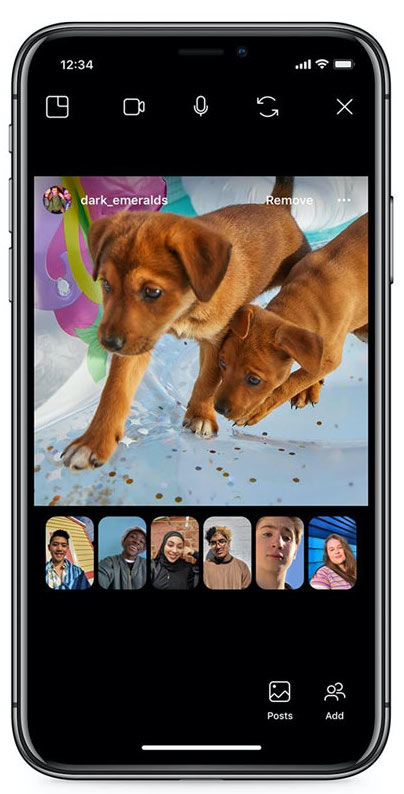
Now you can scroll Instagram together with friends, turning a typically isolating, passive experience into something more social and active. Today Instagram launched Co-Watching, which lets friends on a video chat or group video chat browse through feed posts one user has Liked or Saved, or that Instagram recommends.

Co-Watching could let people ooh, ahh, joke, and talk about Instagram’s content instead of just consuming it solo and maybe posting it to a chat thread so friends can do the same. That could lead to long usage sessions, incentivize users to collect a great depository of Saved posts to share, and spur more video calls that drag people into the app. TechCrunch first reported Instagram was testing Co-Watching a year ago, so we’ll see if it managed to work out the technical and privacy questions of operating the feature.

The launch comes alongside other COVID-19 responses from Instagram that include:
-Showing a shared Instagram Story featuring all the posts from you network that include the “Stay Home” sticker

-Adding Story stickers that remind people to wash their hands or keep their distance from others

-Adding coronavirus educational info to the top of results for related searches

-Removing unofficial COVID-19 accounts from recommendations, as well as virus related content from Explore if it doesn’t come from a credible health organization

-Expanding the donation sticker to more countries so people can search for and ask friends for contributions to relevant non-profits

These updates build on Instagram’s efforts from two weeks ago which included putting COVID-19 prevention tips atop the feed, listing official health organizations atop search results, and demoting the reach of coronavirus-related content rated false by fact checkers.

But Co-Watching will remain a powerful feature long after the quarantines and social distancing end. The ability to co-view content while browsing social networks has already made screensharing app Squad popular. When Squad launched in January 2019, I suggested that “With Facebook and Snap already sniffing around Squad, it’s quite possible they’ll try to copy it.” Facebook tested a Watch Together feature for viewing Facebook Watch videos inside Messenger back in April. And now here we are with Instagram.

The question is whether Squad’s first-mover advantage and option to screenshare from any app will let it hold its own, or if Instagram Co-Watching will just popularize the concept and send users searching for more flexible options like Squad. “Everyone knows that the content flooding our feeds is a filtered version of reality” Squad CEO Esther Crawford told me. “The real and interesting stuff goes down in DMs because people are more authentic when they’re 1:1 or in small group conversations.”

With Co-Watching Instagram users can spill the tea and gossip about posts live and unfiltered over video chat. When people launch a video chat from the Direct inbox or a chat thread, they’ll see a “Posts” button that launches Co-Watching. They’ll be able to pick from their Liked, Saved, or Explore feeds and then reveal it to the video chat, with everyone’s windows lined up beneath the post.

Up to six people can Co-Watch at once on Instagram, consuming feed photos and videos but not IGTV posts. You can share public posts, or private ones that everyone in the chat are allowed to see. If one participant is blocked from viewing a post, it’s inelligible for Co-Watching.

Co-Watching could finally provide an answer to Instagram’s Time Well Spent problem. Research shows how the real danger in social network overuse is passive content consumption like endless solo feed scrolling. It can inspire envy, poor self-esteem, and leave users deflated, especially if the highlights of everyone else’s lives look more interesting than their own day-to-day reality. But active sharing, commenting, and messaging can have a positive effect on well-being, making people feel like they have a stronger support network.

With Co-Watching, Instagram has found a way to turn the one-player experience into a multi-player game. Especially now with everyone stuck at home and unable to crowd around one person’s phone to gab about what they see, there’s a great need for this new feature. One concern is that it could be used for bullying, with people all making fun of someone’s posts.

But in general, the idea of sifting through cute animal photos, dance tutorials, or epic art could take the focus off of the individuals in a video chat. Not having one’s face as the center of attention could make video chat less performative and exhausting. Instead, Co-Watching could let us do apart what we love to do together: just hang out.


Read Full Article