29 April 2018

T-Mobile and Sprint have finally announced a merger agreement


Sprint and T-Mobile, after years of going back and forth as to whether they are going to tie up two of the largest telecom providers in the U.S., have announced that the two companies have entered a merger agreement this morning.

The merger will be an all-stock transaction, and will now be subject to regulatory approval. That latter part is going to be its biggest challenge, because it will not only tie up the No. 3 and No. 4 carriers into the U.S. into a single unit, but also that international organizations hold significant stakes in both companies. Softbank controls a majority of Spring, while Deutsche Telekom controls a significant chunk of T-Mobile. Following the administration’s intervention in the Broadcom-Qualcomm takeover attempt, it isn’t clear what will actually go through in terms of major mergers these days.

Bloomberg is reporting that Deutsche Telekom will have 42% ownership of the combined company, while SoftBan will own around 27% of the company.

As expected, the argument here is for the expansion of 5G networks as plans for that start to ramp up. T-Mobile argues in its announcement that it will help it be competitive with AT&T and Verizon as telecom companies start to roll out a next-generation 5G network, though it does in the end remove a carrier choice for end consumers in the U.S..

“The New T-Mobile will have the network capacity to rapidly create a nationwide 5G network with the breadth and depth needed to enable U.S. firms and entrepreneurs to continue to lead the world in the coming 5G era, as U.S. companies did in 4G,” T-Mobile said in a statement as part of the announcement. “The new company will be able to light up a broad and deep 5G network faster than either company could separately. T-Mobile deployed nationwide LTE twice as fast as Verizon and three times faster than AT&T, and the combined company is positioned to do the same in 5G with deep spectrum assets and network capacity.”

Both companies appeared to be finalizing the deal on Friday, when they set valuation terms and were preparing to announce the merger today. The deal values Sprint at an enterprise value of around $59 billion, with the combined company having an enterprise value of $146 billion. AT&T has a market cap of around $214 billion, while Verizon has a market cap of around $213 billion, as of Sunday.

The transaction, the companies said, is of course subject to regulatory approval. But, pending approval, it is expected to close “no later than the first half of 2019.”

Disclosure: Verizon is the parent company of Oath, which owns TechCrunch.


Read Full Article

Facebook’s dark ads problem is systemic


Facebook’s admission to the UK parliament this week that it had unearthed unquantified thousands of dark fake ads after investigating fakes bearing the face and name of well-known consumer advice personality, Martin Lewis, underscores the massive challenge for its platform on this front. Lewis is suing the company for defamation over its failure to stop bogus ads besmirching his reputation with their associated scams.

Lewis decided to file his campaigning lawsuit after reporting 50 fake ads himself, having been alerted to the scale of the problem by consumers contacting him to ask if the ads were genuine or not. But the revelation that there were in fact associated “thousands” of fake ads being run on Facebook as a clickdriver for fraud shows the company needs to change its entire system, he has now argued.

In a response statement after Facebook’s CTO Mike Schroepfer revealed the new data-point to the DCMS committee, Lewis wrote: “It is creepy to hear that there have been 1,000s of adverts. This makes a farce of Facebook’s suggestion earlier this week that to get it to take down fake ads I have to report them to it.”

“Facebook allows advertisers to use what is called ‘dark ads’. This means they are targeted only at set individuals and are not shown in a time line. That means I have no way of knowing about them. I never get to hear about them. So how on earth could I report them? It’s not my job to police Facebook. It is Facebook’s job — it is the one being paid to publish scams.”

As Schroepfer told it to the committee, Facebook had removed the additional “thousands” of ads “proactively” — but as Lewis points out that action is essentially irrelevant given the problem is systemic. “A one off cleansing, only of ads with my name in, isn’t good enough. It needs to change its whole system,” he wrote.

In a statement on the case, a Facebook spokesperson told us: “We have also offered to meet Martin Lewis in person to discuss the issues he’s experienced, explain the actions we have taken already and discuss how we could help stop more bad ads from being placed.”

The committee raised various ‘dark ads’-related issues with Schroepfer — asking how, as with the Lewis example, a person could complain about an advert they literally can’t see?

The Facebook CTO avoided a direct answer but essentially his reply boiled down to: People can’t do anything about this right now; they have to wait until June when Facebook will be rolling out the ad transparency measures it trailed earlier this month — then he claimed: “You will basically be able to see every running ad on the platform.”

But there’s a very big different between being able to technically see every ad running on the platform — and literally being able to see every ad running on the platform. (And, well, pity the pair of eyeballs that were condemned to that Dantean fate… )

In its PR about the new tools Facebook says a new feature — called “view ads” — will let users see the ads a Facebook Page is running, even if that Page’s ads haven’t appeared in an individual’s News Feed. So that’s one minor concession. However, while ‘view ads’ will apply to every advertiser Page on Facebook, a Facebook user will still have to know about the Page, navigate to it and click to ‘view ads’.

What Facebook is not launching is a public, searchable archive of all ads on its platform. It’s only doing that for a sub-set of ads — specially those labeled “Political Ad”.

Clearly the Martin Lewis fakes wouldn’t fit into that category. So Lewis won’t be able to run searches against his name or face in future to try to identify new dark fake Facebook ads that are trying to trick consumers into scams by misappropriating his brand. Instead, he’d have to employ a massive team of people to click “view ads” on every advertiser Page on Facebook — and do so continuously, so long as his brand lasts — to try to stay ahead of the scammers.

So unless Facebook radically expands the ad transparency tools it has announced thus far it’s really not offering any kind of fix for the dark fake ads problem at all. Not for Lewis. Nor indeed for any other personality or brand that’s being quietly misused in the hidden bulk of scams we can only guess are passing across its platform.

Kremlin-backed political disinformation scams are really just the tip of the iceberg here. But even in that narrow instance Facebook estimated there had been 80,000 pieces of fake content targeted at just one election.

What’s clear is that without regulatory invention the burden of proactive policing of dark ads and fake content on Facebook will keep falling on users — who will now have to actively sift through Facebook Pages to see what ads they’re running and try to figure out if they look legit.

Yet Facebook has 2BN+ users globally. The sheer number of Pages and advertisers on its platform renders “view ads” an almost entirely meaningless addition, especially as cyberscammers and malicious actors are also going to be experts at setting up new accounts to further their scams — moving on to the next batch of burner accounts after they’ve netted each fresh catch of unsuspecting victims.

The committee asked Schroepfer whether Facebook retains money from advertisers it ejects from its platform for running ‘bad ads’ — i.e. after finding they were running an ad its terms prohibit. He said he wasn’t sure, and promised to follow up with an answer. Which rather suggests it doesn’t have an actual policy. Mostly it’s happy to collect your ad spend.

“I do think we are trying to catch all of these things pro-actively. I won’t want the onus to be put on people to go find these things,” he also said, which is essentially a twisted way of saying the exact opposite: That the onus remains on users — and Facebook is simply hoping to have a technical capacity that can accurately review content at scale at some undefined moment in the future.

“We think of people reporting things, we are trying to get to a mode over time — particularly with technical systems — that can catch this stuff up front,” he added. “We want to get to a mode where people reporting bad content of any kind is the sort of defense of last resort and that the vast majority of this stuff is caught up front by automated systems. So that’s the future that I am personally spending my time trying to get us to.”

Trying, want to, future… aka zero guarantees that the parallel universe he was describing will ever align with the reality of how Facebook’s business actually operates — right here, right now.

In truth this kind of contextual AI content review is a very hard problem, as Facebook CEO Mark Zuckerberg has himself admitted. And it’s by no means certain the company can develop robust systems to properly police this kind of stuff. Certainly not without hiring orders of magnitude more human reviewers than it’s currently committed to doing. It would need to employ literally millions more humans to manually check all the nuanced things AIs simply won’t be able to figure out.

Or else it would need to radically revise its processes — as Lewis has suggested  — to make them a whole lot more conservative than they currently are — by, for example, requiring much more careful and thorough scrutiny of (and even pre-vetting) certain classes of high risk adverts. So yes, by engineering in friction.

In the meanwhile, as Facebook continues its lucrative business as usual — raking in huge earnings thanks to its ad platform (in its Q1 earnings this week it reported a whopping $11.97BN in revenue) — Internet users are left performing unpaid moderation for a massively wealthy for-profit business while simultaneously being subject to the bogus and fraudulent content its platform is also distributing at scale.

There’s a very clear and very major asymmetry here — and one European lawmakers at least look increasingly wise to.

Facebook frequently falling back on pointing to its massive size as the justification for why it keeps failing on so many types of issues — be it consumer safety or indeed data protection compliance — may even have interesting competition-related implications, as some have suggested.

On the technical front, Schroepfer was asked specifically by the committee why Facebook doesn’t use the facial recognition technology it has already developed — which it applies across its user-base for features such as automatic photo tagging — to block ads that are using a person’s face without their consent.

“We are investigating ways to do that,” he replied. “It is challenging to do technically at scale. And it is one of the things I am hopeful for in the future that would catch more of these things automatically. Usually what we end up doing is a series of different features would figure out that these ads are bad. It’s not just the picture, it’s the wording. What can often catch classes — what we’ll do is catch classes of ads and say ‘we’re pretty sure this is a financial ad, and maybe financial ads we should take a little bit more scrutiny on up front because there is the risk for fraud’.

“This is why we took a hard look at the hype going around cryptocurrencies. And decided that — when we started looking at the ads being run there, the vast majority of those were not good ads. And so we just banned the entire category.”

That response is also interesting, given that many of the fake ads Lewis is complaining about (which incidentally often point to offsite crypto scams) — and indeed which he has been complaining about for months at this point — fall into a financial category.

If Facebook can easily identify classes of ads using its current AI content review systems why hasn’t it been able to proactively catch the thousands of dodgy fake ads bearing Lewis’ image?

Why did it require Lewis to make a full 50 reports — and have to complain to it for months — before Facebook did some ‘proactive’ investigating of its own?

And why isn’t it proposing to radically tighten the moderation of financial ads, period?

The risks to individual users here are stark and clear. (Lewis writes, for example, that “one lady had over £100,000 taken from her”.)

Again it comes back to the company simply not wanting to slow down its revenue engines, nor take the financial hit and business burden of employing enough humans to review all the free content it’s happy to monetize. It also doesn’t want to be regulated by governments — which is why it’s rushing out its own set of self-crafted ‘transparency’ tools, rather than waiting for rules to be imposed on it.

Committee chair Damian Collins concluded one round of dark ads questions for the Facebook CTO by remarking that his overarching concern about the company’s approach is that “a lot of the tools seem to work for the advertiser more than they do for the consumer”. And, really, it’s hard to argue with that assessment.

This is not just an advertising problem either. All sorts of other issues that Facebook had been blasted for not doing enough about can also be explained as a result of inadequate content review — from hate speech, to child protection issues, to people trafficking, to ethnic violence in Myanmar, which the UN has accused its platform of exacerbating (the committee questioned Schroepfer on that too, and he lamented that it is “awful”).

In the Lewis fake ads case, this type of ‘bad ad’ — as Facebook would call it — should really be the most trivial type of content review problem for the company to fix because it’s an exceeding narrow issue, involving a single named individual. (Though that might also explain why Facebook hasn’t bothered; albeit having ‘total willingness to trash individual reputations’ as your business M.O. doesn’t make for a nice PR message to sell.)

And of course it goes without saying there are far more — and far more murky and obscure — uses of dark ads that remain to be fully dragged into the light where their impact on people, societies and civilized processes can be scrutinized and better understood. (The difficulty of defining what is a “political ad” is another lurking loophole in the credibility of Facebook’s self-serving plan to ‘clean up’ its ad platform.)

Schroepfer was asked by one committee member about the use of dark ads to try to suppress African American votes in the US elections, for example, but he just reframed the question to avoid answering it — saying instead that he agrees with the principle of “transparency across all advertising”, before repeating the PR line about tools coming in June. Shame those “transparency” tools look so well designed to ensure Facebook’s platform remains as shadily opaque as possible.

Whatever the role of US targeted Facebook dark ads in African American voter suppression, Schroepfer wasn’t at all comfortable talking about it — and Facebook isn’t publicly saying. Though the CTO confirmed to the committee that Facebook employs people to work with advertisers, including political advertisers, to “help them to use our ad systems to best effect”.

“So if a political campaign were using dark advertising your people helping support their use of Facebook would be advising them on how to use dark advertising,” astutely observed one committee member. “So if somebody wanted to reach specific audiences with a specific message but didn’t want another audience to [view] that message because it would be counterproductive, your people who are supporting these campaigns by these users spending money would be advising how to do that wouldn’t they?”

“Yeah,” confirmed Schroepfer, before immediately pointing to Facebook’s ad policy — claiming “hateful, divisive ads are not allowed on the platform”. But of course bad actors will simply ignore your policy unless it’s actively enforced.

“We don’t want divisive ads on the platform. This is not good for us in the long run,” he added, without shedding so much as a chink more light on any of the bad things Facebook-distributed dark ads might have already done.

At one point he even claimed not to know what the term ‘dark advertising’ meant — leading the committee member to read out the definition from Google, before noting drily: “I’m sure you know that.”

Pressed again on why Facebook can’t use facial recognition at scale to at least fix the Lewis fake ads — given it’s already using the tech elsewhere on its platform — Schroepfer played down the value of the tech for these types of security use-cases, saying: “The larger the search space you use, so if you’re looking across a large set of people the more likely you’ll have a false positive — that two people tend to look the same — and you won’t be able to make automated decisions that said this is for sure this person.

“This is why I say that it may be one of the tools but I think usually what ends up happening is it’s a portfolio of tools — so maybe it’s something about the image, maybe the fact that it’s got ‘Lewis’ in the name, maybe the fact that it’s a financial ad, wording that is consistent with a financial ads. We tend to use a basket of features in order to detect these things.”

That’s also an interesting response since it was a security use-case that Facebook selected as the first of just two sample ‘benefits’ it presents to users in Europe ahead of the choice it is required (under EU law) to offer people on whether to switch facial recognition technology on or keep it turned off — claiming it “allows us to help protect you from a stranger using your photo to impersonate you”…

Yet judging by its own CTO’s analysis, Facebook’s face recognition tech would actually be pretty useless for identifying “strangers” misusing your photographs — at least without being combined with a “basket” of other unmentioned (and doubtless equally privacy-hostile) technical measures.

So this is yet another example of a manipulative message being put out by a company that is also the controller of a platform that enables all sorts of unknown third parties to experiment with and distribute their own forms of manipulative messaging at vast scale, thanks to a system designed to facilitate — nay, embrace — dark advertising.

What face recognition technology is genuinely useful for is Facebook’s own business. Because it gives the company yet another personal signal to triangulate and better understand who people on its platform are really friends with — which in turn fleshes out the user-profiles behind the eyeballs that Facebook uses to fuel its ad targeting, money-minting engines.

For profiteering use-cases the company rarely sits on its hands when it comes to engineering “challenges”. Hence its erstwhile motto to ‘move fast and break things’ — which has now, of course, morphed uncomfortably into Zuckerberg’s 2018 mission to ‘fix the platform’; thanks, in no small part, to the existential threat posed by dark ads which, up until very recently, Facebook wasn’t saying anything about at all. Except to claim it was “crazy” to think they might have any influence.

And now, despite major scandals and political pressure, Facebook is still showing zero appetite to “fix” its platform — because the issues being thrown into sharp relief are actually there by design; this is how Facebook’s business functions.

“We won’t prevent all mistakes or abuse, but we currently make too many errors enforcing our policies and preventing misuse of our tools. If we’re successful this year then we’ll end 2018 on a much better trajectory,” wrote Zuckerberg in January, underlining how much easier it is to break stuff than put things back together — or even just make a convincing show of fiddling with sticking plaster.


Read Full Article

Investing in frontier technology is (and isn’t) cleantech all over again


I entered the world of venture investing a dozen years ago.  Little did I know that I was embarking on a journey to master the art of balancing contradictions: building up experience and pattern recognition to identify outliers, emphasizing what’s possible over what’s actual, generating comfort and consensus around a maverick founder with a non-consensus view, seeking the comfort of proof points in startups that are still very early, and most importantly, knowing that no single lesson learned can ever be applied directly in the future as every future scenario will certainly be different.

I was fortunate to start my venture career at a fund specializing in funding “Frontier” technology companies. Real-estate was white hot, banks were practically giving away money, and VCs were hungry to fund hot startups.

I quickly found myself in the same room as mainstream software investors looking for what’s coming after search, social, ad-tech, and enterprise software. Cleantech was very compelling: an opportunity to make money while saving our planet.  Unfortunately for most, neither happened: they lost their money and did little to save the planet.

Fast forward a decade, after investors scored their wins in online lending, cloud storage, and on-demand, I find myself, again, in the same room with consumer and cloud investors venturing into “Frontier Tech”.  The are dazzled by the founders’ presentations, and proud to have a role in funding turning the seemingly impossible to what’s possible through science. However, what lessons did they take away from the Cleantech cycle? What should Frontier Tech founders and investors be thinking about to avoid the same fate?

Coming from a predominantly academic background, I was excited to be part of the emerging trend of funding founders leveraging technology to make how we generate, move, and consume our natural resources more efficient and sustainable. I was thrilled to be digging into technologies underpinning new batteries, photovoltaics, wind turbines, superconductors, and power electronics.  

To prove out their business models, these companies needed to build out factories, supply chains, and distribution channels. It wasn’t long until the core technology development became a small piece of an otherwise complex, expensive operation. The hot energy startup factory started to look and feel mysteriously like a magnetic hard drive factory down the street. Wait a minute, that’s because much of the equipment and staff did come from factories making components for PCs; but this time they were making products for generating, storing, and moving energy more renewably. So what went wrong?

Whether it was solar, wind, or batteries, the metrics were pretty similar: dollars per megawatt, mass per megawatt, or multiplying by time to get dollars and mass per unit energy, whether it was for the factories or the systems. Energy is pretty abundant, so the race was on to to produce and handle a commodity. Getting started as a real competitive business meant going BIG: as many of the metrics above depended on size and scale. Hundreds of millions of dollars of venture money only went so far.

The onus was on banks, private equity, engineering firms, and other entities that do not take technology risk, to take a leap of faith to take a product or factory from 1/10th scale to full-scale. The rest is history: most cleantech startups hit a funding valley of death.  They need to raise big money while sitting at high valuations, without a kernel of a real business to attract investors that write those big checks to scale up businesses.

How are Frontier-Tech companies advantaged relative to their Cleantech counterparts? For starters, most aren’t producing a commodity…

Frontier Tech, like Cleantech, can be capital-intense. Whether its satellite communications, driverless cars, AI chips, or quantum computing; like Cleantech, there is relatively larger amounts of capital needed to take the startups the point where they can demonstrate the kernel of a competitive business.  In other words, they typically need at least tens of millions of dollars to show they can sell something and profitably scale that business into a big market. Some money is dedicated to technology development, but, like cleantech a disproportionate amount will go into building up an operation to support the business. Here are a couple examples:

  • Satellite communications: It takes a few million dollars to demonstrate a new radio and spacecraft. It takes tens of millions of dollars to produce the satellites, put them into orbit, build up ground station infrastructure, the software, systems, and operations needed to serve fickle, enterprise customers. All of this while facing competition from incumbent or in-house efforts. At what point will the economics of the business attract a conventional growth investor to fund expansion? If Cleantech taught us anything, it’s that the big money would prefer to watch from the sidelines for longer than you’d think.
  • Quantum compute: Moore’s law is improving new computers at a breakneck pace, but the way they get implemented as pretty incremental. Basic compute architectures date back to the dawn of computing, and new devices can take decades to find their way into servers. For example, NAND Flash technology dates back to the 80s, found its way into devices in the 90s, and has been slowly penetrating datacenters in the past decade. Same goes for GPUs; even with all the hype around AI. Quantum compute companies can offer a service direct to users, i.e., homomorphic computing, advanced encryption/decryption, or molecular simulations. However, that would one of the rare occasions where novel computing machine company has offered computing as opposed to just selling machines. If I had to guess; building the quantum computers will be relatively quick; building the business will be expensive.
  • Operating systems for driverless cars: Tremendous progress has been made since Google first presented its early work in 2011. Dozens of companies are building software that do some combination of perception, prediction, planning, mapping, and simulations.  Every operator of autonomous cars, whether they are vertical like Zoox, or working in partnerships like GM/Cruise, have their own proprietary technology stacks. Unlike building an iPhone app, where the tools are abundant and the platform is well-understood, integrating a complete software module into an autonomous driving system may take up more effort than putting together the original code in the first place.

How are Frontier-Tech companies advantaged relative to their Cleantech counterparts? For starters, most aren’t producing a commodity: it’s easier to build a Frontier-tech company that doesn’t need to raise big dollars before demonstrating the kernel of an interesting business. On rare occasions, if the Frontier tech startup is a pioneer in its field, then it can be acquired for top dollar for the quality of its results and its team.

Recent examples are Salesforce’s acquisition of Metamind, GM’s acquisition of Cruise, and Intel’s acquisition of Nervana (a Lux investment). However, as more competing companies get to work on a new technology, the sense of urgency to acquire rapidly diminishes as the scarce, emerging technology quickly becomes widely available: there are now scores of AI, autonomous car, and AI chip companies out there. Furthermore, as technology becomes more complex, its cost of integration into a product (think about the driverless car example above) also skyrockets.  Knowing this likely liability, acquirers will tend to pay less.

Creative founding teams will find ways to incrementally build interesting businesses as they are building up their technologies.  

I encourage founders, and investors to emphasize the businesses they are building through their inventions.  I encourage founders to rethink plans that require tens of millions of dollars before being able to sell products, while warning founders not to chase revenue for the sake of revenue.  

I suggest they look closely at their plans and find creative ways to start penetrating, or building exciting markets, hence interesting businesses, with modest amounts of capital. I advise them to work with investors who, regardless of whether they saw how Cleantech unfolded, are convinced that their $$ can take the company to the point where it can engage customers with an interesting product with a sense for how it can scale into an attractive business.


Read Full Article

28 April 2018

Facebook shrinks fake news after warnings backfire


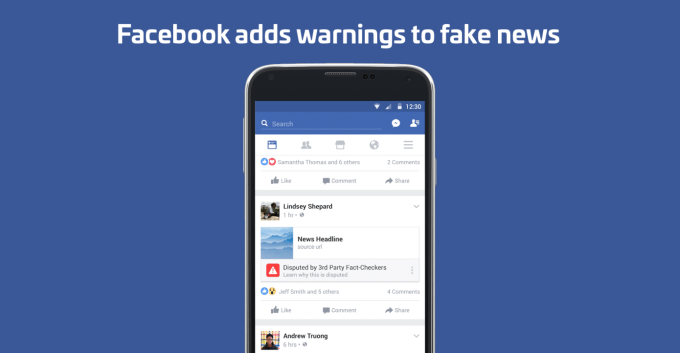
Tell someone not to do something and sometimes they just want to do it more. That’s what happened when Facebook put red flags on debunked fake news. Users who wanted to believe the false stories had their fevers ignited and they actually shared the hoaxes more. That led Facebook to ditch the incendiary red flags in favor of showing Related Articles with more level-headed perspectives from trusted news sources.

But now it’s got two more tactics to reduce the spread of misinformation, which Facebook detailed at its Fighting Abuse @Scale event in San Francisco. Facebook’s director of News Feed integrity Michael McNally and data scientist Lauren Bose held a talk discussing all the ways it intervenes. The company is trying to walk a fine line between censorship and sensibility.

These red warning labels actually backfired and made some users more likely to share, so Facebook switched to showing Related Articles

First, rather than call more attention to fake news, Facebook wants to make it easier to miss these stories while scrolling. When Facebook’s third-party fact-checkers verify an article is inaccurate, Facebook will shrink the size of the link post in the News Feed. “We reduce the visual prominence of feed stories that are fact-checked false,” a Facebook spokesperson confirmed to me.

As you can see below in the image on the left, confirmed-to-be-false news stories on mobile show up with their headline and image rolled into a single smaller row of space. Below, a Related Articles box shows “Fact-Checker”-labeled stories debunking the original link. Meanwhile on the right, a real news article’s image appears about 10 times larger, and its headline gets its own space.


Second, Facebook is now using machine learning to look at newly published articles and scan them for signs of falsehood. Combined with other signals like user reports, Facebook can use high falsehood prediction scores from the machine learning systems to prioritize articles in its queue for fact-checkers. That way, the fact-checkers can spend their time reviewing articles that are already qualified to probably be wrong.

“We use machine learning to help predict things that might be more likely to be false news, to help prioritize material we send to fact-checkers (given the large volume of potential material),” a spokesperson from Facebook confirmed. The social network now works with 20 fact-checkers in several countries around the world, but it’s still trying to find more to partner with. In the meantime, the machine learning will ensure their time is used efficiently.

Bose and McNally also walked the audience through Facebook’s “ecosystem” approach that fights fake news at every step of its development:

  • Account Creation – If accounts are created using fake identities or networks of bad actors, they’re removed.
  • Asset Creation – Facebook looks for similarities to shut down clusters of fraudulently created Pages and inhibit the domains they’re connected to.
  • Ad Policies – Malicious Pages and domains that exhibit signatures of wrong use lose the ability to buy or host ads, which deters them from growing their audience or monetizing it.
  • False Content Creation – Facebook applies machine learning to text and images to find patterns that indicate risk.
  • Distribution – To limit the spread of false news, Facebook works with fact-checkers. If they debunk an article, its size shrinks, Related Articles are appended and Facebook downranks the stories in News Feed.

Together, by chipping away at each phase, Facebook says it can reduce the spread of a false news story by 80 percent. Facebook needs to prove it has a handle on false news before more big elections in the U.S. and around the world arrive. There’s a lot of work to do, but Facebook has committed to hiring enough engineers and content moderators to attack the problem. And with conferences like Fighting Abuse @Scale, it can share its best practices with other tech companies so Silicon Valley can put up a united front against election interference.


Read Full Article

This soft robotic arm is straight out of Big Hero 6 (it’s even from Disney)


The charming robot at the heart of Disney’s Big Hero 6, Baymax, isn’t exactly realistic, but its puffy bod is an (admittedly aspirational) example of the growing field of soft robotics. And now Disney itself has produced a soft robot arm that seems like it could be a prototype from the movie.

Created by Disney Research roboticists, the arm seems clearly inspired by Baymax, from the overstuffed style and delicate sausage fingers to the internal projector that can show status or information to nearby people.

“Where physical human-robot interaction is expected, robots should be compliant and reactive to avoid human injury and hardware damage,” the researchers write in the paper describing the system. “Our goal is the realization of a robot arm and hand system which can physically interact with humans and gently manipulate objects.”

The mechanical parts of the arm are ordinary enough — it has an elbow and wrist and can move around the way many other robot arms do, using the same servos and such.

But around the joints are what look like big pillows, which the researchers call “force sensing modules.” They’re filled with air and can detect pressure on them. This has the dual effect of protecting the servos from humans and vice versa, while also allowing natural tactile interactions.

“Distributing individual modules over the various links of a robot provides contact force sensing over a large area of the robot and allows for the implementation of spatially aware, engaging physical human-robot interactions,” they write. “The independent sensing areas also allow a human to communicate with the robot or guide its motions through touch.”

Like hugging, as one of the researchers demonstrates:

Presumably in this case the robot (also presuming the rest of the robot) would understand that it is being hugged, and reciprocate or otherwise respond.

The fingers are also soft and filled with air; they’re created in a 3D printer that can lay down both rigid and flexible materials. Pressure sensors within each inflatable finger let the robot know whether, for example, one fingertip is pressing too hard or bearing all the weight, signaling it to adjust its grip.

This is still very much a prototype; the sensors can’t detect the direction of a force yet, and the materials and construction aren’t airtight by design, meaning they have to be continuously pumped full. But it still shows what they want it to show: that a traditional “hard” robot can be retrofitted into a soft one with a bit of ingenuity. We’re still a long way from Baymax, but it’s a more science than fiction now.


Read Full Article

T-Mobile is reportedly much closer to a merger deal with Sprint


It looks like a potential merger deal between T-Mobile and Sprint, two of the major telecom companies in the U.S., is getting closer and now has set valuation terms, according to a report by Bloomberg.

The deal could be announced as soon as Sunday, according to a report by CNBC. The proposed tie-up of the two companies was called off in November last year, but now that deal appears to be coming closer, with T-Mobile’s backer valuing Sprint at around $24 billion, according to Bloomberg. As part of the deal, Deutsche Telekom AG will get a 69% voting interest on a 42% stake in the company, according to that report. (Both reports, however, disagree on the valuation — with CNBC citing a $26 billion valuation.)

This deal seems to have been a long time coming, and consolidates two of the four major telecom providers in the U.S. into one larger entity. That could, in theory, offer it some more flexibility as they expand into 5G networks. Still, a deal of this scale could still fall apart and would be subject to regulation — with significant international ownership of both companies (Softbank for Sprint, and Deutsche Telekom for T-Mobile).

Sprint shares fell more than 8% in extended trading to under $6, while T-Mobile shares were largely unchanged. Shares of Sprint were up around 8% on the day up to $6.50 in early trading.

A representative from Sprint declined to comment. A representative from T-Mobile did not immediately respond to a request for comment.


Read Full Article

Essential’s first handset is coming to more markets


It’s hard launching a phone company — something Essential was pretty candid about from the start. Andy Rubin’s latest endeavor got off to something of a slow start, according to outside accounts, but today the well-funded hardware startup is getting ready to add a whole bunch of new markets to its online store.

On Twitter today, the company announced a handful of key additions to its coverage map, including Canada, France, Japan and UK. As Engadget notes, availability in some of those markets already exists, but not through the company’s own shop, most notably Canada, where users can pick the handset up via Amazon or Telus.

There are also some country specific caveats here. Those can be found through the company’s Terms of Service, which notes that the handset is now also available in Germany.

It’s been a slow roll out for the company, but understandably so. It’s not easy starting this kind of endevour from scratch, even with the $300 million in funding the company managed to drum up. Essential spent its first year primarily focused on its home market, delivering Amazon and Best Buy availability, along with a Sprint deal.

Building distribution channels this time out should ease some of the burden of launching when time comes to deliver version 2.0.


Read Full Article

27 April 2018

Facebook’s Messenger Kids’ app gains a ‘sleep mode’


Facebook’s Messenger Kids, the social network’s new chat app for the under-13 crowd, has been designed to give parents more control over their kids’ contact list. Today, the app is gaining a new feature, “sleep mode,” aimed at giving parents the ability to turn the app off at designated times. The idea is that parents and children will talk about when it’s appropriate to send messages to friends and family, and when it’s time for other activities – like homework or bedtime, for example.

The app, which launched last December, has not been without controversy.

Some see it as a gateway drug for Facebook proper. Others whine that “kids should be playing outside!” – as if kids don’t engage in all sorts of activities, including device usage, at times. And of course, amid Facebook’s numerous scandals around data privacy, it’s hard for some parents to fathom installing a Facebook-operated anything on their child’s phone or tablet.

But the reality, from down here in the parenting trenches, is that kids are messaging anyway and we’re desperately short on tools.

Instead of apps built with children’s and parents’ needs in mind, our kids are fumbling around on their own, making mistakes, then having their devices taken away in punishment.

The truth is, with the kids, it’s too late to put the toothpaste back in the tube. Our children are FaceTime’ing their way through Roblox playdates, they’re texting grandma and grandpa, they’re watching YouTube instead of TV, and they’re begging for too-adult apps like Snapchat – so they can play with the face filters – and Musical.ly, which has a lot of inappropriate content. (Seriously, can someone launch kid-safe versions?)

Until Messenger Kids, parents haven’t been offered any social or messaging apps built with monitoring and education in mind.

I decided to install it on my own child’s device, and I’ll admit being conflicted. But I’m using it with my child as a learning tool. We talk about how to use the app’s features, but also about appropriate messaging behavior – what to chat about, why not to send a dozen stickers at once, and how to politely end a conversation, for example.

Unlike child predator playgrounds like Kik, popularity-focused social apps like Instagram, or apps where messages simply vanish like Snapchat, Messenger Kids lets parents choose the contact list and control the experience. And, as a backup, I have a copy of the app on my own phone, so I can spot check messages sent when I’m not around.

With the new sleep mode feature, I can now turn Messenger Kids off at certain times. That means no more 8 AM video calls to the BFF. (Yes, we’ve discussed this – after the fact. Sorry, BFF’s parents.) And no more messaging right at bedtime, either.

To configure sleep mode, parents access the Messenger Kids controls from the main Facebook app, and tap on the child’s name. You can create different settings for weekdays and weekends. If the child tries to use the app during these times, they’ll instead see a message that says the app is in sleep mode and to come back later.

The control panel is also where parents can add and remove contacts, delete the child’s account, or create a new account.

Facebook suggests that parents have a discussion with kids about the boundaries they’re creating when turning on sleep mode.

[gallery ids="1629819,1629820,1629821,1629822"]

That may seem obvious, but it’s surprisingly not. I’ve actually heard some parents scoff at parental control features because they think it’s about offloading the job of parenting to technology. It’s not. It’s about using tools and parenting techniques together – whether that’s internet off times, device or app “bedtimes,” internet filtering, or whatever other mechanisms parents employ.

I understand if you can’t get past the fact that the app is from Facebook, of all places. Or you have a philosophical point of view on using Facebook products. But Facebook integration means this app could scale. In the few months it’s been live, the app has been download around 325,000 times, according to data from Sensor Tower.

Messenger Kids is a free download on iOS and Android.


Read Full Article

Facebook drops fundraising fees for personal causes


Despite Facebook being under fire for everything pertaining to Cambridge Analytica, the company still hopes to be able to do some good. Today, Facebook is dropping its platform fees pertaining to fundraisers for personal causes.

That means Facebook is getting rid of the 4.3 percent platform fee in the u.S. and the 6.2 percent fee in Canada. Those fees were charged to cover a review process for and vetting for each fundraiser. Now, Facebook says it will absorb the costs associated with those safety and protection measures.

“We’re continuously learning and this was something we wanted to do to help people maximize the benefits,” Facebook Head of Product for Social Good Asha Sharma told me over the phone.

To be clear, there will, however, still be fees for payment processing and taxes. In the U.S. and Canada, payment processing fees are 2.6 percent plus $0.30.Facebook is also unveiling two new features for its fundraising tool.

The first is the ability for people to match donations for non-profit fundraisers and the second is the expansion of categories for personal causes. Now, in addition to raising money for things like vet bills, personal emergencies and whatnot, people can also raise money for travel (community trips or for medical needs), family-related causes (adoption, etc), religious events and volunteer supplies.


Facebook isn’t yet sharing specific dollar amounts raised pertaining to fundraisers, but says its tool has helped over 750,000 non-profits collect donations. All Sharma would say about personal causes is that “we’re seeing activity across all of these categories, which is why we have them.”

Read Full Article

MIST paints your walls so you don’t have to


If you’ve ever painted a room you know that getting every nook and cranny is pretty difficult and Tim Allen help you if you have hardwood or carpet. The tarp alone costs more than the paint. Now, thanks to MIST, your robot can manage the entire job, slapping paint up like a robotic Jackson Pollock.

The robot uses mapping technology and a sort of elevator-like neck to spray up and down walls. The team, which hails from the University of Waterloo, has finished their prototype and it’s called Maverick. The team has experience working at multiple big names including Apple and Facebook. It includes Shubham Aggarwal, Utkarsh Saini, Baraa Hamodi, Hammad Mirza, and Dhruv Sharma.

This is just the beginning for Maverick. The team plans on adding other features that make it easier to use.

“We actually plan on mounting a camera behind the sprayer so that it follows the sprayer up and down, and hence can use image processing to make decisions about whether to actuate the spray or not. We’ve already implemented this logic in software and even have a paint quality detection algorithm. That being said, we haven’t mounted the camera just yet as seen in this video,” the team said.

As you can see below the project involves a platform, arm, and spray system. The robot maps the room and then rolls around, hitting spots that are supposed to be painted and avoiding spots that aren’t. Obviously you’re going to want to tape up some spots but for the most part Maverick will blast your walls with a few layers of paint in the time it would take you to go down to the paint store.

I’ve reached out to the team for more information on their project but until then enjoy their jaunty video below. I, for one, welcome our robotic spraying overlords.


Read Full Article

Nintendo is releasing a mobile RPG this summer


The maker of Shadowverse and Granblue Fantasy is teaming up with Nintendo for a new mobile RPG. Called Dragalia Lost, the Japanese-style action RPG will be a free-to-play game though likely loaded with Loot Box-style mechanics that will result in a financial windfall for Nintendo and developer Cygames.

The trailer doesn’t reveal many details about the game’s story. I assume from the title that someone called Dragalia is lost and a team of unlikely heros will have to fight monsters along their journey to find this Dragalia. I guess.

Nintendo turned to Cygames to make this new title instead of retooling Zelda or Xenoblade for the mobile screen. The game reportedly use Cygame’s system that randomly unlocks characters and upgrades. It’s like loot boxes but not called loot boxes. This is how the game will make money as players are encouraged to pay to buy more unlocks.

As part of the deal, Nintendo is acquiring 5-percent of Cygrames. Nintendo also has a stake in mobile phone platform maker DeNA, which also holds 25-percent of Cygrames showing how Nintendo is slowing spreading throughout the mobile game world.


Read Full Article

How to Merge and Unmerge Cells in Excel: Tips and Tricks to Know


When you want to combine two cells into one in Excel, you have a few options. Merging cells is one of the best ways to do it. But it has a few drawbacks, too. Even so, you might find that it’s useful for working with text in Excel.

We’ll take a look at how to merge cells in Excel, how to unmerge them, and another method for combining two cells into one without losing the data in the cells.

How to Merge Cells in Excel

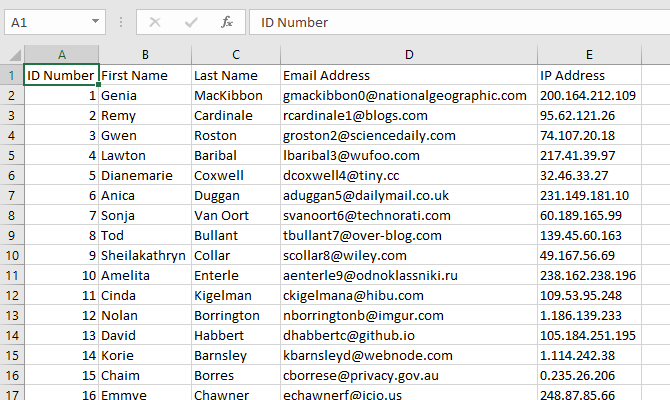
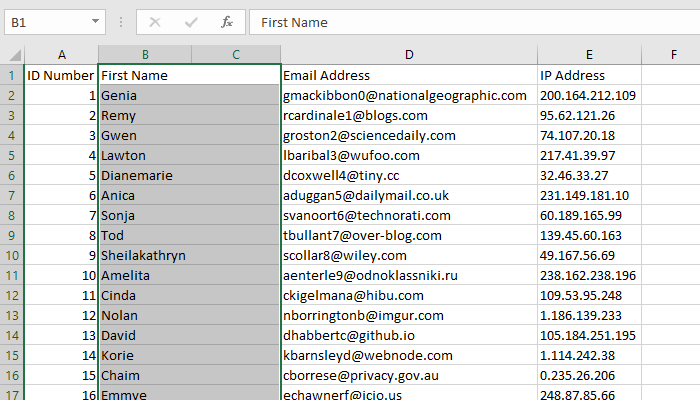
Before we get into how to merge cells, let’s talk about exactly what happens when you merge in Excel. In this example, we’ll look at two columns, one for first name and one for last name:

how to merge cells in excel - Two Excel columns before merging

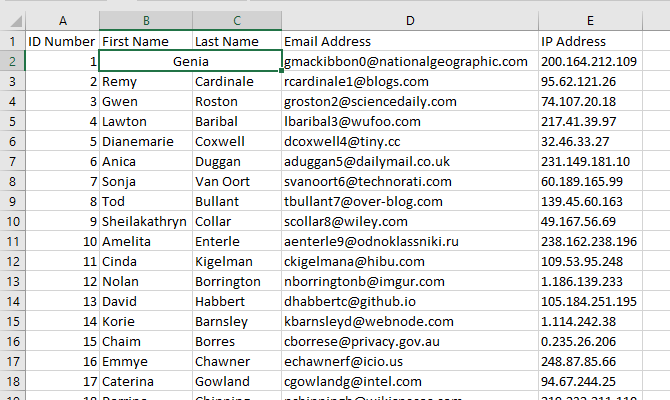
When we merge two of these cells, we end up with the contents of those cells in a single cell, like this:

how to merge cells in excel - A single merged cell in Excel

The two cells have been combined, leaving a single cell that’s twice as wide and only contains one value. Excel only keeps the upper-left value of any merged cells. That’s one drawback to merging in Excel. We’ll talk about how to get around that in a moment.

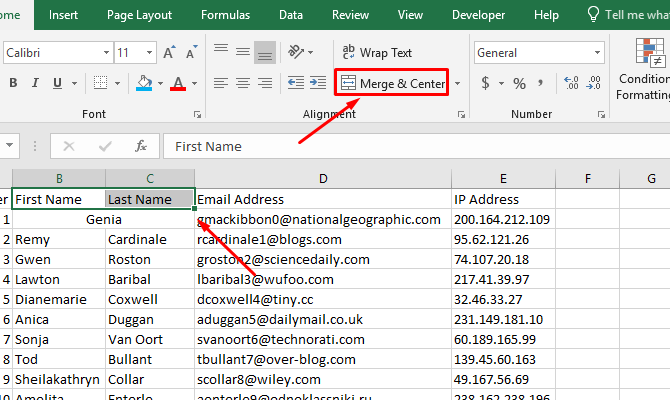
To merge cells in Excel, select the cells you want to merge. You can select any number of cells; in our example, we’ll select just two. Once you’ve selected the cells, head to the Home tab and click Merge & Center in the Alignment section:

how to merge cells in excel - Excel Merge & Center button

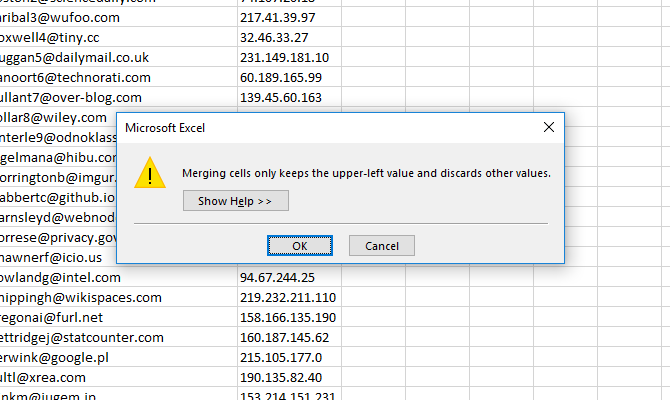
If you’ve selected more than one with text in it, you’ll get a warning:

how to merge cells in excel - Excel merge cells warning

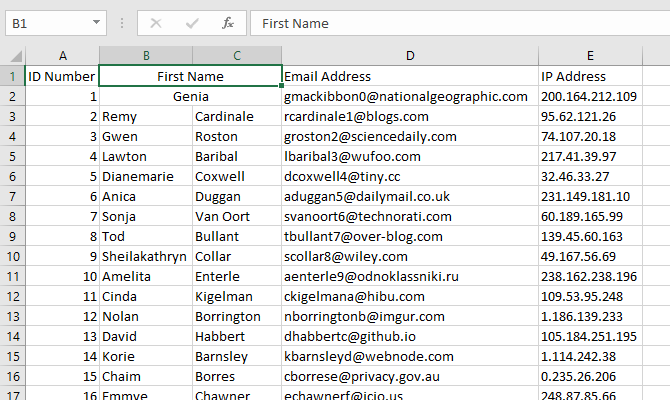
If you want to continue, just hit OK. You’ll then have your merged cell as in the screenshot below. That’s all there is to it.

how to merge cells in excel - Excel merged cell

Merging Columns in Excel

In some cases, you’ll want to merge entire columns instead of just a few cells. Merging columns in Excel is easy; just select both columns and use the same steps.

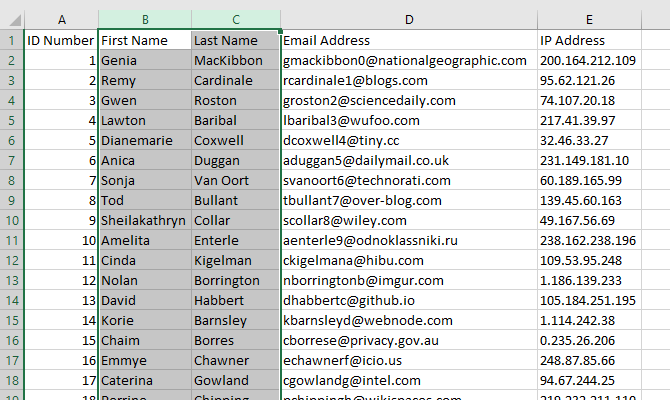
First, highlight the two columns you want to merge:

Selecting columns to merge in Excel

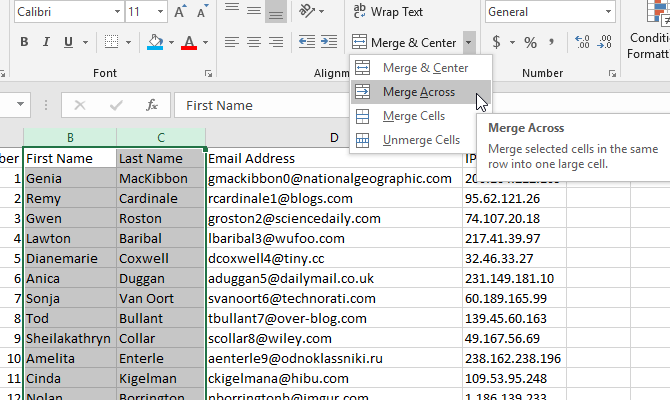
If you hit the Merge & Center button right now, you’ll end up with one huge cell that has a single value in it. Instead, click the dropdown arrow next to Merge & Center and select Merge Across:

Excel Merge Across button

After clicking Merge Across, you’ll receive another warning from Excel. But instead of a single warning, you’ll get one warning for each row in your selection. Which is a lot. After clicking OK for each row, you’ll have a newly combined column:

Excel merged columns

You might be wondering why you wouldn’t just delete the second column in this case. Well, you probably would. Merging columns doesn’t do a whole lot for you.

Let’s talk about a better way to merge cells in Excel.

Combining Cells With CONCATENATE

The fact that combining cells makes you lose data is a big disadvantage of using Excel’s merging function. However, you can get around that by using a formula. Here’s the syntax of the CONCATENATE function, one of Excel’s most useful text functions:

=CONCATENATE(text 1, [text 2],...)

The function takes multiple text inputs and creates a new cell that combines all of them. This lets you merge cells without losing any data. Let’s use the same spreadsheet as before, with the list of first and last names. Instead of merging the cells and losing the last names, we’ll create a new column and use CONCATENATE to bring in both the first and last names.

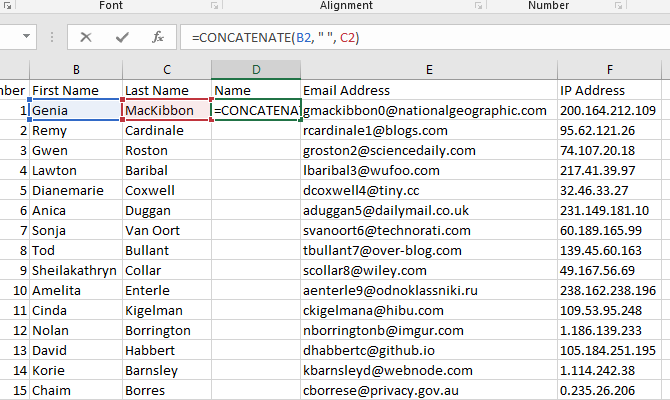
Here’s the formula we’ll use in the new columns:

=CONCATENATE(B2, " ", C2)

Notice that between B2 and C2 we have a space between two quotes. This is important because it inserts a space between the contents of the cells being merged. If you forget it, you’ll get the first and last names mashed together.

Here’s what it looks like in Excel:

Using CONCATENATE to merge cells in Excel

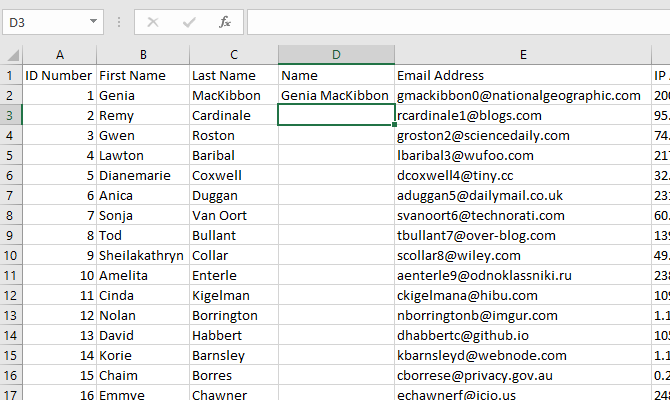
When I hit Enter, here’s what we get:

Merged cells using CONCATENATE

Much better than our first attempt, isn’t it?

You also have the advantage of being able to modify the combination later, whereas you cannot do that when you merge cells the regular way.

How to Unmerge Cells in Excel

If you decide to merge cells, you’ll also want to know how to unmerge them.

Unfortunately, unmerging doesn’t bring any of your lost data back. When you merge cells in Excel, you’re going to lose some information, and it’s gone forever. Merged cells can create weird spaces in your spreadsheet, though, and unmerging them solves the problem.

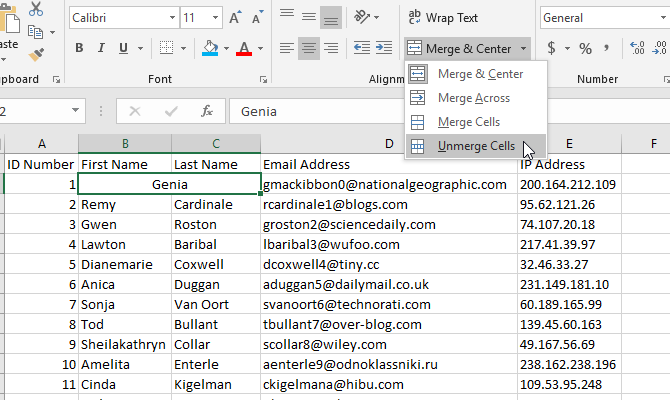
To unmerge cells, just select the merged cell, click the dropdown arrow next to Merge & Center, and click on Unmerge Cells:

how to unmerge cells in excel - Unmerge Cells button in Excel

The cells will go back to their original count and size. You’ll still only have the data from the upper-left corner of your selection, though. This is one reason why it’s a good idea to work on a copy of your spreadsheet (or use the CONCATENATE function).

Merging Cells Can Still Be Useful

While you’ll need to use CONCATENATE to merge cells without losing data, there are still some uses of merging in Excel. It’s often used for formatting to clean up a table, for example, which may help you get a better print of your spreadsheet:

Using Merge in Excel for formatting

In general, though, it’s better to use CONCATENATE if you’re looking to merge cells without losing data.

That being said, you may find that you come across a situation where you need to merge cells in Excel. Even an Excel beginner will need to use them every day. So, when you find one of those situations now, you’ll know exactly how to do it.

And don’t forget that you can merge Excel files and sheets too!


Read Full Article

Maverick, a social network for young women, launches with $2.7M in funding


While Bumble BFF and Hey! Vina help adult women find new friends, there isn’t a social network dedicated to young women.

But Brooke Chaffin and Catherine Connors are looking to change that with the introduction of Maverick, a social network that connects young girls with female mentors to express their creativity in a safe space.

Here’s how it works:

When a new user signs up, they can browse through various challenges set forth by Catalysts, inspiring role models selected specifically by the founders to inspire the younger demographic on the network. These challenges include things like making their own super hero, creating their own dance number or choosing a mantra.

Users, usually between the ages of 10 and 20, can post their response to a challenge via photo or a 30-second video and browse the responses of others. Interestingly, Maverick has done away with ‘likes’ and instead offers points for various types of engagement, like posting a response to a challenge, posting a comment, or giving someone a badge.

For now, there are four badges on the platform (unique, creative, unstoppable, and daring) and the company has plans to add more badges as it grows.

But Maverick isn’t just an app. The company also plans on holding a series of one-day live events across the country, highlighting young women emerging on the platform in categories like STEAM, entrepreneurship, comedy and music.

In fact, the first live event goes down tomorrow in Los Angeles, featuring “Founding Mavericks” or role models such as Chloe & Halle Baily, Brooklyn and Bailey McKnight, Daunnette Reyome, Laurie Hernandez and Ruby Karp.

For now, Maverick is a free app focused on growing its user base. But the founders see an opportunity to turn Maverick into a utility, not unlike LinkedIn, offering a subscription for premium features. And it makes sense that LinkedIn would serve as inspiration for Chaffin and Connors, as LinkedIn CEO Jeff Weiner is one of Maverick’s investors.

The company has raised $2.7 million in seed funding led by Matt Robinson of Heroic Ventures, with participatino from Susan Lyne and Nisha Dua of BBG Ventures as well as Jeff Weiner.

Here’s what co-founder and Chief Content Officer Catherine Connors had to say:

The research on girls’ social development has shown us the same thing for decades. During early adolescence, the majority of girls stop raising their hands, participating in sports and extra-curricular activities, taking risks, and stepping into leadership roles. In short, they stop believing in themselves. And it’s not because we don’t tell them that they should believe in themselves — it’s that they don’t get enough real opportunity to prove to themselves that they can.

Founders Chaffin and Connors met during their tenure at the Walt Disney Company and kept coming back to the idea of empowering girls through a new social network, and so Maverick was born.

The network is designed with a progression loop not unlike that of a game, where Mavericks can progress toward becoming a Catalyst and inspiring other young women.

The app launches out of beta today.


Read Full Article

How to Easily Switch Between Multiple DNS Servers in Windows


If you’ve looked into your boosting your internet speed or getting around blocked content, you’ve probably come across DNS servers, which are used to translate website domain names into IP addresses.

While using your ISP’s default DNS works fine, customizing your DNS has lots of advantages. But digging into your computer settings to change your DNS provider is a hassle, and keeping all those DNS server IP addresses straight isn’t always easy. Thankfully, a small utility can help solve both these issues.

Easily Switching Between Multiple DNS Servers

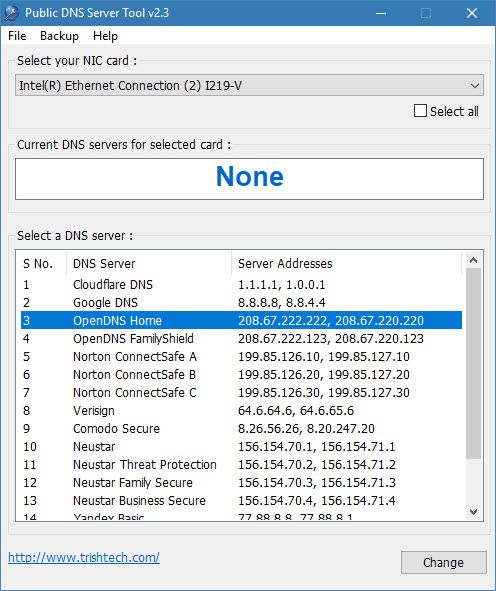
Public-DNS-Server-Tool

  1. Download the free Public DNS Server Tool (the link is in step 1 under Setting up public DNS servers).
  2. Extract the downloaded ZIP and run the PublicDNS.exe file inside.
  3. Confirm administrator access for the app. You’ll see the tool’s main interface once it launches.
  4. First, you should create a backup of your current DNS settings for easy restoration. Select Backup > Backup from the menu bar and choose a location to save the backup.
  5. Once that’s done, select your wireless card from the top dropdown menu or choose Select all to apply changes to all of them (if applicable). You might see multiple options if you have both an Ethernet and wireless connection available.
  6. Next, select the DNS server you’d like to use from the list. This tool currently supports 16 options, including Cloudflare’s new DNS, Google’s Public DNS, OpenDNS, and more.
  7. With the server you want to use highlighted, click Change.
  8. You’ve successfully changed your DNS options!

To restore your original settings, just visit Backup > Restore and import your backup file. For further reading, check out why third-party DNS is more secure.


Read Full Article

How to Set Specific Download Folders for File Types in Chrome and Firefox


Keeping your downloads folder organized can be a hassle, but there are a few automated ways to keep the mess under control. You can automatically delete files older than 30 days, and you can save files to specific folders based on file type. We’ll show you how to do the latter in this article.

How to Auto-Save File Types to Specific Folders

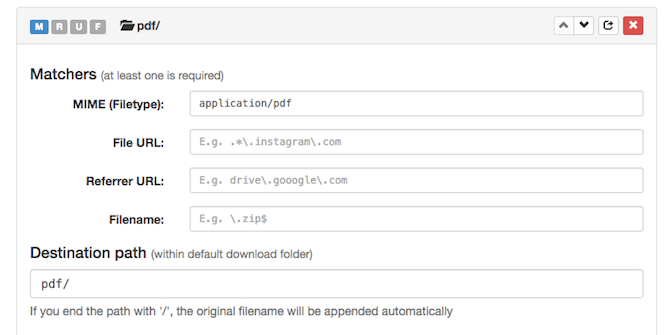
The Chrome extension RegExp Download Organizer allows you to create rules for downloaded file types. For example, every time you download a PDF, it will be automatically saved to a folder of your choice in the downloads folder.

You can also filter down to specific file types. For example, you can save all images to one folder, or you can create a separate folder for JPEGs, another for PNGs, etc. The Chrome extension comes with a couple of rules already created: one for images and one for torrents.

Let’s say you want to create a new rule for PDFs, enter the following:

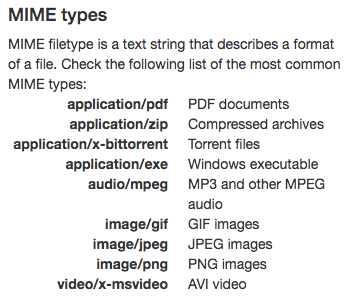
  1. For MIME (Filetype), enter application/pdf.
  2. For Destination Path, select pdf/ (or the folder name of your choice).

The extension includes a list of rules you can use for various file types, including compressed files (ZIP), Windows executable files (EXE), audio files, and video files.

As you can see from the screenshot above, you can also create rules based on specific URLs and file names.

How to Add “Save In” Folders to the Right-Click Menu

If you would rather add specific locations you can choose from as you save the file, there is an extension available that does that.

The Save In extension (ChromeFirefox) requires extensive permissions when installing, including the ability to read and change all data on websites you visit. By way of contrast, the aforementioned RegExp Download Organizer extension only requires permission to manage your downloads.

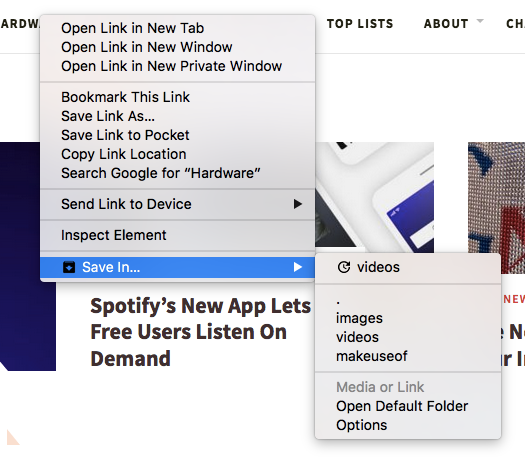
If you decide Save In is right for you, once you’ve installed the extension, when you right-click a link or file in your browser, you’ll now see Save in in your context menu, with two folder options already listed: images and video. If you save a file to these locations, your browser will automatically create those subfolders in your Downloads folder if they don’t exist.

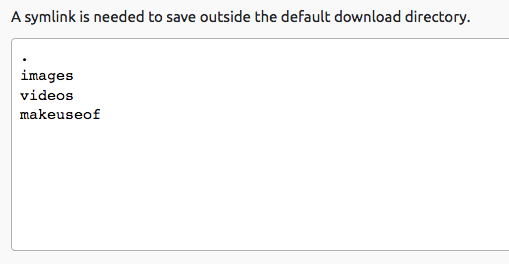
To add or modify the locations on that list, open the extension options in your browser and just add them to the existing list:

When you right-click a file, those locations will now be available in your context menu:

If you want to select a folder that isn’t in the downloads folder, it gets a little more complicated and will require you to create a symbolic link. If that seems too complicated for you and you really want to save your files to folders that aren’t in the downloads folder, there is one more option to consider:

Mac users can automatically move files to and from specific folders using automated rules with Hazel or Mac’s Automator, while Windows users can give QuickMove a try.


Read Full Article