09 November 2020

Autonomous delivery startup Nuro hits $5 billion valuation on fresh funding of $500 million


Nuro, the autonomous delivery startup founded by two former Google engineers, has raised $500 million, suggesting that investors still have an appetite for long-term pursuits such as robotics and automated vehicle technology. Nuro now has a post-money valuation of $5 billion.

The Series C round was led by funds and accounts advised by T. Rowe Price Associates, Inc., with participation from new investors including Fidelity Management & Research Company and Baillie Gifford. The round also includes existing investors such as SoftBank Vision Fund 1 and Greylock.

Nuro was founded in June 2016 by former Google engineers Dave Ferguson and Jiajun Zhu. While the startup was initially bootstrapped by Ferguson and Zhu, it has never struggled to attract investors. Nuro completed its first Series A funding round in China in 2016, a deal that gave NetEase founder Ding Lei (aka William Ding) a seat on Nuro’s board. A second, U.S.-based round in June 2017 raised Nuro’s total Series A funding to $92 million. But it was the monster $940 million investment made by the SoftBank Vision Fund in February 2019 that catapulted Nuro ahead of numerous other startups attempting to commercialize autonomous vehicle technology. Nuro had a $2.7 billion valuation following the Softbank investment, meaning its value doubled in about 18 months. That money has helped it grow to more than 650 employees.

Unlike many other startups in the AV industry, Nuro has focused its effort designing a low-speed electric self-driving vehicle that transports packages, not people. Some of Nuro’s first tests and pilots were with Toyota Prius vehicles equipped with its self-driving system. Nuro partnered in 2018 with with Kroger to pilot a delivery service in Arizona. The pilot, which initially used Toyota Prius vehicles, transitioned to its R1 delivery bot. Nuro has also partnered with companies like CVS, Domino’s and Walmart.

The company has since developed a second generation vehicle, known as the R2. This delivery bot, which is designed for local delivery service for restaurants, grocery stores and other businesses, received an exemption from the federal government earlier this year that allows it to operate as a driverless vehicle.

“We are witnessing an unprecedented shift in consumer demand for safe and affordable local delivery services,” said Zhu, CEO and co-founder of Nuro said in a statement. “This funding, which brings us together with many of the world’s top investors, positions Nuro confidently toward a future where our world-class technology is adopted into people’s everyday lives.”

The company, which is testing and operating R2 on public roads in Arizona, California and Texas, told TechCrunch that the new funding will allow it to “confidently grow for years to come, with multi-year runway to build in multiple cities and scale across multiple markets.” Nuro’s near-term focus is on scaling its service in Houston and implementing R2 into commercial service.


Read Full Article

India opens antitrust case against Google over its payments app


India’s antitrust watchdog has opened an investigation into Google for allegedly abusing the dominant position of its app store and Android mobile operating system to promote its payments service in the world’s second largest internet market.

In its Monday announcement (PDF) about opening an antitrust case against Google, Indian watchdog Competition Commission of India (CCI) said it would review claims whether Google “unfairly” skews the search results on the Play Store in favor of Google Pay app over others; prominently promotes Google Pay during the setup of an Android smartphone; and if Play Store’s billing system is designed “to the disadvantage of both i.e. apps facilitating payment through UPI, as well as users.”

The informant, who has not been identified, alleged that in addition to Google Play Store’s billing system favoring Google Pay app, in-app purchases for apps downloaded through Play Store are also mandated to support Google Pay service “if they want to be listed on the Play Store.”

Google “rigs its feature app lists such as ‘Editor’s Choice Apps’, ‘User Choice Apps’ and ‘Top Free apps’ … demonstrating clear bias in favor of its own app; by manipulating the search advertisements algorithm on the Play Store in favour of Google Pay; and by pre-installing and prominently placing Google Pay on Android smartphones at the time of initial set-up resulting in a ‘status-quo bias’ to the detriment of other apps facilitating payments through UPI as well,” the informant was quoted as saying by the Indian watchdog.

“The informant pointed out similarities between the conducts of Apple in Europe and Google in India i.e. like Apple (as set out in the Press Release of EC), as a mandatory requirement for listing on the Play Store, Google requires the app developers to exclusively use Google Play Store’s payment system and Google Play In-App Billing for charging users who purchase apps on the Play Store or buy goods/services from inside an app (i.e. IAP), and further like Apple, Google charges app developers a 30% commission for allowing them to use the Play Store’s payment system and Google Play In-App Billing,” the Indian watchdog said.

Google told CCI that Android “is not dominant in India and it faces significant competition from feature phones operating systems,” the Indian watchdog revealed. According to research firm Counterpoint, Android powers 99% of all smartphones in India. Google also disputed all the other allegations as well. For instance, it said, “Google’s 30% (and in certain circumstances, 15%) service fee is not arbitrary. It is market based, legitimate, and pro-competitive as the service fee allows Google to cover third party fees and support its significant and continued investments in Play, including the vast resources it develops for developers.”

If the allegations provided by the informant are found credible, Google’s practices could be in violation of various provisions of Section 4 of India’s Competition Act of 2002.

Google Pay, formerly known as Tez, is one of the most popular payments services in India. It competes with Walmart’s PhonePe, Paytm, and a range of other apps. As of last month, Walmart’s PhonePe was slightly ahead of Google Pay in India. Both the apps individually process roughly 40% of all transactions on UPI, a payments infrastructure built by large banks in the country. UPI is the most popular digital payments solution in India.

Google Play Store supports a range of payments methods, including credit cards, mobile wallets, internet banking, and UPI. But, as the informant alleges, “UPI based digital payment apps are more convenient, secured, economical, etc. over other digital payment solutions.” Based on such distinct features, the Indian watchdog said, “the Informant has averred that the market for apps facilitating payment through UPI is a separate relevant market as users do not regard apps facilitating payment through UPI as interchangeable or substitutable with other modes of digital payment.”

The new antitrust case is the latest headache for Google in India, its biggest market by users. In recent months, the dominant position of Android has also irked many startups in the country, who have formed an informal coalition to fight back the Android maker. Following the backlash in India, Google postponed the enforcement of its new Play Store billing rule in India to April 2022.

Google did not immediately respond to a request for comment.


Read Full Article

Equity Monday: Vaccine news scrambles the stock market, shakes up startups


Hello and welcome back to Equity, TechCrunch’s venture capital-focused podcast where we unpack the numbers behind the headlines.

This is Equity Monday, our weekly kickoff that tracks the latest big news, chats about the coming week, digs into some recent funding rounds and mulls over a larger theme or narrative from the private markets. You can follow the show on Twitter here and myself here — and don’t forget to check out last Friday’s episode that we wound up titling “Fortnite is actually a SaaS company.”

It makes sense in context, I promise.

Anyway, here’s what’s on today’s show:

  • Joe Biden was elected President and the stock market is not mad about divided government.
  • Positive vaccine news sent many stocks sharply higher this morning, but not all. Some pandemic-favored tech companies instantly dropped double-digit percentage points of value.
  • Esign raised $151 million, showing strength in the Chinese startup market, and the esignature space.
  • And this neat Series B for Cellwize caught our attention this morning.
  • Finally, a warning. The stuff that is changing lately may begin to change a bit less. We’ve lived in the pandemic economy long enough now that it’s hard to recall what life was like before. But, we’d best start remembering as there’s a lot that is going to change in the next few quarters.

This has been a wild to start the week, but with good news.

I suppose a vaccine was always going to eventually make it to this step, but, that said, the United States is seeing record COVID-19 cases today. So mask up and let’s get as many of us across the line as we can.

Equity drops every Monday at 7:00 a.m. PDT and Thursday afternoon as fast as we can get it out, so subscribe to us on Apple PodcastsOvercastSpotify and all the casts.


Read Full Article

Brand New Samsung Released in India


The South Korean giant announced its mid-range leader a few weeks ago. The tech-hungry Indian market welcomed its release with enthusiastic reviews. India’s Dynamic Online Scene Makes the M51 an Instant Hit When the new Samsung Galaxy M51 was first officially revealed on the company’s German website, few expected it to make waves in the […]

The post Brand New Samsung Released in India appeared first on ALL TECH BUZZ.


07 November 2020

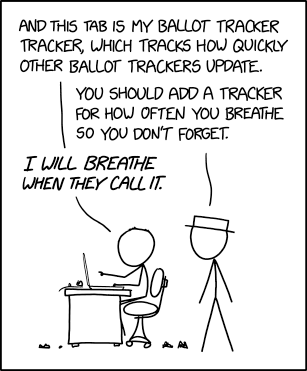
Ballot Tracker Tracker


Ballot Tracker Tracker

Home Entertainment Trends During The COVID-19 Pandemic


Covid-19 has forced everyone to stay in their homes for longer than they could have imagined. Being human beings, people continuously need exposure to entertainment to keep them occupied. Our minds wander from thought to thought does not rest even for a single second. To give this restless, unsatisfied, and never free mind a purpose, […]

The post Home Entertainment Trends During The COVID-19 Pandemic appeared first on ALL TECH BUZZ.


How Accurate is XRF Analysis?


PMI or Positive Material Identification is a key part of many industries and has several applications like avoiding dangers in the chemical petroleum sector, maintenance, in the construction businesses, and also in the power plants. There can be production loss if the right alloy is not used in the applications. The threat to public safety, […]

The post How Accurate is XRF Analysis? appeared first on ALL TECH BUZZ.


Must-Have Gadgets If You’re Joining College or University


Going to school means lots of packing and preparation for the study period ahead. New college and university scholars leaving their homes to study for the first time may find this entire period daunting. It all begins with the items you pack, and you want to carry everything necessary for you to adapt to the […]

The post Must-Have Gadgets If You’re Joining College or University appeared first on ALL TECH BUZZ.


High-Tech Gadgets That Are Changing How Students Learn


Education is defined as the process of providing students with adequate knowledge, cultural values, skills, etc. required to take advantage of numerous opportunities in the future. Education helps people feel, behave, and think to contribute to their success and prosperity. Education is meant to impart knowledge about the world around us and provide the tools […]

The post High-Tech Gadgets That Are Changing How Students Learn appeared first on ALL TECH BUZZ.


Provizio closes $6.2M seed round for its car safety platform using sensors and AI


Provizio, a combination hardware and software startup with technology to improve car safety, has closed a seed investment round of $6.2million. Investors include Bobby Hambrick (the founder of Autonomous Stuff); the founders of Movidius; the European Innovation Council (EIC); ACT Venture Capital.

The startup has a ‘five-dimensional’ sensory platform that – it says – perceives, predicts and prevents car accidents in real-time and beyond the line-of-sight. Its ‘Accident Prevention Technology Platform’ combines proprietary vision sensors, machine learning, radar and with ultra-long range and foresight capabilities to prevent collisions at high speed and in all weather conditions, says the company. The Provizio team is made up of experts in robotics, AI, and vision and radar sensor development.

Barry Lunn, CEO of Provizio Said: “One point three five road deaths to zero drives everything we do at Provizio. We have put together an incredible team that is growing daily. AI is the future of automotive accident prevention and Provizio 5D radars with AI on-the-edge are the first step towards that goal.”

Also involved in Provizio is also Dr. Scott Thayer and Prof Jeff Mishler formally of Carnegie Mellon robotics, famous for developing early autonomous technologies for Google/ class="crunchbase-link" href="https://ift.tt/3k6s0iC" target="_blank" data-type="organization" data-entity="waymo">Waymo, Argo, Aurora and Uber.


Read Full Article

06 November 2020

I stepped out of grief -- by dancing with fire | Danielle Torley

I stepped out of grief -- by dancing with fire | Danielle Torley

After losing her mother in a house fire when she was just six years old, Danielle Torley saw two paths before her: a life full of fear, or one that promised healing and recovery. In this inspiring talk, she describes how she turned her grief into beauty in a most unexpected way -- by dancing with fire.

https://ift.tt/3eEBrof

Click this link to view the TED Talk

Review: Sony’s PlayStation 5 is here, but next-generation gaming is still on its way


The new generation of consoles is both a hard and an easy sell. With a big bump to specs and broad backwards compatibility, both the PlayStation 5 and Xbox Series X are certainly the consoles anyone should buy going forward. But with nearly no launch content or must-have features they also fail to make a compelling case for themselves beyond “the same, but better.” What we’re left with is something more like a new iPhone: You’ll have to upgrade eventually, and it’ll be fine. Just don’t believe the hype for the new consoles… yet.

Disclosure: TechCrunch was provided consoles from both Microsoft and Sony ahead of release, as well as a handful of titles from first- and third-party publishers.

In accordance with an elaborate (and ongoing!) series of embargoes for different features and games, impressions have been trickling out about the new platforms for a month now. For a launch that’s already lacking impact, this may have further blunted excitement: Few gamers will get excited when all anyone can write about is the exterior of the console itself, or the first level of the pack-in game. Some features wouldn’t even be available before launch, or are prohibited from coverage until long afterwards, leaving reviewers wondering whether day-one changes would make any impressions they had obsolete. (I’ll update this review when new information comes to light, or link to future coverage.)

But whatever the case, the shackles are finally removed and now we can talk about most (but not all) the new consoles have to offer. Unfortunately it’s… not that much. Despite the companies’ attempts to hype the next generation as a huge leap, there’s simply no evidence of that at launch and probably won’t be for many months.

That doesn’t mean the new platforms are a flop — or even that they aren’t great. But the new generation is a lot like the old one, and compatibility with it is actually the biggest thing the PS5 and Series X have going for them for the opening stretch. Here’s what I can tell you honestly about my time with the PS5.

The hardware: Conversation piece

A PS5 console with a PS4 on top

As you can see, the PS5 is CONSIDERABLY larger than the PS4 Slim.

The PS5 is a strange-looking beast, but I’ll give it this: no one is going to mistake it for any other gaming console. Though they may think it’s an air purifier.

The large, curvy device likely won’t fit with anyone’s decor, so it may be best to just bite the bullet and display it prominently (fortunately it sits comfortably vertically or on a stand horizontally). I look forward to getting custom shields for the side to make this thing a little less prominent.

The console is fairly quiet while playing games, but you’ll probably want it at least a few feet away from you, especially if you’re going to play with a disc, which is much louder than normal operation.

As for performance, it’s really impossible to say. The only “next-gen” (really cross-gen) game I got to play much of was Spider-Man: Miles Morales, and while it looked great (more impressions below), it’s incredibly hard to make any substantive comment on the machine’s computing and rendering chops.

Close up of the Sony logo on the PS5 and tiny characters making a pattern.

Image Credits: Devin Coldewey / TechCrunch

The prospect of gaming in 4K and HDR, and of advanced techniques like ray tracing changing how games look, is an exciting one. But in the first place you need a TV setup that’s capable of taking advantage of these features, and in the second — to be perfectly honest, they’re not all they’re cracked up to be. A high-quality 1080p TV from the last couple years will look very nearly as good despite not supporting Dolby Vision or what have you. (I know because I got a new TV during the review period. They both looked great.)

Load times — a factor of the much-lauded custom SSD in this thing — are similarly hard to evaluate, though certainly going from menu to game in Miles Morales was fast, fast-traveling faster, and the previous game was faster to load than on my regular PS4. This benefit will of course vary from game to game, however — some developers are announcing their performance gains publicly, while others with less impressive ones may just let sleeping dogs lie. Without more titles to get a feel for the console’s performance improvements, right now you’ll have to take Sony’s word on things.

The controller: DualSense makes sense

Close up image of a Sony DualSense controller

Image Credits: Devin Coldewey/TechCrunch

One place where Sony is attempting to advance the ball is in the new DualSense controller.

Not in the shape and color and slick, transparent buttons — those are not so hot. It feels like a DualShock that’s let itself go a bit, and I’m definitely not a fan of the “PS” shaped PlayStation button. This thing feels like a grime magnet.

And not in the built-in speaker and microphone, either; I struggle to think of any application for these that wouldn’t be better served by a headset or avoided altogether.

What’s actually a clear and impressive upgrade is the triggers, which feature incredibly precise mechanical resistance that serves all kinds of gameplay functions and sets the imagination running.

A Playstation 5 and 4 controller next to each other.

Image Credits: Devin Coldewey / TechCrunch

The new triggers are connected to a set of gears that impart actual pressure against your fingers, from a very light tap to, presumably (though I haven’t experienced it), actually pushing your fingers back.

The range is wide and it can impart the pressure anywhere along the trigger’s range, giving interesting effects like (the obvious one in violent games) resistance while you pull a gun’s trigger, which then clicks and releases when it fires. In Miles Morales, the triggers act as a very sensitive rumble, but also give you tactile feedback when you’re swinging, telling you when you’ve made contact and so on.

Honestly, I love it. I want to play games that use it well. I don’t want to play games that don’t have it! Hopefully developers will embrace the variable-resistance triggers, because it genuinely adds something to the experience and if I’m not mistaken even has the potential to make games more accessible.

The UI: More is more

The PS4’s interface had the illusion of simplicity, and the PS5 continues that with two steps forward and one step back.

For one thing, separating out the “games” and “media” portions of the machine is a smart move. As OTT apps and streaming services proliferate they take up more and more space and it makes perfect sense to isolate them.
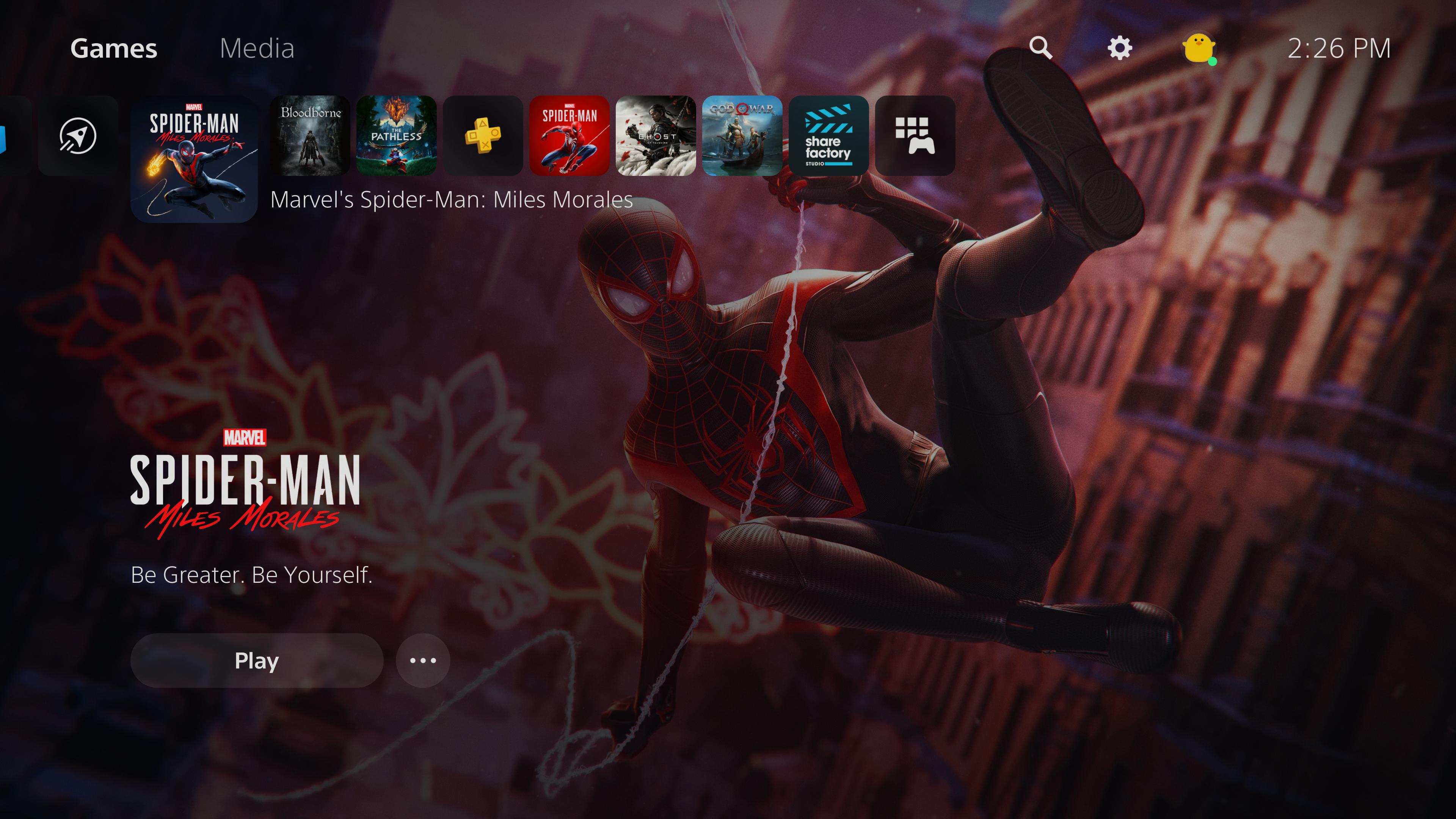
Screenshot of the PS5 menu.

As for the games side, it’s similar to the PS4 in that it’s a horizontal line that you click through, and when a game is highlighted it “takes over” the screen with a background, the latest news, achievements, and so on. As before it works perfectly well.

Previously, when you pressed the PlayStation button, you’d return to the main menu and pause whatever you were playing. If you held down the button, it opened an in-game side menu where you could invite friends, turn off the console, and other common tasks.

The PS5 reverses that: the long press now returns you to the home screen, while a short press brings up the in-game menu (now a row of tiny icons on the bottom of the screen — not a fan of this change).

The in-game menu now sports an in-depth “card” system that, while cool in theory, seems like one of those things that will not actually be used to great effect. The giant cards show recent screenshots and achievements, friend activity, and if the developer has enabled it, info about your current mission or game progress.

For instance, in Miles Morales, hitting pause told me I was 22% of the way through a side mission to rescue a bodega cat named Spider-Man, with an image of the bodega where I accepted it. Nice, but it’s redundant with the info presented in-game if I pause in the ordinary way. There’s more to it, though — the cards can also be used as “deep links” to game features like multiplayer, quests in progress, quick travel locations, even hints.
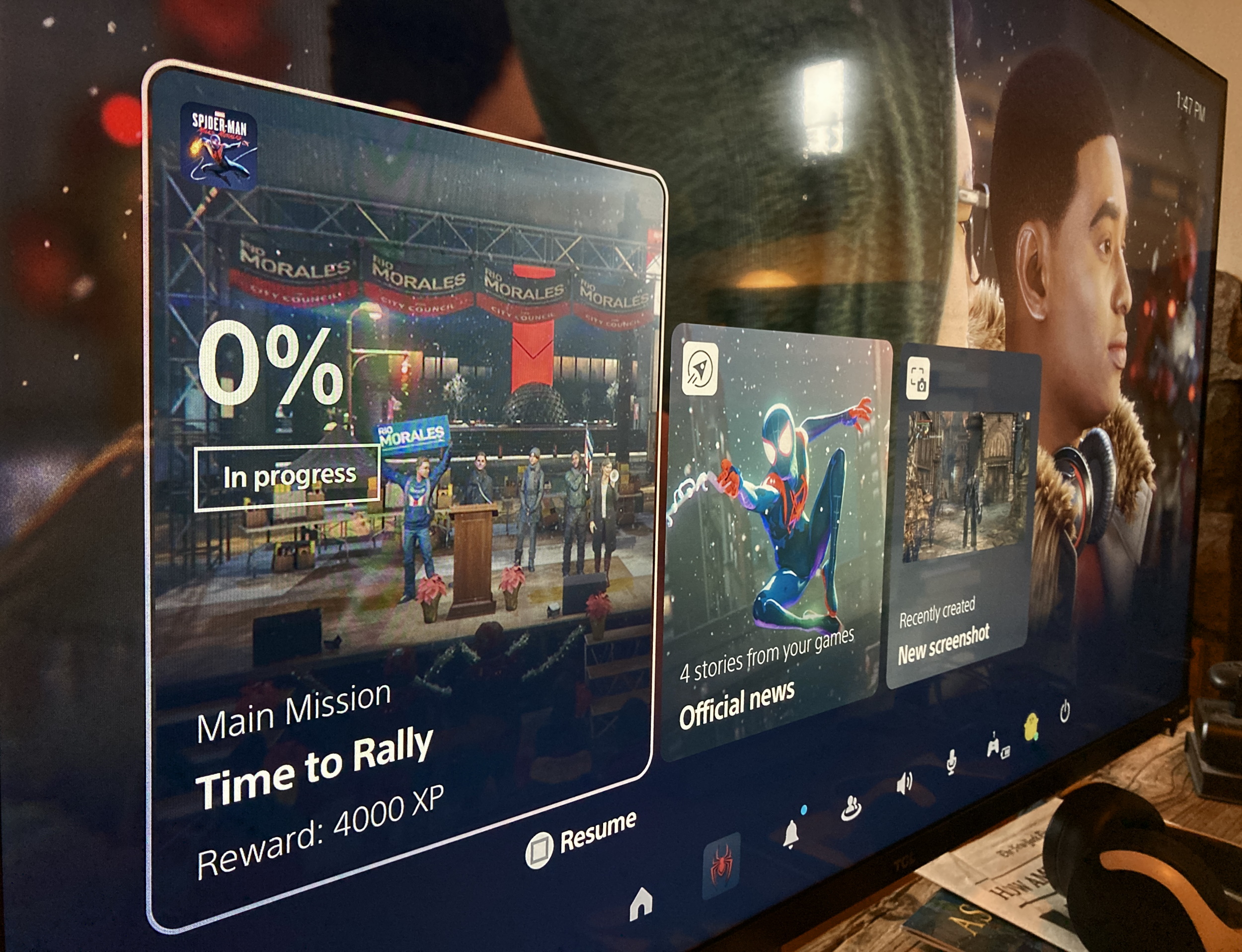
Sony showed these advanced possibilities off in a video of Sackboy: The Big Adventure, but since that game isn’t yet available I can’t yet speak to how well it works. More importantly, I can’t make any promises on behalf of developers, who may or may not integrate the system well. At the very least it could be nice, but I’m afraid it will be relegated to first-party games (of which Sony promises many) and be optional at that.

It’s hard to call the new UI an improvement over the old one — it’s different, in some ways more busy and in some ways streamlined. Where it may improve things is in reducing friction in things like organizing voice chat and joining friends’ games. But that capability wasn’t ready for launch.

A couple nice things I want to note: Setting up the PS5 to your own preferences is super easy. I downloaded my cloud saves in a minute or two, and there’s a great new settings page for things people often change in games: difficulty, language, inverting the camera, and some other things. There are also accessibility options built-in: a screen reader, chat transcription, and other goodies I wasn’t able to test but am glad to see.

The games: Well… the PS5 is the best PS4 you can buy

The chief reason for buying a new console is to play the new games on it. When the Switch came out, half the reason anyone bought it was to play the fabulous new Zelda. Sadly, the selection at this launch is laughably thin for both Sony and Microsoft fanboys.

As I noted above, the only game I was provided in time to get any real impressions (that I’m permitted to write about) was Spider-Man: Miles Morales. Having recently completed its predecessor on PS4, I can say that the new game looks and plays better, with shorter load times, improved lighting, more detailed buildings, and so on. But the 2018 Spider-Man still looks and plays very well — this is the difference you’d expect in a sequel, not from one generation to the next.
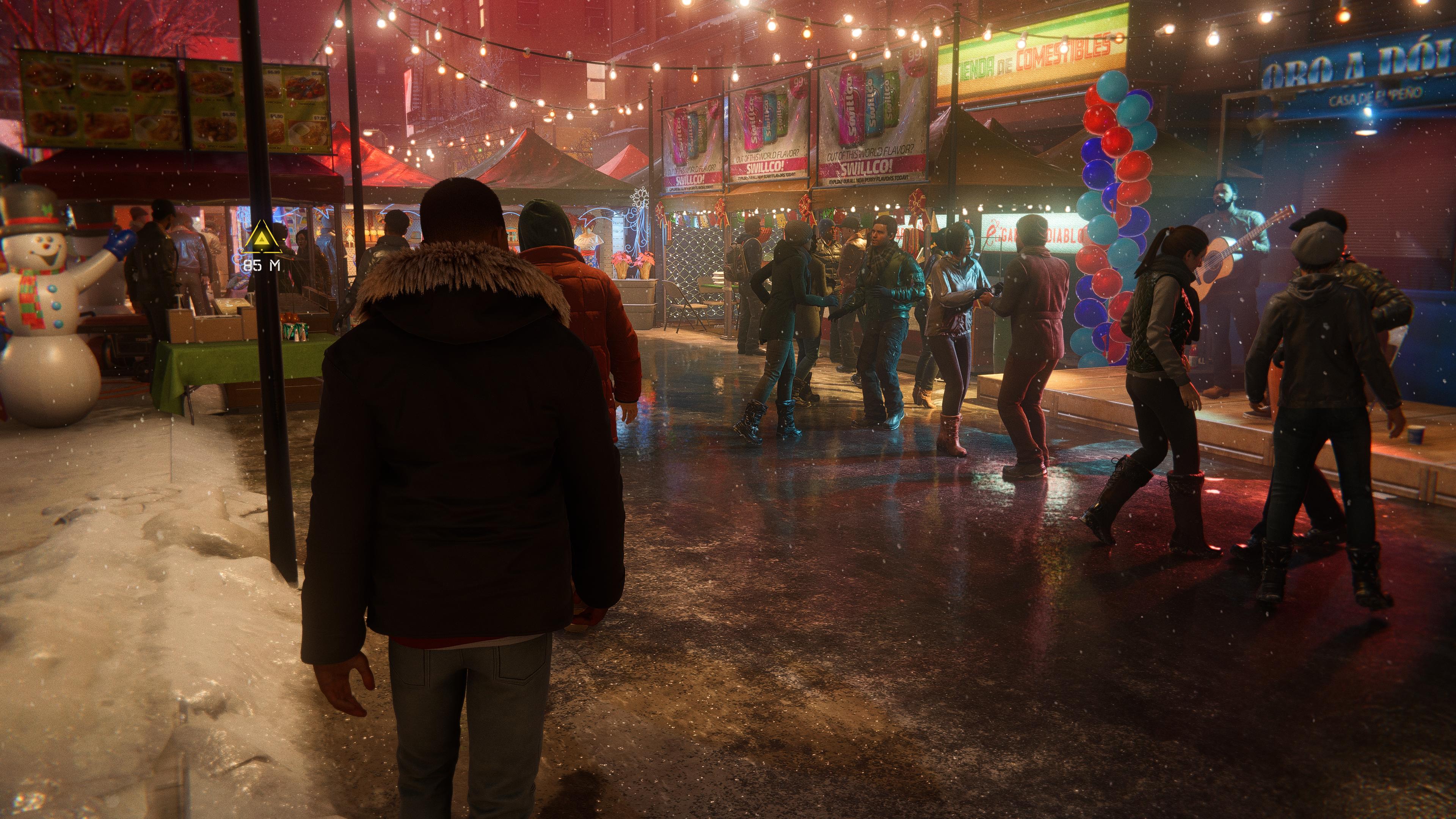
A screenshot of Spider-Man: Miles Morales on PS5As far as a review goes, I’ll just say that if you liked the first, you’ll like the second, and if you didn’t play the original, play it first because it’s great. I also want to hand it to the new game for its commitment to diversity.

But that will also be coming out on the PS4… and Xbox One and Series X… In fact, almost all the big games of the next year will be.

They will, of course, play and look better on the PS5 than the PS4. But it’s a hard sell to tell someone to pay $500 so they can play the next Assassin’s Creed or Horizon: Zero Dawn in 4K HDR rather than 1080p.

Meanwhile, the few games you can only play on PS5 are niche players. Sackboy looks to be a fun platformer but hardly a blockbuster; Demon’s Souls is my most anticipated title of the season, but a remake of a legendary but little-played and controller-bitingly difficult PS3 game isn’t going to break sales records; Destruction All-Stars, an online-only racing battle royale game, got delayed until February, which suggests it’s not playing well.

Adding them all up there really isn’t much reason in terms of exclusives to pick the PS5 over the Xbox Series X or, at least for 2021, a PS4 Pro.

The good news is that the PS5 is now without a question the best way to play the huge catalog of amazing PS4 games out there. Nearly all of them will look better, play better, and load faster. Sony as much as admitted this when they bundled a dozen of the best games from the last generation with the PS5. Honestly, I’m looking forward to finally playing God of War (I know… don’t hassle me!) on this thing than I am to Assassin’s Creed: Valhalla.

[gallery ids="2070471,2070472"]

Unfortunately I can’t speak to whether these PS4 games have much to speak of in terms of real improvements yet. As mentioned above, a lot of that depends on support from the developers. But as a simple test, loading the Central Yharnam area in Bloodborne took about 33 seconds on the PS4, and 16 on the PS5 (as you can see in the shots above, the game looks identical). I didn’t time them, but anecdotally other games showed improvements as well.

The verdict: The must-have console for the 2021 holidays

A PS5 console

Image Credits: Devin Coldewey / TechCrunch

No, that isn’t a typo. The PS5 (and I am joined in this opinion by our review of its rival, the Xbox Series X) simply isn’t a console anyone should rush out and purchase for any reason. Not least of which because it will be near-impossible to get one in the next month or so, making the possibility of unwrapping a PS5 a remote one for eager youths.

The power of the next generation is not much on display in any of the titles I have been able to play, and while a handful of upcoming games may show off its advantages, those games will likely play just as well on the other platforms they’re being released on.

Nor are there any compelling new features that make the PS5 feel truly next gen, with the possible exception of the variable resistance triggers (the Series X has multi-game suspension at least, and I’d jealous if there were any games to switch between). For the next 6-8 months, the PS5 will merely be the best way to play the same games everyone else is playing, or has been playing for years, but in 4K. That’s it!

The rush by Sony and Microsoft to get these consoles out by the holidays this year simply didn’t have the support of the publishers and developers that make the games that make consoles worth having. That will change late next year as the actual next-gen titles and meaningful exclusives start to appear. And a year from now the PS5 and Series X will truly be must-haves, because there will be things that are only available for them.

I’m not saying buy your kid a PS4 Pro for Christmas. And I’m not saying the PS5 isn’t a great way to play games. I’m just saying that outside some slight differences that many gamers don’t even have the setup to notice, there’s no reason to run out and buy a PS5 right now. Relax and enjoy the latest, greatest games on your old PS4 in confidence, knowing that you’ll save $50 when a Cyberpunk 2077 bundle goes on sale in the summer.

So don’t feel bad if you can’t lay your hands on a PS5 to keep you entertained this winter — a PS4 will do you just fine for the present while the next generation makes its lazy way towards the consoles it will eventually grace.


Read Full Article

Amazon to invest $2.8 billion to build its second data center region in India


Amazon will invest about $2.8 billion in Telangana to set up a new AWS Cloud region in the southern state of India, a top Indian politician announced on Friday.

The investment will allow Amazon to launch an AWS Cloud region in Hyderabad city by mid-2022, said K. T. Rama Rao, Minister for Information Technology, Electronics & Communications, Municipal Administration and Urban Development and Industries & Commerce Departments, Government of Telangana.

The new AWS Asia Region will be Amazon’s second infrastructure region in India, Amazon said in a press release. It did not disclose the size of the investment.

“The new AWS Asia Pacific (Hyderabad) Region will enable even more developers, startups, and enterprises as well as government, education, and non-profit organizations to run their applications and serve end users from data centers located in India,” the e-commerce giant said.

“Businesses in India are embracing cloud computing to reduce costs, increase agility, and enable rapid innovation to meet the needs of billions of customers in India and abroad,” said Peter DeSantis, Senior Vice President of Global Infrastructure and Customer Support, Amazon Web Services, in a statement. “Together with our AWS Asia Pacific (Mumbai) Region, we’re providing customers with more flexibility and choice, while allowing them to architect their infrastructure for even greater fault tolerance, resiliency, and availability across geographic locations.”

The investment illustrates the opportunities Amazon, which has poured over $6.5 billion in its India operations to date and leads the cloud market in the nation, sees in the world’s second largest internet market.

“This is a big win for the state government of Telangana for attracting this level of investment,” said Jayanth Kolla, chief analyst at consultancy firm Convergence Catalyst. He told TechCrunch that the move will also help Amazon better comply with India’s data localization policy. “We could see states launch their own similar laws in the future.”

AWS has courted several high-profile businesses as customers in recent years. Some of these include automobile giant Ashok Leyland, life insurance firm Aditya Birla Capital, edtech giant Byju’s, Axis Bank, Bajaj Capital, ClearTax, Dream11, Druva, Edelweiss, Edunext, Extramarks, Freshworks, HDFC Life, Mahindra Electric, Ola, Oyo, Policybazaar, Quantela, RBL Bank, redBus, Sharda University, Swiggy, Tata Sky, and Zerodha.

More to follow…


Read Full Article

PUBG Mobile plots return to India following ban


PUBG Mobile, the sleeper hit title that was banned in India two months ago over cybersecurity concerns, is plotting to make a return in the world’s second largest internet market, two sources familiar with the matter told TechCrunch.

The South Korean firm has engaged with global cloud service providers in recent weeks to store Indian users’ data within the country to allay New Delhi’s concerns about user data residency and security, one of the sources said.

The gaming giant has privately informed some high-profile streamers in the country that it expects to resume the service in India before the end of this year, the other source said. Both the sources requested anonymity as they are not authorized to speak to the press. PUBG Corporation did not respond to a request for comment Thursday.

The company could make an announcement about its future plans for India as soon as this week. It also plans to run a marketing campaign in the country during the festival of Diwali next week, one of the sources said.

In recent weeks, PUBG has also engaged with a number of local firms including SoftBank-backed Paytm and telecom giant Airtel to explore whether they would be interested in publishing the popular mobile game in the country, an industry executive said. A Paytm spokesperson declined to comment.

Chinese giant Tencent initially published PUBG Mobile apps in India. After New Delhi banned PUBG Mobile, the gaming firm cut publishing ties with Tencent in the country.

Late last month, two months after the ban order, PUBG Mobile terminated its service for Indian users. “Protecting user data has always been a top priority and we have always complied with applicable data protection laws and regulations in India. All users’ gameplay information is processed in a transparent manner as disclosed in our privacy policy,” it said at the time.

With more than 50 million monthly active users in India, PUBG Mobile was by far the most popular mobile game in the country before it was banned. It helped establish an entire ecosystem of  esports organisations to teams and even a cottage industry of streamers that made the most of its spectator sport-friendly gameplay, said Rishi Alwani, a long-time analyst of Indian gaming market and publisher of news outlet The Mako Reactor.

PUBG Mobile’s return, however, could complicate matters for several industry players, including some that are currently building similar games to cash in on its absence and their conversations with venture capital firms over ongoing financing rounds.

It would also suggest that more than 200 other Chinese apps that India has banned in recent months could hope to allay New Delhi’s concerns by making some changes to where they store their users data. (That was also the understanding between TikTok and Reliance when they engaged in investment opportunities earlier this year.)


Read Full Article

Steve Bannon’s show pulled off Twitter and YouTube over calls for violence


Former Presidential advisor and right-wing pundit Steve Bannon had his show suspended from Twitter and an episode removed by YouTube after calling for violence against FBI director Christopher Wray and the government’s leading pandemic expert, Dr. Anthony Fauci.

Bannon, speaking with co-host Jack Maxey, was discussing what Trump should do in a hypothetical second term. He suggested firing Wray and Fauci, but then went further, saying “I’d actually like to go back to the old times of Tudor England, I’d put the heads on pikes, right, I’d put them at the two corners of the White House as a warning to federal bureaucrats.”

This may strike one at first as mere hyperbole – one may say “we want his head on a platter” and not really be suggesting they actually behead anyone. But the conversation continued and seemed to be more in earnest than it first appeared:

Maxey: Just yesterday there was the anniversary of the hanging of two Tories in Philadelphia. These were Quaker businessmen who had cohabitated, if you wil,l with the British while they were occupying Philadelphia. These people were hung. This is what we used to do to traitors.

Bannon: That’s how you won the revolution. No one wants to talk about it. The revolution wasn’t some sort of garden party, right? It was a civil war. It was a civil war.

Whether one considers this only nostalgia for the good old days of mob justice or an actual call to bring those days back, the exchange seems to have been enough for moderators at YouTube and Twitter to come down hard on the pair’s makeshift broadcast.

Twitter confirmed that it has “permanently suspended” (i.e. it can be appealed but won’t be restored automatically) the account for violating the rule against glorifying violence.

YouTube removed the episode from “Steve Bannon’s War Room” channel Wednesday afternoon after it was brought to their attention. A representative for the platform said “We’ve removed this video for violating our policy against inciting violence. We will continue to be vigilant as we enforce our policies in the post-election period.”

Online platforms have struggled with finding the line between under- and over-moderation. Facebook, Twitter, YouTube, Tiktok, Instagram and others have all taken different measures, from preemptively turning off features to silently banning hashtags. Facebook today took down a group with more than 300,000 members that was acting as an amplifier for misinformation about the election.

While the platforms have been vigorous in at least some ways in the labeling and isolation of misinformation, it’s more difficult for video platforms. Just minutes ago Trump took to YouTube to detail a variety of unfounded conspiracy theories about mail-in voting, but the platform can’t exactly do a live fact-check of the President and shut down his channel. More than with text-based networks, video tends to spread before it is caught and flagged due to the time it takes to review it.


Read Full Article

Facebook takes down ‘Stop the Steal 2020’ group organizing around false claims of election chicanery


Facebook has taken down a group that had amassed more than 300,000 members and was sharing misinformation and organizing around false allegations of impropriety during the 2020 elections.

The group, called “Stop the Steal 2020,” was organizing protests targeting the election officials currently counting ballots cast in Michigan, Pennsylvania, Phoenix and Las Vegas.

“In line with the exceptional measures that we are taking during this period of heightened tension, we have removed the Group ‘Stop the Steal,’ which was creating real-world events,” said a Facebook spokesperson in a statement emailed to TechCrunch. “The group was organized around the delegitimization of the election process, and we saw worrying calls for violence from some members of the group.”

Facebook’s action was first noticed by Ryan Mac of BuzzFeed, who reported the move in a tweet.

Protestors advocating for votes to be counted and for vote counting to cease are cropping up across the country as Republican Party organizers and campaign officials try to derail the count of mail-in ballots and absentee votes cast in the 2020 race and Democratic supporters organize counter-protests.

Social media election takedowns

While the organizers may be tapping supporters of President Trump across the country, their messaging is different depending on the state.

In Phoenix, protestors are calling for all votes to be counted, as presidential candidate and former Vice President Joe Biden hangs on to a slim lead in Arizona.

Meanwhile, the messaging is the opposite in Georgia, Michigan, Pennsylvania and Nevada, where President Donald Trump is trying to preserve the slim margins that have him ahead or reverse the counts that had put him behind in the polls. In Detroit, for instance, Trump supporters held up signs that said “stop the steal” and “stop the cheat” according to news reports.

Conservative advocates across the Twittersphere have had their tweets amended by the company to indicate that they were sharing election misinformation.

Facebook has also added “labels” to election posts that break the rules, though they are designed to mostly point users to contextual, factual information rather than to offer explicit warnings about false claims.

In fact, as a direct response to Trump’s premature claims of victory, Facebook also rolled out an eye-catching set of messages across Facebook and Instagram reminding users that votes were still being counted.

Facebook has also instituted changes to its policies about groups that organize real-world events in the wake of 2016’s election disinformation campaign carried out by Russian agents and the recent shooting in Kenosha, Wisconsin in which two men were killed after a local self-declared militia group organized a response to protests against the shooting of Kenosha resident, Jacob Blake.


Read Full Article

TikTok’s parent company, ByteDance, is reportedly looking for $2B before its Hong Kong public offering


ByteDance, the company behind the social media sensation TikTok, is in talks to raise another $2 billion before the initial public offering of a large chunk of its international businesses on the Hong Kong StockExchange, according to a Bloomberg report.

The new financing would give the Chinese tech powerhouse a valuation of $180 billion, according to people cited by Bloomberg.

Investors, including ByteDance’s existing backers like Sequoia, are in the running to finance the new investment, the Bloomberg report said.

Sequoia had emerged as one of the drivers behind a now-stalled deal touted by the Trump administration to have Oracle take some sort of control over the American operations of ByteDance’s most valuable international asset — TikTok.

Both Sequoia and Oracle have significant ties to President Trump through Republican mega-donors Doug Leone, a managing partner at Sequoia, and Safra Catz and Larry Ellison, Oracle’s top leadership and founder.

ByteDance has long planned a public offering for some of its largest Asian assets Douyin and Toutiao, which are huge drivers for the company’s revenues.

TechCrunch previously reported that ByteDance last year generated 120 billion yuan ($17.2 billion) in revenue, citing an investor with knowledge of the company’s finances. Around 67% of that revenue was derived from ads sold on its domestic apps Douyin, TikTok’s Chinese version, and popular news aggregator Toutiao. Live streaming targeted at users of Douyin and another app in the family made up about 17%. Nascent businesses, including games, e-commerce and TikTok, accounted for 20 billion yuan, or roughly another 17%.

The company projected its 2020 revenue at 200 billion yuan ($28.7 billion), with TikTok and other emerging businesses contributing 30 billion yuan, or 15%, according to the investor. Previous reports by Reuters and Bloomberg cited similar revenue figures.

ByteDance is already the most valuable privately held, venture-backed technology company in the world, but at least some of that value is tied up in the revenue-generating potential of the company’s TikTok assets. And it appears that any new investment (at the valuations being reported) would be an indication that investors are shrugging off previous concerns about how a TikTok spin-off might affect the company.

Much of what happens next will hinge on the presidential elections in the U.S. and various court battles that remain underway. A Biden administration could scuttle the planned deal between TikTok, Oracle and Walmart — and a timeline for a separate TikTok public offering within the U.S.

There’s also internal confusion among the TikTok deal’s participants over who will own what when the dust finally settles and a deal moves forward.

As we reported in September:

… our assumption, that Oracle is taking 12.5% in TikTok Global, and Walmart will take 7.5%. The deal terms would value TikTok at about $60 billion by some estimates.

That’s a simple story, but apparently not the full one, because now there is another wrinkle happening here.

In a new statement attributed to its executive vice president Ken Glueck, Oracle said that “Upon creation of TikTok Global, Oracle/Walmart will make their investment and the TikTok Global shares will be distributed to their owners, Americans will be the majority and ByteDance will have no ownership in TikTok Global.”

President Donald Trump has spoken out about the deal himself in places like CNBC, arguing that TikTok must be completely controlled by Americans.

The U.S. government’s trouble with TikTok stems from a few different sources. For one, users on the platform managed to troll a deeply vindictive president and turn one of his planned marquee campaign events into a farce. And more importantly to the nation, but apparently less so to the administration, the company’s ties to China could expose U.S. citizens’ data to the CCP and its users to the potential for manipulation through TikTok’s decisions on what to post or not post on the app.

Sequoia and ByteDance had not responded to a request for comment at the time of publication.


Read Full Article

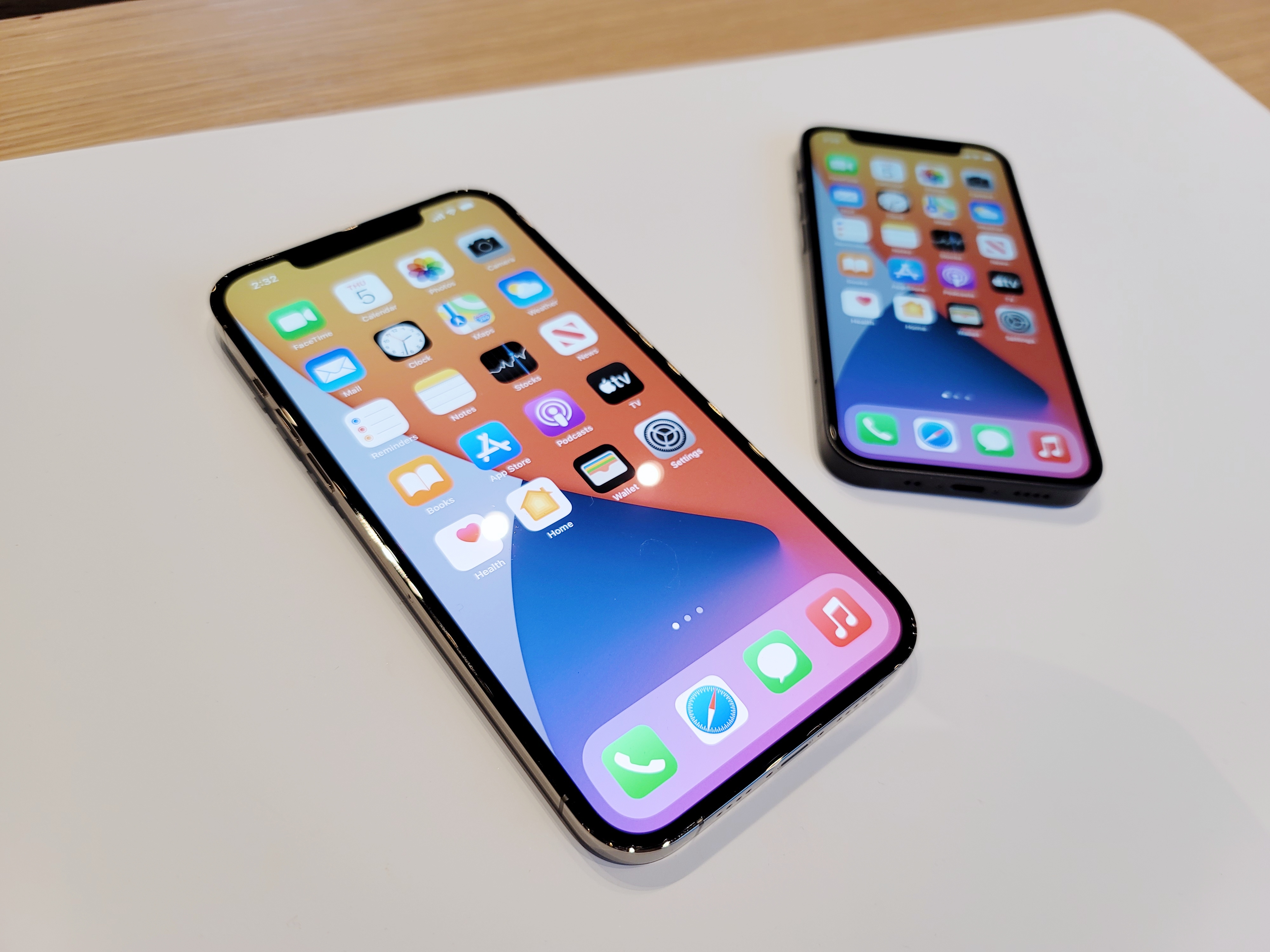
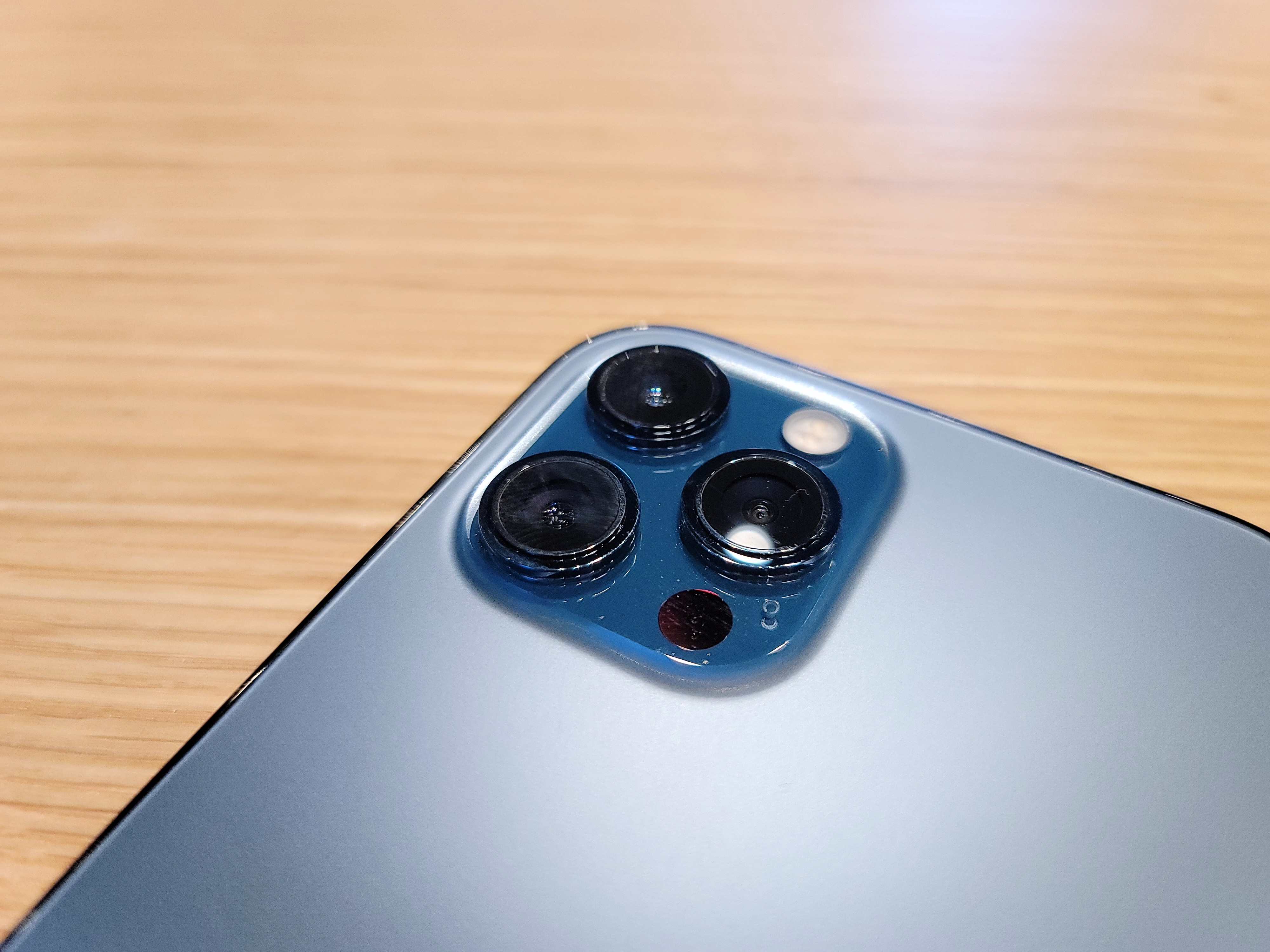
A better look at Apple’s iPhone 12 Pro Max and iPhone Mini


The various iterations of the new iPhone were announced 800 million years ago. Actually, wait, I just double checked — it was only about two or so weeks ago, but it turns out that time has no meaning anymore. Another cursory glance at my calendar tells me that, while the iPhone 12 and iPhone 12 Pro were released in late-October, not long after being announced, the iPhone 12 Pro Max and iPhone Mini, meanwhile, won’t be available for sale for another week or so.

You can check out Matthew’s substantial review of those middle of the line devices here. And while we wait for the low and high end of the line to arrive, I spent a little time with the devices and snapped a couple of photos with the products, which you can check out below.

Image Credits: Brian Heater

Again, we can talk more in-depth write-ups at some point in the future, likely, but for now a smattering of thoughts and images. Consider this a kind of make up for the sorts of hands-ons with products we used to do at Apple’s in-person events, back in the before times, when Apple had in-person events.

All of the four sizes were present and accounted for. As someone who’s been testing a fair number of large Android devices in recent months, the 6.7-inch Pro Max doesn’t appear exceptionally large. As you can see in that top photo, however, the difference between it and the Mini is pretty pronounced.

Image Credits: Brian Heater

It’s amazing how quickly our perceptions of screen sizes have shifted over the years, that a handset sporting a screen two inches larger than the original iPhone is now considered “mini” by a fairly considerable margin. Heck, even the 6-inch Pixel 5 I’ve been using off and on feels pretty small by today’s standards.

The standard iPhone 12 and 12 Pro’s 6.1-inch display seem like a pretty good sweet spot for many or most users. Many of the key specs are surprisingly consistent, given the $400 price difference between the high and low end. All sport 5G connectivity, the new magnetic MagSafe connector, OLED displays and an A14 chip.

[gallery ids="2070393,2070392,2070391,2070390,2070389,2070388,2070387,2070386,2070385,2070384,2070383,2070382"]

Beyond size, storage and battery capacity, the big differentiator are the cameras. No huge surprise there, as that continues to be where most smartphone manufacturers are making their biggest strides. Here’s a chart we made to break down those distinctions:

The iPhone 12 Pro Max and iPhone 12 Mini hit retail November 13.


Read Full Article

TikTok takes down some hashtags related to election misinformation, leaves others


As social media platforms struggle to get U.S. election misinformation under control with varying degrees of success, TikTok has taken new actions to stop people from searching and browsing select hashtags associated with misinformation and conspiracies related to the U.S. election results.

The video app has redirected some hashtags — including #RiggedElection, #SharpieGate and others — where users have been publishing election misinformation. And it has taken down various videos making claims of “election fraud.

However, based on our scans of the app and other election-related hashtags today, it’s clear that it’s still an uphill battle for TikTok in terms of getting a handle on violating content.

Because of TikTok’s size and scale, even smaller videos from unknown publishers can rack up thousands of views before they disappear.

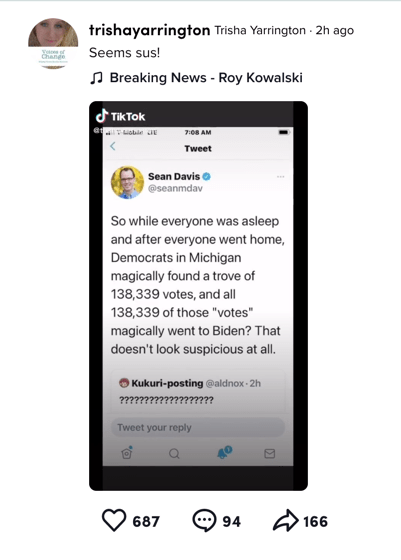
Media Matters, for example, reported yesterday it was able to identify 11 examples of election misinformation spreading across TikTok, with more than 200,000 combined views. The videos shared conspiracies that ranged from unfounded “magic ballot” narratives to the completely untrue allegations that Arizona poll workers handed out markers to Trump voters so their votes wouldn’t count.

Image Credits: TikTok screenshot via Media Matters

TikTok says all the videos Media Matters reported have since been removed except one where a user made a premature declaration of victory. That one was shadowbanned — meaning its discoverability on the platform was reduced. It also has a banner pointing to authoritative information about the election results.

These individual takedowns are a drop in the bucket compared to the number of videos that are still out there making claims of election fraud. And, so far, TikTok has only removed a small number of hashtags on this subject.

Image Credits: TikTok screenshot via TechCrunch

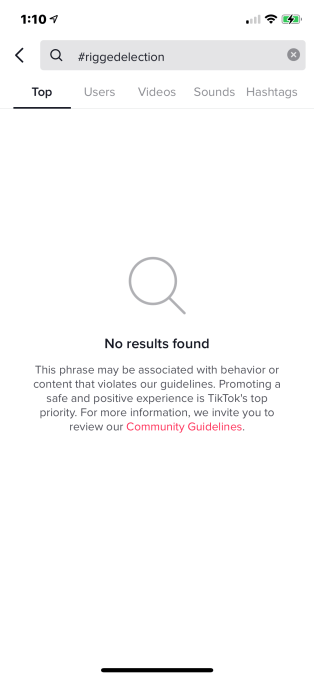
TikTok confirmed it has removed content and redirected searches for the hashtag #RiggedElection as of yesterday. Now, when you try to find videos flagged with this term in the app, you’ll get to a blank page with a notification that says the search term “may be associated with behavior or content that violates our guidelines.” The page also provides a link to TikTok’s Community Guidelines.

“Promoting a safe and positive experience is TikTok’s top priority,” the message reads.

This is the same playbook that TikTok recently used to address the spread of QAnon-related content on its platform. By redirecting searches and hashtags, it makes misinformation harder to find.

While TikTok declined to share an exhaustive list of hashtags it has taken action on during the elections, we found a few hashtags that returned either no results — like #RiggedElection and #SharpieGate — as well as those that returned only a small handful videos, or what TikTok considers “counter speech.”

The TikTok community will often create videos with counter speech or other content related to a misinformation-related hashtag. In these videos, they’ll provide factual information or will dispute the claims being made in another video. TikTok says this sort of counter speech doesn’t violate its policies. That’s why you may see videos listed under hashtags that would otherwise be associated with misinformation, as opposed to seeing the hashtag entirely silenced.

We also found some lesser-used hashtags like #RepealtheSteal and #VeritasArmy, which have been seen on Twitter, were not showing on TikTok at all. (However, upon reaching out to TikTok, the company chose to redirect these hashtags, too.)

A popular misinfo hashtag, #StoptheSteal, was also not available, but its variation, #StoptheStealing, had seven videos.

Many other hashtags were being used, too, as of the time of writing, including #VoterFraud (and its misspelling #VoterFruad), #DemsCheat, #CorruptElection, #ElectionCorruption, #StoptheStealing, #ElectionFraud (and misspelling #ElectionFruad), #CrookedJoeBiden, #CrookedDems, #Fraud (and its misspelling #Fruad), #Rigged, #Rigged2020, #MailinBallots, #CoupdEtat, #ElectionMeddling, #DemocratsAreDestroyingAmerica and #BallotHarvesting, to name a few.

While some hashtags had little content, many were filled with videos that weren’t just expressing their political views — they were making claims of election fraud. Combined, these hashtags have tens of millions of views, or even more.

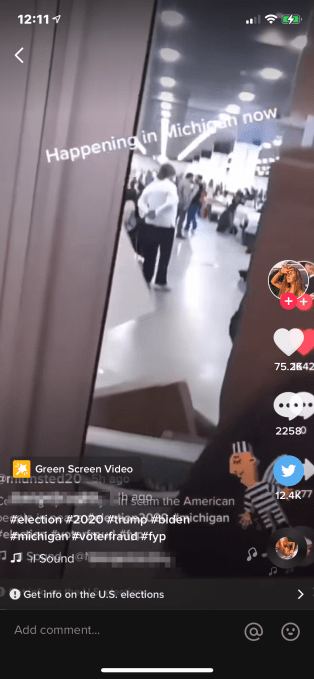
Image Credits: TikTok screenshot, video republished previously removed content; screenshot via TechCrunch

For example, when we searched for the hashtag #VoterFraud (20.9 million views), we first encountered videos posted in the months leading up to Election Day that were responding to the Republican-driven claims of voter fraud associated with mail-in ballots.

But many videos under this hashtag have been published by Trump supporters this week, and are videos where the supporters are directly disputing the election results.

Among the videos we found were those reposting videos TikTok had already taken down. These included videos featuring Trump supporters’ protests against or for the counting of ballots in various states, calling them proof of election fraud.

In other videos, users opine about how Trump’s lawsuits will prove fraud took place and win him re-election. They sometimes use screenshots of website vote tallies as their “proof.”

Image Credits: TikTok app screenshot via TechCrunch

We also saw videos using text labels overtop their video footage. The text was used to make their claims of election fraud, while the video itself may have them talking in more measured terms about their disappointment with the election results. (It’s unclear if this is a viable workaround to avoiding rule enforcement, however.)

TikTok says its list of blocked hashtags continually grows as new terms and phrases emerge and it’s able to determine how the terms are being used on its platform. It also said it block more election misinformation hashtags in the hours, days and weeks to come.

To be clear, TikTok’s decision to keep this sort of content online doesn’t make it much different from other social networks.

During election season, Facebook and Twitter have taken to labeling election misinformation from high-profile accounts (like Trump’s). Facebook even ran in-app notifications to inform users that votes are still being counted. But both platforms today still easily allow users to click through on a wide range of hashtags that promote this idea of election fraud or rigged results.

TikTok may not much be doing much better, overall, in addressing the sizable amount of content promoting election misinformation on its video network. But TikTok’s ban of top election misinformation hashtags works differently from hashtag bans on other social networks.

Once TikTok has made the decision to ban a term like “SharpieGate,” for example, the content won’t be surfaced whether you use the hashtag symbol (#) itself or not. Facebook, on the other hand, may ban the hashtag specifically, but not the term entirely. That means you can still find content about SharpieGate on its platform — even if it’s largely posts and videos from news organizations.

#SharpieGate was also among the hashtags Facebook began blocking today related to election misinformation. It also blocked #StoptheSteal and a related group.


Read Full Article