11 October 2020

The case for stubborn optimism on climate | Christiana Figueres

The case for stubborn optimism on climate | Christiana Figueres

"This decade is a moment of choice unlike any we have ever lived," says Christiana Figueres, the architect of the historic 2015 Paris Agreement. The daughter of Costa Rica's beloved President José Figueres Ferrer, she shares how her father's unwillingness to lose the country he loved taught her how stubborn optimism can catalyze action and change. With an unshakeable determination to fight for the generations that will come after us, Figueres describes what stubborn optimism is (and isn't) -- and urges everyone to envision and work for the future they want for humanity.

https://ift.tt/34JVnS3

Click this link to view the TED Talk

10 October 2020

The race to a zero-emission world starts now | António Guterres

The race to a zero-emission world starts now | António Guterres

"If we don't act now on climate change, this coming century may be one of humanity's last," says António Guterres, Secretary-General of the United Nations. As the world recovers from the COVID-19 pandemic, Guterres urges us to use this moment to rebuild with ambitious climate action in mind -- and lays out a blueprint for getting companies, governments and countries to reach net-zero carbon emissions by 2050. "We can only win the race to zero together," he says. "I urge you all to get on board."

https://ift.tt/2GR79ll

Click this link to view the TED Talk

Cities are driving climate change. Here's how they can fix it. | Angel Hsu

Cities are driving climate change. Here's how they can fix it. | Angel Hsu

Cities pump out 70 percent of all global carbon emissions -- which means they also have the greatest opportunity to lower CO2 levels and energy consumption. Climate and data scientist Angel Hsu shares how cities around the world are leading the response to climate change by innovating new, low-carbon ways of living.

https://ift.tt/3jOeSiN

Click this link to view the TED Talk

10 years to transform the future of humanity -- or destabilize the planet | Johan Rockström

10 years to transform the future of humanity -- or destabilize the planet | Johan Rockström

"For the first time, we are forced to consider the real risk of destabilizing the entire planet," says climate impact scholar Johan Rockström. In a talk backed by vivid animations of the climate crisis, he shows how nine out of the 15 big biophysical systems that regulate the climate -- from the permafrost of Siberia to the great forests of the North to the Amazon rainforest -- are at risk of reaching tipping points, which could make Earth uninhabitable for humanity. Hear his plan for putting the planet back on the path of sustainability over the next 10 years -- and protecting the future of our children.

https://ift.tt/3iMGGCR

Click this link to view the TED Talk

Presently making an online model is simple with the best device


A site model can be any model or demo of what a site will resemble when it goes live. It very well may be anything from a paper sketch to an interactive HTML model. Be that as it may, normally when individuals talk about a model they are alluding to an intuitive model or some […]

The post Presently making an online model is simple with the best device appeared first on ALL TECH BUZZ.


6 Ways Why Online Reviews are Favorable for Your Business


Image source The world has transformed from actual store buying and window shopping to online browsing and purchasing through fleeting time. As time changes, the customer’s writing reviews method has also shifted from paper and pen to keyboard to screen their mobile devices. The trend of online reviews to businesses inflict great importance. It lures […]

The post 6 Ways Why Online Reviews are Favorable for Your Business appeared first on ALL TECH BUZZ.


Facebook and Instagram will pin vote-by-mail explainers to top of feeds


Starting this weekend, everyone of voting age in the U.S. will begin seeing informational videos at the top of Instagram and Facebook, offering tips and state-specific guidance on how to vote through the mail. The videos will be offered in both English and Spanish.

The vote-by-mail videos will run on Facebook for four straight days in each state, starting between October 10 and October 18 depending on local registration deadlines. On Instagram, the videos will run in all 50 states on October 15 and October 16, followed by other notifications with vote-by-mail information over the next two days.

Facebook vote-by-mail video

Image via Facebook

Facebook vote-by-mail video

Image via Facebook

The videos let voters know when they can return a ballot in person, instruct them to sign carefully on additional envelopes that might be required and encourage returning ballots as soon as possible while being mindful of postmarking deadlines. Facebook will continue providing additional state-specific voting information in a voting information center dedicated to the 2020 election.

Even more than in past years, app makers have taken up the mantle of nudging their users to vote in the U.S. general election. From Snapchat to Credit Karma, it’s hard to open an app without being reminded to register — and that’s a good thing. Snapchat says it registered around 400,000 new voters through its own reminders and Facebook estimates that it helped 2.5 million people register to vote this year.

Voting rights advocates are concerned that 2020’s rapid scale-up of vote-by-mail might lead to many ballots being thrown out — a worry foreshadowed by the half a million ballots that were tossed out in state primaries. Some of those ballots failed to meet deadlines or were deemed invalid due to other mistakes voters made when filling them out.

In Florida, voters that were young, non-white or voting for the first time were twice as likely to have their ballots thrown out compared to white voters in the 2018 election, according to research by the ACLU.

Adding to concerns, state rules vary and they can be specific and confusing for voters new to voting through the mail. In Pennsylvania, the most likely state to decide the results of the 2020 election, new rules against “naked ballots” mean that any ballot not cast in an additional secrecy sleeve will be tossed out. In other states, secrecy sleeves have long been optional.

Facebook gets ready for November

Since 2016, Facebook has faced widespread criticism for rewarding hyper-partisan content, amplifying misinformation and incubating violent extremism. This week, the FBI revealed a plot to kidnap Michigan Governor Gretchen Whitmer that was hatched by militia groups who used the platform to organize.

Whether the public reveal of that months-long domestic terrorism investigation factored into its decisions or not, Facebook has taken a notably more aggressive posture across a handful of recent policy decisions. This week, the company expanded its ban on QAnon, the elaborate web of outlandish pro-Trump conspiracies that have increasingly spilled over into real-world violence, after that content had been allowed to thrive on the platform for years.

Facebook also just broadened its rules prohibiting voter intimidation to ban calls for poll watching that use militaristic language, like the Trump campaign’s own effort to recruit an “Army for Trump” to hold its political enemies to account on election day. The company also announced that it would suspend political advertising after election night, a policy that will likely remain in place until the results of the election are clear.

While President Trump has gone to great lengths to cast doubt on the integrity of vote-by-mail, mailed ballots are a historically very safe practice. States like Oregon and Colorado already conduct their voting through the mail in normal years, and all 50 states have absentee voting in place for people who can’t cast a ballot in person, whether they’re out of town or overseas serving in the military.


Read Full Article

Prediction


Prediction

Changing how retweets work, Twitter seeks to slow down election misinformation


Twitter announced Friday a major set of changes to the way its platform would work as the social network braces for the most contentious, uncertain and potentially high-stakes election in modern U.S. history.

In what will likely be the most noticeable change, Twitter will try a new tactic to discourage users from retweeting posts without adding their own commentary. Starting on October 20 in a “global” change, the platform will prompt anyone who goes to retweet something to share a quote tweet instead. The change will stay in place through the “end of election week,” when Twitter will decide if the change needs to stick around for longer.

Gif via Twitter

“Though this adds some extra friction for those who simply want to Retweet, we hope it will encourage everyone to not only consider why they are amplifying a Tweet, but also increase the likelihood that people add their own thoughts, reactions and perspectives to the conversation,” Twitter said of the change, which some users may see on Twitter for the web starting on Friday.

Twitter has in recent months been experimenting with changes that add friction to the platform. Last month, the company announced that it would roll out a test feature prompting users to click through a link before retweeting it to the platform at large. The change marks a major shift in thinking for social platforms, which grew aggressively by prioritizing engagement above all other measures.

The company also clarified its policy on election results, and now a candidate for office “may not claim an election win before it is authoritatively called.” Twitter will look to state election officials or projected results from at least two national news sources to make that determination.

Twitter stopped short of saying it will remove those posts, but said that it will add to any content claiming premature victory a misleading information label pointing users toward its hub for vetted election information. The company does plan to remove any tweets “meant to incite interference with the election process or with the implementation of election results,” including ones that incite violence.

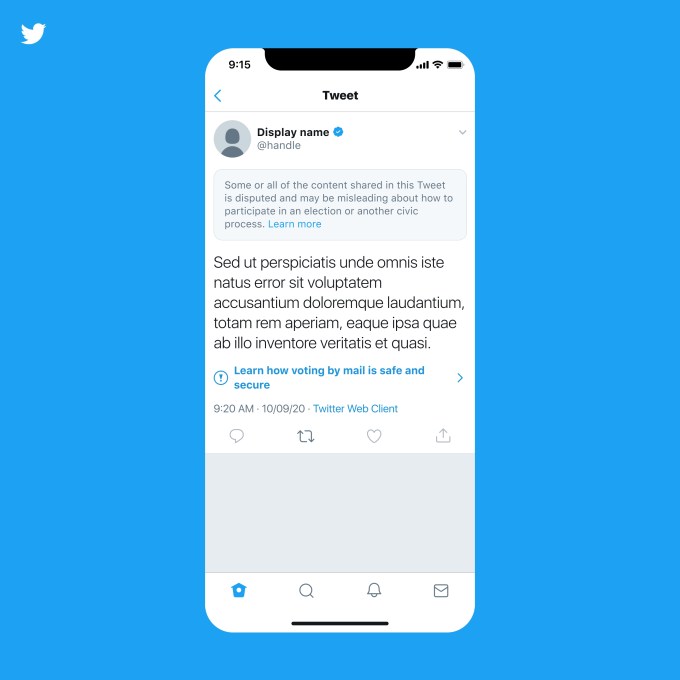
Next week, Twitter will also implement new restrictions on misleading tweets it labels, showing users a pop-up prompt linking to credible information when they go to view the tweet. Twitter applies these labels to tweets that spread misinformation about COVID-19, elections and voting, and anything that contains manipulated media, like deepfakes or otherwise misleading edited videos.

The company will also take additional measures against misleading tweets that get a label when they’re from a U.S. political figure, candidate or campaign. To see a tweet with one of its labels, a user will have to tap through a warning. Labeled tweets will have likes, normal retweets and replies disabled.

These new measures will also apply to labeled tweets from anyone with more than 100,000 followers or tweets that are getting viral traction. “We expect this will further reduce the visibility of misleading information, and will encourage people to reconsider if they want to amplify these Tweets,” Twitter said in its announcement.

Twitter warning on labeled tweet

Image via Twitter

Twitter will also turn off recommendations in the timeline in an effort to “slow down” how fast tweets can reach people from accounts they don’t follow. The company calls the decision a “worthwhile sacrifice to encourage more thoughtful and explicit amplification.” The company will also only allow trending content that comes with additional context to show up in the “for you” recommendation tab in an effort to slow the spread of misinformation.

The company acknowledges that it plays a “critical role” in protecting the U.S. election, adding that it had staffed up dedicated teams to monitoring the platform and “respond rapidly” on election night and in the potentially uncertain period of time until authoritative election results are clear.


Read Full Article

New Chinese browser offers a glimpse beyond the Great Firewall – with caveats


China now has a tool that lets users access YouTube, Facebook, Twitter, Instagram, Google, and other internet services that have otherwise long been banned in the country.

Called Tuber, the mobile browser recently debuted on China’s third-party Android stores, with an iOS launch in the pipeline. The landing page of the app features a scrolling feed of YouTube videos, with tabs at the bottom that allow users to visit other mainstream Western internet services.

While some celebrate the app as an unprecedented “opening up” of the Chinese internet, others quickly noticed the browser comes with a veil of censorship. YouTube queries for politically sensitive keywords such as “Tiananmen” and “Xi Jinping” returned no results on the app, according to tests done by TechCrunch.

Using the app also comes with liabilities. Registration requires a Chinese phone number, which is tied to a person’s real identity. The platform could suspend users’ accounts and share their data “with the relevant authorities” if they “actively watch or share” content that breaches the constitution, endangers national security and sovereignty, spreads rumors, disrupts social orders, or violates other local laws, according to the app’s terms of service.

Rather than blocking sites that are beyond the purview of Beijing and tracking individuals using VPNs to circumvent the Great Firewall, China now has an app that gives its people a glimpse into the Western internet — with the caveat that their digital footprint may be under close watch by the authorities.

Much about the app remains unclear, such as its origin and the motive behind it. The operator of the app’s official website (上海丰炫信息技术有限公司) is 70% owned by a subsidiary of Qihoo 360, a Chinese cybersecurity software giant. It remains to be seen whether the app will take off.

This is an updating story.


Read Full Article

Odell Beckham Jr. turned to Mojichat’s advertising features during his inaugural live-stream


Mojiit, the Los Angeles-based company behind the popular avatar generation service Mojichat, has landed one of its highest-profile users with the launch of Odell Beckham Jr.’s live stream over the weekend.

As Odell Beckham Jr. did his first live stream with the gaming superstar Dr. Disrespect, he turned to Mojichat to create the pop-up onscreen emote that danced above a logo from Scuf Gaming, a retailer of customized controllers.

Customized, branded emotes are one of the ways that companies are trying to make it easier for live-streamers to make money off of their shows. Companies like Mochjichat argue that it’s a more elegant solution for gamers to use, because it doesn’t take viewers away from the live stream, where they could potentially miss some of the action.

Typically, streamers rely on advertising revenue from pre-roll, mid-roll and post-roll advertising, according to Mojichat co-founder Jeremy Greene. Alongside his wife, Janelle, Greene built Mojichat into one of the premier names in avatar development. As competitors crowded in, the company has been diversifying its products to allow for influencers to begin using their digital avatars as a monetization source.

“No streamer… wants to run a pre-roll,” said Greene. “The first thing about Mojichat that made us very successful from the very beginning, you have to hunt down someone to make your custom emotes for you.”

Earlier this year, the company partnered with DoorDash on a similar activation for a concert to raise money for the Boys and Girls Club as part of a broad celebrity effort to raise money to alleviate food insecurity for families affected by the COVID-19 outbreak.

“Any time someone sends a communication, that will trigger an alert that floats as a Mojichat animation on top of the screen,” Greene said of the earlier activation. 

The way that Greene describes the service — and Janelle and his larger vision for the company — is to be the next generation of adserver for the live-streaming market.

“My plan is to become the avatar solution for all of Unity,” Greene told me earlier. “We will offer up our platform to every single gaming platform or mobile developer to plug and play… I would consider us… we’re like the Google Admob for live stream.”

Companies like Streamlabs are integrating Mojichat’s features into their streaming offerings. and the work with Dr. Disrespect and Odell Beckham Jr. show just how much demand there is for these types of offerings.

“The avatar space is going to be won in the gaming community,” Greene said.

Mojichat already has 12,000 streamers using the technology right now, and through a partnership inked earlier this year the company expects to push more ads through the service.

“Nobody wants to sit on a stream for 15 hours a day,” said Greene.

“It’s really wrong that streamers can’t make as much money as YouTubers… a streamer can spend all day on Twitch and they are forced to run these pre-rolls… [meanwhile] Jake Paul can upload a video to YouTube and make $300,000… That’s really why I built Mojichat… I wanted to make gamers’ lives easier… We are going to build custom software for gamers that makes their lives easier.”


Read Full Article

09 October 2020

Pakistan bans TikTok over ‘immoral and indecent’ videos


Pakistan has banned popular short video app TikTok in the nation, citing circulation of videos that it deemed “immoral and indecent.”

The move comes months after the South Asian country raised serious concerns about the nature of some videos on ByteDance’s app and the impact they posed on society.

Pakistan Telecommunication Authority, the country’s telecommunication authority, said in a statement Friday evening that despite the warnings and months-long time, TikTok “failed to comply with the instructions, therefore, directions were issued for blocking of TikTok application in the country.” The authority had received a “number of complaints from different segments of the society” over the videos, it said.

Some individuals in Pakistan, a nation with about 75 million internet users, told TechCrunch that the TikTok app and its website were already inaccessible to them.

“TikTok has been informed that the authority is open for engagement and will review its decision subject to a satisfactory mechanism by TikTok to moderate unlawful content,” said Pakistan Telecommunication Authority in a statement.

The move from Pakistan comes months after its neighboring nation, India, banned TikTok, Bigo and 57 other apps developed by Chinese firms over cybersecurity concerns. Prior to the ban, TikTok identified India — where it had amassed over 200 million monthly active users — as its biggest market outside of China. Like in India, TikTok is also immensely popular in Pakistan, said Danish Khalid, an executive at Bykea, a Karachi-headquartered ride-hailing startup.

And then there is the U.S., the biggest market by revenue for TikTok, where also the app’s future remains uncertain.


Read Full Article

High-profile startup execs back Indian influencers platform CreatorOS


The advent of low-cost Android smartphones and the world’s cheapest mobile data has paved the way for millions of social media influencers in India to amass a following of tens of millions of users in recent years.

These influencers, also known as creators, share their daily vlogs, thoughts on a wide range of issues, and some engage with big brands to help sell their products to niche, loyal audiences. E-commerce giant Flipkart and scores of several other businesses today work with these influencers.

But India’s ban on TikTok, the Chinese short-video app that reached more than 200 million users in the country, in late June unearthed some of the biggest problems these creators face today: They are too reliant on a handful of platforms, and their work structure is not well organized.

A new startup believes it has built the platform to help creators assume more control over their work. And a number of high-profile entrepreneurs agree.

On Friday, Madhavan Malolan announced CreatorOS, a platform that enables creators to build, manage and grow their businesses. About 1,000 creators including a number of short-film makers, teachers, consultants have already joined the platform, Madhavan, who co-founded the startup, formerly known as Socionity, in January this year. Prior to CreatorOS, he worked at a number of firms including Microsoft.

“We believe that these creators will become an entrepreneur in the coming decade. So we are creating tools, connections and infrastructure that they will need to run their digital businesses. Currently, there is a lot of spray and pray happening on the creator’s part. They are producing videos in hopes that they go viral so more people in the industry discover them,” said Madhavan in an interview with TechCrunch.

The marquee tool on CreatorOS today is an app-builder that allows creators to build their own apps, push and sell their content in it, and build their own communities. Madhavan said CreatorOS has overly reduced the efforts that need to go into building an app to simply drag and drop.

The startup said today it has also raised $500,000 from a clutch of high-profile names. Some of the angel investors include Phanindra Sama (founder and former chief executive of online ticket booking platform RedBus.in), Gaurav Munjal (co-founder and chief executive of online learning platform Unacademy), Kalyan Krishnamurthy (chief executive of Flipkart Group), Sujeet Kumar (co-founder of business-to-business marketplace Udaan), Vidit Aatrey (co-founder and chief executive of social e-commerce Meesho), Vivekananda Hallekere (co-founder and chief executive of mobility firm Bounce), and Alvin Tse (GM of Xiaomi Indonesia).

Madhavan said that the trust that so many established entrepreneurs showed in CreatorOS convinced him that he did not need to engage with VC firms yet and instead put the entire focus on serving creators. He said the ban on TikTok and how so many startups are trying to scale their short-video apps has created an immense opportunity for CreatorOS.

The startup expects to have more than 5,000 creators on its platform by the end of the year. It is working with creators to understand and build more features that would benefit them, said Madhavan.


Read Full Article

Devialet announces wireless earbuds


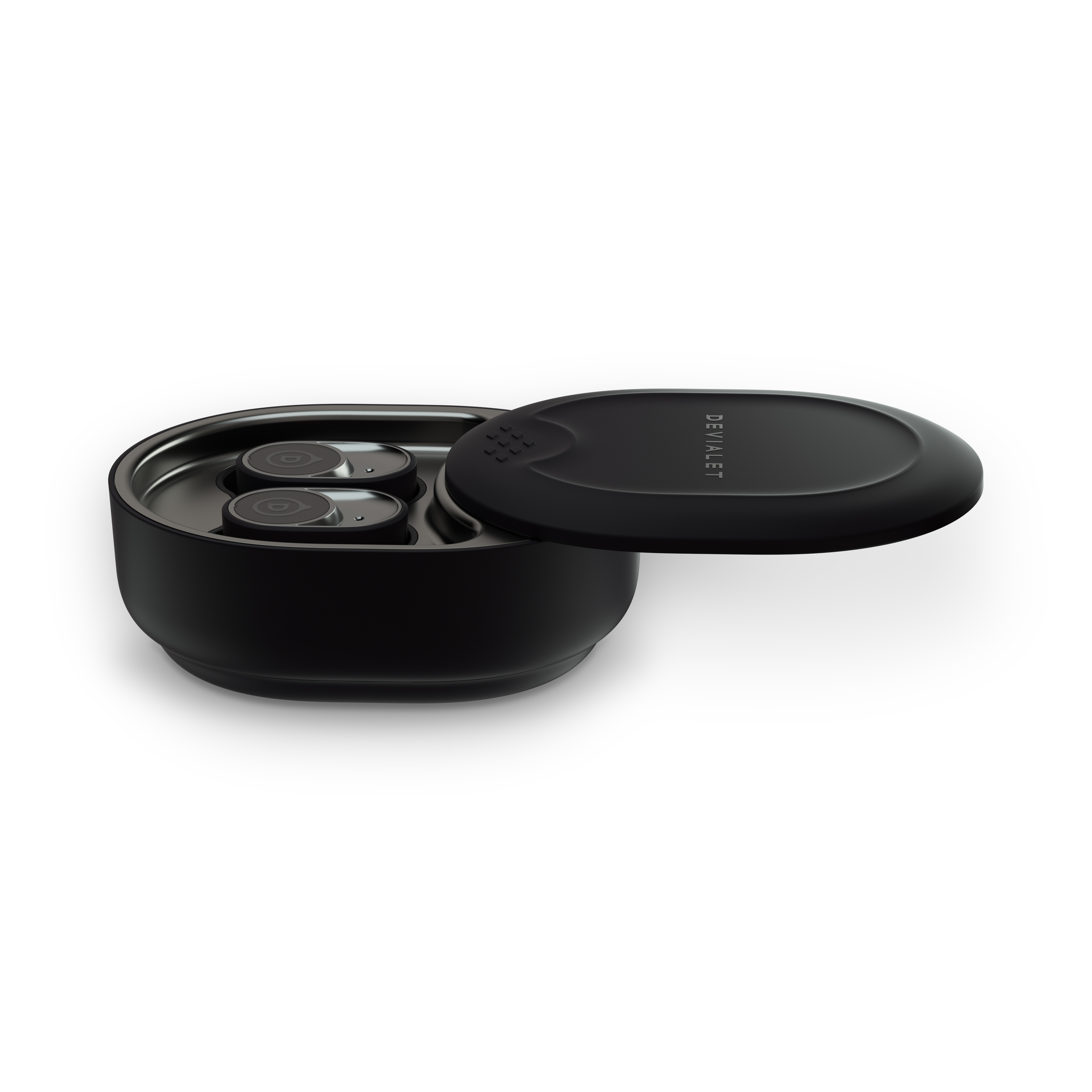
High-end speaker manufacturer Devialet is launching its first pair of earbuds called Devialet Gemini. The in-ear earbuds feature active noise canceling and cost £279 in the U.K. — they will be available in the coming weeks.

The Devialet Gemini are completely wireless, which means that there’s no cord between each earbud, like on Apple’s AirPods. The company has developed three new patents for the product.

They feature cascading decompression chambers, which means that they should stick in your ears and provide adequate pressure. In-ear earbuds require a good seal.

Image Credits: Devialet

There are two microphones in each earbud for the active noise cancelation feature and a dedicated microphone for calls and other voice interactions. Like on the AirPods Pro, there are multiple ANC modes. You can remove background noise altogether or activate transparency modes so that you can hear what’s happening around you.

You can choose between three levels of ANC and two levels of transparency mode. The company is releasing a mobile app so that you can control those settings. There’s also a touch button at the rear of the earbuds that you can use to control music playback, noise cancelation or voice assistants.

The earbuds automatically adjusts the audio signal when the earbud moves. It uses a microphone to detect a change in frequency. The app can also tell you if you’re using the right tip for your ear.

The company promises 8 hours of battery life without ANC and 6 hours with ANC activated. The case provides 3.5 charges and works with wireless chargers using the Qi standard or a USB-C cable.

Image Credits: Devialet


Read Full Article

Daily Crunch: Waymo opens up driverless ride-hailing


Alphabet’s self-driving technology company hits a major milestone, Apple TV+ extends its free subscription period and Affirm files to go public. This is your Daily Crunch for October 8, 2020.

The big story: Waymo opens up driverless ride-hailing

Waymo hit a major milestone today: It’s offering fully driverless rides to (some) members of the public.

While the Alphabet-owned company has offered plenty of self-driving rides before, they usually came with a human in the driver’s seat for safety. Members of the early rider program who’d signed nondisclosure agreements were able to try out fully driverless rides — but again, they had to sign NDAs first.

Today, the company said members of its more open Waymo One program in Phoenix will be able to go fully driverless, and to take friends and family with them. And over the next few weeks, the program will open up to even more passengers.

The tech giants

Apple is extending some Apple TV+ subs through February 2021 for free — Apple gave away a free year of Apple TV+ to new device purchasers last year; now it’s bumping those subs out to February.

Amazon debuts its first fully electric delivery vehicle, created in partnership with Rivian — The van’s unique features include sensor-based highway driving and traffic assist features.

IBM plans to spin off infrastructure services as a separate $19B business — The company said this will allow it to focus on newer opportunities in hybrid cloud applications and artificial intelligence.

Startups, funding and venture capital

Instacart raises $200M more at a $17.7B valuation — It’s not hard to trace a connection between COVID-19 and Instacart’s business results.

Affirm files confidentially to go public — The news comes after the impending debut was reported in July.

Delivery startup goPuff raises $380M at a $3.9B valuation — GoPuff delivers products like over-the-counter medicine, baby food and alcohol (basically, the stuff you’d buy at a convenience store) in 30 minutes or less.

Advice and analysis from Extra Crunch

Investors, founders report hot market for API startups — Startups that deliver their service via an API are having a moment.

Tech’s role in the COVID-19 response: Assist, don’t reinvent — Speakers at Disrupt explained how technology companies have taken a backseat to frontline workers, rather than attempting to “solve” the issues on their own.

These 3 factors are holding back podcast monetization — Fundamental fixes could unleash the channel’s revenue potential.

(Reminder: Extra Crunch is our subscription membership program, which aims to democratize information about startups. You can sign up here.)

Everything else

General Motors finally gets serious about in-car tech, taps Unreal Engine for next-gen interface — Matt Burns writes that GM’s current crop of in-car user interfaces is among the worst on the market.

Consumers spent a record $28B in apps in Q3, aided by pandemic — According to a new report from App Annie, consumers in the third quarter downloaded 33 billion new apps globally.

US Space Force is getting an immersive space sim training tool built in part by the VFX studio behind ‘The Mandalorian’ — The U.S. Space Force obviously won’t be able to train most of their service people in actual space, so the new arm of America’s defense forces has tasked Slingshot Aerospace to create a VR space sim.

The Daily Crunch is TechCrunch’s roundup of our biggest and most important stories. If you’d like to get this delivered to your inbox every day at around 3pm Pacific, you can subscribe here.


Read Full Article

Google Assistant can now control Android apps


Google today announced it’s making it possible to use the voice command “Hey Google” to not just open but also perform specific tasks within Android apps. The feature will be rolled out to all Google Assistant-enabled Android phones, allowing users to launch apps with their voice as well as search inside apps or perform specific tasks — like ordering food, playing music, posting to social media, hailing a ride, and more.

For example, users could say something like, “Hey Google, search cozy blankets on Etsy,” “open Selena Gomez on Snapchat,” “start my run with Nike Run Club,” or “check news on Twitter.”

At launch, Google says these sorts of voice commands will work with more than 30 of the top apps on Google Play in English globally, with more apps coming soon. Some of the supported apps today include Spotify, Snapchat, Twitter, Walmart, Discord, Etsy, MyFitnessPal, Mint, Nike Adapt, Nike Run Club, eBay, Kroger, and Postmates, Wayfair, to name a few.

If the specific voice command you would use to perform a common task is a little clumsy, the feature will also allow you to create a custom shortcut phrase instead. That means, instead of saying “Hey Google, tighten my shoes with Nike Adapt,” you could create a command that just said, “Hey Google, lace it.”

To get started with shortcuts, Android users can say “Hey Google, show my shortcuts” to get to the correct Settings screen.

The feature is similar to Apple’s support for using Siri with iOS apps, which also includes the ability to open apps, perform tasks and record your own custom phrase.

In Google’s case, the ability to perform tasks inside an app is implemented on the developer’s side by mapping users’ intents to specific functionality inside their apps. This feature, known as App Actions, allows users to open their favorite apps with a voice command. And, with the added functionality, lets users say “Hey Google” to search within the app or to open specific app pages.

Google says it has grown its catalog to include over 60 intents across 10 verticals, including Finance, Ridesharing, Food Ordering, Fitness, and now, Social, Games, Travel & Local, Productivity, Shopping and Communications, too.

To help users understand how and when they can use these new App Actions, Google says it’s building touchpoints in Android that will help them learn when they use certain voice commands. For instance, if a user said “Hey Google, show me Taylor Swift,” it may highlight a suggestion chip that will guide the users to opening the search result on Twitter.

Image Credits: Google

Related to this news, Google says it also released two new English voices for developers to leverage when building custom experiences for Assistant on Smart Displays, alongside other developer tools and resources for those building for displays.

The Google Assistant upgrade for apps was one of several Android improvements Google highlighted today. The company also says it’s adding screen-sharing to Google Duo, expanding its Verified Calls anti-spam feature to more devices (Android 9 and up), and updating the Google Play Movies & TV app to become the new “Google TV” app, announced last week.

On the accessibility front, it’s introducing new tools for hearing loss with Sound Notifications and others for communicating using Action blocks, aimed at people with cerebral palsy, Down Syndrome, autism, aphasia, and other speech related disabilities.

The features are available now.


Read Full Article

Waymo starts to open driverless ride-hailing service to the public


Waymo, the Google self-driving-project-turned-Alphabet unit, is beginning to open up its driverless ride-hailing service to the public.

The company said that starting today members of its Waymo One service will be able to take family and friends along on their fully driverless rides in the Phoenix area. Existing Waymo One members will have the first access to the driverless rides — terminology that means no human behind the wheel. However, the company said that in the next several weeks more people will be welcomed directly into the service through its app, which is available on Google Play and the App Store.

Waymo said that 100% of its rides will be fully driverless — which it has deemed its “rider only” mode. That 100% claim requires a bit of unpacking. The public shouldn’t expect hundreds of Waymo-branded Chrysler Pacifica minivans — no human behind the wheel — to suddenly inundate the entire 600-plus square miles of the greater Phoenix area.

Waymo has abut 600 vehicles in its fleet. About 300 to 400 of those are in the Phoenix area. Waymo wouldn’t share exact numbers of how many of these vehicles would be dedicated to driverless rides. However, Waymo CEO John Krafcik explained to TechCrunch in a recent interview, that there will be various modes operating in the Phoenix area. Some of these will be “rider only,” while other vehicles will still have train safety operators behind the wheel. Some of the fleet will also be used for testing.

“We’re just ready from every standpoint,” Krafcik told TechCrunch. “And how do we know we’re ready? We’ve had our wonderful group of early riders, who’ve helped us hone the service, obviously not from a safety standpoint because we’ve had the confidence on the safety side for some time, but rather more for the fit of the product itself.” He added that these early riders helped the company determine if the product was “delivering satisfaction and delight for them.”

Later this year, Waymo will relaunch rides with a trained vehicle operator to add capacity and allow us to serve a larger geographical area. Krafcik said the company is in the process of adding in-vehicle barriers between the front row and rear passenger cabin for in-vehicle hygiene and safety.

Waymo operates in about 100-square-mile area. The driverless or “rider only” service area that will be offered to Waymo One members is about 50 square miles, Krafcik said.

Despite the various caveats, this is still a milestone — one of many the company has achieved in the past decade. The past five years has been particularly packed, starting with Steve Mahan, who is legally blind, taking the “first: driverless ride in the company’s Firefly prototype on Austin’s city streets in 2015. More than a dozen journalists experienced driverless rides in 2017 on a closed course at Waymo’s testing facility in Castle; and. Then last November, TechCrunch took one of the first driverless rides in Waymo Pacifica minivan along the public streets of a Phoenix suburb.

waymo-driverless app

The company scaled its commercial product even as these demos and testing continued. In 2017, Waymo launched its early rider program, which let vetted members of the public, who had signed non-disclosure agreements, hail its self-driving cars in the Phoenix area. Those autonomous vehicles all had human safety operators behind the wheel.

Waymo then launched Waymo One, a self-driving ride-hailing service aimed for public use, no NDA strings attached. But again, those rides all had human safety operators in the drivers seat, ready to take over if needed. Waymo slowly moved its early rider program members into the more open Waymo One service. It also started experimenting with charging for rides and expanded its footprint – or geofenced service area. Today, the company charges for rides across all of its programs (early rider and Waymo One) in the Phoenix area. The Waymo One service (with human safety operators) is about 100 square miles in Phoenix suburbs like Chandler.

The first meaningful signs that Waymo was ready to put people in vehicles without human safety operators popped up last fall when members of its early rider program received an email indicating that driverless rides would soon become available.

And they did. These driverless rides were limited and free. And importantly, still fell under the early rider program, which had that extra NDA protection. Waymo did slowly scale until about 5 to 10% of its total rides in 2020 were fully driverless for its exclusive group of early riders under NDA. Then COVID-19 hit and the service was halted. The company has continued testing with its safety drivers in Arizona and California. That has raised some concerns among those workers about the dual issue of catching COVID and dealing with air quality issues caused by wildfires in California.

Waymo said it has added new safety protocols due to COVID-19, including requiring users to wear masks, having hand sanitizer in all vehicles and conducting what Krafcik described as a cabin flush — essentially a four to five increase in air volume sent through the vehicle — after every ride.

Krafcik also said Waymo will soon add the all-electric Jaguar I-Pace to the mix, first testing them on public roads and then adding the vehicles to the early rider program.

Updated: to reflect that the company charges for all rides now in Phoenix. 


Read Full Article

Announcing the 2020 Google PhD Fellows


Google created the PhD Fellowship Program in 2009 to recognize and support outstanding graduate students who seek to influence the future of technology by pursuing exceptional research in computer science and related fields. Now in its twelfth year, these Fellowships have helped support approximately 500 graduate students globally in North America and Europe, Africa, Australia, East Asia, and India.

It is our ongoing goal to continue to support the academic community as a whole, and these Fellows as they make their mark on the world. We congratulate all of this year’s awardees!

Algorithms, Optimizations and Markets
Jan van den Brand, KTH Royal Institute of Technology
Mahsa Derakhshan, University of Maryland, College Park
Sidhanth Mohanty, University of California, Berkeley

Computational Neuroscience
Connor Brennan, University of Pennsylvania

Human Computer Interaction
Abdelkareem Bedri, Carnegie Mellon University
Brendan David-John, University of Florida
Hiromu Yakura, University of Tsukuba
Manaswi Saha, University of Washington
Muratcan Cicek, University of California, Santa Cruz
Prashan Madumal, University of Melbourne

Machine Learning
Alon Brutzkus, Tel Aviv University
Chin-Wei Huang, Universite de Montreal
Eli Sherman, Johns Hopkins University
Esther Rolf, University of California, Berkeley
Imke Mayer, Fondation Sciences Mathématique de Paris
Jean Michel Sarr, Cheikh Anta Diop University
Lei Bai, University of New South Wales
Nontawat Charoenphakdee, The University of Tokyo
Preetum Nakkiran, Harvard University
Sravanti Addepalli, Indian Institute of Science
Taesik Gong, Korea Advanced Institute of Science and Technology
Vihari Piratla, Indian Institute of Technology - Bombay
Vishakha Patil, Indian Institute of Science
Wilson Tsakane Mongwe, University of Johannesburg
Xinshi Chen, Georgia Institute of Technology
Yadan Luo, University of Queensland

Machine Perception, Speech Technology and Computer Vision
Benjamin van Niekerk, University of Stellenbosch
Eric Heiden, University of Southern California
Gyeongsik Moon, Seoul National University
Hou-Ning Hu, National Tsing Hua University
Nan Wu, New York University
Shaoshuai Shi, The Chinese University of Hong Kong
Yaman Kumar, Indraprastha Institute of Information Technology - Delhi
Yifan Liu, University of Adelaide
Yu Wu, University of Technology Sydney
Zhengqi Li, Cornell University

Mobile Computing
Xiaofan Zhang, University of Illinois at Urbana-Champaign

Natural Language Processing
Anjalie Field, Carnegie Mellon University
Mingda Chen, Toyota Technological Institute at Chicago
Shang-Yu Su, National Taiwan University
Yanai Elazar, Bar-Ilan

Privacy and Security
Julien Gamba, Universidad Carlos III de Madrid
Shuwen Deng, Yale University
Yunusa Simpa Abdulsalm, Mohammed VI Polytechnic University

Programming Technology and Software Engineering
Adriana Sejfia, University of Southern California
John Cyphert, University of Wisconsin-Madison

Quantum Computing
Amira Abbas, University of KwaZulu-Natal
Mozafari Ghoraba Fereshte, EPFL

Structured Data and Database Management
Yanqing Peng, University of Utah

Systems and Networking
Huynh Nguyen Van, University of Technology Sydney
Michael Sammler, Saarland University, MPI-SWS
Sihang Liu, University of Virginia
Yun-Zhan Cai, National Cheng Kung University


08 October 2020

Density’s Open Area radar tracks people in a space, precisely but anonymously


Everyone in the world is rethinking shared spaces right about now, and part of that rethink is understanding how they’re used, minute by minute and day by day. Density’s tiny ceiling-mounted radar finds and tracks people unobtrusively but with great precision, letting the powers that be monitor every table, chair, and office.

Okay, in some ways that doesn’t sound great. But don’t worry, we’ll get to that.

Density began looking into creating large-scale people-monitoring tech after seeing the possibilities latent in its entryway-monitoring Entry device, which tracks people coming and going using infrared imagery. They settled on radar as a technology that has the range and precision to cover hundreds of square feet from a single point, but also lacks any capability of easily identifying someone.

That’s an important point, as many are wary of installing people-monitoring software on ordinary security cameras. The potential for abuse is high simply because the imagery is easy to match with identities. So while it may be cheaper to layer some computer vision on top of a regular camera, there are non-trivial risks and shortcomings.

Image Credits: Density

Not to mention few like the idea of security cameras watching over every desk and computer, able to read confidential documents and see every minute motion. The system Density has created is very much focused on presence — is someone in that chair? Is someone in that office? How many people are in this room?

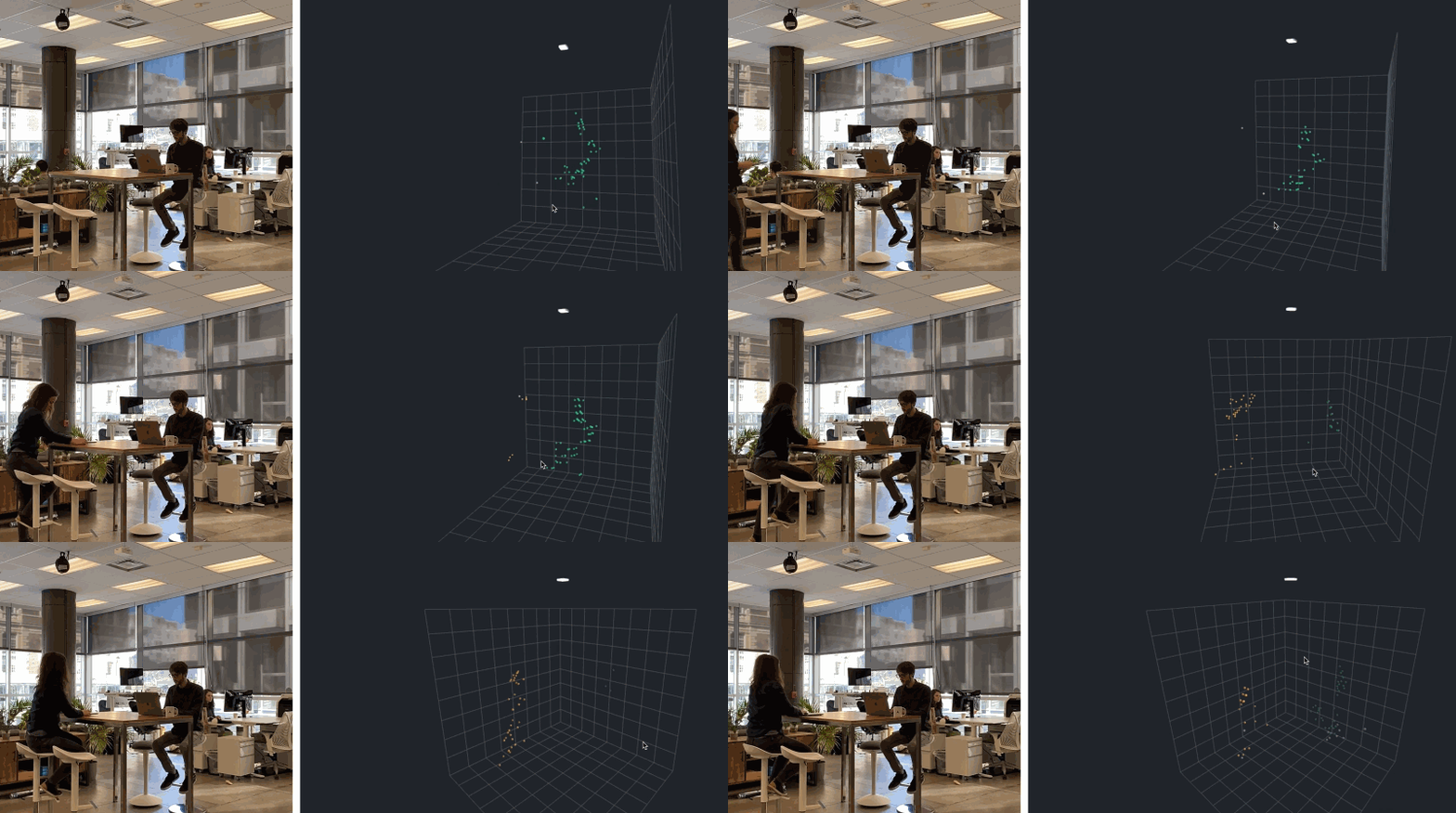
The radar produces point clouds, but not the detailed ones you see in the lidar systems of self-driving cars. It really is more like a cloud than anything else — a small, upright cloud standing near the fridge in the office kitchen. When someone else comes in to grab a coffee, there’s another, separately tracked cloud. But there’s not enough detail to tell people apart, or, without careful scrutiny anyway, features like size or clothing.

A GIF showing a person sitting down at a desk and the radar point cloud of her.

Image Credits: Density

Of course you could track the clouds back to their desks and retroactively identify them, but really there’s no shortage of ways to track people now. Why install a new one that’s more useful for other things?

Because the data from something like this is certainly valuable. Cafes can watch occupancy rates of seats and A-B test different layouts; gyms can see which machines are used the most and require maintenance or cleaning; offices can repurpose unpopular meeting rooms or furniture; retail stores can find cold racks. The software that comes with the devices can also tell how far people are from each other, how long they tend to stay at various spots, and whether certain thoroughfares are used more than others.

A screenshot of the Density software in action.

The data is aggregated in real time, so a shared office space can easily tell — without asking or double-checking — which desks are empty and have been all morning. Restaurants similarly wouldn’t have their table counts at the host station lag behind reality. (As you can imagine these applications are primarily for non-pandemic times, but now may be the perfect chance to install the devices.)

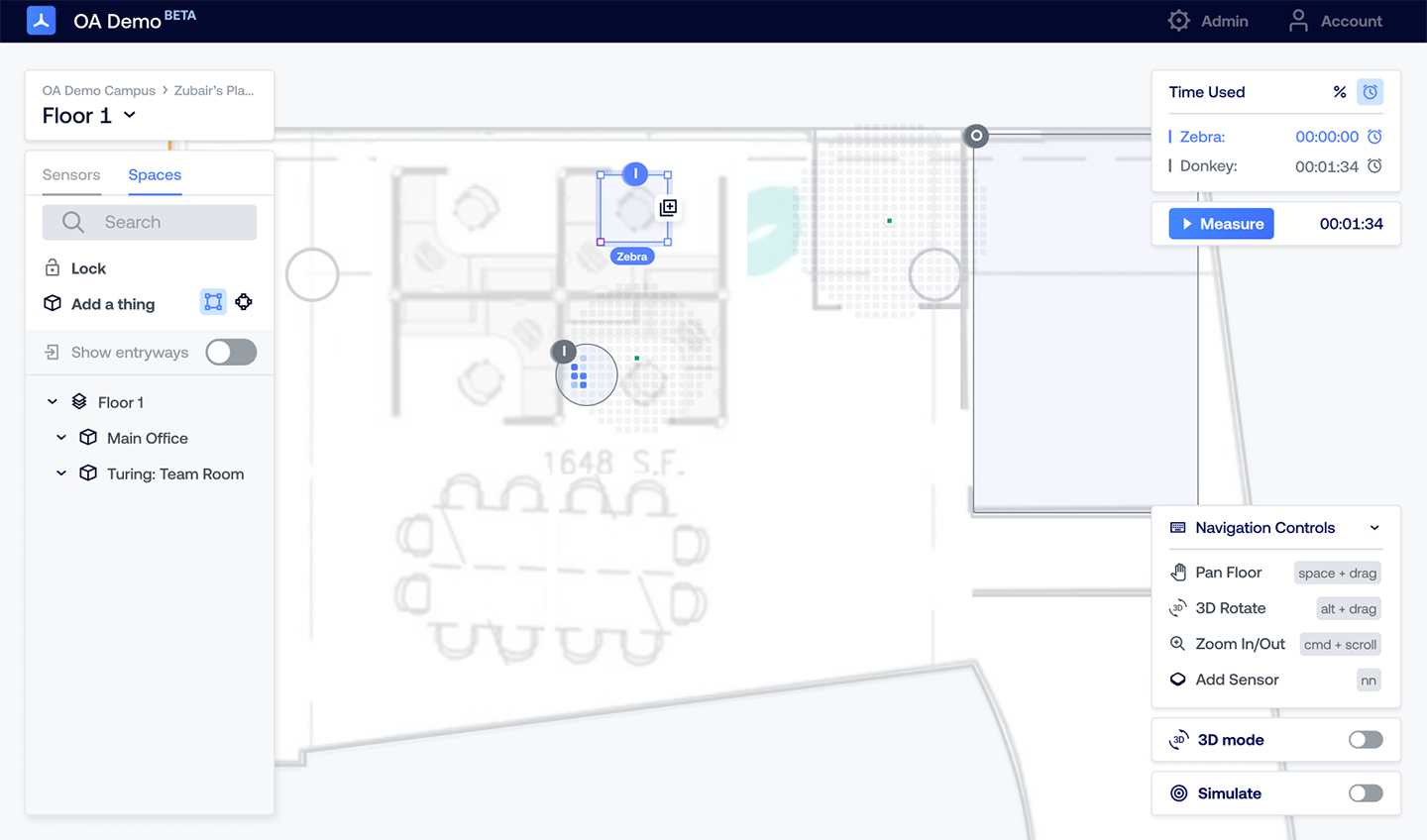
Add a layout image to the real-time cloud and all of a sudden things get really real:

Image Credits: Density

Each of the Open Area sensors, which are about the size of a BLT, can cover 1,325 square feet from up to 20 feet off the ground. That’s a circle about 38-40 feet in diameter, into which you can fit a couple meeting rooms or about 20 desks. That’s more than competitive with overhead optical cameras, plus the privacy benefit.

If you’re curious how they look in a real office area, here’s a little “seek and find” puzzle for you. They’re hidden in each of the following office photos. I’ve put them in this gallery in order of difficulty.

[gallery ids="2057950,2057951,2057952"]

Be ready for a bit of sticker shock at first, though. An Open Area sensor costs $399 and there’s a $199 yearly license fee for each one you use. So kitting out a decent size office will probably get you well into the five-figure range. Of course, anyone who runs a space that large knows the costs of things like doing space usage studies (people actually sitting there, watching who uses what) and other useful gear like badge-based entry.

“We’re an order of magnitude less expensive and an order of magnitude more useful,” said CEO Andrew Farah.

Density already counts some major enterprises among its customers, and while the entire office and retail world is being turned upside-down right now, tools like this are likely to figure into whatever comes next. Being smart about how you use a space not only saves money, it’s safer and probably makes for happier people in it.


Read Full Article

Headroom, which uses AI to supercharge videoconferencing, raises $5M


Videoconferencing has become a cornerstone of how many of us work these days — so much so that one leading service, Zoom, has graduated into verb status because of how much it’s getting used.

But does that mean videoconferencing works as well as it should? Today, a new startup called Headroom is coming out of stealth, tapping into a battery of AI tools — computer vision, natural language processing and more — on the belief that the answer to that question is a clear — no bad WiFi interruption here — “no.”

Headroom not only hosts videoconferences, but then provides transcripts, summaries with highlights, gesture recognition, optimised video quality, and more, and today it’s announcing that it has raised a seed round of $5 million as it gears up to launch its freemium service into the world.

You can sign up to the waitlist to pilot it, and get other updates here.

The funding is coming from Anna Patterson of Gradient Ventures (Google’s AI venture fund); Evan Nisselson of LDV Capital (a specialist VC backing companies buidling visual technologies); Yahoo founder Jerry Yang, now of AME Cloud Ventures; Ash Patel of Morado Ventures; Anthony Goldbloom, the cofounder and CEO of Kaggle.com; and Serge Belongie, Cornell Tech associate dean and Professor of Computer Vision and Machine Learning.

It’s an interesting group of backers, but that might be because the founders themselves have a pretty illustrious background with years of experience using some of the most cutting-edge visual technologies to build other consumer and enterprise services.

Julian Green — a British transplant — was most recently at Google, where he ran the company’s computer vision products, including the Cloud Vision API that was launched under his watch. He came to Google by way of its acquisition of his previous startup Jetpac, which used deep learning and other AI tools to analyze photos to make travel recommendations. In a previous life, he was one of the co-founders of Houzz, another kind of platform that hinges on visual interactivity.

Russian-born Andrew Rabinovich, meanwhile, spent the last five years at Magic Leap, where he was the head of AI, and before that, the director of deep learning and the head of engineering. Before that, he too was at Google, as a software engineer specializing in computer vision and machine learning.

You might think that leaving their jobs to build an improved videoconferencing service was an opportunistic move, given the huge surge of use that the medium has had this year. Green, however, tells me that they came up with the idea and started building it at the end of 2019, when the term “Covid-19” didn’t even exist.

“But it certainly has made this a more interesting area,” he quipped, adding that it did make raising money significantly easier, too. (The round closed in July, he said.)

Given that Magic Leap had long been in limbo — AR and VR have proven to be incredibly tough to build businesses around, especially in the short- to medium-term, even for a startup with hundreds of millions of dollars in VC backing — and could have probably used some more interesting ideas to pivot to; and that Google is Google, with everything tech having an endpoint in Mountain View, it’s also curious that the pair decided to strike out on their own to build Headroom rather than pitch building the tech at their respective previous employers.

Green said the reasons were two-fold. The first has to do with the efficiency of building something when you are small. “I enjoy moving at startup speed,” he said.

And the second has to do with the challenges of building things on legacy platforms versus fresh, from the ground up.

“Google can do anything it wants,” he replied when I asked why he didn’t think of bringing these ideas to the team working on Meet (or Hangouts if you’re a non-business user). “But to run real-time AI on video conferencing, you need to build for that from the start. We started with that assumption,” he said.

All the same, the reasons why Headroom are interesting are also likely going to be the ones that will pose big challenges for it. The new ubiquity (and our present lives working at home) might make us more open to using video calling, but for better or worse, we’re all also now pretty used to what we already use. And for many companies, they’ve now paid up as premium users to one service or another, so they may be reluctant to try out new and less-tested platforms.

But as we’ve seen in tech so many times, sometimes it pays to be a late mover, and the early movers are not always the winners.

The first iteration of Headroom will include features that will automatically take transcripts of the whole conversation, with the ability to use the video replay to edit the transcript if something has gone awry; offer a summary of the key points that are made during the call; and identify gestures to help shift the conversation.

And Green tells me that they are already also working on features that will be added into future iterations. When the videoconference uses supplementary presentation materials, those can also be processed by the engine for highlights and transcription too.

And another feature will optimize the pixels that you see for much better video quality, which should come in especially handy when you or the person/people you are talking to are on poor connections.

“You can understand where and what the pixels are in a video conference and send the right ones,” he explained. “Most of what you see of me and my background is not changing, so those don’t need to be sent all the time.”

All of this taps into some of the more interesting aspects of sophisticated computer vision and natural language algorithms. Creating a summary, for example, relies on technology that is able to suss out not just what you are saying, but what are the most important parts of what you or someone else is saying.

And if you’ve ever been on a videocall and found it hard to make it clear you’ve wanted to say something, without straight-out interrupting the speaker, you’ll understand why gestures might be very useful.

But they can also come in handy if a speaker wants to know if he or she is losing the attention of the audience: the same tech that Headroom is using to detect gestures for people keen to speak up can also be used to detect when they are getting bored or annoyed and pass that information on to the person doing the talking.

“It’s about helping with EQ,” he said, with what I’m sure was a little bit of his tongue in his cheek, but then again we were on a Google Meet, and I may have misread that.

And that brings us to why Headroom is tapping into an interesting opportunity. At their best, when they work, tools like these not only supercharge videoconferences, but they have the potential to solve some of the problems you may have come up against in face-to-face meetings, too. Building software that actually might be better than the “real thing” is one way of making sure that it can have staying power beyond the demands of our current circumstances (which hopefully won’t be permanent circumstances).


Read Full Article