22 September 2020

Human Capital: The Black founder’s burden


Welcome back to Human Capital, where we unpack all-things diversity, inclusion and labor in tech. This week, we’re looking at Google’s internal message board problem, as well as some highlights from TechCrunch Disrupt, where I had the pleasure of chatting with actress, producer and tech investor Kerry Washington about her investment strategy and her thoughts on The Wing’s internal turmoil.

Later, we’ll also highlight some other gems from Disrupt speakers on imposter syndrome, representation syndrome, the hidden burden of being a Black founder, and the importance of encouraging other Black and brown folks to enter this industry and stay.

Also, Human Capital will soon be available as a weekly newsletter. You can sign up here.

Google’s internal message board problem

Google found itself asking employees to be more active in moderating some of the internal message boards, according to CNBC. The issue is that Google has reportedly seen more posts being flagged for racism or abuse on its message boards. Some of these posts reportedly reinforce negative racial stereotypes, use harmful gendered phrases of insult Google employees based on their nationality. Here’s a snippet from Google’s internal blog, via CNBC:

“Our world is going to get more complicated as the year continues,” the team stated in the internal blog. “Tensions continue specifically for our Black+ community with Black Lives Matter, and our Asian Googlers with coronavirus and China/Hong Kong. All of this is compounded by the additional stress of working from home, social isolation, and caregiver responsibilities — to name a few. This new world creates urgency to keep work a welcoming place.”

Yes, tough conversations are the theme of the year. But we also know Google has had issues with employees before. You may remember James Damore, the now former Google employee who sent around an anti-diversity manifesto back in 2017. Google ultimately fired Damore that same month.

We reached out to Google for comment but have not heard back.

Kerry Washington on The Wing scandal

At TechCrunch Disrupt, I had the pleasure of virtually interviewing Kerry Washington, best known for her work in Hollywood as the lead actress on “Scandal” and “Little Fires Everywhere.” But she’s also invested in a handful of tech companies, including Community, Byte and The Wing. The Wing, however, went through some turmoil earlier this year. Employees alleged mistreatment of Black and brown workers, which ultimately led to The Wing CEO Audrey Gelman’s resignation.

“Well, you know, I’m not new to scandal, so there’s that,” Washington told me in response to a question about her reaction to the news. “I was and I am really deeply still inspired by the original vision of the company. And, I think like a lot of companies in this time, because of the several pandemics that we’re facing, whether it’s our awareness around racial injustice, or COVID, lots of people are in a moment of recalibration and self-reflection. So I think that there is incredible space to improve the dynamics. And as somebody who’s an investor, as a woman of color, it’s important to me that there is increased transparency and also accountability.”

Over the past few months, Washington said her role as an investor has been “really just supporting leadership in this transition,” as well as expressing to those leaders a “deep desire” for transparency and accountability.

On imposter syndrome and representation 

Also at Disrupt, my homegirl Kirsten Korosec led a wonderful conversation with Phaedra Ellis-Lamkins of PromisePay and Jessica Matthews of Uncharted Power, two Black female founders, about how they both successfully pivoted their companies while navigating the pressures that come with being an underrepresented founder in Silicon Valley.

Phaedra Ellis-Lamkins, founder and CEO at PromisePay:

It feels like tech has failed so significantly in investing in people they don’t know and missed out in growing companies because of that. So I think our obligation is to help make sure that we are not the only ones.

Jessica Matthews, founder and CEO at Uncharted Power:

It’s not imposter syndrome, it’s representation syndrome because I feel the exact same way. When we raised our Series A, the immediate thing I thought was, ‘Oh, man. I can not lose these people’s money.’ This is huge and if we don’t work, it’s not even about us, it’s about every other person who looks like me.

Michael Seibel on the Black founder experience

In a panel on the Black founder experience at Disrupt, Y Combinator CEO Michael Seibel spoke about a “hidden burden” for underrepresented founders.

“I think that there’s so much deserved activism around access to this world for underrepresented founders, that I feel as though there’s like, more pressure to succeed, in a weird way,” he said. “And I think that can be helpful to a point, but I think that it can be challenging. I also think that there’s so much emphasis around the toxicity in the technology world that a lot of really talented people believe it’s horrible, like believe that our world looks like Jim Crow South. And so therefore they shouldn’t even step any foot into it where like, I would challenge anyone trying to be successful in any industry to be able to avoid the types of problems that exists in the technology industry, if they come from an underrepresented background. So I don’t think the environment’s significantly different in our world than other worlds. I think that the environment is hard. You know, there is bias if you’re underrepresented, across the board, no matter what industry you go to. So if you’re gonna be successful, you’re going to figure out a way to get around it.”

But that’s not to say you’ll have to figure it out on your own, Seibel said. He pointed to how there are people who are willing and able to help. That includes him and the many other Black founders present in Silicon Valley.

“But if we somehow scare talented people away from this world, we won’t ever fix this world,” he said. “And we won’t ever, even more importantly than fixing this world, there’ll be huge swaths of the world that don’t have products and services that they deserve and that they need. And so I think we have to be careful to make sure we communicate that opportunities exist here. And that if you’re trying to be a high powered lawyer, or if you’re trying to be, you know, a top banker, you’re gonna go through the same bullshit. Like, different industries, same bullshit. So if you’re trying to make an impact in the world, strap in. If you’re an underrepresented founder, you’re gonna have to deal with these issues, no matter where you do it.”


Don’t miss


Read Full Article

Advancing NLP with Efficient Projection-Based Model Architectures


Deep neural networks have radically transformed natural language processing (NLP) in the last decade, primarily through their application in data centers using specialized hardware. However, issues such as preserving user privacy, eliminating network latency, enabling offline functionality, and reducing operation costs have rapidly spurred the development of NLP models that can be run on-device rather than in data centers. Yet mobile devices have limited memory and processing power, which requires models running on them to be small and efficient — without compromising quality.

Last year, we published a neural architecture called PRADO, which at the time achieved state-of-the-art performance on many text classification problems, using a model with less than 200K parameters. While most models use a fixed number of parameters per token, the PRADO model used a network structure that required extremely few parameters to learn the most relevant or useful tokens for the task.

Today we describe a new extension to the model, called pQRNN, which advances the state of the art for NLP performance with a minimal model size. The novelty of pQRNN is in how it combines a simple projection operation with a quasi-RNN encoder for fast, parallel processing. We show that the pQRNN model is able to achieve BERT-level performance on a text classification task with orders of magnitude fewer number of parameters.

What Makes PRADO Work?
When developed a year ago, PRADO exploited NLP domain-specific knowledge on text segmentation to reduce the model size and improve the performance. Normally, the text input to NLP models is first processed into a form that is suitable for the neural network, by segmenting text into pieces (tokens) that correspond to values in a predefined universal dictionary (a list of all possible tokens). The neural network then uniquely identifies each segment using a trainable parameter vector, which comprises the embedding table. However, the way in which text is segmented has a significant impact on the model performance, size, and latency. The figure below shows the spectrum of approaches used by the NLP community and their pros and cons.

Since the number of text segments is such an important parameter for model performance and compression, it raises the question of whether or not an NLP model needs to be able to distinctly identify every possible text segment. To answer this question we look at the inherent complexity of NLP tasks.

Only a few NLP tasks (e.g., language models and machine translation) need to know subtle differences between text segments and thus need to be capable of uniquely identifying all possible text segments. In contrast, the majority of other tasks can be solved by knowing a small subset of these segments. Furthermore, this subset of task-relevant segments will likely not be the most frequent, as a significant fraction of segments will undoubtedly be dedicated to articles, such as a, an, the, etc., which for many tasks are not necessarily critical. Hence, allowing the network to determine the most relevant segments for a given task results in better performance. In addition, the network does not need to be able to uniquely identify these segments, but only needs to recognize clusters of text segments. For example, a sentiment classifier just needs to know segment clusters that are strongly correlated to the sentiment in the text.

Leveraging these insights, PRADO was designed to learn clusters of text segments from words rather than word pieces or characters, which enabled it to achieve good performance on low-complexity NLP tasks. Since word units are more meaningful, and yet the most relevant words for most tasks are reasonably small, many fewer model parameters are needed to learn such a reduced subset of relevant word clusters.

Improving PRADO
Building on the success of PRADO, we developed an improved NLP model, called pQRNN. This model is composed of three building blocks, a projection operator that converts tokens in text to a sequence of ternary vectors, a dense bottleneck layer and a stack of QRNN encoders.

The implementation of the projection layer in pQRNN is identical to that used in PRADO and helps the model learn the most relevant tokens without a fixed set of parameters to define them. It first fingerprints the tokens in the text and converts it to a ternary feature vector using a simple mapping function. This results in a ternary vector sequence with a balanced symmetric distribution that uniquely represents the text. This representation is not directly useful since it does not have any information needed to solve the task of interest and the network has no control over this representation. We combine it with a dense bottleneck layer to allow the network to learn a per word representation that is relevant for the task at hand. The representation resulting from the bottleneck layer still does not take the context of the word into account. We learn a contextual representation by using a stack of bidirectional QRNN encoders. The result is a network that is capable of learning a contextual representation from just text input without employing any kind of preprocessing.

Performance
We evaluated pQRNN on the civil_comments dataset and compared it with the BERT model on the same task. Simply because the model size is proportional to the number of parameters, pQRNN is much smaller than BERT. But in addition, pQRNN is quantized, further reducing the model size by a factor of 4x. The public pretrained version of BERT performed poorly on the task hence the comparison is done to a BERT version that is pretrained on several different relevant multilingual data sources to achieve the best possible performance.

We capture the area under the curve (AUC) for the two models. Without any kind of pre-training and just trained on the supervised data, the AUC for pQRNN is 0.963 using 1.3 million quantized (8-bit) parameters. With pre-training on several different data sources and fine-tuning on the supervised data, the BERT model gets 0.976 AUC using 110 million floating point parameters.

Conclusion
Using our previous generation model PRADO, we have demonstrated how it can be used as the foundation for the next generation of state-of-the-art light-weight text classification models. We present one such model, pQRNN, and show that this new architecture can nearly achieve BERT-level performance, despite using 300x fewer parameters and being trained on only the supervised data. To stimulate further research in this area, we have open-sourced the PRADO model and encourage the community to use it as a jumping off point for new model architectures.

Acknowledgements
We thank Yicheng Fan, Márius Šajgalík, Peter Young and Arun Kandoor for contributing to the open sourcing effort and helping improve the models. We would also like to thank Amarnag Subramanya, Ashwini Venkatesh, Benoit Jacob, Catherine Wah, Dana Movshovitz-Attias, Dang Hien, Dmitry Kalenichenko, Edgar Gonzàlez i Pellicer, Edward Li, Erik Vee, Evgeny Livshits, Gaurav Nemade, Jeffrey Soren, Jeongwoo Ko, Julia Proskurnia, Rushin Shah, Shirin Badiezadegan, Sidharth KV, Victor Cărbune and the Learn2Compress team for their support. We would like to thank Andrew Tomkins and Patrick Mcgregor for sponsoring this research project.


Indian mobile gaming platform Mobile Premier League raises $90 million


Mobile Premier League (MPL) has raised $90 million in a new financing round as the two-year-old Bangalore-based esports and mobile gaming platform demonstrates fast-growth and looks to expand outside of India.

SIG, early-stage tech investor RTP Global and MDI Ventures led MPL’s $90 million Series C financing round, with participation from existing investors Sequoia India, Go-Ventures and Base Partners. Times Internet is also an early investor in MPL. The new investment brings MPL’s to-date raise to $130.5 million. It was valued between $375 million to $400 million pre-money, according to a person familiar with the matter.

MPL operates a pure-play gaming platform that hosts a range of tournaments. The app, which has amassed more than 60 million users, also serves as a publishing platform for other gaming firms. MPL, which does not develop games of its own, hosts about 70 games across multiple sports on the app today.

The Bangalore-based startup also offers fantasy sports, a segment that has taken off in many parts of India in recent years.

Because fantasy sports is only one part of the business, the coronavirus outbreak that has shut most real-world matches has not impeded the startup’s growth in recent months. The startup claimed it has grown four times since March this year, and more than 2 billion cash transactions have been recorded on the app to date.

“We’re competing with battle-hardened, decade old companies with much, much deeper pockets but it’s incredible what the young team has achieved over the past couple of years. When we were on the Play Store, a couple of years back, MPL was the fastest app to reach a 1M DAU ever in India!” tweeted Abhishek Madhavan, SVP of Marketing at MPL. “We signed Virat Kohli (pictured above), when we were a 3-month old company! When we got out of the Play Store, we were told growth will be very very hard to come by, every single marketing metric would fall.”

Sai Srinivas, co-founder and chief executive of Mobile Premier League, told TechCrunch in an interview that the new financing round validates that esports is here to stay and it is beginning to see its e-commerce moment.

“I believe that esports will be inducted by the Olympics way before than cricket does. And the market cap of esports will most probably will exceed those of all physical sports combined in the next 10 years,” he said.

“Even in an environment as challenging as the current one, we are impressed with the success and accessibility of the platform concept – giving users a unique variety of experiences and social interaction. MPL’s track record speaks for itself, so we’re excited to support the team as they grow and expand,” said Galina Chifina, managing partner at RTP Global, in a statement.

But since an aspect of MPL is about fantasy sports, its app is not available on the Google Play Store. Google Play Store prohibits online casinos, and other kinds of betting, a guideline Google reiterated last week as it pulled Indian financial services platform Paytm from the app store for eight hours. Srinivas declined to comment on Google and Paytm’s episode.

The startup plans to expand outside of India in the following months, said Srinivas. He did not name the new markets, but suggested that India’s neighboring countries as well as Japan and South Korea will likely be part of it.

The startup also plans to expand its gaming catalog and offer more marketing support to third-party developers, who currently either sell licenses to MPL or work through a revenue-sharing agreement with the Indian startup.


Read Full Article

TikTok fact checks: US IPO, Chinese ownership, $5B in taxes


There is no shortage of speculation and reports around TikTok’s future in the U.S. Amid a swirl of rumors, TikTok’s Chinese parent ByteDance issued a statement (in Chinese) on Monday morning, bringing clarity to its ongoing deal that has captured global attention over the past few weeks.

ByteDance is still the owner

China’s ByteDance confirms it will retain an 80% stake in TikTok after selling a total of 20% to Oracle, its “trusted technology partner,” and Walmart, its “commercial partner.”

But the arrangement doesn’t address the core of many observers’ worries, as my colleague Jonathan Shieber argued: “The deal benefits everyone except U.S. consumers and people who have actual security concerns about TikTok’s algorithms and the ways they can be used to influence opinion in the U.S.”

Sitting on TikTok’s board are ByteDance’s current members, all non-Chinese except ByteDance founder Zhang Yiming. Walmart CEO Doug McMillon is the latest addition to the board.

TikTok seeks US IPO

TikTok confirms it’s seeking an initial public offering in the U.S. in an effort to “further enhance corporate governance and transparency.”

Clearly, the video app hopes an IPO, which will expose it to more public scrutiny, could allay fears over the alleged national security threat attached to its Chinese origin.

Notably, ByteDance refers to the video app as “TikTok Global” in the statement, suggesting the app won’t be split into a U.S. unit and the rest of the world. TikTok claims nearly 700 million monthly users around the globe, as revealed in a court document; 100 million of the users are based in the U.S., where its current headquarters is located.

No algorithm transfer

In line with previous reports, ByteDance won’t be handing over TikTok’s algorithms or technologies to Oracle. Instead, the American database giant will gain the authority to perform security checks on “TikTok’s U.S. source codes.”

“Revealing source codes is a universal solution to data security challenges posed to multinational corporations,” ByteDance said, attempting to equate its decision to Microsoft’s Transparency Center in China as well as a similar facility Cisco set up in Bonn, Germany.

It’s still unclear how Oracle’s role as a code inspector and user data host will resolve concerns around Beijing’s possible tinkering of TikTok’s content black box.

$5 billion tax dollars

ByteDance estimates that TikTok will pay to the U.S. Treasury in the coming years a total of $5 billion in income tax and other tax dollars incurred in business. Nonetheless, the final figure is contingent on TikTok’s “actual business performance and the U.S. tax structure,” the parent said, stressing that the tax money has “nothing to do with the ongoing deal.”

Educational commitment

In response to reports claiming TikTok will be setting up a $5 billion education fund in the U.S., ByteDance said it was not aware of such a plan but has consistently devoted effort to education, including working with its “partners and shareholders” to design online classes powered by artificial intelligence and videos.

In China, ByteDance’s incursion into education has been widely reported. Aside from proprietary products like the English-learning platform Gogokid, the company also invested in a range of outside players, including Minerva, the venture-backed institution challenging traditional higher education.


Read Full Article

21 September 2020

Facebook’s new Rights Manager tool lets creators protect their photos, including those embedded elsewhere


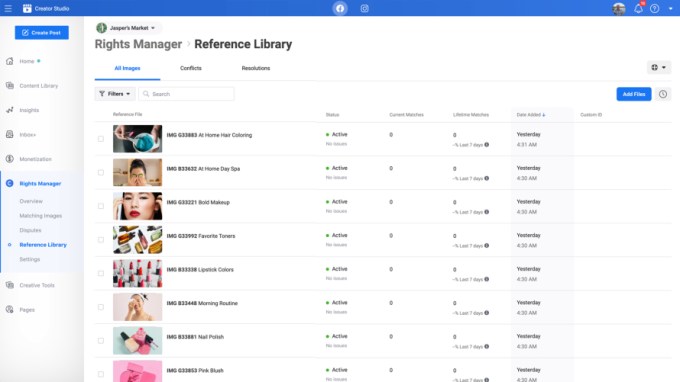
Facebook today is introducing a new tool that will allow rights holders to protect and manage their photos across both Facebook and Instagram. With the newly launched “Rights Manager for Images,” Facebook is offering creators and publishers access to content matching technology similar to what it introduced in 2016 to combat stolen videos. The new feature, which is available in Facebook’s Creator Studio, will allow rights owners to assert control over their intellectual property across Facebook and Instagram, including when the image is embedded on an external website.

As with Facebook’s existing Rights Manager for video content, creators who want to assert their control over their images will have to provide Facebook with a copy of the images they want to protect as well as a CSV file with image metadata, as a first step. These are uploaded to a reference library that Rights Manager uses to locate matches across both Facebook and Instagram.

The creator doesn’t have to publicly post their images on Facebook or Instagram for this process to work.

When matching content is found on a Page or a profile, the rights holder can choose whether to simply monitor the content, block its use through a takedown request, or attribute credit to themselves via an ownership link. Creators can also choose whether or not they want their ownership to apply worldwide or only in certain geographic locations.

Image Credits:

The new feature is designed more for those who maintain a large catalog of images or who post new content on a regular basis. For individuals who only occasionally encounter issues around misuse of their images, Facebook offers an IP reporting form instead, which even allows users to report more than one piece of matching content at a time.

The topic of who has the rights to use a photo that’s been posted on Facebook, and in particular, the image-heavy site Instagram, has become more controversial in recent months.

Many had long believed that embedding an Instagram post on their own website was a perfectly legal use case. But when Newsweek asked to feature a photographer’s image and they declined, the publication ran it as an embed, which then opened them up to a copyright lawsuit, filed this summer.

Newsweek had assumed the embed was legally permissible, given that Mashable recently won a similar copyright case in the recent past. But following the Newsweek case, Instagram clarified that its embedding feature didn’t include a license — if someone wanted to use the photo, they would need to ensure they had the proper license to do so. That bit of information came as something of a surprise and the case with Mashable was reopened as a result.

Until now, photographers had limited means of protecting their content across Facebook’s platforms. They could only take actions like enabling or disabling embedding entirely or making their account private, for example, to ensure their content wasn’t used and distributed without their permission. Of course, neither solution was ideal for a photographer trying to gain exposure and grow their career.

The Rights Manager for Images will now allow them a third option, as it’s capable of finding and matching images that have been used as embeds. At that point, the creator could choose to monitor, block or or allow the image as they choose, a Facebook spokesperson told TechCrunch.

Facebook says access to the new Rights Manager for Images will be opened up initially those who apply here.


Read Full Article

Microsoft commits to putting more water than it consumes back into the ecosystems where it operates by 2030


One good trend in 2020 has been large technology companies almost falling over one another to make ever-bolder commitments regarding their ecological impact. A cynic might argue that just doing without most of the things they make could have a much greater impact, but Microsoft is the latest to make a commitment that not only focuses on minimizing its impact, but actually on reversing it. The Windows-maker has committed to achieving a net positive water footprint by 2030, by which it means it wants to be contributing more energy back into environment in the places it operates than it is drawing out, as measured across all “basins” that span its footprint.

Microsoft hopes to achieve this goal through two main types of initiatives: First, it’ll be reducing the “intensity” of its water use across its operations, as measured by the amount of water used per megawatt of energy consumed by the company. Second, it will also be looking to actually replenish water in the areas of the world where Microsoft operations are located in “water-stressed” regions, through efforts like investment in area wetland restoration, or the removal and replacement of certain surfaces, including asphalt, which are not water-permeable and therefore prevent water from natural sources like rainfall from being absorbed back into a region’s overall available basin.

The company says that how much water it will return will vary, and depend on how much Microsoft consumes in each region, as well as how much the local basin is under duress in terms of overall consumption. Microsoft isn’t going to rely solely on external sources for this info, however: It plans to put its artificial intelligence technology to work to provide better information around what areas are under stress in terms of water usage, and where optimization projects would have the greatest impact. It’s already working towards these goals with a number of industry groups, including The Freshwater Trust.

Microsoft has made a number of commitments towards improving its global ecological impact, including a commitment from earlier this year to become ‘carbon negative’ by 2030. Meanwhile, Apple said in July that its products, including the supply chains that produce them, will be net carbon neutral by 2030, while Google made a commitment just last week to use only energy from carbon-free sources by that same year.


Read Full Article

Why I fight for climate justice | Xiye Bastida

Why I fight for climate justice | Xiye Bastida

In a deeply moving letter to her grandmother, Xiye Bastida reflects on what led her to become a leading voice for global climate activism -- from mobilizing school climate strikes to speaking at the United Nations Climate Summit alongside Greta Thunberg -- and traces her resolve, resilience and profound love of the earth to the values passed down to her. "Thank you for inviting me to love the world since the moment I was born," she says.

https://ift.tt/3kBj19B

Click this link to view the TED Talk

Illumina buying cancer-screening spinout Grail in blockbuster $8B biotech deal


Biotech has become one of the hottest areas of venture investment in recent years, as progress in machine learning, genetics, medical devices, and biology fuse together into new products for the gargantuan health industry.

Case in point: Grail, which began in 2016 as a spinoff from genetic sequencing giant Illumina and co-founded by longtime Google executive Jeff Huber (who was involved in the creation of the company’s experimental laboratory Google[x]), is now being spun back in to the tune of an $8 billion acquisition announced this morning.

Illumina originally invested $100 million in the spinout, and Grail would go on to raise more than a billion dollars in funding from prominent biotech firm ARCH, one of China’s top VCs Hillhouse Capital, among many others according to Crunchbase.

Grail’s technology was designed to use modern genetic sequencing tools coupled with data science to detect cancer earlier than other competing products on the market.

As we discussed on TechCrunch back in 2017 when the company raised $900 million, “while liquid biopsies to detect cancer aren’t anything new and GRAIL will have to compete with several other contenders both large and small, the technology to take a blood sample and detect the early, free-floating cancer DNA floating in your bloodstream is revolutionary in the industry and only made possible through new DNA sequencing machinery.”

Cancer screening is a $100 billion market and growing rapidly, particularly internationally as countries like China and India develop economically and more patients require active screening. Detecting cancer early is pivotal for reducing mortality risk, and so Grail’s promise was to offer the “holy grail” (couldn’t help myself) for saving these lives. According to the U.S. government, roughly 600,000 people will die this year from cancer, and it is a leading cause of death.

As part of the deal, Grail will receive $3.5 billion in cash, with another $4.5 billion earmarked for Illumina stock. The company set a deadline of December 20th for consummating the acquisition, at which point Illumina will begin offering Grail $35 million per month in cash payments until the deal closes. The two companies have signed a $315 million merger termination agreement as part of the deal.

The acquisition is subject to customary regulatory review.


Read Full Article

The Lumos Matrix is the ideal urban bike helmet for a smarter, safer day trip


With many of us are still more or less confined to our own homes and limited social spaces for the foreseeable future, and for a lot of you, that has led to a rediscovery of the joys of biking. Bike riding is a great way to spend time outdoors exploring your own town or city, and if you’re just getting into exploring this hobby, or if you’re a long-time bike rider looking for an upgrade, the Lumos Matrix smart helmet is a sensible piece of tech with a solid design that combines a number of connected features into one great package.

The basics

The Matrix is a version of Lumos’ smart helmet updated with modern, urban helmet aesthetics and a new large LED display on the back that can be programmed to show a variety of different patterns, including simple images. It includes a built-in front light in addition to the rear light panel, as well as integrated turn signals that work with an included physical handlebar remote, or in concert with an Apple Watch app. It’s available in either a gloss white finish, or a matte black (as reviewed).


Lumos has designed the Matrix to work with a wide range of head sizes, thanks in part to two sets of included velcro pads for the inside of the helmet, but due mostly to the adjustable, ratcheting sizing harness on the inside. This can be easily dialled to tighten or loosen the helmet, helping it fit heads ranging between 22 and 24-inches in size.

The exterior of the Lumos is made of an ABS plastic that provides full weatherproofing, so that you can wear it in the rain without having to worry about the condition of the embedded electronics. There’s also a MIPS (Multi-directional Impact Protection System) option that you can add on if you want an additional level of safety and security, though that’s not yet shipping and should be “available soon” according to the company.

A button integrated into the helmet’s strap lets you turn it on and off, and cycle between the built-in patters. You can pair the helmet via Bluetooth with your smartphone, too, and use the dedicated app to customize features including brightness, and even creating your own custom patterns for the rear display. In the box, you’ll also find a charging cable with a standard USB A connector on one end, and a proprietary magnetic charging surface on the other for powering up both your helmet and the handlebar remote.

Design and performance

The Lumos Matrix features a mostly continuous surface, with four vents on the top of the helmet for airflow, with an integrated brim built into the shell. As mentioned, there’s a front-facing light built-in to the helmet and protected by a transparent plastic covering, as well as a rear panel of 7×11 led lights, which create a dot matrix-style display that can display images or animations, including scrolling text. These LEDs are all full RGB, allowing the user to take full advantage for their own, or built-in display creations.

Lumos also makes the Kickstart, which features a more aerodynamic, thoroughly vented design. The look of the Matrix is more akin to helmets used in skateboarding, and for urban commuter bicyclists. Despite its more solid-looking design, in testing I found that it was actually very comfortable and cool, allowing plenty of airflow. The helmet sits a bit high on the head, but has ample hard foam padding and definitely feels like a solid piece of protective gear. Overall, the extreme quality of the construction and level of the finishes on the Matrix help it earn its higher price tag.

The Matrix is also comfortable, and the adjustable sizing straps ensure a snug fit that means the helmet won’t be shifting around at all while worn. The activation button located on the chin strap near your ear is easy to find and press, with a tactile response combined with an auditory signal so you’ll know it’s on. There’s also a built-in magnetic holder for the included two-button handlebar turn signal remote in the rear interior of the helmet itself, which is super useful when wearing the helmet out on errands.

In terms of the smart features, Lumos has created a very sensible set of defaults for the on-board lighting that make it easy to just turn on the helmet and get riding. The built-in patterns offer a range of options, but all do the job of increasing your visibility – and the bright lighting means that it adds to your ability to be seen by motorists, other cyclists and pedestrians even while you’re biking in bright daylight.

The customizability of the rear dot matrix display is also super handy. Even if you’re not interested in creating colorful designs to express your artistic self, you can use it for much more practical reasons – like displaying a simple scrolling message (ie. ‘biking with kids’) in order to alert anyone else around to reasons to pay heightened attention.

The included Lumos handlebar remote is paired out of the box, and is extremely reliable in terms of activating the turn signals on the helmet. Lumos’ smartwatch app was much more hit-or-miss for me in terms of recognizing my arm gestures reliably to automate the signalling, but that’s really a value-add feature anyway, and totally not necessary to get the full benefit of the helmet. The app’s integration with Apple Health for workout tracking while biking is also fantastic, and really adds to the overall experience of using the Matrix helmet.

Bottom line

The Lumos Matrix is a fantastic bike helmet, with an amazing integrated smart lighting system that’s both bright and highly customizable. There’s a reason this thing is carried at Apple Stores – it’s top quality in terms of construction, software integration and design. That said, its retail price starts at $249.95 – which is a lot when you consider that a good quality MIPS helmet without smart features will only set you back about $60 or so.

When you consider just how much technology is onboard the Matrix, however, the pricing becomes a lot easier to swallow. It’s true that dedicated lights also aren’t expensive, but the ones on the Matrix are very high quality and extremely visible in all lighting conditions. And the Matrix offers unique features you won’t find anywhere else, including active turn signals and automated brake lights, which really add to your ability to safely share the road with other cyclists and vehicles.


Read Full Article

With $100M in funding, Playco is already a mobile gaming unicorn


Playco is a new mobile gaming startup created by Game Closure co-founder Michael Carter and Zynga co-founder Justin Waldron, as well as game producers Takeshi Otsuka and Teddy Cross.

Although the Tokyo-headquartered company is only announcing its existence today, it’s already a unicorn — it says it’s raised $100 million in Series A funding, at a valuation “just north of $1 billion.”

The round was led by Josh Buckley and Sequoia Capital, with participation from Sozo Ventures, Raymond Tonsing’s Caffeinated Capital, Keisuke Honda’s KSK Angel Fund, Taizo Son’s Mistletoe Singapore, Digital Garage, Will Smith’s Dreamers, Makers Fund and others.

Carter (Playco’s CEO) said the startup will be revealing its first games later this year. For now, he wants to talk about Playco’s vision: It’s trying to address the fact that “it’s very difficult to get two people into a single game in the App Store.” After all, downloading an app is a pretty big hurdle, especially compared to the early days of web and social gaming, when all you needed was a link.

“We’re going to bring that back,” Carter said — with Playco’s titles, sharing and playing a mobile game with your friend should be as simple as texting or calling them. “All it really takes is a hyperlink.”

He pointed to a number of technologies that can enable this “instant play” experience on mobile, including cloud gaming, HTML5 and platform-specific tools like Apple’s new App Clips. He claimed the team is “very good at this cutting edge technology” — and the company has created its own game engine — but he said technology is not the sole focus: “That’s just table stakes.”

Waldron (Playco’s president) argued that this represents the next big platform shift in gaming, and it will require “reinventing a lot of the most popular genres today” while also creating entirely new genres, in the same way that social gaming enabled new types of games.

“If you think about FarmVille, there were no farm games being advertised being in local console games store,” Waldron said. “They don’t market well; if you put up a poster for a farm game, no one wants to play.” But if your friends invite you by sending you some digital crops, then you absolutely want to play.

Carter added that enabling instant play also means that the games themselves have to be fairly straightforward, at least at first glance.

“Ultimately, as we build up the portfolio, we think about what makes the game accessible to anyone on the planet, any ethnicity, any language,” he said. “And the answer is: It has to be broadly appealing. That doesn’t mean we can’t build into it relatively interesting and deep features, but the initial impression has to be the right sort of experience that people can easily relate to.”

Carter also acknowledged that it’s unusual for a startup to raise so much money in its Series A (“It’s not your typical company, and it’s not your typical Series A”), but he said that being more ambitious with fundraising allowed Playco to quickly grow the team to 75 people.

“Bringing talented people together is the most important thing, and [thanks to the funding,] we haven’t had to make any really hard decisions,” he said.

As for how its games will make money, Waldron suggested that Playco will borrow from (but also potentially evolve) many of the existing business models in gaming.

“We don’t need to reinvent the wheel,” he said. “There’s going to be amazing things we can learn from my last company — we ended up inventing a lot of the ways these games are monetizing today … But these new technologies available today create new opportunities. The world has changed a lot since then, and I don’t think everything has caught up.”


Read Full Article

Ireland’s data watchdog slammed for letting adtech carry on ‘biggest breach of all time’


A dossier of evidence detailing how the online ad targeting industry profiles Internet users’ intimate characteristics without their knowledge or consent has been published today by the Irish Council for Civil Liberties (ICCL), piling more pressure on the country’s data watchdog to take enforcement action over what complainants contend is the “biggest data breach of all time”.

The publication follows a now two-year-old complaint lodged with Ireland’s Data Protection Commission (DPC) claiming unlawful exploitation of personal data via the programmatic advertising Real-Time Bidding (RTB) process — including dominant RTB systems devised by Google and the Internet Advertising Bureau (IAB).

The Irish DPC opened an investigation into Google’s online Ad Exchange in May 2019, following a complaint filed by Dr Johnny Ryan (then at Brave, now a senior fellow at the ICCL) in September 2018 — but two years on that complaint, like so many major cross-border GDPR cases, remains unresolved.

And, indeed, multiple RTB complaints have been filed with regulators across the EU but none have yet been resolved. It’s a major black mark against the bloc’s flagship data protection framework.

“September 2020 marks two years since my formal complaint to the Irish Data Protection Commission about the “Real-Time Bidding” data breach. This submission demonstrates the consequences of two years of failure to enforce,” writes Ryan in the report.

Among hair-raising highlights in the ICCL dossier are that:

  • Google’s RTB system sends data to 968 companies;
  • that a data broker company which uses RTB data to profile people influenced the 2019 Polish Parliamentary Election by targeting LGBTQ+ people; 
  • that a profile built by a data broker with RTB data allows users of Google’s system to target 1,200 people in Ireland profiled in a “Substance abuse” category, with other health condition profiles offered by the same data broker available via Google reported to include “Diabetes”, “Chronic Pain”, and “Sleep Disorders”;
  • that the IAB’s RTB system allows users to target 1,300 people in Ireland profiled in a “AIDS & HIV” category, based on a data broker profile build with RTB data, while other categories from the same data broker include “Incest & Abuse Support”, “Brain Tumor”, “Incontinence”, and “Depression”;
  • that a data broker that gathers RTB data tracked the movements of people in Italy to see if they observed the Covid-19 lockdown;
  • that a data broker that illicitly profiled Black Lives Matters protesters in the US has also been allowed to gather RTB data about Europeans;
  • that the industry template for profiles includes intimate personal characteristics such as “Infertility”, “STD”, and “Conservative” politics;

Under EU data protection law, personal information that relates to highly sensitive and intimate topics — such as health, sexuality and politics — is what’s known as special category personal data. Processing this type of information generally requires explicit consent from users — with only very narrow exceptions, such as for protecting the vital interests of the data subjects (and serving behavioral ads clearly wouldn’t meet such a bar).

So it’s hard to see how the current practices of the targeted ad industry can possibly be compliant with EU law, in spite of the massive scale on which Internet users’ data is being processed.

In the report, the ICCL estimates that just three ad exchanges (OpenX, IndexExchange and PubMatic) have made around 113.9 trillion RTB broadcasts in the past year.

“Google’s RTB system now sends people’s private data to more companies, and from more websites than when the DPC was notified two years ago,” it writes. “A single ad exchange using the IAB RTB system now sends 120 billion RTB broadcasts in a day, an increase of 140% over two years ago when the DPC was notified.”

“Real-Time Bidding operates behind the scenes on websites and apps. It constantly broadcasts the private things we do and watch online, and where we are in the real-world, to countless companies. As a result, we are all an open book to data broker companies, and others, who can build intimate dossiers about each of us,” it adds. 

Reached for a response to the report, Google sent us the following statement:

We enforce strict privacy protocols and standards to protect people’s personal information, including industry-leading safeguards on the use of data for real-time bidding. We do not allow advertisers to select ads based on sensitive personal data and we do not share people’s sensitive personal data, browsing histories or profiles with advertisers. We perform audits of ad buyers on Google’s ad exchange and if we find breaches of our policies we take action.

We also reached out to the IAB Europe for comment on the report. A spokeswoman told us it would issue a response tomorrow.

Responding to the ICCL submission, the DPC’s deputy commissioner Graham Doyle sent this statement: “Extensive recent updates and correspondence on this matter, including a meeting, have been provided by the DPC. The investigation has progressed and a full update on the next steps provided to the concerned party.”

However in a follow up to Doyle’s remarks, Ryan told TechCrunch he has “no idea” what the DPC is referring to when it mentions a “full update”. On “next steps” he said the regulator informed him it will produce a document setting out what it believes the issues are — within four weeks of its letter, dated September 15.

Ryan expressed particular concern that the DPC’s enquiry does not appear to cover security — which is the crux of the RTB complaints, since GDPR’s security principle puts an obligation on processors to ensure data is handled securely and protected against unauthorized processing or loss. (Whereas RTB broadcasts personal data across the Internet, leaking highly sensitive information in the process, per earlier evidence gathered by the complainants.)

He told TechCrunch the regulator finally sent him a letter, in May 2020, in response to his request to know what the scope of the inquiry is — saying then that it is examining the following issues:

  • Whether Google has a lawful basis for processing of personal data, including special category data, for the purposes of targeted advertising via the Authorised Buyers mechanism and, specifically, for the sourcing, sharing and combining of the personal data collected by Google with other companies / partners;
  • How Google complies with its transparency obligations, particularly with regard to Art. 5(1), 12, 13 and 14 of the GDPR;
  • The legal basis / bases for Google’s retention of personal data processed in the context of the Authorised Buyers mechanism and how it complies with Article 5(1)(c) in respect of its retention of personal data processed through the Authorised Buyers mechanism;

We’ve asked the DPC to confirm whether its investigation of Google’s adtech is also examining compliance with GDPR Article 5(1)f and will update this report with any response.

The DPC did not respond to our question about the timing for any draft decision on Ryan’s two-year-old complaint. But Doyle also pointed us to work this year around cookies and other tracking technologies — including guidance on compliant usage — adding that it has set out its intention to begin related enforcement from next month, when a six-month grace period for industry to comply with the rules on tracking elapses.

The regulator also pointed to another related open enquiry — into adtech veteran Quantcast, also beginning in May 2019. (That enquiry followed a submission by privacy rights advocacy group, Privacy International.)

The DPC has said the Quantcast enquiry is examining the lawful basis claimed for processing Internet users’ data for ad targeting purposes, as well as considering whether transparency and data retention obligations are being fulfilled. It’s not clear whether the regulator is looking at the security of the data in that case, either. A summary of the scope of Quantcast enquiry in the DPC’s annual report states:

In particular, the DPC is examining whether Quantcast has discharged its obligations in connection with the processing and aggregating of personal data which it conducts for the purposes of profiling and utilising the profiles generated for targeted advertising. The inquiry is examining how, and to what extent, Quantcast fulfils its obligation to be transparent to individuals in relation to what it does with personal data (including sources of collection, combining and making the data available to its customers) as well as Quantcast’s personal data retention practices. The inquiry will also examine the lawful basis pursuant to which processing occurs.

While Ireland remains under huge pressure over the glacial pace of cross-border GDPR investigations, given it’s the lead regulator for many major tech platforms, it’s not the only EU regulator accused of sitting on its hands where enforcement is concerned.

The UK’s data watchdog has similarly faced anger for failing to act over RTB complaints — despite acknowledging systematic breaches. In its case, after months of regulatory inaction, the ICO announced earlier this year that it had ‘paused ‘its investigation into the industry’s processing of Internet users’ personal data — owing to disruption to businesses as a result of the COVID-19 pandemic.


Read Full Article

JavaPipe Web Hosting 101: How To Choose The Best One For Your Business Needs


A web hosting service is a kind of Internet-based service that enables organizations to create their own website on the Internet. This service can be very useful to a business or organization as it provides the services and features needed for running and maintaining a website. It also enables you to store your files on […]

The post JavaPipe Web Hosting 101: How To Choose The Best One For Your Business Needs appeared first on ALL TECH BUZZ.


Benefits of Self-service Car Wash Technology


We all like to keep our cars in good condition. And one good way to do that is by visiting the car wash regularly. However, you may want to save some money by washing your car on your own. It is good, but the downside is that you may not have the proper equipment required […]

The post Benefits of Self-service Car Wash Technology appeared first on ALL TECH BUZZ.


Thanks to Google, app store monopoly concerns have now reached India


Last week, as Epic Games, Facebook, and Microsoft continued to express concerns about Apple’s “monopolistic” hold over what a billion people can download on their iPhones, a similar story unfolded in India, the world’s second largest internet market, between a giant developer and the operator of the only other large mobile app store.

Google pulled Paytm, the app from India’s most valuable startup, off of the Play Store on Friday. The app returned to the store eight hours later, but the controversy and acrimony Google has stirred up in the country will linger for years.

TechCrunch reported on Friday that Google pulled Paytm app from its app store after a repeat pattern of violations of Google Play Store guidelines by the Indian firm.

Paytm, which is locked in a battle against Google to win India’s payments market, has been frustrated at Google’s policies — which it argues gives Google an unfair advantage — for several past quarters over how the Android-maker is limiting its marketing campaigns to acquire new users, sources familiar with the matter told TechCrunch.

The explanation provided by Google to Paytm for why it pulled the Indian firm’s app this week from its app store is the latest attempt by the company to thwart the Noida-headquartered firm’s ability to acquire new users, Paytm executives said.

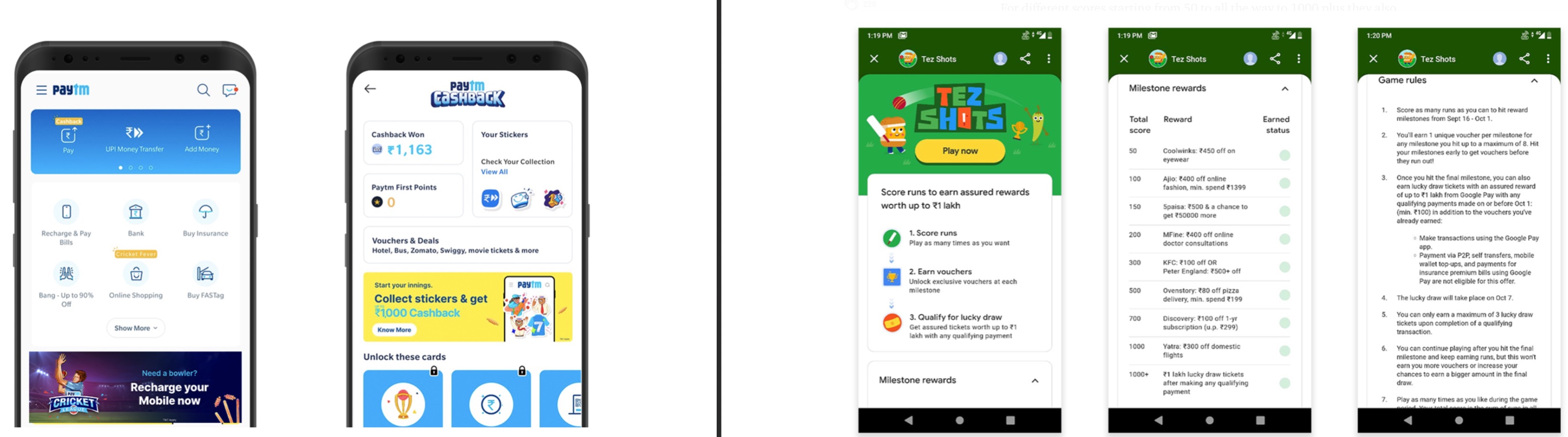
In a blog post Paytm posted Sunday evening (local India time), the Indian firm said Google took issue with the company for giving customers cashbacks and scratch cards for initiating transactions over UPI, a government-backed payments infrastructure in India that has become the most popular way for people to exchange money digitally in the country.

Paytm said it rolled out this new version of scratch cards that are linked to cricket on September 11. Users collected these cricket-themed stickers for sending money to others, or making transactions such as topping up credit on their phone or paying their broadband or electricity bill.

In a statement on Sunday evening, a Google spokesperson said, “offering cashbacks and vouchers alone do not constitute a violation of our Google Play gambling policies” and that Play Store “policies are applied and enforced on all developers consistently.”

But it’s arguably anything but consistent.

On September 18, Google told Paytm that it had pulled its app for not complying with Play Store’s “gambling policy” as it offered games with “loyalty points.” Paytm said that Google had not expressed any concerns over Paytm’s new marketing campaign prior to its notice on Friday, in which it revealed that Paytm app had been temporarily removed from the Play Store.

But Google itself is running a similar campaign linked to cricket in India, Paytm argues. (Why cricket? Cricket is immensely popular in India and one of the biggest cricket tournaments globally, Indian Premier League, kicked off its latest season on Saturday.)

Cricket-themed cashback offered by Paytm (left) and Google Pay (right) in India

Google Play Store in India has long prohibited apps that promote gambling such as betting on sporting events, and Google has raised concerns about Paytm’s marquee app promoting Paytm First Games, a fantasy sports app run by Paytm, in the past.

Paytm executives argued that PhonePe, a Walmart-owned payments app in India, also promoted Dream11, the most popular fantasy sports app in the country, and got away without any action.

Google also permits fantasy sports app operators — including Paytm — to advertise on Search in India.

“This is bullshit of a different degree,” Paytm chief executive Vijay Shekhar Sharma said of Google’s objection to Paytm offering cashback in a televised interview Friday. The removal of Paytm app was only on the grounds of Paytm offering cricket-themed cashback, he claimed. “Google is not allowing us to acquire new customers right now. That’s all what this is,” he added.

Google’s payments app, Google Pay, competes with Paytm in India. In fact, Google Pay is the largest payments app for peer-to-peer transaction between users in India and holds the largest market share in UPI.

Without identifying any names, Sharma, the poster child of Indian startup ecosystem, claimed that many founders in India have just accepted that it is Google that has the final say on any matter in India — and not the country’s regulatory agencies.

For Google, which reaches more users than any other company in India and whose Android operating system commands 99% of the local smartphone market, this kind of accusation is exactly what it needs to avoid in the country. The Silicon Valley search and advertising giant has launched a charm offensive in India, including a recently commitment to invest $10 billion — more than any other American or Chinese technology firm.

The timing for Google’s parent company, Alphabet, couldn’t be worse. Google is currently the subject of an antitrust complaint in India over an allegation that it has abused its market position to unfairly promote its mobile payments app in the country; and in the U.S., Congress has intimidated that it may pursue antitrust regulatory action against Alphabet and Apple over app store concerns.

In India, Google’s moves could have a devastating impact on businesses and everyday consumers.

Paytm is not just a payments app. It is also a fully licensed digital bank. And just an eight-hour of absence from the Play Store created a panic among a portion of its users. A source familiar with the matter told TechCrunch that Paytm saw several people withdraw their fixed deposit in Paytm Payments Bank on Friday.

Anecdotally, TechCrunch heard of instances where vendors who previously preferred Paytm for accepting money digitally asked their customers to use a different payments method as they had heard that Paytm was “banned” in India.

Sharma said Google’s monopoly on Indian app ecosystem is of a magnitude unparalleled elsewhere in the world.

“If paying someone and getting a cashback is gambling, then the same rule should be applied to everyone,” said Sharma. “It’s disgraceful that we are standing here at the cusp of an internet revolution in India and we are being sanctioned by companies that are not governed by the law of this country.”

If this sentiment gained traction in India it could create challenges for Google’s future in the world’s second largest internet market.

Meanwhile, the U.S. is forcing a Chinese company to sell stakes to local firms to continue operations in the country. In a recent episode of Dithering podcast, Ben Thompson cautioned that Trump administration’s move — which some have argued is a long due tit for tat against Chinese companies (as China has long prevented U.S. firms from meaningfully operating in the world’s largest  internet market) — might encourage other open markets to do to American firms what it is doing to TikTok.

Several U.S. tech executives share these concerns.

“I’ve said this before, but a US TikTok ban would be quite bad for Instagram, Facebook, and the internet more broadly,” Instagram chief executive Adam Mosseri tweeted earlier this week. “If you’re skeptical keep in mind that most of the people who use Instagram are outside the US, as is most of our potential growth. The long term costs of moods countries making aggressive demands and banning us over the next decade outweigh slowing down one competitor today.”

India, which Google, Facebook, and many other tech giants count as their biggest market by users, has made several proposals in the past three years — including mandates that foreign firms store payments information of users locally in India and companies help local enforcement agencies identify the originator of questionable messages circulating on their platforms — that are widely seen as protectionist moves.

And India is not even that open anymore. New Delhi has also banned more than 200 Chinese apps including TikTok, UC Browser, and PUBG Mobile citing cybersecurity concerns in recent months. India has not made public what those cybersecurity concerns are and in its orders acknowledged that users had expressed concerns.

Enough noise against a foreign firm might just be enough to face an avalanche of serious troubles in India.


Read Full Article

Original Content podcast: ‘Wireless’ shows off Quibi’s Turnstyle technology


“Wireless” is probably the best showcase so far for Quibi’s Turnstyle technology.

That’s the technology that allows the streaming video app to switch seamlessly between landscape and portrait mode depending on the orientation of your phone. With other Quibi shows, you’re essentially getting two views of the same footage — but with “Wireless” (which is executive produced by Steven Soderbergh), you’re switching between traditional cinematic footage (in landscape) and a view of the protagonist’s phone (in portrait).

In this bonus episode of the Original Content podcast, director Zach Wechter told me that he and his co-writer Jack Seidman wrote the initial script — about a college student played by Tye Sheridan who gets trapped in the snow after a car crash, with only his iPhone to save him — before they decided on the phone-centric format. But when they heard about Turnstyle, “It just felt like a match made in heaven that would allow us to facilitate this idea.”

I wondered whether that required going back and adding a bunch of phone interactions to the story, but said Wechter said, “It was quite the opposite. One thing we found in testing was when the phone plot moved really fast, it would be hard, because there are these two perspectives happening at once.”

So that actually meant “reducing some fo the intriacy of the plot happening on the phone” to ensure that viewers didn’t get lost.

And if you’re wondering which mode to focus on as you watch, Wechter has some simple advice: “Go with your gut.” He said he had a “roadmap” for when he was hoping to nudge viewers to turn their phones — like when there’s a notification sound or Sheridan focuses on his phone — “but I think the most important part of the experience is that we’re not indicating when our viewers turn, that it becomes this sort of passive-but-active viewing experience.”

Wechter described making the show — essentially a feature length film divided into episodes of 10 minutes or less — as shooting “two films that had to dance together” in just 19 days. And he made things even more challenging by insisting that all the phone/FaceTime calls and even the text messages be filmed live, rather than just recording both ends separately.

“When I think about directing and my job, really the most fundamental part of it to me is making the actorss comfortable, and I think that having a scene partner is paramount,” he said. “It was a long conversation about why we couldn’t just have them act off of a recording and shoot it separately — because it took a lot of logistical effort and resources to do it — but it really makes the scenes feel very alive and realistic.”

You can listen to the full interview in the player below, subscribe using Apple Podcasts or find us in your podcast player of choice. If you like the show, please let us know by leaving a review on Apple. You can also follow us on Twitter or send us feedback directly. (Or suggest shows and movies for us to review!)


Read Full Article

20 September 2020

What Should Beginners Keep in Mind When Playing at An Online Casino


If you are a beginner in the world of digital gambling, then there is a lot that you need to learn. There is a variety of digital games in online casinos for virtual gambling which might seem a bit overwhelming initially, but as one explores different options and set particular interests, it gets into a […]

The post What Should Beginners Keep in Mind When Playing at An Online Casino appeared first on ALL TECH BUZZ.