27 August 2020

Amazon debuts Halo smart health subscription service and Halo Band wearable activity tracker


Amazon has introduced an entirely new membership program called Halo today that aims to provide comprehensive personal health and wellness monitoring and advice. The Halo service, which is opening to early access by special request today, includes both the service and a new Amazon Halo Band wristworn activity tracker for $64.99 for a six-month membership. Amazon says that the standard public price of the same will be $99.99 once it’s more generally available.

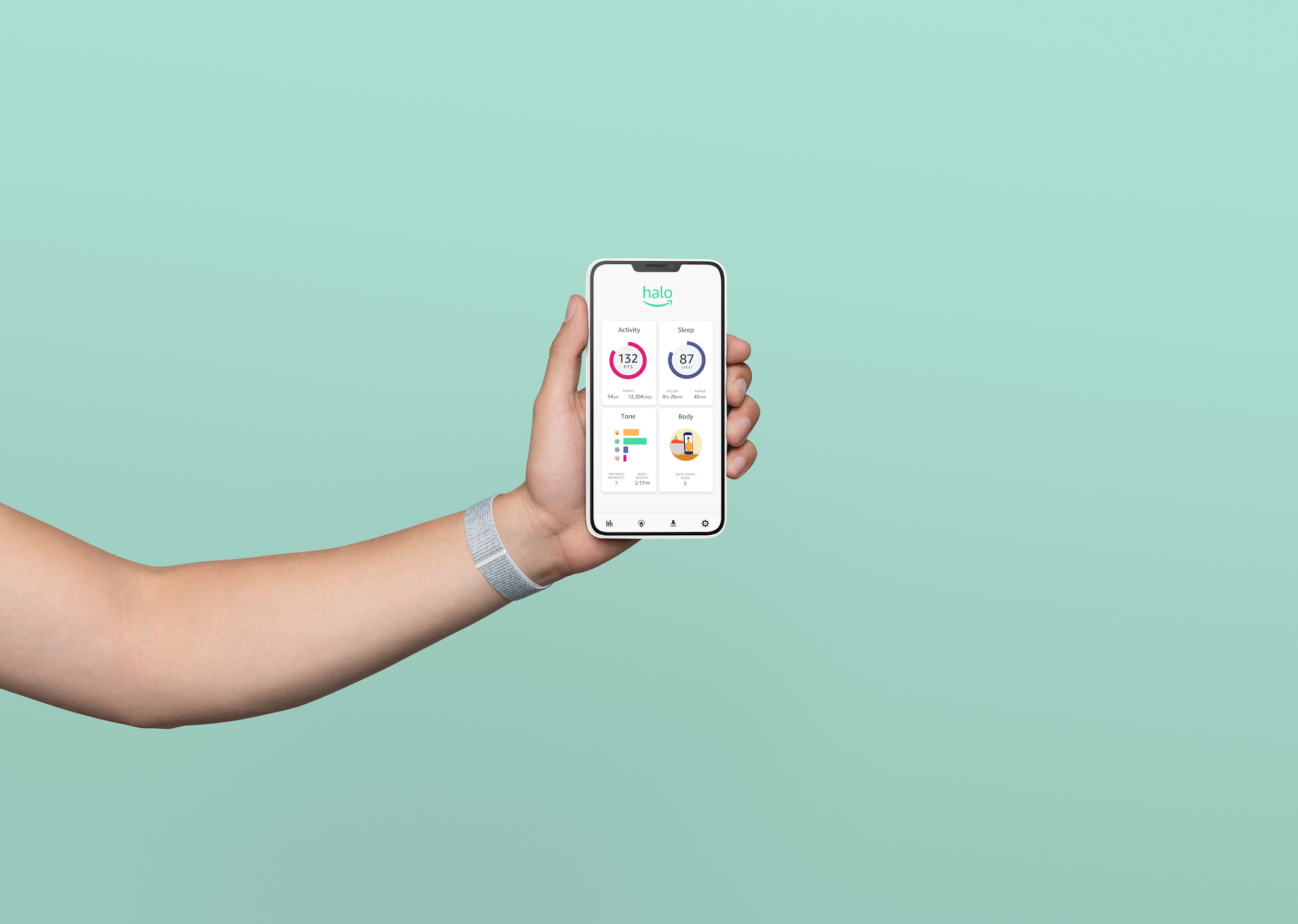
Halo looks to offer more than your standard health tracking gadget/app combo, by taking a comprehensive look at various measures of health, including body fat percentage, as measured at home with just your smartphone’s own camera and the Amazon Halo app. The company says that it was able to make this possible using its own advances in computer vision and machine learning. Amazon employes deep neural network-based processing of your uploaded photos to separate your body from its surroundings, analyze so-called body fat “hot spots” where it’s easier to measure body fat percentage, and then generates a 3D model of your body. You can then use a slider to adjust your body fat percentage up or down to see what kind of impact gaining or losing body fat would actually have on your physique.

Image Credits: Amazon

Amazon claims that its technology is able to provide accuracy up to the standards of what a doctor would be able to determine in a clinical setting – and as much as twice as accurate as is currently possible using other at-home methods, including smart scales.

Meanwhile, the Amazon Halo Band is a small, sleek wristworn device that can capture other measures of health, including activity, skin temperature, sleep states (including REM, light and deep sleep). It has an accelerometer, a heart rate monitor, two microphones, and it’s water resistant. The built-in battery can last up to a fully week on a 90 minute charge, and it’s compatible with a range of different band accessories for switching style.

Another unique vector that Amazon is measuring on top of activity, sleep and body fat percentage is wha tit’s calling “Tone” – that’s why there are microphones on board the Halo Band. That monitors your voice, and applies machine learning to determine factors including “energy and positivity.” Amazon says this will allow them to provide unique insights like whether “a difficult work call leads to less positivity in communication with a customer’s family,” for instance.

Image Credits: Amazon

The blatant, obvious concern here is that Amazon Halo seeks unprecedented access to a person’s personal data in order to derive its insights. Amazon is looking to collect information about the time, lengthy and quality of your sleep; biometric data including your heart rate and body temperature; information about when you exercise and where; and even highly accurate and detailed info about your body’s physical makeup – not to mention how your voice sounds and what that might indicate about your mental state.

Amazon says in a release about Halo that both Halo and Body were built with “privacy in mind,” and that body scans are automatically deleted from any servers where they’re stored after they’re processed. They’re then stored only locally on your phone, and Amazon says this means “no one but you ever sees them” unless you opt to share them. Further, it says all health data “is encrypted in transit and in the cloud,” with customers able to delete their data at any time. As for voice and speech data, Amazon says that these are analyzed locally on the phone itself and then immediately deleted after processing, so that no one ever hears them – including them customer themselves.

Image Credits: Amazon

Even so, this is handing a lot of trust and information to Amazon, and while the raw data may be protected, the insights gathered, even if anonymized, obviously stand to offer Amazon a lot more value in terms of its ability to tune its overall product offerings and create additional opportunities for things like its bourgeoning healthcare business. That said, Amazon’s Alexa voice assistant and ecosystem hasn’t seemed to deter customers, so it’ll be interesting to see how many are open to sharing even more info with Amazon in exchange for guided health and wellness advice.


Read Full Article

Christopher Ward’s C1 Moonglow moonphase automatic watch is perfect for space lovers


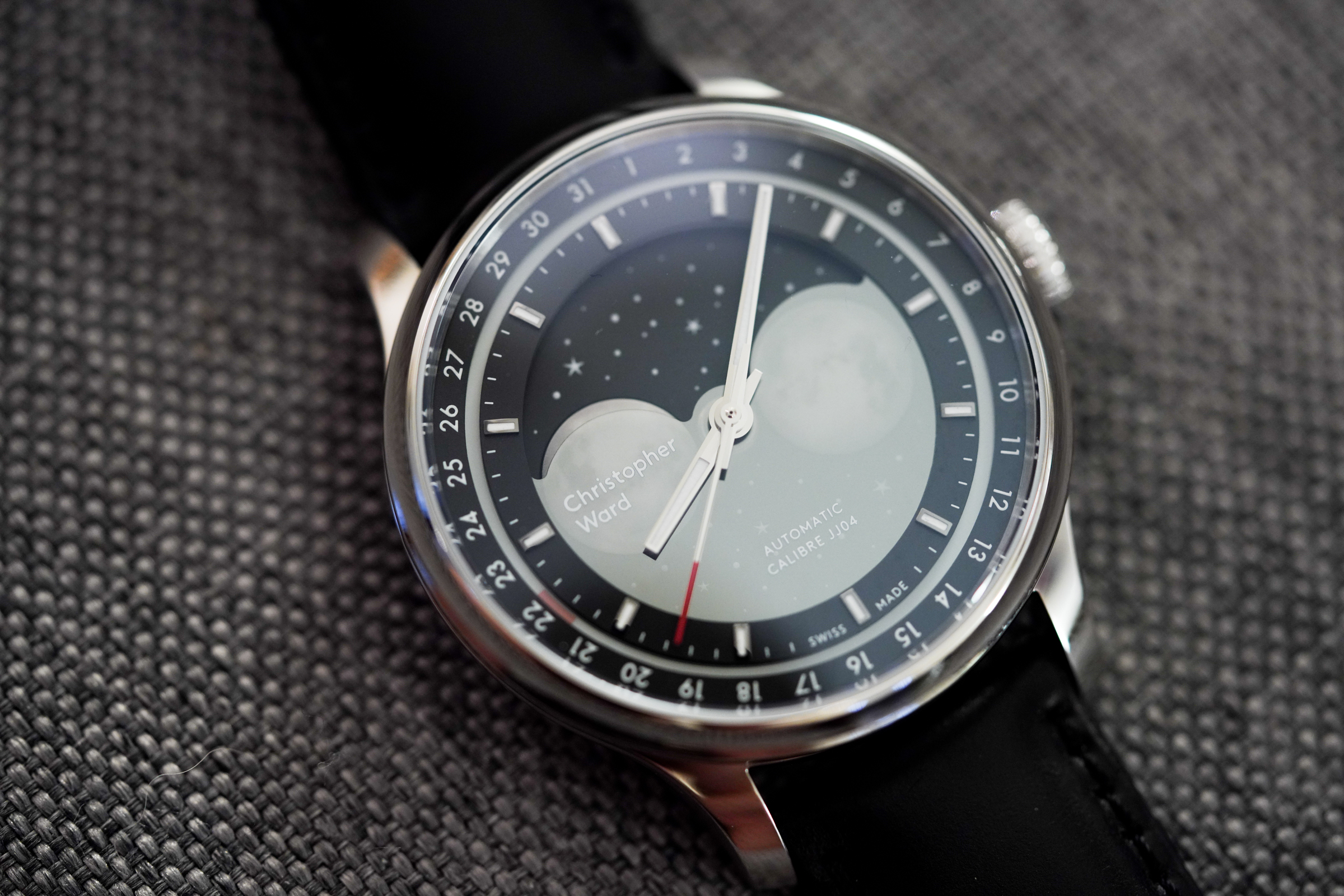
The moonphase watch is a long-standing marvel of the analog watch industry – featuring a complication that allows it to accurately track the phases of the Moon across a long period (provided the watch remains wound). Christopher Ward’s C1 Moonglow ($1,995) is a fresh, contemporary take on a moonphase that that really puts the Moon front and center, in a design that’s equally comfortable on the wrist for everyday wear, in the boardroom, or at a formal event. Its unique design is also sure to please anyone who likes to watch the stars, and the bourgeoning private launch industry that’s reaching out to them.

The basics

The C1 Moonglow features a version of Selita’s reliable SW220 automatic movement with that includes an in-house moonphase modification. The in-house customization does more than just add moonphase tracking – UK-based Christopher Ward has made it possible for the moonphase feature to work continually, rather than simply flipping once per day, as do most off-the-self versions of this complication. That’s what enables the Moon graphic details on the face to move smoothly across the surface of the watch, while providing accurate phase tracking for a span of up to 128 years according to the company.

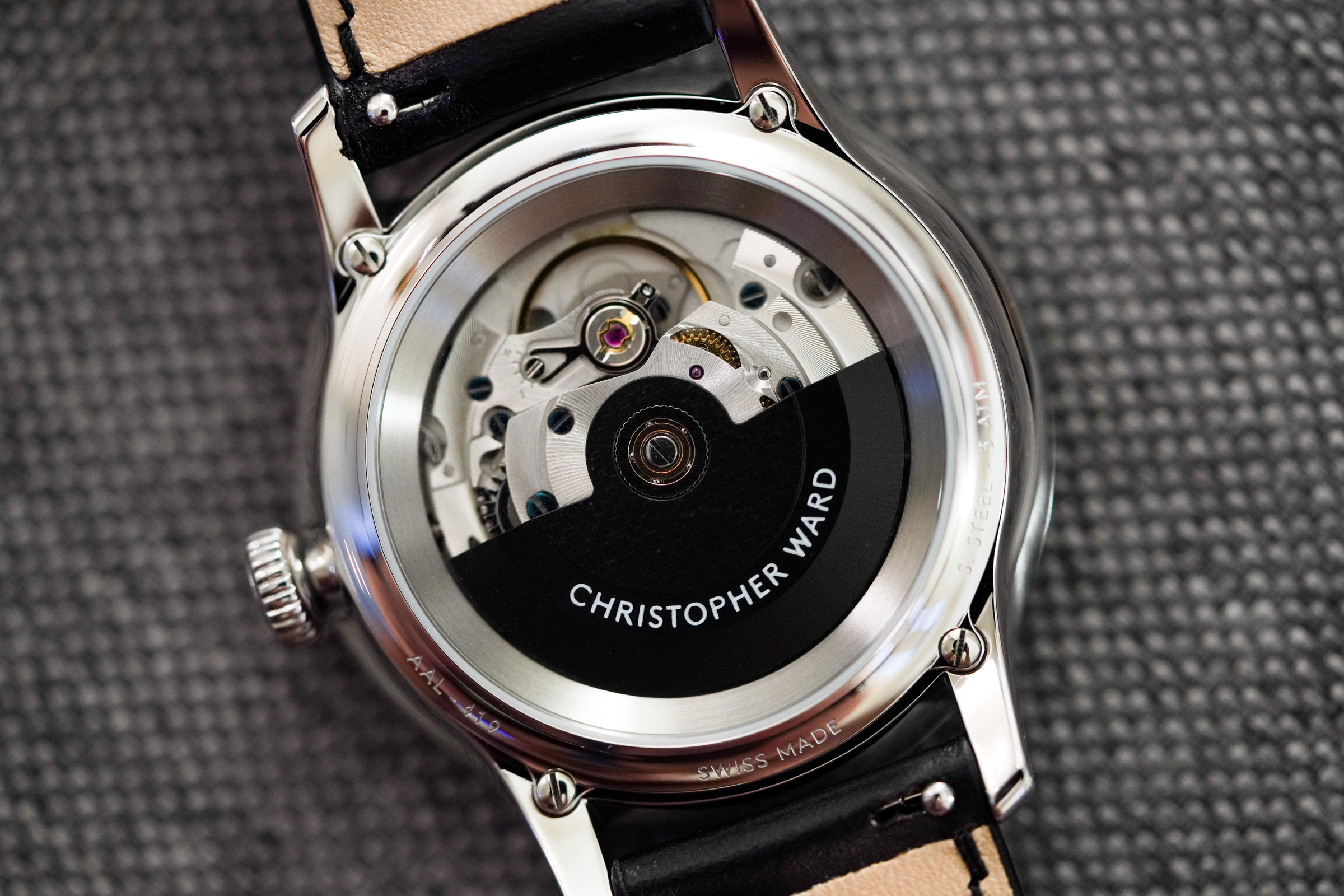
The C1 also includes a calendar complication, which occupies the outer ring of the watch face and uses a sub-dial red highlight to mark the date. The watch measures 40.5 mm on the wrist, with a primarily black dial and a polished stainless steel case. It’s 12.35mm thick, and spans 48.55mm lug-to-lug. The automatic movement is wound with a custom Christopher Ward rotor that’s finished in black with a diamond-like carbon (DLC) coating, and the moment is 26 jewels with a 38 hour power reserve when fully wound. The included strap is a black Italian shell cordovan leather, with a deployant clasp.

Design and features

The key to the C1 Moonglow’s unique design is the custom moonphase dial, which features two incredibly detailed, 3D-textured images of the Moon. These are positioned opposite one another on the dial, and provide the phase indication as they peak above a smoked aperture limiter that spans the bottom half of the watch face. Depending on lighting conditions, this can either appear pretty much entirely opaque, or mostly translucent, and it’s a fantastic detail that also allows the top-grade Super-LumiNova lime applied to the Moon graphics to shine through at night.

The moonphase indicator dial also includes scattered stars, a touch that elevates this to the level of being somewhat playful while retaining the utmost class and sophistication. The stars are also luted, as are the watch hands, hour markers and date ring. The stacking off all these layers, and the textured surface of the hour ring, along with a white border ring between it and the date dial, give the watch an excellent amount of depth, but it’s still not a chunky or large watch on the wrist at a very reasonable 40.5mm size and just over 12mm height.

The caseback of the C1 Moonglow is also impressive, providing a great view of the in-house customized movement and coated rotor. A fairly aggressive bevel in from the watch case side means that the exhibition sapphire window seems to take up almost all of the back of the watch, and helps minimize the visual height of the C1 when viewed from the side.

Setting the moonphase is very easy, and accomplished by pulling the crown to its second position and turning it counter-clockwise. Clockwise sets the date, but you can adjust both independently and also independently of the time. Getting the phase accurate can be a bit tricker, but Christopher Ward provides easy instructions in the included manual – or you can use an app like Watchville which provides a very handy and highly accurate virtual watch face with moonphase to set your analog by.

Bottom line

As one of the most consistent and admired microbrand watchmakers out there, Christopher Ward has a great reputation for delivering interesting timepieces. The C1 Moonglow is among the most unique and appealing of its offerings, providing a tremendous amount of value for a watch with a custom-modified in-house movement and a moonphase complication. Best of all, it sports a stunning visual design that’s sure to turn heads – and maybe even distract some skywatchers from their telescopes and observatories.


Read Full Article

How to Send HTML Emails with Gmail


This tutorial describes how you can easily send HTML emails in Gmail without using any extensions. You can format your Gmail messages to include tables, buttons, custom fonts, social media icons, wrap images around text, and more. A little knowledge of HTML and CSS will come handy but it is not a pre-requisite.

The built-in WYSIWYG editor of Gmail offers basic formatting options - you can make text bold, create lists, change font colors - but that’s pretty much it. There’s no option to insert custom HTML into the message body that is required to send rich emails though Gmail.

Write HTML Emails Directly in Gmail

Let’s start with some basic examples and then we move on to more advanced example where you’ll learn how to send email newsletters that were created separately inside MailChimp.

Insert Buttons in Gmail

This HTML snippet creates a beautiful call-to-action button with a blue background, slightly rounded edges and rendered in the popular Roboto font.

<a
  href="https://digitalinspiration.com/"
  style="background-color:#1a73e8; padding:10px 20px;
         color: white; text-decoration:none; font-size:15px;
         font-family:Roboto,sans-serif; border-radius:5px;
         display:block; margin:20px 0; width: 120px"
  >Explore our work
</a>

We cannot copy-paste this HTML directly into the email editor of Gmail but with the magic of Chrome Dev Tools, we can. Let’s see how:

Open gmail.com and compose a new email message. Add an emoji in the message body to be replaced with the HTML button. Right-click the emoji in the Gmail editor and choose Inspect.

This opens the Developer tools in the bottom half of the browser. Select the <img> tag that contains the emoji, right-click and choose Editor HTML. Replace the selected content with the button HTML and click anywhere outside the dev tools window.

You’ll now see a beautiful HTML button rendered in your email message with all the CSS styles and formatting. Watch the video for a more detailed tutorial.

Insert HTML in Gmail

Insert HTML Tables in Gmail

In the next example, we will embed an HTML table in the Gmail editor. Unlike our button above that had all styles inlined, the CSS of the table is contained in a separate stylesheet.

Therefore, prior to pasting the pasting the table HTML into Gmail, we need to “inline” the styles else the formatting will be ignored by Gmail. This can be easily done through Juice - simply paste the HTML and CSS in the input box and it will inline all the CSS styles in the HTML tags that is compatible with Gmail.

Gmail with Inline CSS

Send Email Newsletters with Gmail

Until now we have seen examples of adding basic HTML blocks inside Gmail but wouldn’t it be nice if we could send professional and responsive email newsletters through Gmail?

Design Email Newsletter for Gmail

If you are new, the term responsive essentially means that the styles change automatically based on the device of the user. So if someone is viewing the email on a mobile phone, they would see a different layout than a person who has opened your email on a desktop computer.

You can use MailChimp or any other email template designer to create the newsletter. The only requirement is that the tool should have an option to download the designs as an HTML file.

You can feed this HTML file into Juice to inline the CSS styles and then insert the transformed HTML into Gmail using the emoji trick. The draft email newsletter can also be used as a template for sending personalized emails with Mail Merge.


Fairphone’s new flagship, the 3+, costs just €70 as a modular upgrade


Dutch social enterprise, Fairphone, has moved a little closer to the sustainability dream of a circular economy by announcing the launch of a modular upgrade for its flagship smartphone.

The backwards compatible hardware units mean users of last year’s Fairphone 3 only need swap out a few modules to be holding the Fairphone 3+ in their hand instead of buying a whole new device.

Fairphone pulled off a similar feat with an earlier model of its ‘ethical smartphone’ but this time it’s managed to shrink the time it took it to offer ‘plug and play’ upgrade modules for its latest gen device.

“What we’ve been able to do is get that whole idea of plug and play to the consumer within the smartphone business,” says Fairphone co-founder Bas van Abel. “That part is not trivial because you have to imagine that getting everything into that module and being able to put it into the old phone… Not only the hardware has to fit and everything has to connect in the right way in that previous kind of architecture but also the software.

“But we’ve been able to do that, and it took some time but we’ve done it way faster than we were able to do it with the Fairphone 2. So we’re proud of that as well.”

“The most important part is it’s really also a signal towards the industry that it’s possible to do upgrades with your phone and not have to come out with a totally new phone every year,” he adds.

Finding clever ways to extend device longevity is a core plank of Fairphone’s mission. The biggest resource sinkhole associated with smartphone consumption is the annual or biennial upgrade cycle which encourages consumers to swap perfectly functional phones for a shiny new model. Fairphone 3 owners can get its latest kit with a cleaner conscience.

Fairphone is selling the Fairphone 3+ camera and audio modules separately for current Fairphone 3 users — at an initial cost of €70 until the end of September (rising to ~€95 from October).

It is also selling a Fairphone 3+ handset for an RRP of €469, aimed at new to the brand users — opening up pre-sales from today on its website and via partner retailers, with a release date of September 14 across Europe.

Specs wise, the 4G Fairphone 3+ has a 5.7in Full-HD display with an 18:9 aspect ratio and is powered by a Qualcomm Snapdragon 632 chipset. Out of the box it runs Android 10. On board there’s 4GB of RAM and 64GB of ROM, expandable via microSD. The removable battery is 3,000mAh. There’s also Bluetooth 5.0, NFC and a fingerprint scanner.  

van Abel confirms the business will continue to sell last year’s flagship — but at a reduced price of around €400.

The 3+ modules are only backwards compatible one generation of Fairphone which means anyone still using a Fairphone 2 can’t get this plug and play upgrade. The blocker there is the core module, per van Abel, who says not being able to swap the SOC out for an upgraded chipset remains the biggest challenge for modular upgrades that are able to span more than one smartphone generation.

“Our vision is definitely there that you can also eventually replace the core module… where the modem and the processor is,” he says, hazarding that it might be possible “within a couple of years”.

However the wider issue is the component industry still moves so fast it remains way out of step with Fairphone’s goal of longevity. The social enterprise pledges to provide up to five years of support for each device it sells, meaning it needs relevant spare parts to still be available in order that it can offer replacements or else stockpile them itself — a capital intensive process. And one that’s at sharp odds with the blistering upgrade trajectory of processor manufacturers.

From a sustainability and resource perspective, the best option is also for a smartphone user to keep using the same chipset for as long as possible. The maturity of the smartphone market and commoditization of the tech — leading to the more iterative device refreshes we generally see now — also tacitly supports that.

van Abel can point to consumers holding onto a handset for an average of about double the time they did when Fairphone got started. It’s a drift that’s providing uplift to environmentally sensitive brand focused on innovating to produce smartphones with a longer lifespan.

“We’ve done a lifecycle assessment on the Fairphone 3 and what comes out of that we’ve also tested what parts of the phone have what kind of footprint and you also see that almost 80% of the CO2 footprint of the phone is within the making and the production of the SOC,” he says. “So that means that if you really want to look at it from a sustainability perspective it really makes sense to keep that part of the phone just as long as possible. Because most of the harm on nature is on that part. So even replacing that part — being able to swap that part — it’s great but it’s kind of a shame that we throw away a lot of stuff and modules and components in the phone.”

“Recycling in the phone business at the moment is plain stupid,” he adds. “How it’s done is you collect the phones and they put them in an oven — they burn them. And then they get the minerals out… You can still reuse the minerals but there’s nothing smart about that. Nothing really has been reused so all the capacitors, the glass of the screen… So it does make sense at a certain point to being also able to swap the processor like you were able to do with the computers in the old days.”

When we reviewed the Fairphone 3 last year we were impressed by how normal the Android device felt — belying its modular, deconstructable interior and all the years of effort Fairphone has ploughed into scrutinising and reworking supply chains to be able to stand up its bold claim of a phone that “dares to be fair”.

Now, with the launch of the Fairphone 3+ modules, last year’s handset is getting a boost to its camera hardware — with a 48MP main lens and a 16MP front-facing lens offered as replacements to last year’s 12MP and 8MP units via the new modules (the main and front modules can be purchased separately or as an upgrade bundle).

On the surface that looks like a huge step up in hardware but it’s down to the camera module using the Samsung GM1 sensor — which uses tiny pixels of 0.8-micro to deliver light sensitivity equal to 1.6-micro pixels.

So it’s actually a software technique to eke more out of the hardware, with a trade off in that it entails some compression of picture quality. A Fairphone spokeswoman confirmed the main lens’ “effective output” is still 12MP. “This is common practice in the industry with phones such as the Samsung S5KGM1, Samsung Galaxy A90 5G, Nokia 7.2 and the Sony IMX363,” she added.

As we noted in our review of the Fairphone 3 last September, the 2019 flagship took a fairly standard snap — with photo quality closer to acceptable, than stand out. The performance gap vs the premium end of the smartphone market was noticeable, even as Fairphone had substantially bested performance vs its earlier handsets.

The company looks keen to further shrink the photo quality gap. Now it touts “significantly” improved photo and video quality via the 3+ upgrade — which it says supports “sharper selfies and clearer video calls”.

It’s also done work to optimize the software, noting support for enhanced object tracking, faster autofocus and image stabilization “for more reliable shots”. While the new audio module serves “louder, crisper sound”, per its press release.

A focus on boosting photo and video performance makes sense given how central the camera has become for smartphone users — feeding into the rise of trendy social video sharing apps like TikTok.

Successfully convincing consumers to hold onto their existing handset for longer means paying attention to such app trends to make sure hardware and software are keeping up with how people are using their phones.

For buyers of the Fairphone 3+ handset there’s another improvement: It boasts 40% recycled plastics — up from just 9% in last year’s model. Fairphone says the volume of recycled plastics is now equivalent to a 33cl plastic drinking bottle — so that’s one piece of plastic waste prevented from ending up in the sea (for now).

While some might wonder if there’s a subtle contradiction in a sustainable smartphone brand launching a new model only a year after unboxing last year’s flagship, van Abel says expanding the portfolio in important — as part of the overall mission to grow demand for ethical smartphones.

That demand is in turn needed to build momentum for the kind of industry-wide shift required for a wholesale upgrade to a circular economy. And the potential of offering devices as a services.

“We want to sell as many phones as possible — because our mission is to show that there is a demand for ethical phones,” he tells TechCrunch. “So the more phones we sell the more we can show that the demand is really there. But that also makes a problem in terms of longevity so we have another KPI where we say we want people to use our phone as long as possible — so we measure how long people actually use our phones and that’s improving every year as well. So a sales person at Fairphone they get a very hard kind of assignment because they have to sell as many phones as possible but they can’t approach people that already have them.”

“We’re challenging ourselves to disconnect the business model from these resources as much as possible but because we take that challenge in the core of our business I think we’re also ahead of where the industry needs to move towards,” he adds.

“Nobody can neglect the fact that we’re running out of resources and it’s getting harder and harder to get these resources. Look at cobalt, for example. Lithium ion batteries. There’s a run on cobalt. It’s gone like 10x, 20x the price it used to be — because we have this energy transition that we need all kinds of batteries for. So even sustainability needs these resources that you can’t get purely from recycling. So we know that this has to change. Even for geopolitical reasons I think that what we’re doing forces us to be ahead of the game.”

Demand for Fairphones has been building steadily over the past decade and the social enterprise is now “almost” at profitability, per van Abel. “We’ve sold over 200k phones — of which 60k were Fairphone 1s. We’ve sold over 100k Fairphone 2s. And last year we sold almost 50k Fairphone 3s and this year we’re aiming for over 100k Fairphone 3+,” he says.

“We’ve never had a portfolio. Now we actually have a portfolio of two phones, Fairphone 3 and 3+, because we’re going to sell the 3 as well at a lower price with the older modules — the previous modules — and the 3+ with the new modules. So that we also have a price point for people that don’t need the newest camera improvements.”

Fairphone remains very much a European project — one that’s perfectly positioned to benefit from a pan-EU push towards sustainability and a circular economy in the coming years. (A ‘right to repair’ Commission proposal for mobiles certainly looks helpful.)

For now, the biggest market for Fairphones is still Germany, per van Abel. While he says its focus for sales of the new portfolio is to push for more growth in Germany, with France, Holland and the UK its other main markets of continued focus. “We’re aiming more also at Scandinavia,” he adds.

“The danger of a commoditizing industry is where you get a lot of easy, cheap access to all these technologies and you see it moving towards two sides: The high end and the really low end stuff. But I hope that customers will also value the companies themselves, and the brands and what they stand for. Whereas [iPhone maker] Apple stands for design; they have a premium to it — you buy something more than just the phone. And I think Fairphone has that as well.

“We have a compelling story. Especially you see the group of conscious consuming growing within every report I read. You see it growing steadily each year. So people do take more notice of what they actually buy.”

Funding wise, the social enterprise is comfortably positioned with the debt, equity and growth financing it raised a few years back from impact investors. Though van Abel moots the possibility of taking in more funding to put towards marketing and help it keep scaling.

“But at the moment we’re good,” he adds. “The impact investors are very patient. It goes with the mission of the company. I think people really are part of Fairphone — participate in this company because they believe not only in the cash return but also in the impact.”

He also notes that Fairphone is also doing separate financing for some related initiatives in the supply chain which are required to underpin its claim of fair and ethical electronics.

“A good example of that is the fair cobalt alliance that we’ve just set up,” he says. “We’re really proud of that. We have set up a great consortium with mining companies, with refineries, with big companies like Signify, that are part of that supply chain of cobalt. It’s partly funded, as well, by the Dutch government. So we have more of a broker position — and that is the nice thing about being a social enterprise. You sometimes can be in between the non-profit and the for-profit sector. You can bridge easily those two worlds.”


Read Full Article
Daily Crunch: Spotify is testing virtual events


Spotify explores virtual concerts, Twitter tests a “quotes” count and Google’s Nest Hub becomes more hotel-friendly. This is your Daily Crunch for August 26, 2020.

The big story: Spotify is testing virtual events

We can’t have real-world concerts at the moment, so the popular music streaming service is exploring virtual alternatives. The feature isn’t live yet, but reverse-engineering scoopster Jane Manchun Wong tweeted out photos of an “Upcoming Virtual Events” section.

Spotify already highlights upcoming concerts from artists you like through various ticketing partners, and the screenshots show Songkick as the ticketing partner. Presumably, Spotify would be able to support virtual events with only minor changes to its bargaining agreement.

And how big can these events be? K-pop megastars BTS raised nearly $20 million for a single show — but it’s probably safe to assume that most events will fall far short of that.

The tech giants

Twitter experiments with adding a ‘Quotes’ count to tweets — This engagement metric would sit alongside the tweet’s existing retweets and likes counts.

Instagram Guides may soon allow creators to recommended places, products and more — The feature, which launched in May, has allowed select organizations and experts to share resources related to managing your mental health.

Google is pushing to get the Nest Hub in more hotel rooms — A new update is tailored for the hotel experience, with key features like wake-up calls, weather and local businesses.

Startups, funding and venture capital

SpaceX will launch Masten’s first lander to the moon in 2022 — Masten’s first lunar mission is set to take place in 2022 if all goes according to plan.

Here are the 94 companies from Y Combinator’s Summer 2020 Demo Day 2 — So many companies!

Course Hero, a profitable edtech unicorn, raises rare cash — A Series B extension of $70 million, to be more specific.

Advice and analysis from Extra Crunch

Synthetic biology startups are giving investors an appetite — Impossible Foods is only the most public face of a growing trend in bioengineering.

Funding for mental health-focused startups rises in 2020 — As wellness startups drift generally, VC hotspots emerge.

(Reminder: Extra Crunch is our subscription membership program, which aims to democratize information about startups. You can sign up here.)

Everything else

GM teases two new all-electric Chevy Bolt models — Both vehicles will go into production in summer 2021, according to GM.

Learn how to scale social impact startups at Disrupt with Phaedra Ellis-Lamkins and Jessica O. Matthews — Uttering the words “making the world a better place” isn’t the same as doing it, or doing it well.

The Daily Crunch is TechCrunch’s roundup of our biggest and most important stories. If you’d like to get this delivered to your inbox every day at around 3pm Pacific, you can subscribe here.


Read Full Article

What Are The Benefits Of A Smartwatch, And How Do You Choose The Right Smartwatch For You?


Smartwatches have become an accessory that almost everyone has these days, but with more and more models coming onto the market now, it can be difficult to know exactly which one to choose. It can be very confusing to differentiate between the different tech available to you, and hopefully, this article will help you know […]

The post What Are The Benefits Of A Smartwatch, And How Do You Choose The Right Smartwatch For You? appeared first on ALL TECH BUZZ.


Standard Model Changes


Standard Model Changes

Daily Crunch: Spotify is testing virtual events


Spotify explores virtual concerts, Twitter tests a “quotes” count and Google’s Nest Hub becomes more hotel-friendly. This is your Daily Crunch for August 26, 2020.

The big story: Spotify is testing virtual events

We can’t have real-world concerts at the moment, so the popular music streaming service is exploring virtual alternatives. The feature isn’t live yet, but reverse-engineering scoopster Jane Manchun Wong tweeted out photos of an “Upcoming Virtual Events” section.

Spotify already highlights upcoming concerts from artists you like through various ticketing partners, and the screenshots show Songkick as the ticketing partner. Presumably, Spotify would be able to support virtual events with only minor changes to its bargaining agreement.

And how big can these events be? K-pop megastars BTS raised nearly $20 million for a single show — but it’s probably safe to assume that most events will fall far short of that.

The tech giants

Twitter experiments with adding a ‘Quotes’ count to tweets — This engagement metric would sit alongside the tweet’s existing retweets and likes counts.

Instagram Guides may soon allow creators to recommended places, products and more — The feature, which launched in May, has allowed select organizations and experts to share resources related to managing your mental health.

Google is pushing to get the Nest Hub in more hotel rooms — A new update is tailored for the hotel experience, with key features like wake-up calls, weather and local businesses.

Startups, funding and venture capital

SpaceX will launch Masten’s first lander to the moon in 2022 — Masten’s first lunar mission is set to take place in 2022 if all goes according to plan.

Here are the 94 companies from Y Combinator’s Summer 2020 Demo Day 2 — So many companies!

Course Hero, a profitable edtech unicorn, raises rare cash — A Series B extension of $70 million, to be more specific.

Advice and analysis from Extra Crunch

Synthetic biology startups are giving investors an appetite — Impossible Foods is only the most public face of a growing trend in bioengineering.

Funding for mental health-focused startups rises in 2020 — As wellness startups drift generally, VC hotspots emerge.

(Reminder: Extra Crunch is our subscription membership program, which aims to democratize information about startups. You can sign up here.)

Everything else

GM teases two new all-electric Chevy Bolt models — Both vehicles will go into production in summer 2021, according to GM.

Learn how to scale social impact startups at Disrupt with Phaedra Ellis-Lamkins and Jessica O. Matthews — Uttering the words “making the world a better place” isn’t the same as doing it, or doing it well.

The Daily Crunch is TechCrunch’s roundup of our biggest and most important stories. If you’d like to get this delivered to your inbox every day at around 3pm Pacific, you can subscribe here.


Read Full Article

Microsoft researcher Dr. Cecily Morrison will discuss keeping AI ‘personal’ at Sight Tech Global


For Dr. Cecily Morrison, research into how AI can help people who are blind or visually disabled is deeply personal. It’s not only that the Microsoft Principal Researcher has a 7-year-old son who is blind, she also believes that the powerful AI-related technologies that will help people must themselves be personal, tailored to the circumstances and abilities of the people they support.

We will see new AI techniques that will enable users to personalize experiences for themselves,” says Dr. Morrison, who is based at Microsoft Research Cambridge and whose work is centered on human-computer interaction and artificial intelligence. “Everyone is different. Having a disability label does not mean a person has the same needs as another with the same label. New techniques will allow people to teach AI technologies about their information needs with just a few examples in order to get a personalized experience suited to their particular needs. Tech will become about personal needs rather than disability labels.”

Dr. Cecily Morrison with her partner and two children, including her seven-year-old son who is holding his cane.

Image Credits: Cecily Morrison

Dr. Morrison will speak at Sight Tech Global, a virtual, global event on Dec. 2-3 that will explore how AI-related technologies will shape the future of accessibility for people who are blind and visually impaired. The event, which launched on TechCrunch, takes place on Dec. 2-3 and is free to attendees. Pre-register here.

Dr. Morrison is currently involved in several research projects that explore the potential of AI to enable people who are blind or low vision. Project Tokyo, for example, is exploring ways to provide information about the immediate social environment to enhance people’s existing sense-making skills and abilities.

The team works closely with people who are blind or low vision to ensure that the research is grounded in their experience and needs. “It is critical that we imagine what the technologies do for people who are blind and low vision in a way that is empowering. Many blind and low vision people have well developed strategies for making sense of their environments. AI technology must augment these acute sense-making skills, covering information gaps. It is important that technology is not seen as replacing vision, but rather augmenting the information a person already has  when going about their lives.”

As the mother to a blind child, Dr. Morrison believes she has gotten “to see the world in a different perspective, taken part in communities that I wouldn’t otherwise have seen or taken part.” That has definitely driven her research.  An inclusive design project, Torino, was inspired by the need of blind children to learn to code. What resulted was a physical programming language designed to teach computational thinking and basic programming to children ages 7–11, regardless of their level of vision. The effort led to a spin out project called Code Jumper, which is now commercially available from the American Printing House for the Blind.

That success came from working very closely through trial and error with blind 7-11-year-olds, which is also where Dr. Morrison deepened her understanding of how critical it is for researchers to work closely with the people they aim to help. Then too, she points out, people with vision limitations are outstanding early technology adopters in general.

“In the agent space,” Dr. Morrison says, “we have done some work with people who are blind and low vision because, at the time we started working with agents, typical people were not heavy users of agents. In fact, most people thought they were toys. Whereas for people who are blind and low vision were early adopters and heavy users of agent technologies. They really could help push the boundaries of what these technologies can do. If you’re not using technology regularly, you can’t really imagine what the next steps are. So, it’s a great example of inclusive design where we can work with this cohort of very able blind people to help us think about what agents of the future are going to look like for all of us.”

Dr. Morrison holds a PhD in Computer Science from University of Cambridge and an undergraduate degree in Ethnomusicology from Barnard College, Columbia University. She shares life with her partner and two children, one of whom is blind.

Pre-registration for Sight Tech Global is open. And the event is free.

Sight Tech Global is a sponsor-driven event, and our partners so far include Waymo, Google, Wells Fargo, TechCrunch and Verizon Media. All proceeds go to the Vista Center for the Blind and Visually Impaired 501 (c)(3). For more information on sponsorship, please contact us at sponsor@sighttechglobal.com.


Read Full Article

Instagram Guides may soon allow creators to recommended places, products and more


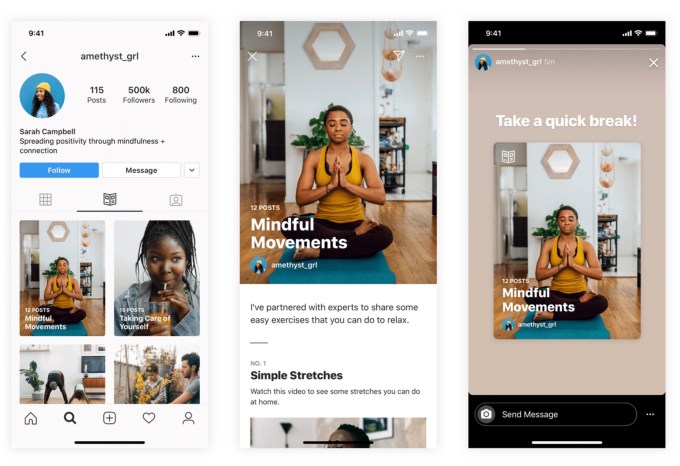
Instagram is working to expand its recently launched “Guides” feature which initially debuted with a specific focus on wellness content. The feature, which launched in May, has allowed select organizations and experts to share resources related to managing your mental health — including things like handling anxiety or grief amid the COVID-19 pandemic, for example. A handful of creators first gained access to the feature, and have since posted their wellness tips on their Instagram profiles in a separate tab, called “Guides.” Now, Instagram is developing tools that will allow creators to build out Guides for other types of tips and recommendations, too — like recommended places or even recommended products.

The larger goal with Guides is to give Instagram users a way to post longer-form content that’s not just a photo or video. Currently, Guides can include photos, galleries and videos sourced from either the creator’s own profile, which is more common, or from other creators. In addition, the Guides include commentary or tips alongside the media.

Instagram Guides

Instagram Guides today (Image Credits: Instagram)

The feature would allow creators to use Instagram as their platform for sharing tips and advice, instead of having that traffic redirected outside of Instagram — like to a blog or other website.

At launch, Instagram head Adam Mosseri said the Guides feature was originally designed with the travel use case in mind, but the company pivoted Guides to focus on wellness because of the COVID-19 pandemic.

Now it appears Instagram will be returning to its original idea of letting creators build Guides for places — and for other things, too.

The changes to Guides were first uncovered by Twitter user and self-described leaker, Alessandro Paluzzi. He tells TechCrunch he found the new features by reverse engineering the Instagram app. But these changes haven’t yet launched to the wider Instagram user base.

Instagram tests new feature

Image Credits: Alessandro Paluzzi, via Twitter

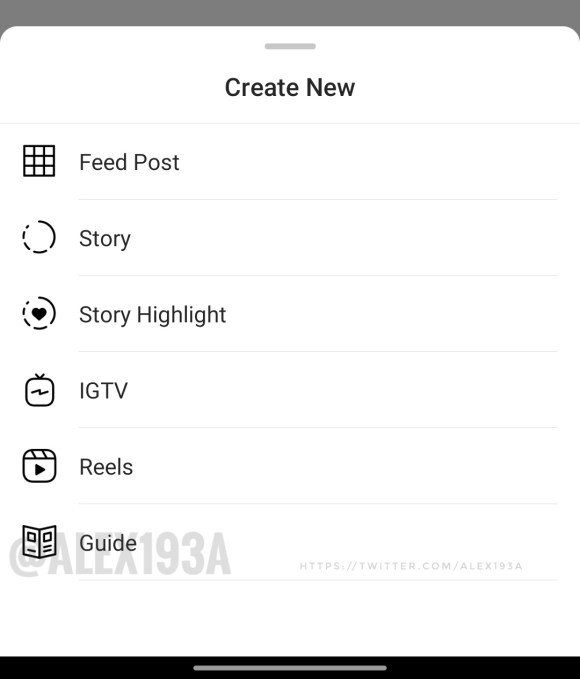
The tests show the company experimenting with a new compose screen, as well. Here, users are presented with all the different ways you can publish to Instagram’s social network. This includes the option to create a new Feed Post, post a Story or Story Highlight, post to IGTV, post to Reels or create a new Guide.

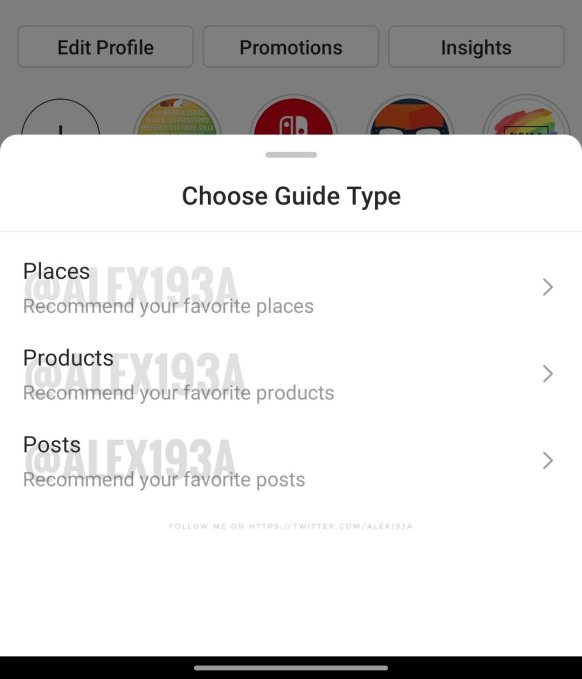
If you choose “Guide” from the list, you’re then presented with a menu that asks you to choose a Guide type. This can be a Places Guide, for recommending favorite places; a Products Guide, for recommending favorite products; or a Posts Guide, which is a more general-purpose format for recommending a series of your favorite Instagram posts.

This feature would allow Guides to easily fit into Instagram influencers’ workflows, as they often make recommendations to followers about where to go, what to purchase and more. Creators could even increase their affiliate network revenue or direct more users to their sponsored posts through the use of Guides, if they chose.

Instagram tests new feature

Image Credits: Alessandro Paluzzi, via Twitter

Instagram confirmed the new features are part of a series of improvements to Guides it’s working on.

“This is part of an early test as we work to improve guides. We’ll have more to share soon,” a spokesperson said. The company declined to say if or when the changes would roll out more broadly, adding it’s still in the early stages and the product could change based on user feedback. Instagram also declined to speak to its long-term plans for the Guides feature.

The changes come shortly after Pinterest began edging its way into Instagram territory. The social pinboarding site recently began testing its own new feature aimed at aggregating content for longer-form storytelling. With Story Pins, Pinterest creators could build out “guides” of their own for topics like recipes, crafts, DIY projects or more. In addition, more users are turning to Facebook rival TikTok for tips, inspiration and other creator content.


Read Full Article

Axial-DeepLab: Long-Range Modeling in All Layers for Panoptic Segmentation


The success of convolutional neural networks (CNNs) mainly comes from two properties of convolution: translation equivariance and locality. Translation equivariance, although not exact, ensures that the model functions well for objects at different positions in an image or for images of different sizes. Locality ensures efficient computation, but at the cost of making the modeling of long-range spatial relations challenging for panoptic segmentation of large images. For example, segmenting a large object requires modeling the shape of it, which could potentially cover a very large pixel area, and context that could be helpful for segmenting the object may come from farther away. In such cases, the inability to inform the model from context far from the convolution kernel could negatively impact the performance.

A rich set of literature has discussed approaches to solving the limitation of locality and enabling long-range interactions in CNNs. Some employ atrous convolutions, or image pyramids, which expand the receptive field somewhat, but it is still limited to a small local region. Another line of work adopts self-attention mechanisms, e.g., non-local neural networks, which allow the receptive field to cover the entire input image, as opposed to local convolutions. Unfortunately, such approaches are computationally expensive, especially for large inputs. Recent works enable building fully attentional models, but at a cost of applying local constraints to non-local neural networks. These restrictions limit the model receptive field, which is harmful to tasks such as segmentation, especially on high-resolution inputs.

In our recent ECCV 2020 paper, “Axial-DeepLab: Stand-Alone Axial-Attention for Panoptic Segmentation”, we propose to adopt axial-attention (or criss-cross attention), which recovers large receptive field in fully attentional models. The core idea is to separate 2D attention into two steps that apply 1D attention in the height and width axes sequentially. The efficiency of this approach enables attention over large regions, allowing models that learn long-range, or even global, interactions. Additionally, we propose a novel formulation for self-attention modules, which is more sensitive to the position of relevant context in a large receptive field with marginal costs. We evaluate our position-sensitive axial-attention method on panoptic segmentation by applying it to Panoptic-DeepLab, a simple and efficient method for panoptic segmentation. The effectiveness of our model is demonstrated on ImageNet, COCO, and Cityscapes. Axial-DeepLab achieves state-of-the-art results on panoptic segmentation and semantic segmentation, outperforming Panoptic-DeepLab by a large margin.

Axial-Attention Architecture
Axial-DeepLab consists of an Axial-ResNet backbone and Panoptic-DeepLab output heads, which produce panoptic segmentation results. Our Axial-ResNet is built on a ResNet architecture, in which all the 3×3 local convolutions in the ResNet bottleneck blocks are replaced by our proposed global position-sensitive axial-attention, thus enabling both a large receptive field and precise positional information.

An axial-attention block consists of two position-sensitive axial-attention layers operating along height- and width-axis sequentially.

The Axial-DeepLab height axial attention layer provides 1-dimensional self-attention globally, propagating information within individual columns — it does not transfer information between columns. The second 1D attention layer operating in the horizontal direction allows one to capture both column-wise and row-wise information. This separation reduces the complexity of self-attention from quadratic (2D) to linear (1D), which enables using a much larger (65×65 vs. previously 3×3) or even global context in all layers for long-range modeling in panoptic segmentation.

A message can be passed globally with two hops.

Note that a message or feature vector at (x1, y1) can always be passed globally on a 2D lattice to any position (x2, y2), with one hop on the height-axis (x1, y1 →x1, y2), followed by another hop on the width axis (x1, y2 → x2, y2). In this way, we are able to model 2D long-range relations in a single residual block. This axial-attention design also reduces the complexity from quadratic to linear and enables global receptive fields in all layers of a model.

Position-Sensitive Self-Attention
Additionally, we propose a position-sensitive formulation for self-attention. Previous self-attention formulations enabled a given pixel A to aggregate long-range context B, but provided no information about where in the receptive field the context originated. For example, perhaps the feature at pixel A represents the eye of a cat, and the context B might be the nose and another eye. In this case, the aggregated feature at pixel A would be a nose and two eyes, regardless of the geometric structure of a face. This could cause a false indication of the presence of a face when the two eyes are on the bottom-left of an image and the nose is on the top-right. A recently proposed solution is to impose a positional bias on where in the receptive field the context can originate. This bias depends on the feature at A only, (an eye), but not the feature at B, which contains important contextual information.

In this work, we let this bias also depend on the context feature at B (i.e., the nose and another eye). This change enables a more accurate positional bias when a pixel and the context informing it are far away from one another and thus contains different information about the bias. In addition, when pixel A aggregates the context feature B, we also include a feature that indicates the relative position from A to B. This change enables A to know precisely where B originated. These two changes make self-attention position-sensitive, especially in the situation of long-range modeling.

Results
We have tested Axial-DeepLab on COCO, and Cityscapes for panoptic segmentation. Improvements over the state-of-the-art Panoptic-DeepLab for each dataset can be seen in the table below. In particular, our Axial-DeepLab outperforms Panoptic-DeepLab by 2.8% Panoptic Quality (PQ) on the COCO test-dev set. Our single-scale small model performs better than multi-scale Panoptic-DeepLab while improving computational efficiency by 27x and using only 1/4 the number of parameters. We also show state-of-the-art results on Cityscapes. Moreover, we find that the performance increases as the block receptive field increases from 5 × 5 to 65 × 65. Our model is also more robust to out-of-distribution scales, on which the model was not trained.

Model     COCO     Citiscapes
Panoptic-DeepLab     39.7     65.3
Axial-DeepLab (ours)     43.4 (+3.7)     66.5 (+1.2)
Single scale comparison with Panoptic-DeepLab on validation sets

Besides our main results on panoptic segmentation, our full axial-attention model, Axial-ResNet, also performs better than the previous best stand-alone self-attention model on ImageNet.

Full Axial-Attention also works well on ImageNet.

Conclusion
We have proposed and demonstrated the effectiveness of position-sensitive axial-attention on image classification and panoptic segmentation. On ImageNet, our Axial-ResNet, formed by stacking axial-attention blocks, achieves state-of-the-art results among stand-alone self-attention models. We further convert Axial-ResNet to Axial-DeepLab for bottom-up panoptic segmentation, and also show state-of-the-art performance on several benchmarks, including COCO, and Cityscapes. We hope our promising results could establish that axial-attention is an effective building block for modern computer vision models.

Acknowledgements
This post reflects the work of the authors as well as Bradley Green, Hartwig Adam, Alan Yuille, and Liang-Chieh Chen. We also thank Niki Parmar for discussion and support; Ashish Vaswani, Xuhui Jia, Raviteja Vemulapalli, Zhuoran Shen for their insightful comments and suggestions; Maxwell Collins and Blake Hechtman for technical support.


Model     Params     M-Adds     Top-1
ResNet-50     25.6M     4.1B     76.9
Stand-Alone     18.0M     3.6B     77.6
Full Axial-Attention (ours)     12.5M     3.3B     78.1

Twitter experiments with adding a ‘Quotes’ count to tweets


Twitter wants to make it easier to see the conversations taking place around a tweet. This May, the company rolled out a change to its user interface that allowed users who clicked on the “Retweets” metric beneath a tweet to view both those Retweets with comments and those without all on one screen. But a new feature may soon make those retweets where discussions are happening even more visible to the end user. Twitter confirmed it’s experimenting with a new “Quotes” count on tweets. This engagement metric would sit alongside the tweet’s existing retweets and likes counts, which today appear beneath the tweet itself.

The feature has already shown up for some subset of Twitter users in recent days, where it has received mixed reviews. Some applauded the addition for helping to separate quotes from standard retweets, while others claimed the placement of the new metric was confusing because they’re used to seeing the Like count on the far right.

The social media news site Social Media Today first reported on the addition, citing social media consultant Matt Navarra’s tweet about the feature as a source.

Twitter confirmed to TechCrunch that what users are seeing now is still considered a test. In addition, the company isn’t yet set on using the word “Quotes” for the new feature, either. It’s also trying out language like “Quote Tweets,” they said.

“A few months ago, we made Retweets with Comments more visible when you tap to see Retweets on a Tweet so everyone could see the entire conversation,” a Twitter spokesperson told TechCrunch. “This is available to everyone. Now, we’re testing making Retweets with Comments accessible directly on the Tweet and new language — Quotes, Quote Tweets — to see if this makes them easier to access and more understandable,” they added.

Breaking out “Quotes” into its own section would make sense, given that referencing the Retweet count as “Retweets and comments” is a bit wordy.

In addition, the feature plays hand-in-hand with another recent change to the Twitter user interface. As of this month, Twitter now lets everyone limit direct replies to tweets, if desired. That means some tweets on the platform won’t be open for public conversations in the traditional sense, where people can respond directly to the poster.

Instead, Twitter users can now choose to limit replies to just the people they follow or only those mentioned in a tweet. However, these tweets with limited replies can still be engaged with in other ways — including by retweeting them or by retweeting the tweet with a comment. That will take the resulting conversation to a different part of Twitter’s network, where it can then be discussed among other users. The only way to truly limit the audience for a tweet is to run a private Twitter account, which few choose to do.

Twitter’s confirmed tests with “Quotes” indicate the feature is moving forward with development.

Before the feature entered public testing, it had been discovered by reverse engineer Jane Manchun Wong, who often finds new features within an app’s code before they go live.

Twitter is always experimenting with interface changes in the hope of enabling better conversations. But fundamentally, its concept of a “online town square” may be at fault for the chaos and unhealthy engagement that can take place on its platform. Its users’ worldviews are too divergent and internet culture itself is too intertwined with trolling to make any social media platform a place for thoughtful discourse.


Read Full Article

The Positive Grid Spark is a versatile smart amp perfect for guitarists stuck at home


Powered amps for electric guitars have gotten some neat tricks powered by modern mobile tech over the years, but the new Positive Grid Spark ($299) might be the one that packs the most intelligence and versatility into a single package. From a companion app, to voice commands, to tunable modelling and home recording – on top of doubling as a standalone Bluetooth speaker – the Spark offers features for beginners and pros alike.

The basics

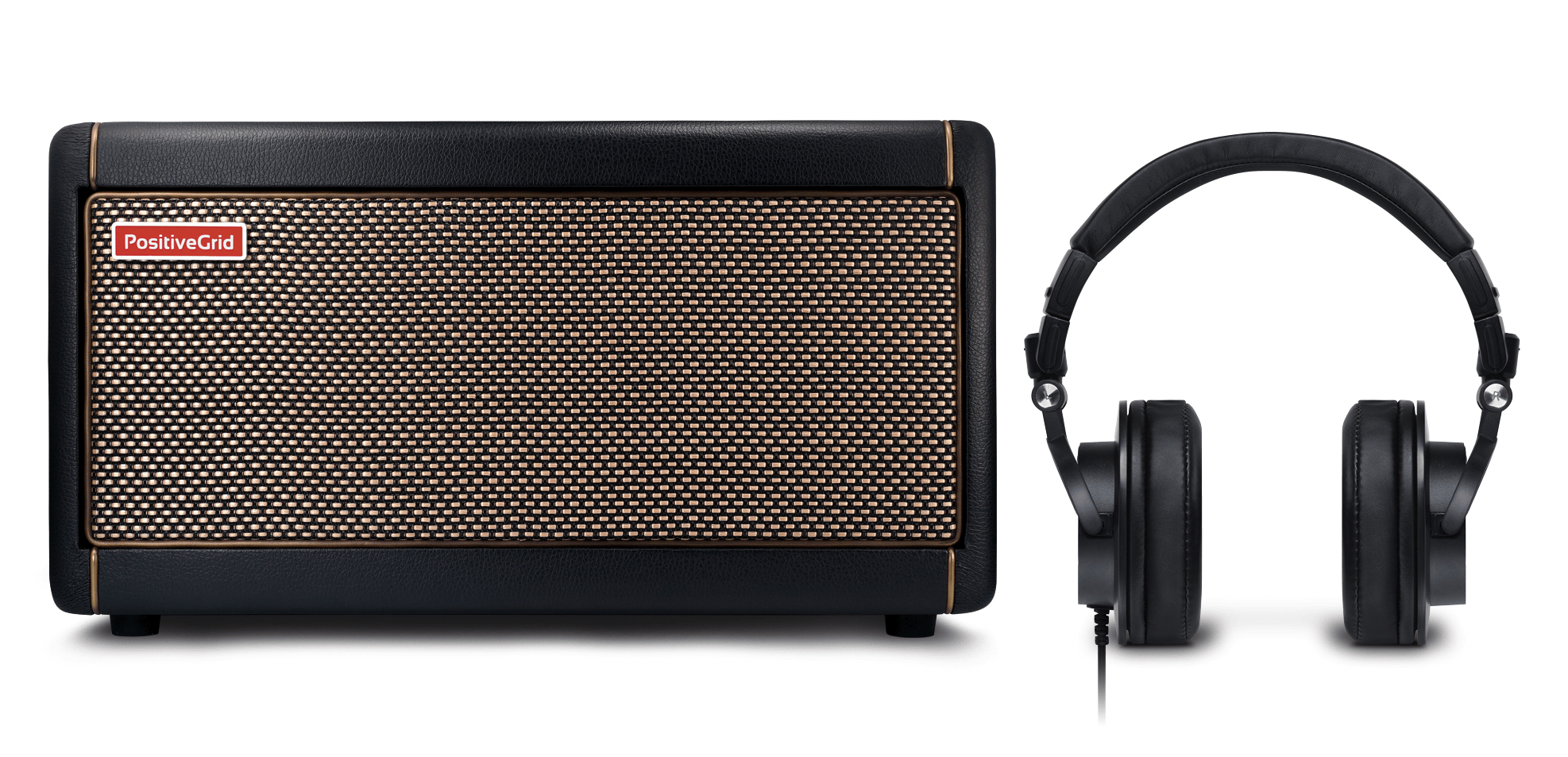
The Positive Grid Spark looks physically like your average, portable practice amp. It’s just over a foot long and about half-a-foot wide and tall, and it weighs just under 12 lbs. There’s a removable leather carrying strap attached for moving it around, and it includes a 1/4″ guitar input, a 1/8″ auxiliary input, and a 1/8″ headphone jack for connecting your audio gear, as well as a USB port for recording and acting as a USB audio interface for connecting to your computer.

The Spark has a host of integrated controls, including a dial for choosing from a number of preset amp types, as well as individual dials for adjusting gain, bass, mid, treble, master, mod, delay and reverb on the fly. There’s a physical control for output volume, and for music volume, as well as four user-programmable buttons for calling up represents, and a tap/tuner button for accessing the onboard tuner and other features.

Image Credits: Positive Grid

Built-in to the amp are 30 different potential amp models, as well as 40 effects to allow you to customize sound, including a noise gate, a compressor, distortion, modulation, delay and reverb. The Spark also features Bluetooth connectivity for streaming audio. Inside, there are two 4-inch speakers for true stereo sound, and it’s rated at 40 watts.

Features and design

The Spark’s design on the outside isn’t very far off from most standard practice amps out there – but it feels high quality, and the grill is done in a nice, retro finish that looks really good even when it’s not in use and just sitting on a side table. The leather is synthetic, making it more durable and more ethical, and the knobs have excellent Color-matched brass-tone detailing that completes the look. The metal flip switch for power on and red LED leave no confusion as to whether you’re ready to jam, and the touch buttons have similar bright backlighting.

Spark’s integrated handle, which you can remove when you’re not using, is comfortable and does its job well. The amp also features rubber feet to keep it elevated off surfaces and provide stability while it’s in operation.

In terms of basic performance and features, the Spark is already an excellent amp. Even if you never download the Positive Grid app (which you should) and instead just plug in your guitar, bass, ukulele or electric-acoustic, you can use the physical control to set up a sound you like and go to town. But when you download the app, you get a whole bunch more functionality that really extends the value of the Spark to elevate it above just about every other amp in its price range (and beyond).

Image Credits: Positive Grid

The app has a number of features, including Positive Grid’s ‘Smart Jam,’ which effectively learns your style as you play and can then create autogenerated bass and drum tracks to accompany you. It’s a very cool feature that takes all the work out of trying to find generic backing or accompanying tracks for when you’re just looking to jam and come up with some interesting compositions.

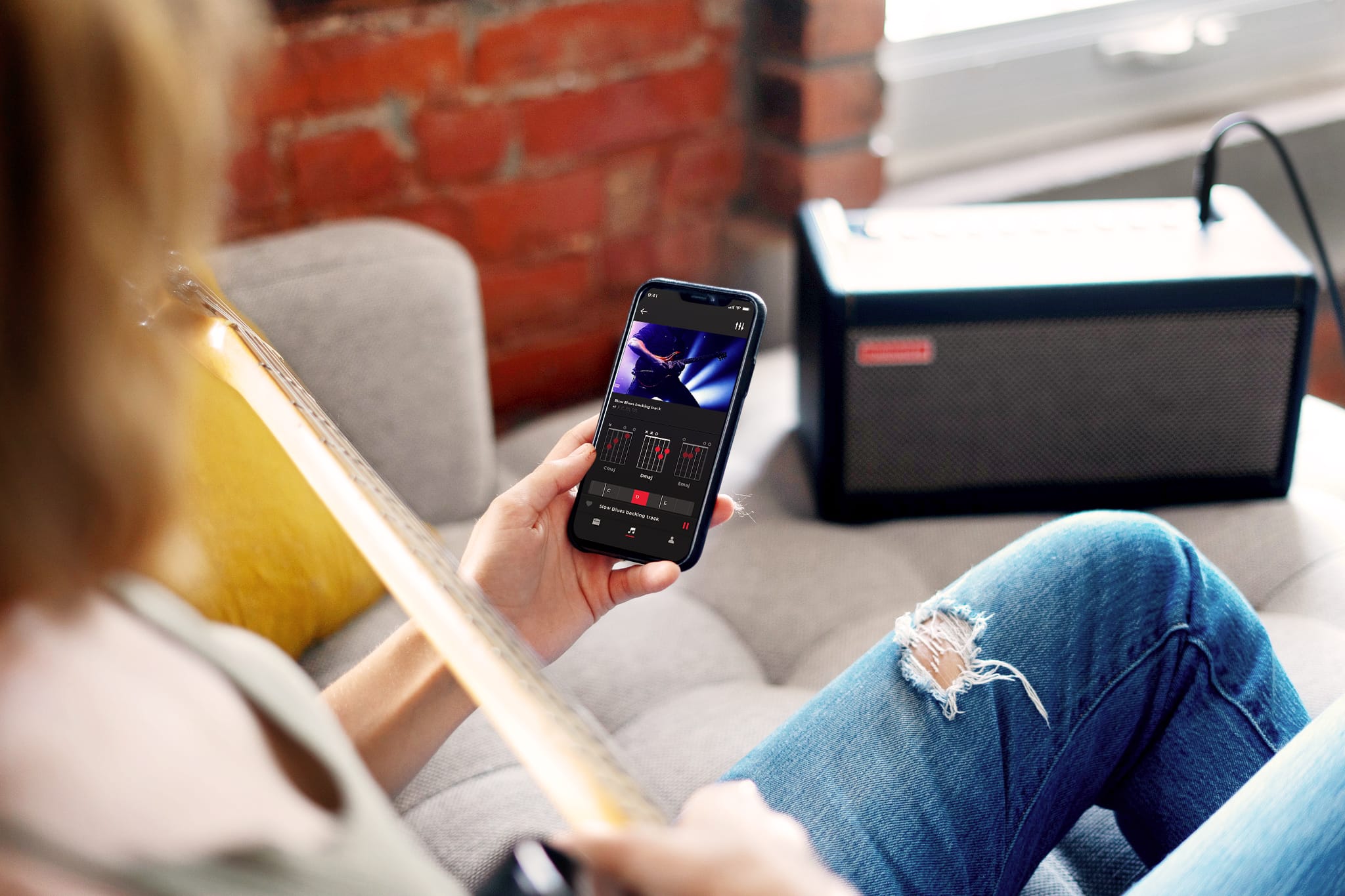
There’s also an auto chords feature for when you’re not looking to come up with your own stuff, but are rather looking to master your favorite existing song. This integrates with Spotify, Apple Music and YouTube, meaning you should be covered no matter what music service you subscribe to, and will automatically display the guitar chords for a song on your device as you play along. You can even slow down the track, or loop specific sections, if you’re stuck on one bit or just starting out.

The Spark app also provides access to over 10,000 guitar and bass amp presets, extending the versatility of the amp hardware. Plus, it’s voice controlled, so you can just ask it to provide you with a virtual band, for instance, and it’ll do that on demand.

Bottom line

The Positive Grid Spark is a unique offering in the field of amps, offering a lot of extensible smarts via the companion app – or a great, highly-customizable but more barebones experience if you’d rather leave your phone out of it and just get to playing. At $299, it’s hard to argue with it as a top pick, given how much more you get for your money once you factor in the advanced software features, and its versatility as a pretty great Bluetooth speaker, too.


Read Full Article