24 June 2020

China’s GPS competitor is now fully launched


For decades, the United States has had a monopoly on positioning, navigation, and timing technology with its Global Positioning System (GPS), a constellation of satellites operated by the military that today provides the backbone for location on billion of devices worldwide.

As those technologies have become not just key to military maneuvers but the very foundation of modern economies, more and more governments around the world have sought ways to decouple from usage of the U.S.-centric system. Russia, Japan, India, the United Kingdom and the European Union have all made forays to build out alternatives to GPS, or at least, to augment the system with additional satellites for better coverage.

Few countries though have made the investment that China has made into its Beidou (北斗) GPS alternative. Over twenty years, the country has spent billions of dollars and launched nearly three dozen satellites to create a completely separate system for positioning. According to Chinese state media, nearly 70% of all Chinese handsets are capable of processing signals from Beidou satellites.

Now, the final puzzle piece is in place, as the last satellite in the Beidou constellation was launched Tuesday morning into orbit, according to the People’s Daily.

It’s just another note in the continuing decoupling of the United States and China, where relations have deteriorated over differences of market access and human rights. Trade talks between the two countries have reached a standstill, with one senior Trump administration advisor calling them off entirely. The announcement of a pause in new issuances of H-1B visas is also telling, as China is the source of the second largest number of petitions according to USCIS, the country’s immigration agency.

While the completion of the current plan for Beidou offers Beijing new flexibility and resiliency for this critical technology, ultimately, positioning technologies are mostly not adversarial — additional satellites can offer more redundancy to all users, and many of these technologies have the potential to coordinate with each other, offering more flexibility to handset manufacturers.

Nonetheless, GPS spoofing and general hacking of positioning technologies remains a serious threat. Earlier this year, the Trump administration published a new executive order that would force government agencies to develop more robust tools to ensure that GPS signals are protected from hacking.

Given how much of global logistics and our daily lives are controlled by these technologies, further international cooperation around protecting these vital assets seems necessary. Now that China has its own fully-working system, they have an incentive to protect their own infrastructure as much as the United States does to continue to provide GPS and positioning more broadly to the highest standards of reliability.


Read Full Article

Google updates its analytics tools for newsrooms


Google is introducing new tools for newsrooms looking to understand their online audiences and how those audiences feed into their overall business.

These efforts fall under the umbrella of the broader Google News Initiative, introduced in 2018 as a way for the search giant to fund quality journalism and find other ways to support the industry. Since then, Google has introduced two journalism-focused products that sit on top of Google Analytics — News Consumer Insights, which is designed to help publishers grow their audiences and become more profitable, as well as Realtime Content Insights, which is supposed to help newsrooms see what’s trending at any given moment.

“We heard over and over again that our news partners were drowning in this data,” said Amy Adams Harding, director of analytics and revenue optimization for news and publishing at Google. “They had difficulty teasing out actionable intelligence in the tsunami of numbers.”

She added that it was “important” to her team that these products be free to use and “accessible to anyone using Google Analytics.”

Today, Google is introducing version 2.0 of both News Consumer Insights and Realtime Content Insights, while also adding a new feature called the News Tagging Guide.

Google NCI

Image Credits: Google

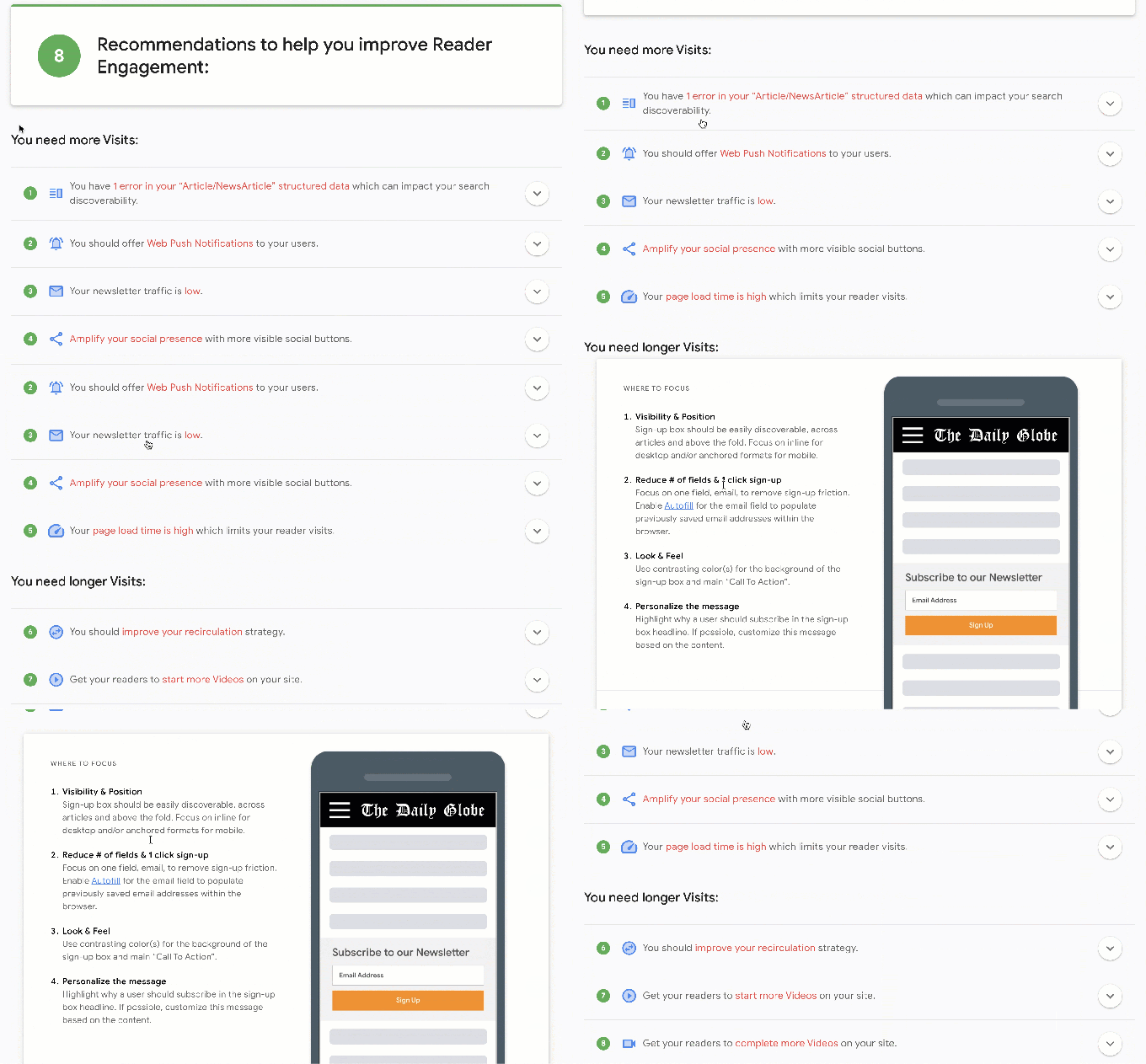
NTG is supposed to make it easier for publishers to collect the data they need. That falls into three broad categories — video analytics, user engagement and reader revenue. Publishers will be able to select the category and the specific types of data they want to track, and then Google will give them JavaScript that they can copy and paste onto their website in order to start feeding that data into Google Analytics.

Meanwhile, the News Consumer Insights product now includes personalized recommendations for the publisher. For example, it might point out that a publisher’s newsletter signups are relatively low, and then it could suggest different ways to improve those signups. Harding noted that NCI didn’t lack recommendations before, but to find them, publishers had to continually refer back to the generalized playbook, rather than having the most relevant recommendations highlighted for them while they’re going over their data.

And Realtime Content Insights have been expanded to include similar data about video content, as well as historic performance data, so publishers can see which stories performed best in a given period of time. And it’s not simply focused on pageviews — RCI also tracks things like social sharing and engagement, and it identifies which stories are doing better with casual readers versus loyal readers (who visit more than once a month) versus brand loyalists (who visit at least 15 times a month).

“We’re not saying one is better than the other,” said Anntao Diaz, Google’s head of News Consumer Insights, Realtime Content Insights and Google Surveys for Publishers. Instead, he suggested that different articles can attract different readers to serve different purposes, whether that’s growing the overall audience or building a relationship with a loyal audience that might pay for subscriptions.

Google has already been testing these features with select publishers, including Time and local newspaper publisher Lee Enterprises.

“As Lee Enterprises’ audience reach continues to grow in our newspapers’ communities, our partnership with Google News Initiative provides excellent insight and industry benchmarks to measure our success,” said Kyle Rickhoff, director of analytics at Lee Enterprises, in a statement. “The new version News Consumer Insights powered by News Tagging Guide improves our understanding of readers’ engagement and helps us prioritize business opportunities for video, engagement conversions and on-site subscriptions with better data.”


Read Full Article

Privacy assistant Jumbo raises $8 million and releases major update


A year after its initial release, Jumbo has two important pieces of news to announce. First, the company has released a major update of its app that protects your privacy on online services. Second, the company has raised an $8 million Series A funding round.

If you’re not familiar with Jumbo, the app wants to fix what’s broken with online privacy today. Complicated terms of services combined customer-hostile default settings have made it really hard to understand what personal information is out there. Due to recent regulatory changes, it’s now possible to change privacy settings on many services.

While it’s possible, it doesn’t mean it’s easy. If you’ve tried to adjust your privacy settings on Facebook or LinkedIn, you know that it’s a convoluted process with a lot of sub-menus and non-descriptive text.

Similarly, social networks have been around for more than a decade. While you were comfortable sharing photos and public messages with a small group of friends ten years ago, you don’t necessarily want to leave this content accessible to hundreds or even thousands of “friends” today.

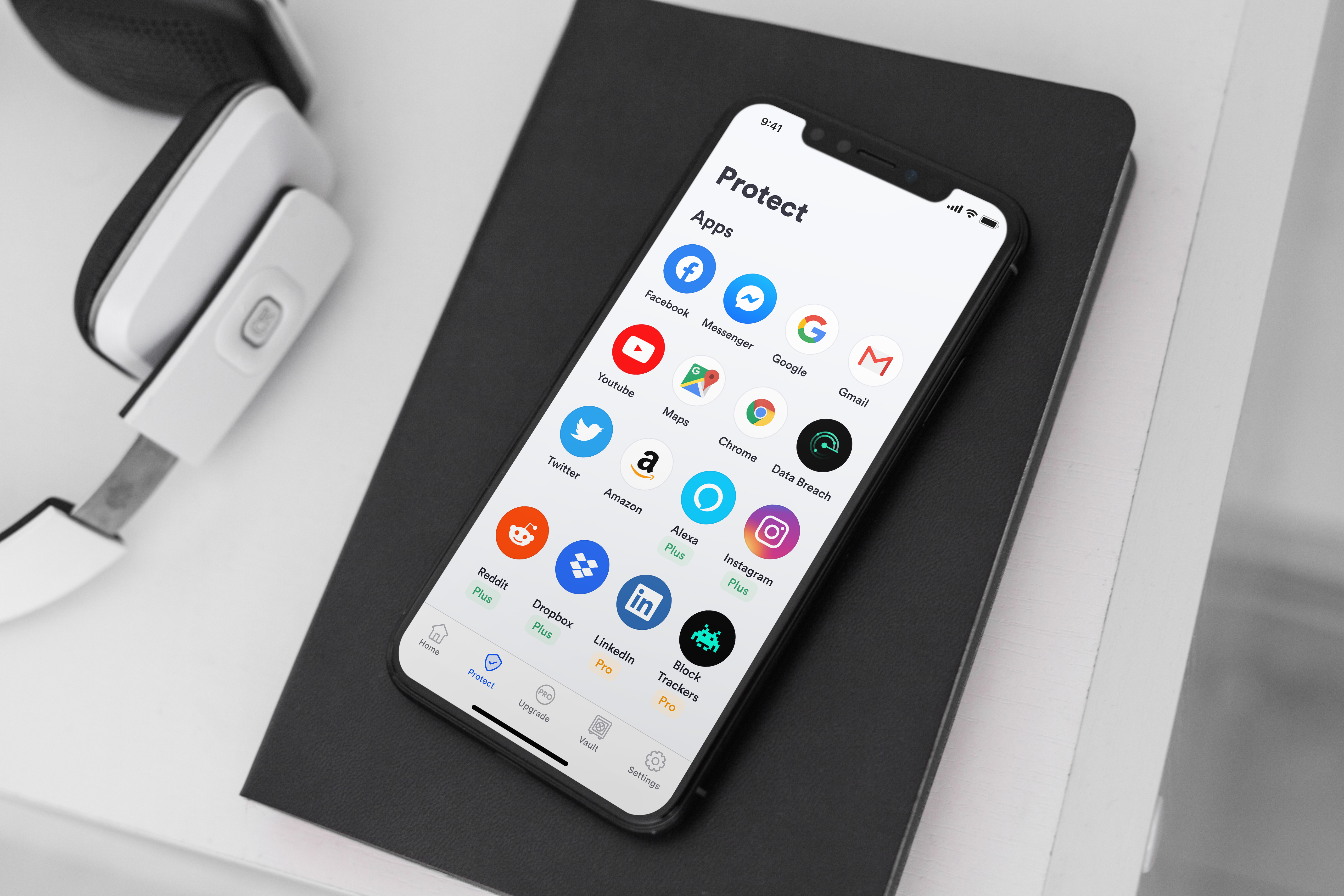
The result is an iPhone and Android app that puts you in charge of your privacy. It’s essentially a dashboard that lets you control your privacy on the web. You first connect the app to various online services and you can then control those services from Jumbo. Jumbo doesn’t limit itself to what you can do with APIs as it can mimic Javascript calls on web pages that are unaccessible to the APIs.

For instance, if you connect your Facebook account, you can remove your profile from advertising lists, delete past searches, change the visibility of posts you’re tagged in and more. On Google, you can delete your history across multiple services — web searches, Chrome history, YouTube searches, Google Map activities, location history, etc.

More fundamentally, Jumbo challenges the fact that everything should remain online forever. Conversations you had six months ago might not be relevant today, so why can’t you delete those conversations?

Jumbo lets you delete and archive old tweets, Messenger conversations and old Facebook posts. The app can regularly scan your accounts and delete everything that is older than a certain threshold — it can be a month, a year or whatever you want.

While your friends will no longer be able to see that content, Jumbo archives everything in a tab called Vault.

With today’s update, everything has been refined. The main tab has been redesigned to inform you of what Jumbo has been doing over the past week. The company now uses background notifications to perform some tasks even if you’re not launching the app every day.

The data breach monitoring has been improved. Jumbo now uses SpyCloud to tell you exactly what has been leaked in a data breach — your phone number, your email address, your password, your address, etc.

It’s also much easier to understand the settings you can change for each service thanks to simple toggles and recommendations that you can accept or ignore.

A clear business model

Jumbo’s basic features are free, but you’ll need to buy a subscription to access the most advanced features. Jumbo Plus lets you scan and archive your Instagram account, delete your Alexa voice recordings, manage your Reddit and Dropbox accounts, and track more than one email address for data breaches.

Jumbo Pro lets you manage your LinkedIn account (and you know that LinkedIn’s privacy settings are a mess). You can also track more information as part of the data breach feature — your ID, your credit card number and your social security number. It also lets you activate a tracker blocker.

This new feature in the second version of Jumbo replaces default DNS settings on your phone. All DNS requests are routed through a Jumbo-managed networking profile on your phone. If you’re trying to access a tracker, the request is blocked, if you’re trying to access some legit content, the request goes through. It works in the browser and in native apps.

You can pay what you want for Jumbo Plus, from $3 per month to $8 per month. Similarly, you can pick what you want to pay for Jumbo Pro between $9 per month and $15 per month.

You might think that you’re giving a ton of personal information to a small startup. Jumbo is well aware of that and tries to reassure its user base with radical design choices, transparency and a clear business model.

Jumbo doesn’t want to mine your data. Your archived data isn’t stored on Jumbo’s servers. It remains on your phone and optionally on your iCloud or Dropbox account as a backup.

Jumbo doesn’t even have user accounts. When you first open the app, the app assigns you with a unique ID in order to send you push notifications but that’s about it. The company has also hired companies for security audits.

“We don’t store email addresses so we don’t know why people subscribe,” Jumbo CEO Pierre Valade told me.

Profitable by 2022

Jumbo has raised an $8 million funding round. It had previously raised a $3.5 million seed round. This time, Balderton Capital is leading the round. The firm had already invested in Valade’s previous startup, Sunrise.

A lot of business angels participated in the round as well, and Jumbo is listing them all on its website. This is all about being transparent again.

Interestingly, Jumbo isn’t betting on explosive growth and eyeballs. The company says it has enough funding until February 2022. By then, the startup hopes it can attract 100,000 subscribers to reach profitability.


Read Full Article

India approves Facebook’s $5.7 billion deal with Reliance Jio Platforms


India’s antitrust watchdog has given its blessing to Facebook and Reliance Jio Platforms for their $5.7 billion deal.

In a statement on Wednesday, the Competition Commission of India said it had approved Facebook’s proposed multi-billion-dollar investment in Jio Platforms for a 9.99% stake in the top Indian telecom network.

Jaadhu Holdings LLC, a wholly-owned subsidiary of Facebook, is acquiring the stake in Jio Platforms. Facebook created this subsidiary earlier this year.

The announcement comes a week after the watchdog said it was accessing the deal for potential misuse of users’ data and pondering if it should consider amending the current rules for some mergers and acquisitions in the country.

At the time, Facebook had argued that its investment in the Indian firm is “pro-competitive, benefits consumers, kirana stores (neighborhood stores) and other small and micro local Indian businesses, and take forward the vision of digital India.”

Analysts have said that Facebook’s investment in billionaire Mukesh Ambani’s Jio Platforms, its biggest investment in recent years, could help the social media giant expand its reach in India, which is already its biggest market by user count.

Facebook’s eponymous service reaches about 350 million users in India, while its messaging service WhatsApp has amassed over 400 million users. WhatsApp is by far the most popular service in the world’s second largest market.

In April, Facebook said it planned to work with Reliance Jio Platforms to empower 60 million small businesses, including mom-and-pop stores in India. Early signs of this collaboration was apparent a week later when JioMart, a joint venture between Reliance Jio Platforms and Reliance Retail (India’s largest retail chain), started to allow customers to track shipment through WhatsApp.

Some analysts said that the deal with Ambani, India’s richest man and an ally of Indian Prime Minister Narendra Modi, could also help Facebook stay on the good side of the Indian government. In India, where Facebook’s Free Basics program was blocked in early 2016, the firm has been stuck in a regulatory maze to get clearance for a nationwide rollout of WhatsApp Pay.

Facebook launched WhatsApp Pay in beta mode to a million users in the country in 2018, only months after Google launched its payments service in India. While WhatsApp Pay remains stuck at a million users, Google and Walmart’s PhonePe have established clear dominance in India’s mobile payments market.

More to follow…


Read Full Article

Spotify Launches Your Summer Rewind for 2020


Spotify has launched a new playlist called Your Summer Rewind. Which, as the name suggests, is designed to transport you back to summers long gone. Essentially, Spotify knows what you listen to in summer, and has compiled these songs into a playlist.

Your Summer Rewind isn’t completely new. Spotify first launched Your Summer Rewind in June 2017, reminding listeners of previous summers. And now, in 2020, it’s back, with Spotify describing the playlist as “a new playlist featuring your old summer favorites.”

Your Summer Rewind is full of songs you have listened to on Spotify in previous summers. They may not be summery songs, but you happen to like listening to them in summer. Mine includes songs from bands I have seen in the summer and songs I play while camping.

You should find Your Summer Rewind on the homepage of the Spotify app. As with all of Spotify’s algorithmically produced playlists, it will be waiting for you in the “Made for [Your Name]” section. That is at least if you’re in the Northern Hemisphere.

As well as Your Summer Rewind, Spotify has revealed its 2020 Songs of Summer predictions. These are the songs the streaming service thinks will soundtrack summer 2020. Even though the ongoing COVID-19 pandemic may stifle many people’s plans.

Spotify’s predictions for summer 2020 include new songs such as ROCKSTAR by DaBaby, feat. Roddy Ricch and Savage Remix by Megan Thee Stallion, feat. Beyoncé. Plus old songs such as This Is America by Childish Gambino and Alright by Kendrick Lamar.

You’ll find all of these and more on Spotify’s Summer Hub.

Given everything that’s been happening in the world of late, it’s easy to forget that we’re heading into summer in the Northern Hemisphere. However, Spotify’s Your Summer Rewind and Songs of Summer playlists should evoke memories old and new of this time of year.

And if you prefer podcasts to music, you should check out Spotify’s Podcast Playlists.

Read the full article: Spotify Launches Your Summer Rewind for 2020


Read Full Article

Turn On or Off Caps Lock & Num Lock Sound & Visual Notifications In Windows 10


CLICK HERE TO SEE FULL POST

On most physical keyboards, the Caps lock key size is relatively large. Because of its size and convenient position, we often inadvertently press the Caps lock key. We notice that the Caps lock is turned on only after typing a couple of letters, if not words. Luckily, Windows 10 offers a way to enable sound […]

The post Turn On or Off Caps Lock & Num Lock Sound & Visual Notifications In Windows 10 appeared first on Into Windows. Content from IntoWindows website.


iOS 14’s App Clips will save you from always needing ‘an app for that’


The App Store ecosystem today is home to nearly 2 million apps. That means finding new apps to download is now more challenging than ever. This, in turn, leads app developers to funnel more money into App Store Search ads, traditional SEO and digital advertising in an effort to acquire new users. A new feature called App Clips, arriving in iOS 14 later this year, will give developers another option to introduce their app to users. With App Clips, users can instead load just a small part of an app on demand, when required. And when they’re done, the App Clip disappears.

The concept behind App Clips isn’t new. Google’s Android platform has for several years offered tiny app-on-demand downloads called “Instant Apps.”

Like Instant Apps, Apple’s App Clips are about making apps as seamless to use as the web. They are fast, ephemeral and eliminate the barrier to entry that is downloading an app from the App Store.

Today, many users don’t want to bother with a full app download when they’re in a hurry. For example, if a user is trying to pay for parking, they’re more likely to swipe their credit card in the meter to save time, instead of downloading the city’s parking app.

A customer waiting in line to place a food or drink order also doesn’t want to bother downloading the restaurant’s app to browse a menu and pay — they’ll just speak their order at the counter. And a customer wanting to rent a scooter just wants to tap, pay and be on their way.

Image Credits: Apple

An App Clip would work in any of of these scenarios, and many others, by making it as easy to use apps as it is to tap to check out with Apple Pay or launch a website.

While Apple will allow users to launch clips by way of a QR code, a new “App Clip Code” arriving later this year will offer an upgraded experience to kicking off these apps you find suggested to you out in the real world. App Clip Codes will combine both NFC and a visual code, so users can either tap or scan the code to access the App Clip experience.

Image Credits: Apple

For example, an App Clip Code placed on a parking meter would allow a user to quickly load just the part of the app where they pay for their time. They can even skip manual credit card entry by using Apple Pay, if included in a given App Clip.

The App Clips themselves are less than 10 MB in size and ship bundled with the app on the App Store. They’re built using the same UI technologies developers use today to build apps, like UIKit or SwiftUI. But using an App Clip doesn’t trigger the app to download to the user’s device.

A key advantage App Clips offer is how they address concerns over data privacy. Because App Clips are essentially a way to run app code on demand, they’re restricted from tapping into iPhone’s more sensitive data — like health and fitness information, for example. Plus, the App Clip and all its data will automatically disappear if it’s not used again within some period of time.

However, if a user begins to launch a particular App Clip more regularly — perhaps one for their favorite coffee order at their local shop, for instance — the App Clip’s lifetime is extended and it can get smarter. In this example, the App Clip could cache the customer’s last order and present it as a recommendation, to speed up the ordering process. Eventually, this repeat user may decide to download the full app.

In that case, the hand-off is seamless as well — iOS will automatically migrate the authorizations for things like Camera, Microphone and Bluetooth access, which the App Clip had already requested. Select data can also be migrated.

Image Credits: Apple

There are other ways for users to encounter App Clips besides out in the real world, though that may be a primary use case.

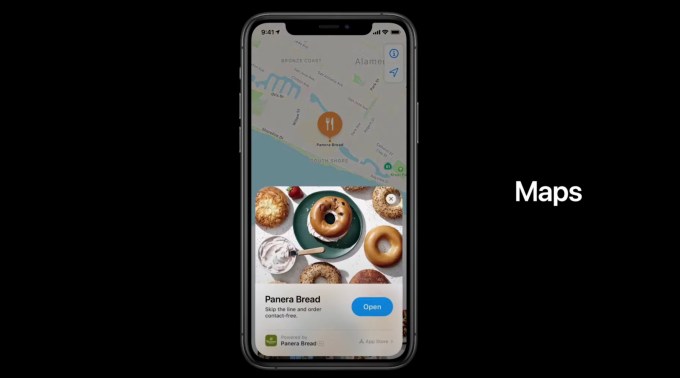
Apple says App Clips can be sent as links in iMessage, popped up as a suggestion when you’re browsing a mobile site in Safari, shown on a business’s details page in Apple Maps or may appear in Siri’s Nearby suggestions.

The idea is that wherever a user may be on their device — or out in the world — the App Clip can be there, too.


Read Full Article

A vision for the future of Afghanistan | Ashraf Ghani

A vision for the future of Afghanistan | Ashraf Ghani

Offering a vision of Afghanistan that goes beyond what's often depicted in the media, President Ashraf Ghani shares his thoughts on peacemaking, the true cost of war, the nation's COVID-19 response strategy and the sweeping economic and social reforms happening throughout the country. "The ultimate goal is a sovereign, democratic, united Afghanistan at peace with itself and the world," he says. (This virtual conversation, hosted by head of TED Chris Anderson, was recorded June 16, 2020.)

Click the above link to download the TED talk.

Twitter hides Trump tweet threatening protesters with ‘serious force’


Twitter took its latest action on content from President Trump Tuesday, again hiding a threat of state violence behind a warning label and appending it with a notice.

Trump’s latest offending tweet declared “There will never be an ‘Autonomous Zone’ in Washington, D.C., as long as I’m your President. If they try they will be met with serious force!” The tweet follows a clash between protesters and law enforcement Monday night in Lafayette Square near the White House.

In recent weeks, the president has frequently derided the city of Seattle for allowing protesters to create a police-free area, returning to the topic to stoke fear and anger within his base. After police abandoned a station in the Capitol Hill neighborhood, Seattle protesters moved into the area, declaring it their own. That self-declared “autonomous zone”—and the president’s latest threat—grew out of national civil rights protests against police brutality and racist violence after Minneapolis police killed George Floyd late last month.

Twitter says the tweet violated its rules prohibiting threats of harm against groups of people, a category of “abusive behavior” on the social network. The company said that it will allow the tweet to remain up, though has restricted the ability of users to interact with it, including likes, replies and retweets without comment.

The tweet is the latest in what may become many examples of Twitter enforcing its platform rules against the president. In the past, the company rarely acted to enforce its policies on tweets from high profile U.S. politicians, Trump included.

Over the last month, Twitter shifted to a much more active approach to its moderation responsibilities for political figures. In late May, Twitter ignited a political firestorm when it flagged two of the president’s tweets making false claims about vote-by-mail systems in California, leading to a retaliatory executive order from Trump days later. In the early days of the George Floyd protests, the company hid another tweet from the president that threatened lethal violence against protesters.


Read Full Article

What went wrong with Quibi?


Two months after Quibi’s high-profile launch as a short-form mobile-native TV app led by Jeffrey Katzenberg and Meg Whitman, it is evident the startup is greatly underperforming relative to the hundreds of millions of dollars already spent on content and marketing. 

According to a Wall Street Journal report, “daily downloads peaked at 379,000 on its April 6 launch day but didn’t exceed 20,000 on any day in the first week of June, according to Sensor Tower.” The article says Quibi is on pace for just 2 million subscribers by year-end, from its predicted 7.2 million. Most of the current subscriber base is on free trials, so even just maintaining the current pace of subscriber growth for several more months will be challenging. Quibi hasn’t released any of its own stats on subscribers, which it almost certainly would do to combat the negative perception among investors and press, if the stats showed a lot of traction.

I argued in 2018 that Facebook should turn its IGTV into a Quibi competitor, and I continue to believe there’s untapped opportunity for premium, mobile-native storytelling apps. So what went wrong with Quibi? There appear to have been four key mistakes:

  1. Miscalculating the risk of launching during the COVID-19 lockdown.
  2. Failing to see the central role of interactivity in mobile-native entertainment.
  3. Creating misaligned financial incentives with the wrong content partners.
  4. Launching Quibi like a movie instead of like a startup.

    Read Full Article

Snapchat adds free phone number verification to its list of SDK perks


Snap’s latest developer offering is a tool called Verify that’s aiming to save its mobile-first developers cash on verifying user phone numbers en masse. The new tool is being integrated into its Login Kit framework, allowing devs with a “Log In with Snapchat” button to move away from tapping services like Twilio for SMS verification, instead checking with Snap to see whether that user has already verified their number with Snapchat.

Snap Kit lead Patrick Mandia tells TechCrunch that his team has been working on the feature for more than a year, aiming to create “an easy, private way to verify phone numbers at no cost to developers.” Mandia says that because phone number verification is already a core part of Snapchat’s login flow, the company wanted to create a way for companies inside its SDK to verify phone numbers with them rather than tapping an external service.

Verify basically works by checking whether the phone number a user just typed into the login flow of a Snap Kit app matches the phone number associated with the Snapchat account they used to log in to the app.

Rather than sending users a verification code, Snap Kit handles this all in the background. If the user has verified that number within the past year, Snap will okay the verification. If a user doesn’t have a phone number on file with Snapchat or hasn’t recently verified that number, Snap will carry out that SMS verification on their end with the user, keeping it on file so the number can be confirmed through Verify on other Snap Kit applications.

At its annual partner summit last week, Snap shared that it now has 800 developers on its Snap Kit platform that collectively reach 150 million users on a monthly basis. The social messaging company has been looking to grow that network through features that tap into its network of resources rather than its network of user data.

“Traditionally, when you think of these platforms, the value is data. The value is what data a third party is going to be able to get about you and your friends, and that turns out to have some real issues,” Snap’s VP of Partnerships Ben Schwerin told us. “So, we took a much different approach, which is that Login Kit is going to power really creative, unique experiences and that’s going to be the value for partners.”

In a conversation with Snap last week, the company connected me with Yolo co-founder Greg Henrion whose app operates on the Snap Kit platform. He says that his app is spending “above six-figures” on a monthly basis just to verify phone numbers.

“The idea that we have portfolio companies spending $1 million per year to verify text messages is pretty crazy,” says Josh Miller, an investor at Thrive Capital, which backed Yolo.

For consumer app developers with a user base that overlaps significantly with Snapchat’s, the new feature offers them something that could save them cash right off the bat. Yolo’s situation is certainly unique, Snap Kit is the only way to log in to their platform, so Verify will take care of almost all of their SMS verification spend. Yolo’s outsized spending on SMS verification is also an outlier; the startup says about one-third of their run rate is devoted to it.

Verify with Snapchat is free and is available for Snap Kit developers starting today.


Read Full Article

Presenting a Challenge and Workshop in Efficient Open-Domain Question Answering


One of the primary goals of natural language processing is to build systems that can answer a user's questions. To do this, computers need to be able to understand questions, represent world knowledge, and reason their way to answers. Traditionally, answers have been retrieved from a collection of documents or a knowledge graph. For example, to answer the question, “When was the declaration of independence officially signed?” a system might first find the most relevant article from Wikipedia, and then locate a sentence containing the answer, “August 2, 1776”. However, more recent approaches, like T5, have also shown that neural models, trained on large amounts of web-text, can also answer questions directly, without retrieving documents or facts from a knowledge graph. This has led to significant debate about how knowledge should be stored for use by our question answering systems — in human readable text and structured formats, or in the learned parameters of a neural network.

Today, we are proud to announce the EfficientQA competition and workshop at NeurIPS 2020, organized in cooperation with Princeton University and the University of Washington. The goal is to develop an end-to-end question answering system that contains all of the knowledge required to answer open-domain questions. There are no constraints on how the knowledge is stored — it could be in documents, databases, the parameters of a neural network, or any other form — but entries will be evaluated based on the number of bytes used to access this knowledge, including code, corpora, and model parameters. There will also be an unconstrained track, in which the goal is to achieve the best possible question answering performance regardless of system size. To build small, yet robust systems, participants will have to explore new methods of knowledge representation and reasoning.
An illustration of how the memory budget changes as a neural network and retrieval corpus grow and shrink. It is possible that successful systems will also use other resources such as a knowledge graph.
Competition Overview
The competition will be evaluated using the open-domain variant of the Natural Questions dataset. We will also provide further human evaluation of all the top performing entries to account for the fact that there are many correct ways to answer a question, not all of which will be covered by any set of reference answers. For example, for the question “What type of car is a Jeep considered?” both “off-road vehicles” and “crossover SUVs” are valid answers.

The competition is divided between four separate tracks: best performing system under 500 Mb; best performing system under 6 Gb; smallest system to get at least 25% accuracy; and the best performing system with no constraints. The winners of each of these tracks will be invited to present their work during the competition track at NeurIPS 2020, which will be hosted virtually. We will also put each of the winning systems up against human trivia experts (the 2017 NeurIPS Human-Computer competition featured Jeopardy! and Who Wants to Be a Millionaire champions) in a real-time contest at the virtual conference.

Participation
To participate, go to the competition site where you will find the data and evaluation code available for download, as well as dates and instructions on how to participate, and a sign-up form for updates. Along with our academic collaborators, we have provided some example systems to help you get started.

We believe that the field of natural language processing will benefit from a greater exploration and comparison of small system question answering options. We hope that by encouraging the development of very small systems, this competition will pave the way for on-device question answering.

Acknowledgements
Creating this challenge and workshop has been a large team effort including Adam Roberts, Colin Raffel, Chris Alberti, Jordan Boyd-Graber, Jennimaria Palomaki, Kenton Lee, Kelvin Guu, and Michael Collins from Google; as well as Sewon Min and Hannaneh Hajishirzi from the University of Washington; and Danqi Chen from Princeton University.

23 June 2020

Antitrust case against Facebook’s ‘super profiling’ back on track after German federal court ruling


A landmark regulatory intervention that seeks to apply structural antitrust remedies to cut big (ad)tech’s rights-hostile surveillance business models down to size has been revived after Germany’s federal court overturned an earlier ruling that had suspended enforcement of a ban on Facebook combining user data.

The upshot is the tech giant could be forced to stop combining the personal data of users of its various social services with other personal data it harvests on Internet users via its various social plug-ins and tracking pixels. Which in turn would amount to a structural separation of Facebook’s social empire.

That said, there’s still some mileage left in the legal process — which will likely delay any enforcement for months more at least. But the federal court has put the train back on the tracks.

As we’ve reported previously, the intervention by Germany’s antitrust regulator is seen as highly innovative as it joins the dots of EU privacy rights and competition law. So this case is being closely watched by regulators around the world.

Quick recap: Last year Germany’s Federal Cartel Office ordered Facebook to stop combining data on users across its different services after determining that its zero opt-out T&Cs combined with Facebook’s dominant market position in the social network space to make its pervasive people-profiling an “exploitative abuse”.

The order originated with an investigation by the Bundeskartellamt (FCO) into Facebook’s data-gathering practices, which kicked off in March 2016. Almost exactly three years later the regulator concluded it had identified abuse — and issued the order banning Facebook from combining data on users across its own suite of social platforms without first obtaining their consent.

Instead of agreeing to offer users a choice over how they’re tracked, Facebook appealed — and, last August, the Higher Regional Court in Dusseldorf granted it a suspension, delaying application of the order — and seemingly derailing the chance for an innovative regulatory intervention against a rights hostile ‘track and target’ adtech business model. 

All was not lost though, as the FCO appealed the suspension — leading to today’s fresh legal twist.

In today’s decision, the Germany Federal Court of Justice provisionally confirms the FCO’s allegation of an abuse of a dominate position by Facebook — opening the door to the regulator being able to enforce the ban.

So it’s game (back) on for the antitrust case against platform giants whose dominance stems from mass surveillance of Internet users.

In a statement, FCO president Andreas Mundt welcomed the decision.

“I am pleased about the decision by the Federal Court of Justice,” he said. “Data are an essential factor for economic strength and a decisive criterion in assessing online market power. The court’s decision provides important information on how we should deal with the issue of data and competition in the future. Whenever data are collected and used in an unlawful way, it must be possible to intervene under antitrust law to avoid an abuse of market power.”

We’ve also reached out to Facebook for comment.

The Dusseldorf Higher Regional Court has still not issued a ruling on Facebook’s original appeal against the FCO order — though it granted the company’s request for a suspension, saying it had doubts about its legality.

But the Federal Court of Justice has overturned that earlier decision. And not just overturned it — it’s blasted it with a legal equivalent of a blowtorch.

In a press release today (in German, which we’ve translated using Google Translate) the court writes [emphasis ours]: “There are no serious doubts about Facebook’s dominant position in the German market for social networks or that Facebook is abusing this dominant position with the terms of use prohibited by the Cartel Office.”

The court takes issue with Facebook’s terms and condition — finding them “abusive” because it says users are not offered a choice over the extent of the company’s tracking and targeting of them; with the court pointing out there’s no option for users to have Facebook’s content “personalization” based only on the data they reveal on Facebook.com. Instead Facebook forces users to accept what it calls “a more intensive personalization of the user experience”, which the court further notes is “associated with a potentially unlimited access to characteristics of their ‘off-Facebook’ Internet use by Facebook”.

Which doesn’t sound, y’know, proportionate.

In additional remarks, the court writes that Facebook’s super profiling of Internet users has negative impacts on people’s personal autonomy — infringing their rights, not only under EU data protection law, but it asserts this also represents an antitrust abuse as a consequence of how Facebook is exploiting its dominant position in the market for social networks.

Or, as it put it in the press release: “The lack of choice for Facebook users not only affects their personal autonomy and the protection of their right to informational self-determination, which is also protected by the GDPR [General Data Protection Regulation]. Against the background of the high hurdles to change that exist for the users of the network (“lock-in effects”), it also represents an exploitation of the users that is relevant under antitrust law, because competition is no longer effective due to Facebook’s dominant position.”

The court also points to findings by the FCO that significant numbers of Facebook users want to be able to hand over less personal information to use its service — noting that if thriving competition existed in the social network market there may well be a more privacy-friendly offer from Facebook. Instead, you get none.

In another interesting observation, the court said Facebook’s access to “a significantly larger database” — i.e. via its super profiling of users — reinforces what are already “pronounced” network effects keeping a lid on competition in the social media market. So a double negative.

Additionally, it suggests Facebook’s super profiling helps the company amass larger ad revenues — which it notes “also depend on the scope and quality of the data available”. “Finally, due to the negative effects on competition for advertising contracts, an impairment of the market for online advertising cannot be ruled out,” it adds in another shot across Zuckerberg’s bow.

Commenting on the decision, Rupprecht Podszun, a chair for civil law, German and European competition law at Heinrich Heine University, called it “a spectacular success” for the FCO and an “important step forward” in regulating Internet giants whose empires are based on this type of rights-hostile profiling. 

“The decision is a spectacular success for the competition watchdog, and an important signal for competition on the internet. The proceedings against Facebook are regarded worldwide as a pioneering case: The FCO is attempting to tame the tech giants and to stop the build-up of economic power through integration of data to ‘super profiles’. This is something new in terms of antitrust law. Exploitation of users through data aggregation, as the FCO has accused Facebook of doing, has so far been uncharted territory,” he told TechCrunch. 

“The Federal Supreme Court said it has ‘no serious doubts’ that Facebook is market-dominant and abuses its market power. The court is even stricter than the competition authority: It does not require a protection of privacy laws (as in the General Data Protection Regulation), but it says that freedom of choice and autonomy of users is key in such cases. This is an important step forward –– making the users’ self-determination a benchmark for competition on the internet.”

“The FCO can now demand from Facebook to submit a plan within four months how to stop the merging of data into so-called ‘super profiles’,” Podszun added. “Facebook merges data from the group’s own services such as Facebook, WhatsApp and Instagram with other data collected on the net via so-called Facebook Business Tools. This was the Bundeskartellamt’s central point of attack.”

The professor remains critical of the pace of regulatory progress — dubbing it “almost a bad joke” for this latest twist of the legal process to be couched an ‘interim proceeding’.

He also cautions against expecting any swift break-up of Facebook’s data mining and mingling to follow, noting there are other legal avenues for the lawyered-up company to pursue — meaning it could be months or even years more before there’s any enforcement of the FCO order.

“This is particularly problematic because economic power in digital markets consolidates extremely quickly,” Podszun also said, calling for reform of competition law so it can effectively respond to digital gatekeepers.

“The proceedings therefore show that there must be changes in the way dominance of gatekeeper companies on the Internet is dealt with. The competition authorities must be able to act more effectively and more quickly in such cases. This is where the German and European legislators are called upon to act. Plans are being developed on the national and the European level. The reasoning in the Facebook case will be a boost to competition commissioner Margrethe Vestager in her fight against these companies, too.”

The sedate pace of regional competition law vs the blistering speed of digital business has long led to calls for competition law reform — a topic that’s now front of mind for EU lawmakers.

After Facebook’s first successful appeal of the FCO order, Podszun suggested a number of changes were needed to update EU competition law for the platform era. One of which — to evolve traditional market definitions to allow for interventions in digital markets to prevent tipping — is being actively consulted on by the Commission which is now considering whether regulators need a new tool to combat tipping in digital markets. 

It is also looking at applying ex ante regulation to so called ‘gatekeepers’ — aka platforms which have gained significant market power — as another step to try to ensure ‘fair functioning’ of digital markets.

Speaking during an Atlantic Council discussion today, Commission EVP Margrethe Vestager — who both leads digital policy for the bloc and heads up its antitrust division — signalled, in her usual roundabout way, that digitally driven competition reform is indeed coming.

“We have an intense debate about competition enforcement in the digital era [and] we need to change for the times we’re in because the market dynamics are different, they are faster, you have marginal prices approaching zero, you have network effects, you have the data-driven economy. So of course we need to change with the times that we’re in,” she said. “But we will not negotiate and we will not compromise on this being build on the rule of law and the responsibility for the courts in order to make sure that we have equal treatment between businesses.”

Asked whether she’d like the power to rescind merger approvals — with the moderator citing the case of Facebook reversing a prior commitment to regulators who approved its acquisition of WhatsApp that it would never combine user data between its eponymous service and the messaging app (before going on to do just that) — she responded that it’s “a very specific situation”, saying EU regulators performed a competition analysis at the time — looking at whether, if Facebook did merge data between the services, would it be a “competition problem” or not?

“Back then they found that no that would not be the case. So in that respect… on substance this would not be a case for unscrambling ‘the eggs’. And it is indeed very difficult to unscramble the eggs,” she said.

Vestager also conceded that the third component of antitrust decisions — “how to make competition come back?” — remains a “work in progress”.

“Of course we haven’t seen the effect of the Android preference menu because very few Android phones have been shipped due to the COVID crisis,” she said on that. “But it remains to be seen if, when Google is preinstalled after the untying and other services can be chosen, will that work? Will that sort of open the market for others — search and browsers — than the Google choices?”


Read Full Article

Google’s grammar suggestions in Docs are now available in Spanish


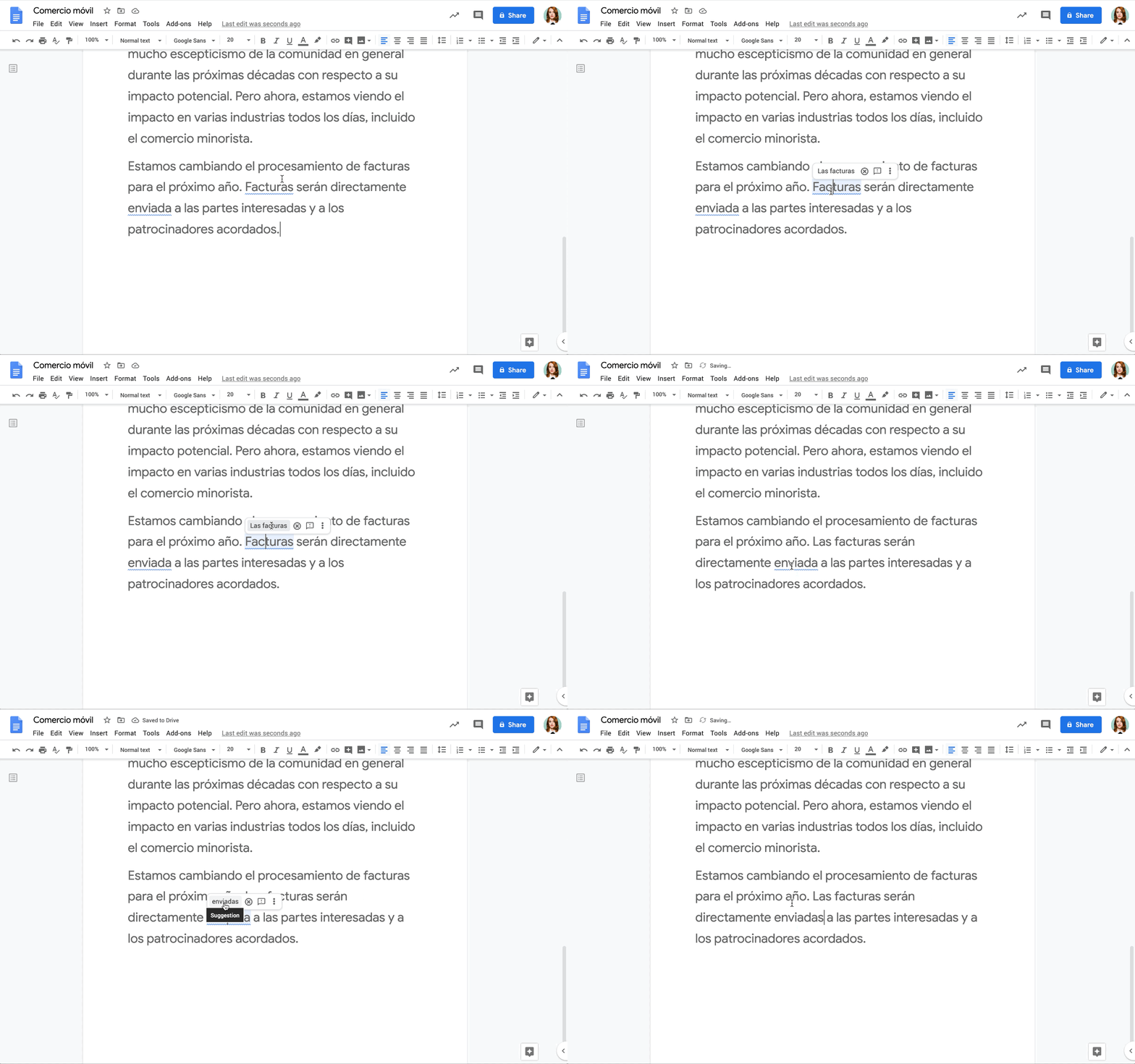
If you regularly write in Spanish, you’ll be happy to hear that Google today announced that its neural network-powered grammar suggestions in its Docs online text editor are now available in Spanish, too. Just like with grammar suggestions for English, though, this feature will only be available for G Suite customers for now — but if you are a G Suite customer, it should be available now. Google says it plans to extend this feature to consumers and educational organizations in the future.

In addition, Google also today announced that Smart Compose, which tries to finish sentences for you, and spelling autocorrect will also come to Docs in Spanish later this year. Google also tells me that grammar suggestions for Spanish will soon come to Gmail as well, where support for English is already available today.

Google introduced its grammar suggestions for English last February (and it first announced it at Google Cloud Next in the middle of 2018). And while Docs had a grammar checker before, this new tool now uses an interesting machine learning approach based on the company’s experience in doing machine translations. That also means Google has to train a new neural network for every new language it supports.

We’ll likely see the company introduce additional languages in the not too distant future, but for now, English and Spanish are the only ones currently supported in Docs.

One nice feature here is that Google’s tool automatically knows what language you are writing in, so there’s no need to manually switch back and forth.

With Google, Microsoft and Grammarly now offering next-generation spell-checking and grammar tools, we’re seeing a lot more competition in this space than even a few months ago. Microsoft and Grammarly are taking a bit of a different approach, though, with extensions that work across applications (though Microsoft Editor only supports text fields across a select number of web apps so far). Microsoft Editor, it’s worth noting, also supports more than 20 languages in Word. All of them, though, only make their most advanced tools available to paying customers for the time being. Those neural networks don’t run themselves, after all.


Read Full Article

Wyze launches its $50 wire-free outdoor camera


In recent years, Seattle-based Wyze made a name for itself thanks to making a lot of smart home gadgets affordable. These days, the company sells everything from smart plugs and locks to scales and fitness bands, but what started it all was the $20 Wyze indoor security camera. Today, the company is following that up with its newest camera, the Wyze Cam Outdoor, which is launching in early access today.

It’ll cost $50 for the starter bundle with a base station and once the camera is out of early access, you’ll be able to add additional cameras for $40 each. As usual, Wyze is undercutting many of its direct competitors in this space for basic outdoor security cameras on price.

For the most part, that name tells you everything you need. It’s a 20 fps 1080p camera for live streaming and recording and features IP65 water resistance that keeps the overall blocky aesthetics of the original Wyze camera. It also offers a night vision mode and two-way audio through the Wyze app, which also offers a rolling 14 days of free cloud storage, in addition to on-device storage. And, of course, it also uses some onboard smarts to do motion detection, using a standard PIR sensor.

Image Credits: Wyze /

Like similar products, it runs purely on battery power, so you don’t have to string any cables across your yard. The company says the battery should last three to six months.

It mounts to its base with magnets, but you still need to do a bit of DIY to screw that base into your walls, ceilings or garden fences.

The base station itself is obviously cabled (and that includes the option to plug in an ethernet cable, in addition to WiFi support). One nice feature here is that the base station also includes an SD card slot, so you can store videos on there, too.

Given that it’s pretty small, at 2.3×2.3×2.8 inches, Wyze also built another nifty feature into the software: offline travel mode. With this, the company says, you can watch your hotel room or campsite while you’re away from home.

Image Credits: Wyze

Based on the samples, this looks to be a pretty capable outdoor camera, but hardware is only one piece of the puzzle here. A lot depends on how well the app and on-camera motion detection work, too. We’ll take a closer look at those once we get a review sample in the next couple of weeks.

If you don’t want to wait until then, the starter pack is now available in Wyze’s shop and in the Wyze app.


Read Full Article

Fandango adds new features to highlight health precautions and distancing in movie theaters


As movie theaters reopen across the United States and the world, there are lingering questions about what kinds of measures those theaters will be taking to keep staff and moviegoers safe in the midst of the ongoing COVID-19 pandemic.

These concerns were illustrated last week, when AMC CEO Adam Aron said in an interview that the theater chain would not be requiring that patrons wear masks except in locations where they’re legally required to do so — because the company “did not want to be drawn into a political controversy.” Naturally, those comments prompted a controversy of their own, leading AMC to reverse its decision.

So it makes sense for NBCUniversal-owned movie ticketing app Fandango to highlight the different safety measures that theaters are taking.

It’s useful from an informational perspective, so that moviegoers understand and prepare for the experience in theaters, and perhaps choose theaters based on how serious they seem about safety. But it’s also a savvy marketing move, as those theaters will need to convince moviegoers that it’s safe to return.

Fandango social distance seating

Image Credits: Fandango

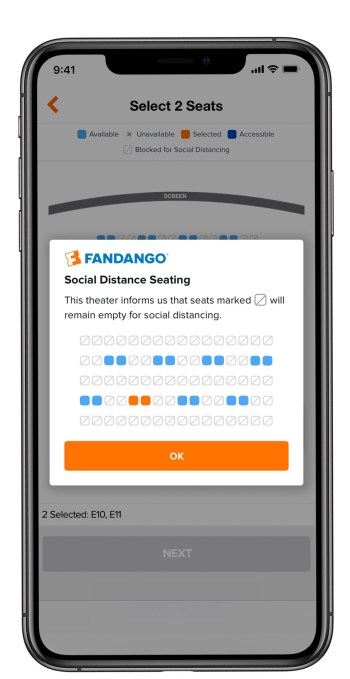
The new features include what Fandango is pitching as a “one-stop shop” to view the safety measures announced by more than 100 theater chains, with information about auditorium occupancy, social distance seating, mask/protective equipment policies, enhanced cleaning measures and special concession arrangements. There will also be instructional videos, social distance seating maps and a way to search for reopened theaters by location.

Since movie theaters have been closed for the past few months, Fandango also says it will be extending expired rewards from its Fandango VIP+ loyalty programs for another 60 days.

“We are working closely with our friends in exhibition to help get their ticketing back online and film fans back in seats with peace of mind,” said Melissa Heller, Fandango’s vice president of domestic ticketing, in a statement. “In addition to our new product features, Fandango’s mobile ticketing will be an added benefit, helping moviegoers and cinema employees reduce the number of contact points at the box office and throughout the theater.”


Read Full Article

Why colonialist stereotypes persist -- and how to stop romanticizing history | Farish Ahmad-Noor

Why colonialist stereotypes persist -- and how to stop romanticizing history | Farish Ahmad-Noor

Colonialism remains as an inescapable blight on the present, lingering in the toxic, internalized mythologies and stereotypes that outlive the regimes that created them, says historian Farish Ahmad-Noor. Examining why these prejudices and narratives persist (and sometimes thrive), he suggests a multidisciplinary approach to reject cultural obsessions with romanticized history and prevent this malignant nostalgia from perpetuating past oppressions.

Click the above link to download the TED talk.

Facebook tests Forecast, an app for making predictions about world events, like COVID-19


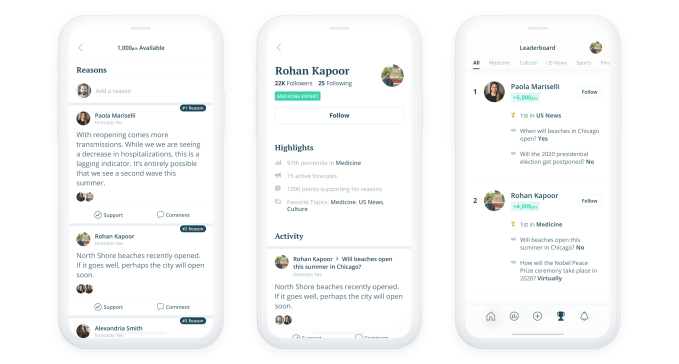
Forecast, a new project from Facebook’s internal R&D group, NPE Team, is launching today to build a community around predictions. The iOS app will allow users to ask questions and then use in-app points to make predictions about what might happen in the future. Users can also create, discuss and view these crowdsourced predictions.

At launch, only invited participants in the U.S. and Canada will be allowed to make predictions and engage in conversations, while the app is in beta testing. But these predictions and related discussions will be publicly accessible on the Forecast website and made shareable.

Before today, Facebook tested the product internally with a small set of employees. Their initial forecasts will form the initial core content in the app at launch.

Starting now, Facebook will invite members of the health, research and academic communities to make predictions about the COVID-19 pandemic and its impact on the world.

At a time when Facebook and other major tech platforms are under fire for their role in aiding the spread of misinformation, fake news, propaganda, conspiracy theories, and other non-factual content presented as truth, an app focused on making “guesses” about the future seems ill-advised — however educated those guesses may be. This is particularly concerning because much of the app’s content will focus on guesses about COVID-19.

Forecast’s predictions may help show what people are thinking, but COVID-19 isn’t a game. To understand the world, scientists form a hypothesis, which is essentially an expanded form of an educated guess. But they don’t then crowdsource voting to determine if a hypothesis is true — they test, experiment, gather supporting data, try to prove and disprove the hypothesis, and ultimately aim to publish their findings and have them peer-reviewed.

The Forecast app turns the hypothesis into the end result, in a way. The app lets users make a forecast and explain their reasoning — in other words, form a hypothesis. But instead of doing the work to test the forecast, through the application of the scientific method, Forecast will track the votes a given question receives.

E.g. “When will the first COVID-19 vaccine candidate begin phase 3 trials?” or “When will most U.S. residents be treated with a COVID-19 vaccine?” In non-COVID questions, you may come across something like “Will the US Presidential Election be fully or partially postponed?” 

Questions will be reviewed by the Forecast team and edited for clarity, if needed. Users will be notified if their question is published.

At some point, the question will be determined as “settled,” based on an elapsed time period or because an event has occurred. For instance, if users were guessing when a vaccine would be released, and then it’s actually released, the questions around that topics would be “settled.”

Forecast’s polls are given aesthetically pleasing charts and graphs which can be shared outside the app. That means users could start posting these guesses and the crowdsourced responses to sites like Facebook, where the line between fact and fiction has already blurred. That could further complicate people’s understanding of what is already a complex topic: the COVID-19 pandemic.

Facebook users who see these shared “forecasts” may believe they have some basis in science and research, when instead, they are the result of a social polling app.

Of course, there is some fun in betting on world events and seeing if they turn out to be true, and there is even some value in organizing a wider community’s collective “best guesses” about a future event to gain an understanding of what people are thinking at a given time. Crowdsourced predictions have their place, as well. But spreading out specific, COVID-19 predictions to Facebook seems like an idea that’s fraught with potential problems and complications.

And Facebook’s goal here is only to test its own hypothesis — that a standalone, community-based predictions app that rewards a participatory audience with social credit will surface insightful voices and thoughtful discussions.

In the end, however, it seems like Facebook is looking for some angle that could prompt thought leaders to engage in meaningful discussions about subjects they know best on a Facebook platform. These sorts of discussions are difficult to have in Facebook’s comments section around a post — as comments, more often than not, are a place people go to troll, argue, threaten and otherwise derail a conversation. Forecast organizes these experts around a topic and allows them to debate. As a self-contained space with a vetted crowd of participants, that could be interesting. Making the data broadly shareable is an issue, however.

Facebook says the questions in Forecast will be moderated for clarity using Forecast’s own moderation guidelines and Facebook’s Community Standards. That means questions can’t mention death, sexual or violent assault of any individual, including public figures. (This isn’t meant to be some sort of new internet Death Clock, for example.) Hate speech isn’t allowed. Questions around illegal content or those involving personal information also aren’t permitted, along with other guidelines detailed here.

The Forecast app is live on the iOS App Store here.


Read Full Article
Facebook tests Forecast, an app for making predictions about world events, like COVID-19


Forecast, a new project from Facebook’s internal R&D group, NPE Team, is launching today to build a community around predictions. The iOS app will allow users to ask questions and then use in-app points to make predictions about what might happen in the future. Users can also create, discuss and view these crowdsourced predictions.

At launch, only invited participants in the U.S. and Canada will be allowed to make predictions and engage in conversations, while the app is in beta testing. But these predictions and related discussions will be publicly accessible on the Forecast website and made shareable.

Before today, Facebook tested the product internally with a small set of employees. Their initial forecasts will form the initial core content in the app at launch.

Starting now, Facebook will invite members of the health, research and academic communities to make predictions about the COVID-19 pandemic and its impact on the world.

At a time when Facebook and other major tech platforms are under fire for their role in aiding the spread of misinformation, fake news, propaganda, conspiracy theories, and other non-factual content presented as truth, an app focused on making “guesses” about the future seems ill-advised — however educated those guesses may be. This is particularly concerning because much of the app’s content will focus on guesses about COVID-19.

Forecast’s predictions may help show what people are thinking, but COVID-19 isn’t a game. To understand the world, scientists form a hypothesis, which is essentially an expanded form of an educated guess. But they don’t then crowdsource voting to determine if a hypothesis is true — they test, experiment, gather supporting data, try to prove and disprove the hypothesis, and ultimately aim to publish their findings and have them peer-reviewed.

The Forecast app turns the hypothesis into the end result, in a way. The app lets users make a forecast and explain their reasoning — in other words, form a hypothesis. But instead of doing the work to test the forecast, through the application of the scientific method, Forecast will track the votes a given question receives.

E.g. “When will the first COVID-19 vaccine candidate begin phase 3 trials?” or “When will most U.S. residents be treated with a COVID-19 vaccine?” In non-COVID questions, you may come across something like “Will the US Presidential Election be fully or partially postponed?” 

Questions will be reviewed by the Forecast team and edited for clarity, if needed. Users will be notified if their question is published.

At some point, the question will be determined as “settled,” based on an elapsed time period or because an event has occurred. For instance, if users were guessing when a vaccine would be released, and then it’s actually released, the questions around that topics would be “settled.”

Forecast’s polls are given aesthetically pleasing charts and graphs which can be shared outside the app. That means users could start posting these guesses and the crowdsourced responses to sites like Facebook, where the line between fact and fiction has already blurred. That could further complicate people’s understanding of what is already a complex topic: the COVID-19 pandemic.

Facebook users who see these shared “forecasts” may believe they have some basis in science and research, when instead, they are the result of a social polling app.

Of course, there is some fun in betting on world events and seeing if they turn out to be true, and there is even some value in organizing a wider community’s collective “best guesses” about a future event to gain an understanding of what people are thinking at a given time. Crowdsourced predictions have their place, as well. But spreading out specific, COVID-19 predictions to Facebook seems like an idea that’s fraught with potential problems and complications.

And Facebook’s goal here is only to test its own hypothesis — that a standalone, community-based predictions app that rewards a participatory audience with social credit will surface insightful voices and thoughtful discussions.

In the end, however, it seems like Facebook is looking for some angle that could prompt thought leaders to engage in meaningful discussions about subjects they know best on a Facebook platform. These sorts of discussions are difficult to have in Facebook’s comments section around a post — as comments, more often than not, are a place people go to troll, argue, threaten and otherwise derail a conversation. Forecast organizes these experts around a topic and allows them to debate. As a self-contained space with a vetted crowd of participants, that could be interesting. Making the data broadly shareable is an issue, however.

Facebook says the questions in Forecast will be moderated for clarity using Forecast’s own moderation guidelines and Facebook’s Community Standards. That means questions can’t mention death, sexual or violent assault of any individual, including public figures. (This isn’t meant to be some sort of new internet Death Clock, for example.) Hate speech isn’t allowed. Questions around illegal content or those involving personal information also aren’t permitted, along with other guidelines detailed here.

The Forecast app is live on the iOS App Store here.


Read Full Article