15 April 2020

Digital mapping of coronavirus contacts will have key role in lifting Europe’s lockdown, says Commission


The European Commission has set out a plan for co-ordinating the lifting of regional coronavirus restrictions that includes a role for digital tools — in what the EU executive couches as “a robust system of reporting and contact tracing”. However it has reiterated that such tools must “fully respect data privacy”.

Last week the Commission made a similar call for a common approach to data and apps for fighting the coronavirus, emphasizing the need for technical measures to be taken to ensure that citizens’ rights and freedoms aren’t torched in the scramble for a tech fix.

Today’s toolbox of measures and principles is the next step in its push to coordinate a pan-EU response.

Responsible planning on the ground, wisely balancing the interests of protection of public health with those of the functioning of our societies, needs a solid foundation. That’s why the Commission has drawn up a catalogue of guidelines, criteria and measures that provide a basis for thoughtful action,” said EC president Ursula von der Leyen, commenting on the full roadmap in a statement.

“The strength of Europe lies in its social and economic balance. Together we learn from each other and help our European Union out of this crisis,” she added.

Harmonized data gathering and sharing by public health authorities — “on the spread of the virus, the characteristics of infected and recovered persons and their potential direct contacts” — is another key plank of the plan for lifting coronavirus restrictions on citizens within the 27 Member State bloc.

While ‘anonymized and aggregated’ data from commercial sources — such as telcos and social media platforms — is seen as a potential aid to pandemic modelling and forecasting efforts, per the plan.

“Social media and mobile network operators can offer a wealth of data on mobility, social interactions, as well as voluntary reports of mild disease cases (e.g. via participatory surveillance) and/or indirect early signals of disease spread (e.g. searches/posts on unusual symptoms),” it writes. “Such data, if pooled and used in anonymised, aggregated format in compliance with EU data protection and privacy rules, could contribute to improve the quality of modelling and forecasting for the pandemic at EU level.”

The Commission has been leaning on telcos to hand over fuzzy metadata for coronavirus modelling which it wants done by the EU’s Joint Research Centre. It wrote to 19 mobile operators last week to formalize its request, per Euractiv, which reported yesterday that its aim is to have the data exchange system operational ‘as soon as possible’ — with the hope being it will cover all the EU’s member states.

Other measures included in the wider roadmap are the need for states to expand their coronavirus testing capacity and harmonize tesing methodologies — with the Commission today issuing guidelines to support the development of “safe and reliable testing”.

Steps to support the reopening of internal and external EU borders is another area of focus, with the executive generally urging a gradual and phased lifting of coronavirus restrictions.

On contacts tracing apps specifically, the Commission writes:

“Mobile applications that warn citizens of an increased risk due to contact with a person tested positive for COVID-19 are particularly relevant in the phase of lifting containment measures, when the infection risk grows as more and more people get in contact with each other. As experienced by other countries dealing with the COVID-19 pandemic, these applications can help interrupt infection chains and reduce the risk of further virus transmission. They should thus be an important element in the strategies put in place by Member States, complementing other measures like increased testing capacities.

“The use of such mobile applications should be voluntary for individuals, based on users’ consent and fully respecting European privacy and personal data protection rules. When using tracing apps, users should remain in control of their data. National health authorities should be involved in the design of the system. Tracing close proximity between mobile devices should be allowed only on an anonymous and aggregated basis, without any tracking of citizens, and names of possibly infected persons should not be disclosed to other users. Mobile tracing and warning applications should be subject to demanding transparency requirements, be deactivated as soon as the COVID-19 crisis is over and any remaining data erased.”

“Confidence in these applications and their respect of privacy and data protection are paramount to their success and effectiveness,” it adds.

Earlier this week Apple and Google announced a collaboration around coronavirus contracts tracing — throwing their weight behind a privacy-sensitive decentralized approach to proximity tracking that would see ephemeral IDs processed locally on devices, rather than being continually uploaded and held on a central server.

A similar decentralized infrastructure for Bluetooth-based COVID-19 contacts tracing had already been suggested by a European coalition of privacy and security experts, as we reported last week.

While a separate coalition of European technologists and researchers has been pushing a standardization effort for COVID-19 contacts tracing that they’ve said will support either centralized or decentralized approaches — in the hopes of garnering the broadest possible international backing.

For its part the Commission has urged the use of technologies such as decentralization for COVID-19 contacts tracing to ensure tools align with core EU principles for handling personal data and safeguarding individual privacy, such as data minimization.

However governments in the region are working on a variety of apps and approaches for coronavirus contacts tracing that don’t all look as if they will check a ‘rights respecting’ box…

In a video address last week, Europe’s lead privacy regulator, the EDPS, intervened to call for a “panEuropean model ‘COVID-19 mobile application’, coordinated at EU level” — in light of varied tech efforts by Member States which involve the processing of personal data for a claimed public health purpose.

“The use of temporary broadcast identifiers and bluetooth technology for contact tracing seems to be a useful path to achieve privacy and personal data protection effectively,” said Wojciech Wiewiórowski on Monday week. “Given these divergences, the European Data Protection Supervisor calls for a panEuropean model “COVID-19 mobile application”, coordinated at EU level. Ideally, coordination with the World Health Organisation should also take place, to ensure data protection by design globally from the start.”

The Commission has not gone so far in today’s plan — calling instead for Member States to ensure their own efforts align with the EU’s existing data protection framework.

Though its roadmap is also heavy on talk of the need for “coordination between Member Statesto avoid negative effects” — dubbing it “a matter of common European interest”. But, for now, the Commission has issued a list of recommendations; it’s up to Member States to choose to fall in behind them or not.

With the caveat that EU regulators are watching very carefully how states’ handle citizens’ data.

“Legality, transparency and proportionality are essential for me,” warned Wiewiórowski, ending last week’s intervention on the EU digital response to the coronavirus with a call for “digital solidarity, which should make data working for all people in Europe and especially for the most vulnerable” — and a cry against “the now tarnished and discredited business models of constant surveillance and targeting that have so damaged trust in the digital society”.


Read Full Article

Digital mapping of coronavirus contacts will have key role in lifting Europe’s lockdown, says Commission


The European Commission has set out a plan for co-ordinating the lifting of regional coronavirus restrictions that includes a role for digital tools — in what the EU executive couches as “a robust system of reporting and contact tracing”. However it has reiterated that such tools must “fully respect data privacy”.

Last week the Commission made a similar call for a common approach to data and apps for fighting the coronavirus, emphasizing the need for technical measures to be taken to ensure that citizens’ rights and freedoms aren’t torched in the scramble for a tech fix.

Today’s toolbox of measures and principles is the next step in its push to coordinate a pan-EU response.

Responsible planning on the ground, wisely balancing the interests of protection of public health with those of the functioning of our societies, needs a solid foundation. That’s why the Commission has drawn up a catalogue of guidelines, criteria and measures that provide a basis for thoughtful action,” said EC president Ursula von der Leyen, commenting on the full roadmap in a statement.

“The strength of Europe lies in its social and economic balance. Together we learn from each other and help our European Union out of this crisis,” she added.

Harmonized data gathering and sharing by public health authorities — “on the spread of the virus, the characteristics of infected and recovered persons and their potential direct contacts” — is another key plank of the plan for lifting coronavirus restrictions on citizens within the 27 Member State bloc.

While ‘anonymized and aggregated’ data from commercial sources — such as telcos and social media platforms — is seen as a potential aid to pandemic modelling and forecasting efforts, per the plan.

“Social media and mobile network operators can offer a wealth of data on mobility, social interactions, as well as voluntary reports of mild disease cases (e.g. via participatory surveillance) and/or indirect early signals of disease spread (e.g. searches/posts on unusual symptoms),” it writes. “Such data, if pooled and used in anonymised, aggregated format in compliance with EU data protection and privacy rules, could contribute to improve the quality of modelling and forecasting for the pandemic at EU level.”

The Commission has been leaning on telcos to hand over fuzzy metadata for coronavirus modelling which it wants done by the EU’s Joint Research Centre. It wrote to 19 mobile operators last week to formalize its request, per Euractiv, which reported yesterday that its aim is to have the data exchange system operational ‘as soon as possible’ — with the hope being it will cover all the EU’s member states.

Other measures included in the wider roadmap are the need for states to expand their coronavirus testing capacity and harmonize tesing methodologies — with the Commission today issuing guidelines to support the development of “safe and reliable testing”.

Steps to support the reopening of internal and external EU borders is another area of focus, with the executive generally urging a gradual and phased lifting of coronavirus restrictions.

On contacts tracing apps specifically, the Commission writes:

“Mobile applications that warn citizens of an increased risk due to contact with a person tested positive for COVID-19 are particularly relevant in the phase of lifting containment measures, when the infection risk grows as more and more people get in contact with each other. As experienced by other countries dealing with the COVID-19 pandemic, these applications can help interrupt infection chains and reduce the risk of further virus transmission. They should thus be an important element in the strategies put in place by Member States, complementing other measures like increased testing capacities.

“The use of such mobile applications should be voluntary for individuals, based on users’ consent and fully respecting European privacy and personal data protection rules. When using tracing apps, users should remain in control of their data. National health authorities should be involved in the design of the system. Tracing close proximity between mobile devices should be allowed only on an anonymous and aggregated basis, without any tracking of citizens, and names of possibly infected persons should not be disclosed to other users. Mobile tracing and warning applications should be subject to demanding transparency requirements, be deactivated as soon as the COVID-19 crisis is over and any remaining data erased.”

“Confidence in these applications and their respect of privacy and data protection are paramount to their success and effectiveness,” it adds.

Earlier this week Apple and Google announced a collaboration around coronavirus contracts tracing — throwing their weight behind a privacy-sensitive decentralized approach to proximity tracking that would see ephemeral IDs processed locally on devices, rather than being continually uploaded and held on a central server.

A similar decentralized infrastructure for Bluetooth-based COVID-19 contacts tracing had already been suggested by a European coalition of privacy and security experts, as we reported last week.

While a separate coalition of European technologists and researchers has been pushing a standardization effort for COVID-19 contacts tracing that they’ve said will support either centralized or decentralized approaches — in the hopes of garnering the broadest possible international backing.

For its part the Commission has urged the use of technologies such as decentralization for COVID-19 contacts tracing to ensure tools align with core EU principles for handling personal data and safeguarding individual privacy, such as data minimization.

However governments in the region are working on a variety of apps and approaches for coronavirus contacts tracing that don’t all look as if they will check a ‘rights respecting’ box…

In a video address last week, Europe’s lead privacy regulator, the EDPS, intervened to call for a “panEuropean model ‘COVID-19 mobile application’, coordinated at EU level” — in light of varied tech efforts by Member States which involve the processing of personal data for a claimed public health purpose.

“The use of temporary broadcast identifiers and bluetooth technology for contact tracing seems to be a useful path to achieve privacy and personal data protection effectively,” said Wojciech Wiewiórowski on Monday week. “Given these divergences, the European Data Protection Supervisor calls for a panEuropean model “COVID-19 mobile application”, coordinated at EU level. Ideally, coordination with the World Health Organisation should also take place, to ensure data protection by design globally from the start.”

The Commission has not gone so far in today’s plan — calling instead for Member States to ensure their own efforts align with the EU’s existing data protection framework.

Though its roadmap is also heavy on talk of the need for “coordination between Member Statesto avoid negative effects” — dubbing it “a matter of common European interest”. But, for now, the Commission has issued a list of recommendations; it’s up to Member States to choose to fall in behind them or not.

With the caveat that EU regulators are watching very carefully how states’ handle citizens’ data.

“Legality, transparency and proportionality are essential for me,” warned Wiewiórowski, ending last week’s intervention on the EU digital response to the coronavirus with a call for “digital solidarity, which should make data working for all people in Europe and especially for the most vulnerable” — and a cry against “the now tarnished and discredited business models of constant surveillance and targeting that have so damaged trust in the digital society”.


Read Full Article

Google announces a Journalism Emergency Relief Fund for local newsrooms


Google is offering financial support to local newsrooms hit by the economic fallout of the COVID-19 pandemic, as part of its Google News Initiative.

The company isn’t disclosing the size of what it’s calling its Journalism Emergency Relief Fund, but in a blog post, Google VP of News Richard Gingras said the goal is to fund “thousands of small, medium and local news publishers globally,” through awards ranging from “low thousands of dollars for small hyper-local newsrooms to low tens of thousands for larger newsrooms, with variations per region.”

“Local news is a vital resource for keeping people and communities connected in the best of times,” Gingras said. “Today, it plays an even greater function in reporting on local lockdowns or shelter at home orders, school and park closures, and data about how COVID-19 is affecting daily life. But that role is being challenged as the news industry deals with job cuts, furloughs and cutbacks as a result of the economic downturn prompted by COVID-19.”

Applications for funding open now. They will be open for two weeks, at 11:59pm Pacific time on April 29.

Gingras also said Google.org will be donating $1 million total to two organizations supporting journalists, the International Center for Journalists and the Columbia Journalism School’s Dart Center for Journalism and Trauma.

The Google News Initiative (a broader effort to support journalism with an initial $300 million in funding) previously announced that it would be spending $6.5 million to support fact checkers and nonprofits that are working to fight coronavirus-related misinformation, funding that’s already led to tools like the COVID-19 Case Mapper.

Facebook has also said it’s committing $100 million ($25 million in grant funding for local coverage, plus $75 million in marketing) to support local news organizations in response to the current crisis.


Read Full Article

How to Bundle your React App in a Single File


When you create a production build for your React App, the output folder contains the main index.html file and associated JavaScript and CSS files are added in the /static/js and /static/css folders respectively.

React Build Output

If you are to combine all these JS and CSS files of React App in a single bundle, you can use gulp. Here’s how:

Go to the command line and install the gulp packages as dev dependencies in your package.json file.

npm install --save-dev gulp gulp-inline-source gulp-replace

Next, create a .env file in your project root folder and set the following environment variable to disable source maps.

INLINE_RUNTIME_CHUNK=false
GENERATE_SOURCEMAP=false
SKIP_PREFLIGHT_CHECK=true

Next, create a gulpfile.js file in the root folder.

const gulp = require('gulp')
const inlinesource = require('gulp-inline-source')
const replace = require('gulp-replace')

gulp.task('default', () => {
    return gulp.src('./build/*.html')
        .pipe(replace('.js"></script>', '.js" inline></script>'))
        .pipe(replace('rel="stylesheet">', 'rel="stylesheet" inline>'))
        .pipe(inlinesource({
            compress: false,
            ignore: ['png']
        }))
        .pipe(gulp.dest('./build'))
});

The gulp task will add the inline attribute to the <script> and the <link> tags. The inlinesource module will read these inline attributes in the html file and replace them with the actual content of the corresponding files.

Run npm run build or npx react-scripts build to create an optimized production build for your React App and then run the command npx gulp to bundle all the JS and CSS files in the static build folder into the single main html file.

React App Inline


How to Update the Library Version in Google Script


This guide explains how you can update the library version in your Google Script. It is specifically written for File Upload Forms but the steps are similar for any Apps Script Projects.

  1. Open the Google Sheet associated with your form and go to Tools > Script Editor.

Google Script Editor

  1. Inside the Script Editor, go to the Resources menu and choose Libraries

Google Script Libraries

  1. You’ll see a list of libraries used by your Google Script project. For the FormsApp library, open the Version dropdown and choose the highest version of the library. Click the Save button to upgrade your project to the new library.

Upgrade Library

  1. Next, go to the Publish menu and choose Deploy as Web App.

Deploy as Web App

  1. Choose a new project version and click update to publish a new version of your Apps Script web app.

Publish Web App

Your Google Script project is now updated to use the latest version of the included libraries.


OnePlus Unveils the OnePlus 8 and OnePlus 8 Pro Android Smartphones


OnePlus 8 Pro

OnePlus has built a reputation for producing some of the most reliable and high-end Android phones, giving much-needed competition for Samsung.

Fortunately, then, the company has unveiled its latest flagship devices; the OnePlus 8 and the OnePlus 8 Pro.

OnePlus 8

OnePlus 8

The OnePlus 8 comes equipped with a 6.55-inch 1080×2400 HD display. This edge-to-edge screen is covered in Gorilla Glass for impact protection, too. Previous OnePlus devices featured the controversial notch at the top of the display. However, the OnePlus 8 opts for a small punch hole for the selfie camera, instead.

This front-facing 16MP camera uses the Sony IMX471 sensor. The rear camera uses a three-lens arrangement, a 48MP primary sensor, a 2MP macro lens, and 16MP ultra-wide sensor.

The phone features Bluetooth 5.1, NFC, and GPS. For the first time on a OnePlus device, the OnePlus 8 and 8 Pro both support 5G networks, too.

The OnePlus 8 runs the company’s OxygenOS based on Android 10. There’s an option for either 8GB or 12GB of RAM. The phone uses the Snapdragon 865 CPU and is supported with a 4,300mAh battery.

The OnePlus 8 is available in Glacial Green, Interstellar Glow, and Onyx Black. The base configuration will be available for $799.

OnePlus 8 Pro

Following in the footsteps of other flagship manufacturers, the OnePlus 8 Pro is a larger, more expensive, and more feature-packed edition of the phone.

The device weighs 199g, making it almost 20g heavier than the OnePlus 8. However, this is to accommodate the larger 6.79-inch, 3168×1440 resolution display. To support this, the battery is also larger at 4,510mAh.

The phone shares the same CPU as its smaller sibling and is also available with 8GB or 12GB of RAM. The 48MP rear camera uses the upgraded Sony IMX689 sensor. The ultra-wide lens also receives an upgrade to 48MP.

The OnePlus 8 Pro is also available in Glacial Green and Onyx Black, alongside Ultramarine Blue. The base configuration will be available for $999.

Which Flagship Smartphone Will You Choose?

The OnePlus 8 and OnePlus 8 Pro show that the company wants to position these as flagship devices to rival those from Samsung and Apple. Both phones will be available to order from April 15, 2020 at the OnePlus Store.

It’s also noteworthy that the new smartphones will launch with 5G support. If you are concerned by the latest technology, find out whether 5G is safe or dangerous before investing.

Read the full article: OnePlus Unveils the OnePlus 8 and OnePlus 8 Pro Android Smartphones


Read Full Article

Bumble Adds New Virtual Dating Tools


Bumble, the dating app which prides itself on doing things differently, has added new virtual dating tools. These tools are designed to help you meet new people online and build relationships with them. Even if you can’t actually meet them in real life.

How Does Dating Work During a Lockdown?

Bumble is a dating app which gained lots of users in a short time thanks to doing things differently than Tinder. One of the biggest differences is the way it requires women to make the first move, which is one of the reasons women flocked to use Bumble.

However, like all dating apps, Bumble has had its business model interrupted by the COVID-19 pandemic. With half of humanity under some kind of lockdown at the time of writing, meeting potential lovers in real-life that you met online has become impossible.

Meet Bumble’s New Virtual Dating Tools

To counter this, while also helping its users to continue forming relationships with potential partners, Bumble has launched a number of virtual dating tools. The company details these virtual dating tools in a post on Bumble.com.

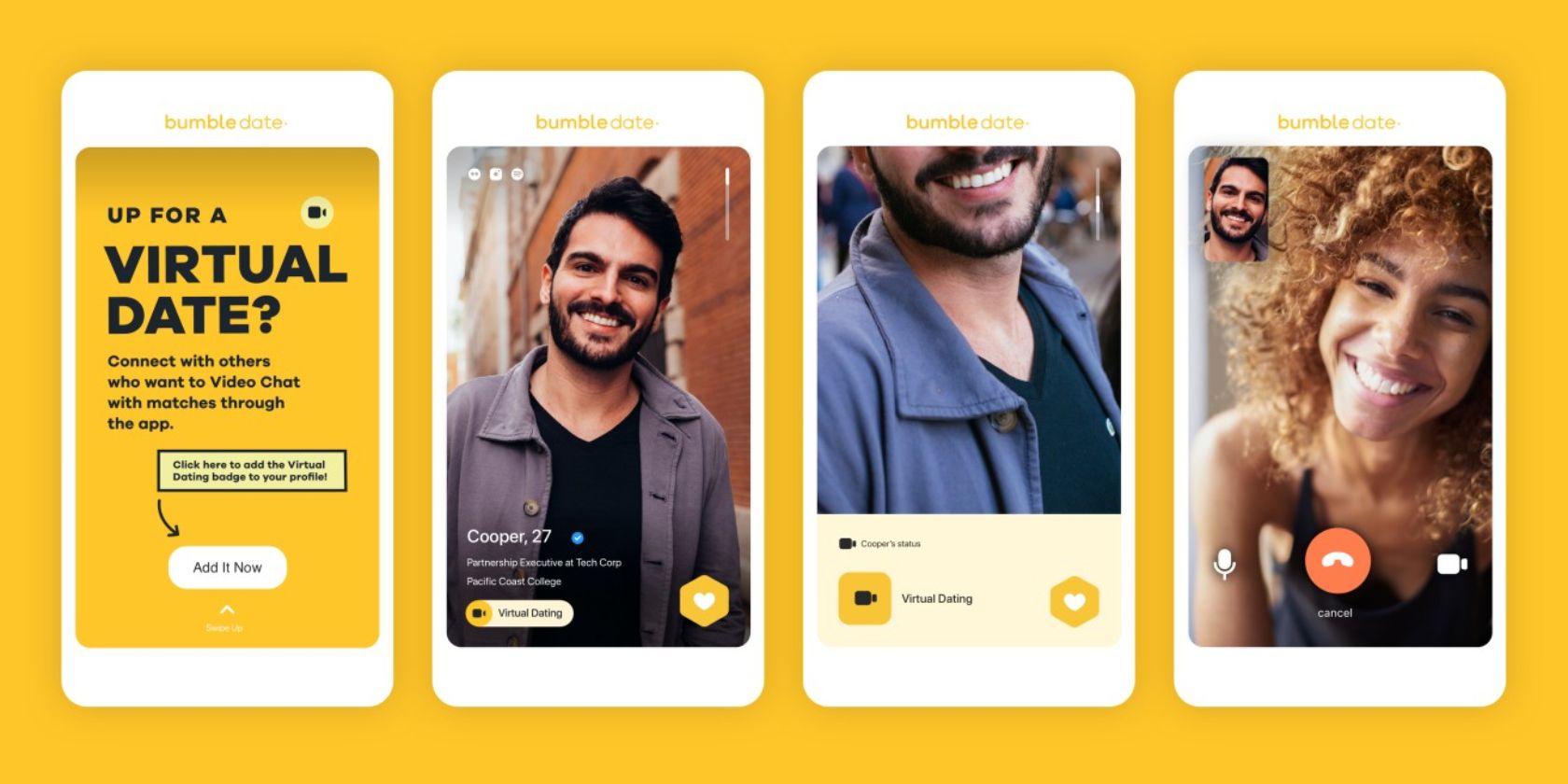
First up is a Virtual Date Badge which lets people know you’re down to Video Chat. This will be displayed on your profile, and you’ll be added to the pool of people happy to Video Chat. You’ll also be able to filter matches to those displaying the Virtual Date Badge.

Next up are Audio Notes. These are short audio messages that your match can play at any time, and more than once. Bumble has also added the option to reply to specific messages, which is a standard feature on most dedicated messaging apps.

Last but not least, Bumble is allowing you to expand your Distance Filter. So, rather than being limited to matches who live within a 100-mile radius, you can move the slider all the way to the right and expand your pool of potential matches to the whole country.

How to Protect Your Privacy While Dating Online

With the prospect of meeting a new soulmate rather limited thanks to the coronavirus crisis, these new virtual dating tools could prove to be a Godsend. After all, long distance relationships can work sometimes. And this lockdown will end eventually…

Even if you’re unable to meet new people through online dating apps, you still need to keep your wits about you to avoid putting yourself at undue risk. So, with that in mind, here’s how to protect your privacy while online dating.

Read the full article: Bumble Adds New Virtual Dating Tools


Read Full Article

Turn Gmail Into a Powerful Collaboration Tool With These Apps


gmail-collaboration-tools

When it is time to collaborate with your team, there are plenty of extensive applications that can assist you. However, these days many of us still live in our inboxes. So, when you want to collaborate on emails received, those you are composing, or even hold a quick conversation, this can all be done right from your Gmail account.

Luckily, there are terrific tools and tips that can help. Let’s take a look at some of the best ones for your Gmail collaborative inbox.

Email Collaboration Tools That Can Help

1. Hiver

Hiver In Gmail

With the Hiver Gmail extension, you can manage your business right from your Gmail account by using labels, assigning tasks, delegating messages, and tracking the status of it all.

By using the shared labels, you and your team can be notified of new tasks quickly. Shared contacts allow for easier messaging, email reminders and snoozing help with follow-ups, notes allow for conversations, and reusable templates can provide your business with a uniform look.

In addition, Hiver provides a collision detection feature so that if another person in your organization is replying to a shared message, you will know it right away.

Hiver offers a free trial so that you can check out the features. Plan pricing varies for Hiver per month after the trial, based on the number of users, emails, templates, and other items.

2. Missive

Missive for Gmail In Browser

Missive is a wonderful web-based collaboration tool as it incorporates threaded chats directly in your inbox. The application also has options to snooze or archive chats, the ability to compose emails with teammates, and gives you a robust email application.

Once you sign up for a free account with Missive, you can create a group simply by entering your company name. Invite people to join, connect a current Gmail account to import your emails, and then you are on your way.

Collaborating is extremely simple. You can mention another team member to draw their attention to a particular message. Then, you can have a conversation regarding the email with a familiar text type of interface. You can also chat with your team members privately if necessary, edit messages, and attach files and photos.

For a complete email application with great features, easy collaboration, and an uncomplicated interface, Missive is a terrific choice. You can also take a look at Missive’s paid plans for additional team members and features.

3. Todoist

Todoist is easily one of the most popular task management apps and with Gmail collaboration, it is even more powerful. You can quickly convert messages into tasks, collaborate on shared projects, and check out to-do lists all from your inbox.

The application provides handy notifications, a workflow-fitting label system, comments with attachment capability, export function for iCalendar, real-time device syncing, and color-coded priority levels. All of these convenient features make collaborating directly from your Gmail inbox as easy as pie.

A standout feature of Todoist is its accessibility. You can use it on the web, your mobile devices, and as a browser extension. The application is available for free with premium and business version plan options for Todoist on a yearly subscription basis.

4. Keeping

If you and your team are Google Chrome users, then an application and Chrome extension called Keeping is one to check out for Gmail collaboration. This application is intended for businesses that provide email support and it contains an internal ticketing system.

Keeping provides a general help desk email box with open and unassigned, assigned to you, and closed sortable labels right at the top of your Gmail account. You can change a message status from open to closed, assign emails to users you set up, and use filters to see how many each user has been assigned.

The application allows for internal notes per message that your entire team can see, which is not only convenient but necessary for email support collaboration.

Keeping offers a free trial so that you can try it out. After that, there are Keeping plans available with pricing dependent on the number of users and shared mailboxes you need. As mentioned, Keeping is only available for Google Chrome.

5. Google Groups

Setting up a Google Group can help you and your team come together on ideas, topics, and emails from a collaborative inbox.

You simply create a new group, adjust basic permission settings, and invite your team. You can assign and resolve topics, manage helpful tags, and use filters to stay up to date. Posting messages and replies is easy, marking conversations as complete is done with a click, and viewing activity and obtaining a link to the stream is also very simple.

If you like to keep things uncomplicated with your business or just have a small number of team members, Google Groups is a collaborative tool to consider.

More Tools You Can Connect

1. Trello

Trello In Gmail

Trello offers its own ways to use their handy project management tool for collaboration. But if you are a Google Chrome user, there is a useful extension called Gmail-to-Trello that lets you add cards to boards. Once you install it and open an email in Gmail, you will see an Add Card button at the top. Select the button and then add the details in the pop-up window. Click the green +Trello button and you are set.

For more on using Trello with Gmail, check out our helpful guide.

2. Dropbox

Dropbox In Gmail

With Dropbox, Google Chrome users have access to an extension called Dropbox for Gmail. This helpful Dropbox tool will display the Dropbox button at the bottom of the compose email window. Just click that button, browse or search for a file or photo in the pop-up window, and then select Choose. This will send a link to that item to your recipient without you having to navigate from your inbox.

3. Google Drive

Google Drive In Gmail

For any browser that you use to access Gmail, Google Drive is an automatic option. Like with the Dropbox extension for Google Chrome, you should see a button for Google Drive at the bottom of the compose email window. Using Google Drive allows you to send either a link to the item or attach it directly to the message, giving you flexibility from your inbox.

Helpful Tips and Tricks

Collaborating with your team using Gmail does not always require you to use third-party applications or extensions. Although all of these tools are useful and wonderful options, if you have a very small team there are some simple tips and tricks you can use that already exist within Gmail.

Assign items with labels. Gmail offers helpful labels for you to keep your inbox and folders organized, but these handy tools can also be used for assigning tasks and calling attention to particular messages.

For example, you can set up color-coded labels for each member of the team. That way, both you and your team can spot emails that need attention at a glance.

Take advantage of filters. Gmail provides powerful filters that are quite useful and flexible. For instance, you can have all emails from Sue have a specific label applied and forwarded to Phil. As another example, you can have all emails with the word Project in the subject line receive a star and be marked as important.

Use the chat feature. Gmail has Google Hangouts built right into it which means you do not have to download another messenger application if your entire team uses Gmail.

You can chat via text or initiate a video or phone call with an individual or a group easily. Especially useful for remote teams, this feature allows you to collaborate throughout the day without leaving Gmail.

Be sure to check out these additional creative ways to get the most out of Google Hangouts.

Additional Tips:

  • Keep your subject lines clear and use keywords and consistency for assigning to-dos.
  • Keep your team in the loop by copying them on important messages.
  • Keep everyone up-to-date on keywords to use and the structure of subject lines.

Your Gmail Collaborative Inbox

Collaboration is key to many successful businesses. So using simple applications like Gmail with email collaboration tools like these can help your company in the long run.

For more, take a look at our power user’s guide to Gmail.

Read the full article: Turn Gmail Into a Powerful Collaboration Tool With These Apps


Read Full Article

After Installing Windows 10: 6 Things You Must Do


after-installing-windows10

Windows 10 is pretty easy to get started with, but for the best experience, there are some important things to do after installing Windows 10. Doing these takes a bit of time, but sets you up for a smoother time down the road.

Let’s look at the first things you should do after installing Windows 10. These are most important when installing it for the first time, but are worth checking after installing a major feature update, too.

1. Run Windows Update and Configure Update Settings

Even though you just installed Windows 10, chances are that some recent updates are pending. You should install these right away to make sure you have the latest features and security patches.

To check for Windows updates, open the Settings app and go to Update & Security > Windows Update.

On this page, click Check for updates and give it some time. After a few moments, it will begin to download and install updates. If there are any that require a restart, you’ll see a prompt to do so.

Windows 10 May 2019 Windows Update

Windows Update runs automatically in Windows 10. While this means less manual work on your part, it can also be a pain if it interrupts you.

Learn how to manage Windows Update to make it work smoothly in the background.

2. Upgrade Your Hardware Drivers

Computer logic board

A device driver is a piece of software that interfaces with and controls how a particular device works when connected to your system. In other words, drivers allow Windows to communicate with hardware properly.

Drivers are usually provided by hardware manufacturers, and like most software, aren’t always perfect. Sometimes they’re buggy or don’t see updates for compatibility with the latest versions of Windows.

Keeping drivers updated is important to make sure your hardware runs at optimal performance. Windows will install generic drivers for devices like keyboards and mice on its own, but you should also know how to update other important drivers, such as display drivers.

See how to find and replace outdated drivers for instructions.

3. Install Essential Windows Software

Windows 10 comes with basic apps for many purposes, but a lot of the best Windows software isn’t pre-installed. We’ve written a full guide to the Windows software that everyone should install right away.

Take a look at that for our recommendations in categories like browsers, security, image editing, messaging, and more.

4. Change Default Windows Settings

Windows 10’s out-of-the-box settings aren’t optimal for everyone. They’re usable, but you’ll probably have a better experience by tweaking them.

There’s a lot to manage in Windows 10’s Settings app, so let’s consider a few key recommended changes after a Windows 10 installation.

Adjust Default Apps

Windows 10 Default Apps Settings

After you’ve installed your favorite apps, you should set them to run by default. To change the preset default apps in Windows 10, perform the following:

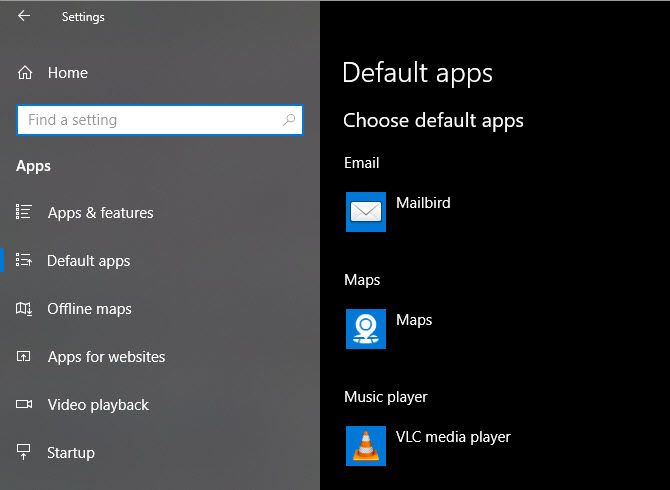
  1. Head to Settings > Apps > Default apps.
  2. Select your preferred apps for each category, including Email, Music player, Web browser, and more.
  3. Below that, click on Choose default apps by file type to associate various programs with other file types, such as PDF, DOCX, and TXT.

See our guide to setting defaults in Windows 10 for more help with this.

Disable Unnecessary Startup Items

Windows Startup Programs Task Manager

Many apps set themselves to run at startup, which is a waste of resources and makes your computer take much longer to boot up. After you’ve installed software, you should make sure that only approved apps run at boot.

To disable unnecessary startup items in Windows 10:

  1. Open the Task Manager with Ctrl + Shift + Esc.
  2. Click More details to switch to the full view, if needed.
  3. Switch to the Startup tab.
  4. Right-click on every app you don’t want to start automatically and select Disable to prevent it from launching on startup.

We have a full guide to managing startup apps on Windows 10 if you’d like to learn more.

Optimize Power Plan Settings

power plan settings

Windows 10’s Power Plan settings allow you to tweak various aspects of the operating system that involve power usage. This is important to help laptop users save battery life, but also has useful settings for desktop users.

You can then tweak your power plan using these steps:

  1. Head to Settings > System > Power & sleep.
  2. On the right side, choose Additional power settings to open the Power Options section of the Control Panel.
  3. You’ll see several plans to choose from, including Balanced, Power Saver, and High performance. Select the plan you want, then click Change plan settings to the right to modify it.
  4. Choose the amount of time that passes before the screen turns off and the computer goes to sleep. Then click Change advanced power settings for more options.
  5. While you can review everything here, pay special attention to the settings under the Hard disk, Sleep, Power buttons and lid, Processor power management, and Display categories.
  6. Click OK to save your changes.

See how to use your Windows 10 power button for more information.

Tweak Privacy Settings

Windows 10 collects all sorts of information about how you use the operating system. This helps Microsoft improve the ever-evolving product, but many view it as an invasion of privacy. Thankfully, you can reduce or disable a lot of the telemetry functions.

Follow our complete guide to Windows 10 privacy settings for all you need to know.

Enable Night Light

Windows 10 Night Light

Windows 10 includes a built-in feature that makes your screen display warmer at night. This helps reduce the blue light that keeps you awake and makes your computer less harsh to look at when working late.

You can enable it by visiting Settings > System > Display. Enable the Night light slider and click Night light settings to change how it works. You can adjust the intensity of the effect and set it to run automatically from sunset to sunrise or during certain hours of your choice.

5. Set Up a Backup Plan

Windows 10 File History Options

You wouldn’t want to go through all this setup only to have your computer ruined by a virus or dead hard drive. It’s vital to back up your data to protect it from these and other dangers.

Consult our guide to backing up and restoring data in Windows 10 to learn everything you need to know, including how backups work, where to store them, how often you should back up data, what software to use, and much more. We’ve also explained which files you should back up and which to skip.

6. Personalize Windows 10

Windows 10 Change Wallpaper

While it’s not important as the above, you should still take some time to customize your desktop after installing Windows 10. It’s amazing what a fresh wallpaper, unique mouse cursor, and other small personalization tweaks can do to make your system feel like home.

You have plenty of options for this. For some quick changes, we’ve shown how to change the look and feel of Windows 10. To get more in-depth, try some of the best tools to customize Windows 10.

After Installing Windows 10, You’re All Set

Now you don’t have to wonder what to do after installing Windows 10. We’ve looked at the essential steps to get your system ready for everyday use. While you might still have to make small tweaks here and there, the initial setup is most of the work.

On the flip side, make sure you know what to do before installing a major Windows 10 update to minimize upgrade problems.

Read the full article: After Installing Windows 10: 6 Things You Must Do


Read Full Article

6 Real-Life Video Game Injuries and How to Avoid Them


Video games offer a wonderful escape from the real world, and are a great way to have fun and relax. There’s no doubting the benefits of playing video games. However, video game injuries, if suffered, take the enjoyment out of gaming.

While your characters will often die or be badly injured, it’s also possible for gamers themselves to suffer an injury while gaming. Some are more severe than others and common video game injuries include carpal tunnel syndrome and neck pain.

In this article, we list a number of video game injuries and explain how to avoid them.

1. Computer Vision Syndrome

Man looking at screen
Image Credit: Amateur Hub/Pexels

Computer vision syndrome isn’t specific to video games, but rather any extended periods of time spent looking at a screen close-up. However, since many games have that addicting “just one more turn” feeling, it’s likely that you will experience this: around 90 percent of people who spend more than three hours at a screen will.

It’s a condition caused by looking at a screen for so long without letting your eyes relax. Focusing on something nearby for so long puts tension on your eyes. You might notice dry or irritated eyes, blurred vision, headaches, and more as a result.

The best solution is to not play games for hours on end. You should also consciously blink if you feel your eyes getting tired and employ the 20-20-20 rule. This means that every 20 minutes, look at something 20 feet (6.1 meters) away for 20 seconds. This allows the eyes to relax.

2. Neck and Back Pain

Physical therapy
Image Credit: Jesper Aggergaard/Unsplash

Sitting is a major killer and you won’t help the situation by slouching in your chair or couch. Sitting increases the pressure on your lower back at the best of times—if your posture is poor, that pressure is greater.

This increased pressure will wear down the bones and joints. You’ll feel the pain all over your body, but primarily in the back and neck.

Ideally, you should do some exercise every day to keep your body fit. If this isn’t possible, at the very least take a break every half hour or so to get up and walk around. It will stop your body seizing up.

While gaming, ensure your posture is correct. Sit up straight, keep the TV or monitor at eye level, arms at 90 degrees, with your feet flat on the floor. You should also invest in a supportive chair if you can afford one.

3. Carpal Tunnel Syndrome

Holding games controller
Image Credit: Deeana Creates/Pexels

Carpal tunnel syndrome is when the bones and ligaments in the wrist have narrowed. This then causes the median nerve, which runs through the tunnel from your upper arm to the palm of your hand, to be pinched.

This is an issue because that tunnel is very slim. Any strain is going to be felt in your hand and cause a tingling sensation. This will then progress to numbness and pain.

One way that carpal tunnel syndrome occurs is due to repeatedly bending the wrist, like when typing or clicking the mouse, or from holding a controller for a long time.

You can wear a wrist splint at night to help keep the wrist straight. Also, you can try wrist exercises, though there’s limited evidence to their usefulness. Ideally, buy ergonomic equipment such as vertical mice to reduce the wrist strain.

4. Seizure

LED lights
Image Credit: Tayla Jeffs/Unsplash

You might have noticed that many video games come with an epilepsy warning. This is because video games were medically recorded as causing seizures in the early 1980s, after which console manufacturers were required to include epilepsy warnings with their systems.

You are only at risk of a seizure if you suffer from photosensitivity. In video games, the seizure can be brought on by aspects like lights flashing repeatedly or stripes of contrasting colors. Some games do have a setting to turn off specific elements that might cause a seizure, so do check for this.

The chance of suffering a seizure is small, but it’s still a risk. You should know if this applies to you. Speak to a doctor if so. Advice they might give you, short of not playing video games at all, is to sit further back from the screen, adjust the screen’s brightness, and be surrounded by natural light.

5. Full-Contact Injuries

Playing VR
Image Credit: David Dvorácek/Unsplash

Gaming used to be a sedentary hobby, but the advent of the Wii took many people off their couch… and swinging their bodies around wildly. News reports at the time talked of gamers who had fallen over or whacked someone in the face with a controller.

It wasn’t just people that were being damaged, but TV screens too! In fact, Nintendo had to issue advice on how to use the Wii controllers safely and started packing them in protective silicone to try to limit damage.

While the Wii is an old console now, similar physical injuries are still a risk. With virtual reality growing, it’s still possible to have a full-contact injury while gaming. Before playing, ensure that you have enough space around you and that you hold on to the controllers properly.

If you’re about to play an intense game, you might even want to stretch and warm up.

6. Obesity

Fast food
Image Credit: Christopher Williams/Unsplash

Being obese means that you’re severely overweight. While it isn’t an injury in itself, it is a condition that will lead to problems.

Children are spending less time outdoors and more time inside playing games. Leading a sedentary lifestyle is more likely to cause obesity due to the lack of physical exercise. There’s also some evidence to show that obsessive gamers eat more while gaming, even if they’re not hungry.

The easiest way to combat this is to get outside and work out. Go for a run, play a sport, or hit the gym. To ease into this, you could try some physical fitness video games, like those that get you dancing or exercising.

Work Out and Stay Active

While there’s no doubting the joys of gaming, it isn’t a hobby you should do all of the time. Many of these injuries can be avoided simply by spending less time playing games and more time being physically fit.

To help keep yourself fit and healthy, use the best workout apps to get in shape.

Read the full article: 6 Real-Life Video Game Injuries and How to Avoid Them


Read Full Article

14 April 2020

Replace non-stop Zoom with remote office avatars app Pragli


Could avatars that show what co-workers are up to save work-from-home teams from constant distraction and loneliness? That’s the idea behind Pragli, the Bitmoji for the enterprise. It’s a virtual office app that makes you actually feel like you’re in the same building.

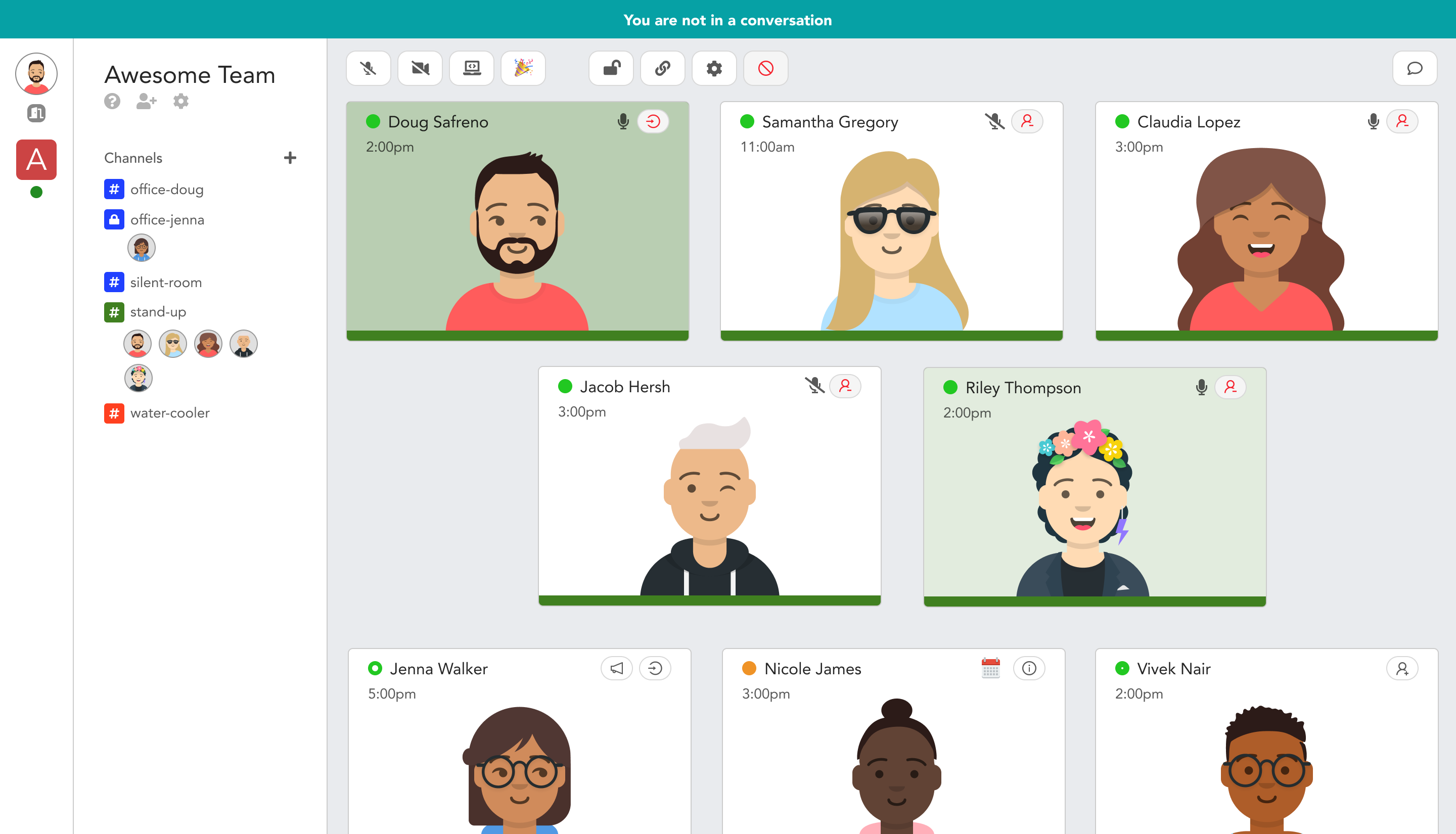
Pragli uses avatars to signal whether co-workers are at their desk, away, in a meeting, in the zone while listening to Spotify, taking a break at a digital virtual watercoooler, or done for the day. From there, you’ll know whether to do a quick ad-hoc audio call, cooperate via screenshare, schedule a deeper video meeting, or a send a chat message they can respond to later. Essentially, it translates the real word presence cues we use to coordinate collaboration into an online workplace for distributed teams.

“What Slack did for email, we want to do for video conferencing” Pragli co-founder Doug Safreno tells me. “Traditional video conferencing is exclusive by design, whereas Pragli is inclusive. Just like in an office, you can see who is talking to who.” That means less time wasted planning meetings, interrupting colleagues who are in flow, or waiting for critical responses. Pragli offers the focus that makes remote work productive with the togetherness that keeps everyone sane and in sync.

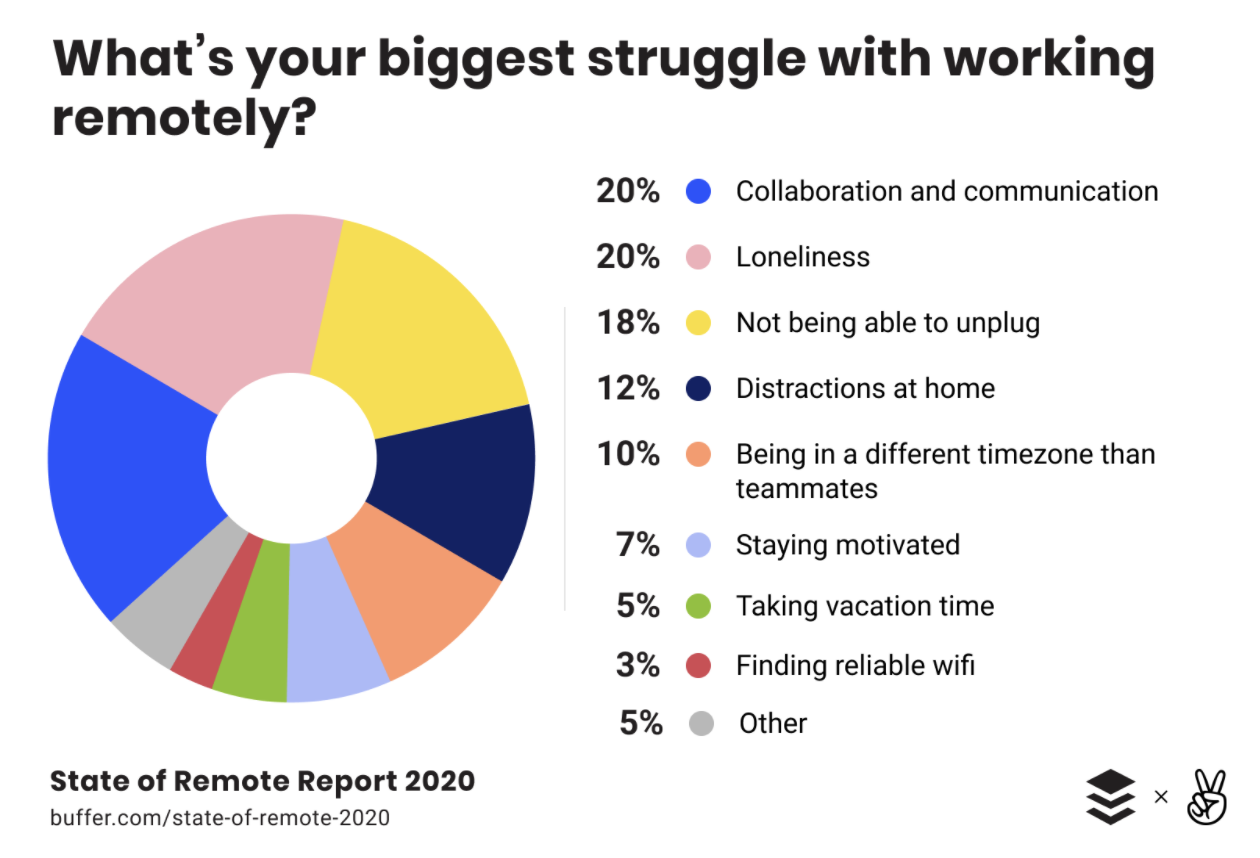
The idea is to solve the top three problems that Pragli’s extensive interviews and a Buffer/AngelList study discovered workers hate:

  1. Communication friction
  2. Loneliness
  3. Lack of boundaries boundaries

You never have to worry about whether you’re intruding on someone’s meeting, or if it’d be quicker to hash something out on a call instead of vague text. Avatars give remote workers a sense of identity, while the Pragli watercooler provides a temporary place to socialize rather than an endless Slack flood of GIFs. And since you clock in and out of the Pragli office just like a real one, co-workers understand when you’ll reply quickly versus when you’ll respond tomorrow unless there’s an emergency.

“In Pragli, you log into the office in the morning and there’s a clear sense of when I’m working and when I’m not working. Slack doesn’t give you a strong sense if they’re online or offline” Safreno explains. “Everyone stays online and feels pressured to respond at any time of day.”

Pragli co-founder Doug Safreno

Safreno and his co-founder Vivek Nair know the feeling first-hand. After both graduating in computer science from Stanford, they built StacksWare to help enterprise software customers avoid overpaying by accurately measuring their usage. But when they sold StacksWare to Avi Networks, they spent two years working remotely for the acquirer. The friction and loneliness quickly crept in.

They’d message someone, not hear back for a while, then go back and forth trying to discuss the problem before eventually scheduling a call. Jumping into synchronous communicating would have been much more efficient. “The loneliness was more subtle, but it built up after the first few weeks” Safreno recalls. “We simply didn’t socially bond while working remotely as well as in the office. Being lonely was de-motivating, and it negatively affected our productivity.”

The founders interviewed 100 remote engineers, and discovered that outside of scheduled meetings, they only had one audio or video call with co-workers per week. That convinced them to start Pragli a year ago to give work-from-home teams a visual, virtual facsimile of a real office. With no other full-time employees, the founders built and released a beta of Pragli last year. Usage grew 6X in March and is up 20X since January 1st.

Today Pragli officially launches, and it’s free until June 1st. Then it plans to become freemium with the full experience reserved for companies that pay per user per month. Pragli is also announcing a small pre-seed round today led by K9 Ventures, inspired by the firm’s delight using the product itself.

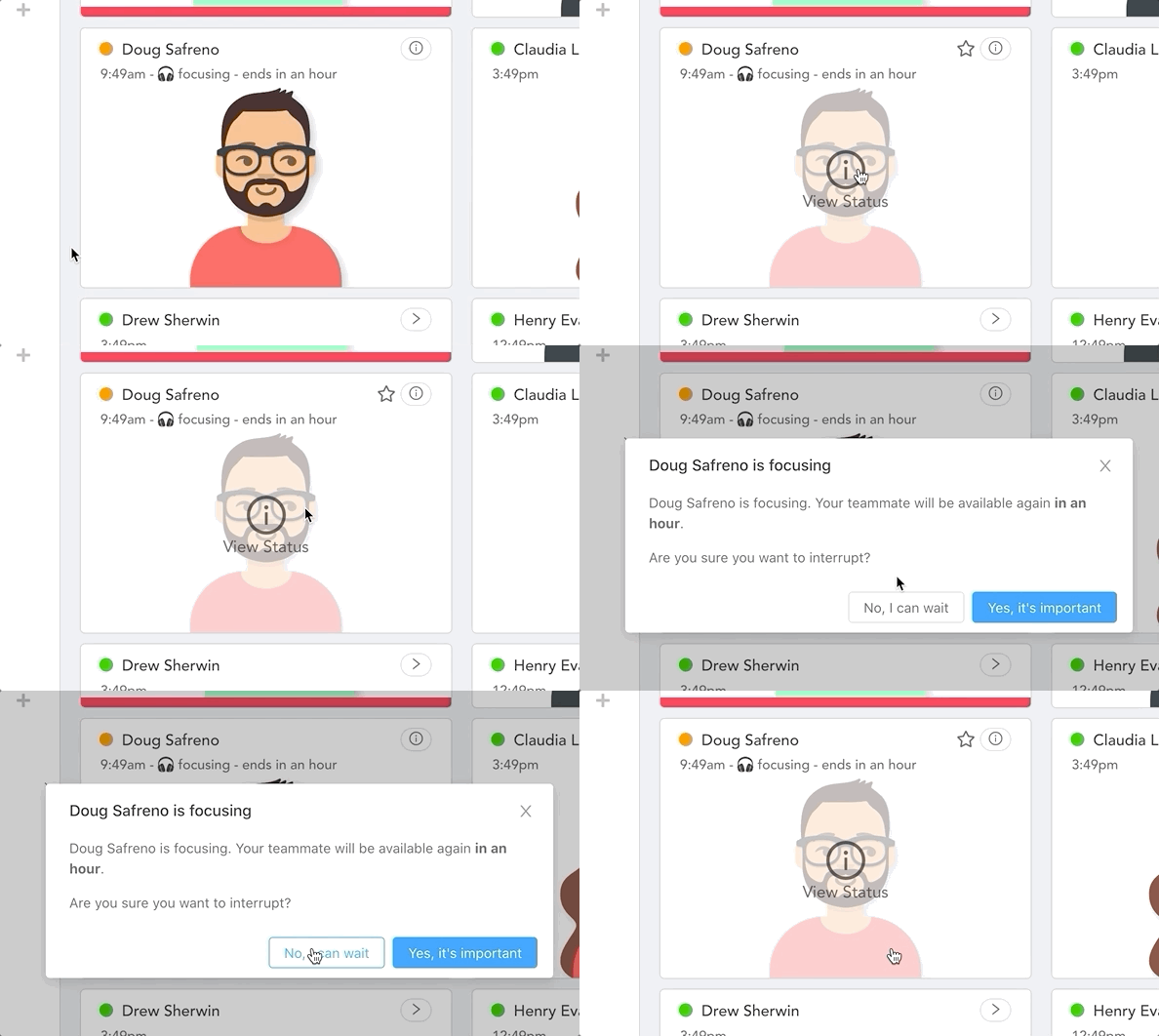
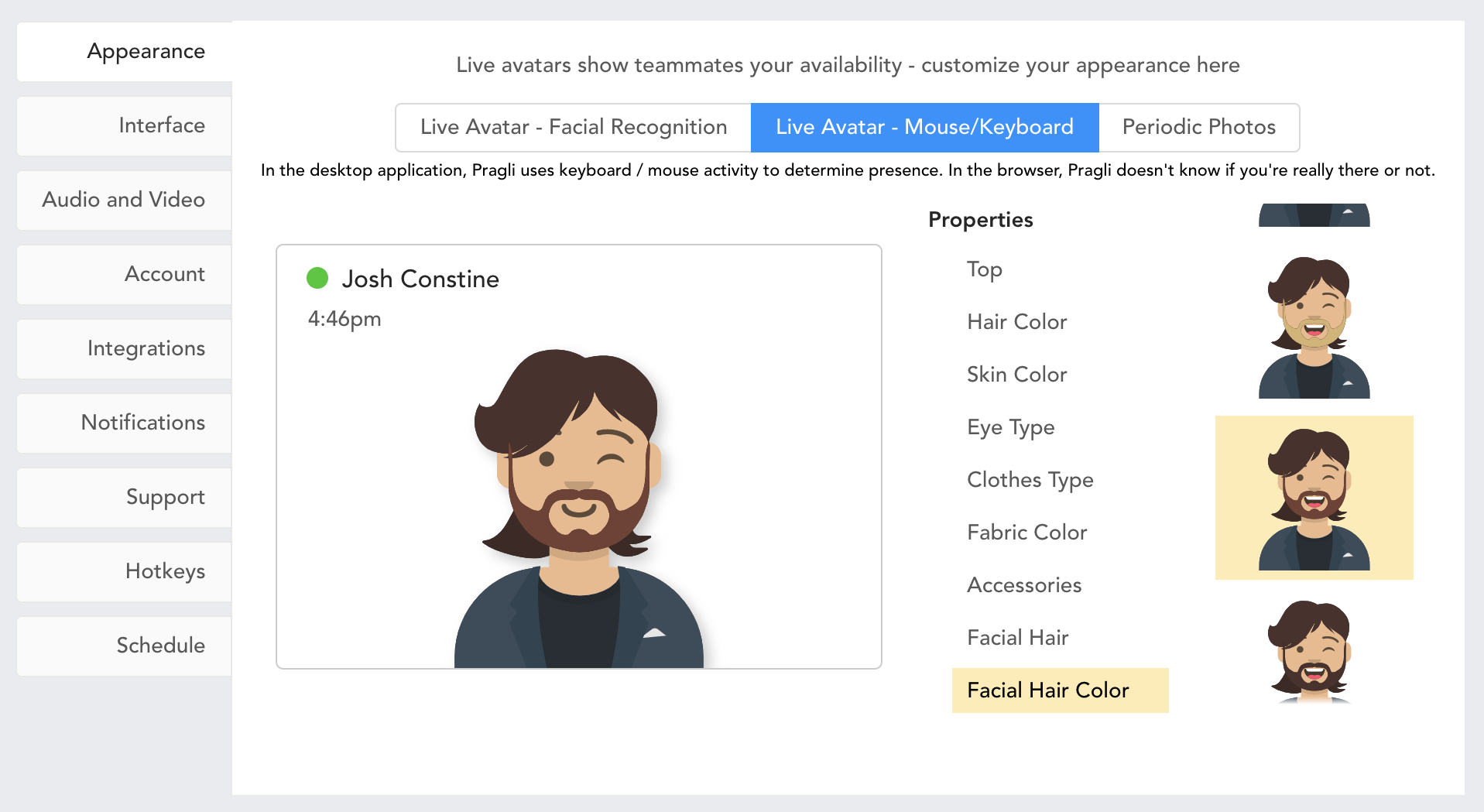
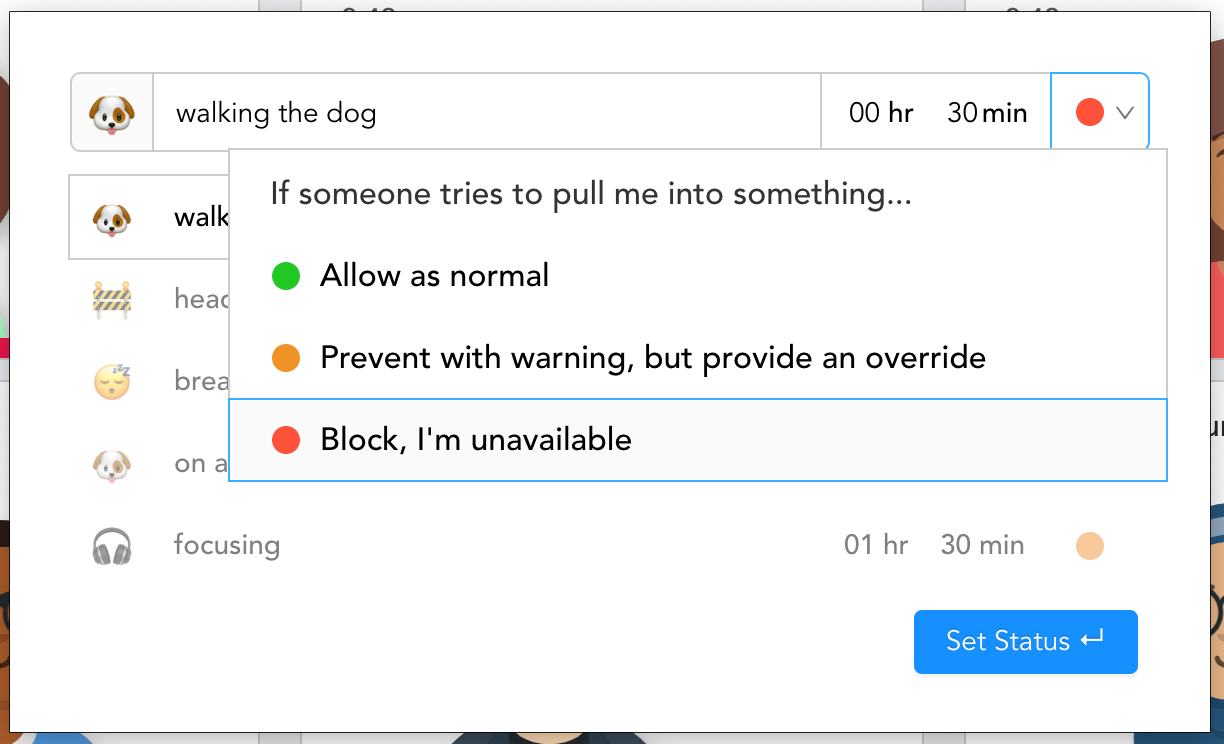
To get started with Pragi, teammates download the Pragli desktop app and sign in with Google, Microsoft, or Github. User then customize their avatar with a wide range of face, hair, skin, and clothing options. It can use your mouse and keyboard interaction to show if you’re at your desk or not, or use your webcam to translate occasional snapshots of your facial expressions to your avatar. You can also connect your Spotify and calendar to show you’re listening to music (and might be concentrating), reveal or hide details of your meeting, and decide whether people can ask to interrupt your or that you’re totally unavailable.

From there, you can communicate by audio, video, or text with any of your available co-workers. Guests can join conversations via the web and mobile too, though the team is working on a full-fledged app for phones and tablets. Tap on someone and you can instantly talk to them, though their mic stays muted until they respond. Alternatively, you can jump into Slack-esque channels for discussing specific topics or holding recurring meetings. And if you need some downtime, you can hang out in the watercooler or trivia game channel, or set a manual away message.

Pragli has put a remarkable amount of consideration into how the little office social cues about when to interrupt someone translate online, like if someone’s wearing headphones, in a deep convo already, or if they’re chilling in the microkitchen. It’s leagues better than having no idea what someone’s doing on the other side of Slack or what’s going on in a Zoom call. It’s a true virtual office without the clunky VR headset.

“Nothing we’ve tried has delivered the natural, water-cooler-style conversations that we get from Pragli” says Storj Labs VP of engineering JT Olio. “The ability to switch between ‘rooms’ with screen sharing, video, and voice in one app is great. It has really helped us improve transparency across teams. Plus, the avatars are quite charming as well.”

With Microsoft’s lack of social experience, Zoom consumed with its scaling challenges, and Slack doubling down on text as it prioritizes Zoom integration over its own visual communication features, there’s plenty of room for Pragli to flourish. Meanwhile, COVID-19 quarantines are turning the whole world towards remote work, and it’s likely to stick afterwards as companies deemphasize office space and hire more abroad.

The biggest challenge will be making such a broad product encompassing every communication medium and tons of new behaviors comprehensible enough to onboard whole teams. How do you build a product that doesn’t feel distracting like Slack but where people can still have the spontaneous conversations that are so important to companies innovating?” Safreno asks. The Pragli founders are also debating how to encompass mobile without making people feel like the office stalks them after hours.

“Long-term, [Pragli] should be better than being in the office because you don’t actually have to walk around looking for [co-workers], and you get to decide how you’re presented” Safreno concludes. “We won’t quit because we want to work remotely for the rest of our lives.”


Read Full Article

The 8 Best Skateboarding Games of All Time


Video game genres peak in cycles. A few great skateboarding and snowboarding games will release at the same time, and then fans have no new titles for years. The time when a new skateboarding, motocross, or other action sports game would appear every year seems long gone.

Still, there are many skateboarding classics worth checking out once more. Better still, a few new skateboarding games are hitting the market, filling the void. With that in mind, here are the best skateboarding games ever made—including a new skateboarding game you should try.

1. Tony Hawk’s Pro Skater 3 (2001)

You could debate the merits of the various “Pro Skater” games all day. But many players agree that the third title in the series reigns supreme. Even though it was released over 15 years ago, it’s still one of the highest-ranked video games of all time on Metacritic. It also holds the honor of being the #1 rated game on the PlayStation 2. If you haven’t played it, you’re missing out.

It took the classic formula set out by Tony Hawk’s Pro Skater and Pro Skater 2, and built upon it. There weren’t any big changes from the previous titles, other than the addition of the revert, which let players string even more tricks together. But delightful new levels like the Foundry, Skater Island, and the Cruise Ship made their first appearance. And a host of new secret characters showed up, including Darth Maul, Doom Guy, and the Demoness.

The game’s signature arcade-like feeling is perfectly on point in this game. It’s no big deal to throw a 900-degree spin or grind for miles at a time with a few button presses. Pick a level, choose a skater, and get ready to shred. Ridiculous tricks like the Human Dart grind, the Pizza Guy, and the Sith Saber Spin cement the fantastic, absurd tone of the game. It’s an absolute blast.

If you don’t have a PlayStation 2 lying around, your best bet for playing THPS 3 is to use a PlayStation 2 emulator on your PC. Tony Hawk’s Pro Skater HD and the Revert Pack give you some of what made the game great on PS3 or Xbox 360, but it’s not the full game experience.

2. Skate (2007)

When Tony Hawk was ruling the streets, EA’s Skate came in with something new. Its control system did away with simple button presses and replaced it with a more “organic” interface. By moving the left and the right sticks in specific patterns, meant to mimic the movement of a skater’s feet, you make your skater do different tricks.

While the control system can be challenging to learn, it has a unique appeal. Unlike the arcade feel of THPS, Skate gives you a more authentic experience. Landing a nollie heelflip is more difficult than just pressing a few buttons. If you’re used to the Tony Hawk’s Pro Skater method of control, making the transition brings a bit of a shock. But it’s worth it when you pull off satisfying tricks.

The story-driven action mimics that of Tony Hawk’s Underground. You travel around the city, completing challenges and garnering acclaim. But the open-ended nature of the game means you can do whatever you want. Skate around San Vanelona to find the best spots. Learn a crazy new trick that you discovered. Or just ride around and chill. It’s totally up to you.

Like Pro Skater 3, if you want to play Skate, you’re going to need to either dig up an older system or emulate it, which is more difficult for PS3 and Xbox 360 games. The difficulty is emulating the specific hardware for each device and creating a stable environment for the game to run.

The emulators that do work—RPRCS3 for the PlayStation 3 and Xenia for the Xbox 360—cannot guarantee you game will work. Furthermore, emulating games at this level places the host system under a huge amount of strain because of all the components that must be reproduced.

3. Tony Hawk’s Underground (2003)

Skate may have redefined the genre, but Tony Hawk’s Underground set the bar high for story-based skateboarding games. Playing as yourself instead of a pro skater was a departure from previous Pro Skater games, as was the “punk-to-pro” storyline. The environments of Underground were likewise different from previous titles, with an emphasis on street skating over parks and crazy dream locations like Area 51.

The story is entertaining (if a bit far-fetched), the skating is as fun as ever, and many opportunities for customization make you feel like the protagonist skater is really your own. The ability to explore a variety of cities gives you plenty of great skating options, but the replay value of Underground does feel quite limited compared to other entries.

You can probably guess what I’m about to say next: you should emulate this one if you don’t own an older console.

4. Skate 2 (2009)

By sticking with the same formula as the first game but beefing up pretty much every area, Skate 2 surpassed its predecessor in the series. Still challenging and rewarding, the flick-it control system continued to differentiate this series from the Hawk games. With a significantly larger bag of tricks than the first, Skate 2 will keep you practicing and learning for hours.

The slightly dystopian storyline also stands out among skateboarding games. Players take on Mongocorp, the giant corporation that has locked down San Vanelona and placed the best skate spots off-limits. You’ll have to take back the skate scene with new tricks, fresh challenges, and all-new contests. Released during a long Tony Hawk’s dry spell, Skate 2 propelled the series to the throne of the skateboarding video game world.

You can download Skate 2 on the Xbox 360, but if you don’t have one, you’re stuck with emulation again.

5. OlliOlli 2: Welcome to Olliwood (2015)

The first OlliOlli broke away from the very successful formula developed by THPS and Skate. Instead of a 3D world packed with thousands of obstacles to skate and a seemingly infinite number of tricks and combos, it stood on simple 2D graphics and difficult, addicting gameplay. Gone are the days of throwing 1080 kickflip-to-indys. Land a simple 50-50 early in the game, and you’ll be elated.

The game keeps you on your toes by throwing new levels with surprising obstacles at you. And with gorgeous art, creative level design, and an almost unmatchable dose of adrenaline when you land the trick you’ve been attempting for the past hour, it’s really hard to put down. Don’t let the simple design fool you: you’ll sink many hours into this one.

And finally, this is a game you can easily buy and play on modern consoles. It’s available to download on your PlayStation 4 or Xbox One for a handful of dollars. It’s also a cross-play on PS4 and Vita, as are these other awesome cross-buy PlayStation titles.

Buy OlliOlli 2: Welcome to Olliwood on Steam.

6. Thrasher Presents Skate and Destroy (1999)

The game with the unfortunate task of releasing after the meteoric success of Tony Hawk’s Pro Skater, Thrasher Presents Skate and Destroy is a cult classic skateboarding game (and is also more commonly referred to as “Thrasher Skate and Destroy”). Where THPS focused on arcade skateboarding with flashy tricks and insane grind combos, Thrasher attempted to create realism between tricks and the player environment.

In that, Thrasher laid the groundwork for games like Skate, where the emphasis is on landing a trick to perfection and finding unique lines throughout a skatepark, instead of a button-bashing point-scoring trick-em-up. Not to say that Thrasher didn’t have a focus on high scores. You must accumulate enough points to rise through the 12 levels, dodging police officers, security guards, and more along the way.

Also, you cannot talk about Thrasher without mentioning the soundtrack, which features 13 of the finest hip-hop tracks ever produced.

Like the other options on this list, you’ll have to use an emulator to delve back into Thrasher. Check out how to download and install a PlayStation 1 emulator if you want to start skating again.

7. Skate or Die! (1987)

Skate or Die! is a classic skateboarding game originally released for the ZX Spectrum, Commodore 64, Atari ST, and other hardware of the era. It received a port to the NES where it sold over 100,000 copies and, with its catchy chiptunes, planted itself firmly in skateboard game history.

In Skate or Die!, you have the choice of five events: a freestyle ramp, high jump ramp (a half pipe), a downhill race, a downhill jam, and a jousting event (which is as it sounds). Although the tricks are basic, the Skate or Die! gameplay is fun, especially if you have someone else to play with.

If you don’t have a NES kicking about at home, check out how to build a custom Raspberry Pi NES or SNES emulator using RetroPie.

8. Skater XL (2020)

Skater XL is one of the newest skateboarding games about, offering an open-world sandbox on PC, PlayStation 4, Xbox One, and Nintendo Switch users. Developers Easy Day Studios are the team behind the massively popular Skater XL smartphone game and, realizing the popularity and demand for a more substantive game, have brought Skater XL to more powerful hardware.

The difference in hardware shows, as you might expect. Skater XL uses a similar control scheme to Skate and uses input from real-world tricks. That means practice makes perfect, and you’ll pick up and learn more tricks as you explore the Skater XL world. Adding to that, the Skater XL world is filled with awesome spots, including some real-world locations that mimic their counterparts, such as downtown Los Angeles.

At the time of writing, Skater XL is available on Steam Early Access and is scheduled to launch in the summer of 2020.

Buy Skater XL on Steam.

And One to Avoid: Tony Hawk’s Pro Skater 5

Tony Hawk’s Pro Skater 5 is terrible, and we would strongly advise you to avoid it. Buggy, laggy gameplay, and no innovation within the game itself make THPS5 one of the worst entries in the series. An online hub, missions for skaters, strange decisions regarding the special bar and trick limitations, and some lifeless level design combine to assign this title to the scrap heap.

The Best Skateboarding Games of All Time

For us, Skate 2 remains the best skateboarding game of all time. It hit that sweet spot of freedom, sandbox play, a semi-storyline to guide you through, and heaps of tricks and spots to try out.

Looking to the future, Skater XL looks like it could ascend the best skateboarding game throne, knocking all other competitors out of the way. Skater XL isn’t the only skateboarding game on the horizon either, with the almost fiendishly difficult Session also under development and available in Steam Early Access.

If you’re looking for some new games that aren’t skateboarding related, check out the best free PC games you can play right now.

Read the full article: The 8 Best Skateboarding Games of All Time


Read Full Article