Every startupper we’ve ever met loves a great deal, and so do we. That’s why we’re celebrating Prime day with a 48-hour flash sale on tickets to TC Sessions: Enterprise 2019, which takes place September 5 at the Yerba Buena Center for the Arts in San Francisco.
We’re talking a classic BOGO — buy-one-get-one — deal that starts today and ends tomorrow, July 16, at 11:59 p.m. (PT). Buy one early-bird ticket ($249) and you get a second ticket for free. But this BOGO goes bye-bye in just 48 hours, so don’t wait. Buy your TC Sessions: Enterprise tickets now and save.
Get ready to join more than 1,000 attendees for a day-long, intensive experience exploring the enterprise colossus — a tech category that generates hundreds of new startups, along with a steady stream of multibillion-dollar acquisitions, every year.
What can you expect at TC Sessions: Enterprise? For starters, you’ll hear TechCrunch editors interview enterprise software leaders, including tech titans, rising founders and boundary-breaking VCs.
One such titan, George Brady — Capital One’s executive VP in charge of tech operations — will join us to discuss how the financial institution left legacy hardware and software behind to embrace the cloud. Quite a journey in such a highly regulated industry.
Our growing speaker roster features other enterprise heavy-hitters, including Aaron Levie, Box co-founder and CEO; Aparna Sinha, Google’s director of product management for Kubernetes and Anthos; Jim Clarke, Intel’s director of quantum hardware; and Scott Farquhar, co-founder and co-CEO of Atlassian.
Looking for in-depth information on technical enterprise topics? You’ll find them in our workshops and breakout sessions. Check out the exhibiting early-stage enterprise startups focused on disrupting, well, everything. Enjoy receptions and world-class networking with other founders, investors and technologists actively building the next generation of enterprise services.
TC Sessions: Enterprise 2019 takes place September 5, and we pack a lot of value into a single day. Double your ROI and take advantage of our 48-hour BOGO sale. Buy your ticket before July 16 at 11:59 p.m. (PT) and get another ticket free. That’s two tickets for one early-bird price. And if that’s not enough value, get this: we’ll register you for a free Expo-only pass to Disrupt SF 2019 for every TC Sessions: Enterprise ticket you purchase (mic drop).
Interested in sponsoring TC Sessions: Enterprise? Fill out this form and a member of our sales team will contact you.
Hello, weekend readers. This is Week-in-Review, where I give a heavy amount of analysis and/or rambling thoughts on one story while scouring the rest of the hundreds of stories that emerged on TechCrunch this week to surface my favorites for your reading pleasure.
Last week, I talked about how Alexa wasn’t forgetting what you requested because that data was more valuable than one might think.
Photo by Justin Sullivan/Getty Images
The big story
In thinking about what to highlight in this week’s newsletter, I was tempted to talk about Zoom and Apple and Superhuman and the idea that secure communications can get screwed up when consent is bypassed, and I’m sure that’s something I’ll dig into down the road, but what intrigued me most this week was a single factoid from Google’s self-driving unit.
Waymo’s CTO told TechCrunch this week that the company has logged 10 billion miles of autonomous driving in simulation. That means that while you might have seen a physical Waymo vehicle driving past you, the real ground work has been laid in digital spaces that are governed by the laws of game engines.
The idea of simulation-training is hardly new; it’s how we’re building plenty of computer vision-navigated machines right now — hell, plenty of self-driving projects have been built leveraging systems like the traffic patterns in games like Grand Theft Auto. These billions of logged miles are just another type of training data, but they’re also a pretty clear presentation of where self-supervised learning systems could theoretically move, creating the boundaries for a model while letting the system adjust its own rules of operation.
“I think what makes it a good simulator, and what makes it powerful is two things,” Waymo’s CTO Dmitri Dolgov told us. “One [is] fidelity. And by fidelity, I mean, not how good it looks. It’s how well it behaves, and how representative it is of what you will encounter in the real world. And then second is scale.”
Robotics and AV efforts are going to rely more and more on learning the rules of how the laws of the universe operate, but those advances are going to be accompanied by other startups’ desires to build more high visual fidelity understanding of the world
There are plenty of pressures to create copies of Earth. Apple is building more detailed maps with sensor-laden vehicles, AR startups are actively 3D-mapping cities using crowd-sourced data and game engine companies like Unity and Epic Games are building engines that replicate nature’s laws in digital spaces.
This is all to say that we’re racing to recreate our spatial world digitally, but we might just be scratching the surface of the relationship between AI and 3D worlds.
Send me feedback
on Twitter @lucasmtny or email
lucas@techcrunch.com
On to the rest of the week’s news.
(Photo: by Chip Somodevilla/Getty Images)
Trends of the week
Here are a few big news items from big companies, with green links to all the sweet, sweet added context.
Trump must unblock his Twitter critics
Twitter is a consumer product, so politicians using it might feel like it’s their own personal account, but when they use it for political announcements it becomes an official communications channel, and using features like blocking stifles national free speech. So says an NY-based appeals court this week of President Trump’s habit of blocking critics. It’s undoubtedly a ruling that’s going to have far-reaching implications for U.S. political figures that use social media. Read more here.
Nintendo switches up the Switch The Nintendo Switch arrived on the scene with the bizarre notoriety of being a handheld system that was also a home console, but it’s not enough for the Japanese game company to capture the hybrid market, it’s looking to revisit the success it had back in the peak Nintendo DS days. The company announced the Switch Lite this week, which strips away a number of features for the sake of making a smaller, simpler version of the Nintendo Switch that is handheld-only and sports a longer battery life. Read more here.
Google and Amazon bury the home-streaming hatchet At long last, one of the stranger passive aggressive fights in the smart home has come to a close. Amazon’s Prime Video is finally available on Google’s Chromecast and YouTube is now on Fire TV after a years-long turf war between the two platforms. Read more here.
AT&T maxes out its HBO ambitions
When AT&T bought HBO, via its Time Warner acquisition, execs made clear that they had acquired a premium product and planned to shift its standing in the market. The company announced this week that it will be launching a new service called HBO Max next year that will bring in new content, including “Friends.” Read more here.
GAFA Gaffes
How did the top tech companies screw up this week? This clearly needs its own section, in order of badness:
Our premium subscription service had another great week of deep dives. My colleague Zack Whittaker revisited the WannaCry ransomware that hit in 2017 with a lengthy profile and interviews with the researchers that stopped the malware dead in its tracks. After you dig into that profile, you can check out his Extra Crunch piece that digs further into how security execs and startups can learn from the saga.
“…There is a good chance that your networks are infected with WannaCry — even if your systems haven’t yet been encrypted. Hankins told TechCrunch that there were 60 million attempted “detonations” of the WannaCry ransomware in June alone. So long as there’s a connection between the infected device and the kill switch domain, affected computers will not be encrypted….”
Here are some of our other top reads this week for premium subscribers. This week, we talked a bit about the future of car ownership and “innovation banking.”
Navigation app Waze is making getting to where you’re going even easier – or at least more transparent. A new feature rolling out today will show you any tolls along your route, including the actual amount you’re going to pay, across both the U.S. and Canada.
This is above and beyond what you’ll get in most navigation apps, where you might get a visual or text indicator that there is a toll on one of the roads in your path (and you can opt to avoid them if possible) but you won’t know what you’re actually paying. With Waze, you’ll get the amount – sourced from its community of user drivers, rather than direct from the official toll road operators, however, but Waze’s crowd-sourced navigation data often has a leg up on the official source in other cases.
Waze will show you the toll prices up front, too, before the navigation actually gets under way, which is great because that’s when you actually have the opportunity to do something about it, whether it’s scrounging seat cushion change or just choosing to drive a different way.
This will be rolling out beginning today, so keep an eye out if you’re trying to get somewhere in the U.S. or Canada.
A UK parliamentary committee has concluded there are no technical grounds for excluding Chinese network kit vendor Huawei from the country’s 5G networks.
In a letter from the chair of the Science & Technology Committee to the UK’s digital minister Jeremy Wright, the committee says: “We have found no evidence from our work to suggest that the complete exclusion of Huawei from the UK’s telecommunications networks would, from a technical point of view, constitute a proportionate response to the potential security threat posed by foreign suppliers.”
Though the committee does go on to recommend the government mandate the exclusion of Huawei from the core of 5G networks, noting that UK mobile network operators have “mostly” done so already — but on a voluntary basis.
If it places a formal requirement on operators not to use Huawei for core supply the committee urges the government to provide “clear criteria” for the exclusion so that it could be applied to other suppliers in future.
Reached for a response to the recommendations, a government spokesperson told us: “The security and resilience of the UK’s telecoms networks is of paramount importance. We have robust procedures in place to manage risks to national security and are committed to the highest possible security standards.”
The spokesperson for the Department for Digital, Media, Culture and Sport added: “The Telecoms Supply Chain Review will be announced in due course. We have been clear throughout the process that all network operators will need to comply with the Government’s decision.”
In recent years the US administration has been putting pressure on allies around the world to entirely exclude Huawei from 5G networks — claiming the Chinese company poses a national security risk.
Australia announced it was banning Huawei and another Chinese vendor ZTE from providing kit for its 5G networks last year. Though in Europe there has not been a rush to follow the US lead and slam the door on Chinese tech giants.
In April leaked information from a UK Cabinet meeting suggested the government had settled on a policy of granting Huawei access as a supplier for some non-core parts of domestic 5G networks, while requiring they be excluded from supplying components for use in network cores.
On this somewhat fuzzy issue of delineating core vs non-core elements of 5G networks, the committee writes that it “heard unanimously and clearly” from witnesses that there will still be a distinction between the two in the next-gen networks.
It also cites testimony by the technical director of the UK’s National Cyber Security Centre (NCSC), Dr Ian Levy, who told it “geography matters in 5G”, and pointed out Australia and the UK have very different “laydowns” — meaning “we may have exactly the same technical understanding, but come to very different conclusions”.
In a response statement to the committee’s letter, Huawei SVP Victor Zhang welcomed the committee’s “key conclusion” before going on to take a thinly veiled swiped at the US — writing: “We are reassured that the UK, unlike others, is taking an evidence based approach to network security. Huawei complies with the laws and regulations in all the markets where we operate.”
The committee’s assessment is not all comfortable reading for Huawei, though, with the letter also flagging the damning conclusions of the most recent Huawei Oversight Board report which found “serious and systematic defects” in its software engineering and cyber security competence — and urging the government to monitor Huawei’s response to the raised security concerns, and to “be prepared to act to restrict the use of Huawei equipment if progress is unsatisfactory”.
Huawei has previously pledged to spend $2BN addressing security shortcomings related to its UK business — a figure it was forced to qualify as an “initial budget” after that same Oversight Board report.
“It is clear that Huawei must improve the standard of its cybersecurity,” the committee warns.
It also suggests the government consults on whether telecoms regulator Ofcom needs stronger powers to be able to force network suppliers to clean up their security act, writing that: “While it is reassuring to hear that network operators share this point of view and are ready to use commercial pressure to encourage this, there is currently limited regulatory power to enforce this.”
Another committee recommendation is for the NCSC to be consulted on whether similar security evaluation mechanisms should be established for other 5G vendors — such as Ericsson and Nokia: Two European based kit vendors which, unlike Huawei, are expected to be supplying core 5G.
“It is worth noting that an assurance system comparable to the Huawei Cyber Security Evaluation Centre does not exist for other vendors. The shortcomings in Huawei’s cyber security reported by the Centre cannot therefore be directly compared to the cyber security of other vendors,” it notes.
On the issue of 5G security generally the committee dubs this “critical”, adding that “all steps must be taken to ensure that the risks are as low as reasonably possible”.
Where “essential services” that make use of 5G networks are concerned, the committee says witnesses were clear such services must be able to continue to operate safely even if the network connection is disrupted.Government must ensure measures are put in place to safeguard operation in the event of cyber attacks, floods, power cuts and other comparable events, it adds.
While the committee concludes there is no technical reason to limit Huawei’s access to UK 5G, the letter does make a point of highlighting other considerations, most notably human rights abuses, emphasizing its conclusion does not factor them in at all — and pointing out: “There may well be geopolitical or ethical grounds… to enact a ban on Huawei’s equipment”.
It adds that Huawei’s global cyber security and privacy officer, John Suffolk, confirmed that a third party had supplied Huawei services to Xinjiang’s Public Security Bureau, despite Huawei forbidding its own employees from misusing IT and comms tech to carry out surveillance of users.
The committee suggests Huawei technology may therefore be being used to “permit the appalling treatment of Muslims in Western China”.
Petcube’s original Bites smart treat dispenser and Play pet camera with a built-in laser pointer were great for pet parents who couldn’t always be around to hang out with their furry charges, but the new Bites 2 and Play 2 come with one big new upgrade that make them far more versatile than the original: They both double as Alexa-powered smart speaker devices.
Both the Bites 2 and Play 2 can hear and respond to Alexa requests, with a four-microphone array that in my limited testing actually outperforms the Alexa mics built into my Sonos One and Sonos Beam speakers, which is pretty impressive for devices whose main features are serving up treats and keeping an eye on your pets. That’s on top of the Bites 2 being able to remotely dispense treats for your pet, and the Play 2 providing playtime away from home with a built-in laser pointer you can direct from your phone.
The Bites 2 and Play 2 also feature other improvements, including new wider angle lenses that offer full 180-degree views of your home for more likelihood you’ll spot your pets wandering around, and better Fi-Fi connectivity support with additional 5GHz networking, plus night vision and full HD video. Currently, the field of view is limited to 160-degrees, with an update to follow that will unlock the full 180, but for most users, the 160 FOV is going to show you an entire room and then some.
With the Bites 2, you can also initiate video calls and chat with your pet, though my dog Chelsea basically is just confused by this. It is handy if I need to ask my partner if there’s anything else I’m forgetting to pick up from the store, however. And the treat-flinging feature definitely does appeal to Chelsea, especially now that it’s Alexa-integrated so that I can easily issue a voice command to give her a well-earned reward.
This has actually proven more than just fun – Chelsea suffers from a little bit of separation anxiety, so when we leave our condo she usually spends a few quick minutes complaining audibly with some rather loud barks. But since getting the Petcube Bites 2 to test, I’ve been reinforcing good behavior by reminding her to keep quiet, waiting outside the door and then flinging her a treat or two for her troubles. It’s pretty much done away with the bye-bye barking in just a short time.
The Play 2 doesn’t fling treats, but it does have a built-in laser pointer (which the company says is totally safe for your pets eyes). Chelsea straight up does not understand the laser or even really acknowledge it, so that’s a bit of a miss, but with a friend’s cat this proved an absolute show-stopping feature. I’ve also known dogs previously who loved this, so your mileage may vary, but if you’re unsure it’s probably worth picking up a dollar store laser pointer keychain first to ensure it’s their jam.
The $249 Bites 2 and $199 Play 2 offer a ton of value in just the image and build quality upgrades over their original incarnations, and their basic features are probably plenty enough for doting pet parents. But the addition of Alexa makes these both much more appealing in my opinion, since it essentially bundles an Echo in each device at no extra cost.
With so many every day devices connected to the internet, the risk of hacking is always there. But this is an even more serious threat for people who use medical IoT devices.
Here we’ll explain how medical IoT devices are vulnerable to hacking. Then we’ll tell you what steps you should take to keep your devices safe.
What Are Medical IoT Devices?
You may have heard of the Internet of Things (IoT), a term for gadgets and devices which are connected to the internet, often in the home. Think of smart kettles, smart bulbs, smart speakers, smart TVs, and so on. These devices connect to the internet to send you information via an app on your phone. Or they provide an interface for the internet so you can watch videos or listen to music.
An expanding field is medical IoT, which refers to Internet of Things devices related to healthcare. This includes devices for diabetic patients to monitor their glucose levels or dispense insulin, smart inhalers for asthmatics, some artificial pacemakers, and smart contact lenses. It even includes the Apple Watch which tracks health indicators like heart rate.
These devices help many people and are particularly useful for allowing doctors to monitor patients remotely. In the case of smart drug delivery devices, they can also make sure people get the right amount of medication they need on time.
Why Are These Devices at Risk From Hackers?
It’s a scary thought, but medical IoT devices are vulnerable to hackers. Cyber criminals can use the same techniques they use on phones and computers to access medical devices. In fact, in some ways IoT devices are more vulnerable because their security systems are often based on older hardware.
Hackers can potentially access any device which is connected to the internet. And the consequences of a life-essential medical IoT device like a pacemaker being hacked are extremely serious.
In mid-2019, a security issue with insulin pumps made by Medtronic arose. Thousands of the devices had to be recalled. And in 2017, the Food and Drug Administration announced that implantable cardiac devices from St. Jude Medical had serious security vulnerabilities, which had to be fixed with a software patch.
There has not yet been a reported case of someone being harmed by a hacked medical IoT device. But the possibility that it could happen in the future has both security experts and device users concerned.
General Security Tips for IoT Devices
There are steps you can take to make more medical IoT devices more secure. Firstly, you should follow standard advice for securing any kind of IoT device:
1. Change the Device’s Default Password
Always change the default password. Most IoT devices come with a default password like “password” or “0000” which makes them incredibly easy to access. Users often don’t think to change these passwords because they don’t realize how vulnerable they are. Whenever you get a new device which connects to the internet, find out if it has a password and change it to something only you know.
2. Update the Device’s Software Regularly
You also need to make sure that you update the device’s firmware regularly. Some devices will automatically update themselves, but not all have this function. It can be an annoyance to update software, but it’s essential to patch any security issues and to keep your device safe. Check with the manufacturer to see if there are updates you need to apply.
3. Turn off Automatic Connection to Wi-Fi Networks
Check your settings and don’t let your device automatically connect to available networks. If your device stays in your home and only connects to your home Wi-Fi, it’s probably fine. But what if your Wi-Fi network goes down, or you move the device to a new location? In that case, the device might detect an open network and automatically connect to it.
There are also specific steps you should take to keep your medical IoT devices safe:
1. Keep Your Device in a Safe Place
It’s a good idea to keep your device on you at all times. You want to make sure no one has the opportunity to interfere with your device in person as well as over the internet. This is best achieved by carrying your device with you or locking it away somewhere safe when it is not in use.
2. Be Careful Where You Plug in Your Device
Don’t ever plug your device into an unknown computer. When you connect your device to a computer, such as through USB, you enable the transfer of data between the two. Hackers could use this connection to interfere with your device and make it less secure. Avoid plugging your device into public computers in locations like libraries. Only connect it to computers you own and monitor yourself.
Also, be careful with charging stations. Sometimes, a charging station will be a simple USB cable and charger, and this can be used safely as it can’t be used to transfer data. But sometimes, a charging station will have a USB cable that goes into a hole or wall so you can’t see what the cable is connected to.
These cables could be connected to a computer, and plugging your device into them will give that computer access to your device which can be dangerous. If you aren’t absolutely sure about a charging station, don’t use it.
3. Keep up to Date on Security Issues
Check the website of your device manufacturer regularly to see if there are updates or security issues that you need to be aware of. And if your device is behaving strangely or you think someone may have accessed it, talk to your doctor as soon as possible.
What to Do If Your Medical IoT Device Has a Security Vulnerability
Look out for letters or emails from your device manufacturer about updates to your device. You should be extra careful if you hear that your device has a vulnerability. In addition to the steps above, follow these steps advised by the FDA:
Don’t share the serial number of your device. If you ever take a photo which includes your device, make sure the serial number is not visible. This is particularly important for known vulnerabilities like the Medtronic Insulin Pumps, as hackers can use the serial number to access the device or find information about you.
Disconnect devices from your computer when you are not downloading data or updating software. When you leave your device plugged in there is a chance that anyone who can access your computer could access your device as well. Minimize this risk by only plugging your device into your computer while you are in front of the computer yourself and unplugging it when you are done.
Don’t let anyone else touch your device. This might sound paranoid, but it’s best to be extra careful with a device which is important for your health. Don’t allow other people to handle your device, and watch out if you have small children who might be curious and press buttons without knowing what they do.
Take Precautions to Keep Medical IoT Devices Secure
These tips will help make sure that your important medical IoT devices are as secure as they can be from hacking attempts.
While you’re here, you can also learn how to secure other IoT devices in your home with our tips for securing smart devices.
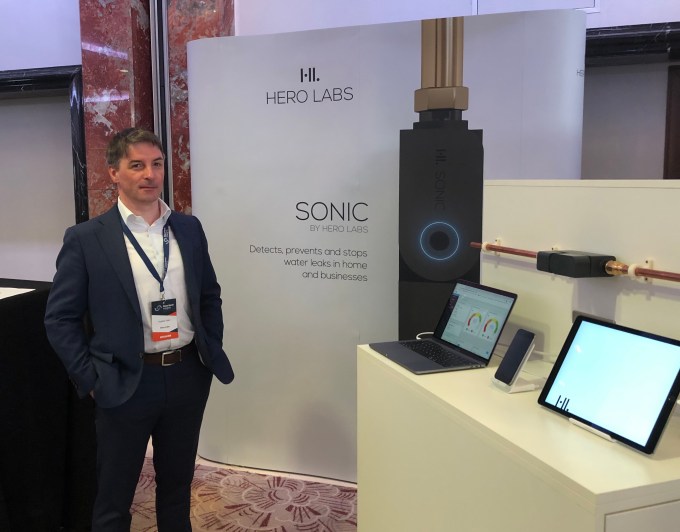
Hero Labs, a London-based startup that is developing “smart” technology to help prevent water leaks in U.K. properties, has raised £2.5 million in seed funding. The round is led by Earthworm Group, an environmental fund manager, with further support via a £300,000 EU innovation grant and a number of unnamed private investors.
The new capital will be used by Hero Labs to accelerate development of its first product: a smart device dubbed “Sonic” that uses ultrasonic technology to monitor water use within a property, including the early detection of water leaks.
Founded in 2018 by Krystian Zajac after he exited Neos, a smart home insurer that was acquired by Aviva, Hero Labs was born out of the realisation that a lot of smart home technology either wasn’t very smart or didn’t solve mass problems (Zajac had also previously ran a smart home company focusing on ultra high net-worth individuals that delivered bespoke designs for things like motorised swimming pool floors or home cinemas doubling up as panic rooms).
Coupled with this, the Hero Labs founder learned that water wastage was a very costly problem, both financially and environmentally, with water leaks being the number one culprit for property damage in the U.K. ahead of fires, gas explosions or break-ins combined. This sees water leaks cost the U.K. insurance industry £1 billion per year, apparently.
“My vision for the company is to solve real-life problems with truly smart technology,” Zajac tells me. “From working at Neos and alongside some of the world’s largest home insurers I understood the problems that impacted ordinary homeowners and their families on a day-to-day basis. Perhaps most surprisingly, I learnt that water leaks are far and way the biggest cause of damage to homes… I also wanted to do more for the environment in my next venture after learning that water leaks waste 3 billion litres of water a day in the U.K. alone”.
To that end, the Sonic device and service is described as a smart leak defence system. Aimed at anyone who wants to prevent water leaks in their property — including homeowners, landlords, facilities management, property developers and businesses — the ultrasonic device typically attaches to the piping below your sink and “listens” to the vibrations coming off the interconnected pipes.
Sonic then monitors the water flow using machine learning and its algorithms to identify usage and detect anomalies. This requires the technology to understand the difference between appliances, running taps and even flushing toilets so that it can build up a picture of normal water usage in the home and in turn identify if that pattern is broken. Crucially, if needed, Sonic can automatically shut off the water supply to prevent a water leak damaging the property or its possessions.
Will a full launch planned for later this year, Sonic is targeting consumers as well as small businesses initially. “We are [also] in discussions with insurers who might subsidise the product or give it away completely for free to certain more affluent customers to minimise the risk of water escape,” adds Zajac.
Would you like to learn how to hack systems like black hat hackers and secure them like security experts? This free ebook (worth $23) could be what you’re looking for!
Written for anyone who wants to learn how to perform hacking and penetration testing, this practical book is aimed at beginners with no prior knowledge.
You’ll first learn some basic terminology, and how to set up your own penetration testing lab to practice safe and legal hacking. Then, when you’ve learned the basics, you’ll study various penetration testing fields, including servers, client-side attacks, networks, websites, and more.
For each of these fields, you’ll learn how they work, their vulnerabilities, how to exploit and hack those vulnerabilities, and how to secure the system.
By the end of the ebook, you’ll have a solid grasp of hacking and penetration testing, allowing you to “combine the techniques shown and tailor them to suit different scenarios”.
You have composed a draft email inside Gmail and would like to send the same message to multiple people, but separately. The subject, the email body, the attachments are common and the only thing that differs between each message is the recipient’s email address.
Maybe you are sending your résumé to multiple companies. How can you do this without having to copy-paste the subject and body of the draft message multiple times?
Create Duplicate Email Messages in Gmail
When you compose a draft email in Gmail and hit the Send button, the email is automatically removed from the Drafts folder and moved to the Sent Items folder.
There are however two easy ways to create duplicate draft emails inside Gmail. You can either use Mail Merge for Gmail or, if you are looking for a more simple one-click option, use the Duplicate Drafts feature available inside Email Studio.
Here’s how to get started.
Open your Gmail mailbox, compose a new email message and save it as a draft. You can attach files, embed inline images and other rich content.
Go to Email Studio and authorize the app* to access your Gmail account. This is required since the app will read your Gmail drafts and create copies inside your Gmail account.
Once the app is authorized, click the Draft Copier section.
Copy Gmail Drafts
To quickly clone a message to send separately to someone else, select the source draft from the drop-down, then select the number of copies you wish to have and click the Create Drafts button. The copied drafts will include the complete contents of the original message, including file attachments and inline images.
The Gmail clone tool works on both desktop and mobile so you can copy Gmail draft messages on a mobile phone as well.
The web app is written in Google Scripts and uses the Gmail API to create drafts copies. The app only requires Gmail access to copy your drafts and does not share, store or upload your data anywhere.
Email Studio is free for basic usage. Free users can copy a maximum of 3 email drafts at a time while premium users can duplicate up to 10 Gmail drafts in a single batch. No branding is included in premium version.
[*] If you have trouble authorizing the app, please ensure that you are not logged into multiple Google accounts. You can try try Email Studio in Chrome’s incognito mode or use this link to sign-out of your Gmail accounts.
What is slowing down my computer? A slow computer is frustrating and keeps you from getting work done.
While all computers slow down over time, in many cases, your own behavior can cause your computer to run slowly. Here are common mistakes that will slow your machine down to a crawl, and how to stop making them.
1. Running Too Many Programs
Over time, you’ve probably installed dozens of programs. Maybe you use a variety of tools for different functions, or have a bunch of apps installed from years ago that you forgot about. Running too many apps all the time can lead to your computer slowing down, as we explained when we looked at why installing software slows down your PC.
The biggest issue comes from programs setting themselves to automatically run in the background. This means that they’re eating up RAM, even if you never use them. To combat this, keep an eye out while installing new apps. If you see a checkbox similar to Automatically run [app] when I start my computer, make sure you clear it.
You can get an idea of what’s running in the background by looking at the System Tray in the bottom-right corner of your screen. You’ll see an icon for each program running, and may need to click the arrow to show the full list. In most cases, you can right-click an icon and choose Exit to close an app.
Removing Startup Programs
Instead of closing programs every time you boot up, you can disable programs from running at startup altogether. On Windows 10, open the Task Manager using Ctrl + Shift + Esc and click More details if you only see the basic interface. From there, switch to the Startup tab and you’ll see everything set to run when you log into Windows.
It’s classic advice to reboot your PC when you have a problem. But restarting regularly is important even if you’re not troubleshooting an active issue.
You might be tempted to never turn your computer off so that you can quickly resume where you left off next time. But this is a bad idea and can result in your Windows computer running slow.
The main benefit of restarting is that doing so flushes your RAM. Because RAM is volatile, it starts fresh upon every reboot. If you have any programs you run have a memory leak (meaning software never returns used RAM to the computer), restarting will fix that temporarily.
Windows also installs OS patches when you restart. Of course, Windows 10 will eventually try to force you to reboot to do this. But if you don’t reboot for long periods of time, your computer will be without the latest security fixes.
In most cases, you don’t need to reboot every night. Aim to restart your PC a few times per week. At other times, you can put your PC to sleep or use hibernation to quickly resume what you were doing.
3. Clicking Without Thinking
Next time you find your PC running slow, you should consider how carefully you click when online. Unfortunately, many websites are a minefield of harmful content. Fake download buttons, giant ads that lead to shady sites, and all sorts of other nonsense can cause problems on your computer.
Even legitimate downloads aren’t safe. While it’s not as big of a problem as it used to be, many free programs try to foist junky third-party software on you with preselected checkboxes. If you click “Next” without thinking, you could end up with extra trash on your system just from installing a few apps.
In the worst cases, this can even lead to malware getting on your system. You can open yourself to infection (and a slow computer) by opening a malicious email attachment that installs spyware or similar.
The lesson here is to make sure you always know what you’re clicking on. Take the extra second to confirm you aren’t missing a hidden checkbox or clicking on something that’s dangerous.
4. Not Maintaining Your Computer
Windows 10 is better than ever at taking care of some maintenance tasks on its own. But it isn’t perfect, so you’ll have to perform some basic tune-ups every once in a while. Making sure you take care of these could be the difference between your laptop running slow and working at peak performance.
As it works, your system builds up files that it only needed for a short time. This is a normal part of computer operation, but if you let these files pile up, they can start to take a toll on speed after a while. This is especially the case if you have a small SSD that fills up quickly.
You can head to Settings > System > Storage to turn on Storage Sense, a Windows 10 feature that helps you free up space automatically. For additional options, search for Disk Cleanup in the Start Menu.
Run Maintenance Scans
While your antivirus is likely set up to scan on a schedule, it’s wise to get a second opinion and scan with a dedicated anti-malware app occasionally. Malwarebytes is a great choice for this since the free version only scans on-demand. It’s much better to catch malware with a scan than to find that your computer is running slow weeks later.
Aside from this, Windows has some other scans you can run for maintenance, but you shouldn’t need to do so often. These include chkdsk and sfc.
The check disk command, or chkdsk, scans your hard drive for bad sectors that can cause your computer to act up. If you have an SSD in your machine, this isn’t as pertinent. But if you notice a sudden slowdown and still have an old HDD in your computer, it’s worth a try.
System file checker, or sfc, is a similar command. This one scans Windows system files and attempts to repair any that are corrupt.
Typically, people run these commands as part of troubleshooting an issue. But doing them every month or so can help you catch problems before they get worse.
Install Updates
We mentioned restarting to install Windows updates earlier, but it’s still a good idea to go to Settings > Update & Security > Windows Update to check for updates manually every once in a while. Doing so makes sure that updates aren’t stuck.
You should also take the time to make sure the software you use regularly is up-to-date. Using the latest version can introduce speed improvements not present in earlier builds.
5. Confusing Your Computer With the Internet
It’s common to think that your computer is slow, when in reality, your internet connection is the problem. If you only have trouble when accessing websites, streaming music, or doing other network-reliant activities, you probably have an issue with your internet connection. This can happen even with a blazing-fast computer in perfect shape.
We’ve taken a look at common user behaviors that can cause your PC to slow down. If you’ve done any of these, now is a great time to change your ways based on the advice provided. Eventually, all computers do slow down and need replacement. But until then, you can use these tips to regain some speed again.
Roku devices are regarded as one of the best ways to stream content on your TV. However, what if you want to use your Roku for other things, such as browsing the web and sorting through your photos?
What you need is access to Google services on your Roku. And in this article, we explain how to get Google on Roku. Including Google Play Movies and TV, Google Photos, and Google Search.
How to Get Google Play Movies and TV on Roku
We begin with one of the more straightforward ways to get Google on Roku.
Given that Roku devices support all of the major streaming services, it should be no surprise to learn that Google Play Movies and TV has an official Roku channel that you can download and use.
Once you have installed the Google Play Movies app on your Roku, you need to pair it with your Google account by visiting play.google.com/roku. You will also need to provide a payment method during the sign-up process, though you won’t be charged unless you order something.
On Google’s official help page, it claims some geo-restrictions exist. In theory, you can only use the app if you live in Canada, Germany, the Republic of Ireland, the United States, or the United Kingdom. It is unclear how accurate the information is; I live in Mexico and can download and access the service on my Roku. Just be aware that non-supported countries may have issues.
Sadly, there is no official Google Play Music for Roku devices. You can draw your own conclusions about Google’s reasoning (cough, Chromecasts).
There used to be a couple of ways to listen to Google Play Music on your Roku—you could use the Nowhere Music private Roku channel, or you could use a third-party plug-in for Plex. Alas, development has ceased on both projects.
As such, the only remaining option is to cast Google Play Music from an Android device or Windows computer directly to your Roku device. Roku sticks use Miracast technology, so iOS devices are not supported. Check out our explanation of how Miracast works to learn more.
It’s an inelegant solution for lots of reasons, but it works. Just remember that you’ll need to control the playback directly from your phone or computer rather than through the Roku TV remote.
To listen to Google Play Music on a Roku, follow these instructions if you’re an Android user:
Make sure your Android device and Roku device are on the same Wi-Fi network.
On your Android, swipe down on the Notification Bar.
Tap on Cast.
Select your Roku from the list of devices.
Or follow these steps if you’re running Windows:
Make sure your Windows computer and Roku device are on the same Wi-Fi network.
Open the Settings app.
Navigate to System > Display.
Scroll down to Multiple Displays.
Click on Connect to a Wireless Display.
Choose your Roku device from the list of available options.
As long as you are running Roku OS 7.7 or later, you do not need to take any action on the Roku device itself—the mirroring will start automatically.
How to Get Google Photos on Roku
Again, there is no official Google Photos app for Roku. This time, however, you can use a third-party app from the Roku Channel Store.
The app is called PhotoView for Google Photos. It started life back in late 2016 as a small and unpolished piece of software. Today, it holds an official “Partner” status with the Google Photos app and has become the best way to access your pictures on a Roku.
PhotoView supports your Google Photos albums and has an integrated search feature. The app also comes with a screensaver feature; you can play your photos in a slideshow when your Roku is not in use.
Be aware that you will need to give PhotoView access to your Google account during the setup process. Some people may feel uncomfortable with this.
Even though we’re sure that many people wish it were possible, there is simply no way to get the Google Play Store on your Roku device.
It’s because of the underlying services that the Play Store relies on. Your Roku would need to be running Google Services Framework, Google Account Manager, and Google Play Services—none of which are available. And, unlike the Fire TV, there is no way to sideload those components onto your stick.
In terms of getting Google apps on your Roku, the upshot of the lack of the Google Play Store is that if you want to use software like Gmail, Google Calendar, Google Keep, et al., you’ll be out of luck.
Again, the only possible solution is to mirror your screen using the steps described earlier. In this case, it’s not clear what benefit screen mirroring would have over merely using the respective apps directly on your phone or tablet.
Can You Get Google Chrome on Roku?
In what’s becoming a familiar story, there’s no Google Chrome app for Roku devices.
If you absolutely need to access Chrome on your TV screen, you need to mirror your screen from another Miracast-enabled device.
How to Get Google Search on Roku
If you are wondering how to get internet on Roku, we’ve got some bad news. Your list of options is minimal. The quality of web browsers on Roku devices is not as robust as the choices on Fire TV sticks or Android TV boxes.
Indeed, there are only two options to choose from: Web Browser X and Poprism.
Poprism is only text-based—it cannot display images, photos, or Flash content. Web Browser X is seriously unreliable. To use Google Search, navigate to google.com in the usual way.
If neither of the browsers work for you, the only option is to mirror your Android or Windows screen onto your TV once again.
Of course, just because the outlook for using Google’s apps and services on your Roku isn’t great, it doesn’t mean there aren’t still tons of great Roku channels for you to choose from.
According to The Wall Street Journal, the 3-2, party-line vote by FTC commissioners was carried by the Republican majority and will be moved to the Justice Department’s civil division to be finalized.
A $5 billion payout seems like a significant sum, but Facebook had already set aside $3 billion to cover the cost of the settlement and the company could likely make up the figure in less than a quarter of revenue (the company’s revenue for the last fiscal quarter was roughly $15 billion). Indeed, Facebook said in April that it expected to pay up to $5 billion to end the government’s probe.
The settlement will also include government restrictions on how Facebook treats user privacy, according to the Journal.
We have reached out to the FTC and Facebook for comment and will update this story when we hear back.
Ultimately, the partisan divide which held up the settlement broke down with Republican members of the commission overriding Democratic concerns for greater oversight of the social media giant.
Specifically the FTC was examining whether the data breach violated a 2012 consent decree which saw Facebook committing to engage in better privacy protection of user data.
Facebook’s woes didn’t end with Cambridge Analytica. The company has since been on the receiving end of a number of exposes around the use and abuse of its customers’ information and comes as calls to break up the big tech companies have only grown louder.
The settlement could also be a way for the company to buy its way out of more strict oversight as it faces investigations into its potentially anti-competitive business practices and inquiries into its launch of a new cryptocurrency — Libra — which is being touted as an electronic currency for Facebook users largely divorced from governmental monetary policy.
Potential sanctions proposed by lawmakers for the FTC were reported to include the possibility of elevating privacy oversight to the company’s board of directors and potentially the deletion of tracking data; restricting certain information collection; limiting ad targeting; and restricting the flow of user data among different Facebook business units.
While the agility of a Spot or Atlas robot is something to behold, there’s a special merit reserved for tiny, simple robots that work not as a versatile individual but as an adaptable group. These “tribots” are built on the model of ants, and like them can work together to overcome obstacles with teamwork.
Developed by EPFL and Osaka University, tribots are tiny, light, and simple, moving more like inchworms than ants, but able to fling themselves up and forward if necessary. The bots themselves and the system they make up are modeled on trap-jaw ants, which alternate between crawling and jumping, and work (as do most other ants) in fluid roles like explorer, worker, and leader. Each robot is not itself very intelligent, but they are controlled as a collective that deploys their abilities intelligently.
In this case a team of tribots might be expected to get from one end of a piece of complex terrain to another. An explorer could move ahead, sensing obstacles and relaying their locations and dimensions to the rest of the team. The leader can then assign worker units to head over and try to push the obstacles out of the way. If that doesn’t work, an explorer can try hopping over it — and if successful, it can relay its telemetry to the others so they can do the same thing.
Fly, tribot, fly!
It’s all done quite slowly at this point — you’ll notice that in the video, much of the action is happening at 16x speed. But rapidity isn’t the idea here; Similar to Squishy Robotics’ creations, it’s more about adaptability and simplicity of deployment.
The little bots weigh only 10 grams each, and are easily mass-produced, as they’re basically PCBs with some mechanical bits and grip points attached — “a quasi-two-dimensional metamaterial sandwich,” according to the paper. If they only cost (say) a buck each, you could drop dozens or hundreds on a target area and over an hour or two they could characterize it, take measurements and look for radiation or heat hot spots, and so on.
If they moved a little faster, the same logic and a modified design could let a set of robots emerge in a kitchen or dining room to find and collect crumbs or scoot plates into place. (Ray Bradbury called them “electric mice” or something in “There will come soft rains,” one of my favorite stories of his. I’m always on the lookout for them.)
Swarm-based bots have the advantage of not failing catastrophically when something goes wrong — when a robot fails, the collective persists, and it can be replaced as easily as a part.
“Since they can be manufactured and deployed in large numbers, having some ‘casualties’ would not affect the success of the mission,” noted With their unique collective intelligence, our tiny robots can demonstrate better adaptability to unknown environments; therefore, for certain missions, they would outperform larger, more powerful robots.”
It raises the question, in fact, of whether the sub-robots themselves constitute a sort of uber-robot? (This is more of a philosophical question, raised first in the case of the Constructicons and Devastator. Transformers was ahead of its time in many ways.)
The robots are still in prototype form, but even as they are constitute a major advance over other “collective” type robot systems. The team documents their advances in a paper published in the journal Nature.
Posted by Yinfei Yang and Amin Ahmad, Software Engineers, Google Research
Since it was introduced last year, “Universal Sentence Encoder (USE) for English’’ has become one of the most downloaded pre-trained text modules in Tensorflow Hub, providing versatile sentence embedding models that convert sentences into vector representations. These vectors capture rich semantic information that can be used to train classifiers for a broad range of downstream tasks. For example, a strong sentiment classifier can be trained from as few as one hundred labeled examples, and still be used to measure semantic similarity and for meaning-based clustering.
Today, we are pleased to announce the release of three new USE multilingual modules with additional features and potential applications. The first two modules provide multilingual models for retrieving semantically similar text, one optimized for retrieval performance and the other for speed and less memory usage. The third model is specialized for question-answer retrieval in sixteen languages (USE-QA), and represents an entirely new application of USE. All three multilingual modules are trained using a multi-task dual-encoder framework, similar to the original USE model for English, while using techniques we developed for improving the dual-encoder with additive margin softmax approach. They are designed not only to maintain good transfer learning performance, but to perform well on semantic retrieval tasks.
Multi-task training structure of the Universal Sentence Encoder. A variety of tasks and task structures are joined by shared encoder layers/parameters (pink boxes).
Semantic Retrieval Applications
The three new modules are all built on semantic retrieval architectures, which typically split the encoding of questions and answers into separate neural networks, which makes it possible to search among billions of potential answers within milliseconds. The key to using dual encoders for efficient semantic retrieval is to pre-encode all candidate answers to expected input queries and store them in a vector database that is optimized for solving the nearest neighbor problem, which allows a large number of candidates to be searched quickly with good precision and recall. For all three modules, the input query is then encoded into a vector on which we can perform an approximate nearest neighbor search. Together, this enables good results to be found quickly without needing to do a direct query/candidate comparison for every candidate. The prototypical pipeline is illustrated below:
A prototypical semantic retrieval pipeline, used for textual similarity.
Semantic Similarity Modules
For semantic similarity tasks, the query and candidates are encoded using the same neural network. Two common semantic retrieval tasks made possible by the new modules include Multilingual Semantic Textual Similarity Retrieval and Multilingual Translation Pair Retrieval.
Multilingual Semantic Textual Similarity Retrieval
Most existing approaches for finding semantically similar text require being given a pair of texts to compare. However, using the Universal Sentence Encoder, semantically similar text can be extracted directly from a very large database. For example, in an application like FAQ search, a system can first index all possible questions with associated answers. Then, given a user’s question, the system can search for known questions that are semantically similar enough to provide an answer. A similar approach was used to find comparable sentences from 50 million sentences in wikipedia. With the new multilingual USE models, this can be done in any of supported non-English languages.
Multilingual Translation Pair Retrieval
The newly released modules can also be used to mine translation pairs to train neural machine translation systems. Given a source sentence in one language (“How do I get to the restroom?”), they can find the potential translation target in any other supported language (“¿Cómo llego al baño?”).
Both new semantic similarity modules are cross-lingual. Given an input in Chinese, for example, the modules can find the best candidates, regardless of which language it is expressed in. This versatility can be particularly useful for languages that are underrepresented on the internet. For example, an early version of these modules has been used by Chidambaram et al. (2018) to provide classifications in circumstances where the training data is only available in a single language, e.g. English, but the end system must function in a range of other languages.
USE for Question-Answer Retrieval
The USE-QA module extends the USE architecture to question-answer retrieval applications, which generally take an input query and find relevant answers from a large set of documents that may be indexed at the document, paragraph, or even sentence level. The input query is encoded with the question encoding network, while the candidates are encoded with the answer encoding network.
Visualizing the action of a neural answer retrieval system. The blue point at the north pole represents the question vector. The other points represent the embeddings of various answers. The correct answer, highlighted here in red, is “closest” to the question, in that it minimizes the angular distance. The points in this diagram are produced by an actual USE-QA model, however, they have been projected downwards from ℝ500 to ℝ3 to assist the reader’s visualization.
Question-answer retrieval systems also rely on the ability to understand semantics. For example, consider a possible query to one such system, Google Talk to Books, which was launched in early 2018 and backed by a sentence-level index of over 100,000 books. A query, “What fragrance brings back memories?”, yields the result, “And for me, the smell of jasmine along with the pan bagnat, it brings back my entire carefree childhood.” Without specifying any explicit rules or substitutions, the vector encoding captures the semantic similarity between the terms fragrance and smell. The advantage provided by the USE-QA module is that it can extend question-answer retrieval tasks such as this to multilingual applications.
For Researchers and Developers
We're pleased to share the latest additions to the Universal Sentence Encoder family with the research community, and are excited to see what other applications will be found. These modules can be used as-is, or fine tuned using domain-specific data. Lastly, we will also host the semantic similarity for natural language page on Cloud AI Workshop to further encourage research in this area.
Acknowledgements Mandy Guo, Daniel Cer, Noah Constant, Jax Law, Muthuraman Chidambaram for core modeling, Gustavo Hernandez Abrego, Chen Chen, Mario Guajardo-Cespedes for infrastructure and colabs, Steve Yuan, Chris Tar, Yunhsuan Sung, Brian Strope, Ray Kurzweil for discussion of the model architecture.
The Daily Crunch is TechCrunch’s roundup of our biggest and most important stories. If you’d like to get this delivered to your inbox every day at around 9am Pacific, you can subscribe here.
Before you start complaining about censorship, keep in mind that hidden replies won’t actually get pulled from Twitter — they’ll disappear from the default view, but you can still tap a gray icon to see them.
The goal is to give the person who starts a conversation more control over which comments are visible, making it harder for trolls to jump in and derail things.
In a long-awaited decision, the Federal Elections Commission will now allow political campaigns to appoint cybersecurity helpers to protect themselves from cyberthreats and malicious attackers.
Kantar provides stats and insights on how consumers buy and think of products in areas like technology, media and health — we’ve written many stories citing their numbers.
Time for a new EC-1, which provides an in-depth profile of a successful startup! This time, we’re focusing on Roblox, a company that took at least a decade to hit its stride. (Extra Crunch membership required.)