08 April 2019

How to Separate First and Last Name in Excel


excel-names-split

When you’re working with data in your Microsoft Excel workbook, it’s not always just numbers. Maybe your spreadsheet contains names of customers, clients, employees, or contacts. And depending on where your data comes from, you may have to manipulate it to suit your needs for a mailing list or database.

If you need to separate first and last names in Excel, you have some flexible options. This includes not only first and last name, but middle name, prefixes, and suffixes. Here’s a helpful guide that shows you how to split names in Excel.

How to Separate Names in Excel with the Wizard

The Text to Column Wizard is the simplest way to separate first and last names in Excel in addition to middle names. And the tool is flexible enough to adjust to your data.

Make sure that there is an empty column next to the data you are going to split because the results will go there by default. If this isn’t possible, you still will be able to change the destination for your data split.

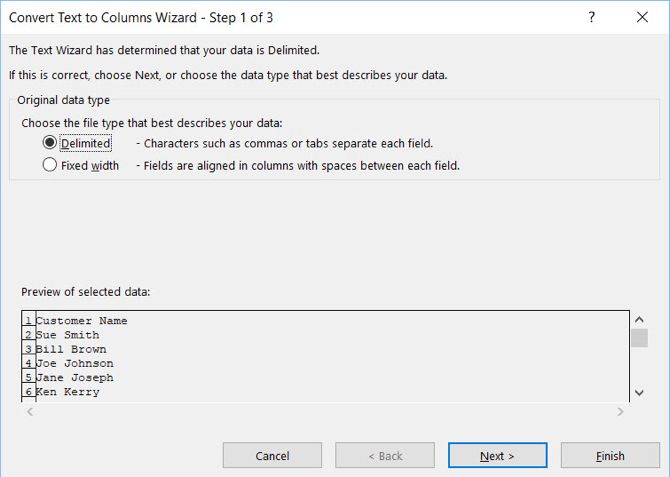
Convert Text To Columns Wizard in Excel

Split Names Separated by Spaces

First, if the names are separated by spaces then just follow these steps.

  1. Select the column or cells containing the names you want to separate. The column or cells will be highlighted.
  2. Click the Data tab and select Text to Columns in your ribbon.
  3. In the popup window, choose Delimited for the file type that best describes your data.
  4. Click Next.
  5. Under Delimiters, uncheck Tab and check Space.
  6. Click Next.
  7. Under Column data format, choose Text. If you need to select a different Destination for your results, enter it in that field.
  8. Click Finish.

Convert Text To Columns Wizard - Separate Names

This method works for separating the first and last name in Excel as well as the middle name or initial. So, if your data is in the cell as Sue Sally Smith, Sue S. Smith, or Sue S Smith, each will work correctly.

Split Names Separated by Commas

If the first and last names are separated by commas, you’ll only need a slight adjustment to the instructions above. In Step 5, under Delimiters, check Comma. You can keep Space checked if the data also has spaces.

Convert Text To Columns Wizard - Comma Separated

Split Names and Remove Data

Let’s say you have names that include first, middle, and last name but you don’t want to keep the middle name. Start with the same steps as above until you get to Step 7, then do the following.

  1. Under Column data format, select Do not import column (Skip).
  2. In the Preview of selected data, click to highlight the column of data you want removed from your results.
  3. Click Finish.

Convert Text To Columns Wizard - Remove Data

How to Separate Names in Excel with Functions

If you’re doing a one-time split, the above methods using the Text to Columns Wizard are simplest. But if you will be adding more data that you wish to split, you may want to use Excel formulas. In addition, while the Wizard is flexible, it does have its limits. So, we’ll cover some functions for special circumstances too.

Split First, Middle, and Last Name

Select the cell where you want the data to display and insert or paste in the following formulas:

First Name:

=LEFT(A2,FIND(" ",A2,1)-1)

Last Name:

=RIGHT(A2,LEN(A2)-FIND(" ",A2,1))

Middle Name:

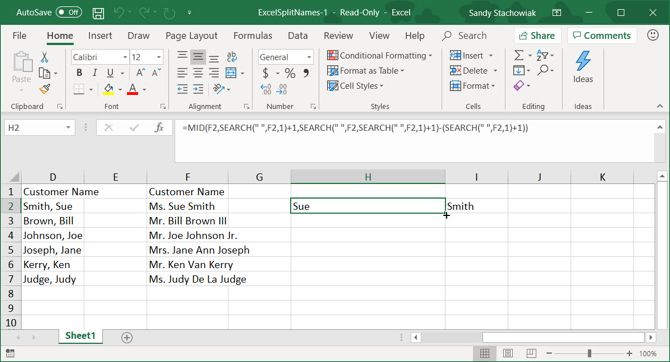
=MID(A2,SEARCH(" ",A2,1)+1,SEARCH(" ",A2,SEARCH(" ",A2,1)+1)-SEARCH(" ",A2,1))

Replace the cell labels (letter and number combination) with those for the cells you are splitting.

Names with a Prefix, Remove the Prefix

First Name:

=MID(A2,SEARCH(" ",A2,1)+1,SEARCH(" ",A2,SEARCH(" ",A2,1)+1)-(SEARCH(" ",A2,1)+1))

Last Name:

=RIGHT(A2,LEN(A2)-SEARCH(" ",A2,SEARCH(" ",A2,1)+1))

Names with a Suffix, Suffix in Separate Column

First Name:

=LEFT(A2, SEARCH(" ",A2,1))

Last Name:

=MID(A2,SEARCH(" ",A2,1)+1,SEARCH(" ",A2,SEARCH(" ",A2,1)+1)-(SEARCH(" ",A2,1)+1))

Suffix:

=RIGHT(A2,LEN(A2)-SEARCH(" ",A2,SEARCH(" ",A2,1)+1))

Two-Part First Names

First Name:

=LEFT(A2, SEARCH(" ",A2,SEARCH(" ",A2,1)+1))

Last Name:

=RIGHT(A2,LEN(A2)-SEARCH(" ",A2,SEARCH(" ",A2,SEARCH(" ",A2,1)+1)+1))

Two-Part Last Names

First Name:

=LEFT(A2, SEARCH(" ",A2,1))

Last Name:

=RIGHT(A2,LEN(A2)-SEARCH(" ",A2,1))

Three-Part Last Names

First Name:

=LEFT(A2, SEARCH(" ",A2,1))

Last Name:

=RIGHT(A2,LEN(A2)-SEARCH(" ",A2,1))

Once again, remember to replace the cell labels with those for the cells you are splitting.

Fill Your Formulas

Once you enter any of the functions above, you can drag to fill the rest of your column with those formulas.

Select the first cell with the formula. Move to the bottom right corner and when the black plus sign appears, drag downward to fill the number of cells you need.

Autofill Formulas in Excel by Dragging

It’s Easy to Separate Names in Excel

If you’re able to use the Text to Column Wizard, then you’ll be able to split first and last name in Excel easily. But if you have some tough data to work with, at least you have options for separating names with functions.

For additional Excel tutorials like this, take a look at how to merge and split cells or quickly delete all blank cells in Excel.

Read the full article: How to Separate First and Last Name in Excel


Read Full Article

Switching From Mac to Linux? 5 Tips to Make Your Life Easier


mac-to-linux

There are a lot of things to love about macOS, but there are definitely issues with using it. One of the bigger problems is that it’s exclusive to Apple computers. If you don’t like the hardware the company offers, you’re out of luck when it comes to using macOS.

If you’re looking for a desktop operating system that runs on top of a solid Unix-based foundation, Linux can be a good alternative. To make it easier to get used to Linux, you might want to make your installation a little more Mac-like.

1. Use Linuxbrew Instead of Your Distribution’s Package Manager

Linuxbrew in action

Moving to Linux is going to be a whole lot easier if you’re used to using the command line. If you’re a frequent command line user on the Mac, you’re probably familiar with the Homebrew package manager. If that’s the case, good news: Homebrew is available on Linux, albeit with a different name.

At the start of 2019, Homebrew got a big update, part of which was adding support for Linux. On Linux, the package manager is known as Linuxbrew, and it works exactly the same as it does on Mac. This can make installing your most-used packages a lot easier than using the default package manager provided by the distribution you use.

Homebrew also installs packages in a home directory instead of system-wide. This makes it nicer for beginners, as you don’t have to worry about installing something that can disrupt your system’s performance.

If you’re a developer, this is especially handy as well, since you can easily install different versions of Ruby or Python languages than your operating system requires.

2. Install a Spotlight-Style Launcher

Cerebro sure looks like Spotlight, doesn't it?

There are two types of Mac users: those who launch applications through Launchpad and those who use Spotlight. If you’re in the latter group, moving to Linux will be much easier for you, since you can replicate this very easily. Some Linux desktops will come with this type of behavior by default, but if not, it’s easy to install a Spotlight-style launcher.

A few launchers for Linux will seem familiar to Mac users, but the most Spotlight-like is Cerebro. In addition to launching apps and searching files, it can function as a basic calculator, show maps, and add other functions with plugins. If you’re more familiar with the third-party launcher Alfred, you might want to look into Albert instead. Both apps are free.

Those two are far from the only app launchers available. If neither is your cup of tea, we have a list of nine of the best app launchers for Linux. Chances are good you’ll find at least one that you really like among them.

3. Make Your Desktop Look More Like macOS

Mojave Theme for Gnome

Getting comfortable with a desktop operating system isn’t all about functionality. Comfort matters too, and some of this comes down to how your environment looks. If you’re feeling a little out of your element, making your Linux desktop look more like macOS might help you ease in.

Changing the look of your desktop is easy, but how you do it will depend on which desktop environment you use. GNOME is probably the most common and has themes available to approximate the look of macOS Mojave. If you’re a fan of the look of older macOS versions, you can find more Aqua-inspired themes as well.

Other desktops like Xfce and KDE vary. Xfce has a dock somewhat similar to macOS and uses GTK themes, so you can definitely get the macOS look. KDE looks more like Windows by default, but is highly customizable, so you can also get this environment looking like macOS.

If you’re not sure where to get started, don’t worry. We’ve already got a list of tweaks you can make to make your Linux desktop look like macOS.

4. Install a macOS-Style Dock

Docky screenshot

A big part of the macOS experience is the dock. Depending on your Linux distribution and desktop, you might have one of these already. Desktops like Xfce include a dock-style panel. If you use Gnome, there is an extension called Dash to Dock that can turn the slide-out dash into a dock.

You can also install a dock, which is the most customizable option. One popular option is Plank, which its developers say is “meant to be the simplest dock on the planet.” Despite this, it’s fairly customizable, at least in terms of its appearance.

If you want something more powerful, there are plenty of options. Docky is meant to approximate the look of the macOS dock, while GLX Dock adds more visual flair. For even more options, see our list of the best dock apps available for Linux.

5. Use a Distribution With Similar Features

The Elementary desktop

The above tweaks will help any Linux distribution act a bit more Mac-like, but you can also start by choosing the right distribution in the first place. Some will be more appealing to Mac users out of the gate, whether it’s due to visual elements or how the user interface acts.

Ubuntu might be the most popular Linux distribution, but Fedora might be a better choice for Mac users. It uses the GNOME 3 desktop, which isn’t all that Mac-like out of the gate but can become Mac-like with a few simple tweaks listed above. You can also enable extended gestures, which can make your touchpad behave more like one on a MacBook.

If you want a desktop that looks Mac-like out of the gate, Elementary OS might be worth a look. The desktop isn’t a direct rip of the macOS UI, but it will be immediately familiar to any Mac user. Elementary OS has a focus on simplicity but also has a unified aesthetic that should appeal to Mac users.

Ready to Make the Move to Linux?

If one or more of these options makes you think moving to Linux might be for you, it’s time to start your journey. The installation process is easier than it has ever been, but there are a few places you might run into stumbling blocks. One of these is getting your installation medium ready.

If that sounds daunting, don’t worry. We have a full walkthrough detailing how to create a USB Linux boot drive to help you get started.

Read the full article: Switching From Mac to Linux? 5 Tips to Make Your Life Easier


Read Full Article

Viber users can now get local numbers in the US, UK and Canada for inbound voice and SMS


Viber, the messaging app owned by Rakuten that a year ago said it had 1 billion registered users, has added another feature in its longer-term efforts to add more stickiness to its service, while also bringing in a little more revenue to the business: users now have the option of subscribing to have “local numbers” that can receive phone calls and SMS messages as if those calls and messages are being sent to mobile numbers in specific regions.

Viber Local Number, as the service is called, is available to anyone globally but for now the numbers you can register are in the US, UK and Canada, with more countries getting added soon. We’re asking which area codes in the US will be covered at launch, and what the roadmap is for subsequent countries.

Viber said that the first 10,000 people to sign up will be able to pay $1.99 per month indefinitely for the service. Otherwise, it’s being priced at $4.99/month, and according to a FAQ on its site, you pay either by way of Apple’s in-app payments service, Google Play or (if you’re on Android) via a credit card direct with Viber itself. You access the option to get the number by way of the “more” tab on the app.

Viber Local Number will sound fairly familiar to people who have used other messaging apps and VoIP services.

Skype, for one, has offered the option of getting a local number in a specific region, both to make and receive calls, for years. There have also been companies that have stepped into the feature gap between the existence of the capability and Viber yet to launch anything of its own. One that I found offering a local number feature for Viber, Freezvon, has an even wider range of countries listed for local numbers than the three that Viber currently offers.

We’ve asked Viber why it’s taken it so long for it to launch this, and also whether third-party services like these are partners for Viber Local Number, or conversely whether Viber will allow them to continue to operate in competition with its own offering. We will update this post as and when we learn the answers.

As with these other services, Viber Local Number is aimed at business people or others who want to offer customers or partners a local number in a particular region to call them, when they themselves might not be in that region. To note: that use case is only valid in countries where users are not required to show proof of residency before taking numbers.

In another possible application, if you are a person who wants to share a number with people but have that inbound traffic not mix with your other inbound calls, this would be a cheaper and more flexible way of handling that without paying for a fully-functional separate phone number. Similarly, those who are living abroad but want to give their family and friends back home a cheaper way to contact them would also be potential users.

“The new Viber Local Number enriches our users in a way that makes Viber the most powerful communication app out there,” says Viber CEO, Djamel Agaoua, in a statement. “We are excited to offer people new ways to be closer and more relevant to what matters and is important to them. From expats who need a local phone number that connects them back home, to global business owners who want overseas clients to feel they are located nearby, this new feature gives them a local presence no matter where they are.”

To be clear, it looks like Viber Local Number is focused only on inbound calls — there is no detail in Viber’s FAQ about pricing for outbound calls, nor even whether these would be possible.

But, the company already has a service called Viber Out that allows users to make calls from their Viber accounts to numbers outside of Viber itself. Viber Local Number sits within Viber Out as a product, and it seems that this is the main option for now but whether those outbound calls will register with your Viber Local Number is not clear. We’ve asked about this, too, and will update as we learn more.

In earlier years of its life as an “over the top” messaging app, Viber was a close competitor to WhatsApp, WeChat, Facebook’s Messenger, Line and others tapping into the smartphone boom with more flexible ways to contact people that transcended stingy SMS allowances with way more features on top of the basic ability to send texts.

When Rakuten acquired Viber for $900 million just weeks before Facebook announced its acquisition of WhatsApp for $19 billion, the two respectively had 300 million and 450 million monthly active users. Now, WhatsApp and Messenger have well over 2 billion monthly active users combined, while Viber never puts out MAU figures.

Indeed, more recently, Viber has arguably stagnated as a go-to messaging service, overtaken in users and features by its rivals. That the company does not give out updated user numbers doesn’t help its image, either.

But under new CEO Agaoua — an ad-tech veteran who joined in February 2017 — the company has been working on a number of new efforts around chatbots and other features that tie the app closer with Rakuten’s e-commerce roots and wider footprint of other holdings. In that regard, today’s announcement — given that it’s turning on functionality that arguably Viber should have added years ago — feels like an important move, enabling essential feature that lays the groundwork for potentially more to come.


Read Full Article

UK sets out safety-focused plan to regulate Internet firms


The UK government has laid out proposals to regulate online and social media platforms, setting out the substance of its long-awaited White Paper on online harms today — and kicking off a public consultation.

The Online Harms White Paper is a joint proposal from the Department for Digital, Culture, Media and Sport (DCMS) and Home Office.

It follows the government announcement of a policy intent last May, and a string of domestic calls for greater regulation of the Internet as politicians have responded to rising concern about the mental health impacts of online content.

The government is now proposing to put a mandatory duty of care on platforms to take reasonable steps to protect their users from a range of harms — including but not limited to illegal material such as terrorist and child sexual exploitation and abuse which will be covered by further stringent requirements under the plan.

The approach is also intended to address a range of content and activity that’s deemed harmful.

Examples providing by the government of the sorts of broader harms it’s targeting include inciting violence and violent content; encouraging suicide; disinformation; cyber bullying; and inappropriate material being accessed by children.

Content promoting suicide has been thrown into the public spotlight in the UK in recent months, following media reports about a schoolgirl whose family found out she had been viewing pro-suicide content on Instagram after she killed herself.

The Facebook-owned platform subsequently agreed to change its policies towards suicide content, saying it would start censoring graphic images of self-harm, after pressure from ministers.

Commenting on the publication of the White Paper today, digital secretary Jeremy Wright said: “The era of self-regulation for online companies is over. Voluntary actions from industry to tackle online harms have not been applied consistently or gone far enough. Tech can be an incredible force for good and we want the sector to be part of the solution in protecting their users. However those that fail to do this will face tough action.

”We want the UK to be the safest place in the world to go online, and the best place to start and grow a digital business and our proposals for new laws will help make sure everyone in our country can enjoy the Internet safely.”

In another supporting statement Home Secretary Sajid Javid added: “The tech giants and social media companies have a moral duty to protect the young people they profit from. Despite our repeated calls to action, harmful and illegal content – including child abuse and terrorism – is still too readily available online.

“That is why we are forcing these firms to clean up their act once and for all. I made it my mission to protect our young people – and we are now delivering on that promise.”

Children’s charity, the NSPCC, was among the sector bodies welcoming the proposal.

“This is a hugely significant commitment by the Government that once enacted, can make the UK a world pioneer in protecting children online,” wrote CEO Peter Wanless in a statement.

“For too long social networks have failed to prioritise children’s safety and left them exposed to grooming, abuse, and harmful content.  So it’s high time they were forced to act through this legally binding duty to protect children, backed up with hefty punishments if they fail to do so.”

Although the Internet Watch Foundation, which works to stop the spread of child exploitation imagery online, warned against unintended consequences from badly planned legislation — and urged the government to take a “balanced approach”.

The proposed laws would apply to any company that allows users to share or discover user generated content or interact with each other online — meaning companies both big and small.

Nor is it just social media platforms either, with file hosting sites, public discussion forums, messaging services, and search engines among those falling under the planned law’s remit.

The government says a new independent regulator will be introduced to ensure Internet companies meet their responsibilities, with ministers consulting on whether this should be a new or existing body.

Telecoms regulator Ofcom has been rumored as one possible contender, though the UK’s data watchdog, the ICO, has previously suggested it should be involved in any Internet oversight given its responsibility for data protection and privacy. (According to the FT a hybrid entity combining the two is another possibility — although it reports that the government remains genuinely undecided on who the regulator will be.)

The future Internet watchdog will be funded by industry in the medium term, with the government saying it’s exploring options such as an industry levy to put it on a sustainable footing.

On the enforcement front, the watchdog will be armed with a range of tools — with the government consulting on powers for it to issue substantial fines; block access to sites; and potentially to impose liability on individual members of senior management.

So there’s at least the prospect of a high profile social media CEO being threatened with UK jail time in future if they don’t do enough to remove harmful content.

On the financial penalties front, Wright suggested that the government is entertaining GDPR-level fines of as much as 4% of a company’s annual global turnover, speaking during an interview on Sky News…

Other elements of the proposed framework include giving the regulator the power to force tech companies to publish annual transparency reports on the amount of harmful content on their platforms and what they are doing to address it; to compel companies to respond to users’ complaints and act to address them quickly; and to comply with codes of practice issued by the regulator, such as requirements to minimise the spread of misleading and harmful disinformation with dedicated fact checkers, particularly during election periods.

A long-running enquiry by a DCMS parliamentary committee into online disinformation last year, which was continuously frustrated in its attempts to get Facebook founder Mark Zuckerberg to testify before it, concluded with a laundry list of recommendations for tightening regulations around digital campaigning.

The committee also recommended clear legal liabilities for tech companies to act against “harmful or illegal content”, and suggested a levy on tech firms to support enhanced regulation.

Responding to the government’s White Paper in a statement today DCMS chair Damian Collins broadly welcomed the government’s proposals — though he also pressed for the future regulator to have the power to conduct its own investigations, rather than relying on self reporting by tech firms.

“We need a clear definition of how quickly social media companies should be required to take down harmful content, and this should include not only when it is referred to them by users, but also when it is easily within their power to discover this content for themselves,” Collins wrote.

“The regulator should also give guidance on the responsibilities of social media companies to ensure that their algorithms are not consistently directing users to harmful content.”

Another element of the government’s proposal is a “Safety by Design” framework that’s intended to help companies incorporate online safety features in new apps and platforms from the start.

The government also wants the regulator to head up a media literacy strategy that’s intended to equip people with the knowledge to recognise and deal with a range of deceptive and malicious behaviours online, such as catfishing, grooming and extremism.

It writes that the UK is committed to a free, open and secure Internet — and makes a point of noting that the watchdog will have a legal duty to pay “due regard” to innovation, and also to protect users’ rights online by paying particular mindful not infringe privacy and freedom of expression.

It therefore suggests technology will be an integral part of any solution, saying the proposals are designed to promote a culture of continuous improvement among companies — and highlighting technologies such as Google’s “Family Link” and Apple’s Screen Time app as examples of the sorts of developments it wants the policy framework to encourage.

Although such caveats are unlikely to do much to reassure those concerned the approach will chill online speech, and/or place an impossible burden on smaller firms with less resource to monitor what their users are doing.

“The government’s proposals would create state regulation of the speech of millions of British citizens,” warns digital and civil rights group, the Open Rights Group, in a statement by its executive director Jim Killock. “We have to expect that the duty of care will end up widely drawn with serious implications for legal content, that is deemed potentially risky, whether it really is nor not.

“The government refused to create a state regulator the press because it didn’t want to be seen to be controlling free expression. We are skeptical that state regulation is the right approach.”

UK startup policy advocacy group Coadec was also quick to voice concerns — warning that the government’s plans will “entrench the tech giants, not punish them”.

“The vast scope of the proposals means they cover not just social media but virtually the entire internet – from file sharing to newspaper comment sections. Those most impacted will not be the tech giants the Government claims they are targeting, but everyone else. It will benefit the largest platforms with the resources and legal might to comply – and restrict the ability of British startups to compete fairly,” said Coadec executive director Dom Hallas in a statement. 

“There is a reason that Mark Zuckerberg has called for more regulation. It is in Facebook’s business interest.”

UK startup industry association, techUK, also put out a response statement that warns about the need to avoid disproportionate impacts.

“Some of the key pillars of the Government’s approach remain too vague,” said Vinous Ali, head of policy, techUK. “It is vital that the new framework is effective, proportionate and predictable. Clear legal definitions that allow companies in scope to understand the law and therefore act quickly and with confidence will be key to the success of the new system.

“Not all of the legitimate concerns about online harms can be addressed through regulation. The new framework must be complemented by renewed efforts to ensure children, young people and adults alike have the skills and awareness to navigate the digital world safely and securely.”

The government has launched a 12-week consultation on the proposals, after which it says it will set out the action it will take in developing its final proposals for legislation.

Last month a House of Lords committee recommended an overarching super regulator be established to plug any gaps and/or handle overlaps in rules on Internet platforms, arguing that “a new framework for regulatory action” is needed to handle the digital world.

Though the government appears confident at this stage that an Internet regulator will be able to navigate any legislative patchwork and keep tech firms in line on its own.

The House of Lords committee was another that came down in support of a statutory duty of care for online services hosting user-generated content, suggesting it should have a special focus on children and “the vulnerable in society”. And there’s no doubt the concept of regulating Internet platforms has broad consensus among UK politicians — on both sides of the aisle.

But how to do that effectively and proportionately is another matter.

We reached out to Facebook and Google for a response to the White Paper.

Commenting on the Online Harms White Paper in a statement, Rebecca Stimson, Facebook’s head of UK public policy, said: “New rules for the internet should protect society from harm while also supporting innovation, the digital economy and freedom of speech. These are complex issues to get right and we look forward to working with the Government and Parliament to ensure new regulations are effective.”

Stimson also reiterated how Facebook has expanded the number of staff it has working on trust and safety issues to 30,000 in recent years, as well as claiming it’s invested heavily in technology to help prevent abuse — while conceding that “we know there is much more to do”.

Last month the company revealed shortcomings with its safety measures around livestreaming, after it emerged that a massacre in Christchurch, New Zealand which was livestreamed to Facebook’s platform, had not been flagged for accelerated review by moderates because it was not tagged as suicide related content.

Facebook said it would be “learning” from the incident and “re-examining our reporting logic and experiences for both live and recently live videos in order to expand the categories that would get to accelerated review”.

In its response to the UK government White Paper today, Stimson added: “The internet has transformed how billions of people live, work and connect with each other, but new forms of communication also bring huge challenges. We have responsibilities to keep people safe on our services and we share the government’s commitment to tackling harmful content online. As Mark Zuckerberg said last month, new regulations are needed so that we have a standardised approach across platforms and private companies aren’t making so many important decisions alone.”


Read Full Article

UK sets out safety-focused plan to regulate Internet firms


The UK government has laid out proposals to regulate online and social media platforms, setting out the substance of its long-awaited White Paper on online harms today — and kicking off a public consultation.

The Online Harms White Paper is a joint proposal from the Department for Digital, Culture, Media and Sport (DCMS) and Home Office.

It follows the government announcement of a policy intent last May, and a string of domestic calls for greater regulation of the Internet as politicians have responded to rising concern about the mental health impacts of online content.

The government is now proposing to put a mandatory duty of care on platforms to take reasonable steps to protect their users from a range of harms — including but not limited to illegal material such as terrorist and child sexual exploitation and abuse which will be covered by further stringent requirements under the plan.

The approach is also intended to address a range of content and activity that’s deemed harmful.

Examples providing by the government of the sorts of broader harms it’s targeting include inciting violence and violent content; encouraging suicide; disinformation; cyber bullying; and inappropriate material being accessed by children.

Content promoting suicide has been thrown into the public spotlight in the UK in recent months, following media reports about a schoolgirl whose family found out she had been viewing pro-suicide content on Instagram after she killed herself.

The Facebook-owned platform subsequently agreed to change its policies towards suicide content, saying it would start censoring graphic images of self-harm, after pressure from ministers.

Commenting on the publication of the White Paper today, digital secretary Jeremy Wright said: “The era of self-regulation for online companies is over. Voluntary actions from industry to tackle online harms have not been applied consistently or gone far enough. Tech can be an incredible force for good and we want the sector to be part of the solution in protecting their users. However those that fail to do this will face tough action.

”We want the UK to be the safest place in the world to go online, and the best place to start and grow a digital business and our proposals for new laws will help make sure everyone in our country can enjoy the Internet safely.”

In another supporting statement Home Secretary Sajid Javid added: “The tech giants and social media companies have a moral duty to protect the young people they profit from. Despite our repeated calls to action, harmful and illegal content – including child abuse and terrorism – is still too readily available online.

“That is why we are forcing these firms to clean up their act once and for all. I made it my mission to protect our young people – and we are now delivering on that promise.”

Children’s charity, the NSPCC, was among the sector bodies welcoming the proposal.

“This is a hugely significant commitment by the Government that once enacted, can make the UK a world pioneer in protecting children online,” wrote CEO Peter Wanless in a statement.

“For too long social networks have failed to prioritise children’s safety and left them exposed to grooming, abuse, and harmful content.  So it’s high time they were forced to act through this legally binding duty to protect children, backed up with hefty punishments if they fail to do so.”

Although the Internet Watch Foundation, which works to stop the spread of child exploitation imagery online, warned against unintended consequences from badly planned legislation — and urged the government to take a “balanced approach”.

The proposed laws would apply to any company that allows users to share or discover user generated content or interact with each other online — meaning companies both big and small.

Nor is it just social media platforms either, with file hosting sites, public discussion forums, messaging services, and search engines among those falling under the planned law’s remit.

The government says a new independent regulator will be introduced to ensure Internet companies meet their responsibilities, with ministers consulting on whether this should be a new or existing body.

Telecoms regulator Ofcom has been rumored as one possible contender, though the UK’s data watchdog, the ICO, has previously suggested it should be involved in any Internet oversight given its responsibility for data protection and privacy. (According to the FT a hybrid entity combining the two is another possibility — although it reports that the government remains genuinely undecided on who the regulator will be.)

The future Internet watchdog will be funded by industry in the medium term, with the government saying it’s exploring options such as an industry levy to put it on a sustainable footing.

On the enforcement front, the watchdog will be armed with a range of tools — with the government consulting on powers for it to issue substantial fines; block access to sites; and potentially to impose liability on individual members of senior management.

So there’s at least the prospect of a high profile social media CEO being threatened with UK jail time in future if they don’t do enough to remove harmful content.

On the financial penalties front, Wright suggested that the government is entertaining GDPR-level fines of as much as 4% of a company’s annual global turnover, speaking during an interview on Sky News…

Other elements of the proposed framework include giving the regulator the power to force tech companies to publish annual transparency reports on the amount of harmful content on their platforms and what they are doing to address it; to compel companies to respond to users’ complaints and act to address them quickly; and to comply with codes of practice issued by the regulator, such as requirements to minimise the spread of misleading and harmful disinformation with dedicated fact checkers, particularly during election periods.

A long-running enquiry by a DCMS parliamentary committee into online disinformation last year, which was continuously frustrated in its attempts to get Facebook founder Mark Zuckerberg to testify before it, concluded with a laundry list of recommendations for tightening regulations around digital campaigning.

The committee also recommended clear legal liabilities for tech companies to act against “harmful or illegal content”, and suggested a levy on tech firms to support enhanced regulation.

Responding to the government’s White Paper in a statement today DCMS chair Damian Collins broadly welcomed the government’s proposals — though he also pressed for the future regulator to have the power to conduct its own investigations, rather than relying on self reporting by tech firms.

“We need a clear definition of how quickly social media companies should be required to take down harmful content, and this should include not only when it is referred to them by users, but also when it is easily within their power to discover this content for themselves,” Collins wrote.

“The regulator should also give guidance on the responsibilities of social media companies to ensure that their algorithms are not consistently directing users to harmful content.”

Another element of the government’s proposal is a “Safety by Design” framework that’s intended to help companies incorporate online safety features in new apps and platforms from the start.

The government also wants the regulator to head up a media literacy strategy that’s intended to equip people with the knowledge to recognise and deal with a range of deceptive and malicious behaviours online, such as catfishing, grooming and extremism.

It writes that the UK is committed to a free, open and secure Internet — and makes a point of noting that the watchdog will have a legal duty to pay “due regard” to innovation, and also to protect users’ rights online by paying particular mindful not infringe privacy and freedom of expression.

It therefore suggests technology will be an integral part of any solution, saying the proposals are designed to promote a culture of continuous improvement among companies — and highlighting technologies such as Google’s “Family Link” and Apple’s Screen Time app as examples of the sorts of developments it wants the policy framework to encourage.

Although such caveats are unlikely to do much to reassure those concerned the approach will chill online speech, and/or place an impossible burden on smaller firms with less resource to monitor what their users are doing.

“The government’s proposals would create state regulation of the speech of millions of British citizens,” warns digital and civil rights group, the Open Rights Group, in a statement by its executive director Jim Killock. “We have to expect that the duty of care will end up widely drawn with serious implications for legal content, that is deemed potentially risky, whether it really is nor not.

“The government refused to create a state regulator the press because it didn’t want to be seen to be controlling free expression. We are skeptical that state regulation is the right approach.”

UK startup policy advocacy group Coadec was also quick to voice concerns — warning that the government’s plans will “entrench the tech giants, not punish them”.

“The vast scope of the proposals means they cover not just social media but virtually the entire internet – from file sharing to newspaper comment sections. Those most impacted will not be the tech giants the Government claims they are targeting, but everyone else. It will benefit the largest platforms with the resources and legal might to comply – and restrict the ability of British startups to compete fairly,” said Coadec executive director Dom Hallas in a statement. 

“There is a reason that Mark Zuckerberg has called for more regulation. It is in Facebook’s business interest.”

UK startup industry association, techUK, also put out a response statement that warns about the need to avoid disproportionate impacts.

“Some of the key pillars of the Government’s approach remain too vague,” said Vinous Ali, head of policy, techUK. “It is vital that the new framework is effective, proportionate and predictable. Clear legal definitions that allow companies in scope to understand the law and therefore act quickly and with confidence will be key to the success of the new system.

“Not all of the legitimate concerns about online harms can be addressed through regulation. The new framework must be complemented by renewed efforts to ensure children, young people and adults alike have the skills and awareness to navigate the digital world safely and securely.”

The government has launched a 12-week consultation on the proposals, after which it says it will set out the action it will take in developing its final proposals for legislation.

Last month a House of Lords committee recommended an overarching super regulator be established to plug any gaps and/or handle overlaps in rules on Internet platforms, arguing that “a new framework for regulatory action” is needed to handle the digital world.

Though the government appears confident at this stage that an Internet regulator will be able to navigate any legislative patchwork and keep tech firms in line on its own.

The House of Lords committee was another that came down in support of a statutory duty of care for online services hosting user-generated content, suggesting it should have a special focus on children and “the vulnerable in society”. And there’s no doubt the concept of regulating Internet platforms has broad consensus among UK politicians — on both sides of the aisle.

But how to do that effectively and proportionately is another matter.

We reached out to Facebook and Google for a response to the White Paper.

Commenting on the Online Harms White Paper in a statement, Rebecca Stimson, Facebook’s head of UK public policy, said: “New rules for the internet should protect society from harm while also supporting innovation, the digital economy and freedom of speech. These are complex issues to get right and we look forward to working with the Government and Parliament to ensure new regulations are effective.”

Stimson also reiterated how Facebook has expanded the number of staff it has working on trust and safety issues to 30,000 in recent years, as well as claiming it’s invested heavily in technology to help prevent abuse — while conceding that “we know there is much more to do”.

Last month the company revealed shortcomings with its safety measures around livestreaming, after it emerged that a massacre in Christchurch, New Zealand which was livestreamed to Facebook’s platform, had not been flagged for accelerated review by moderates because it was not tagged as suicide related content.

Facebook said it would be “learning” from the incident and “re-examining our reporting logic and experiences for both live and recently live videos in order to expand the categories that would get to accelerated review”.

In its response to the UK government White Paper today, Stimson added: “The internet has transformed how billions of people live, work and connect with each other, but new forms of communication also bring huge challenges. We have responsibilities to keep people safe on our services and we share the government’s commitment to tackling harmful content online. As Mark Zuckerberg said last month, new regulations are needed so that we have a standardised approach across platforms and private companies aren’t making so many important decisions alone.”


Read Full Article
How to Turn Bash Scripts Into Clickable Apps Using AppleScript


bash-script-applescript

Say you’re a bash scripting wizard who loves automating tasks for your less tech-savvy friends and family. Even though you’ve given them a script that completely fixes their problem, they might still be anxious about using the Terminal on their own. In this case, you might as well just do it all for them manually.

Fortunately, AppleScript is a user-friendly language that can easily take your scripts and turn them into something both shareable and GUI friendly.

Getting Started With AppleScript

AppleScript is an age-old programming language that dates all the way back to Mac OS 7. It was designed as an easy and readable language by the standards of users in the 1980s. Its primary purpose is to interact with Finder in order to automate workflows.

You can use it to take a complex workflow, such as a bash script or the modification of a preference file, and simplify it to nothing more than the click of a button. You can also take input in the form of files that you drag and drop on top of it.

Note: Start with our introductory guide to AppleScript syntax and workflow.

The Script Editor tool in your Utilities folder is an AppleScript text editor and IDE that will help you write a functional AppleScript. Its Help menu bar item is an invaluable resource. Use it to load the AppleScript Language Guide.

You can also go to Window > Library to get a list of every possible AppleScript command.

Make Your Bash Scripts Clickable With AppleScript

Bash can help you interact with your Mac in a surgical, hyper-specific way. It’s possible to script almost anything you want to do to your machine.

Normally, if you want to run a bash script, you have to ensure that it has executable permissions. Then you must open Terminal, navigate to the script path, and hit Return to run it. With AppleScript, however, you can run your bash scripts with a quick double-click.

The “do shell script” Command

Adding your bash script to AppleScript is a simple process. First, go to Applications > Utilities > Script Editor to open a new AppleScript. Then, choose a location for your finished script and hit New Document. You’ll see a blank editor window.

Prepare a bash script using your favorite macOS text editor, or do it right in Script Editor. When you’re ready, add it using the do shell script command. You can send a command using:

do shell script "Command"

Add a semicolon (;) to send multiple commands, as in:

do shell script "Command1; Command 2"

To refer to an existing bash script that is somewhere else, simply use:

do shell script "/path/to/your/script.sh"

If you want to run a command that requires administrator privileges, you can set them in the AppleScript first, like so:

do shell script "command" user name "USER" password "PASSWORD" with administrator privileges

Hit the Play button to run through your AppleScript and check it for syntax errors. Finally, save your AppleScript; under File Format, choose Application. This will allow you to double-click to run it.

Reverse It Up in Bash

As a side note, what if you wanted to do the reverse and add AppleScript commands to your bash script? Well, you can do that too!

In your bash scripts, you can add an osascript command, followed by your AppleScript, to add fun elements like user input or alert banners.

Using AppleScript Droplets

Applescript droplet icon

Say you have a load of pictures that you need to resize to get ready for your blog, or you want to sort all your files by type. You can write scripts to accomplish these actions, but a traditional bash script requires you to write the full path of every file you want to manipulate each time you want to do it. That can become tedious when doing a big batch of files.

Fortunately, you can set up an AppleScript that only requires you to drag your target file on top of it to run it as input. These special AppleScripts are referred to as Droplets. Here’s how to create one:

  1. Open a new AppleScript with Script Editor.
  2. Start the AppleScript with the handler on open dropped_file. You can call the dropped_file anything you want. AppleScript will use it as a variable that is assigned to the file you dropped.
  3. Finish the rest of your script, using do shell script or regular AppleScript syntax. Make sure that you close your script with end open to close out the handler.
  4. Save your AppleScript as an application, as explained above.

Now you can drag and drop files directly onto your scripts.

An Example AppleScript Script

Applescript editor window

The example below shows both these handy features in action.

Change the Permissions of Any Drag-and-Dropped File

Say you wanted to give a file, script, or document to a friend and wanted to make sure they couldn’t mess around with it. Using this script, you can easily take away the write permissions of any file to give them a read-only version of it.

Keep in mind, that when you drop a file on top of a Droplet, its path name is read by AppleScript in HFS format (Hierarchical File System). This uses colons, and does not escape spaces, so a file on your desktop reads as:

Macintosh HD:Users:jdoe:Desktop:myfile

Bash uses a different path standard called POSIX, so the same file in bash is read as Macintosh\ HD/Users/jdoe/Desktop/myfile. The script below converts the file name to the appropriate path standard before changing permissions on it:

on open dropped_file
  set bash_path_file to the POSIX path of dropped_file
  do shell script "chmod -R -w " & quoted form of bash_path_file
end open

Use Automator for a More Mac Automation

Now that you’ve got the automation itch, scratch it by diving into Automator on your Mac. Automator and AppleScript have a lot of similarities. If you’re just getting started in the world of scripting and automation, you may find Automator an easier gateway. Instead of a readable programming language, Automator uses intuitive drag-and-drop bubbles and an easy-to-learn interface to simplify your mundane tasks.

Read the full article: How to Turn Bash Scripts Into Clickable Apps Using AppleScript


Read Full Article

To stop copycats, Snapchat shares itself


Evan Spiegel has finally found a way to fight back against Mark Zuckerberg’s army of clones. For 2.5 years, Snapchat foolishly tried to take the high road versus Facebook, with Spiegel claiming “Our values are hard to copy”. That inaction allowed Zuckerberg to accrue over 1 billion daily Stories users across Instagram, WhatsApp, and Facebook compared to Snapchat’s 186 million total daily users. Meanwhile, the whole tech industry scrambled to build knock-offs of Snap’s vision of an ephemeral, visual future.

But Snapchat’s new strategy is a rallying call for the rest of the social web that’s scared of being squashed beneath Facebook’s boot. It rearranges the adage of “if you can’t beat them, join them” into “to beat them, join us”. As a unified front, Snap’s partners get the infrastructure they need to focus on what differentiates them, while Snapchat gains the reach and entrenchment necessary to weather the war.

Tinder lets you use Snapchat Stories as profile photos

Snapchat’s plan is to let other apps embed the best parts of it rather than building their own half-rate copies.

Why reinvent the wheel of Stories, Bitmoji, and ads when you can reuse the original? A high-ranking Snap executive told me on background that this is indeed the strategy. If it’s going to invent these products, and others want something similar, it’s smarter to enable and partly control the Snapchatification than to try to ignore it. Otherwise, Facebook might be the one to platform-tize what Snap inspired everyone to want.

The “Camera company” corrected course and took back control of its destiny this week at its first ever Snap Partner Summit in its hometown of Los Angeles. Now it’s a camera platform thanks to Snap Kit. Its new Story Kit will implant Snapchat Stories into other apps later this year. They can display a more traditional carousel of your friends’ Stories, or lace them into their app in a custom format. Houseparty’s Stories carousel shares what your buddies are up to outside of the group video chat app. Tinder will let you show off your Snapchat Story alongside your photos to seduce potential matches. But the camera stays inside Snapchat, with new options to share out to these App Stories.

Snap CEO Evan Spiegel presents at the Snap Partner Summit

This is how Snapchat colonizes the native app ecosystem similarly to how Facebook invaded the web with the Like button. Snap’s strong privacy record makes these partners willing to host it where now they might fear that Facebook and its history with Cambridge Analytica could tarnish their brand.

Instead of watching these other apps spin up mini competitors that further fragment the Stories world, Snap saves developers the slow and costly hassle while instantly giving them best-in-class tools to boost their own engagement. Each outpost makes your Snapchat account a little more indispensable, grants its camera new utility, and reminds you to visit again. It’s another reason to stick with Snap rather than straying to other versions of Stories.

If Spiegel knows what’s up, he’ll douse the Story Kit partnerships team with resources so they can sign up as many apps as possible before Facebook can copy this idea too. For now, Snap isn’t injecting ads into App Stories, but it could easily do so and split the cash with its host. This would attract partners, generate revenue, and give Snap’s advertisers more reach.

Houseparty embeds Snapchat Stories

Either way, Snap will score those benefits with its new Ad Kit. Later this year the Snapchat Audience Network will launch allowing partners to host Snap’s full-screen vertical video ads and earn an as-yet-undisclosed revenue share. They won’t have to build up an ad sales force or build an auction and delivery system, but just drop in an SDK to start displaying ads to both Snapchat users and non-users. The company’s message again is that it’s becoming easier to cooperate with Snapchat than copy it.

Snap’s new ad network

Giving its advertisers more reach and reusability for Snap’s somewhat proprietary ad unit format helps Snap address its core challenge: scale. Snap’s 186 million total users can look small in comparison to Instagram, Facebook, or YouTube, especially since that count sank in Q2 and Q3 before stabilzing in Q4 of last year. That makes it tougher for advertisers to justify the chore of spending on Snapchat. Ad Kit and potentially Story Kit give Snap more reach even without user growth.

Added size could tip the cards in Snap’s favor given it’s already popular with an extremely important demographic. Snapchat now reaches 75 percent of 13 to 34-year olds in the US, and 90 percent of 13 to 24-year olds there. It claims to now reach more of that younger age group than Facebook in the most lucrative countries: the US, Canada, UK, France, and Australia.

Facebook has massively neglected this segment. Case in point: Facebook Messenger’s Stickers feature that’s popular with kids has hardly improved since its launch in 2013, which I hear was a fight to get approved internally. Meanwhile, Snapchat keeps growing its lead on virtual identity with Bitmoji. Now Snap will let you put your personalized Bitmoji avatar on your FitBit smart watch face, use them to joke about Venmo purchases, and even represent yourself with one in Snap’s new multiplayer games platform.

Again, Snap wants partners to integrate the real thing rather than try to build some half-assed facsimile of Bitmoji. Surprisingly, Facebook’s Avatars have been mired in development for over a year and Apple’s Memoji can’t escape iMessage and FaceTime yet. That’s why Snapchat would be wise to double-down on trying to make Bitmoji the ubiquitous way to represent yourself without a photograph. Facebook’s lack of design cool and Bitmoji’s massive headstart with this differentiated product is a powerful way for Snap to wedge itself into partnerships.

Snap needs all the help it can get if the underdog is going to carve out a substantial and sustainable piece of social networking. Teaming up was the theme of the rest of the Snap Partner Summit. It’s built ways for Netflix, GoFundMe, VSCO, and Anchor to share stickers and for publishers like the Washington Post to share articles back to Snapchat. It’s got Zynga and ZeptoLab building real-time multiplayer Snap Games that live inside chat and are a clever way of slipping ads into messaging.

Snapchat’s new Scan augmented reality utility platform has signed up Giphy and Photomath as well as former partners Shazam and Amazon to let you squeeze extra interactivity out of your surroundings. And since the physical world is too vast for any one developer to fill with AR experiences, Snap beefed up its Lens Studio platform with new templates and creator profiles so developers add to its warchest of 400,000 special effects. Facebook may be able to clone Snap’s features, but not its developer army.

“If we can show the right Lens in the right moment, we can inspire a whole new world of creativity” says Snap co-founder Bobby Murphy. From partnerships to utilities to toys, all the new announcements drive attention back to Snapchat’s camera. That makes it ripe to become the augmented reality brower of the world.

It all feels like a coming of age moment for Snapchat, punctuated by the glitzy press event where media bigwigs gnoshed on Chinese steak buns and played with AR art installations in West Hollywood.

Spiegel has discovered a method of capitalizing on his penchant for inspiring mobile product design. With this strategy in place and Snap’s reengineered Android app and new languages rolling out now, I believe Snapchat will grow again, at least in terms of deeper engagement if not also total user count. Perhaps it will need a little bit more funding to get it over the hurdle, but I expect it will reach profitability before the end of 2020. 

During a pre-event press briefing with a dozen Snap executives including Spiegel and Murphy (that was on ‘background’ so we can’t quote or specify who said what), one Snap higher-up joked that Facebook has been copying it for seven years so it’s started to feel normal. Zuckerberg recently declared he wanted to reorient Facebook around privacy, ephemerality, and messaging — the core tenets of Snapchat. But a Snap leader used some colorful language to describe how they don’t care what Facebook says its philosophy is until it fixes the 2 billion-user product that keeps doing harm.

Subtly throwing shade from the stage, Spiegel concluded that “Our camera lets the natural light from our world penetrate the darkness of the Internet . . . as we use the Internet more and more in our daily lives, we need a way to make it a bit more human.” That apparently means making other apps a bit more Snapchat.


Read Full Article

To stop copycats, Snapchat shares itself


Evan Spiegel has finally found a way to fight back against Mark Zuckerberg’s army of clones. For 2.5 years, Snapchat foolishly tried to take the high road versus Facebook, with Spiegel claiming “Our values are hard to copy”. That inaction allowed Zuckerberg to accrue over 1 billion daily Stories users across Instagram, WhatsApp, and Facebook compared to Snapchat’s 186 million total daily users. Meanwhile, the whole tech industry scrambled to build knock-offs of Snap’s vision of an ephemeral, visual future.

But Snapchat’s new strategy is a rallying call for the rest of the social web that’s scared of being squashed beneath Facebook’s boot. It rearranges the adage of “if you can’t beat them, join them” into “to beat them, join us”. As a unified front, Snap’s partners get the infrastructure they need to focus on what differentiates them, while Snapchat gains the reach and entrenchment necessary to weather the war.

Tinder lets you use Snapchat Stories as profile photos

Snapchat’s plan is to let other apps embed the best parts of it rather than building their own half-rate copies.

Why reinvent the wheel of Stories, Bitmoji, and ads when you can reuse the original? A high-ranking Snap executive told me on background that this is indeed the strategy. If it’s going to invent these products, and others want something similar, it’s smarter to enable and partly control the Snapchatification than to try to ignore it. Otherwise, Facebook might be the one to platform-tize what Snap inspired everyone to want.

The “Camera company” corrected course and took back control of its destiny this week at its first ever Snap Partner Summit in its hometown of Los Angeles. Now it’s a camera platform thanks to Snap Kit. Its new Story Kit will implant Snapchat Stories into other apps later this year. They can display a more traditional carousel of your friends’ Stories, or lace them into their app in a custom format. Houseparty’s Stories carousel shares what your buddies are up to outside of the group video chat app. Tinder will let you show off your Snapchat Story alongside your photos to seduce potential matches. But the camera stays inside Snapchat, with new options to share out to these App Stories.

Snap CEO Evan Spiegel presents at the Snap Partner Summit

This is how Snapchat colonizes the native app ecosystem similarly to how Facebook invaded the web with the Like button. Snap’s strong privacy record makes these partners willing to host it where now they might fear that Facebook and its history with Cambridge Analytica could tarnish their brand.

Instead of watching these other apps spin up mini competitors that further fragment the Stories world, Snap saves developers the slow and costly hassle while instantly giving them best-in-class tools to boost their own engagement. Each outpost makes your Snapchat account a little more indispensable, grants its camera new utility, and reminds you to visit again. It’s another reason to stick with Snap rather than straying to other versions of Stories.

If Spiegel knows what’s up, he’ll douse the Story Kit partnerships team with resources so they can sign up as many apps as possible before Facebook can copy this idea too. For now, Snap isn’t injecting ads into App Stories, but it could easily do so and split the cash with its host. This would attract partners, generate revenue, and give Snap’s advertisers more reach.

Houseparty embeds Snapchat Stories

Either way, Snap will score those benefits with its new Ad Kit. Later this year the Snapchat Audience Network will launch allowing partners to host Snap’s full-screen vertical video ads and earn an as-yet-undisclosed revenue share. They won’t have to build up an ad sales force or build an auction and delivery system, but just drop in an SDK to start displaying ads to both Snapchat users and non-users. The company’s message again is that it’s becoming easier to cooperate with Snapchat than copy it.

Snap’s new ad network

Giving its advertisers more reach and reusability for Snap’s somewhat proprietary ad unit format helps Snap address its core challenge: scale. Snap’s 186 million total users can look small in comparison to Instagram, Facebook, or YouTube, especially since that count sank in Q2 and Q3 before stabilzing in Q4 of last year. That makes it tougher for advertisers to justify the chore of spending on Snapchat. Ad Kit and potentially Story Kit give Snap more reach even without user growth.

Added size could tip the cards in Snap’s favor given it’s already popular with an extremely important demographic. Snapchat now reaches 75 percent of 13 to 34-year olds in the US, and 90 percent of 13 to 24-year olds there. It claims to now reach more of that younger age group than Facebook in the most lucrative countries: the US, Canada, UK, France, and Australia.

Facebook has massively neglected this segment. Case in point: Facebook Messenger’s Stickers feature that’s popular with kids has hardly improved since its launch in 2013, which I hear was a fight to get approved internally. Meanwhile, Snapchat keeps growing its lead on virtual identity with Bitmoji. Now Snap will let you put your personalized Bitmoji avatar on your FitBit smart watch face, use them to joke about Venmo purchases, and even represent yourself with one in Snap’s new multiplayer games platform.

Again, Snap wants partners to integrate the real thing rather than try to build some half-assed facsimile of Bitmoji. Surprisingly, Facebook’s Avatars have been mired in development for over a year and Apple’s Memoji can’t escape iMessage and FaceTime yet. That’s why Snapchat would be wise to double-down on trying to make Bitmoji the ubiquitous way to represent yourself without a photograph. Facebook’s lack of design cool and Bitmoji’s massive headstart with this differentiated product is a powerful way for Snap to wedge itself into partnerships.

Snap needs all the help it can get if the underdog is going to carve out a substantial and sustainable piece of social networking. Teaming up was the theme of the rest of the Snap Partner Summit. It’s built ways for Netflix, GoFundMe, VSCO, and Anchor to share stickers and for publishers like the Washington Post to share articles back to Snapchat. It’s got Zynga and ZeptoLab building real-time multiplayer Snap Games that live inside chat and are a clever way of slipping ads into messaging.

Snapchat’s new Scan augmented reality utility platform has signed up Giphy and Photomath as well as former partners Shazam and Amazon to let you squeeze extra interactivity out of your surroundings. And since the physical world is too vast for any one developer to fill with AR experiences, Snap beefed up its Lens Studio platform with new templates and creator profiles so developers add to its warchest of 400,000 special effects. Facebook may be able to clone Snap’s features, but not its developer army.

“If we can show the right Lens in the right moment, we can inspire a whole new world of creativity” says Snap co-founder Bobby Murphy. From partnerships to utilities to toys, all the new announcements drive attention back to Snapchat’s camera. That makes it ripe to become the augmented reality brower of the world.

It all feels like a coming of age moment for Snapchat, punctuated by the glitzy press event where media bigwigs gnoshed on Chinese steak buns and played with AR art installations in West Hollywood.

Spiegel has discovered a method of capitalizing on his penchant for inspiring mobile product design. With this strategy in place and Snap’s reengineered Android app and new languages rolling out now, I believe Snapchat will grow again, at least in terms of deeper engagement if not also total user count. Perhaps it will need a little bit more funding to get it over the hurdle, but I expect it will reach profitability before the end of 2020. 

During a pre-event press briefing with a dozen Snap executives including Spiegel and Murphy (that was on ‘background’ so we can’t quote or specify who said what), one Snap higher-up joked that Facebook has been copying it for seven years so it’s started to feel normal. Zuckerberg recently declared he wanted to reorient Facebook around privacy, ephemerality, and messaging — the core tenets of Snapchat. But a Snap leader used some colorful language to describe how they don’t care what Facebook says its philosophy is until it fixes the 2 billion-user product that keeps doing harm.

Subtly throwing shade from the stage, Spiegel concluded that “Our camera lets the natural light from our world penetrate the darkness of the Internet . . . as we use the Internet more and more in our daily lives, we need a way to make it a bit more human.” That apparently means making other apps a bit more Snapchat.


Read Full Article

07 April 2019

GPS Rollover is today. Here’s why devices might get wacky


The Global Positioning System time epoch is ending and another one is beginning, an event that could affect your devices or any equipment or legacy system that relies on GPS for time and location.

Most clocks obtain their time from Coordinated Universal Time (UTC). But the atomic clocks on satellites are set to GPS time. The timing signals you can get from GPS satellites are very accurate and globally available. And so they’re often used by systems as the primary source of time and frequency accuracy.

When Global Positioning System was first implemented, time and date function was defined by a 10-bit number. So unlike the Gregorian calendar, which uses year, month and date format, the GPS date is a “week number,” or WN. The WN is transmitted as a 10-bit field in navigation messages and rolls over or resets to zero every 1,204 weeks.

Since that time, the count has been incremented by one each week, and broadcast as part of the GPS message.

The GPS week started January 6, 1980 and it became zero for the first time midnight August 21, 1999.  At midnight April 6, the GPS WN is scheduled to reset, which could be problematic for legacy systems and impact time and the time tags in location data. Utilities and cellular networks also use GPs receivers for timing and controlling certain functions. For instance, the U.S. power grid uses timestamps embedded in GPS. The U.S. Department of Energy says that “GPS supports a wide variety of critical grid functions that allow separate components on the electric system to work in unison.”

It should be noted that the WN restart date could be different in some devices, depending on when the firmware was created.

The bug, which some has described as the Y2K of GPS, will cause problems in some GPS receivers such as resetting the time and corrupting location data. The GPS WN rollover event may hurt the reliability of the reported UTC, according to U.S. Department of Homeland Security. HDS said an GPS device that conforms to the latest IS-GPS-200 and provides UTC should not be adversely affected. The agency also provided a word of caution:

However, tests of some GPS devices revealed that not all manufacturer implementations correctly handle the April 6, 2019 WN rollover. Additionally, some manufacturer implementations interpret the WN parameter relative to a date other than January 5, 1980. These devices should not be affected by the WN rollover on April 6, 2019 but may experience a similar rollover event at a future date.

If you own a newer commercial device with updated software, it’s most likely fine. But double check and make sure the software is up-to-date.

The U.S. Naval Observatory suggests contact the manufacturer of your GPS receiver if you have been effected by the GPS week number rollover. Some GPS receiver manufacturers can be found at the GPS World website.

Work has been done to avoid this kind of rollover issue — or at least punt it down the line. The modernized GPS navigation message uses a 13-bit field that repeats every 8,192 weeks.


Read Full Article