20 November 2018

5 Early Black Friday Deals on Top Apps


While the clock counts down to the biggest shopping day of the year, there are many great deals already available. If you’re looking to improve your productivity or get creative, these apps at MakeUseOf Deals are worth your attention. Right now, you can use code BFSAVE40 for an extra 40% off everything in this post.

iAwake Pro: Lifetime Subscription

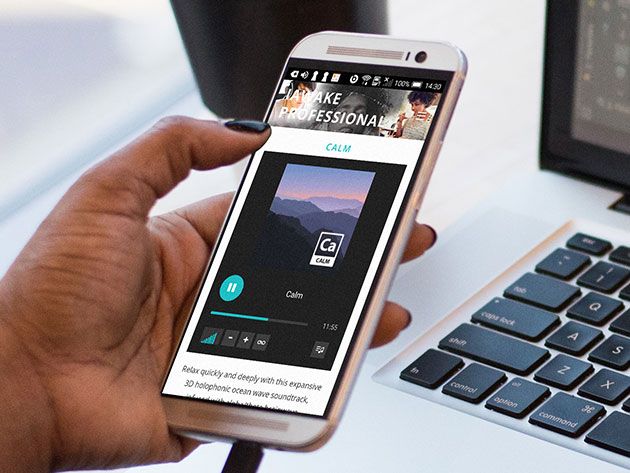
Whether you want to focus on work or relax at bedtime, iAwake Pro uses sound to help you reach the right state of mind. The app provides a range of carefully created tracks, each lasting between 8 and 10 minutes. Listening in can release your creativity, boost your energy levels, or help you overcome insomnia. Worth $499, lifetime subscriptions are now $49.

2Do Task Manager: Lifetime License

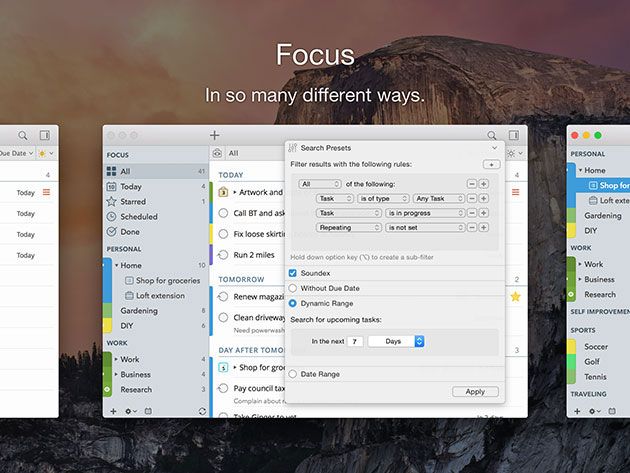
The best task managers are really easy to use, yet packed with powerful features. That would be a good description of 2Do. This highly-rated Mac app lets you drag and drop tasks into projects and stay organized with color coding. In addition, 2Do syncs with your calendar. You can get it now for $29.99 (was $49.99) with lifetime updates.

Kualto Money Management: Lifetime Subscription

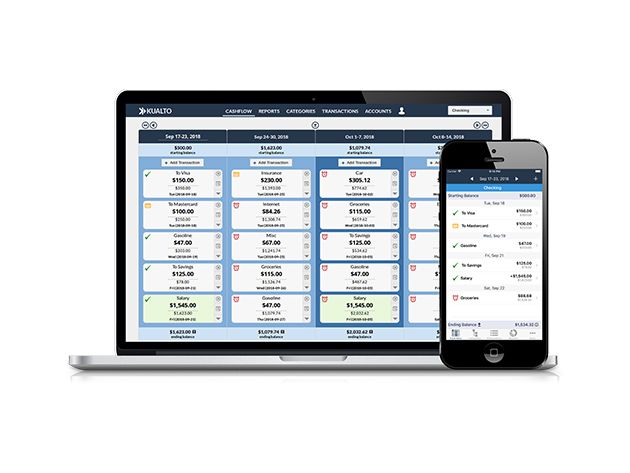
With Kualto, managing your budget couldn’t be easier. This smart personal finance app lets you track your income and outgoings. It then uses this data to forecast your future bank balance. Kualto can also remind you to pay your bills, meaning you avoid costly fees. Order now for $39.99 to get your lifetime subscription, worth $239.40.

KeyShade Password Manager: Lifetime Subscription

Keep forgetting your passwords? KeyShade is the solution. This password manager stores all your login details securely on Mac and iOS. KeyShade lets you log in on any device with one master password, and all your data is protected by strong encryption. Worth $199, lifetime service is now just $19.

Photolemur 3

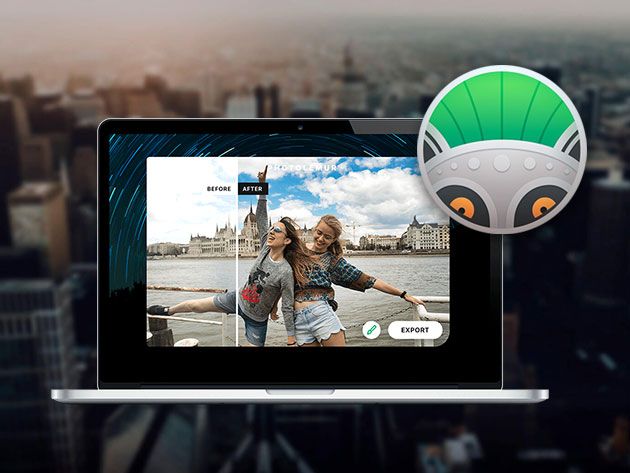
This 2018 Red Dot award-winner lets you edit your photos in seconds. The app uses 12 smart features to enhance your images, including color recovery, sky enhancement, and exposure compensation. You can then control the adjustments through one simple slider. Available on Mac and Windows, you can grab Photolemur 3 now for $19 — that’s 40% off.

Read the full article: 5 Early Black Friday Deals on Top Apps


Read Full Article

How Dumb Are You? 5 Brain Training and Analyzing Apps to Check Your Mind


brain-training

Like everything else about yourself, you can improve how your brain functions. These brain training and analyzing apps show just how dumb you are, and teach you to sharpen your mind.

We aren’t going to debate brain training games and their neuroscience. These apps will analyze your brain to give you an idea of which areas you really need to work on. Others give you exercises to improve those functions. And one app shows you how the human brain is easily tricked into making bad decisions.

Cambridge Brain Sciences (Web): Free “Brain Health” Analysis

Canada-based Cambridge Brain Sciences (CBS) is the go-to app if you want to analyze how healthy your brain is right now. It’s even used by researchers and academics for basic cognitive function tests, and were the prime tests for our analysis of what happens when you stare at a screen for 48 hours.

Sign up for the free service and you can access these tests, split into reasoning, memory, and verbal. Each test is an online game with simple instructions, like the one in the video above. The more answers you get right, the more difficult the game gets. There’s a timer for each turn, and three wrong answers ends the game. Get as high a score as you can to raise your brain health.

At the end of the test, CBS calculates an overall brain health score and shows how you ranked compared to others who took the same tests. It’ll also break down your reasoning, memory, and verbal skills to show how you did. This is a good indication of which part you really need to work on next, with the help of other apps.

NeuroNation (Web): Long-Term Brain-Boosting Courses Based on Analysis

NeuroNation has brain training analysis and exercises

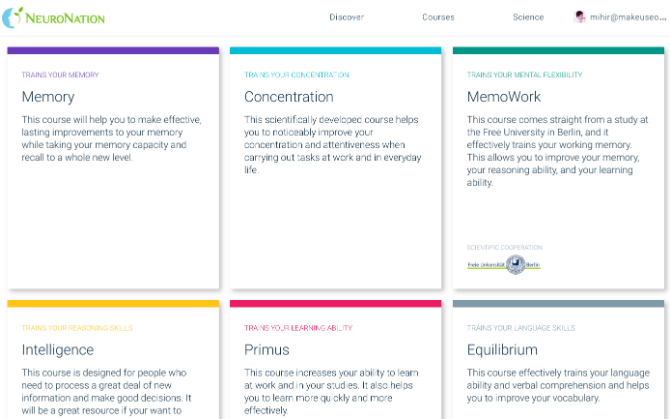
Much like CBS, NeuroNation offers its own exercises to create a profile of your current brain health. But it doesn’t just stop there. NeuroNation also provides a series of courses for free.

There are six courses for different aspects of brain training: memory, concentration, intelligence, equilibrium, primus (ability to learn faster), and memowork (memory, reasoning, and learning). Each course is a few weeks long and is tailored based on how you do on the brain test at the start.

Some of the courses or games are free to begin but will ask you for payment to continue. This can range from $20 to $60.

Note that NeuroNation is primarily a German app, and there are aspects of the test that require language skills. So if you want to take an English test, please make sure the URL says “en” and your browser doesn’t ask to translate the German page to English at any time. Taking the German test would give a false result and the test would suffer.

Brain Errors (Web): How Your Brain Makes Silly Mistakes

Brain Errors shows how the human brain makes mistakes through experiements

The human brain is far more powerful than any supercomputer on the planet. But unlike those supercomputers, our brains can make silly mistakes. It’s hard-wired in us, as scientists are discovering.

Brain Errors is a website that explains the most common ways our mind trips over its own feet. Each error is presented as a question you have to answer. It doesn’t matter how right or wrong you are, the analysis explains how the brain abandons logic in common situations. Each error includes research papers to find out more about it.

Brain Errors is a classy way to find out more about the inner workings of the mind. Try all 12 experiments, it’s fascinating. And if you find this interesting, you might want to check out these fantastic TED talks that explain how the brain works.

Brain Workshop (Windows, macOS, Linux): Dual N-Back Brain Training

There is still a lot of debate about whether brain-training games help or not. But what everyone agrees on is that playing Dual N-Back games boost short-term memory and fluid intelligence, which we commoners call smartness.

What is Dual N-Back? Let’s say “N” is two. You’ll be shown a pattern, while at the same time a letter of the alphabet is said out loud. Then you’ll get another pattern and number. And so on, infinitely.

If the current pattern or number matches the pattern or number of what was shown two (N) turns ago, you need to act. If the number repeated, click the number button. If the letter repeated, click the letter button. The video above demonstrates a simple version of the free Brain Workshop game,

The brain constantly has to discard something from the memory and add something new to it. It sounds difficult, but try it out, and you’ll get better at it over time.

Download: Brain Workshop for Windows | macOS | Linux (Free)

If you don’t want to install anything, try a free web version of the Dual N-Back game.

Brainturk (Web, Android, iOS): Cheapest Brain Training Games App

Brain-training apps are a hot commodity with big names like Lumosity and Peak. So why should you look at Brainturk instead of these amazing brain exercise games for mobile? Because the price is right.

Most brain-training apps force you to buy a monthly subscription to unlock all games or give you a few for free. These costs can end up costing a pretty penny. And it’s a bit annoying when most of these games are similar anyway. Brainturk also makes you pay, but it’s the cheapest option among all these apps.

For three dollars, you get over 40 games that you can play endlessly. Use the CBS test to find out what you need to work on, and play games from that category to slowly improve your cognitive functions.

In fact, if you play Brainturk on the web, you don’t even need to pay anything. Sign up and start playing all the games for free.

Download: Brainturk Lite for Android | iOS (Free)

Download: Brainturk for Android | iOS ($2.99)

5-Minute Exercises For Your Brain

These apps will help you appreciate how your brain functions, and even level-up your mind with repeated usage. But apps aren’t the only solution to better mental capabilities. In fact, there are a series of proven 5-minute exercises for your brain that can make you smarter over time.

Read the full article: How Dumb Are You? 5 Brain Training and Analyzing Apps to Check Your Mind


Read Full Article

Read the mud-slinging pitches Facebook’s PR firm sent us 


Facebook’s latest PR crisis has cast a lurid spotlight on a GOP-led publicity firm called Definers Public Affairs, after a New York Times investigation revealed last week the firm had sought to discredit Facebook critics by, in one instance, linking them to the liberal financier George Soros — a long-time target of anti-semitic conspiracy theories.

The sight of any company paying a firm to leverage anti-semitic and antisocial sentiment on its behalf is, to put it very politely, not a good look.

For Facebook, whose platform is aflame with socially divisive fakes, it’s bombshell bad news.

Although it’s not the only tech firm caught tapping Definers’ oppo research tactics. A piece of internal moves news the PR firm emailed us last month, in happier times for its own reputation, containing promotions and personnel moves in its Washington office, enthused about Definers adding “three new team members to its Bay Area office in California”.

“Today, Definers is a team of 40 with locations in Washington, D.C., San Francisco, and an affiliate operation in London,” the upbeat announcement ended.

How well the Definers brand survives its brush with Facebook remains to be seen.

Tarnishing

Facebook was quick to issue a rebuttal to the NYT article, claiming it had never asked Definers to generate fake news or anti-semitic memes in an attempt to smear its critics.

But it could not deny it had hired a mud-slinger in the first place, raising questions about due diligence, business oversight and, well, whether Facebook has any self perspective at all in the midst of a global brand trust scandal.

Zooming out for a second, you do also have to pause and wonder at quite how radioactive the corporate culture must be when the ‘solution’ to a string of hugely damaging disinformation scandals is to reach for whataboutery and even actual fake news, as the NYT has claimed, to try to muddy the waters in your favor.

It’s almost as if manipulation is in the corporate DNA.

Though again Facebook has decried knowledge of exactly what Definers was up to on its behalf. Yet not knowing isn’t any kind of defence when your business stands accused of defective oversight, self-serving opacity and having a vacuum where its moral compass should be. Accountability? Facebook’s algorithms keep saying no.

It’s still not clear which individual (or individuals) at Facebook actually signed on the line to put a controversial PR outfit to work slinging mud on its behalf.

In a call with reporters the day after the NYT story broke Facebook’s founder Mark Zuckerberg claimed not to know — suggesting: “Someone on our comms team must have hired them.”

He then went on to imply — in the same breath — that there could be more skeletons in the closet, reaching for his favorite solution to self-made scandals (another self-audit), by saying: “In general we need to go through and look at all the relations we have and see if there are more like this.”

As we reported earlier Facebook’s comms department has a bunch of ties to Definers. While Joel Kaplan, its longtime chief lobbyist, looks a very likely candidate for an intimate acquaintance with ‘oppo research’ dark arts — if indeed COO Sheryl Sandberg is in the clear on this one.

But without an actual answer from Facebook we’re left to speculate.

Meanwhile, Facebook users, investors and lawmakers should absolutely be left staggered at the WTFuckery of all this. How is it possible that no one in senior Facebook management knew what its left hand was doing? Where was even basic oversight of its own crisis PR response?

And who in its exec team actually feels accountability for all these fuck ups since no one with actual responsibility has fallen on their sword (though CSO Alex Stamos left recently, apparently of his own volition) — despite 2018 being another annus horribilis for Facebook, with a freshly cracked pandora’s box of privacy scandals, trust breaches and PR own-goals.

Zuckerberg’s artful political question-dodging on home turf and over the pond, in the European parliament, has merely served to further enrage lawmakers who — much like journalists — really don’t like being fobbed off with PR guff.

As a strategy the tactic necessarily burns its own runway. And it already looks to have boxed Facebook’s leadership in.

This is also — let’s not forget — the year that Zuckerberg made it his personal mission to ‘fix Facebook’. Frankly he might have had more success with another f-word.

Mud sticks

Whoever at Facebook made the call to bring in Definers opened the door to dirt-digging and smear tactics that are euphemistically passed off in political circles with the vanilla-sounding label of ‘opposition research’.

More knowingly it’s referred to as ‘the dark arts. 

The basic modus operandi is to locate (or indeed generate) selective information and seed it to the media (or, nowadays, the socials) with the intention of discrediting an opponent. 

These tactics are typically associated with the free-for-all of campaign season politics. And even there it’s always a dirty, unpleasant and ugly business.

Smear tactics and cynically spun counter narratives are also of course the bread and butter of murky interest groups seeking to manipulate public opinion without disclosing their actual agenda (and funders).

Plenty of wealthy individuals and industry groups have been fingered on the non-transparent lobbying front. And social media platforms like Facebook have, ironically enough, made it easier for shadowy agenda-pushers to deploy astroturfing techniques to mask and pass off their self-interested lobbying as grassroots activism — and thus to try to shift public opinion without being caught in the act.

Facebook engaging a PR firm to fling mud on its behalf squares this virtue-less circle.

And the connective tissue is that all these self-interests are being very well-served indeed by unregulated social media.

Since the NYT story broke, Facebook has claimed journalists were well aware that Definers was working on its behalf. But the truth is rather murkier there too.

We checked our inboxes and none of the pitches Definers sent to TechCrunch made an explicit disclosure that the messages they contained had been paid for by Facebook to push a pro-Facebook agenda. They all required the recipient to join those dots themselves.

A proper journalist engaging their critical faculties should have been able to deduce Facebook was the paying customer, given the usually obvious skew.

But if Definers was also sending this stuff (and indeed worse things than we were pitched) out more widely, to content seeders and fencers that trade on framed outrage to drive online clicks, their tasty-sounding tidbits would not have been so critically parsed. And angles they were pushing likely still flowed where they could influence opinion — thanks to the ‘inverse’ osmosis of social media.

(As far as we can tell none of the Definers’ oppo research pitches that we received ended up in a TechCrunch article — well, until now… )

You might find it interesting…

Here’s an example of Definers’ oppo mud-slinging we were sent targeting Apple and Google on Facebook’s behalf:

Just came across this – thought you might find it interesting: https://digitalcontentnext.org/blog/2018/08/21/google-data-collection-research/

“A major part of Google’s data collection occurs while a user is not directly engaged with any of its products. The magnitude of such collection is significant, especially on Android mobile devices, arguably the most popular personal accessory now carried 24/7 by more than 2 billion people.”
The study’s findings are rather shocking… It really highlights how other tech companies should be looked at critically – scrutiny shouldn’t just be on FB for data misuse. Apple & Google have been perpetrators of data abuse as well… 

“Scrutiny shouldn’t just be on FB for data misuse” is the key line there, though it’s still hardly a plain English disclosure that Facebook paid for the message to be sent.

We received multiple Definers’ pitches on behalf of what looks to be three different tech companies — and only one of these is explicitly badged as a press release from the firm paying Definers to do PR. (In that case, e-scooter startup Lime.)

We weren’t entirely convinced even then — given the sender was a random public affairs company — and ended up emailing our own Lime contacts and CCing their press email to double-check.

Generally, though, the Definers pitches we received looked nothing like traditional press releases.

A different pitch that was also sent (we must assume) on Lime’s behalf sought not, as the aforementioned press release did, to trumpet a positive PR goal (of Lime shooting to make its global fleet carbon neutral) but to fling dirt on rival scooter startup, Bird.

Dirt doesn’t fit in a traditional press release template though. So instead we got this email…

I read your piece on Bird’s custom scooter and delivery. Just wanted to flag that Bird’s numbers seem off based on what they have listed on their website: https://www.bird.co/
They’ve taken a bunch off the list. Seems odd since they just announced 100 cities two weeks agoThought you’d find this interesting. 

Other similarly mug-slinging Definers pitches we received included more fulsome info dumps in the body of the email — not just a link or few lines trailing something selectively “interesting”.

Sometimes these data dumps came with key lines highlighted. Sometimes there was also a chattily worded email intro (like the one above) to frame the content — typically including a clickbait-style appeal to journalistic curiosity. (The word “interesting” seems to be a popular choice with Definers flaks.)

At other times the pitches didn’t include much or any foreplay at all.

One “ICYMI” email subject line pitch was introed in the email body text without fanfare — with just two words: “see below”. Another had no intro text at all.

The “see below” content in the aforementioned pitch referred to this Mashable article — literally pasted word for word but with two paragraphs highlighted, drawing attention to the author’s claim that the next iPhone “could have significantly slower LTE data speeds than competing Android phones”; and to an “independent” speedtest study cited in the article (which was actually carried out by a company owned by Mashable’s own parent company… ) — and which the author concludes “revealed just how inferior Intel’s modems are compared to Qualcomm’s latest modems”.

It’s not yet been confirmed who Definers was working for to spread that particular cut-n-paste conjecture — but one obvious candidate is Qualcomm. (And for the why, the Mashable article includes an accidentally helpful pointer, noting the pair’s legal disputes over patent royalties and Apple moving away from using Qualcomm chips.)

Another “ICYMI” cut-n-paste job that Definers sent us also targeted Apple — though likely, in that case, the mud was being flung on Facebook’s behalf.

Here the pasted content was this article, by the National Legal and Policy Center, reporting on an Apple shareholder filing a proposal for the company to make a report on human rights and free speech.

So for free speech read ‘Facebook’ as the most likely self-interested source.

(The NYT article also suggested Zuckerberg was especially unhappy about Apple CEO Tim Cook publicly blasting privacy hostile business models — suggesting Facebook might have been keen to find a way to throw shade at its claim to ‘human rights’-based moral high ground.)

As an aside, the Apple-China talking point surfaced by Definers via the aforementioned National Legal and Policy Center article is also, interestingly enough, something Facebook’s former CSO Stamos has sought to hammer hard on in public…

And while Stamos may have left the building at 1 Hacker Way he’s continued to speak up on behalf of his former employer and its choices in public — and liberally fling blame at Facebook’s critics.

That Facebook’s ex-CSO is using the exact same attack points as Definers is interesting in terms of the PR alignment. How deep does that strategic ‘infowars’ rabbit hole go?

Returning again to Definers, in another instance the firm reached out to me via email to “pass along some context” after I wrote this article — about a tool created by Oxford University’s Oxford Internet Institute to aggregate junk news being shared on Facebook.

“Facebook ahas [sic] been working to curb the proliferation of this kind of news and there have been encouraging results from three different studies in the past month,” wrote the flak, flagging three studies to back up his claim — summarizing them in short bullet points (without linking to the cited research).

The ‘context’ being pitched here boiled down to:

  • an academic study that Definers claimed suggested “interactions with fake news sites declined by more than half on Facebook after the 2016 election”;
  • a metric created by another university to measure the Facebook distribution of the number of sites that share misinformation — again with the pitch claiming ‘dramatic improvements’ for Facebook at the same time as flinging shade on Twitter (Definers wrote: “The metric was very high for Facebook in 2016 — much higher than Twitter’s — but beginning in mid 2017 it was dramatically improved, and now Facebook has 50% less of what the University of Michigan calls “Iffy Quotient content” than Twitter”);
  • and a study by French newspaper looking at 630 French websites and claiming “Facebook engagement with “unreliable or dubious sites” has halved in France since 2015”

As another aside Facebook policy staffers recently cited the exact same ‘Iffy Quotient’ metric in a letter to the UK’s DCMS committee — which has been running a multi-month enquiry into online disinformation and trying (unsuccessfully) to get Zuckerberg to personally answer its questions — as part of several pages of ‘contextual filler’ Facebook used to pad out yet another letter to UK lawmakers that contained the word ‘no’.

Committee chair Damian Collins was not impressed by Facebook’s attention-sapping tactics.

“We will not let the matter rest there, and are not reassured in any way by the corporate puff piece that passes off as Facebook’s letter back to us,” he wrote. “The fact that the University of Michigan believes that Facebook’s ‘Iffy Quotient’ scores have recently improved means nothing to the victims of Facebook data breaches.”

Well, quite.

Further reflections

Facebook’s approach to its own publicity brings to mind something that academic and techno-sociologist Zeynep Tufecki wrote earlier this year — when she asserted: “The most effective forms of censorship today involve meddling with trust and attention, not muzzling speech itself.”

Although, in that moment, she was actually talking more about online disinformation tactics than the distribution platforms themselves.

Yet the point does seem to stand — when, in Facebook’s case, the platform business appears to be reflecting (or, well, channeling, via its PR) the same problematic qualities that mire and/or bog down content on Facebook.

Again, returning to how Definers sought to engage with us, in another more labor intensive episode, it pitched another TechCrunch journalist — ahead of a Senate Intelligence hearing which was attended by Facebook’s COO, Sheryl Sandberg and Twitter’s CEO Jack Dorsey. But not by any senior execs from Google.

Here the firm worked to flag up and critically frame Google’s absence, after the Facebook adtech rival had declined to send either of the two C-suite execs the committee had asked for.

“Hey… Are you covering Google’s lack of cooperation for next week’s Senate Intel hearing with Twitter & FB? If so, let me know. May have a new angle for you,” was its opening gambit to a TC colleague in an email sent on the last day of August (the committee hearing took place on September 5) — which earned it a “happy to entertain a pitch” response from the journalist in question.

Definers then suggested a phone call. But after about an hour of radio silence it emailed again, now fleshing out its ‘Google isn’t taking the committee’s concerns seriously’ angle:

I’m sure this is on your radar, but wanted to flag something for you. Google isn’t sending an exec to testify at next week’s Senate Intel hearing:
From all reports on the Hill, it will be an empty chair. Given recent news that disruption campaigns have been launched by the Russians and Iranians, it seems very irresponsible on their part. After all, Google is not only the most powerful search engine, it also has one of the largest market shares on digital ads.
I think there is an interesting story on how Twitter and Facebook (while both are far from perfect) are taking the committee’s concerns seriously and Google is absent.
Thoughts?

Note the “both are far from perfect” fillip aimed at Twitter and Facebook to lay down a little light covering fire for a reframed double-barrel assault on Google as the really big baddie for not even showing up.

A few days later the same Definers’ staffer pitched this reporter again, now the day before the Senate hearing — offering “an interesting backgrounder re the committee’s members’ campaign expenses for FB ads, campaign contributions from big tech, and the data tools senators are using to track visitors to their website”.

After getting through on the phone this time they emailed to hammer home a final thought: “Check out the attached docs – there’s a level of hypocrisy here especially before tomorrow’s hearing with FB & Twitter”.

More smear tactics — now aimed directly at the lawmakers who would be asking Facebook tough questions by seeking to attack their moral right to defend privacy.

A month later the Definers operator was back pitching the same TC reporter. Though here it’s even less clear who’s the paymaster behind this particular pitch.

“Hey – any interest in taking a look at Apple employees’ political contributions from the last 14 years or so?” the PR opened.

The pitch was for a report written by another Washington-based PR firm, called GovPredict — whose website describes its business as “research, analytics, and actionable intelligence for winning public affairs campaigns” — which Definers said it could share ahead of release time, under embargo.

The report in question consisted of a six-page proprietary “analysis” conducted by the other PR firm which claimed to summarize the recipients of political contributions of Apple employees — slicing the self-structured data by political party and breaking out contributions to key individuals (e.g. Hillary Clinton, Obama etc).

“In total, 91% of Apple employee contributions have gone to Democrats, and 9% to Republicans,” concluded the ‘report’ — which had been compiled by a PR firm whose stated business is “winning public affairs campaigns” on behalf of its clients, and which was seeded to a journalist by another PR firm being paid by an unknown tech firm to daub Apple in partisan colors.

Whoever was paying to paint a picture of Apple in near pure Democrat blue clearly had an agenda to peddle. Just as clearly, they didn’t want to be seen doing the peddling themselves.

Nor did they need to — given the mushrooming influencer PR industry that’s more than happy to be paid to fling mud on the tech industry’s behalf. (Even, seemingly, at the same company for different paying clients. Nice but dirty business if you can get it then.)

Yet many of the wider problems of big tech which are the root cause of their brand trust crises boil down to a problematic lack of transparency. And the chain-linked lack of accountability that flows from that.

Throwing more mud at this problem doesn’t look like a fix for or an answer to anything.

Nor is it a great look for a scandal-hit adtech giant like Facebook, whose founder claims to be hard at work fixing a flawed platform philosophy that’s failed repeatedly on integrity, transparency and responsibility, to be found dipping into a murky oppo research well — even as it’s simultaneously trying to cast the specter of regulation from the door.

For dark arts read fresh scandals, as Facebook has now found.

Yet it’s interesting that someone at the company — realizing it was in a trust hole — only knew how to keep digging.


Read Full Article

Read the mud-slinging pitches Facebook’s PR firm sent us 


Facebook’s latest PR crisis has cast a lurid spotlight on a GOP-led publicity firm called Definers Public Affairs, after a New York Times investigation revealed last week the firm had sought to discredit Facebook critics by, in one instance, linking them to the liberal financier George Soros — a long-time target of anti-semitic conspiracy theories.

The sight of any company paying a firm to leverage anti-semitic and antisocial sentiment on its behalf is, to put it very politely, not a good look.

For Facebook, whose platform is aflame with socially divisive fakes, it’s bombshell bad news.

Although it’s not the only tech firm caught tapping Definers’ oppo research tactics. A piece of internal moves news the PR firm emailed us last month, in happier times for its own reputation, containing promotions and personnel moves in its Washington office, enthused about Definers adding “three new team members to its Bay Area office in California”.

“Today, Definers is a team of 40 with locations in Washington, D.C., San Francisco, and an affiliate operation in London,” the upbeat announcement ended.

How well the Definers brand survives its brush with Facebook remains to be seen.

Tarnishing

Facebook was quick to issue a rebuttal to the NYT article, claiming it had never asked Definers to generate fake news or anti-semitic memes in an attempt to smear its critics.

But it could not deny it had hired a mud-slinger in the first place, raising questions about due diligence, business oversight and, well, whether Facebook has any self perspective at all in the midst of a global brand trust scandal.

Zooming out for a second, you do also have to pause and wonder at quite how radioactive the corporate culture must be when the ‘solution’ to a string of hugely damaging disinformation scandals is to reach for whataboutery and even actual fake news, as the NYT has claimed, to try to muddy the waters in your favor.

It’s almost as if manipulation is in the corporate DNA.

Though again Facebook has decried knowledge of exactly what Definers was up to on its behalf. Yet not knowing isn’t any kind of defence when your business stands accused of defective oversight, self-serving opacity and having a vacuum where its moral compass should be. Accountability? Facebook’s algorithms keep saying no.

It’s still not clear which individual (or individuals) at Facebook actually signed on the line to put a controversial PR outfit to work slinging mud on its behalf.

In a call with reporters the day after the NYT story broke Facebook’s founder Mark Zuckerberg claimed not to know — suggesting: “Someone on our comms team must have hired them.”

He then went on to imply — in the same breath — that there could be more skeletons in the closet, reaching for his favorite solution to self-made scandals (another self-audit), by saying: “In general we need to go through and look at all the relations we have and see if there are more like this.”

As we reported earlier Facebook’s comms department has a bunch of ties to Definers. While Joel Kaplan, its longtime chief lobbyist, looks a very likely candidate for an intimate acquaintance with ‘oppo research’ dark arts — if indeed COO Sheryl Sandberg is in the clear on this one.

But without an actual answer from Facebook we’re left to speculate.

Meanwhile, Facebook users, investors and lawmakers should absolutely be left staggered at the WTFuckery of all this. How is it possible that no one in senior Facebook management knew what its left hand was doing? Where was even basic oversight of its own crisis PR response?

And who in its exec team actually feels accountability for all these fuck ups since no one with actual responsibility has fallen on their sword (though CSO Alex Stamos left recently, apparently of his own volition) — despite 2018 being another annus horribilis for Facebook, with a freshly cracked pandora’s box of privacy scandals, trust breaches and PR own-goals.

Zuckerberg’s artful political question-dodging on home turf and over the pond, in the European parliament, has merely served to further enrage lawmakers who — much like journalists — really don’t like being fobbed off with PR guff.

As a strategy the tactic necessarily burns its own runway. And it already looks to have boxed Facebook’s leadership in.

This is also — let’s not forget — the year that Zuckerberg made it his personal mission to ‘fix Facebook’. Frankly he might have had more success with another f-word.

Mud sticks

Whoever at Facebook made the call to bring in Definers opened the door to dirt-digging and smear tactics that are euphemistically passed off in political circles with the vanilla-sounding label of ‘opposition research’.

More knowingly it’s referred to as ‘the dark arts. 

The basic modus operandi is to locate (or indeed generate) selective information and seed it to the media (or, nowadays, the socials) with the intention of discrediting an opponent. 

These tactics are typically associated with the free-for-all of campaign season politics. And even there it’s always a dirty, unpleasant and ugly business.

Smear tactics and cynically spun counter narratives are also of course the bread and butter of murky interest groups seeking to manipulate public opinion without disclosing their actual agenda (and funders).

Plenty of wealthy individuals and industry groups have been fingered on the non-transparent lobbying front. And social media platforms like Facebook have, ironically enough, made it easier for shadowy agenda-pushers to deploy astroturfing techniques to mask and pass off their self-interested lobbying as grassroots activism — and thus to try to shift public opinion without being caught in the act.

Facebook engaging a PR firm to fling mud on its behalf squares this virtue-less circle.

And the connective tissue is that all these self-interests are being very well-served indeed by unregulated social media.

Since the NYT story broke, Facebook has claimed journalists were well aware that Definers was working on its behalf. But the truth is rather murkier there too.

We checked our inboxes and none of the pitches Definers sent to TechCrunch made an explicit disclosure that the messages they contained had been paid for by Facebook to push a pro-Facebook agenda. They all required the recipient to join those dots themselves.

A proper journalist engaging their critical faculties should have been able to deduce Facebook was the paying customer, given the usually obvious skew.

But if Definers was also sending this stuff (and indeed worse things than we were pitched) out more widely, to content seeders and fencers that trade on framed outrage to drive online clicks, their tasty-sounding tidbits would not have been so critically parsed. And angles they were pushing likely still flowed where they could influence opinion — thanks to the ‘inverse’ osmosis of social media.

(As far as we can tell none of the Definers’ oppo research pitches that we received ended up in a TechCrunch article — well, until now… )

You might find it interesting…

Here’s an example of Definers’ oppo mud-slinging we were sent targeting Apple and Google on Facebook’s behalf:

Just came across this – thought you might find it interesting: https://digitalcontentnext.org/blog/2018/08/21/google-data-collection-research/

“A major part of Google’s data collection occurs while a user is not directly engaged with any of its products. The magnitude of such collection is significant, especially on Android mobile devices, arguably the most popular personal accessory now carried 24/7 by more than 2 billion people.”
The study’s findings are rather shocking… It really highlights how other tech companies should be looked at critically – scrutiny shouldn’t just be on FB for data misuse. Apple & Google have been perpetrators of data abuse as well… 

“Scrutiny shouldn’t just be on FB for data misuse” is the key line there, though it’s still hardly a plain English disclosure that Facebook paid for the message to be sent.

We received multiple Definers’ pitches on behalf of what looks to be three different tech companies — and only one of these is explicitly badged as a press release from the firm paying Definers to do PR. (In that case, e-scooter startup Lime.)

We weren’t entirely convinced even then — given the sender was a random public affairs company — and ended up emailing our own Lime contacts and CCing their press email to double-check.

Generally, though, the Definers pitches we received looked nothing like traditional press releases.

A different pitch that was also sent (we must assume) on Lime’s behalf sought not, as the aforementioned press release did, to trumpet a positive PR goal (of Lime shooting to make its global fleet carbon neutral) but to fling dirt on rival scooter startup, Bird.

Dirt doesn’t fit in a traditional press release template though. So instead we got this email…

I read your piece on Bird’s custom scooter and delivery. Just wanted to flag that Bird’s numbers seem off based on what they have listed on their website: https://www.bird.co/
They’ve taken a bunch off the list. Seems odd since they just announced 100 cities two weeks agoThought you’d find this interesting. 

Other similarly mug-slinging Definers pitches we received included more fulsome info dumps in the body of the email — not just a link or few lines trailing something selectively “interesting”.

Sometimes these data dumps came with key lines highlighted. Sometimes there was also a chattily worded email intro (like the one above) to frame the content — typically including a clickbait-style appeal to journalistic curiosity. (The word “interesting” seems to be a popular choice with Definers flaks.)

At other times the pitches didn’t include much or any foreplay at all.

One “ICYMI” email subject line pitch was introed in the email body text without fanfare — with just two words: “see below”. Another had no intro text at all.

The “see below” content in the aforementioned pitch referred to this Mashable article — literally pasted word for word but with two paragraphs highlighted, drawing attention to the author’s claim that the next iPhone “could have significantly slower LTE data speeds than competing Android phones”; and to an “independent” speedtest study cited in the article (which was actually carried out by a company owned by Mashable’s own parent company… ) — and which the author concludes “revealed just how inferior Intel’s modems are compared to Qualcomm’s latest modems”.

It’s not yet been confirmed who Definers was working for to spread that particular cut-n-paste conjecture — but one obvious candidate is Qualcomm. (And for the why, the Mashable article includes an accidentally helpful pointer, noting the pair’s legal disputes over patent royalties and Apple moving away from using Qualcomm chips.)

Another “ICYMI” cut-n-paste job that Definers sent us also targeted Apple — though likely, in that case, the mud was being flung on Facebook’s behalf.

Here the pasted content was this article, by the National Legal and Policy Center, reporting on an Apple shareholder filing a proposal for the company to make a report on human rights and free speech.

So for free speech read ‘Facebook’ as the most likely self-interested source.

(The NYT article also suggested Zuckerberg was especially unhappy about Apple CEO Tim Cook publicly blasting privacy hostile business models — suggesting Facebook might have been keen to find a way to throw shade at its claim to ‘human rights’-based moral high ground.)

As an aside, the Apple-China talking point surfaced by Definers via the aforementioned National Legal and Policy Center article is also, interestingly enough, something Facebook’s former CSO Stamos has sought to hammer hard on in public…

And while Stamos may have left the building at 1 Hacker Way he’s continued to speak up on behalf of his former employer and its choices in public — and liberally fling blame at Facebook’s critics.

That Facebook’s ex-CSO is using the exact same attack points as Definers is interesting in terms of the PR alignment. How deep does that strategic ‘infowars’ rabbit hole go?

Returning again to Definers, in another instance the firm reached out to me via email to “pass along some context” after I wrote this article — about a tool created by Oxford University’s Oxford Internet Institute to aggregate junk news being shared on Facebook.

“Facebook ahas [sic] been working to curb the proliferation of this kind of news and there have been encouraging results from three different studies in the past month,” wrote the flak, flagging three studies to back up his claim — summarizing them in short bullet points (without linking to the cited research).

The ‘context’ being pitched here boiled down to:

  • an academic study that Definers claimed suggested “interactions with fake news sites declined by more than half on Facebook after the 2016 election”;
  • a metric created by another university to measure the Facebook distribution of the number of sites that share misinformation — again with the pitch claiming ‘dramatic improvements’ for Facebook at the same time as flinging shade on Twitter (Definers wrote: “The metric was very high for Facebook in 2016 — much higher than Twitter’s — but beginning in mid 2017 it was dramatically improved, and now Facebook has 50% less of what the University of Michigan calls “Iffy Quotient content” than Twitter”);
  • and a study by French newspaper looking at 630 French websites and claiming “Facebook engagement with “unreliable or dubious sites” has halved in France since 2015”

As another aside Facebook policy staffers recently cited the exact same ‘Iffy Quotient’ metric in a letter to the UK’s DCMS committee — which has been running a multi-month enquiry into online disinformation and trying (unsuccessfully) to get Zuckerberg to personally answer its questions — as part of several pages of ‘contextual filler’ Facebook used to pad out yet another letter to UK lawmakers that contained the word ‘no’.

Committee chair Damian Collins was not impressed by Facebook’s attention-sapping tactics.

“We will not let the matter rest there, and are not reassured in any way by the corporate puff piece that passes off as Facebook’s letter back to us,” he wrote. “The fact that the University of Michigan believes that Facebook’s ‘Iffy Quotient’ scores have recently improved means nothing to the victims of Facebook data breaches.”

Well, quite.

Further reflections

Facebook’s approach to its own publicity brings to mind something that academic and techno-sociologist Zeynep Tufecki wrote earlier this year — when she asserted: “The most effective forms of censorship today involve meddling with trust and attention, not muzzling speech itself.”

Although, in that moment, she was actually talking more about online disinformation tactics than the distribution platforms themselves.

Yet the point does seem to stand — when, in Facebook’s case, the platform business appears to be reflecting (or, well, channeling, via its PR) the same problematic qualities that mire and/or bog down content on Facebook.

Again, returning to how Definers sought to engage with us, in another more labor intensive episode, it pitched another TechCrunch journalist — ahead of a Senate Intelligence hearing which was attended by Facebook’s COO, Sheryl Sandberg and Twitter’s CEO Jack Dorsey. But not by any senior execs from Google.

Here the firm worked to flag up and critically frame Google’s absence, after the Facebook adtech rival had declined to send either of the two C-suite execs the committee had asked for.

“Hey… Are you covering Google’s lack of cooperation for next week’s Senate Intel hearing with Twitter & FB? If so, let me know. May have a new angle for you,” was its opening gambit to a TC colleague in an email sent on the last day of August (the committee hearing took place on September 5) — which earned it a “happy to entertain a pitch” response from the journalist in question.

Definers then suggested a phone call. But after about an hour of radio silence it emailed again, now fleshing out its ‘Google isn’t taking the committee’s concerns seriously’ angle:

I’m sure this is on your radar, but wanted to flag something for you. Google isn’t sending an exec to testify at next week’s Senate Intel hearing:
From all reports on the Hill, it will be an empty chair. Given recent news that disruption campaigns have been launched by the Russians and Iranians, it seems very irresponsible on their part. After all, Google is not only the most powerful search engine, it also has one of the largest market shares on digital ads.
I think there is an interesting story on how Twitter and Facebook (while both are far from perfect) are taking the committee’s concerns seriously and Google is absent.
Thoughts?

Note the “both are far from perfect” fillip aimed at Twitter and Facebook to lay down a little light covering fire for a reframed double-barrel assault on Google as the really big baddie for not even showing up.

A few days later the same Definers’ staffer pitched this reporter again, now the day before the Senate hearing — offering “an interesting backgrounder re the committee’s members’ campaign expenses for FB ads, campaign contributions from big tech, and the data tools senators are using to track visitors to their website”.

After getting through on the phone this time they emailed to hammer home a final thought: “Check out the attached docs – there’s a level of hypocrisy here especially before tomorrow’s hearing with FB & Twitter”.

More smear tactics — now aimed directly at the lawmakers who would be asking Facebook tough questions by seeking to attack their moral right to defend privacy.

A month later the Definers operator was back pitching the same TC reporter. Though here it’s even less clear who’s the paymaster behind this particular pitch.

“Hey – any interest in taking a look at Apple employees’ political contributions from the last 14 years or so?” the PR opened.

The pitch was for a report written by another Washington-based PR firm, called GovPredict — whose website describes its business as “research, analytics, and actionable intelligence for winning public affairs campaigns” — which Definers said it could share ahead of release time, under embargo.

The report in question consisted of a six-page proprietary “analysis” conducted by the other PR firm which claimed to summarize the recipients of political contributions of Apple employees — slicing the self-structured data by political party and breaking out contributions to key individuals (e.g. Hillary Clinton, Obama etc).

“In total, 91% of Apple employee contributions have gone to Democrats, and 9% to Republicans,” concluded the ‘report’ — which had been compiled by a PR firm whose stated business is “winning public affairs campaigns” on behalf of its clients, and which was seeded to a journalist by another PR firm being paid by an unknown tech firm to daub Apple in partisan colors.

Whoever was paying to paint a picture of Apple in near pure Democrat blue clearly had an agenda to peddle. Just as clearly, they didn’t want to be seen doing the peddling themselves.

Nor did they need to — given the mushrooming influencer PR industry that’s more than happy to be paid to fling mud on the tech industry’s behalf. (Even, seemingly, at the same company for different paying clients. Nice but dirty business if you can get it then.)

Yet many of the wider problems of big tech which are the root cause of their brand trust crises boil down to a problematic lack of transparency. And the chain-linked lack of accountability that flows from that.

Throwing more mud at this problem doesn’t look like a fix for or an answer to anything.

Nor is it a great look for a scandal-hit adtech giant like Facebook, whose founder claims to be hard at work fixing a flawed platform philosophy that’s failed repeatedly on integrity, transparency and responsibility, to be found dipping into a murky oppo research well — even as it’s simultaneously trying to cast the specter of regulation from the door.

For dark arts read fresh scandals, as Facebook has now found.

Yet it’s interesting that someone at the company — realizing it was in a trust hole — only knew how to keep digging.


Read Full Article

Xiaomi gobbles up selfie phone brand Meitu as revenue jumps 49%


Xiaomi is diversifying into a new range of phones as the Chinese smartphone maker announced impressive growth with its latest financials.

The company announced it will take over selfie app maker Meitu’s smartphone business to go after new demographics, particularly women, while it lodged impressive 49 percent revenue growth in Q3.

Xiaomi posted a net profit of 2.481 billion RMB ($357 million) for the quarter on total sales of 50.846 billion RMB ($7.3 billion). The bulk of that income came from smartphones sales — 35 billion RMB, $5 billion — as Xiaomi surpassed its annual target of 100 million shipments with two months of the year still to go. The majority of those phones are sold in China, but the company said that international revenue overall was up by 113 percent year-on-year.

The company has ventured into Europe this year, with its most recent launch in the UK this month, but now it is taking aim at a more diverse set of customers in the Chinese market through this tie-in with Meitu. Best known for its ‘beautification’ selfie apps, Meitu also sells smartphones that tap its selfie brand with optimized cameras and advanced editing features.

Now Xiaomi is taking over that business through a partnership that will see Meitu paid 10 percent of the profits for all devices sold, with a minimum guaranteed fee of $10 million per year. For other smart products, its cut increases to 15 percent.

Meitu is hardly a mainstream phone brand. Its first device launched in 2013 and it has sold 3.5 million units to date. Recently, the company cut back on its hardware — it has launched just one device this year compared to five last year — while the average sell price of its devices has fallen, causing it to forecast a net loss of up to 1.2 billion RMB (or $173 million) up from just 197 million RMB last year. Shifting the heavy-lifting to Xiaomi makes a lot of sense — despite its total cut of sales dropping to just 10 percent, Xiaomi has impressive reach and a sales platform that already features third-party hardware.

Back to Xiaomi, these results are its first ‘true’ financials since the company went public through a Hong Kong IPO back in July. It posted a $2.1 billion profit in the previous quarter but a large chunk of spending and revenue was down to the listing.


Read Full Article

One billion 3D views and counting

CyberGhost VPN Review: Why This Top VPN Is Worth Your Time

PS4 Black Friday Deals You Won’t Want to Miss

8 Ways to Clear Memory and Increase RAM on Your Windows Computer


ram-clean

Are you concerned about RAM usage on your computer? Seeing messages that your computer is low on memory? Don’t fear—we’re here to help.

Unlock the "Windows Keyboard Shortcuts 101" cheat sheet now!

This will sign you up to our newsletter

Enter your Email

Let’s take a look at some practical steps to free up RAM on your PC. You’ll be back to a smooth experience in no time.

What Is RAM?

Before we dive into RAM usage tips, we should briefly describe what RAM does in case you’re not familiar.

RAM stands for Random Access Memory. It’s a short-term storage that holds programs currently running on your computer.

The more RAM that’s in your machine, the more programs you can run at once without negatively affecting performance. When your computer runs low on RAM, it uses a part of the hard drive called the page file that acts as “pretend RAM.” This is much slower than actual RAM, which is why you notice slowdowns.

Because RAM is volatile, you’ll lose its contents when your computer shuts off. Anything you want to keep must save to a hard drive or other permanent storage.

Check out our quick guide to RAM for more background info.

1. Restart Your PC

This is a tip you’re probably familiar with, but it’s popular for a reason.

Restarting your PC will also clear memory and reset all running programs. While this obviously won’t increase your total RAM, it will clean up processes running in the background that could be eating up RAM.

You should restart your computer regularly to keep it from getting bogged down, especially if you use it all the time.

2. Check RAM Usage

Windows Power Usage Task Manager

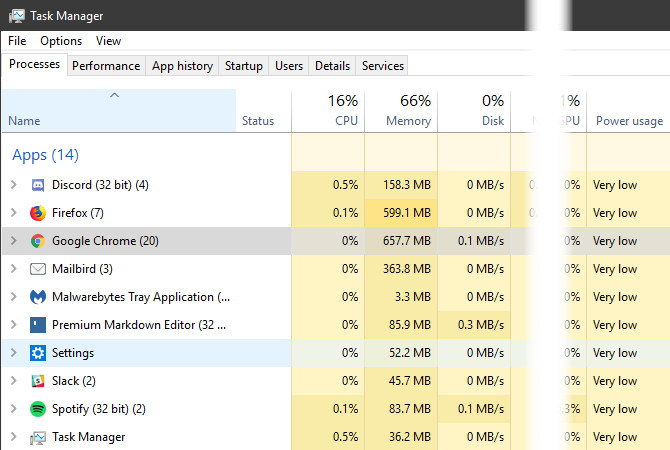
You don’t have to guess what’s using your RAM; Windows provides tools to show you. To get started, open the Task Manager by searching for it in the Start Menu, or use the Ctrl + Shift + Esc shortcut.

Click More details to expand to the full utility if needed. Then on the Processes tab, click the Memory header to sort from most to least RAM usage. Keep the apps you see here in mind, as we’ll discuss more on them later.

For more information, switch to the Performance tab. On the Memory section, you’ll see a chart of your RAM usage over time. Click Open Resource Monitor at the bottom and you can get more information.

Windows Resource Monitor Memory

The chart at the bottom will show you how much RAM you have free. Sort by Commit (KB) on the top list to see which programs use the most RAM. If you suspect you have a deep problem based on what you see here, see the complete guide to troubleshooting memory leaks.

3. Uninstall or Disable Software

Now that you’ve seen what apps use the most RAM on your system, think about whether you really use them.

Apps you haven’t opened in months are just wasting resources on your computer, so you should remove them. Do so by navigating to Settings > Apps and clicking Uninstall on any app you want to remove.

Uninstall Chrome Windows 10

If you don’t want to uninstall an app because you use it sometimes, you can instead prevent it from running at startup. Many apps set themselves to automatically run every time you log in, which is inefficient if you rarely use them.

Take a look at our guide to startup programs for help.

4. Use Lighter Apps and Manage Programs

Chrome Task Manager

What if you really need to cut down on RAM usage, but the apps hogging RAM are necessary to your workflow? You can work with this in two ways.

First, try using lighter app alternatives when you can. If your computer struggles when you have Photoshop open, try using a smaller app like Paint.NET for minor edits. Only use Photoshop when you’re fully dedicated to working on a project.

Second, pay closer attention to the programs you have open. Close any software that you’re not actively working with. Bookmark open browser tabs that you want to read later, then close them to free up RAM. Keeping a tighter leash on what’s open will help free up RAM.

Google Chrome is in its own category here, as it’s notorious for gobbling RAM. See how to control Chrome’s memory usage for tips.

5. Scan for Malware

It’s worth checking for malware on your PC. Rogue software stealing resources will obviously suck up your available RAM.

We recommend running a scan with Malwarebytes. Hopefully it won’t find anything, but at least you can rule out the possibility.

6. Adjust Virtual Memory

We mentioned the paging file earlier. If you see error messages that your system is low on virtual memory, you can increase this and hopefully keep performance stable.

To do so, search for the Control Panel on the Start Menu to open it. Switch the Category view in the top-right to Small icons (if needed) and choose System. On the left side, click Advanced system settings, which will open a new window.

Here, on the Advanced tab, click Settings under Performance. Switch to the Advanced tab once again and click the Change button.

Now you’ll see the paging file size for your main drive. In most cases, you can leave the Automatically manage box checked and let Windows take care of it. However, to resolve problems, you may need to uncheck this and set the Initial size and Maximum size to higher values.

Virtual Memory Management Windows

See our guide to virtual memory for more help.

7. Try ReadyBoost

If your computer still has an older mechanical hard disk drive (HDD) in it, you can try a lesser-known Windows feature called ReadyBoost to increase RAM. This allows you to plug in a flash drive or SD card that Windows effectively treats as extra RAM.

While it sounds great, this feature offers limited use today. If your computer has an SSD, ReadyBoost won’t do anything. This is because an SSD is faster than a flash drive.

Plus, since computers have more RAM installed by default now, you won’t see as much gain from ReadyBoost as you would on an anemic system from a decade ago. The “pretend RAM” from ReadyBoost doesn’t offer the same performance gains as actually adding more RAM.

8. Install More RAM

If you’re really low on RAM or want to run more programs at once, there’s really no way around it: you need to add some more RAM to your machine. While it’s not cheap, adding RAM will grant much-improved performance if your computer hasn’t had much until now.

On a desktop, this is a pretty simple upgrade. But due to the confined space on a laptop, it may be difficult or even impossible. You’ll also need to make sure you buy RAM that’s compatible with your system. So ask yourself some important questions before making any upgrade, and decide how much RAM you need.

What About RAM Cleaners?

You’ve likely seen RAM cleaning utilities that promise to help you boost your RAM in various ways. While these sound great, we recommend avoiding them.

Have a look at our coverage of CleanMem, one such app, for the reasons why. In summary, RAM boosters are placebos at best, as they “free up” RAM by taking it from programs that probably need it.

Memory management is a complex computing issue. The developers of Windows, who are experts in their field, have a much better grasp on how to do this than some random developer who publishes a RAM cleaner.

RAM Is Important, But Don’t Neglect Other Upgrades

We’ve taken a look at several ways to manage the RAM on your computer. Ultimately, adding more physical RAM to your machine is the best solution for RAM-related issues. Walking through the above steps will help you decide if this is necessary, though.

Amongst all this talk of RAM, don’t forget that other PC upgrades are important too. Find out what upgrades will improve your computer’s performance the most.

Read the full article: 8 Ways to Clear Memory and Increase RAM on Your Windows Computer


Read Full Article
First ever drone-delivered kidney is no worse for wear


Drone delivery really only seems practical for two things: take-out and organ transplants. Both are relatively light and also extremely time sensitive. Well, experiments in flying a kidney around Baltimore in a refrigerated box have yielded positive results — which also seems promising for getting your pad thai to you in good kit.

The test flights were conducted by researchers at the University of Maryland there, led by surgeon Joseph Scalea. He has been frustrated in the past with the inflexibility of air delivery systems, and felt that drones represent an obvious solution to the last-mile problem.

Scalea and his colleagues modified a DJI M600 drone to carry a refrigerated box payload, and also designed a wireless biosensor for monitoring the organ while in flight.

After months of waiting, their study was assigned a kidney that was healthy enough for testing but not good enough for transplant. Once it landed in Baltimore, the team loaded it into the container and had it travel 14 separate missions of various distances and profiles. The longest of these was three miles, a realistic distance between hospitals in the area, and the top speed achieved was 67.6 km/h, or about 42 mph.

Biopsies of the kidney were taken before and after the flights, and also after a reference flight on a small aircraft, which is another common way to transport organs medium distances.

Image credit: Joseph Scalea

The results are good: despite the potential threats of wind chill and heat from the motors of the drone (though this was mitigated by choosing a design with a distal motor-rotor setup), the temperature of the box remained at 2.5 degrees Celsius, just above freezing. And no damage appeared to have been done by the drones’ vibrations or maneuvers.

Restrictions on drones and on how organs can be transported make it unlikely that this type of delivery will be taking place any time soon, but it’s studies like this that make it possible to challenge those restrictions. Once the risk has been quantified, then kidneys, livers, blood, and other tissues or important medical supplies may be transported this way — and in many cases, every minute counts.

One can also imagine the usefulness of this type of thing in disaster situations, when not just ordinary aircraft but also land vehicles may have trouble getting around a city. Drones should be able to carry much-needed supplies — but before they do, they should definitely be studied to make sure they aren’t going to curdle the blood or anything.

The specifics of the study are detailed in a paper published in the IEEE Journal of Translational Engineering in Health and Medicine.


Read Full Article

Interest rates and fears of a mounting trade war send tech stocks lower


Shares of technology companies were battered in today’s trading as fears of an increasing trade war between the U.S. and China and rising interest rates convinced worried investors to sell.

The Nasdaq Composite Index, which is where many of the country’s largest technology companies trade their shares, was down 219.4 points, or 3%, to 7,028.48. Meanwhile, the Dow Jones Industrial Average fell 395.8 points, or 1.6%, to 25,017.44.

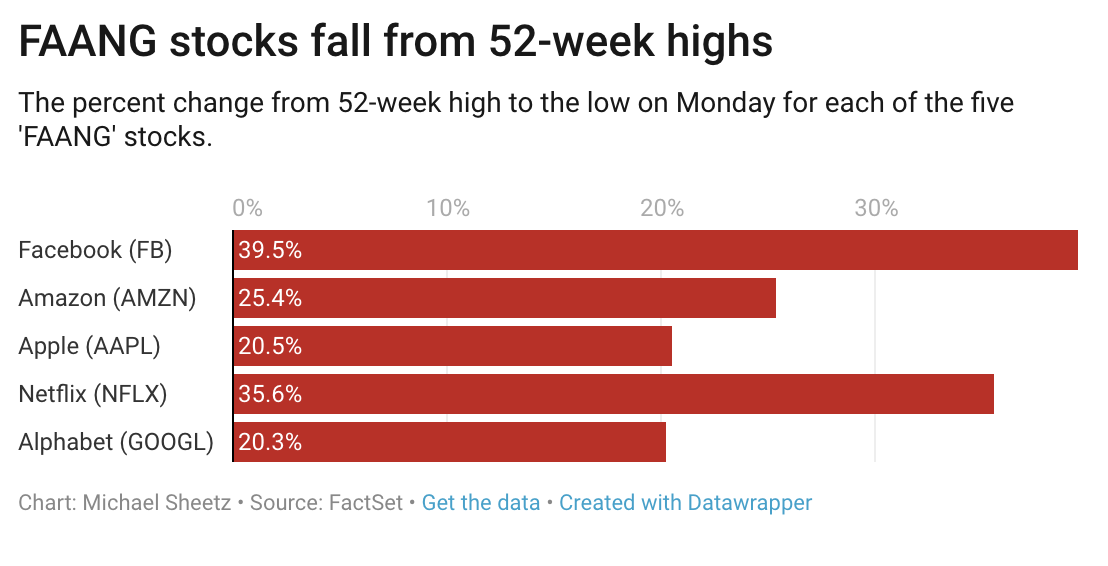
Facebook, Alphabet (the parent company of Google), Apple, Netflix and Amazon all fell into bear trading territory, which means that the value of these stocks have slid more than 20%. CNBC has a handy chart illustrating just how bad things have been for the largest tech companies in the U.S.

Some of the woes from tech stocks aren’t necessarily trade war related. Facebook shares have been hammered on the back of a blockbuster New York Times report detailing the missteps and misdirection involved in the company’s response to Russian interference in the U.S. elections. Investors are likely concerned that the company’s margins will shrink as it spends more on content moderation.

And Apple saw its shares decline on reports that sales of its new iPhones may not be as rosy as the company predicted — although the holiday season should boost  those numbers. According to a Wall Street Journal report, Apple has cut the targets for all of its new phones amid uncertainties around sales.

The Journal reported that in recent weeks, Apple had cut its production orders for all of the iPhone models it unveiled in September, which has carried through the supply chain. Specifically, targets for the new iPhone XR were cut by one-third from the 70 million units the company had asked suppliers to produce, according to WSJ sources.

Those sales numbers had a ripple effect throughout Apple’s supply chain, hitting the stock prices for a number of suppliers and competitors.

But the U.S. government’s escalating trade war with China is definitely a concern for most of the technology industry as tariffs are likely to affect supply chains and drive prices higher.

According to a research note from Chris Zaccarelli, the chief investment officer at Independent Advisor Alliance, quoted in MarketWatchinterest rates and slowing global growth are adding to trade war pressures to drive tech stock prices down.

“Tech continues to be caught in the crosshairs of the triple threat of rising interest rates, global growth fears and trade tensions with China,” Zaccarelli wrote. “Trade war concerns with China weigh on the global supply chain for large technology companies while global growth fears worry many that future earnings will be lower,” he said.


Read Full Article

Google looks to former Oracle exec Thomas Kurian to move cloud business along


Diane Greene announced on Friday that she was stepping down after three years running Google’s cloud business. She will stay on until the first of the year to help her successor, Thomas Kurian in the transition. He left Oracle at the end of September after more than 20 years with the company, and is charged with making Google’s cloud division more enterprise-friendly, a goal that has oddly eluded the company.

Greene was brought on board in 2015 to bring some order and enterprise savvy to the company’s cloud business. While she did help move them along that path, and grew the cloud business, it simply hasn’t been enough. There have been rumblings for months that Greene’s time was coming to an end.

So the torch is being passed to Kurian, a man who spent over two decades at a company that might be the exact opposite of Google. He ran product at Oracle, a traditional enterprise software company. Oracle itself has struggled to make the transition to a cloud company, but Bloomberg reported in September that one of the reasons Kurian was taking a leave of absence at the time was a difference of opinion with Chairman Larry Ellison over cloud strategy. According to the report, Kurian wanted to make Oracle’s software available on public clouds like AWS and Azure (and Google Cloud). Ellison apparently didn’t agree and a couple of weeks later Kurian announced he was moving on.

Even though Kurian’s background might not seem to be perfectly aligned with Google, it’s important to keep in mind that his thinking was evolving. He was also in charge of thousands of products and helped champion Oracle’s move to the cloud. He has experience successfully nurturing products enterprises have wanted, and perhaps that’s the kind of knowledge Google was looking for in its next cloud leader.

Ray Wang, founder and principal analyst at Constellation Research, says Google still needs to learn to support the enterprise, and he believes Kurian is the right person to help the company get there. “Kurian knows what’s required to make a cloud company work for enterprise customers,” Wang said.

If he’s right, perhaps an old-school enterprise executive is just what Google requires to turn its Cloud division into an enterprise-friendly powerhouse. Greene has always maintained that it was still early days for the cloud and Google had plenty of time to capture part of the untapped market, a point she reiterated in her blog post on Friday. “The cloud space is early and there is an enormous opportunity ahead,” she wrote.

She may be right about that, but market share positions seem to be hardening. AWS, which was first to market, has an enormous market share lead, with over 30 percent by most accounts. Microsoft is the only company at the moment with the market strength to give them a run for their money and the only other company with double-digit market share numbers. In fact, Amazon has a larger market share than the next four companies combined, according to data from Synergy Research.While Google is always mentioned in the Big 3 cloud companies with AWS and Microsoft, with around $4 billion revenue a year, it has a long way to go to get to the level of these other companies. Despite Greene’s assertions, time could be running out to make a run. Perhaps Kurian is the person to push the company to grab some of that untapped market as companies move more workloads to the cloud. At this point, Google is counting on him to do just that.


Read Full Article