11 July 2018

Facebook under fresh political pressure as UK watchdog calls for “ethical pause” of ad ops


The UK’s privacy watchdog revealed yesterday that it intends to fine Facebook the maximum possible (£500k) under the country’s 1998 data protection regime for breaches related to the Cambridge Analytica data misuse scandal.

But that’s just the tip of the regulatory missiles now being directed at the platform and its ad-targeting methods — and indeed, at the wider big data economy’s corrosive undermining of individuals’ rights.

Alongside yesterday’s update on its investigation into the Facebook-Cambridge Analytica data scandal, the Information Commissioner’s Office (ICO) has published a policy report — entitled Democracy Disrupted? Personal information and political influence — in which it sets out a series of policy recommendations related to how personal information is used in modern political campaigns.

In the report it calls directly for an “ethical pause” around the use of microtargeting ad tools for political campaigning — to “allow the key players — government, parliament, regulators, political parties, online platforms and citizens — to reflect on their responsibilities in respect of the use of personal information in the era of big data before there is a greater expansion in the use of new technologies”.

The watchdog writes [emphasis ours]:

Rapid social and technological developments in the use of big data mean that there is limited knowledge of – or transparency around – the ‘behind the scenes’ data processing techniques (including algorithms, analysis, data matching and profiling) being used by organisations and businesses to micro-target individuals. What is clear is that these tools can have a significant impact on people’s privacy. It is important that there is greater and genuine transparency about the use of such techniques to ensure that people have control over their own data and that the law is upheld. When the purpose for using these techniques is related to the democratic process, the case for high standards of transparency is very strong.

Engagement with the electorate is vital to the democratic process; it is therefore understandable that political campaigns are exploring the potential of advanced data analysis tools to help win votes. The public have the right to expect that this takes place in accordance with the law as it relates to data protection and electronic marketing. Without a high level of transparency – and therefore trust amongst citizens that their data is being used appropriately – we are at risk of developing a system of voter surveillance by default. This could have a damaging long-term effect on the fabric of our democracy and political life.

It also flags a number of specific concerns attached to Facebook’s platform and its impact upon people’s rights and democratic processes — some of which are sparking fresh regulatory investigations into the company’s business practices.

“A significant finding of the ICO investigation is the conclusion that Facebook has not been sufficiently transparent to enable users to understand how and why they might be targeted by a political party or campaign,” it writes. “Whilst these concerns about Facebook’s advertising model exist generally in relation to its commercial use, they are heightened when these tools are used for political campaigning. Facebook’s use of relevant interest categories for targeted advertising and it’s, Partner Categories Service are also cause for concern. Although the service has ceased in the EU, the ICO will be looking into both of these areas, and in the case of partner categories, commencing a new, broader investigation.”

The ICO says its discussions with Facebook for this report focused on “the level of transparency around how Facebook user data and third party data is being used to target users, and the controls available to users over the adverts they see”.

Among the concerns it raises about what it dubs Facebook’s “very complex” online targeting advertising model are [emphasis ours]:

Our investigation found significant fair-processing concerns both in terms of the information available to users about the sources of the data that are being used to determine what adverts they see and the nature of the profiling taking place. There were further concerns about the availability and transparency of the controls offered to users over what ads and messages they receive. The controls were difficult to find and were not intuitive to the user if they wanted to control the political advertising they received. Whilst users were informed that their data would be used for commercial advertising, it was not clear that political advertising would take place on the platform.

The ICO also found that despite a significant amount of privacy information and controls being made available, overall they did not effectively inform the users about the likely uses of their personal information. In particular, more explicit information should have been made available at the first layer of the privacy policy. The user tools available to block or remove ads were also complex and not clearly available to users from the core pages they would be accessing. The controls were also limited in relation to political advertising.

The company has been criticized for years for confusing and complex privacy controls. But during the investigation, the ICO says it was also not provided with “satisfactory information” from the company to understand the process it uses for determining what interest segments individuals are placed in for ad targeting purposes.

“Whilst Facebook confirmed that the content of users’ posts were not used to derive categories or target ads, it was difficult to understand how the different ‘signals’, as Facebook called them, built up to place individuals into categories,” it writes.

Similar complaints of foot-dragging responses to information requests related to political ads on its platform have also been directed at Facebook by a parliamentary committee that’s running an inquiry into fake news and online disinformation — and in April the chair of the committee accused Facebook of “a pattern of evasive behavior”.

So the ICO is not alone in feeling that Facebook’s responses to requests for specific information have lacked the specific information being sought. (CEO Mark Zuckerberg also annoyed the European Parliament with highly evasive responses to their highly detailed questions this Spring.)

Meanwhile, a European media investigation in May found that Facebook’s platform allows advertisers to target individuals based on interests related to sensitive categories such as political beliefs, sexuality and religion — which are categories that are marked out as sensitive information under regional data protection law, suggesting such targeting is legally problematic.

The investigation found that Facebook’s platform enables this type of ad targeting in the EU by making sensitive inferences about users — inferred interests including communism, social democrats, Hinduism and Christianity. And its defense against charges that what it’s doing breaks regional law is that inferred interests are not personal data.

However the ICO report sends a very chill wind rattling towards that fig leaf, noting “there is a concern that by placing users into categories, Facebook have been processing sensitive personal information – and, in particular, data about political opinions”.

It further writes [emphasis ours]:

Facebook made clear to the ICO that it does ‘not target advertising to EU users on the basis of sensitive personal data’… The ICO accepts that indicating a person is interested in a topic is not the same as formally placing them within a special personal information category. However, a risk clearly exists that advertisers will use core audience categories in a way that does seek to target individuals based on sensitive personal information. In the context of this investigation, the ICO is particularly concerned that such categories can be used for political advertising.

The ICO believes that this is part of a broader issue about the processing of personal information by online platforms in the use of targeted advertising; this goes beyond political advertising. It is clear from academic research conducted by the University of Madrid on this topic that a significant privacy risk can arise. For example, advertisers were using these categories to target individuals with the assumption that they are, for example, homosexual. Therefore, the effect was that individuals were being singled out and targeted on the basis of their sexuality. This is deeply concerning, and it is the ICO’s intention as a concerned authority under the GDPR to work via the one-stop-shop system with the Irish Data Protection Commission to see if there is scope to undertake a wider examination of online platforms’ use of special categories of data in their targeted advertising models.

So, essentially, the regulator is saying it will work with other EU data protection authorities to push for a wider, structural investigation of online ad targeting platforms which put users into categories based on inferred interests — and certainly where those platforms are allowing targeting against special categories of data (such as data related to racial or ethnic origin, political opinions, religious beliefs, health data, sexuality).

Another concern the ICO raises that’s specifically attached to Facebook’s business is transparency around its so-called “partner categories” service — an option for advertisers that allows them to use third party data (i.e. personal data collected by third party data brokers) to create custom audiences on its platform.

In March, ahead of a major update to the EU’s data protection framework, Facebook announced it would be “winding down” this service down over the next six months.

But the ICO is going to investigate it anyway.

“A preliminary investigation of the service has raised significant concerns about transparency of use of the [partner categories] service for political advertising and wider concerns about the legal basis for the service, including Facebook’s claim that it is acting only as a processor for the third-party data providers,” it writes. “Facebook announced in March 2018 that it will be winding down this service over a six-month period, and we understand that it has already ceased in the EU. The ICO has also commenced a broader investigation into the service under the DPA 1998 (which will be concluded at a later date) as we believe it is in the public interest to do so.”

In conclusion on Facebook the regulator asserts the company has not been “sufficiently transparent to enable users to understand how and why they might be targeted by a political party or campaign”.

“Individuals can opt out of particular interests, and that is likely to reduce the number of ads they receive on political issues, but it will not completely block them,” it points out. “These concerns about transparency lie at the core of our investigation. Whilst these concerns about Facebook’s advertising model exist in relation in general terms and its use in the commercial sphere, the concerns are heightened when these tools are used for political campaigning.”

The regulator also looked at political campaign use of three other online ad platforms — Google, Twitter and Snapchat — although Facebook gets the lion’s share of its attention in the report given the platform has also attracted the lion’s share of UK political parties’ digital spending. (“Figures from the Electoral Commission show that the political parties spent £3.2 million on direct Facebook advertising during the 2017 general election,” it notes. “This was up from £1.3 million during the 2015 general election. By contrast, the political parties spent £1 million on Google advertising.”)

The ICO is recommending that all online platforms which provide advertising services to political parties and campaigns should include experts within the sales support team who can provide political parties and campaigns with “specific advice on transparency and accountability in relation to how data is used to target users”.

“Social media companies have a responsibility to act as information fiduciaries, as citizens increasingly live their lives online,” it further writes.

It also says it will work with the European Data Protection Board, and the relevant lead data protection authorities in the region, to ensure that online platforms comply with the EU’s new data protection framework (GDPR) — and specifically to ensure that users “understand how personal information is processed in the targeted advertising model, and that effective controls are available”.

“This includes greater transparency in relation to the privacy settings, and the design and prominence of privacy notices,” it warns.

Facebook’s use of dark pattern design and A/B tested social engineering to obtain user consent for processing their data at the same time as obfuscating its intentions for people’s data has been a long-standing criticism of the company — but one which the ICO is here signaling is very much on the regulatory radar in the EU.

So expecting new laws — as well as lots more GDPR lawsuits — seems prudent.

The regulator is also pushing for all four online platforms to “urgently roll out planned transparency features in relation to political advertising to the UK” — in consultation with both relevant domestic oversight bodies (the ICO and the Electoral Commission).

In Facebook’s case, it has been developing policies around political ad transparency — amid a series of related data scandals in recent years, which have ramped up political pressure on the company. But self-regulation looks very unlikely to go far enough (or fast enough) to fix the real risks now being raised at the highest political levels.

“We opened this report by asking whether democracy has been disrupted by the use of data analytics and new technologies. Throughout this investigation, we have seen evidence that it is beginning to have a profound effect whereby information asymmetry between different groups of voters is beginning to emerge,” writes the ICO. “We are a now at a crucial juncture where trust and confidence in the integrity of our democratic process risks being undermined if an ethical pause is not taken. The recommendations made in this report — if effectively implemented — will change the behaviour and compliance of all the actors in the political campaigning space.”

Another key policy recommendation the ICO is making is to urge the UK government to legislate “at the earliest opportunity” to introduce a statutory Code of Practice under the country’s new data protection law for the use of personal information in political campaigns.

The report also essentially calls out all the UK’s political parties for data protection failures — a universal problem that’s very evidently being supercharged by the rise of accessible and powerful online platforms which have enabled political parties to combine (and thus enrich) voter databases they are legally entitled to with all sorts of additional online intelligence that’s been harvested by the likes of Facebook and other major data brokers.

Hence the ICO’s concern about “developing a system of voter surveillance by default”. And why she’s pushing for online platforms to “act as information fiduciaries”.

Or, in other words, without exercising great responsibility around people’s information, online ad platforms like Facebook risk becoming the enabling layer that breaks democracy and shatters civic society.

Particular concerns being attached by the ICO to political parties’ activities include: The purchasing of marketing lists and lifestyle information from data brokers without sufficient due diligence; a lack of fair processing; and use of third party data analytics companies with insufficient checks around consent. And the regulator says it has several related investigations ongoing.

In March, the information commissioner, Elizabeth Denham, foreshadowed the conclusions in this report, telling a UK parliamentary committee she would be recommending a code of conduct for political use of personal data, and pushing for increased transparency around how and where people’s data is flowing — telling MPs: “We need information that is transparent, otherwise we will push people into little filter bubbles, where they have no idea about what other people are saying and what the other side of the campaign is saying. We want to make sure that social media is used well.”

The ICO says now that it will work closely with government to determine the scope of the Code. It also wants the government to conduct a review of regulatory gaps.

We’ve reached out to the Cabinet Office for a government response to the ICO’s recommendations. Update: A Cabinet Office spokesperson directed us to the Department for Digital, Culture, Media and Sport — and a DCMS spokesman told us the government will wait to review the full ICO report once it’s completed before setting out a formal response.

A Facebook spokesman declined to answer specific questions related to the report — instead sending us this short statement, attributed to its chief privacy officer, Erin Egan: “As we have said before, we should have done more to investigate claims about Cambridge Analytica and take action in 2015. We have been working closely with the ICO in their investigation of Cambridge Analytica, just as we have with authorities in the US and other countries. We’re reviewing the report and will respond to the ICO soon.”

Here’s the ICO’s summary of its ten policy recommendations:

1) The political parties must work with the ICO, the Cabinet Office and the Electoral Commission to identify and implement a cross-party solution to improve transparency around the use of commonly held data.

2) The ICO will work with the Electoral Commission, Cabinet Office and the political parties to launch a version of its successful Your Data Matters campaign before the next General Election. The aim will be to increase transparency and build trust and confidence amongst 5 the electorate on how their personal data is being used during political campaigns.

3) Political parties need to apply due diligence when sourcing personal information from third party organisations, including data brokers, to ensure the appropriate consent has been sought from the individuals concerned and that individuals are effectively informed in line with transparency requirements under the GDPR. This should form part of the data protection impact assessments conducted by political parties.

4) The Government should legislate at the earliest opportunity to introduce a statutory Code of Practice under the DPA2018 for the use of personal information in political campaigns. The ICO will work closely with Government to determine the scope of the Code.

5) It should be a requirement that third party audits be carried out after referendum campaigns are concluded to ensure personal data held by the campaign is deleted, or if it has been shared, the appropriate consent has been obtained.

6) The Centre for Data Ethics and Innovation should work with the ICO, the Electoral Commission to conduct an ethical debate in the form of a citizen jury to understand further the impact of new and developing technologies and the use of data analytics in political campaigns.

7) All online platforms providing advertising services to political parties and campaigns should include expertise within the sales support team who can provide political parties and campaigns with specific advice on transparency and accountability in relation to how data is used to target users.

8) The ICO will work with the European Data Protection Board (EDPB), and the relevant lead Data Protection Authorities, to ensure online platforms’ compliance with the GDPR – that users understand how personal information is processed in the targeted advertising model and that effective controls are available. This includes greater transparency in relation to the privacy settings and the design and prominence of privacy notices.

9) All of the platforms covered in this report should urgently roll out planned transparency features in relation to political advertising to the UK. This should include consultation and evaluation of these tools by the ICO and the Electoral Commission.

10)The Government should conduct a review of the regulatory gaps in relation to content and provenance and jurisdictional scope of political advertising online. This should include consideration of requirements for digital political advertising to be archived in an open data repository to enable scrutiny and analysis of the data.


Read Full Article

Netflix Launches Smart Downloads for Mobile Users


Netflix has launched a new feature designed to make it easier for binge-watchers to get their fix of flix. Smart Downloads sees Netflix managing your mobile downloads so that you don’t have to. Which means you’ll always have something to watch on your phone.

Since 2016, you have been able to download movies and TV shows from Netflix. For people who enjoy watching Netflix on the go but who don’t have unlimited data, this changed everything. And now Smart Downloads have arrived to make life even sweeter.

Netflix Now Manages Your Mobile Downloads

Smart Downloads are exactly what the name suggests. With the feature enabled, Netflix will manage your downloads for you, and hopefully in a smart manner. Which means you can focus on watching your favorite content without worrying about managing it.

The idea is that when you finish watching an episode of your favorite show, Netflix will delete that episode off your mobile device and download the next episode in its place. This should prove especially useful for binge-watchers who burn through multiple episodes.

Smart Downloads only kicks in when you’re connected over Wi-Fi. So if you’re going on a long journey you’ll still have to download lots of episodes in advance. However, as soon as you reconnect to a Wi-Fi network Smart Downloads will do its thing.

If you’re one of those strange people who watches the same episode multiple times you’ll need to turn Smart Downloads off. To do so, tap the Menu icon, scroll down and tap on App Settings, and under Downloads toggle the Smart Downloads feature off.

Smart Downloads Is Only on Android (for Now)

Smart Downloads is now available on Android, so Android users just need to update the Netflix app to gain access to it. Unfortunately, iOS users are going to have to wait a while longer, with Netflix suggesting Smart Downloads will hit reach them later this year.

If you weren’t previously aware you could watch Netflix content offline now is as good a time as any to learn how to download movies and TV shows on Netflix. And then all that’s left to do is discover the TV shows worth watching on your commute to work.

Read the full article: Netflix Launches Smart Downloads for Mobile Users


Read Full Article

HTC’s blockchain phone is real, and it’s arriving later this year


HTC isn’t gone just yet. Granted, it’s closer than it’s ever been before, with a headcount of fewer than 5,000 employees worldwide — that’s down from 19,000 in 2013. But in spite of those “market competition, product mix, pricing, and recognized inventory write-downs,” the company’s still trucking on.

And while its claim to being “the leading innovator in smart phone devices,” is up for debate, the Taiwanese manufacturer has never shied away from a compelling gimmick. Announced earlier this year, the Exodus definitely fits the bill. The “world’s first major blockchain phone” is still shrouded in mystery, though the company did reveal a couple of key details this week at RISE in Hong Kong intended to keep folks interested while it irons out the rest of the product’s hiccups.

Chief among the reveals is an admittedly nebulous release date of Q3 this year. It’s hardly specific, but it does make the phone a little bit more real — unlike the images, which are still limited to the above blueprint picture at press time.

Here’s a quote from the company’s chief crypto officer, a position that really exists.

In the new internet age people are generally more conscious about their data, this a perfect opportunity to empower the user to start owning their digital identity. The Exodus is a great place to start because the phone is the most personal device, and it is also the place where all your data originates from. I’m excited about the opportunity it brings to decentralize the internet and reshape it for the modern user.

Prior to the launch, the company is partnering with the popular blockchain title, CryptoKitties. The game will be available on a small selection of the company’s handsets starting with the U12+. “This is a significant first step in creating a platform and distribution channel for creatives who make unique digital goods,” the company writes in a release tied to the news. “Mobile is the most prevalent device in the history of humankind and for digital assets and dapps to reach their potential, mobile will need to be the main point of distribution. The partnership with Cryptokitties is the beginning of a non fungible, collectible marketplace and crypto gaming app store.”

The company says the partnership marks the beginning of a “platform and distribution channel for creatives who make unique digital goods.” In other words, it’s attempting to reintroduce the concept of scarcity through these decentralized apps. HTC will also be partnering with Bitmark to help accomplish this.

If HTC is looking for the next mainstream play to right the ship, this is emphatically not it. That said, it could be compelling enough to gain some adoption among those heavily invested enough in the crypto space to pick up a handset built around the technology.

HTC promises more information on the device in “the coming months.”


Read Full Article

UK’s Information Commissioner will fine Facebook the maximum £500K over Cambridge Analytica breach


Facebook continues to face fallout over the Cambridge Analytica scandal, which revealed how user data was stealthily obtained by way of quizzes and then appropriated for other purposes, such as targeted political advertising. Today, the U.K. Information Commissioner’s Office (ICO) announced that it would be issuing the social network with its maximum fine, £500,000 ($662,000) after it concluded that it “contravened the law” — specifically the 1998 Data Protection Act — “by failing to safeguard people’s information.”

The ICO is clear that Facebook effectively broke the law by failing to keep users data safe, when their systems allowed Dr Aleksandr Kogan, who developed an app, called “This is your digital life” on behalf of Cambridge Analytica, to scrape the data of up to 87 million Facebook users. This included accessing all of the friends data of the individual accounts that had engaged with Dr Kogan’s app.

The ICO’s inquiry first started in May 2017 in the wake of the Brexit vote and questions over how parties could have manipulated the outcome using targeted digital campaigns.

Damian Collins, the MP who is the chair of the Digital, Culture, Media and Sport Committee that has been undertaking the investigation, has as a result of this said that the DCMS will now demand more information from Facebook, including which other apps might have also been involved, or used in a similar way by others, as well as what potential links all of this activity might have had to Russia. He’s also gearing up to demand a full, independent investigation of the company, rather than the internal audit that Facebook so far has provided. A full statement from Collins is below.

The fine, and the follow-up questions that U.K. government officials are now asking, are a signal that Facebook — after months of grilling on both sides of the Atlantic amid a wider investigation — is not yet off the hook in the U.K. This will come as good news to those who watched the hearings (and non-hearings) in Washington, London and European Parliament and felt that Facebook and others walked away relatively unscathed. The reverberations are also being felt in other parts of the world. In Australia, a group earlier today announced that it was forming a class action lawsuit against Facebook for breaching data privacy as well. (Australia has also been conducting a probe into the scandal.)

The ICO also put forward three questions alongside its announcement of the fine, which it will now be seeking answers to from Facebook. In its own words:

  1. Who had access to the Facebook data scraped by Dr Kogan, or any data sets derived from it?
  2. Given Dr Kogan also worked on a project commissioned by the Russian Government through the University of St Petersburg, did anyone in Russia ever have access to this data or data sets derived from it?
  3. Did organisations who benefited from the scraped data fail to delete it when asked to by Facebook, and if so where is it now?

The DCMS committee has been conducting a wider investigation into disinformation and data use in political campaigns and it plans to publish an interim report on it later this month.

Collins’ full statement:

Given that the ICO is saying that Facebook broke the law, it is essential that we now know which other apps that ran on their platform may have scraped data in a similar way. This cannot by left to a secret internal investigation at Facebook. If other developers broke the law we have a right to know, and the users whose data may have been compromised in this way should be informed.

Facebook users will be rightly concerned that the company left their data far too vulnerable to being collected without their consent by developers working on behalf of companies like Cambridge Analytica. The number of Facebook users affected by this kind of data scraping may be far greater than has currently been acknowledged. Facebook should now make the results of their internal investigations known to the ICO, our committee and other relevant investigatory authorities.

Facebook state that they only knew about this data breach when it was first reported in the press in December 2015. The company has consistently failed to answer the questions from our committee as to who at Facebook was informed about it. They say that Mark Zuckerberg did not know about it until it was reported in the press this year. In which case, given that it concerns a breach of the law, they should state who was the most senior person in the company to know, why they decided people like Mark Zuckerberg didn’t need to know, and why they didn’t inform users at the time about the data breach. Facebook need to provide answers on these important points. These important issues would have remained hidden, were it not for people speaking out about them. Facebook’s response during our inquiry has been consistently slow and unsatisfactory.

The receivers of SCL elections should comply with the law and respond to the enforcement notice issued by the ICO. It is also disturbing that AIQ have failed to comply with their enforcement notice.

Facebook has been in the crosshairs of the ICO over other data protection issues, and not come out well.


Read Full Article

Court victory legalizes 3D-printable gun blueprints


A multi-year legal battle over the ability to distribute computer models of gun parts and replicate them in 3D printers has ended in defeat for government authorities who sought to prevent the practice. Cody Wilson, the gunmaker and free speech advocate behind the lawsuit, now intends to expand his operations, providing printable gun blueprints to all who desire them.

The longer story of the lawsuit is well told by Andy Greenberg over at Wired, but the decision is eloquent on its own. The fundamental question is whether making 3D models of gun components available online is covered by the free speech rights granted by the First Amendment.

This is a timely but complex conflict because it touches on two themes that happen to be, for many, ethically contradictory. Arguments for tighter restrictions on firearms are, in this case, directly opposed to arguments for the unfettered exchange of information on the internet. It’s hard to advocate for both here: restricting firearms and restricting free speech are one and the same.

That at least seems to be conclusion of the government lawyers, who settled Wilson’s lawsuit after years of court battles. In a copy of the settlement provided to me by Wilson, the U.S. government agrees to exempt “the technical data that is the subject of the Action” from legal restriction. The modified rules should appear in the Federal Register soon.

What does this mean? It means that a 3D model that can be used to print the components of a working firearm is legal to own and legal to distribute. You can likely even print it and use the product — you just can’t sell it. There are technicalities to the law here (certain parts are restricted, but can be sold in an incomplete state, etc) but the implications as regards the files themselves seems clear.

Wilson’s original vision, which he is now pursuing free of legal obstacles, is a repository of gun models, called DEFCAD, much like any other collection of data on the web, though naturally considerably more dangerous and controversial.

“I currently have no national legal barriers to continue or expand DEFCAD,” he wrote in an email to TechCrunch. “This legal victory is the formal beginning to the era of downloadable guns. Guns are as downloadable as music. There will be streaming services for semi-automatics.”

The concepts don’t map perfectly, no doubt, but it’s hard to deny that with the success of this lawsuit, there are few legal restrictions to speak of on the digital distribution of firearms. Before it even, there were few technical restrictions: certainly just as you could download MP3s on Napster in 2002, you can download a gun file today.

Gun control advocates will no doubt argue that greater availability of lethal weaponry is the opposite of what is needed in this country. But others will point out that in a way this is a powerful example of how liberally free speech can be defined. It’s important to note that both of these things can be true.

This court victory settles one case, but marks the beginnings of many another. “I have promoted my values for years with great care and diligence,” Wilson wrote. It’s hard to disagree with that. Those whose values differ are free to pursue them in their own way; perhaps they too will be awarded victories of this scale.


Read Full Article

Nerf updates laser tag with smartphone AR


There’s nothing like a great new toy to make you mourn the ghost of bygone youth. I don’t have the opportunity to try many out at this job, but when I do, there’s an invariable pang of jealousy for kids today who have much broader access to sophisticated playthings than we did in our day.

Nerf Laser Ops Pro is a pretty solid example of this. It finds the company combining a solid bit of nostalgic IP with some modern technology, to good effect. The new toys, which hit virtual store shelves next Monday, look like a Nerf, play like a Lazer Tag and incorporate your smartphone to help take them a step beyond what either line has offered in the past.

Arguably the most compelling bit in all of this is the price point, with none of the sets running more than $50. I have a vague memory of the original Lazer Tag system being prohibitively expensive in my youth — or maybe that’s just what my parents told me because they didn’t want any fake guns lying around the house.

There was, after all, some controversy with the line from the outset. Here’s a pretty depressing story from the height of Lazer Tag’s success that no doubt caused its manufacturers to rethink the product’s presentation. In 1998, the brand was purchased by Hasbro, and in 2012, it was rolled into the Nerf line.

The foam gun brand has always offered a warmer, fuzzier take on toy weapons, and that’s very much at play here. The likelihood of ever mistaking Nerf Laser Ops Pro for a real gun is slim to none. That said, true diehards will likely miss the Knight Rider-esque black and red vibe of the original product. But if that’s enough to ruin your childhood, it was probably already on shaky ground to begin with.

The more important question is whether Laser Ops Pro is fun. I only played with it briefly today (reminder: I’m an adult with a job), but I can unequivocally state “yes” on that front. Habro’s done a good job marrying the new with the old here. The guns are big and plasticky and hearty, combining digital technology with mechanical haptic feedback.

Smartphone use is optional, which is good for the little ones. When you add that in, however, you get the benefit of things like leaderboards, states and GPS tracking (all secure and private, the company assures me). There’s also a fun little AR shooting game you can play when you’re all by your lonesome.

The blasters will be available online July 16, with retail availability next month. They’re a solid summer purchase for parents looking for ways to get their video game-obsessed offspring up off the couch while the weather’s still nice.


Read Full Article

Is insurance a rich enough game to disrupt?


For the last decade, the largest technology companies have increasingly looked outside of tech to grow their operations. From automotive to retail to groceries, these companies use massive competitive advantages in the form of data, consumer relationships and software engineers to fundamentally change markets.

Now, companies like Apple and Google and Amazon are eyeing innovation across the insurance landscape. For example, Amazon is teaming with JPMorgan and Berkshire Hathaway to create a new way to approach health insurance, focusing first on the group’s own employees. On the retail side, Amazon is selling product insurance and extended warranties at the point of sale and investing in insurtech startups. Meanwhile, Tesla is developing an insurance product specific to the Model S. Waymo, Uber and Lyft are certainly having similar conversations internally.

Obviously, these are all preliminary steps. Insurance is a complex, multifaceted and, yes, risky business. In the end, whether or not companies like Amazon become insurers themselves depends on their appetite for risk, their ability to innovate and the potential pay off.

To start, let’s look at the reasons why tech giants are well-suited to upend the space.

They have direct consumer relationships

Like many businesses, a large aspect of a successful insurance business is distribution. Just look at brokers, which are a major means of distribution for insurers today — their cut can be up to 30 percent of the cost of an insurance policy. Brokers also see better margins than insurers themselves, usually around 10 percent net margins. Facebook, Amazon, Apple, Microsoft and Google (FAAMG) possess direct relationship with billions of consumers and could, over time, disrupt the broker business.

They have deep data and analytics

The big secret in insurance is that insurers are actually terrible at using their data. Different departments (marketing, underwriting, claims) rarely work together, and their data tends to be siloed. FAAMG, on the other hand, has put data at the core of their offering; they know how to leverage analytics and AI to create better products.

Tech giants may be tempted to use their troves of data to compete with insurers directly.

They also have access to data that insurers can only dream of having: global geospatial imagery of homes, infrastructure and buildings; location, browsing and advertising data; even real-world behavioral data from smartphones and IoT devices. Combining all these signals can create a very complete picture of human behavior, interests and risk profile.

They have an army of software engineers and a monopoly of AI talent

Tech innovation has long been a challenge for insurance incumbents. Old systems are difficult to displace in any industry, but the complexity of insurance, tradition of relying on the past to predict the future and silos of data can make it a Herculean effort. Tech giants, on the other hand, regularly cannibalize their own revenue with new products and can enlist tens of thousands of engineers to develop fantastic digital customer experiences and bring large-scale efficiencies to back-end insurance systems through better software and AI.

So, yes, FAAMG has a number of major advantages over insurance incumbents. But for tech giants, new verticals and initiatives are also longer-term decisions around margins and market scope. It’s an obvious point, but if FAAMG wants to jump into insurance, they’ll want a decent return. Can they find that in insurance?

There are a number of reasons why it might be a tough sell.

Ultra-low margins

Average insurance net margins are 3-8 percent, and 25-30 percent gross margins, which are meager for tech standards. Software companies average around 80 percent gross margins and around 15 percent net margins. Even consumer hardware like the iPhone — a costly endeavor by software standards — sees 55-60 percent gross margins.

Within insurance, health tends to have the highest margins, followed by property and casualty (i.e. home and auto insurance), followed by life insurance. So if anything, healthcare is probably the closest thing to “low-hanging fruit” — but it’s not exactly attractive to most companies outside insurance.

High risk

Such low margin also means that one major event can destroy a company’s balance sheet for an entire fiscal year (think disasters like hurricanes, fire, flood, etc.). In addition, tech companies don’t have the historical data and actuarial scientists that insurers have spent decades building up, so they might be more prone to misjudging their overall risk exposure.

Complex administration

For insurers, evaluating and underwriting policies is an expensive endeavor. Claims, customer support and back-end are costly and complex. That said, most insurance companies are already outsourcing the development of core administration software to companies like GuideWire and Duck Creek, and then customizing the software to meet their specific needs at the last mile. So it’s not as huge of a leap as it once was to think that the likes of Amazon or Google could develop similar infrastructure in-house to rival incumbent systems. Or, they could easily buy one of the development companies outright and subsume that expertise.

Amazon makes a big move

Still, the creation and underwriting of policies is something tech giants have avoided to date. Amazon has been working on warranties for certain products as an add-on to their margins — but these were backed and administered by The Warranty Group rather than Amazon itself. Before that, Amazon acted as a sales channel for SquareTrade and built up an understanding of the warranty business before diving in deeper. Tesla, as another example, announced it was selling Tesla-branded tailor-made policies for its vehicle owners, but those policies were backed by Liberty Mutual.

What role will tech giants in the U.S. play in the insurance landscape?

Then, in January, Amazon made a well-publicized announcement, in tandem with Berkshire Hathaway and JPMorgan, around its intention to create a private healthcare option for their workers. We don’t know much about the initiative, but Amazon has been working on a healthcare technology project codenamed 1492 for some time. Rumors point to a “platform for electronic medical record data, telemedicine, and health apps.” Amazon’s technology paired with Berkshire Hathaway’s insurance knowledge and JPMorgan’s financial expertise makes the creation of a new health insurance entity more likely. If so, this would be a significant shot across the bow of U.S. healthcare insurers.

Of all the tech giants, it would not be a surprise if Amazon were the first to jump into insurance. Amazon has mastered the art of building massive businesses off of razor-thin margins. They’re also targeting health insurance, which presents the best margin opportunity. They can test their offering within the company first and then scale across their massive consumer base. Finally, they have a history of building out complex back-end services for their own purposes before offering it to their customers — just look at AWS.

Will other tech companies follow Amazon’s lead?

Signs point to yes. Recently, Google’s sister company, Verily, “has been in talks with insurers about jointly bidding for contracts that would involve taking on risk for hundreds of thousands of patients.” In addition, Apple will be opening a network of medical clinics for its employees.

It may not stop at health insurance. There’s no question technology is changing human behavior and society, and as the developers of much of this new tech, FAAMG will inevitably be pushed closer to other sectors of insurance, as well, including home and auto.

Autonomous vehicle fleets will make companies like Tesla, Google and Uber the owners of tens of thousands of cars, subjecting them to the risk that comes with that. Meanwhile, IoT hardware and accompanying services are bringing tech giants into the living room. That’s a literal statement when it comes to Amazon Key. Nest, Google Home and Amazon Echo are more innocuous, but provide all sorts of data about what’s going on inside the home and could, someday, help inform the creation of real-time home insurance policies.

East Asia as a leading indicator?

It also can be instructive to look at markets outside the U.S. In East Asia, businesses are taking a more aggressive posture vis-à-vis insurance. BaiduAlibabaRakutenTencent and LINE have all shown some level of appetite for offering their own insurance products. These companies can verify identities, enforce trust and access the behavioral and financial data necessary to provide better policies than many insurance incumbents in those countries.

They also are exploring new ways of looking at risk and changing user behavior: Tencent’s WeSure is paying users to stay healthy by walking more, while Yongqianbao, a lending company, tracks unconventional digital data to determine credit risk, such as phone brand (iPhone users are less likely to default) and whether they let their phone batteries run down.

Still, the question remains: What role will tech giants in the U.S. play in the insurance landscape? Will they act as a channel for existing insurers, as a provider of data and analytics to those insurers or even as a provider of direct insurance themselves?

Insurance may not be lucrative-enough for tech giants in the short-term, but as real-time data and analytics are used to create insurance policies, tech giants may be tempted to use their troves of data to compete with insurers directly. Until then, we can expect insurers and tech giants to form alliances, as they have in East Asia, with tech companies using insurance and warranties as a value-add for their customers, and insurers using tech companies as a sales channel. Regardless, the story of FAAMG (and others) in insurance is undoubtedly just getting started, and we’ll have to check back in as the landscape develops.


Read Full Article

7 Apps That Let You Help Someone and Do Good Today

Your next summer DIY project is an AI-powered doodle camera


With long summer evenings comes the perfect opportunity to dust off your old boxes of circuits and wires and start to build something. If you’re short on inspiration, you might be interested in artist and engineer Dan Macnish’s how-to guide on building an AI-powered doodle camera using a thermal printer, Raspberry pi, a dash of Python and Google’s Quick Draw data set.

“Playing with neural networks for object recognition one day, I wondered if I could take the concept of a Polaroid one step further, and ask the camera to re-interpret the image, printing out a cartoon instead of a faithful photograph.” Macnish wrote on his blog about the project, called Draw This.

To make this work, Macnish drew on Google’s object recognition neural network and the data set created for the game Google Quick, Draw! Tying the two systems together with some python code, Macnish was able to have his creation recognize real images and print out the best corresponding doodle in the Quick, Draw! data set

But since output doodles are limited to the data set, there can be some discrepancy between what the camera “sees” and what it generates for the photo.

“You point and shoot – and out pops a cartoon; the camera’s best interpretation of what it saw,” Macnish writes. “The result is always a surprise. A food selfie of a healthy salad might turn into an enormous hot dog.”

If you want to give this a go for yourself, Macnish has uploaded the instructions and code needed to build this project on GitHub.


Read Full Article

How to Keep Your Slack Messages Private Using Shhlack Encryption


slack-encryption

Communicating with your colleagues on Slack is a lot of fun. The instant messaging tool brings your workplace together into a single communication portal and removes reliance on long-winded email threads of yore.

But one thing Slack doesn’t do is protect your messages. For all of its amazing positives, Slack unfortunately doesn’t feature integrated encryption.

That’s where the Shhlack encryption tool for Slack comes in. Let’s take a look at Shhlack, what it is, and how you can use it to protect from prying eyes.

What Is Shhlack?

Shhlack is a message encryption service for Slack developed by Minded Security. The development of a messaging encryption tool was prompted by two things: changes to the Slack privacy policy, and GDPR compliance.

On April 20, 2018, Slack updated their privacy policy. The new privacy policy made a few additions and changes that make it easier for the owners of certain Slack plans to access the data of other users.

For instance, those with a Plus plan ($12.50 per user per month) can request access to a “self-service export tool” that allows them to download “all data from their workspace,” including “content from public and private channels and direct messages.”

Obviously, that’s quite a change. But there is another, more worrying change for Slack users:

“Automatic notices to employees will be discontinued. The employer will now decide whether users will be told their conversations are being exported.”

Before the privacy policy update, Slack users received a notification when their private messages were exported. But now, the entire Slack workspace can be downloaded without warning—so long as the Workspace Owner has previously informed its users that this is a possibility.

In a corporate environment, this equates to a formal notification that it might happen at some point, so most likely when you sign your contract.

In addition, Slack doesn’t enforce the measures. Slack confirmed to me that “it’s the responsibility of each Workspace Owner to ensure that both measures are in place” before they proceed to exporting the data via the self-service export tool.

Wait, My Boss Can Read My Slack Messages?

Your boss has a chance of reading your Slack messages if they have a Slack Plus plan or an Enterprise Grid plan. That means they’ll get to read all those super nice things you and your colleagues said about them!

However, this doesn’t completely apply to Free or Standard plans. Free or Standard Workspace Owners can use Standard Export to “export content from public channels only.” Private channels and messages require a “valid legal process,” the “consent of all members,” or the demonstration of “a requirement or right under applicable laws.”

How Does Shhlack Encryption Work?

Before Shhlack, if you and your team wanted or required the security and privacy of encrypted messaging, you would have to use a different service. That’s no longer the case, but how does Shhlack work?

Shhlack allows users to trade encryption keys to view messages with end-to-end encryption. Anyone else attempting to read the messages receives a string of jumbled characters.

Shhlack uses Pre-Shared Keys (PSK). PSK means that if you want Shhlack to encrypt your messages, you need to exchange your keys in the form of a passphrase. Only other users with the passphrase can decrypt your messages, and vice versa.

Interestingly, you can send messages using Shhlack encryption in group chats, but people without the passphrase only see gobbledygook.

The Two Downsides to Shhlack

The idea behind Shhlack is pure. Slack is fast becoming the workplace messaging tool of choice, from small businesses to global conglomerates. Data privacy is important, and users are worried about who can peek over their shoulder.

But Shhlack has a couple of issues.

First, you have to share your keys. Obviously, you cannot share your keys using Slack because someone could export the Workspace, find your keys, and crack your messages wide open. That’s out of the question.

Instead, you have to send your keys via an alternative secure messenger, such as Signal or Telegram, then enter them in Shhlack. But if you and the recipient both have Telegram or another encrypted messaging app, why not just use that for your messages in the first place?

Second, Reddit user ScottContini points out that “there is a security issue with the implementation [of Shhlack] due to a security issue in cryptojs.”

The issue stems from how CryptoJS converts passwords to keys, and how the current Shhlack CryptoJS implementation does this in an insecure way. Read the linked post above for more information regarding this issue (as well as more links that further detail the issue).

How to Install Shhlack

Before installing, consider that Shhlack is a work-in-progress and may not protect your messages. As such, “use it with a grain of salt!”

That said, the developers over at Minded Security have made it easy for you to add encryption to your Slack messages. Shhlack is available for:

Shhlack will only protect messages on the platform you install it on. For instance, if you install the Chrome extension, messages sent from your browser are secure, but those from your desktop app are not. Installing Shhlack is simple. Use the links above to head to the app store for your browser of choice, then follow the on-screen instructions to add to your browser.

Alternatively, download the standalone archive, then unzip using your favorite archive tool. The standalone archive contains a number of files. Locate patch_slack.bat, then right-click and select Run as administrator.

The first time you use Slack after installing the standalone or browser extension, a Shhlack dialog box will appear. (If it doesn’t, click the Shhlack padlock icon next to the message input box, or use the Alt + S shortcut.)

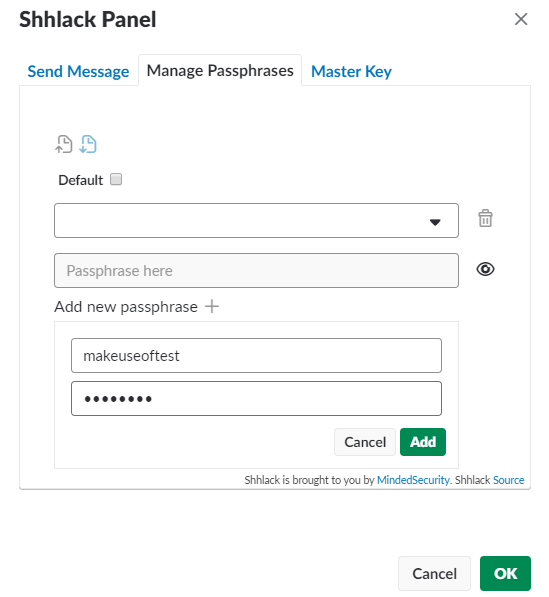
It has three tabs: Send Message, Manage Passphrases, and Master Key. Open the Manage Passphrases tab and select Add new passphrase. Add a Passphrase name, then add your Pre-shared passphrase. The Pre-shared passphrase is what you need to share with your intended encrypted message recipient, or else they will only see jumbled characters.

Manage passphrases in Shhlack

How to Send an Encrypted Message Using Shhlack

Open the Send Message panel, select your Passphrase name from the dropdown menu, and type your message. Hit OK when you’re ready.

The message will broadcast to whichever Slack channel you are currently in. Anyone with your pre-shared passphrase can unlock the message and read the contents. Those who don’t will see a mishmash of characters.

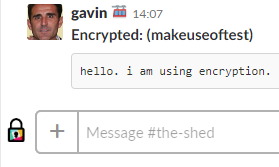
Here’s what a message looks like to the sender:

Sent message in Slack, encrypted with Shhlack

And here’s how it appears to users without the passphrase:

An encrypted Slack message

You can also send a message to your current channel using the previously selected passphrase by adding the @@@@ prefix to your text. For example:

@@@@ I love MakeUseOf

It’s that easy, just like the main Slack service. And really, Shhlack can be just another aspect of Slack for you to master.

Secure Messaging Alternatives to Slack

Of course, setting up and using Shhlack isn’t ideal for everyone. For some, it’s too fiddly (even if it’s well worth learning). For others, it could directly violate your workplace policies.

Don’t do anything that jeopardizes your job security. There are other messaging services out there that use encryption to keep your communications private!

Read the full article: How to Keep Your Slack Messages Private Using Shhlack Encryption


Read Full Article

WhatsApp now marks forwarded messages to curb the spread of deadly misinformation


WhatsApp just introduced a new feature designed to help its users identify the origin of information that they receive in the messaging app. For the first time, a forwarded WhatsApp message will include an indicator that marks it as forwarded. It’s a small shift for the messaging platform, but potentially one that could make a big difference in the way people transmit information, especially dubious viral content, over the app.

The newest version of WhatsApp includes the feature, which marks forwarded messages in subtle but still hard to miss italicized text above the content of a message.

The forwarded message designation is meant as a measure to control the spread of viral misinformation in countries like India, where the company has 200 million users. Misinformation spread through the app has been linked to the mob killing of multiple men who were targeted by false rumors accusing them of kidnapping children. Those rumors are believed to have spread through Facebook and WhatsApp.

Last week, India’s Information Technology Ministry issued a warning to WhatsApp specifically:

“Instances of lynching of innocent people have been noticed recently because of large number of irresponsible and explosive messages filled with rumours and provocation are being circulated on WhatsApp. The unfortunate killing in many states such as Assam, Maharashtra, Karnataka, Tripura and west Bengals are deeply painful and regretable.

While the Law and order machinery is taking steps to apprehend the culprits, the abuse of platform like WhatsApp for repeated circulation of such provocative content are equally a matter of deep concern. The Ministry of Electronics and Information Technology has taken serious note of these irresponsible messages and their circulation in such platforms. Deep disapproval of such developments has been conveyed to the senior management of the WhatsApp and they have been advised that necessary remedial measures should be taken to prevent  proliferation of  these  fake  and at times motivated/sensational messages. The Government has also directed that spread of such messages should be immediately contained through the application of appropriate technology.

It has also been pointed out that such platform cannot evade accountability and responsibility specially when good technological inventions are abused by some miscreants who resort to provocative messages which lead to spread of violence.

The Government has also conveyed in no uncertain terms that WhatsApp must take immediate action to end this menace and ensure that their platform is not used for such malafide activities.”

In a blog post accompanying the new message feature, WhatsApp encouraged its users to stop and think before sharing a forwarded message.


Read Full Article

5 Handwriting Apps for Visual Note-Taking on iOS

My favorite summer toy is the GDP XD emulator


People ask me all the time about my favorite gadgets and I rarely have any answers. I’ve been playing with stuff since 2004 and I’m pretty gadget-ed out. But this year I’ve finally found something that I really enjoy: the GPD XD, an Android-based gaming handheld that lets you play multiple emulators including an endless array homebrew and classic ROMS.

As an early fan of the Caanoo I’m always looking for handheld emulators that can let you play classic games without much fuss. The Caanoo worked quite well, especially for 2010 technology, and I was looking to upgrade.

[gallery ids="1670742,1670739,1670738"]

My friend bought a GDP and showed it to me and I was hooked. I could play some wonderful old ROMs in a form factor that was superior to the Caanoo and this super cheap, super awful 4.3-inch device that emulates like a truck.

The GDP, which has two joysticks, one four-axis button, four shoulder buttons, and a diamond of game buttons, is basically a Wi-Fi enabled Android device with a touch screen. It runs Android 7.0 and has a MTK8176 Quad-core+ processor and 4GB of memory. It comes with NES, SNES, Arcade, and Playstation emulators built in as well as a few home-brew games. You can install almost anything from the Google Play store and it includes a file manager and ebook reader. It also has a micro SD card slot, HDMI out, and headphone jack.

To be clear, the GDP isn’t exactly well documented. The device includes a bit of on board documentation – basically a few graphics files that describe how to add and upload ROMS and emulators. There are are also a number of online resources including Reddit threads talking about this thing’s emulation prowess. The original model appeared two years ago and they are now selling an updated 2018 version with a better processor and more memory.

GPD recently launched another handheld, the Win 2, which is a full Windows machine in a form factor similar to the XD. It is considerably more expensive – about $700 vs. $300 – and if you’re looking for a more computer-like experience it might work. I have, however, had a lot of fun with the XD these past few months.

So whatever your feelings regarding ROMs, emulators, and tiny PCs, I’m pleased to report that I’ve finally pleased with a clever and fun bit of portable technology.


Read Full Article

10 July 2018

Microsoft Launches $399 Surface Go Tablet


Microsoft has unveiled the Surface Go, its new, low-end iPad competitor. The Surface Go is a 10-inch Windows tablet which looks almost identical to the Surface Pro, but smaller and more affordable. But can it tempt people away from their iPads?

Microsoft’s Surface line has sold surprisingly well so far, thank you very much. However, Microsoft has never been able to compete with Apple on price and portability. Until now. The Surface Go is Microsoft most affordable and portable Surface product yet.

The Most Affordable Surface Yet

On the Windows Blog, Microsoft describes the Go as the “smallest, lightest, and most affordable Surface yet.” This represents Microsoft offering “a new entry point for the Surface family, while keeping the premium qualities that have come to define it.”

The Surface Go boasts a 10-inch display (with a 1800 x 1200 pixel resolution), an integrated kickstand with unlimited positions, a front-facing camera, and a USB-C 3.1 port. It’s powered by Windows 10 and the 7th Generation Intel Pentium Gold Processor 4415Y.

Prices start at just $399, which puts the Microsoft Surface Go within spitting distance of the 9.7-inch Apple iPad. For $399 you get 4GB of RAM and 64GB of eMMC storage. However, if you’re willing to pay $549 you can get 8GB of RAM and a 128GB SSD.

The Microsoft Surface Go is available to pre-order in the U.S., Canada, Australia, New Zealand, the UK, Ireland, France, Germany, Austria, Belgium, Luxembourg, the Netherlands, Switzerland, Denmark, Finland, Norway, Sweden, Poland, Italy, Portugal, and Spain.

Coming to a Store Near You Soon

The Surface Go with Wi-Fi will start shipping (and appearing on store shelves) on August 2nd. Microsoft is promising to roll it out to more countries in the coming weeks. For those with good data plans, Microsoft will be launching an LTE model later this year.

If you have money burning a hole in your pocket you could always check out the Microsoft Surface Pro, which we described in our review as “the one tablet to rule them all”. Just follow our advice before swapping your MacBook with a Surface laptop.

Read the full article: Microsoft Launches $399 Surface Go Tablet


Read Full Article

The 25 Best Books to Read in 2018

A Complete Guide to Chromebook’s Accessibility Tools and Features


chromebook-accessibility-guide

Accessibility features are an essential part of any operating system. Of course, they’re vital for people with disabilities, but most users can make use of them in some capacity.

Windows 10’s suite of accessibility tools is fantastic, and macOS also provides accessibility features. But how does a Chromebook stack up? Let’s take a look.

Note: Throughout this article, you will see the Search key feature prominently in shortcuts. However, the shortcuts will not work if you’ve remapped your Search key to Caps Lock (Settings > Device > Keyboard > Search).

ChromeVox

Ignore the futuristic-sounding name. ChromeVox is Google’s term for the operating system’s built-in screen reader.

You can enable ChromeVox by going to Settings > Advanced > Manage accessibility features > Text-to-speech and turning on the appropriate toggle. Alternatively, press Ctrl + Alt + Z on any page.

There’s a long list of shortcuts that let you use the tool, but the most important are:

  • Search + K: Cursor location
  • Search + B: Next button
  • Search + L: Next line
  • Search + E: Next editable text area
  • Search + H: Next heading

Select to Speak

Select to Speak can read parts of a webpage out loud. Aside from the obvious benefits for people with vision impairments, you might find it useful if you’re eyes are feeling tired and you want to listen to an article rather than read it.

Enable Select to Speak in Settings > Advanced > Manage accessibility features > Text-to-speech > Select to Speak or press Ctrl + Alt + S to toggle the feature on and off.

To listen to text, you can either:

  • Hold down Search and click a line of text.
  • Hold down Search and drag your mouse over a section of text.
  • Highlight the text you want to listen to and press Search + S.

High Contrast Mode

Chromebooks offer a high contrast mode. They invert your screen’s colors to make them stand out more prominently. Doing so will make your desktop look seriously cool, even if it gives you a headache after a few hours of use.

You can turn on high contrast mode by navigating to Settings > Advanced > Manage accessibility features > Use high contrast mode. Alternatively, use the Ctrl + Search + H keyboard shortcut.

Magnifier

There are two parts to the Chromebook’s magnifier tool. You can either enable a full-screen magnifier, or a docked magnifier.

The full-screen magnifier turns your display into a zoomed in version of whatever is being shown (i.e. you will not be able to see your whole desktop at the same time).

The docked magnifier places a zoomed in window at the bottom of your display, thus letting you see both your whole desktop and a close-up section of your screen at the same time.

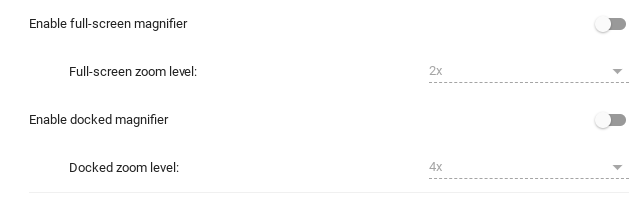
Use the Chome OS magnifier to see your Chromebook's desktop more clearly.

For both options, you can customize the level of zoom. Go to Settings > Advanced > Manage accessibility features > Display and flick the toggle next to either Enable full-screen magnifier or Enable docked magnifier. You can choose your zoom level below each respective toggle.

You can adjust the level of zoom in real-time by using one of two shortcuts:

  • Zoom in: Ctrl + Alt + Brightness up or Ctrl + Alt + two-finger scroll up
  • Zoom out: Ctrl + Alt + Brightness down or Ctrl + Alt + two-finger scroll down

Sticky Keys

No, we’re not talking about when you accidentally throw a glass of soda over your keyboard (though we do have a few tips for fixing a water-damaged keyboard).

Sticky Key functionality lets you use keyboard shortcuts (such as the ones we have been referencing in this article) without needing to hold down the various keys at the same time. Instead, you can press them sequentially.

For example, if you want to use the keyboard shortcut for paste, you would not need to press Control and V in tandem. You could press Control, release it, then press V, and the paste feature would activate.

When Sticky Keys are enabled, you will see a small box in the upper right-hand corner of your screen that shows when keys are active in the current sequence. If you don’t complete the sequence within a few seconds, the box will vanish, and you will need to start again.

You can turn on Sticky Keys by going to Settings > Advanced > Manage accessibility features > Keyboard > Enable Sticky Keys.

On-Screen Keyboard

As the name suggests, enabling this feature will place a virtual keyboard on your screen. You can then type by clicking on the appropriate letters with your mouse pointer.

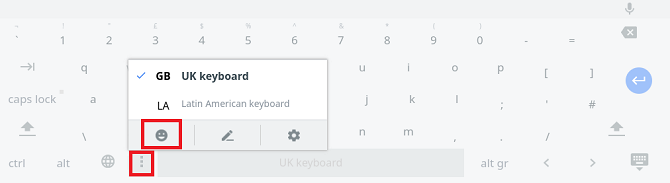
Again, this is another feature that everyone can make use of. Why? Because it gives you access to an emoji keyboard. Click on the three vertical dots on the left-hand side of the space bar, then select the smiley face.

The Chromebook's on-screen keyboard is a useful accessibility tool and time saver.

Chrome is slowly implementing a way to type emojis in Chrome, but this trick gives you the functionality right now (rather than needing to use one of your Chromebook’s development channels) and lets you use emoji across the entire operating system rather than just in the browser.

The on-screen keyboard can be activated if you follow Settings > Advanced > Manage accessibility features > Keyboard > Enable on-screen keyboard.

Automatic Clicking

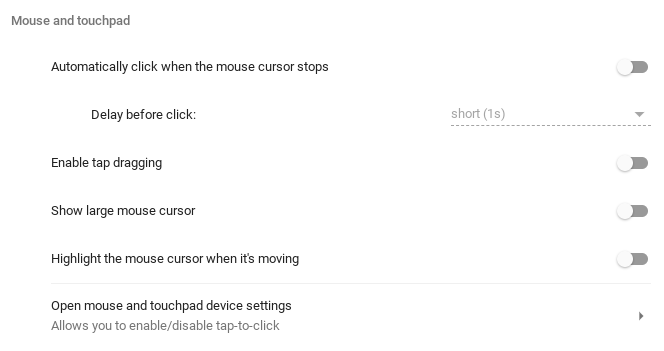
You can make Chrome automatically click objects on your screen merely by hovering the mouse over them.

This is useful if you don’t have a USB mouse handy and your Chromebook’s trackpad has become jammed.

You can even customize how long you need to hover for before a click is registered, thus preventing the possibility of accidentally clicking something you didn’t want to, just because you stopped moving your pointer.

To turn on the feature, go to Settings > Advanced > Manage accessibility features > Mouse and touchpad > Automatically click when the mouse cursor stops. Once the feature is enabled, you can set the timer in the dropdown box below.

Large Mouse Cursor

The final accessibility tool worth paying attention to is the large mouse cursor. If you’re casting your screen in a presentation or making an instructional video for YouTube, this is really useful. It lets you—and others—locate the cursor more easily.

The large mouse cursor can be easily seen by other people.

You can turn on the large mouse cursor by going to Settings > Advanced > Manage accessibility features > Mouse and touchpad > Show large mouse cursor.

You might also find it useful to highlight the cursor while it’s moving. You turn on the feature in the same menu, just slide the toggle next to Highlight the mouse cursor while it’s moving into the On position.

Check Out the Chrome Web Store for More Options

If Chrome OS doesn’t offer the accessibility tools you need, check out the Chrome Web Store’s dedicated section. It offers a few tools that might provide what you’re looking for, including a color enhancer and caret (keyboard shortcut) browsing.

If you’d like to learn even more about Chrome OS, we’ve written an ultimate Chromebook guide for beginners.

Read the full article: A Complete Guide to Chromebook’s Accessibility Tools and Features


Read Full Article

Ledger finally has a good app for its crypto wallet


French startup Ledger has been working for a while on a brand new app to manage your crypto assets on your computer. The company is designing and manufacturing one of the most secure hardware wallets out there.

While it’s clear that security has always been the first focus of the company, the user experience has been lacking, especially on the software front. The company launched a new app called Ledger Live to handle everything you used to do with Chrome apps before.

That’s right, before today, the company relied on Google Chrome for its desktop apps. You had to install the browser first, and then install a new app for each cryptocurrency. There was also a main app to update the firmware. It could quickly become a mess.

Now, everything is centralized in a single app. After downloading and installing the app on Windows, macOS or Linux, you can either configure the app with an existing Ledger device or configure a new Ledger wallet.

The app first checks the integrity of your device and then lets you manage the device. You can upgrade the firmware and install apps on your Ledger Nano S or Ledger Blue from the “Manager” tab.

More interestingly, you can now add all your wallets to the Ledger Live app. You won’t have to switch from one app to another to view your wallets. When you click the add button, the app will try and retrieve existing wallets on your device. You can also generate a new set of keys (and a new wallet) from there.

Once you’ve added all your wallets, you can get an overview of your entire portfolio. The app gets historical pricing information from popular exchanges, such as Kraken and Bitfinex. You can also click on individual accounts to see how a specific cryptocurrency has evolved over time.

The portfolio interface looks like a Coinbase account. It’s well-designed and it’s a great way to get a quick look of your accounts.

Many Ledger users have been using tracker websites and apps. These services let you enter a cryptocurrency and the amount you own to get an overview of everything you own independently of the wallet.

Ledger’s new app partially replace tracker services. If you don’t need to check your balance from your phone, you can get enough information with the Ledger app. You can see your balance without having to plug your Ledger device.

The company is already working on new features. You’ll be able to view and manager ERC20 tokens in the future. So if you invested in a bunch of obscure ICOs, your tokens will be there too.

Ledger also told me that you could imagine an integration with decentralized exchanges eventually. This way, you would be able to send tokens to an address and get another set of tokens back on another Ledger-generated address. It would be a great way to exchange cryptocurrencies without signing up to a centralized exchange and leaving the Ledger app.


Read Full Article