29 October 2020

True, the social networking app that promises to ‘protect your privacy,’ exposed private messages and user locations


True bills itself as the social networking app that will “protect your privacy.” But a security lapse left one of its servers exposed — and spilling private user data to the internet for anyone to find.

The app was launched in 2017 by Hello Mobile, a little-known virtual cell carrier that piggybacks off T-Mobile’s network. True’s website says it has raised $14 million in seed funding, and claimed more than half a million users shortly after its launch.

But a dashboard for one of the app’s databases was exposed to the internet without a password, allowing anyone to read, browse and search the database — including private user data.

Mossab Hussein, chief security officer at Dubai-based cybersecurity firm SpiderSilk, found the exposed dashboard and provided details to TechCrunch. Data provided by BinaryEdge, a search engine for exposed databases and devices, showed the dashboard was exposed since at least early September.

More on Extra Crunch

After we reached out, True pulled the dashboard offline.

Bret Cox, chief executive at True, confirmed the security lapse but did not answer our specific questions, including if the company planned to inform users of the security lapse or if it planned to disclose the incident to regulators under state data breach notification laws.

The dashboard contained daily server logs dating back to February, and included the user’s registered email address or phone number, the contents of private posts and messages between users, and the user’s last known geolocation, which could identify where a user was or had been. The dashboard also exposed the email and phone contacts uploaded by the user, which True uses to match with known friends in the app.

None of the data was encrypted.

TechCrunch confirmed the dashboard was returning real user data by creating a test account and asking Hussein to provide data that only we would know, such as the phone number used to register the account.

Hussein said that the dashboard was also leaking account access tokens, which could be used to hack into and hijack any user’s account. These account access tokens look like a line of random letters and numbers, but keep the user logged into the app without having to enter their login details every time. Using our test account, Hussein found our access token from the dashboard, and used it to access our account and post a message on our feed.

The dashboard also exposed one-time login codes, which True sends to an account’s associated email address or phone number instead of storing passwords.

True says deleting an account “will immediately remove all of your content from our servers,” but deleting our test account did not remove our private messages, posts and photos, and could still be searched from the dashboard.

“This is another example of how mistakes can happen at any organization, even those that are privacy-centric,” Hussein told TechCrunch. “It highlights the importance of not only building secure applications and websites, but also ensuring that proper data security measures are embedded within their internal procedures.”

A spokesperson for Hello Mobile could not be reached.

Last year, Hussein found an exposed database dashboard belonging to Blind, the “anonymous social network,” favored by employees to publicly disclose malfeasance and wrongdoing at their companies.


You can contact the author with tips securely using Signal and WhatsApp to: +1 646-755-8849.


Read Full Article

Estimating the Impact of Training Data with Reinforcement Learning


Recent work suggests that not all data samples are equally useful for training, particularly for deep neural networks (DNNs). Indeed, if a dataset contains low-quality or incorrectly labeled data, one can often improve performance by removing a significant portion of training samples. Moreover, in cases where there is a mismatch between the train and test datasets (e.g., due to difference in train and test location or time), one can also achieve higher performance by carefully restricting samples in the training set to those most relevant for the test scenario. Because of the ubiquity of these scenarios, accurately quantifying the values of training samples has great potential for improving model performance on real-world datasets.


Top: Examples of low-quality samples (noisy/crowd-sourced); Bottom: Examples of a train and test mismatch.

In addition to improving model performance, assigning a quality value to individual data can also enable new use cases. It can be used to suggest better practices for data collection, e.g., what kinds of additional data would benefit the most, and can be used to construct large-scale training datasets more efficiently, e.g., by web searching using the labels as keywords and filtering out less valuable data.

In “Data Valuation Using Deep Reinforcement Learning”, accepted at ICML 2020, we address the challenge of quantifying the value of training data using a novel approach based on meta-learning. Our method integrates data valuation into the training procedure of a predictor model that learns to recognize samples that are more valuable for the given task, improving both predictor and data valuation performance. We have also launched four AI Hub Notebooks that exemplify the use cases of DVRL and are designed to be conveniently adapted to other tasks and datasets, such as domain adaptationcorrupted sample discovery and robust learningtransfer learning on image data and data valuation.

Quantifying the Value of Data
Not all data are equal for a given ML model — some have greater relevance for the task at hand or are more rich in informative content than others. So how does one evaluate the value of a single datum? At the granularity of a full dataset, it is straightforward; one can simply train a model on the entire dataset and use its performance on a test set as its value. However, estimating the value of a single datum is far more difficult, especially for complex models that rely on large-scale datasets, because it is computationally infeasible to re-train and re-evaluate a model on all possible subsets.

To tackle this, researchers have explored permutation-based methods (e.g., influence functions), and game theory-based methods (e.g., data Shapley). However, even the best current methods are far from being computationally feasible for large datasets and complex models, and their data valuation performance is limited. Concurrently, meta learning-based adaptive weight assignment approaches have been developed to estimate the weight values using a meta-objective. But rather than prioritizing learning from high value data samples, their data value mapping is typically based on gradient descent learning or other heuristic approaches that alter the conventional predictor model training dynamics, which can result in performance changes that are unrelated to the value of individual data points.

Data Valuation Using Reinforcement Learning (DVRL)
To infer the data values, we propose a data value estimator (DVE) that estimates data values and selects the most valuable samples to train the predictor model. This selection operation is fundamentally non-differentiable and thus conventional gradient descent-based methods cannot be used. Instead, we propose to use reinforcement learning (RL) such that the supervision of the DVE is based on a reward that quantifies the predictor performance on a small (but clean) validation set. The reward guides the optimization of the policy towards the action of optimal data valuation, given the state and input samples. Here, we treat the predictor model learning and evaluation framework as the environment, a novel application scenario of RL-assisted machine learning.

Training with Data Value Estimation using Reinforcement Learning (DVRL). When training the data value estimator with an accuracy reward, the most valuable samples (denoted with green dots) are used more and more, whereas the least valuable samples (red dots) are used less frequently.

Results
We evaluate the data value estimation quality of DVRL on multiple types of datasets and use cases.

  • Model performance after removing high/low value samples
    Removing low value samples from the training dataset can improve the predictor model performance, especially in the cases where the training dataset contains corrupted samples. On the other hand, removing high value samples, especially if the dataset is small, decreases the performance significantly. Overall, the performance after removing high/low value samples is a strong indicator for the quality of data valuation.
    Accuracy with the removal of most and least valuable samples, where 20% of the labels are noisy by design. By removing such noisy labels as the least valuable samples, a high-quality data valuation method achieves better accuracy. We demonstrate that DVRL outperforms other methods significantly from this perspective.
    DVRL shows the fastest performance degradation after removing the most important samples and the slowest performance degradation after removing the least important samples in most cases, underlining the superiority of DVRL in identifying noisy labels compared to competing methods (Leave-One-Out and Data Shapley).

  • Robust learning with noisy labels
    We consider how reliably DVRL can learn with noisy data in an end-to-end way, without removing the low-value samples. Ideally, noisy samples should get low data values as DVRL converges and a high performance model would be returned.
    Robust learning with noisy labels. Test accuracy for ResNet-32 and WideResNet-28-10 on CIFAR-10 and CIFAR-100 datasets with 40% of uniform random noise on labels. DVRL outperforms other popular methods that are based on meta-learning.
    We show state-of-the-art results with DVRL in minimizing the impact of noisy labels. These also demonstrate that DVRL can scale to complex models and large-scale datasets.

  • Domain adaptation
    We consider the scenario where the training dataset comes from a substantially different distribution from the validation and testing datasets. Data valuation is expected to be beneficial for this task by selecting the samples from the training dataset that best match the distribution of the validation dataset. We focus on the three cases: (1) a training set based on image search results (low-quality web-scraped) applied to the task of predicting skin lesion classification using HAM 10000 data (high-quality medical); (2) an MNIST training set for a digit recognition task on USPS data (different visual domain); (3) e-mail spam data to detect spam applied to an SMS dataset (different task). DVRL yields significant improvements for domain adaptation, by jointly optimizing the data valuator and corresponding predictor model.

Conclusions
We propose a novel meta learning framework for data valuation which determines how likely each training sample will be used in training of the predictor model. Unlike previous works, our method integrates data valuation into the training procedure of the predictor model, allowing the predictor and DVE to improve each other's performance. We model this data value estimation task using a DNN trained through RL with a reward obtained from a small validation set that represents the target task performance. In a computationally-efficient way, DVRL can provide high quality ranking of training data that is useful for domain adaptation, corrupted sample discovery and robust learning. We show that DVRL significantly outperforms alternative methods on diverse types of tasks and datasets.

Acknowledgements
We gratefully acknowledge the contributions of Tomas Pfister.


Apple search crawler activity could signal a Google competitor, or a bid to make Siri a one-stop-shop


Encouraged by the spate of antitrust activity brewing in both the Justice Department and on Capitol Hill, Apple may be developing a search competitor to Google, according to a report in the Financial Times.

That would be a move ripe with irony as the push for an end to anti-competitive practices is seemingly creating greater competition among the largest companies which already dominate the technology industry rather than between those established companies and more nimble upstarts.

Signs of Apple’s resurgent interest in search technologies can be found in both a subtle but significant change to the latest version of the iOS 14 iPhone operating system and increasing activity from Apple’s spidering tools that are used to scour the web and refine search functionality, the Financial Times reported.

Apple is now showing its own search results and linking directly to websites when users type queries from its home screen in iOS 14. For context, this is a behavior that has been known for a while as people have seen the feature pop up in beta versions of iOS. And the search volume being up on Apple’s crawler is something that Jon Henshaw of Coywolf had noted back in August.

Sources cited by the Financial Times said that the change marked a significant step-change in Apple’s in-house search development and could be the basis for a broader push into search.

The Cupertino, Calif.-based company certainly has the expertise. A little less than three years ago it nabbed Google’s head of search, John Giannandrea in what was widely seen as an attempt to shore up Apple’s foundations in artificial intelligence and voice search via Siri. Because of the way that Apple is organized internally, it’s unlikely that Giannandrea will be devoting full-time effort to both a potential “search product” and Siri. But it’s within the realm of possibility that he could be lending his expertise to a team working on a separate feature.

Any development of a search tool would be a third way for Apple, which now uses Google as its default search service thanks to a lucrative contract between the two (one that’s also at the heart of a Justice Department inquiry into Google’s purported anti-competitive activities around search). The only other major search services on the market rely on Microsoft’s Bing to power their results.

While the signs do point to an actual uptick in activity, there could be an explanation for Apple’s crawler activity that’s less heavy on corporate skunkworks skulduggery and more in line with goals that Apple’s stated pretty clearly.

While the story about Apple getting into direct competition with Google on search makes for a great headline, the uptick in activity could be explained equally as rationally by Siri getting more search queries and being more of an interlocutor between Apple and search services like Google or Microsoft’s Bing. This disintermediation is something that Google began years ago and has even modified and expanded over the years to combat the same kind of behavior from Siri.

Some of this comes down to semantics. By “search engine” do we mean “a web site that people type queries into” or do we mean a voice assistant that steps in to white-label web results with its own sourcing. Cutting down on the brand presence of a monster like Google on your own platform is a powerful motivator for any competitor, no matter the space.

Making Siri a one-stop-shop could inoculate Apple in the scenario where they are forced to enable a search provider choice in the iOS onboarding flow by regulation. It won’t do anything to help Google though, who pays Apple billions because iOS users are worth way more than any other mobile web users to its business. Google, for its part, says that when people have a choice they still pick Google anyway. Perhaps another reason why making Siri the search equivalent of an overtalker is the strong play for Apple.

TechCrunch has reached out to Apple for comment and will update when we hear back.


Read Full Article

The Flume 2 Smart Home Water Monitor is a smart, easy-to-use and essential smart home device


Many smart home gadgets focus on convenience or automation of typically manual tasks, but Flume’s smart water sensor provides a potentially much more vital service: The ability to track how much water you’re consuming, and alert you to potential leaks in you home’s plumbing. The company just released its second-generation Flume Smart Home Water Monitor ($199), and the device is easier to set up and use, and smarter, than ever.

The basics

Flume’s Smart Home Water Monitor consists of a device you affix to your water meter, and a gateway that connects it to your home Wi-Fi network. Installation is super simple and requires no plumbing or any kind of home DIY expertise. The Flume app guides you through installation, and in most cases you should be up and running in less than 10 minutes — plus Flume has live assistance available via chat through the app in case you get stuck.

The Flume monitor provides up-to-date information about your whole home’s water usage, including any consumption from interior or exterior faucets, plumbing and fixtures. It can alert you when it detects suspected leaks based on water behavior, and help you budget your water use if you’re looking to save on your utility bill, or just conserve more water through more efficient usage.

Design and features

The Flume meter is a very impressive example of technology designed for use by just about anyone, anywhere. It doesn’t have its own display or interface, and instead works entirely through the app, but that simplicity is part of its genius. The water monitor itself is encased in a simple gray plastic box, which you attach to your water meter externally using the included rubber straps. All it needs is to be placed on the side of where your meter’s readout is located, and then it’s activated by you simply running water through your system by turning on a faucet. It’s reading the magnetic field generated by your water meter, which the company says can detect any water usage all the way down to one one-hundredth of a gallon — i.e. a slowly dripping faucet.

Image Credits: Darrell Etherington

The meter is powered by four AA batteries that come pre-installed, and you can see the battery status in the app, but those should last a very long time. The meter talks to a Flume bridge, which does need to be connected to power but can be set up pretty much anywhere within Wi-Fi range in your home. The final component is the app, which is available for iOS and Android, and which provides a dashboard visualizing your usage, as well as push notifications you can set up for when the Flume system detects a leak.

In practice, set up is a breeze, and it’s truly amazing how much detail and information Flume can provide, given how easy it is to install and use. The data itself is also incredibly fascinating, and truly resulted in my being more aware about my general water consumption, how it affects my monthly utility bills and how I might be able to conserve water going forward. My home didn’t have a dishwasher when I originally installed the Flume 2, for instance, and I realized how much more water I was using hand-washing dishes versus putting in a small, water-efficient 18-inch dishwasher instead — which was proven out by the Flume data.

Bottom line

You might not realize you need a smart home water sensor, but Flume 2 makes a strong case for everyone investing in one. The simple, practical design and user-friendly app instantly make you a much more informed consumer of water, and can save you a bundle in the long run by detecting leaks early and preventing any more serious and damaging flooding incidents. It also just feels good to be aware of what you’re using, and being able to translate that into direct action to save a little water here and there, for the good of the environment and your monthly spending.


Read Full Article

28 October 2020

Jackery’s solar generator system helps you collect and store more than enough juice for off-grid essentials


Portable power is a very convenient thing to have on hand, as proven by the popularity of pocket power banks for providing backup energy for smartphones and tablets. Jackery’s lineup of battery backups offer an entirely different, much greater level of portable energy storage, and when combined with the company’s durable and portable solar panels, they add up to an impressive mobile solar power generation solution that can offer a little piece of mind at home for when the power goes out, or a lot of flexibility on the road for day trips, camping excursions and more.

The basics

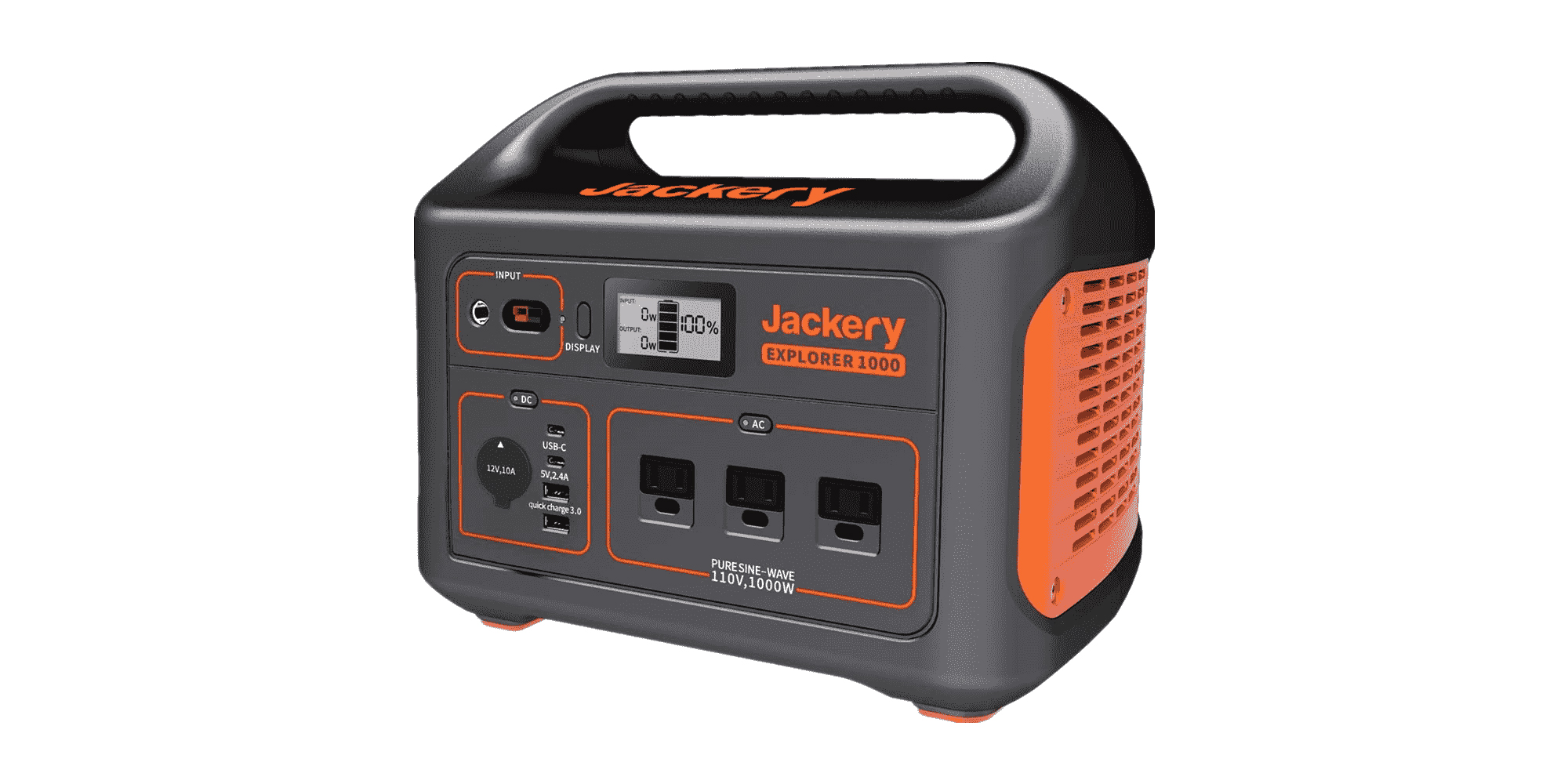
Jackery sells the Explorer 1000 Portable Power Station and SolarSaga 100W Solar Panels I reviewed separately, but it also bundles them together in a pack ($1,599.97) with the power station and two of the panels in a ‘Solar Generator’ combo, which is what I tested. The Portable Power Station retails for $999.99, though it’s the top of the line offering and there are more affordable models with less capacity. The station itself offers a 1002Wh internal lithium battery, and 1000W rated power with 2000W surge power rating. IT has two USB-C outputs, one standard USB, one DC port like you’d find in your car dash, and three standard AC outlets. It has an integrated handle, a tough plastic exterior and a built-in LCD display for information including battery charge status and output info.

The Explorer 1000, on a full charge, can provide up to 100 chargers for your standard iPhone, or up to 8 charges of a MacBook Pro. It can power an electric grill for 50 minutes, or a mini fridge for up to 66 hours. It can be recharged via a wall outlet (fully charges in 7 hours) or a car outlet (14 hours), but it can also be paired up with the 2x SolarSaga panels for a full recharge in around 8 hours of direct sun exposure – almost as fast as you’d charge it plugging git into an outlet at home (it takes double the time, or around 17 hours, when using just one).

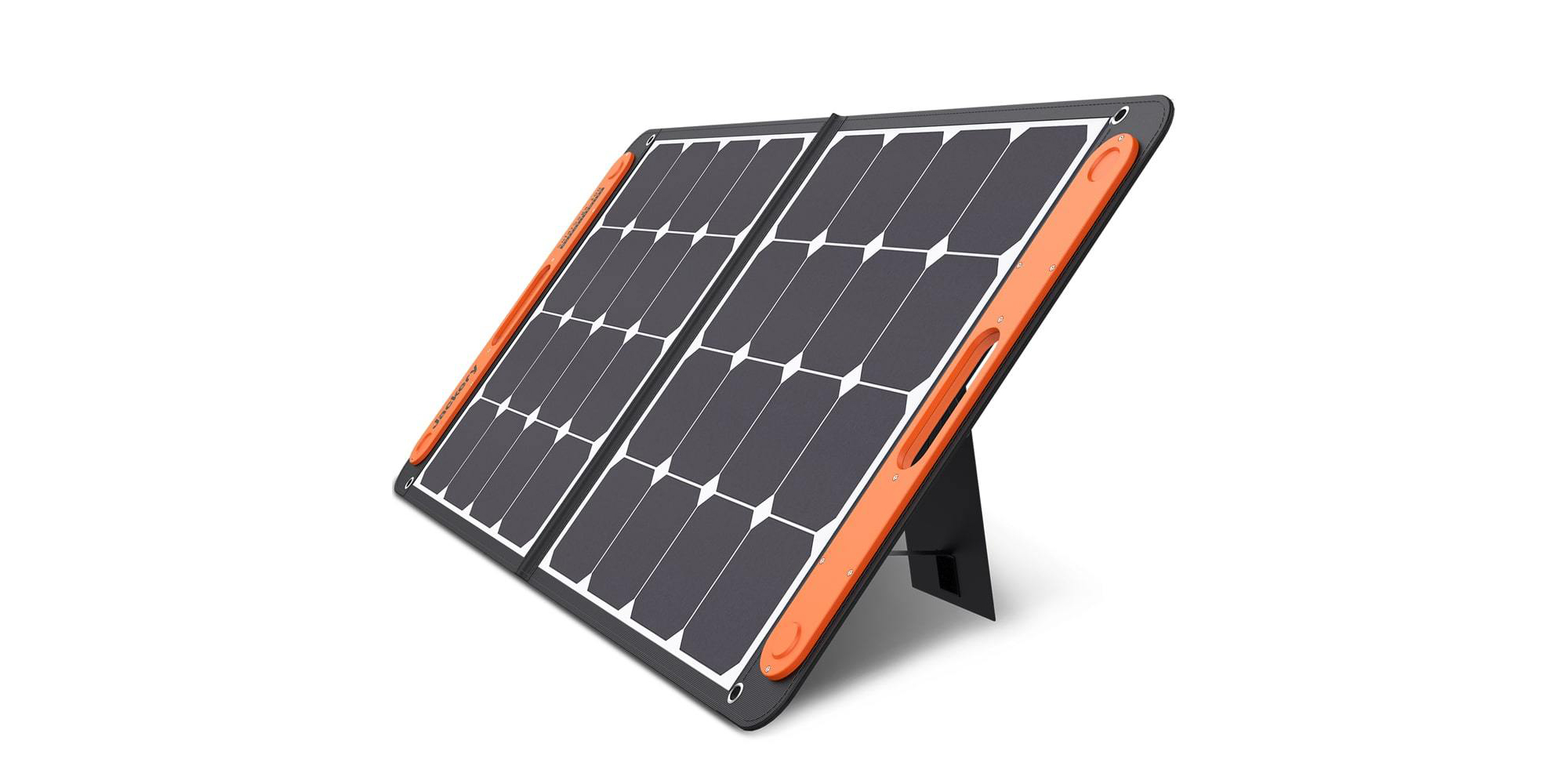
As for the solar panels, they each retail for $299.99, and fold in half for greater portability, and feature integrated pockets and stands for cable storage and easy setup anywhere. Each ways less than 10 lbs, and they offer both USB-C and USB-A direct output for charging up devices without any battery or power station required. It’s worth noting that they’re not waterproof, however, so you should exercise some caution when using them in inclement weather.

Image Credits: Jackery

Design and features

The Jackery Portable Power Station is a perfect blend of portability, practicality and durability. Its internal powerhouse will keep you going for days in terms of mobile device power, and it weighs only a relatively portable 22 lbs, despite packing in a massive battery. The range of output options built-in mean you can connect to just about any electronically-powered device you can think of, and three AC outlets mean you can power multiple appliances at once if you want to spend your juice on running a lightweight outdoor kitchen – albeit not for a super long time at that kind of power draw.

Jackery’s Explorer series features durable and attractive (insofar as any utility device is ever that attractive) exterior impact-resistant plastic housings, and they definitely feel like they don’t need to be treated with kid gloves. The display is legible and clear, and provides all the info you need at-glance in terms of reserve power, and power expenditure for connected devices, as well as charging info when plugged in.

The many charging options are also super convenient, and that’s where the SolarSaga 100W panes come in. These fold up to roughly the size of a folding camp side table, and have integrated handles for even easier carrying. They’re also protected outside by a tough polycarbonate shell, and the panels are resistant to high temperatures for max durability. They come with included output converter cables for connecting to USB A and USB C devices, and can be used with the adapter included with the Power Station to charge that either in tandem with one another, or on their own.

Around back you’ll find an adjustable kickstands, which allow you to angle the panels towards the sun across a range of positions for maximum energy absorption. Between these and the Explorer power stations, you have everything you need to set up your own fully mobile solar energy power generation station in just a few minutes and with minimal effort.

Image Credits: Jackery

Bottom line

In actual use, the Jackery Explorer 1000 Portable Power Station provides so much backup power that it was hard to expend it all through general testing. You really do have to plug alliances like my Blendtec blender in to make a dent, and even then I got roughly 12 hours of usage or more out of it. This is a great solution for taking some selective on-grid equipment off-grid while on camping trips, like a TV, small fridge or a projector, and it’s an amazing thing to have at home just in case of power outages, where having your own backup options can make the difference between getting through a productive workday or staying in touch with family.

The SolarSaga panels are an amazing complement to the Explorer, and truly turn this into your own mini green energy power generation station. Even if you’re not convinced on the expense and necessity of converting your home to solar power, using something like Tesla’s Powerwall, for instance, this is a nice way to power a cooler in the backyard effectively for ‘free’ when it comes to energy costs, or to extend the useful life of the Explorer on trips when you’re away from the grid over the course of multiple days.


Read Full Article

Easy Ways to Remove Watermark from Photo


Assuming you have a company presentation in less than an hour and you need a few images to assist drive your point home. Unfortunately, you can’t access the original photo your company owns. A similar photo has a watermark, and you urgently need to remove it but keep in mind, you are running out of […]

The post Easy Ways to Remove Watermark from Photo appeared first on ALL TECH BUZZ.


Current and upcoming trends in Latin America’s mobile growth


Latin America (LATAM) is home to one of the fastest-growing mobile markets in the world. In 2018, there were 326 million mobile internet users in the region, and that figure is anticipated to increase to over 422 million users by 2025. Part of the reason for such exponential growth is that mobile is the main tool for internet access in Latin America, providing a portable way for people living in rural areas to get online. The social media boom and rise in messaging platforms in recent years have also spurred demand for optimized mobile services.

As mobile penetration continues in LATAM, it is facilitating innovative apps that promote opportunities for social mobility, financial control, access to overseas markets and societal development. And while a difference in maturity levels and local regulations dictates the mobile landscape for individual countries, there are visible trends throughout the region.

These trends are both reactions to LATAM’s unique mobile conditions and broader international influences, so can be telling of future mobile user expectations and behaviors. By recognizing and assimilating these trends, new mobile apps and services can disrupt the market in a more meaningful way.

Here are the current and upcoming trends of mobile growth across Latin America:

Digital wallets

Approximately 70% of Latin America’s population is unbanked or underbanked, meaning there is a huge opportunity to improve financial access. One emerging solution is digital wallets, which work via top-ups and don’t require a bank account with a physical company or branch to set up. Digital wallets, therefore, bypass the mistrust that many Latin Americans have around official banking institutions.

COVID-19 has certainly contributed to the heightened demand for mobile wallets in LATAM. As a predominantly cash-driven location, concerns about handling paper money have been confirmed as new studies reveal that the virus can survive on physical currency for 28 days. In turn, masses of citizens and consumers have begun looking for safer alternatives to cash. In Mexico, digital wallets are thought to occupy a 27.7% share of the business-to-consumer e-commerce payments market by 2021, while Argentina has also been showing high in-store use of digital wallets during the pandemic.

Over in Venezuela, AirTM’s digital wallet has been processing funds promised by interim President Guaidó to essential workers. The company has been instrumental in delivering the money to healthcare staff after the Maduro regime blocked the provider operating in the country. Beyond financial aid, digital wallets in Venezuela and other countries with high inflation rates mean locals don’t have to carry large amounts of bills and coins with them.


Read Full Article

Our existential flight from death -- and wisdom on connecting to grief | Kevin Toolis

Our existential flight from death -- and wisdom on connecting to grief | Kevin Toolis

For centuries, the Irish funeral wake has served as a time for people to grieve a life lost and celebrate a life lived, together. In this profound and lyrical talk, poet Kevin Toolis laments the fear and denial of death that characterizes increasingly individualistic societies. He reasons that living life fully means embracing our shared mortality -- and offers simple ways to reconnect with your community, the people you love and even yourself.

https://ift.tt/3jDQ4sR

Click this link to view the TED Talk

Chronicle’s ex-CSO is starting a new company he doesn’t want you to know much about


Mike Wiacek is back with a new company, a year after departing his role as chief security officer at Chronicle, Google’s moonshot cybersecurity company.

Wiacek spent 13 years at Google, founding the company’s Threat Analysis Group, a unit dedicated to countering government and state-backed hacking efforts, and also co-founding Chronicle, which was rolled into Google Cloud after a series of high-profile executive departures, including his own.

Armed with over a decade of experience, Wiacek is now steering the ship at Stairwell, his new cybersecurity startup. Stairwell is now out of stealth after almost a year and securing $4.5 million in seed funding, led by venture firm Accel, with participation from Sequoia Capital, Gradient Ventures, and Allen & Company.

In a press release, the company said it wants “to provide security teams with accessible, user-centric tools that help them understand the pivotal relationships between their external and internal data sources. With this intelligence, organizations will be in a much stronger position to proactively combat the most sophisticated and dangerous cyber attacks.” And, in a call with TechCrunch, Wiacek said his vision for the new company is to “empower any team to defend against every attacker.”

But the founder took the unusual step of declining to say how the company plans to get there. Wiacek confirmed that Stairwell is building at least one product, but declined to offer details of what it is, what it does, or when it will be out.

Admittedly, that made the ensuing conversation rather difficult.

Wiacek said Jan Kang, former chief legal officer at Chronicle, has joined the startup, and the seed round will go towards staffing his team. Stairwell has ten employees at launch, largely focused on engineering, and plans to also include designers, physicists, and applied mathematicians.

As for what the company is working on, “I think it’s one of those we just have to wait and see,” said Wiacek.

I guess we’ll have to.


Read Full Article

Google’s display advertising business is under antitrust probe in Italy


Italy’s competition authority has opened an antitrust investigation into Google’s display ad business — adding another allegation of abuse of a dominant position to the tech giant’s regulatory woes.

In a press release announcing the action the AGCM said it “questions the discriminatory use of the huge amount of data collected through its various applications, preventing rivals from competing effectively as well as adversely affecting consumers”.

The probe follows a complaint by local ad lobby group the IAB Italy, per Reuters, which says the investigation must be concluded by November 2021.

Specifically, the AGCM said it suspects Google of what it refers to as “internal/external discriminatory conduct” — by refusing to provide competitors with Google ID decryption keys and excluding third-party tracking pixels.

“At the same time, Google has allegedly used tracking elements enabling its advertising intermediation services to achieve a targeting capability that some equally efficient competitors are unable to replicate,” it adds.

We’ve reached out to Google for comment on the allegations.

The move comes as Google is being sued on home turf by the US Department of Justice (DoJ), which filed an antitrust case earlier this month — following a 16 month investigation — alleging Google is “unlawfully maintaining monopolies in the markets for general search services, search advertising, and general search text advertising in the United States.”

The Italian case also looks interesting as Google has been seeking to reframe the debate around online ad targeting vs privacy — announcing an initiative called Privacy Sandbox last year.

Its aim is to evolve open web standards towards a middle ground between Internet users’ privacy and content providers’ hunger for information to target visitors with ads (as well as, of course, its own people-profiling monetization model as an adtech giant) — proposing a technique called federated learning of cohorts (FloC) which it bills as a “privacy-preserving” mechanism to enable ad targeting without individual tracking.

But as part of that standards push, this January Google announced it was dialling up a plan to phase out support for third party tracking cookies — saying it now wanted to do so within the next two years. So it’s not so much an ‘evolution’ as Google cranking its market power lever.

While others in the browser space have also been clamping down on trackers, Google’s dominance of the online ad market means there are clear competition risks to it unilaterally shutting the door on third party trackers while maintaining its own lucrative access to Internet users’ data. And that seems to be the crux of the Italian competition authority’s concern.

Google has previously been found to be dominant in search by the European Commission — putting requirements on it to avoid abusing its market power to advance in other verticals.

The AGCM suggests that the conduct it’s investigating could have a significant impact on competition across the digital advertising space, as well as flagging the potential for “wide repercussions on competitors and consumers”.

“The absence of competition in the intermediation of digital advertising, in fact, might reduce the resources allocated to website producers and publishers, thus impoverishing the quality of content directed to end customers,” it writes, also suggesting that a lack of “effective competition based on merits” could discourage the development of innovative new adtech and ad techniques that are less intrusive for consumers. 

So, in other words, Google’s dominance of the digital ad space could be damaging both publishers and Internet users, and holding back the development of genuinely privacy-preserving adtech.

Plenty of such concerns have been raised elsewhere about the market distorting power of the adtech duopoly.

In a final report into the online ad market this summer, the UK’s Competition and Markets Authority (CMA) concluded that the market power of Google and Facebook is now so great that a new regulatory approach — and a dedicated regulator — is needed to address what it described as “wide ranging and self reinforcing” concerns. 

“Weak competition in search and social media leads to reduced innovation and choice and to consumers giving up more data than they would like. Weak competition in digital advertising increases the prices of goods and services across the economy and undermines the ability of newspapers and others to produce valuable content, to the detriment of broader society,” the CMA warned.

“Our concern is that such platforms have an incentive to interpret data protection regulation in a way that entrenches their own competitive advantage, including by denying third parties access to data that is necessary for targeting, attribution, verification and fee or price assessment while preserving their right to use this data within their walled gardens,” it added.

The report concluded that there is a “compelling case for the development of a pro-competition ex ante regulatory regime, to oversee the activities of online platforms funded by digital advertising” — something Google has been lobbying the European Commission not to do as regional lawmakers shape new pan-EU rules for gatekeeper platforms.

Per the AGCM, online advertising in Italy was worth more than €3.3 billion in 2019, representing 22% of the resources of the media sector — with such sales being the second most important source of revenue in the sector. 


Read Full Article

Kandji hauls in $21M Series A as Apple device management flourishes during pandemic


Kandji, a mobile device management (MDM) startup, launched last October. That means it was trying to build the early stage company just as the pandemic hit earlier this year. But a company that helps manage devices remotely has been in demand in this environment, and today it announced a $21 million Series A.

Greycroft led the round with participation from new investors Okta Ventures and B
Capital Group, and existing investor First Round Capital. Today’s investment brings the total raised to $28.4 million, according to the company.

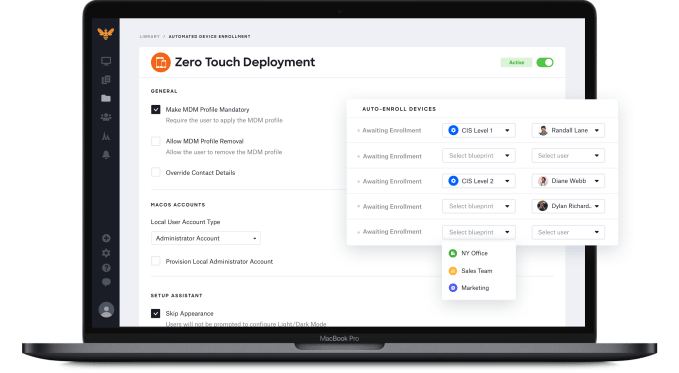
What Kandji is building is a sophisticated zero-touch device management solution to help larger companies manage their fleet of Apple devices, including keeping them in compliance with a particular set of rules. As CEO and co-founder Adam Pettit told TechCrunch at the time of his seed investment last year:

“We’re the only product that has almost 200 of these one-click policy frameworks we call parameters. So an organization can go in and browse by compliance framework, or we have pre-built templates for companies that don’t necessarily have a specific compliance mandate in mind,” he said.

Monty Gray, SVP of corporate development at Okta, says Okta Ventures is investing because he sees this approach as a valuable extension of his company’s mission.

“Kandji’s device management streamlines the most common and complex tasks for Apple IT administrators and enables distributed workforces to get up and running quickly and securely,” he said in a statement.

It seems to be working. Since the company’s launch last year it reports it has gained hundreds of new paying customers and grown from 10 employees at launch to 40 today. He has plans to triple that number in the next 12 months. As he builds the company, he says finding and hiring a diverse pool of candidates is an important goal.

“There are ways to extend out into different candidate pools so that you’re not just looking at the same old candidates that you normally would. There are certain ways to reduce bias in the hiring process. So again, I think we look at this as absolutely critical, and we’re excited to build a really diverse company over the next several years,” he said.

Kandji - Zero Touch Deployment

Image Credits: Kandji

He said the investment will not only enable him to build the employee base, but also expand the product too. He says in the past year, it has already taken it from basic MDM into compliance and there are new features coming as they continue to grow the product.

“If someone saw our product a year ago, it’s a very different product today, and it’s allowed us to move up market into the enterprise, which has been very exciting for us,” he said.


Read Full Article

Watch Facebook, Google, and Twitter’s CEOs defend the law that created social media to Congress


The CEOs of Twitter, Facebook and Google will appear before the Senate Commerce Committee on Wednesday in big tech’s latest showdown with Congress.

The Senate hearing will have a narrower, more policy-centric scope than other recent high profile tech hearings, focusing specifically on Section 230 of the Communications Decency Act. That short law might sound obscure, but it’s the key legal shield that protects internet companies from liability for the user-generated content they host, from Facebook posts and tweets to Yelp reviews and comments sections.

Recent big tech hearings have meandered, seldom forcing the leaders of some of the world’s most powerful companies into revealing much. But the cumulative pressure of federal antitrust action, a high-stakes election less than a week away and a number of legislative proposals that could dismantle the law that made their businesses possible will likely set a different tone — and hopefully offer more substance.

You can follow a livestream of the hearing here (above) starting at 10:00 AM ET on Wednesday, October 28. We’ll be following the testimony and all things Section 230, so check back for our coverage of the day’s key takeaways.


Read Full Article

Dallas’ ShearShare has a marketplace connecting stylists with available seats at salons and $2.3 million in funding


Courtney Caldwell and her husband Tye have been building the Dallas-based startup ShearShare, which provides a marketplace service connecting stylists with open seats at hair salons, since 2017.

Since their launch the two co-founders have been committed to the humble hustle of starting their own business — including flying between San Francisco and Dallas weekly to participate in the 19th 500 Startups cohort or participating in Y Combinator’s Fellowship program.

Now, with a seed round of $2.3 million and another non-dilutive cash grant from Google for Startups Black Founders Fund, the early-stage company is ready to expand.

The two co-founders certainly have a pedigree in the beauty industry. Tye Caldwell has been a luminary in the industry and is a member-elect of the Professional Beauty Association’s advisory board. Together with Courtney he runs an award-winning salon in Dallas.

ShearShare co-founders Tye and Courtney Caldwell

Meanwhile, Courtney Caldwell spent more than 20 years working for Oracle in technology marketing. But the two hadn’t really been exposed to the venture capital industry. So when they came up with the idea to start a service providing online matchmaking between salons and stylists — based on their own need to fill a chair at their salon — they didn’t really no where to turn.

Enter TD Lowe. A longtime investor on her own and with organizations like StartupGrind, Lowe introduced the couple to the world of venture capital and startups, and the two were off to the races.

“We pioneered on-demand barbershop and space rentals,” Courtney said. “If a salon or barbershop has an open station a stylist can book it like they would a hotel room.”

According to the Caldwells, the beauty industry is the second largest industry for freelancers and independent contractors. Unlike other companies that are trying to serve stylists by offering them features like booking and appointments independent of salons — or services for salons alone — ShearShare is trying to serve both sides of the marketplace with the tools they need.

“We’re not a StyleSeat. We’re not a Squire,” said Courtney. What they are is expanding rapidly. The company has listings in more than 600 cities ranging from a chair that rents for $15 in Georgia to one that rents for $569 in the heart of Manhattan in New York City.

The company processes payments for the stylists directly through a partnership with a local payment solution called First American Payments based in Ft. Worth, Texas.

“Everyone is setting their sights on direct-to-consumer,” said Courtney. “This is a way we’re helping to keep people at work and refuel the individual economic recovery.”

The next step for the company is to begin launching more ancillary services for stylists. They’re pioneering an insurance policy for stylists that would cover them from on-the-job lawsuits.

“It’s becoming a huge opportunity for the stylist that just didn’t exist,” said Tye. And it all began when the two Caldwells couldn’t find any options when they searched for any terms related to renting space at a barbershop, they said. “We reached out to a friend and told her about the opportunity that we’d been presented with and she said, ‘Guys… that’s a billion-dollar idea.’ ”

That friend was Lowe — who came in to advise the couple and show them the ropes of startup investing.

It’s at least an idea that’s worth tens of millions. That’s how much the startup Mayvenn has raised for its business providing hair extensions and other cosmetics to stylists.

Now with its new funding, ShearShare is ready to expand, the couple said.

ShearShare’s backers include: Precursor Ventures, Revolution’s Rise of the Rest Seed Fund, Structure Capital, Backstage Capital and 500 Startups, alongside new participants Bread and Butter Ventures, ArlanWasHere Investments (Arlan Hamilton’s fund, in which Mark Cuban is the sole LP), Lightspeed Venture Partners Scouts Program (with Veronica Juarez and Jason McBride leading), Jaylon Smith of the Dallas Cowboys through the Minority Entrepreneurship Institute, Thaddeus Young of the Chicago Bulls with Reform Venture, the Bumble Fund, Notley Ventures, Sachse Family Fund and other global investors.

These investors are part of a new breed of investor that’s pushing venture investment into areas that were previously considered beyond the reach of typical firms.

As the chief executive of a beauty and lifestyle startup, Julie Fredrickson told TechCrunch three years ago, “Most of these brands are commensurately underfunded compared to tech companies in similar positions. There’s a chance for a totally new dominant player and no one’s really gunning for it.”

There’s a huge opportunity for businesses serving all aspects of the beauty industry to flourish, entrepreneurs and investors.

“Venture is obsoleting itself as private equity and family offices increasingly go downstream because they’re willing to seek venture-style returns in verticals that venture capital is not prepared or is less educated about,” according to Frederickson.


Read Full Article

Mophie introduces a modular wireless charging module


Here’s a clever addition for Mophie, one of the longstanding battery case makers, which is now a part of the same smartphone accessory conglomerate as Zagg, Braven, iFrogz and InvisibleShield. The Juice Pack Connect is a modular take on the category, with a battery pack that slides on and off.

For $80 you get a 5,400mAh battery (that should get you plenty of additional charge time) and a ring stand that props the phone up. Mophie may offer additional models at some point, but right now, the biggest selling point is less about add-ons and more the fact that you can slip the battery off the device when not needed and still use the case.

Image Credits: Mophie

It’s not entirely dissimilar from the modular uniVERSE case OtterBox introduced a bunch of years ago, but the big advantage here is that the charging works via Qi, so you don’t have to plug it into the phone’s port.

It’s not cheap (Mophie isn’t, generally). And, no, it’s not a MagSafe accessory. Instead, the add-on attaches to your case (needs to be one thin enough to support the charging, mind) using adhesive. The upside is that it works with a much larger number of phones, including multiple generations of iPhones and wireless-capable handsets like Samsung Galaxies and Google Pixels.


Read Full Article

Mophie introduces a modular wireless charging module


Here’s a clever addition for Mophie, one of the longstanding battery case makers, which is now a part of the same smartphone accessory conglomerate as Zagg, Braven, iFrogz and InvisibleShield. The Juice Pack Connect is a modular take on the category, with a battery pack that slides on and off.

For $80 you get a 5,400mAh battery (that should get you plenty of additional charge time) and a ring stand that props the phone up. Mophie may offer additional models at some point, but right now, the biggest selling point is less about add-ons and more the fact that you can slip the battery off the device when not needed and still use the case.

Image Credits: Mophie

It’s not entirely dissimilar from the modular uniVERSE case OtterBox introduced a bunch of years ago, but the big advantage here is that the charging works via Qi, so you don’t have to plug it into the phone’s port.

It’s not cheap (Mophie isn’t, generally). And, no, it’s not a MagSafe accessory. Instead, the add-on attaches to your case (needs to be one thin enough to support the charging, mind) using adhesive. The upside is that it works with a much larger number of phones, including multiple generations of iPhones and wireless-capable handsets like Samsung Galaxies and Google Pixels.


Read Full Article

Mophie introduces a modular wireless charging module


Here’s a clever addition for Mophie, one of the longstanding battery case makers, which is now a part of the same smartphone accessory conglomerate as Zagg, Braven, iFrogz and InvisibleShield. The Juice Pack Connect is a modular take on the category, with a battery pack that slides on and off.

For $80 you get a 5,400mAh battery (that should get you plenty of additional charge time) and a ring stand that props the phone up. Mophie may offer additional models at some point, but right now, the biggest selling point is less about add-ons and more the fact that you can slip the battery off the device when not needed and still use the case.

Image Credits: Mophie

It’s not entirely dissimilar from the modular uniVERSE case OtterBox introduced a bunch of years ago, but the big advantage here is that the charging works via Qi, so you don’t have to plug it into the phone’s port.

It’s not cheap (Mophie isn’t, generally). And, no, it’s not a MagSafe accessory. Instead, the add-on attaches to your case (needs to be one thin enough to support the charging, mind) using adhesive. The upside is that it works with a much larger number of phones, including multiple generations of iPhones and wireless-capable handsets like Samsung Galaxies and Google Pixels.


Read Full Article

Google’s EU Android choice screen isn’t working say search rivals, calling for a joint process to devise a fair remedy


Google search engine rivals have dialled up pressure on the European Commission over the tech giant’s ‘pay-to-play’ choice screen for Android users in Europe — arguing the Google-devised auction has failed to remedy antitrust issues identified by the European Commission more than two years ago.

The joint letter to the Commission, which has been signed by Ecosia, DuckDuckGo, Lilo, Qwant and Seznam, requests a trilateral meeting between the EU executive, Google, and the five search rivals — with “the goal of establishing an effective preference menu”.

“We are companies operating search engines that compete against Google. As you know, we are deeply dissatisfied with the so-called remedy created by Google to address the adverse effects of its anticompetitive conduct in the Android case,” they write. “We understand that Google regularly updates you regarding its pay-to-play auction, but it appears that you may not be receiving complete or accurate information.”

A Commission spokeswoman confirmed it’s received the letter and said it will respond in due course, adding that it’s “seen in the past that a choice screen can be an effective way to promote user choice”.

“We have been discussing the choice screen mechanism with Google, following relevant feedback from the market, in particular in relation to the presentation and mechanics of the choice screen and to the selection mechanism of rival search providers,” the spokeswoman also told us, adding that the Commission is “committed to a full and effective implementation of the decision” and “will continue monitoring closely the implementation of the choice screen mechanism”.

Back in 2018 the EU’s antitrust division fined Google $5BN for competition violations related to how it operates its smartphone platform and instructed the company to make good on the issues identified — leading it to offer Android users in Europe a search engine choice screen, rather than simply preloading its own.

Google initially offered a choice based on rivals’ local market share but quickly moved to a paid auction model. This appears to benefit larger, commercial entities at the expense of privacy-focused, regional and not-for-profit alternatives.

Pro-privacy DuckDuckGo has, for example, lost out in recent auctions — while Microsoft-owned Bing has gained more slots. The former lowered how much it bids, saying it believes it cannot profitably win a slot.

European tech for good not-for-profit, Ecosia — which uses search click revenue to fund tree planting — has also denounced the model as unfair, going so far as to boycott it entirely at first. It gave in after seeing its revenue take a massive hit during the coronavirus crisis. (Though failed to gain a slot in almost every market in the most recent auction.)

Google, meanwhile, continue to enjoy a search marketshare in excess of 90% in the region.

The five rivals argue that Google is unfairly constraining the search market by limiting the number of available slots on the choice screen to three (Google’s own search engine is a staple fourth option).

They want a collaborative process to devise a choice screen, rather than Google being allowed to continue to design its own ‘solution’ — favoring a non-paid choice screen with space for many more choices than the current three (non-Google) options, likely with selections based on multiple, pro-competition criteria.

The timing of the letter comes hard on the heels of a competition investigation in the US that’s sparked a similar antitrust case against Google on home turf. The department of Justice filed a long-awaited case against it earlier this month, arguing the tech giant uses a web of exclusionary business agreements to shut out competitors.

Discussing how DuckDuckGo would like to see the Android choice screen evolve, founder Gabe Weinberg told TechCrunch: “We would like to see a properly designed search preference menu that gives people all the search engine options they expect, is free of all dark patterns, and enables search competition to sustainably flourish. Unfortunately, the current implementation meets none of these essential criteria, but we are hopeful that a more collaborative process could fix this failing remedy.”

Another signatory to the letter, France’s Qwant, also brings up the Commission’s goal of regional digital sovereignty — arguing that the Google-devised auction favors US tech giants at the expense of European alternatives, undermining the EU executive’s wider tech ambitions.

“After more or less three to four quarters of auction we are now in the situation where the auction system is seeing the price going up and up every quarter,” Qwant CEO Jean-Claude Ghinozzi told TechCrunch. “The prices are going up and up and competition moves to the large search engine and the global search engine — or the ones that have the ability to invest a lot in this search auction.” 

The result is a return to “unfair competition”, argued Ghinozzi, because the cost of acquiring users via Google’s auction is simply too high for smaller European competitors to participate. With the cost per click to win a slot on the choice screen inflating he suggested the current model essentially amounts to Google outsourcing the cost of its EU antitrust penalty to rivals.

“That’s in this letter to the commissioner. We require an urgent opportunity to discuss — inviting potentially Google if they [wish to participate] — that this mechanism doesn’t work,” he said, adding: “We are just starting to pay the bill for Google because at the end of the day we are getting to a level where it is not acceptable anymore for us as a [smaller] search [engine] to pay such an amount to Google just to be listed.”

“The system should be open and not related to any auction or payment and with a much larger list of search being proposed and provided to the new Android phone users,” he added, calling on the EU’s competition commissioner to “urgently” review the mechanism — and “propose some solutions for opening the European search [market]”.

“After more or less a year of the auction system being active we see that definitely they should look again because it does not work. It does not create a fair market and an open market. So that’s the reason we are coming now with this proposition — we urgently need to totally reconsider.”

Auction participants are constrained in what they can say publicly given Google’s requirement that they sign an NDA. This is another reason why they’re asking for a tripartite meeting — with the rivals expressing concerns that not every stakeholder involved in Google’s auction process is seeing the same data as Google is.

“The problem is that we don’t really know what Google says to the European Commission and what we fear is that they say some things to us that they don’t say to the European Commission,” said Guillaume Champeau, Qwant’s chief ethics and legal affairs officer. “The idea behind the tripartite meeting would be to ensure that we all have around the table the same kind of information and the same kind of answers to our concerns.”

Asked about the letter’s reference to a concern that the Commission is not receiving complete and/or accurate information from Google, Champeau also told us: “It’s really a matter of being sure that all that’s being said is the same. And that it doesn’t change depending on who is on the other side of the table.

“We don’t understand why the European Commission wouldn’t ask for changes to the choice screen based on the information that we have. So the only guess that we have is that it’s based on information that is not accurate. Otherwise we would be probably sure that the European Commission would have required changes to the choice screen even sooner than today.”

“We need to design something that appeals, that resonates with Europeans in Europe,” added Ghinozzi, reiterating that the design of the mechanism shouldn’t be left to the same company that’s been fined for anticompetitive behavior and which maintains up to 90% marketshare in Europe.

We reached out to Google for a response to the complaints about the auction model and it sent us this statement, attributed to a spokesperson:

Android provides people with unprecedented choice in deciding which applications they install, use and set as default on their devices. The choice screen for Europe strikes a careful balance between giving users yet more choice and ensuring that we can continue to invest in developing and maintaining the open-source Android platform for the long-term. The goal for the choice screen is to give all search providers equal opportunity to bid — not to give certain rivals special treatment.

While the Commission has yet to offer any relief to the consistent complaints from Google’s search rivals that the paid choice screen doesn’t meaningfully reset the competitive landscape on Android it is set to introduce a legislation package next month which will update ecommerce regulations and introduce a new set of obligations and requirements for so-called gatekeeper platforms holding dominant market positions — a move that’s being widely interpreted as a push to clip the wings of US tech giants like Google.


Read Full Article