27 August 2020

Axial-DeepLab: Long-Range Modeling in All Layers for Panoptic Segmentation


The success of convolutional neural networks (CNNs) mainly comes from two properties of convolution: translation equivariance and locality. Translation equivariance, although not exact, ensures that the model functions well for objects at different positions in an image or for images of different sizes. Locality ensures efficient computation, but at the cost of making the modeling of long-range spatial relations challenging for panoptic segmentation of large images. For example, segmenting a large object requires modeling the shape of it, which could potentially cover a very large pixel area, and context that could be helpful for segmenting the object may come from farther away. In such cases, the inability to inform the model from context far from the convolution kernel could negatively impact the performance.

A rich set of literature has discussed approaches to solving the limitation of locality and enabling long-range interactions in CNNs. Some employ atrous convolutions, or image pyramids, which expand the receptive field somewhat, but it is still limited to a small local region. Another line of work adopts self-attention mechanisms, e.g., non-local neural networks, which allow the receptive field to cover the entire input image, as opposed to local convolutions. Unfortunately, such approaches are computationally expensive, especially for large inputs. Recent works enable building fully attentional models, but at a cost of applying local constraints to non-local neural networks. These restrictions limit the model receptive field, which is harmful to tasks such as segmentation, especially on high-resolution inputs.

In our recent ECCV 2020 paper, “Axial-DeepLab: Stand-Alone Axial-Attention for Panoptic Segmentation”, we propose to adopt axial-attention (or criss-cross attention), which recovers large receptive field in fully attentional models. The core idea is to separate 2D attention into two steps that apply 1D attention in the height and width axes sequentially. The efficiency of this approach enables attention over large regions, allowing models that learn long-range, or even global, interactions. Additionally, we propose a novel formulation for self-attention modules, which is more sensitive to the position of relevant context in a large receptive field with marginal costs. We evaluate our position-sensitive axial-attention method on panoptic segmentation by applying it to Panoptic-DeepLab, a simple and efficient method for panoptic segmentation. The effectiveness of our model is demonstrated on ImageNet, COCO, and Cityscapes. Axial-DeepLab achieves state-of-the-art results on panoptic segmentation and semantic segmentation, outperforming Panoptic-DeepLab by a large margin.

Axial-Attention Architecture
Axial-DeepLab consists of an Axial-ResNet backbone and Panoptic-DeepLab output heads, which produce panoptic segmentation results. Our Axial-ResNet is built on a ResNet architecture, in which all the 3×3 local convolutions in the ResNet bottleneck blocks are replaced by our proposed global position-sensitive axial-attention, thus enabling both a large receptive field and precise positional information.

An axial-attention block consists of two position-sensitive axial-attention layers operating along height- and width-axis sequentially.

The Axial-DeepLab height axial attention layer provides 1-dimensional self-attention globally, propagating information within individual columns — it does not transfer information between columns. The second 1D attention layer operating in the horizontal direction allows one to capture both column-wise and row-wise information. This separation reduces the complexity of self-attention from quadratic (2D) to linear (1D), which enables using a much larger (65×65 vs. previously 3×3) or even global context in all layers for long-range modeling in panoptic segmentation.

A message can be passed globally with two hops.

Note that a message or feature vector at (x1, y1) can always be passed globally on a 2D lattice to any position (x2, y2), with one hop on the height-axis (x1, y1 →x1, y2), followed by another hop on the width axis (x1, y2 → x2, y2). In this way, we are able to model 2D long-range relations in a single residual block. This axial-attention design also reduces the complexity from quadratic to linear and enables global receptive fields in all layers of a model.

Position-Sensitive Self-Attention
Additionally, we propose a position-sensitive formulation for self-attention. Previous self-attention formulations enabled a given pixel A to aggregate long-range context B, but provided no information about where in the receptive field the context originated. For example, perhaps the feature at pixel A represents the eye of a cat, and the context B might be the nose and another eye. In this case, the aggregated feature at pixel A would be a nose and two eyes, regardless of the geometric structure of a face. This could cause a false indication of the presence of a face when the two eyes are on the bottom-left of an image and the nose is on the top-right. A recently proposed solution is to impose a positional bias on where in the receptive field the context can originate. This bias depends on the feature at A only, (an eye), but not the feature at B, which contains important contextual information.

In this work, we let this bias also depend on the context feature at B (i.e., the nose and another eye). This change enables a more accurate positional bias when a pixel and the context informing it are far away from one another and thus contains different information about the bias. In addition, when pixel A aggregates the context feature B, we also include a feature that indicates the relative position from A to B. This change enables A to know precisely where B originated. These two changes make self-attention position-sensitive, especially in the situation of long-range modeling.

Results
We have tested Axial-DeepLab on COCO, and Cityscapes for panoptic segmentation. Improvements over the state-of-the-art Panoptic-DeepLab for each dataset can be seen in the table below. In particular, our Axial-DeepLab outperforms Panoptic-DeepLab by 2.8% Panoptic Quality (PQ) on the COCO test-dev set. Our single-scale small model performs better than multi-scale Panoptic-DeepLab while improving computational efficiency by 27x and using only 1/4 the number of parameters. We also show state-of-the-art results on Cityscapes. Moreover, we find that the performance increases as the block receptive field increases from 5 × 5 to 65 × 65. Our model is also more robust to out-of-distribution scales, on which the model was not trained.

Model     COCO     Citiscapes
Panoptic-DeepLab     39.7     65.3
Axial-DeepLab (ours)     43.4 (+3.7)     66.5 (+1.2)
Single scale comparison with Panoptic-DeepLab on validation sets

Besides our main results on panoptic segmentation, our full axial-attention model, Axial-ResNet, also performs better than the previous best stand-alone self-attention model on ImageNet.

Full Axial-Attention also works well on ImageNet.

Conclusion
We have proposed and demonstrated the effectiveness of position-sensitive axial-attention on image classification and panoptic segmentation. On ImageNet, our Axial-ResNet, formed by stacking axial-attention blocks, achieves state-of-the-art results among stand-alone self-attention models. We further convert Axial-ResNet to Axial-DeepLab for bottom-up panoptic segmentation, and also show state-of-the-art performance on several benchmarks, including COCO, and Cityscapes. We hope our promising results could establish that axial-attention is an effective building block for modern computer vision models.

Acknowledgements
This post reflects the work of the authors as well as Bradley Green, Hartwig Adam, Alan Yuille, and Liang-Chieh Chen. We also thank Niki Parmar for discussion and support; Ashish Vaswani, Xuhui Jia, Raviteja Vemulapalli, Zhuoran Shen for their insightful comments and suggestions; Maxwell Collins and Blake Hechtman for technical support.


Model     Params     M-Adds     Top-1
ResNet-50     25.6M     4.1B     76.9
Stand-Alone     18.0M     3.6B     77.6
Full Axial-Attention (ours)     12.5M     3.3B     78.1

Twitter experiments with adding a ‘Quotes’ count to tweets


Twitter wants to make it easier to see the conversations taking place around a tweet. This May, the company rolled out a change to its user interface that allowed users who clicked on the “Retweets” metric beneath a tweet to view both those Retweets with comments and those without all on one screen. But a new feature may soon make those retweets where discussions are happening even more visible to the end user. Twitter confirmed it’s experimenting with a new “Quotes” count on tweets. This engagement metric would sit alongside the tweet’s existing retweets and likes counts, which today appear beneath the tweet itself.

The feature has already shown up for some subset of Twitter users in recent days, where it has received mixed reviews. Some applauded the addition for helping to separate quotes from standard retweets, while others claimed the placement of the new metric was confusing because they’re used to seeing the Like count on the far right.

The social media news site Social Media Today first reported on the addition, citing social media consultant Matt Navarra’s tweet about the feature as a source.

Twitter confirmed to TechCrunch that what users are seeing now is still considered a test. In addition, the company isn’t yet set on using the word “Quotes” for the new feature, either. It’s also trying out language like “Quote Tweets,” they said.

“A few months ago, we made Retweets with Comments more visible when you tap to see Retweets on a Tweet so everyone could see the entire conversation,” a Twitter spokesperson told TechCrunch. “This is available to everyone. Now, we’re testing making Retweets with Comments accessible directly on the Tweet and new language — Quotes, Quote Tweets — to see if this makes them easier to access and more understandable,” they added.

Breaking out “Quotes” into its own section would make sense, given that referencing the Retweet count as “Retweets and comments” is a bit wordy.

In addition, the feature plays hand-in-hand with another recent change to the Twitter user interface. As of this month, Twitter now lets everyone limit direct replies to tweets, if desired. That means some tweets on the platform won’t be open for public conversations in the traditional sense, where people can respond directly to the poster.

Instead, Twitter users can now choose to limit replies to just the people they follow or only those mentioned in a tweet. However, these tweets with limited replies can still be engaged with in other ways — including by retweeting them or by retweeting the tweet with a comment. That will take the resulting conversation to a different part of Twitter’s network, where it can then be discussed among other users. The only way to truly limit the audience for a tweet is to run a private Twitter account, which few choose to do.

Twitter’s confirmed tests with “Quotes” indicate the feature is moving forward with development.

Before the feature entered public testing, it had been discovered by reverse engineer Jane Manchun Wong, who often finds new features within an app’s code before they go live.

Twitter is always experimenting with interface changes in the hope of enabling better conversations. But fundamentally, its concept of a “online town square” may be at fault for the chaos and unhealthy engagement that can take place on its platform. Its users’ worldviews are too divergent and internet culture itself is too intertwined with trolling to make any social media platform a place for thoughtful discourse.


Read Full Article

The Positive Grid Spark is a versatile smart amp perfect for guitarists stuck at home


Powered amps for electric guitars have gotten some neat tricks powered by modern mobile tech over the years, but the new Positive Grid Spark ($299) might be the one that packs the most intelligence and versatility into a single package. From a companion app, to voice commands, to tunable modelling and home recording – on top of doubling as a standalone Bluetooth speaker – the Spark offers features for beginners and pros alike.

The basics

The Positive Grid Spark looks physically like your average, portable practice amp. It’s just over a foot long and about half-a-foot wide and tall, and it weighs just under 12 lbs. There’s a removable leather carrying strap attached for moving it around, and it includes a 1/4″ guitar input, a 1/8″ auxiliary input, and a 1/8″ headphone jack for connecting your audio gear, as well as a USB port for recording and acting as a USB audio interface for connecting to your computer.

The Spark has a host of integrated controls, including a dial for choosing from a number of preset amp types, as well as individual dials for adjusting gain, bass, mid, treble, master, mod, delay and reverb on the fly. There’s a physical control for output volume, and for music volume, as well as four user-programmable buttons for calling up represents, and a tap/tuner button for accessing the onboard tuner and other features.

Image Credits: Positive Grid

Built-in to the amp are 30 different potential amp models, as well as 40 effects to allow you to customize sound, including a noise gate, a compressor, distortion, modulation, delay and reverb. The Spark also features Bluetooth connectivity for streaming audio. Inside, there are two 4-inch speakers for true stereo sound, and it’s rated at 40 watts.

Features and design

The Spark’s design on the outside isn’t very far off from most standard practice amps out there – but it feels high quality, and the grill is done in a nice, retro finish that looks really good even when it’s not in use and just sitting on a side table. The leather is synthetic, making it more durable and more ethical, and the knobs have excellent Color-matched brass-tone detailing that completes the look. The metal flip switch for power on and red LED leave no confusion as to whether you’re ready to jam, and the touch buttons have similar bright backlighting.

Spark’s integrated handle, which you can remove when you’re not using, is comfortable and does its job well. The amp also features rubber feet to keep it elevated off surfaces and provide stability while it’s in operation.

In terms of basic performance and features, the Spark is already an excellent amp. Even if you never download the Positive Grid app (which you should) and instead just plug in your guitar, bass, ukulele or electric-acoustic, you can use the physical control to set up a sound you like and go to town. But when you download the app, you get a whole bunch more functionality that really extends the value of the Spark to elevate it above just about every other amp in its price range (and beyond).

Image Credits: Positive Grid

The app has a number of features, including Positive Grid’s ‘Smart Jam,’ which effectively learns your style as you play and can then create autogenerated bass and drum tracks to accompany you. It’s a very cool feature that takes all the work out of trying to find generic backing or accompanying tracks for when you’re just looking to jam and come up with some interesting compositions.

There’s also an auto chords feature for when you’re not looking to come up with your own stuff, but are rather looking to master your favorite existing song. This integrates with Spotify, Apple Music and YouTube, meaning you should be covered no matter what music service you subscribe to, and will automatically display the guitar chords for a song on your device as you play along. You can even slow down the track, or loop specific sections, if you’re stuck on one bit or just starting out.

The Spark app also provides access to over 10,000 guitar and bass amp presets, extending the versatility of the amp hardware. Plus, it’s voice controlled, so you can just ask it to provide you with a virtual band, for instance, and it’ll do that on demand.

Bottom line

The Positive Grid Spark is a unique offering in the field of amps, offering a lot of extensible smarts via the companion app – or a great, highly-customizable but more barebones experience if you’d rather leave your phone out of it and just get to playing. At $299, it’s hard to argue with it as a top pick, given how much more you get for your money once you factor in the advanced software features, and its versatility as a pretty great Bluetooth speaker, too.


Read Full Article

26 August 2020

Facebook updates Messenger Rooms as Zoom sits at top of the App Store


Messenger Rooms, Facebook’s social Zoom competitor, is today rolling out new features aimed at making Rooms easier to both create and discover, as well as those for further personalizing your Rooms experience. The changes follow Messenger’s recent slight dip from the top of the U.S. App Store charts, where typically it ranks in the top 10. Last week, the app got as low as No. 15, according to data from mobile data and analytics firm App Annie.

The app has since re-entered the top 10. But as virtual school begins in the U.S., it could see usage decline as kids grow more comfortable with alternative solutions, like Zoom and Google Meet, and begin to use them for after-school chats, as well. Already, Meet has climbed to No. 15 as some schools started classes in August, for example. And Zoom is No. 1 on the U.S. App Store.

The new version of Messenger Rooms will now display the Rooms you’ve been invited to up at the top of your Chats tab in your inbox to make them easier to find. It will also make the ability to create a new Room more visible, by placing the option front and center in the Chats tab.

Other changes impact Rooms management. You can now create a Room with a default, suggested or custom activity, set a future start date and customize your audience selection, Facebook says. In addition, the Manage Rooms feature will let you view,  join, edit or later delete the rooms you have created, or invite more people to join an existing Room.

A Share Rooms option will also make it easier to send a notification to a friend to remind them of their invite.

Image Credits: Facebook

On the personalization front, Messenger is beginning to roll out a new way to customize your own Rooms experience. You’ll now be able to decorate the background of the Room with your own photos, in addition to the previously offered options to use 360-degree backgrounds and mood lighting filters.

Not coincidentally, Rooms rival Houseparty recently introduced a new personalization feature of its own: Frames, which are original collections designed by independent artists for use as video chat backgrounds.

Facebook rolled out Messenger Rooms globally this May, with the aim of offering a social video chat experience amid growing popularity for video communications seen during the coronavirus pandemic. The health crisis has led to sharp increases for Messenger competitors, including not only Zoom, which continues to sit at the top of the U.S. App Store, but also social video apps like Houseparty, Fam, Bunch and many others. Gen Z users are also increasingly socializing on non-Facebook properties, including TikTok and even gaming platforms like Roblox and Fortnite. That means Facebook could be losing its grip on the network effects by being tied to Facebook that helped make Messenger a top mobile app.

The company seems to be aware of that potential concern. Earlier this month, it began integrating the chat systems for Instagram and Messenger, to help Messenger retain its top app status.


Read Full Article

Bingie is an app for all your streaming recommendations and debates


If you’re overwhelmed trying to choose the next movie or TV show to watch on Netflix, Hulu, Disney+, HBO Max or any other streaming service, Bingie could be the app for you.

You may recall a previous wave of TV recommendation apps from a decade ago, like Viggle and GetGlue. Those apps have largely disappeared, with most of us relying on social media and group chats when we want to talk about TV with our friends.

However, Bingie’s co-founder and CEO Joey Lane pointed out that the world has changed since then, with people needing more guidance than ever when it comes to navigating the streaming world. (Obligatory plug: TechCrunch has a podcast devoted to that very proposition.)

“I think the time is unique,” Lane said. “The amount of content that’s out there makes it such a big challenge.”

He recalled surveying potential users at the beginning of the year and having them say, “Let me show you this notes section of my phone with 60 titles and no idea where to watch them [and] no one to tell me, ‘Dude, that was horrible’ or ‘That was really great.'”

Bingie screen shot

Image Credits: Bingie

So with Bingie, you can search for different shows and movies, then share a recommendation link with a friend and start a chat about that specific title, with a direct link to wherever people can stream that title. And if your friend isn’t on Bingie already, the app allows you to send them a link via SMS.

The Bingie team created the app (launching today, and currently iOS-only) with digital agency Wonderful Collective, and Wonderful’s Matt Knox is a co-founder of the startup. He described the startup’s approach to content discovery as “the human algorithm,” where you’re getting recommendations from people you care about, rather than relying on Netflix’s technology.

Lane added that his hope is to make Bingie the home for all your conversations and arguments about this content.

“There’s no politics, there are no pictures of food,” he said. “Here, it’s all about sharing this really, really fun content that’s out there in TV shows and movies.”


Read Full Article

Many Canon cameras can now automatically back up pictures to Google Photos


Canon and Google today announced a new software integration that enables automatic Google Photos backup of pictures taken with select Canon cameras — a full list is available here, but it’s most of their recent interchangeable lens cameras dating back basically to when they started getting Wi-Fi on board.

The auto-backup feature will work via the Canon mobile app, which is available on Android and iOS devices. If you have the most recent version, you can add your Canon camera to the app and set it to automatically transfer full, original-quality photos from your camera to Google Photos when your phone is connected to the camera. That takes out the typically manual process of somehow connecting either your camera or its memory cards physically to either your computer or your smartphone.

This feature does come with some caveats, however, including that it’s only available to Google One members. To ease the financial sting of that requirement (though it’s one of the more affordable and comprehensive cloud photo and data products out there), Canon users new to Google One will get one month of access free, with up to 100GB of cloud storage.

Speaking from experience, I know that a lot of photos I take with my “real” cameras just end up staying on the camera, or on countless backup drives and SD cards I have strewn about. This auto-backup feature makes it much more likely I’ll actually discover and look at more of those photos again — and possibly even print and share them with loved ones. Here’s hoping it expands to other camera makers in the future.


Read Full Article

Google is pushing to get the Nest Hub in more hotel rooms


Given the number of rooms I’ve stayed in over the past couple of years that still sported a 30-pin iPod alarm clock, I think it’s a safe bet that refreshing a new technology isn’t high up on the list of priorities for most hotels. For those looking to offer a little tech hospitality beyond the TV set and a USB port or two, Google’s angling for a place with its Nest Hub.

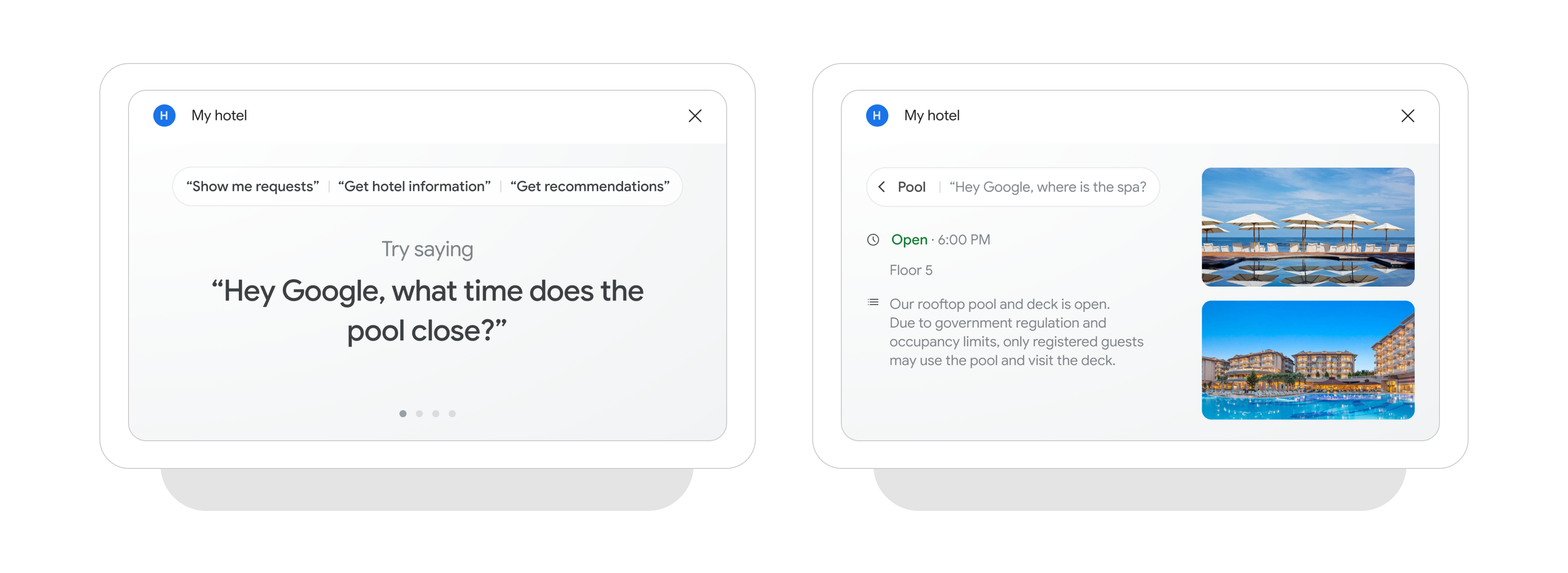
This week the company is announcing an update for the hotel industry aimed at bringing its smart screen to more hotel rooms. Tailored for the hotel experience, the update is focused on key features like wake-up calls, weather and information and local businesses. It’s also designed to let guests check out quickly and request things like towels from the concierge — essentially attempting to replace having to dial “0” on the hotel phone.

Honestly, it seems like a no-brainer for hotels looking to upgrade the experience. And, importantly, the Hub doesn’t have a built-in camera (as opposed to the Hub Max). That was a conscious omission on Google’s part that’s really welcome when inviting a device into an intimate setting like a hotel room. The company notes that guests won’t be able to sign in on the device, so no personal info will be shared. No audio is stored on the device either, and activities are wiped when the guest checks out.

The Hub is already being offered in a handful of boutique hotels across the U.S. and one in the U.K. Additional locations will be announced soon, and perhaps will be in place by the time people start heading to hotels again.


Read Full Article

What it means to be intersex -- and how the false sex binary harms us | Susannah Temko

What it means to be intersex -- and how the false sex binary harms us | Susannah Temko

For intersex people -- those born with sex characteristics outside the traditional definitions of female and male -- the stakes to appear "normal" are high. Drawing on her personal experience, Susannah Temko reveals the shame, prejudice and harm faced by the intersex community, as they're forced to conform to a binary understanding of sex that ultimately hinders their health and well-being. She calls on us all to discard outdated notions of biological sex and accept the complexity within humanity.

https://ift.tt/3jaztwS

Click this link to view the TED Talk

How to Highlight Duplicates in Google Sheets and Remove


The Email Extractor app pulls emails addresses of your contacts from Gmail into a Google Sheet. You can then use Mail Merge or Document Studio to send personalized emails to your contacts from within the sheet itself.

That said, the imported mailing list may sometimes have duplicate email addresses and it is thus be a good idea to clean up the data in your Google Sheet by removing duplicates before sending out the emails.

Highlight Duplicates in Google Sheets

You can use Conditional Formatting in Google Sheets combined with the COUNTIF formula to quickly highlight cells that contain duplicate values.

Highlight Duplicates in Google Sheets

Here’s how you can find duplicates in Google Sheets:

  1. Open the Google Sheet containing your data and go to the Format menu.

  2. Select Conditional Formatting from the expanded menu. This will help us change the colors of cells, rows or columns that meet a specific criteria.

  3. In the Apply to Range input box, add the range of cells that contain possible duplicates. In our case, the email addresses are in column A so we can put A:A to specify the entire A column.

  4. Under the ‘Format cells if’ section, choose “Custom formula is” from the dropdown list as set the formula as =COUNTIF(A:A, A1) > 1

Click the Done button and you’ll instantly notice that all duplicate cells are highlighted as shows in the screenshot below.

Duplicate Cells in Google Spreadsheet

The COUNTIF Function

The COUNTIF function in Google sheets (and Microsoft Excel) essentially counts the number of cells in the range that meet a specific criteria. For instance =COUNTIF(A:A, "apple") will count the number of cells that contain the word apple.

It can accept wildcard characters too so =COUNTIF(A:A, "apple?") will count cells that contain the word apple or apples. Or say =COUNTIF(A:A, "*@gmail.com") and it will highlight all email address that end with a gmail address.

Please note that the COUNTIF function is case-insensitive so values like gmail.com and Gmail.com are seen as duplicates.

Highlight Entire Row Containing Duplicates

If you’ve noticed in the previous screenshot, only specific cells that have duplicate values are highlighted through conditional formatting.

However, if you would like the Google Sheet to highlight the entire spreadsheet row that contains duplicate values, we need to slightly tweak the formatting rule.

  1. Go to the Apply to Range input box and specify the entire spreadsheet range, not just the column that contains duplicates.

  2. In the custom formula,use absolute reference for the range and also change criterion to use $A1 instead of A1. When we use $A1, we are telling Google Sheet to only change the row but lock the column.

The new duplicate detection formula reads =COUNTIF($A$1:$C$50, $A1)>1

Highlight Duplicate Rows in Spreadsheet

Compare Multiple Columns for Duplicates

If you would like to determine duplicates by comparing data in multiple columns of the Google Sheet, use COUNTIFS instead of COUNTIF.

For instance, if column A is Email Address and column B is Company Name and you would like highlight duplicates cell only when the combination of values in Column A and B is identical, the new formula can be written as =COUNTIFS(A:A, A1, B:B, B1)>1

Remove Duplicate Rows in Google Sheets

Now that we have figured out a simple method to highlight duplicates in Google Sheets, the next task is to remove all duplicate rows.

There are two ways to go about it - either use Google Apps script or use the built-in feature of Google Sheets to remove duplicates.

First, highlight the entire column in Google Sheet that contains the duplicate data. Next, go to the Data menu and choose the Remove Duplicates option.

Select which columns to include and whether or not the selected range has any header row. Click Remove duplicates and your list is clean up in one go. Like with COUNTIF function, Google Sheets will ignore case and formatting when determining duplicates.

Remove Duplicate Rows

Remove Duplicates with Google Scripts

If you prefer automation, here’s a little snippet that will remove the duplicates in your active Google Sheet based on data in the first column.

/** @OnlyCurrentDoc */

function removeDuplicateRows() {
  SpreadsheetApp.getActiveSpreadsheet()
    .getActiveSheet()
    .getDataRange()
    .removeDuplicates([1]);
}

How to Get Ready for a Baby Shower Party?


Anyone in the life of an expectant mom can organize a baby shower for her, bet her parents, family, and even spouses. You’re expected to toss in a fun and festive commemoration for your loved one. This is important as every mother needs a pat on the back to tell her that everything would be […]

The post How to Get Ready for a Baby Shower Party? appeared first on ALL TECH BUZZ.


Is Outbyte PC Repair Safe?


Recently, we have been receiving a lot of questions about PC optimizers – how they work and whether they are actually safe. A few questions were specifically about the recently popular Outbyte PC Repair program. We have reached out to the Outbyte team, who happily provided us with an insight on security measures within the […]

The post Is Outbyte PC Repair Safe? appeared first on ALL TECH BUZZ.


How Much Security to Expect from Your Web Host


Web hosting security is becoming more and more important. There was a time when if your site was small, you needn’t have worried too much about getting hacked. However, as the resources available to attackers increase, malware is becoming more and more prevalent. Attacks are evolving all the time. So, it’s important to know just […]

The post How Much Security to Expect from Your Web Host appeared first on ALL TECH BUZZ.


The Advantages of Hiring Luxury Sedan Black Car Service Houston


When you are looking for a black car service Houston, you have many options at your disposal. You can select a minivan, if you are traveling with a big company, or pick a comfortable and sturdy SUV. However, the luxury sedan is the car that will offer you the best possible experience. Below, you will […]

The post The Advantages of Hiring Luxury Sedan Black Car Service Houston appeared first on ALL TECH BUZZ.


View Optional Updates Link Is Missing In Windows 10


CLICK HERE TO SEE FULL POST

A user who went through our how to turn on or off the new Start menu in Windows 10 article reached out to me saying the View optional updates link is not showing up on his Windows 10 installation. In this guide, we will see what optional updates are, why the View optional updates link […]

The post View Optional Updates Link Is Missing In Windows 10 appeared first on Into Windows. Content from IntoWindows website.


Important Mobile Apps for Sports Betting Pundits


The sports betting industry has always found ways to roll with the times, from progressing through high street betting shops to online betting, like SBOBET and similar platforms. The explosion of mobile betting apps is the pinnacle, revolutionizing the sports betting industry significantly in a short period. The rise of sports betting apps has brought […]

The post Important Mobile Apps for Sports Betting Pundits appeared first on ALL TECH BUZZ.


Max Schrems on the EU court ruling that could cut Facebook in two


Last month’s ruling by the Court of Justice of the European Union (CJEU), ripping up the EU-US Privacy Shield and sewing doubt over alternative mechanisms, has put a cat among the pigeons of international data transfers.

For Facebook the impact could fall like a cleaving sword as its business is front and center following the so-called Schrems II judgement.

Eponymous privacy campaigner Max Schrems’ underlying complaint targeted the tech giant’s use of a data transfer tool known as Standard Contractual Clauses (SCCs). Thousands of businesses make use of SCCs to carry out EU to US transfers of personal data, sometimes in addition to the now defunct Privacy Shield framework. An earlier ruling by the CJEU — following another Schrems complaint which also drew on the 2013 Snowden disclosures of US government mass surveillance programs — struck down the prior transatlantic ‘Safe Harbor’ arrangement.

SCCs were an existing alternative for businesses to plug the gap then until Privacy Shield came into effect. But the CJEU ruling of no US adequacy with EU privacy standards casts doubt on their continued use for these transfers. Facebook was using SCCs in the Safe Harbor era. Now, in the wake of the CJEU decision, it’s said it’s moving its Privacy Shield transfers to SCCs. So the tech giant has no visible ‘plan B’ if it’s ordered to suspend these data flows too.

In Schrems’ views the only way Facebook will be able to comply with the CJEU ruling is if it splits its infrastructure into two. And while other types of companies — such as cloud storage providers — may already separate data by regions owing to factors like latency or even cost, Facebook’s business simply doesn’t operate like that. It’s designed to draws data to its center.

“Facebook is probably the most [susceptible] to all of this,” says Schrems, discussing the ramifications of the CJEU ruling in an interview with TechCrunch. “For Facebook it’s really, really complicated as a company to comply with any of this.”

“There are parts that are necessary data transfers, and [Facebook] can continue to do that. So basically the message that I sent to an American friend, stuff like that. But that’s only a small percentage,” he continues. “So I think technically the approach they’d have to do is basically split Facebook in two. And then kind of reconnect the necessary data transfers. So you’ve basically federated. A bit like Diaspora was always designed to be; a federated social network where you basically have different parts and what’s necessary is communicated and what’s not necessary is not communicated.”

“They’re not going to do that without heaven and hell moving onto them,” he adds. “I guess — especially for Facebook — that the problem is we kind of have a case where the consequences are so extreme the pushback is obviously as extreme as possible… They know that without fundamentally restructuring the whole system they will never be able to comply with any of this — so they don’t.”

Schrems points to what happened historically with SWIFT financial data exchanges as a comparable scenario — where the fix was to move backups from the US to Switzerland “so only the data that is international and US is actually stored in the US and all the other transfer data is kept in Belgium and Switzerland”. “So you separate your backups and your situations and so on,” he says, adding: “It’s a lot of engineering.”

At this point most of the big tech companies have data centers in Europe. While newer social video sharing app TikTok recently announced plans to establish one Ireland for EU users’ data. But Schrems reckons there’s no easy way for Facebook to unpick all its EU data flows.

We asked Facebook for details on its legal basis for continuing to use SCCs but the company did not engage with questions on the topic. Nor did it respond when we asked for clarity on any ‘plan B’ if it’s ordered to stop using SCCs.

Beyond a massive engineering headache for the company, Schrems doesn’t see huge legal significance in a federated version of Facebook’s service that holds EU users’ data in Europe. But he argues such a split would send an important message about the rule of law.

“The law doesn’t differentiate if the data is processed in Europe or in the US on having to be compliant with it… So I don’t really think we can probably gain much from it. To me it’s more of a general question of companies having to respect the law or just getting away with it, over and over again, without really complying. I don’t think [it would be a gain] for direct compliance — it’s probably more of a big message that you don’t get away with it that would be important to send,” he says.

Can SCCs still be used for US transfers?

In the clash between EU privacy rights and US surveillance law, Europe’s highest court has made it clear it isn’t budging. At the same time, lawyers all over the region are busy grappling with the apparent contradiction of the CJEU finding US surveillance practices fatal to Privacy Shield yet not putting an indelible blocker on SCCs for data transfers over the pond. This other long-standing transfer mechanism — sometimes also referred to as ‘model clauses’ — could have been struck down too but wasn’t. So the court left the door ajar.

Law firms have seized on that to shape strategies for businesses to proceed using SCCs for US data transfers in a way that minimizes their risk — via performing detailed risk assessments and/or applying ‘special measures’, where possible. Given the rich seam of paid advice opportunities opening up it’s not hard to find European lawyers who believe SCCs can be made to work for some data controllers who want to continue (or start) bulk processing EU users’ data in the US.

This advice boils down to handling all of the associated bureaucracy around performing risk assessments over a particular data transfer and whether/how it falls under US surveillance law; for some it may also mean investigating technical and operational solutions, such as whether data could be encrypted in transit and the keys held by a EU entity that’s not subject to US law; and perhaps seeing whether policies can be applied and contractual language beefed up so that a US receiving entity which gets a law enforcement request for data is obliged to take steps to make sure there’s a real legal compulsion underpinning it.

In a public discussion on the topic hosted by the International Association of Privacy Professionals last month, Hogan Lovells partner, Eduardo Ustaran — one of the more bullish voices touting the ongoing value of SCCs for US transfers — made the case for building policy protections into contracts to require a level of push back and interrogation of US government agency requests for data.

“When the court talked about additional safeguards and making up for the lack of protection in the regime of the recipients… they’re talking about precisely that: Having that legal process in place — a contractual obligation — to question that request. And you will probably find that if that is in place only a very, very, very small minority of cases will lead to something that is a true conflict where the prohibition of data really needs to be given,” he argued.

“Even in that case, one needs to question whether that is actually within the parameters of what European law provides. Or outside those parameters. Because, again, what the court didn’t say was that all access to data is unlawful; it’s the one that’s not necessary, it’s disproportionate. So that’s what you need to get at. And that’s what we’re saying. I think there is definitely room for manoeuvre in that contractual document for the parties to that document to agree to what level of scrutiny they’re going to undertake when one of them receives a request.”

In the same discussion, Fieldfisher privacy, security and information partner, Renzo Marchini, suggested some data controllers may be able to determine they do not have any risk of European standards not being met for their particular data transfer.

“For some vanilla transfers there might simply be no risks,” he posited. “They might be outside of FISA [the Foreign Intelligence Surveillance Act] and so on. And you only get to additional safeguards, additional measures if you conclude that you need to do something more — and the court has allowed you to do something more.”

“They haven’t said what that’s got to be,” he added. “I hope the EDPB [European Data Protection Board] will give some certainty here and tell us what those things are.”

The lack of judicial redress linked to US surveillance law is a stickier problem, though. One Marchini accepted can’t be fixed with any amount of contractual spit and polish — and which, for businesses subject to FISA, will carry through as what he couched as “residual risk”.

“That simply goes to the risk assessment that’s carried out beforehand,” he said when pressed on that point. “So if you’re at risk and you can’t fix it technically, operationally, then you’re left with the residual risk that you haven’t fulfilled essential equivalence. There’s no way of avoiding that, I think. You’re not going to fix that gap in US law which the court found either… There’s a lack of judicial redress under FISA 702; you can’t fix it, but you might be able to conclude you’re not at risk under FISA 702.”

In Facebook’s case, there’s no plausible dispute the company falls under US surveillance laws — which means its wiggle room in the face of Schrems II is minimal. And so suddenly the company throwing all its eggs into the SCCs’ basket in the hopes that Europe’s regulators will ignore the CJEU’s instruction to step in looks high risk.

“One of the holdings of the Court of Justice was there is simply no legal redress whatsoever as a foreigner,” notes Schrems, adding: “I’ve had calls with people from industry and they said we know that we actually don’t have a legal basis but we just hope they’re going to be reasonable and not enforce it. Which is basically saying you’re working illegally and you hope the law doesn’t apply to you.”

“We’re now asking different companies and most of them say we don’t really know the legal basis — we’re waiting for guidance,” he adds. “The reality is the vast majority of them is simply now working illegally. Google and Microsoft and even Facebook put out ‘oh we’re still using SCCs because we read the judgement differently’.”

In another example, the IAB Europe suggests in an Q&A on the CJEU ruling that worried advertisers “seek guidance from your lead supervisory authority” — and then immediately suggests DPAs “may give leniency towards data transfers that took place under the Privacy Shield due to the sudden nature of this change in the law”. Although, on SCCs, the ad industry body is more circumspect, writing that compliance is now determined on a case-by-case basis and “will depend on the companies sending and receiving the personal data, the regulator in the target country, and the types of personal data”.

“To be honest I’m not super enthusiastic about data transfers because we have so many other privacy problems there probably are bigger issues. But the reason why I’m really getting more and more excited about this case is it just shows the vast ignorance on any of these decisions,” adds Schrems. “If the Supreme Court of the EU says for the second time you can’t do that and they’re just saying ‘oh I guess the law doesn’t apply to us or is not going to be enforced anyways’.

“With the data transfers you kind of understand why it’s complicated and you can’t change it overnight. Even in the Facebook complaint I filed in 2015 — back then I said you know they should at least have an order where, within a certain time period, they should have to stop the data transfers than say you’ve got to stop it overnight because that’s not going to happen. But they could, theoretically, order them to stop the data transfers within a year, for example. Which would give them enough time to actually comply with it.”

What happens next?

Individual EU regulators have generally been keeping their cards close to their chest since the CJEU ruling. And it remains to be seen what action Facebook’s lead supervisor, the Irish Data Protection Commission (DPC), will take as its next steps vis-a-vis Schrems’ seven-year-old complaint. All eyes are on Dublin.

More than two years since the application of Europe’s General Data Protection Regulation (GDPR), the regulator is no stranger to complaints that it needs to pick up the pace and get on with the job of enforcing major cross-border complaints against tech giants like Facebook. Though its counter argument to such criticism is that building robust cases that will stand up to legal challenge takes time.

In the meanwhile, guidance on the CJEU ruling put out by the EDPB emphasizes that international data transfers via SCC must be assessed on a case by case basis; and, if a data controller intends to keep using SCCs, it must inform the relevant EU supervisory authority — inviting scrutiny of these flows.

Combine that with the CJEU telling EU data protection agencies they have a duty to intervene and stop data transfers to places where they suspect people’s information is at risk and it’s hard to see how regulators can keep sitting on their hands in obvious cases involving FISA-subject entities.

One thing looks clear: The era of ‘tickbox’ data transfers to any international jurisdiction that lacks an EU data adequacy agreement is toast.

Taking that further, any third country that lacks a comprehensive data protection framework akin to GDPR probably isn’t going to be able to sustain ‘seamless’ access to the European market for long, if at all — which means, yes, the US; but also China, India, and so on (a post-Brexit UK also looks dicey on the adequacy front given its penchant for surveillance overreach; though some of that has already been dialled back via the courts).

And even though there are now noises on both sides of the Atlantic about cooking up a ‘Privacy Shield 2‘, barring enlightened reform of US surveillance law — or the impossible flip-side of Europe tearing up its charter of fundamental rights — any such respawned instrument would soon follow its predecessors into legal history.

As we said last month, all this sums to a lot more work for lawyers. And right on cue law firms are talking up contractual risk reduction strategies to sell concerned data controllers a way forward.

Cash-strapped regulators are also going to find more work piled on their plates now they have unequivocal instruction not to look the other way at lawbreaking data transfer ‘business as usual’.

Pressure is being applied to regulators by EU lawmakers too who want to see more joint working to ensure harmonious application of major rulings across the bloc’s patchwork of data authorities. Businesses need clarity, is the common refrain. And the role of the EDPB — whose current duties include issuing guidance and promoting pan-EU cooperation and consistency of regulatory application — looks set to become increasingly pivotal as more of these cross-border cases and pinch-points flare up.

The EDPB will need to take on more of a leadership, decision-making role vs its customary talking shop, per Schrems. “They will have to become a proper legal entity that does proper legal decisions because they will be tested in court,” he argues. “So far they got away with more political statements and so on. In both directions. There’s some things that they put out that are just going way too far, which the GDPR does not provide for. And there are other things where they’re miles away from the basics of what the GDPR says. [Their output] will have to become more like a proper legal analysis — that says this is what you have to do now.”

Unsurprisingly, for a privacy activist who’s been petitioning regulators to uphold his fundamental rights for so many years — and now with two adequacy-crushing CJEU rulings that bear his name — Schrems expresses plenty of frustration at the DPAs’ performance to date.

After so much time and legal energy it’s amazing to think his original complaint against Facebook’s use of SCCs is still unresolved. And that’s just one of many he’s filed, having spun up noyb: A not-for-profit European digital rights group dedicated to strategic litigation to defend privacy.

“The other problem is that that the authorities locally then also have to enforce [EDPB guidance] because there’s still a lot of talk,” he says. “We have decisions that, I can’t name them publicly — but we have ‘in between’ decision from the Irish DPC where they literally say yeah that’s what the EDPB says but we have a different view and we’re just going to decide the opposite way. And they’re not technically bound by these guidelines but if structurally they’re not upheld in Member States then, yeah, nothing’s going to happen.”

noyb also has pending cases that have been sitting with DPAs for as much as 1.5 years without a key authority providing feedback — because “they simply don’t talk to each other”.

“I mean just in daily practice. We have cases that are pending — like the forced consent stuff — where the Germans said they now called them every month in Ireland and there’s simply no answer,” he adds. “And so it’s not working on such a childish, basic level.

“So the problem that we’re having is this whole cooperation system is just so fundamentally not working. It could work if everybody tries to pull in the same direction. But right now they are rather all pulling in different directions.”

What does Schrems believe will happen with his Facebook SCCs complaint now the CJEU has finally weighed in?

“I have no clue to be honest. We’re now planning to do more and more turning up the heat a bit,” he says, nodding to the 101 complaints just filed by noyb against the use of SCCs for Facebook Connect and Google Analytics data transfers. “Fundamentally it’s a question of whether the data protection authorities take themselves seriously or if they continue to be like ‘FAQs’ that are just like ‘blah, blah, we don’t really tell you anything’. And which of the DPAs are going to start to take some enforcement measures.”

“People complain about the US a lot and US companies not being compliant with EU law… But the reality is we’re simply not enforcing these laws. And it’s a fundamental European problem that we don’t do that,” he adds. “I’m usually joking in Austria; one Google penalty would buy us up to four high speed rail tunnels through the Alps!”

There has been one Google penalty since the GDPR began being applied in May 2018 — levied by France’s CNIL in early 2019. But Schrems argues the €50M fine was woefully low, pointing out Austria slapped a larger penalty on its postal service (€80M) for trying to calculate people’s political interests based on their location and age in order to run a direct mailing service. And it’s clear Google’s behavioral ad-targeting personal-data-sink goes a lot deeper than a spreadsheet to sell direct mailing.

“If you never really enforce the law, if you never really put out a penalty, if the maximum penalty even from the CNIL was €50M — which was nothing — then there’s no reason to wonder why [tech giants] don’t comply,” adds Schrems.

The Irish DPC has also sought to package product launch delays as annual-report-worthy enforcement wins. But Schrems argues such stuff “fundamentally underestimates their power”. He also notes that noyb has instigated legal action against the DPC “for being inactive”, as he puts it.

“They’re oftentimes more happy to write a press release than to actually take the law and take the options that they have on the law and go for it,” Schrems adds, discussing the problem of EU DPAs generally not feeling willing or able to enforce. “That’s the reason why we’ve tried to push them with these complaints, the 101 complaints. Basically they can’t say that they haven’t a case on their table anymore.”

He likens the impact on Europeans’ fundamental rights of so much regulatory inaction as akin to having the right to vote but without access to a polling station most of the time.

“That’s a bit of how we do privacy,” he suggests. “And that’s a part of what we’re trying to do at noyb; just dig into that and just see, you know, there is a law, you breached it, now you pay for it. Because unless we actually push for that structurally, and bit by bit, we’re just going to be in this endless debate about privacy for the next 30, 40 years.

“I’m always telling myself it’s a bit normal because when we had the first time that we talked about workers’ rights — it still is a 100+ years ongoing debate about actually getting paid what your collective, bargaining agreement says. It’s not like any of these problems are done tomorrow or done forever but here the gap between reality and law is just so huge — and even huge companies just fundamentally do not comply — and that’s a bit exceptional. Because in other areas they at least pretend to comply. Or somehow comply if they’re a larger company with some reputation.”

Of course even massive financial penalties can amount to a parking ticket for tech giants. Witness Facebook’s smiles-all-round $5BN FTC settlement. Or Google’s $5BN antitrust fine for a still dominant Android OS. But Schrems’ point is you have to actually have functioning institutions issuing penalties to stand any chance of tackling such massive rights asymmetries. And, well, a law that’s not enforced is like a footpath no one walks; soon enough there’s weeds growing over it and pretty quickly you couldn’t even walk it if you tried.

“We’re not going to police the world by having a DPA behind each bush and ogling each click that everybody does. But if they, in general, have an enforcement pressure that companies have the feeling that ok if I don’t comply, bit by bit, I’m going to get caught for something… It’s a bit like with traffic,” says Schrems. “You know I’m not a fan of having a speeding camera around every corner but if once in a while you get a speeding ticket you kind of realize that going 160 on an autobahn is not a good idea and it generally keeps people to drive at 140 if 130 is legal. It keeps it somehow at a format that is somehow acceptable — and that’s totally missing in the privacy world.”

For now, the enforcement gap is being challenged by not-for-profits like noyb. It’s also increasingly viewed as an opportunity by class action style litigation funders — hoping to profit off of population-scale damages even if regulators won’t.

Schrems says noyb has managed to attract a crowdfunded annual budget of around €600k-€700k at this point — “all donated money for doing the job that regulators are actually paid to do” — although he’s recently been running ads on social media to try to get it to full target funding. “Technically noyb shouldn’t exist,” he jokes.

Clearly, though, Schrems has tapped into an appetite among Europeans for someone to champion their rights.

After years of regulatory inaction that has allowed data-mining giants to exploit people’s privacy without any meaningful consequences — sewing up the attention economic in the process — there’s a vacancy for privacy heroes to tackle the sorts of abuses Schrems and his team are worried about. Problems regulators have failed historically to act on, and which Europeans are still waiting for action on. (A two-year Commission review of GDPR in June acknowledged a lack of uniformly vigorous enforcement.)

“Right now we’re looking into a lot of the data brokers on the advertisement stuff,” says Schrems, when asked about his biggest privacy concern. “What’s kind of interesting in some countries — not all — the credit ranking agencies and what they do and why they think they can have data on every European and their financial situation without ever having consent or anything. So there’s tonnes of stuff that we’re looking on right now. I’m luckily not involved in all of it at the same time anymore.”


Read Full Article

Daily Crunch: Judge says Apple can’t block Unreal Engine


Epic Games wins a victory against Apple, Fitbit announces a new smartwatch and Microsoft Word adds a transcription feature. This is your Daily Crunch for August 25, 2020.

The big story: Judge says Apple can’t block Unreal Engine

U.S. District Court Judge Yvonne Gonzalez Rogers weighed in on the legal battle between Epic Games and Apple with a mixed verdict. She denied Epic’s motion to restore the popular game Fortnite to Apple’s App Store, but also ordered Apple not to block Epic’s developer accounts or to restrict developers on Apple platforms from accessing Epic’s Unreal Engine tools.

“Apple has chosen to act severely, and by doing so, has impacted non-parties, and a third-party developer ecosystem,” Rogers said.

A full hearing on the dispute is scheduled for September 28.

The tech giants

Fitbit launches a $330 Apple Watch competitor — The Sense is designed to be a premium alternative to the Versa line, described by the company as its most advanced health smartwatch.

Facebook is bringing a Shop section to its app, while Instagram expands Live Shopping — Facebook Shop doesn’t sound too different from the similarly named Instagram Shop, where users can browse products from their favorite brands and businesses.

Microsoft brings transcriptions to Word — This new feature lets you transcribe conversations, both live and pre-recorded, and then edit those transcripts right inside of Word.

Startups, funding and venture capital

YC’s most anticipated startup raised $16M from a16z before Demo Day — Trove sells a suite of internal compensation tools to other startups.

Self-charging, thousand-year battery startup NDB aces key tests and lands first beta customers — NDB has created a new, proprietary nano diamond treatment that allows for more efficient extraction of electric charge from the diamond used in the creation of the battery.

Instacart workers are demanding disaster relief amid CA wildfires — Gig Workers Collective, a gig worker-activist group led by Instacart shoppers, is asking Instacart to provide disaster relief to workers impacted by natural disasters.

Advice and analysis from Extra Crunch

How to establish a startup and draw up your first contract — We invited James Alonso from Magnolia Law and Adam Zagaris from Moonshot Legal to join us at TechCrunch Early Stage to give us a 360 overview of the legal side of running a startup.

Unity, JFrog, Asana, Snowflake and Sumo Logic file for IPOs in rapid-fire fashion — Alex Wilhelm does a big roundup of new IPO filings.

As DevOps takes off, site reliability engineers are flying high — The emergence of site reliability engineers is not a new trend, but one closely coupled with the theme of DevOps over the last decade.

(Reminder: Extra Crunch is our subscription membership program, which aims to democratize information about startups. You can sign up here.)

Everything else

Netflix’s ‘Emily’s Wonder Lab’ is smart, interactive science TV for kids — TV science host (and former TechCrunch contributor) Emily Calandrelli told us that “Wonder Lab” is the realization of a concept that she’s been pitching for years.

Porsche experiments with subscription pricing, expands to Los Angeles — Porsche now has three tiers under its newly rebranded Porsche Drive vehicle subscription program.

Meet the Disrupt 2020 ‘TC10’ — The TC10 is a group of entrepreneurs, investors, etc. who have been a staple of our Disrupt conference over the past decade. And they’re all coming back!

The Daily Crunch is TechCrunch’s roundup of our biggest and most important stories. If you’d like to get this delivered to your inbox every day at around 3pm Pacific, you can subscribe here.


Read Full Article