Mozilla is launching version 75 of its Firefox browser today. As always, there are plenty of bug fixes and changes for developers who write web apps, but the marquee feature of this update is a refreshed address bar. Given how often you likely use the address bar — though these days it’s often more of a search bar than URL bar — that’s prime real estate in any browser and the kind of feature where users will quickly notice any changes.
Today’s update brings three major changes to the Firefox address bar. The one you’ll notice immediately is that when you click into the address bar it’ll open a list of your most visited site. If you have that site already open in a tab, that’ll get highlighted in the list and you can jump right to that tab with a shortcut (though that’s something I didn’t quite see in the preview releases yet). This list of most-visited sites is the same you see in Firefox’s new tab page and you can manage it from there, too.
When you start a search in the address bar, Firefox now also makes the autocompleted queries a bit easier to read. That’s a minor but welcome change.
With the redesign, the address bar is also getting a bit of a refreshed look and you’ll likely notice that it’s a bit larger, too. For the most part, though, it’s not a radical change.
As the Firefox team also announced today, Mozilla believes that it doesn’t need to make any changes to its 2020 release schedule for the time being, despite the COVID-19 pandemic. So while Google has decided to skip a version with its Chrome release schedule, you’re unlikely to see any changes to how Mozilla releases Firefox. But the team did take note of what today’s users are doing with their browser and has prioritized fixing issues with in-browser video conferencing systems, for example.
“Going forward, we will continue to examine all new features and planned changes with closer attention paid to backwards compatibility, and their potential for any user-facing issues,” the team writes today.
The Cloud Foundry Foundation (CFF), the home of the Cloud Foundry open-source developer platform, today announced that its executive director Abby Kearns is stepping down from her role to pursue an executive role elsewhere.
If you’ve followed the development of the CFF for a while, it won’t come as a surprise that its current CTO, Chip Childers, is stepping into the executive director role. For the last few years, Kearns and Childers shared duties hosting the foundation’s bi-annual conferences and were essentially the public faces of the organization.
Both Kearns and Childers stepped into their roles in 2016 after CFF founding CEO Sam Ramji departed the organization for a role at Google. Before joining the Cloud Foundry Foundation, Kearns worked on Pivotal Cloud Foundry and spent over eight years as head of product management for integration services at Verizon (which, full disclosure, is also the corporate parent of TechCrunch).
Today, according to its own data, the Linux Foundation-based Cloud Foundry project is used by more than half the Fortune 500 enterprises. And while some use the open-source code to run and manage their own Cloud Foundry platforms, most work with a partner like the now VMware-owned Pivotal.
“I am tremendously proud of Cloud Foundry and of the Foundation we have all built together,” said Kearns in today’s announcement. “Cloud Foundry offers the premier developer experience for the cloud native landscape and has seen massive adoption in the enterprise. It also has one of the strongest, kindest, most diverse communities (and staff) in open source. I leave the organization in the best hands possible. Chip was the first Foundation staff member and has served as CTO for more than four years. There is literally nobody else in the world more qualified for this job.”
During her role as executive director, Kearns helped shepherd the project through a number of changes. The most important of those was surely the rise of Kubernetes and containers in general, which quickly changed the DevOps landscape. Unlike other organizations, the CFF adapted to these changing times and started integrating these new technologies. Over the course of the last two years, the Cloud Foundry community started to deeply integrate these cloud-native technologies into its own platform, despite the fact that the community had already built its own container orchestration system in the past.
As Childers told me last year, though, the point of Cloud Foundry isn’t any specific technology, though. Instead, it’s about the developer experience. Ideally, the developers who use it don’t have to care about the underlying infrastructure and can simply integrate it into their DevOps workflow. With a lot of the recent technical changes behind it,
“We as a Foundation are turning the page to a new chapter; raising the profiles of our technical contributors, highlighting the community’s accomplishments and redefining the Cloud Foundry platform as the best Kubernetes experience for enterprise developers,” said Childers today. “Abby has done a tremendous job leading the Foundation through a period of massive growth and upheaval in the cloud native world. Her leadership was instrumental in building Cloud Foundry as a leading cloud development tool.”
As the CFF also today announced, Paul Fazzone, SVP Tanzu R&D at VMware, has been named Chairman of the Board of Directors, where he replaces Dell EMC global CTO John Roese.
“This next chapter for Cloud Foundry will be a shift forward in focusing on evolving the technology to a Kubernetes-based platform and supporting the diverse set of contributors who will make that outcome possible,” said Fazzone. “In my new role as Chairman of the Board, I look forward to helping guide the Foundation toward its goal of expanding and bolstering the ecosystem, its community and its core of users.”
WhatsApp is imposing additional restriction on how frequently a message can be shared on its platform in its latest effort to curtail the spread of misinformation.
The Facebook-owned instant messaging service said today that any message that has been forwarded five or more times will now face a new limit that will prevent a user from forwarding it to more than one chat (contact) at a time.
A spokesperson told TechCrunch that WhatsApp will roll out this change to users worldwide today.
The end-to-end encryption on WhatsApp — which the company is fighting for in several markets — prevents it from reading the content of a message, so it relies on metadata of a message to gauge its spread.
“Is all forwarding bad? Certainly not,” the company wrote in a blogpost today. “However, we’ve seen a significant increase in the amount of forwarding which users have told us can feel overwhelming and can contribute to the spread of misinformation. We believe it’s important to slow the spread of these messages down to keep WhatsApp a place for personal conversation.”
But the vast reach of Facebook has also attracted scammers. “Unfortunately, scammers may try to take advantage of people’s vulnerability and generosity during this time,” wrote Stan Chudnovsky, VP of Messenger.
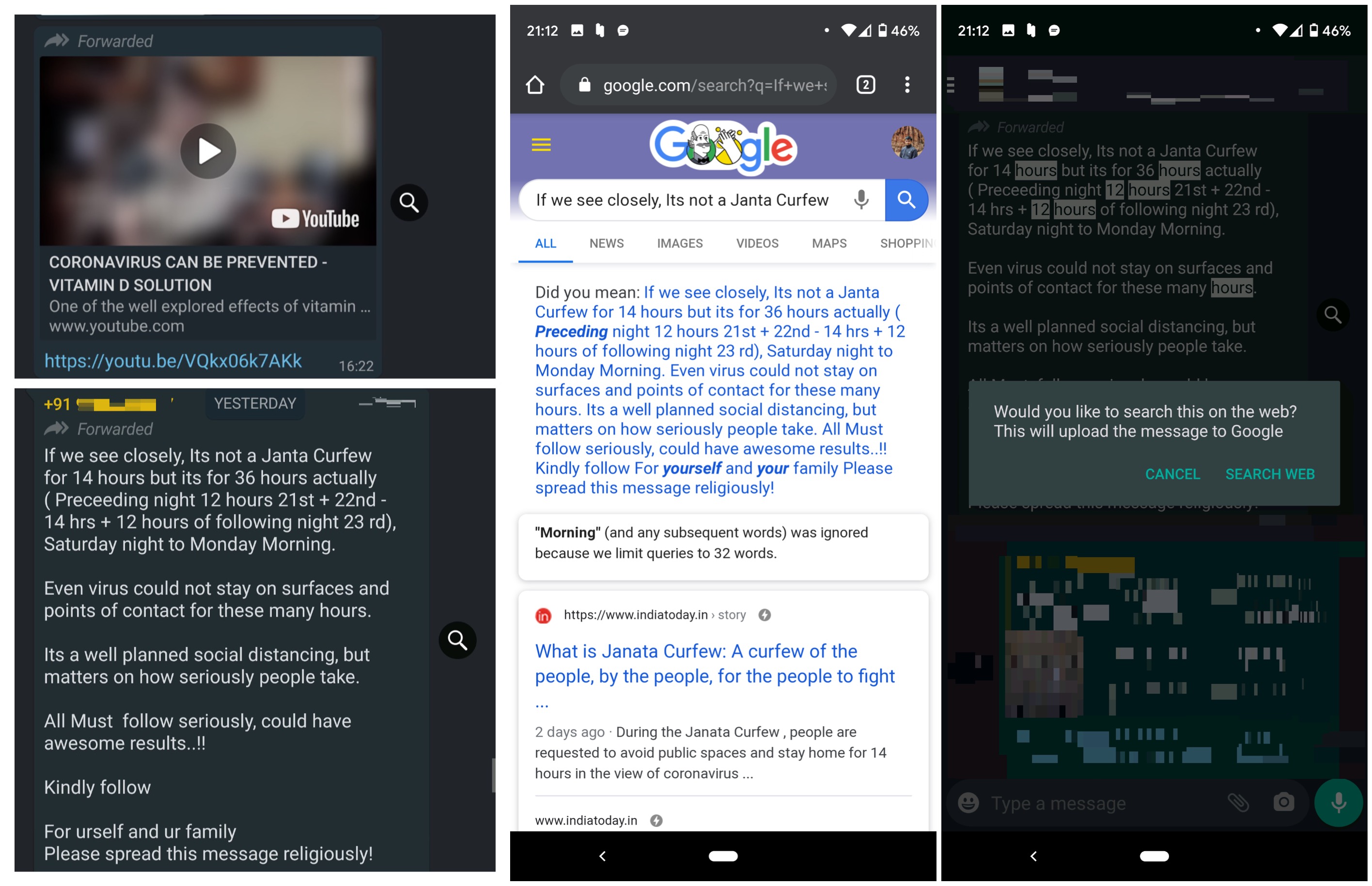
WhatsApp has also been testing a feature on the beta version of its Android app that gives users the ability to quickly comb through the web with the text or video they have received for more context.
Images credit: @shrinivassg
A spokesperson said the platform plans to roll out this feature in the near future.
Custom support systems like Freshdesk, Zoho Desk, or Zendesk offer an email address - like support@example.com - for quickly creating customer tickets without having to fill any complicated web forms.
Any email message sent to your support email address automatically gets converted into a ticket and a unique ticket ID gets assigned to the support request.
When a ticket is created from an email address, the email subject becomes the ticket title, the email body becomes the ticket description and the most important part, the customer’s name and email address is pulled from the FROM field of the email message header. This is important because when your helpdesk agents respond to a ticket, the replies are sent directly to the customer.
Email Ticketing with Gmail Forwards - The Problem
This system works perfect when the customer sends an email message directly to the help desk email but imagine if they send an email to you, the support agent, and it is your job to create a support ticket from the customer’s email.
Now if you forward the customer’s email message received in your Gmail mailbox to Freshdesk, the ticket would still be created but since it will have your name and email in the FROM field, the helpdesk software would assign you as the customer even though you are just creating a support ticket on behalf of the customer. If any agent responds to such a ticket, you’ll be part of all the communication and not the original customer since their email address is no part of the support ticket created from the forwarded email.
I have been exploring Freskdesk and faced a similar issue. How to easily create support tickets from existing email messages in Gmail. Couldn’t find a readymade solution so decided to build one using the Freshdesk API and Google Apps Script.
Convert Gmail Emails to Freshdesk Tickets
To get started, you’ll need the domain (where your Freshdesk site is hosted) and the API Key that is available under your Freshdesk profile page.
Next, go to your Gmail and create a label - say Freshdesk. Now you can simply drag customer emails from your Gmail Inbox to this new Freshdesk label and they’ll be automatically converted into customer tickets. Unlike email forwards, here the tickets would be created with the customer’s name and email address as the requestor.
Inside the Google Script editor, go to Edit > Current Project Triggers > Add Triggers and create a new time based trigger that runs every 15 minutes for the gmailToFreshdesk method.
Now the Google Script will connect to your Gmail every 15 minutes, finds any new email messages in the specified label and convert them to Freskdesk support tickets. It will also remove the email message from the label after the ticket is created.
No Gmail Sending Limits Apply
With Apps Script, you need not worry about Gmail sending limits since the tickets are created with API calls and your not sending (forwarding) email anywhere.
The latest confirmation of the online tracking industry’s continued flouting of EU privacy laws which — at least on paper — are supposed to protect citizens from consent-less digital surveillance comes by via Ireland’s Data Protection Commission (DPC).
The watchdog did a sweep survey of around 40 popular websites last year — covering sectors including media and publishing; retail; restaurants and food ordering services; insurance; sport and leisure; and the public sector — and in a new report, published yesterday, it found almost all failing on a number of cookie and tracking compliance issues, with breaches ranging from minor to serious.
Twenty were graded ‘amber’ by the regulator, which signals a good response and approach to compliance but with at least one serious concern identified; twelve were graded ‘red’, based on very poor quality responses and a plethora of bad practices around cookie banners, setting multiple cookies without consent, badly designed cookies policies or privacy policies, and a lack of clarity about whether they understood the purposes of the ePrivacy legislation; while a further three got a borderline ‘amber to red’ grade.
Just two of the 38 controllers got a ‘green’ rating (substantially compliance with any concerns straightforward and easily remedied); and one more got a borderline ‘green to amber’ grade.
EU law means that if a data controller is relying on consent as the legal basis for tracking a user the consent must be specific, informed and freely given. Additional court rulings last year have further finessed guidance around online tracking — clarifying pre-checked consent boxes aren’t valid, for example.
Yet the DPC still found examples of cookie banners that offer no actual choice at all. Such as those which serve a dummy banner with a cookie notice that users can only meaningless click ‘Got it!’. (‘Gotcha data’ more like.. )
In fact the watchdog writes that it found ‘implied’ consent being relied upon by around two-thirds of the controllers, based on the wording of their cookie banners (e.g. notices such as: “by continuing to browse this site you consent to the use of cookies”) — despite this no longer meeting the required legal standard.
“Some appeared to be drawing on older, but no longer extant, guidance published by the DPC that indicated consent could be obtained ‘by implication’, where such informational notices were put in place,” it writes, noting that current guidance on its website “does not make any reference to implied consent, but it also focuses more on user controls for cookies rather than on controller obligations”.
Another finding was that all but one website set cookies immediately on landing — with “many” of these found to have no legal justification for not asking first, as the DPC determined they fall outside available consent exemptions in the relevant regulations.
It also identified widespread abuse of the concept of ‘strictly necessary’ where the use of trackers are concerned. “Many controllers categorised the cookies deployed on their websites as having a ‘necessary’ or ‘strictly necessary’ function, where the stated function of the cookie appeared to meet neither of the two consent exemption criteria set down in the ePrivacy Regulations/ePrivacy Directive,” it writes in the report. “These included cookies used to establish chatbot sessions that were set prior to any request by the user to initiate a chatbot function. In some cases, it was noted that the chatbot function on the websites concerned did not work at all.
“It was clear that some controllers may either misunderstand the ‘strictly necessary’ criteria, or that their definitions of what is strictly necessary are rather more expansive than the definitions provided in Regulation 5(5),” it adds.
Another problem the report highlights is a lack of tools for users to vary or withdraw their consent choices, despite some of the reviewed sites using so called ‘consent management platforms’ (CMPs) sold by third-party vendors.
This chimes with a recent independent study of CPMs — which earlier this year found illegal practices to be widespread, with “dark patterns and implied consent… ubiquitous”, as the researchers put it.
“Badly designed — or potentially even deliberately deceptive — cookie banners and consent-management tools were also a feature on some sites,” the DPC writes in its report, detailing some examples of Quantcast’s CPM which had been implemented in such a way as to make the interface “confusing and potentially deceptive” (such as unlabelled toggles and a ‘reject all’ button that had no effect).
Pre-checked boxes/sliders were also found to be common, with the DPC finding ten of the 38 controllers used them — despite ‘consent’ collected like that not actually being valid consent.
“In the case of most of the controllers, consent was also ‘bundled’ — in other words, it was not possible for users to control consent to the different purposes for which cookies were being used,” the DPC also writes. “This is not permitted, as has been clarified in the Planet49 judgment. Consent does not need to be given for each cookie, but rather for each purpose. Where a cookie has more than one purpose requiring consent, it must be obtained for all of those purposes separately.”
In another finding, the regulator came across instances of websites that had embedded tracking technologies, such as Facebook pixels, yet their operators did not list these in responses to the survey, listing only http browser cookies instead. The DPC suggests this indicates some controllers aren’t even aware of trackers baked into their own sites.
“It was not clear, therefore, whether some controllers were aware of some of the tracking elements deployed on their websites — this was particularly the case where small controllers had outsourced their website management and development to a third-part,” it writes.
The worst sector of its targeted sweep — in terms of “poor practices and, in particular, poor understanding of the ePrivacy Regulations and their purpose” — was the restaurants and food-ordering sector, per the report. (Though the finding is clearly based on a small sampling across multiple sectors.)
Despite encountering near blanket failure to actually comply with the law, the DPC, which also happens to be the lead regulator for much of big tech in Europe, has responded by issuing, er, further guidance.
This includes specifics such as pre-checked consent boxes must be removed; cookie banners can’t be designed to ‘nudge’ users to accept and a reject option must have equal prominence; and no non-necessary cookies be set on landing. It also stipulates there must always be a way for users to withdraw consent — and doing so should be as easy as consenting.
All stuff that’s been clear and increasingly so at least since the GDPR came into application in May 2018. Nonetheless the regulator is giving the website operators in question a further six months’ grace to get their houses in order — after which it has raised the prospect of actually enforcing the EU’s ePrivacy Directive and the General Data Protection Regulation.
“Where controllers fail to voluntarily make changes to their user interfaces and/or their processing, the DPC has enforcement options available under both the ePrivacy Regulations and the GDPR and will, where necessary, examine the most appropriate enforcement options in order to bring controllers into compliance with the law,” it warns.
The report is just the latest shot across the bows of the online tracking industry in Europe.
The UK’s Information Commission’s Office (ICO) has been issuing sternly worded blog posts for months. Its own report last summer found illegal profiling of Internet users by the programmatic ad industry to be rampant — also giving the industry six months to reform.
However the ICO still hasn’t done anything about the adtech industry’s legal blackhole — leading to privacy experts to denouncing the lack of any “substantive action to end the largest data breach ever recorded in the UK”, as one put it at the start of this year.
Ireland’s DPC, meanwhile, has yet to put the decision trigger on multiple cross-border investigations into the data-mining business practices of tech giants including Facebook and Google, following scores of GDPR complaints — including several targeting their legal base to process people’s data.
A two-year review of the pan-EU regulation, set for May 2020, provides one hard deadline that might concentrate minds.
It’s time to roll up your sleeves and get your house in order. These five experts share their best tips, tricks, and techniques to clean and tidy your home, as well as how to keep it organized.
When you sit back and really take a long look at your house, you realize that it could do with some sprucing up. When was the last time you dusted in the corners and the high spots? Couldn’t this room be straightened out to make everything easier? How about adding a little aesthetic comfort to make it more liveable?
The internet is full of blogs and YouTube channels where everyday folks and experts share household hacks to manage a home. They’ll show you how to clean and organize, they’ll give downloadable checklists, they’ll share DIY instructions. Crank up a playlist and get cleaning.
1. The Order Expert (Web): Workbook to Figure Things Out Before You Start
Rashelle Isip, a professional organizer and productivity consultant in New York, believes that your personality doesn’t inherently make you organized or disorganized. Instead, she says organization is a skill that anyone can learn and shares how to go about it.
On her blog The Order Expert, Isip shares her knowledge about how to organize your home (and your life). Cluttered workspaces and home often lead to disorganized thoughts and a feeling of being overwhelmed, which is part of the productivity tips she offers.
She has written posts on every type of household cleaning and organizing you can think of, such as how to clean a garage, how to organize a drawer, how to declutter a closet, and so on.
A good starting point is to download her free guide on the three smart steps to organize your home. You’ll need to sign up to access this, but you can opt out of getting newsletters. It’s like a workbook, in which Isip first makes you organize your thoughts about the problems with your space and how to address them.
It’s just 11 pages with only three of them being interactive but go through the exercise. This will end up becoming a guide you can use for all future house-cleaning and organizing projects.
2. Clean My Space (Web, YouTube): Tips From a Professional Cleaner
Melissa Maker hosts the Clean My Space YouTube channel, and also runs a professional cleaning service. You can watch her videos or head to the website for articles about the same things, depending on how you like to learn.
Maker recently went viral with her “3 Wave System” of cleaning fast and effectively. In it, she explains how to break down the big task of cleaning a room into smaller bite-sized tasks. It’s a common productivity technique to get things done, which she applies in a practical way to declutter, organize, and clean any room in any house.
The website divides household chores into categories like home cleaning, cleaning routines, decluttering and organizing, and products and tools. You’ll find several DIY substitutes to make cleaning products if you can’t get something off the shelf.
Rebecca covers a wide range of topics at her blog, Unexpectedly Domestic, including household cleaning, budget and finance management, and meal planning. Across these various topics, her checklists to get things done are the stand-out feature.
You’ll need to sign up for the newsletter to get access to the checklists. For household cleaning, she offers six lists:
Get your home organized toolkit
Daily tidy checklist
Blank weekly checklist
Spring cleaning checklist
Fall cleaning checklist
Cleaning supplies
For each list, you will find an accompanying article that talks about how best to put it into practice. The “Get your home organized toolkit” is the largest of these, with tips on decluttering your home by getting rid of 135 things.
Apart from the lists, check out Unexpectedly Domestic’s section for cleaning and decluttering. Rebecca shares several techniques and tips to simplify home organization and upkeep. And if you like what you find here, the rest of the blog is pretty good too.
Some people think cleaning and organizing one’s home is a monumental task that will never end. Kaitlin Stearns wants to bust such myths by showing you how to get a clean home in five days.
Sign up for the email course to get a new set of tasks every day, complete with free printables, tips and tricks, and other resources. At the end of the fifth day, your home will be spic and span.
At the Simply Organized Home blog, Stearns shares several household hacks to make it easier to clean and organize your kitchen, living room, bathroom, and everything else. It largely divides the posts into organizing, decluttering, home management, and home decor, with a mix of guides, DIY tips, and other articles.
Make sure you also check out the Resources section. Apart from the 5-day course, this also has Stearns’ “home management toolbox,” which is a collection of cleaning and organizing tools she recommends. And you can sign up for the newsletter to get access to her library of free printables.
Dumpster rental company Budget Dumpster isn’t where you’d expect to find one of the best decluttering guides on the internet. But that’s exactly what you get with The Ridiculously Thorough Guide to Declutter Your Home. It’s an aptly-titled piece full of expert advice and logical step-by-step instructions.
You’ve probably heard of many decluttering experts such as Marie Kondo, Peter Walsh, Joshua Decker, and Davon Parks. This article rounds up salient advice from all these professional cleaners as well as several others. It then applies those tips in the appropriate section, making it easier to act upon them.
The guide breaks the cleaning process into decluttering methods and tips, room-by-room organization, and staying decluttered. Even though it’s a long read, it clarifies the whole idea of home cleanliness and organization in your head, once and for all.
Let Robots Clean for You
With these guides and experts, you’ll have everything put in its proper place and your house looking neat in no time. But things are slowly getting even easier, as you don’t have to do many of these tasks. From vacuuming the floors to cleaning your windows, these robots will do the chores for you.
If you misplace your best headphones, you might need to turn to Apple’s free EarPods for listening to music instead. Most of us have a few pairs lying around the house, so it isn’t necessarily a big deal if these go missing as well.
The problem is that Apple’s headphones suck. Or at least, that’s what their reputation would have you believe.
We don’t think that’s an entirely fair analysis. So in this review, we’ll discuss what’s good and bad about Apple’s earbuds and build a case for why they might be worth using after all.
Perhaps the best aspect of Apple’s EarPods is that you get a free set with any iPhone or iPod you buy. Back in the day, Apple used to give these out with new iPads as well, though that isn’t the case anymore.
In 2012, Apple revised the earphone design, making them more ergonomic and comfortable. Since removing the headphone jack from iPhones, Apple also released a Lightning-connector version of the EarPods. As a result, this does mean you need an adapter to use those EarPods with other devices.
Apple’s EarPods used to come in a hard case for safe storage. But now you only get some disposable cardboard packaging. The EarPods are also equipped with a remote for volume control, phone calls, Siri, and more.
Your EarPods are covered by Apple’s standard warranty. If you have any problems with them that aren’t your fault, Apple should replace the EarPods free of charge for as long as the warranty lasts.
If you haven’t used Apple’s EarPods in a while, you might be pleasantly surprised to find the sound quality on them is far better than it once was. Apple’s older headphones had pretty dire sound quality. But Apple changed the internal drivers in the 2012 redesign, bringing vast improvements.
The treble is surprisingly punchy. There’s an unexpected richness to the bass that doesn’t overpower the sound. And the overall tone compared to Apple’s older EarPods is actually pretty good.
Unfortunately, the mid-range is weak. This is a problem that’s exacerbated by the fact that EarPods don’t employ any passive sound isolation. There aren’t silicon tips to create a tight seal in your ear, as you find with the AirPods Pro. This means the sounds around you wash out any clarity from the midrange.
Apple’s EarPods are also leaky. Anyone near you will hear a lot of noise coming out of your EarPods as you listen to music. They thus aren’t ideal for libraries and other quiet environments.
Despite this design flaw, the EarPods hold up well when listening to a variety of musical styles. Apple doesn’t design its products for one target market, so it makes sense that Apple EarPods should sound good with a range of musical genres. That said, for a standalone price of $29, it’s not worth buying a set of EarPods for the sound quality alone.
Apple designed the EarPods to sit loosely in your ears, rather than forming a seal for a tighter fit. The smooth plastic design is largely inoffensive—they’re not uncomfortable. But if you’re used to sound-isolating silicon buds, they tend to lack the snug fit that you might like.
Like the sound quality, the form of these newer EarPods is a massive improvement over the previous design.
A particularly good aspect about the new design is that they don’t get caught on your ear if you yank them out suddenly. The use of anti-tangle rubber is also a nice touch. It certainly helps, but you’ll still spend time untangling them every now and then.
Of course, to ditch wires altogether, you should look at buying Apple’s AirPods or AirPods Pro. But that’s a totally different ballgame.
One problem with the design is that EarPods move around a lot. They slip and twist in your ear, negatively affecting the sound quality. They also fall out when you move too much.
Apple’s EarPods are particularly bad for running, cycling, and other high-energy activities because you constantly need to put them back in your ears.
Apple’s old headphones were known for their poor build quality, and EarPods do little to buck the trend. They still feel flimsy and the materials used are quite soft. At the points where the cable joins the earbuds and connector, you’re likely to experience loose connections.
There’s a lot of flex in the plastic used for the remote control. Once this breaks, there’s nothing to protect the wire within. It’s hardly surprising that EarPods have maintained their reputation for dying suddenly. It’s probably what you should expect from free headphones, but as we already pointed out, Apple prices them at $29.
One way you can mitigate damage is by storing them properly. Look into getting a third-party pouch or case to keep your EarPods in. If that doesn’t feel like enough, take a look at our advice for protecting your headphones, much of which applies to EarPods as well.
Should your EarPods break, Apple covers them under the same AppleCare warranty as everything else. That warranty includes the Lightning cable, power adapter, and the device itself. If you bought your EarPods standalone, they still get a year of coverage.
The warranty is only for manufacturer defects, rather than accidental damage. But a Genius bar appointment costs nothing, and Apple might surprise you with what it considers a manufacturer defect.
For free, Apple’s EarPods represent excellent value for money. But if you’re thinking about shelling out $29 for a new pair, there are better alternatives available to you.
If you want a cheap pair of earphones and you’re not worried about the best sound quality, you can spend less and get more for your money elsewhere. Find some cheap earphones that use silicon tips for better noise isolation instead. Just make sure you can use them with your iPhone if you have a newer model without a headphone jack.
If you want to spend a little more on high-quality earphones, take a look at this list of the best Lightning connector earphones available. They cost more than Apple’s EarPods, but you get much better sound quality and isolation.
Alternatively, head to a local headphone shop and speak to the staff. They should ask about your use, your budget, what sort of music you listen to, and even offer you a few different pairs to try out.
Extra Features on Apple’s EarPods
EarPods sound okay, but they won’t knock your socks off. They’re distinctly inoffensive. Apple’s design is flawed in terms of ambient noise and sound leakage with the build quality leaving a lot to be desired. But they’re good enough for everyday use.
One particularly useful feature of Apple’s EarPods is the versatility you get from the remote. With these three buttons, you can control the volume, play and pause music, skip tracks, and even rewind music. Take a look at all the cool tricks you can do with your Apple EarPods.
While the circumstances that led to the boom are sobering, the bidet company needed to adapt its strategy after seeing an uptick in business amid the COVID-19 pandemic. Other companies in this cohort include video conferencing service Zoom, meal kit service Blue Apron and Facebook, thanks to its social network, video hardware Portal and Oculus Quest VR headset. These companies all have something in common — they offer solutions to problems that, until recently, were not all that urgent.
Founded in 2015 by Thinx founder Miki Agrawal, Tushy aims to replace toilet paper, CEO Jason Ojalvo tells TechCrunch. Ojalvo, who joined the company as CEO in 2018, says North America has been a holdout when it comes to bidets. As a result, the nation flushes about 15 million trees down the toilet every year.
Tushy, which has raised $2.9 million since its founding, has been profitable for the last two years. That’s in part thanks to the company’s focus on sustainability — not just from an environmental standpoint, but from a business one, Ojalvo says. That means not over-hiring or spending too much on marketing.
“We’re really careful about doing it in a way so we won’t explode like some other direct-to-consumer companies can do when they raise too much money and they over-hire and then they have to let people go,” Ojalvo says. “That’s just a debacle that I’ve seen first hand and I don’t want to be part of it. Not only do I not want to be part of it but I don’t want to be the leader of the company that does that.”
Prior to the coronavirus pandemic, Tushy saw its growth double year-over-year. Ojalvo says that’s partly been a result of having customers who evangelize on their behalf. Fast-forward to around March 9, when sales really started to double beyond the norm; a few days later, Tushy was having days where it brought in $500,000 in sales.
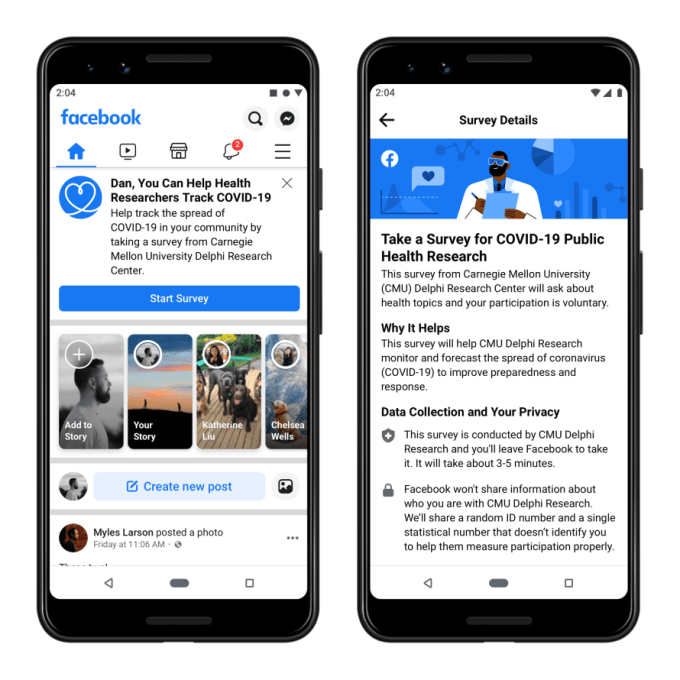
Starting today, some U.S. Facebook users will see a new pop-up on the app asking them to complete a survey about COVID-19. The survey, from Carnegie Mellon University’s Delphi epidemiological research center, is one of many new symptom mapping projects that seek to anticipate where the next wave of the virus will hit as COVID-19 sweeps through populations the world over.
As if often the case in research, the challenge for these symptom mapping efforts is attracting a large enough sample of respondents to paint a statistically meaningful picture. Carnegie Mellon’s research effort will get a big leg up from Facebook, which may promote similar surveys in different parts of the world if this one goes well.
While some other projects require users to download an app or find their way to an obscure web portal, Facebook’s promotion of the Carnegie Mellon survey means it can instantly reach a portion of users from the largest pool of online users any social network has ever collected. Facebook declined to provide details on how many users will be seeing the new prompt, but even a sub-section of Facebook’s U.S. users over the age of 18 would likely be massive from a data collection standpoint.
Many U.S. symptom tracking projects launched as the virus exploded over the last month, including a new app from Pinterest’s co-founder and others from research institutes like Harvard and New York’s Weill Cornell Medicine. The idea is that tracking self-reported symptoms could provide geographical insights that bolster the limited testing data available now.
While users might be understandably wary of a research effort promoted by Facebook, given its recently fairly notorious record on user privacy, the company’s knowledge of who you are won’t be linked to the university’s data, which will be examined in aggregate. According to Facebook’s announcement, the survey data collected will aid public health planning around resource allocation and eventually “when, where and how to reopen parts of society.”
The company announced the effort along with an expanded set of disease prevention maps, which the company will make available to researchers as part of its “Data for Good” initiative.
Social distancing requirements amid the COVID-19 pandemic may have canceled kids’ birthday parties, but parents are finding new ways to take the celebrations online. While video chat apps like Zoom, Google Hangouts or FaceTime are an option for gathering kids together in the virtual space, there’s still the challenge of what to do once there. A few companies are working to solve this challenge for parents who are looking for ideas to make their child’s birthday special in the time of COVID-19.
Sky Zone
One business that’s been heavily impacted by government-mandated retail closures is Sky Zone, the indoor trampoline park that’s home to dozens of kids’ birthday parties per day. The company operates Sky Zone parks in more than 160 locations across the U.S. and Canada, mainly to franchisees, which have now temporarily closed due to the coronavirus outbreak.
To help give back to families who still want a party while staying at home, Sky Zone has shifted its current focus to virtual birthday parties. The move not only offers parents the benefit of the hassle-free party planning that a typical events space provides, it also gives Sky Zone a way to keep employees working during the business closures.
The party, however, is not a new source to replace the business’s lost revenue or a way to make payroll. Instead, Sky Zone is offering to host the party for free to parents for up to 10 guests. Parents will have the option to tip the party host at the end of the event to support Sky Zone team members.
To request a party, parents fill out an online form with their information, then wait to hear from the Sky Zone representative who will schedule the party and create a digital invitation with a link to join the party room. Parents forward the digital invite to their friends and family however they choose. Then, on the day of the event, everyone joins the virtual party, which is hosted via Zoom.
The party itself is a 20 to 25-minute experience with the party host leading the kids through games and activities to get kids moving, like Simon Says, Dance Battles, Trivia and even teaching the kids a TikTok dance. They’ll also lead the group in singing Happy Birthday to the Guest of Honor while parents bring in the cake.
The offering was first launched on March 26, 2020 and already Sky Zone has hosted 30 parties and has more than 100 others scheduled.
The benefit of this party over a DIY group chat is that the staff hosting the party are already used to working with kids. Plus, it’s an easy way for overworked parents to get the party handled when they don’t have time to organize more time-consuming events, like a drive-by birthday parade, in-home scavenger hunt or the other alternative birthday party options some parents have turned to in this time of crisis.
Roblox
Another company venturing into the virtual party space is gaming platform Roblox.
Already a huge online hangout for kids in the pre-COVID-19 era, Roblox usage has been booming in recent weeks as kids stuck at home look for ways to socialize with both online and real-life friends in the virtual world. Today, Roblox claims more than 120 million monthly active users and is now No. 35 on App Annie’s 2020 ranking of the top 52 mobile game publishers by revenue.
The company says it was inspired by the stories of friends, family and classmates connecting on its platform during the pandemic, including those who were hosting in-game birthday parties.
Together, with its developer community, Roblox on Friday launched the new “Play Together” game sort, which makes it easier for players to find those games where you socialize with others — like visiting a virtual shopping mall, going camping or riding virtual water slides, for example. The games in the Play Together game sort also offer VIP servers for 10 Robux (10 cents). That allow users to play with family, friends, classmates and others they choose in a private virtual space — like a virtual birthday party.
To create a VIP server, you first visit the individual game’s page on Roblox, then click on the “Servers” tab and then the button “Create VIP Server.” Give your server a name, then invite others using the link provided. (Note that this is opting you into a subscription, so you’ll need to cancel it after the party ends — unless you want to retain the option to have private playspaces like this going forward.)
If you can’t figure out this process, trust me that your child can show you the ropes here.
While Roblox is popular with both boys and girls alike, a private match on Fornite is an alternative for some parents. The majority of Fornite players (roughly 73%) are male, so this could be an option for non-coed parties, for instance.
Caribu
For younger children and toddlers whose virtual party may only involve gathering together extended family — like grandparents, aunts, uncles and cousins, for example — there’s Caribu.
The family-friendly video calling app helps little ones get over their awkwardness about chatting online by offering a variety of in-app activities. For birthday parties, Caribu’s paint and drawing feature could be a fun, mess-free activity. The app also includes other simple games like Tic-Tac-Toe, interactive word puzzles and word searches.
To help keep families connected during the COVID-19 pandemic, AT&T is sponsoring 60 days of free access and unlimited use of the Caribu app, which offers in-app subscriptions for its full content library, which includes kids’ e-books.
Houseparty
For tweens and teens, the group video chat app Houseparty is another option that works across mobile and desktop.
Houseparty has also seen significant growth due to coronavirus-related lockdowns and home quarantines, particularly in Europe. During the week of March 21, Houseparty downloads surged at 423 times the average weekly number of downloads in Q4 2019.
What makes Houseparty an option for a virtual party experience is that it’s not just another way to group chat — friends can play online games in the chat, including Heads Up!, Trivia, Chips and Guac and Quick Draw. These are free to play, though there is an option to purchase more decks through in-app purchases for some games.
Evites with built-in video chat
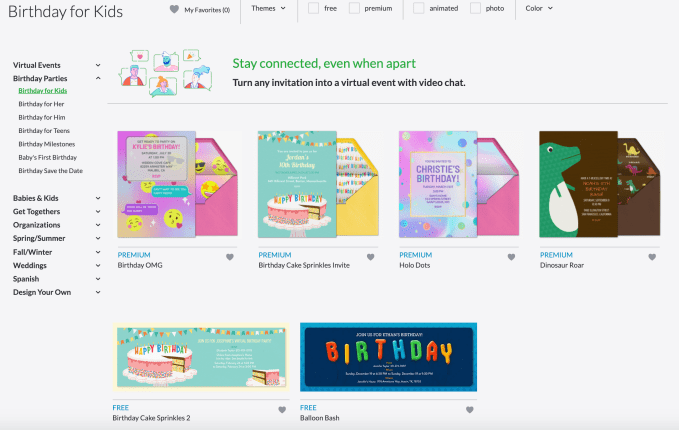
Even if you do choose to go the DIY route to host a simple FaceTime, Google Hangouts, Zoom or Skype video chat, there are ways to make the invite more special than just a text. For example, the digital invitations service Evite has updated its app and website to now allow party hosts to add a video chat link to their personalized invite.
The company is also beta testing its own Evite video chat, which is a more integrated option that allows up to eght guests to be able to join from a tab within the invite.
Hobnob’s digital invites app has also updated to make it easier for friends to send invitations for online-only events through Zoom, Facebook Live and YouTube Live.
This free online tool lets you customize your Zoom video call invite URL with a title, explanation, image and RSVP requirement. This latter RSVP feature means that only those you’ve specifically invited via email will be able to access the provided link and join.
While a Facebook Live stream may not have a party host like Sky Zone, or built-in options to play games like Caribu or Houseparty, it does offer an easy way to share a celebration happening at home with others. Though children won’t have their own Facebook account (hopefully!), parents can send out invites to the parents of the child’s friends or family members through a Facebook Group invite, for instance, or by posting a message about the virtual party on their own profile. Participants can then watch the stream together as the child opens gifts left on the porch (and wiped down) and celebrates at home with family.
While technology can help to facilitate these virtual events, parents can take extra steps to make a virtual party special. Some local businesses that used to send characters — like superheroes or Disney princesses — to kids’ birthday parties are now offering to record video messages or even join a virtual party the parent is hosting. Neighbors and friends can decorate the yard or leave chalk messages. Surpriseballoon drops, car parades, scavenger hunts and other activities can make the party memorable for other reasons besides being the child’s first quarantine birthday.
Looks like things haven’t gone completely smoothly with Quibi‘s launch.
The issue appears to have been resolved, but the Quibi customer support account tweeted this afternoon that “some users may be experiencing problems with the Quibi app,” only to add an hour later that “Users should once again be able to use the Quibi app normally. Thank you for your patience.”
It’s not clear how widespread the outage was, but according to The Verge, one staffer saw an error screen and was unable to browse the app, while another was another to create an account. The app seems to be working normally as I write this shortly after 4pm Eastern.
A quick catch-up for those of you still wondering what Quibi even is: It’s a short-form video service founded by Hollywood executive Jeffrey Katzenberg and led by CEO Meg Whitman (previously CEO of Hewlett Packard Enterprise and eBay).
The app is launching with nearly 50 shows today, all of them created specifically for mobile, with episodes that are less than 10 minutes long. After a 90-day free trial, it’ll cost you $4.99 with ads or $7.99 per month without ads.
It has the simplest name but the sort of shadowy overtones that national security writers lust after.
Team Telecom, a mostly informal working committee of the Departments of Defense, Homeland Security, and Justice (along with affiliated agencies) has for years been quietly tasked with evaluating and maintaining the security of America telecom infrastructure in concert with the FCC. Its primary objective as far as we have been able to ascertain is to monitor the ownership of key telecom assets to ensure they don’t fall into the hands of suspect nations (think China, Russia, etc).
That informal arrangement is disappearing, as the administration over the weekend published a new executive order formally instantiating Team Telecom as a legal process for reviewing applications for telecom licenses, deals, and other requests made to the FCC.
Under a newly-christened “Committee for the Assessment of Foreign Participation in the United States Telecommunications Services Sector” (CAFPUSTSS?), the Committee will be charged with assisting “the FCC in its public interest review of national security and law enforcement concerns that may be raised by foreign participation in the United States telecommunications services sector.”
Like its Team Telecom forerunner, the Committee will be made up of the heads of Justice, Defense, and Homeland Security, with the Attorney General playing the role of chair. Applications to the Committee will be referred to the U.S. government’s highest-ranking intelligence officer, the Director of National Intelligence, for analysis.
Unlike in the past where the timeline for reviews was anything but standardized, the executive order provides for a 120-day adjudication process, with a 90-day extension if the Committee has additional concerns and goes through a secondary review.
In a brief press statement, FCC Chairman Ajit Pai said, “I applaud the President for formalizing Team Telecom review and establishing a process that will allow the Executive Branch to provide its expert input to the FCC in a timely manner.” The FCC intends to finish its own rulemaking around Team Telecom, a process which was first proposed at the tail end of the Obama administration and has been on-going ever since.
These reforms to Team Telecom are in line with similar reforms made to CFIUS, the Committee for Foreign Investment in the United States, which were finalized at the beginning of this year after Congress passed a reform bill in 2018.
While the new rules will provide some certainty to areas of telecom like fiber optic cable expansion and wireless services, expect the new rules to be used to put even more restrictions of countries like China hoping to get a slice of the U.S. infrastructure market. Indeed, in the FCC’s statement today, the agency said “As we demonstrated last year in rejecting the China Mobile application, this FCC will not hesitate to act to protect our networks from foreign threats.”



















 The party itself is a 20 to 25-minute experience with the party host leading the kids through games and activities to get kids moving, like Simon Says, Dance Battles, Trivia and even teaching the kids a TikTok dance. They’ll also lead the group in singing Happy Birthday to the Guest of Honor while parents bring in the cake.