18 September 2019

Facebook launches Portal TV, a $149 video chat set-top box


Facebook wants to take over your television with a clip-on camera for video calling, AR gaming, and content co-watching. If you can get past the creepiness, the new Portal TV let you hang out with friends on your home’s biggest screen. It’s a fresh product category that could give the social network a unique foothold in the living room where unlike on phones where it’s beholden to Apple and Google, Facebook owns the hardware and operating system.

Today Facebook unveiled a new line of Portal devices that bring its auto-zooming AI camera, in-house voice assistant speaker, Alexa, apps like Spotify and newly added  Amazon Prime Video, Messenger video chat, and now end-to-end encrypted WhatsApp video calls to smaller form factors.

The $149 Portal TV is the star of the show, turning most televisions with an HDMI connection into a video chat smart screen. And if you video call between two Portal TVs, you can use the new Watch Together feature to co-view Facebook Watch videos simultaneously while chilling together over picture-in-picture. The Portal TV is genius way for Facebook to make its hardware both cheaper yet more immersive by co-opting a screen you already own and have given a space in your life, thereby leapfrogging smart speakers like Amazon Echo and Google Home.

There’s also the new pint-size 8-inch Portal Mini for just $129, which makes counter-top video chat exceedingly cheap. The 10-inch Portal that launched a year ago now has a sleeker, minimal bezel look with a price drop for $199 to $179. Both look more like digital picture frames, which they are, and can be stood on their side or end for optimal full-screen chatting. Lastly, the giant 15.6-inch Portal+ swivel screen falls to $279 instead of $349, and you still get $50 off if you buy any two Portal devices.
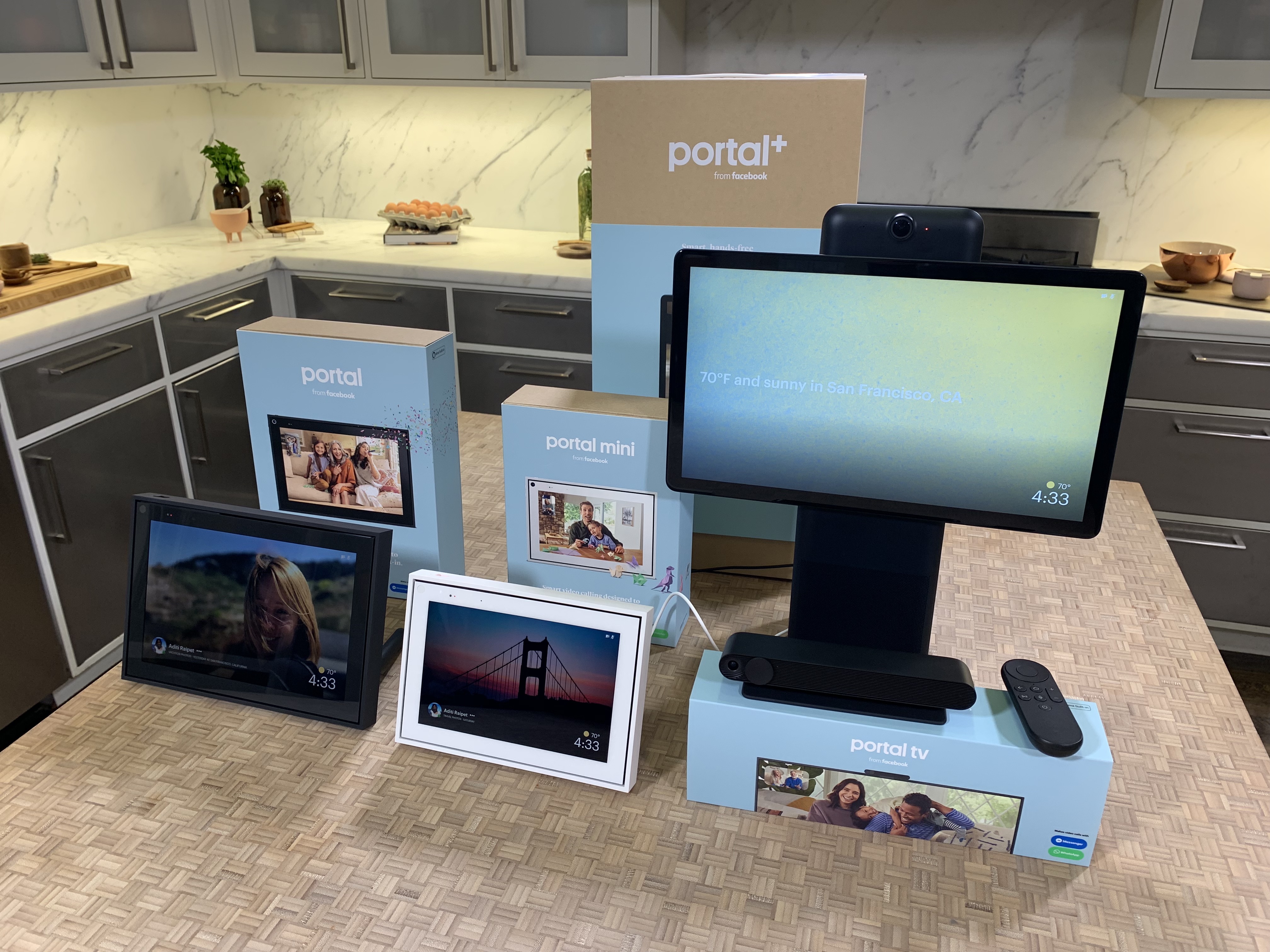
Facebook Portal Lineup

“The TV has been a staple of living rooms around the world, but to date it’s been primarily about people who are physically interacting with the device” says  Facebook’s VP of consumer hardware Andrew ‘Boz’ Bosworth. “We see the opportunity for people to use their TVs not just to do that but also to interact with other people.”

The new Portals all go on pre-sale today from Portal.facebook.com, Amazon, and Best Buy in the US and Canada plus new markets like the UK, Australia, New Zealand, Spain, Italy, and France (though the Hey Portal assistant only works in English). Portal and Portal Mini ship October 15th and Portal TV ships November 5th.
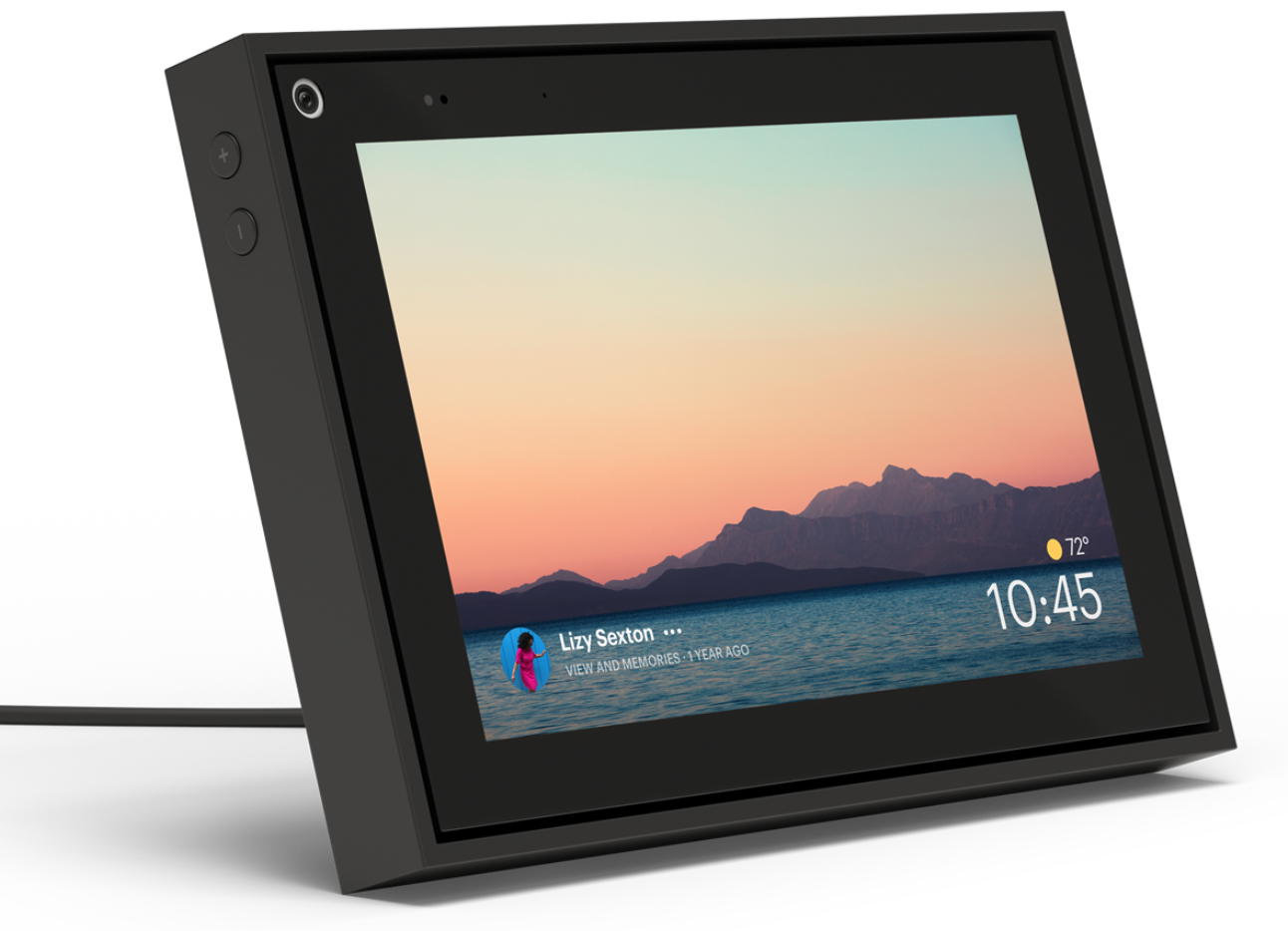
Portal Mini Black

The whole Portal gang lack essential video apps like Netflix and HBO, and Boz claims he’s not trying to compete directly with Roku, Fire TV etc. Instead, Facebook is trying to compete where it’s strongest, on communication and video chat where rivals lack a scaled social network.

“You’re kind of more hanging out. It isn’t as transactional. It’s not as urgent as when you sacrifice your left arm to the cause” explains Boz. Like how Fortnite created a way for people to just chill together while gaming remotely, Portal TV could do the same for watching television together, apart.

Battling The Creepiness

The original Portal launched a year ago to favorable reviews except for one sticking point: journalists all thought it was too sketchy to bring Facebook surveillance tech inside their homes. Whether the mainstream consumer feels the same way is still a mystery as the company has refused to share sales numbers. Though Boz told me “The engagement, the retention numbers are all really positive”, we haven’t seen developers like Netflix rush to bring their apps to the Portal platform.

To that end, privacy on Portal no longer feels clipped on like the old plastic removeable camera covers. “We have to always do more work to grow the number of people who have that level of comfort, and bring that technology into their home” says Boz. “We’ve done what we can in this latest generation of products, now with integrated camera covers that are hardware, indicator lights when the microphone is off, and form factors that are less obtrusive and blend more into the background of the home.”
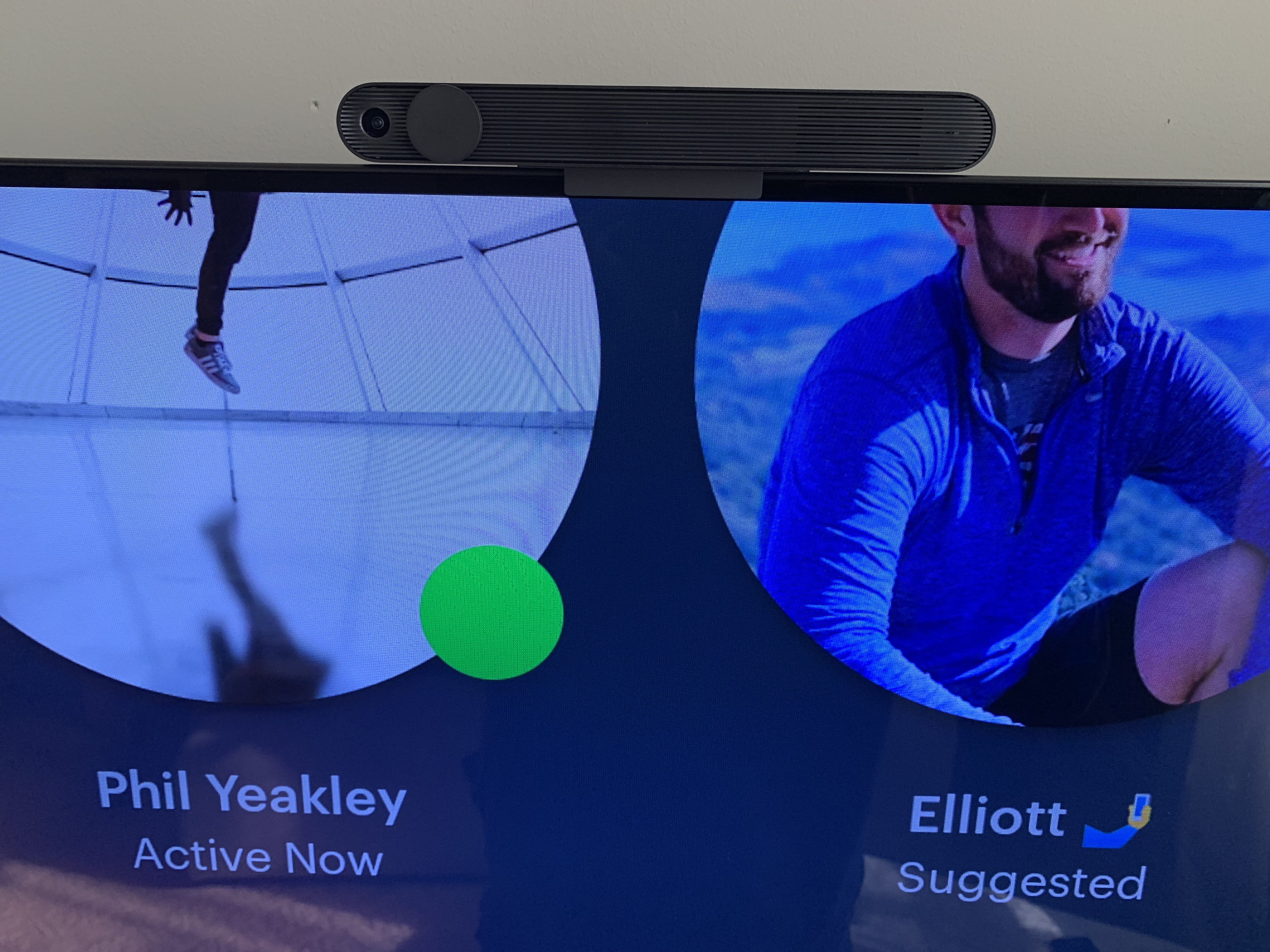
Portal TV Closeup

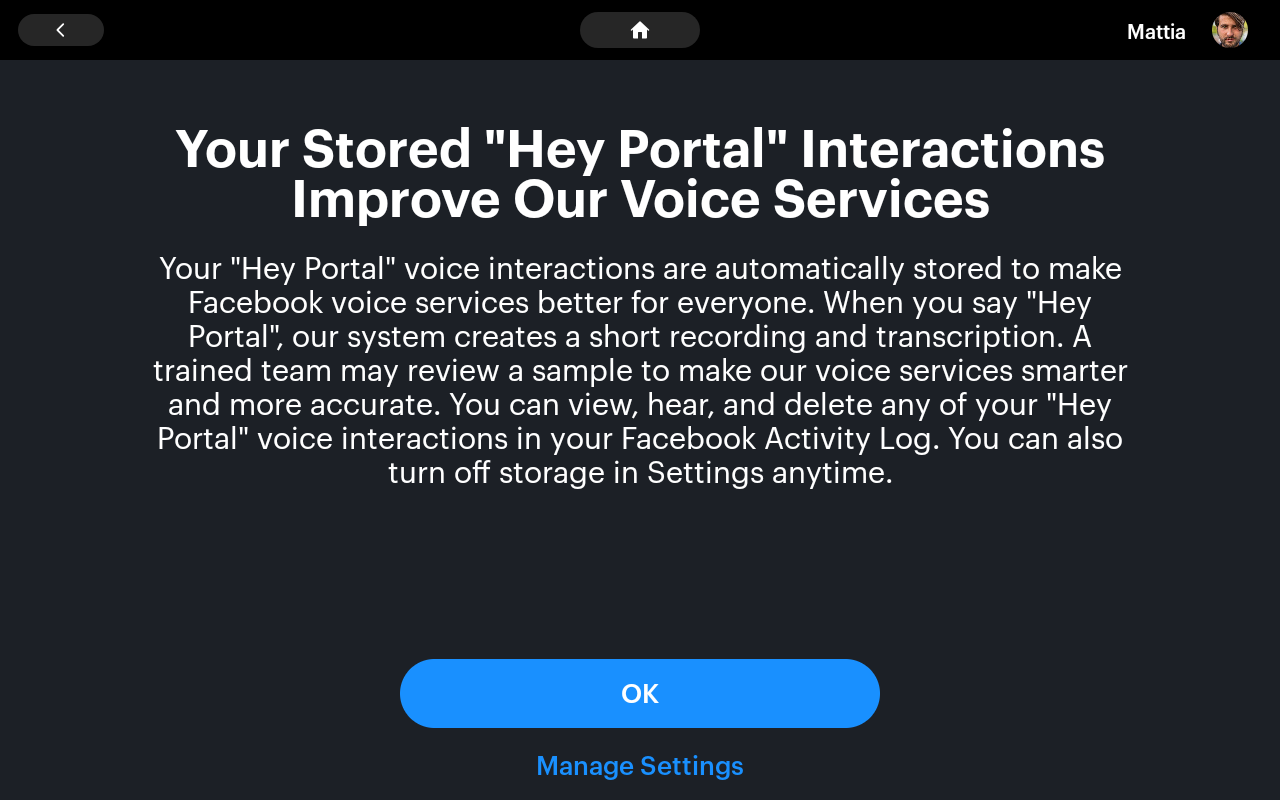
One major change stems from a scandal that spread across the tech sector, with Apple, Google, Amazon, and Facebook all being criticized for quietly sending voice clips to human reviewers to improve speech recognition in what felt like a privacy violation. “Part of the Portal out-of-box experience is going to be a splash screen on data storage and it will literally walk through how . . . when we hear ‘hey Portal’ a voice recording and transcription is sent, it may be reviewed by humans, and people have the ability to opt out.”

But if Portal if battling the perception of creepiness, why make human reviews the default? Boz defended the call from the perspective of accessibility. “We say ‘oh they’re good enough” but for a lot of people that might have a mild speech impedentment, a subtle accent, who might use different words because they’re from a different region, these assistants aren’t inclusive.” He claims more voice data reviewed by humans means better products for everyone, though better sales for Facebook wouldn’t hurt.
Portal Privacy Set Up Notice Screen

Instead, Facebook is leaning on the evolution of the smart screen market in general to help its camera blend in. “The more value we can create, not just any one player but as an entire industry, that allows consumers to feel – ‘yeah, I both am comfortable with how the data is being used and why’.”

Hands-On With The New Portals

If you can get past Facebook’s toxic brand, the new Portals are quite pleasing. They’re remarkably polished products for a company just a year into selling consumer hardware. They all feel sturdy and elegant enough to place in your kitchen or living room. The Portal and Portal Mini work just like last year’s models, but without the big speaker bezel, they can be flipped on their side and look much more like picture frames while running Portal’s Smart Frame showing your Facebook, Instagram, or Camera roll photos.
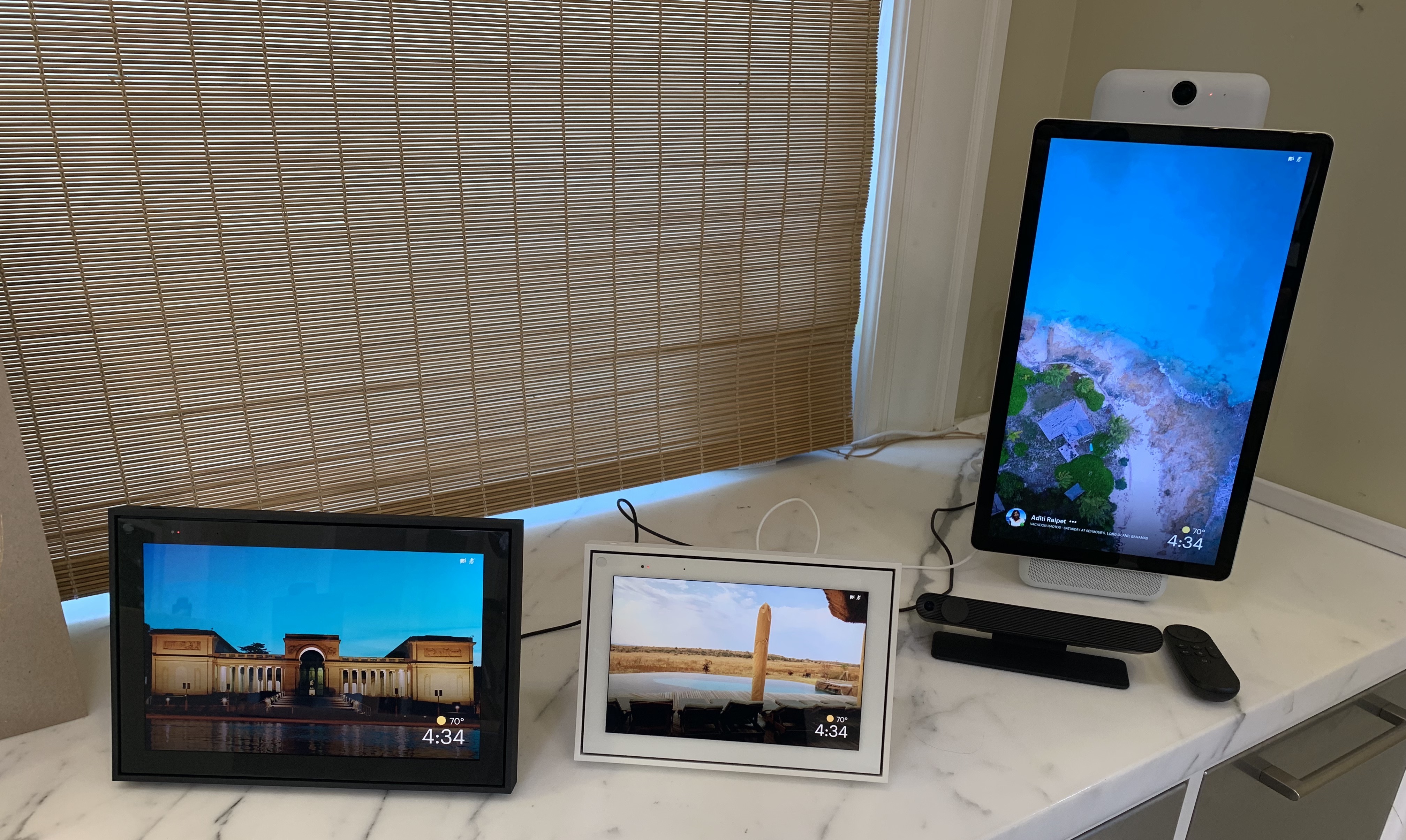
Portal Mini Portal TV

Portal TV’s flexible form factor is a clever innovation, first spotted as “Codename: Ripley” by Jane Manchun Wong and reported by Alex Heath for Cheddar a year ago. It has an integrated stand for placing on your TV console, but that stand also squeezes onto a front wing to let it clip onto both wide and extremely thin new flatscreen televisions. With just an HDMI connection it brings a 12.5 megapixel, 120-degree camera and 8 mic array to any tube. It also ships with a stubby remote control for basic browsing without having to shout across the room. TechCrunch.

Portal TV includes an integrated smart speaker that can be used even when the TV is off or on a different input, and offers HDMI CEC for control through other remotes. The built-in camera cover gives users piece of mind and a switch conjures a red light to signal that all sensors are disabled. Overall, control felt a tad sluggish but passable.
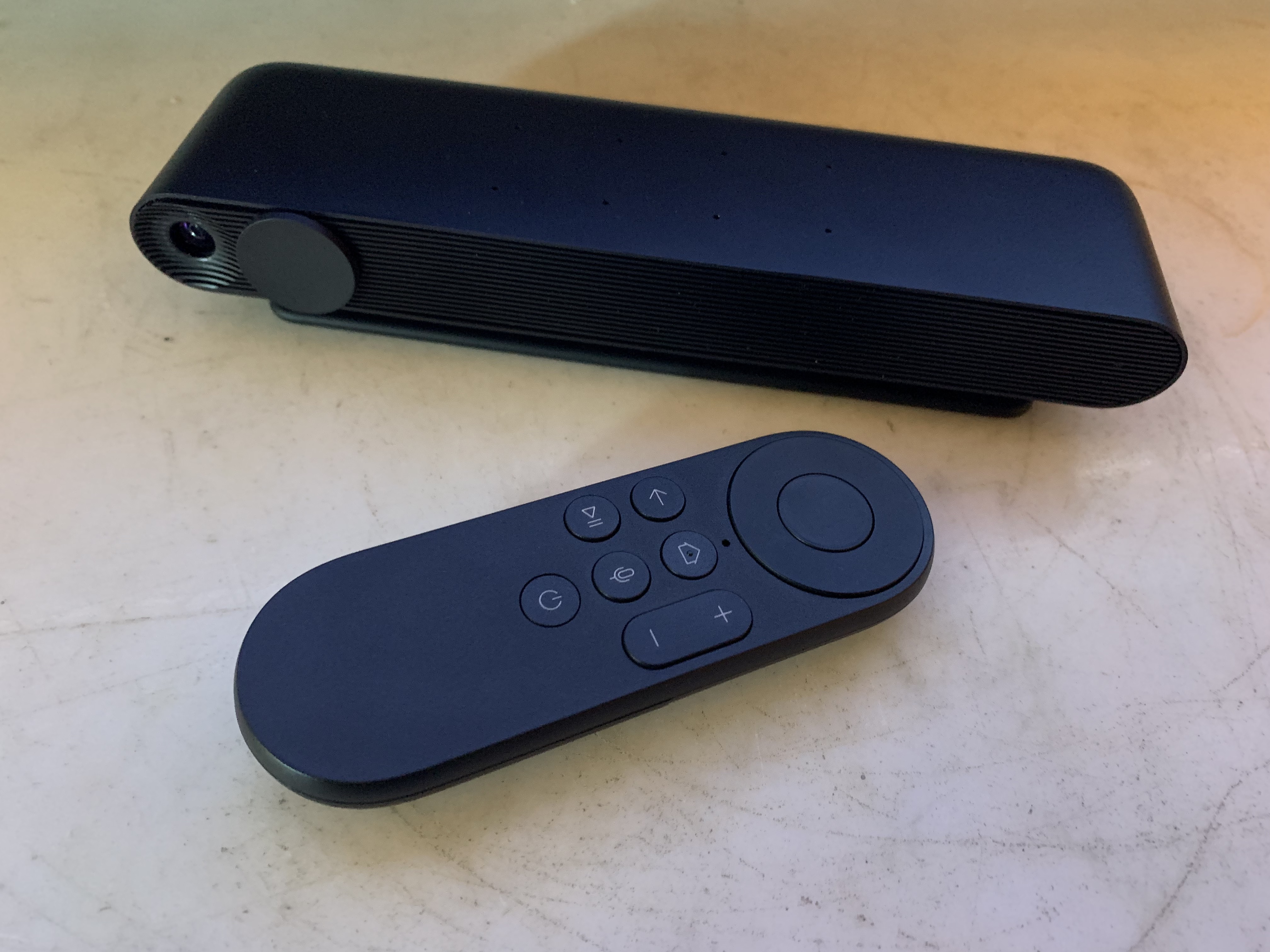
Portal TV and Remote

Portal’s software is largely the same as before with a few key improvements, the addition of WhatsApp, and one big bonus feature for Portal TVs. The AI Smart Camera is the best part, automatically tracking multiple people to keep everyone in frame as zoomed in as possible. Improved adaptive background modeling and human pose estimation lets it keep faces in view without facial recognition, and all video processing is done locally on the device. A sharper Spotlight feature lets you select one person, like a child running around the room so you don’t miss the gymnastics routines.

The Portal app platform that features Spotify and Pandora is gaining Amazon’s suite of apps, starting with Prime Video while Ring doorbell and smart home controls are on the way. Beyond Messenger calls and AR Storytime where you don related AR masks as you read aloud a children’s book, there are new AR games like Cats Catching Donuts With Their Mouths. Designed for kids and casual players, the games had some trouble with motion tracking and felt too thin for more than a few seconds of play. But if Facebook gave Portal TV a real controller or bought a better AR games studio, it could dive deeper into gaming as a selling point.
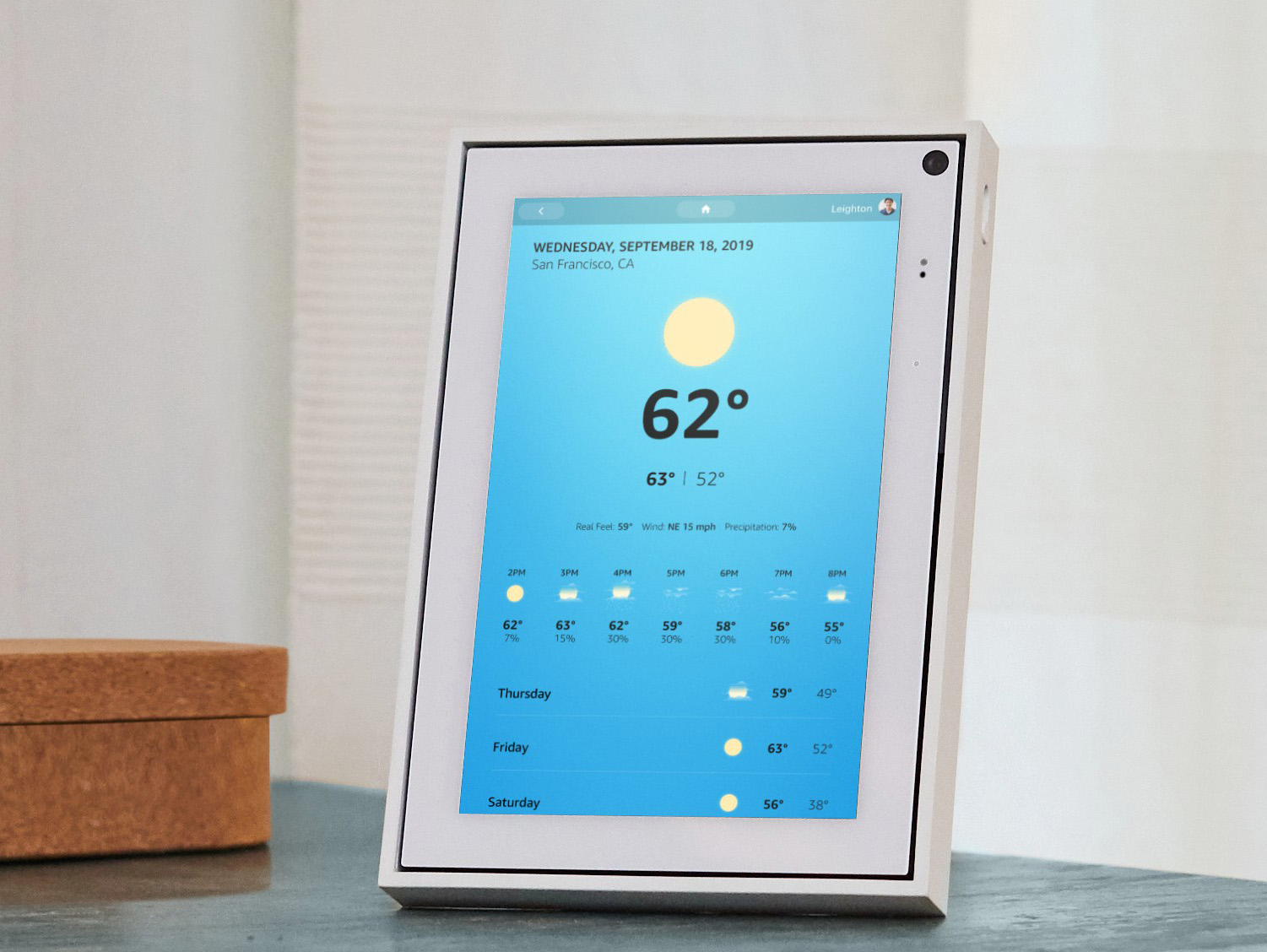
Portal Mini Alexa

WhatsApp is the top new feature for all the Portals. Though you can’t use the voice assistant to call people, you can now WhatsApp video chat friends with end-to-end encryption rather than just Messenger’s encryption in transit. The two messaging apps combined give Portal a big advantage over Google and Amazon’s devices since their parents have screwed up or ignored chat over the years. Still, there’s no way to send text messages which would be exceedingly helpful.

Reserved for Portal TV-to-Portal TV Messenger chats is the new Watch Together feature we broke the news of a year ago after Ananay Arora spotted it in Messenger’s code. This lets you do a picture-in-picture video chat with friends while you simultaneously view a Facebook Watch video. It even smartly ducks down the video’s audio while friends are talking so you can share reactions. While it doesn’t work with other content apps like Prime Video, Watch Together shows the potential of Portal: passive hang out time.
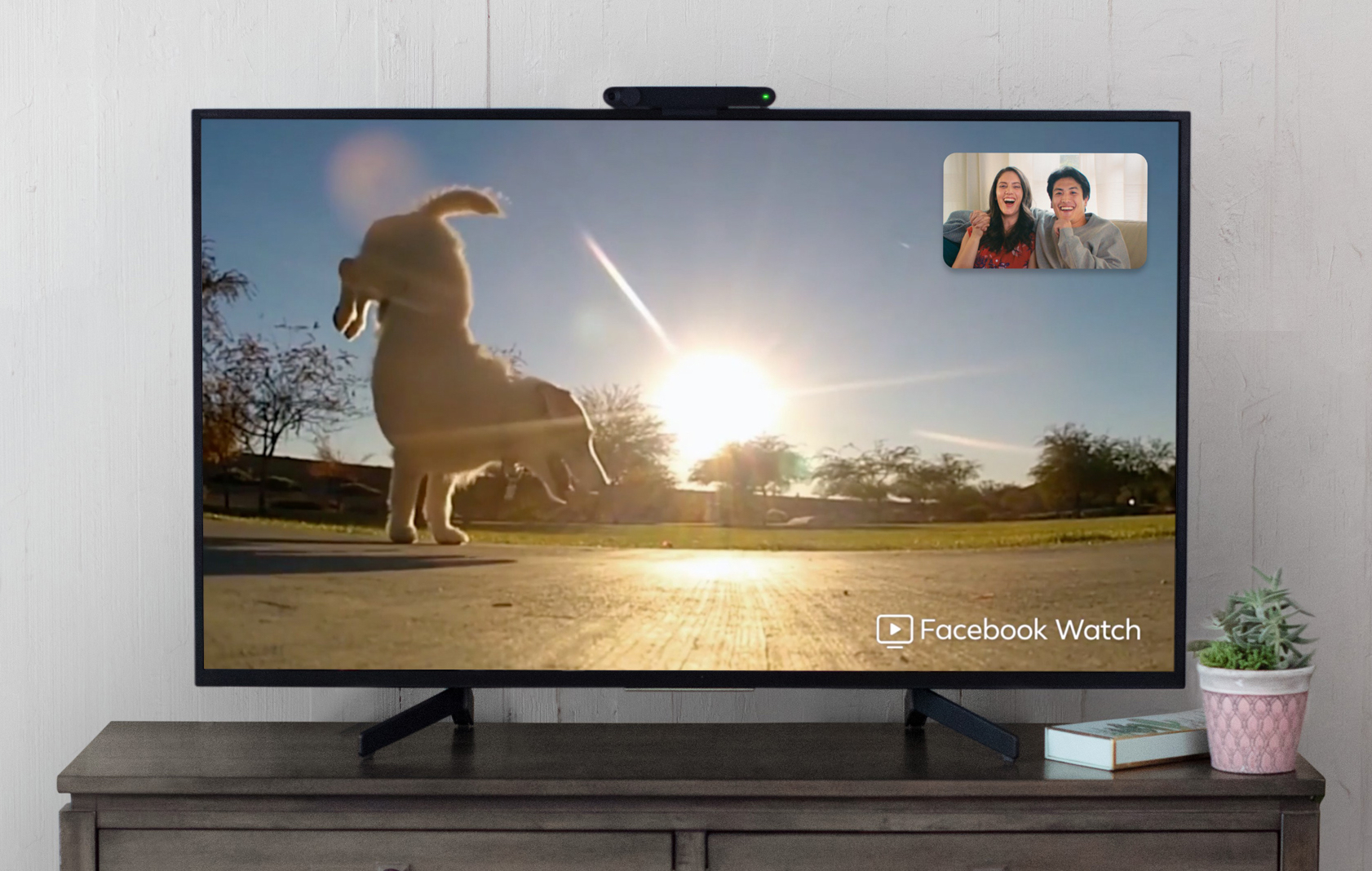
PortalTV CoWatching

“Have you ever thought about how weird bowling is, Josh? Bowling is a weird thing to go do. I enjoy bowling, I don’t enjoy bowling by myself that much. I enjoy going with other people” Boz tells me. “It’s just a pretext, it’s some  reason for us to get together and have some beers and to have time and have conversation. Whether it’s video calling or the AR games . . . those are a pre-text, to have an excuse to go be together.”

This is Portal’s true purpose. Facebook has always been about time spent, getting deeper into your life, and learning more about you. While other companies’ products might feel less creepy or be more entertaining, none have the ubiquitous social connection of Facebook and Portal. When your friends are on screen to, a mediocre game or silly video is elevated into a memorable experience. With Portal TV, Facebook finally has something unique enough to offset its brand tax and earn it a place in your home.


Read Full Article

DxOMark’s night and wide-angle camera tests push today’s smartphones to their limits


Sure, you could take Apple’s word for it that the new iPhone’s cameras are amazing — or you could let some obsessive pixel-peepers perform some (mostly) objective tests and really get into the nitty-gritty. Pixel peepers in extraordinary DxOMark are here to help, with new tests focused on evaluating the latest gadgets’ night modes and ultra-wide-angle lenses.

The site’s already extensive image quality tests cover the usual aspects of a smartphone camera — color representation, exposure, noise, all that. But the latest devices are making advances in new directions that aren’t adequately covered by those tests; Namely the emergence of “night mode” shooting and multi-lens setups like the iPhone 11 Pro and its hulking rear camera assembly.

Therefore the tests must change! And DxOMark has begun including extremely nitpicky breakdowns of camera performance in the particularly difficult circumstances of extreme low light and extreme wide angle photography.

nightshots

Night shots are graded on detail, noise, color reproduction — the kinds of things that tend to be lost in low light. Wide angle shots are graded on distortion, detail throughout the frame, and chromatic aberration — all difficult to correct for.

Some devices may be great in one area but poor in another, for example trading too much detail for lower noise in a night shot but getting great color. A higher score may indicate a better overall camera, but if you care about your phone photography you should look into what goes into that score as well. I for one never plan to use these ultra-wide cameras, so I can ignore that category altogether!

Now, this is an interesting area to grade such cameras in, and difficult one, because so much of the work is being done in software. As I’ve noted, the future (and of course the present) of photography is code, and without code there would be no night mode or ultra-wide angle shots.

The image stacking and denoising that allow low-light photography, and the speed of things like perspective correction and other tricks that allow a nearly fisheye lens to look relatively normal, are consequences of massive improvements in image processing efficiency and huge jumps in processing power. And they’ll only get better, even for a given camera-sensor-processor combo.

So DxOMark may find itself revising these scores — which are themselves being mapped retroactively onto reviews already posted: Low light performance is replacing the flash performance category, and wide angle is a new score.

The first phones to get the new treatment are the Samsung Galaxy S10 and Note 10+, the Huawei P30 Pro, a handful of others, and of course the new iPhones. No doubt the upcoming Pixel 4 will be a contender as well, especially in the night mode category.

It’s good to know someone is systematically testing these aspects of phones with a critical eye. Watch for the updated tests and listings on DxOMark starting today.


Read Full Article

DxOMark’s night and wide-angle camera tests push today’s smartphones to their limits


Sure, you could take Apple’s word for it that the new iPhone’s cameras are amazing — or you could let some obsessive pixel-peepers perform some (mostly) objective tests and really get into the nitty-gritty. Pixel peepers in extraordinary DxOMark are here to help, with new tests focused on evaluating the latest gadgets’ night modes and ultra-wide-angle lenses.

The site’s already extensive image quality tests cover the usual aspects of a smartphone camera — color representation, exposure, noise, all that. But the latest devices are making advances in new directions that aren’t adequately covered by those tests; Namely the emergence of “night mode” shooting and multi-lens setups like the iPhone 11 Pro and its hulking rear camera assembly.

Therefore the tests must change! And DxOMark has begun including extremely nitpicky breakdowns of camera performance in the particularly difficult circumstances of extreme low light and extreme wide angle photography.

nightshots

Night shots are graded on detail, noise, color reproduction — the kinds of things that tend to be lost in low light. Wide angle shots are graded on distortion, detail throughout the frame, and chromatic aberration — all difficult to correct for.

Some devices may be great in one area but poor in another, for example trading too much detail for lower noise in a night shot but getting great color. A higher score may indicate a better overall camera, but if you care about your phone photography you should look into what goes into that score as well. I for one never plan to use these ultra-wide cameras, so I can ignore that category altogether!

Now, this is an interesting area to grade such cameras in, and difficult one, because so much of the work is being done in software. As I’ve noted, the future (and of course the present) of photography is code, and without code there would be no night mode or ultra-wide angle shots.

The image stacking and denoising that allow low-light photography, and the speed of things like perspective correction and other tricks that allow a nearly fisheye lens to look relatively normal, are consequences of massive improvements in image processing efficiency and huge jumps in processing power. And they’ll only get better, even for a given camera-sensor-processor combo.

So DxOMark may find itself revising these scores — which are themselves being mapped retroactively onto reviews already posted: Low light performance is replacing the flash performance category, and wide angle is a new score.

The first phones to get the new treatment are the Samsung Galaxy S10 and Note 10+, the Huawei P30 Pro, a handful of others, and of course the new iPhones. No doubt the upcoming Pixel 4 will be a contender as well, especially in the night mode category.

It’s good to know someone is systematically testing these aspects of phones with a critical eye. Watch for the updated tests and listings on DxOMark starting today.


Read Full Article
Amazon’s Alexa now understands Hindi


Only about 10% of India’s 1.3 billion people know English. Yet, that is the only language Amazon’s digital assistant Alexa understands in the nation. That changes today.

At a press conference in New Delhi on Wednesday, the e-commerce giant said Alexa now supports Hindi, a language spoken by roughly half a billion people in India. Bringing support for Hindi to Alexa has been more than a year in making, company executives said, noting the unique contextual, cultural, and content-related challenges the Hindi implementation posed.

Users can now ask Alexa their commands in Hindi, and the digital assistant would be able to respond in the same language. The feature is now live from the app settings. In the months to come, Amazon plans to add multilingual households support, allowing members in the family to interact with Alexa in the language their prefer.

Support for local languages has proven immensely beneficial to customers in the past, Manish Tiwari, head of devices category business for Amazon India, said at the event. Amazon last year introduced support for Hindi language on its apps and website. Since then, it has seen Hindi usage grow on the site by six times, he said.

“The adoption of Alxa in India has been phenomenal,” said Rohit Prasad, VP and Head Scientist, Alexa AI Amazon. Alexa has supported some Hinglish words, combination of English and Hindi, but the company wanted to bring full-fledged support. “A lot of how people in India engage with their smartphones and internet services is different from those of the people in the United States. For instance, in India, people often use the name of an actor instead of singer or band when looking for particular songs,” he added.

alexa hindi

The announcement comes months after Amazon added a Hindi voice model to its Alexa Skills Kit, enabling developers to update their skills in India to support the more popular local language. Google smart speakers gained support for Hindi language late last year.

Amazon says it offers it offers over its Alexa customers in India over 30,000 skills across various categories including cricket, education, and Bollywood. The company’s voice assistant is available to users through its smart speakers — Echo Dot, Echo Plus and more — and over three-dozen devices from other manufacturers including Sony, iBall, and LG, the company said.

Hindi should also help Amazon’s smart speakers maintain their lead over Google’s in India. Amazon commanded the local smart speakers market with a 59% market share in 2018, according to research firm IDC. (Google launched its smart speakers in India months after Amazon did its. IDC has not updated its findings since March this year.)

More to follow…


Read Full Article
IFA Predictions, Google Memories, Can You Trust Huawei?, Dark Web Accounts


safely-clean-airpods

James Frew joins Christian Cawley to assess the latest tech news that matters in the Really Useful Podcast, the tech podcast for technophobes.

This week’s slightly longer show features a mini debriefing on IFA and what products impressed, and we also look at whether you can trust Huawei products, the Google Photos Memories feature, how to clean your EarPods, and how your accounts are sold on the Dark Web.

Really Useful Podcast Season 4 Episode 3 Shownotes

This week:

This Really Useful Podcast was hosted by Christian Cawley and James Frew. You can follow them both on Twitter for tech tips and thoughts:

Know someone who would would benefit from some clarity about tech and how to use it smarter? Share this podcast with them! Just point them to the Really Useful Podcast on:

If you enjoyed this show, don’t forget to subscribe to the Really Useful Podcast today!

Read the full article: IFA Predictions, Google Memories, Can You Trust Huawei?, Dark Web Accounts


Read Full Article

The Rockstar Games Launcher Comes With a Free GTA Game


Rockstar has launched its own PC games launcher called the Rockstar Games Launcher. The Rockstar Games Launcher allows Rockstar to offer its games (and microtransactions) directly to gamers, avoiding the need to go through a storefront such as Steam.

There are already a host of PC game launchers available, so why would you install the Rockstar Games Launcher? To get a free game, basically, with Rockstar offering a free copy of Grand Theft Auto: San Andreas to everyone who installs it.

How to Start Using the Rockstar Games Launcher

The Rockstar Games Launcher lets you purchase and install the latest Rockstar Games titles. While not all games are available at launch you can already buy GTA V, GTA 3, GTA: Vice City, Bully: Scholarship Edition, L.A. Noire, and Max Payne 3.

Here’s how to download and install the Rockstar Games Launcher:

  1. Go to the Rockstar Games Launcher website.
  2. Click “Download for Windows”.
  3. Open the installer and follow the instructions.
  4. If you don’t already have one, create a Rockstar Social account.
  5. Launch the Rockstar Games Launcher and log in.

To get your free copy of Grand Theft Auto: San Andreas, click the banner at the top of the welcome page. Complete the transaction, and the game will be added to your library. You can then play one of the best GTA games of all time completely for free.

The Best Free PC Games to Play Right Now

As well as giving you a free game and letting you purchase other titles, the Rockstar Games Launcher will also pull all of your Rockstar Games titles together in one place. There’s also cloud saves for certain titles, and automatic updates for games.

The fact that the Rockstar Games Launcher bags you a free copy of GTA: San Andreas makes it a no-brainer. Which is exactly why Rockstar included it. And once you’ve finished playing San Andreas you should check out the best free PC games to play right now.

Read the full article: The Rockstar Games Launcher Comes With a Free GTA Game


Read Full Article

The portrait of an avatar as a young artist

7 Free PowerPoint Alternatives for Your Presentation Needs


powerpoint-alternatives

Microsoft PowerPoint is fantastic and there are good reasons why it’s the industry standard presentation tool for schools and businesses: it’s standard, it’s easy, it works, and it has a bunch of nifty templates that make presentations simpler to create.

But there are also reasons why you might not need an alternative to Microsoft PowerPoint. For example, you probably shouldn’t buy Microsoft Office. It’d be smarter to get an Office 365 subscription, but that will still cost you.

Fortunately, there are free PowerPoint alternatives! None of them are quite as good, but many of them are good enough for most users—especially if you aren’t in a business setting. Here are the best free alternatives to Microsoft PowerPoint.

1. LibreOffice Impress

LibreOffice is the best free alternative to Microsoft Office. It has improved a lot over the years, putting it on par with Microsoft Office in many ways—and the best part is that it’s 100% free, open-source, and cross-platform, making it one of the best Linux presentation tools.

LibreOffice Impress is LibreOffice’s analog to Microsoft’s PowerPoint. With it, you can create all kinds of slide-based multimedia presentations that can be viewed in several ways: regular editing, outline mode, annotated slides, and even a handout mode for printing presentations to paper.

Impress supports all PowerPoint formats—PPS, PPT, PPTX—and it also supports a handful of other open formats and standards.

2. Google Slides

presentation-tool-google-slides

Google Slides has been a solid alternative to Microsoft PowerPoint for several years now. (Prior to 2012, it was known as Google Presentations.) As with Google Docs and Google Sheets, Google Slides is an online web app.

It’s 100% free, supports templates, allows you to create/edit/manage from anywhere with internet access, comes with mobile apps (Android, iPhone), supports real-time collaboration and annotations, and converts flawlessly back and forth when used in conjunction with Microsoft PowerPoint.

We highly recommend Google Slides if you’re already in Google’s cloud ecosystem. Meaning, if you’re already using Google Drive, Docs, and Sheets, you may as well use Google Slides. Check our our guides on creating a presentation in Google Slides and using custom gradients in Google Slides.

3. Zoho Show

Zoho is another office suite in line with Microsoft Office and LibreOffice, but it’s more of an in-between for the two. It’s not 100% free and open-source like LibreOffice is, but it does come with a free option. If you want to unlock advanced features, you’ll have to subscribe like with Office 365.

Zoho Show is this office suite’s presentation tool, and it’s a web app so it’s most similar to PowerPoint Online. The beauty of it is that you can create, edit, and manage your presentations from anywhere with internet access, and you can collaborate in real-time too.

Not only can Zoho Show import several common file formats—PPS, PPT, PPTX, PPSX, ODP, and SXI—you can also rest assured that every bit of presentation formatting will remain true-to-view, no matter which format you use. No distorted layouts or misaligned images!

You can also publish presentations on the web.

4. SlideDog

Maybe options like Microsoft PowerPoint and Google Slides are too complex for what you need. Or maybe they’re too traditional and stuffy. SlideDog is the presentation tool for anyone who wants an alternative that’s modern yet easy.

With SlideDog, you can take all kinds of media—images, videos, PDFs, websites, and even PowerPoint or Prezi files—and stitch them together in a seamless way. It’s perfect for simple and straightforward image-to-image presentations.

What’s even cooler is that you can liveshare your SlideDog presentation and anyone can watch over the internet in real-time. They can ask questions, comment on slides, and even vote in polls. It’s an awesome way to get immediate feedback on what you’re presenting.

The free version of SlideDog is available indefinitely. Advanced features like custom backgrounds, dual screen mode, liveshare, and audience interaction cost $49 per presentation event or $99/year for unlimited presentations.

5. Visme

Visme isn’t a dedicated presentation tool, but you can create presentations with it. The goal of Visme is to make it easy for you to translate ideas into engaging content: presentations, infographics, reports, and more.

Visme comes with its own online editor and hundreds of templates to get you started in just minutes. You can change everything—fonts, backgrounds, colors, images—and you can publish your results on the web, offline, or save as a PDF.

The downside is that you can’t import from Microsoft PowerPoint or export to Microsoft PowerPoint. And even though anyone can publish online, free accounts can only download projects as JPG. (PDF is available in the $14/mo plan and HTML5 is available in the $25/mo plan.)

6. Sozi

presentation-tool-sozi

Sozi is a unique free tool that doesn’t use the same slideshow concept that other presentation tools use. Rather, you’re given a large canvas that you can design however you want—whether by drawing or embedding content—and then you transition from area to area.

It’s actually really cool once you give it a try. Is it professional-grade software? No, not yet. For business settings, you’d really want to use something like Adobe After Effects instead. But for simple, personal presentations that require some dynamics, Sozi is pretty awesome.

7. Haiku Deck / Prezi / Slid.es

These three web tools are independent and unaffiliated with each other, but I’m grouping them together because they all share one important characteristic: their free versions only support public presentations that are published online and searchable by anyone.

Whether you choose Haiku Deck, Prezi, or Slid.es, all you have to do is use the respective online editor to build your presentation. In the case of Haiku Deck, audience members can even view your presentation through a mobile app.

Obviously, these aren’t the best choices for business needs or private projects, but if you don’t care whether or not strangers can access your presentation—or if you want strangers to see it—then these free services can be quite useful.

You can always unlock private presentations by upgrading to a paid account, starting at $10/mo for Haiku Deck, $7/mo for Prezi, and $5/mo for Slid.es.

Which Microsoft PowerPoint Alternative Is Best?

There’s no one-size-fits-all solution when it comes to Microsoft PowerPoint alternatives. LibreOffice is the closest real clone that you’ll find, but Google Slides and Zoho Show are both great if you prefer a web-based tool over a desktop tool.

Want one more option? Take a look at how you can create professional presentations with Canva.

Image Credit: wavebreakmedia/Shutterstock

Read the full article: 7 Free PowerPoint Alternatives for Your Presentation Needs


Read Full Article

4 Reputable Linux Hardware Makers for Open-Source Enthusiasts


reputable-linux-makers

It’s a great time to love free and open software, free apps that don’t try to exploit you for profit. For years, if you’ve wanted to use a free and libre operating system, such as Linux, then you’ve had to install them yourself.

Now there are a growing number of machines you can buy that come with Linux pre-installed, with hardware makers appealing to different types of free software users and different wallet sizes. Here are three companies and one charity attracting admiration from FOSS enthusiasts and growing attention from the broader public.

1. Raspberry Pi Foundation

The Raspberry Pi is the most mainstream consumer device that comes with a genuine GNU-based free and open source desktop interface. Whether you’re making a set-top box, building a robot, or crafting your own Game Boy, a Raspberry Pi is ideal.

That’s because the Raspberry Pi is a highly-functional computer with everything you need contained on a single board. You can buy one for around the price of dinner for two at a restaurant. You can upgrade to a more powerful model for the cost of appetizers and dessert.

With newer models, the specs have reached a point where you could use a Raspberry Pi as your desktop PC. Word processing and similar office work is not a problem. You can browse the web with numerous tabs open. Music and video stream just fine on the Raspberry Pi 4, even at high quality.

Thanks to affordable hardware, the Raspberry Pi Foundation has distributed free software to millions. This is all without trying to convince people that they need to abandon Microsoft Windows or Apple macOS. Many find the Raspberry Pi to simply be the most functional tool for the job.

2. Pine Microsystems

Pine Microsystems (commonly known as Pine64) is a company that exists to create hardware for the FOSS community. The ambition is not only to provide computers and mobile devices, but to make these available for cheap.

The Pine A64 chip is a piece of hardware like the Raspberry Pi, and another way to access free software. By sticking this chip inside a laptop chassis like the Pinebook, anyone can grab an affordable machine to code on. Incredibly, the Pinebook costs just $100 (plus shipping).

Pine Microsystems is also helping the community overcome an even bigger roadblock. Until now, developers have not had access to open phone hardware. This has limited Linux mobile OS makers to providing aftermarket options for aging devices such as the Nexus 5.

With the PinePhone, developers using Plasma Mobile and UB Ports have a far more open device to develop for. Unsurprisingly, it will only cost them $150. The PineTab does the same thing, but for tablets.

Pine Microsystems is notable not only for its ambition, but its approach. It works with the broader open source community to see what developers want and provide hardware that meets those needs.

Pine does not develop its own software because it believes the community is already capable of doing that. What developers need is accessible hardware.

Pine Microsystems has broader goals as well. The company sees low-cost hardware combined with free software as a way to help close the digital divide. It is working to donate machines to people in places where $100 is still quite a lot to ask.

3. System76

System76's Thelio desktop computers

System76 is a Linux hardware manufacturer that first made its name shipping computers that came with Ubuntu pre-installed. While System76 remains small compared to the likes of Acer and HP, the company has grown substantially since those early days. So has its product line.

Today, System76 ships laptops ranging from slim ultrabooks like the Galago Pro to 17-inch desktop replacements like the Serval WS. With the Thelio line of desktop rigs, System76 is now in the business of providing its own customized hardware. These systems are among the most stylish options you will find, period, Windows and macOS desktops included.

It’s not only the hardware that makes System76 an easy recommendation; the software support is great as well. The company now maintains its own Linux distribution known as Pop!_OS. Based on Ubuntu with added niceties (e.g. built-in proprietary graphics drivers, easy firmware updates), Pop!_OS runs on any PC. You can even enjoy improved power management options and some additional pre-installed GNOME extensions.

If you want a powerful Linux machine to crunch code or keep up with the latest Steam Proton games, System76 has what you need. System76 is easily the best choice for a functional mid-to-high-end Linux PC with great support whenever you encounter any issues.

4. Purism

System76 is the company I would most strongly recommend to someone looking to switch to Linux, but the out-of-the-box experience isn’t for me. That’s because both Ubuntu and Pop!_OS recommend proprietary software, and I’ve reached a point in my free software journey where that isn’t functionality I desire.

If you feel the same way, there’s a different company selling computers that don’t nudge you toward any closed source code.

Purism began in 2014 from a crowd-funding campaign to create privacy-focused laptops running entirely free software. The resulting Librem line of laptops have delivered on that promise at the operating system level thanks to PureOS. This is Purism’s customized Debian build that doesn’t include proprietary code. Even the Linux kernel (not as open as you think) and the Purism app store are free of proprietary software.

Since the first iteration, Purism has gradually expanded the depth of that software freedom. Librem laptops now come with coreboot and a neutralized version of the Intel Management Engine where most of the code has been removed.

While there are still some proprietary bits that keep Librem laptops from getting the Free Software Foundation’s “Respects Your Freedom” certification, Purism continues to work toward that goal. If things go as planned, the Librem 5 smartphone will have that certification before the laptops.

In the meantime, it still impresses me that you can now buy a sleek aluminum ultrabook that comes with a 100% free and libre Linux desktop.

If you’re more inclined towards GNU in GNU/Linux and want to support efforts to provide truly free hardware, then you may be willing to pay the premium it takes to own a Librem device. But if you’re looking for high specs, save money by buying machines with similar numbers from just about anyone else.

Are These the Only FOSS-Friendly Companies?

Hardly. If you want a computer that doesn’t come with a Debian-based distro, or you want one that specifically comes with Debian itself, ZaReason will sell you System76-comparable hardware with a distro of your choice pre-installed. Slimbook sells what can be considered the flagship KDE computer.

And while I wouldn’t exactly consider Dell a free software company, that multinational has a growing number of computers that come with Ubuntu, and they’re now easier to find.

Interested in grabbing a Linux PC of your own? Here’s a list of specific Linux computer models worth checking out.

Read the full article: 4 Reputable Linux Hardware Makers for Open-Source Enthusiasts


Read Full Article

Everything You Need to Know About Instagram Screenshot Notifications

Facebook’s new policy Supreme Court could override Zuckerberg


A real check to Facebook CEO Mark Zuckerberg’s control is finally coming in the form of a 11- to 40-member Oversight Board that will review appeals to its policy decisions like content takedowns and make recommendations for changes. Today Facebook released the charter establishing the theoretically independent Oversight Board, with Zuckerberg explaining that when it takes a stance, “The board’s decision will be binding, even if I or anyone at Facebook disagrees with it.”

Slated to be staffed up with members this year who will be paid by a Facebook established trust (the biggest update to its January draft charter), the Oversight Board will begin judging cases in the first half of 2020. Given Zuckerberg’s overwhelming voting control of the company, and the fact that its board of directors contains many loyalists like COO Sheryl Sandberg and investor Peter Thiel who he’s made very rich, the Oversight Board could ensure the CEO doesn’t always have the final say in how Facebook works.

But in some ways, the committee could serve to shield Zuckerberg and Facebook from scrutiny and regulation much to their advantage. The Oversight Board could remove total culpability for policy blunders around censorship or political bias from Facebook’s executives. It also might serve as a talking point towards the FTC and other regulators investigating it for potential anti-trust violations and other malpractice, as the company could claim the Oversight Board means it’s not completely free to pursue profit over what’s fair for society.

One of the most important projects I've worked on over the past couple of years is establishing an independent Oversight…

Posted by Mark Zuckerberg on Tuesday, September 17, 2019

Finally, there remain serious concerns about how the Oversight Board is selected and the wiggle room the charter provides Facebook. Most glaringly, Facebook itself will choose the initial members and then work with them to select the rest of the board, and thereby could avoid adding overly incendiary figures. And it maintains that “Facebook will support the board to the extent that requests are technically and operationally feasible and consistent with a reasonable allocation of Facebook’s resources”, giving it the right to decide if it should apply the precedent of Oversight Board verdicts to similar cases or broadly implement its policy guidance.

How The Oversight Board Works

When a user disagrees with how Facebook enforces its policies, and with the result of an appeal to Facebook’s internal moderation team, they can request an appeal to the oversight board. Examples of potential cases include someone disagreeing with Facebook’s refusal to deem a piece of content as unacceptable hate speech or bullying, its choice to designate a Page as promoting terrorism and remove it, or the company’s decision to leave problematic content such as nudity up because its newsworthy. Facebook can also directly ask the Oversight Board to review policy decisions or specific cases, especially urgent ones with real-world consequences.

Facebook Oversight Board

After Zuckerberg initially laid out a blueprint for the Oversight Board a year ago, Facebook assigned a 100-person team to build out the plan for the board. It held 6 workshops and 22 round-tables plus case review simulations with 650 people from 88 countries.

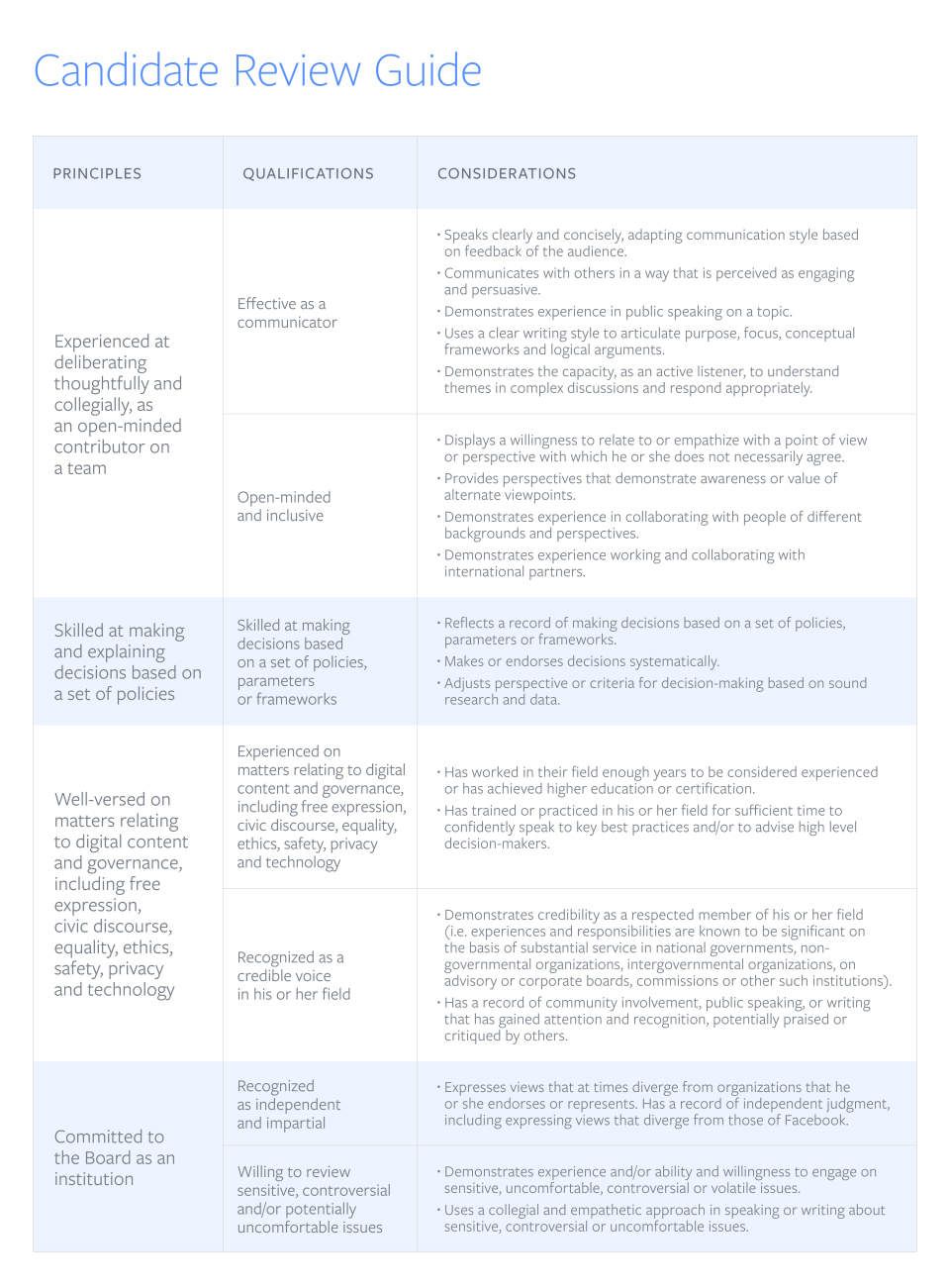
The board will include a minimum of 11 members but Facebook is aiming for 40. They’ll serve three year terms and a maximum of three terms each as a part-time job, with appointments staggered so there isn’t a full change-over at any time. Facebook is looking for members with a broad range of knowledge, competencies, and expertise who lack conflicts of interest. They’re meant to be “experienced at deliberating thoughtfully and collegially”, “skilled at making and explaining decisions based on a set of policies”, “well-versed on matters relating to digital content and governance”, and “independent and impartial”. 

Facebook will appoint a set of trustees that will work with it to select initial co-chairs for the board, who will then assist with sourcing, vetting, interviewing, and orienting new members. The goal is “broad diversity of geographic, gender, political, social and religious representation”. The trust, funded by Facebook with an as yet undecided amount of capital, will set members’ compensation rate in the near future and oversee term renewals.

Facebook Oversight Board candidate review guide

What Cases Get Reviewed

The board will choose which cases to review based on their significance and difficulty. They’re looking for issues that are severe, large-scale and important for public discourse, while raising difficult questions about Facebook’s policy or enforcement that is disputed, uncertain, or represents tension or trade-offs between Facebook’s recently codified values of authenticity, safety, privacy, and dignity. The board will then create a sub-panel of five members to review a specific case.

The board will be able to question that request that Facebook provide information necessary to rule on the case with a mind to not violating user privacy. They’ll interpret Facebook’s Community Standards and policies and then decide whether Facebook should remove or restore a piece of content and whether it should change how that content was designated.

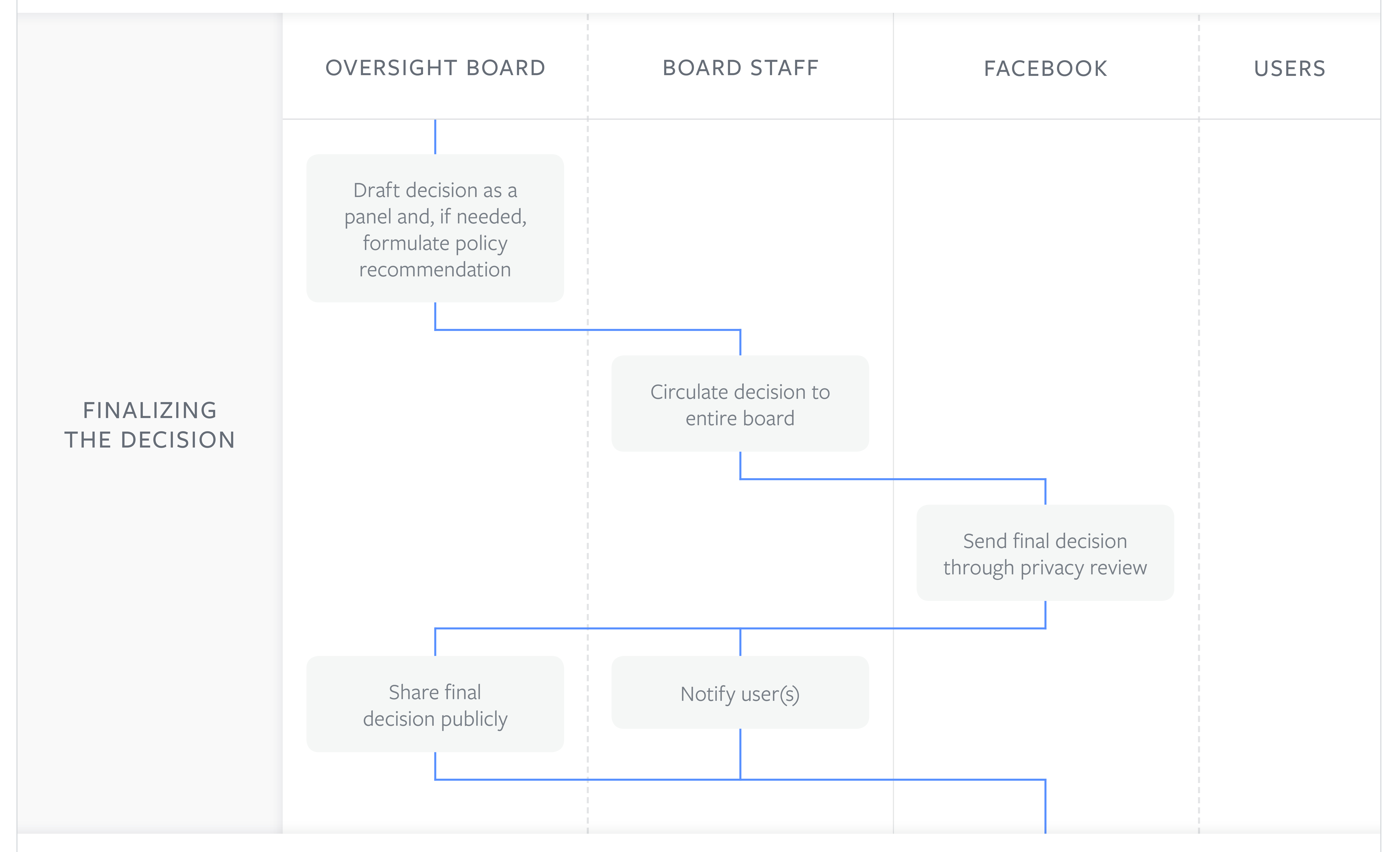
Once a panel makes a draft decision, it’s circulated to the full board who can recommend a new panel review it if a majority take issue with the verdict. Once they’ve gone through a privacy review to protect the identities of those involved with the case, the decisions will be made public. Those decisions will be archived in a database, and are meant to act as precedent for future decisions. The idea is that the decisions of the board will be binding and implemented by Facebook as long as they don’t require it to violate the law.

Facebook Oversight Board Decisions


Read Full Article

How we use astrophysics to study earthbound problems | Federica Bianco

How we use astrophysics to study earthbound problems | Federica Bianco

To study a system as complex as the entire universe, astrophysicists need to be experts at extracting simple solutions from large data sets. What else could they do with this expertise? In an interdisciplinary talk, TED Fellow and astrophysicist Federica Bianco explains how she uses astrophysical data analysis to solve urban and social problems -- as well as stellar mysteries.

Click the above link to download the TED talk.

17 September 2019

Daily Crunch: The iPhone 11 goes to Disneyland


The Daily Crunch is TechCrunch’s roundup of our biggest and most important stories. If you’d like to get this delivered to your inbox every day at around 9am Pacific, you can subscribe here.

1. Review: The iPhone 11 Pro and iPhone 11 do Disneyland after dark

Matthew Panzarino continues his tradition of testing out the latest iPhones at Disneyland. This time, he was particularly interested in how well the iPhone 11’s Night Mode works. His verdict: It compares extremely well to other low-light cameras, with exposure and color rendition that’s best-in-class.

But if you’re planning to upgrade, should you get the Pro, or the regular ol’ iPhone 11? Apparently the Pro is really there to address edge cases — the best video and photo options, a better dark mode experience, a brighter screen.

2. Under pressure, The We Company now only says it expects to go public ‘by the end of the year’

A new note from WeWork’s parent company all but confirms that it is indeed delaying its IPO roadshow, which had been expected to commence this week.

3. Amazon launches Amazon Music HD with lossless audio streaming

Amazon has a new, high-quality streaming tier of its music service called Amazon Music HD. It’s priced at $12.99 per month for Prime members, and you can add it to your existing Amazon Music subscription for an additional $5 each month.

disrupt will smith ang lee

4. Will Smith and Ang Lee are coming to Disrupt SF

They’ll be joining us to discuss their upcoming film “Gemini Man,” which features “jaw-dropping effects” from Weta Digital. The effects allow Smith to play both an assassin named Henry Brogan and a younger clone who’s been sent to kill his older counterpart.

5. Computer scientist Richard Stallman, who defended Jeffrey Epstein, resigns from MIT CSAIL and the Free Software Foundation

Stallman said he has resigned from his position as a visiting scientist at MIT’s Computer Science and Artificial Intelligence Lab after describing a victim of sex trafficker Jeffrey Epstein as “entirely willing” in emails sent to a department list.

6. I hope Apple Arcade makes room for weird, cool shit

Apple Arcade seems purpose-built to make room in the market for beautiful, sad, weird, moving, slow, clever and heartfelt.

7. What startup CSOs can learn from three enterprise security experts

How do you keep your startup secure? That’s one of the big questions we explored at TC Sessions: Enterprise earlier this month — and if you weren’t there, we’ve got a write-up of the main takeaways. (Extra Crunch membership required.)


Read Full Article

Google starts highlighting key moments from videos in Search


Google today announced an update to how it handles videos in search results. Instead of just listing relevant videos on the search results page, Google will now also highlight the most relevant parts of longer videos, based on timestamps provided by the video creators. That’s especially useful for how-to videos or documentaries.

“Videos aren’t skimmable like text, meaning it can be easy to overlook video content altogether,” Google Search product manager Prashant Baheti writes in today’s announcement. “Now, just like we’ve worked to make other types of information more easily accessible, we’re developing new ways to understand and organize video content in Search to make it more useful for you.”

In the search results, you will then be able to see direct links to the different parts of a video and a click on those will take you right into that part of the video.

01b Video anchors white frame.max 1000x1000

To make this work, content creators first have to mark up their videos with bookmarks for the specific segments they want to highlight, no matter what platform they are on. Indeed, it’s worth stressing that this isn’t just a feature for YouTube creators. Google says it’s already working with video publishers like CBS Sports and NDTV, who will soon start marking up their videos.

I’m somewhat surprised that Google isn’t using its machine learning wizardry to mark up videos automatically. For now, the burden is on the video creator and given how much work simply creating a good video is, it remains to be seen how many of them will do so. On the other hand, though, it’ll give them a chance to highlight their work more prominently on Google Search, though Google doesn’t say whether the markup will have any influence on a video’s ranking on its search results pages.


Read Full Article

Pax Labs’ Bharat Vasan is out as CEO


Bharat Vasan is no longer the Chief Executive Officer at Pax Labs, the consumer tech company that makes cannabis vaporizers. A source familiar with the situation said that the board of directors made the decision to remove Vasan from the CEO role. His last day was Friday.

We’ve reached out to Vasan for comment. Pax is declining to elaborate on what drove its decision.

Certainly, it’s a surprising move, given that Vasan was appointed the CEO of Pax not so long ago —  in February of 2018. Before that, he served as President and COO of August Home, which was acquired by Swedish lock maker Assa Abloy in 2017. Previous to that, Vasan was the cofounder of Basis, a fitness-based wearable company that was acquired by Intel in 2014 for $100 million.

Vasan also led the company in its most recent round this past April, in which it secured $420 million from Tiger Global Management, Tao Capital, and Prescott General Partners, among others. The post-money valuation for the company at the time was $1.7 billion.

Vasan is a veteran of consumer electronics, but Pax may be looking for a CEO that has more operational experience in cannabis.

After all, Pax is at an interesting intersection in its path, navigating an oft-changing regulatory landscape around cannabis. Moreover, the entire cannabis industry — and vaporizer industry —  is under a microscope in the wake of hundreds of reports of vape-related lung illness. The CDC says that there have been 380 cases of lung illness reported across 36 states, with six deaths. Most patients reported a history of using e-cigarette products containing THC.

Pax is currently on the hunt for a new chief executive. In the meantime, its general counsel, Lisa Sergi, who joined the company at the end of July, will be its interim CEO and president.

Sergi had this to say in a prepared statement:

PAX is uniquely positioned as a leader in the burgeoning cannabis industry, with a talented team, an iconic brand, quality products and the balance sheet to achieve our ambitious goals and continued growth trajectory. I am extremely excited and honored to have been entrusted to lead this extraordinary company.


Read Full Article

Natural lighting is the key to Apple’s remodeled Fifth Ave. store


When it opened in 2006, Apple’s Fifth Avenue flagship quickly became a top destination for New York City residents and tourists, alike. The big, glass cube was a radical departure from prior electronics stores, serving as the entrance to a 24-hour subterranean retail location. Location didn’t hurt either, with the company planting its flag across from the Plaza Hotel and Central Park and sharing a block with the iconic high-end toy store, FAO Schwarz.

Since early 2017, however, the store has been closed for renovations. Earlier this month, the company took the wraps off the outside of the cube (albeit with some multi-color reflective wrap still occupying the outside of the familiar retail landmark). Last week, the company offered more insight into the plan as retail SVP Deirdre O’Brien took to the stage during the iPhone 11 event to discuss the company’s plans for the reinvented space.

Fifth Ave 1

During a discussion with TechCrunch, Apple shed even more light on the underground store, which will occupy the full area of the Fifth Avenue plaza. As is the case with all of Apple’s flagships, light is the thing here — though that’s easier said than done when dealing with an underground space. Illuminating the store is done through a combination of natural lights and LEDs.

When the store reopens, a series of skylights flush on the ground of the plaza will be doing much of the heavy lifting for the lighting during the day. Each of those round portholes will be frosted to let the light in, while protecting the privacy of people walking above, with supplemental lighting from silver LED rings. That, in turn, is augmented by 18 (nine on each side of the cube) “sky lenses.” Oriented in two 3×3 configurations, the “sculptural furniture” will also provide seating in the outdoor plaza.

Of course, the natural lighting isn’t able to do all of the work for a 24-hour store. That’s complemented by a ceiling system that uses a similar stretched fabric-based lighting system as other Apple Stores. Here, however, the fabric will take on a more cloud-like structure with a more complicated geometrical shape than other Apple stores. The fabric houses tunable LED lights that react to the external environment. If it’s sunny outside, it will be brighter downstairs. When it’s cloudy, the lights will dim.

In all, there are five modes tuned to a 24-hour cycle, including:

  • Sunrise: 3,000K
  • Day: 4,500K-5,250K (depending on how bright it is outside)
  • Sunset: 3,000K
  • Evening: 3,250K
  • Night: 3,500K

Screen Shot 2019 09 17 at 12.21.48 PM

Sunrise and sunset are apparently the best time to check it out, as the lights glow warmly for about an hour or so. There are 80 ring lights in all, and around 500,000 LEDs, with about 2,500 LED spotlights used to illuminate tables and products inside the store. The natural lighting also will be used to keep alive eight trees and a green wall in the underground space. 

The newly remodeled store opens at 8AM on September 20, just in time to line up for the new iPhone.


Read Full Article