30 May 2019

The latest modular Moto Z has a beefy battery and improved low-light camera


When it arrived in 2016, the Moto Z felt revolutionary — or, at the very least, novel. Motorola soon announced it was making the Moto Z its flagship device. In the intervening three years, the line has yet to set the world on fire.

It’s seemingly been a decent seller for the company, but with rare exceptions (as it happens, today is the second anniversary of the Essential announcement) the rest of the smartphone industry has yet to embrace the modular handset revolution.

It’s not for lack of trying, of course. Motorola’s released a wide range of Mods, including, most notably, a 5G unit, marking the first time that technology was widely available in North America. This morning the Lenovo-owned brand just announced the availability of the Moto Z4 (though not before the product accidentally went on sale at at least one retail location).

As ever, the latest version of the line points to one of the peculiarities of the modular phone concept, with upgraded base specs on a phone whose features rely largely on peripherals. Of course, the reasonable $499 starting price certainly cushions the blow a bit.

The base specs are a mixed bag. It’s got a 6.39-inch display, coupled with a middling Qualcomm Snapdragon 675 and a beefy 3,600mAh battery that the company rates at two days. The phone also adds a night-vision mode to the rear-facing 48 megapixel sensor.

The gray version of the handset starts shipping June 13, with a white model arriving over the summer. The unlocked version ships with a free Moto 360. Verizon’s also making the 5G Mod available for $200 (down from $350) for a limited time.

I’ll be spending more time with the phone in the near future — for now, however, it feels like Motorola’s most intriguing and promising handset is beginning to feel more and more like a middle of the road device.


Read Full Article

UK Internet attitudes study finds public support for social media regulation


UK telecoms regulator Ofcom has published a new joint report and stat-fest on Internet attitudes and usage with the national data protection watchdog, the ICO — a quantitative study to be published annually which they’re calling the Online Nation report.

The new structure hints at the direction of travel for online regulation in the UK, following government plans set out in a recent whitepaper to regulate online harms — which will include creating a new independent regulator to ensure Internet companies meet their responsibilities.

Ministers are still consulting on whether this should be a new or existing body. But both Ofcom and the ICO have relevant interests in being involved — so it’s fitting to see joint working going into this report.

As most of us spend more time than ever online, we’re increasingly worried about harmful content — and also more likely to come across it,” writes Yih-Choung Teh, group director of strategy and research at Ofcom, in a statement. “ For most people, those risks are still outweighed by the huge benefits of the internet. And while most internet users favour tighter rules in some areas, particularly social media, people also recognise the importance of protecting free speech – which is one of the internet’s great strengths.”

While it’s not yet clear exactly what form the UK’s future Internet regulator will take, the Online Nation report does suggest a flavor of the planned focus.

The report, which is based on responses from 2,057 adult internet users and 1,001 children, flags as a top-line finding that eight in ten adults have concerns about some aspects of Internet use and further suggests the proportion of adults concerned about going online has risen from 59% to 78% since last year (though its small-print notes this result is not directly comparable with last year’s survey so “can only be interpreted as indicative”).

Another stat being highlighted is a finding that 61% of adults have had a potentially harmful online experience in the past year — rising to 79% among children (aged 12-15). (Albeit with the caveat that it’s using a “broad definition”, with experiences ranging from “mildly annoying to seriously harmful”.)

While a full 83% of polled adults are found to have expressed concern about harms to children on the Internet.

The UK government, meanwhile, has made child safety a key focus of its push to regulate online content.

At the same time the report found that most adults (59%) agree that the benefits of going online outweigh the risks, and 61% of children think the internet makes their lives better.

While Ofcom’s annual Internet reports of years past often had a fairly dry flavor, tracking usage such as time spent online on different devices and particular services, the new joint study puts more of an emphasis on attitudes to online content and how people understand (or don’t) the commercial workings of the Internet — delving into more nuanced questions, such as by asking web users whether they understand how and why their data is collected, and assessing their understanding of ad-supported business models, as well as registering relative trust in different online services’ use of personal data.

The report also assesses public support for Internet regulation — and on that front it suggests there is increased support for greater online regulation in a range of areas. Specifically it found that most adults favour tighter rules for social media sites (70% in 2019, up from 52% in 2018); video-sharing sites (64% v. 46%); and instant-messaging services (61% v. 40%).

At the same time it says nearly half (47%) of adult internet users expressed recognition that websites and social media platforms play an important role in supporting free speech — “even where some people might find content offensive”. So the subtext there is that future regulation of harmful Internet content needs to strike the right balance.

On managing personal data, the report found most Internet users (74%) say they feel confident to do so. A majority of UK adults are also happy for companies to collect their information under certain conditions — vs over a third (39%) saying they are not happy for companies to collect and use their personal information.

Those conditions look to be key, though — with only small minorities reporting they are happy for their personal data to be used to program content (17% of adult Internet users were okay with this); and to target them with ads (only 18% didn’t mind that, so most do).

Trust in online services to protect user data and/or use it responsibly also varies significantly, per the report findings — with social media definitely in the dog house on that front. “Among ten leading UK sites, trust among users of these services was highest for BBC News (67%) and Amazon (66%) and lowest for Facebook (31%) and YouTube (34%),” the report notes.

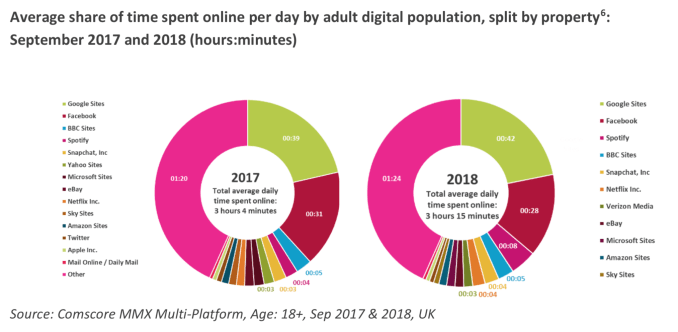
Despite low privacy trust in tech giants, more than a third (35%) of the total time spent online in the UK is on sites owned by Google or Facebook.

“This reflects the primacy of video and social media in people’s online consumption, particularly on smartphones,” it writes. “Around nine in ten internet users visit YouTube every month, spending an average of 27 minutes a day on the site. A similar number visit Facebook, spending an average of 23 minutes a day there.”

And while the report records relatively high awareness that personal data collection is happening online — finding that 71% of adults were aware of cookies being used to collect information through websites they’re browsing (falling to 60% for social media accounts; and 49% for smartphone apps) — most (69%) also reported accepting terms and conditions without reading them.

So, again, mainstream public awareness of how personal data is being used looks questionable.

The report also flags limited understanding of how search engines are funded — despite the bald fact that around half of UK online advertising revenue comes from paid-for search (£6.7BN in 2018). “[T]here is still widespread lack of understanding about how search engines are funded,” it writes. “Fifty-four per cent of adult internet users correctly said they are funded by advertising, with 18% giving an incorrect response and 28% saying they did not know.”

The report also highlights the disconnect between time spent online and digital ad revenue generated by the adtech duopoly, Google and Facebook — which it says together generated an estimated 61% of UK online advertising revenue in 2018; a share of revenue that it points out is far greater than time spent (35%) on their websites (even as those websites are the most visited by adults in the UK).

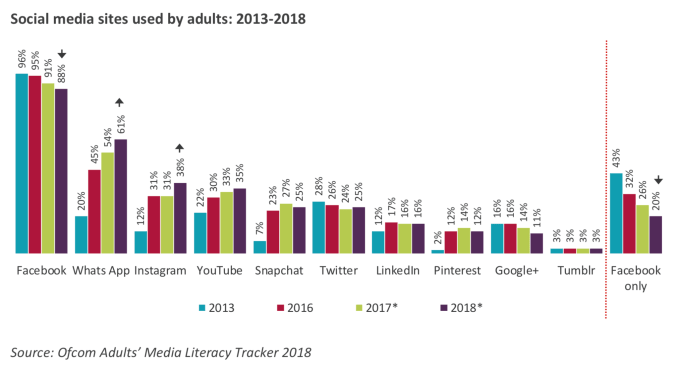
As in previous years of Ofcom ‘state of the Internet’ reports, the Online Nation study also found that Facebook use still dominates the social media landscape in the UK.

Though use of the eponymous service continues falling (from 95% of social media users in 2016 to 88% in 2018). Even as use of other Facebook-owned social properties — Instagram and WhatsApp — grew over the same period.


The report also recorded an increase in people using multiple social services — with just a fifth of social media users only using Facebook in 2018 (down from 32% in 2018). Though as noted above, Facebook still dominates time spent, clocking up way more time (~23 minutes) per user per day on average vs Snapchat (around nine minutes) and Instagram (five minutes).  

A large majority (74%) of Facebook users also still check it at least once a day.

Overall, the report found that Brits have a varied online diet, though — on average spending a minute or more each day on 15 different internet sites and apps. Even as online ad revenues are not so equally distributed.

“Sites and apps that were not among the top 40 sites ranked by time spent accounted for 43% of average daily consumption,” the report notes. “Just over one in five internet users said that in the past month they had used ‘lots of websites or apps they’ve used before’ while a third (36%) said they ‘only use websites or apps they’ve used before’.”

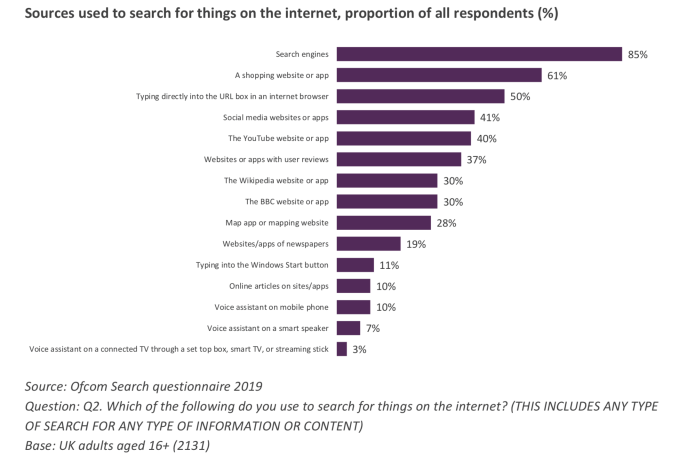
There is also variety when it comes to how Brits search for stuff online, and while 97% of adult internet users still use search engines the report found a variety of other services also in the mix. 

It found that nearly two-thirds of people (65%) go more often to specific sites to find specific things, such as a news site for news stories or a video site for videos; while 30% of respondents said they used to have a search engine as their home page but no longer do.

The high proportion of searches being registered on shopping websites/apps (61%) also looks interesting in light of the 2017 EU antitrust ruling against Google Shopping — when the European Commission found Google had demoted rival shopping comparison services in search results, while promoting its own, thereby undermining rivals’ ability to gain traffic and brand recognition.

The report findings also indicate that use of voice-based search interfaces remains relatively low in the UK, with just 10% using voice assistants on a mobile phone — and even smaller percentages tapping into smart speakers (7%) or voice AIs on connected TVs (3%).

In another finding, the report suggests recommendation engines play a major part in content discovery.

“Recommendation engines are a key way for platforms to help people discover content and products — 70% of viewing to YouTube is reportedly driven by recommendations, while 35% of what consumers purchase on Amazon comes from recommendations,” it writes. 

In overarching aggregate, the report says UK adults now spend the equivalent of almost 50 days online per year.

While, each week, 44 million Brits use the internet to send or receive email; 29 million send instant messages; 30 million bank or pay bills via the internet; 27 million shop online; and 21 million people download information for work, school or university.

The full report can be found here.


Read Full Article

UK Internet attitudes study finds public support for social media regulation


UK telecoms regulator Ofcom has published a new joint report and stat-fest on Internet attitudes and usage with the national data protection watchdog, the ICO — a quantitative study to be published annually which they’re calling the Online Nation report.

The new structure hints at the direction of travel for online regulation in the UK, following government plans set out in a recent whitepaper to regulate online harms — which will include creating a new independent regulator to ensure Internet companies meet their responsibilities.

Ministers are still consulting on whether this should be a new or existing body. But both Ofcom and the ICO have relevant interests in being involved — so it’s fitting to see joint working going into this report.

As most of us spend more time than ever online, we’re increasingly worried about harmful content — and also more likely to come across it,” writes Yih-Choung Teh, group director of strategy and research at Ofcom, in a statement. “ For most people, those risks are still outweighed by the huge benefits of the internet. And while most internet users favour tighter rules in some areas, particularly social media, people also recognise the importance of protecting free speech – which is one of the internet’s great strengths.”

While it’s not yet clear exactly what form the UK’s future Internet regulator will take, the Online Nation report does suggest a flavor of the planned focus.

The report, which is based on responses from 2,057 adult internet users and 1,001 children, flags as a top-line finding that eight in ten adults have concerns about some aspects of Internet use and further suggests the proportion of adults concerned about going online has risen from 59% to 78% since last year (though its small-print notes this result is not directly comparable with last year’s survey so “can only be interpreted as indicative”).

Another stat being highlighted is a finding that 61% of adults have had a potentially harmful online experience in the past year — rising to 79% among children (aged 12-15). (Albeit with the caveat that it’s using a “broad definition”, with experiences ranging from “mildly annoying to seriously harmful”.)

While a full 83% of polled adults are found to have expressed concern about harms to children on the Internet.

The UK government, meanwhile, has made child safety a key focus of its push to regulate online content.

At the same time the report found that most adults (59%) agree that the benefits of going online outweigh the risks, and 61% of children think the internet makes their lives better.

While Ofcom’s annual Internet reports of years past often had a fairly dry flavor, tracking usage such as time spent online on different devices and particular services, the new joint study puts more of an emphasis on attitudes to online content and how people understand (or don’t) the commercial workings of the Internet — delving into more nuanced questions, such as by asking web users whether they understand how and why their data is collected, and assessing their understanding of ad-supported business models, as well as registering relative trust in different online services’ use of personal data.

The report also assesses public support for Internet regulation — and on that front it suggests there is increased support for greater online regulation in a range of areas. Specifically it found that most adults favour tighter rules for social media sites (70% in 2019, up from 52% in 2018); video-sharing sites (64% v. 46%); and instant-messaging services (61% v. 40%).

At the same time it says nearly half (47%) of adult internet users expressed recognition that websites and social media platforms play an important role in supporting free speech — “even where some people might find content offensive”. So the subtext there is that future regulation of harmful Internet content needs to strike the right balance.

On managing personal data, the report found most Internet users (74%) say they feel confident to do so. A majority of UK adults are also happy for companies to collect their information under certain conditions — vs over a third (39%) saying they are not happy for companies to collect and use their personal information.

Those conditions look to be key, though — with only small minorities reporting they are happy for their personal data to be used to program content (17% of adult Internet users were okay with this); and to target them with ads (only 18% didn’t mind that, so most do).

Trust in online services to protect user data and/or use it responsibly also varies significantly, per the report findings — with social media definitely in the dog house on that front. “Among ten leading UK sites, trust among users of these services was highest for BBC News (67%) and Amazon (66%) and lowest for Facebook (31%) and YouTube (34%),” the report notes.

Despite low privacy trust in tech giants, more than a third (35%) of the total time spent online in the UK is on sites owned by Google or Facebook.

“This reflects the primacy of video and social media in people’s online consumption, particularly on smartphones,” it writes. “Around nine in ten internet users visit YouTube every month, spending an average of 27 minutes a day on the site. A similar number visit Facebook, spending an average of 23 minutes a day there.”

And while the report records relatively high awareness that personal data collection is happening online — finding that 71% of adults were aware of cookies being used to collect information through websites they’re browsing (falling to 60% for social media accounts; and 49% for smartphone apps) — most (69%) also reported accepting terms and conditions without reading them.

So, again, mainstream public awareness of how personal data is being used looks questionable.

The report also flags limited understanding of how search engines are funded — despite the bald fact that around half of UK online advertising revenue comes from paid-for search (£6.7BN in 2018). “[T]here is still widespread lack of understanding about how search engines are funded,” it writes. “Fifty-four per cent of adult internet users correctly said they are funded by advertising, with 18% giving an incorrect response and 28% saying they did not know.”

The report also highlights the disconnect between time spent online and digital ad revenue generated by the adtech duopoly, Google and Facebook — which it says together generated an estimated 61% of UK online advertising revenue in 2018; a share of revenue that it points out is far greater than time spent (35%) on their websites (even as those websites are the most visited by adults in the UK).

As in previous years of Ofcom ‘state of the Internet’ reports, the Online Nation study also found that Facebook use still dominates the social media landscape in the UK.

Though use of the eponymous service continues falling (from 95% of social media users in 2016 to 88% in 2018). Even as use of other Facebook-owned social properties — Instagram and WhatsApp — grew over the same period.


The report also recorded an increase in people using multiple social services — with just a fifth of social media users only using Facebook in 2018 (down from 32% in 2018). Though as noted above, Facebook still dominates time spent, clocking up way more time (~23 minutes) per user per day on average vs Snapchat (around nine minutes) and Instagram (five minutes).  

A large majority (74%) of Facebook users also still check it at least once a day.

Overall, the report found that Brits have a varied online diet, though — on average spending a minute or more each day on 15 different internet sites and apps. Even as online ad revenues are not so equally distributed.

“Sites and apps that were not among the top 40 sites ranked by time spent accounted for 43% of average daily consumption,” the report notes. “Just over one in five internet users said that in the past month they had used ‘lots of websites or apps they’ve used before’ while a third (36%) said they ‘only use websites or apps they’ve used before’.”

There is also variety when it comes to how Brits search for stuff online, and while 97% of adult internet users still use search engines the report found a variety of other services also in the mix. 

It found that nearly two-thirds of people (65%) go more often to specific sites to find specific things, such as a news site for news stories or a video site for videos; while 30% of respondents said they used to have a search engine as their home page but no longer do.

The high proportion of searches being registered on shopping websites/apps (61%) also looks interesting in light of the 2017 EU antitrust ruling against Google Shopping — when the European Commission found Google had demoted rival shopping comparison services in search results, while promoting its own, thereby undermining rivals’ ability to gain traffic and brand recognition.

The report findings also indicate that use of voice-based search interfaces remains relatively low in the UK, with just 10% using voice assistants on a mobile phone — and even smaller percentages tapping into smart speakers (7%) or voice AIs on connected TVs (3%).

In another finding, the report suggests recommendation engines play a major part in content discovery.

“Recommendation engines are a key way for platforms to help people discover content and products — 70% of viewing to YouTube is reportedly driven by recommendations, while 35% of what consumers purchase on Amazon comes from recommendations,” it writes. 

In overarching aggregate, the report says UK adults now spend the equivalent of almost 50 days online per year.

While, each week, 44 million Brits use the internet to send or receive email; 29 million send instant messages; 30 million bank or pay bills via the internet; 27 million shop online; and 21 million people download information for work, school or university.

The full report can be found here.


Read Full Article

Apple, Google, Microsoft, WhatsApp sign open letter condemning GCHQ proposal to listen in on encrypted chats


An international coalition of civic society organizations, security and policy experts and tech companies — including Apple, Google, Microsoft and WhatsApp — has penned a critical slap-down to a surveillance proposal made last year by the UK’s intelligence agency, warning it would undermine trust and security and threaten fundamental rights.

“The GCHQ’s ghost protocol creates serious threats to digital security: if implemented, it will undermine the authentication process that enables users to verify that they are communicating with the right people, introduce potential unintentional vulnerabilities, and increase risks that communications systems could be abused or misused,” they wrire.

“These cybersecurity risks mean that users cannot trust that their communications are secure, as users would no longer be able to trust that they know who is on the other end of their communications, thereby posing threats to fundamental human rights, including privacy and free expression. Further, systems would be subject to new potential vulnerabilities and risks of abuse.”

GCHQ’s idea for a so-called ‘ghost protocol’ would be for state intelligence or law enforcement agencies to be invisibly CC’d by service providers into encrypted communications — on what’s billed as targeted, government authorized basis.

The agency set out the idea in an article published last fall on the Lawfare blog, written by the National Cyber Security Centre’s (NCSC) Ian Levy and GCHQ’s Crispin Robinson (NB: the NCSC is a public facing branch of GCHQ) — which they said was intended to open a discussion about the ‘going dark’ problem which robust encryption poses for security agencies.

The pair argued that such an “exceptional access mechanism” could be baked into encrypted platforms to enable end to end encryption to be bypassed by state agencies would could instruct the platform provider to add them as a silent listener to eavesdrop on a conversation — but without the encryption protocol itself being compromised.

“It’s relatively easy for a service provider to silently add a law enforcement participant to a group chat or call. The service provider usually controls the identity system and so really decides who’s who and which devices are involved — they’re usually involved in introducing the parties to a chat or call,” Levy and Robinson argued. “You end up with everything still being end-to-end encrypted, but there’s an extra ‘end’ on this particular communication. This sort of solution seems to be no more intrusive than the virtual crocodile clips that our democratically elected representatives and judiciary authorise today in traditional voice intercept solutions and certainly doesn’t give any government power they shouldn’t have.”

“We’re not talking about weakening encryption or defeating the end-to-end nature of the service. In a solution like this, we’re normally talking about suppressing a notification on a target’s device, and only on the device of the target and possibly those they communicate with. That’s a very different proposition to discuss and you don’t even have to touch the encryption.”

“[M]ass-scale, commodity, end-to-end encrypted services… today pose one of the toughest challenges for targeted lawful access to data and an apparent dichotomy around security,” they added.

However while encryption might technically remain intact in the scenario they sketch, their argument glosses over both the fact and risks of bypassing encryption via fiddling with authentication systems in order to enable deceptive third party snooping.

As the coalition’s letter points out, doing that would both undermine user trust and inject extra complexity — with the risk of fresh vulnerabilities that could be exploited by hackers.

Compromising authentication would also result in platforms themselves gaining a mechanism that they could use to snoop on users’ comms — thereby circumventing the wider privacy benefits provided by end to end encryption in the first place, perhaps especially when deployed on commercial messaging platforms.

So, in other words, just because what’s being asked for is not literally a backdoor in encryption that doesn’t mean it isn’t similarly risky for security and privacy and just as horrible for user trust and rights.

“Currently the overwhelming majority of users rely on their confidence in reputable providers to perform authentication functions and verify that the participants in a conversation are the people that they think they are, and only those people. The GCHQ’s ghost protocol completely undermines this trust relationship and the authentication process,” the coalition writes, also pointing out that authentication remains an active research area — and that work would likely dry up if the systems in question were suddenly made fundamentally untrustworthy on order of the state.

They further assert there’s no way for the security risk to be targeted to the individuals that state agencies want to specifically snoop on. Ergo, the added security risk is universal.

“The ghost protocol would introduce a security threat to all users of a targeted encrypted messaging application since the proposed changes could not be exposed only to a single target,” they warn. “In order for providers to be able to suppress notifications when a ghost user is added, messaging applications would need to rewrite the software that every user relies on. This means that any mistake made in the development of this new function could create an unintentional vulnerability that affects every single user of that application.”

There are more than 50 signatories to the letter in all, and others civic society and privacy rights groups Human Rights Watch, Reporters Without Borders, Liberty, Privacy International and the EFF, as well as veteran security professionals such as Bruce Schneier, Philip Zimmermann and Jon Callas, and policy experts such as former FTC CTO and Whitehouse security advisor, Ashkan Soltani.

While the letter welcomes other elements of the article penned by Levy and Robinson — which also set out a series of principles for defining a “minimum standard” governments should meet to have their requests accepted by companies in other countries (with the pair writing, for example, that “privacy and security protections are critical to public confidence” and “transparency is essential”) — it ends by urging GCHQ to abandon the ghost protocol idea altogether, and “avoid any alternative approaches that would similarly threaten digital security and human rights”.

Reached for a response to the coalition’s concerns, the NCSC sent us the following statement, attributed to Levy:

We welcome this response to our request for thoughts on exceptional access to data — for example to stop terrorists. The hypothetical proposal was always intended as a starting point for discussion.

It is pleasing to see support for the six principles and we welcome feedback on their practical application. We will continue to engage with interested parties and look forward to having an open discussion to reach the best solutions possible.

Back in 2016 the UK passed updated surveillance legislation that affords state agencies expansive powers to snoop on and hack into digital comms. And with such an intrusive regime in place it may seem odd that GCHQ is pushing for even greater powers to snoop on people’s digital chatter.

Even robust end-to-end encryption can include exploitable vulnerabilities. One bug was disclosed affecting WhatsApp just a couple of weeks ago, for example (since fixed via an update).

However in the Lawfare article the GCHQ staffers argue that “lawful hacking” of target devices is not a panacea to governments’ “lawful access requirements” because it would require governments have vulnerabilities on the shelf to use to hack devices — which “is completely at odds with the demands for governments to disclose all vulnerabilities they find to protect the population”.

“That seems daft,” they conclude.

Yet it also seems daft — and predictably so — to suggest a ‘sidedoor’ in authentication systems as an alternative to a backdoor in encrypted messaging apps.


Read Full Article

Ekasbo’s Matebot may be the cutest cat robot yet created


If Shrek saw Matebot, no amount of sad-eyes could win him back to Puss in Boots’ side. Created by Shenzhen-based robotics company Ekasbo, Matebot looks like a black and white cartoon cat and responds to your touch by wiggling its ears, changing the expression in its big LED eyes and tilting its head.

Ekasbo's Matebot in a sad mood

Built with voice recognition, infrared technology and seven moving parts, the Matebot is designed to serve as an interactive companion, including for people who can’t keep pets, creator Zhang Meng told TechCrunch at Computex in Taiwan.

The Matebot is controlled with a smartphone app and can be integrated with Android voice control systems. Its price starts at about 4,999 yen or about $45 USD.


Read Full Article

Ulo is an adorable security camera that interacts with you while keeping watch over your home


Tired of home security cameras that add nothing to your home (besides, well, surveillance)? The Ulo, created by Luxembourg-based Mu Design, adds a touch of whimsy. The owl-shaped surveillance camera has two big interactive LCD eyes that follow your movements, and its two lenses—a HD camera and motion sensor camera—discreetly hidden in its beak, made of one-way mirrored glass, that capture high-resolution images. .

Mu Design founder Vivien Muller, who is currently showing off Ulo at Computex in Taipei, said he wanted to create a security camera that feels like a pet and makes its owners happy. The Ulo, with its huge, expressive eyes, is certainly adorable. Ulo runs on a Qualcomm Snapdragon 212 series processor and is made with an internal microphone, WifFi and Bluetooth models and an orientation sensor. It can use rechargeable NiMH batteries or be charged with a standard micro USB charger. Ulo also boosts 8GB eMMC and a microSD card clot.

Ulo is controlled by iOS or Android apps. Like other cameras, it can send images to your email when movement is detected, send data to secure devices if requested and stores a few minutes of video locally.

The camera is currently out of stock, but available for pre-order and costs 199 euros, or about $220.


Read Full Article

Science publisher IEEE bans Huawei but says trade rules will have ‘minimal impact’ on members


The IEEE’s ban on Huawei following new trade restrictions in the United States has sent shock waves through the global academic circles. The organization responded saying the impact of the trade policy will have limited effects on its members, but it’s hard at this point to appease those who have long hailed it as an open platform for scientists and professors worldwide to collaborate.

Earlier this week, the New York-headquartered Institute of Electrical and Electronics Engineers blocked Huawei employees from being reviewers or editors for its peer-review process, according to screenshots of an email sent to its editors that first circulated in the Chinese media.

The IEEE later confirmed the ban in a statement issued on Wednesday, saying it “complies with U.S. government regulations which restrict the ability of the listed Huawei companies and their employees to participate in certain activities that are not generally open to the public. This includes certain aspects of the publication peer review and editorial process.”

In mid-May, the U.S. Department of Commerce’s Bureau of Industry and Security added Huawei and its affiliates to its “Entity List,” effectively barring U.S. firms from selling technology to Huawei without government approval.

It’s unclear what makes peer review at the IEEE a technology export, but the science association wrote in its email to editors that violation “may have severe legal implications.”

Whilst being physically based in the U.S., the IEEE bills itself as a “non-political” and “global” community aiming to “foster technological innovation and excellence for the benefit of humanity.”

Despite its removal of Huawei scientists from paper vetting, the IEEE assured that its compliance with U.S. trade restrictions should have “minimal impact” on its members around the world. It further added that Huawei and its employees can continue to participate in other activities as a member, including accessing the IEEE digital library; submitting technical papers for publication; presenting at IEEE-sponsored conferences; and accepting IEEE awards.

As members of its standard-setting body, Huawei employees can also continue to exercise their voting rights, attend standards development meetings, submit proposals and comment in public discussions on new standards.

A number of Chinese professors have reprimanded the IEEE’s decision, flagging the danger of letting politics meddle with academic collaboration. Zhang Haixia, a professor at the School of Electronic and Computer Engineering of China’s prestigious Peking University, said in a statement that she’s quitting the IEEE boards in protest.

This is Haixia Zhang from Peking University, as an old friend and senior IEEE member, I am really shocked to hear that IEEE is involved in “US-Huawei Ban” for replacing all reviewers from Huawei, which is far beyond the basic line of Science and Technology which I was trainedand am following in my professional career till now.

…today, this message from IEEE for “replacing all reviewers from Huawei in IEEE journals” is challenging my professional integrity. I have to say that, As a professor, I AM NOT accept this. Therefore, I decided to quit from IEEE NANO and IEEE JMEMS editorial board untill one day it come back to our common professional integrity.

The IEEE freeze on Huawei adds to a growing list of international companies and organizations that are severing ties or clashing with the Chinese smartphone and telecom giant in response to the trade blacklist. That includes Google, which has blocked select Android services from Huawei; FedEx, which allegedly “diverted” a number of Huawei packages; ARM, which reportedly told employees to suspend business with Huawei; as well as Intel and Qualcomm, which also reportedly cut ties with Huawei. 


Read Full Article

You Can Now Tell Alexa to Delete Your Voice Recordings


Amazon Alexa with its microphone off

If you own an Amazon Echo or another Alexa-enabled device, you can now tell Alexa to delete your voice recordings. While this is currently only limited to voice recordings up to one day old, it is at least a start.

Amazon Records Your Alexa Voice Commands

Amazon has been getting some bad press of late over the way it retains voice recordings. There have been claims Amazon tracks and shares voice data, and even that Amazon employees are listening into these snippets of conversation to help train the Alexa AI.

It is possible to delete these voice recordings manually through the Alexa app. Click the hamburger menu in the top-left, then Settings, then Alexa Account, followed by History. From here you can listen to your voice recordings and delete them individually.

However, Amazon is now making it even easier to delete your Alexa voice recordings.

How to Delete Your Alexa Voice Recordings

Starting today, you can delete all of your voice recordings with a voice command. Just say, “Alexa, delete everything I said today,” and your data will be deleted. This even includes you asking Alexa to delete your voice recordings.

Over the next few weeks, Alexa will learn a second trick. This one will allow you to delete your most recent voice recording. Just say, “Alexa, delete what I just said” to prompt Alexa to wipe your last command from the Amazon servers.

Unfortunately (but understandably) this is opt-in only, so you’ll have to set it up in the Alexa app first. To do so, open the app, go to Settings > Alexa Account > Alexa Privacy > Review Voice History. Then toggle “Enable Deletion By Voice”.

Alexa Is Listening, But That’s OK

There are likely to be practical reasons why Amazon is only allowing users to delete voice recordings up to a day old. However, we would like to see this extended so that users can delete data stored over a longer period, or, preferably, everything you have ever said.

Hopefully, this option to delete your voice recordings on a daily basis will embolden you to ask Alexa some funny questions. Or, if that’s not your thing, here are some fun Alexa games you can play on an Echo. Just remember to delete your commands afterwards.

Image Credit: Tony Webster/Flickr

Read the full article: You Can Now Tell Alexa to Delete Your Voice Recordings


Read Full Article

It’s Official: Video Game Addiction Is Real


Pile of video games controllers

The World Health Organization (WHO) has officially declared video game addiction as a disease. So if you feel like you or someone you know plays video games for too long and too often they may well be suffering from a recognized medical disorder.

This has been coming for some time. In January 2018, the first draft of the 11th edition of The International Classification of Diseases (ICD-11) was published. Gaming disorder was included for the first time, leading us to suggest gaming addiction is a disease.

What Is Gaming Disorder?

It’s now officially official, with the World Health Assembly formally adopting ICD-11. Which includes an entry for what the WHO calls “Gaming disorder”. This is a condition listed after “Gambling disorder,” and it uses much of the same language.

Signs of gaming disorder include “a pattern of persistent or recurrent gaming behavior (‘digital gaming’ or ‘video-gaming’), which may be online (i.e., over the internet) or offline.” This will lead to “impaired control over gaming.”

Sufferers may show “increasing priority given to gaming to the extent that gaming takes precedence over other life interests and daily activities” and the “continuation or escalation of gaming despite the occurrence of negative consequences.”

Representatives from the video game industry, including the Entertainment Software Association and European Games Developer Federation have called on the WHO to rethink the decision. In all, 10 organizations put their name to a statement reading:

“The WHO is an esteemed organization and its guidance needs to be based on regular, inclusive, and transparent reviews backed by independent experts. Gaming disorder is not based on sufficiently robust evidence to justify its inclusion in one of the WHO’s most important norm-setting tools.”

Assuming the video game industry fails in its efforts to stop “Gaming disorder” becoming a thing, ICD-11 will come into effect on January 1, 2022. At which point, video game addiction will be officially recognized as a disorder, at least according to the WHO.

Don’t Play Video Games to Excess

The decision to classify video game addiction as a disease was always going to be controversial. The problem, as with most addictions, is where to draw the line. By including it in ICD-11, the WHO can at least study the impact of playing video games to excess.

There is evidence that video games are addicting. So our advice is to game in moderation, as anything done to excess can be harmful. In the same way you wouldn’t spend 18 hours a day eating, don’t play video games for 18 hours a day.

Image Credit: Andy Simmons/Flickr

Read the full article: It’s Official: Video Game Addiction Is Real


Read Full Article

Microsoft hints at a new “modern” operating system designed to support different form factors


In a week where AMD, Intel and Qualcomm have already made major announcements, Microsoft’s keynote yesterday at Computex in Taipei was relatively lowkey. Instead of revealing new products, the company hinted at what it wants in a modernized operating system. Intriguingly, Microsoft’s blog post about the keynote does not mention Windows, lending credence to speculation that it is developing a new “super-secure” OS.

According to the blog post by Nick Parker, corporate vice president of consumer and device sales, a modern OS should enable “form factor agility” by being flexible enough to be integrated into different types of devices, which is noteworthy because last year the company hinted at new additions to the Surface lineup, which some have speculated might mean the line is adding a smartphone.

He added that a modern OS should include seamless updates, done invisibly in the background without forcing people to stop using their computers and be secure by default, preventing attacks by separating the state from the operating system and the compute from applications.

A modern OS would constantly be connected to LTE 5G and use AI to help make apps more efficient. It would also support different kinds of input, including pen, voice, touch and even the ability to use your eyes to control apps or write—two things that likely to fuel more speculation that the new OS will be developed with mobile products (like a possible Surface Phone) and lightweight or dual-screen laptops in mind.


Read Full Article
EfficientNet: Improving Accuracy and Efficiency through AutoML and Model Scaling


Convolutional neural networks (CNNs) are commonly developed at a fixed resource cost, and then scaled up in order to achieve better accuracy when more resources are made available. For example, ResNet can be scaled up from ResNet-18 to ResNet-200 by increasing the number of layers, and recently, GPipe achieved 84.3% ImageNet top-1 accuracy by scaling up a baseline CNN by a factor of four. The conventional practice for model scaling is to arbitrarily increase the CNN depth or width, or to use larger input image resolution for training and evaluation. While these methods do improve accuracy, they usually require tedious manual tuning, and still often yield suboptimal performance. What if, instead, we could find a more principled method to scale up a CNN to obtain better accuracy and efficiency?

In our ICML 2019 paper, “EfficientNet: Rethinking Model Scaling for Convolutional Neural Networks”, we propose a novel model scaling method that uses a simple yet highly effective compound coefficient to scale up CNNs in a more structured manner. Unlike conventional approaches that arbitrarily scale network dimensions, such as width, depth and resolution, our method uniformly scales each dimension with a fixed set of scaling coefficients. Powered by this novel scaling method and recent progress on AutoML, we have developed a family of models, called EfficientNets, which superpass state-of-the-art accuracy with up to 10x better efficiency (smaller and faster).

Compound Model Scaling: A Better Way to Scale Up CNNs
In order to understand the effect of scaling the network, we systematically studied the impact of scaling different dimensions of the model. While scaling individual dimensions improves model performance, we observed that balancing all dimensions of the network—width, depth, and image resolution—against the available resources would best improve overall performance.

The first step in the compound scaling method is to perform a grid search to find the relationship between different scaling dimensions of the baseline network under a fixed resource constraint (e.g., 2x more FLOPS).This determines the appropriate scaling coefficient for each of the dimensions mentioned above. We then apply those coefficients to scale up the baseline network to the desired target model size or computational budget.

Comparison of different scaling methods. Unlike conventional scaling methods (b)-(d) that arbitrary scale a single dimension of the network, our compound scaling method uniformly scales up all dimensions in a principled way.
This compound scaling method consistently improves model accuracy and efficiency for scaling up existing models such as MobileNet (+1.4% imagenet accuracy), and ResNet (+0.7%), compared to conventional scaling methods.

EfficientNet Architecture
The effectiveness of model scaling also relies heavily on the baseline network. So, to further improve performance, we have also developed a new baseline network by performing a neural architecture search using the AutoML MNAS framework, which optimizes both accuracy and efficiency (FLOPS). The resulting architecture uses mobile inverted bottleneck convolution (MBConv), similar to MobileNetV2 and MnasNet, but is slightly larger due to an increased FLOP budget. We then scale up the baseline network to obtain a family of models, called EfficientNets.
The architecture for our baseline network EfficientNet-B0 is simple and clean, making it easier to scale and generalize.
EfficientNet Performance
We have compared our EfficientNets with other existing CNNs on ImageNet. In general, the EfficientNet models achieve both higher accuracy and better efficiency over existing CNNs, reducing parameter size and FLOPS by an order of magnitude. For example, in the high-accuracy regime, our EfficientNet-B7 reaches state-of-the-art 84.4% top-1 / 97.1% top-5 accuracy on ImageNet, while being 8.4x smaller and 6.1x faster on CPU inference than the previous Gpipe. Compared with the widely used ResNet-50, our EfficientNet-B4 uses similar FLOPS, while improving the top-1 accuracy from 76.3% of ResNet-50 to 82.6% (+6.3%).
Model Size vs. Accuracy Comparison. EfficientNet-B0 is the baseline network developed by AutoML MNAS, while Efficient-B1 to B7 are obtained by scaling up the baseline network. In particular, our EfficientNet-B7 achieves new state-of-the-art 84.4% top-1 / 97.1% top-5 accuracy, while being 8.4x smaller than the best existing CNN.
Though EfficientNets perform well on ImageNet, to be most useful, they should also transfer to other datasets. To evaluate this, we tested EfficientNets on eight widely used transfer learning datasets. EfficientNets achieved state-of-the-art accuracy in 5 out of the 8 datasets, such as CIFAR-100 (91.7%) and Flowers (98.8%), with an order of magnitude fewer parameters (up to 21x parameter reduction), suggesting that our EfficientNets also transfer well.

By providing significant improvements to model efficiency, we expect EfficientNets could potentially serve as a new foundation for future computer vision tasks. Therefore, we have open-sourced all EfficientNet models, which we hope can benefit the larger machine learning community. You can find the EfficientNet source code and TPU training scripts here.

Acknowledgements:
Special thanks to Hongkun Yu, Ruoming Pang, Vijay Vasudevan, Alok Aggarwal, Barret Zoph, Xianzhi Du, Xiaodan Song, Samy Bengio, Jeff Dean, and the Google Brain team.

Waymo is bringing its self-driving trucks back to Arizona


Waymo, the autonomous vehicle company under Alphabet, is bringing its self-driving trucks back to Arizona.

The company’s autonomous Chysler Pacifica hybrid vehicles, which are used in its Waymo One ride-hailing service, are a common sight on public streets in Chandler and other suburbs of Phoenix. But its self-driving Class 8 big rig trucks haven’t been in Arizona for more than year.

Waymo integrated its self-driving system into Class 8 trucks and began testing them in Arizona in August 2017. The company stopped testing its trucks on Arizona roads sometime later that year.

Those early Arizona tests were aimed at gathering initial information about driving trucks in the region, according to Waymo. This new round of testing is at a more advanced stage in the program’s development.

Testing will be conducted on freeways around the metro Phoenix area and will expand over time, according to Waymo. The company wouldn’t share details of how many autonomous trucks it has in its total fleet, how many will be in Arizona or when it will broaden its testing area outside of metro Phoenix.

The company said it will be testing with both empty trucks and with freight. However, the freight will be for testing purposes only and not part of a commercial business.

The self-driving trucks have two trained safety drivers who can takeover if needed.

Waymo has been testing its self-driving trucks in a handful of locations in the U.S., including Arizona, in the San Francisco area and Atlanta. In 2018, the company announced planned to use its self-driving trucks to deliver freight bound for Google’s data centers in Atlanta.

Waymo self-driving trucks will be sharing Arizona freeways with at least one other company — TuSimple, which runs an autonomous route (with safety drivers) between Tucson and Phoenix along Interstate 10.

Self-driving trucks part of Waymo’s broader business strategy that also includes launching a ride-sharing service and one day even licensing autonomous technology to vehicle manufacturers.


Read Full Article

Google Maps adds ability to see speed limits and speed traps in 40+ countries


Google Maps is gaining some features previously exclusive to Google’s navigation app, Waze. The company confirmed it’s rolling out the ability for Google Maps users to see speed limits, speed cameras, and mobile speed cameras in over 40 countries worldwide — an expansion of its earlier launch of these features, which were previously limited to select markets.

The change was noted earlier by ZDNet and, of course, Reddit.

Google confirmed with TechCrunch the full list of supported countries, which now includes:

Australia, Brazil, U.S., Canada, U.K., India, Mexico, Russia, Japan, Andorra, Bosnia and Herzegovina, Bulgaria, Croatia, Czechia, Estonia, Finland, Greece, Hungary, Iceland, Israel, Italy, Jordan, Kuwait, Latvia, Lithuania, Malta, Morocco, Namibia, Netherlands, Norway, Oman, Poland, Portugal, Qatar, Romania, Saudi Arabia, Serbia, Slovakia, South Africa, Spain, Sweden, Tunisia, and Zimbabwe.

Google had not been quick to integrate Waze’s best features into its own Google Maps app, following its 2013 acquisition of the popular navigation app. Instead, it seems to prefer using Google Maps as a broader platform for helping people find places including — most importantly — nearby businesses and Google advertisers.

Above: Image credit – Android Police

But last year, some people began to spot incident reports as well as crash and speed trap reports appearing in Google Maps. Those features were not broadly rolled out to all users at that time, however.

Now, that’s starting to change.

Google began to roll out the ability for users in more countries to see speed limits and speed cameras around two weeks ago, we understand. The rollout is taking place on both Android and iOS. But Android users will additionally be able to report mobile speed cameras and stationary cameras, while both iOS and Android users will be able to see those updates during their drive.

The speed limit appears in the bottom corner of the app, while speed traps show up as icons on the roads themselves.

The features will likely appeal to users who want similar functionality as to what’s available today in Waze, but don’t either care for the Waze user interface (which can be overwhelming if you’re not used to it), or the way Waze chooses its routes.

There has been some confusion over where and when these alerts would be available, as Google failed to officially announce the features’ expansion. Adding to the confusion, was the fact that people were seeing the changes appear at different stages of the rollout in different countries around the world.

Despite the usefulness of speed-related alerts, Waze remains the more useful navigation platform due to its ability to crowdsource reports of all kinds — including police ahead, crashes, cars pulled over on the side of the road, gas prices, road closures, obstacles in your path like debris, red light cameras, and more.


Read Full Article

29 May 2019

This robot learns its two-handed moves from human dexterity


If robots are really to help us out around the house or care for our injured and elderly, they’re going to want two hands… at least. But using two hands is harder than we make it look — so this robotic control system learns from humans before attempting to do the same.

The idea behind the research, from the University of Wisconsin-Madison, isn’t to build a two-handed robot from scratch, but simply to create a system that understands and executes the same type of manipulations that we humans do without thinking about them.

For instance, when you need to open a jar, you grip it with one hand and move it into position, then tighten that grip as the other hand takes hold of the lid and twists or pops it off. There’s so much going on in this elementary two-handed action that it would be hopeless to ask a robot to do it autonomously right now. But that robot could still have a general idea of why this type of manipulation is done on this occasion, and do what it can to pursue it.

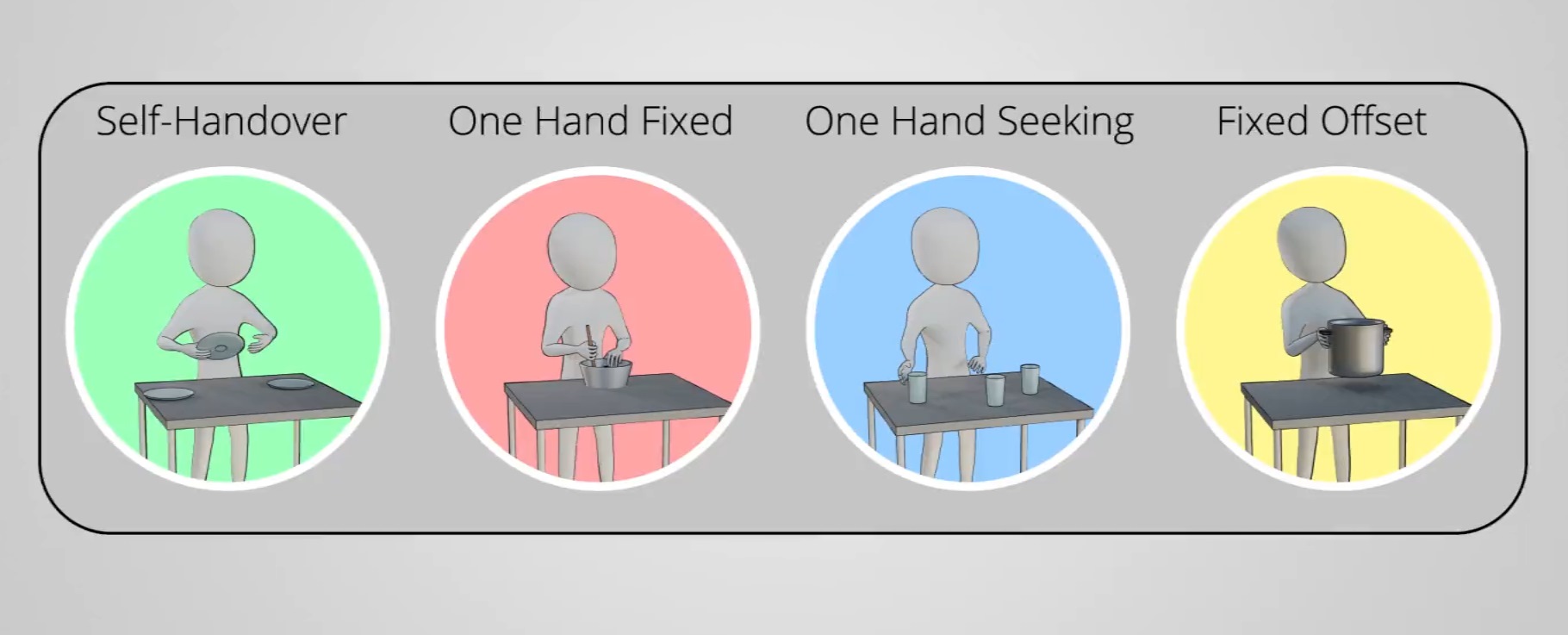
The researchers first had humans wearing a motion capture equipment perform a variety of simulated everyday tasks, like stacking cups, opening containers and pouring out the contents, and picking up items with other things balanced on top. All this data — where the hands go, how they interact, and so on — was chewed up and ruminated on by a machine learning system, which found that people tended to do one of four things with their hands:

  • Self-handover: This is where you pick up an object and put it in the other hand so it’s easier to put it where it’s going, or to free up the first hand to do something else.
  • One hand fixed: An object is held steady by one hand providing a strong, rigid grip, while the other performs an operation on it like removing a lid or stirring the contents.
  • Fixed offset: Both hands work together to pick something up and rotate or move it.
  • One hand seeking: Not actually a two-handed action, but the principle of deliberately keeping one hand out of action while the other finds the object required or performs its own task.

The robot put this knowledge to work not in doing the actions itself — again, these are extremely complex motions that current AIs are incapable of executing — but in its interpretations of movements made by a human controller.

You would think that when a person is remotely controlling a robot, it would just mirror the person’s movements exactly. And in the tests, the robot does so to provide a baseline of how without knowledge about these “bimanual actions,” many of them are simply impossible.

Think of the jar-opening example. We know that when we’re opening the jar, we have to hold one side steady with a stronger grip and may even have to push back with the jar hand against the movement of the opening hand. If you tried to do this remotely with robotic arms, that information is not present any more, and the one hand will likely knock the jar out of the grip of the other, or fail to grip it properly because the other isn’t helping out.

The system created by the researchers recognizes when one of the four actions above is happening, and takes measures to make sure that they’re a success. That means, for instance, being aware of the pressures exerted on each arm by the other when they pick up a bucket together. Or providing extra rigidity to the arm holding an object while the other interacts with the lid. Even when only one hand is being used (“seeking”), the system knows that it can deprioritize the movements of the unused hand and dedicate more resources (be it body movements or computational power) to the working hand.

In videos of demonstrations, it seems clear that this knowledge greatly improves the success rate of the attempts by remote operators to perform a set of tasks meant to simulate preparing a breakfast: cracking (fake) eggs, stirring and shifting things, picking up a tray with glasses on it and keeping it level.

Of course this is all still being done by a human, more or less — but the human’s actions are being augmented and re-interpreted into something more than simple mechanical reproduction.

Doing these tasks autonomously is a long ways off, but research like this forms the foundation for that work. Before a robot can attempt to move like a human, it has to understand not just how humans move, but why they do certain things in certain circumstances, and furthermore what important processes may be hidden from obvious observation — things like planning the hand’s route, choosing a grip location, and so on.

The Madison team was led by Daniel Rakita; their paper describing the system is published in the journal Science Robotics.


Read Full Article

The 14 Most Profitable Places to Sell Your Photos Online


sell-photos-online

If you believe you have taken some photos people would be willing to pay for, you need to know the most profitable places to sell photos online.

Thankfully, there are some reputable websites that can help you turn those photos into cash, and selling your photos online can help diversify your income.

1. Alamy

Alamy Sell Photos Online

There’s a reason why Alamy has over 160 million videos and photos for sale on its website. It offers photographers a huge 50 percent royalty payment on each photo sold. The site also allows photographers to sell their photos elsewhere, but you’ll only get 40 percent commission for those.

This has enabled Alamy to become the world’s largest marketplace for stock photos, with a huge number of monthly visitors—all of whom are potential customers for your photos.

2. Shutterstock

Shutterstock Sell Photos Online

Since launch, Shutterstock has paid out over $500 million to its contributors. When you upload a photo to the marketplace, you still keep the copyright. And you can earn up to 30 percent of the sale price of your photos depending on the size of your image. Currently, the payout starts at $0.25 and can go up to $120 for custom images.

3. iStock Photo

iStock Photo Sell Photos Online

If you’re interested in learning about the best types of photos to sell online, take a look at iStock Photo. Its popular forums and resources will help you to find your feet, and understand how to sell photos online.

You have to apply before you start selling your photos. The application process consists of submitting a few samples of your work through the Contributor by Getty Images app. Since iStock Photos and Getty Images are partners, you may get accepted into either platform.

The site doesn’t provide any specifics about how much you can get paid, but states that you’ll earn a percentage off of every photo that you sell.

4. PhotoShelter

PhotoShelter Sell Photos Online

If you want to sell your photos online, but would rather make those sales through your own site, PhotoShelter is a fantastic tool for this.

At its core, it’s a photography-oriented eCommerce platform that you can integrate into almost any website. This includes cloud storage for your photos, a built-in shopping cart, drag-and-drop website templates, an intuitive interface, decent SEO (search engine optimization), and several social media integrations.

The benefits of this option include retaining full control over how your photos are displayed, not having your competitors photos displayed alongside your own, and the ability to earn much more of the sale price.

Unfortunately, you will have to pay a subscription fee for this service. The basic plan starts at $10/month and comes with the minimum amount of features.

5. Adobe Stock

Adobe Stock Sell Photos Online

Adobe Stock is a beautiful site that offers a royalty of 33 percent for photos and 35 percent for vector art. You can deposit these royalties into your bank account after you’ve reached a threshold of $25. Adobe Stock is integrated into Adobe’s apps, making it more likely your photo will get noticed.

Adobe has simplified the way you upload your photos. Instead of going through the painstakingly slow process of tagging all of your images, Adobe’s smart tagging system does it for you. To make your life even easier, Adobe allows you to upload your photos through Adobe Lightroom CC, Adobe Bridge CC, or its website.

6. SmugMug

SmugMug Sell Photos Online

The SmugMug Pro package is an alternative to PhotoShelter. The platform enables you to showcase your work on a massively customizable storefront, and to manage your orders for a yearly subscription fee.

The main distinguishing feature is the ability to use SmugMug’s printing service create prints, books, and greetings cards from your snapshots. There are also some additional features such as the ability to create coupons, photo packages, and built-in analytics. You’ll also get to keep up to 85 percent of your revenue.

7. Can Stock Photo

Can Stock Sell Photos Online

If you’re looking for an easy way to sell your photos online, Can Stock Photo is a viable option. After you submit three images to the site’s editors, you’ll need to wait 24 hours for approval to start selling.

When uploading photos onto the site, Can Stock Photo will also post your work to one of the largest stock image databases, Fotosearch. You can earn up to 50 percent in royalties on the site, and can withdraw your money into PayPal once your balance reaches $50. If you want a mailed check, you’ll have to wait until you have earned $100.

8. 123RF

123 RF Sell Photos Online

This site has over 110 million files on offer, with almost 100,000 more added every day. The royalties payable vary between 30 percent and 60 percent depending on your level of contribution. This means that the more photos you upload, the higher your payout.

If you upload less than 999 images to the site, you’ll earn 30 percent, which equates to $0.216 per download. If you upload over 1 million images, you’ll receive 60 percent, which equates to $0.432 per download.

9. Dreamstime

Dreamstime Sell Photos Online

In the stock photography world, Dreamstime is a reputable player. It achieved this status by ensuring that all uploads are reviewed to check they meet their high standards, thereby guaranteeing quality.

Once your photos are approved, you’ll receive royalties of 25-50 percent. However, this could increase to 60 percent on all images if you sign an exclusivity contract. If you do sign that exclusivity deal, you’ll also receive an additional bonus of $0.20 for your first 100 approved submissions.

10. FineArtAmerica

FineArtAmerica Sell Photos Online

FineArtAmerica is the perfect place to set up an alluring portfolio, and to sell physical prints of your shots. You can sell each photo as a canvas print, poster, framed print, metal print, acrylic print, greeting card, phone case, and more.

When you make a sale, the order (including the printing) can be fulfilled by the company’s own printing service. You’ll have to pay the base price for the production, but you can make a profit by raising the price of the final product.

In other words, if a canvas print costs $50 for FineArtAmerica to produce, you can increase the price to $75—that way, you’ll earn $25 from an order.

If you’re able to print your own digital photos online, you might want to sell pictures on a craft site like Etsy instead.

11. Snapped4U

Snapped4U Sell Photos Online

If you’re a photographer who takes photos at events—parties, gigs, festivals, weddings—you should know that Snapped4U allows you to easily sell these pictures online. You can also use the sale of your photos as a way to raise money for a good cause.

By uploading and selling your photos here, you don’t need to deal with the nightmare of order processing, printing, and postage. Snapped4U deals with all of that on your behalf. For each photo sold that costs $5 or less, you’ll have to pay a $0.50 fee. If the photo is sold at more than $5, Snapped4U will charge a 10 percent commission.

12. Fotomoto

Fotomoto Sell Photos Online

For photographers who already have a website, but want to sell physical prints, Fotomoto is the way to go. This site handles all the printing, packing, and shipping, so you can concentrate on taking pictures. All you have to do is copy and paste Fotomoto’s code into your website, and you can instantly start to sell your photography online.

The most basic subscription plan is free, but you’ll have to pay 22 percent in transactions fees.

13. Stocksy

Stocksy Sell Photos Online

Stocksy pays out some of the highest royalties for contributors, making it one of the best sites to sell photos online. To apply, you’ll need to submit at least 25 photos, along with some information about yourself. If you manage to get accepted, expect to see royalties ranging from 50-75 percent.

Stocksy recruits top-notch photographers who take high-resolution images, so make sure that you have all of the essential photography gear you need to snap amazing photos. You should also keep in mind that Stocksy requires that all of your photos are exclusive.

14. EyeEm

EyeEm Sell Photos Online

EyeEm is a creative community app that lets you upload and sell photography online, while allowing you to retain your own copyrights. Better yet, you’ll earn 50 percent in royalties every time someone buys one of your photos.

This site pairs up with other image marketplaces as well, giving your pictures a ton of exposure. The more exposure, the more money you can earn. If you’re starting to run dry on ideas, visit EyeEm’s community page on the app to gain some inspiration from other professional photographers.

Sell Photos Online to Earn Some Extra Cash

Photography is such a fun hobby, so making money doing what you love is a bonus. These photo selling websites can finally give your photography the recognition that it deserves.

Hopefully, as you improve your photography skills, you’ll start figuring out the photos that sell well (and those that don’t)—leading to more sales and bigger profits!

Read the full article: The 14 Most Profitable Places to Sell Your Photos Online


Read Full Article