21 May 2019

Why is Facebook doing robotics research?


It’s a bit strange to hear that the world’s leading social network is pursuing research in robotics rather than, say, making search useful, but Facebook is a big organization with many competing priorities. And while these robots aren’t directly going to affect your Facebook experience, what the company learns from them could be impactful in surprising ways.

Though robotics is a new area of research for Facebook, its reliance on and bleeding-edge work in AI are well known. Mechanisms that could be called AI (the definition is quite hazy) govern all sorts of things, from camera effects to automated moderation of restricted content.

AI and robotics are naturally overlapping magisteria — it’s why we have an event covering both — and advances in one often do the same, or open new areas of inquiry, in the other. So really it’s no surprise that Facebook, with its strong interest in using AI for a variety of tasks in the real and social media worlds, might want to dabble in robotics to mine for insights.

What then could be the possible wider applications of the robotics projects it announced today? Let’s take a look.

Learning to walk from scratch
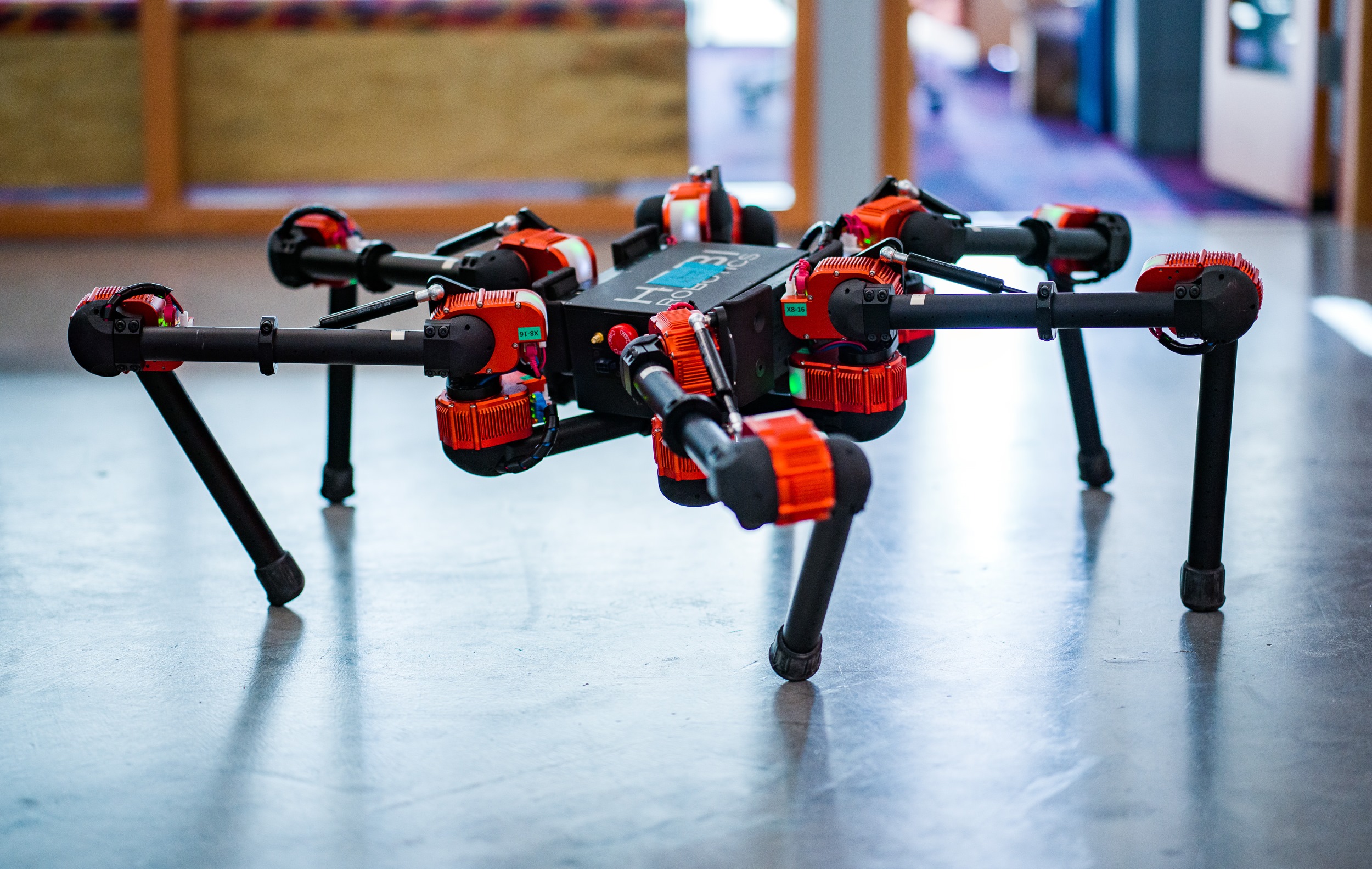
“Daisy” the hexapod robot.

Walking is a surprisingly complex action, or series of actions, especially when you’ve got six legs, like the robot used in this experiment. You can program in how it should move its legs to go forward, turn around, and so on, but doesn’t that feel a bit like cheating? After all, we had to learn on our own, with no instruction manual or settings to import. So the team looked into having the robot teach itself to walk.

This isn’t a new type of research — lots of roboticists and AI researchers are into it. Evolutionary algorithms (different but related) go back a long way, and we’ve already seen interesting papers like this one:

By giving their robot some basic priorities like being “rewarded” for moving forward, but no real clue how to work its legs, the team let it experiment and try out different things, slowly learning and refining the model by which it moves. The goal is to reduce the amount of time it takes for the robot to go from zero to reliable locomotion from weeks to hours.

What could this be used for? Facebook is a vast wilderness of data, complex and dubiously structured. Learning to navigate a network of data is of course very different from learning to navigate an office — but the idea of a system teaching itself the basics on a short timescale given some simple rules and goals is shared.

Learning how AI systems teach themselves, and how to remove roadblocks like mistaken priorities, cheating the rules, weird data-hoarding habits and other stuff is important for agents meant to be set loose in both real and virtual worlds. Perhaps the next time there is a humanitarian crisis that Facebook needs to monitor on its platform, the AI model that helps do so will be informed by the autodidactic efficiencies that turn up here.

Leveraging “curiosity”
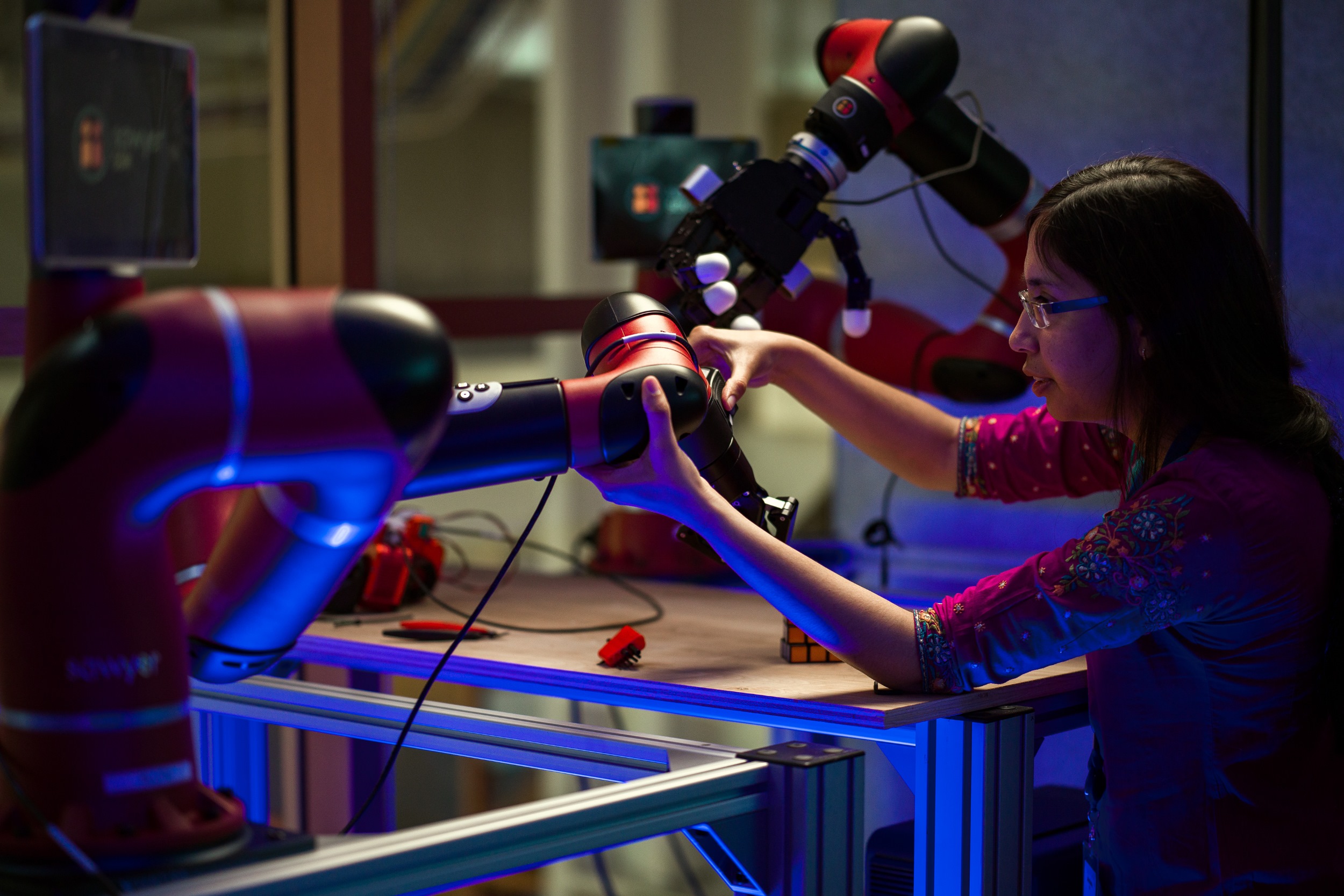
Researcher Akshara Rai adjusts a robot arm in the robotics AI lab in Menlo Park. (Facebook)

This work is a little less visual, but more relatable. After all, everyone feels curiosity to a certain degree, and while we understand that sometimes it kills the cat, most times it’s a drive that leads us to learn more effectively. Facebook applied the concept of curiosity to a robot arm being asked to perform various ordinary tasks.

Now, it may seem odd that they could imbue a robot arm with “curiosity,” but what’s meant by that term in this context is simply that the AI in charge of the arm — whether it’s seeing or deciding how to grip, or how fast to move — is given motivation to reduce uncertainty about that action.

That could mean lots of things — perhaps twisting the camera a little while identifying an object gives it a little bit of a better view, improving its confidence in identifying it. Maybe it looks at the target area first to double check the distance and make sure there’s no obstacle. Whatever the case, giving the AI latitude to find actions that increase confidence could eventually let it complete tasks faster, even though at the beginning it may be slowed by the “curious” acts.

What could this be used for? Facebook is big on computer vision, as we’ve seen both in its camera and image work and in devices like Portal, which (some would say creepily) follows you around the room with its “face.” Learning about the environment is critical for both these applications and for any others that require context about what they’re seeing or sensing in order to function.

Any camera operating in an app or device like those from Facebook is constantly analyzing the images it sees for usable information. When a face enters the frame, that’s the cue for a dozen new algorithms to spin up and start working. If someone holds up an object, does it have text? Does it need to be translated? Is there a QR code? What about the background, how far away is it? If the user is applying AR effects or filters, where does the face or hair stop and the trees behind begin?

If the camera, or gadget, or robot, left these tasks to be accomplished “just in time,” they will produce CPU usage spikes, visible latency in the image, and all kinds of stuff the user or system engineer doesn’t want. But if it’s doing it all the time, that’s just as bad. If instead the AI agent is exerting curiosity to check these things when it senses too much uncertainty about the scene, that’s a happy medium. This is just one way it could be used, but given Facebook’s priorities it seems like an important one.

Seeing by touching

Although vision is important, it’s not the only way that we, or robots, perceive the world. Many robots are equipped with sensors for motion, sound, and other modalities, but actual touch is relatively rare. Chalk it up to a lack of good tactile interfaces (though we’re getting there). Nevertheless, Facebook’s researchers wanted to look into the possibility of using tactile data as a surrogate for visual data.

If you think about it, that’s perfectly normal — people with visual impairments use touch to navigate their surroundings or acquire fine details about objects. It’s not exactly that they’re “seeing” via touch, but there’s a meaningful overlap between the concepts. So Facebook’s researchers deployed an AI model that decides what actions to take based on video, but instead of actual video data, fed it high-resolution touch data.

Turns out the algorithm doesn’t really care whether it’s looking at an image of the world as we’d see it or not — as long as the data is presented visually, for instance as a map of pressure on a tactile sensor, it can be analyzed for patterns just like a photographic image.

What could this be used for? It’s doubtful Facebook is super interested in reaching out and touching its users. But this isn’t just about touch — it’s about applying learning across modalities.

Think about how, if you were presented with two distinct objects for the first time, it would be trivial to tell them apart with your eyes closed, by touch alone. Why can you do that? Because when you see something, you don’t just understand what it looks like, you develop an internal model representing it that encompasses multiple senses and perspectives.

Similarly, an AI agent may need to transfer its learning from one domain to another — auditory data telling a grip sensor how hard to hold an object, or visual data telling the microphone how to separate voices. The real world is a complicated place and data is noisier here — but voluminous. Being able to leverage that data regardless of its type is important to reliably being able to understand and interact with reality.

So you see that while this research is interesting in its own right, and can in fact be explained on that simpler premise, it is also important to recognize the context in which it is being conducted. As the blog post describing the research concludes:

We are focused on using robotics work that will not only lead to more capable robots but will also push the limits of AI over the years and decades to come. If we want to move closer to machines that can think, plan, and reason the way people do, then we need to build AI systems that can learn for themselves in a multitude of scenarios — beyond the digital world.

As Facebook continually works on expanding its influence from its walled garden of apps and services into the rich but unstructured world of your living room, kitchen, and office, its AI agents require more and more sophistication. Sure, you won’t see a “Facebook robot” any time soon… unless you count the one they already sell, or the one in your pocket right now.


Read Full Article

Instagram’s IGTV copies TikTok’s AI, Snapchat’s design


Instagram conquered Stories, but it’s losing the battle for the next video formats. TikTok is blowing up with an algorithmically suggested vertical one-at-a-time feed featuring videos of users remixing each other’s clips. Snapchat Discover’s 2 x infinity grid has grown into a canvas for multi-media magazines, themed video collections, and premium mobile TV shows.

Instagram’s IGTV…feels like a flop in comparison. Launched a year ago, it’s full of crudely cropped & imported viral trash from around the web. The long-form video hub that lives inside both a homescreen button in Instagram as well as a standalone app has failed to host lengthier must-see original vertical content. Sensor Tower estimates that the IGTV app has just 4.2 million installs worldwide with just 7,700 new ones per day — implying less than half a percent of Instagram’s billion-plus users have downloaded it. IGTV doesn’t rank on the overall charts and hangs low at #191 on the US – Photo & Video app charts according to App Annie.

Now Instagram has quietly overhauled the design of IGTV’s space inside its main app to crib what’s working from its two top competitors. The new design showed up in last week’s announcements for Instagram Explore’s new Shopping and IGTV discovery experiences, but the company declined to answer questions about it.

IGTV has ditched its category-based navigation system’s tabs like “For You”, “Following”, “Popular”, and “Continue Watching” for just one central feed of algorithmically suggested videos — much like TikTok. This affords a more lean-back, ‘just show me something fun’ experience that relies on Instagram’s AI to analyze your behavior and recommend content instead of putting the burden of choice on the viewer.
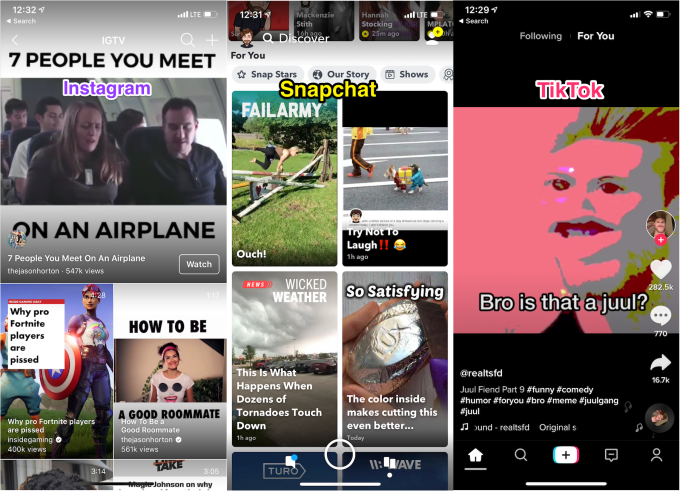

IGTV has also ditched its awkward horizontal scrolling design that always kept a clip playing in the top half of the screen. Now you’ll scroll vertically through a 2 x infinity grid of recommended clips in a what looks just like Snapchat Discover feed. Once you get past a first video that auto-plays up top, you’ll find a full-screen grid of things to watch. You’ll only see the horizontal scroller in the standalone IGTV app, or if you tap into an IGTV video, and then tap the Browse button for finding a next clip while the last one plays up top.

Instagram seems to be trying to straddle the designs of its two competitors. The problem is that TikTok’s one-at-a-time feed works great for punchy, short videos that get right to the point. If you’re bored after 5 second you swipe to the next. IGTV’s focus on long-form means its videos might start too slowly to grab your attention if they were auto-played full-screen in the feed rather than being chosen by a viewer. But Snapchat makes the most of the two previews per row design IGTV has adopted because professional publishers take the time to make compelling cover thumbnail images promoting their content. IGTV’s focus on independent creators means fewer have labored to make great cover images, so viewers have to rely on a screenshot and caption.

Instagram is prototyping a number of other features to boost engagement across its app, as discovered by reverse engineering specialist and frequent TechCrunch tipster Jane Manchun Wong. Those include options to blast a direct message to all your Close Friends at once but in individual message threads, see a divider between notifications and likes you have or haven’t seen, or post a Chat sticker to Stories that lets friends join a group message thread about that content. And to better compete with TikTok, it may let you add lyrics stickers to Stories that appear word-by-word in sync with Instagram’s licensed music soundtrack feature, and share Music Stories to Facebook.

When I spoke with Instagram co-founder and ex-CEO Kevin Systrom last year a few months after IGTV’s launch, he told me “It’s a new format. It’s different. We have to wait for people to adopt it and that takes time . . . Everything that is great starts small.”

But to grow large, IGTV needs to demonstrate how long-form portrait mode video can give us a deeper look at the nuances of the influencers and topics we care about. The company has rightfully prioritized other drives like safety and well-being with features that hide bullies and deter overuse. But my advice from August still stands despite all the ground Instagram has lost in the meantime. “Concentrate on teaching creators how to find what works on the format and incentivizing them with cash and traffic. Develop some must-see IGTV and stoke a viral blockbuster. Prove the gravity of extended, personality-driven vertical video.” Until the content is right, it won’t matter how IGTV surfaces it.


Read Full Article

20 May 2019

This clever transforming robot flies and rolls on its rotating arms


There’s great potential in using both drones and ground-based robots for situations like disaster response, but generally these platforms either fly or creep along the ground. Not the “Flying STAR,” which does both quite well, and through a mechanism so clever and simple you’ll wish you’d thought of it.

Conceived of by researchers at Ben-Gurion University in Israel, the “flying sprawl-tuned autonomous robot” is based on the elementary observation that both rotors and wheels spin. So why shouldn’t a vehicle have both?

Well, there are lots of good reasons why it’s difficult to create such a hybrid, but the team, led by David Zarrouk, overcame them with the help of today’s high-powered, lightweight drone components. The result is a robot that can easily fly when it needs to, then land softly and, by tilting the rotor arms downwards, direct that same motive force into four wheels.

Of course you could have a drone that simply has a couple wheels on the bottom that let it roll along. But this improves on that idea in several ways. In the first place, it’s mechanically more efficient since the same motor drives the rotors and wheels at the same time — though when rolling the RPMs are of course considerably lower. But the rotating arms also give the robot a flexible stance, large wheelbase, and high clearance that make it much more capable on rough terrain.

You can watch FSTAR fly, roll, transform, flatten, and so on in the following video, prepared for presentation at the IEEE International Convention on Robotics and Automation in Montreal:

The ability to roll along at up to 8 feet per second using comparatively little energy, while also being able to leap over obstacles, scale stairs, or simply ascend and fly to a new location give FSTAR considerable adaptability.

“We plan to develop larger and smaller versions to expand this family of sprawling robots for different applications, as well as algorithms that will help exploit speed and cost of transport for these flying/driving robots,” said Zarrouk in a press release.

Obviously at present this is a mere prototype, and will need further work to bring it to a state where it could be useful for rescue teams, commercial operations, and the military.


Read Full Article

On the Internet of Women with Moira Weigel


“Feminism,” the writer and editor Marie Shear famously said in an often-misattributed quote, “is the radical notion that women are people.” The genius of this line, of course, is that it appears to be entirely non-controversial, which reminds us all the more effectively of the past century of fierce debates surrounding women’s equality.

And what about in tech ethics? It would seem equally non-controversial that ethical tech is supposed to be good for “people,” but is the broader tech world and its culture good for the majority of humans who happen to be women? And to the extent it isn’t, what does that say about any of us, and about all of our technology?

I’ve known, since I began planning this TechCrunch series exploring the ethics of tech, that it would need to thoroughly cover issues of gender. Because as we enter an age of AI, with machines learning to be ever more like us, what could be more critical than addressing the issues of sex and sexism often at the heart of the hardest conflicts in human history thus far?

Meanwhile, several months before I began envisioning this series I stumbled across the fourth issue of a new magazine called Logic, a journal on technology, ethics, and culture. Logic publishes primarily on paper — yes, the actual, physical stuff, and a satisfyingly meaty stock of it, at that.

In it, I found a brief essay, “The Internet of Women,” that is a must-read, an instant classic in tech ethics. The piece is by Moira Weigel, one of Logic’s founders and currently a member of Harvard University’s “Society of Fellows” — one of the world’s most elite societies of young academics.

A fast-talking 30-something Brooklynite with a Ph.D. from Yale, Weigel’s work combines her interest in sex, gender, and feminism, with a critical and witty analysis of our technology culture.

In this first of a two-part interview, I speak with Moira in depth about some of the issues she covers in her essay and beyond: #MeToo; the internet as a “feminizing” influence on culture; digital media ethics around sexism; and women in political and tech leadership.

Greg E.: How would you summarize the piece in a sentence or so?

Moira W.: It’s an idiosyncratic piece with a couple of different layers. But if I had to summarize it in just a sentence or two I’d say that it’s taking a closer look at the role that platforms like Facebook and Twitter have played in the so-called “#MeToo moment.”

In late 2017 and early 2018, I became interested in the tensions that the moment was exposing between digital media and so-called “legacy media” — print newspapers and magazines like The New York Times and Harper’s and The Atlantic. Digital media were making it possible to see structural sexism in new ways, and for voices and stories to be heard that would have gotten buried, previously.

A lot of the conversation unfolding in legacy media seemed to concern who was allowed to say what where. For me, this subtext was important: The #MeToo moment was not just about the sexualized abuse of power but also about who had authority to talk about what in public — or the semi-public spaces of the Internet.

At the same time, it seemed to me that the ongoing collapse of print media as an industry, and really what people sometimes call the “feminization” of work in general, was an important part of the context.

When people talk about jobs getting “feminized” they can mean many things — jobs becoming lower paid, lower status, flexible or precarious, demanding more emotional management and the cultivation of an “image,” blurring the boundary between “work” and “life.”

The increasing instability or insecurity of media workplaces only make women more vulnerable to the kinds of sexualized abuses of power the #MeToo hashtag was being used to talk about.


Read Full Article

China overtakes U.S. in smart speaker market share


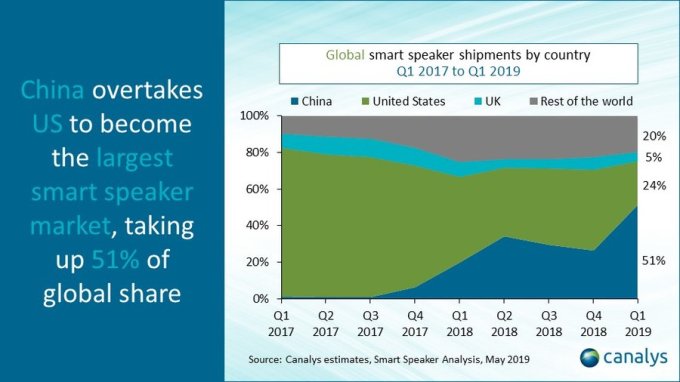
The U.S. no longer leads the smart speaker market, according to new data from Canalys out this morning, which found China’s smart speaker shipments grew by 500 percent in Q1 2019 to overtake the U.S. and achieve a 51 percent market share.

The firm said shipments in China reached 10.6 million units which was driven by “festive promotions.”

More specifically, Baidu had a huge quarter thanks to an exclusive sponsorship deal with China’s national TV channel, CCTV, on its New Year’s Gala on Chinese New Year’s Eve — one of the biggest entertainment shows in terms of viewer numbers. This promotion prompted users to download the Baidu app, which distributed over 100 million coupons to an audience of 1.2 billion during the show, and drove awareness around the brand’s smart speakers, Canalys says.

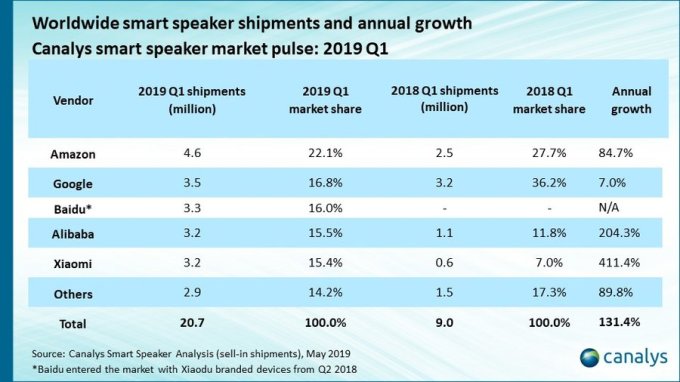
In Q1, Baidu shipped 3.3 million speakers — putting it in third place behind Amazon’s 4.6 million and Google’s 3.5 million. Alibaba and Xiaomi followed, each with 3.2 million shipments, also driven by Chinese New Year promotions.

“The lightning fast development in China is largely driven by vendors pouring in large amount of capital to achieve dominant share quickly,” noted Nicole Peng, VP of Mobility at Canalys, in a statement. “This strategy is favoured by internet service providers like Baidu, Alibaba and Tencent who are used to spending billions on traffic acquisition and know how to reach critical installed base fast.”

Other brands, combined, accounted for a further 2.9 million shipments. That includes Apple’s HomePod, whose market share was so small it got wrapped into this “Other” section instead of being broken out on its own.

With 10.6 million units, China topped the U.S. 5 million units shipped and brought its market share up to 51 percent, while the U.S. dropped from 44 percent in Q4 2018 to 24 percent in Q1 2019.

Overall, the global smart speaker market returned to triple digit annual growth of 131 percent in the quarter, reaching 20.7 million total Q1 shipments — up from just 9 million in the first quarter of 2018.


Read Full Article

On the Internet of Women with Moira Weigel


“Feminism,” the writer and editor Marie Shear famously said in an often-misattributed quote, “is the radical notion that women are people.” The genius of this line, of course, is that it appears to be entirely non-controversial, which reminds us all the more effectively of the past century of fierce debates surrounding women’s equality.

And what about in tech ethics? It would seem equally non-controversial that ethical tech is supposed to be good for “people,” but is the broader tech world and its culture good for the majority of humans who happen to be women? And to the extent it isn’t, what does that say about any of us, and about all of our technology?

I’ve known, since I began planning this TechCrunch series exploring the ethics of tech, that it would need to thoroughly cover issues of gender. Because as we enter an age of AI, with machines learning to be ever more like us, what could be more critical than addressing the issues of sex and sexism often at the heart of the hardest conflicts in human history thus far?

Meanwhile, several months before I began envisioning this series I stumbled across the fourth issue of a new magazine called Logic, a journal on technology, ethics, and culture. Logic publishes primarily on paper — yes, the actual, physical stuff, and a satisfyingly meaty stock of it, at that.

In it, I found a brief essay, “The Internet of Women,” that is a must-read, an instant classic in tech ethics. The piece is by Moira Weigel, one of Logic’s founders and currently a member of Harvard University’s “Society of Fellows” — one of the world’s most elite societies of young academics.

A fast-talking 30-something Brooklynite with a Ph.D. from Yale, Weigel’s work combines her interest in sex, gender, and feminism, with a critical and witty analysis of our technology culture.

In this first of a two-part interview, I speak with Moira in depth about some of the issues she covers in her essay and beyond: #MeToo; the internet as a “feminizing” influence on culture; digital media ethics around sexism; and women in political and tech leadership.

Greg E.: How would you summarize the piece in a sentence or so?

Moira W.: It’s an idiosyncratic piece with a couple of different layers. But if I had to summarize it in just a sentence or two I’d say that it’s taking a closer look at the role that platforms like Facebook and Twitter have played in the so-called “#MeToo moment.”

In late 2017 and early 2018, I became interested in the tensions that the moment was exposing between digital media and so-called “legacy media” — print newspapers and magazines like The New York Times and Harper’s and The Atlantic. Digital media were making it possible to see structural sexism in new ways, and for voices and stories to be heard that would have gotten buried, previously.

A lot of the conversation unfolding in legacy media seemed to concern who was allowed to say what where. For me, this subtext was important: The #MeToo moment was not just about the sexualized abuse of power but also about who had authority to talk about what in public — or the semi-public spaces of the Internet.

At the same time, it seemed to me that the ongoing collapse of print media as an industry, and really what people sometimes call the “feminization” of work in general, was an important part of the context.

When people talk about jobs getting “feminized” they can mean many things — jobs becoming lower paid, lower status, flexible or precarious, demanding more emotional management and the cultivation of an “image,” blurring the boundary between “work” and “life.”

The increasing instability or insecurity of media workplaces only make women more vulnerable to the kinds of sexualized abuses of power the #MeToo hashtag was being used to talk about.


Read Full Article

Glass graduates from Google X as it scores new hardware update


Google’s head-worn smart display, Google Glass, in finally ready to move the tassel.

After defining the company’s far-flung connected dreams when it was first announced in 2013, the enterprise-refocused headset is graduating from the X moonshot factory with a new hardware update that aims to make it more approachable for companies.

After a soft consumer tease that was buzz-worthy if not laughably pre-mature, Google Glass Enterprise Edition was announced two years ago and the dedicated group has been plugging along since then courting businesses to hop on board.

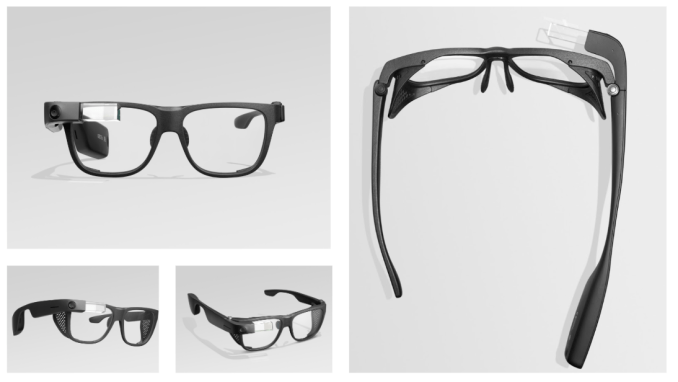
The design of Glass Enterprise Edition 2 doesn’t appear to be radically different from its predecessor, but under the hood there are some noteworthy changes, namely the platform now runs on Android and can be managed by Android Enterprise Mobile Device Management. Those changes alone are probably enough for enterprise customers to move from the non-starter camp to giving it a first look.

The software upgrades are made possible by the headset’s transition to Qualcomm’s AR/VR-focused XR1 chipset. The company also says the new headset has “improved camera performance and quality” as well as USB-C connectivity.

The Glass team joins Google’s AR/VR team and marks another key point in the company’s gradual pivot away from driving to the consumer hoop. In the past year, Google has minimized product updates to its consumer VR platform, while shuttering some groups focused on creative content production and refocusing efforts on enterprise and consumer products more heavily leveraging machine learning.

With its move from X, the Glass team joins projects like Waymo, Wing and Loon that also proved worthy of moving deeper inside Google.


Read Full Article

Select FCC leaders announce support for T-Mobile, Sprint merger


It’s been more than a year since T-Mobile and Sprint formally announced a merger agreement. This morning, members of FCC leadership have issued statements voicing their support for the $26 billion proposal.

Ajit Pai was first out with a statement, suggesting that the pricey consolidation of two of the Unites States’ largest carriers would help accelerate his longstanding desire to provide more internet coverage to rural areas.

“Demonstrating that 5G will indeed benefit rural Americans,” Pai wrote, “T-Mobile and Sprint have promised that their network would cover at least two-thirds of our nation’s rural population with highs peed, mid-band 5G, which could improve the economy and quality of life in many small towns across the country.”

The FCC Chairman went on to suggest that the merger “is in the public interest,” adding that he would recommend fellow members of the commission’s leadership approve it. Commissioner Brendan Carr followed soon after with his own statement of approval, suggesting that a merger would actually increase competition among by consolidating it.

“I support the combination of T-Mobile and Sprint because Americans across the country will see more competition and an accelerated buildout of fast, 5G services,” the Commissioner writes. “The proposed transaction will strengthen competition in the U.S. wireless market and provide mobile and in-home broadband access to communities that demand better coverage and more choices.”

A number of ground rules have been laid out for approval. In a bid for approval, Sprint has promised to sell off prepaid brand, Boost Mobile. “[W]e have committed to divest Sprint’s Boost pre-paid business to a third party following the closing of the merger,” T-Mobile CEO John Legere said in a blog post following the statements of support. “We’ll work to find a serious, credible, financially capable and independent buyer for all the assets needed to run – and grow – the business, and we’ll make sure that buyer has attractive wholesale arrangements.”


Read Full Article

Trump’s Huawei ban also causing tech shocks in Europe


The escalating US-China trade war that’s seen Chinese tech giant Huawei slapped on a US trade blacklist is causing ripples of shock across Europe too, as restrictions imposed on US companies hit regional suppliers concerned they could face US restrictions if they don’t ditch Huawei.

Reuters reports shares fell sharply today in three European chipmakers, Infineon Technologies, AMS and STMicroelectronics, after reports suggested some already had, or were about to, halt shipments to Huawei following the executive order barring US firms from trading with the Chinese tech giant.

The interconnectedness of high tech supply chains coupled with US dominance of the sector and Huawei’s strong regional position as a supplier of cellular, IT and network kit in Europe suddenly makes political risk a fast-accelerating threat for EU technology companies, large and small.

On the small side is French startup Qwant, which competes with Google by offering a pro-privacy search engine. In recent months it has been hoping to leverage a European antitrust decision against Google  Android last year to get smartphones to market in Europe that preload its search engine, not Google’s.

Huawei was its intended first major partner for such devices. Though, prior to recent trade war developments, it was already facing difficulties related to price incentives Google included in reworked EU Android licensing terms.

Still, the US-China trade war threatens to throw a far more existential spanner in European Commission efforts to reset the competitive planning field for smartphone services. Certainly if Google’s response to Huawei’s blacklisting is to torch its supply of almost all Android-related services, per Reuters.

A key aim of the EU antitrust decision was intended to support the unbundling of popular Google services from Android so that device makers can try selling combinations that aren’t entirely Google-flavored — while still being able to offer enough ‘Google’ to excite consumers (such as preloading the Play Store but with a different search and browser bundle instead of the usual Google + Chrome combo).

Yet if Google intends to limit Huawei’s access to such key services there’s little chance of that.

(In a statement responding to the Reuters report Google suggested it’s still deciding how to proceed, with a spokesperson writing: “We are complying with the order and reviewing the implications. For users of our services, Google Play and the security protections from Google Play Protect will continue to function on existing Huawei devices.”)

Going on Google’s initial response, Qwant co-founder and CEO Eric Léandri told us he thinks Google has overreacted — even as he dubbed the US-China trade war “world war III — economical war but it’s a world war for sure”.

“I really need to see exactly what the president trump has said about Huawei and how to work with them. Because I think maybe Google has overreacted. Because I haven’t [interpreted it] that way so I’m very surprised,” he told TechCrunch.

“If Huawei can be [blacklisted] what about the others?” he added. “Because I would say 60% of the cell phone sales in Europe today are coming from China. Huawei or ZTE, OnePlus and the others — they are all under the same kind of risk.

“Even some of our European brands who are very small like Nokia… all of them are made in China, usually with partnership with these big cell phone manufacturers. So that means several things but one thing that I’m sure is we should not rely on one OS. It would be difficult to explain how the Play Store is not as important as the search in Android.”

Léandri also questioned whether Google’s response to the blacklisting will include instructing Huawei not to even use its search engine — a move that could impact its share of the smartphone search market.

“At the end of the day there is just one thing I can say because I’m just a search engine and a European one — I haven’t seen Google asking to not be by default in Huawei as search engine. If they can be in the Huawei by default as a search engine so I presume that everyone else can be there.”

Léandri said Qwant will be watching to see what Huawei’s next steps will be — such as whether it will decide to try offering devices with its own store baked in in Europe.

And indeed how China will react.

“We have to understand the result politically, globally, the European consequences. The European attitude. It’s not only American and China — the rest of the world exists,” he said.

“I have plan b, plan c, plan d, plan f. To be clear we are a startup — so we can have tonnes of plans, The only thing is right now is it’s too enormous.

“I know that they are the two giants in the tech field… but the rest of the world have some words today and let’s see how the European Commission will react, my government will react and some of us will react because it’s not only a small commercial problem right now. It’s a real political power demonstration and it’s global so I will not be more — I am nobody in all this. I do my job and I do my job well and I will use the maximum opportunity that I can find on the market.”

We’ve reached out to the Commission to ask how it intends to respond to escalating risks for European tech firms as Trump’s trade war steps up.

Also today, Reuters reports that the German Economy Minister is examining the impact of US sanctions against Huawei on local companies.

But while a startup like Qwant waits to see what the next few months will bring — and how the landscape of the smartphone market might radically reconfigure in the face of sharply spiking political risk, a different European startup is hoping to catch some uplift: Finland-based Jolla steers development of a made-in-Europe Android alternative, called Sailfish OS.

It’s a very tiny player in a Google-dominated smartphone world. Yet could be positioned to make gains amid US and Chinese tech clashes — which in turn risk making major platform pieces feel a whole lot less stable.

A made-in-Europe non-Google-led OS might gain more ground among risk averse governments and enterprises — as a sensible hedge against Trump-fuelled global uncertainty.

“Sailfish OS, as a non-American, open source based, secure mobile OS platform, is naturally an interesting option for different players — currently the interest is stronger among corporate and governmental customers and partners, as our product offering is clearly focused on this segment,” says Jolla co-founder and CEO Sami Pienimäki.

“Overall, there definitely has been increased interest towards Sailfish OS as a mobile OS platform in different parts of the world, partly triggered by the on-going political activity in many locations. We have also had clearly more discussions with e.g. Chinese device manufacturers, and Jolla has also recently started new corporate and governmental customer projects in Europe.”


Read Full Article

Trump’s Huawei ban also causing tech shocks in Europe


The escalating US-China trade war that’s seen Chinese tech giant Huawei slapped on a US trade blacklist is causing ripples of shock across Europe too, as restrictions imposed on US companies hit regional suppliers concerned they could face US restrictions if they don’t ditch Huawei.

Reuters reports shares fell sharply today in three European chipmakers, Infineon Technologies, AMS and STMicroelectronics, after reports suggested some already had, or were about to, halt shipments to Huawei following the executive order barring US firms from trading with the Chinese tech giant.

The interconnectedness of high tech supply chains coupled with US dominance of the sector and Huawei’s strong regional position as a supplier of cellular, IT and network kit in Europe suddenly makes political risk a fast-accelerating threat for EU technology companies, large and small.

On the small side is French startup Qwant, which competes with Google by offering a pro-privacy search engine. In recent months it has been hoping to leverage a European antitrust decision against Google  Android last year to get smartphones to market in Europe that preload its search engine, not Google’s.

Huawei was its intended first major partner for such devices. Though, prior to recent trade war developments, it was already facing difficulties related to price incentives Google included in reworked EU Android licensing terms.

Still, the US-China trade war threatens to throw a far more existential spanner in European Commission efforts to reset the competitive planning field for smartphone services. Certainly if Google’s response to Huawei’s blacklisting is to torch its supply of almost all Android-related services, per Reuters.

A key aim of the EU antitrust decision was intended to support the unbundling of popular Google services from Android so that device makers can try selling combinations that aren’t entirely Google-flavored — while still being able to offer enough ‘Google’ to excite consumers (such as preloading the Play Store but with a different search and browser bundle instead of the usual Google + Chrome combo).

Yet if Google intends to limit Huawei’s access to such key services there’s little chance of that.

(In a statement responding to the Reuters report Google suggested it’s still deciding how to proceed, with a spokesperson writing: “We are complying with the order and reviewing the implications. For users of our services, Google Play and the security protections from Google Play Protect will continue to function on existing Huawei devices.”)

Going on Google’s initial response, Qwant co-founder and CEO Eric Léandri told us he thinks Google has overreacted — even as he dubbed the US-China trade war “world war III — economical war but it’s a world war for sure”.

“I really need to see exactly what the president trump has said about Huawei and how to work with them. Because I think maybe Google has overreacted. Because I haven’t [interpreted it] that way so I’m very surprised,” he told TechCrunch.

“If Huawei can be [blacklisted] what about the others?” he added. “Because I would say 60% of the cell phone sales in Europe today are coming from China. Huawei or ZTE, OnePlus and the others — they are all under the same kind of risk.

“Even some of our European brands who are very small like Nokia… all of them are made in China, usually with partnership with these big cell phone manufacturers. So that means several things but one thing that I’m sure is we should not rely on one OS. It would be difficult to explain how the Play Store is not as important as the search in Android.”

Léandri also questioned whether Google’s response to the blacklisting will include instructing Huawei not to even use its search engine — a move that could impact its share of the smartphone search market.

“At the end of the day there is just one thing I can say because I’m just a search engine and a European one — I haven’t seen Google asking to not be by default in Huawei as search engine. If they can be in the Huawei by default as a search engine so I presume that everyone else can be there.”

Léandri said Qwant will be watching to see what Huawei’s next steps will be — such as whether it will decide to try offering devices with its own store baked in in Europe.

And indeed how China will react.

“We have to understand the result politically, globally, the European consequences. The European attitude. It’s not only American and China — the rest of the world exists,” he said.

“I have plan b, plan c, plan d, plan f. To be clear we are a startup — so we can have tonnes of plans, The only thing is right now is it’s too enormous.

“I know that they are the two giants in the tech field… but the rest of the world have some words today and let’s see how the European Commission will react, my government will react and some of us will react because it’s not only a small commercial problem right now. It’s a real political power demonstration and it’s global so I will not be more — I am nobody in all this. I do my job and I do my job well and I will use the maximum opportunity that I can find on the market.”

We’ve reached out to the Commission to ask how it intends to respond to escalating risks for European tech firms as Trump’s trade war steps up.

Also today, Reuters reports that the German Economy Minister is examining the impact of US sanctions against Huawei on local companies.

But while a startup like Qwant waits to see what the next few months will bring — and how the landscape of the smartphone market might radically reconfigure in the face of sharply spiking political risk, a different European startup is hoping to catch some uplift: Finland-based Jolla steers development of a made-in-Europe Android alternative, called Sailfish OS.

It’s a very tiny player in a Google-dominated smartphone world. Yet could be positioned to make gains amid US and Chinese tech clashes — which in turn risk making major platform pieces feel a whole lot less stable.

A made-in-Europe non-Google-led OS might gain more ground among risk averse governments and enterprises — as a sensible hedge against Trump-fuelled global uncertainty.

“Sailfish OS, as a non-American, open source based, secure mobile OS platform, is naturally an interesting option for different players — currently the interest is stronger among corporate and governmental customers and partners, as our product offering is clearly focused on this segment,” says Jolla co-founder and CEO Sami Pienimäki.

“Overall, there definitely has been increased interest towards Sailfish OS as a mobile OS platform in different parts of the world, partly triggered by the on-going political activity in many locations. We have also had clearly more discussions with e.g. Chinese device manufacturers, and Jolla has also recently started new corporate and governmental customer projects in Europe.”


Read Full Article

How to Use the Custom Shape Tool in Adobe Photoshop


custom-shapes-photoshop

Sometimes—when you see a cool design that was created in Photoshop—you might wonder what tool was used to make it. You’ll invariably discover that the design was created with Photoshop’s Custom Shape Tool.

Custom shapes, you think? The only shape designs you’ve seen look like stock art. But this robust tool can offer so much more, and its versatility is often underutilized. So here is a beginner’s guide to using the Custom Shape Tool in Photoshop.

Step 1: Set Up Your Photoshop File

How to Use Custom Shape Tool Photoshop Open New File

The first thing you’ll want to do is set up your document in Photoshop. For the purposes of this tutorial, simply open the program and pick the Default Photoshop Size.

How to Use Custom Shape Tool Photoshop Apply Gradient

Next, you’ll want to drop some basic color onto your background, so you can see how your shape interacts with it (more on that later).

For this image we’ve decided to add a simple orange gradient. I then made that gradient darker by applying a Layer style.

If you don’t know how to make a gradient, check out our tutorial detailing how to make a custom gradient in Photoshop.

Step 2: Understand Your Custom Shape Tool

How to Use Custom Shape Tool Photoshop Understanding

Next, you’ll want to go to your Custom Shape Tool. Your Custom Shape Tool can be found in the left-hand toolbar.

You’ll recognize the Custom Shape Tool by the little splatter pattern of its icon, almost like a puddle. Click on this icon to make sure your Custom Shape Tool is active.

How to Use Custom Shape Tool Photoshop Choose New Shape

After your Custom Shape Tool is active, you’ll see the toolbar along the top of your workspace change to fit its parameters.

The most important part of the Custom Shape Tool is choosing the shape itself. To pick a shape from Photoshop’s library, go to the Custom Shape picker menu, seen here highlighted in red.

How to Use Custom Shape Tool Photoshop Shape Dropdown Menu

Once you click on the dropdown menu, you’ll see a whole host of premade options. These shapes range from picture frames and signage, to nature elements, text bubbles, hearts, and squares.

For this tutorial we’re going to pick one of the flowers.

Shape Adjustment Tools

How to Use Custom Shape Tool Photoshop Fill and Stroke

After I pick my shape style, I need to pick the color for both the Fill and Stroke.

Fill is the color that will be inside your shape. Stroke is the color that will outline your shape.

These two options can be found in the top left-hand corner of your workspace. By clicking on each corresponding swatch, you will see a dropdown menu emerge.

From there, you can choose a hue for your Fill or Stroke. You can also choose to have no color at all. To leave your Fill or Stroke blank, pick the white box with a red strikethrough line.

How to Use Custom Shape Tool Photoshop Color Picker

Additionally—if you don’t like any of these color swatches—you can also pick a custom color from the Color Picker. It’s found on the right-hand side of your dropdown menu.

Do you want to use multiple custom colors at once? Here’s how to create a color palette in Photoshop.

How to Use Custom Shape Tool Photoshop Stroke Width and Type

The last setting that you need to be aware of is the Width and Type options for your Stroke.

We’ll be covering these settings later on in the tutorial, but for now just be aware that they are located next to your Fill and Stroke options. You can also adjust your line width and type before you draw your shape, or after you’ve finished.

Step 3: Draw Your Shape

How to Use Custom Shape Tool Photoshop Draw Your Shape

Now that you’ve familiarized yourself with the Custom Shape Tool, it’s time to draw the “flower”.

First, create a new layer for your shape to sit on. This is important, as it allows you to easily edit your shape and use the blending mode to tweak the color later.

Next, make sure your Custom Shape Tool is still active. Then click and drag your cursor across the page to draw your shape. You’ll see the outline of it in blue.

Don’t worry too much about the placement of this shape, or that the dimensions are not exactly where you want them to be. You can fix both of these things later.

How to use Custom Shape Tool Photoshop Shape on Page

Once your shape is roughly the size that you want it at, release your cursor. The blue lines will automatically fill with color, so long as you didn’t have your Fill option set to the red strikethrough before you started.

You’ll also see small “markers” placed at strategic points along this blue outline that still surrounds your flower. You can use these markers to adjust your shape, so let’s do that right now.

Step 4: Adjust Your Shape

How to Use Custom Shape Tool Direct Selection Tool

To adjust your shape, go to the left-hand toolbar and click on the Direct Selection Tool. Its icon looks like a little white arrow, seen here highlighted in red.

How to Use Custom Shape Tool Photoshop Select Anchor Point

The Direct Selection Tool allows you to adjust individual anchor points along a path. Once you have your tool active, you’ll see all the blue “markers” turn white. These are your anchor points.

To adjust an anchor point, click on one of the white dots—it will turn blue again to show you that it’s selected.

How to Use Custom Shape Tool Photoshop Drag Anchor Point

Next, click and drag this anchor point to a new position to adjust your shape.

Let’s say I want to make the petals on this flower skinnier. To do that, I’m going to click and drag this point downwards, towards the center. It will cut the petal in half.

How to Use Custom Shape Tool Photoshop Drag More Anchor Points

When the anchor point is where I want it to be, I’m going to release my cursor. The flower will automatically adjust to this new path.

I like the look of this, so I’m going to grab another anchor point, then click and drag to create another identical flower petal.

Keep on doing this until all of your points are adjusted.

Step 5: Adjust Your Anchor Points

How to Use Custom Shape Tool Photoshop Anchor Point

When you click on an anchor point, you might notice that two little “handles” will stick out on either side of it.

These are your drag control points. When you adjust them, they alter the shape of your anchor point, instead of moving it from point A to B.

To adjust these handles, click on the anchor point you want to adjust.

Then click on the drag control point you want to adjust. It will turn blue.

Once you click on this drag control point, hold down your cursor and move it around the page. You’ll notice the individual curve of your shape—associated with that specific anchor point—will change with it. All your other anchor points will remain the same.

If you don’t like the look of this curve, you can simply go Edit > Undo Drag Control Point. Photoshop will revert your changes.

Step 6: Adjust Your Stroke

How to Use Custom Shape Tool Photoshop Adjust Stroke

Now that you’ve adjusted the shape of your flower, it’s time to finesse the Stroke.

Make sure your shape is selected. Next, go to the toolbar at the top of your workspace, and click on the dropdown menu for the Stroke Size.

By dragging the slider back and forth across the bar, you can make your Stroke line look thinner or thicker.

How to Use Custom Shape Tool Photoshop Adjust Stroke Type

You can also change the Type of stroke by clicking on the dropdown menu next to it.

Step 7: Make Final Adjustments

How to Use Custom Shape Tool Photoshop Use Blending Mode

Now that we’ve adjusted the shape, color, stroke width, and type, it’s time to take a look at this custom shape to see if we’re happy with it.

I’m mostly happy with how this looks. If you aren’t satisfied with your own colors, you can tweak them further by using the Blending Mode in the Layers panel, seen here highlighted in red.

How to Use Custom Shape Tool Photoshop Path Selection

You can also move your final design around on the page.

To do this, go back to your left-hand toolbar. On the Direct Selection Tool icon, click the small white arrow in the corner to access the dropdown menu. Choose the black arrow instead.

This black arrow is the Path Selection Tool. With this tool active, click on your shape so that the blue lines appear. Then click and drag your shape around the page until you’re happy with its placement.

Use the Custom Shape Tool to Design Something Cool

There’s a lot of other, smaller tweaks that you can make with Photoshop’s Custom Shape Tool. By knowing these basic steps, however, you’ll be able to adjust even the most boring of Adobe’s shapes and turn them into something cool.

Are you interested in knowing more about the Layers panel and how you can use it to change your design’s color? Then check out our tutorial explaining how to use the Blending Mode in Photoshop.

Read the full article: How to Use the Custom Shape Tool in Adobe Photoshop


Read Full Article