21 June 2018

Lydia now supports Samsung Pay
While French banks are just catching up to Apple Pay, French startup Lydia is adding support for Samsung Pay. If you have a recent Samsung phone, you can now add a virtual card to Samsung Pay and pay using your phone in your favorite stores.
Lydia started as a peer-to-peer payment app. It works more or less like Venmo or Square Cash in the U.S. After signing up, you can add a debit card to your account and send and receive money for free. You can withdraw your balance to a traditional bank account whenever you want.
The company has been adding more features to turn Lydia into the only banking app you need. You can now connect Lydia to your bank accounts, view your balances, get an IBAN, initiate transfers, create Lydia sub-accounts with multiple people and get a physical MasterCard.
Some features are now part of a premium subscription for €2.99 per month ($3.47) or €3.99 per month with the physical card ($4.62). The company also expanded to the U.K., Ireland, Spain and Portugal. There are a million registered users on Lydia.
More interestingly, Lydia wants to go beyond peer-to-peer payments. You can use Lydia to pay in some grocery stores, such as Franprix stores. You can also pay online by receiving a push notification and confirming the transaction in the Lydia app — Cdiscount supports Lydia for instance.
And when you can’t pay with your Lydia account directly, the startup doesn’t want to play favorites. You can generate a virtual card and enter the card number on an e-commerce website. You can add this virtual card to Apple Pay or Samsung Pay. Let’s see if Google Pay is next.
This could be particularly interesting for users who can’t use those payment systems because their banks don’t support those features. Let’s be honest, you rarely change your bank. With Lydia, you can still use Apple Pay or Samsung Pay with your existing bank account.


Read Full Article
What Is Amazon Prime Wardrobe? And How to Sign Up for It

In direct competition with online shopping platforms like Stitch Fix and Trunk Club, Amazon has made its Prime Wardrobe service available to all US Prime users.
Amazon Prime Wardrobe allows users to order at least three items and try them before deciding whether to purchase. Unlike Stitch Fix and Trunk Club, however, you’re choosing each item yourself and you don’t have to pay a fee if you decide not to keep any items at all.
How Amazon Prime Wardrobe Works
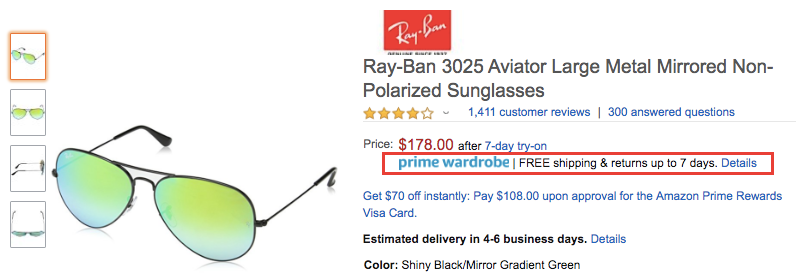
If you have a Prime membership and are based in the US, you have instant access to Prime Wardrobe.
You can order clothes, shoes, or accessories that are Prime Wardrobe eligible. You can either find the items on the Prime Wardrobe page, or look out for items with the Prime Wardrobe logo next to them when you’re browsing Amazon.
When you’re looking on Amazon, you might not see the icon until you make the Prime Wardrobe selection in the screenshot below, selecting Try before you buy:
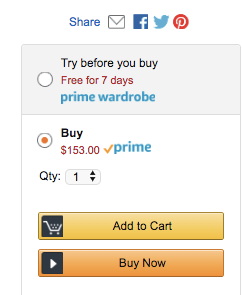
When you find items you want to try out and select your size, click the Add to Prime Wardrobe Cart button.
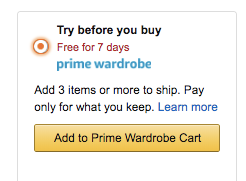
You will need to add at least three items to your Prime Wardrobe Cart before you can check out.
Once you’ve got at least three items in your Prime Wardrobe Cart, click the View or Ship your Prime Wardrobe button.

You’ll view the items in your cart and their total cost (minus shipping). Click the Proceed to Shipping button.
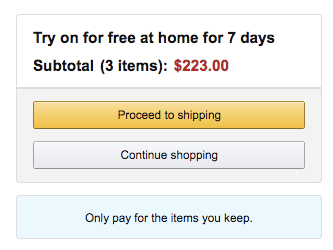
Select your address and payment method as you would with any other Amazon purchase, and click Ship Prime Wardrobe.
What’s in the Fine Print?
- You have to order at least three items and no more than eight items.
- With some items, you might find that only certain sizes are available through Prime Wardrobe.
- Once you receive the items, you have seven days to try them on and decide if you’re going to purchase or return them.
- The items come in a resealable box you can use to return the items you don’t keep.
- Amazon Prime Wardrobe is available to all Prime members in the United States.
- There are no additional fees associated with Prime Wardrobe.
Is Amazon Prime Wardrobe Worth Using?
Why not just order what you want from Amazon and return it if it doesn’t work out?
Rather than go through the process of an Amazon return and waiting for your refund, you can avoid being charged before you’re sure you want to purchase the item. Since there’s no additional cost to using Prime Wardrobe, it’s a no brainer.

And while services like Stitch Fix take a lot of the hard work out of the equation by curating the box for you, Amazon does at least have some curated collections you can choose from.
If you’re still on the fence about signing up for an Amazon Prime membership, there are plenty of perks you get beyond two day shipping. And if you don’t want to pay the annual feel up front, you could also consider a monthly membership.
Read the full article: What Is Amazon Prime Wardrobe? And How to Sign Up for It
Read Full Article
How to Fix “Kill Page” or “Wait” Errors in Chrome

Today’s browsers are pretty stable, so it’s surprising when they start having issues. If you’re frequently seeing Chrome popups saying that a page has become unresponsive and you can either Kill pages or Wait, we can help you troubleshoot them.
Whether your browser displays these errors only on particular sites or all the time, try these tips to nurse your browser back to health.
Step 1: Clear the Cache

Chrome uses local cached data to speed up website loading. If this becomes corrupted, Chrome might crash when it tries to read the information.
To clear your Chrome cache, press the Ctrl + Shift + Del shortcut to open the Clear browsing data option. On the Basic tab, check only Cached images and files. A time range of Last 24 hours should work if your problems are recent, but you can choose a longer one if needed. Click Clear data, then try loading the affected website again.
Step 2: Remove Bad Extensions
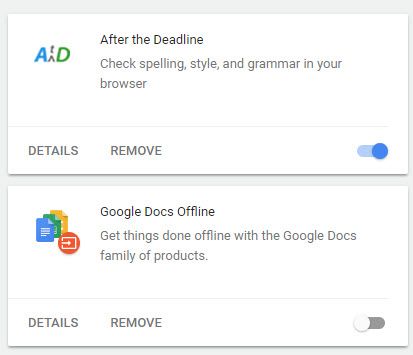
Chrome extensions can add a lot of functionality to your browser, but they can also cause issues. A buggy or malicious extension can cause Chrome to malfunction.
Head to Menu > More tools > Extensions to take a look at your installed extensions. Toggle the slider off for an extension to disable it—you may need to try disabling several of them to see if any are the issue. Also check for malicious extensions while you’re here.
Step 3: Reset the User Data Folder
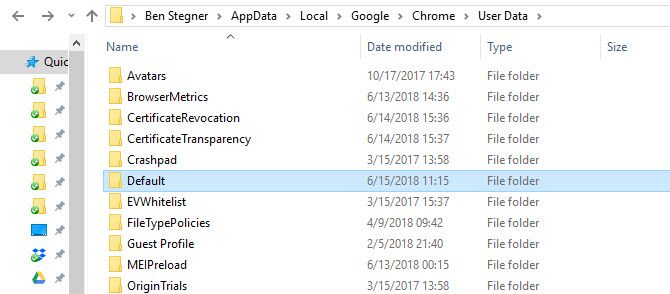
Chrome keeps your specific configuration information in a specific folder. Renaming this folder forces Chrome to create a new one, which might resolve your issue.
To do so, first close Chrome if it’s running. Then enter %localappdata% into the Start Menu. In this directory, browse down to Google\Chrome\User Data and locate the Default folder. Rename it to something like Old Default or Default Backup, then start Chrome again and see if issues persist. (Learn more about AppData!)
Step 4: Reset Chrome
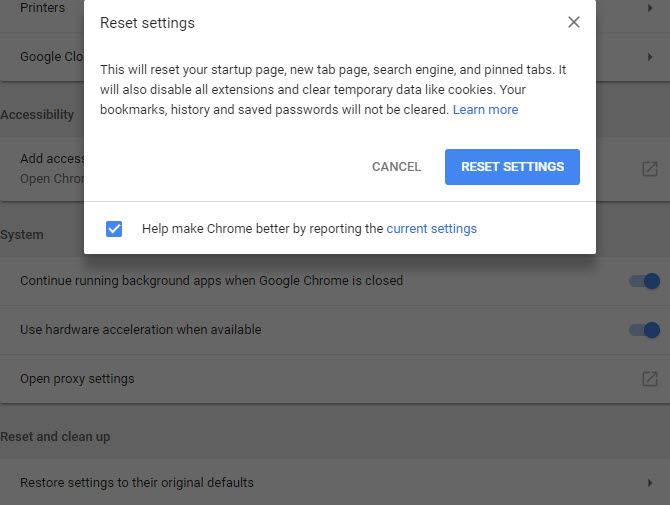
If none of these tips work, it’s worth resetting Chrome. Of course, this will wipe out all your preferences, so make sure you’ve backed up your Chrome data before proceeding.
Head to Menu > Settings and scroll all the way to the bottom of the page (expanding the Advanced settings). Choose Restore settings to their original defaults and confirm. This won’t reset everything, but it’s a good troubleshooting step.
Should this still fail to fix the issue, try reinstalling a fresh copy of Chrome and/or check our Chrome troubleshooting tips for further issues.
Image Credit: ccaetano/Depositphotos
Read the full article: How to Fix “Kill Page” or “Wait” Errors in Chrome
Read Full Article
How to Always Show Scrollbars in Windows Store Apps
The Windows Store is almost unrecognizable from the barren wasteland that it was when it first went live. Microsoft clearly envisages a future in which all your mainstream apps are available via the Store, and they have been making a concerted effort to get everyone onboard with the idea as quickly as possible.
But Windows Store apps (or UWP apps, modern apps, metro apps, universal apps, or whatever else you want to call them) still have one major annoyance: the lack of a scrollbar. Or, more accurately, the auto-hiding scrollbar.
How are you supposed to know the page is scrollable if there’s no bar on the side of the window? It turns out you can unhide the scrollbar so it’s always visible. Let’s take a closer look on how to do this.
How to Unhide Scrollbars in Windows Store Apps
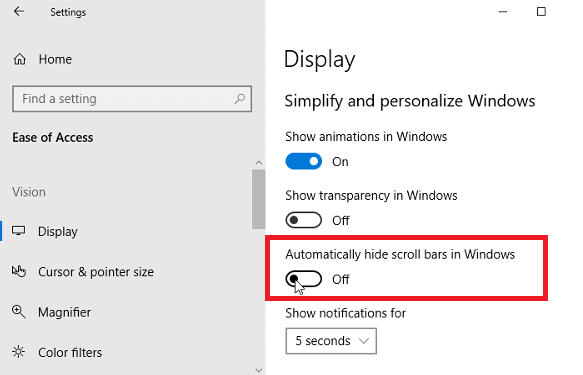
To make scroll bars permanently visible in Windows Store apps, follow the step-by-step instructions below. Note: You need to be running Windows build 17083 or later.
- Open the Settings app.
- Go to the Ease of Access section.
- In the menu on the left-hand side of the screen, click on Display.
- Scroll down to Simplify and personalize Windows.
- Slide the toggle next to Automatically hide scroll bars in Windows into the Off position.
Alternatively, you can edit the registry:
To begin, open the Registry Editor and go to HKEY_CURRENT_USER\Control Panel\Accessibility. Next, in the right-hand pane, create a new 32-Bit DWORD value called DynamicScrollbars. To complete the process, set its value to 0 (setting the value to 1 hides the bars again.)
Read the full article: How to Always Show Scrollbars in Windows Store Apps
Read Full Article
20 June 2018
Google teams with the CIJ in the UK for free workshops for journalists on investigative journalism
Google has been the target of many an investigative journalism scoop, but today in the UK it’s sitting on the other side of the table. The search giant’s Digital News Initiative — the division that was created to give millions in funding to startups and new projects that are pushing the boundaries of digital news — has announced a new partnership with the Centre for Investigative Journalism to help journalists learn how use digital tools to dig up news.
The two will be jointly running 20 free workshops in the UK under the name “Access to Tools,” available both to freelancers and staff editors and writers, that will train them on some of the tricks of the trade when it comes to using digital media to find and report a story, including data analysis on spreadsheets, finding and ‘reading’ minutes from public meetings, and tracking down sources for images. Google says the workshops will use “technology from a range of providers” — not just Google. As for the content: the focus here seems to be on using these tools for digging up local news stories, not dirt on Google.
The efforts are Google’s latest moves to position itself as a friend, and not a foe, to the news industry. Over the years, the company has raised the hackles of many a publisher that has been unhappy with how Google either summarizes stories in Google News, or simply provides enough links around a subject from other sources that a user potentially never needs to visit a publication online to read the original source of the information — thereby depriving the news organisations of traffic and subsequent revenues that come with that traffic from advertising.
That scuffle between Google and the news industry has been going on for years, with the latest frontier being mobile. Google has developed a format for viewing stories on pages with accelerated loading times on mobile, but those stories (signified with a lightning bolt when you search on Google for a story on you mobile device) all get delivered on Google URLs. Now, as Google plans to expand its so-called AMP project to desktop, it has said it’s working on fixing that URL situation, although I’ve checked just now and those Google URLs are still there.
All of this comes at the same time that company is already under investigation by European regulators for its anticompetitive practices in areas like search and mobile.
Google’s News Initiative is one example of how Google is trying to offset all this controversy. Aimed at news organisations in Europe, the group provides no-strings-attached grants to businesses that are aiming to bring more innovation to the field using tech like AI, mobile and more. Google has also run training on its own steam through its News Lab, and also offers online courses. The CIJ association adds another layer of impartiality to the wider strategy.
For the CIJ, it gives the group some funding to bring more of their expertise to a wider set of journalists, and that on balance can only be a good thing.
“Our leading concern is to put the best tools in the hands of investigative journalists, and then grow their expertise in using them,” said CIJ director James Harkin. “Building on our 15 years of expertise in data journalism, advanced internet research, financial search, and internet-powered fact-checking and our relationships of trust with the corporate and independent local media, ‘Access to Tools’ is the perfect way to extend the already impressive reach of our regional network and to get out there into more regional newsrooms, communities, and universities.”

Read Full Article
Instagram hits 1 billion monthly users, up from 800M in September
Instagram’s meteoric rise continues, dwarfing the stagnant growth rates of Snapchat and Facebook. Today Instagram announced that it has reached 1 billion monthly active users, after reaching 800 million in September 2017 with 500 million daily users.
That massive audience could be a powerful draw for IGTV, the longer-form video hub its launching for creators today. While IGTV monetization options are expected in the future, content makers may flock to it early just to get exposure and build their fan base.
While Snapchat’s daily user count grew just 2.13 percent in Q1 2018 to 191 million, and Facebook’s monthly count grew 3.14 percent to reach 2.196 billion, Instagram is growing closer to 5 percent per quarter.
Hitting the 1 billion user milestone could put more pressure on Instagram to carry its weight in the Facebook family and bring home more cash. Facebook doesn’t break out Instagram’s revenue and has never given any guidance about it. But eMarketer estimates that Instagram will generate $5.48 billion in US ad revenue in 2018, up 70 percent from last year. It reports that Instagram makes up 28.2 pecent of Facebook’s mobile ad revenue.
The Instagram brand increasingly looks like Facebook’s life raft. Sentiment towards Facebook, especially amongst teens, has been in decline, and its constantly rocked by privacy scandals. But many users don’t even realize Facebook owns Instagram, and still love the photo sharing app. With the 1 billion user badge, businesses and content creators may take the photo and video app even more seriously. Selling windows into your friends’ worlds is a lucrative business.


Read Full Article
Instagram launches IGTV video hub for creators with 1-hour uploads
Instagram is ready to compete head on with YouTube. Today at a flashy event in San Francisco, the company is announcing it will begin allowing users to upload videos up to 1 hour in length, up from the previous 1 minute limit. And to house the new longer-form videos from star content creators, Instagram is launching IGTV. Located in the app’s Explore Tab, IGTV will spotlight popular videos from Instagram celebrities.
The launch confirms TechCrunch’s scoops over the past month outlining the features and potential of IGTV that we said would arrive today, following the WSJ’s report that Instagram would offer videos up to an hour in length.
“It’s time for video to move forward, and evolve” said Instagram CEO Kevin Systrom on stage at the event. “IGTV is for watching long-from videos from your favorite creators.”

Instagram’s press event just started, but the Instagram Business blog has already been updated with all the details of today’s launch.
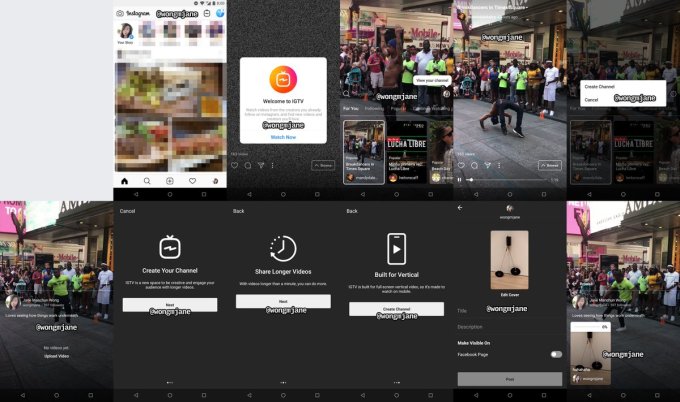
IGTV will let anyone be a creator, not just big name celebrities. People will be able to upload vertical videos through Instagram’s app or the web. In the IGTV hub, viewers will be able to swipe through a variety of longer-form videos, or swipe up to visit a Browse tab of personally recommend videos, popular videos, creators they’re following, and the option to continue watching previously started videos.
Meanwhile, app investigator Jane Manchun Wong dug these screenshots out of Instagram’s Android app.
With 1 billion users on Instagram, IGTV could be popular with creators not only trying to earn money but grow their audience. Instagram is expected to build out a monetization option for IGTV creators, potentially including ad revenue shares. The big user base could also attract advertisers. eMarketer already expects Instagram to earn $5.48 billion in US ad revenue in 2018.
Instagram has evolved far beyond the initial simplicity of just filtering and sharing photos. When it launched, mobile networks, screens, and cameras weren’t ready for longer-form video, and neither were users. As more families cut the cord or teens ignore television all together, though, Instagram has an opportunity to become the TV of mobile. YouTube may always have a wider breadth of content. But through curation of creators and publishers’ video content, Instagram could become the reliable place to watch something great on the small screen.


Read Full Article
Instagram hits 1 billion monthly users, up from 800M in September
Instagram’s meteoric rise continues, dwarfing the stagnant growth rates of Snapchat and Facebook. Today Instagram announced that it has reached 1 billion monthly active users, after reaching 800 million in September 2017 with 500 million daily users.
That massive audience could be a powerful draw for IGTV, the longer-form video hub its launching for creators today. While IGTV monetization options are expected in the future, content makers may flock to it early just to get exposure and build their fan base.
While Snapchat’s daily user count grew just 2.13 percent in Q1 2018 to 191 million, and Facebook’s monthly count grew 3.14 percent to reach 2.196 billion, Instagram is growing closer to 5 percent per quarter.
Hitting the 1 billion user milestone could put more pressure on Instagram to carry its weight in the Facebook family and bring home more cash. Facebook doesn’t break out Instagram’s revenue and has never given any guidance about it. But eMarketer estimates that Instagram will generate $5.48 billion in US ad revenue in 2018, up 70 percent from last year. It reports that Instagram makes up 28.2 pecent of Facebook’s mobile ad revenue.
The Instagram brand increasingly looks like Facebook’s life raft. Sentiment towards Facebook, especially amongst teens, has been in decline, and its constantly rocked by privacy scandals. But many users don’t even realize Facebook owns Instagram, and still love the photo sharing app. With the 1 billion user badge, businesses and content creators may take the photo and video app even more seriously. Selling windows into your friends’ worlds is a lucrative business.

Read Full Article
Mobile website creator Universe nabs $4 million Series A
The small team behind Universe, an iOS app that allows users to build modular, simplistic websites in a minute or two, has scored some new funding as it looks to grow its operation and its ambitions.
The startup has closed a $4 million Series A investment from Javelin Venture Partners, General Catalyst, Y Combinator, Box Group, Eniac Ventures, Paul Buchheit, Yuri Sagalov, Louis Beryl and others. Universe has raised $7.2 million to date.
The startup’s focus on building mobile websites has aimed to bypass the more complicated approaches of desktop-first web design companies for a process that feels a bit more like editing an Instagram photo. More than 160 thousand sites have been built with the app.
We covered the Brooklyn-based company when it launched last year and when it graduated from Y Combinator with seed funding. The team is still just three full-time employees; with this latest funding the team is looking to grow a bit.
“Javelin got excited about Universe because we saw a massive group of content creators that aren’t sitting at a desk or taking the time and cost to develop a website with the traditional tools,” Noah Doyle, Javelin’s managing director said in a statement. “We loved how Universe’s grid-based interface gives anyone the power to design a high-quality web presence, and see it as transformative for artists, free agent professionals, small business owners and individual personal use, too.”
Universe has spent the last few months rethinking how it’s approaching monetization with power users of the service. The company is switching from an à la carte approach that let users use a custom URL or ditch Universe branding on their site for an extra $3 a pop to a Pro tier that’s a flat $10 per month and will gain new functionality over time.
Universe is iOS-only for now; you can check it out here.


Read Full Article
New system connects your mind to a machine to help stop mistakes
How do you tell your robot not do something that could be catastrophic? You could give it a verbal or programmatic command or you could have it watch your brain for signs of distress and have it stop itself. That’s what researchers at MIT’s robotics research lab have done with a system that is wired to your brain and tells robots how to do their job.
The initial system is fairly simple. A scalp EEG and EMG system is connected to a Baxter work robot and lets a human wave or gesture when the robot is doing something that it shouldn’t be doing. For example, the robot could regularly do a task – drilling holes, for example – but when it approaches an unfamiliar scenario the human can gesture at the task that should be done.
“By looking at both muscle and brain signals, we can start to pick up on a person’s natural gestures along with their snap decisions about whether something is going wrong,” said PhD candidate Joseph DelPreto. “This helps make communicating with a robot more like communicating with another person.”
Because the system uses nuances like gestures and emotional reactions you can train robots to interact with humans with disabilities and even prevent accidents by catching concern or alarm before it is communicated verbally. This lets workers stop a robot before it damages something and even help the robot understand slight changes to its tasks before it begins.
In their tests the team trained Baxter to drill holes in an airplane fuselage. The task changed occasionally and a human standing nearby was able to gesture to the robot to change position before it drilled, essentially training it to do new tasks in the midst of its current task. Further, there was no actual programming involved on the human’s part, just a suggestion that the robot move the drill left or right on the fuselage. The most important thing? Humans don’t have to think in a special way or train themselves to interact with the machine.
“What’s great about this approach is that there’s no need to train users to think in a prescribed way,” said DelPreto. “The machine adapts to you, and not the other way around.”
The team will present their findings at the Robotics: Science and Systems (RSS) conference.


Read Full Article
Facebook tests “subscription Groups” that charge for exclusive content
Facebook is starting to let Group admins charge $4.99 to $29.99 per month for access to special sub-Groups full of exclusive posts. A hand-picked array of parenting, cooking, and ‘organize my home’ Groups will be the first to get the chance to spawn a subscription Group open to their members.
During the test, Facebook won’t be taking a cut, but since the feature bills through iOS and Android, they’ll get their 30 percent cut of a user’s first year of subscription and 15 percent after that. But if Facebook eventually did ask for a revenue share, it could finally start to monetize the Groups feature that’s grown to over 1 billion users.

The idea for subscription Groups originally came from the admins. “It’s not so much about making money as it is investing in their community” says Facebook Groups product manager Alex Deve. “The fact that there will be funds coming out of the activity helps them create higher quality content.” Some admins tell Facebook they actually want to funnel subscription dues back into activities their Group does together offline.
Content users might get in the exclusive version of groups include video tutorials, lists of tips, and support directly from admins themselves. For example, Sandra Mueller’s Declutter My Home Group is launching a $14.99 per month Organize My Home subscription Group that will teach members how to stay tidy with checklists and video guides. The Grown and Flown Parents group is spawning a College Admissions and Affordability subscription group with access to college counselors for $29.99. Cooking On A Budget: Recipes & Meal Planning will launch a $9.99 Meal Planning Central Premium subscription group with weekly meal plans, shopping lists for different grocery stores, and more.
But the point of the test is actually to figure out what admins would post and whether members find it valuable. “They have their own ideas. We want to see how that is going to evolve” says Deve.

Here’s how subscription Groups work. First, a user must be in a larger group where the admin has access to the subscription options and posts an invitation for members to check it out. They’ll see preview cards outlining what exclusive content they’ll get access to and how much it costs. If they want to join, the admin vets their application, and if they’re approved they’re charged the monthly fee right away.
They’ll be billed on that date each month, and if they cancel, they’ll still have access until the end of the month. That prevents anyone from joining a group and scraping all the content without paying the full price. The whole system is a bit similar to subscription patronage platform Patreon, but with a Group and its admin at the center instead of some star creator.
Back in 2016, Facebook briefly tested showing ads in Groups, but now says that was never rolled out. However, the company says that admins want other ways beyond subscriptions to build revenue from Groups and it’s considering the possibilities. Facebook didn’t have any more to share on this, but perhaps one day it will offer a revenue split from ads shown within groups.
Between subscriptions, ad revenue shares, tipping, sponsored content, and product placement — all of which Facebook is testing — creators are suddenly flush with monetization options. While we spent the last few decades of the consumer internet scarfing up free content, creativity can’t be a labor of love forever. Letting creators earn money could help them turn their passion into their profession and dedicate more time to making things people love.


Read Full Article
Facebook tests “subscription Groups” that charge for exclusive content
Facebook is starting to let Group admins charge $4.99 to $29.99 per month for access to special sub-Groups full of exclusive posts. A hand-picked array of parenting, cooking, and ‘organize my home’ Groups will be the first to get the chance to spawn a subscription Group open to their members.
During the test, Facebook won’t be taking a cut, but since the feature bills through iOS and Android, they’ll get their 30 percent cut of a user’s first year of subscription and 15 percent after that. But if Facebook eventually did ask for a revenue share, it could finally start to monetize the Groups feature that’s grown to over 1 billion users.
The idea for subscription Groups originally came from the admins. “It’s not so much about making money as it is investing in their community” says Facebook Groups product manager Alex Deve. “The fact that there will be funds coming out of the activity helps them create higher quality content.” Some admins tell Facebook they actually want to funnel subscription dues back into activities their Group does together offline.
Content users might get in the exclusive version of groups include video tutorials, lists of tips, and support directly from admins themselves. For example, Sandra Mueller’s Declutter My Home Group is launching a $14.99 per month Organize My Home subscription Group that will teach members how to stay tidy with checklists and video guides. The Grown and Flown Parents group is spawning a College Admissions and Affordability subscription group with access to college counselors for $29.99. Cooking On A Budget: Recipes & Meal Planning will launch a $9.99 Meal Planning Central Premium subscription group with weekly meal plans, shopping lists for different grocery stores, and more.
But the point of the test is actually to figure out what admins would post and whether members find it valuable. “They have their own ideas. We want to see how that is going to evolve” says Deve.
Here’s how subscription Groups work. First, a user must be in a larger group where the admin has access to the subscription options and posts an invitation for members to check it out. They’ll see preview cards outlining what exclusive content they’ll get access to and how much it costs. If they want to join, the admin vets their application, and if they’re approved they’re charged the monthly fee right away.
They’ll be billed on that date each month, and if they cancel, they’ll still have access until the end of the month. That prevents anyone from joining a group and scraping all the content without paying the full price. The whole system is a bit similar to subscription patronage platform Patreon, but with a Group and its admin at the center instead of some star creator.
Back in 2016, Facebook briefly tested showing ads in Groups, but now says that was never rolled out. However, the company says that admins want other ways beyond subscriptions to build revenue from Groups and it’s considering the possibilities. Facebook didn’t have any more to share on this, but perhaps one day it will offer a revenue split from ads shown within groups.
Between subscriptions, ad revenue shares, tipping, sponsored content, and product placement — all of which Facebook is testing — creators are suddenly flush with monetization options. While we spent the last few decades of the consumer internet scarfing up free content, creativity can’t be a labor of love forever. Letting creators earn money could help them turn their passion into their profession and dedicate more time to making things people love.

Read Full Article
PC Gaming on Linux: 7 Common Questions and Concerns Answered

You use a Windows PC, but you’ve been thinking about trying out Linux. The only problem: no games. After all, you can’t play games on Linux, right?
Wrong!
Anything you can do with a Windows computer, you can do with Linux. That includes watching and editing movies, playing local and streamed music, standard browsing and office tasks… and yes, even gaming.
In fact, Linux has almost as many gaming options as Windows, making it a great alternative. Here’s everything you need to know about gaming on Linux.
1. Yes, You Can Play Games on Linux!
We’ve established that you can play games on Linux. But how many? How good are they? Do modern titles get released on Linux? So many questions!
In short, there are five types of games you can play on Linux:
- Native Linux Games
- Windows games in Linux
- Browser Games
- Terminal Games
- Retro games
Of that list, the first two are the ones that you might be more interested in, coming from a Windows PC. But playing Linux versions of popular games and running the Windows originals within Linux might just open up a whole new world of gaming to you.
2. Where Can I Find Native Linux Games?
You think it’s easy to find Windows games? Let us tell you something: it’s just as easy to find Linux games. While you’re unlikely to find them in your favorite game shop, you’re unlikely to buy a Windows game there anyway.
No, Linux games are found almost exclusively online—often in the same places you find Windows games.
Finding Linux Games via Steam
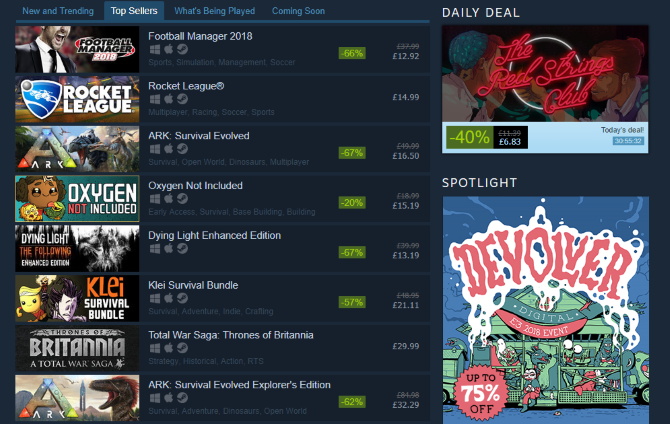
Without a doubt, the first place you should look for Linux games is on Steam. While it might be a proprietary service, the majority of Linux versions of popular Windows games are hosted here. A vast number of titles are available in the Linux library; many top titles are simultaneously released across Windows, macOS, and Linux these days.
All types of Linux games are available on Steam, from top MMORPGs playable on Linux to high-quality strategy games that support Linux.
Note that Linux games are intended mainly for Ubuntu-based distros. You also won’t see the Tux emblem in Steam. Developers Valve released their own Ubuntu-based Linux gaming distro called SteamOS, and Linux games available in Steam display this logo instead.
But you don’t have to use SteamOS to play Steam titles on Linux. Simply install the Steam client on your Linux PC!
Finding Linux Games via GOG
Linux games can also be found on GOG, where the former mantra of “good old games” has more recently made way for newer titles. Whatever the era of game, however, many have been packaged with the necessary software (which we’ll come to below) to enable Linux playability.
Simply head to gog.com to browse the library and sign up for an account.
Finding Linux Games via Penguspy

If you’re looking for purely open source titles, then this is the place to go.
Although free, paid, and closed source titles are also available, Penguspy gives you a collection of titles to browse. It’s a good idea to check the ratings before installing. You won’t find the games at Penguspy, however; instead, links to the homepages of each title are provided.
Finding Linux Games via Humble Store
Another online store that sells games for Linux users, humblebundle.com invariably furnishes you with keys for games via Steam. However, you’re likely to find massive discounts through the Humble Store.
Finding Linux Games via Linux Game Database

Similarly, the Linux Game Database (or LGDb for short) has a great collection of games. Again, you can check screenshots, read descriptions, and check ratings. Unlike Penguspy, however, LGDb will provide links to almost every Linux game going, including those on Steam.
Finding Linux Games via Itch.io
The home of indie games on the internet, itch.io features a number of Linux games. You can identify these via the Tux logo, or find them all via this filter page.
Finding Linux Games via Game Jolt
Another crucial site for indie games and developers, Game Jolt also includes a number of Linux games within its library.
Games-Centric Linux Operating Systems
Another place to find Linux games is to install a Linux operating system that has been designed just for games. These distributions have the games either built in, or accessible from the repository or app store.
Our list of the best Linux gaming operating systems should help you out here. But note that you don’t NEED a games-focused flavor of Linux. Almost all Linux distros have games available in their repositories.
What About Portable Linux Games?
If for some reason you prefer your Linux games to run off external media (such as a USB stick or SD card), then portable games might be more suitable. A good selection of these can be found at portablelinuxgames.org.
3. How Can I Play Windows Games on Linux?
Concerned that you won’t be able to play your favorite Windows games on Linux? Don’t be.
The overwhelming majority of Windows games that have not been released on Linux can nevertheless be run using Wine. This is a piece of software that creates the right environment within Linux for the Windows games to be run. Three options are available for Wine.
- Wine: This is the original project, but it’s a bit fiddly to use on its own.
- PlayOnLinux: A more usable version of Wine, this lets you install your Windows games with the correct settings via a slick user interface.
- Crossover: A paid version of Wine, Crossover features fixes and improvements before they’re included in Wine. This means that Crossover essentially allows you to play more games than Wine. Using Crossover pays for development of Wine.
If none of these solutions works for the game you’re trying to run in Linux, try installing a Windows virtual machine instead.
4. What About Terminal Games for Linux?
Amazingly, it’s even possible to play Linux games in the terminal. If you’re not keen on graphics-heavy first person shooters (FPS) and MMORPGs, and prefer the simplicity of ASCII graphics, this might be the option for you.
A great selection of terminal games can be found at ttygames.wordpress.com. Many of these titles evoke the early 8-bit era with their rudimentary graphics, so prepare for a nostalgia hit!
5. How Do I Play Retro Games on Linux?

If you’re into old games, revisiting nostalgic classics from yesteryear, or simply enjoying them for the first time, Linux is the perfect platform. Unlike modern gaming, you can enjoy retro gaming on lower spec computers.
Even the Raspberry Pi, which has a whole selection of emulation suites to choose from!
Many options are available for playing retro games on Linux. Some are available on Steam; others can be accessed via the Internet Archive; older MS-DOS PC games can be emulated in DOSBox. Our roundup of retro gaming options for Linux covers all the bases.
6. How Do I Host Online Games on Linux?

Linux gaming doesn’t end when you save the game. You can install the server version of Minecraft for group online play. You can go further by installing SteamCMD, which lets you host many Steam games for online multiplayer action.
There’s also the Linux Game Server Manager software, which makes hosting online games easy to use. Our guide to hosting games on Linux covers all you need to know.
7. How Do I Play Browser Games on Linux?
As well as games that you install locally, Linux users can play browser games. This might be anything from Facebook games to browser-based MMORPGs.
Our list of the best free browser games will get you started, as will our look at browser-based FPS titles. Just make sure you’re using an up-to-date browser on your Linux PC.
Linux Gaming Is Great and Here to Stay
While Linux gaming isn’t quite mainstream yet (although if we consider that Android is based on Linux, then the opposite is true), it is nevertheless the best alternative to Windows for PC gaming. Steam’s support is a major driver for this, but other factors are in play too.
At the very least, retro gaming is perfect for Linux. However, we reckon Linux is the perfect alternative to Windows for all but the most hardcore PC gamers.
Image Credit: AY_PHOTO/Depositphotos
Read the full article: PC Gaming on Linux: 7 Common Questions and Concerns Answered
Read Full Article

GoFundMe now allows team fundraising, where multiple people collaborate to raise money
GoFundMe, the popular service for raising money for causes with some $5 billion raised to date, is expanding its platform to serve more community efforts: today the company is launching GoFundMe Team Fundraising, which lets groups of people collectively raise money for a single effort. The idea is that it will make it possible for schools, churches, sports teams, and other groups to set up fundraising campaigns on GoFundMe.
In many cases, groups have traditionally relied on people to use offline methods to raise money for a single cause, or if people have used digital platforms, harnessing those individual campaigns has not been straightforward.
The idea with GoFundMe’s team product is that the organization that is raising the money can create the main repository, and then link up individuals to that anchor so that they can collect contributions directly. Then those contributions can all feed into the main goal as they go along, and campaign leaders can run leaderboards to show how they are progressing. Early tests of the Team feature have included sports teams, school groups raising money for travel to an event; work teams raising for a cause; and local communities.
As with GoFundMe’s other fundraising options, there is no platform fee for starting or running a team campaign, as GoFundMe has now switched to a “tips” model. (There are still standard card processing fees.)
“Before, when a sports team, school club, professional organization or other group was looking to raise money together, the options were limited and could take a lot of time and resources in order to execute successfully,” said Rob Solomon, CEO of GoFundMe, in a statement. “With GoFundMe Team Fundraising, we’re introducing an easy social fundraising solution to maximize reach and success for groups.These new tools will also give our existing community another way to fundraise. Our goal is to make fundraising faster, easier and more efficient for anyone looking to raise money, whether an individual, nonprofit or team.”
The move to expand to a team option is somewhat overdue for GoFundMe: fundraising in groups either for something for that group, or for a cause supported by that group, is one of the more popular ways of driving and getting donations. GoFundMe has built a strong business around individuals starting campaigns for specific causes, so this, in a way, is part of a second wave of expansion for the company.
It’s not coming a moment too soon. GoFundMe is currently the market leader when it comes to fundraising platforms, but it is facing very strong competition in the form of Facebook. The social networking behemoth has been working hard to expand its own fundraising services (which also has a team element) as part of its strategy to highlight its role as a community builder and strengthener (and not just a place to get your entertainment and news fixes). A move today to build stronger bridges with non-profits — it launched Workplace for Good, a free tier of its Slack-competing enterprise product for publicly-focused organisations — will only strengthen its credibility with them.
And separate to that, Facebook is in the process of scoring a huge win for its team-based fundraising efforts at the moment, as three people (who all happen to be ex-Facebook employees) are using Facebook to raise money to support the families who are getting separated at the US/Mexico border. The campaign has gone viral and is now close to raising $10 million, originally aiming for a mere $1,500. Given GoFundMe’s extremely astute use of social media to help spread the word about its own campaigns, it will well understand the significance of that turn of events.
GoFundMe is also running several campaigns related to the wider effort to help these families.

Read Full Article