15 October 2020

Snapchat launches its TikTok rival, Sounds on Snapchat


Snapchat this summer announced it would soon release a new music-powered feature that would allow users to set their Snaps to music. Today, the company made good on that promise with the launch of “Sounds on Snapchat” on iOS, a feature that lets users enhance their Snaps with music from curated catalog of both emerging and established artists.

The music can be added to Snaps either pre or post capture, then shared without any limitations. You can post it to your Story or share directly with friends, as you choose.

At launch, the Snapchat music catalog offers “millions” of licensed songs from Snap’s music industry partners, the company says.

When users receive a Snap with Sounds, they can then swipe up to view the album art, the song title, and the name of the artist. There’s also a “Play This Song” link that lets you listen to the full song on your preferred streaming platform, including Spotify, Apple Music and SoundCloud.

This differentiates Snapchat’s music feature from rival TikTok, where a tap on the “sound” takes users to a page in the app that shows other videos using the same music clip. Only some of these pages also offer a link to play the full song, however.

To kick off the launch of the new Snapchat music feature, Justin Bieber and benny blanco’s new song “Lonely” will be offered as an exclusive in Snapchat’s Featured Sounds list today.

“Music makes video creations and communication more expressive, and offers a personal way to recommend music to your closest friends,” notes the company, in announcement about the feature’s launch.

Snap had said in August it would begin testing the new music feature and detailed the deals that made the addition possible.

To power Sounds on Snapchat, the company forged multi-year agreements with major and independent publishers and labels, including Warner Music Group, Merlin (including their independent label members), NMPA, Universal Music Publishing Group, Warner Chappell Music, Kobalt, and BMG Music Publishing.

The move to introduce a music feature is meant to counter the growing threat of the ByteDance-owned TikTok app, which has popularized short-form video sharing with posts set to music from a large catalog.

Though TikTok’s future in the U.S. remains uncertain due to the ever-changing nature of the Trump administration’s TikTok ban (and an election that could upset those plans), it still remains one of the top U.S. apps, with around 100 million monthly active U.S. users as of August. (TikTok is currently engaged in a lawsuit to challenge its ban, so the app remains live today.)

Social media companies have capitalized on the chaos surrounding a possible TikTok U.S. exit to promote their alternatives, like Triller, Dubsmash, Byte, and others, including, of course Instagram Reels.

Snapchat, meanwhile, touts its traction with a younger user base as its new music feature goes to launch.

In the U.S., Snapchat now reaches 90% of all 13-24 year-olds, which the company notes is more than Facebook, Instagram, and Messenger combined. It also reaches 75% of all 13-34 year-olds and, o average, more than 4 billion Snaps are created every day.

The feature is live now on iOS to start.

In other Snapchat music news, the company has partnered with Spotify to launch Spotify’s first Augmented Reality Portal Lens on Snapchat. The Lens allows users to experience a Latinx art gallery, in celebration of Latinx Heritage Month. Snapchat users open the Lens in World view to view art from include Orly Anan, Cristina Martinez, Luisa Salas, Pedro Nekoi, and D’Ana Nunez. The Lens will also raise awareness for Spotify’s Latin Hub in its own app.


Read Full Article

France and the Netherlands signal support for EU body to clip the wings of big tech


The French and Dutch governments have signalled support for EU rules that can proactively intervene against so-called gatekeepers, aka “structuring platforms” or “large digital platforms with significant network effects acting as gatekeepers” — or, more colloquially, ‘big tech’.

They have also called for a single European body with enforcement powers over such platforms — and the ability to audit their algorithms.

Pre-emptive action should intervene prior to the stage where damage becomes irreversible,” French digital minister, Cederic O, and Mona Keijzer, the secretary of state for economic affairs for the Netherlands, write in a joint position paper where they also argue that: “Intervention is justified when the asymmetric bargaining power of structuring platforms leads to negative consequences.”

The two ministers went further in accompanying remarks to the press, with the Financial Times reporting that their support for intervention against big tech’s market muscle includes keeping the option of breaking up companies “on the table” — although their stated preference is for rules that prevent such an “ultimate” step being necessary.

The intervention by two high profile EU Member States comes as the European Commission is working on a major package of pan-EU legislation to update the bloc’s ecommerce rules — including devising a new regime of ex ante rules for so-called ‘gatekeeper’ platforms. 

In recent months press reports have suggested EU lawmakers are considering forcing such platforms to share data with smaller rivals and/or limiting how they can make use of data — such as via strict purpose limitation.

They are also reportedly considering rules to ban self-preferencing and apply conditions on bundling, as well as requiring annual audits of ad metrics and reporting practices.

Although the package remains at the draft stage for now, with the Commission saying only that it’s committed to introduce the Digital Services Act (DSA) by the end of this year.

Commission lawmakers are also eyeing expanded powers for competition regulators to proactively tackle the network effects that can apply in digital markets — and have, in recent weeks, been consulting on a new competition tool for this purpose. 

The French-Dutch intervention thus sends a strong signal of support to the Commission for regulating big tech — and a warning shot against watering down policy measures.

Competition chief and Commission EVP, Margrethe Vestager, who is one of the key lawmakers drafting the DSA, has previously cautioned against breaking up tech giants as a solution to competitive imbalances in digital markets — calling instead for a finer grained regulatory framework which regulates their access to data.

Such an approach would be akin to a structural separation, without the huge legal challenge involved in actually breaking up businesses, is the thinking.

The French-Dutch position paper reflects back many of the ideas the Commission is actively considering, per recent press leaks. So it may be intended to send a message that key Member States are on the same page.

The paper advocates for intervention to apply to platforms that have “considerable market power” in at least one market, while warning against imposing “unnecessary obligations” to platforms without any gatekeeper position.

It also suggests a “platform-by-platform approach” by regulators to determine whether or not a platform is a gatekeeper or not, noting: “It is important to stress that classical methods of market definition cannot always be used effectively in digital markets.”

Platform-specific factors such as the characteristics of the service and the behaviour of users should factor into the analysis of whether it holds a structural position, they also suggest — before again hitting a cautious note and urging that “a right balance” be struck between a platform-specific analysis and “the need for a reasonable level a legal certainty”.

Interventions should also be ‘case-by-case, flexible and proportionate’ in their view — with the pair suggesting regulatory authorities be empowered to “impose tailor-made remedies to a structuring platform”.

“Proportionate intervention is needed to preserve the benefits of platforms whilst enhancing competition. Too heavy-handed an intervention would hamper innovation,” they warn.

They also voice support for gatekeepers to be subject to a set of “principle-based obligations and prohibited practices” — and recent press reports have also suggested EU lawmakers are considering a laundry list of obligations and conditions on gatekeepers.

“The full set of behavioural obligations could be widened to the whole ecosystem of the platform to tackle the risks stemming from its gatekeeper position on a number of neighbouring markets (leveraging). Also, it could be adjusted over time, in light of the evolution of the business environment. The measures could be either eased or tightened depending on the actual evolution of these conditions,” they further suggest.

Among the “possible behavioral measures” listed in the position paper are beefing up the right to portability (which EU users’ already enjoy under the GDPR); rules to ensure fair contracts (and unfair contract clauses have already attracted EU antitrust enforcement action in the case of, for example, Google Android); a ban on what they describe as “disruptive” self-preferencing; and a stop on platforms yanking third party access (e.g. to APIs or data) — “without objective justification” (the EU has already agreed on some fairness and transparency rules for general ecommerce).

The position paper also voices support for access obligations — such as obligations to share data; provide interoperability; and/or proactively offer alternatives to users — as a potential intervention to ensure market openness, while cautioning of the need to properly investigate ‘pros and cons’ before such enforcement.

On sanctions for infringements, the French and Dutch ministers urge “significant enough” penalties that platforms are effectively deterred from breaking rules, i.e. rather than being able to factor them in as a line of business cost (as now).

The level of these fines or other sanctions should be significant enough to ensure the effectiveness of the rules at stake by deterring the platform from breaking them. The requirement of an efficient and deterrent mechanism of sanctions is all the more important here since any breach of the rules would be likely to induce serious and irreversible harm,” they write. 

On enforcement, the paper calls for a single “European body” outfitted with “proper tools” — including “broad investigation, audit and monitoring powers, and the ability to audit algorithms” — to be entrusted with enforcing the new regulations. 

That would mark a step-change from the EU’s data protection framework (GDPR), where responsibility for enforcement is decentralized to a patchwork of under-resourced local/national data protection agencies. Critics maintain the pace of GDPR enforcement in complex, cross-border cases against big tech is too slow to be effective. A two-year review of the regulation by the Commission this summer also found a general lack of uniformly vigorous enforcement.

That stands as a warning signal to EU lawmakers shaping the next generation of digital regulations that very careful attention needs to be paid to ensuring effective enforcement.


Read Full Article

Best Methods to Rank Your Website Higher


People always use search engines to find what they are looking for in today’s digital world since it is easy and efficient. Now, it is vital for businesses and brands to have a strong online presence to connect with their audiences. Google and other search engines have various algorithms that are designed to show the […]

The post Best Methods to Rank Your Website Higher appeared first on ALL TECH BUZZ.


14 October 2020

How to Improve Taking Photos with a Camera Phone


When it comes to taking photos on your phone it is always an issue of them being rubbish quality that you always wish could be a little better, and it always seems that your friend with the same phone as you takes the most beautiful and clear photographs every time. Here is a 10 step […]

The post How to Improve Taking Photos with a Camera Phone appeared first on ALL TECH BUZZ.


13 October 2020

Apple reveals the $99 HomePod Mini


Today, during its iPhone hardware event, Apple unveiled the $99 HomePod Mini.

The HomePod Mini is clearly a reach for a broader swath of new users. The original HomePod managed to impress audiophiles but its high price served as a high barrier of entry to new users looking for a new smart speaker. Complicating that “smart speaker” designation is the face that Siri was and is several years behind the intelligence of both Amazon Alexa and Google Assistant, leaving the speaker as a more compromised choice for users who might have been hoping to embrace the fully smart home ecosystem.

The new device starts shipping the week of November 16. The device comes in white and space grey colors.

The HomePod Mini ditches the trashcan Mac Pro design of its bigger relative and is much more spherical in shape, still covered in a mesh fabric. It boasts the same onboard screen that allows users to summon Siri and adjust volume, while giving the device a more interesting visual look than smart devices from other companies. Also differentiating the device is Apple’s S5 chip which the company says helps the HomePod Mini bring users its “computational audio.”

Like with the original HomePod, users can arrange a stereo pair of two of the HomePod Minis and will also be able to utilize multiple HomePod devices in a home to operate a new “Intercom” experience.

Image Credits: Apple


Read Full Article

Proxmox Backup and Recovery Strategies


An open-source enterprise virtualization platform, Proxmox has its roots in the early part of the 21st century and has undergone extensive development over the years. Proxmox offers a choice of options used to backup virtual machines using the Proxmox Module and in particular the Bacula Enterprise Edition. Where hosted on a Proxmox hypervisor, the Proxmox […]

The post Proxmox Backup and Recovery Strategies appeared first on ALL TECH BUZZ.


Live from Apple’s virtual 2020 iPhone event


Apple’s big iPhone event is finally here – virtual, which is to be expected these day. This is already the second virtual event Apple has hosted this fall, following one in September at which it revealed the Apple Watch Series 6 and a new iPad Air. This time around, we’re going to see what the iPhone 12 looks like, as well as how many colors and sizes it comes in.

There’s also supposed to be plenty of other news, including a new smaller HomePod mini, maybe an updated Apple TV, possibly a number of different headphone products and more. Will we get our first glance at the first shipping ARM-based Mac to use Apple’s in-house processors? Probably not, but maybe!

We’re going to be following along live and offering commentary below, and you can also tune in live to the video stream right here. Everything gets underway at 10 AM PT/ 1 PM ET.


Read Full Article

Messenger’s latest update brings new features, cross-app communication with Instagram


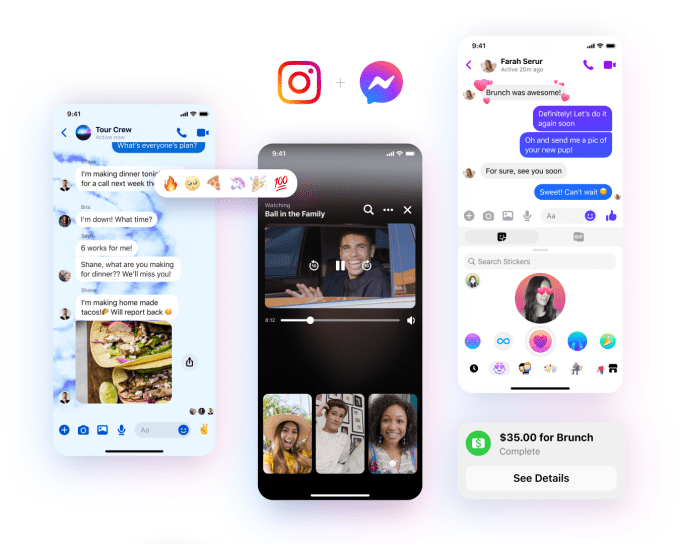
Facebook Messenger is getting a visual update and a number of new features, including support for chat themes, custom reactions, and soon, selfie stickers and vanish mode. The changes are a part of Facebook’s overhauled messaging platform, announced in late September, which introduced the ability for Instagram users to communicate with people on Facebook for the first time.

While Instagram users had to opt-in to the upgraded new feature set in order to also gain access to the cross-platform communication capabilities, Messenger users don’t have to make a similar choice.

Instead, Facebook says this morning that cross-app communication with Instagram will be rolled out soon to users across North America. (At the time of the Instagram announcement, Facebook hadn’t yet confirmed which markets would receive the update first.)

Image Credits: Facebook

Messenger users won’t need to take action to gain the new feature set either. These will also be rolled out to users automatically, as they become available in the user’s region.

On the visual side, one noticeable change — meant to be reflective of Messenger’s cross-platform messaging capabilities — is the updated Messenger logo. It now looks more Instagram-esque with shades of blues, purples and pinks, instead of being Facebook blue.

Image Credits: Facebook

Messenger’s default chat color will be changed to match the new style, as well.

New chat themes, including love and tie-dye, will also now begin to roll out to users, as well as custom reactions, which allow you to react with a variety of emoji instead of the standard set offered today.

Other features are expected to arrive “soon” thereafter, including selfie stickers, which let you decorate your own photo to use a sticker, and a vanish mode to make chats disappear.

These are the same features Instagram users received in their latest update, too.

Before today, Messenger had received a number of new features, including most recently, the ability to co-watch videos with friends and family in Messenger or in Messenger Rooms.

Facebook’s decision to lock users into a new messaging platform with cross-app communication capabilities will make it more difficult for users to defect to other competitive messaging apps. After all, why bother when one app can reach two of the largest social networks? (And one day, possibly, it will incorporate WhatsApp, too.)

It will also make it more difficult for Facebook to unwind its separate businesses, if required to do so by regulars in the future.

Today’s announcement follows last week’s antitrust report put out by the U.S. House Judiciary Committee, which recommended Congress to review a number of potential remedies for Facebook’s monopoly power, including to split parts of its business, as one solution. However, regulators may be more focused on how Facebook acquires competitors to gain an advantage, rather than how it operates its existing apps today, like Instagram and Messenger.


Read Full Article

5 Email Marketing Automation Strategies That Actually Work


An email marketing platform is a service-based software used by marketers to grow their brand or business through email marketing. The functions of this software will vary from one platform brand to another. One platform has a variety of email templates you can use to connect to your customers. Another function is to analyze your […]

The post 5 Email Marketing Automation Strategies That Actually Work appeared first on ALL TECH BUZZ.


Tips And Tricks To Win An Online Casino Game Every Time


Without a doubt, online casinos are on an upward curve these days. They are famous by the name of internet casinos and visual casinos, which are now offered with high-tech audio and video visuals and smooth user experience. Besides, the legalization of online casinos has brought about an additional surge in its popularity. The games […]

The post Tips And Tricks To Win An Online Casino Game Every Time appeared first on ALL TECH BUZZ.


Watch Apple unveil the new iPhone live right here


Apple is set to announce new iPhone models today. The company is holding a (virtual) keynote at 10 AM PT (1 PM in New York, 6 PM in London, 7 PM in Paris). And you’ll be able to watch the event right here as the company is streaming it live.

Rumor has it that there will be four versions of the iPhone 12, including a “mini” phone with a 5.4-inch display, an iPhone 12, 12 Pro and 12 Pro Max. The iPhone 12 and 12 Pro could share the same 6.1-inch display, while the iPhone 12 Pro Max could feature a 6.7-inch display.

You can expect some models with 5G networking capabilities. While the company will likely spend time explaining why 5G is faster than 4G, remember that many carriers have yet to roll out their 5G networks beyond some testing cities.

But that’s not all. Apple could also unveil a wireless charging pad. This time, it’s not going to be named AirPower. The company could bring back the name MagSafe for the accessory.

On the audio front, many people believe that Apple has been working on over-ear headphones. It would fit well in the AirPods lineup. Apple could also use this opportunity to launch a smaller, cheaper HomePod.

You can watch the live stream directly on this page, as Apple is streaming its conference on YouTube.

If you have an Apple TV, you can download the Apple Events app in the App Store. It lets you stream today’s event and rewatch old ones. The app icon was updated a few days ago for the event.

And if you don’t have an Apple TV and don’t want to use YouTube, the company also lets you live stream the event from the Apple Events section on its website. This video feed now works in all major browsers — Safari, Microsoft Edge, Google Chrome and Mozilla Firefox.


Read Full Article

Family-tracking app Life360 launches ‘Bubbles,’ a location-sharing feature inspired by teens on TikTok


Helicopter parenting turned into surveillance with the debut of family-tracking apps like Life360. While the app can alleviate parental fears when setting younger kids loose in the neighborhood, Life360’s teenage users have hated the app’s location-tracking features so much that avoiding and dissing the app quickly became a TikTok meme. Life360 could have ignored the criticism — after all, teens aren’t the app’s paying subscribers; it’s the parents. But Life360 CEO Chris Hulls took a different approach. He created a TikTok account and started a dialogue with the app’s younger users. As a result of these conversations, the company has now launched a new privacy-respecting feature: “Bubbles.”

Bubbles work by allowing any Life360 Circle member to share a circle representing their generalized location instead of their exact whereabouts. To set a bubble, the user can adjust the radius on the map anywhere from 1 to 25 miles in diameter, for a given period of time of 1 to 6 hours. After this temporary bubble is created, Life360’s other existing safety and messaging features will remain enabled. But parents won’t be able to see precisely where their teen is located, other than somewhere in the bubble.

Image Credits: Life360

For example, a teen could tell their parents they were hanging out with some friends in a given part of town after school, then set a bubble accordingly. But without popping that bubble, the parents wouldn’t know if their teenager was at a friend’s house, out driving around, at a park, out shopping, and so on. The expectation is that parents and teens should communicate with one another, not rely on cyberstalking. Plus, parents need to respect that teens deserve to have more freedom to make choices, even if they will sometimes break the rules and then have to suffer the consequences.

A location bubble isn’t un-poppable, however. The bubble will burst if a car crash or other emergency is detected, the company says. A parent can also choose to override the setting and pop the bubble for any reason — like if they don’t hear from the teen for a long period of time or suspect the teen may be unsafe. This could encourage a teen to increase their direct communication with a parent in order to reassure them that they are safe, rather than risk their parent turning tracking back on.

But parents are actively discouraged from popping the bubbles out of fear. Before the bubble is burst, the app will ask the user if they’re sure they want to do so, reminding them also that the member will be notified about the bubble being burst. This gives parents a moment to pause and reconsider whether it’s really enough of an emergency to break their teen’s trust and privacy.

Image Credits: Life360

The feature isn’t necessarily going to solve the problems for teens who want to sneak out or just be un-tracked entirely, which is where many of the complaints have stemmed from in recent years. Instead, it’s meant to represent a compromise in the battle between adult surveillance of kids’ every move and teenagers’ needs to have more personal freedom.

Hulls says the idea for the new feature was inspired by conversations he had with teens on TikTok about Life360’s issues.

“Teens are a core part of the family unit — and our user base — and we value their input,” said Hulls. “After months of communicating with both parents and teens, I am proud to launch a feature that was designed with the whole family in mind, continuing our mission of redefining how safety is delivered to families,” he added.

Before joining TikTok, the Life360 mobile app had been subject to a downrating campaign where teen users rated the app with just one star in hopes of getting it kicked off the App Store. (Apps are not automatically removed for low ratings, but that hasn’t stopped teens from trying this tactic with anything they don’t like, from Google Classroom’s app to the Trump 2020 app, at times.)

In his TikTok debut, Hulls appeared as Darth Vader, then took off the mask to reveal, in his own words, “just your standard, awkward tech CEO.” In the months since, his account has posted and reacted to Life360 memes, answered questions and asked for — and even paid for — helpful user feedback. One of the ideas resulting from the collaboration was “ghost mode,” which is now being referred to at launch as “Bubbles” — a name generated by a TikTok contest to brand the feature.

In addition to sourcing ideas on TikTok, Hulls used the platform to rehabilitate the Life360 brand among teens, explaining how he created the app after Hurricane Katrina to help families reconnect after big emergencies, for example (true). His videos also suggested that he was now on teens’ side and that building “ghost mode” was going to piss off parents or even lose him his job (highly debatable).

In a related effort, the company posted a YouTube parody video to explain the app’s benefits to parents and teens. The video, suggested to teen users through a notification, hit over a million views in 24 hours.

Many teens, ultimately, came around. “i’m crying he seems so nice,” said one commenter. “ngl it’s the parents not the app,” admitted another.

In other words, the strategy worked. Hulls’ “life360ceo” TikTok account has since gained over 231,000 followers and its videos have been “liked” 6.5 million times. Teens have also turned their righteous anger back to where it may actually belong — at their cyberstalking parents, not the tech enabling the location-tracking.

Bubbles is now part of the most recent version of the Life360 app, a free download on iOS and Android. The company offers an optional upgrade to premium plans for families in need of extra features, like location history, crash detection and roadside assistance, among other things.

Family trackers are a large and growing business. As of June 2020, Life360 had 25 million monthly active users located in more than 195 countries. The company’s annualized monthly revenue was forecasted at $77.9 million, a 26% increase year-over-year.

To celebrate the launch of Bubbles, this past Saturday, Life360 launched a branded Hashtag Challenge on TikTok, #ghostmode, for a $10,000 prize. As of today, the hashtag already has 1.4 billion views.


[gallery ids="2059509,2059513,2059512,2059511,2059510"]


Read Full Article

Election Screen Time


Election Screen Time

Alphabet’s latest moonshot is a field-roving, plant-inspecting robo-buggy


Alphabet (you know… Google) has taken the wraps off the latest “moonshot” from its X labs: A robotic buggy that cruises over crops, inspecting each plant individually and, perhaps, generating the kind of “big data” that agriculture needs to keep up with the demands of a hungry world.

Mineral is the name of the project, and there’s no hidden meaning there. The team just thinks minerals are really important to agriculture.

Announced with little fanfare in a blog post and site, Mineral is still very much in the experimental phase. It was born when the team saw that efforts to digitize agriculture had not found as much success as expected at a time when sustainable food production is growing in importance every year.

“These new streams of data are either overwhelming or don’t measure up to the complexity of agriculture, so they defer back to things like tradition, instinct or habit,” writes Mineral head Elliott Grant. What’s needed is something both more comprehensive and more accessible.

Much as Google originally began with the idea of indexing the entire web and organizing that information, Grant and the team imagined what might be possible if every plant in a field were to be measured and adjusted for individually.

A robotic plant inspector from Mineral.

Image Credits: Mineral

The way to do this, they decided, was the “Plant buggy,” a machine that can intelligently and indefatigably navigate fields and do those tedious and repetitive inspections without pause. With reliable data at a plant-to-plant scale, growers can initiate solutions at that scale as well — a dollop of fertilizer here, a spritz of a very specific insecticide there.

They’re not to first to think so. FarmWise raised quite a bit of money last year to expand from autonomous weed-pulling to a full-featured plant intelligence platform.

As with previous X projects at the outset, there’s a lot of talk about what could happen in the future, and how they got where they are, but rather little when it comes to “our robo-buggy lowered waste on a hundred acres of soy by 10 percent” and such like concrete information. No doubt we’ll hear more as the project digs in.


Read Full Article

If data is labor, can collective bargaining limit big tech?


There are plenty of reasons to doubt that the House Judiciary Committee’s antitrust report will mark a turning point in the digital economy. In the end, it lacked true bipartisan support. Yet we can still marvel at the extent of left-right agreement over its central finding: The big tech companies wield troublingly great power over American society.

The bigger worry is whether the solutions on the table cut to the heart of the problem. One wonders whether empowered antitrust agencies can solve the problem before them — and whether they can keep the public behind them. For the proposition that many Facebooks would be better than one simply doesn’t resonate.

There are good reasons why not. Despite all their harms, we know that whatever benefits these platforms provide are largely a result of their titanic scale. We are as uneasy with the platforms’ exercises of their vast power over suppliers and users, as we are with their forbearance; yet it is precisely because of their enormous scale that we use their services. So if regulators broke up the networks, consumers would simply flock toward whatever platforms had the most scale, pushing the industry toward reconsolidation.

Does this mean that the platforms do not have too much power, that they are not harming society? No. It simply means they are infrastructure. In other words, we don’t need these technology platforms to be more fragmented, we need them to belong to us. We need democratic, rather than strictly market processes, to determine how they wield their power.

When you notice that an institution is infrastructure, the usual reaction is to suggest nationalization or regulation. But today, we have good reasons to suspect our political system is not up to this task. Even if an ideal government could competently tackle a problem as complex as managing the 21st century’s digital infrastructure, ours probably cannot.

This appears to leave us in a lose-lose situation and explains the current mood of resignation. But there is another option that we seem to have forgotten about. Labor organization has long afforded control to a broad array of otherwise-powerless stakeholders over the operation of powerful business enterprises. Why is this not on the table?

A growing army of academics, technologists, and commentators are warming to the proposition that “data is labor.” In short, this is the idea that the vast data streams we all produce through our contact with the digital world are a legitimate sort of work-product — over which we ought to have much more meaningful rights than the laws now afford. Collective bargaining plays a central role in this picture. Because the reason that the markets are now failing (to the benefit of the Silicon Valley giants) is that we are all trying to negotiate only for ourselves, when in fact the very nature of data is that it always touches and implicates the interests of many people.

This may seem like a complicated or intractable problem, but leading thinkers are already working on legal and technical solutions.

So in some sense, the scale of the tech giants may indeed not be such a bad thing — the problem, instead, is the power that scale gives them. But what if Facebook had to do business with large coalitions representing ordinary peoples’ data interests — presumably paying large sums, or admitting these representatives into its governance — in order to get the right to exploit its users’ data? That would put power back where it belongs, without undermining the inherent benefits of large platforms. It just might be a future we can believe in.

So what is the way forward? The answer to this question is enabling collective bargaining through data unions. Data unions would become the necessary counterpart to big tech’s information acquiring transitions. By requiring the big tech companies to deal with data unions authorized to negotiate on behalf of their memberships, both of the problems that have allowed these giant tech companies to amass the power to corrupt society are solved.

Labor unions did not gain true traction until the passage of the National Labor Relations Act of 1935. Perhaps, rather than burning our political capital on breaking up the tech giants through a slow and potentially Sisyphean process, we should focus on creating a 21st century version of this groundbreaking legislation — legislation to protect the data rights of all citizens and provide a responsible legal framework for data unions to represent public interests from the bottom up.


Read Full Article

12 October 2020

Facebook, in a reversal, will now ban Holocaust denial content under its hate-speech policy


Facebook this morning announced a significant change in how it approaches Holocaust denial content on its social network. For years, the company has been criticized for not taking down this extremely offensive form of content in favor of allowing free speech and distancing itself from taking on the responsibilities of a traditional publisher. Today, it’s reversing that position, saying it will now update its hate-speech policy to “prohibit any content that denies or distorts the Holocaust.”

The company said it made the decision amid a growing number of online hate speech attacks and is a part of Facebook’s newer efforts to fight the spread of hate speech across its platform.

“We have banned more than 250 white supremacist organizations and updated our policies to address militia groups and QAnon,” explained Facebook in an announcement, authored by Monika Bickert, VP of Content Policy. “We also routinely ban other individuals and organizations globally, and we took down 22.5 million pieces of hate speech from our platform in the second quarter of this year. Following a year of consultation with external experts, we recently banned anti-Semitic stereotypes about the collective power of Jews that often depicts them running the world or its major institutions,” the company said.

Facebook also shared some disturbing statistics representative of how its inaction on this front has impacted the world. It said that according to a recent survey of U.S. adults, ages 18-39, nearly a quarter said they believed the Holocaust was a myth, that it had been exaggerated or that they weren’t sure.

The company noted, too, that institutions focused on Holocaust research and remembrance, such as Yad Vashem, have stressed that Holocaust education is a key component in combating anti-Semitism.

As many may recall, Facebook CEO Mark Zuckerberg once used Holocaust denial as an example of where he thought Facebook shouldn’t intervene with regard to what’s posted to its platform. In a 2018 Recode interview and related follow-up, he suggested that Holocaust denial was a wrong idea that he personally found “deeply offensive,” but said Facebook shouldn’t take that content down because “there are things that different people get wrong.”

The issue and its controversy, however, was not a new one to Facebook. Holocaust-denial content has been a longstanding problem for the company — and one where many employees disagreed with Facebook’s stated position on the matter. Even back in 2009, Facebook had favored the protection of free speech, arguing that it outweighed the negative consequences.

In the years since, Facebook was found to not only allow Holocaust denial on its platform, but to actively promote it. In a 2020 investigation by U.K.-based counter-extremist organisation Institute for Strategic Dialogue (ISD), Facebook search results would bring up suggestions for denial pages on Facebook. These would also recommend links to publishers who sold revisionist and denial literature, among other things.

This summer, ADL and other civil rights organizations, like the NAACP and Color of Change, ran a month-long boycott of Facebook advertising in an effort to get Facebook to step up and do something about hate speech on its platform. The effort gained over 1,000 advertisers and put pressure on the company to make changes.

Facebook then moved to ban across Facebook and Instagram (for the first time) anti-Semitic conspiracy theories about Jewish people running the world, and began to ban QAnon, which has some anti-Semitic elements. But it stopped short of taking action on Holocaust denial.

In a public Facebook post, Zuckerberg added:

I’ve struggled with the tension between standing for free expression and the harm caused by minimizing or denying the horror of the Holocaust. My own thinking has evolved as I’ve seen data showing an increase in anti-Semitic violence, as have our wider policies on hate speech. Drawing the right lines between what is and isn’t acceptable speech isn’t straightforward, but with the current state of the world, I believe this is the right balance.

Facebook says its new decision on this matter does not mean users see an immediate clearing of this sort of content from the platform.

“Enforcement of these policies cannot happen overnight. There is a range of content that can violate these policies, and it will take some time to train our reviewers and systems on enforcement,” Facebook noted.


Read Full Article

Facebook EU-US data transfer complaint: Schrems gets a judicial review of the Irish DPC’s procedure


Another twist in a multi-year complaint saga related to the legality of Facebook’s data transfers: European privacy campaigner Max Schrems has today been granted a judicial review of the Irish regulator’s handling of his complaint.

He’s expecting the hearing to take place before the end of the year — and is hoping the action will, at long last, lead to a suspension of Facebook’s EU-US data transfers.

Schrems says his aim is to “kick start a ‘paused’ complaints procedure'” after Ireland’s Data Protection Commission (DPC) chose to open a new case procedure last month — simultaneously pausing its handling of his original complaint, which dates back some seven years at this point.

The vintage complaint had a major injection of attention following a ruling by Europe’s top court this summer, which struck down a flagship EU-US data transfer arrangement (called Privacy Shield) — and cast doubt on the legality of alternative transfer mechanisms for taking EU citizens’ data to the U.S. for processing when processors are subject to U.S. surveillance law, as Facebook is.

Yet there’s still no decision on Schrems’ original complaint. Hence, he’s returned to court.

“The DPC has already pledged to the Court in 2015 that it will swiftly decide. It seems like we need a clear judgment to force the DPC to do its job,” said Schrems in a statement today on the judicial review being granted.

Facebook has already successfully applied for a judicial review of a preliminary order sent by the DPC last month to suspend its data transfers to the U.S. The tech giant was granted a stay on that preliminary order, so its data transfers continue unabated and uninterrupted — even as the regulatory process is mired in yet more legal wrangling.

The stay also bought Facebook more time to lobby EU lawmakers to “fix” the legal uncertainty now firmly attached to EU-U.S. data transfers — with VP Nick Clegg popping up on a live-streamed debate last month to predict economic doom for the region’s small businesses if Facebook gets forced to suspend transfers. (Clegg further claimed Facebook’s business of “personalized advertising” would be vital to Europe’s coronavirus economic recovery, without pointing out other, less invasive/rights-hostile forms of ad-targeting are available…)

It’s not hard to see why Schrems is so unhappy that his 2013 complaint has been turned into an endless game of regulatory whack-a-mole that leaves Facebook free to continue its data-mining business as usual.

In a press release put out by his privacy-focused not-for-profit, noyb, Schrems writes: “Today’s Judicial Review by noyb is in many ways the counterpart to Facebook’s Judicial Review: While Facebook wants to block the second procedure by the DPC, noyb wants to move the original complaints procedure towards a decision.”

“The DPC has opened a second case, just get rid of the complainant from the first case. Now this second case was stalled by a lawsuit from Facebook within weeks. This was complete procedural mismanagement by the Irish regulator. We are now trying to kick start the original procedure from 2013 to finally get a decision by the DPC after seven years and five court judgements that all confirmed our position,” he adds in the statement.

Schrems/noyb is also making a more pointed allegation against the regulator, saying it saw documents last week that suggest Facebook has been using alternative data transfer mechanisms to take EU users’ data to the U.S. — and accusing the regulator of knowing about this since 2016, yet failing to pass the information on to it.

“The documents we received suggest that seven years of procedures and both references to the European Court of Justice were largely irrelevant for the case before the DPC,” writes Schrems, accusing the regulator of hiding documents from the Courts and his lawyers “despite our right to be provided with all the files of a case”. “We are therefore asking the High Court to clarify that all documents must be put on the table that all parties are properly heard and a quick decision is then made,” he adds.

We reached out to the DPC with questions but the regulator declined to answer specific points at this stage. “As you can see Mr Schrems’ application to the Court this morning was made ex parte, meaning that any comments/arguments put forward were unchallenged. We will outline our position when we make our own submission to the Court,” deputy commissioner, Graham Doyle, told us.

Ireland’s regulator is no stranger to accusations of dragging its feet on enforcing the bloc’s data protection regime against major tech firms and platforms, many of whom have chosen to site their regional base in the country — meaning their data handling typically comes under the supervision of the DPC. (Which in turn means it has a huge backlog of complex, cross-border cases to investigate and issue decisions on.)

More than two years after the GDPR came into application, the DPC has only submitted one draft decision on cross-border cases (related to a Twitter security breach) — which is still pending agreement from the EU’s other data supervisors.

Scores more cases remain open on its desk.

In June, a Commission two-year review of GDPR flagged a lack of uniformly vigorous enforcement — with lawmakers acknowledging: “The best answer [to criticism of GDPR’s failure to regulate big tech] will be a decision from the Irish data protection authority about important cases.”

Separately, Irish parliamentarian Malcolm Byrne raised questions in the senate recently over another long-standing complaint that’s sitting on the DPC’s desk — related to Google and the real-time bidding process that’s involved in programmatic advertising — also still an open investigation.


Read Full Article

What to expect from Apple’s ‘Hi Speed’ iPhone event


For starters, iPhones, of course. That one was easy. The company skipped out on new mobile devices during its recent Apple Watch event, owing to COVID-19-related delays. And, of course, the fact that the events are all pre-taped and virtual now means companies can more easily split them up in ways that were harder to justify when people were expected to fly in from all over the world.

That doesn’t mean we won’t be getting more than just a phone (or, more like multiple phones). While Apple’s been more inclined to host more, smaller events, there’s a decent chance this is going to be the last major event the company hosts before the holidays. That means it’s going to want to get a lot of bang for its buck this time out.

The iPhone 12 is expected to be the centerpiece, of course. The headline feature will almost certainly be 5G. Apple’s been a little behind the curve on that front versus its Android competitors (Samsung, for instance, has several devices with next-gen wireless), though another knock-on effect from the pandemic has been a slower than expected adoption of the tech. So in some ways, Apple’s really right on time here. In the U.S., the company is said to offer both the mmWave and sub-6Ghz 5G technologies. Availability may vary depending on the needs of a given market.

Rumors point to a bunch of different models. After all, gone are the days a company like Apple could just offer up a big premium device and be done with it. Sales for high-end devices were already drying up well before the virus came along to bring smartphone sales to a screeching halt there for a bit. People were already tired of paying in excess of $1,000 for new phones when the ones they already had still did the job perfectly fine.

There are supposedly four sizes arriving. There will be higher-end devices at 6.1 and 6.7 inches, and more budget-minded devices at 6.1 and 5.4 inches. It’s a pretty broad price range, from $699 for the “mini” to $1,099 and up for the Pro Max (sandwiched between are the $799 iPhone 12 and $999 Pro). Along with its recently expanded Watch line, Apple’s all about choice this time out.

Reportedly, however, the company will be bringing OLED tech to all of the models, marking a pretty big change from the days of LCD-sporting budget models. The new models are expected to get a welcome redesign, reportedly returning to something more in line with the iPhone 5. The rounded edges are expected to be dropped in favor of a flatter design, akin to what you get on the iPad Pro.

Other interesting potential additions include the return of the company’s dearly departed MagSafe life for a pair of wireless charging pads that will hopefully finally lay to rest any memory of the failed AirPower experiment. Available for one or two devices, the new pads will reportedly leverage magnets built into the phones to snap them in place.

Music has always been a cornerstone for the company, and it’s long overdue for some updates to audio products. This time out, we may finally get the long-awaited AirPods Studio, an over-ear addition to its line of headphones. The models are set to come in two variations, the largest variation being build materials. A smaller version of its smart speaker could be on the way, as well. The HomePod has long been cost-prohibitive for many, so a mini version could finally make it a bit more accessible.

Another long-rumored addition — AirTags — could finally arrive, as well. Apple’s product-tracking Tile competitor has been in the cards for some time now, but has repeatedly been delayed. That may still be the case — and same goes for a refresh to Apple TV. With the company’s subscription service about to celebrate its year anniversary, it could really use some updated hardware. New Macs with Apple-built chips could be on the table, as well, though the company is reportedly planning one more 2020 event for that big launch.

The event kicks off tomorrow at 10AM PT/1PM ET. We’ll be watching along with you, bringing you the news as it breaks.


Read Full Article

Nest launches its $129 thermostat with a new design, swipe and touch interface on the side


Google’s Nest unit today launched its newest thermostat. At $129, the Nest Thermostat is the company’s most affordable one yet, but it’s also the first to feature a new swipe and tap interface on its side, as well as Google’s Soli radar technology to sense room occupancy and when you are near the device.

Soli, it is worth noting, is not being used for enabling gesture controls. Instead, because the design team wanted a solid mirror finish on the front, Nest decided to use it purely for motion sensing.

The new thermostat, which is made from 49 percent recycled plastic, will come in four colors, Snow, Charcoal, Sand and Fog. The company is also launching a $14.99 trim kit to help you hide any imperfections in your pain when you install the new thermostat.

Image Credits: Nest

“It has this inviting form with this intuitive swipe up and down control, which lets you interact with this product really naturally, instead of pressing these tiny little buttons that most traditional thermostats have,” Nest product lead Ruchi Desai told me.

It’s worth noting that this new version is mostly meant for users in smaller apartments or condos, as it doesn’t support Nest’s remote sensors. To get support for those, you’ll need a Nest Thermostat E (which can occasionally be found for around $139) or the fully-fledged Nest Learning Thermostat.

Talking about learning, among the feature the team is highlighting with this release is the thermostat’s ability to help you schedule your custom temperature settings for different times of the day — and different days. Nest calls this Quick Schedule.

“Unlike the Nest Learning Thermostat, which has the auto-schedule [feature], this one actually offers the ability to create temperature presets, which gives you the ability to set up a schedule based on your lifestyle, based on your preferences,” Desai said. “It will also give you the flexibility of holding temperatures, which means it’ll override the schedule that you have in times when you need the control and flexibility.”

Image Credits: Nest

That sounds a lot like what you’d find in most of today’s smart thermostats from the likes of Ecobee and other Nest competitors, but it’s a first for Nest.

With its Savings Finder feature, the thermostat can also look for small optimizations and suggest minor tweaks that can result in additional energy savings.

Thanks to the new built-in Soli radar chip, the device can automatically lower the temperature when you’re not home. It’s a shame the team isn’t using the chip for any gesture controls, something Google did with its Pixel 4 phone, but the team tells me that it decided not to do this because it didn’t fit the user profile.

“I think that was a very conscious decision we made while designing this product, because for this product we really have the user in mind and we really wanted to focus on the features that were really important to this user. And these are brand new to smart home, they really wanted app control — it seems so basic to us but it’s a massive upgrade for them, right. And all these energy-saving features that come with the thermostat were something that they valued a lot. So we wanted to focus on the features that these users valued for this product,” Desai explained.

Maybe we’ll see Nest do more with this technology in the next iterations of its more expensive thermostats. For now, it feels like a bit of a missed opportunity, though in all fairness, Soli in the Pixel 4 mostly felt like a gimmick and at least the Nest team is putting it to practical use here.

Image Credits: Nest

Like before, Nest promises that it will only take about half an hour or so to install the new thermostat. The app walks you through the individual steps, which should make the process pretty straightforward, assuming your heating and cooling system follows modern standards.

To control the thermostat remotely, you’ll use the Google Home app, where you’ll also find all of the smart features to help you save more energy.

The new thermostat is now available in the U.S. (for $129.99) and Canada (for $179.99 CAD). In Canada, the trim kit will retail for $19.99 CAD). As the team noted, between various utility rebates and rewards, a lot of users may be able to get theirs for only a few dollars, depending on where they live.

Image Credits: Nest


Read Full Article

Fix: Cannot Close Cortana Window In Windows 10


CLICK HERE TO SEE FULL POST

Over the past weekend, I reinstalled Windows 10 on my ThinkPad laptop. This time around, instead of using a Microsoft account to sign in, I created a local user account and started using it. After installing Windows 10, while installing device drivers, I noticed the Cortana window (sign in window) was open. Since I was […]

The post Fix: Cannot Close Cortana Window In Windows 10 appeared first on Into Windows. Content from IntoWindows website.