18 September 2020

Instagram CEO, ACLU slam TikTok and WeChat app bans for putting US freedoms into the balance


As people begin to process the announcement from the U.S. Department of Commerce detailing how it plans, on grounds of national security, to shut down TikTok and WeChat — starting with app downloads and updates for both, plus all of WeChat’s services, on September 20, with TikTok following with a shut down of servers and services on November 12 — the CEO of Instagram and the ACLU are among those that are speaking out against the move.

The CEO of Instagram, Adam Mosseri, wasted little time in taking to Twitter to criticize the announcement. His particular beef is the implication the move will have for US companies — like his — that also have built their businesses around operating across national boundaries.

In essence, if the U.S. starts to ban international companies from operating in the U.S., then it opens the door for other countries to take the same approach with U.S. companies.

Meanwhile, the ACLU has been outspoken in criticizing the announcement on the grounds of free speech.

“This order violates the First Amendment rights of people in the United States by restricting their ability to communicate and conduct important transactions on the two social media platforms,” said Hina Shamsi, director of the American Civil Liberties Union’s National Security Project, in a statement today.

Shamsi added that ironically, while the U.S. government might be crying foul over national security, blocking app updates poses a security threat in itself.

“The order also harms the privacy and security of millions of existing TikTok and WeChat users in the United States by blocking software updates, which can fix vulnerabilities and make the apps more secure. In implementing President Trump’s abuse of emergency powers, Secretary Ross is undermining our rights and our security. To truly address privacy concerns raised by social media platforms, Congress should enact comprehensive surveillance reform and strong consumer data privacy legislation.”

Vanessa Pappas, who is the acting CEO of TikTok, also stepped in to endorse Mosseri’s words and publicly asked Facebook to join TikTok’s litigation against the U.S. over its moves.

We agree that this type of ban would be bad for the industry. We invite Facebook and Instagram to publicly join our challenge and support our litigation,” she said in her own tweet responding to Mosseri, while also retweeting the ACLU. (Interesting how Twitter becomes Switzlerland in these stories, huh?) “This is a moment to put aside our competition and focus on core principles like freedom of expression and due process of law.”

The move to shutter these apps has been wrapped in an increasingly complex set of issues, and these two dissenting voices highlight not just some of the conflict between those issues, but the potential consequences and detriment of acting based on one issue over another.

The Trump administration has stated that the main reason it has pinpointed the apps has been to “safeguard the national security of the United States” in the face of nefarious activity out of China, where the owners of WeChat and TikTok, respectively Tencent and ByteDance, are based:

“The Chinese Communist Party (CCP) has demonstrated the means and motives to use these apps to threaten the national security, foreign policy, and the economy of the U.S.,” today statement from the U.S. Department of Commerce noted. “Today’s announced prohibitions, when combined, protect users in the U.S. by eliminating access to these applications and significantly reducing their functionality.”

In reality, it’s hard to know where the truth actually lies.

In the case of the ACLU and Mosseri’s comments, they are highlighting issues of principles but not necessarily precedent.

It’s not as if the US would be the first country to take a nationalist approach to how it permits the operation of apps. Facebook and its stable of apps, as of right now, are unable to operate in China without a VPN (and even with a VPN things can get tricky). And free speech is regularly ignored in a range of countries today.

But the US has always positioned itself as a standard bearer in both of these areas, and so apart from the self-interest that Instagram might have in advocating for more free market policies, it points to wider market and business position that’s being eroded.

The issue, of course, is a little like an onion (a stinking onion, I’d say), with well more than just a couple of layers around it, and with the ramifications bigger than TikTok (with 100 million users in the U.S. and huge in pop culture beyond even that) or WeChat (much smaller in the U.S. but huge elsewhere and valued by those who do use it).

The Trump administration has been carefully selecting issues to tackle to give voters reassurance of Trump’s commitment to “Make America Great Again,” building examples of how it’s helping to promote U.S. interests and demote those that stand in its way. China has been a huge part of that image building, positioned as an adversary in industrial, defence and other arenas. Pinpointing specific apps and how they might pose a security threat by sucking up our data fits neatly into that strategy.

But are they really security threats, or are they just doing the same kind of nefarious data ingesting that every social app does in order to work? Will the US banning them really mean that other countries, up to now more in favor of a free market, will fall in line and take a similar approach? Will people really stop being able to express themselves?

Those are the questions that Trump has forced into the balance with his actions, and even if they were not issues before, they have very much become so now.


Read Full Article

What magic tricks can reveal about free will | Alice Pailhès

What magic tricks can reveal about free will | Alice Pailhès

Are you in control of your choices? Magic tricks might reveal otherwise, says scientist and illusionist Alice Pailhès. Watch closely as she performs magic tricks that unveil how your brain works, how you can be subtly influenced and what that means for free will and your day-to-day life. Did she guess your card right?

https://ift.tt/3mBhr9x

Click this link to view the TED Talk

Google pulls India’s Paytm app from Play Store for repeat policy violations


Google has pulled popular Indian financial services app Paytm from the Play Store for violating its gambling policies. Paytm is India’s most valuable startup and claims over 50 million monthly active users. Its marquee app, which competes with Google Pay in India, disappeared from the Play Store in the country earlier Friday.

Google said that Play Store prohibits online casinos and other unregulated gambling apps that facilitate sports betting in India. Paytm, which promotes fantasy sports service within its marquee app, repeatedly violated Play Store’s policies, two people familiar with the matter told TechCrunch. Paytm’s fantasy sports service Paytm First Games, which is also available as a standalone app, was also pulled from the Play Store.

The Android-maker, which maintains similar guidelines in most other markets, additionally noted that if an app leads consumers to an external website that allows them to participate in paid tournaments to win real money or cash prizes is also in violation of its Play Store policies.

In an email reviewed by TechCrunch, Google has told several companies in India to pause all advertising campaigns to drive users to websites that offer installation files of sports betting apps.

TechCrunch has reached out to Paytm for comment but has yet to hear back (see below). Google’s Pay app currently dominates the payments market in India.

The announcement today from Google is also a preemptive attempt from the company to remind other developers about its gambling policies a day before the popular cricket tournament Indian Premier League is scheduled to kick off.

Previous seasons of IPL, which last for nearly two months and attract the attention of hundreds of millions of Indians, have seen a surge in apps that look to promote or participate in sports betting.

Sports betting is banned in India, but fantasy sports where users select their favorite players and win if their preferred team or players play well is not illegal in most Indian states.

A person familiar with the matter told TechCrunch that Google has also asked Disney+ Hotstar, one of the most popular on-demand video streaming services in India, to display a warning before running ads about fantasy sports apps.

“We have these policies to protect users from potential harm. When an app violates these policies, we notify the developer of the violation and remove the app from Google Play until the developer brings the app into compliance,” wrote Suzanne Frey, Vice President, Product, Android Security and Privacy, in a blog post.

“And in the case where there are repeated policy violations, we may take more serious action which may include terminating Google Play Developer accounts. Our policies are applied and enforced on all developers consistently,” she added.


Read Full Article

Daily Crunch: Twitter tightens security ahead of election


Twitter takes preemptive steps to avoid election-related hacks, we check out the new Apple Watches and Facebook launches new business tools. This is your Daily Crunch for September 17, 2020.

The big story: Twitter tightens security ahead of election

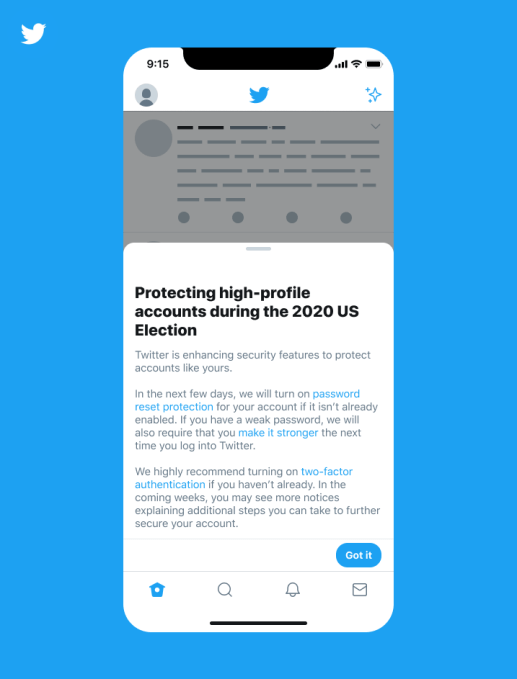
Twitter said today that “high-profile, election-related” accounts in the United States will be receiving notifications telling them they’re required to adopt strong passwords. The company will also be enabling password reset protections for those accounts, and encouraging them to adopt two-factor authentication.

And on top of the steps that it’s requiring candidates to take, Twitter also said it’s adopting additional “proactive internal security safeguards,” such as more sophisticated alerts.

This comes after Twitter was hacked in July, resulting in many high-profile accounts tweeting out a cryptocurrency scam. The company probably wants to avoid an election-related repeat.

The tech giants

A closer look at the new Apple Watches — This isn’t our full review, but rather Brian Heater’s first impressions of the Series 6 and SE.

Facebook launches Facebook Business Suite, an app for managing business accounts across Facebook, Instagram and Messenger — The app offers combined access to a business’s key updates and priorities across Facebook and Instagram.

Amazon makes Alexa Routines shareable — In the U.S., Alexa users will be able to visit the Routines section in the Alexa app, then click on the routine they want to share and grab a shareable URL.

Startups, funding and venture capital

Connected fitness startup Tonal raises another $110 million — It’s a pretty massive round for the strength training company, especially as the space has become increasingly crowded in recent years.

Amazon’s first five climate fund investments include Tesla co-founder JB Straubel’s startup Redwood Materials — Redwood Materials is a recycling startup aiming to create a circular supply chain.

With Goat Capital, Justin Kan and Robin Chan want to keep founding alongside the right teams — Goat Capital is a hybrid incubator, as opposed to a pure seed investment firm.

Advice and analysis from Extra Crunch

Superhuman’s Rahul Vohra asks 6 VCs how to raise funding when the sky is falling — Deal velocity has gone up!

Startup founders must overcome information overload — Entrepreneurs share their tips for weighing advice and data.

Does early-stage health tech need more ‘patient’ capital? — Steve O’Hear interviews Dr. Fiona Pathiraja of early-stage health tech fund Crista Galli Ventures.

(Reminder: Extra Crunch is our subscription membership program, which aims to democratize information about startups. You can sign up here.)

Everything else

Jennifer Doudna sees CRISPR gene-editing tech as a Swiss Army knife for COVID-19 and beyond — Doudna is one of the pioneers of the gene-editing technique known as CRISPR, and she discussed its potential at Disrupt.

Hulu tests its co-viewing feature ‘Watch Party’ with ad-supported viewers — Hulu Watch Party was initially only available for subscribers on the service’s ad-free tier.

The Daily Crunch is TechCrunch’s roundup of our biggest and most important stories. If you’d like to get this delivered to your inbox every day at around 3pm Pacific, you can subscribe here.


Read Full Article
Boston Robotics delivers plan for logistics robots as early as next year


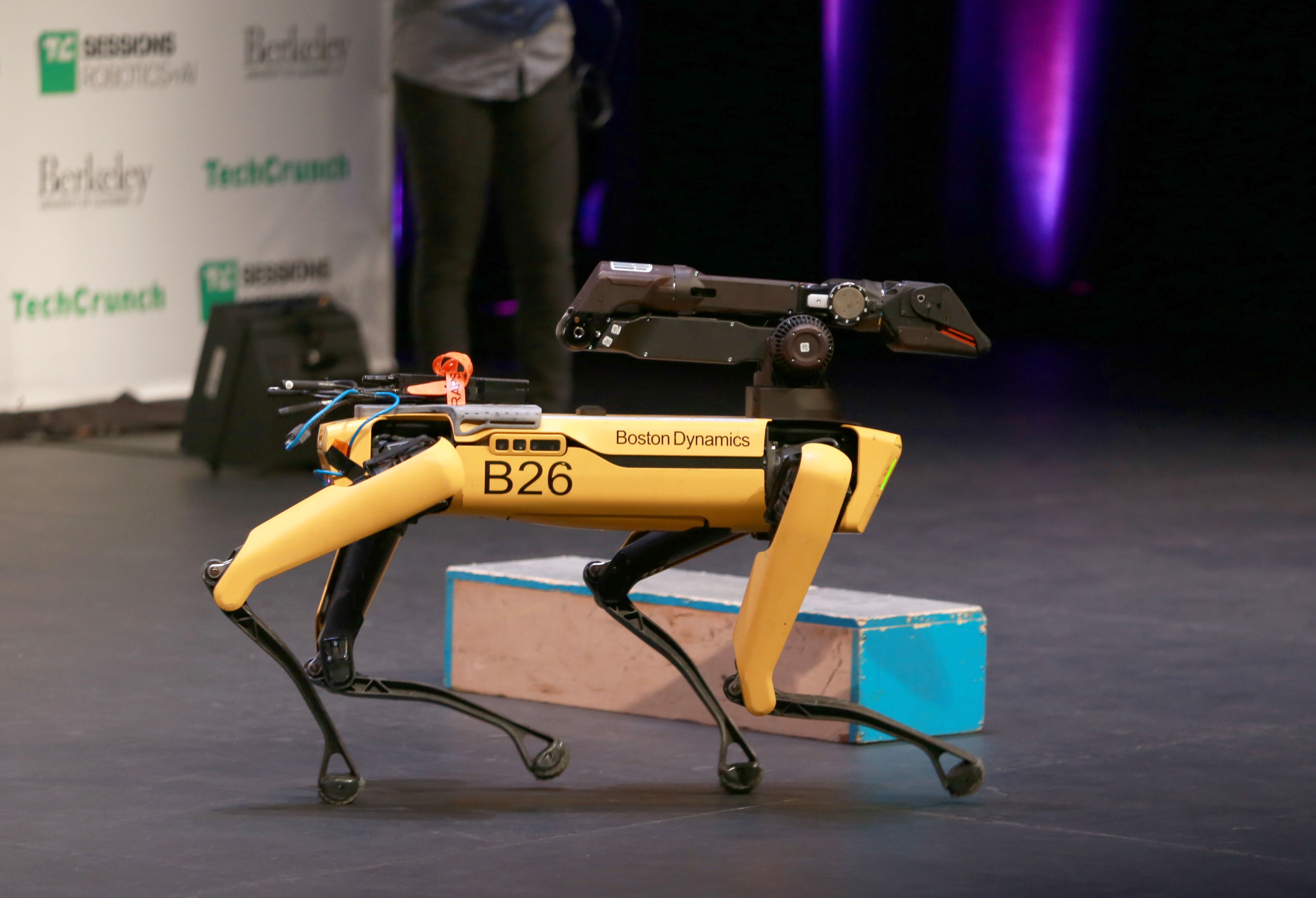
Boston Dynamics is just months away from announcing their approach to logistics, the first real vertical it aims to enter, after proving their ability to build robots at scale with the quadrupedal Spot. The company’s new CEO, Robert Playter, sees the company coming into its own after decades of experimentation.

Playter, interviewed on the virtual main stage of Disrupt 2020, only recently ascended from COO to that role after many years of working there, after longtime CEO and founder Marc Raibert stepped aside to focus on R&D. This is his Playter’s first public speaking engagement since taking on the new responsibility, and it’s clear he has big plans for Boston Robotics.

The recent commercialization of Spot, the versatile quadrupedal robot that is a distant descendant of the famous Big Dog, showed Playter and the company that there is a huge demand for what they’re offering, even if they’re not completely sure where that demand is.

“We weren’t sure exactly what the target verticals would be,” he admitted, and seemingly neither did the customers, who have collectively bought about 260 of the $75,000 robots and are now actively building their own add-ons and industry-specific tools for the platform. And the price hasn’t been a deterrent, he said: “As an industrial tool this is actually quite affordable. But we’ve been very aggressive, spending a lot of money to try to build an affordable way to produce this, and we’re already working on ways to continue to reduce costs.”

boston dynamics spot

Image Credits: TechCrunch

The global pandemic has also helped create a sense of urgency around robots as an alternative to or augmentation of manual labor.

“People are realizing that having a physical proxy for themselves, to be able to be present remotely, might be more important than we imagined before,” Playter said. “We’ve always thought of robots as being able to go into dangerous places, but now danger has been redefined a little bit because of COVID. The pandemic is accelerating the sense of urgency and, I think, probably opening up the kinds of applications that we will explore with this technology.”

Among the COVID-specific applications, the company has fielded requests for collaboration on remote monitoring of patients, and automatic disinfection using spot to carry aerosol spray through a facility. “I don’t know whether that’ll be a big market going forward, but we thought it was important to respond at the time,” he said. “Partly out of a sense of obligation to the community and society that we do the right thing here.”

The “Dr Spot” remote vitals measurement program at MIT.

One of the earliest applications to scale successfully was, of course, logistics, where companies like Amazon have embraced robotics as a way to increase productivity and lower labor costs. Boston Dynamics is poised to jump into the market with a very different robot — or rather robots — meant to help move boxes and other box-like items around in a very different way from the currently practical “autonomous pallet” method.

“We have big plans in logistics,” Playter said. “we’re going to have some exciting new logistics products coming out in the next two years. We have customers now doing proof of concept tests. We’ll announce something in 2021, exactly what we’re doing, and we’ll have product available in 2022.”

The company already offers Pick, a more traditional, stationary item-picking system, and they’re working on the next version of Handle, a birdlike mobile robot that can grab boxes and move them around while taking up comparatively little space — no more than a person or two standing up. This mobility allows it to unload things like shipping containers, trucks, and other confined or less predictable spaces.

In a video shown during the interview (which you can watch above), Handle is also shown working in concert with an off-the-shelf pallet robot, and Playter emphasized the need for this kind of cooperation, and not just between robots from a single creator.

“We’ll be offering software that lets robots work together,” he said. “Now, we don’t have to create them all. But ultimately it will take teams of robots to do some of these tasks, and we anticipate being able to work with a heterogeneous fleet.”

This kinder, gentler, more industry-friendly Boston Dynamics is almost certainly a product of nudging from Softbank, which acquired the company in 2018, but also the simple reality that you can’t run a world-leading robotics R&D outfit for nothing. But Playter was keen to note that the Japanese tech giant understands that “we’re only in the position we’re in now because of the previous work we’ve done in the last two decades, developing these advanced capabilities, so we have to keep doing that.”

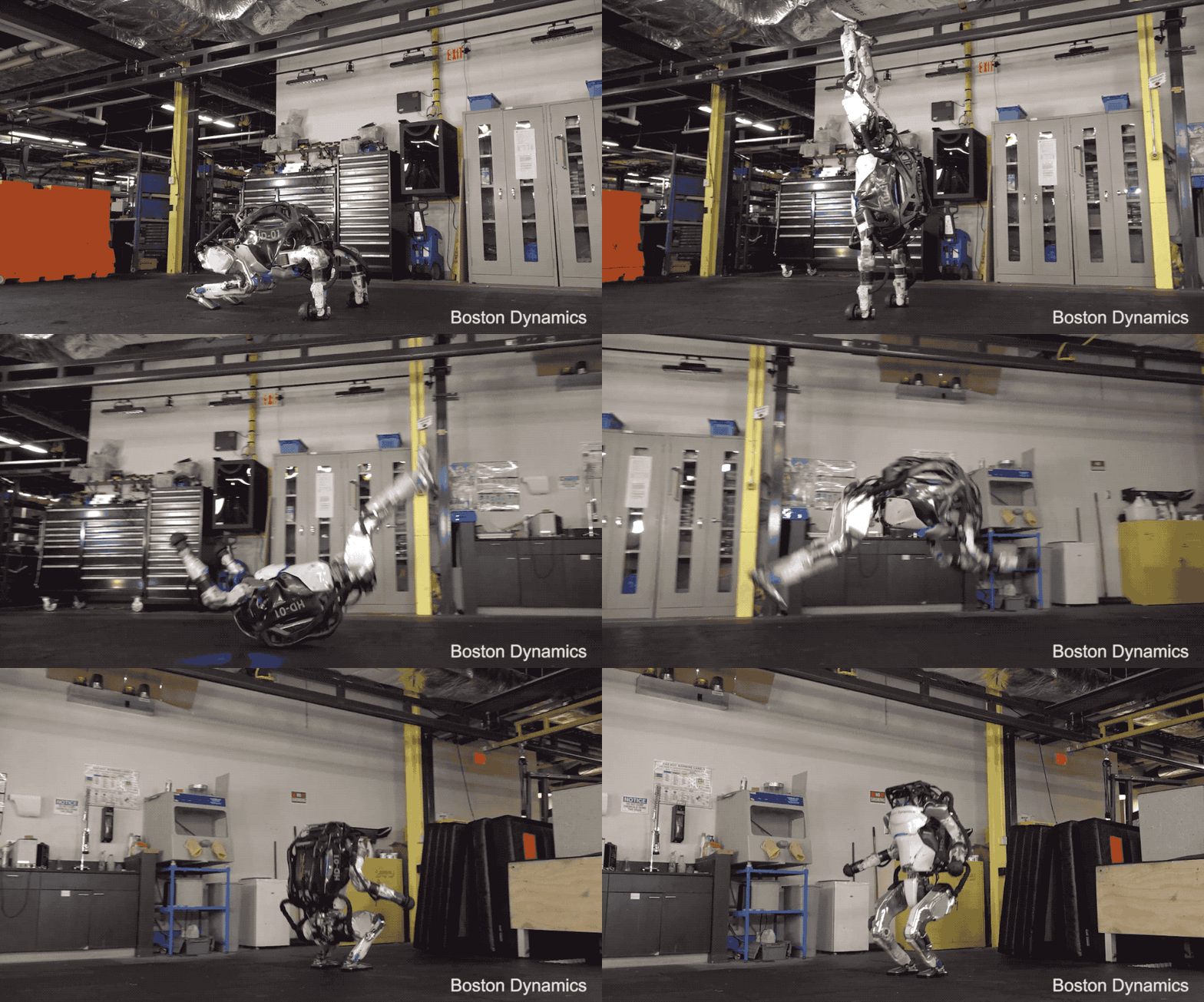
One thing you won’t likely seeing doing real work any time soon is Atlas, the company’s astonishingly agile humanoid robot. It’s just not practical for anything just yet, but instead acts as a kind of prestige project, forcing the company to constantly adjust its sights upward.

atlas gymnastics boston dynamics

“It’s such a complex robot, and it can do so much it forces us to create tools we would not otherwise. And people love it — it’s aspirational, it attracts talent,” said Playter.

And he himself is no exception. Once a gymnast, he recalled “a nostalgic moment” watching Atlas vault around. “A lot of the people in the company, including Marc, have inspiration from the athletic performance of people and animals,” Playter said. “That DNA is deeply embedded in our company.”


Read Full Article

Amazon makes Alexa Routines shareable


Amazon is making it easier for Alexa device owners to use Routines. The feature, which has been around for years, allows Alexa users to combine multiple tasks into a single voice command of their choosing. For example, you could make a routine that turns off your lights, plays relaxing music and locks your doors when you say, “Alexa, goodnight.” A morning routine could read you the headlines and weather forecast, as well as turn on your connected coffee maker. Now, Amazon will allow users to share their favorite routines with others.

Routines may still be considered something of a power-user feature. Because they take time to set up and aren’t necessarily well-highlighted in the Alexa mobile app where they’re under the “more” menu, it’s possible some Alexa device owners have never used them.

In the U.S., Alexa users will be able to visit the Routines section in the Alexa app, then click on the routine they want to share to grab a shareable URL. This URL can then be posted on social media, or sent in a text message, email or anywhere else.

When a user receives a shared routine, they simply click the URL while on the mobile device where they have the Alexa app installed. They’ll then follow the on-screen instructions in the app to complete the setup. Options that are shown in yellow text will indicate which fields can be customized — like specifying which smart light you want to turn off or on, for instance.

It would be useful if there was a larger online repository for Alexa routines where you could discover and activate those that have been shared by the wider community, similar to those directories created for sharing iOS Shortcuts. Also useful would be some sort of way to discover popular routines directly within the Alexa app. But these sorts of ideas are not included with the feature’s launch.

Instead, Amazon today introduced several new shareable routines created by Alexa Skill maker partners, like NPR, iHeartRadio, Headspace, Fitness Day, History Channel and others. These provide templates integrating their own voice app experiences for you to customize further.


Read Full Article

Designing Your Team’s Remote Workflow


Collaboration is an essential element of design. But what happens when your team suddenly has to work remotely? This phenomenon is nothing new, but it’s met with some trepidation. Even those businesses that relish the idea of harnessing global talent, aren’t crazy about the idea of not seeing the team face to face every day. […]

The post Designing Your Team’s Remote Workflow appeared first on ALL TECH BUZZ.


Twitter tightens account security for political candidates ahead of US election


Twitter is taking steps to tighten account security for a range of users ahead of the US presidential election, including by requiring the use of strong passwords.

“We’re taking the additional step of proactively implementing account security measures for a designated group of high-profile, election-related Twitter accounts in the US. Starting today, these accounts will be informed via an in-app notification from Twitter of some of the initial account security measures we will be requiring or strongly recommending going forward,” it said in a blog post announcing the pre-emptive step.

Image credit: Twitter

Last month Twitter said it would be dialling up efforts to combat misinformation and election interference, as well as pledging to help get out the vote — going on to out an election hub to help voters navigate the 2020 poll earlier this week.

Its latest election-focused security move follows an embarrassing account hack incident in July which saw scores of verified users’ accounts accessed and used to tweet out a cryptocurrency scam.

Clearly, Twitter won’t want a politically-flavored repeat of that.

Twitter said accounts that will be required to take steps to tighten their security are:

  • US Executive Branch and Congress

  • US Governors and Secretaries of State

  • Presidential campaigns, political parties and candidates with Twitter Election Labels running for US House, US Senate, or Governor

  • Major US news outlets and political journalists

As well as requiring users in these categories to have a strong password — prompting those without one to update it next time they log in — Twitter said it will also enable Password reset protection for the accounts by default.

“This is a setting that helps prevent unauthorized password changes by requiring an account to confirm its email address or phone number to initiate a password reset,” it noted.

It will also encourage the target types of users to enable Two-factor authentication (2FA) as a further measure to bolster against unauthorized logins. Although it will not be requiring 2FA be switched on.

The platform also said it would be implementing extra layers of what it called “proactive internal security safeguards” for the aforementioned accounts, including:

  • More sophisticated detections and alerts to help us, and account holders, respond rapidly to suspicious activity

  • Increased login defenses to prevent malicious account takeover attempts

  • Expedited account recovery support to ensure account security issues are resolved quickly

Also today, Twitter released more detail about how its platform manipulation and spam policies apply to groups seeking to coordinate to cause harm, giving the example of the conspiracy group QAnon. It began a crack down on the conspiracy group in July, when it banned thousands of accounts that had been spreading baseless BS which Twitter said had “the potential to lead to offline harm”.


Read Full Article

17 September 2020

8 Perfectly Legal Leeways to A Seamless Bingo Game Experience


Bingo games have gained a lot of fame in the last few years. Players flock online bingo sites seeking the best offers and prizes. And it’s no wonder more and more bingo sites are now coming up. Bingo operators haven’t been left behind either; many offer free games to draw more players. Although all bingo […]

The post 8 Perfectly Legal Leeways to A Seamless Bingo Game Experience appeared first on ALL TECH BUZZ.


Facebook launches Facebook Business Suite, an app for managing business accounts across Facebook, Instagram and Messenger


Facebook this morning launched a new app designed to make it easier for businesses to manage their pages and profiles across Facebook, Instagram and Messenger in a single place. The app, Facebook Business Suite, combines access to the business’s key updates and priorities, and offers a way to draft and schedule feed posts for both Facebook and Instagram, view insights and create ads.

To use the new app, business will first need to link their Facebook and Instagram business accounts, if they hadn’t already.

Once logged into Facebook, the Business Suite can be accessed on the desktop at business.facebook.com. On mobile, users of the existing Pages Manager App will see an option to join Business Suite instead. The app will also become available as a standalone download for both iOS and Android.

Image Credits: Facebook

Inside Business Suite, business owners will be able to see critical alerts, messages, comments and other activity taking place across Facebook and Instagram right in the new app’s homescreen. They can also set up personalized saved replies here, in order to respond to common customer inquiries.

The app offers tools for creating feed posts for Facebook and Instagram, scheduling posts, and provides insights on what’s working. Here, businesses can view their posts’ reach, engagement and performance across both Facebook and Instagram. They can also choose to create an ad to help boost that engagement and grow their audience, if needed.

Facebook says it’s initially building Facebook Business Suite with the needs of small businesses first, as so many have been forced by the pandemic to find new ways to reach customers and sell online. However, the long-term plan is to build out a set of tools that can be used by all businesses, including larger ones. The company aims to address that market sometime next year. Business Suite will also expand to include WhatsApp in the future.

Related to the news, Facebook published two surveys offering insights on small business trends. One, the monthly Global State of Small Business Report, produced in partnership with the World Bank and OECD, found that businesses that make more than 25% of sales online are more likely to be reporting higher sales this year, and are less likely to have laid off employees.

A second study details the impact of COVID-19 on consumer purchasing patterns and use of digital tools. Nearly half of respondents said they spent more money online overall since the outbreak, and 40% increased their use of social media and online messaging for product and business recommendations, Facebook says.

Of course, these fairly upbeat reports on the state of small businesses in the midst of the pandemic don’t provide the full picture. In the U.S., for example, Yelp is reporting that 60% of the U.S. businesses that closed due to COVID-19 won’t be re-opening. As of August, 163,735 of U.S. businesses have closed since the start of the pandemic, the report said, up 23% since mid-July.

These closures could impact Facebook as well, as the majority of Facebook’s advertisers are small and medium-sized businesses. But Facebook’s global nature protects it. Even if the U.S. loses more small businesses due to its mishandling of the pandemic, there are far more advertisers are outside the U.S. that Facebook taps into.

Facebook says the Business Suite will gradually roll out during the month of September. The app joins several others Facebook offers today for its business customers, including Facebook Pages Manager, Facebook Analytics, and Facebook Ads Manager. However, Facebook notes that its new Business Suite isn’t currently designed to serve those who use Ads Manager.


Read Full Article

What role does luck play in your life? | Barry Schwartz

What role does luck play in your life? | Barry Schwartz

Chance plays a far bigger role in life than we're willing to admit, says psychologist Barry Schwartz. Of course, working hard and following the rules can get you far -- but the rest could boil down to simple good fortune. Schwartz examines the overlooked link between luck, merit and success, offering an intriguing solution to equalize opportunity -- starting with college admissions.

https://ift.tt/2ZO3ETg

Click this link to view the TED Talk

How to Use Instagram Live?


Instagram is one of the most popular social media platforms for all ages. It is estimated that around one billion people use Instagram every month. This includes posting images to their profile, browsing images on their feed, and creating Instagram stories. But the most recent feature that a lot of people are using is Instagram […]

The post How to Use Instagram Live? appeared first on ALL TECH BUZZ.


How To Download Videos From Facebook, Youtube, And Twitter?


Social media is bridging the gap between people, brands, businesses, and they are all coming together, trying to create a whole new world that knows no boundaries when it comes to connections and communication. But it is not just about that. Social media entertains us too! On a regular basis, we see many videos; funny, […]

The post How To Download Videos From Facebook, Youtube, And Twitter? appeared first on ALL TECH BUZZ.


Puristic Interior Design


What is purism? Let’s start with the terminology. Translated from the Latin language “purus” means – pure. Purism means striving for perfection, purity, and inviolability of established norms. Purism became part of the design direction at the beginning of the 20th century. When people got tired of excesses and bizarre shapes, designers again returned to […]

The post Puristic Interior Design appeared first on ALL TECH BUZZ.


JAWS architect Glen Gordon is joining Sight Tech Global, a virtual event Dec. 2-3


For people who are blind or visually impaired, JAWS is synonymous with freedom to operate Windows PCs with a remarkable degree of control and precision with output in speech and Braille. The keyboard-driven application makes it possible to navigate GUI-based interfaces of web sites and Windows programs. Anyone who has ever listened to someone proficient in JAWS (the acronym for “Job Access With Speech”) navigate a PC can’t help but marvel at the speed of the operator and the rapid fire machine-voice responses from JAWS itself.

For nearly 25 years, JAWS has dominated the field of screen readers, and is in use by hundreds of thousands of people worldwide. It is inarguably one of the greatest achievements in modern assistive technology. We are delighted to announce that Glen Gordon, the architect of JAWS for over 25 years, is joining the agenda at Sight Tech Global, which is a virtual event (Dec. 2-3) focused on how AI-related technologies will influence assistive technology and accessibility in the years ahead. Attendance is free and registration is open.

Blind since birth, Gordon’s interest in accessibility developed out of what he calls “a selfish desire to use Windows at a time when it was not at all clear that graphical  user interfaces could be made accessible.”  He has an MBA from the UCLA Anderson School, and he learned software development through “the school of hard knocks and lots of frustration trying to use inaccessible software.” He is an audio and broadcasting buff and host of FSCast, the podcast from Freedom Scientific.

The latest public beta release of JAWS contains a glimpse of the future for the storied software: It now works with certain user voice commands – “Voice Assist” – and provides more streamlined access to image descriptions, both thanks to AI technologies that the JAWS team at Freedom Scientific is using  in JAWS as well as FUSION (which combines JAWS and ZoomText, a screen magnifier). Those updates address two of JAWS’ challenges – the complexity of the available keyboard command set that intimidates some users and “alt tags” on images that don’t always adequately describe the image.

“The upcoming versions of JAWS, ZoomText,  and Fusion use natural language processing to allow many screen reader commands to be performed verbally,” says Gordon. “ You probably wouldn’t want to speak every command, but for the less common ones Voice assist offers a way to minimize the key combinations that you need to learn.”

“Broadly speaking, we’re looking to make it easier for  people to  use a smaller command set to work efficiently. This fundamentally means making our products smarter, and being able to anticipate what a user wants and needs based on their prior actions. Getting there is an imprecise process and we’ll continue to rely on user feedback to help guide us towards what works best.”

The next generation of screen readers will take advantage of AI among other technologies, and that will be a major topic at Sight Tech Global on Dec. 2-3. Get your free pass now.

Sight Tech Global Sight Tech Global welcomes sponsors. Current sponsors include Verizon Media, Google, Waymo, Mojo Vision and Wells Fargo, The event is organized by volunteers and all proceeds from the event benefit The Vista Center for the Blind and Visually Impaired in Silicon Valley.

Pictured above: JAWS Architect Glen Gordon in his home audio studio. 


Read Full Article

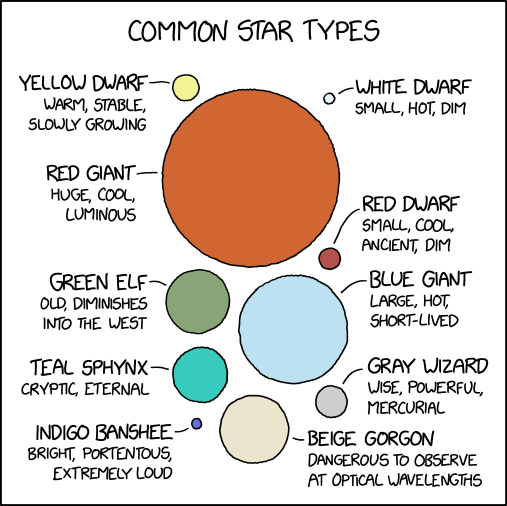
Common Star Types


Common Star Types

iOS 14 is now available to download


Apple has just released the final version of iOS 14, the next major version of the operating system for the iPhone. It is a free download and it works with the iPhone 6s or later, both generations of iPhone SE and the most recent iPod touch model. If your device runs iOS 13, it supports iOS 14. The update may or may not be immediately available, but keep checking because people are now receiving the update.

The company is also releasing major updates for the iPad, Apple Watch and Apple TV today. So you can expect some new features with iPadOS 14, tvOS 14 and watchOS 7 as well.

The release of those updates caught many developers by surprise. Apple announced yesterday that iOS 14 would be ready for prime time today. Usually, the company announces the release date a week or two in advance. This way, developers have enough time to fix the last remaining bugs and submit updates to the App Store.

If you update your iPhone today, don’t be surprised if you encounter a few bugs here and there from third-party apps. There are some major changes under the hood and nobody expected such a short turnaround.

The update is currently rolling out and is available both over-the-air in the Settings app, and by plugging your device into iTunes for a wired update. But first, back up your device. Make sure your iCloud backup is up to date by opening the Settings app on your iPhone or iPad and tapping on your account information at the top and then on your device name. Additionally, you can also plug your iOS device into your computer to do a manual backup in iTunes (or do both, really).

Don’t forget to encrypt your backup in iTunes. It is much safer if somebody hacks your computer. And encrypted backups include saved passwords and health data. This way, you don’t have to reconnect to all your online accounts.

Once this is done, you should go to the Settings app, then ‘General’ and then ‘Software Update.’ Then you should see ‘Update Requested…’ It will then automatically start downloading once the download is available.

The biggest change of iOS 14 is the introduction of widgets on the home screen, a new App Library to browse all your apps and the ability to run App Clips — those are mini apps that feature a small part of an app and that you can run without installing anything.

There are also many refinements across the board, such as new features for Messages, with a big focus on groups with @-mentions and replies, a new Translate app that works on your device, cycling directions in Apple Maps in some cities and various improvements in Notes, Reminders, Weather, Home and more.

If you want to learn more about iOS 14, I looked at some of the features in the new version earlier this summer:


Read Full Article

iOS 14 is now available to download


Apple has just released the final version of iOS 14, the next major version of the operating system for the iPhone. It is a free download and it works with the iPhone 6s or later, both generations of iPhone SE and the most recent iPod touch model. If your device runs iOS 13, it supports iOS 14. The update may or may not be immediately available, but keep checking because people are now receiving the update.

The company is also releasing major updates for the iPad, Apple Watch and Apple TV today. So you can expect some new features with iPadOS 14, tvOS 14 and watchOS 7 as well.

The release of those updates caught many developers by surprise. Apple announced yesterday that iOS 14 would be ready for prime time today. Usually, the company announces the release date a week or two in advance. This way, developers have enough time to fix the last remaining bugs and submit updates to the App Store.

If you update your iPhone today, don’t be surprised if you encounter a few bugs here and there from third-party apps. There are some major changes under the hood and nobody expected such a short turnaround.

The update is currently rolling out and is available both over-the-air in the Settings app, and by plugging your device into iTunes for a wired update. But first, back up your device. Make sure your iCloud backup is up to date by opening the Settings app on your iPhone or iPad and tapping on your account information at the top and then on your device name. Additionally, you can also plug your iOS device into your computer to do a manual backup in iTunes (or do both, really).

Don’t forget to encrypt your backup in iTunes. It is much safer if somebody hacks your computer. And encrypted backups include saved passwords and health data. This way, you don’t have to reconnect to all your online accounts.

Once this is done, you should go to the Settings app, then ‘General’ and then ‘Software Update.’ Then you should see ‘Update Requested…’ It will then automatically start downloading once the download is available.

The biggest change of iOS 14 is the introduction of widgets on the home screen, a new App Library to browse all your apps and the ability to run App Clips — those are mini apps that feature a small part of an app and that you can run without installing anything.

There are also many refinements across the board, such as new features for Messages, with a big focus on groups with @-mentions and replies, a new Translate app that works on your device, cycling directions in Apple Maps in some cities and various improvements in Notes, Reminders, Weather, Home and more.

If you want to learn more about iOS 14, I looked at some of the features in the new version earlier this summer:


Read Full Article

Improving Sparse Training with RigL


Modern deep neural network architectures are often highly redundant [1, 2, 3], making it possible to remove a significant fraction of connections without harming performance. The sparse neural networks that result have been shown to be more parameter and compute efficient compared to dense networks, and, in many cases, can significantly decrease wall clock inference times.

By far the most popular method for training sparse neural networks is pruning, (dense-to-sparse training) which usually requires first training a dense model, and then “sparsifying” it by cutting out the connections with negligible weights. However, this process has two limitations.

  1. The size of the largest trainable sparse model is limited by that of the largest trainable dense model. Even if sparse models are more parameter efficient, one cannot use pruning to train models that are larger and more accurate than the largest possible dense models.
  2. Pruning is inefficient, meaning that large amounts of computation must be performed for parameters that are zero valued or that will be zero during inference. Additionally, it remains unknown if the performance of the current best pruning algorithms are an upper bound on the quality of sparse models.
Training sparse networks from scratch, on the other hand, is efficient, however often achieves inferior performance compared to pruning.

In “Rigging the Lottery: Making All Tickets Winners”, presented at ICML 2020, we introduce RigL, an algorithm for training sparse neural networks that uses a fixed parameter count and computational cost throughout training, without sacrificing accuracy relative to existing dense-to-sparse training methods. The algorithm identifies which neurons should be active during training, which helps the optimization process to utilize the most relevant connections and results in better sparse solutions. An example of this is shown below, where, during the training of a multilayer perceptron (MLP) network on MNIST, our sparse network trained with RigL learns to focus on the center of the images, discarding the uninformative pixels from the edges. A Tensorflow implementation of our method along with three other baselines (SET, SNFS, SNIP) can be found at github.com/google-research/rigl.

Left: Average MNIST image. Right: Evolution of the connectivity of the input throughout the training of a 98% sparse, 2-layer MLP on MNIST. Training starts from a random sparse mask, where each input pixel has roughly six outgoing connections. Connections that originate from the edges do not exhibit meaningful gradients and are therefore replaced by more informative connections that originate from the center pixels.

RigL Overview
The RigL method starts with a network initialized with a random sparse topology. At regularly spaced intervals we remove a fraction of the connections with the smallest weight magnitudes. Such a strategy has been shown to have very little effect on the loss. RigL then activates new connections using instantaneous gradient information, i.e., without using past gradient information. After updating the connectivity, training continues with the updated network until the next scheduled update. Next, the system activates connections with large gradients, since these connections are expected to decrease the loss most quickly.

RigL begins with a random sparse initialization of the network. It then trains the network and trims out those connections with weak activations. Based on the gradients calculated for the new configuration, it grows new connections and trains again, repeating the cycle.

Evaluating Performance
By changing the connectivity of the neurons dynamically during training, RigL helps optimize to find better solutions. To demonstrate this, we restart training from a bad solution that exhibits poor accuracy and show that RigL's mask updates help the optimization achieve better loss compared to static training, in which connectivity of the sparse network remains the same.

Training loss of RigL and Static methods starting from the same static sparse solution, shown together with their final test accuracies.

The figure below summarizes the performance of various methods on training an 80% sparse ResNet-50 architecture. We compare RigL with two recent sparse training methods, SET and SNFS and three baselines: Static, Small-Dense and Pruning. Two of these methods (SNFS and Pruning) require dense resources as they need to either train a large network or store the gradients of it. Overall, we observe that the performance of all methods improves with additional training time; thus, for each method we run extended training with up to 5x the training steps of the original 100 epochs.

As noted in a number of studies [4, 5, 6, 7], training a network with fixed sparsity from scratch (Static) leads to inferior performance compared to solutions found by pruning. Training a small, dense network (Small-Dense) with the same number of parameters gets better results than Static, but fails to match the performance of dynamic sparse models. Similarly, SET improves the performance over Small-Dense, but saturates at around 75% accuracy, revealing the limits of growing new connections randomly. Methods that use gradient information to grow new connections (RigL and SNFS) obtain higher accuracy in general, but RigL achieves the highest accuracy, while also consistently requiring fewer FLOPs (and memory footprint) than the other methods.

Performance of sparse training methods on training an 80% sparse ResNet-50 architecture with uniform sparsity distribution. Points at each curve correspond to the individual training runs with increasing training length. The number of FLOPs required to train a standard dense ResNet-50 along with its performance is indicated with a dashed red line. RigL matches the standard ResNet-50 performance, even though it is 5x smaller in size.

Observing the trend between extended training and performance, we compare the results using longer training runs. Within the interval considered (i.e., 1x-100x) RigL's performance constantly improves with additional training. RigL achieves state of art performance of 68.07% Top-1 accuracy at training with a 99% sparse ResNet-50 architecture. Similarly extended training of a 90% sparse MobileNet-v1 architecture with RigL achieves 70.55% Top-1 accuracy. Obtaining the same results with fewer training iterations is an exciting future research direction.

Effect of training time on RigL accuracy at training 99% sparse ResNet-50 (left) and 90% sparse MobileNets-v1 (right) architectures.

Other experiments include image classification on CIFAR-10 datasets and character-based language modelling using RNNs with the WikiText-103 dataset and can be found in the full paper.

Future Work
RigL is useful in three different scenarios:

  1. Improving the accuracy of sparse models intended for deployment.
  2. Improving the accuracy of large sparse models that can only be trained for a limited number of iterations.
  3. Combining with sparse primitives to enable training of extremely large sparse models which otherwise would not be possible.
The third scenario is unexplored due to the lack of hardware and software support for sparsity. Nonetheless, work continues [8, 9, 10] to improve the performance of sparse networks on current hardware and new types of hardware accelerators are expected to have better support for parameter sparsity [11, 12]. We hope RigL provides the tools to take advantage of, and motivation for, such advances.

Acknowledgements
We would like to thank Eleni Triantafillou, Hugo Larochelle, Bart van Merrienboer, Fabian Pedregosa, Joan Puigcerver, Danny Tarlow, Nicolas Le Roux, Karen Simonyan for giving feedback on the preprint of the paper; Namhoon Lee for helping us verify and debug our SNIP implementation; Chris Jones for helping us discover and solve the distributed training bug; and Tom Small for creating the visualization of the algorithm.


TouchWood puts versatile, unobtrusive interfaces inside your desk, table and walls


Everything we do seems to have an associated app these days, and all day they vie for your attention, pinging and lighting up in their needy ways. TouchWood wants to tone down this exhausting non-stop competition with a quiet, simplified interface built right into the natural material of your desk or wall.

Co-founders Matthew Dworman and Gaurav Asthana were fed up with the idea that making your home or workplace smarter usually meant adding even more stuff: a smart speaker that sits on your desk, a smart watch constantly telling you your step count, a smart fridge that slips advertisements into your morning routine. Not only that but these devices and apps are constantly drawing you away from what you want to do, whether that’s work or trying not to work.

They wanted (they told me) something like the enchanted sword Sting from Lord of the Rings: It’s just a sword 99 percent of the time, but it’s also an orc radar if and when you need it, and even then it just glows. Why doesn’t the digital world similarly only appear when you need it, and in the least obtrusive fashion possible?

Dworman previously worked in high-end furniture design, and with Asthana developed the idea of interacting with tech via “a slab of wood instead of an app,” as the latter put it.

Image Credits: TouchWood

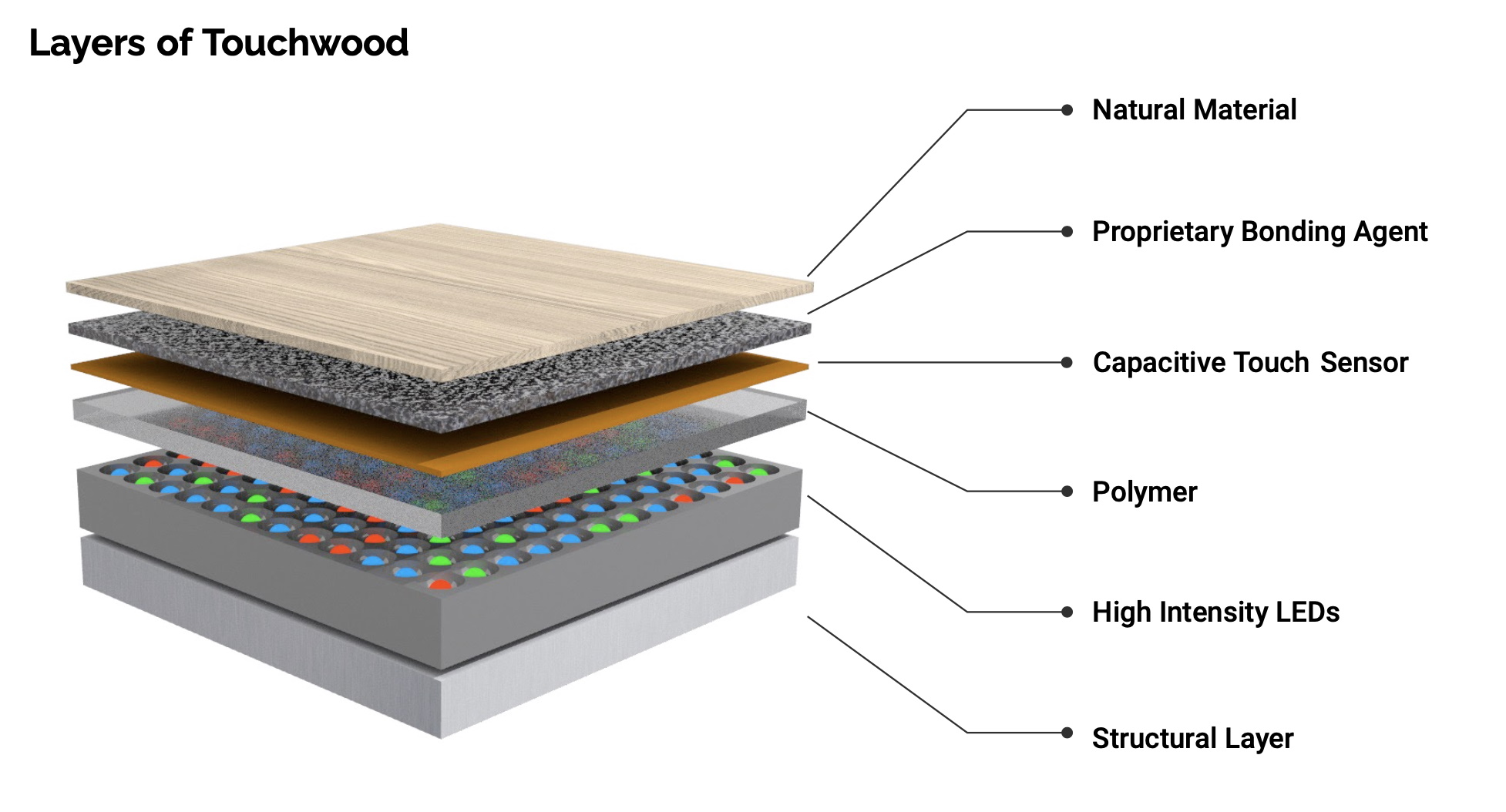
“What we’ve created is a modular tech platform that uses high-intensity LEDs with capacitive touch sensing. This allows us to embed it in essentially opaque material,” Dworman explained. “The wall, countertop, desk, in the home, the office, retail, transportation, we see so many ways to provide information and completely invisible controls.”

The surface would appear completely normal when the display is off, and indeed it is. Mui Labs, which demonstrated at CES its own natural material display, requires a specially perforated wood surface that you probably wouldn’t want to spill coffee on. A TouchWood display is just that: wood — or many other common surface materials.

A TouchWood surface in action. (The lines are an artifact of the camera’s framerate.)

It’s not meant to be a second display, but a friendly overflow for the information avalanche presented to us via our desktops, laptops, and phones… and speakers, watches, coffee makers, robot dogs, and so on.

“We’re not trying to put a computer in a surface — we want to provide you with a better touchpoint for your existing devices, to enhance their capabilities by taking away some of the information pressure that’s put on them,” said Asthana.

Image Credits: TouchWood

Perhaps you, like me, constantly flick your eyes towards the tabs in your browsers, or the apps arrayed on the bottom of your screen, to see if there’s any change — a new email, a message on Slack, a calendar item. A TouchWood desk would let those notifications take alternative routes, like a glowing circle off where you put your coffee or mouse. Tap it there and get a summary, or go to the content, or swipe it away — but you never have to switch tabs, or go to a different app, or unlock your phone. And when it’s done, the desk is just a piece of wood again.

Dworman sees the transition as natural. “Touchscreens the way we know them have really only been around for 10 or 11 years. But because they’re so ubiquitous we kind of take them for granted,” he said. “When you watch sci-fi films, this tech is still being used 500 years in the future! But it shouldn’t be. In car terms, the iPhone as it is now is like the Model T.”

TouchWood aims to be a platform eventually, but needs to launch a product of its own first. It plans to have a nice sit/stand desk with two large display areas available next year for somewhere in the $2,000 region. Expensive, yes — but you may be surprised what people will happily spend on new furniture, especially something like a major component of a newly important home office.
After proving out the concept with a flagship product, they can start working their way into other niches and working with partners. Embedding an invisible display in a countertop, wall, or of course a restaurant table leads to all kinds of use cases. Here’s hoping TouchWood’s tech leads to a future with slightly fewer screens in it — at least ones we can see.


Read Full Article