03 September 2020

Facebook Watch is getting 1.25B visitors each month


Facebook is sharing some new growth numbers around its video destination — namely, that Facebook Watch is now receiving more than 1.25 billion visitors every month.

The company isn’t saying specifically how those numbers have changed during the pandemic (when video services like Netflix have seen dramatic growth), but product lead Paresh Rajwat said there was “a really big surge” at the beginning of lockdown and social distancing, and that the surge has not subsided as society begins to reopen.

Facebook Watch launched in 2018. Back in June of last year, the company said that 720 million people were watching at least one minute of Watch content every month.

Rajwat noted that while Watch is built on “the social layer of Facebook,” with videos shareable across Facebook’s many products, the views are happening on Watch itself.

“It is super critical for us to have a destination,” he said, keeping videos from popular creators and publishers separate from the core Facebook experience of interacting with friends and family. “The moment we mix them together, it becomes a completely different product for people.”

Rajwat added that the company isn’t just looking at overall audience size. He argued that when you look at “the reactions and comments and shares” you can see that “the content we have is working.” (Advertisers have wondered about the true extent of audience engagement on Facebook Watch.)

Last year, as tech and media companies were all investing heavily to launch their own streaming services, we argued that Facebook’s efforts with unscripted shows and older content seemed pretty lackluster in comparison. But it sounds like the content that’s working on Watch isn’t the kind of thing that you’d find on Netflix or Disney+ — as Rajwat put it, “The angle we’ve taken is to focus more on content that is around social topics to drive conversations.”
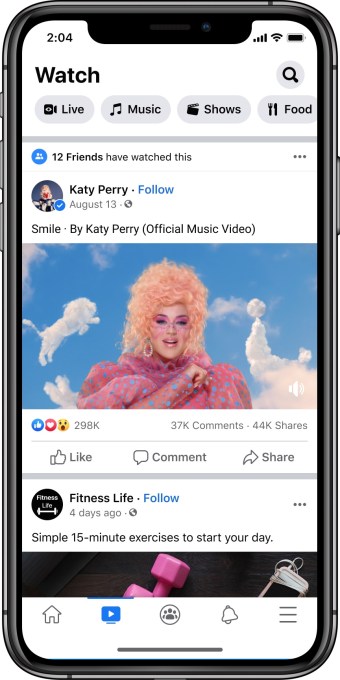
Facebook Watch

Image Credits: Facebook

For example, there’s “Red Table Talk” from Jada Pinkett Smith and family, a talk show that made headlines over the summer for bringing Will Smith and Jada together to discuss their marital issues. Facebook plans to launch another version of Red Table talk in October, “Red Table Talk: The Estefans,” with Gloria Estefan, her niece Lily and her daughter Emily.

As another example of a successful original Facebook Watch show, Rajwat pointed to “Returning the Favor,” an Emmy-winning program where host Mike Rowe showcases everyday heroes.

Rajwat said that live programming has increased significantly during the pandemic. That includes live sports, with 13.7 million people watching the UEFA Champions League final, making it the most popular football broadcast ever on Facebook Watch. And Facebook recently announced that publishers and other businesses will be able to charge for access to live online events, with Facebook taking no fees for the next year.

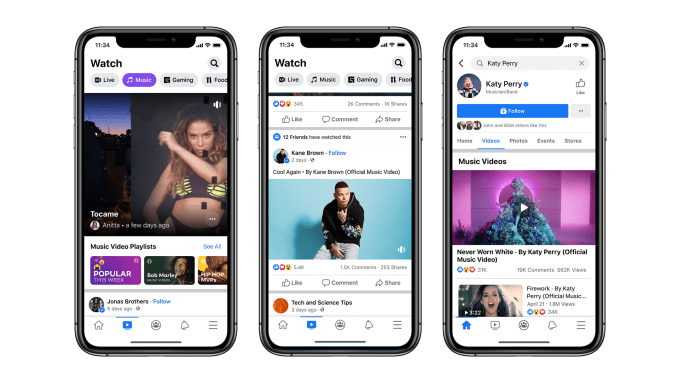
The site also added licensed music videos over the summer, with Katy Perry premiering her music video for “Smile” exclusively on Facebook Watch, where it was watched by “millions” of fans.
Facebook Watch

Image Credits: Facebook

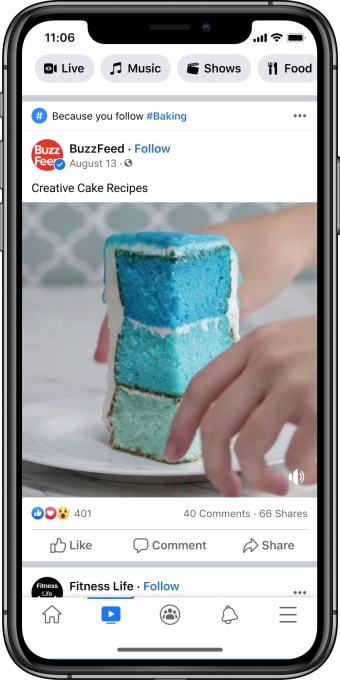
The company highlighted successful publishers on Facebook Watch include organizations like UFC, large publishers like BuzzFeed and individual creators like Benito Skinner and Brandi Guice, a.k.a. Braannxo, who’s making 98% of her revenue from Facebook Stars and fan subscriptions.

Looking forward, Rajat said that a big priority is making “more and more investment in showing people what they really are interested in.” To that end, users have already spotted that Facebook Watch is now allowing users to customize their feed by exploring and subscribing to different topics.


Read Full Article

Facebook Watch is getting 1.25B visitors each month


Facebook is sharing some new growth numbers around its video destination — namely, that Facebook Watch is now receiving more than 1.25 billion visitors every month.

The company isn’t saying specifically how those numbers have changed during the pandemic (when video services like Netflix have seen dramatic growth), but product lead Paresh Rajwat said there was “a really big surge” at the beginning of lockdown and social distancing, and that the surge has not subsided as society begins to reopen.

Facebook Watch launched in 2018. Back in June of last year, the company said that 720 million people were watching at least one minute of Watch content every month.

Rajwat noted that while Watch is built on “the social layer of Facebook,” with videos shareable across Facebook’s many products, the views are happening on Watch itself.

“It is super critical for us to have a destination,” he said, keeping videos from popular creators and publishers separate from the core Facebook experience of interacting with friends and family. “The moment we mix them together, it becomes a completely different product for people.”

Rajwat added that the company isn’t just looking at overall audience size. He argued that when you look at “the reactions and comments and shares” you can see that “the content we have is working.” (Advertisers have wondered about the true extent of audience engagement on Facebook Watch.)

Last year, as tech and media companies were all investing heavily to launch their own streaming services, we argued that Facebook’s efforts with unscripted shows and older content seemed pretty lackluster in comparison. But it sounds like the content that’s working on Watch isn’t the kind of thing that you’d find on Netflix or Disney+ — as Rajwat put it, “The angle we’ve taken is to focus more on content that is around social topics to drive conversations.”

Image Credits: Facebook

For example, there’s “Red Table Talk” from Jada Pinkett Smith and family, a talk show that made headlines over the summer for bringing Will Smith and Jada together to discuss their marital issues. Facebook plans to launch another version of Red Table talk in October, “Red Table Talk: The Estefans,” with Gloria Estefan, her niece Lily and her daughter Emily.

As another example of a successful original Facebook Watch show, Rajwat pointed to “Returning the Favor,” an Emmy-winning program where host Mike Rowe showcases everyday heroes.

Rajwat said that live programming has increased significantly during the pandemic. That includes live sports, with 13.7 million people watching the UEFA Champions League final, making it the most popular football broadcast ever on Facebook Watch. And Facebook recently announced that publishers and other businesses will be able to charge for access to live online events, with Facebook taking no fees for the next year.

The site also added licensed music videos over the summer, with Katy Perry premiering her music video for “Smile” exclusively on Facebook Watch, where it was watched by “millions” of fans.

The company highlighted successful publishers on Facebook Watch include organizations like UFC, large publishers like BuzzFeed and individual creators like Benito Skinner and Brandi Guice, a.k.a. Braannxo, who’s making 98% of her revenue from Facebook Stars and fan subscriptions.

Looking forward, Rajat said that a big priority is making “more and more investment in showing people what they really are interested in.” To that end, users have already spotted that Facebook Watch is now allowing users to customize their feed by exploring and subscribing to different topics.


Read Full Article
Philips Hue’s new Play gradient lightstrip promises a big upgrade for home entertainment spaces


Smart lighting company Philips Hue has a new product in its home entertainment catalog that should make a smart TV lighting setup much easier and more powerful. The new Philips Hue Play gradient lightstrip features individually-addressable full-color LEDs, meaning each one can be tuned to a different color independent of the rest for a more immersive color-matching experience when using it in tandem with the Philips Hue Play HDMI Sync box, or the sync software for PC or Mac.

The new gradient lightstrip is custom-made in three different size settings, for 55-inch ($199.99), 65-inch ($219.99) and 75-inch ($239.99) TVs respectively. The company created them in these settings for easy mounting and installation, but you can also use them with larger or smaller sets with just a bit of tweaking. They’re available for pre-order now, and will ship on October 16 in the U.S.

Using the Hue Sync mobile app, users can tweak the position and height of the gradient lights (and any other compatible Hue products) in their entertainment area, and the lights will tune their color and brightness to match what’s being displayed on screen. Prior versions of Hue’s lightstrip products were only able to switch entirely from one color to another, meaning they weren’t nearly as good at matching specific to particular areas of the screen. The gradient lightstrip looks to be able to provide a much more natural and immersive color matching experience as a result.

Image Credits: Philips Hue

Alongside the new gradient lightstrip, Philips also introduced a number of other new products, including a redesigned Hue Iris table lamp that now has increased brightness, better colors, and a lower dimmed floor. It’s got Bluetooth onboard, for use with out a Hue bridge, too. Likewise for the company’s news Philips Hue E12 candelabra bulbs, which all have Bluetooth on board.

Image Credits: Philips Hue

The Hue collection also now includes vintage-look filament bulbs in two new form factors, ungluing a large globe and. large Edison design, and the Hue Ensis pendant light is available in a new black colorway. Finally, there’s a new Philips Hue White buster E14 bubble, which is a tiny adorable little bulb for use in itty bitty sconce lights and other small fixtures.


Read Full Article

Facebook to block new political ads 1 week before Nov 3, adds more tools and rules for fair elections


We’re now 61 days away from the US Presidential election, and Facebook is once more ramping up its efforts to level the playing field and attempt to keep its platform from being manipulated to influence how people vote.

CEO Mark Zuckerberg today announced a series of new measures, including the news that it will block new political and issue ads in the final week of the campaign — although campaigns can still run ads to encourage people to vote, and they can still run older political ads. Other announcements today detailed more work to counter misinformation, and stronger rules to counter voter suppression, including misleading references to COVID-19 at the polls.

The news today is significant not just because it’s a sign of how Facebook continues to work on more proactive measures around the election, but that it is definitely past the point of trying to present itself as an innocent bystander to forces that would have been in play even if Facebook didn’t exist.

“This election is not going to be business as usual,” he wrote in the post. “We all have a responsibility to protect our democracy. That means helping people register and vote, clearing up confusion about how this election will work, and taking steps to reduce the chances of violence and unrest.”

Other measures will include placing its Voter Information Center — a hub for voting information, with deadlines and guides on how to vote by mail and other related details that it announced in August — at the top of Facebook and Instagram “almost every day until the election.” (Originally, the hub was going to be accessible — and somewhat hidden — in the menu; now it’s being moved it into a more prominent slot.)

Zuckerberg said that the political ad blocking is being put in place because Facebook — another admission — doesn’t believe that there would be enough time to contest any new claims that might come in the ads.

But while blocking those last-minute political ads is an important move, it’s not a complete block of all political ads. Facebook said that political ads posted more than a week before the election can still stay up, and targeting for those ads can still be adjusted (that is — they can essentially be run as new campaigns).

Zuck’s explanation is that the older ads have time to be researched. “Those ads will already be published transparently in our Ads Library so anyone, including fact-checkers and journalists, can scrutinize them,” he noted.

The company said that its efforts so far have driven 24 million clicks to voter registration sites, but how those translate into actual registrations is not clear. The company has set a goal of helping 4 million people register and vote, and Zuckerberg himself has donated $300 million to organizations working on that effort.

Other efforts announced today include a number of moves to try to combat misinformation — one of the key ways that Facebook has been leveraged in past elections to influence voting.

Specifically, Facebook said it is extending the window beyond 72 hours — its original timescale — where it’s going to try to identify and remove false claims about polling conditions, given that many may try to vote early this time around.

And given how a lot of misinformation is also shared through direct channels off Facebook itself, it’s also going to limit how things can be forwarded on Messenger to stem how content goes viral on there. “You’ll still be able to share information about the election, but we’ll limit the number of chats you can forward a message to at one time,” Zuckerberg noted. This will, of course, cut both ways (those trying to put out accurate information might also get dinged) but ultimately is a direct result of how Facebook has altered forwarding on WhatsApp around elections in other countries, such as India.

One of the other issues that has been highlighted by many has been how the high percentage of people voting by mail might be exploited to the advantage of candidates that take strong early leads in live voting: the worry is that the live results get called as early victories, before other votes are tallied, which could, for example, dissuade people from going to polling stations and voting. Facebook now says that it will be adding labels to candidates and campaigns that try to declare victory before the official calls (but won’t be removing those posts). It’s working with Reuters and the National Election Pool to determine more accurate results, it said.

Another big theme in misinformation has been around COVID-19 and how scare tactics around this are used to dissuade people from voting. Facebook said it will “remove posts with claims that people will get Covid-19 if they take part in voting”, with links to more accurate information. The rule will also include ads with this message.

Misinformation also comes through Facebook by way of sending false details about how polling stations or how voting works, for example not just trying to discourage people from going to polls, but also intentionally giving specific groups of voters the wrong information about how to vote, for example telling them that it’s okay to send in their ballots past the deadline.

All of these policies will work in tandem with how Facebook deals with a completely different threat, coming not from candidates and their campaigns but other actors intent on destabilising how democratic processes work, or simply to influence how they go.

Just this week, Facebook took down a network of 13 accounts and 2 pages sending out misleading claims about political candidates. The company says that it’s investing more into its security to continue fighting this but it’s a huge problem, stretching back years now to the previous US Presidential election, and apparently not going away anytime soon. While originally the threats were identified as coming from countries like Russia, Zuckerberg now admitted that “We’re increasingly seeing attempts to undermine the legitimacy of our elections from within our own borders.”

It’s going to be a long 61 days….


Read Full Article

Facebook’s photo porting tool adds support for Dropbox and Koofr


Facebook’s photo and video portability tool has added support for two more third party services for users to send data via encrypted transfer — namely: cloud storage providers Dropbox and (EU-based) Koofr.

The tech giant debuted the photo porting tool in December last year, initially offering users in its EU HQ location of Ireland the ability to port their media direct to Google Photos, before going on to open up access in more markets. It completed a global rollout of that first offering in June.

Facebook users in all its markets now have three options to choose from if they want to transfer Facebook photos and videos elsewhere. A company spokesman confirmed support for other (unnamed) services is also in the works, telling us: “There will be more partnership announcements in the coming months.”

The transfer tool is based on code developed via Facebook’s participation in the Data Transfer Project — a collaborative effort started last year, with backing from other tech giants including Apple, Google, Microsoft and Twitter.

To access the tool, Facebook users need to navigate to the ‘Your Facebook Information’ menu and select ‘Transfer a copy of your photos and videos’. Facebook will then prompt you to re-enter your password prior to initiating the transfer. You will then be asked to select a destination service from the three on offer (Google Photos, Dropbox or Koofr) and asked to enter your password for that third party service — kicking off the transfer.

Users will receive a notification on Facebook and via email when the transfer has been completed.

The encrypted transfers work from both the desktop version of Facebook or its mobile app.

Last month, the tech giant signalled in comments to the FTC ahead of a hearing on portability scheduled for later this month that it would be expanding the scope of its data portability offerings — including hinting it might offer direct transfers for more types of content in future, such as events or even users’ “most meaningful” posts.

For now, though, Facebook only supports direct, encrypted transfers for photos and videos uploaded to Facebook.

While Google and Dropbox are familiar names, the addition of a smaller, EU-based cloud storage provider in the list of supported services does stand out a bit. On that, Facebook’s spokesperson told us it reached out to discuss adding Koofr to the transfer tool after a staffer came across an article on Mashable discussing it as an EU cloud storage solution.

A bigger question is when — or whether — Facebook will offer direct photo portability to users of its photo sharing service, Instagram. It has not mentioned anything specific on that front when discussing its plans to expand portability.

When we asked Facebook about bringing the photo porting tool to Instagram, a spokesman told us: “Facebook have prioritised portability tools on Facebook at the moment but look forward to exploring expansion to the other apps in the future.”

In a blog post announcing the new destinations for users of the Facebook photo & video porting tool, the tech giant repeats its call for lawmakers to come up with “clearer rules” to govern portability, writing that: “We want to continue to build data portability features people can trust. To do that, the Internet needs clearer rules about what kinds of data should be portable and who is responsible for protecting that data as it moves to different services. Policymakers have a vital role to play in this.”

It also writes that it’s keen for other companies to join the Data Transfer Project — “to expand options for people and push data portability innovation forward”.

In recent years Facebook has been lobbying for what it calls ‘the right regulation’ to wrap around portability — releasing a white paper on the topic last year which plays up what it couches as privacy and security trade-offs in a bid to influence regulatory thinking around requirements on direct data transfers.

Portability is in the frame as a possible tool for helping rebalance markets in favor of new entrants or smaller players as lawmakers dig into concerns around data-fuelled barriers to competition in an era of platform giants.


Read Full Article

Facebook’s photo porting tool adds support for Dropbox and Koofr


Facebook’s photo and video portability tool has added support for two more third party services for users to send data via encrypted transfer — namely: cloud storage providers Dropbox and (EU-based) Koofr.

The tech giant debuted the photo porting tool in December last year, initially offering users in its EU HQ location of Ireland the ability to port their media direct to Google Photos, before going on to open up access in more markets. It completed a global rollout of that first offering in June.

Facebook users in all its markets now have three options to choose from if they want to transfer Facebook photos and videos elsewhere. A company spokesman confirmed support for other (unnamed) services is also in the works, telling us: “There will be more partnership announcements in the coming months.”

The transfer tool is based on code developed via Facebook’s participation in the Data Transfer Project — a collaborative effort started last year, with backing from other tech giants including Apple, Google, Microsoft and Twitter.

To access the tool, Facebook users need to navigate to the ‘Your Facebook Information’ menu and select ‘Transfer a copy of your photos and videos’. Facebook will then prompt you to re-enter your password prior to initiating the transfer. You will then be asked to select a destination service from the three on offer (Google Photos, Dropbox or Koofr) and asked to enter your password for that third party service — kicking off the transfer.

Users will receive a notification on Facebook and via email when the transfer has been completed.

The encrypted transfers work from both the desktop version of Facebook or its mobile app.

Last month, the tech giant signalled in comments to the FTC ahead of a hearing on portability scheduled for later this month that it would be expanding the scope of its data portability offerings — including hinting it might offer direct transfers for more types of content in future, such as events or even users’ “most meaningful” posts.

For now, though, Facebook only supports direct, encrypted transfers for photos and videos uploaded to Facebook.

While Google and Dropbox are familiar names, the addition of a smaller, EU-based cloud storage provider in the list of supported services does stand out a bit. On that, Facebook’s spokesperson told us it reached out to discuss adding Koofr to the transfer tool after a staffer came across an article on Mashable discussing it as an EU cloud storage solution.

A bigger question is when — or whether — Facebook will offer direct photo portability to users of its photo sharing service, Instagram. It has not mentioned anything specific on that front when discussing its plans to expand portability.

When we asked Facebook about bringing the photo porting tool to Instagram, a spokesman told us: “Facebook have prioritised portability tools on Facebook at the moment but look forward to exploring expansion to the other apps in the future.”

In a blog post announcing the new destinations for users of the Facebook photo & video porting tool, the tech giant repeats its call for lawmakers to come up with “clearer rules” to govern portability, writing that: “We want to continue to build data portability features people can trust. To do that, the Internet needs clearer rules about what kinds of data should be portable and who is responsible for protecting that data as it moves to different services. Policymakers have a vital role to play in this.”

It also writes that it’s keen for other companies to join the Data Transfer Project — “to expand options for people and push data portability innovation forward”.

In recent years Facebook has been lobbying for what it calls ‘the right regulation’ to wrap around portability — releasing a white paper on the topic last year which plays up what it couches as privacy and security trade-offs in a bid to influence regulatory thinking around requirements on direct data transfers.

Portability is in the frame as a possible tool for helping rebalance markets in favor of new entrants or smaller players as lawmakers dig into concerns around data-fuelled barriers to competition in an era of platform giants.


Read Full Article
Facebook bans politician of India’s ruling party for violating hate speech


Facebook has banned a politician from India’s ruling party, Bharatiya Janata Party, for violating its policies against hate speech on its platform, the company said today, weeks after inaction on the politician’s posts landed the social giant in hot water in its biggest market by users.

The company said it had removed profiles of T. Raja Singh, who had posted about Rohingya Muslim immigrants to be shot among other anti-Muslim sentiments. Singh will no longer be allowed to create profiles across Facebook services and unofficial pages, groups, and accounts set up to represent him will be removed, too.

Singh, termed as a “dangerous individual” by Facebook, has a history of voicing problematic and hateful views on social platforms and in public appearances. Several of those posts, for which Facebook has banned him, remain online on Twitter and YouTube.

Today’s move comes weeks after the Wall Street Journal reported that a top Facebook executive in India had chosen to not take any actions on Singh’s posts because she was afraid it could hurt the company’s business prospects in the country.

A person familiar with the matter and local media reports claim that Facebook had removed some of Singh’s posts in the past. The Wall Street Journal also reported that the aforementioned Facebook executive — Ankhi Das — also showed support to BJP’s Narendra Modi before he was elected as Prime Minister in 2014 and disparaged the opposition party, Indian National Congress.

In a statement today, a Facebook spokesperson said, “the process for evaluating potential violators is extensive and it is what led us to our decision to remove his account.” 

In the last few weeks, Facebook has received some of the harshest criticism to date in India, where it reaches more than 400 million users. Politicians from both sides — the opposition and ruling party — have accused the company of having political biases.

In a letter to Facebook chief executive Mark Zuckerberg, India’s IT Minister Ravi Shankar Prasad earlier this month expressed concerns about the alleged political leanings of the company’s staff and accused them of suppressing pages that support right-wing views.


Read Full Article
Panda Helper App – iPhone and Android Game MOD Store


If you are looking for an alternative to the iOS app store, then look no further than here. Panda Helper offers users access to tons of unofficial apps and games that you cannot get from the official store simply because of policy restrictions and, in some cases, geo-restrictions. What is Panda Helper? It is an […]

The post Panda Helper App – iPhone and Android Game MOD Store appeared first on ALL TECH BUZZ.


AppCake App – iPhone and Mac Apps Store


AppCake is a familiar name to jailbreakers the world over, once one of the most popular tweaks in Cydia that helped us to install IPA files onto the iPhone or iPad very easily. Jailbreaks are no longer as widely available as they once were, although we are starting to see more and more utilities being […]

The post AppCake App – iPhone and Mac Apps Store appeared first on ALL TECH BUZZ.


ACMarket AppStore – Exclusive Android App Store for Apps and Games


While the Google Play Store is the largest mobile app store in the world, it doesn’t have everything users want. Many apps and games are not available in the store because Google has certain restrictions in place that make it impossible for some developers to get their app s accepted. Add to that geo-restrictions, and […]

The post ACMarket AppStore – Exclusive Android App Store for Apps and Games appeared first on ALL TECH BUZZ.


How Good Is The Security Of Online Slots Games?


Online slots are one of the most popular casino games and fun to play. The best online casinos offer hundreds of different slots in every color, theme, and symbol you can imagine. The first step to enjoying online slot games is to ascertain that the site is secure, though. You want a casino that protects […]

The post How Good Is The Security Of Online Slots Games? appeared first on ALL TECH BUZZ.


Stellar Evolution


Stellar Evolution

Daily Crunch: India bans PUBG and other Chinese apps


India continues to crack down on Chinese apps, Microsoft launches a deepfake detector and Google offers a personalized news podcast. This is your Daily Crunch for September 2, 2020.

The big story: India bans PUBG and other Chinese apps

The Indian government continues its purge of apps created by or linked to Chinese companies. It already banned 59 Chinese apps back in June, including TikTok.

India’s IT Ministry justified the decision as “a targeted move to ensure safety, security, and sovereignty of Indian cyberspace.” The apps banned today include search engine Baidu, business collaboration suite WeChat Work, cloud storage service Tencent Weiyun and the game Rise of Kingdoms. But PUBG is the most popular, with more than 40 million monthly active users.

The tech giants

Microsoft launches a deepfake detector tool ahead of US election — The Video Authenticator tool will provide a confidence score that a given piece of media has been artificially manipulated.

Google’s personalized audio news feature, Your News Update, comes to Google Podcasts — That means you’ll be able to get a personalized podcast of the latest headlines.

Twitch launches Watch Parties to all creators worldwideTwitch is doubling down on becoming more than just a place for live-streamed gaming videos.

Startups, funding and venture capital

Indonesian insurtech startup PasarPolis gets $54 million Series B from investors including LeapFrog and SBI — The startup’s goal is to reach people who have never purchased insurance before with products like inexpensive “micro-policies” that cover broken device screens.

XRobotics is keeping the dream of pizza robots alive — XRobotics’ offering resembles an industrial 3D printer, in terms of size and form factor.

India’s online learning platform Unacademy raises $150 million at $1.45 billion valuation — India has a new startup unicorn.

Advice and analysis from Extra Crunch

The IPO parade continues as Wish files, Bumble targets an eventual debut — Alex Wilhelm looks at the latest IPO news, including Bumble planning to go public at a $6 to $8 billion valuation.

3 ways COVID-19 has affected the property investment market — COVID-19 has stirred up the long-settled dust on real estate investing.

Deep Science: Dog detectors, Mars mappers and AI-scrambling sweaters — Devin Coldewey kicks off a new feature in which he gets you all caught up on the most recent research papers and scientific discoveries.

(Reminder: Extra Crunch is our subscription membership program, which aims to democratize information about startups. You can sign up here.)

Everything else

‘The Mandalorian’ launches its second season on Oct. 30 — The show finished shooting its second season right before the pandemic shut down production everywhere.

GM, Ford wrap up ventilator production and shift back to auto business — Both automakers said they’d completed their contracts with the Department of Health and Human Services.

The Daily Crunch is TechCrunch’s roundup of our biggest and most important stories. If you’d like to get this delivered to your inbox every day at around 3pm Pacific, you can subscribe here.


Read Full Article

Daily Crunch: India bans PUBG and other Chinese apps


India continues to crack down on Chinese apps, Microsoft launches a deepfake detector and Google offers a personalized news podcast. This is your Daily Crunch for September 2, 2020.

The big story: India bans PUBG and other Chinese apps

The Indian government continues its purge of apps created by or linked to Chinese companies. It already banned 59 Chinese apps back in June, including TikTok.

India’s IT Ministry justified the decision as “a targeted move to ensure safety, security, and sovereignty of Indian cyberspace.” The apps banned today include search engine Baidu, business collaboration suite WeChat Work, cloud storage service Tencent Weiyun and the game Rise of Kingdoms. But PUBG is the most popular, with more than 40 million monthly active users.

The tech giants

Microsoft launches a deepfake detector tool ahead of US election — The Video Authenticator tool will provide a confidence score that a given piece of media has been artificially manipulated.

Google’s personalized audio news feature, Your News Update, comes to Google Podcasts — That means you’ll be able to get a personalized podcast of the latest headlines.

Twitch launches Watch Parties to all creators worldwide — Twitch is doubling down on becoming more than just a place for live-streamed gaming videos.

Startups, funding and venture capital

Indonesian insurtech startup PasarPolis gets $54 million Series B from investors including LeapFrog and SBI — The startup’s goal is to reach people who have never purchased insurance before with products like inexpensive “micro-policies” that cover broken device screens.

XRobotics is keeping the dream of pizza robots alive — XRobotics’ offering resembles an industrial 3D printer, in terms of size and form factor.

India’s online learning platform Unacademy raises $150 million at $1.45 billion valuation — India has a new startup unicorn.

Advice and analysis from Extra Crunch

The IPO parade continues as Wish files, Bumble targets an eventual debut — Alex Wilhelm looks at the latest IPO news, including Bumble planning to go public at a $6 to $8 billion valuation.

3 ways COVID-19 has affected the property investment market — COVID-19 has stirred up the long-settled dust on real estate investing.

Deep Science: Dog detectors, Mars mappers and AI-scrambling sweaters — Devin Coldewey kicks off a new feature in which he gets you all caught up on the most recent research papers and scientific discoveries.

(Reminder: Extra Crunch is our subscription membership program, which aims to democratize information about startups. You can sign up here.)

Everything else

‘The Mandalorian’ launches its second season on Oct. 30 — The show finished shooting its second season right before the pandemic shut down production everywhere.

GM, Ford wrap up ventilator production and shift back to auto business — Both automakers said they’d completed their contracts with the Department of Health and Human Services.

The Daily Crunch is TechCrunch’s roundup of our biggest and most important stories. If you’d like to get this delivered to your inbox every day at around 3pm Pacific, you can subscribe here.


Read Full Article
Facebook now lets you customize your Watch video feed with #Topics


Facebook’s video destination, Facebook Watch, is introducing a new feature called “Your Topics” that will allow you to tailor its feed to include more of the content you want to see. Currently, Facebook leverages its existing understanding of each viewer’s interests to personalize the Watch Feed. Topics, however, will allow users to more explicitly tell Facebook what sort of things they like by exploring and subscribing to various content categories.

The feature has been quietly rolling out to Facebook users in recent days, and now some portion of the user base already has the feature in their own Facebook app.

Among the first to notice the new addition was Twitter user @whimchic, who regularly spots updates and changes to mobile applications before they’re made public.

They were alerted to the feature through a pop-up within Watch on the Facebook mobile app, we’re told. Here, a message explained that Facebook will now focus on showing more of the videos related to the #Topics you follow.

“Due to the many different ways your Watch feed is determined and how videos get categorized, you may see videos in your Watch feed that you aren’t interested in,” the message also warned. “Some videos related to the #Topics or Pages you follow may not appear in your Watch feed,” it noted.

Image Credits: Facebook app, screenshot via @whimchic

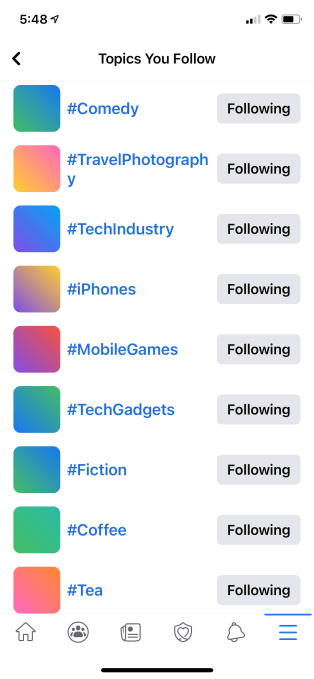
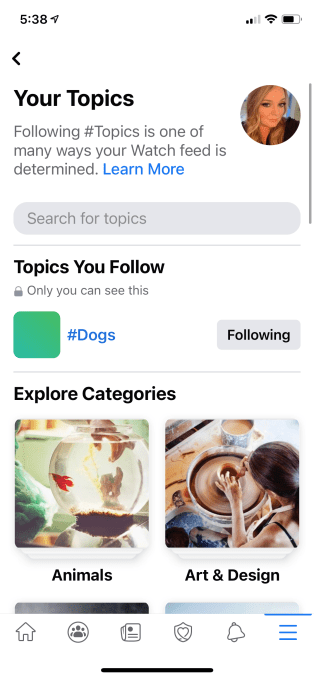
If you have the feature, you can access it for yourself by clicking on the Profile icon in the Facebook Watch tab on mobile, then clicking on the link to “Your Topics” to browse the available categories.

The subcategories which you can actually follow or unfollow are grouped underneath broader category pages, like Animals, Art & Design, Books, Business, Education, Fashion & Style, Food, Games, History & Philosophy, Home & Garden, Music, Performing Arts, Science & Tech, Sports, Travel & Leisure, TV & Movies, and Transportation.

Image Credits: Facebook app, screenshot via TechCrunch

However, you can’t follow these high-level categories themselves — you have to click inside them to follow the individual topics. These can be very specific. For example, within Animals, you could follow #EndangeredSpecies or #GoldenRetrievers. Within Travel & Leisure, you could follow #TravelOceania or #WinterActivities. And so on.

But the subcategory listings are not comprehensive. Upon testing the feature within the Facebook app on my iPhone, a search for many other possible topics yielded no results. (What, no #Corgi videos?!) This, of course, could change in time as the feature is expanded.

Image Credits: Facebook app, screenshot via TechCrunch

Once you follow a topic, a message will confirm your choice and then the topic will appear under “Topics You Follow” in the Your Topics section of Facebook Watch.

From here, you can choose to unfollow the topic later on if you decide you want to see less of it in your feed. And if you want to watch only videos from a given topic, you can tap the topic to delve into a customized feed.


The feature is now one of several ways users can personalize and filter their broader Facebook Watch feed.

You can also filter the feed by Live, Music, Following, Shows, Gaming and more, by tapping on the buttons at the top of the screen or from the What’s on Watch category picker that shows up as you scroll further down the Watch Feed.

Facebook also adds groupings like its editorially curated “Get Caught Up” section with videos from paid partners, or those groupings that are more algorithmically sorted, like the one with videos that got the most “HaHa’s” or “Loves” this week, or those that are popular with friends.

Image Credits: Facebook app, screenshot via TechCrunch

The new feature could make Facebook Watch more competitive with YouTube, where there’s historically been a heavier focus on connecting users with individual channels to subscribe to. But YouTube has also embraced Topics in its own way, with broad categories like “Gaming” and “Fashion & Beauty” that are now a part of its main navigation. And it puts personalized topics at the top of the home page directing signed-in users to categories of videos they tend to watch.

Twitter, of course, has its own Topics feature, too, which showcases top tweets that match a particular interest. These may or may contain videos, however.

Reached for comment, a Facebook spokesperson confirmed the addition of Topics, saying “we’re working on more ways to connect people with videos that match their interests.” No further details were provided.


Read Full Article

Samsung’s got a new budget 5G handset and a fitness tracker with a two-week battery


Yesterday’s overflow Galaxy Unpacked event was about one thing and one thing alone: the Galaxy Z Fold 2. Honestly, it was a bit anticlimactic after its predecessor found Samsung unveiling five new devices. But the singular focus wasn’t for lack of new stuff to show off. In fact, the company just unleashed a whole slew of new products across a wide range of categories, including a gaming monitor, charging pad, refrigerator and washing machine.

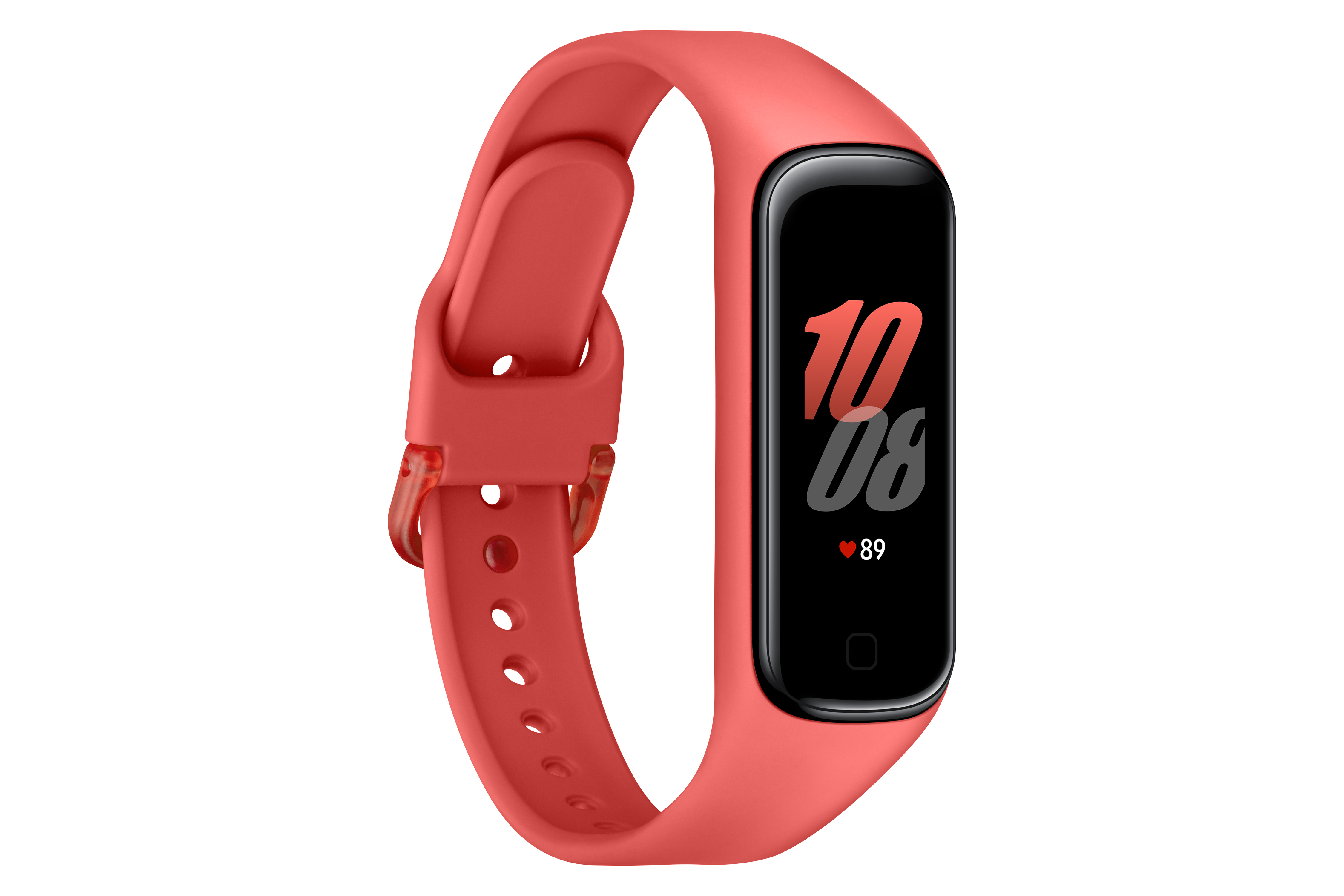
There are two in particular I’d like to break out here, however: the new Galaxy Fit 2 band and A42 5G handset. The latter in particular is worth highlighting, given the company’s huge push into 5G this year. Samsung is betting big on pushing early and hard on the next-generation wireless tech.

Early this year, the company announced that it would be standardizing 5G across its flagship products. The company has also made a major push toward embracing the tech on its budget devices, including the A7 and now the A42. 5G hasn’t quite turned out to be the market correction the industry was banking on, due in no small part to a slowdown in sales from the pandemic. Certainly few banked on that. But while Apple has yet to announce a 5G iPhone (give it a month or two, mind), Samsung’s already loaded up.

And importantly, the A42 looks like it may be Samsung’s cheapest 5G offering (though we’re still waiting on exact pricing). Honestly, Samsung wasn’t particularly chatty about the device during an IFA-tied event. Though we do know there’s a quad-camera system and a 6.6-inch display. Honestly, one of the most remarkable things about 5G is how quickly affordable devices have hit the market, thanks in part to the efforts of component makers like Qualcomm.

Image Credits: Samsung

The Galaxy Fit 2 is notable mostly for the inclusion of a 15-day battery (per Samsung). It can autodetect five different kinds of workouts and monitors sleep. It’s nice to see Samsung still offering something up to the dwindling tracker market, even as its (and the world’s) focus has clearly shifted over to smartwatches.


Read Full Article

KeyPose: Estimating the 3D Pose of Transparent Objects from Stereo


Estimating the position and orientation of 3D objects is one of the core problems in computer vision applications that involve object-level perception, such as augmented reality and robotic manipulation. In these applications, it is important to know the 3D position of objects in the world, either to directly affect them, or to place simulated objects correctly around them. While there has been much research on this topic using machine learning (ML) techniques, especially Deep Nets, most have relied on the use of depth sensing devices, such as the Kinect, which give direct measurements of the distance to an object. For objects that are shiny or transparent, direct depth sensing does not work well. For example, the figure below includes a number of objects (left), two of which are transparent stars. A depth device does not find good depth values for the stars, and gives a very poor reconstruction of the actual 3D points (right).

Left: RGB image of transparent objects.  Right: A four-panel image showing the reconstructed depth for the scene on the left.The top row includes depth images and the bottom row presents the 3D point cloud. The left panels were reconstructed using a depth camera and the right panels are output from the ClearGrasp model.  Note that although ClearGrasp inpaints the depth of the stars, it mistakes the actual depth of the rightmost one.

One solution to this problem, such as that proposed by ClearGrasp, is to use a deep neural network to inpaint the corrupted depth map of the transparent objects. Given a single RGB-D image of transparent objects, ClearGrasp uses deep convolutional networks to infer surface normals, masks of transparent surfaces, and occlusion boundaries, which it uses to refine the initial depth estimates for all transparent surfaces in the scene (far right in the figure above). This approach is very promising, and allows scenes with transparent objects to be processed by pose-estimation methods that rely on depth.  But inpainting can be tricky, especially when trained completely with synthetic images, and can still result in errors in depth.

In “KeyPose: Multi-View 3D Labeling and Keypoint Estimation for Transparent Objects”, presented at CVPR 2020 in collaboration with the Stanford AI Lab, we describe an ML system that estimates the depth of transparent objects by directly predicting 3D keypoints. To train the system we gather a large real-world dataset of images of transparent objects in a semi-automated way, and efficiently label their pose using 3D keypoints selected by hand. We then train deep models (called KeyPose) to estimate the 3D keypoints end-to-end from monocular or stereo images, without explicitly computing depth. The models work on objects both seen and unseen during training, for both individual objects and categories of objects. While KeyPose can work with monocular images, the extra information available from stereo images allows it to improve its results by a factor of two over monocular image input, with typical errors from 5 mm to 10 mm, depending on the objects. It substantially improves over state-of-the-art in pose estimation for these objects, even when competing methods are provided with ground truth depth. We are releasing the dataset of keypoint-labeled transparent objects for use by the research community.

Real-World Transparent Object Dataset with 3D Keypoint Labels
To facilitate gathering large quantities of real-world images, we set up a robotic data-gathering system in which a robot arm moves through a trajectory while taking video with two devices, a stereo camera and the Kinect Azure depth camera.

Automated image sequence capture using a robot arm with a stereo camera and an Azure Kinect device.

The AprilTags on the target enable accurate tracing of the pose of the cameras. By hand-labelling only a few images in each video with 2D keypoints, we can extract 3D keypoints for all frames of the video using multi-view geometry, thus increasing the labelling efficiency by a factor of 100.

We captured imagery for 15 different transparent objects in five categories, using 10 different background textures and four different poses for each object, yielding a total of 600 video sequences comprising 48k stereo and depth images. We also captured the same images with an opaque version of the object, to provide accurate ground truth depth images. All the images are labelled with 3D keypoints. We are releasing this dataset of real-world images publicly, complementing the synthetic ClearGrasp dataset with which it shares similar objects.

KeyPose Algorithm Using Early Fusion Stereo
The idea of using stereo images directly for keypoint estimation was developed independently for this project; it has also appeared recently in the context of hand-tracking. The diagram below shows the basic idea: the two images from a stereo camera are cropped around the object and fed to the KeyPose network, which predicts a sparse set of 3D keypoints that represent the 3D pose of the object. The network is trained using supervision from the labelled 3D keypoints.

One of the key aspects of stereo KeyPose is the use of early fusion to intermix the stereo images, and allow the network to implicitly compute disparity, in contrast to late fusion, in which keypoints are predicted for each image separately, and then combined. As shown in the diagram below, the output of KeyPose is a 2D keypoint heatmap in the image plane along with a disparity (i.e., inverse depth) heatmap for each keypoint. The combination of these two heatmaps yields the 3D coordinate of the keypoint, for each keypoint.

Keypose system diagram. Stereo images are passed to a CNN model to produce a probability heatmap for each keypoint.  This heatmap yields 2D image coordinates U,V for the keypoint.  The CNN model also produces a disparity (inverse depth) heatmap for each keypoint, which when combined with the U,V coordinates, gives a 3D position (X,Y,Z).

When compared to late fusion or to monocular input, early fusion stereo typically is twice as accurate.

Results
The images below show qualitative results of KeyPose on individual objects. On the left is one of the original stereo images; in the middle are the predicted 3D keypoints projected onto the image. On the right, we visualize points from a 3D model of the bottle, placed at the pose determined by the predicted 3D keypoints. The network is efficient and accurate, predicting keypoints with an MAE of 5.2 mm for the bottle and 10.1 mm for the mug using just 5 ms on a standard GPU.

The following table shows results for KeyPose on category-level estimation. The test set used a background texture not seen by the training set. Note that the MAE varies from 5.8 mm to 9.9 mm, showing the accuracy of the method.

Quantitative comparison of KeyPose with the state-of-the-art DenseFusion system, on category-level data. We provide DenseFusion with two versions of depth, one from the transparent objects, and one from opaque objects. <2cm is the percent of estimates with errors less than 2 cm. MAE is the mean absolute error of the keypoints, in mm.

For a complete accounting of quantitative results, as well as, ablation studies, please see the paper and supplementary materials and the KeyPose website.

Conclusion
This work shows that it is possible to accurately estimate the 3D pose of transparent objects from RGB images without reliance on depth images. It validates the use of stereo images as input to an early fusion deep net, where the network is trained to extract sparse 3D keypoints directly from the stereo pair. We hope the availability of an extensive, labelled dataset of transparent objects will help to advance the field. Finally, while we used semi-automatic methods to efficiently label the dataset, we hope to employ self-supervision methods in future work to do away with manual labelling.

Acknowledgements
I want to thank my co-authors, Xingyu Liu of Stanford University, and Rico Jonschkowski and Anelia Angelova; as well the many who helped us through discussions during the project and paper writing, including Andy Zheng, Shuran Song, Vincent Vanhoucke, Pete Florence, and Jonathan Tompson.


Snapchat had a big August amid TikTok uncertainty


The continual uncertainty around TikTok’s future may have provided a big boost to Snapchat in August. Or maybe it was just the Disney eyes filter that went viral. In any event, preliminary estimates from app store intelligence firm Sensor Tower indicate that Snapchat’s mobile app across both iOS and Android saw approximately 28.5 million new installs last month — its single largest month for first-time downloads since May 2019, when it had then seen 41.2 million new installs.

May 2019, however, was an outlier in Snapchat’s history. The only other month, besides May 2019, where Snapchat had seen more monthly downloads than it did in August was December 2016, Sensor Tower data indicates.

Based on the firm’s findings, Snapchat downloads were up 29% year-over-year in August 2020 compared with 9% growth in July.

It’s unclear what combination of trends or changes may have shaped Snapchat’s download data over the past month.

But one significant area of interest in the social apps space has been the ongoing news around a possible TikTok ban in the U.S. News coverage of the ban already had a notable impact on the app stores’ top charts in recent weeks. Earlier in August, a number of direct TikTok competitors — including Likee, Byte, Dubsmash, Triller and others — saw sizable increases in weekly active users in the U.S. But none have grown to the point where they’re an obvious shoo-in to take TikTok’s place if the Chinese-owned video app is banned from the U.S., per Trump’s executive order.

It’s been more difficult, however, to pinpoint how larger TikTok competitors — like Snapchat and Instagram –were impacted by the news of a TikTok ban. These broader social apps tend to continually grow on a month-over-month basis and they regularly add new features which could impact downloads and usage. For example, Instagram in recent weeks has been expanding features around live streaming, shopping and debuted its own TikTok alternative, Reels.

Though not a direct TikTok rival, Snapchat has also been working to attract the same young demographic that now favors the short-form video app.

This month, Snapchat announced its plans to launch a new music-powered feature that would appeal to TikTok users. The feature, due to arrive this fall, will allow users to set their Snaps to music, similar to TikTok. Snap also confirmed it has deals in place with top music industry partners, including Warner Music Group, Warner Chappell, Universal Music Publishing Group, NMPA publisher members, Merlin and others, who have licensed their content for use in the Snapchat app.

Image Credits: App Store, screenshot by TechCrunch

In addition, Snapchat in late July turned on a new feature called “Minis,” which are basically lightweight, simplified versions of apps that live within Snapchat’s chat section. The apps, built using HTML, allow users to engage with a range of tasks — like buying tickets, meditating with Headspace, collaborating with friends, and more — without having to leave the app.

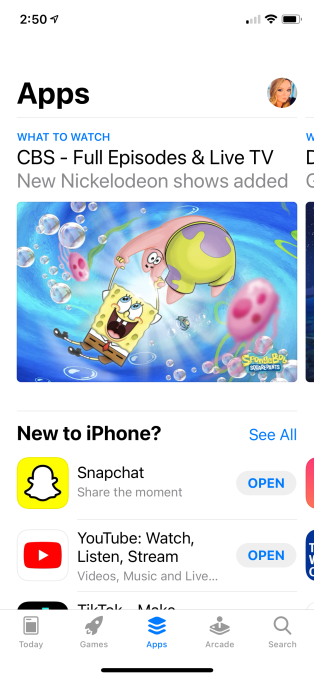
Snapchat has been benefitting, too, from a prominent position on the App Store. Apple currently has it featured in an editorially curated list of app suggestions called “New to iPhone?” which is on the App Store’s “App” homepage. The collection, which you don’t even have to scroll down to find, recommends apps that first-time iPhone users will want to download.

Other bumps in downloads could be attributed to increased marketing spend, as is common among larger app publishers. Snapchat, however, isn’t commenting on what, specifically, may have changed in August.

And maybe it was just those 66.4 million TikTok videos tagged #disneyfilter that gave Snapchat a bump this past month!

Sensor Tower’s new Snapchat data is considered preliminary because it’s only been finalized through August 26th. When the remaining days of August are also finalized, there may be some changes to the resulting numbers. But those changes will likely be minor, at best.

These figures were also initially reported by one of Sensor Tower’s financial services customers in an analyst note. They were not publicized by Sensor Tower’s data reporting team. But the company confirmed the data’s accuracy with TechCrunch.

Snapchat, as of its Q2 earnings in July, reported its daily active users had grown to 238 million, up nearly 4% from the 229 million the company reported in April. The company won’t comment on the new download data.


Read Full Article

Deep Science: Dog detectors, Mars mappers and AI-scrambling sweaters


Research papers come out at far too rapid a rate for anyone to read them all, especially in the field of machine learning, which now affects (and produces papers in) practically every industry and company. This column aims to collect the most relevant recent discoveries and papers, particularly in but not limited to artificial intelligence, and explain why they matter.

This week in Deep Science spans the stars all the way down to human anatomy, with research concerning exoplanets and Mars exploration, as well as understanding the subtlest habits and most hidden parts of the body.

Let’s proceed in order of distance from Earth. First is the confirmation of 50 new exoplanets by researchers at the University of Warwick. It’s important to distinguish this process from discovering exoplanets among the huge volumes of data collected by various satellites. These planets were flagged as candidates but no one has had the chance to say whether the data is conclusive. The team built on previous work that ranked planet candidates from least to most likely, creating a machine learning agent that could make precise statistical assessments and say with conviction, here is a planet.

“A prime example when the additional computational complexity of probabilistic methods pays off significantly,” said the university’s Theo Damoulas. It’s an excellent example of a field where marquee announcements, like the Google-powered discovery of Kepler-90 i, represent only the earliest results rather than a final destination, emphasizing the need for further study.

In our own solar system, we are getting to know our neighbor Mars quite well, though even the Perseverance rover, currently hurtling through the void in the direction of the red planet, is like its predecessors a very resource-limited platform. With a small power budget and years-old radiation-hardened CPUs, there’s only so much in the way of image analysis and other AI-type work it can do locally. But scientists are preparing for when a new generation of more powerful, efficient chips makes it to Mars.


Read Full Article

Deep Science: Dog detectors, Mars mappers and AI-scrambling sweaters


Research papers come out at far too rapid a rate for anyone to read them all, especially in the field of machine learning, which now affects (and produces papers in) practically every industry and company. This column aims to collect the most relevant recent discoveries and papers, particularly in but not limited to artificial intelligence, and explain why they matter.

This week in Deep Science spans the stars all the way down to human anatomy, with research concerning exoplanets and Mars exploration, as well as understanding the subtlest habits and most hidden parts of the body.

Let’s proceed in order of distance from Earth. First is the confirmation of 50 new exoplanets by researchers at the University of Warwick. It’s important to distinguish this process from discovering exoplanets among the huge volumes of data collected by various satellites. These planets were flagged as candidates but no one has had the chance to say whether the data is conclusive. The team built on previous work that ranked planet candidates from least to most likely, creating a machine learning agent that could make precise statistical assessments and say with conviction, here is a planet.

“A prime example when the additional computational complexity of probabilistic methods pays off significantly,” said the university’s Theo Damoulas. It’s an excellent example of a field where marquee announcements, like the Google-powered discovery of Kepler-90 i, represent only the earliest results rather than a final destination, emphasizing the need for further study.

In our own solar system, we are getting to know our neighbor Mars quite well, though even the Perseverance rover, currently hurtling through the void in the direction of the red planet, is like its predecessors a very resource-limited platform. With a small power budget and years-old radiation-hardened CPUs, there’s only so much in the way of image analysis and other AI-type work it can do locally. But scientists are preparing for when a new generation of more powerful, efficient chips makes it to Mars.


Read Full Article