13 March 2020

Top 4 Unbiased World News Sources Free From Censorship


This is a world where money seems to have such control over journalistic integrity. Are there no unbiased news sources you can turn to anymore? The short answer is an emphatic yes.

There’s still hope.

When it comes to “censorship,” news is censored either by the overreach of government entities or by a corporate stranglehold on the editorial processes of news organizations.

What Is Unbiased News?

Unbiased news is a news story presented factually, without any spin toward a political stance or to benefit the owners of the news outlet. In that, news carrying a bias usually comes with the opposite; constantly positive news from a state news organization or policies financed through the state leadership themselves.

There is no better example of this than the Xinhua News Agency, the mouthpiece of the Peoples Republic of China. Or, the Telegraph Agency of the Soviet Union (TASS), the news agency owned by the Russian government. However, the US and other Western countries are not innocent. In the US and the UK, those controlling the journalists’ pens are corporate leaders rather than government leaders.

In the US, five corporate media giants control most of the US media market: Comcast, The Walt Disney Company, AT&T, Viacom, and Fox Corporation. The merging of media companies in multi-billion-dollar deals has concentrated ownership of media outlets into an ever-decreasing number of conglomerates.

As a prime example, in 1983, 50 companies controlled 90% of US media. In 2011, just six companies controlled 90%. In 2020, that number is down to five, and it could become even less in the future.

It would be naive of anyone to believe that the people writing the paychecks for those reporting the news don’t hold some sway over what news gets reported, and how it gets reported.

You can see the effect of media concentration during the run-up to every US Presidential election. Media corporate owners contribute significant campaign contributions to their favored candidates.

On the other hand, they publish news stories with a positive spin for their own favored candidate. CNN, Fox News, MSNBC, The New Yorker, and The Blaze are just a few examples. Not only that, but we live in a time where media and tech conglomerate owners are running for office, blurring the lines between politics, media, and news.

So, are there are any unbiased news sources?

1. The Associated Press

Associated Press unbiased news sources

The Associated Press was founded in 1846. The renowned global news organization has 53 Pulitzer Prizes under its belt. It is and has always been the epitome of clear and unbiased news journalism and reporting. It is actually where most journalists seek out their own news stories to report on.

John Daniszewski, for the AP, wrote a piece about fake news on social media titled “Getting the facts right.” He cited a memo sent out to AP staff by Social Media Editor Eric Carvin where Eric wrote:

“The language we use: Whenever possible, we want to emphasize specifics rather than generalizations or labels. Let’s say what we know to be true and what is false, based on our reporting.”

This is the very definition of unbiased news.

The AP doesn’t paint rainbows for one side on any story while drawing storm clouds for the other. The language used in each report is neutral, and the focus is only on reporting the news.

Independent media bias checkers consistently place The Associated Press firmly in the center of the news, with some extremely borderline leanings toward the left-center. Check out the AllSides report for more information, or the Media Bias Fact Check for an alternative.

The AP also made it onto our list of most trusted news websites.

2. Wall Street Journal

the wall street journal media bias

Wall Street Journal is well known for reporting the news as it is. It serves a healthy dose of reality from both sides of the political spectrum.

It isn’t likely you’ll see a Wall Street Journal White House correspondent trading blows with the President in the Press Room. The reason for this isn’t because WSJ loves our current president. It’s because you won’t often find antagonistic stories on the front page that are lambasting either side.

They explain what’s happening, who’s doing it, and why, without excessive editorializing or using emotion-ridden writing.

WSJ journalists tell it like it is, without letting their own biases (or the biases of the corporate ownership) filter down into the story.

This isn’t an easy thing to accomplish with any news organization.

AllSides confirms that the Wall Street Journal presents unbiased news coverage, with a slight lean to the right-center at times. Furthermore, the 2014 Pew Research Center Study on Where News Audiences Fit on the Political Spectrum found that the WSJ has almost equal coverage across the political spectrum.

Contrast with Fox News and CNN

You can contrast the WSJ with Fox News, a site with a strong bias toward the right, and CNN, a site with a strong bias toward the left.

The political bias extends from the media, too. Other sites that lack journalistic integrity are usually overtly nationalistic (overly pro-American—posting negative news headlines specifically attacking other countries, glossing over or glorifying negative national issues), or blatantly anti-American (attacking American foreign policy without contrasting with positives, deriding US healthcare with little nuance, gun policies, and so on).

cnn media bias

If you become a reader of the Wall Street Journal, you’ll find yourself more often better-informed and less often offended or annoyed by the journalist’s choice of words.

3. Reuters

reuiters media bias

Reuters is a well-respected unbiased news outlet with a strong focus on clean, accurate reporting. News events on this site are written with some of the most straightforward reporting seen anywhere.

World stories on controversial hot-topics like the Israeli-Palestinian conflict, Brexit, or various government elections, don’t appear to take one side or another. Headlines cover insights from every end of the spectrum.

This is especially refreshing at a time when this kind of journalistic, unbiased news reporting is so rare.

If you want to bookmark only one news website, you should bookmark this one. You will get a fair and balanced perspective on all important matters in the world today.

Both AllSides and Media Bias Fact Check report Reuters as one of the least biased news sources currently available. It also features as one of the most unbiased news sources in The Economist’s report on ideological bias in news reporting.

4. BBC

bbc news media bias

The BBC is the world’s oldest national broadcasting service and one of the largest news services in the world. If you want to know what’s going on in the world, the BBC is the place to go. There is a good chance you will find better information than the same stories at a US news site.

It may seem ironic that US news organizations appear far more censored and filled with pro-government propaganda than British news organizations. These days, US foreign policy includes so much government cooperation with corporate US news media. So, the only alternative for Americans (or anyone for that matter), is to turn to foreign news sources for the whole story.

Maybe (hopefully) this will change for the better. But for now, the BBC is an excellent source of unbiased news.

In recent years, the BBC has been accused of taking a left-leaning stance on news reporting. While AllSides reports that the BBC is unbiased, the Media Bias Fact Check site agrees that the BBC has a story selection that “slightly favors the left.”

The BBC is undoubtedly far from perfect—name me a news outlet that is—and there is a lot of very valid criticism of the BBC. But if both the right and left bemoan its reporting in equal parts, surely that means it is somewhere toward the middle.

Other Unbiased News Sources Worth Mentioning

There are a few additional news organizations in the world that deserve mention. They didn’t make the first list because, at times, bias might appear in their reporting. C-Span and Pew Research aren’t specifically news organizations. However, both deserve mention as fantastic factual resources you can use to delve further into and learn the truth behind many of today’s news stories.

  1. C-Span. C-Span lets you watch government hearings and other events direct, allowing you to hear what your politicians are saying without the interference of a journalist’s pen. You’ll find it surprising how much certain journalists twist what is said during an important hearing, all to fit in with the bias of their news outlet or personal political outlook.
  2. The Financial Times. As one of the oldest broadsheets in the world, the Financial Times maintains an excellent reputation for delivering impartial news relating to economics, politics, business, and more.
  3. The Bureau of Investigative Journalism. With a strong focus on investigative journalism and long-form news articles, you can count on the Bureau to deliver fact-based reporting.
  4. Christian Science Monitor. Despite a name that would make you expect it to be a bastion of Conservative news reporting like The Blaze, CSMonitor is a refreshingly honest and impartial news source. You’ll find stories here that attack or support government policies from both sides of the aisle.
  5. Pew Research. If you want the pure facts and figures behind the articles, you need to head to Pew Research, the “nonpartisan think tank.” Pew Research consistently publishes unbiased research into news, politics, technology, media, and much more. If you start reading their reports rather than the news, you’ll understand more about the bias found throughout the media, allowing you to make informed decisions about where you read your news.
  6. The Economist. The Economist covers an array of political, economics, tech, and media commentary both online and in print. According to their About page, The Economist attempts to blend right and left, “drawing on the classic liberalism of the 19th” The combination certainly works, as The Economist frequently features as one of the least biased news sources around.

Is Google News Unbiased?

Google News is sometimes pointed at as a source of unbiased news because it presents users with a list of articles from both sides of the political spectrum. However, multiple studies have shown that the curated articles found on Google News have a bias towards sites from the left of the spectrum.

Take this chart, for example. The AllSides media bias check site analyzed the media bias rating of Google News sites following the August 2019 mass-shootings in the US:

allsides media bias google news outlets

The distinct lack of right-leaning sites found in those search terms perfectly illustrates the issue with Google News.

Despite what some readers think, the bias isn’t as bad you would expect. The Economist’s report on Google News bias found that the figures for left and right-leaning articles were closer than previously thought.

As the article states, “If Google favored liberals, left-wing sites would appear more often than our model predicted, and right-wing ones less.” The article concludes that Google News punishes right-leaning sites because of the trust issues surrounding content on those sites and that ultimately, Google News pushes viral articles that could make it more income through extra clicks.

Which, in turn, makes it a questionable source for your daily news.

What Is the Most Unbiased News Source?

That is a difficult question. Is there a “most” unbiased news source? US media polarization is at one of its most extreme points ever, with the right and left consuming news from essentially different spheres of information. A Pew Research report indicates that partisan media polarization has grown considerably throughout the past five years, with Republican trust in mainstream news sources heading in one negative direction.

pew research media bias dems repub

One issue is that anyone who disagrees with a news story believes it carries a bias. Readers on the right hate CNN, MSNBC, The Guardian, and so on. Those on the left hate Fox News, The Blaze, The Daily Mail, and so on. Everyone in the middle hates them all. Is there a way to call any news organization unbiased, when bias itself is subjective to the reader?

Every journalist is aware of the nine principles of journalism. The first says that a journalist’s first obligation is to the truth.

“This ‘journalistic truth’ is a process that begins with the professional discipline of assembling and verifying facts. Then journalists try to convey a fair and reliable account of their meaning, valid for now, subject to further investigation.”

The ability to set aside one’s own prejudices to be “neutral” is not a part of those principles. However, “the source of their credibility is still their accuracy, intellectual fairness, and ability to inform.” When journalists let personal biases hinder their objectivity, it puts the entire media organization at risk. Thankfully there are still enough media outlets left that uphold these principles.

Of course, it isn’t just the traditional media that carry bias. Social media sites present another issue. For instance, check out how Facebook uses your date during the election period, and how that data feeds into the beast of election hacking.

Read the full article: Top 4 Unbiased World News Sources Free From Censorship


Read Full Article

Amazon asks all employees to work from home, if they can


Amazon issued guidance Thursday in response to the COVID-19 outbreak recommending that global employees who are able to work from home to do so through the end of March.

“We continue to work closely with public and private medical experts to ensure we are taking the right precautions as the situation continues to evolve,” an Amazon spokesperson said in an email statement. “As a result, we are now recommending that all of our employees globally who are able to work from home do so through the end of March.”

Earlier this week, Amazon said it would provide two weeks of extra paid time off for full and part-time employees who are diagnosed with COVID-19 or placed into quarantine. This is in addition to unlimited unpaid time off for all hourly employees through the end of March. The company said it will continue to pay all hourly employees, including food service, janitorial and security staff, who support its offices around the world.

Amazon employs some 798,000 employees. While some Amazon office workers will be able to work from home, the vast majority of its workforce have jobs that require them to be on site. The company is reliant on tens of thousands of delivery drivers and employees who work at the more than 100 order fulfillment centers.

Amazon’s move follows the call from global health officials to take measure to slow the spread of COVID-19, a disease caused by a new virus that is a member of the coronavirus family and a close cousin to the SARS and MERS viruses. COVID-19 has caused governments and companies to cancel tech, business and automotive events around the world, including the NCAA March Madness basketball tournaments, professional sports games in the NBA and NHL, the Geneva International Motor Show, MWC in Barcelona and the SXSW festival in Austin, Texas. Disneyland and California Adventure will close through the end of the month.

It has also prompted companies to recommend its employees to work from home. Google href="https://techcrunch.com/2020/03/10/google-expands-work-from-home-recommendation-to-all-north-american-employees-establishes-covid-19-fund/"> expanded its work-from-home recommendation to include all employees in North America. Box, Lyft, Microsoft and Twitter have also issued memos to employees to recommend or require staff to work from home. In some cases, companies have committed to maintaining wages in spite of reduced hours.


Read Full Article

Google employee in Bangalore tests positive for coronavirus


Google said on Thursday that an employee at its office in Bangalore, India has tested positive for the COVID-19 coronavirus and the firm has asked all the other employees in that office to work from home on Friday out of abundance of caution.

“We can confirm that an employee from our Bangalore office has been diagnosed with COVID-19. They were in one of our Bangalore offices for a few hours before developing any symptoms,” a company spokesperson said in a statement, adding that those who were in close contact with the employee have been asked to quarantine themselves.

In an internal email, accessed by TechCrunch, Anand Rangarajan, director of engineering at Google, said the infected “Googler contracted the virus after traveling overseas.”

In recent days, Google has moved to ask all its employees in North America, Europe, and several other regions to work from home. But the company has yet to extend such measure to its employees and contractor workers in Asian markets.

Several startups in India have taken a more proactive approach. Bangalore-based Zerodha, which is the largest stock broker, made it mandatory for all its employees on Thursday to work from home.

Bangalore-based Instamojo, which helps small merchants, education startup Unacademy, mobility firm Bounce, recruiting startup Springworks, and social commerce startup Meesho have all enforced a similar policy.

To date, 74 cases of COVID-19 have been detected in India, up from some 40 late last week. To raise awareness about the infectious disease, telecom operators in the country have started to warn users ahead of each call. On Wednesday, India suspended a vast majority of visas to the country to contain the virus.

The Indian stock markets plunged into bear territory on Thursday, heightening worries for the immediate future prospects of the nation’s already slowing economy. The Nifty plunged 8.3% to 9,590.15, its lowest close in two-and-a-half years, while the Sensex slid about 8% to a near two-year low of 32,778.14.

The last time Indian stock indexes dropped as much was at the height of the global financial crisis in 2008.


Read Full Article

The Best YouTube Originals to Watch on YouTube Premium


youtube-premium-originals

In 2018, Google split YouTube Red into two standalone offerings: YouTube Music and YouTube Premium. YouTube Premium offers ad-free videos, offline viewing, background playback, and access to YouTube Originals.

As YouTube Premium matures, the number of YouTube Originals grows. So, in this article, we list the best YouTube Originals to watch on YouTube Premium.

What Are YouTube Originals?

Much like Netflix and Amazon, YouTube is now creating its own exclusive content. All of this content is available under the YouTube Originals moniker.

The shows and movies straddle a wide range of genres and feature a mix of well-known actors and famous YouTubers. All of the shows are available in any market in which YouTube Premium is available, and they are viewable on all of your devices.

To help you get started, here are the best YouTube Originals that you can watch right now.

Note: Some YouTube Originals are now available to watch for free without a YouTube Premium subscription.

1. Wayne

Wayne is an action-comedy that first aired in January 2019. The show has been well-received by critics, boasting an 89 percent score on Rotten Tomatoes.

The story follows the life of the titular character and his crush, Del, as they aim to retrieve a stolen car that belonged to Wayne’s father. Mark McKenna and Ciara Bravo play the lead roles.

Despite its popularity, Wayne was canceled after one season.

2. Impulse

Science fiction drama Impulse is based on a book of the same name by Steven Gould. The first season premiered in June 2018 with a second season going live in October 2019. At the time of writing, there is still no word on a possible third season.

The central character is a 16-year-old girl called Henrietta. Without giving away too many spoilers, Henrietta has the power to teleport whenever she feels emotional discomfort.

3. Best Shot

Best Shot is a basketball documentary series. It follows the fortunes of Newark Central High School through both the results on the court and the off-field lives of the players during the 2017-18 season.

Only one season is available. It first aired in mid-2018. There are eight episodes for you to dig into. Each episode lasts between 20 and 50 minutes.

The series is produced by legendary players, LeBron James, Maverick Carter, and Andrew Fried, and the content was made in partnership with the NBA.

4. Origin

After the popularity of Impulse in mid-2018, YouTube followed up with a second science fiction drama in the winter.

Origin tells the story of a bunch of strangers who find themselves stuck on an alien spaceship heading out into the universe. It quickly transpires that one of the party is not the same as the rest.

Despite what sounds like an appealing plot for sci-fi plans, the show was not as popular as Impulse, and was canceled after one season.

5. Ryan Hansen Solves Crimes on Television

Another YouTube Original worth checking out is Ryan Hansen Solves Crimes on Television. Ryan Hansen plays an exaggerated version of himself in the show.

He is part of a dysfunctional LAPD. The series stands as a comedic mirror to the way the police conducts itself, with the notion of celebrity, police procedures, and endless stereotypes put under the microscope.

The series was popular. It ran for two seasons and 16 episodes before YouTube and Hansen decided to cancel it in mid-2019.

6. Weird City

Science fiction drama Weird City premiered in February 2019. With an 84 percent score on Rotten Tomatoes (based on 25 critics’ ratings), it’s definitely one of the best YouTube Originals to watch.

The city, called Weird, is physically divided into two halves: the “haves” and the “have-nots.” Each episode follows a different resident of the metropolis as they go about their daily lives. It’s satirically brilliant.

7. Sherwood

Sherwood is an animated show for both kids and adults. It retells the story of Robin Hood, albeit with a hefty dose of creative license.

Robin is now played by a teenage girl, while Sherwood has become a dystopia in a world that’s predominantly underwater following the climate crisis.

So far, there has only been one season consisting of 10 episodes. Each episode runs for 20 minutes.

8. The Gift: The Journey of Johnny Cash

Some of the best original YouTube shows are documentaries. Many of them focus on particular celebrities, artists, or musicians.

One of the most recent releases (airing in late-2019) is The Gift: The Journey of Johnny Cash. It follows the singer’s rise from a tiny town in Arkansas to become of the best-selling music artists of all-time. It is estimated that Cash sold more than 90 million records before his death in 2003.

9. Cobra Kai

Cobra Kai is perhaps the best-known YouTube Original. The storyline uses the four Karate Kid movies as inspiration.

Taking place 34 years after the first film, the series follows the reopening of the Cobra Kai karate dojo and the rekindling of the rivalry between Daniel LaRusso and Johnny Lawrence.

Actors Ralph Macchio (LaRusso) and William Zabka (Lawrence) both return to reprise their original roles.

The first season aired in 2018 and a second followed in 2019. YouTube has confirmed that a third is in the works.

10. Step Up: High Water

Step Up: High Water is another YouTube Original that draws heavily on a movie franchise.

For those who aren’t aware, there were five Step Up films released between 2006 and 2014. They fall into the dance drama genre.

The YouTube show tells the story of twins Tal (Petrice Jones) and Janelle (Lauryn McClain) as they are forced to relocate to Atlanta due to a family crisis. Once they arrive in their new home, they join a free performing arts school run by Sage Odom (Ne-Yo). It’s described as the most cutthroat school in the city.

You can expect lots of music, lots of comedy, and lots of dark moments across the episodes. The franchise’s breakout star, Channing Tatum, serves as an executive producer on the YouTube show.

The show was canceled after two seasons.

11. Kedi

What do you get if you place a group of documentary makers in a city with millions of stray cats? The answer is Kedi. It’s the first movie on our list.

Kedi tracks the lives of seven strays in Istanbul. With a healthy dose of melancholic music and a voiceover that’s sure to pull on your heartstrings, it’s a must-watch for cat lovers.

12. Rhett and Link’s Buddy System

Still wondering what to watch on YouTube Premium? Try Rhett and Link’s Buddy System. Created by comedy duo Rhett McLaughlin and Link Neal, this absurdist comedy hit was arguably the first YouTube Original that became popular with a mainstream audience.

When it launched in early 2017, demand was for the show was higher than demand for several big-hitting series from other streaming providers, including Orange is the New Black, Santa Clarita Diet, The Grand Tour, and The Man In the High Castle.

The story follows the lives of Rhett and Link (playing themselves) as they seek to regain control of their morning chat show from a mutual ex-girlfriend.

There are two seasons and 16 episodes.

13. Scare PewDiePie

If you like Felix Kjellberg’s style of content, you’ll enjoy Scare PewDiePie. The series sees the YouTube star put himself into reality-based horror setups.

There’s only one season of 10 episodes. The second season was canceled before its release in 2017 after YouTube decided Kjellberg was too divisive a figure to promote on its platform.

14. Youth and Consequences

Youth and Consequences ticks all of the usual boxes for a teenage high school drama.

There’s the school queen struggling to hold on to her status, the ensemble of bullies making crude remarks about everything from sexuality to social class, the ongoing web of love interests, the cliques, and every other high school stereotype you can think of.

It might not be everyone’s cup of tea, but after its release in March 2018 it quickly shot up to the top of YouTube’s most popular shows.

No second season is planned.

15. The Keys of Christmas

The Keys of Christmas is the second YouTube Original movie on the list. It offers a modern take on the classic Charles Dickens novel, A Christmas Carol.

The film enjoys an all-star cast, with Mariah Carey, DJ Khaled, Ciara, Fifth Harmony, Rudy Mancuso, Melanie Iglesias, and Mike Tyson all playing significant roles.

DJ Khaled and Mariah Carey are the do-gooders; they transport YouTube star Mancuso into a winter wonderland in an attempt to teach him about the true meaning of Christmas.

It’s certainly not a classic film, but it’s a fun Christmas movie. For more festive fun, check out our list of Christmas movies worth watching on Netflix.

16. Lifeline

Lifeline takes us into the world of science fiction (as do the best modern sci-fi movies on Netflix). The two main protagonists, Conner (Zach Gilford) and Haley (Amanda Crew) work for an insurance firm that has the ability to time travel.

Using their powers, Conner and Haley try to predict their clients’ death by traveling 33 days into the future. They then return to the present day and try to prevent the deaths from occurring.

In some respects, the show feels like Black Mirror. Some of the sub-plots, such as the duo’s slower aging process due to their time travel, are explored in more detail in later episodes.

The series runs for eight episodes. Unfortunately, YouTube has confirmed that there will not be a season two.

17. Mind Field

Fans of Michael Stevens’ Vsauce channel will be instantly familiar with the premise of Mind Field. The episodes use a documentary-style format, with Stevens discussing various aspects of human behavior.

Each episode contains an experiment that links to the theme of the video. Sometimes Stevens performs the experiment on himself. On other occasions, he uses guests or test subjects.

Experiments have included three days of solitary confinement to test the effect on the brain, making people angry and giving them things to smash up, and asking a group of people to incorrectly answer a question in front of one unwitting participant to test the power of conformity.

18. Single by 30

Single by 30 is a romantic comedy series. Set in Los Angeles, the show starts with two high school students who make a pact to go to the senior dance together if they cannot find a date.

In the aftermath of the dance, they make another pact: They will marry each other if they are both still single by the time they hit 30.

Predictably, they lose touch with each other. But as they approach their 30th birthdays, they reunite after the breakdown of their long-term relationships. They choose to reinstate the old pact, with the series focusing on their feelings for each other as they re-enter the dating world.

Is YouTube Premium Worth the Money?

Some of these shows are only available to YouTube Premium subscribers. However, despite this, some of you might not see the value in subscribing to yet another streaming service.

To help you decide whether YouTube Premium is for you, you should read our article on Is YouTube Premium worth the money?

Read the full article: The Best YouTube Originals to Watch on YouTube Premium


Read Full Article

Daily Crunch: Stocks plummet after travel ban


We’ve got a barrage of news related to the COVID-19 pandemic, while Comscore partners with Twitch and the ACLU sues over facial recognition in airports. Here’s your Daily Crunch for March 12, 2020.

1. US institutes 30-day travel ban on Europe, taps SBA and tax deferrals to stimulate the economy

Let’s see if I can fit all the recent COVID-19-related news into one entry. The big one is President Donald Trump’s decision to institute a 30-day ban on travel from Europe — not tech news per se, but it’s going to have a huge impact on tech companies and the broader economy. In fact, stocks were falling again this morning.

Meanwhile, the World Health Organization has officially declared that this is a pandemic, and Twitter is making it mandatory for employees to work from home.

2. Comscore partners with Twitch to bring gaming and esports viewership stats to advertisers

The deal will see Comscore measuring video streaming activity across Twitch, including gaming and esports, as well as other audience viewing metrics. This will allow advertisers to get a better understanding of video viewing behavior on Twitch, which helps them target their campaigns to reach key demographics.

3. ACLU sues Homeland Security over airport face recognition program secrecy

The American Civil Liberties Union filed the lawsuit in a New York federal court on Thursday, demanding that the agency turn over records to understand the scope of its airport face recognition system. The group wants to know who Homeland Security works with — including private companies and airlines — as well as internal policies and guidance on how the system is used.

4. European lawmakers propose a ‘right to repair’ for mobiles and laptops

More generally, the European Commission wants to restrict single-use products, tackle “premature obsolescence” and ban the destruction of unsold durable goods, in order to make sustainable products the norm.

5. Speedinvest’s new €190 million seed-stage fund is ‘investing on conviction’

Speedinvest broadly targets fintech, deep tech, marketplaces, industrial tech, digital health and consumer tech startups, writing first checks between €50,000 and €1.5 million. A few days before the new fund was unveiled, we interviewed Speedinvest’s CEO Oliver Holle. (Extra Crunch membership required.)

6. Deep North raises $25.7M for AI that uses CCTV to build retail analytics

Deep North’s AI currently measures such parameters as daily entries and exits, occupancy, queue times, conversions and heat maps — a product roadmap that it’s planning to continue growing with this latest investment.

7. AWS launches Bottlerocket, a Linux-based OS for container hosting

AWS has launched its own open-source operating system for running containers on both virtual machines and bare metal hosts. Bottlerocket, as the new OS is called, is basically a stripped-down Linux distribution that’s akin to projects like CoreOS’s now-defunct Container Linux and Google’s container-optimized OS.

The Daily Crunch is TechCrunch’s roundup of our biggest and most important stories. If you’d like to get this delivered to your inbox every day at around 9am Pacific, you can subscribe here.


Read Full Article

Democrats are using a data scientist’s secret sauce to flip Texas blue


For a political campaign, it’s not enough to pull together an army of bright-eyed, venti-caffeinated canvassers—you’ve got to tell them which doors to knock on. In Texas, the Democratic party is spearheading a data experiment that, if it works, could turn an emerging battleground state’s electoral outlook indigo by doing just that.

In other states, parties rely on imperfect national datasets to determine who might become a Democratic voter, a critical function that optimizes the valuable time volunteers and coordinators spend convincing would-be voters to show up to the polls. But for a state like Texas, the normal models don’t work very well—and in true Texas fashion, the Lone Star State is going its own way.  

Texas Democratic Party Targeting Director Hudson Cavanagh told TechCrunch that his small team of strategists will leverage a new home-brewed machine learning model to mobilize the new voters the party views as mission critical. 

“We’re working on registering literally millions of voters across the state,” Cavanagh said. 

Lauren Pully, the state party’s data and analytics director, began bringing together resources for a better way of targeting voters in 2018. Cavanagh was brought into the mix fresh out of a New York startup early last fall to build it out and by primary season, the pair had their own proprietary model ready to go. 

Known as the “Texas model,” the data science project blends insights on the state’s unique voter makeup with a machine learning algorithm that can learn as it goes. The model helps coordinators determine a given person’s likely partisanship, a critical piece of knowledge for allocating campaign resources.

Powered by open source Python packages developed at Google and other machine learning hubs, the project eschews the normal path for state parties, which generally hire expensive outside data firms that come up with cookie cutter models trained on national datasets. 

It’s kind of a data scientist’s dream,” Cavanagh told TechCrunch. “We build models and they’re immediately tested in fields all across the state.”

According to Cavanagh, normal partisanship models aren’t flexible and can’t be retrained to keep up with changes to state voter files and new data collected by campaign workers. Instead, “We’re using Texas to predict Texas,” Cavanagh told TechCrunch. “And we’re already outperforming any of the national models.”

From a voter registration standpoint, a few things make Texas unique (likely more if you ask a Texan). For one, the state holds an open primary, meaning that Texas voters can cast a vote in either party’s primary, but not both. That fact, coupled with a massive influx of people moving into the state presents a logistical challenge for the Texas Democratic Party as it tracks potential voters.

Now in action, the Texas model has already flagged 600,000 additional potential Democratic voters, people the traditional off-the-shelf model missed. Party representatives believe that somewhere between two-thirds and three-quarters of the 600,000 are likely Democrats, many of them new Texas residents, young voters and people of color. The new model fits hand-in-glove with the Texas Democrats’ newly announced initiative to register 2.6 million new voters.

“We think it’s going to be the X-factor turning Texas blue,” Abhi Rahman, communications director for the Texas Democrats, told TechCrunch. 

According to Hudson, the state’s campaign stakeholders are also on board, proud to have a uniquely Texan secret weapon in the quest for a blue Texas. Hudson they’ve shown “tremendous” level of engagement with the tool.

In Texas, the Republican electoral base, which skews older and whiter, has not blossomed along with the state’s population numbers. For Democrats, that presents a uniquely Texas-sized opportunity—and one not far out of reach. In 2018, Texas Senator Ted Cruz narrowly survived a Democratic challenge from Beto O’Rourke, hanging on by a remarkable 215,000 votes. 

Once blood red, the state’s shifting demographics make Texas a glittering prize for Democrats eager to see their state run blue. For a scrappy machine learning experiment seeking to shift the Lone Star state’s political fortunes, the proof will be in the pudding later in 2020.


Read Full Article

12 March 2020

New Twitter client Brizzly+ lets you ‘edit’ and auto-delete your tweets


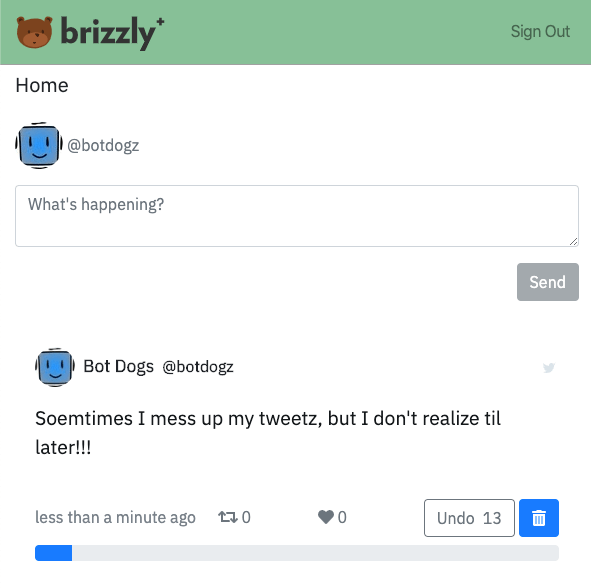
Brizzly, the name associated with a long-gone Twitter client, and later, a goofy project highlighting our addiction to social media, is coming back. And this time, it’s focused on serving the needs of Twitter power users in search of features Twitter itself has failed to build — like an Edit button and an auto-deletion option for tweets, among other things.

These features and more are a part of a new subscription service, Brizzly+, which offers a robust toolset built on the Twitter API.

Brizzly+ offers a simple Twitter client that shows your home timeline and allows you to like and post tweets.

But the most in-demand feature is Brizzly’s version of an Edit button for tweets.

Twitter, for whatever reason — complexity, confusion, or just not caring — has consistently refused to build an Edit button, despite the feature being a top request among Twitter users who want to correct typos in their tweets. That left third-party Twitter apps to step in to meet users’ needs. In the third-party Twitterific app, for example, the company worked around the problem by adding a “Delete and Edit Tweet” action that would let you correct a tweet by replacing it with a new one.

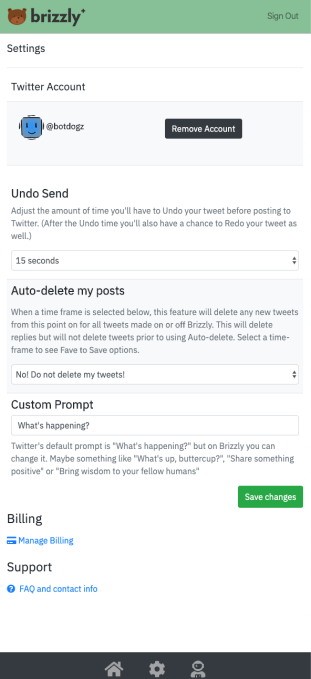
Brizzly+ handles the edit tweet feature a bit differently, however. According to Brizzly founder Jason Shellen, former Head of Product at Slack, the Brizzly+ ‘Undo’ feature involves the client briefly storing your tweets before posting them. This allows you to go back and make corrections as needed before they go live. You can even configure how long of a delay you need, which can be anywhere between 10 seconds and 10 minutes.

Another feature called “Redo Tweet” will help you to fix your typoed tweets after they’ve gone live. This works more like Twitterific, as it deletes the old tweet and replaces it with a new one. But Brizzly+ helpfully copies the post into a new field, allowing you to make the changes quickly.

Auto-deleting tweets has become a more in-demand request among Twitter users in recent years. In part, this is because things posted online years ago on the then much smaller social network today may come across as too personal, too oversharing or just embarrassing. But some high-profile Twitter users have also been targeted by critics who dug up old tweets to shame them. One of the more notable examples was the 2018 firing of director James Gunn from the “Guardians of the Galaxy” franchise after Twitter users pulled up a series of past, offensive tweets. Gunn was later reinstated but the campaign to take him down raised awareness of how older tweets could be problematic.

A number of services are available today that focus on mass-deletion or auto-deletion or bot. Some even have hundreds of thousands or even millions of users, according to a 2019 story by The New York Times.

With Brizzly+, Twitter users can opt to instead just have their tweets automatically erase themselves after 24 hours. Once enabled, the feature turns Twitter posts into ephemeral instead of permanent content. That’s similar to something Twitter itself is now testing with its Stories-like feature, called “Fleets.” But Fleets are a part of a separate product, so they don’t really address users’ concerns over their tweeted content.

There’s also a handy addition to the Brizzly+ auto-delete feature called “Fave to Save.” This allows you to set a threshold of likes for your tweets in order to prevent them from being auto-deleted. The option may make sense for people who are less concerned with their tweets’ content, but want to seem more popular on Twitter by highlighting their best content when you visit their profile.

Finally, for a little fun, Brizzly+ lets you replace Twitter’s “What’s happening?” prompt in the edit window with a custom phrase of your own choosing.

Brizzly’s founder Jason Shellen has worked on a number of top social and communication apps over the years, most recently, Slack. Earlier in his career, he worked at Pyra Labs, maker of Blogger, which sold to Google in 2003. At Google, he continued to work on Blogger, created Google Reader, and helped Google acquire companies like Feedburner, Picasa, and Measure Map. After Google, Shellen sold his startup Thing Labs, maker of Brizzly, to AOL in 2010 where he stayed to work on AIM and messaging. His next startup, Hike Labs, sold to Pinterest.

Shellen bought back Brizzly from AOL/Oath (Oath became Verizon Media, which also owns TechCrunch). In 2018, he relaunched it for a joke before developing Brizzly+. That original post-to-nowhere version of Brizzly remains, but is now called Brizzly Zero.

The new Brizzly+ subscription service costs $6 per month which reduces to $5 per month, when billed annually. It’s also offering a two-week free trial.

For now, Brizzly+ is only a web client, but the company lists a native iOS app among the ideas it’s planning to work on next, along with image upload, dark mode, tweet history deletion, and others.

Twitter has had a contentious history with third-party clients, even actively trying to shut them down at times But interestingly, Twitter has been expressing support for Brizzly+.

“We love to see developers building things that improve on a core piece of Twitter — like Tweet compose. They’re helping people do things that weren’t otherwise possible,” said Ian Cairns, Head of Product for Twitter’s Developer Platform, in a statement shared with TechCrunch. “This was one of the best parts of the Twitter API in the early days, and we know we haven’t always made it easy. We’re starting to change that,” he added.


Read Full Article

Apple could announce new MacBook models with scissor-switch keyboards soon


According to a new report from analyst Ming-Chi Kuo, Apple could unveil new MacBook Pro and MacBook Air models with scissor-switch keyboards. MacRumors first noticed the report, TechCrunch obtained the research note as well.

Apple has already updated the big MacBook Pro in November. The company slightly increased the size of the display from 15” to 16” without any meaningful changes in overall size. Apple also abandoned the controversial butterfly keyboards. The 16-inch MacBook Pro now relies on a more traditional scissor-switch keyboards.

But Kuo thinks Apple will ship updated MacBook models with a scissor-switch keyboard at some point during the second quarter of 2020. So you can expect a MacBook Air and small MacBook Pro update in the near future. Apple could use this opportunity to increase the size of the display of the 13-inch MacBook Pro model as well.

In addition to those minor but important updates, rumor has it that Apple is already planning bigger changes for the MacBook lineup. The first laptop with an Apple-designed ARM processor could ship in the last quarter of 2020 or the first quarter of 2021.

This change will have wide implications for developers as they’ll need to recompile their apps to run on ARM processors. Apple will likely lay out a roadmap so that third-party developers have enough time before releasing an ARM-based laptop.

There could also be a brand new laptop design in Q2 or Q3 of 2021. But Kuo is a bit vague on this front. Apple plans could still change.


Read Full Article

Soli Radar-Based Perception and Interaction in Pixel 4


The Pixel 4 and Pixel 4 XL are optimized for ease of use, and a key feature helping to realize this goal is Motion Sense, which enables users to interact with their Pixel in numerous ways without touching the device. For example, with Motion Sense you can use specific gestures to change music tracks or instantly silence an incoming call. Motion Sense additionally detects when you're near your phone and when you reach for it, allowing your Pixel to be more helpful by anticipating your actions, such as by priming the camera to provide a seamless face unlock experience, politely lowering the volume of a ringing alarm as you reach to dismiss it, or turning off the display to save power when you’re no longer near the device.

The technology behind Motion Sense is Soli, the first integrated short-range radar sensor in a consumer smartphone, which facilitates close-proximity interaction with the phone without contact. Below, we discuss Soli’s core radar sensing principles, design of the signal processing and machine learning (ML) algorithms used to recognize human activity from radar data, and how we resolved some of the integration challenges to prepare Soli for use in consumer devices.

Designing the Soli Radar System for Motion Sense
The basic function of radar is to detect and measure properties of remote objects based on their interactions with radio waves. A classic radar system includes a transmitter that emits radio waves, which are then scattered, or redirected, by objects within their paths, with some portion of energy reflected back and intercepted by the radar receiver. Based on the received waveforms, the radar system can detect the presence of objects as well as estimate certain properties of these objects, such as distance and size.

Radar has been under active development as a detection and ranging technology for almost a century. Traditional radar approaches are designed for detecting large, rigid, distant objects, such as planes and cars; therefore, they lack the sensitivity and resolution for sensing complex motions within the requirements of a consumer handheld device. Thus, to enable Motion Sense, the Soli team developed a new, small-scale radar system, novel sensing paradigms, and algorithms from the ground up specifically for fine-grained perception of human interactions.

Classic radar designs rely on fine spatial resolution relative to target size in order to resolve different objects and distinguish their spatial structures. Such spatial resolution typically requires broad transmission bandwidth, narrow antenna beamwidth, and large antenna arrays. Soli, on the other hand, employs a fundamentally different sensing paradigm based on motion, rather than spatial structure. Because of this novel paradigm, we were able to fit Soli’s entire antenna array for Pixel 4 on a 5 mm x 6.5 mm x 0.873 mm chip package, allowing the radar to be integrated in the top of the phone. Remarkably, we developed algorithms that specifically do not require forming a well-defined image of a target’s spatial structure, in contrast to an optical imaging sensor, for example. Therefore, no distinguishable images of a person’s body or face are generated or used for Motion Sense presence or gesture detection.
Soli’s location in Pixel 4.
Soli relies on processing temporal changes in the received signal in order to detect and resolve subtle motions. The Soli radar transmits a 60 GHz frequency-modulated signal and receives a superposition of reflections off of nearby objects or people. A sub-millimeter-scale displacement in a target’s position from one transmission to the next induces a distinguishable timing shift in the received signal. Over a window of multiple transmissions, these shifts manifest as a Doppler frequency that is proportional to the object’s velocity. By resolving different Doppler frequencies, the Soli signal processing pipeline can distinguish objects moving with different motion patterns.

The animations below demonstrate how different actions exhibit distinctive motion features in the processed Soli signal. The vertical axis of each image represents range, or radial distance, from the sensor, increasing from top to bottom. The horizontal axis represents velocity toward or away from the sensor, with zero at the center, negative velocities corresponding to approaching targets on the left, and positive velocities corresponding to receding targets on the right. Energy received by the radar is mapped into these range-velocity dimensions and represented by the intensity of each pixel. Thus, strongly reflective targets tend to be brighter relative to the surrounding noise floor compared to weakly reflective targets. The distribution and trajectory of energy within these range-velocity mappings show clear differences for a person walking, reaching, and swiping over the device.

In the left image, we see reflections from multiple body parts appearing on the negative side of the velocity axis as the person approaches the device, then converging at zero velocity at the top of the image as the person stops close to the device. In the middle image depicting a reach, a hand starts from a stationary position 20 cm from the sensor, then accelerates with negative velocity toward the device, and finally decelerates to a stop as it reaches the device. The reflection corresponding to the hand moves from the middle to the top of the image, corresponding to the hand’s decreasing range from the sensor over the course of the gesture. Finally, the third image shows a hand swiping over the device, moving with negative velocity toward the sensor on the left half of the velocity axis, passing directly over the sensor where its radial velocity is zero, and then away from the sensor on the right half of the velocity axis, before reaching a stop on the opposite side of the device.

Left: Presence - Person walking towards the device. Middle: Reach - Person reaching towards the device. Right: Swipe - Person swiping over the device.
The 3D position of each resolvable reflection can also be estimated by processing the signal received at each of Soli’s three receivers; this positional information can be used in addition to range and velocity for target differentiation.

The signal processing pipeline we designed for Soli includes a combination of custom filters and coherent integration steps that boost signal-to-noise ratio, attenuate unwanted interference, and differentiate reflections off a person from noise and clutter. These signal processing features enable Soli to operate at low-power within the constraints of a consumer smartphone.

Designing Machine Learning Algorithms for Radar
After using Soli’s signal processing pipeline to filter and boost the original radar signal, the resulting signal transformations are fed to Soli’s ML models for gesture classification. These models have been trained to accurately detect and recognize the Motion Sense gestures with low latency.

There are two major research challenges to robustly classifying in-air gestures that are common to any motion sensing technology. The first is that every user is unique and performs even simple motions, such as a swipe, in a myriad of ways. The second is that throughout the day, there may be numerous extraneous motions within the range of the sensor that may appear similar to target gestures. Furthermore, when the phone moves, the whole world looks like it’s moving from the point of view of the motion sensor in the phone.

Solving these challenges required designing custom ML algorithms optimized for low-latency detection of in-air gestures from radar signals. Soli’s ML models consist of neural networks trained using millions of gestures recorded from thousands of Google volunteers. These radar recordings were mixed with hundreds of hours of background radar recordings from other Google volunteers containing generic motions made near the device. Soli’s ML models were trained using TensorFlow and optimized to run directly on Pixel’s low-power digital signal processor (DSP). This allows us to run the models at low power, even when the main application processor is powered down.

Taking Soli from Concept to Product
Soli’s integration into the Pixel smartphone was possible because the end-to-end radar system — including hardware, software, and algorithms — was carefully designed to enable touchless interaction within the size and power constraints of consumer devices. Soli’s miniature hardware allowed the full radar system to fit into the limited space in Pixel’s upper bezel, which was a significant team accomplishment. Indeed, the first Soli prototype in 2014 was the size of a desktop computer. We combined hardware innovations with our novel temporal sensing paradigm described earlier in order to shrink the entire radar system down to a single 5.0 mm x 6.5 mm RFIC, including antennas on package. The Soli team also introduced several innovative hardware power management schemes and optimized Soli’s compute cycles, enabling Motion Sense to fit within the power budget of the smartphone.

Hardware innovations included iteratively shrinking the radar system from a desktop-sized prototype to a single 5.0 mm x 6.5 mm RFIC, including antennas on package.
For integration into Pixel, the radar system team collaborated closely with product design engineers to preserve Soli signal quality. The chip placement within the phone and the z-stack of materials above the chip were optimized to maximize signal transmission through the glass and minimize reflections and occlusions from surrounding components. The team also invented custom signal processing techniques to enable coexistence with surrounding phone components. For example, a novel filter was developed to reduce the impact of audio vibration on the radar signal, enabling gesture detection while music is playing. Such algorithmic innovations enabled Motion Sense features across a variety of common user scenarios.

Vibration due to audio on Pixel 4 appearing as an artifact in Soli’s range-doppler signal representation.
Future Directions
The successful integration of Soli into Pixel 4 and Pixel 4 XL devices demonstrates for the first time the feasibility of radar-based machine perception in an everyday mobile consumer device. Motion Sense in Pixel devices shows Soli’s potential to bring seamless context awareness and gesture recognition for explicit and implicit interaction. We are excited to continue researching and developing Soli to enable new radar-based sensing and perception capabilities.

Acknowledgments
The work described above was a collaborative effort between Google Advanced Technology and Projects (ATAP) and the Pixel and Android product teams. We particularly thank Patrick Amihood for major contributions to this blog post.

Senate bill seeks to ban Chinese app TikTok from government work phones


On Thursday, Sen. Josh Hawley (R-MO) and Rick Scott (R-FL) introduced legislation to further restrict the use of the popular viral video app TikTok on government devices.

The bill seeks to expand existing federal guidance prohibiting use of TikTok to encompass any U.S. government-issued device. The legislation is the most recent effort by U.S. lawmakers to limit Chinese-built tech software, devices and components for fear that those products have the potential to be leveraged by the Chinese government.

While other Asia-based social apps have struggled to gain a global foothold, TikTok quickly amassed more than a billion users worldwide and became a household name alongside American social media stalwarts like Facebook and YouTube. The app is owned by Beijing-based tech startup ByteDance.

Growth does appear to be slowing for ByteDance, but the app’s ubiquity raises alarms among China hawks like Hawley, who warns that the app could be compelled to share data with the Chinese government. In a release with the bill’s text, Sen. Scott called TikTok a “risk to our networks and a threat to our national security.”

“As many of our federal agencies have already recognized, TikTok is a major security risk to the United States, and it has no place on government devices,” Hawley said.

The bill comes as the Trump administration prepares a draft order that would ban federal agencies from buying foreign-made drones, another effort to curtail Chinese technology in the United States.


Read Full Article

Why it's so hard to talk about the N-word | Elizabeth Stordeur Pryor

Why it's so hard to talk about the N-word | Elizabeth Stordeur Pryor

Professor Elizabeth Stordeur Pryor leads a thoughtful and history-backed examination of one of the most divisive words in the English language: the N-word. Drawing from personal experience, she explains how reflecting on our points of encounter with the word can help promote productive discussions and, ultimately, create a framework that reshapes education around the complicated history of racism in the US.

Click the above link to download the TED talk.

Cloud gaming platform Shadow brings its new plans to the US


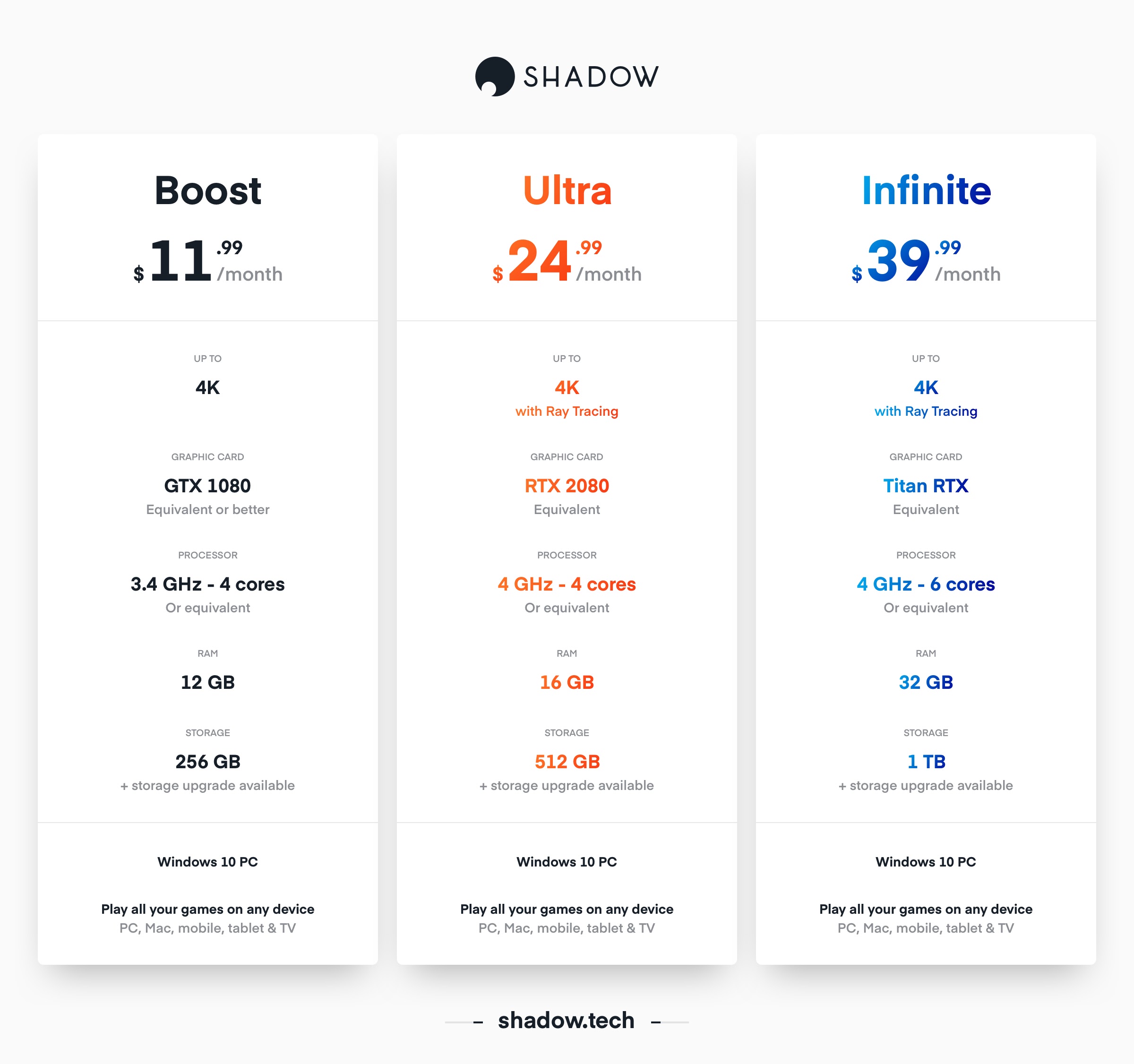
Blade, the French startup behind Shadow, announced plans to overhaul its subscription tiers back in October. The company is now bringing the new plans to the U.S. with a new entry tier at $11.99 per month as well as more powerful options in the coming months.

Shadow is a cloud computing service for gamers. For a monthly subscription fee, you can access a gaming PC in a data center near you. Compared to other cloud gaming services, Shadow provides a full Windows 10 instance. You can install anything you want — Steam, Photoshop or Word.

The current subscription tier, now called Shadow Boost, offers the same performance for a lower price. You get an Nvidia GTX 1080 GPU, 3.4GHz with 4 cores CPU, 12GB of RAM, 256GB of storage. It costs $11.99 per month if you sign up to a 12-month plan or $14.99 per month if you pay on a monthly basis.

Later this year, Shadow will also offer two additional plans:

  • Shadow Ultra: Nvidia RTX 2080 GPU, 4GHz with 4 cores CPU, 16GB of RAM, 512GB of storage
  • Shadow Infinite: Nvidia Titan RTX GPU, 4 GHz with 6 cores CPU, 32GB of RAM, 1TB of storage

These plans will cost $24.99 and $39.99 per month respectively if you subscribe to a 12-month plan — or $29.99 and $49.99 per month on a monthly basis.

Shadow Ultra and Shadow Infinite will roll out gradually starting this summer — only a limited number of users will be able to subscribe at first.

It’s worth noting that you’ll be able to add an option to get more storage with any plan. Storage plans include 256GB of SSD performance — anything above that will perform like a more traditional HDD.

The company now has four data centers in the U.S., which means that anybody in the U.S. can now access the service — not just people living on the West Coast or the East Coast.

In Europe, Shadow has had issues rolling out the new plans. While the company originally promised to deliver the new options in February, users who pre-ordered the new plans will only be able to access their new instance by the end of the summer.

Shadow offers apps for Windows, macOS, Linux, Android and Apple devices. Apple recently pulled Shadow’s apps from the App Store on iOS, iPadOS and tvOS. The company is still trying to find a solution with Apple to re-release the apps in the App Store.

In other news, the startup has signed a strategic partnership with LG Electronics. Details are thin, but LG is now a shareholder of the company. LG will also offer Shadow with some of its products.


Read Full Article

Tree planting search engine Ecosia is getting a visibility boost in Chrome


Ecosia, a not-for-profit search engine which uses ad generated revenue to fund planting trees, is set to get a visibility boost in Chrome. A change Google is making to its chromium engine will see it added as a default search engine choice in up to 47 markets for the version 81 release of Google’s web browser.

Ecosia will soon be included on Chrome’s default search engine list in several major markets, including the UK, US, France and Germany — alongside the likes of Google Search, Bing, DuckDuckGo and Yahoo!

It’s the first time the not-for-profit search engine will have appeared in Chrome’s default search engine choice list. And while users of Chrome can always navigate directly to Ecosia to search, or download an extension to search via it directly in the browser’s URL bar, those active steps require prior knowledge of the product. Whereas being listed as a default option in Chrome means Ecosia will be put in front of people who aren’t yet familiar with it.

The Berlin-based search engine said Google Chrome’s selection of default search engines is based on search engine popularity rankings in different markets.

The full list of markets where it will be offered as a choice in the v81 release is: Argentina, Austria, Australia, Belgium, Bahrain, Brunei, Bolivia, Brazil, Canada, Switzerland, Chile, Colombia, Costa Rica, Germany, Denmark, Ecuador, Spain, Faroe Islands, France, Guatemala, Croatia, Hungary, Ireland, Iceland, Italy, Lebanon, Liechtenstein, Luxembourg, Mexico, Nicaragua, New Zealand, Oman, Panama, Peru, Philippines, Puerto Rico, Portugal, Paraguay, Sweden, El Salvador, Taiwan, United States, United Kingdom, Uruguay, Venezuela and Vietnam.

The shift comes after what Ecosia said was a record year of usage growth for its search engine — with monthly active users rising from 8 million to 15 million during 2019.

The company dedicates 80% of advertising profits to funding reforestation projects in biodiversity hotspots around the world, and says it has planted 86 million+ trees since it was founded back in 2009 — a total it’s expecting will grow as a result of Google’s decision to include Ecosia as a default choice.

Commenting in a statement Ecosia CEO Christian Kroll said: “Ecosia’s growth over the last year shows just how invested users are in the fight against the climate crisis. Everywhere, people are weighing up the changes they can make to reduce their carbon footprint, including adopting technologies such as Ecosia. Our addition to Chrome will now make it even easier for users to help reforest delicate, at-risk and often devastated ecosystems, and to fight climate change, just by using the internet.”

“It’s also good news for user choice and fairness,” he added, pointing to recent research which he said indicates that providing a choice of search engines has the potential to increase the collective mobile market share of Google alternatives by 300-800%.

“It’s important that there are independent players in the market that don’t just exist for profit. We put our profits into tree planting and we are also focused on privacy, so users can have a positive impact on the environment while having greater control over their personal information.”

The chromium update will also see rival search engines DuckDuckGo and Yahoo added as a default in more markets when the v81 release of Chrome is pushed out.

These are the latest revisions to Chrome’s search engine defaults. But in a major shift this time last year Google quietly expanded the choice of search product in a way that gave the biggest single boost to the visibility of pro-privacy search engine rival DuckDuckGo.

It said then that the changes derived from “new usage statistics” from “recently collected data.”

But the company’s business had been facing rising attention over privacy and competition concerns.

As, indeed, Google still is…

In Europe, meanwhile, antitrust enforcement around how Google operates its Android smartphone platform has already forced the tech giant to offer a choice screen that surfaces alternative search engines and web browsers alongside its own products.

In 2018 the EU’s competition competition concluded Google had violated antitrust rules by requiring Android device makers pre-install its own search and browser apps. It was fined $5BN and ordered to cease the infringement — initially responding with a choice screen prompt that appeared to select products based on marketshare. Before announcing it would move to a ‘pay-to-play’ auction model to assign the non-Google slots on the screen starting early this year.

Rival search engines including Ecosia, DuckDuckGo and French pro-privacy search engine Qwant have been highly critical of this pay-to-play switch — hitting out at the limited slots and sealed bid auction structure Google devised. And DuckDuckGo has remained critical despite winning a universal slot on the screen early this year.

Ecosia chose to boycott the auction entirely — telling the BBC in January it’s at odds with the spirit of the Commission ruling.

“Internet users deserve a free choice over which search engine they use and the response of Google with this auction is an affront to our right to a free, open and federated internet. Why is Google able to pick and choose who gets default status on Android?” Kroll said then.

Asked for current Android usage metrics the company told us Ecosia’s total daily active users on Google’s platform have grown from 489,422 this time last year to 1,245,777 now — a 155% year over year rise in DAUs.

Though it remains to be seen whether Google’s shift to a paid auction model which Ecosia is not participating in — given doing so would require the not-for-profit to spend money paying Google to appear as a choice rather than ploughing those revenues into planting more trees — will put a dampener on Ecosia’s Android growth this year.

A spokesman for Ecosia pointed us to statcounter figures that estimate it took a 0.22%market share of mobile search in Europe between February 2019 and February 2020.

On desktop the search engine takes a higher regional share, per statcounter, account for 0.5% of desktop searches.

Overall, across mobile and desktop, Google’s share of the European search market over the same period is 93.83% vs 0.33% for Ecosia.


Read Full Article

Create Great Presentations in Minutes With SlideHeap’s Template Library


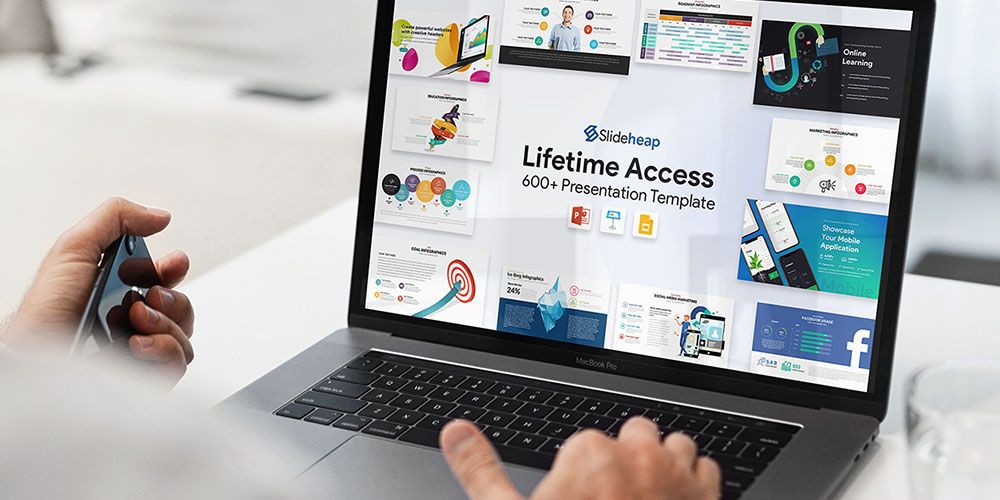
When you are trying to impress investors or win over potential clients, how you present is very important. Using the basic templates provided by Microsoft will not help your cause. If you want to look professional every time, SlideHeap can help. This huge library gives access to more than 600 slide templates created by professional designers, covering 25 different markets. You can get a lifetime subscription now for $29 at MakeUseOf Deals.

Better Slides

According to the best-selling science author, Dr. John Medina, most people tend to tune out of presentations after ten minutes. Backing up your script with well-designed slides makes it much easier to keep your audience engaged.

With SlideHeap, you have high-quality slide templates at your fingertips. This online library offers a huge range of premium designs for Microsoft PowerPoint, Keynote, and Google Slides. The selection includes simple lists, infographics, timelines, and more.

All the templates are customizable, meaning you can tweak the layout and change the colors as required. In addition, you get access to over 1,000 icons which you can add to your presentation.

Lifetime Access for $29

It’s worth $490, but you can currently get lifetime access to the SlideHeap library for $29 including unlimited downloads.

Read the full article: Create Great Presentations in Minutes With SlideHeap’s Template Library


Read Full Article