26 September 2019

Can You Fix a Scratched CD With Toothpaste? Here’s How!


Your compact disc (CD) is scratched and won’t play. Perhaps it is an album of music, maybe you have photos on the disc. Or perhaps it’s a DVD that is scratched, with your favorite movie on it, or even a game disc.

Want to get that scratched disc working again? Amazingly, you can! Here’s how to fix a scratched CD or DVD, make it playable on any device, and what to do next.

Want Data Off That CD? You’ll Need to Fix It First

Can a scratched DVD be fixed with toothpaste?
Image credit: Fred/Flickr

If your CD or DVD is scratched and won’t play, it must be repaired before it will work again. Repairing any type of optical disc isn’t as difficult as it might sound.

In most cases, a scratch in the disc is only at the surface level. The actual data on the disc is stored on a material sandwiched between two layers of polycarbonate. That’s the transparent plastic of the disc, the surface prone to scratching.

Taking care of your discs is clearly a good idea, so you should always put them back in the case when done. Also take the time to ensure the inside of the case is clean, too. Bits of grit can scratch the disc when it is apparently safely put away. Also, you should take care removing a disc that gets stuck in the DVD drive. This is another occasion when optical discs can be scratched or otherwise damaged.

However, if blemishes playback, there’s a good chance you can fix the scratched DVD or CD and make it playable again.

Several methods have been found to work. None of them require any special materials or skills, and all can be done with household items.

5 Ways to Repair a CD or DVD

If the disc has scratches preventing successful reading, you can try to repair them to make the disc playable again.

Here are five ways you might (temporarily) repair a CD, DVD, or even Blu-ray disc.

1. Fix Your Optical Disc by Cleaning It

Clean your scratched CD

Much of the time, discs we think are scratched—and therefore unreadable—aren’t all that bad.

Often, the scratches are merely surface scuffs. Rather than deep gashes that divert the laser in the disc reader away from the encoded data on the metal layer, some scratches might simply be dirt.

The check this, clean the surface of the disc with a soft lint-free cloth. You can use a gentle detergent (or rubbing alcohol) if there are grease spots. Make sure there are no fingerprints or dust particles. Don’t scrub too hard as you may do more harm than good this way.

Where children, pets, and/or fast food is regularly found, look out also for food and liquid debris.

With any luck, your disc will work once cleaned.

2. Repair Scratches on Damaged CDs with Toothpaste

Incredibly, this is possible using a whitening toothpaste or some polish (especially those used by opticians) although Brasso also works.

But how does toothpaste fix scratches on your CDs? The principle here is simple: the toothpaste fills the gap caused by the scratch. The laser is then correctly focused to accurately read the data on the disc. Follow these steps:

  1. Clean the disc as described above.
  2. Deposit a small amount of toothpaste (or your chosen filler) onto a plate. With a wooden toothpick, apply a little filler along the scratch.
  3. Rub gently with a suitable cloth, from the center of the scratch outwards.

After a few moments you will see the scratch diminishing. It might even disappear.

While the cosmetic results might be satisfactory, the practical impact can be hit and miss.

3. Can a Light Bulb Fix a Scratched DVD?

Another DIY scratch fixing technique is to employ a lamp with an incandescent 60W light bulb.

With the optical disc threaded onto your index finger, shiny side up, hold the disc around 10cm from the lamp. Rotate the disc for a maximum of 20 seconds, then remove. Note that too much exposure to the heat can damage the disc.

Play the disc while it is still warm, immediately copying the data to your computer.

If you’re not getting any joy so far, this might be worth a go.

4. Fix a Scratched Disc With Wax

Incredibly, scratches in the surface of a CD or DVD can be fixed with softened wax!

As with the toothpaste fix, you can use shoe polish, lip balm, furniture wax, or even petroleum jelly. Again, rub it into the surface of the disc to fill the scratch. With a lint-free cloth, wipe of the excess wax, with a radial action.

Once you’re done, try and play the disc. If it works, copy the data to your PC.

5. Fix Holes in the Disc With Scotch Tape

Fix holes in old CDs and DVDs

Not all disc issues are limited to the plastic layer. In some cases, holes can appear in the aluminum layer. As this is where the data is stored, it can prove devastating.

If a hole is found by the laser, it will simply stop reading.

The answer is to cover the holes, thereby prompting the laser to keep reading. Hold the disc shiny side up and find the holes. Then flip it over and mark the gaps with a permanent marker. Finish by placing two small strips of tape over each whole you find.

With this done, the disc will play, allowing you to recover most of the data. Of course, any data stored where the holes appeared will be lost.

What to Do Next With Your Scratched CD

So, what have we learned? Well, you don’t need to bin those scratched CDs and DVDs right away. Instead of using them as coasters or windchimes, use one of these methods to overcome the scratches and retrieve data.

To recap, you can fix a scratched CD using the following techniques:

  1. Clean the disc with a soft cloth, warm water, and soap
  2. Use toothpaste to fill the scratches
  3. Soften the polycarbonate later with a hot lamp
  4. Fill the scratches with wax
  5. Find and cover any holes in the data layer with a Sharpie and tape

With the disc spinning and the player reading it, you can be reasonably happy. The disc is repaired, albeit temporarily. It’s time to take the time to get the data off it.

Whether you’re trying to rescue audio, data, or video discs, don’t rest on your laurels. Instead, copy the data to another disc, your hard disk drive, or whatever your preferred storage solution is.

Not sure how to do this? Find out how to recover data from a scratched CD or DVD.

Read the full article: Can You Fix a Scratched CD With Toothpaste? Here’s How!


Read Full Article

The 5 Best MoviePass Alternatives for Film Fans


moviepass-alternatives

In September 2019, MoviePass shut down for all customers. The company had been on life-support since 2018 due to financial problems, so the end had been nigh for a while.

The company’s demise means lots of film fans are on the hunt for MoviePass alternatives. Sure, the MoviePass offer of unlimited films for just $10/month is hard to match, but there are some solid alternatives out there which let you visit the cinema for a monthly fee.

In this article we take a look at the best MoviePass alternatives you can subscribe to today.

1. AMC Stubs A-List

As you’ll soon see, all of the MoviePass alternatives are in-house projects run by individual theater chains. Indeed, one of MoviePass’ most significant issues was that the theaters were never entirely comfortable with the service.

AMC Stubs A-List was one of the first competitors to announce its launch. Ironically, the service went live in mid-2018, just as MoviePass’ problems were starting to become apparent.

The new venture built on the existing AMC Stubs brand by offering features that were never available to MoviePass users. Those features include being able to book tickets weeks in advance, a way to choose your seat, and access to premium formats like 4K, 3D, and IMAX—all of which were excluded from MoviePass plans.

Furthermore, there are no restrictions on when you attend. MoviePass users would often find blackouts on opening nights and busy holiday days. Other perks include discounted food and drink, free upgrades on popcorn, and priority queuing.

The AMC Stubs A-List isn’t a free-for-all, however. It does have some restrictions. Most notably, you can only watch three movies a week. Your allowance resets every Friday. There’s also no way to buy extra tickets for family and friends.

AMC Stubs A-List doesn’t require you to sign up for a long contract; you can cancel at any time. The service does not have a fixed price. It can vary from $20-$23/month, depending on which state you live in.

2. Regal Unlimited

MoviePass alternatives - Regal Unlimited

Regal Cinemas unveiled its movie subscription plan—Regal Unlimited—in July 2019.

Whereas the AMC plan aims to enhance the movie-going experience with added perks and benefits that weren’t available to MoviePass subscribers, the Regal Unlimited plan tries to replicate the originally MoviePass product more closely.

If you subscribe, you can watch an unlimited number of movies in Regal theaters. There are no restrictions on days or times, or on how often you can watch the same film. Sadly, you cannot buy tickets for other people.

Like AMC, the Regal Unlimited plan lets you book tickets in advance, choose your seats, and get a 10 percent discount on all food and drink.

There are three versions of the plan. The basic package costs $18/month, but only 200 Regal locations support the scheme (make sure you check with your local theater before you sign up). Regal Unlimited Plus covers 400 theaters; Regal Unlimited All Access covers every Regal Cinema across the US (more than 500).

The minimum contract term is one year. You cannot cancel during the period. And if you buy tickets for ScreenX, 4DX, IMAX, RPX, 3D, or VIP screens, you will have to pay an additional surcharge at the time of purchase.

3. Cinemark Movie Club

MoviePass alternatives - Cinemark Movie Club

Cinemark Movie Club lags behind AMC Stubs A-List and Regal Unlimited with regard to the benefits. However, it’s also cheaper, so you’ll need to decide what is more important to you.

For $10/month, you get one free cinema ticket per month. If you don’t use the ticket, it rolls over into the following month. You can watch a maximum of three free movies per day.

The Cinemark Movie Club plan does not impose blackouts on popular or busy days.

You’ll also get 20 percent off food and drink. And, importantly for many people, a Cinemark Movie Club plan entitles you to buy two additional tickets at the member price. If you always go to the movies with friends, you might find this perk appealing.

Having a Cinemark Movie Club subscription also automatically enrolls you into the company’s points scheme. You can exchange points for tickets, merchandise, food, digital downloads, and more.

4. ArcLight Membership

MoviePass alternatives - Arclight Membership

The three plans we’ve looked at so far are all designed to appeal to more hardcore movie lovers (people who go to the theater several times per month). Without that kind of frequency, the plans make little financial sense for users.

The ArcLight Membership plan positions itself slightly differently. If you live in the Los Angeles, San Diego, Boston, Washington DC, or Chicago areas, you can sign up to the plan for just $15/year.

For that price, you get $1 off every cinema ticket that you buy online. You’ll also get one free ticket for your birthday, free popcorn upgrades, 10 percent off drinks, and—if you visit more than 12 times in a year—10 percent off gift shop items. The impressive perks and low price mean you don’t need to go to the theater more than a few times a year to get your money’s worth.

5. Alamo Season Pass

MoviePass alternatives - Alamo Season Pass

The Alamo Season Pass is still in beta. At the moment, it is only available in Denver, Kansas, New York, Austin, San Antonio, and a few smaller towns. A national rollout is due in early- to mid-2020.

In many ways, the service will offer the best of all the movie subscription plans we’ve covered. For example, you will be able to watch one movie per day, buy tickets up to seven days in advance, and purchase additional companion tickets for a discounted rate.

All regularly priced 2D and 3D movies are part of the program, though an additional $1.99 charge will be applied for 3D showings. The Season Pass will not cover you for special events or other premium tickets.

Because the plan is still in beta, Alamo has not confirmed the price. At the moment, the company is trialing different prices in different areas. The cheapest plans are $20/month; the most expensive plans are $30/month.

Other Ways to Watch Movies

Some people have questioned whether movie theaters can continue to survive. As streaming services gather pace and new plans like Disney+ come into existence, more people are saving money by watching at home instead.

If you’re not bothered about the movie theater experience and just want to watch films from the comfort of your sofa instead, be sure to read our articles on the best Kodi add-ons for free movies and the best free apps for watching movies online.

Read the full article: The 5 Best MoviePass Alternatives for Film Fans


Read Full Article

5 Websites That Teach You How to Hack Legally


sites-hack-legally

If you’re an ethical hacker, it can be hard to put your skills to the test without harming anyone. Fortunately, there are resources that give you a sandbox to hack in, giving you a place to learn while also keeping it legal.

Here are some websites to test your mettle against without getting into trouble.

1. Google Gruyere

The Google Gruyere website

Google Gruyere is the web giant’s entry into the hacking world. The website is full of holes and uses “cheesy” code, hence its cheese-related name. Even the website is cheese-themed!

Once you’re ready to start, Google Gruyere will give you a few challenges to perform. Google Gruyere features deliberately weak and vulnerable code for you to exploit. The problems highlight these weak areas and give you a task to perform. For example, one challenge has you inject HTML alert boxes into the website’s snippets feature, which fire when the user loads the page.

If you get stuck on how to complete a challenge, don’t worry. Each mission comes with some hints to help prod you in the right direction. If these don’t help, you can view the solution and implement it yourself to get a feel of how the exploit works.

2. HackThis

The HackThis website, trying a "Real" mission

Not many websites actively invite you to hack them in their title, but HackThis is one exception. Of course, you’re not hacking the actual website, but it does give you challenges to try.

HackThis has a wide variety of challenges in different categories, so you’re bound to find something to test you. There are fundamental challenges and difficult challenges to try depending on your skill level. If you want to try busting simple CAPTCHA codes, there’s an entire segment for that.

There’s even a “Real” category which includes fun fictional scenarios where you hack a website for a client.

The best part about HackThis are the hints. Each puzzle has a dedicated hints page where you can talk to members of the forum and discuss where you’re going wrong. The members will never give you the solution so that you can figure it out yourself without spoilers.

3. bWAPP

The BWAPP website

While hacking websites are useful, there are some bugs and exploits that they can’t cover. For example, these websites can’t host challenges that involve taking down a website; if they did, nobody else would get a turn afterward!

As such, you’re best off performing more devastating attacks on a self-hosted server, so you don’t damage other people’s websites. If you’re interested in this area of hacking, try the buggy web app (bWAPP).

The main strength of bWAPP is its sheer number of bugs. It has over 100 of them, ranging from Direct Denial of Service (DDoS) weaknesses to Heartbleed vulnerabilities to HTML5 ClickJacking. If you want to learn about a specific vulnerability, there’s a good chance bWAPP has it implemented.

When you want to give it a shot, download it and run it on your target system. Once it’s running, you can launch attacks at it without worrying about annoying a webmaster.

Download: bWAPP (Free)

4. OverTheWire

The OverTheWire website, showing the challenges available.

OverTheWire features wargames and warzones for more advanced hacking sessions. Wargames are unique hacking scenarios, usually with a little bit of story to spice things up. Wargames can be a competitive event between hackers, either as a race or by attacking each other’s servers.

While this may sound complicated and scary, don’t worry. The website still features lessons ranging from the basics to more advanced tricks. It does require a Secure Shell (SSH) connection to use, so be sure to learn SSH if you want to try OverTheWire. Thankfully, there are easy ways to set up SSH in Windows, so it shouldn’t be too big a hurdle.

OverTheWire has three primary uses. First, you can play through small games with increasing difficulty to learn how to hack. Once you’ve gained some skill, you can download wargames with unique backstories for a more immersive experience.

There’s also the warzone, which is an exclusive network designed to work just like an IPV4 internet. People can put vulnerable, hackable devices onto this network, and others can use them to practice their hacking skills.

At the time of writing, there is an exercise that replicates when Kevin Mitnick hacked computer expert Tsutomu Shimomura in 1995. Now you can put yourself in Mitnik’s shoes and see if you can crack the security yourself!

5. Hack This Site

The HackThisSite website, performing one of the basic challenges

Another website that’s cordially inviting you to hack it, Hack This Site is a fantastic learning resource. It stretches from beginner-oriented lessons to hosting a dedicated phone line for phone phreak attacks.

Some of the missions have a little story to keep you engaged with the lessons. For example, people on the Basic course will go toe-to-toe with Network Security Sam. Sam is a forgetful man who’s adamant on storing his password on the website, so he never forgets it. Every time you crack his security and discover his password, he adds more security to his website.

The “realistic” exercises are also enjoyable. These are fake websites set up for you to hack with a specific goal in mind. You may be rigging a voting system to get a band to the top spot, or undoing the work of spiteful people who hacked into a peace poem site.

Each puzzle comes with a dedicated thread on the forums where you can get help. The problems and discussions have been around for a long time, and users have posted lots of helpful resources. Again, nobody will outright tell you the solution to each challenge, so you don’t have to worry about spoilers. If you’re willing to do some research, however, you’ll find their hints and tips more than enough to solve your puzzle.

Do These Websites Promote Illegal Hacking?

As you browse these websites, you may realize that malicious people can use these same skills for evil. Some of the “realistic” missions have you breaking into a library system or a band rating website, for example. It’s easy to assume these websites are training people to be evil agents.

The truth is, if these websites didn’t exist, nefarious hackers would still get their resources on the dark web. Meanwhile, website developers—the people who need to learn hacking techniques the most—wouldn’t have anywhere legal to learn and test these hacking techniques.

Developers would make the same errors over and over, while hackers would take advantage of them using the dark web to spread resources and tutorials.

As such, by making this information public, it gives web developers the practice they need to secure their websites. In an ideal world, all web designers will learn how to protect their websites this way, thus preventing malicious agents from using this knowledge for evil.

Learning How to Hack

If you want to learn how to hack, there’s no better way than to do some hacking yourself. Fortunately, you don’t need to target your local hairdresser’s website; give these legal hacking websites a try instead.

If you want to take your skills further, why not try an ethical hacking online class?

Read the full article: 5 Websites That Teach You How to Hack Legally


Read Full Article

What Is an eSIM and How Is It Better Than a Standard SIM Card?


simcard-vs-esim

If you’re eyeing a new iPhone 11, or hoping to pick up a Pixel 4, you might find they have a feature you don’t know much about: the eSIM.

An eSIM is a smaller, built-in version of the traditional SIM card, and it’s coming to a phone or other smart device near you soon. But how does it work and is it worth having? Let’s take a look.

What Is an eSIM?

An eSIM is an embedded SIM card. It’s a replacement for the physical SIM card that currently connects phones to a mobile network, but the eSIM is a lot smaller.

sim card

Unlike a SIM card, the eSIM is fixed onto the phone’s (or other device’s) motherboard. You don’t need to insert it, and you can’t remove it. That doesn’t mean you can’t switch numbers or change carriers, though, since the information on the eSIM is rewritable.

In fact, switching or setting it up might even be easier. You don’t have to wait for a new SIM to be delivered to your house; it could all happen instantly with just a quick phone call.

eSIM cards use the same tech, and run on the same GSM networks that normal SIMs use. Take a look at our article What is a SIM Card? for more on this.

To use an eSIM you’ll need to be with a carrier that offers it, and have a compatible phone. Carriers like AT&T and T-Mobile in the US, or EE in the UK, along with over 85 more worldwide offer eSIM support.

eSIM cards are currently used to bring dual SIM capability to smartphones including the iPhone 11 range, and the Pixel 3, as well as in smaller devices like the Apple Watch.

In time it’s likely that all phones and tablets will switch to using eSIM. Its much smaller size means that it could also become a common feature in internet-of-Things devices, although there’s an even newer and vastly smaller tech called iSIM just around the corner.

How to Set Up an eSIM Card

You connect most phones to a network by inserting the SIM card into the tray. But if it doesn’t use cards, how do you connect an eSIM phone?

how to activate esim

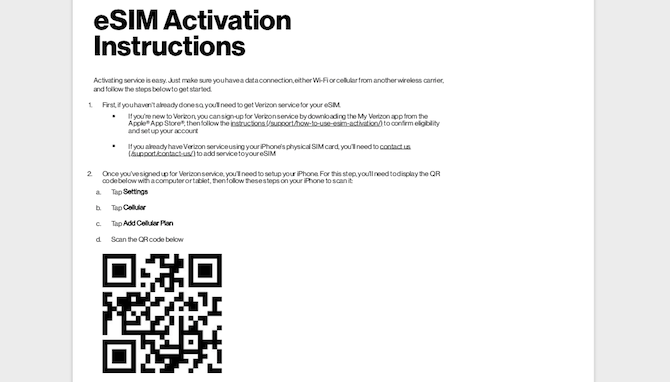
It depends what device you’ve got, and whether you bought it with a cellular plan or added your plan separately. Buy the plan separately and you’ll get an eSIM activation card that includes a QR code that you need to scan on your phone.

  • On iPhone go to Settings > Cellular (or Mobile Data) > Add Cellular Plan then scan the code when prompted.
  • On Android you can set up your eSIM at Settings > Network & internet > Add. Follow the onscreen instructions and choose Use 2 Numbers when prompted. This may of course differ depending on which Android version and phone you’ve got.

Buy a Pixel on Google Fi and your eSIM details will be automatically tied to your account.

Your Apple Watch will come with the eSIM preconfigured when you buy it with a plan, or you can add the details through the Apple Watch app if you don’t. On a Samsung Galaxy Watch you must complete the setup through a mobile app on your phone.

Dual SIM devices need to support DSDS (Dual SIM, Dual Standby) in order to offer full functionality. This is available on the iPhone, and in Android 10. DSDS enables both SIMs to connect to a network at the same time. When you set it up, you’ll need to choose which line to use as your default line.

What Are the Benefits of eSIM?

The main benefit to the eSIM is that it’s really small. Nano SIMs already seem pretty small, but with a surface area of 108.24mm² (4.2 inches) they’re actually more than three times larger than an eSIM, which measures just 30mm² (1.18 inches).

That’s before we even factor in the additional size of the SIM tray, and the card reader inside the device. These are no longer needed with the embedded technology.

eSIM card on an iPHONE XS board
The eSIM, marked in yellow, is much smaller than a nano SIM. Image Credit: iFixit

This not only allows extra room for other components, or perhaps a larger battery, it also enables manufacturers to rejig the internal layout of their devices. An eSIM doesn’t need to be near the edge of the phone and could make waterproofing devices even easier.

There are also benefits for us users. No fiddly cards to work with, and no need to find a paperclip if you ever need to extract the SIM tray.

As we’ve seen, eSIMs enable devices to easily offer dual SIM capabilities. This is ideal if you want to keep separate personal and work numbers, or if you’re travelling overseas.

Dual SIM phones make it much easier to hop onto a local network and avoid the expensive roaming fees you’d expect to pay on your usual plan.

What Are the Downsides?

The main downside to an eSIM is that it’s less convenient when you’re switching phones. You can’t simply remove the SIM card from one device and pop it into another.

It also makes it more difficult to test for problems with your device. At the moment, when you have connection or signal problems an easy test is to stick your SIM into a different phone to check if the problem is with your network or your device. You wouldn’t be able to do that with an eSIM.

And then there’s the fact that new technologies take a while to become mainstream. In 2019 the support and availability is still very limited.

What Devices Use eSIM?

The iPhone 11 series, plus the older iPhone XS and XR devices use an eSIM alongside a nano SIM. Pixel phones since the Pixel 2 have the same setup, although is not supported everywhere—it’s best if you use Google Fi.

Other than that there are a limited number of phones with eSIM support. Even a company like Samsung, usually so eager to embrace new technologies, is yet to offer one.

apple watch 5 esim
Image Credit: Apple

As for other devices, the cellular versions of the Apple Watch, Samsung Watch, and Huawei Watch 2 are among those that use eSIM. There’s eSIM support in Windows 10 as well, so always-connected laptops may well become a more common sight in future.

Do More With Your SIM Card

The eSIM is very much the future for smartphones and smart devices. Even if you don’t have it now, it’s likely that your next phone—or certainly the one after—will make use of it.

In the meantime, why not make sure you’re getting the most from the SIM you have got. First, learn how to beef up your phone’s security by setting up a SIM card lock. Then take a look at our guide to the best apps to manage your SIM card on Android.

Read the full article: What Is an eSIM and How Is It Better Than a Standard SIM Card?


Read Full Article

OnePlus 7T arrives with Android 10 in October for $599


For the past few years, OnePlus has happily pushed into a six-month product refresh cycle. It’s a model that’s worked well for the plucky smartphone maker, and another way it’s managed to buck some of the prevailing industry trends as competitors struggle to maintain sales amid a global slowdown.

As tends to be the case, the year’s second flagship seems to mostly be about refining its predecessor — and keeping the company competitive. The OnePlus 7T adopts the 90Hz AMOLED screen offered on the 7 Pro, coupled with a three-camera set up on the rear.

OnePlus 7t

That last bit keeps with the company’s solid design language, with a large, circular configuration that’s an aesthetic improvement over Apple’s square situation. The lenses are a 48 megapixel main, 2x telephoto and ultra-wide-angle with a 117-degree field of view.

The speakers have been upgraded to include Dolby Atmos and fast charging has been amped up, promising a full charge in an hour. That’s nearly 25% faster than OnePlus’s previous version of Warp Charge.

Perhaps most interesting is that the company gets the jump on the competition by being the first to ship with Android 10 preloaded. How far the company has come from the CyanogenMod days. Of course, it continues to offer a customized experience through the “bespoke” OxygenOS.

OnePlus 7t

I’m usually resistant to Android add-ons, but OnePlus has generally done a good job augmenting and, in some cases, improving the stock Android experience. In addition to design choices, the company says the latest version of the software includes “370 rigorous optimizations.”

The best bit continues to be the pricing. The OnePlus 7T will run $599 when it starts shipping on October 18. It’s a nice price for a solid piece of hardware in an era when flagships routinely run in excess of $1,000.

[gallery ids="1885409,1885408,1885407,1885406,1885405,1885404,1885402,1885401,1885400"]


Read Full Article

Alexa developers can now personalize their skills by recognizing the user’s voice


Amazon Alexa is already capable of identifying different voices to give personalized responses to different users in the household, thanks to the added support for voice profiles two years ago. Now, those same personalization capabilities will be offered to Alexa Skill developers, Amazon has announced.

Alongside Amazon’s big rollout of new consumer devices on Wednesday, the company also introduced a new “skill personalization” feature for the Alexa Skills Kit, that lets developers tap into the voice profiles that customers create through the Alexa companion app or from their device.

This expanded capability lets developers make skills that are able to remember a user’s custom settings, address their preferences when using the skill, and just generally recognize the different household members who are speaking at the time, among other things.

To work, Alexa will send a directed identifier — a generated string of characters and numbers — to the skill in question, if the customer has a voice profile set up. Every time the customer returns to that skill, the same identifier is share. This identifier doesn’t include any personally identifiable information, Amazon says, and is different for each voice profile for each skill the customer users.

Skill developers can then leverage this information to generate personalized greetings or responses based on the customers’ likes, dislikes, and interests.

If the customer doesn’t want to use skill personalization even though they configured a voice profile, they can opt out of the feature in the Alexa app.

Personalization could be a particular advantage to Alexa skills like games, where users may want to save their progress, or to music or podcasts/audio programming skills, where taste preferences come into play.

However, Alexa’s process for establishing voice profiles still requires manual input on users’ parts — people have to configure the option in the Alexa companion app’s settings, or say to Alexa, “learn my voice.” Many consumers may not know it’s even an option — which means developers interested in the feature may have to educate users by way of informational tips in their own apps, at first.

The feature is launching into preview, which means Amazon is just now opening up the ability to select developers. Those interested in putting the option to use will have to apply for access and wait to hear back.


Read Full Article

A wall won't solve America's border problems | Will Hurd

A wall won't solve America's border problems | Will Hurd

"Building a 30-foot-high concrete structure from sea to shining sea is the most expensive and least effective way to do border security," says Congressman Will Hurd, a Republican from Texas whose district encompasses two times zones and shares an 820-mile border with Mexico. Speaking from Washington, DC in a video interview with former state attorney general Anne Milgram, Hurd discusses the US government's border policy and its controversial detention and child separation practices -- and lays out steps toward a better future at the border. (Recorded at the TED World Theater in New York on September 10, 2019)

Click the above link to download the TED talk.

Apple’s iOS and iPadOS 13 support multiple PS4 or Xbox One controllers, which could be huge for Arcade


Apple’s iOS 13 update (and the newly-renamed iPadOS for iPad hardware) both support multiple simultaneous Bluetooth game controller connections. Apple added Xbox One and PlayStation 4 controller support in the updates, and after doing some digging, I can confirm that you can use multiple of either type of controller on one iOS device running the update, with each controlling a different player character.

That’s the good news: The bad news is that not many games take advantage of this right now. I wasn’t able to find a game in Apple’s new Arcade subscription service to try this out, for instance – and even finding a non-Arcade iOS game took a bit of digging. I finally was able to try local multi-controller multiplayer with Horde, a free-to-play 2-player co-op brawler, and found that it worked exactly as you’d expect.

With Arcade, Apple has done more to re-invigorate the App Store, and gaming on iOS in particular, than it has since the original launch of the iPhone. The all-you can game subscription offering, which delivers extremely high-quality gaming experiences without ads or in-app purchases, has already impressed me immensely with the breadth and depth of its launch slate, which includes fantastic titles like Where Cards Fall, Skate, Sayonara: Wild Hearts and What the Golf, to name just a few.

Combine the quality and value of the library with cross-play on iOS, iPadOS, Apple TV and eventually Mac devices, and you have a killer combo that’s well-positioned to eat up a lot of the gaming market currently owned by Nintendo’s Switch and other home consoles.

Local multiplayer, especially on iPads, is another potential killer feature here. Already, iPad owners are likely to be using their tablets both at home and on the road, and providing quality local gaming experiences on that big display, with just the added requirement that you pack a couple of PS4 or Xbox controllers in your suitcase or carry-on, opens up a lot of potential value for device owners.

As I said above, there’s not much in the way of games that support this right now, but it’s refreshing to know that the features are there for when game developers want to take advantage.


Read Full Article

Verizon lights up 5G in (parts of) NYC


Verizon this week announced that it’s finally begun to flip the switch on its 5G network in parts of New York City, along with Panama City and Boise. That brings the wireless carrier’s (disclosure: also TechCrunch’s parent) totally number up to 13 cities with a taste of the next ten network.

Here in NYC, 5G will touch three of the five boroughs (my home base of Queens, sadly, is not among them). Manhattan and Downtown Brooklyn are, not surprisingly, the first focus of coverage. Here’s the specific breakdown per VZW,

  • Manhattan: Midtown, Financial District, Harlem, East Harlem, Hell’s Kitchen and Washington Heights.
  • Brooklyn: Downtown Brooklyn
  • The Bronx: Pelham Bay, Fordham Heights, and Hunt’s Point
  • Around Landmarks: Bryant Park, St. Patrick’s Cathedral, Madison Square Garden, Trinity Park (Brooklyn), the Lincoln Tunnel (Manhattan Entrance), Javits Center on 11th Ave between 36th and 37th and the Theatre District on Broadway between 49th and 52nd.

The network is similarly limited to specific neighborhoods in Panama City and Boise, as well. AT&T rolled out its own limited 5G coverage in the Big Apple back in August. I’ve been carrying around a 5G AT&T phone for a few days now and it brings to mind the early days of LTE. The 5G marker pops up on the phone for a fleeting bit in the most surprising places.

Until rollout is wider, however, it’s probably not worth the extra money for most folks. Verizon says it plans to have the service in (parts of) 30 cities by end of year.


Read Full Article

Nigeria’s CcHub acquires Kenya’s iHub to create mega Africa incubator


Two of Africa’s powerhouse tech incubators will join forces. Nigerian innovation center and seed-fund CcHub has acquired Nairobi based iHub — CcHub CEO Bosun Tijani confirmed to TechCrunch.

The purchase amount is undisclosed, but Tijani said CcHub will finance the deal out of its real-estate project to build a new 10 story innovation center to replace its Herbert Macaulay Way building in Lagos.

Details are emerging on how the two entities will operate together, but Tijani noted some degree of autonomy.

“The names will stay the same…iHub will remain iHub…it is a strong brand…but iHub will be supported from the central CcHub, which will help them strengthen what they do,” he said.

Per the acquisition, Tijani becomes CEO of both organizations, while Nekesa Were continues as iHub Managing Director. iHub’s existing programs will remain, according to Tijani, but CcHub will extend some of its existing activities in education, healthcare, and governance to Kenya.

CcHub will also use the iHub addition to expand its investment scope. “We’ll now have access to pipeline in Nigeria, Kenya, and Rwanda,” he said.

CcHub CEO Bosun Tijani

Tijani views the arrangement as a boost to the continent’s tech ecosystem. “It strengthens our ability to support innovation. iHub and CcHub…coming together makes us stronger; it gives us a chance to attract greater resources and talent,” he said.

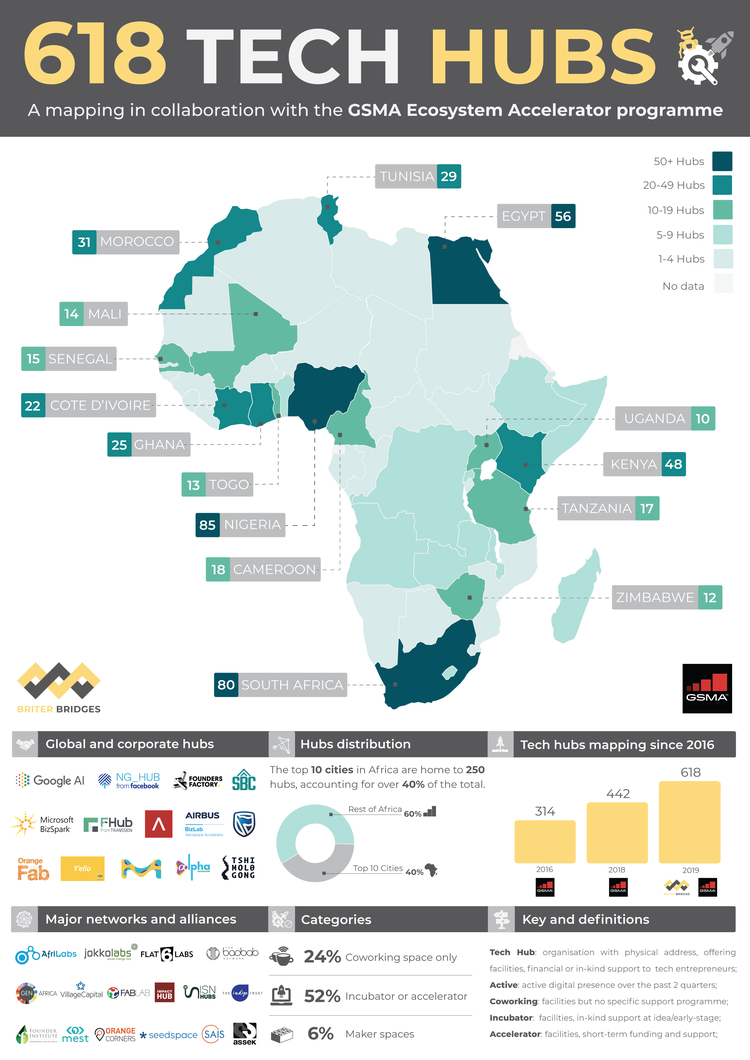
The acquisition joins two of the Africa’s most recognized tech hubs. These innovation spaces, accelerators, and incubators—which tally 618 per GSMA stats—have become focal points for startup formation, training, and IT activity on the continent.

TechHubsinAfricain2019 Briter Bridges

There aren’t official rankings for Africa’s most powerful tech hubs, but if there were, CcHub and iHub would arguably be up top. This would be based on the size of their membership networks, volume of tech related programs, startups incubated, partnerships, and global visibility.

Founded in 2011 in Lagos’ tech-synonymous Yaba suburb, the Co-Creation Hub has grown into a multi-faceted innovation center. The organization manages digital skills programs for entrepreneurs and school kids, startup incubation, and a portfolio of investments through its Growth Capital Fund.

CcHub is considered a go-to spot for any tech related visit to Nigeria. It was Mark Zuckerberg’s first public stop on his 2016 Africa trip. While leaving a CcHub event in 2018, I noticed the Vice President of Nigeria, Yemi Osinbajo, and his entourage packing into the elevator.

CcHub ZuckerbergTijani and team have mastered gaining partnerships with big global tech names. When Facebook launched its tech space in Nigeria—NG_Hub—CcHub was named lead partnered. Google for Startups sponsored CcHub’s Pitch Drive, an African startup tour to Europe and Asia. CcHub also collaborated with the Government of Rwanda this year to open its Design Lab in Kigali, focused on innovating impact solutions in health, education, and governance.

The Design Lab launch extended CcHub’s West Africa reach further east and closer to iHub. The innovation center was co-founded by Erik Hersman in 2010 out of what he saw as a need in Africa’s emerging tech scene “for…creating community spaces…in major cities [for] young entrepreneurs. The nexus point for technologists, investors, [and] tech companies.”

iHub became that central spot in East Africa. Along with M-Pesa mobile-money and a vibrant startup scene, it is one of the pillars that inspired Kenya’s Silicon Savannah moniker.

iHub is also widely seen as giving rise to the Africa’s innovation center movement that inspired the upsurge in tech hubs across the continent.

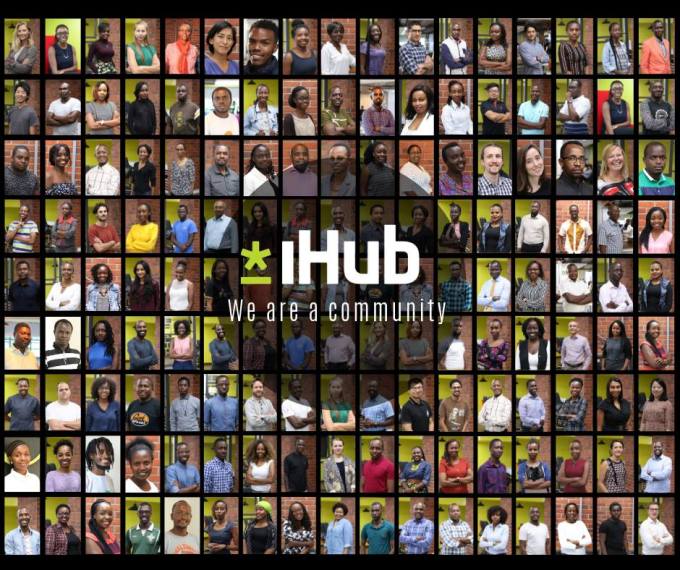
IHub Kenya PeopleSince 2010, 170  companies have formed out of iHub. It has 16,000 members and has played host to most major visitors to Kenya’s tech scene. After seeing CcHub in Nigeria in 2016, Zuck then headed to Kenya and toured iHub.

There’ll be plenty for continuing coverage on how these two prominent African incubators settle into becoming one big Africa mega-hub. That includes the sustainability question and what this all means to the continent’s tech scene.

At a high level, for now, the CcHub-iHub union creates a direct innovation link between two of Africa’s most active markets for VC and startup formation—Nigeria and Kenya.

In the past, both countries’ techies have shared a healthy rivalry. That could now turn to more  collaborations, as CcHub’s acquisition connects East and West in African tech.


Read Full Article

Voter manipulation on social media now a global problem, report finds


New research by the Oxford Internet Institute has found that social media manipulation is getting worse, with rising numbers of governments and political parties making cynical use of social media algorithms, automation and big data to manipulate public opinion at scale — with hugely worrying implications for democracy.

The report found that computational propaganda and social media manipulation have proliferated massively in recently years — now prevalent in more than double the number of countries (70) vs two years ago (28). An increase of 150%.

The research suggests that the spreading of fake news and toxic narratives has become the dysfunctional new ‘normal’ for political actors across the globe, thanks to social media’s global reach.

“Although propaganda has always been a part of political discourse, the deep and wide-ranging scope of these campaigns raise critical public interest concerns,” the report warns.

The researchers go on to dub the global uptake of computational propaganda tools and techniques a “critical threat” to democracies.

“The use of computational propaganda to shape public attitudes via social media has become mainstream, extending far beyond the actions of a few bad actors,” they add. “In an information environment characterized by high volumes of information and limited levels of user attention and trust, the tools and techniques of computational propaganda are becoming a common – and arguably essential – part of digital campaigning and public diplomacy.”

Techniques the researchers found being deployed by governments and political parties to spread political propaganda include the use of bots to amplify hate speech or other forms of manipulated content; the illegal harvesting of data or micro-targeting; and the use of armies of ‘trolls’ to bully or harass political dissidents or journalists online.

The researchers looked at computational propaganda activity in 70 countries around the world — including the US, the UK, Germany, China, Russia, India, Pakistan, Kenya, Rwanda, South Africa, Argentina, Brazil and Australia (see the end of this article for the full list) — finding organized social media manipulation in all of them.

So next time Facebook puts out another press release detailing a bit of “coordinated inauthentic behavior” it claims to have found and removed from its platform, it’s important to put it in context of the bigger picture. And the picture painted by this report suggests that such small-scale, selective discloses of propaganda-quashing successes sum to misleading Facebook PR vs the sheer scale of the problem.

The problem is massive, global and largely taking place through Facebook’s funnel, per the report.

Facebook remains the platform of choice for social media manipulation — with researchers finding evidence of formally organised political disops campaigns on its platform taking place in 56 countries.

We reached out to Facebook for a response to the report and the company sent us a laundry list of steps it says it’s been taking to combat election interference and coordinated inauthentic activity — including in areas such as voter suppression, political ad transparency and industry-civil society partnerships.

But it did not offer any explanation why all this apparent effort (just its summary of what it’s been doing exceeds 1,600 words) has so spectacularly failed to stem the rising tide of political fakes being amplified via Facebook.

Instead it sent us this statement: “Helping show people accurate information and protecting against harm is a major priority for us. We’ve developed smarter tools, greater transparency, and stronger partnerships to better identify emerging threats, stop bad actors, and reduce the spread of misinformation on Facebook, Instagram and WhatsApp. We also know that this work is never finished and we can’t do this alone. That’s why we are working with policymakers, academics, and outside experts to make sure we continue to improve.”

We followed up to ask why all its efforts have so far failed to reduce fake activity on its platform and will update this report with any response.

Returning to the report, the researchers say China has entered the global disinformation fray in a big way — using social media platforms to target international audiences with disinformation, something the country has long directed at its domestic population of course.

The report describes China as “a major player in the global disinformation order”.

It also warns that the use of computational propaganda techniques combined with tech-enabled surveillance is providing authoritarian regimes around the world with the means to extend their control of citizens’ lives.

“The co-option of social media technologies provides authoritarian regimes with a powerful tool to shape public discussions and spread propaganda online, while simultaneously surveilling, censoring, and restricting digital public spaces,” the researchers write.

Other key findings from the report include that both democracies and authoritarian states are making (il)liberal use of computational propaganda tools and techniques.

Per the report:

  • In 45 democracies, politicians and political parties “have used computational propaganda tools by amassing fake followers or spreading manipulated media to garner voter support”
  • In 26 authoritarian states, government entities “have used computational propaganda as a tool of information control to suppress public opinion and press freedom, discredit criticism and oppositional voices, and drown out political dissent”

The report also identifies seven “sophisticated state actors” — China, India, Iran, Pakistan, Russia, Saudi Arabia and Venezuela — using what it calls “cyber troops” (aka dedicated online workers whose job is to use computational propaganda tools to manipulate public opinion) to run foreign influence campaigns.

Foreign influence operations — which includes election interference — were found by the researchers to primarily be taking place on Facebook and Twitter.

We’ve reached out to Twitter for comment and will update this article with any response.

A year ago, when Twitter CEO Jack Dorsey was questioned by the Senate Intelligence Committee, he said it was considering labelling bot accounts on its platform — agreeing that “more context” around tweets and accounts would be a good thing, while also arguing that identifying automation that’s scripted to look like a human is difficult.

Instead of adding a ‘bot or not’ label, Twitter has just launched a ‘hide replies’ feature — which lets users screen individual replies to their tweets (requiring an affirmative action from viewers to unhide and be able to view any hidden replies). Twitter says this is intended at increasing civility on the platform. But there have been concerns the feature could be abused to help propaganda spreaders — i.e. by allowing them to suppress replies that debunk their junk.

The Oxford Internet Institute researchers found bot accounts are very widely used to spread political propaganda (80% of countries studied used them). However the use of human agents was even more prevalent (87% of countries).

Bot-human blended accounts, which combine automation with human curation in an attempt to fly under the BS detector radar, were much rarer: Identified in 11% of countries.

While hacked or stolen accounts were found being used in just 7% of countries.

In another key finding from the report, the researchers identified 25 countries working with private companies or strategic communications firms offering a computational propaganda as a service, noting that: “In some cases, like in Azerbaijan, Israel, Russia, Tajikistan, Uzbekistan, student or youth groups are hired by government agencies to use computational propaganda.”

Commenting on the report in a statement, professor Philip Howard, director of the Oxford Internet Institute, said: “The manipulation of public opinion over social media remains a critical threat to democracy, as computational propaganda becomes a pervasive part of everyday life. Government agencies and political parties around the world are using social media to spread disinformation and other forms of manipulated media. Although propaganda has always been a part of politics, the wide-ranging scope of these campaigns raises critical concerns for modern democracy.”

Samantha Bradshaw, researcher and lead author of the report, added: “The affordances of social networking technologies — algorithms, automation and big data — vastly changes the scale, scope, and precision of how information is transmitted in the digital age. Although social media was once heralded as a force for freedom and democracy, it has increasingly come under scrutiny for its role in amplifying disinformation, inciting violence, and lowering trust in the media and democratic institutions.”

Other findings from the report include that:

  • 52 countries used “disinformation and media manipulation” to mislead users
  • 47 countries used state sponsored trolls to attack political opponents or activists, up from 27 last year

Which backs up the widespread sense in some Western democracies that political discourse has been getting less truthful and more toxic for a number of years — given tactics that amplify disinformation and target harassment at political opponents are indeed thriving on social media, per the report.

Despite finding an alarming rise in the number of government actors across the globe who are misappropriating powerful social media platforms and other tech tools to influence public attitudes and try to disrupt elections, Howard said the researchers remain optimistic that social media can be “a force for good” — by “creating a space for public deliberation and democracy to flourish”.

“A strong democracy requires access to high quality information and an ability for citizens to come together to debate, discuss, deliberate, empathise and make concessions,” he said.

Clearly, though, there’s a stark risk of high quality information being drowned out by the tsunami of BS that’s being paid for by self-interested political actors. It’s also of course much cheaper to produce BS political propaganda than carry out investigative journalism.

Democracy needs a free press to function but the press itself is also under assault from online ad giants that have disrupted its business model by being able to spread and monetize any old junk content. If you want a perfect storm hammering democracy this most certainly is it.

It’s therefore imperative for democratic states to arm their citizens with education and awareness to enable them to think critically about the junk being pushed at them online. But as we’ve said before, there are no shortcuts to universal education.

Meanwhile regulation of social media platforms and/or the use of powerful computational tools and techniques for political purposes simply isn’t there. So there’s no hard check on voter manipulation.

Lawmakers have failed to keep up with the tech-fuelled times. Perhaps unsurprisingly, given how many political parties have their own hands in the data and ad-targeting cookie jar, as well as pushing fakes. (Concerned citizens are advised to practise good digital privacy hygiene to fight back against undemocratic attempts to hack public opinion. More privacy tips here.)

The researchers say their 2019 report, which is based on research work carried out between 2018 and 2019, draws upon a four-step methodology to identify evidence of globally organised manipulation campaigns — including a systematic content analysis of news articles on cyber troop activity and a secondary literature review of public archives and scientific reports, generating country specific case studies and expert consultations.

Here’s the full list of countries studied:

Angola, Argentina, Armenia, Australia, Austria, Azerbaijan, Bahrain, Bosnia & Herzegovina, Brazil, Cambodia, China, Colombia, Croatia, Cuba, Czech Republic, Ecuador, Egypt, Eritrea, Ethiopia, Georgia, Germany, Greece, Honduras, Guatemala, Hungary, India, Indonesia, Iran, Israel, Italy, Kazakhstan, Kenya, Kyrgyzstan, Macedonia, Malaysia, Malta, Mexico, Moldova, Myanmar, Netherlands, Nigeria, North Korea, Pakistan, Philippines, Poland, Qatar, Russia, Rwanda, Saudi Arabia, Serbia, South Africa, South Korea, Spain, Sri Lanka, Sweden, Syria, Taiwan, Tajikistan, Thailand, Tunisia, Turkey, Ukraine, United Arab Emirates, United Kingdom, United States, Uzbekistan, Venezuela, Vietnam, and Zimbabwe.


Read Full Article

Facebook secures exclusive digital rights for ICC cricket events


If you’re a cricket fan, you will be visiting Facebook way more often in the coming months and years. The social juggernaut announced on Thursday it has partnered with the International Cricket Council (ICC), the global governing body of cricket, to secure exclusive digital rights until 2023 to stream global ICC events in the Indian sub-continent.

As part of the four-year deal, financial details of which were not disclosed, Facebook will also show post-match recaps of the matches in the rest of the world.

In a statement, Ajit Mohan, VP and Managing Director Facebook India said, “We are excited to partner with the ICC to bring the most exciting moments in cricket to Facebook Watch and to chart the next stage of technology led transformation in cricket. With Facebook, Instagram and WhatsApp, the ICC has an exceptional opportunity to leverage our family of apps to serve current sports fans as well as bring in an entirely new generation of fans. Every day, people come to our platforms to talk about, and form friendships around, cricket. With this partnership, we will be able to serve these fans with the kind of premium content that can ignite new conversations, new connections and new followership.”

He added, “the future of AR and VR is being charted by Facebook and we are excited about the possibility of bringing the best of our innovations to fans around the world.”


Read Full Article

Indonesia’s ride-hailing giant Gojek launches video streaming service GoPlay


On-demand video streaming giant Netflix, which is increasingly expanding its footprint in developing markets, now has a new competitor in Indonesia: Gojek.

The Indonesian ride-hailing giant on Thursday launched a video streaming service called GoPlay that features exclusive access to “hundreds of movies and TV shows” as well as snackable short clips.

The service, which Gojek began testing with select users in June, focuses on local content, Edy Sulistyo, CEO of GoPlay said. Gojek, which was valued at $9.5 billion in its last financing round, said it has partnered with major local production houses such as Base Entertainment, Kalyana Shira Films, and Wahana Kreator for production of original titles. The firm said it has also tied up with some international studios to source foreign content.

“Despite a rise in demand for local content and a growing number of mobile audiences in Indonesia, access has still been limited especially for consumers living outside of urban areas. With GoPlay, we aim to enable all Indonesian consumers to enjoy high-quality on-demand entertainment at their convenience, while providing a platform for local content producers to showcase their creative work,” said Sulistyo in a statement.

Gojek is offering the video streaming service through two aggressively priced monthly plans: IDR 89,000 ($6.27), which offers access to the full catalog in HD; and IDR 99,000 ($7), which will additionally also provide users with access to GoFood delivery vouchers.

GoPlay will compete with a range of streaming services such as Netflix, iFlix, and Hooq. Netflix last year began testing a low-cost mobile-only plan in some developing markets including Indonesia to boost its presence in those nations. The global giant eventually launched the affordable tier in India earlier this year. A Netflix spokesperson told TechCrunch this week that it currently has no plans to expand the low-cost tier to other markets.

Like many other major firms in Southeast Asia, Gojek is increasingly bulking up its ride-sharing platform to enter additional categories. Today, it offers an online payments service and a gaming platform. The firm began working on its video streaming service last year after it set up an in-house content studio.

Grab, Gojek’s arch rival in Southeast Asian markets, and India’s Ola, have also expanded their offerings in recent years. While Grab, like Gojek, offers everything including a video streaming service, Ola launched a credit card in May.

Grab has a partnership with Hooq for its video streaming service. In the run up to GoPlay’s launch, Hooq CEO Peter Bithos told TechCrunch in an interview that Gojek lacks the reach Hooq maintains in Southeast Asian markets. “Gojek hasn’t been able to get to anything like the scale or reach that we’ve got,” he said.

About 125 million people in Indonesia, or half of the nation’s population, is currently online. Sulistyo said Gojek sees a lot of potential for GoPlay’s growth in the country.

Indonesia has emerged as one of the fastest growing economies in Asia in recent years. According to a study conducted by Google and Singapore’s Temasek, Indonesia’s internet economy is estimated to be worth $100 billion by 2025.


Read Full Article

How to Get an Education in Computer Science Without the Debt


At the age of 18, most aspiring developers seek a place studying computer science at college. They come out with the skills to pursue an exciting and highly rewarding six-figure career. But what if you don’t want all the debt or you can’t just start again? That’s where the Complete Computer Science Master Class Bundle comes in. This vast learning library offers 174 hours of hands-on training, covering the same topics as you would learn in college. The best part? You can get it now for just $39 at MakeUseOf Deals.

The Real College Alternative

This might not be the first time you have seen courses being advertised as an alternative to college. While some learning programs overpromise, this bundle is the real deal.

It contains 11 in-depth courses, packed with real-world knowledge and hands-on training. Through video tutorials, you learn how to build apps with C#, algorithms in Java, and advanced web apps using PHP and MySQL. The videos also look at Python, Golang, JavaScript, Scala, Bootstrap, and Amazon Alexa.

You even get 23 hours of advice on how to prepare for coding interviews, compiled by a team of technical recruiters. If you want to build a career in code, this bundle is the place to start.

174 Hours of Training for $39

It’s worth $2,799, but you can grab this mammoth training bundle now for $39.

Read the full article: How to Get an Education in Computer Science Without the Debt


Read Full Article

India’s Darwinbox raises $15M to bring its HR tech platform to more Asian markets


An Indian SaaS startup, which is increasingly courting clients from outside of the country, just raised a significant amount of capital to expand its business.

Hyderabad-based Darwinbox, which operates a cloud-based human resource management platform, said on Thursday it has raised $15 million in a new financing round. The Series B round — which moves the firm’s total raise to $19.7 million — was led by Sequoia India and saw participation from existing investors Lightspeed India Partners, Endiya Partners, and 3one4 Capital.

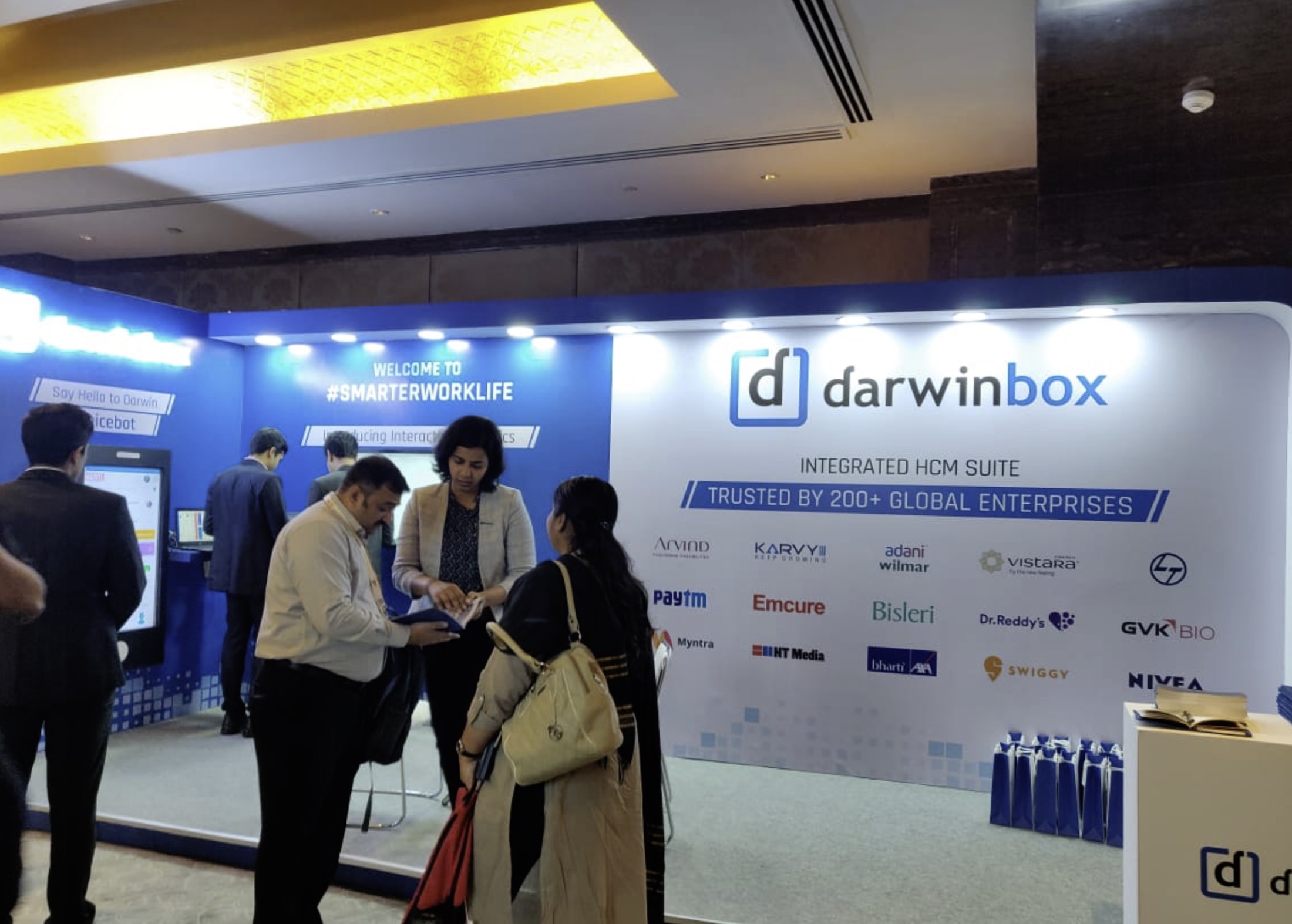
More than 200 firms including giants such as adtech firm InMobi, fintech startup Paytm, drink conglomerate Bisleri, automobile maker Mahindra, Kotak group, and delivery firms Swiggy and Milkbasket use Darwinbox’s HR platform to serve half a million of their employees in 50 nations, Rohit Chennamaneni, cofounder of Darwinbox, told TechCrunch in an interview.

The startup, which competes with giants such as SAP and Oracle, said its platform enables high level of configurability, ease of use, and understands the needs of modern employees. “The employees today who have grown accustomed to using consumer-focused services such as Uber and Amazon are left disappointed in their experience with their own firm’s HR offerings,” said Gowthami Kanumuru, VP Marketing at Darwinbox, in an interview.

Darwinbox’s HR platform offers a range of features including the ability for firms to offer their employees insurance and early salary as loans. Its platform also features social networks for employees within a company to connect and talk, as well as an AI assistant that allows them to apply for a leave or set up meetings with quick voice commands from their phone.

“The AI system is not just looking for certain keywords. If an employee tells the system he or she is not feeling well today, it automatically applies a leave for them,” she said.

Darwinbox’s platform is built to handle onboarding new employees, keeping a tab on their performance, monitor attrition rate, and maintain an ongoing feedback loop. Or as Kanumuru puts it, the entire “hiring to retiring” cycle.

One of Darwinbox’s clients is L&T, which is tasked with setting up subway in many Indian cities. L&T is using geo-fencing feature of Darwin to log the attendance of employees. “They are not using biometric punch machine that is typically used by other firms. Instead, they just require their 1,200 employees to check-in from the workplace using their phones,” said Kanumuru.

darwinbox event

Additionally, Darwinbox is largely focusing on serving companies based in Asia as it believes Western companies’ solutions are not a great fit for people here, said Kanumuru. The startup began courting clients in Southeast Asian markets last year.

“Our growth is a huge validation for our vision,” she said. “Within six months of operations, we had the delivery giant Delhivery with over 23,000 employees use our platform.”

In a statement to TechCrunch, Dev Khare, a partner at Lightspeed Venture, said, “there is a new trend of SaaS companies targeting the India/SE Asia markets. This trend is gathering steam and is disproving the conventional wisdom that Asia-focused SaaS companies cannot get to be big companies. We firmly believe that Asia-focused SaaS companies can get to large impact value and become large and profitable. Darwinbox is one of these companies.”

Darwinbox’s Chennamaneni said the startup will use the fresh capital to expand its footprints in Indonesia, Malaysia, Thailand, and other Southeast Asian markets. Darwinbox will also expand its product offerings to address more of employees’ needs. The startup is also looking to make its platform enable tasks such as booking of flights and hotels.

Chennamaneni, an alum of Google and McKinsey, said Darwinbox aims to double the number of clients it has in the next six to nine months.


Read Full Article