18 December 2018

How Russia’s online influence campaign engaged with millions for years


Russian efforts to influence U.S. politics and sway public opinion were consistent and, as far as engaging with target audiences, largely successful, according to a report from Oxford’s Computational Propaganda Project published today. Based on data provided to Congress by Facebook, Instagram, Google, and Twitter, the study paints a portrait of the years-long campaign that’s less than flattering to the companies.

The report, which you can read here, was published today but given to some outlets over the weekend, summarizes the work of the Internet Research Agency, Moscow’s online influence factory and troll farm. The data cover various periods for different companies, but 2016 and 2017 showed by far the most activity.

A clearer picture

If you’ve only checked into this narrative occasionally during the last couple years, the Comprop report is a great way to get a bird’s-eye view of the whole thing, with no “we take this very seriously” palaver interrupting the facts.

If you’ve been following the story closely, the value of the report is mostly in deriving specifics and some new statistics from the data, which Oxford researchers were provided some seven months ago for analysis. The numbers, predictably, all seem to be a bit higher or more damning than those provided by the companies themselves in their voluntary reports and carefully practiced testimony.

Previous estimates have focused on the rather nebulous metric of “encountering” or “seeing” IRA content put on these social metrics. This had the dual effect of increasing the affected number — to over a hundred million on Facebook alone — but “seeing” could easily be downplayed in importance; after all, how many things do you “see” on the internet every day?

The Oxford researchers better quantify the engagement, on Facebook first, with more specific and consequential numbers. For instance, in 2016 and 2017, nearly 30 million people on Facebook actually shared Russian propaganda content, with similar numbers of likes garnered, and millions of comments generated.

Note that these aren’t ads that Russian shell companies were paying to shove into your timeline — these were pages and groups with thousands of users on board who actively engaged with and spread posts, memes, and disinformation on captive news sites linked to by the propaganda accounts.

The content itself was, of course, carefully curated to touch on a number of divisive issues: immigration, gun control, race relations, and so on. Many different groups (i.e. black Americans, conservatives, Muslims, LGBT communities) were targeted all generated significant engagement, as this breakdown of the above stats shows:

Although the targeted communities were surprisingly diverse, the intent was highly focused: stoke partisan divisions, suppress left-leaning voters, and activate right-leaning ones.

Black voters in particular were a popular target across all platforms, and a great deal of content was posted both to keep racial tensions high and to interfere with their actual voting. Memes were posted suggesting followers withhold their votes, or deliberately incorrect instructions on how to vote. These efforts were among the most numerous and popular of the IRA’s campaign; it’s difficult to judge their effectiveness, but certainly they had reach.

Examples of posts targeting black Americans.

In a statement, Facebook said that it was cooperating with officials and that “Congress and the intelligence community are best placed to use the information we and others provide to determine the political motivations of actors like the Internet Research Agency.” It also noted that it has “made progress in helping prevent interference on our platforms during elections, strengthened our policies against voter suppression ahead of the 2018 midterms, and funded independent research on the impact of social media on democracy.”

Instagram on the rise

Based on the narrative thus far, one might expect that Facebook — being the focus for much of it — was the biggest platform for this propaganda, and that it would have peaked around the 2016 election, when the evident goal of helping Donald Trump get elected had been accomplished.

In fact Instagram was receiving as much or more content than Facebook, and it was being engaged with on a similar scale. Previous reports disclosed that around 120,000 IRA-related posts on Instagram had reached several million people in the run-up to the election. The Oxford researchers conclude, however, that 40 accounts received in total some 185 million likes and 4 million comments during the period covered by the data (2015-2017).

A partial explanation for these rather high numbers may be that, also counter to the most obvious narrative, IRA posting in fact increased following the election — for all platforms, but particularly on Instagram.
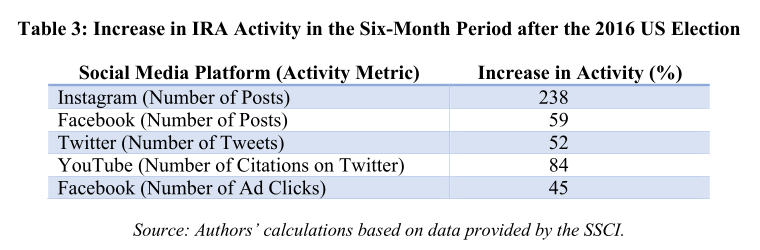
IRA-related Instagram posts jumped from an average of 2,611 per month in 2016 to 5,956 in 2017; note that the numbers don’t match the above table exactly because the time periods differ slightly.

Twitter posts, while extremely numerous, are quite steady at just under 60,000 per month, totaling around 73 million engagements over the period studied. To be perfectly frank this kind of voluminous bot and sock puppet activity is so commonplace on Twitter, and the company seems to have done so little to thwart it, that it hardly bears mentioning. But it was certainly there, and often reused existing bot nets that previously had chimed in on politics elsewhere and in other languages.

In a statement, Twitter said that it has “made significant strides since 2016 to counter manipulation of our service, including our release of additional data in October related to previously disclosed activities to enable further independent academic research and investigation.”

Google too is somewhat hard to find in the report, though not necessarily because it has a handle on Russian influence on its platforms. Oxford’s researchers complain that Google and YouTube have been not just stingy, but appear to have actively attempted to stymie analysis.

Google chose to supply the Senate committee with data in a non-machine-readable format. The evidence that the IRA had bought ads on Google was provided as images of ad text and in PDF format whose pages displayed copies of information previously organized in spreadsheets. This means that Google could have provided the useable ad text and spreadsheets—in a standard machine- readable file format, such as CSV or JSON, that would be useful to data scientists—but chose to turn them into images and PDFs as if the material would all be printed out on paper.

This forced the researchers to collect their own data via citations and mentions of YouTube content. As a consequence their conclusions are limited. Generally speaking when a tech company does this, it means that the data they could provide would tell a story they don’t want heard.

For instance, one interesting point brought up by a second report published today, by New Knowledge, concerns the 1,108 videos uploaded by IRA-linked accounts on YouTube. These videos, a Google statement explained, “were not targeted to the U.S. or to any particular sector of the U.S. population.”

In fact, all but a few dozen of these videos concerned police brutality and Black Lives Matter, which as you’ll recall were among the most popular topics on the other platforms. Seems reasonable to expect that this extremely narrow targeting would have been mentioned by YouTube in some way. Unfortunately it was left to be discovered by a third party and gives one an idea of just how far a statement from the company can be trusted.

Desperately seeking transparency

In its conclusion, the Oxford researchers — Philip N. Howard, Bharath Ganesh, and Dimitra Liotsiou — point out that although the Russian propaganda efforts were (and remain) disturbingly effective and well organized, the country is not alone in this.

“During 2016 and 2017 we saw significant efforts made by Russia to disrupt elections around the world, but also political parties in these countries spreading disinformation domestically,” they write. “In many democracies it is not even clear that spreading computational propaganda contravenes election laws.”

“It is, however, quite clear that the strategies and techniques used by government cyber troops have an impact,” the report continues, “and that their activities violate the norms of democratic practice… Social media have gone from being the natural infrastructure for sharing collective grievances and coordinating civic engagement, to being a computational tool for social control, manipulated by canny political consultants, and available to politicians in democracies and dictatorships alike.”

Predictably, even social networks’ moderation policies became targets for propagandizing.

Waiting on politicians is, as usual, something of a long shot, and the onus is squarely on the providers of social media and internet services to create an environment in which malicious actors are less likely to thrive.

Specifically, this means that these companies need to embrace researchers and watchdogs in good faith instead of freezing them out in order to protect some internal process or embarrassing misstep.

“Twitter used to provide researchers at major universities with access to several APIs, but has withdrawn this and provides so little information on the sampling of existing APIs that researchers increasingly question its utility for even basic social science,” the researchers point out. “Facebook provides an extremely limited API for the analysis of public pages, but no API for Instagram.” (And we’ve already heard what they think of Google’s submissions.)

If the companies exposed in this report truly take these issues seriously, as they tell us time and again, perhaps they should implement some of these suggestions.


Read Full Article

Lightspeed is raising its largest China fund yet


Lightspeed China Partners, the China-focused affiliate of Silicon Valley-based Lightspeed Venture Partners, has set a $360 million target for its fourth flagship venture fund, according to a document filed with the U.S. Securities and Exchange Commission today.

If the target is reached, the fund will be Lightspeed China’s largest yet, per PitchBook. Lightspeed China’s previous two funds each closed on $260 million. The VC raised $168 million for its debut fund in 2013.

Lightspeed China is led by David Mi (pictured). Mi, an investor in multiple billion-dollar Chinese companies, was previously the director of corporate development at Google, where he helped lead the search giant’s investment in Baidu. He joined Lightspeed in 2008 and established the firm’s China presence in 2011. Yan Han, a long-time Lightspeed investor and a founding partner of the firm’s Chinese branch, is also listed on the filing.

Lightspeed China has backed e-commerce platform Pingduoduo and loan provider Rong360, a pair of Chinese “unicorns” that both completed U.S. initial public offerings since 2017. Typically, the firm makes early-stage investments in the internet, mobile and enterprise spaces. 

Earlier this year, Lightspeed Venture Partners filed to raise a record $1.8 billion in new capital commitments. This month, it tacked five new partners onto its consumer and enterprise investment teams, including Slack’s former head of growth and Twitter’s former vice president of global business development.

Lightspeed didn’t immediately respond to a request for comment.


Read Full Article

Twitter’s support form leaked phone number country codes to IPs in China & Saudi


Twitter accidentally exposed the ability to pull an account’s phone number country code and whether the accounts had been locked by Twitter. The concern here is that malicious actors could have used the security flaw to figure out which countries accounts were based in, which could have ramifications for whistleblowers or political dissidents.

The issue came through one of Twitter’s support forms for contacting the company, and the company found that a large number of inquiries through the form came from IP addresses located in China and Saudi Arabia. Twitter writes “While we cannot confirm intent or attribution for certain, it is possible that some of these IP addresses may have ties to state-sponsored actors.” We’ve requested more info on why it’s suggesting that. Attribution in these situations can be murky, and naming specific countries or suggesting state actors could be involved carry heavy implications.

Twitter began working on the issue on November 15th and fixed it on November 16th. Twitter tells TechCrunch that it has notified the European Union’s Data Protection Commissioner, as EU citizens may have been impacted. However, since country codes aren’t necessarily considered sensitive personal information, the leak may not trigger any GDPR enforcement or fines. Twitter tells us it has also updated the FTC and other regulatory organizations about the issue, though we’ve asked when it informed these different regulators.

Twitter has directly contacted users impacted by the issue, says full phone numbers were not leaked, and users don’t have to do anything in response. Users can contact Twitter here for more info. We’ve asked how many accounts were impacted, but Twitter told us that it doesn’t have more data to share as its investigation continues.

A Twitter spokesperson pointed us to a previous statement:

“It is clear that information operations and coordinated inauthentic behavior will not cease. These types of tactics have been around for far longer than Twitter has existed — they will adapt and change as the geopolitical terrain evolves worldwide and as new technologies emerge. For our part, we are committed to understanding how bad-faith actors use our services. We will continue to proactively combat nefarious attempts to undermine the integrity of Twitter, while partnering with civil society, government, our industry peers, and researchers to improve our collective understanding of coordinated attempts to interfere in the public conversation.”

Sloppy security on the part of tech companies can make it dangerous for political dissidents or others at odds with their governments. Twitter explains that it locks accounts if it suspects they’ve been compromised by hackers or violate “Twitter’s Rules”, that includes “unlawful use” that depends greatly on what national governments deem illegal. What’s worrisome is that attackers with IP addresses in China or Saudi Arabia might have been able to use the exploit to confirm that certain accounts belonged to users in their countries and whether they’ve been locked. That information could be used to hunt down the people who own these accounts.

The company apologized, writing that “We recognize and appreciate the trust you place in us, and are committed to earning that trust every day. We are sorry this happened.” But that echoes other apologies from big tech companies that consistently ring hollow. Here in particular, it fails to acknowledge how the leak could harm people and how it will prevent this kind of thing from happening again. With these companies judged quarterly by their user growth and business, they’re incentivized to cut corners on security, privacy, and societal impact as they chase the favor of Wall Street.


Read Full Article

Twitter’s support form leaked phone number country codes to IPs in China & Saudi


Twitter accidentally exposed the ability to pull an account’s phone number country code and whether the accounts had been locked by Twitter. The concern here is that malicious actors could have used the security flaw to figure out which countries accounts were based in, which could have ramifications for whistleblowers or political dissidents.

The issue came through one of Twitter’s support forms for contacting the company, and the company found that a large number of inquiries through the form came from IP addresses located in China and Saudi Arabia. Twitter writes “While we cannot confirm intent or attribution for certain, it is possible that some of these IP addresses may have ties to state-sponsored actors.” We’ve requested more info on why it’s suggesting that. Attribution in these situations can be murky, and naming specific countries or suggesting state actors could be involved carry heavy implications.

Twitter began working on the issue on November 15th and fixed it on November 16th. Twitter tells TechCrunch that it has notified the European Union’s Data Protection Commissioner, as EU citizens may have been impacted. However, since country codes aren’t necessarily considered sensitive personal information, the leak may not trigger any GDPR enforcement or fines. Twitter tells us it has also updated the FTC and other regulatory organizations about the issue, though we’ve asked when it informed these different regulators.

Twitter has directly contacted users impacted by the issue, says full phone numbers were not leaked, and users don’t have to do anything in response. Users can contact Twitter here for more info. We’ve asked how many accounts were impacted, but Twitter told us that it doesn’t have more data to share as its investigation continues.

A Twitter spokesperson pointed us to a previous statement:

“It is clear that information operations and coordinated inauthentic behavior will not cease. These types of tactics have been around for far longer than Twitter has existed — they will adapt and change as the geopolitical terrain evolves worldwide and as new technologies emerge. For our part, we are committed to understanding how bad-faith actors use our services. We will continue to proactively combat nefarious attempts to undermine the integrity of Twitter, while partnering with civil society, government, our industry peers, and researchers to improve our collective understanding of coordinated attempts to interfere in the public conversation.”

Sloppy security on the part of tech companies can make it dangerous for political dissidents or others at odds with their governments. Twitter explains that it locks accounts if it suspects they’ve been compromised by hackers or violate “Twitter’s Rules”, that includes “unlawful use” that depends greatly on what national governments deem illegal. What’s worrisome is that attackers with IP addresses in China or Saudi Arabia might have been able to use the exploit to confirm that certain accounts belonged to users in their countries and whether they’ve been locked. That information could be used to hunt down the people who own these accounts.

The company apologized, writing that “We recognize and appreciate the trust you place in us, and are committed to earning that trust every day. We are sorry this happened.” But that echoes other apologies from big tech companies that consistently ring hollow. Here in particular, it fails to acknowledge how the leak could harm people and how it will prevent this kind of thing from happening again. With these companies judged quarterly by their user growth and business, they’re incentivized to cut corners on security, privacy, and societal impact as they chase the favor of Wall Street.


Read Full Article

Exploring Quantum Neural Networks


Since its inception, the Google AI Quantum team has pushed to understand the role of quantum computing in machine learning. The existence of algorithms with provable advantages for global optimization suggest that quantum computers may be useful for training existing models within machine learning more quickly, and we are building experimental quantum computers to investigate how intricate quantum systems can carry out these computations. While this may prove invaluable, it does not yet touch on the tantalizing idea that quantum computers might be able to provide a way to learn more about complex patterns in physical systems that conventional computers cannot in any reasonable amount of time.

Today we talk about two recent papers from the Google AI Quantum team that make progress towards understanding the power of quantum computers for learning tasks. The first constructs a quantum model of neural networks to investigate how a popular classification task might be carried out on quantum processors. In the second paper, we show how peculiar features of quantum geometry change the strategies for training these networks in comparison to their classical counterparts, and offer guidance towards more robust training of these networks.

In “Classification with Quantum Neural Networks on Near Term Processors”, we construct a model of quantum neural networks (QNNs) that is specifically designed to work on quantum processors that are expected to be available in the near term. While the current work is primarily theoretical, their structure facilitates implementation and testing on quantum computers in the immediate future. These QNNs can be adapted through supervised learning of labeled data, and we show that it is possible to train a QNN to classify images in the famous MNIST dataset. Follow up work in this area with larger quantum devices may pit the ability of quantum networks to learn patterns against popular classical networks.
Quantum Neural Network for classification. Here we depict a sample quantum neural network, where in contrast to hidden layers in classical deep neural networks, the boxes represent entangling actions, or “quantum gates”, on qubits. In a superconducting qubit setup this could be enacted through a microwave control pulse corresponding to each box.
In “Barren Plateaus in Quantum Neural Network Training Landscapes”, we focus on the training of quantum neural networks, and probe questions related to a key difficulty in classical neural networks, which is the problem of vanishing or exploding gradients. In conventional neural networks, a good unbiased initial guess for the neuron weights often involves randomization, although there can be some difficulties as well. Our paper shows that peculiar features of quantum geometry unequivocally prevent this from being a good strategy in the quantum case, instead taking you to barren plateaus. The implications of this work may guide future strategies for initializing and training quantum neural networks.
QNN vanishing gradient: concentration of measure in high dimensional spaces. In very high dimensional spaces, such as those explored by quantum computers, the vast majority of states counterintuitively sit near the equator of the hypersphere (left). This means that any smooth function on this space will tend to take a value very close to its mean with overwhelming probability when selected at random (right).
This research sets the stage for improvements in both the construction and training of quantum neural networks. In particular, experimental realizations of quantum neural networks using hardware at Google will enable rapid exploration of quantum neural networks in the near term. We hope that the insights from the geometry of these states will lead to new algorithms to train these networks that will be essential to unlocking their full potential.

History Department


History Department

17 December 2018

The Google Assistant can now alert you of potential flight delays


If you’re an experienced traveler, you know that plenty of your delays are due to your plane being stuck somewhere else or because the weather at your local or arrival airport isn’t ideal (I’m looking at you, fogged-in SFO in the morning). So you also know to check on your incoming flight, even when the airline tells you everything is fine, and the FAA’s airspace status pages.

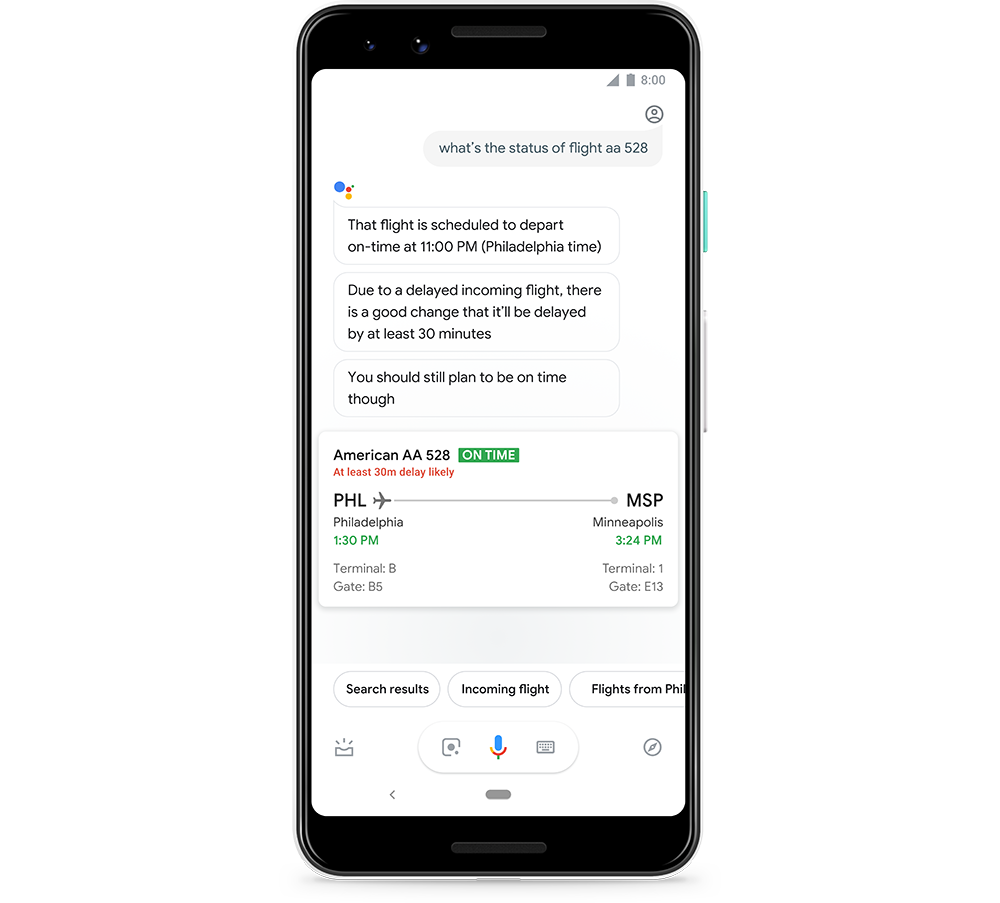
But maybe you are not a frequent flier (be glad and rejoice) or don’t care to go through that process. In that case, you’ll be happy to hear that Google today announced that its Assistant will soon proactively notify you on your phone when its algorithms predict that your flight will be late. This feature is rolling out now and should be available to all users in the next few weeks.

It’s worth noting that flight delay predictions from Google aren’t new. It introduced its first iteration of this in January. At the time, it didn’t proactively alert you of those delays, though. You first had to search for your flight. So unless you knew this feature existed, you probably never saw it in action.

Google says it mostly uses machine learning algorithms trained on historic flight data to predict delays. In addition, though, the company also clearly looks at some other information, given that it knows about delays of incoming flights, too.

The airlines aren’t kidding when they tell you that you should still be at the gate at the original time, by the way. If you’re flying through a hub, they could still swap in another plane, after all. If you’re like me, though, instead of taking to the friendly skies, you will likely have to sit in Newark until well after midnight before the plane finally arrives. That’ll be right as your crew times out and with the next available reserve crew hours away. Chances are Google wouldn’t have been able to alert me of those delays, though, given that incompetence isn’t something it can predict yet, after all.


Read Full Article

Google is spending $1 billion to build a massive new campus in New York


Days after Apple announced a major expansion to its operations in the U.S. — including a new $1 billion campus in Austin — fellow tech giant Google has announced that it too will invest $1 billion as it sets up a new campus at Hudson Square in New York.

Google already has 7,000 staff located in New York, and this strategy is aimed at doubling that headcount over the next 10 years. Hudson Square will be a 1.7 million-square-foot campus that’ll serve as “the primary location” for Google’s Global Business Organization.

Google expects two Hudson Square buildings to be operational for staff by 2020, with a building on 550 Washington Street coming online two years later. That’s in addition to Manhattan’s Chelsea Market, which it bought for $2.4 billion in March, and additional space at Pier 57, which it is planning to take.

All this adds up to a major hiring push outside of the Bay Area.

“Our investment in New York is a huge part of our commitment to grow and invest in U.S. facilities, offices and jobs. In fact, we’re growing faster outside the Bay Area than within it, and this year opened new offices and data centers in locations like Detroit, Boulder, Los Angeles, Tennessee and Alabama,” wrote Google CFO Ruth Porat.

Google and Apple’s commitments come after Amazon announced that New York would be the location for its much-anticipated “HQ2” following a long search that pulled in authorities from cities and states across the U.S.


Read Full Article

B-Social raises £3.2M seed round to begin building a ‘social’ bank


B-Social, a London fintech that currently offers a ‘social finance’ app and beta debit Mastercard, has raised £3.2 million in Seed round funding from undisclosed high-net-worth individuals. However, the fundraise is just the first step in a journey in which B-Social want to eventually become a fully licensed bank that reimagines banking around everyday social interactions.

As it exists today, the B-Social app and accompanying card enables users to have control over everyday spending, track expenditure, and create groups between friends to split bills and record settlements. It’s currently in the hands of a limited number of beta testers, spanning employees, investors, friends and family, with plans for a wider U.K. launch in February next year.

“We recognise that almost all financial transactions are inherently social,” B-Social co-founder and CEO Nazim Valimahomed tells me. “We want to change the relationship people have with money by helping them overcome the anxiety, awkwardness and wasted time when they engage with their social finances. We are doing that by building a digital bank that truly accommodates the way people live their lives and is dedicated to connecting a person’s finances to their social world”.

The idea was born in part out of Valimahomed’s own frustrations and is informed by his belief that individuals are often a bank themselves, lending and borrowing to friends and family by making shared purchases and then getting paid back.

“A simple example might be that you pay for flights for two or more people and then get paid back individually,” he says. “For multiple transactions, this becomes complex often resulting in the trip organiser having to create a spreadsheet to work out what people owe across multiple transactions”.

To simplify this problem, B-Social wants to let you to make purchases with your card, which are flagged as an expense on behalf of a group of individuals. From here the bank to be will enable all members of a group — and where groups can be ad hoc and temporary or more long-term — to continuously see who is owed how much and to get paid back easily within the app and record settlements.

Dubbing this future proposition as the seeds of a “social bank,” the B-Social CEO cites competitors as traditional high street banks that currently dominate the U.K. consumer market (the so-called big 5 have around 87 percent market share in the U.K.).

“We are aiming at winning a part of their market share by targeting customers looking for a bank as social as they are that offers a unique digital experience in order to help change the banking ecosystem forever,” Valimahomed tells me, although he also concedes that challengers such as Monzo, N26, Starling and Revolut have also built some basic social features into their apps.

“Our entire technology and product focus is to build a bank from scratch through a social lens,” he says.


Read Full Article

Why Kinsta’s Managed WordPress Hosting Is Great For Everyone


kinsta-hosting

Running a WordPress site with more than a few hundred visitors is tough. Get the hosting plan wrong, and you could end up spending money for a site that doesn’t respond to your needs, and those of your readers.

Common issues with bad hosting include slow speeds, bottlenecks, and the possibility of knocking other websites on the same server offline. Managed WordPress hosting is a better idea.

This is what Kinsta offers. The company promises “premium WordPress hosting for everyone, small or large.” Let’s take a look.

What’s Different About Kinsta Hosting?

Used to a web host that offers slow shared hosting? Or a poorly configured expensive VPS?

Unless the host’s system admin knows how to correctly configure the hardware, and manage the virtual server, your WordPress site will never meet its potential.

To reach your goals, you need to move.

Kinsta hosting is one of the best destinations for your blog or store. Its managed WordPress hosting relies on the Google Cloud Platform, using Google’s premium tier global network to ensure sites load fast. Kinsta also offers 18 data centers around the globe, allowing you to situate your website on the server nearest your audience.

Every WordPress site on Kinsta is housed in its own isolated LXC container, with all resources dedicated to your site. The LXC is managed using the LXD lightweight container hypervisor. While not a precise comparison, you can think of an LXC container as a virtual server.

The Kinsta managed WordPress hosting dashboard

Each LXC container includes Linux, Nginx, PHP (versions 7 to 7.3 are available), and MySQL, as well as the WordPress software. This gives you everything you need to run your website.

To keep your website running 24/7, support is available around the clock all 365 days of the year from Kinsta’s support engineers. They’re all WordPress developers, capable of writing themes and plugins and contributing to the core code of the software.

Thus, you can be confident that they know what you need.

The independent testers at Review Signal have rated Kinsta among the top WordPress hosts. In fact, Kinsta has held the award for Top Tier WordPress Hosting Performance for four years in a row.

Features You Get With Kinsta Hosting

That’s how the service works. But what features should you expect from Kinsta’s hosting?

To start off, free content delivery network (CDN) ensures your site loads media as quickly as possible, thanks to KeyCDN integration. Meanwhile, page caching delivers content rapidly. This pairs with Kinsta’s own cache plugin to improve speed and control over caching.

You can also make sure your site offers the necessary security to your readers and customers by enabling HTTPS. Kinsta offers Let’s Encrypt integration for creating SSL certificates for free, and you can also add custom certificates.

Kinsta considers your site security a priority. The company offers a daily backup service, and a free hack fix if your site becomes compromised.

For testing new features, Kinsta offers a staging environment, enabling you to try new themes and plugins before rolling them out. There’s also SSH support for sysadmin tasks, and if needed, you can use tools such as Git, npm, WP-CLI, and other package managers to add software.

Manage WordPress plugins in Kinsta's dashbaord

You’ll manage your hosting package via a custom-designed dashboard. This not only gives you instant access to your WordPress installation, plugins, data, and backups, but also holds analytics reports for performance analysis.

Enhanced Hosting Options

Kinsta will accommodate the peculiarities of your website. In addition to some advanced options, this WordPress host offers optimizations and server-level rules for WooCommerce stores. The same is available for Easy Digital Download stores.

So whatever type of website you run on WordPress, whether it’s a blog, news site, or something else, Kinsta’s managed WordPress hosting can accommodate you.

Kinsta Hosting Plans: What’s Best For You?

Reckon you’re ready to sign up with Kinsta? We recommend you try the Starter plan. This is ideal for single WordPress installs, for sites with up to 20,000 visits. With 5GB of disk space and free SSL and CDN, this package also comes with a 30-day money back guarantee.

Browse payment plans with Kinsta

It costs just $30 per month. Alternatively, you might pay $300 for 12 months, thereby saving $60.

For bigger sites, larger packages are available. For $60 a month, the Pro package includes two installs, 40,000 visits, and 10GB of storage. $100 per month will upgrade you to the Business 1 package for five installs, 15GB of storage, and 100,000 visits.

Check out the Kinsta Plans page to see which one is right for you.

What happens if your plan isn’t quite large enough to satisfy your site or visitor numbers? Kinsta charges overage rates; you can receive notifications when your site is at 80% and 100% capacity. Overage is charged at $1 per 1,000 visitors.

Free Migrations Make Moving Your Site Easy

Moving your website between hosts can be time-consuming, fraught with risk, and difficult.

Fortunately, Kinsta offers a migration service for new accounts. This means you can provide the company with the necessary information, and support staff will migrate your data from the existing host to your managed WordPress hosting.

If your focus is on creating and editing content rather than on the technicality of web hosting, this could be beneficial. It lets you concentrate on your strengths and site continuity, without the distraction of moving data yourself.

Setting Up Your WordPress Site With Kinsta

Once you’ve signed up with Kinsta, it takes just a few minutes to set up your hosting. If you’re using the free migration service for an existing site, you’ll receive a notification when everything is ready. Otherwise, you’ll need to set up a new WordPress blog.

Begin by opening the my.kinsta.com admin dashboard and entering your Kinsta username and password. Then head to Sites > Add site, and input your preferred server location, name of the site, domain details, and select Add a brand new WordPress install, then Add.

Create a new WordPress site Kinsta

Make a note of your username and password, and wait as the WordPress software installs. To access your site, go to Sites > Domains and look for the Open WordPress Admin button. Click this to sign into your site’s admin account.

From here, you’re ready to select a theme, add plugins, and write content.

Launch your website on Kinsta

If you’re familiar WordPress, you’ll know how easy it is to use. Just get your site configured as required, confirm you’ve enabled the Yoast SEO plugin, and you’re all set!

What If You Need More From Kinsta Hosting?

Setting up a Kinsta account is easy, getting your hosting primed is fast, and setting up WordPress is simple. You should be up and running in minutes, but what if you want more?

Kinsta offers a selection of add-ons for sites with special requirements. You’ll find support for Nginx reverse proxy, Redis, Elasticsearch, Cloudflare Railgun, and can even opt for hourly backups.

Why You Need Kinsta Managed Hosting

By now, you should least be interested in taking advantage of Kinsta’s easy migration service. If your site needs a performance boost that you won’t get from shared virtual hosting and you can’t afford a premium VPS, then Kinsta’s managed WordPress hosting is surely your best bet.

To recap, Kinsta offers:

  • The full LAMP experience with WordPress pre-installed
  • Easy migration to bring your site from another host
  • Fast web page delivery thanks to integration with KeyCDN and Google Cloud Platform
  • HTTPS and SSL from Let’s Encrypt integration
  • Free hack fix service, and daily backups that you can restore for up to 30 days
  • 24/7 support, 365 days a year, from WordPress developers
  • A range of affordable packages, depending on your requirements
  • Upgrades to customize your package, a detailed dashboard, advanced features like Cloudflare support, and even hourly backups

(Some of these features are only available with multi-site subscriptions.)

Kinsta’s managed WordPress hosting is a great opportunity for you to level up and take your existing website to the next level. At just $30 a month for the basic package, it’s an opportunity you should seriously consider.

Read the full article: Why Kinsta’s Managed WordPress Hosting Is Great For Everyone


Read Full Article

The 7 Best iPhone GIF Apps to Create, Collect, Save, and Share

The Best Features in elementaryOS You May Have Overlooked


elementary-os-tips

I’m a long-time desktop Linux user, and elementaryOS is one of my favorite options. I love the work the team has done to make free and open source software feel vibrant and welcoming in the era of intuitive smartphone interfaces.

elementaryOS 5.0 “Juno” is the most refined version of the desktop to date. Here are some of the best parts of the experience that you may have missed. Some of these features are specific to Juno, while others also apply to elementaryOS in general.

1. Built-In Night Light

Night Light feature in elementaryOS "Juno"

The light that radiates from electronic devices into our eyeballs isn’t great for us. It causes eyestrain, makes it harder to fall asleep, and reduces the quality of that sleep.

While it’s best to avoid screens at night time, there are times when you need to get work done to meet a deadline. In that case, it’s better to replace the blue light with red light. There are third-party apps that do this, but elementaryOS Juno now comes with the functionality out of the box.

Look for the Night Light tab under System Settings > Displays.

2. Picture-in-Picture Mode

Picture-in-picture mode in elementaryOS "Juno"

Do you regularly watch video while working? Whether it’s clicking back and forth, or lining two apps side-by-side, managing windows is probably a regular part of your routine.

In elementaryOS Juno, you can say goodbye to this struggle with Picture-in-Picture mode. Just press Super + F and select the window you want to keep visible. (The “Super” key is either the Windows key on PCs or the Command key on Macs.) To exit, click the X that appears when you hover your mouse over the floating preview.

A few things to keep in mind about Picture-in-Picture mode:

  • The floating preview provides an ongoing look at the window you selected.
  • Click on the preview to drag it around.
  • You can resize the preview by clicking the button that appears in its bottom-right corner.
  • If you minimize the window you selected, the preview freezes, so you must leave the window open in the background.
  • If you want to stream video while looking at other tabs, move the video out into a separate window.

3. Easy Image Resizing

Resizing image using Resizer app in elementaryOS "Juno"

Resizing an image isn’t particularly fun or exciting (you might even call it tedious). You often need to resize an image before sending an email or uploading a photo to a website.

This usual process involves opening an image viewer or photo editor and clicking a “resize” button. Thanks to the Resizer app, you can do this task in elementaryOS from the right-click context menu. Right-click > Resize images opens up a window that lets you designate a size and name. Boom. Done.

4. Easier App Funding

App funding option in AppCenter on elementaryOS "Juno"

When elementary introduced AppCenter, it also rolled out a new funding model for Linux apps that lets you pay what you want for software. Some apps recommend a default price, but there’s always the option to change that number to $0.

Thing is, you often don’t know if you want to toss a developer a few bucks until you’ve first tried out their app. In the past, you could only pay money when first installing an app. This meant you had to reinstall an app if you decided to make a contribution.

With Juno, “paid” apps that you downloaded for free will prompt you to pay whenever an update is available to download (you can still change the number to $0). You can also find a Fund button at the bottom of a paid app’s AppCenter page, allowing you to make donations whenever you like.

5. Simple App Launcher Edits

AppEditor in elementaryOS "Juno"

The app launcher is a part of the computer interface that we may not stare at for long, but we see it often. Occasionally you will come across an app that doesn’t fit in with the others. Either the name is off or the icon is big and fuzzy.

On elementaryOS, you can address the issue using AppEditor. It will let you edit icons, change names or descriptions, alter categories, and more. This is one of the most straightforward tools for the job you can find on any system.

If you’re on the lookout for alternate icons for apps like LibreOffice and VirtualBox, I recommend downloading the elementary add or elementaryPlus icon packs.

In both cases, you can extract the icon folder without having to deal with any pesky installation instructions!

6. A Panel That Adapts to Your Wallpaper

A light translucent panel in elementaryOS "Juno"

The panel along the top of the screen provides a few essentials. You have your app launcher, the time, and system indicators. These elements change color depending on your desktop wallpaper.

How the elementaryOS panel adapts to wallpapers:

  • On dark backgrounds, icons are white.
  • On bright wallpapers, the icons turn black.
  • On relatively clear images, the panel’s background is transparent.
  • If a wallpaper is busy toward the top of the screen, the panel becomes translucent.

When it comes to translucent panels, Juno is more adaptable than previous versions. There’s now a light translucent option for bright and busy wallpapers (pictured above).

7. Keyboard Shortcut Cheatsheat

A list of keyboard shortcuts available in elementaryOS "Juno"

elementaryOS may be a relatively simple desktop interface, but it still comes with a fair amount of keyboard shortcuts. Discovering and memorizing them all can take time and effort.

Juno makes your job easier by including a Shortcut Overlay that appears when you tap the Super key. Many of these shortcuts use the Super key and are not the standardized ones you see on other desktops.

But don’t fret! Common shortcuts like Ctrl + B (to bold text) or Alt + F4 (to close windows) still work on elementaryOS.

8. Bold Use of Color

Apps in different colors on elementaryOS "Juno"

The elementary project began as a desktop theme, so it makes sense that color would play a role in elementaryOS. While the overwhelming majority of apps are gray, some have HeaderBars (the name for the toolbar with core app buttons) in various colors.

Consider the Vocal podcast client, which is purple. The Aesop PDF reader is brown. The Eddy DEB installer is red (what is a DEB, you ask?).

While colorful HeaderBars were around in the previous version of elementaryOS, Juno continues the trend. The elementaryOS Music app may have a gray interface, but it has adopted orange highlights. More apps may make this sort of change in the future.

9. Easy Web Integration

AppCenter apps in a browser window on elementaryOS "Juno"

I love how easy it is to view and share elementaryOS software online. The team has provided a way to browse AppCenter in your browser. If you’re currently running elementaryOS, the apps compatible with your version will appear at the top, with others listed below.

Click on the app to get to a page you can share with others. If they’re using elementaryOS, the browser will attempt to open the app in AppCenter directly. To share an app with someone from the desktop version of AppCenter, just click the Share button at the bottom of an app’s page to get a link you can copy and paste.

10. Transparent and Readable Updates

Update announcement for elementaryOS "Juno"

Want to know what recent changes have come down the pipeline? The elementary team provides semi-monthly updates that summarize what’s new.

To get this information, check out the elementary Medium page. There you will find write ups and screenshots about major app changes and background system improvements. Transparency is hardly new to the Linux world, but it’s a treat to see this information presented in such a readable and digestible format.

Do You Use elementaryOS?

elementaryOS isn’t quite like other Linux-based operating systems. While, technically, it isn’t all that different under the hood, it feels like a polished and distinct alternative. The elementary team regularly states that most downloads come from people using Windows or macOS.

On the fence? Here are several reasons to start using elementaryOS.

Read the full article: The Best Features in elementaryOS You May Have Overlooked


Read Full Article

7 Reasons Why PC Gaming Is Better Than Console Gaming

7 Reasons Why Console Gaming Is Better Than PC Gaming


console-gaming

The console vs. PC gaming debate is a perennial battle we don’t expect to end anytime soon. But if you’re just starting out or looking to switch your gaming rig, a console might be the way to go. Here are seven reasons why console gaming is better than PC gaming.

1. Console Games Just Work

Hold PS4 Power

With console gaming, there’s essentially no installation process. You simply insert the disc or download the game and in a couple of minutes, you’re all set. There are no pesky drivers to worry about, nor you will have to download a separate, proprietary installation tool for a particular game.

Sure, you may have to download updates if there are any, but this is a simple process. In addition, on a PC, you might also have to make a few adjustments specific to your machine’s specifications, like the games graphics settings in order to avoid framerate drops.

The bottom line is that on a console, you won’t have to face the majority of the common nuances of configuring a new game on a PC. It just works.

2. You Don’t Need to Check the Specs

Another burden you can avoid by opting for a console is hardware specifications. There are thousands of options you will have to go through to find the right PC to suits your needs. You have to ensure the mouse is comfortable and the graphics card can handle the games you want to play, and check how high is the display refresh rate, and more besides.

With consoles, you only have to worry about your budget and desire to play 4K games. In addition, unlike PCs, consoles continue to perform smoothly and run the latest games even after a couple of years of use. PC rigs generally wear out quicker and you will be forced to upgrade two or three years down the line (especially if you want to try out the most recent games).

3. There Are More AAA Games to Choose From

Red dead redemption 2

With studios such as Sony and Microsoft backing them, consoles have benefited from a wide collection of AAA games. Just look at the best PS4 exclusives for proof.

For instance, some of the most highly rated titles, such as The Last of Us, the Uncharted series, God of War (2018), and Red Dead Redemption 2 are not even available on PC. On the contrary, most popular PC games will be ported to consoles.

4. Console Gaming Is Generally Cheaper

Console gaming is more affordable than PC gaming. You can buy one for as little as $250 and still play each and every available game at 1080p. That package will even include the controller, one or two games, and possibly more. New gaming PCs, however, start at about $700 and that will only enable you to play the mid-tier games.

Plus, you will be spending hundreds of dollars extra for other accessories, like the keyboard and mouse. In addition, on consoles, you can share game discs with your friends and split the cost. On PCs, licenses are locked to a specific account and are non-transferrable.

5. You Can Play Console Games From Your Sofa

Since consoles are compatible with televisions, you can operate and play games on them from the comfort of your sofa. Their controllers are also designed in a way that you won’t have to fiddle around to find the right spot.

PCs, in addition to being incompatible with television displays, are not suited for non-desk setups and you will end up spending most of your time trying to make it work somehow. Make the sensible choice and play a console from the comfort of your sofa.

6. It’s Easier to Play With Friends

Xbox controller

PCs also fall short in scenarios like parties or when your friends come over to hang out. Your desk probably doesn’t have the space for more than one keyboard and mouse, your laptop might not have enough ports, and more issues plague a PC’s ability to handle local multiplayer.

On a console, you can simply plug more consoles in to play with your friends. In addition, consoles have slots for USBs too, so if you have a keyboard lying around, you can plug that in as well.

What’s more, the aforementioned fifth argument supplements this advantage even further. If your monitor is a little small or there’s not room for more than two or three people in your study, you can quickly move to the living room where there is a larger television and more seating available.

7. Controllers Are Better Than Keyboard and Mouse

PS4 Controller

Controller preferences are certainly a subjective topic. But if you’re new and still exploring video games, the controller is the way to go. It’s built with a design that more naturally sits in your hands, unlike the keyboard and mouse combo which has a steeper learning curve.

With a controller, the fingers you’re not using can easily rest on the rear triggers and can come into play as soon as you want them.

In addition, apart from FPS (first-person shooters) and RTS (real-time strategy) games, the joysticks are a more ergonomic fit for most titles. PlayStation 4’s controller also has a touchpad so that you can navigate around the interface easily.

Are You Ready to Start Gaming on Consoles?

While PC gaming certainly has its advantages, consoles are definitely superior. As outlined in this article, they offer a hassle-free experience, a cheaper point of entry, and a wider selection of games.

If, after reading this article, you have made up your mind to buy a console, here is our Xbox One X review and our PlayStation Pro review to help you choose.

You might also be interested in hearing the other side: reasons why PC gaming is better than console gaming!

Read the full article: 7 Reasons Why Console Gaming Is Better Than PC Gaming


Read Full Article

Careem launches delivery service as it nears closing a massive round


The ride-hailing giant Careem is now in the delivery business as the company seeks new verticals in its ever-increasing fight against other services in the Middle East including Uber. Starting with food delivery in Dhabi and Jeddah, the company sees the delivery service expanding to pharmaceuticals according to a report by Reuters. Careem is investing over $150m into the service.

“We believe the opportunity for deliveries in the region is even bigger than ride-hailing,” Chief Executive and Co-Founder Mudassir Sheikha told Reuters. “It is going to become a very significant part of Careem over time.”

Called Careem Now, the service will operate independently from its ride-hailing business. It will have its own app and Careem is building the service a dedicated call center.

This comes as the company is trying to close a $500m funding round. Back in October, the company announced it had already raised $200m from existing investors. Prior to this announcement, rumors were swirling around the company that several companies including Didi Chuxing could acquire the company.


Read Full Article

K Health raises $25m for its AI-powered primary care platform


K Health, the startup providing consumers with an AI-powered primary care platform, has raised $25 million in series B funding. The round was led by 14W, Comcast Ventures and Mangrove Capital Partners, with participation from Lerer Hippeau, Primary Ventures, BoxGroup, Bessemer Venture Partners and Max Ventures – all previous investors from the company’s seed or Series A rounds.

Co-founded and led by former Vroom CEO and Wix co-CEO, Allon Bloch, K Health (previously Kang Health) looks to equip consumers with a free and easy-to-use application that can provide accurate, personalized, data-driven information about their symptoms and health.

“When your child says their head hurts, you can play doctor for the first two questions or so – where does it hurt? How does it hurt?” Bloch explained in a conversation with TechCrunch. “Then it gets complex really quickly. Are they nauseous or vomiting? Did anything unusual happen? Did you come back from a trip somewhere? Doctors then use differential diagnosis to prove that it’s a tension headache vs other things by ruling out a whole list of chronic or unusual conditions based on their deep knowledge sets.”

K Health’s platform, which currently focuses on primary care, effectively looks to perform a simulation and data-driven version of the differential diagnosis process. On the company’s free mobile app, users spend three-to-four minutes answering an average of 21 questions about their background and the symptoms they’re experiencing.

Using a data set of two billion historical health events over the past 20 years – compiled from doctors notes, lab results, hospitalizations, drug statistics and outcome data – K Health is able to compare users to those with similar symptoms and medical histories before zeroing in on a diagnosis. 

With its expansive comparative approach, the platform hopes to offer vastly more thorough, precise and user-specific diagnostic information relative to existing consumer alternatives, like WebMD or – what Bloch calls – “Dr. Google”, which often produce broad, downright frightening, and inaccurate diagnoses. 

Ease and efficiency for both consumers and physicians

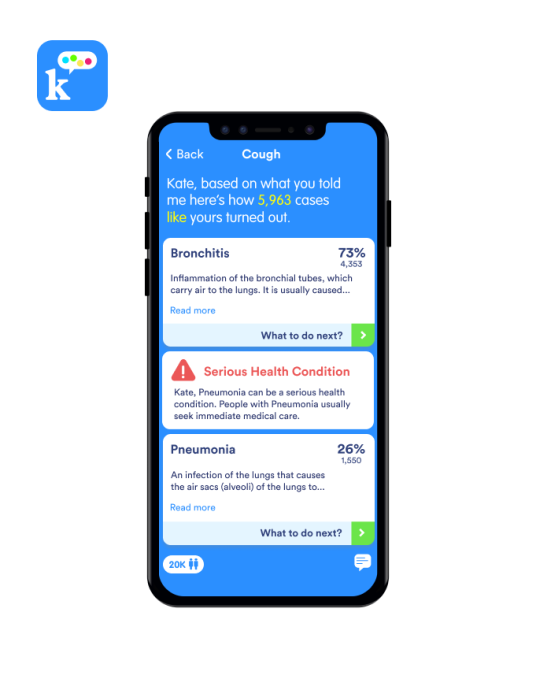
Users are able to see cases and diagnoses that had symptoms similar to their own, with K Health notifying users with serious conditions when to consider seeking immediate care. (K Health Press Image / K Health / https://www.khealth.ai)

In addition to pure peace of mind, the utility provided to consumers is clear. With more accurate at-home diagnostic information, users are able to make better preventative health decisions, avoid costly and unnecessary trips to in-person care centers or appointments with telehealth providers, and engage in constructive conversations with physicians when they do opt for in-person consultations.

K Health isn’t looking to replace doctors, and in fact, believes its platform can unlock tremendous value for physicians and the broader healthcare system by enabling better resource allocation. 

Without access to quality, personalized medical information at home, many defer to in-person doctor visits even when it may not be necessary. And with around one primary care physician per 1000 in the US, primary care practitioners are subsequently faced with an overwhelming number of patients and are unable to focus on more complex cases that may require more time and resources. The high volume of patients also forces physicians to allocate budgets for support staff to help interact with patients, collect initial background information and perform less-demanding tasks.

K Health believes that by providing an accurate alternative for those with lighter or more trivial symptoms, it can help lower unnecessary in-person visits, reduce costs for practices and allow physicians to focus on complicated, rare or resource-intensive cases where their expertise can be most useful and where brute machine processing power is less valuable.

The startup is looking to enhance the platform’s symbiotic patient-doctor benefits further in early-2019, when it plans to launch in-app capabilities that allow users to share their AI-driven health conversations directly with physicians, hopefully reducing time spent on information gathering and enabling more-informed treatment.

With K Health’s AI and machine learning capabilities, the platform also gets smarter with every conversation as it captures more outcomes, hopefully enriching the system and becoming more valuable to all parties over time. Initial results seem promising with K Health currently boasting around 500,000 users, most having joined since this past July.

Using access and affordability to improve global health outcomes

With the latest round, the company has raised a total of $37.5 million since its late-2016 founding. K Health plans to use the capital to ramp up marketing efforts, further refine its product and technology, and perform additional research to identify methods for earlier detection and areas outside of primary care where the platform may be valuable.

Longer term, the platform has much broader aspirations of driving better health outcomes, normalizing better preventative health behavior, and creating more efficient and affordable global healthcare systems.

The high costs of the American healthcare system and the impacts they have on health behavior has been well-documented. With heavy copays, premiums and treatment cost, many avoid primary care altogether or opt for more reactionary treatment, leading to worse health outcomes overall.

Issues seen in the American healthcare system are also observable in many emerging market countries with less medical infrastructure. According to the World Health Organization, the international standard for the number of citizens per primary care physician is one for every 1,500 to 2,000 people, with some countries facing much steeper gaps – such as China, where there is only one primary care doctor for every 6,666.

The startup hopes it can help limit the immense costs associated with emerging countries educating millions of doctors for eight-to-ten years and help provide more efficient and accessible healthcare systems much more quickly.

By reducing primary care costs for consumers and operating costs for medical practices, while creating a more convenient diagnostic experience, K Health believes it can improve access to information, ultimately driving earlier detection and better health outcomes for consumers everywhere.


Read Full Article

16 December 2018

HQ Trivia and Vine co-founder Colin Kroll found dead of suspected overdose


Colin Kroll, the 35-year-old co-founder and CEO of the HQ Trivia app, has been found dead of an apparent drug overdose in his apartment, TechCrunch has confirmed.

A spokesman for the NYPD told us that a female called 911 for a wellness check on Kroll’s apartment and he was found dead inside at 08:00 hours today.

The police department said the investigation is ongoing but added that the cause of death is “allegedly a drug overdose”.

“We’re still waiting on the ME’s report to confirm that,” he added.

The story was reported earlier by TMZ — which cites a police source saying cocaine and heroin were believed to be involved.

We reached out to HQ for comment but the company has declined to make a statement at this time.

Kroll was only named CEO of the HQ Trivia mobile game show app three months ago, replacing fellow co-founder Rus Yusupov who moved over to serve as chief creative officer.

Prior to taking the CEO role Kroll served as HQ’s CTO. He co-founded the startup in 2015, a few months after moving on from Vine — the Twitter-owned short video format startup which got closed down in 2017.

It’s not clear who will take over the CEO role for HQ Trivia at this stage but Yusupov looks a likely candidate, at least in the interim.

In recent months the startup has been beta testing a follow up mobile game show, called HQ Words. Its original trivia format show airs twice per day and awards winners as much as $100,000 for successfully answering 12 questions.

The app debuted last August and was a viral success. But the question hanging over HQ Trivia and its co-founders has increasingly been how to sustain an early winning streak, once the novelty of the original show ran its course.

As we reported previously, HQ Trivia’s ranking in the app store has been steadily decreasing in recent months.

Kroll started his career as a software engineer at Right Media, which went on to be acquired by Yahoo in 2006. From then until 2011, he led the engineering team in Yahoo’s search and advertising tech group before joining luxury travel site Jetsetter as VP of Product — where he went on to be promoted to CTO.

In 2012 he left to start Vine with co-founders Dominik Hofmann and Yusopov.


Read Full Article

3D-printed heads let hackers – and cops – unlock your phone


There’s a lot you can make with a 3D printer: from prosthetics, corneas, and firearms — even an Olympic-standard luge.

You can even 3D print a life-size replica of a human head — and not just for Hollywood. Forbes reporter Thomas Brewster commissioned a 3D printed model of his own head to test the face unlocking systems on a range of phones — four Android models and an iPhone X.

Bad news if you’re an Android user: all four phones unlocked with the 3D printed head.

Gone, it seems, are the days of the trusty passcode, which many still find cumbersome, fiddly, and inconvenient — especially when you unlock your phone dozens of times a day. Phone makers are taking to the more convenient unlock methods. Even if Google’s latest Pixel 3 shunned facial recognition, many Android models — including popular Samsung devices — are relying more on your facial biometrics. In its latest models, Apple effectively killed its fingerprint-reading Touch ID in favor of its newer Face ID.

But that poses a problem for your data if a mere 3D-printed model can trick your phone into giving up your secrets. That makes life much easier for hackers, who have no rulebook to go from. But what about the police or the feds, who do?

It’s no secret that biometrics — your fingerprints and your face — aren’t protected under the Fifth Amendment. That means police can’t compel you to give up your passcode, but they can forcibly depress your fingerprint to unlock your phone, or hold it to your face while you’re looking at it. And the police know it — it happens more often than you might realize.

But there’s also little in the way of stopping police from 3D printing or replicating a set of biometrics to break into a phone.

“Legally, it’s no different from using fingerprints to unlock a device,” said Orin Kerr, professor at USC Gould School of Law, in an email. “The government needs to get the biometric unlocking information somehow,” by either the finger pattern shape or the head shape, he said.

Although a warrant “wouldn’t necessarily be a requirement” to get the biometric data, one would be needed to use the data to unlock a device, he said.

Jake Laperruque, senior counsel at the Project On Government Oversight, said it was doable but isn’t the most practical or cost-effective way for cops to get access to phone data.

“A situation where you couldn’t get the actual person but could use a 3D print model may exist,” he said. “I think the big threat is that a system where anyone — cops or criminals — can get into your phone by holding your face up to it is a system with serious security limits.”

The FBI alone has thousands of devices in its custody — even after admitting the number of encrypted devices is far lower than first reported. With the ubiquitous nature of surveillance, now even more powerful with high-resolution cameras and facial recognition software, it’s easier than ever for police to obtain our biometric data as we go about our everyday lives.

Those cheering on the “death of the password” might want to think again. They’re still the only thing that’s keeping your data safe from the law.


Read Full Article

Facebook Bug Exposes Users’ Photos


A Facebook bug has exposed the private photos of up to 6.8 million users. The bug means thousands of third-party apps had potential access to photos they didn’t have permission to view. The worst thing is the amount of time Facebook took to disclose the incident.

Facebook’s Very Bad Year

It’s fair to say Facebook hasn’t had a good 2018. There was the Cambridge Analytica scandal everyone should be familiar with by now. And over a backdrop of people deleting Facebook, the social network has had ongoing issues maintaining people’s trust.

The issues run deep, with Facebook battling the spread of fake news, advertising campaigns with the potential to influence elections, and a seemingly lax attitude to users’ data and privacy. And now we get the news that private photos were exposed to apps.

Facebook Discloses New Bug

Facebook disclosed the incident in a Facebook for Developers Blog post. The social network explains that this bug affected “people who used Facebook Login and granted permission to third-party apps to access their photos”.

Users sometimes give apps permission to access photos they share on their timeline. However, this bug meant that for 12 days developers could also access other photos shared on Facebook, and even photos people uploaded but then decided not to post.

The bug in question was live between September 13 and September 25, 2018. Facebook discovered and duly fixed the bug on the 25th. However, it has taken almost three months for Facebook to notify the developers affected and, by extension, the users affected.

Facebook is “sorry this happened,” and is rolling out tools to help developers “determine which people using their app might be impacted by this bug.” Those people will then be notified, and directed to a Help Center link explaining the issue in more detail.

Fingers Crossed for 2019

This tops off an annus horribilis for Facebook, and we really hope 2019 brings better fortune. Not for Facebook’s sake, but for the sake of its users. Otherwise Facebook et al might find that everyone collectively decides to quit social media altogether.

Image Credit: Marco Verch/Flickr

Read the full article: Facebook Bug Exposes Users’ Photos


Read Full Article