05 December 2018

Europe dials up pressure on tech giants over election security


The European Union has announced a package of measures intended to step up efforts and pressure on tech giants to combat democracy-denting disinformation ahead of the EU parliament elections next May.

The European Commission Action Plan, which was presented at a press briefing earlier today, has four areas of focus: 1) Improving detection of disinformation; 2) Greater co-ordination across EU Member States, including by sharing alerts about threats; 3) Increased pressure on online platforms, including to increase transparency around political ads and purge fake accounts; and 4) raising awareness and critical thinking among EU citizens.

The Commission says 67% of EU citizens are worried about their personal data being used for political targeting, and 80% want improved transparency around how much political parties spend to run campaigns on social media.

And it warned today that it wants to see rapid action from online platforms to deliver on pledges they’ve already made to fight fake news and election interference.

The EC’s plan follows a voluntary Code of Practice launched two months ago, which signed up tech giants including Facebook, Google and Twitter, along with some ad industry players, to some fairly fuzzy commitments to combat the spread of so-called ‘fake news’.

They also agreed to hike transparency around political advertising. But efforts so far remain piecemeal, with — for example — no EU-wide roll out of Facebook’s political ads disclosure system.

Facebook has only launched political ad identification checks plus an archive library of ads in the US and the UK so far, leaving the rest of the world to rely on the more limited ‘view ads’ functionality that it has rolled out globally.

The EC said it will be stepping up its monitoring of platforms’ efforts to combat election interference — with the new plan including “continuous” monitoring.

This will take the form of monthly progress reports, starting with a Commission progress report in January and then monthly reports thereafter (against what it slated as “very specific targets”) to ensure signatories are actually purging and disincentivizing bad actors and inauthentic content from their platform, not just saying they’re going to.

As we reported in September the Code of Practice looked to be a pretty dilute first effort. But ongoing progress reports could at least help concentrate minds — coupled with the ongoing threat of EU-wide legislation if platforms fail to effectively self-regulate.

Digital economy and society commissioner Mariya Gabriel said the EC would have “measurable and visible results very soon”, warning platforms: “We need greater transparency, greater responsibility both on the content, as well as the political approach.”

Security union commissioner, Julian King, came in even harder on tech firms — warning that the EC wants to see “real progress” from here on in.

“We need to see the Internet platforms step up and make some real progress on their commitments. This is stuff that we believe the platforms can and need to do now,” he said, accusing them of “excuses” and “foot-dragging”.

“The risks are real. We need to see urgent improvement in how adverts are placed,” he continued. “Greater transparency around sponsored content. Fake accounts rapidly and effectively identified and deleted.”

King pointed out Facebook admits that between 3% and 4% of its entire user-base is fake.

“That is somewhere between 60M and 90M face accounts,” he continued. “And some of those accounts are the most active accounts. A recent study found that 80% of the Twitter accounts that spread disinformation during the 2016 US election are still active today — publishing more than a million tweets a day. So we’ve got to get serious about this stuff.”

Twitter declined to comment on today’s developments but a spokesperson told us its “number one priority is improving the health of the public conversation”.

“Tackling co-ordinated disinformation campaigns is a key component of this. Disinformation is a complex, societal issue which merits a societal response,” Twitter’s statement said. “For our part, we are already working with our industry partners, Governments, academics and a range of civil society actors to develop collaborative solutions that have a meaningful impact for citizens. For example, Twitter recently announced a global partnership with UNESCO on media and information literacy to help equip citizens with the skills they need to critically analyse content they are engaging with online.”

We’ve also reached out to Facebook and Google for comment on the Commission plan.

King went on to press for “clearer rules around bots”, saying he would personally favor a ban on political content being “disseminated by machines”.

The Code of Practice does include a commitment to address both fake accounts and online bots, and “establish clear marking systems and rules for bots to ensure their activities cannot be confused with human interactions”. And Twitter has previously said it’s considering labelling bots; albeit with the caveat “as far as we can detect them”.

But action is still lacking.

“We need rapid corrections, which are given the same prominence and circulation as the original fake news. We need more effective promotion of alternative narratives. And we need to see overall greater clarity around how the algorithms are working,” King continued, banging the drum for algorithmic accountability.

“All of this should be subject to independent oversight and audit,” he added, suggesting the self-regulation leash here will be a very short one.

He said the Commission will make a “comprehensive assessment” of how the Code is working next year, warning: “If the necessary progress is not made we will not hesitate to reconsider our options — including, eventually, regulation.”

“We need to be honest about the risks, we need to be ready to act. We can’t afford an Internet that is the wild west where anything goes, so we won’t allow it,” he concluded.

Commissioner Vera Jourova also attended the briefing and used her time at the podium to press platforms to “immediately guarantee the transparency of political advertising”.

“This is a quick fix that is necessary and urgent,” she said. “It includes properly checking and clearly indicating who is behind online advertisement and who paid for it.”

In Spain regional elections took place in Andalusia on Sunday and — as noted above — while Facebook has launched a political ad authentication process and ad archive library in the US and the UK, the company confirmed to us that such a system was not up and running in Spain in time for that regional European election.

In the vote in Andalusia a tiny Far Right party, Vox, broke pollsters’ predictions to take twelve seats in the parliament — a first since the country’s return to democracy after the death of the dictator Francisco Franco in 1975.

Zooming in on election security risks, Jourova warned that “large-scale organized disinformation campaigns” have become “extremely efficient and spread with the speed of light” online. She also warned that non-transparent ads “will be massively used to influence opinions” in the run up to the EU elections.

Hence the pressing need for a transparency guarantee.

“When we allow the machines to massively influence free decisions of democracy I think that we have appeared in a bad science fiction,” she added. “The electoral campaign should be the competition of ideas, not the competition of dirty money, dirty methods, and hidden advertising where the people are not informed and don’t have a clue that they are influenced by some hidden powers.”

Jourova urged Member States to update their election laws so existing requirements on traditional media to observe a pre-election period also apply online.

“We all have roles to play, not only Member States, also social media platforms, but also traditional political parties. [They] need to make public the information on their expenditure for online activities as well as information on any targeting criteria used,” she concluded.

A report by the UK’s DCMS committee, which has been running an enquiry into online disinformation for the best part of this year, made similar recommendations in its preliminary report this summer.

Though the committee also went further — calling for a levy on social media to defend democracy. Albeit, the UK government did not leap into the recommended actions.

Also speaking at today’s presser, EC VP, Andrus Ansip, warned of the ongoing disinformation threat from Russia but said the EU does not intend to respond to the threat from propaganda outlets like RT, Sputnik and IRA troll farms by creating its own pro-EU propaganda machine.

Rather he said the plan is to focus efforts on accelerating collaboration and knowledge-sharing to improve detection and indeed debunking of disinformation campaigns.

“We need to work together and co-ordinate our efforts — in a European way, protecting our freedoms,” he said, adding that the plan sets out “how to fight back against the relentless propaganda and information weaponizing used against our democracies”.

Under the action plan, the budget of the European External Action Service (EEAS) — which bills itself as the EU’s diplomatic service — will more than double next year, to €5M, with the additional funds intended for strategic comms to “address disinformation and raise awareness about its adverse impact”, including beefing up headcount.

“This will help them to use new tools and technologies to fight disinformation,” Ansip suggested.

Another new measure announced today is a dedicated Rapid Alert System which the EC says will facilitate “the sharing of data and assessments of disinformation campaigns and to provide alerts on disinformation threats in real time”, with knowledge-sharing flowing between EU institutions and Member States.

The EC also says it will boost resource for national multidisciplinary teams of independent fact-checkers and researchers to detect and expose disinformation campaigns across social networks — working towards establishing a European network of fact-checkers.

“Their work is absolutely vital in order to combat disinformation,” said Gabriel, adding: “This is very much in line with our principles of pluralism of the media and freedom of expression.”

Investments will also go towards supporting media education and critical awareness, with Gabriel noting that the Commission will to run a European media education week, next March, to draw attention to the issue and gather ideas.

She said the overarching aim is to “give our citizens a whole array of tools that they can use to make a free choice”.

“It’s high time we give greater visibility to this problem because we face this on a day to day basis. We want to provide solutions — so we really need a bottom up approach,” she added. “It’s not up to the Commission to say what sort of initiatives should be adopted; we need to give stakeholders and citizens their possibility to share best practices.”


Read Full Article

Middle Latitudes


Middle Latitudes

AT&T announces a second Samsung 5G smartphone for 2019


Leave it to Samsung to talk up its second 5G smartphone before most companies have tipped their first. A few days after announcing its first 5G handset via Verizon, the company is already onto number two. This one comes via an AT&T press release with that qualifies the handset a bit more, calling it “another standards-based 5G device.”

Shortly after Verizon was first with the original Samsung 5G news, both AT&T and Sprint announced that they would be getting the handset, as well. That device is scheduled, broadly, for some time in the first half of the year. This one, meanwhile, will likely arriving in the second half. “Likely” because of roadmaps and all of that stuff that’s ultimately subject to change. 

The device will “be able to access both 5G mmWave and sub-6 GHz.” Beyond that, unsurprisingly, there’s about as much detail as we got the first time around. The rest of the release finds the carrier talking up its wireless plans, going forward, and noting that this deal brings it up to three 5G device, including a mobile hotspot announced in late October.

It’s a bit unlike smartphone makers to tip their hands this far out, but between these handsets and the foldable prototype the company recent showed off, Samsung is clearly making at effort to demonstrate the innovation it’s got in the works. That appears to be, at least in part, due to somewhat lackluster sales in 2018. Wireless carriers, meanwhile, are clearly falling all over themselves to be the first announced partner for these devices.

Given the fairly lengthy lead time, the companies don’t risk cannibalizing holiday sales too much, especially with some deep December discounts on flagship devices.


Read Full Article

5 Essential Quick Look Tips for Previewing Mac Files


mac-quick-look

Want to see what a file contains without opening its associated app on your Mac? All you have to do is press the Space bar. This shortcut triggers the handy Quick Look feature on your Mac.

While it’s simple to use, we’ll explore five essential tips for getting more out of it.

1. Preview Files With a Shortcut

sample-file-preview-in-quick-look-on-mac

After you have revealed the contents of a Finder file by pressing Space, you can make the preview disappear by tapping Space again. Pressing the Escape key is another option for this.

The shortcut Cmd + Y also works as a Quick Look trigger. There’s a corresponding menu option too: File > Quick Look.

Feel free to drag the edges of the preview window to scale it up and down. You can also zoom and pan within Quick Look previews as you would in any Mac app. Use a double-tap gesture or pinch with two fingers to zoom. Plus, you can use the shortcuts Cmd + Plus and Cmd + Minus to zoom in and out of previews.

To pan across a preview, swipe left and right with two fingers. Of course, if you use this gesture in a video preview, you’ll scrub through the video instead.

If you want a Quick Look preview window to expand to fill the screen, hold down the Option key while you tap Space. This toggles a full-screen preview. By the way, holding down the Option key triggers many useful actions across macOS.

Clicking on the Full Screen button next to the Close button in the preview window is another way to switch to a full-screen preview.

2. Open, Mark Up, and Share Files

markup-open-and-share-options-in-quick-look-preview-on-mac

Quick Look lets you preview everything from text files, PDFs, and images to spreadsheets, presentations, and videos.

You’ll find a couple of common buttons in all previews:

  • Open with [App]: Use this to open the file you’re previewing in its corresponding or default app. You won’t see this button in full-screen previews.
  • Share: This button is for sharing the file via the Share sheet that’s standard across macOS.

Depending on the type of file you’re previewing, you’ll also find a few extra options if you have upgraded to macOS Mojave.

For example, when you’re previewing a PDF, you’ll get access to one of the best new features of Mojave—markup tools embedded in Finder.

Look for the Markup button that gives you tools to annotate the PDF right from the preview window. You can also navigate to different pages in the PDF using the page thumbnails in the sidebar. Similarly, in spreadsheet previews, you can navigate between sheets.

Also, you can rotate images/videos from their previews with the Rotate Left button. Change the button to a Rotate Right button temporarily by holding down the Option key. In audio/video previews, you’ll find a Trim button. If it’s missing, you’ll have to enable it from System Preferences > Extensions > Finder.

Remember, you can find the right macOS setting faster with a few tips.

3. Preview Multiple Items

index-sheet-for-multiple-item-preview-in-quick-look-on-mac

You don’t have to select Finder items one at a time to preview them. You can select multiple items and Quick Look will display their previews as a collection that you can browse through. Use the right and left arrow keys to move between file previews.

(If you hit the arrow keys when you have a single file selected, Quick Look will still walk you through the previews of the remaining items in that folder.)

It doesn’t matter if the items you select are in different formats; Quick Look will work just the same.

When you’re previewing multiple items, look for the Index Sheet button in the left section of the title bar. This button gives you a grid-based display of the selected files, making it easier for you to preview them in random order.

In full-screen previews, you’ll find the Index Sheet button in the toolbar at the bottom of the screen. Here, you’ll also find a Play/Pause button that comes in handy when you want to preview selected images as a slideshow.

4. Preview Items in Spotlight, Dock, Notes, and More

quick-look-preview-from-dock-folder-on-mac

Spotlight (your Mac’s search mechanism) and folders added to the Dock also give you file previews. With these, you can browse through PDFs, play videos, switch sheets in spreadsheets, and so on. But you won’t find advanced Quick Look features like the share menu and the index sheet.

In Spotlight, you’ll automatically see the preview for a file when you select it in the search results.

In the case of folders added to the Dock, you can preview the contents of their files only when you have displayed the folder contents as a fan or as a grid. (To switch between different views for the folder contents, select the correct view from the context menu of the folder’s Dock shortcut.)

It’s quite convenient that macOS also allows you to use Quick Look in a few other Mac apps. This comes in handy when you want to, say, preview attachments in Apple Mail or Apple Notes, or preview files in Time Machine before restoring them.

5. Install Quick Look Plugins

preview-zip-archive-with-quick-look-plugin-on-mac

You’ll find that you can’t preview certain types of files—such as archives and EPUBs—with Quick Look. But you can get around this restriction with third-party plugins. Here are a few:

QLImage is another useful QuickLook plugin. It displays the image dimensions and file size in image previews.

You’ll find a useful compilation of various other plugins at quicklookplugins.com. To install a QuickLook plugin, here’s what you need to do:

  1. Click on Go > Go to Folder.
  2. In the popup box that shows up, paste this location and hit the Go button:
    ~/Library/QuickLook
    
  3. Drag the plugin file (with the QLGENERATOR extension) to the folder that opens up.

If the plugin doesn’t activate quickly, you can speed it up by executing this Terminal command:

qlmanage -r

Use Quick Look on Mac More Often

Quick Look is one of most subtle features of macOS and it’s an important one on our list of Finder tips for Mac newbies. Sometimes people go years without knowing about Quick Look. Have you similarly missed out on any tiny, but useful macOS features?

Read the full article: 5 Essential Quick Look Tips for Previewing Mac Files


Read Full Article

What Is the Kik App and Why Do Teens Love It?

Google invests in Japanese AI and machine learning startup ABEJA


Google has made a rare investment in Japan after the company led a follow-on round for AI and machine learning startup ABEJA.

The deal amount is undisclosed but a little digging suggests that it is likely a single-digit million US dollar figure. That’s because six-year-old ABEJA did confirm that it has now raised JPY 6 billion ($53 million) from investors to date. The company has raised $45 million in disclosed capital, according to Crunchbase, which leaves around $8 million unaccounted for — although that covers both the Google investment and a previous Series A deal in 2014, which was also undisclosed.

Numbers aside, the deal is notable not only because it represents a Google deal in Japan, but because it is strategic in nature.

“Going forward, ABEJA and Google will collaborate on AI and ML solutions across various sectors, including retail and manufacturing, driving the application of AI solutions, along with further growth in the Japanese AI sector,” ABEJA said in a statement.

The startup’s core offering is a ‘platform as a service’ that uses machine learning to help over 150 companies develop business analysis and insight from their data piles. There is a specialist product for retail stores which hones in on customer and retail data — that’s used by some 100 corporate customers, according to ABEJA.

“ABEJA has strong technical capabilities and ML expertise, and is respected across the industry for its track record of collaboration and the effective deployment of its tech solutions,” said Shinichi Abe, Managing Director of Google Cloud Japan, in a pre-prepared statement. “This investment paves the way for collaboration with ABEJA in innovative solutions in the retail and manufacturing sector, as well as other verticals.”

Google has placed significant emphasis on AI and machine learning in China — where it opened a lab in Beijing one year ago — but that aside the majority of its research and focus has come from the U.S. and also Europe, where its Deep Mind unit is headquartered. Google did acquire startups in India and Singapore that include AI and ML capabilities, but those deals were aimed at growing its in-house product teams which are customizing and creating services for those growing local markets.


Read Full Article

Google contract workers demand better pay and benefits


Google contract workers, internally referred to as Temporary, Vendor and Contractors (TVCs, are seeking better, equal treatment. That entails better pay and access to benefits, as well as better access to company-wide information. In a letter to Google CEO Sundar Pichai, they allege Google “routinely denies TVCs access to information that is relevant to our jobs and our lives.”

For example, when there was a shooting at YouTube this past April, TVCs say Google only sent out updates to full-time employees. They say they were also left out of the town hall discussion the following the day.

“The exclusion of TVCs from important communications and fair treatment is part of a system of institutional racism, sexism, and discrimination,” they wrote in the letter. “TVCs are disproportionately people from marginalized groups who are treated as less deserving of compensation, opportunities, workplace protections, and respect. We wear different badges from full-time employees, which reinforces this arbitrary and discriminatory separation. Even when we’re doing the same work as full-time employees, these jobs routinely fail to provide living wages and often offer minimal benefits.”

As Bloomberg reported in July, Google’s TVCs make up more than half of the company’s total staff. They handle a variety of jobs, including serving meals, testing self-driving cars and managing teams.

This comes after Google conceded to some of the employee’s demands in the aftermath of sexual harassment and assault allegations. While Google did make some changes, the company did not address all of the organizers’ demands. For example, Google failed to elevate its chief diversity officer to report directly to Pichai and also ignored the organizers’ request to add an employee representative to the board of directors.

I’ve reached out to Google and will update this story if I hear back.


Read Full Article

Bose’s Audio-Based AR Future Available to Preorder for $199


When you think of augmented reality, you probably think of a screen that appears in your field of vision. You probably imagine a screen that’ll show you key information, or even one that lets you play games that involve the world around you. Your mind probably travels to thoughts of virtual reality as well, but augmented and virtual reality are actually quite different.

Bose has a different vision, as the company just put out a pair of  augmented reality glasses that function through the use of sound, rather than visuals. The Verge posted about the new AR sunglasses, and it immediately caught our attention.

Introducing the Bose Frames

The Bose Frames are $199 pair of sunglasses that use audio to relay information about the world around you. The actual lenses on the sunglasses are just that—sunglasses.

Everything works through the built-in microphone and open-ear headphones for both receiving and relaying information to the user. Both Siri and Google Assistant are integrated into the headphones, so users will be able to control music, ask questions, and so on.

Bose plans to launch a full platform of apps later in 2019, so for the time being, they’ll serve as an interesting way to interact with your favorite digital assistants.

Because they use an open-ear headphone design, privacy could be a bit of a concern. Bose promises that the devices won’t broadcast sound to everyone around you, but they won’t be nearly as discreet as a pair of closed-back headphones, so you might want to be careful broadcasting anything too personal.

Here are some other interesting things to know about the Bose Frames:

  • Battery Life: 3.5 hours of playback, 12 hours of standby
  • Recharge Time: 2 hours for a full charge
  • 9-axis head motion sensor detects the direction you’re facing
  • Uses GPS from Android or iPhone to know user’s location
  • Includes cleaning cloth and protective case
  • Headphones weight 45 grams
  • Available in round and square frame shapes

When Are the Bose Frames Available?

Bose announced that The Frames are available for preorder right now for $199 from Bose.com. The company is planning on shipping the devices in January 2019, so anyone who decides to throw down their money on a pair won’t need to wait too long to get their hands (or eyes and ears, as it were) on a set.

If you’re interested in the world of augmented reality as it relates to your eyes, check out some of the best AR apps out there right now.

Read the full article: Bose’s Audio-Based AR Future Available to Preorder for $199


Read Full Article

Google’s Santa Tracker Is Back for 2018


Google’s Santa Tracker is back for 2018, and there are a host of new features available in Santa’s Village this time around. Google has added new elements to Santa’s Village every year since its inception, and in 2018 there are more things to do than ever before.

While this will probably make you feel old, Santa’s Village has been an annual tradition for 15 years now. And if you need to entertain the kids through December there are games to play, fun ways to learn simple coding and foreign languages, and animated shorts to watch.

Google Upgrades Its Santa Tracker for 2018

We know what’s new for 2018 thanks to a post on The Keyword written by a certain Mrs. Claus, the VP of Product, Santa’s Village and Santa Tracker. She draws attention to Elf Maker, a new game which lets you customize an elf from head to toe.

There are also holiday photos from Local Guides, a quiz about holiday traditions powered by Google Earth, and a Translations game (using Google Translate) designed to help people of all ages and nationalities learn holiday phrases in other languages.

The most important part of Google’s Christmas celebrations is back with a vengeance. On December 24th, kids (and infantile adults) will be able to track Santa as he wends his way around the world delivering presents to everyone who made it onto his Nice list.

As well as being able to track Santa using the dedicated Santa Tracker, you can also see where he is at any time using Google Maps. Unfortunately, this feature is locked until December 24th, which is the one day Santa actually does any work. The lazy so-and-so.

Explore Santa’s Village With Help From Google

You (or your children) can visit Santa’s Village here. You can then click on individual buildings to play games, learn something new, and/or watch something entertaining. Clicking the hamburger menu in the top-left will open up even more options.

Two of the options hidden away in the menu are the option to Call Santa and the option to hear a Holiday Story. These are just two of the new Google Assistant features launched in time for the holidays. So I think it’s fair to say Google likes Christmas.

Read the full article: Google’s Santa Tracker Is Back for 2018


Read Full Article

Tumblr Bans Adult Content and Upsets Users


tumblr-followers

Tumblr is banning adult content from its platform. This comes after Apple pulled Tumblr from the iOS App Store when harmful images were found to have beaten Tumblr’s filtering system. Unfortunately, Tumblr has taken the nuclear option to avoid a repeat performance.

Tumblr’s Evolving Attitude to Adult Content

Since its inception, Tumblr has always hosted a certain amount of adult content. And while it has mostly turned a blind eye to anything legal, it has employed a Safe Mode and search filters to hide the adult content from people who aren’t interested in it.

Now, however, things are changing, and Tumblr is trying to remove adult content from the site entirely. The only exceptions being nudity related to health situations, nudity found in art, nudity related to newsworthy speech, and written erotica.

A Better, More Positive Tumblr?

Tumblr announced the changes in a post titled, “A better, more positive Tumblr“. In it, CEO Jeff D’Onofrio explains how “posts that contain adult content will no longer be allowed on Tumblr, and we’ve updated our Community Guidelines to reflect this policy change.”

He goes onto say, “There are no shortage of sites on the internet that feature adult content. We will leave it to them and focus our efforts on creating the most welcoming environment possible for our community.” Except the people this excludes, obviously.

The people who were using Tumblr to post and view adult content are upset at this decision. And understandably so. However, as D’Onofrio suggests (and everyone else already knows), there are plenty of other places online to post and view adult content.

It’s true that Tumblr had become home for a non-mainstream audience who won’t necessarily find what they’re looking for elsewhere. But forums catering to Tumblr refugees will inevitably pop up. And Tumblr itself will be just fine without the adult content.

Tumblr Is Determined to Clean Up Its Act

This move to ban adult content is the second big policy change Tumblr has announced recently. In August 2018, Tumblr cracked down on hate speech, violent imagery, and sexual harassment. Which also upset some users who value free speech above all else.

Read the full article: Tumblr Bans Adult Content and Upsets Users


Read Full Article
What Are Gaming Routers and Are They Worth Buying?


Hardware companies target gamers with all kinds of special gaming hardware. You can grab gaming keyboards, headsets, mice, monitors, and even gaming motherboards and sound cards. It doesn’t stop there though.

Most of the major router manufacturers now offer “gaming routers”—routers specifically designed with online gaming experiences in mind.

But what exactly do these gaming routers do differently from standard routers? Moreover, do their features really matter?

What Does a Gaming Router Do?

If manufacturers want you to buy a gaming router, what separates them from a regular router? The key difference between a gaming router and a regular router is Quality of Service (QoS) features. A QoS utility predominantly focuses on sending your data exactly where it needs to go.

Don’t all routers do that? Yes, they do. However…

A typical router doesn’t care about which type of traffic is which. Your roommate using BitTorrent at maximum speed, Dropbox uploading and downloading files, web browsing, Netflix, gaming—it’s all the same to your router. All of it has equal priority when it comes to your internet connection

Of course, if you live in a busy household with multiple people attempting to use these services simultaneously, your internet can struggle to meet the demand. And if you’re trying to smash someone online at FIFA while someone else streams 4K video and another decides to upload their entire photo collection, your online gaming experience becomes decidedly laggy.

Gaming Router Quality of Service and Other Features

QoS takes that incoming data and, understanding how important gaming is, prioritizes incoming traffic for your game. In that, your gaming router attempts to minimize packet loss for gaming connections while bunching the rest of the incoming and outgoing network data into a separate stream.

One of the most common quality of service tools is Qualcomm’s StreamBoost. StreamBoost (or variants based upon StreamBoost) features in a wide range of gaming routers as many are powered by a Qualcomm chipset.

Manufacturers have tweaked and developed their own versions, too. StreamBoost and similar technologies are considered adaptive QoS, in that they can automatically adjust to the shifting demands of your home network.

In many cases, adaptive QoS isn’t there to strangle the connections of other internet users in your home. (Unless you set it up like that, of course.)

Rather, the adaptive QoS attempts to balance the demands of the available incoming bandwidth for the end users. But as it is a gaming router, your gaming QoS will take precedence if that’s what you require.

Other Useful Gaming Router Features

Gaming routers also come with a bunch of other useful QoS and quality of life (QoL) features. There are a few gaming router features you should look out for.

  • Gigabit Ethernet. How many Gigabit Ethernet ports does the router have? The Netgear Nighthawk XR700 even has a 10 Gigabit Ethernet port for those with an ultra-fast internet connection. The answer lies in your home network. How many wired devices do you have and will you add more in the future?
  • Wireless standards. At this point, most gaming routers pack in the latest wireless standards. The most common wireless standard at the time of writing is 802.11ac. However, the IEEE is developing 802.11ax, the successor to 802.11ac, while 802.11ay is set to function in the largely untapped 60GHz spectrum (wireless internet currently uses 2.4GHz and 5GHz).
  • Multi-band Wi-Fi. High-end routers now support tri-band wireless networking, allowing them to transmit on three channels at once. Some gaming routers use tri-band to transmit on two 5Ghz and a single 2.4GHz, while others broadcast on the newer but as yet largely unused 60GHz frequency.
  • Processor and RAM. Powerful modern gaming routers feature faster, more powerful CPUs and more RAM. Increased power and memory in your gaming router means it can a) handle more connections and attempt to decrease latency, and b) create and use more advanced QoS features.

Now, none of these features are exclusive to “gaming routers.” However, they’re certainly not found on low-end routers, or ISP-provided routers either. But they’re certainly available on routers that are cheaper than the high-end gaming routers.

How to Prioritize Your Gaming Router Traffic

One of the most important things to do after purchasing a gaming router is configuring your network priorities. What’s the best way to prioritize your gaming router traffic to deliver the best gaming experience?

  • Prioritize by Service. Want every device on the network to access a specific app? Set your network to prioritize by service. For instance, you could set every device on your network to have priority to a specific game or a video streaming service, like Netflix.
  • Prioritize by Network. Gaming routers allow prioritization by the network. That is, you can give your wireless connections priority over wired.
  • Prioritize by IP Address. Each device on your home network has a specific IP address behind your router. If each device has a static IP address—that’s an IP address that isn’t dynamically allocated when it joins the network—you can specify the network traffic priority for each IP address. (How do you get a static IP address, anyway?)
  • Prioritize by MAC Address. Your hardware has a unique identifier known as a MAC address. When your device connects to your gaming router, the router receives the device MAC address. You can then prioritize network traffic to devices based upon their unique identifier.

Some gaming routers let you combine prioritization methods. You could prioritize by service and IP address; funnily enough, that’s the perfect combination for streamlining gaming traffic.

Gaming Mode on D-Link Routers

D-Link routers—not just gaming routers, but many D-Link brand routers marketed to home users in general—come with a “Gaming Mode.”

This mode isn’t very self-explanatory. The D-Link router configuration interface says “If you are having difficulties playing some online games—please enable this mode.” and that “Gaming Mode should be used when you are playing games on the internet from behind the router.”

d-link-router-gaming-mode.png

While D-Link doesn’t provide much documentation on this, it turns out that “Gaming Mode” is essentially the same thing as “Full-Cone NAT” and the router uses “Symmetric NAT” when gaming mode is disabled.

Let’s back up a bit here. Your router uses network address translation (NAT) to share your internet connection between the devices connected to it: PCs, gaming consoles, smartphones, tablets, and whatever else. Your router discards incoming traffic by default because it has no idea which device to forward it to.

Now, let’s say your Xbox console establishes an outgoing connection to the internet. When the Xbox receives a response to that connection, the router will forward the incoming traffic to the Xbox.

With the default Symmetric NAT, the router will only forward traffic to the Xbox if it’s from the same destination the Xbox opened a communication channel with.

With full-cone NAT—that’s “Gaming Mode” in D-Link router parlance—the router will forward all incoming traffic on that port over to the Xbox.

In other words, when Gaming Mode is enabled, the Xbox can establish an outgoing connection and then receive incoming connections from any other address. This is often necessary when playing games, as they may be hosted on the Xbox itself.

Many people have reported that enabling Gaming Mode on a D-Link router is necessary to use Xbox Live.

Is a Gaming Router Worth the Money?

Gaming routers aren’t just a marketing ploy. They genuinely come with a host of useful features such as gaming traffic prioritization, additional Gigabit Ethernet ports, the latest wireless standards, and powerful router hardware.

However, it’s important to remember that none of these features are exclusive to gaming routers. QoS, Gigabit Ethernet, and dual-band 802.11ac Wi-Fi are common features in all higher-end routers.

Check out our guide to the best routers for gaming.

Read the full article: What Are Gaming Routers and Are They Worth Buying?


Read Full Article

10 Proven and Tested Tips to Extend Battery Life on Android

Welcome to the stochastic age


In 1990, Kleiner Perkins rejected 99.4 percent of the proposals it received, while investing in 12 new companies a year. Those investees made Kleiner Perkins “the most successful financial institution in the history of the world,” boasting “returns of about 40 percent per year, compounded, for coming up on thirty years.”

Nowadays, the Valley’s VC poster child is Y Combinator, which invests in more like 250 companies annually. They’re famously selective, accepting something like 1.5 percent of applicants, but still noticeably less selective than Kleiner Perkins in its heyday. They invest less money (though not necessarily that much less; KP bought 25 percent of Netscape for a mere $5 million back in 1994) in more companies.

In 1995, three networks controlled essentially all American television, and made only enough to fill the week; nowadays there is so much TV that you could binge watch a new scripted series every day of the year. In 1995, the top 10 movies of the year were responsible for 14 percent of the total box office. So far in 2018, the top 10 have claimed a full 25 percent of the total gross. Something similar happened in publishing; the so-called “midlist” was largely replaced by a “bestseller or bust” attitude.

In 1995, if you were a journalist, your readership was dictated almost entirely by who published you. No matter how compelling your piece in the Halifax Daily News may have been, the same number of people would glance at your headline as at the others in that issue, and that number would be drastically smaller than that of any article, no matter how buried, in The New York Times. Now, the relative readership of any article, both between and within publications, is determined mostly by social media sharing, and inevitably follows a power-law curve, such that a surprisingly small number of pieces attract the lion’s share of readers.

What do these fields have in common? The number of “hits” has remained relatively constant, while their value has grown, and the number of “swings” has grown to the point where it is difficult for any person, or even any group, to pay close attention to them all. And the outcomes inevitably follow a power law. So it doesn’t make sense to focus on individual outcomes any more; instead you focus on cohorts, and you think stochastically.

“Stochastic” means “randomly determined,” and your initial inclination may be to recoil — of course producers and investors and publishers aren’t acting randomly! They put enormous amounts of analysis, effort and intelligence into what they do! Which is true. But I put it to you that as gatekeepers’ power has diminished, and the number of would-be directors, CEOs and pundits has skyrocketed, while the costs of trying have shrunk — randomness has become a more and more important factor.

It’s easy to cite anecdotes. What if Excite had bought Google when it was offered to them for $1 million? How far were we, really, from a world in which Picplz succeeded and Instagram failed? Any honest success story will include elements of luck, which is, in this context, another word for randomness. My contention is that the world’s larger trends — greater interconnectedness, faster speed, democratized access to technology — make randomness an ever-more-important factor.

This is not automatically a good thing. People talk about “stochastic terrorism,” a.k.a. “The use of mass public communication, usually against a particular individual or group, which incites or inspires acts of terrorism which are statistically probable but happen seemingly at random.” Think of killers who dedicate their attack to ISIS after the fact despite no previous communication with them, or, more generally and contentiously, political violence promoted by broadcasting hatred and extremism.

And it seems that climate change is increasingly a stochastic disaster. Warmer weather means more energy in the atmosphere, which means more volatile behavior, which means more catastrophes like droughts, wildfires, hurricanes. Does climate change cause those things? Not directly. It increases the probability of them happening. It means both more and bigger hits, if you will.

This doesn’t apply to every field of human endeavor. But it seems to apply to essentially every field driven by unusual, extreme successes or failures — to extremistan, to use Nassim Taleb’s term. Extremistan seems to everywhere be growing more extreme, and there’s no end in sight.


Read Full Article

Facebook ends platform policy banning apps that copy its features


Facebook will now freely allow developers to build competitors to its features upon its own platform. Today Facebook announced it will drop Platform Policy section 4.1 which stipulates “Add something unique to the community. Don’t replicate core functionality that Facebook already provides.”

Facebook had previously enforced that policy selectively to hurt competitors that had used its Find Friends or viral distribution features. Apps like Vine, Voxer, MessageMe, Phhhoto and more had been cut off from Facebook’s platform for too closely replicating its video, messaging, or GIF creation tools. Find Friends is a vital API that lets users find their Facebook friends within other apps.

The move will significantly reduce the platform risk of building on the Facebook platform. It could also cast it in a better light in the eyes of regulators. Anyone seeking ways Facebook abuses its dominance will lose a talking point. And by creating a more fair and open platform where developers can build without fear of straying too close to Facebook’s history or roadmap, it could reinvigorate its developer ecosystem.

A Facebook spokesperson provided this statement to TechCrunch:

“We built our developer platform years ago to pave the way for innovation in social apps and services. At that time we made the decision to restrict apps built on top of our platform that replicated our core functionality. These kind of restrictions are common across the tech industry with different platforms having their own variant including YouTube, Twitter, Snap and Apple. We regularly review our policies to ensure they are both protecting people’s data and enabling useful services to be built on our platform for the benefit of the Facebook community. As part of our ongoing review we have decided that we will remove this out of date policy so that our platform remains as open as possible. We think this is the right thing to do as platforms and technology develop and grow.”

The change comes after Facebook locked down parts of its platform in April for privacy and security reasons in the wake of the Cambridge Analytica scandal. Diplomatically, Facebook said it didn’t expect the change to impact its standing with regulators but it’s open to answering their questions.

Earlier in April, I wrote a report on how Facebook used Policy 4.1 to attack competitors it saw gaining traction. The article “Facebook shouldn’t block you from finding friends on competitors” advocated for Facebook to make its social graph more portable and interoperable so users could decamp to competitors if they felt they weren’t treated right in order for to coerce Facebook to act better.

The policy change will apply retroactively. Old apps that lost Find Friends or other functionality will be able to submit their app for review and once approved, will regain access.

Friend lists still can’t be exported in a truly interoperable way. But at least now Facebook has enacted the spirit of that call to action. Developers won’t be in danger of losing access to that Find Friends Facebook API for treading in its path.


Below is an excerpt from our previous reporting on how Facebook has previously enforced Platform Policy 4.1 that before today’s change was used to hamper competitors:

  • Voxer was one of the hottest messaging apps of 2012, climbing the charts and raising a $30 million round with its walkie-talkie-style functionality. In early January 2013, Facebook copied Voxer by adding voice messaging into Messenger. Two weeks later, Facebook cut off Voxer’s Find Friends access. Voxer CEO Tom Katis told me at the time that Facebook stated his app with tens of millions of users was a “competitive social network” and wasn’t sharing content back to Facebook. Katis told us he thought that was hypocritical. By June, Voxer had pivoted toward business communications, tumbling down the app charts and leaving Facebook Messenger to thrive.
  • MessageMe had a well-built chat app that was growing quickly after launching in 2013, posing a threat to Facebook Messenger. Shortly before reaching 1 million users, Facebook cut off MessageMe‘s Find Friends access. The app ended up selling for a paltry double-digit millions price tag to Yahoo before disintegrating.
  • Phhhoto and its fate show how Facebook’s data protectionism encompasses Instagram. Phhhoto’s app that let you shoot animated GIFs was growing popular. But soon after it hit 1 million users, it got cut off from Instagram’s social graph in April 2015. Six months later, Instagram launched Boomerang, a blatant clone of Phhhoto. Within two years, Phhhoto shut down its app, blaming Facebook and Instagram. “We watched [Instagram CEO Kevin] Systrom and his product team quietly using PHHHOTO almost a year before Boomerang was released. So it wasn’t a surprise at all . . . I’m not sure Instagram has a creative bone in their entire body.”
  • Vine had a real shot at being the future of short-form video. The day the Twitter-owned app launched, though, Facebook shut off Vine’s Find Friends access. Vine let you share back to Facebook, and its six-second loops you shot in the app were a far cry from Facebook’s heavyweight video file uploader. Still, Facebook cut it off, and by late 2016, Twitter announced it was shutting down Vine.

Read Full Article

Facebook ends platform policy banning apps that copy its features


Facebook will now freely allow developers to build competitors to its features upon its own platform. Today Facebook announced it will drop Platform Policy section 4.1 which stipulates “Add something unique to the community. Don’t replicate core functionality that Facebook already provides.”

Facebook had previously enforced that policy selectively to hurt competitors that had used its Find Friends or viral distribution features. Apps like Vine, Voxer, MessageMe, Phhhoto and more had been cut off from Facebook’s platform for too closely replicating its video, messaging, or GIF creation tools. Find Friends is a vital API that lets users find their Facebook friends within other apps.

The move will significantly reduce the platform risk of building on the Facebook platform. It could also cast it in a better light in the eyes of regulators. Anyone seeking ways Facebook abuses its dominance will lose a talking point. And by creating a more fair and open platform where developers can build without fear of straying too close to Facebook’s history or roadmap, it could reinvigorate its developer ecosystem.

A Facebook spokesperson provided this statement to TechCrunch:

“We built our developer platform years ago to pave the way for innovation in social apps and services. At that time we made the decision to restrict apps built on top of our platform that replicated our core functionality. These kind of restrictions are common across the tech industry with different platforms having their own variant including YouTube, Twitter, Snap and Apple. We regularly review our policies to ensure they are both protecting people’s data and enabling useful services to be built on our platform for the benefit of the Facebook community. As part of our ongoing review we have decided that we will remove this out of date policy so that our platform remains as open as possible. We think this is the right thing to do as platforms and technology develop and grow.”

The change comes after Facebook locked down parts of its platform in April for privacy and security reasons in the wake of the Cambridge Analytica scandal. Diplomatically, Facebook said it didn’t expect the change to impact its standing with regulators but it’s open to answering their questions.

Earlier in April, I wrote a report on how Facebook used Policy 4.1 to attack competitors it saw gaining traction. The article “Facebook shouldn’t block you from finding friends on competitors” advocated for Facebook to make its social graph more portable and interoperable so users could decamp to competitors if they felt they weren’t treated right in order for to coerce Facebook to act better.

The policy change will apply retroactively. Old apps that lost Find Friends or other functionality will be able to submit their app for review and once approved, will regain access.

Friend lists still can’t be exported in a truly interoperable way. But at least now Facebook has enacted the spirit of that call to action. Developers won’t be in danger of losing access to that Find Friends Facebook API for treading in its path.


Below is an excerpt from our previous reporting on how Facebook has previously enforced Platform Policy 4.1 that before today’s change was used to hamper competitors:

  • Voxer was one of the hottest messaging apps of 2012, climbing the charts and raising a $30 million round with its walkie-talkie-style functionality. In early January 2013, Facebook copied Voxer by adding voice messaging into Messenger. Two weeks later, Facebook cut off Voxer’s Find Friends access. Voxer CEO Tom Katis told me at the time that Facebook stated his app with tens of millions of users was a “competitive social network” and wasn’t sharing content back to Facebook. Katis told us he thought that was hypocritical. By June, Voxer had pivoted toward business communications, tumbling down the app charts and leaving Facebook Messenger to thrive.
  • MessageMe had a well-built chat app that was growing quickly after launching in 2013, posing a threat to Facebook Messenger. Shortly before reaching 1 million users, Facebook cut off MessageMe‘s Find Friends access. The app ended up selling for a paltry double-digit millions price tag to Yahoo before disintegrating.
  • Phhhoto and its fate show how Facebook’s data protectionism encompasses Instagram. Phhhoto’s app that let you shoot animated GIFs was growing popular. But soon after it hit 1 million users, it got cut off from Instagram’s social graph in April 2015. Six months later, Instagram launched Boomerang, a blatant clone of Phhhoto. Within two years, Phhhoto shut down its app, blaming Facebook and Instagram. “We watched [Instagram CEO Kevin] Systrom and his product team quietly using PHHHOTO almost a year before Boomerang was released. So it wasn’t a surprise at all . . . I’m not sure Instagram has a creative bone in their entire body.”
  • Vine had a real shot at being the future of short-form video. The day the Twitter-owned app launched, though, Facebook shut off Vine’s Find Friends access. Vine let you share back to Facebook, and its six-second loops you shot in the app were a far cry from Facebook’s heavyweight video file uploader. Still, Facebook cut it off, and by late 2016, Twitter announced it was shutting down Vine.

Read Full Article
Samsung fakes test photo by using a stock DSLR image


Samsung’s Malaysian arm has some explaining to do. The company, in an effort to show off the Galaxy A8 Star’s amazing photo retouching abilities, used a cleverly-shot portrait, modified it, and then ostensibly passed it off as one taken by the A8.

The trouble began when Serbian photographer Dunja Djudjic noticed someone had bought one of her photos from a service called EyeEm that supplies pictures to Getty Images, a renowned photo reseller. Djudjic, curious as to the buyer, did a quick reverse search and found her image – adulterated to within an inch of its life – on Samsung’s Malaysian product page.

Djudjic, for her part, was a good sport.

My first reaction was to burst out into laughter. Just look at the Photoshop job they did on my face and hair! I’ve always liked my natural hair color (even though it’s turning gray black and white), but I guess the creator of this franken-image prefers reddish tones. Except in the eyes though, where they removed all of the blood vessels.

Whoever created this image, they also cut me out of the original background and pasted me onto a random photo of a park. I mean, the original photo was taken at f/2.0 if I remember well, and they needed the “before” and “after” – a photo with a sharp background, and another one where the almighty “portrait mode” blurred it out. So Samsung’s Photoshop master resolved it by using a different background.

This move follows a decision by Huawei to pull the same stunt with a demo photo in August.

To be fair, Samsung warned us this would happen. “The contents within the screen are simulated images and are for demonstration purposes only,” they write in the fine print, way at the bottom of the page. Luckily for Djudjic, Samsung paid her for her photo.


Read Full Article
Google ‘incognito’ search results still vary from person to person, DDG study finds


A study of Google search results by anti-tracking rival DuckDuckGo has suggested that escaping the so-called ‘filter bubble’ of personalized online searches is a perniciously hard problem for the put upon Internet consumer who just wants to carve out a little unbiased space online, free from the suggestive taint of algorithmic fingers.

DDG reckons it’s not possible even for logged out users of Google search, who are also browsing in Incognito mode, to prevent their online activity from being used by Google to program — and thus shape — the results they see.

DDG says it found significant variation in Google search results, with most of the participants in the study seeing results that were unique to them — and some seeing links others simply did not.

Results within news and video infoboxes also varied significantly, it found.

While it says there was very little difference for logged out, incognito browsers.

“It’s simply not possible to use Google search and avoid its filter bubble,” it concludes.

Google has responded by counter-claiming that DuckDuckGo’s research is “flawed”.

Degrees of personalization

DuckDuckGo says it carried out the research to test recent claims by Google to have tweaked its algorithms to reduce personalization.

A CNBC report in September, drawing on access provided by Google, letting the reporter sit in on an internal meeting and speak to employees on its algorithm team, suggested that Mountain View is now using only very little personalization to generate search results.

A query a user comes with usually has so much context that the opportunity for personalization is just very limited,” Google fellow Pandu Nayak, who leads the search ranking team, told CNBC this fall.

On the surface, that would represent a radical reprogramming of Google’s search modus operandi — given the company made “Personalized Search” the default for even logged out users all the way back in 2009.

Announcing the expansion of the feature then Google explained it would ‘customize’ search results for these logged out users via an ‘anonymous cookie’:

This addition enables us to customize search results for you based upon 180 days of search activity linked to an anonymous cookie in your browser. It’s completely separate from your Google Account and Web History (which are only available to signed-in users). You’ll know when we customize results because a “View customizations” link will appear on the top right of the search results page. Clicking the link will let you see how we’ve customized your results and also let you turn off this type of customization.

A couple of years after Google threw the Personalized Search switch, Eli Pariser published his now famous book describing the filter bubble problem. Since then online personalization’s bad press has only grown.

In recent years concern has especially spiked over the horizon-reducing impact of big tech’s subjective funnels on democratic processes, with algorithms carefully engineered to keep serving users more of the same stuff now being widely accused of entrenching partisan opinions, rather than helping broaden people’s horizons.

Especially so where political (and politically charged) topics are concerned. And, well, at the extreme end, algorithmic filter bubbles stand accused of breaking democracy itself — by creating highly effective distribution channels for individually targeted propaganda.

Although there have also been some counter claims floating around academic circles in recent years that imply the echo chamber impact is itself overblown. (Albeit sometimes emanating from institutions that also take funding from tech giants like Google.)

As ever, where the operational opacity of commercial algorithms is concerned, the truth can be a very difficult animal to dig out.

Of course DDG has its own self-interested iron in the fire here — suggesting, as it is, that “Google is influencing what you click” — given it offers an anti-tracking alternative to the eponymous Google search.

But that does not merit an instant dismissal of a finding of major variation in even supposedly ‘incognito’ Google search results.

DDG has also made the data from the study downloadable — and the code it used to analyze the data open source — allowing others to look and draw their own conclusions.

It carried out a similar study in 2012, after the earlier US presidential election — and claimed then to have found that Google’s search had inserted tens of millions of more links for Obama than for Romney in the run-up to that.

It says it wanted to revisit the state of Google search results now, in the wake of the 2016 presidential election that installed Trump in the White House — to see if it could find evidence to back up Google’s claims to have ‘de-personalized’ search.

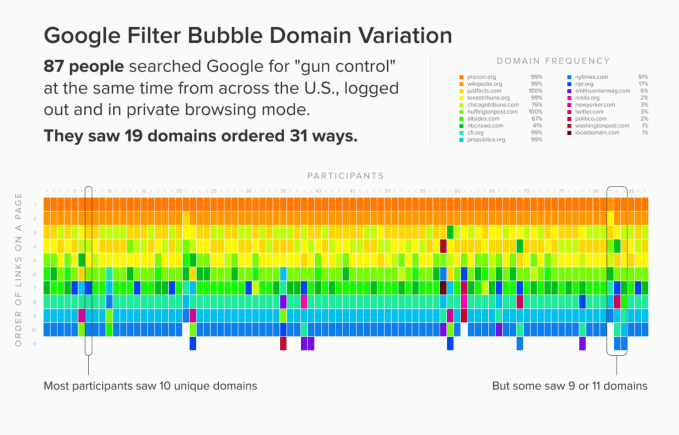
For the latest study DDG asked 87 volunteers in the US to search for the politically charged topics of “gun control”, “immigration”, and “vaccinations” (in that order) at 9pm ET on Sunday, June 24, 2018 — initially searching in private browsing mode and logged out of Google, and then again without using Incognito mode.

You can read its full write-up of the study results here.

The results ended up being based on 76 users as those searching on mobile were excluded to control for significant variation in the number of displayed infoboxes.

Here’s the topline of what DDG found:

Private browsing mode (and logged out):

  • “gun control”: 62 variations with 52/76 participants (68%) seeing unique results.
  • “immigration”: 57 variations with 43/76 participants (57%) seeing unique results.
  • “vaccinations”: 73 variations with 70/76 participants (92%) seeing unique results.

‘Normal’ mode:

  • “gun control”: 58 variations with 45/76 participants (59%) seeing unique results.
  • “immigration”: 59 variations with 48/76 participants (63%) seeing unique results.
  • “vaccinations”: 73 variations with 70/76 participants (92%) seeing unique results.

DDG’s contention is that truly ‘unbiased’ search results should produce largely the same results.

Yet, by contrast, the search results its volunteers got served were — in the majority — unique. (Ranging from 57% at the low end to a full 92% at the upper end.)

“With no filter bubble, one would expect to see very little variation of search result pages — nearly everyone would see the same single set of results,” it writes. “Instead, most people saw results unique to them. We also found about the same variation in private browsing mode and logged out of Google vs. in normal mode.”

“We often hear of confusion that private browsing mode enables anonymity on the web, but this finding demonstrates that Google tailors search results regardless of browsing mode. People should not be lulled into a false sense of security that so-called “incognito” mode makes them anonymous,” DDG adds.

Google initially declined to provide a statement responding to the study, telling us instead that several factors can contribute to variations in search results — flagging time and location differences among them.

It even suggested results could vary depending on the data center a user query was connected with — potentially introducing some crawler-based micro-lag.

Google also claimed it does not personalize the results of logged out users browsing in Incognito mode based on their signed-in search history.

However the company admited it uses contextual signals to rank results even for logged out users (as that 2009 blog post described) — such as when trying to clarify an ambiguous query.

In which case it said a recent search might be used for disambiguation purposes. (Although it also described this type of contextualization in search as extremely limited, saying it would not account for dramatically different results.)

But with so much variation evident in the DDG volunteer data, there seems little question that Google’s approach very often results in individualized — and sometimes highly individualized — search results.

Some Google users were even served with more or fewer unique domains than others.

Lots of questions naturally flow from this.

Such as: Does Google applying a little ‘ranking contextualization’ sound like an adequately ‘de-personalized’ approach — if the name of the game is popping the filter bubble?

Does it make the served results even marginally less clickable, biased and/or influential?

Or indeed any less ‘rank’ from a privacy perspective… ?

You tell me.

Even the same bunch of links served up in a slightly different configuration has the potential to be majorly significant since the top search link always gets a disproportionate chunk of clicks. (DDG says the no.1 link gets circa 40%.)

And if the topics being Google-searched are especially politically charged even small variations in search results could — at least in theory — contribute to some major democratic impacts.

There is much to chew on.

DDG says it controlled for time- and location-based variation in the served search results by having all participants in the study carry out the search from the US and do so at the very same time.

While it says it controlled for the inclusion of local links (i.e to cancel out any localization-based variation) by bundling such results with a localdomain.com placeholder (and ‘Local Source’ for infoboxes).

Yet even taking steps to control for space-time based variations it still found the majority of Google search results to be unique to the individual.

“These editorialized results are informed by the personal information Google has on you (like your search, browsing, and purchase history), and puts you in a bubble based on what Google’s algorithms think you’re most likely to click on,” it argues.

Google would counter argue that’s ‘contextualizing’, not editorializing.

And that any ‘slight variation’ in results is a natural property of the dynamic nature of its Internet-crawling search response business.

Albeit, as noted above, DDG found some volunteers did not get served certain links (when others did), which sounds rather more significant than ‘slight difference’.

In the statement Google later sent us it describes DDG’s attempts to control for time and location differences as ineffective — and the study as a whole as “flawed” — asserting:

This study’s methodology and conclusions are flawed since they are based on the assumption that any difference in search results are based on personalization. That is simply not true. In fact, there are a number of factors that can lead to slight differences, including time and location, which this study doesn’t appear to have controlled for effectively.

One thing is crystal clear: Google is — and always has been — making decisions that affect what people see.

This capacity is undoubtedly influential, given the majority marketshare captured by Google search. (And the major role Google still plays in shaping what Internet users are exposed to.)

That’s clear even without knowing every detail of how personalized and/or customized these individual Google search results were.

Google’s programming formula remains locked up in a proprietary algorithm box — so we can’t easily (and independently) unpick that.

And this unfortunate ‘techno-opacity’ habit offers convenient cover for all sorts of claim and counter-claim — which can’t really now be detached from the filter bubble problem.

Unless and until we can know exactly how the algorithms work to properly track and quantify impacts.

Also true: Algorithmic accountability is a topic of increasing public and political concern.

Lastly, ‘trust us’ isn’t the great brand mantra for Google it once was.

So the devil may yet get (manually) unchained from all these fuzzy details.


Read Full Article

New York’s Taxi and Limousine Commission approves minimum wage rules for app-based drivers


The New York City Taxi and Limousine Commission has approved new rules that set a minimum hourly wage of $17.22 (after expenses) for drivers who work with app-based services like Uber, Lyft, Via and Juno.

Fast Company reports that the rules try to deliver that minimum wage by requiring drivers be paid according to a formula that incorporates mileage, time and utilization rate (the average percentage of time drivers have passengers in their cars). They also call a higher payment when drivers have to take passengers far outside the city (to compensate for them for the return trip).

A proposed bonus payment for drivers offering Uber Pool and other shared ride options appears to have been removed from the rules.

The Independent Drivers Guild, a labor organization that advocates for drivers, has been advocating for these changes, and it praised the TLC vote in a press release.

“Today we brought desperately needed relief to 80,000 working families,” said IDG founder Jim Conigliaro, Jr. “All workers deserve the protection of a fair, livable wage and we are proud to be setting the new bar for contractor workers’ rights in America. We are thankful to the Mayor, Commissioner [Meera] Joshi and the Taxi and Limousine Commission, City Council Member Brad Lander and all of the city officials who listened to and stood up for drivers.”

Uber and Lyft, meanwhile, criticized the decision, though with careful wording emphasizing that the companies aren’t opposed to ensuring that drivers receive a living wage.

“Uber supports efforts to ensure that full-time drivers in NYC – whether driving with taxi, limo or Uber – are able to make a living wage, without harming outer borough riders who have been ignored by yellow taxi and underserved by mass transit,” said Uber Director of Public Affairs Jason Post in a statement. “The TLC’s implementation of the City Council’s legislation to increase driver earnings will lead to higher than necessary fare increases for riders while missing an opportunity to deal with congestion in Manhattan’s central business district.”

Post argued that the rules do not account for the bonuses and other incentive payments that Uber and other companies might make. He criticized the TLC for adopting “an industry-wide utilization rate that does not hold bases accountable for keeping cars full with paying passengers.”

And here’s the statement from Lyft:

Lyft believes all drivers should earn a livable wage and we are committed to helping drivers reach their goals. Unfortunately, the TLC’s proposed pay rules will undermine competition by allowing certain companies to pay drivers lower wages, and disincentive drivers from giving rides to and from areas outside Manhattan. These rules would be a step backward for New Yorkers, and we urge the TLC to reconsider them.

Specifically Lyft says that companies would be able to essentially adopt a lower minimum wage by claiming a higher utilization rate than the industry average. It also says that it will be nearly impossible to implement the higher out-of-town payment rates in the 30-day window before the new rules take effect.


Read Full Article

Uber Eats test lets restaurants trade discounts for ranking boost


Uber Eats has effectively invented its own native ad unit. Uber confirmed to TechCrunch that a test quietly running in markets around India allows restaurants to bundle several food items together and sell them at a discounted price in exchange for promoted placement by Uber Eats in a featured section of local “Specials”. In some cases, restaurants foot the cost of the discount, while in others Uber pays for the discounts.

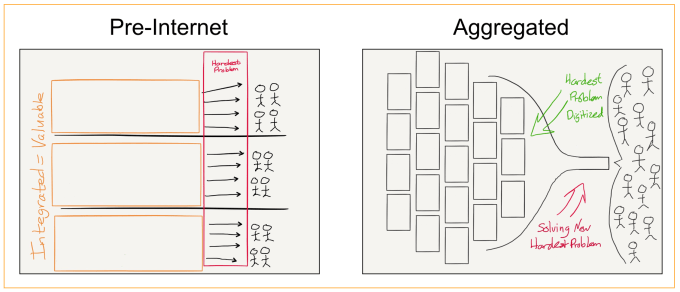
The Uber Specials feature demonstrates the massive leverage awarded to food delivery apps that aggregate restaurants. Users often come to Uber Eats and its competitors without a specific restaurant in mind. Uber can then point those customers to whichever food supplier it prefers. The suppliers in turn will increasingly compete for the favor the aggregators — not just in terms of food quality, speed, and review scores, but also in terms of discounts. The aggregators will win users if they offer the best deals, creating a network effect makes restaurants more keen to play ball.

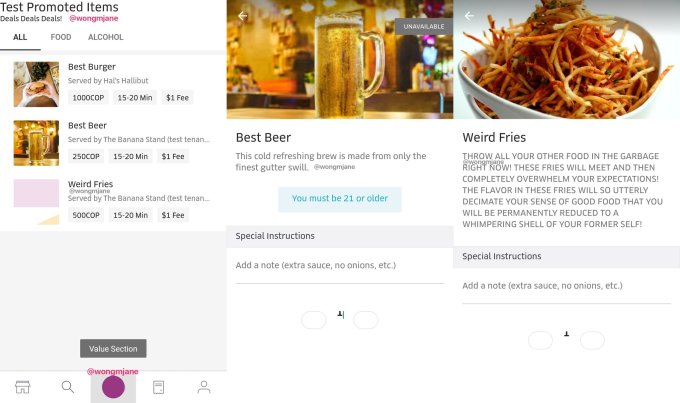
TechCrunch first learned of Uber’s ambitions in the space from a mock-up of the Promoted Items Value Section feature spotted in its app by mobile researcher and frequent TC tipster Jane Manchun Wong. The fictional food items included “Best Beer” that “is made from only the finest gutter swill” and “Weird Fries” that “will so utterly decimate your sense of good food that you will be permanently reduced to a whimpering shell of your former self!” This jokey text that seemingly was never meant for public viewing also noted that the fries are so good you should “throw all your other food in the garbage right now!” Uber assured us these weren’t real.

But what it did confirm is that the discounts for promoted placement test is live in India. “We’re always experimenting with ways to make it easier to find your favorite foods on Uber Eats”, according to a statement provided by an Uber spokesperson.

The feature allows restaurants to create a bundled meal at certain price point, such as a chicken sandwich, french fries, and a drink at a price that’s less than the sum of its parts. The company tells me the goal is to take the friction out of ordering by giving people pre-set meals at a better price prominently available in the app. Attracting more customers that have plenty of other options could offset the discount. Businesses could also use it to bundle high margin items like soft drinks in with meals, or to get rid of overstock.

Ben Thompson’s aggregation theory describes how power accrues to aggregators that match supply with demand

It’s already common for restaurants to make ‘specials’ out of food they have too much of. That butternut squash ravioli might only be featured because they can’t get rid of it. In that sense, you could think of Uber Specials as the inverse of surge pricing. When supply is too high, restaurants can offer discounts to gain more demand. It’s also not far off from Google Search’s keyword ads where business pay for more visibility.

Uber wouldn’t discuss whether it plans to bring the strategy to other markets, but it makes sense to assume it’s considering expansion. Done wrong, it could look a bit like Uber Eats is pressuring restaurants to surrender discounts if they want to be discoverable inside its app. If restaurants within Uber Eats get into heated competition to offer discounts, it could drive down their profits. But done right, Specials could look like a triple-win. Restaurants can offload surplus and bundle in high margin items while scoring new customers from enhanced placement, customers get cheaper food options, and Uber Eats becomes people’s go-to app for easy-to-order discounted meals.


Read Full Article
Google’s Flutter toolkit goes beyond mobile with Project Hummingbird


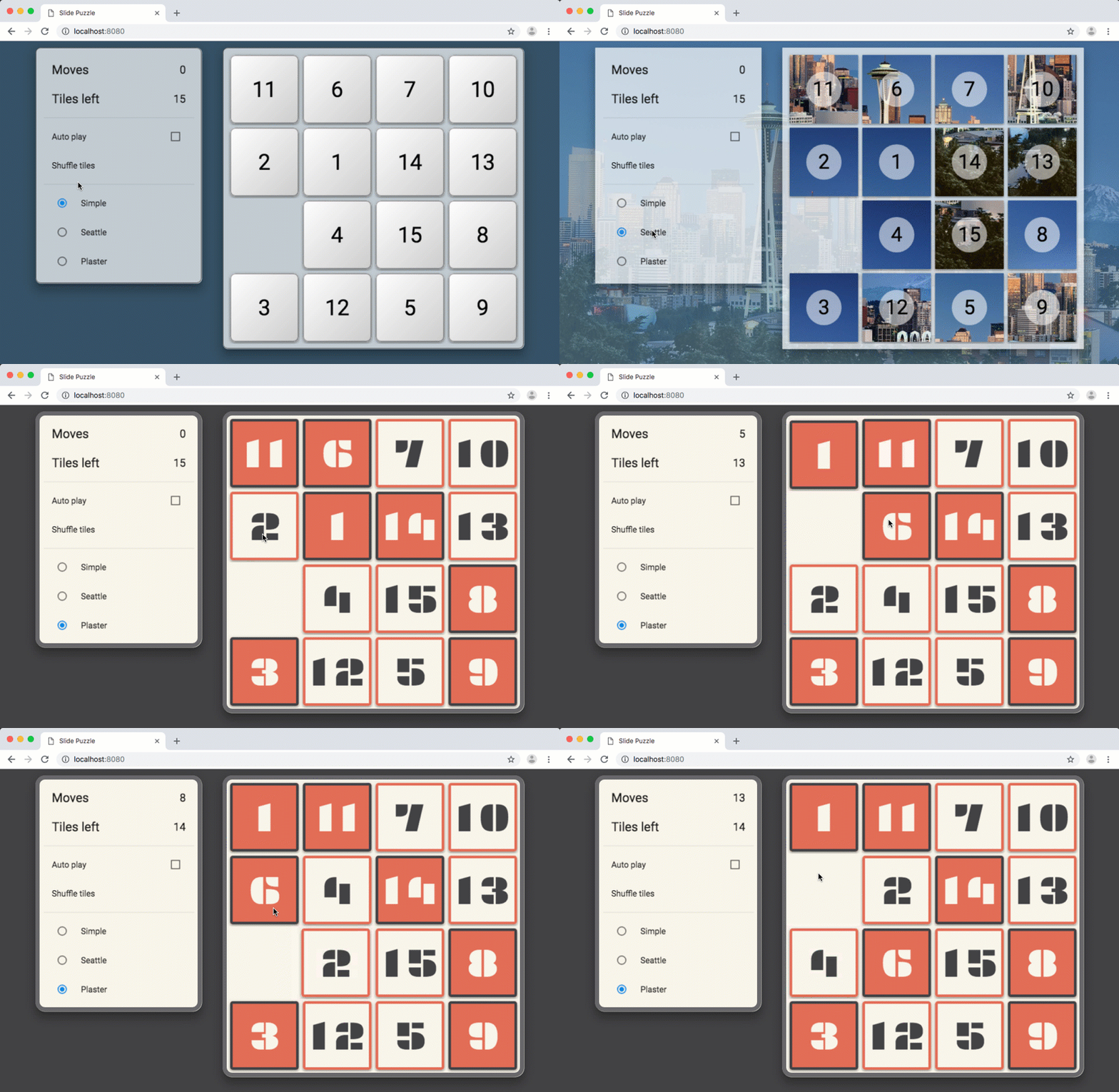
Flutter, Google’s toolkit for building cross-platform applications, hit version 1.0 today. Traditionally, the project always focused on iOS and Android apps, but as the company announced today, it’s now looking at bringing Flutter to the web, too. That project, currently called Hummingbird, is essentially an experimental web-based implementation of the Flutter runtime.

“From the beginning, we designed Flutter to be a portable UI toolkit, not just a mobile UI toolkit,” Google’s group product manager for Flutter, Tim Sneath, told me. “And so we’ve been experimenting with how we can bring Flutter to different places.”

Hummingbird takes the Dart code that all Flutter applications are written in and then compiles it to JavaScript, which in turn allows the code to run in any modern browser. Developers have always been able to compile Dart to JavaScript, so this part isn’t new, but ensuring that the Flutter engine would work, and bringing all the relevant Flutter features to the web was a major engineering effort. Indeed, Google built three prototypes to see how this could work. Just bringing the widgets over wasn’t enough. A combination of the Flutter widgets and its layout system was also discarded and in the end, the team decided to build a full Flutter web engine that retains all of the layers that sit above the dart:ui library.

“One of the great things about Flutter itself is that it compiles to machine code, to Arm code. But Hummingbird extends that further and says, okay, we’ll also compile to JavaScript and we’ll replace the Flutter engine on the web with the Hummingbird engine which then enables Flutter code to run without changes in web browsers. And that, of course, extends Flutter’s perspective to a whole new ecosystem.”

With tools like Electron, it’s easy enough to bring a web app to the desktop, too, so there’s now also a pathway for bringing Flutter apps to Windows and MacOS that way, though there is already another project in progress to embed Flutter into native desktop apps, too.

It’s worth noting that Google always touted the fact that Flutter compiled to native code — and the speed gains it got from that. Compiling to the web is a bit of a tradeoff, though. Sneath acknowledged as much and stressed that Hummingbird is an experimental project and that Google isn’t releasing any code today. Right now, it’s a technical demonstration.

“If you can go native, you should go native,” he said. “Think of it as an extension of Flutter’s reach rather than a solution to the problem that Flutter itself is solving.”

In its current iteration, the Flutter web engine can handle most apps, but there’s still a lot of work to do to ensure that all widgets run correctly, for example. The team is also looking at building a plugin system and ways to embed Flutter and into existing web apps — and existing web apps into Flutter web apps.


Read Full Article