26 November 2018

8 Adobe Photoshop Workflow Tips to Improve Your Image Editing


photoshop-workflow

Working in Photoshop can be time-consuming, but there are a few tips and tricks you can use to speed up your workflow. This will ensure that you spend your time being creative, rather than wasting time doing things the long winded way.

1. Clone Photoshop Layer Styles

You’ve spent a ton of time perfecting your design using Photoshop’s layers and styles. Instead of painstakingly applying the same styles to a new layer or design, you can “copy and paste” the styles.

To access Layer Styles, right-click the layer and select Blending Options. You can add outlines to your Photoshop designs, along with drop shadows, bevels, and strokes.

To quickly copy one layer style to another, right-click the layer with the styles applied and click Copy Layer Style.

Click on the layer where you want to apply the styles. Right-click the layer and select Paste Layer Style.

Copy-Layer-Style-Photoshop

You can also drag and drop the layer style in the layers panel, but this will remove it from the original layer.

Drag-Photoshop-Layer-Style

2. Batch Resize Images

You can easily resize a large batch of photos in Photoshop using a script. (Don’t worry, it’s not as intimidating as it sounds.)

Go to File > Scripts > Image Processor, and you’ll find a few options available. You can run the script on images that you currently have open in Photoshop or better yet, you can apply the settings to an entire folder of images.

You can also select the location on your computer to save the resized images, the file type (jpeg, PSD, or TIFF), and the quality.

Once you’ve selected your file type, you can now select your image size by checking Resize to Fit. You can select a specific width or height, depending on your needs.

Once you’ve made your selections, click Run.

Photoshop-Scripts-Batch-Resize-Images

3. Quickly Select a Photoshop Layer

If you’re working with a ton of layers, it can be tedious scrolling to find the exact one you’re looking for.

There are a few faster ways to get straight to the layer(s) you want to adjust without touching the layers panel.

  1. Select the Move tool from the Tools menu or use the keyboard shortcut V
  2. In the menu at the top of the screen, make sure Auto-Select is checked and that Layer is selected from the drop-down menu.
  3. Click on the item in your canvas that you want to select and it should now be the selected, active layer in the Layers panel.

Auto-Select-Layers-Photoshop

You can also use this feature to quickly select Groups by choosing Groups from the Auto-Select drop-down menu.

There’s another option. With the Move tool selected, press the Ctrl/Cmd button on your keyboard and then click the layer you want to select.

If you have a crowded canvas, you can get more specific with the following:

  1. With any tool selected, use the Ctrl+Cmd+Right click combination to bring up a menu panel. (Make sure that you’re clicking in the area where the item you want to select is on the canvas.)
  2. Click on the name of the layer you want to select.

Select-Layers-Photoshop

If you want to select all of the layers at the same time use the keyboard shortcut Command+Option+A on a Mac or Ctrl+Alt+A on Windows or go to Select > All Layers.

4. Zoom In and Out Simultaneously

If you’re working on an image, it can be helpful to see a closeup at the same time as the entire image. This means you can make small edits in a detailed view, and see how they affect the overall image at the same time.

To view a zoomed and 1:1 version of the image simultaneously, do the following:

  1. Go to Window > Arrange > New Window for [FileName.PSD]. This will open a second version of your image in a second tab.
  2. Go to Window > Arrange > 2-up Vertical to display both canvases side by side.
  3. With one of the canvases selected, zoom in. (You can easily zoom in and out using the keyboard shortcut Cmd/Ctrl+ and Cmd/Ctrl-.)

Dual-View-Zoom

5. Automate Using Actions and Scripts

There are plenty of ways to automate your work in Photoshop using a combination of actions and scripts.

Photoshop Actions cut your editing time by allowing you to apply the same editing techniques to your photos or images with the click of a button.

You can download Photoshop Actions or you create your own Actions for your personalized editing style. You can use also Actions for repetitive tasks like adding watermarks to your images or creating diptychs and triptychs.

And as we’ve mentioned, you can use Photoshop Scripts to automate repetitive tasks like batch resizing images.

In addition to Actions and Scripts, you can also use Photoshop filters for quick work. For example, filters make it easy to quickly add realistic trees to your Photoshop designs.

6. Create Custom Photoshop Shortcuts

You can create custom shortcuts and workspaces that suit your workflow.

Let’s say you want to set a keyboard shortcut for toggling the 2-Up vertical view used in the fourth tip in this article:

  1. Go to Edit > Keyboard Shortcuts or use keyboard shortcut Option+Shift+Cmd/Ctrl+K.
  2. In the panel that opens up, you can set or change existing keyboard shortcuts for Application Menus, Panel Menus, and Tools.
  3. In the drop-down menu for Shortcuts For select Application Menus.
  4. Scroll down to Window and click the arrow to expand the selection and see all the items you’d find under the Window menu.
  5. Scroll down to the menu item you want (in this case 2-Up Vertical) and click to select.
  6. Enter the keyboard shortcut you want to use. If the keyboard shortcut is already in use for another feature, Photoshop will let you know.
  7. Click OK.

Custom-Keyboard-Shortcuts-Photoshop

To create a custom workspace, open up all the panels you use frequently, and then go to Windows > Workspace > New Workspace to create a customized interface.

7. Hide All Photoshop Layers Except One

While we’ve shown you a few easy ways to get right to the layer you want to work with, Photoshop also offers the option to hide all layers except one. To do this, you’ll need the Layers panel open:

  1. If you don’t see the Layers panel to go to Windows > Layers to open it.
  2. Hold down the Alt/Option key and click the visibility (eye) icon next to the layer you want to keep open.
  3. All other layers will be toggled off with the exception of the one you clicked.

Toggle-One-Layer-On-Photoshop

This method will also toggle off your background.

8. Organize Your Photoshop Layers

Keeping your layers organized can be a little time consuming, but in the long run, it can save you time.

Properly naming your layers makes it easier to navigate the Layers panel and to select your layers using the tips on how to quickly select a layer.

To rename a layer, open the Layers panel and find the layer you want to rename and double-click the text of the name. You can then type in the new name.

You can also name your layers as you create them by using the menu item Layer > New > Layer or use the keyboard shortcut Shift+Cmd/Ctrl+N. You can then type in the name of the layer before you create it.

New-Layer-Name

To add your layers to groups, open the Layers panel:

  1. To select multiple layers, hold down the Ctrl/Cmd key and click the layers you want to select.
  2. Use the keyboard shortcut Ctrl/Cmd+G or right-click the layers and click Group from Layers.

When it comes to organizing your layers, you can use whatever approach suits your workflow best, but here are some tips if you need a hint on how to get started with keeping your layers in check:

  • Group your layers by type. If you’re creating a button, for example, group all the items that make up that button: shapes, text etc. in one folder.
  • Position your layers in the panel similarly to how they appear on your canvas. Place the items at the top of your design at the top of your Layers panel.

To quickly navigate between layers, you can use the following keyboard shortcuts:

  • Select layer beneath selected layer: Alt/Opt+[
  • Select layer above selected layer: Alt/Opt+]
  • Move layer down one position: Cmd/Ctrl+[
  • Move layer up one position: Cmd/Ctrl+]

Keep Speeding Up Your Photoshop Workflow

The more you use Photoshop, the more you’ll learn about speeding up your workflow. As it becomes clearer to you which features you use most often, you can search for more tips and tricks to speed up your workflow.

If you’re still getting the hang of Photoshop, these tips will come in handy, but first be sure to take a look at everything you need to know to learn the basics of Photoshop.

Read the full article: 8 Adobe Photoshop Workflow Tips to Improve Your Image Editing


Read Full Article

5 Essential Tips to Secure Your Google Home Device


google-home-security

Although Amazon Alexa is leading the way among home-based digital assistants, Google Home is quickly catching up, packed with powerful features.

To set up and use your Google Home device with full functionality, you need to use your Google account credentials. This means that Google Home collects a significant amount of data and personal information.

If this worries you, it’s time to think about your relationship with Google, and how to secure your Google Home.

5 Ways to Secure Your Google Home Device

How do you secure a Google Home device?
In my opinion, Google is one of the more trustworthy companies when it comes to the collection and processing of personal data. In fact, having all this data in one place within Google Home is arguably preferable to having it scattered among various third parties.

  1. Enable voice match
  2. Limit external devices
  3. Use two-factor authentication
  4. Mute Google Home
  5. Discard old voice recordings

As with any IoT device, however, there are a few accepted best practices for securing Google Home devices. Before reading on, ensure your Wi-Fi network is backed-up by a secure password and WPA2 encryption. For bonus points, set up your Google Home and other smart devices on their own network.

When you have secured your home network, you can take these steps to protect your Google Home device.

1. Enable the Voice Match Feature

Unlike Amazon Alexa, Google Home has a feature known as ‘Voice Match’ that learns your voice over time.

This means that you can not only tailor Google Home to answer your questions in a personalized way, but you can also stop third-parties and unauthorized strangers from using Google Home’s voice functionality to access sensitive information.

Using Voice Match, Google Home will provide personalized results only if it recognizes an authorized voice. You can enable Voice Match by navigating to your Google Home app and setting it up.

You will have to train Google Home by talking to it, but this doesn’t take too long. When Voice Match is enabled, only authorized voices will be able to activate the device.

2. Don’t Go Crazy With External Devices

It can be tempting to hook up all your external devices with Google Home. However, the more additional devices and services you use—for example, banking—the more vulnerable you and your personal information become.

If you are using more devices and services then more data is being sent back and forth to third-party companies and service providers, and not all these entities are guaranteed to protect your data to the same extent as Google; when data is sent between Google Home and Google, it is encrypted.

Google Home provides plenty of opportunities to link external devices and services. Companies are understandably keen to get you to do this, however, you should resist the temptation if you are concerned about security.

Whilst linking your financial information to Google Home may be convenient, is it worth the risk?

3. Use Two-Factor Authentication

Two-factor authentication is an additional layer of security that can act as a barrier between thieves and your data. Remember, your Google Home is connected to your Google account, teeming with potentially valuable data. Consider your search history, email, Google Drive, music, and more.

If a hacker manages to steal your Google password, all this (including voice recordings from Google Home) is fair game.

Setting up two-factor authentication on the other hand completely secures your account. It makes it virtually impossible for a malicious third-party to access your account. The only way this would be possible is if somebody knew your password and had your phone.

Regardless of whether you use Google Home, use of two-factor authentication is always recommended.

4. Not Using Google Home? Mute It

Just like Amazon Alexa, Google Home can be unintentionally triggered and record conversations. Many people leave Google Home unmuted whilst it is not being used, however, they shouldn’t.

Phrases that sound nothing like the two wake words can still activate your device, so if you are concerned that unintentional waking of Google Home could record sensitive information then it’s a good idea to mute the device when it is not in use. Unintentional wakes will happen, that’s a virtual certainty.

Google Home devices have either an on/off toggle switch or mute button at the back of the device. When the microphone is muted, the notification light will turn orange. Until you re-enable the microphone, you will not be able to use voice commands.

5. Regularly Prune Old Voice Recordings

Many people don’t realize that Google stores all the interactions you and other people have with Google Home on the Google servers until you delete them.

Whilst most things that you use Google Home for is unlikely to be anything groundbreaking or valuable—who really cares about the fact that you asked Google for the time?—if you have ever used it for anything related to your finances or health, for example, you should delete these.

Regularly go through your Google Home’s old voice recordings in your Google account under “My Activity” to listen and delete them. You can also do this through the google Home app or by visiting myactivity.google.com—there’s no need to go rummaging through your Google account’s settings!

It’s Easy to Use Smart Devices Securely

Although home-based smart assistants have attracted negative press, they are perfectly safe when used properly. It is good practice to be securing your home network and any smart devices you use on them regardless. This simply comes with the territory when using modern smart products and benefiting from the IoT.

The bottom-line is that you don’t need to be a cybersecurity expert to use devices such as Google Home safely. By taking care of some very basic security-related housekeeping that, in the grand scheme of things, doesn’t take much time or effort, you can use smart devices without compromising your personal information.

Google Home isn’t the only risk from connected smart devices in your home. Various Internet of Things vulnerabilities can cause problems with smart home hardware.

Read the full article: 5 Essential Tips to Secure Your Google Home Device


Read Full Article

5 Ways to Fix a Malfunctioning USB Device or Port on Linux


fix-linux-usb

You’ve hooked up a USB flash drive, or a keyboard or mouse to your Linux PC. But nothing is happening.

What’s going on? Why won’t your Linux computer detect the device? Is it a Linux thing, or has your USB device stopped working?

USB Not Working in Ubuntu?

USB ports on a laptop

Disk drives, card readers, phones, media players, and media peripherals… they’re all useful, but if there’s a problem with your system’s USB port or drivers, they’re not going to work. This can be particularly frustrating if you use a Bluetooth keyboard (here’s why you shouldn’t) or mouse (with a USB dongle) as it means digging out wired USB alternatives.

However, it might not be the port that doesn’t work. Perhaps the USB device you’re using has developed a fault and cannot be detected.

Dealing with USB issues can be tricky, but it’s not impossible to diagnose a fault and make the necessary fixes.

There are five steps to follow to fix USB issues in Linux:

  1. Confirm the USB port is detected
  2. Make any necessary repairs to the port
  3. Fix or repair USB devices
  4. Reboot your Linux operating system
  5. Confirm the presence of device drivers

Let’s look at each of these in turn and learn how to deal with dodgy USB devices in Linux.

1. Is Your Device Detected by Linux?

The first thing to check upon inserting your USB device in your Linux computer is whether it is being detected. USB device detection is usually not as verbal or audible as it is in Windows or macOS, which means that often you need to check that the device has been picked up by the operating system.

Fortunately, this is simple.

Use the lsusb command in Linux

First, disconnect the USB device you’re querying. Then, open a terminal window and input the “list USB” command:

lsusb

Make a note of the results, then connect the USB device, and run lsusb again.

This time, you should see an extra device listed, with a Bus ID, Device ID, USB ID, and a description. If you can’t work out what the extra device is (you may have an internal USB device, perhaps Ethernet), try a different command.

dmesg | grep -i USB

The dmesg command will list the connected USB devices on your system. It will also include non-USB hardware, and unfortunately offers an overwhelming amount of information. To counter this, you can try

dmesg | less

Finally, you could just rely on the more user-friendly

usb-devices

This is like a cross between the dmesg and lsusb commands, listing connected USB hardware with enough information to identify them.

So, is the USB you’ve connected listed here? If not, then perhaps the port is damaged or there is a problem with the device. Equally, the device may not be compatible with Linux.

2. How to Check Your USB Port

If the USB device isn’t showing, it could be due to an issue with the USB port.

The best way to check this quickly is to simply use a different USB port on the same computer. If the USB hardware is now detected, then you know you have a problem with the other USB port.

If another USB port is not available, you’ll need to try the USB device on another PC or laptop. This may not be ideal, however, as you may only have a Windows or macOS computer as an alternative. As some USB devices cannot be used on Linux it will be difficult to ascertain whether it is the USB device, or the USB port that is causing you problems.

For the best results, where possible stick to Linux-compatible hardware when troubleshooting USB devices. No time to install Linux on another PC? Consider confirming the state of your USB hardware with a low-cost Raspberry Pi Zero instead.

3. Fixing Broken USB Hardware

If your USB hardware is defective, you have two choices: fix or return.

A fix will typically involve checking the USB port, as well as the device that is currently not working. Fixes will almost always center around the USB cable, and the port on your computer. USB cables can usually be replaced, however, while ports can be repaired.

A physical check of USB equipment is a good idea. Cables should be sturdy, without any splits; the plugs should be solid, with the metal section firmly attached.

USB ports, meanwhile, should be checked with your PC switched off, and disconnected from the mains supply. Check the ports are firmly seated; wobbly USB ports are an indication of hardware that is wearing out.

If the USB port is coming loose, you may be able to solder it back into place. Of course, you should already know how to solder; never attempt DIY jobs without prior experience.

Also, check for dust and dirt in your USB ports, especially those around the back of your PC where dust regularly collects. Dust is the enemy of PCs, so it is worth keeping your system in a dust free environment to encourage performance. As dust can work its way into your PC via USB slots, take the time to keep these ports clean. Use a can of compressed air to disperse dust and dirt.

Can you return your USB device? If it’s new, then probably. The problem is, unless it is explicitly labeled as running under Linux, then, the retailer is unlikely to accept a return. You may need to be a little selective with the facts you share with them…

4. Restarting Linux to Fix a USB Port

In some cases—such as if you’re using a laptop—power issues might be affecting its ability to detect USB devices. The autosuspend setting is designed to reduce power usage on Linux laptops, but it can prove counterproductive.

So, what can you do?

First, check whether autosuspend is causing the problem. You can do this by rebooting your computer; if the USB device works, then that USB port is receiving power.

The next step is to ensure this doesn’t happen again. The following command line tricks are for Ubuntu 18.10, so check for the correct procedure on your preferred Linux distribution.

Open a terminal window and input:

cat /sys/module/usbcore/parameters/autosuspend

This should return a value of 2, which means autosuspend is enabled. You can fix this by editing the grub file. Enter:

sudo nano /etc/default/grub

Fix USB power issues in Linux

Here, look for

GRUB_CMDLINE_LINUX_DEFAULT="quiet splash"

Change this to

GRUB_CMDLINE_LINUX_DEFAULT="quiet splash usbcore.autosuspend=-1"

Press Ctrl + X to save the file, and exit. Next, update grub:

sudo update-grub

When that completes, restart Ubuntu.

After rebooting, log into your account and enter the cat command again:

cat /sys/module/usbcore/parameters/autosuspend

This time, the value returned should be -1. You’ve disabled autosuspend, so USB devices connected to your laptop should not fail due to power issues.

5. Checking USB Device Drivers on Linux

Once upon a time, USB devices didn’t often work in Linux. Only devices produced by OEMs with an interest in Linux (perhaps they used it for development) would offer a Linux driver.

These days, things are very different, with most manufacturers offering a Linux driver. In most cases, this will already be available in your Linux operating system, via the kernel.  You shouldn’t need to install any USB drivers.

If a driver is unavailable, you’ll probably be able to find it by contacting the USB device manufacturer.

Troubleshooting USB Issues on Linux: Fixed!

With built-in drivers and wide support for many types of USB device, it should be easy to diagnose issues with your computer’s USB hardware.

While broken hardware may need repairing or swapping, software fixes are also available.

If you’ve recently swapped from Windows, running into USB issues on Linux can be a problem. Fortunately, these problems are usually easily solved, helping to make switching to Linux easy!

Read the full article: 5 Ways to Fix a Malfunctioning USB Device or Port on Linux


Read Full Article

9 Useful Apps to Download Before Your Next International Trip

The Best Cyber Monday Deals From Amazon

Banuba raises $7M to supercharge any app or device with the ability to really see you


Walking into the office of Viktor Prokopenya – which overlooks a central London park – you would perhaps be forgiven for missing the significance of this unassuming location, just south of Victoria Station in London. While giant firms battle globally to make Augmented Reality a ‘real industry’, this jovial businessman form Belrarus is poised to launch a revolutionary new technology for just this space. This is the kind of technology some of the biggest companies in the world are snapping up right now, and yet, scuttling off to make me a coffee in the kitchen is someone who could be sitting on just such a company.

Regardless of whether it’s immediate future is obvious or not, AR has a future if the amount of investment pouring into the space is anything to go by.

In 2016 AR and VR attracted $2.3 billion worth of investments (a 300% jump from 2015) and is expected to reach $108 billion by 2021 – 25% of which will be aimed at the AR sector. But, according to numerous forecasts, AR will overtake VR in 5-10 years.

Apple is clearly making headway in its AR developments, having recently acquired AR lens company Akonia Holographics and in releasing iOS 12 this month, it enables developers to fully utilize ARKit 2, no doubt prompting the release of a new wave of camera-centric apps. This year Sequoia Capital China, SoftBank invested $50M in AR camera app Snow. Samsung recently introduced its version of the AR cloud and a partnership with Wacom that turns Samsung’s S-Pen into an augmented reality magic wand.

The IBM/Unity partnership allows developers to integrate Watson cloud services such as visual recognition, speech to text, and more into their Unity applications.

So there is no question that AR is becoming increasingly important, given the sheer amount of funding and M&A activity.

Joining the field is Prokopenya’s “Banuba” project. For although you can download a Snapchat-like app called ‘Banuba’ from the App Store right now, underlying this is a suite of tools of which Prokopenya is the founding investor, and who is working closely to realize a very big vision with the founding team of AI/AR experts behind it.

The key to Banuba’s pitch is the idea that its technology could equip not only apps but even hardware devices with “vision”. This is a perfect marriage of both AI and AR. What if, for instance, Amazon’s Alexa couldn’t just hear you? What if it could see you and interpret your facial expressions or perhaps even your mood? That’s the tantalizing strategy at the heart of this growing company.

Better known for its consumer apps, which have been effectively testing their concepts in the consumer field for the last year, Banuba is about to move heavily into the world of developer tools with the release of its new Banuba 3.0 mobile SDK. (Available to download now in the App Store for iOS devices and Google Play Store for Android). It’s also now secured a further $7m in funding from Larnabel Ventures, the fund of Russian entrepreneur Said Gutseriev, and Prokopenya’s VP Capital.

This move will take its total funding to $12m. In the world of AR, this is like a Romulan warbird de-cloaking in a scene from Star Trek.

Banuba hopes that its SDK will enable brands and apps to utilise 3D Face AR inside their own apps, meaning users can benefit from cutting-edge face motion tracking, facial analysis, skin smoothing and tone adjustment. Banuba’s SDK also enables app developers to utilise background subtraction, which is similar to ‘green screen’ technology regularly used in movies and TV shows, enabling end-users to create a range of AR scenarios. Thus, like magic, you can remove that unsightly office surrounding and place yourself on a beach in the Bahamas…

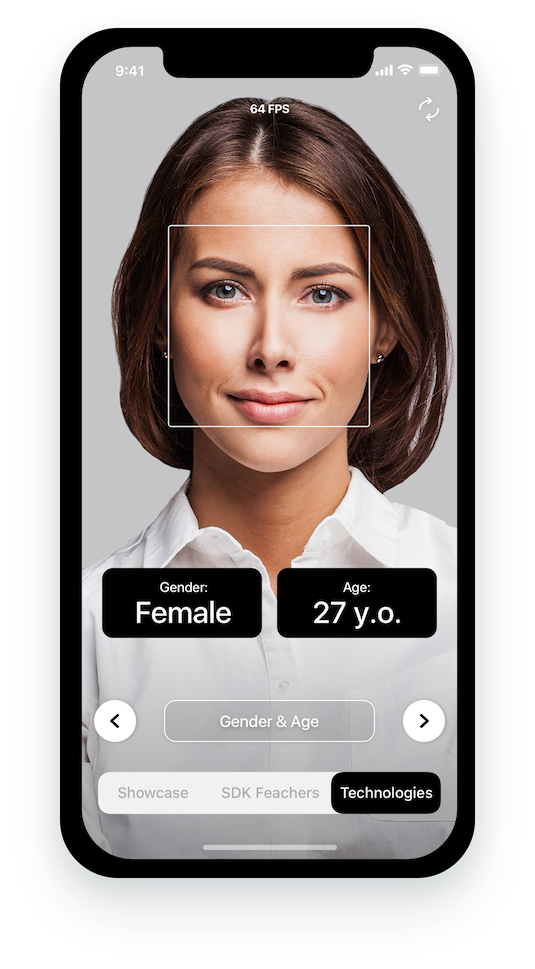
Because Banuba’s technology equips devices with ‘vision’, meaning they can ‘see’ human faces in 3D and extract meaningful subject analysis based on neural networks, including age, gender, it can do things that other apps just cannot do. It can even monitor your heart rate via spectral analysis of the time-varying color tones in your face.

It has already been incorporated into an app called Facemetrix, which can track a child’s eyes to ascertain whether they are reading something on a phone or tablet or not. Thanks to this technology, it is possible to not just to “track” a person’s gaze, but also to control a smartphone’s function with a gaze. To that end, the SDF can detect micro-movements of the eye with subpixel accuracy in real-time, and also detects certain points of the eye. The idea behind this is to “Gamify education”, rewarding a child with games and entertainment apps if the Facemetrix app has duly checked that they really did read the e-book they told their parents they’d read.

If that makes you think of a parallel with a certain Black Mirror episode where a young girl is prevented from seeing certain things via a brain implant, then you wouldn’t be a million miles away. At least this is a more benign version…

Banuba’s SDK also includes ‘Avatar AR’, empowering developers to get creative with digital communication by giving users the ability to interact with – and create personalized – avatars using any iOS or Android device.

Prokopenya says: “We are in the midst of a critical transformation between our existing smartphones and future of AR devices, such as advanced glasses and lenses. Camera-centric apps have never been more important because of this.” He says that while developers using ARKit and ARCore are able to build experiences primarily for top-of-the-range smartphones, Banuba’s SDK can work on even low-range smartphones.

The SDK will also feature Avatar AR, which allows users to interact with fun avatars or create personalised ones for all iOS and Android devices. Why should users of Apple’s iPhone X be the only people to enjoy Animoji?

Banbua is also likely to take advantage of the news that Facebook recently announced it was testing AR ads in its newsfeed, following trials for businesses to show off products within Messenger.

Banuna’s technology won’t simply be for fun apps however. Inside 2 years, the company has filed 25 patent applications with the the US patent office and of six of those were processed in record time compared with the average. Its R&D center, staffed by 50 people and based in Minsk, is focused on developing a portfolio of technologies.

Interestingly, Belarus has become famous for AI and facial recognition technologies.

For instance, cast your mind back to early 2016, when Facebook bought Masquerade, a Minsk-based developer of a video filter app, MSQRD, which at one point was one of the most popular apps in the App Store. And in 2017, another Belarusian company, AIMatter, was acquired by Google, only months after raising $2M. It too took an SDK approach, releasing a platform for real-time photo and video editing on mobile, dubbed Fabby. This was built upon a neural network-based AI platform. But Prokopenya has much bolder plans for Banuba.

In early 2017, he and Banuba launched a “technology-for-equity” program to enroll app developers and publishers across the world. This signed up Inventain, another startup from Belarus, to develop AR-based mobile games.

Prokopenya says the technologies associated with AR will be “leveraged by virtually every kind of app. Any app can recognize its user through the camera: male or female, age, ethnicity, level of stress, etc.” He says the app could then respond to the user in any number of ways. Literally, your apps could be watching you.

So for instance, a fitness app could see how much weight you’d lost just by using the Banuba SDF to look at your face. Games apps could personalize the game based on what it knows about your face, such as reading your facial cues.

Back in his London office, overlooking a small park, Prokopenya waxes lyrical about the “incredible concentration of diversity, energy and opportunity” of London. “Living in London is fantastic,” he says. “The only thing I am upset about, however, is the uncertainty surrounding Brexit and what it might mean for business in the UK in the future.”

London may be great (and will always be), but sitting on his desk though is a laptop with direct links back to Minsk, a place where the facial recognition technologies of the future are only now just emerging.


Read Full Article

Heist


Heist

Black Friday drove half a million new users to the top shopping apps


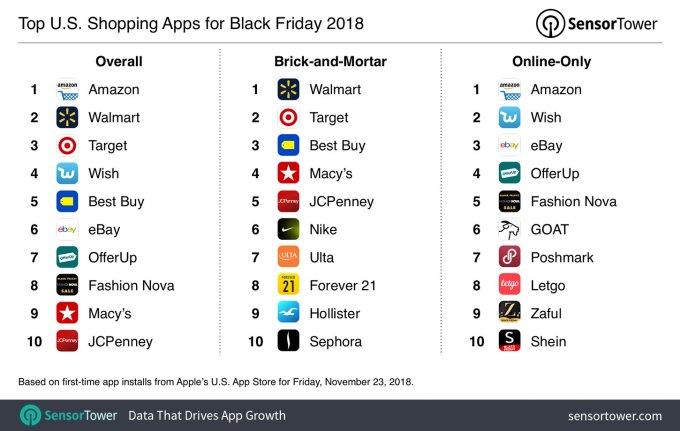
More U.S. consumers were shopping on mobile devices on Black Friday this year, with $2.1 billion in sales coming from smartphones. This trend was also reflected across the U.S. App Store. According to new data from Sensor Tower out this morning, the top 10 shopping apps on the App Store added half a million first-time users on Black Friday. That’s up 16.3 percent from the same day in 2017, the firm found.

Overall, new shopping app installs grew 9 percent over last year to reach approximately 1.8 million. To be clear, this number is new downloads, not re-downloads from someone who previously had the app installed on their device, but deleted it at some point. (Of course, those consumers may have already been customers on the web.)

Not surprisingly, Amazon’s app was the most installed, as it has been in years past. But Walmart’s app gained steam as it saw more significant year-over-year growth, the report said.

This year, Amazon added around 115,000 new app users, up 11.7 percent from 2017. Walmart, however, added 95,000 first-time users, up 39.7 percent over last year. Target’s app, which was the third most installed this year, grew 3.3 percent from 2017 with around 62,000 new users.

The rest of the top 10 was rounded out by Wish, Best Buy, eBay, Offer Up, Fashion Nova, Macy’s and JCPenney. This includes both brick-and-mortar and online retailers.

In terms of online-only retailers, the list looked a little different. Amazon was still in the lead, but was then followed by Wish, eBay, Offer Up, Fashion Nova, GOAT, Poshmark, Letgo, Zaful, and Shein.

Walmart, meanwhile, was the most-downloaded app out of all the brick-and-mortar retailers, followed by Target, Best Buy, Macy’s, JCPenney, Nike, Ulta, Forever 21, Hollister, and Sephora.

Overall, new downloads from the brick-and-mortar apps were up 24.7 percent over last year’s Black Friday, while the online-only apps grew around 20 percent.

Of these, Best Buy also had a good year in terms of new installs, the firm said. Around 34.5 percent new users installed its app for the first time, with about 39,000 new downloads in 2018 compared to 29,000 in 2017.

Sensor Tower wasn’t the only App Store intelligence firm predicting a boost in mobile shopping for this year’s Black Friday. App Annie had also forecast the sales holiday in 2018 would break new records.

In the two-week period including Thanksgiving, Black Friday and Cyber Monday, App Annie was predicting a 25 percent increase in time spent in shopping apps on Android devices – nearly double from the four years prior.

However, the Google Play numbers aren’t in yet because there’s a 3-plus day delay on Google Play between downloads and chart ranking changes. That means we won’t have accurate Android app store’s numbers until later in the week.


Read Full Article

Google reportedly paid £4,000 to settle a racial discrimination lawsuit in the UK


Google paid £4,000 to settle a discrimination lawsuit that claims it did not do enough to protect a contractor from being racially profiled while working on an undercover project for Google Maps in shopping malls, reports the Guardian. The contractor, a UK citizen of Moroccan descent, said he was subjected to frequent harassment, including being asked if he was a terrorist, while gathering information about wi-fi signals inside stores, and the situation was exacerbated because he was instructed not to disclose that he was conducting research for Google.

Ahmed Rashid (not his real name) contracted with Google last year to work on Expedite, a project meant to help with indoor mapping within shopping centers. Rashid told the Guardian he sued the company when an offer for a new contract was withdrawn after he complained about being harassed while carrying out his duties. Google denied wrongdoing, but paid to settle the case. Rashid agreed to sign a non-disclosure agreement, but decided to speak out after the global walkout by Google employees to protest sexual harassment and other forms of discrimination.

“There was a complete disregard for the safety and interest of contractors. This research was being conducted in secret at the expense of the security of Google contractors that fit a stereotypically Muslim/Arab profile,” Rashid said, adding that he believes Google did not think about how researchers of Arab background would be treated because “there weren’t any Arabs on the board designing this project.”

Rashid says his team members walked around stores in intervals of six, eight, or 12 minutes, while recording information about the strength and range of their wi-fi signals through a private Google app installed onto their phones. Rashid’s claims that he was frequently targeted for racial profiling and harassment were corroborated by a white team member who also spoke to the Guardian despite signing an NDA about the project.

“It would have been helpful to all of us to have ID because we all got stopped, but a lot of us didn’t have problems because we were white. Google could have done more to help him,” the team member said.

Rashid said he asked Google to let him wear a badge in order to avoid harassment, but was ignored until he complained about being followed by security at a shopping center in London last September. Rashid claims a new contract he had been promised was withdrawn later the same day.

While Google’s policies regarding sexual harassment, including forced arbitration (which the company announced after the walkouts that it would end), have been under scrutiny, Rashid believes the company needs to address other issues as well. “We need to address sexual misconduct, but nobody is talking about intersectional issues, like institutional discrimination and racism,” he said. Other employees have also made similar calls, including the walkout’s organizers, who wrote that “the company must address issues of systemic racism and discrimination, including pay equity and rates of promotion, and not just sexual harassment alone.”

TechCrunch has contacted Google for comment. In a statement to the Guardian, the company said: “We often work with service providers to measure wi-fi signal strength, which helps us improve Google’s mapping products. All employees and contractors are provided with clear guidelines that outline the details of their project and role, and they’re instructed to be forthright about the fact that they’re working on behalf of Google.”


Read Full Article

Tech giants offer empty apologies because users can’t quit


A true apology consists of a sincere acknowledgement of wrong-doing, a show of empathic remorse for why you wronged and the harm it caused, and a promise of restitution by improving ones actions to make things right. Without the follow-through, saying sorry isn’t an apology, it’s a hollow ploy for forgiveness.

That’s the kind of “sorry” we’re getting from tech giants — an attempt to quell bad PR and placate the afflicted, often without the systemic change necessary to prevent repeated problems. Sometimes it’s delivered in a blog post. Sometimes it’s in an executive apology tour of media interviews. But rarely is it in the form of change to the underlying structures of a business that caused the issue.

Intractable Revenue

Unfortunately, tech company business models often conflict with the way we wish they would act. We want more privacy but they thrive on targeting and personalization data. We want control of our attention but they subsist on stealing as much of it as possible with distraction while showing us ads. We want safe, ethically built devices that don’t spy on us but they make their margins by manufacturing them wherever’s cheap with questionable standards of labor and oversight. We want groundbreaking technologies to be responsibly applied, but juicy government contracts and the allure of China’s enormous population compromise their morals. And we want to stick to what we need and what’s best for us, but they monetize our craving for the latest status symbol or content through planned obsolescence and locking us into their platforms.

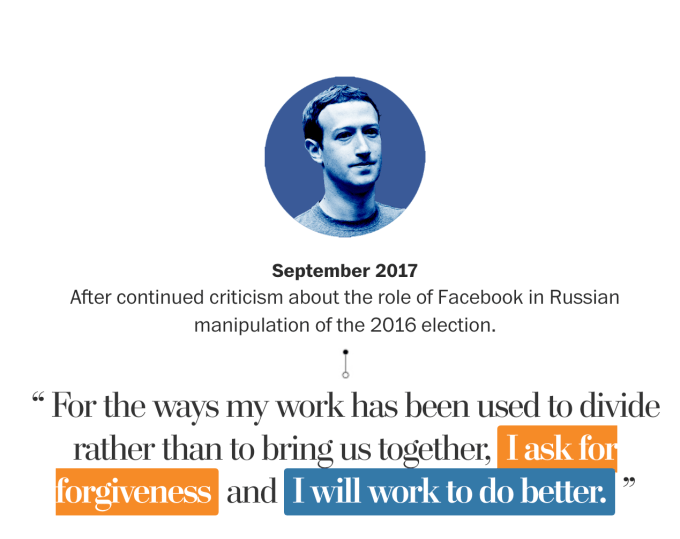
The result is that even if their leaders earnestly wanted to impart meaningful change to provide restitution for their wrongs, their hands are tied by entrenched business models and the short-term focus of the quarterly earnings cycle. They apologize and go right back to problematic behavior. The Washington Post recently chronicled a dozen times Facebook CEO Mark Zuckerberg has apologized, yet the social network keeps experiencing fiasco after fiasco. Tech giants won’t improve enough on their own.

Addiction To Utility

The threat of us abandoning ship should theoretically hold the captains in line. But tech giants have evolved into fundamental utilities that many have a hard time imagining living without. How would you connect with friends? Find what you needed? Get work done? Spend your time? What hardware or software would you cuddle up with in the moments you feel lonely? We live our lives through tech, have become addicted to its utility, and fear the withdrawal.

If there were principled alternatives to switch to, perhaps we could hold the giants accountable. But the scalability, network effects, and aggregation of supply by distributors has led to near monopolies in these core utilities. The second-place solution is often distant. What’s the next best social network that serves as an identity and login platform that isn’t owned by Facebook? The next best premium mobile and PC maker behind Apple? The next best mobile operating system for the developing world beyond Google’s Android? The next best ecommerce hub that’s not Amazon? The next best search engine? Photo feed? Web hosting service? Global chat app? Spreadsheet?

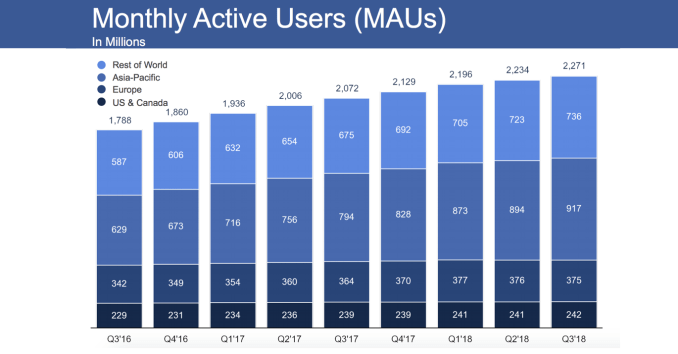
Facebook is still growing in the US & Canada despite the backlash, proving that tech users aren’t voting with their feet. And if not for a calculation methodology change, it would have added 1 million users in Europe this quarter too.

One of the few tech backlashes that led to real flight was #DeleteUber. Workplace discrimination, shady business protocols, exploitative pricing and more combined to spur the movement to ditch the ridehailing app. But what was different here is that US Uber users did have a principled alternative to switch to without much hassle: Lyft. The result was that “Lyft benefitted tremendously from Uber’s troubles in 2018” eMarketer’s forecasting director Shelleen Shum told the USA Today in May. Uber missed eMarketer’s projections while Lyft exceeded them, narrowing the gap between the car services. And meanwhile, Uber’s CEO stepped down as it tried to overhaul its internal policies.

But in the absence of viable alternatives to the giants, leaving these mainstays is inconvenient. After all, they’re the ones that made us practically allergic to friction. Even after massive scandals, data breaches, toxic cultures, and unfair practices, we largely stick with them to avoid the uncertainty of life without them. Even Facebook added 1 million monthly users in the US and Canada last quarter despite seemingly every possible source of unrest. Tech users are not voting with their feet. We’ve proven we can harbor ill will towards the giants while begrudgingly buying and using their products. Our leverage to improve their behavior is vastly weakened by our loyalty.

Inadequate Oversight

Regulators have failed to adequately step up either. This year’s congressional hearings about Facebook and social media often devolved into inane and uninformed questioning like how does Facebook earn money if its doesn’t charge? “Senator, we run ads” Facebook CEO Mark Zuckerberg said with a smirk. Other times, politicians were so intent on scoring partisan points by grandstanding or advancing conspiracy theories about bias that they were unable to make any real progress. A recent survey commissioned by Axios found that “In the past year, there has been a 15-point spike in the number of people who fear the federal government won’t do enough to regulate big tech companies — with 55% now sharing this concern.”

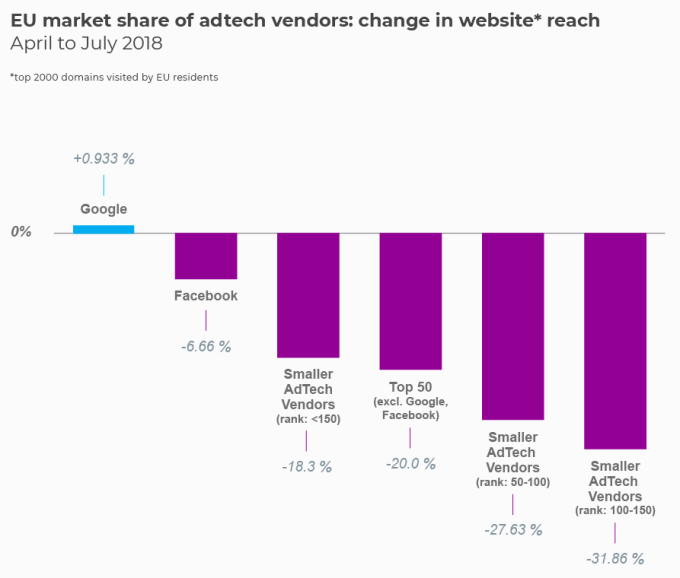
When regulators do step in, their attempts can backfire. GDPR was supposed to help tamp down on the dominance of Google and Facebook by limiting how they could collect user data and making them more transparent. But the high cost of compliance simply hindered smaller players or drove them out of the market while the giants had ample cash to spend on jumping through government hoops. Google actually gained ad tech market share and Facebook saw the littlest loss while smaller ad tech firms lost 20 or 30 percent of their business.

Europe’s GDPR privacy regulations backfired, reinforcing Google and Facebook’s dominance. Chart via Ghostery, Cliqz, and WhoTracksMe.

Even the Honest Ads act, which was designed to bring political campaign transparency to internet platforms following election interference in 2016, has yet to be passed even despite support from Facebook and Twitter. There’s hasn’t been meaningful discussion of blocking social networks from acquiring their competitors in the future, let alone actually breaking Instagram and WhatsApp off of Facebook. Governments like the U.K. that just forcibly seized documents related to Facebook’s machinations surrounding the Cambridge Analytica debacle provide some indication of willpower. But clumsy regulation could deepen the moats of the incumbents, and prevent disruptors from gaining a foothold. We can’t depend on regulators to sufficiently protect us from tech giants right now.

Our Hope On The Inside

The best bet for change will come from the rank and file of these monolithic companies. With the war for talent raging, rock star employees able to have huge impact on products, and compensation costs to keep them around rising, tech giants are vulnerable to the opinions of their own staff. It’s simply too expensive and disjointing to have to recruit new high-skilled workers to replace those that flee.

Google declined to renew a contract with the government after 4000 employees petitioned and a few resigned over Project Maven’s artificial intelligence being used to target lethal drone strikes. Change can even flow across company lines. Many tech giants including Facebook and Airbnb have removed their forced arbitration rules for harassment disputes after Google did the same in response to 20,000 of its employees walking out in protest.

Thousands of Google employees protested the company’s handling of sexual harassment and misconduct allegations on Nov. 1.

Facebook is desperately pushing an internal communications campaign to reassure staffers it’s improving in the wake of damning press reports from the New York Times and others. TechCrunch published an internal memo from Facebook’s outgoing VP of communications Elliot Schrage in which he took the blame for recent issues, encouraged employees to avoid finger-pointing, and COO Sheryl Sandberg tried to reassure employees that “I know this has been a distraction at a time when you’re all working hard to close out the year — and I am sorry.” These internal apologizes could come with much more contrition and real change than those paraded for the public.

And so after years of us relying on these tech workers to build the product we use every day, we must now rely that will save us from them. It’s a weighty responsibility to move their talents where the impact is positive, or commit to standing up against the business imperatives of their employers. We as the public and media must in turn celebrate when they do what’s right for society, even when it reduces value for shareholders. And we must accept that shaping the future for the collective good may be inconvenient for the individual.

For more on this topic:


Read Full Article

Tech giants offer empty apologies because users can’t quit


A true apology consists of a sincere acknowledgement of wrong-doing, a show of empathic remorse for why you wronged and the harm it caused, and a promise of restitution by improving ones actions to make things right. Without the follow-through, saying sorry isn’t an apology, it’s a hollow ploy for forgiveness.

That’s the kind of “sorry” we’re getting from tech giants — an attempt to quell bad PR and placate the afflicted, often without the systemic change necessary to prevent repeated problems. Sometimes it’s delivered in a blog post. Sometimes it’s in an executive apology tour of media interviews. But rarely is it in the form of change to the underlying structures of a business that caused the issue.

Intractable Revenue

Unfortunately, tech company business models often conflict with the way we wish they would act. We want more privacy but they thrive on targeting and personalization data. We want control of our attention but they subsist on stealing as much of it as possible with distraction while showing us ads. We want safe, ethically built devices that don’t spy on us but they make their margins by manufacturing them wherever’s cheap with questionable standards of labor and oversight. We want groundbreaking technologies to be responsibly applied, but juicy government contracts and the allure of China’s enormous population compromise their morals. And we want to stick to what we need and what’s best for us, but they monetize our craving for the latest status symbol or content through planned obsolescence and locking us into their platforms.

The result is that even if their leaders earnestly wanted to impart meaningful change to provide restitution for their wrongs, their hands are tied by entrenched business models and the short-term focus of the quarterly earnings cycle. They apologize and go right back to problematic behavior. The Washington Post recently chronicled a dozen times Facebook CEO Mark Zuckerberg has apologized, yet the social network keeps experiencing fiasco after fiasco. Tech giants won’t improve enough on their own.

Addiction To Utility

The threat of us abandoning ship should theoretically hold the captains in line. But tech giants have evolved into fundamental utilities that many have a hard time imagining living without. How would you connect with friends? Find what you needed? Get work done? Spend your time? What hardware or software would you cuddle up with in the moments you feel lonely? We live our lives through tech, have become addicted to its utility, and fear the withdrawal.

If there were principled alternatives to switch to, perhaps we could hold the giants accountable. But the scalability, network effects, and aggregation of supply by distributors has led to near monopolies in these core utilities. The second-place solution is often distant. What’s the next best social network that serves as an identity and login platform that isn’t owned by Facebook? The next best premium mobile and PC maker behind Apple? The next best mobile operating system for the developing world beyond Google’s Android? The next best ecommerce hub that’s not Amazon? The next best search engine? Photo feed? Web hosting service? Global chat app? Spreadsheet?

Facebook is still growing in the US & Canada despite the backlash, proving that tech users aren’t voting with their feet. And if not for a calculation methodology change, it would have added 1 million users in Europe this quarter too.

One of the few tech backlashes that led to real flight was #DeleteUber. Workplace discrimination, shady business protocols, exploitative pricing and more combined to spur the movement to ditch the ridehailing app. But what was different here is that US Uber users did have a principled alternative to switch to without much hassle: Lyft. The result was that “Lyft benefitted tremendously from Uber’s troubles in 2018” eMarketer’s forecasting director Shelleen Shum told the USA Today in May. Uber missed eMarketer’s projections while Lyft exceeded them, narrowing the gap between the car services. And meanwhile, Uber’s CEO stepped down as it tried to overhaul its internal policies.

But in the absence of viable alternatives to the giants, leaving these mainstays is inconvenient. After all, they’re the ones that made us practically allergic to friction. Even after massive scandals, data breaches, toxic cultures, and unfair practices, we largely stick with them to avoid the uncertainty of life without them. Even Facebook added 1 million monthly users in the US and Canada last quarter despite seemingly every possible source of unrest. Tech users are not voting with their feet. We’ve proven we can harbor ill will towards the giants while begrudgingly buying and using their products. Our leverage to improve their behavior is vastly weakened by our loyalty.

Inadequate Oversight

Regulators have failed to adequately step up either. This year’s congressional hearings about Facebook and social media often devolved into inane and uninformed questioning like how does Facebook earn money if its doesn’t charge? “Senator, we run ads” Facebook CEO Mark Zuckerberg said with a smirk. Other times, politicians were so intent on scoring partisan points by grandstanding or advancing conspiracy theories about bias that they were unable to make any real progress. A recent survey commissioned by Axios found that “In the past year, there has been a 15-point spike in the number of people who fear the federal government won’t do enough to regulate big tech companies — with 55% now sharing this concern.”

When regulators do step in, their attempts can backfire. GDPR was supposed to help tamp down on the dominance of Google and Facebook by limiting how they could collect user data and making them more transparent. But the high cost of compliance simply hindered smaller players or drove them out of the market while the giants had ample cash to spend on jumping through government hoops. Google actually gained ad tech market share and Facebook saw the littlest loss while smaller ad tech firms lost 20 or 30 percent of their business.

Europe’s GDPR privacy regulations backfired, reinforcing Google and Facebook’s dominance. Chart via Ghostery, Cliqz, and WhoTracksMe.

Even the Honest Ads act, which was designed to bring political campaign transparency to internet platforms following election interference in 2016, has yet to be passed even despite support from Facebook and Twitter. There’s hasn’t been meaningful discussion of blocking social networks from acquiring their competitors in the future, let alone actually breaking Instagram and WhatsApp off of Facebook. Governments like the U.K. that just forcibly seized documents related to Facebook’s machinations surrounding the Cambridge Analytica debacle provide some indication of willpower. But clumsy regulation could deepen the moats of the incumbents, and prevent disruptors from gaining a foothold. We can’t depend on regulators to sufficiently protect us from tech giants right now.

Our Hope On The Inside

The best bet for change will come from the rank and file of these monolithic companies. With the war for talent raging, rock star employees able to have huge impact on products, and compensation costs to keep them around rising, tech giants are vulnerable to the opinions of their own staff. It’s simply too expensive and disjointing to have to recruit new high-skilled workers to replace those that flee.

Google declined to renew a contract with the government after 4000 employees petitioned and a few resigned over Project Maven’s artificial intelligence being used to target lethal drone strikes. Change can even flow across company lines. Many tech giants including Facebook and Airbnb have removed their forced arbitration rules for harassment disputes after Google did the same in response to 20,000 of its employees walking out in protest.

Thousands of Google employees protested the company’s handling of sexual harassment and misconduct allegations on Nov. 1.

Facebook is desperately pushing an internal communications campaign to reassure staffers it’s improving in the wake of damning press reports from the New York Times and others. TechCrunch published an internal memo from Facebook’s outgoing VP of communications Elliot Schrage in which he took the blame for recent issues, encouraged employees to avoid finger-pointing, and COO Sheryl Sandberg tried to reassure employees that “I know this has been a distraction at a time when you’re all working hard to close out the year — and I am sorry.” These internal apologizes could come with much more contrition and real change than those paraded for the public.

And so after years of us relying on these tech workers to build the product we use every day, we must now rely that will save us from them. It’s a weighty responsibility to move their talents where the impact is positive, or commit to standing up against the business imperatives of their employers. We as the public and media must in turn celebrate when they do what’s right for society, even when it reduces value for shareholders. And we must accept that shaping the future for the collective good may be inconvenient for the individual.

For more on this topic:


Read Full Article

Tech giants offer empty apologies because users can’t quit


A true apology consists of a sincere acknowledgement of wrong-doing, a show of empathic remorse for why you wronged and the harm it caused, and a promise of restitution by improving ones actions to make things right. Without the follow-through, saying sorry isn’t an apology, it’s a hollow ploy for forgiveness.

That’s the kind of “sorry” we’re getting from tech giants — an attempt to quell bad PR and placate the afflicted, often without the systemic change necessary to prevent repeated problems. Sometimes it’s delivered in a blog post. Sometimes it’s in an executive apology tour of media interviews. But rarely is it in the form of change to the underlying structures of a business that caused the issue.

Intractable Revenue

Unfortunately, tech company business models often conflict with the way we wish they would act. We want more privacy but they thrive on targeting and personalization data. We want control of our attention but they subsist on stealing as much of it as possible with distraction while showing us ads. We want safe, ethically built devices that don’t spy on us but they make their margins by manufacturing them wherever’s cheap with questionable standards of labor and oversight. We want groundbreaking technologies to be responsibly applied, but juicy government contracts and the allure of China’s enormous population compromise their morals. And we want to stick to what we need and what’s best for us, but they monetize our craving for the latest status symbol or content through planned obsolescence and locking us into their platforms.

The result is that even if their leaders earnestly wanted to impart meaningful change to provide restitution for their wrongs, their hands are tied by entrenched business models and the short-term focus of the quarterly earnings cycle. They apologize and go right back to problematic behavior. The Washington Post recently chronicled a dozen times Facebook CEO Mark Zuckerberg has apologized, yet the social network keeps experiencing fiasco after fiasco. Tech giants won’t improve enough on their own.

Addiction To Utility

The threat of us abandoning ship should theoretically hold the captains in line. But tech giants have evolved into fundamental utilities that many have a hard time imagining living without. How would you connect with friends? Find what you needed? Get work done? Spend your time? What hardware or software would you cuddle up with in the moments you feel lonely? We live our lives through tech, have become addicted to its utility, and fear the withdrawal.

If there were principled alternatives to switch to, perhaps we could hold the giants accountable. But the scalability, network effects, and aggregation of supply by distributors has led to near monopolies in these core utilities. The second-place solution is often distant. What’s the next best social network that serves as an identity and login platform that isn’t owned by Facebook? The next best premium mobile and PC maker behind Apple? The next best mobile operating system for the developing world beyond Google’s Android? The next best ecommerce hub that’s not Amazon? The next best search engine? Photo feed? Web hosting service? Global chat app? Spreadsheet?

Facebook is still growing in the US & Canada despite the backlash, proving that tech users aren’t voting with their feet. And if not for a calculation methodology change, it would have added 1 million users in Europe this quarter too.

One of the few tech backlashes that led to real flight was #DeleteUber. Workplace discrimination, shady business protocols, exploitative pricing and more combined to spur the movement to ditch the ridehailing app. But what was different here is that US Uber users did have a principled alternative to switch to without much hassle: Lyft. The result was that “Lyft benefitted tremendously from Uber’s troubles in 2018” eMarketer’s forecasting director Shelleen Shum told the USA Today in May. Uber missed eMarketer’s projections while Lyft exceeded them, narrowing the gap between the car services. And meanwhile, Uber’s CEO stepped down as it tried to overhaul its internal policies.

But in the absence of viable alternatives to the giants, leaving these mainstays is inconvenient. After all, they’re the ones that made us practically allergic to friction. Even after massive scandals, data breaches, toxic cultures, and unfair practices, we largely stick with them to avoid the uncertainty of life without them. Even Facebook added 1 million monthly users in the US and Canada last quarter despite seemingly every possible source of unrest. Tech users are not voting with their feet. We’ve proven we can harbor ill will towards the giants while begrudgingly buying and using their products. Our leverage to improve their behavior is vastly weakened by our loyalty.

Inadequate Oversight

Regulators have failed to adequately step up either. This year’s congressional hearings about Facebook and social media often devolved into inane and uninformed questioning like how does Facebook earn money if its doesn’t charge? “Senator, we run ads” Facebook CEO Mark Zuckerberg said with a smirk. Other times, politicians were so intent on scoring partisan points by grandstanding or advancing conspiracy theories about bias that they were unable to make any real progress. A recent survey commissioned by Axios found that “In the past year, there has been a 15-point spike in the number of people who fear the federal government won’t do enough to regulate big tech companies — with 55% now sharing this concern.”

When regulators do step in, their attempts can backfire. GDPR was supposed to help tamp down on the dominance of Google and Facebook by limiting how they could collect user data and making them more transparent. But the high cost of compliance simply hindered smaller players or drove them out of the market while the giants had ample cash to spend on jumping through government hoops. Google actually gained ad tech market share and Facebook saw the littlest loss while smaller ad tech firms lost 20 or 30 percent of their business.

Europe’s GDPR privacy regulations backfired, reinforcing Google and Facebook’s dominance. Chart via Ghostery, Cliqz, and WhoTracksMe.

Even the Honest Ads act, which was designed to bring political campaign transparency to internet platforms following election interference in 2016, has yet to be passed even despite support from Facebook and Twitter. There’s hasn’t been meaningful discussion of blocking social networks from acquiring their competitors in the future, let alone actually breaking Instagram and WhatsApp off of Facebook. Governments like the U.K. that just forcibly seized documents related to Facebook’s machinations surrounding the Cambridge Analytica debacle provide some indication of willpower. But clumsy regulation could deepen the moats of the incumbents, and prevent disruptors from gaining a foothold. We can’t depend on regulators to sufficiently protect us from tech giants right now.

Our Hope On The Inside

The best bet for change will come from the rank and file of these monolithic companies. With the war for talent raging, rock star employees able to have huge impact on products, and compensation costs to keep them around rising, tech giants are vulnerable to the opinions of their own staff. It’s simply too expensive and disjointing to have to recruit new high-skilled workers to replace those that flee.

Google declined to renew a contract with the government after 4000 employees petitioned and a few resigned over Project Maven’s artificial intelligence being used to target lethal drone strikes. Change can even flow across company lines. Many tech giants including Facebook and Airbnb have removed their forced arbitration rules for harassment disputes after Google did the same in response to 20,000 of its employees walking out in protest.

Thousands of Google employees protested the company’s handling of sexual harassment and misconduct allegations on Nov. 1.

Facebook is desperately pushing an internal communications campaign to reassure staffers it’s improving in the wake of damning press reports from the New York Times and others. TechCrunch published an internal memo from Facebook’s outgoing VP of communications Elliot Schrage in which he took the blame for recent issues, encouraged employees to avoid finger-pointing, and COO Sheryl Sandberg tried to reassure employees that “I know this has been a distraction at a time when you’re all working hard to close out the year — and I am sorry.” These internal apologizes could come with much more contrition and real change than those paraded for the public.

And so after years of us relying on these tech workers to build the product we use every day, we must now rely that will save us from them. It’s a weighty responsibility to move their talents where the impact is positive, or commit to standing up against the business imperatives of their employers. We as the public and media must in turn celebrate when they do what’s right for society, even when it reduces value for shareholders. And we must accept that shaping the future for the collective good may be inconvenient for the individual.

For more on this topic:


Read Full Article

25 November 2018

UK parliament seizes cache of internal Facebook documents to further privacy probe


Facebook founder Mark Zuckerberg may yet regret underestimating a UK parliamentary committee that’s been investigating the democracy-denting impact of online disinformation for the best part of this year — and whose repeat requests for facetime he’s just as repeatedly snubbed.

In the latest high gear change, reported in yesterday’s Observer, the committee has used parliamentary powers to seize a cache of documents pertaining to a US lawsuit to further its attempt to hold Facebook to account for misuse of user data.

Facebook’s oversight — or rather lack of it — where user data is concerned has been a major focus for the committee, as its enquiry into disinformation and data misuse has unfolded and scaled over the course of this year, ballooning in scope and visibility since the Cambridge Analytica story blew up into a global scandal this April.

The internal documents now in the committee’s possession are alleged to contain significant revelations about decisions made by Facebook senior management vis-a-vis data and privacy controls — including confidential emails between senior executives and correspondence with Zuckerberg himself.

This has been a key line of enquiry for parliamentarians. And an equally frustrating one — with committee members accusing Facebook of being deliberately misleading and concealing key details from it.

The seized files pertain to a US lawsuit that predates mainstream publicity around political misuse of Facebook data, with the suit filed in 2015, by a US startup called Six4Three, after Facebook removed developer access to friend data. (As we’ve previously reported Facebook was actually being warned about data risks related to its app permissions as far back as 2011 — yet it didn’t full shut down the friends data API until May 2015.)

The core complaint is an allegation that Facebook enticed developers to create apps for its platform by implying they would get long-term access to user data in return. So by later cutting data access the claim is that Facebook was effectively defrauding developers.

Since lodging the complaint, the plaintiffs have seized on the Cambridge Analytica saga to try to bolster their case.

And in a legal motion filed in May Six4Three’s lawyers claimed evidence they had uncovered demonstrated that “the Cambridge Analytica scandal was not the result of mere negligence on Facebook’s part but was rather the direct consequence of the malicious and fraudulent scheme Zuckerberg designed in 2012 to cover up his failure to anticipate the world’s transition to smartphones”.

The startup used legal powers to obtain the cache of documents — which remain under seal on order of a California court. But the UK parliament used its own powers to swoop in and seize the files from the founder of Six4Three during a business trip to London when he came under the jurisdiction of UK law, compelling him to hand them over.

According to the Observer, parliament sent a serjeant at arms to the founder’s hotel — giving him a final warning and a two-hour deadline to comply with its order.

“When the software firm founder failed to do so, it’s understood he was escorted to parliament. He was told he risked fines and even imprisonment if he didn’t hand over the documents,” it adds, apparently revealing how Facebook lost control over some more data (albeit, its own this time).

In comments to the newspaper yesterday, DCMS committee chair Damian Collins said: “We are in uncharted territory. This is an unprecedented move but it’s an unprecedented situation. We’ve failed to get answers from Facebook and we believe the documents contain information of very high public interest.”

Collins later tweeted the Observer’s report on the seizure, teasing “more next week” — likely a reference to the grand committee hearing in parliament already scheduled for November 27.

But it could also be a hint the committee intends to reveal and/or make use of information locked up in the documents, as it puts questions to Facebook’s VP of policy solutions…

That said, the documents are subject to the Californian superior court’s seal order, so — as the Observer points out — cannot be shared or made public without risk of being found in contempt of court.

A spokesperson for Facebook made the same point, telling the newspaper: “The materials obtained by the DCMS committee are subject to a protective order of the San Mateo Superior Court restricting their disclosure. We have asked the DCMS committee to refrain from reviewing them and to return them to counsel or to Facebook. We have no further comment.”

Facebook’s spokesperson added that Six4Three’s “claims have no merit”, further asserting: “We will continue to defend ourselves vigorously.”

And, well, the irony of Facebook asking for its data to remain private also shouldn’t be lost on anyone at this point…

Another irony: In July, the Guardian reported that as part of Facebook’s defence against Six4Three’s suit the company had argued in court that it is a publisher — seeking to have what it couched as ‘editorial decisions’ about data access protected by the US’ first amendment.

Which is — to put it mildly — quite the contradiction, given Facebook’s long-standing public characterization of its business as just a distribution platform, never a media company.

So expect plenty of fireworks at next week’s public hearing as parliamentarians once again question Facebook over its various contradictory claims.

It’s also possible the committee will have been sent an internal email distribution list by then, detailing who at Facebook knew about the Cambridge Analytica breach in the earliest instance.

This list was obtained by the UK’s data watchdog, over the course of its own investigation into the data misuse saga. And earlier this month information commissioner Elizabeth Denham confirmed the ICO has the list and said it would pass it to the committee.

The accountability net does look to be closing in on Facebook management.

Even as Facebook continues to deny international parliaments any face-time with its founder and CEO (the EU parliament remains the sole exception).

Last week the company refused to even have Zuckerberg do a video call to take the committee’s questions — offering its VP of policy solutions, Richard Allan, to go before what’s now a grand committee comprised of representatives from seven international parliaments instead.

The grand committee hearing will take place in London on Tuesday morning, British time — followed by a press conference in which parliamentarians representing Facebook users from across the world will sign a set of ‘International Principles for the Law Governing the Internet’, making “a declaration on future action”.

So it’s also ‘watch this space’ where international social media regulation is concerned.

As noted above, Allan is just the latest stand-in for Zuckerberg. Back in April the DCMS committee spend the best part of five hours trying to extract answers from Facebook CTO, Mike Schroepfer.

“You are doing your best but the buck doesn’t stop with you does it? Where does the buck stop?” one committee member asked him then.

“It stops with Mark,” replied Schroepfer.

But Zuckerberg definitely won’t be stopping by on Tuesday.


Read Full Article