17 August 2018

How to Delete Your eBay Account


Fed up with eBay? Whether you’ve been burned by eBay’s security issues or just can’t seem to win any auctions, it’s easy to become frustrated with the service.

If you never use eBay anymore, you can delete your account for closure. It’s not difficult! Here’s how it works.

Before You Delete Your eBay Account

Before you delete your account, you should consider a few points to make sure it’s right for you. Keep these in mind:

  • When you close your account, you’ll lose your feedback and history.
  • You need to have all fees paid and an account balance of zero.
  • You shouldn’t have any open bids out.
  • You can’t close if your account doesn’t meet eBay’s seller performance standards.

How to Delete Your eBay Account

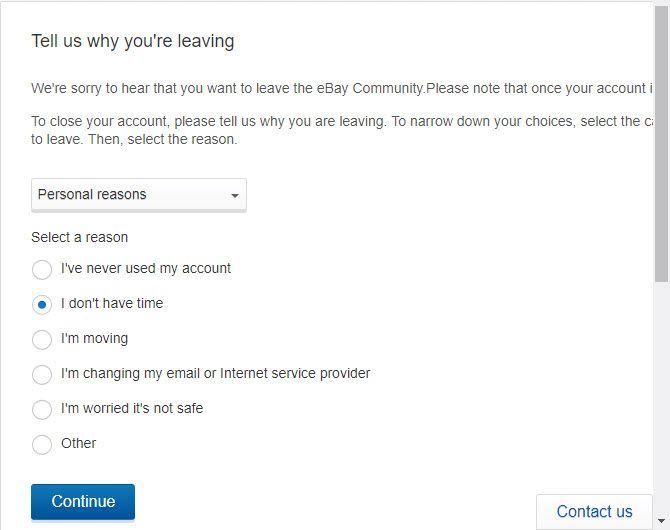
eBay-Reason-For-Leaving

Visit eBay’s Close Account page and sign in if needed. Here, eBay will ask you for a reason why you’re closing your account. Choose a category from the dropdown like Security concerns or Personal reasons, then select a specific reason from the bullets.

After you click Continue, eBay will display some advice based on what you chose. It wants you to keep your account open, so it will suggest that you take a different action. You can select whether this resolved your issue and you’d like to keep your account, or if you still want to close it.

Once you proceed and submit a request to close your account, you’ll get an email and won’t be able to use your account anymore. eBay says it usually takes 30 days to to close an account, but it will keep your account open for 60 days if you’ve bought or sold an item recently.

You can contact eBay if you change your mind during the 30/60 day period. If you just want to stop selling on eBay, you don’t have to close your account. Simply removing auto-payment methods will let you keep your account open without costing you anything.

Since you’re done with eBay, why not check out some of the other best bargain websites?

Image Credit: bernardojbp/Depositphotos

Read the full article: How to Delete Your eBay Account


Read Full Article

Equations


Equations

Google and GN Hearing partner to stream audio from Android devices directly to hearing aids


Denmark’s GN Hearing broke new ground in hearing aid technology five years ago when it inked a deal with Apple to develop a hearing aid that would integrate seamlessly with an iPhone, with no need for an intermediary device. And today it announced a significant, new milestone expansion in that technology: it has partnered with Google to bring the same functionality to Android handsets.

Google has published a specification for audio streaming for hearing aids using Bluetooth Low Energy (BLE) and connection-oriented channels which, in the words of Google, relies on “an elastic buffer of several audio packets to maintain a steady flow of audio, even in the presence of packet loss. This buffer provides audio quality for hearing aid devices at the expense of latency.” GN Hearing will be the first to develop these hearing aids using Google’s specifications, which it helped to write.

“Google is working with GN Hearing to create a new open specification for hearing aid streaming support on future versions of Android devices,” said Seang Chau, Vice President of Engineering at Google, in a statement.

This will mark the first time that Android smartphones will stream audio directly to hearing aids, and, since Android devices account for a majority of smartphones in use today, it is a big step up in helping people who use hearing aids be more integrated with the “smartphone revolution” and the wave of services and applications that come with using mobile devices.

Up to now, because of how hearing aids are designed to amplify sounds, those who used one, and also wanted to use an Android device, would either have to use a supplementary piece of hardware to use the two together, or remove the hearing aid altogether and have a poor quality conversation.

In addition to using the specification to stream audio from calls and phone apps directly to the hearing aid, users will also be able to monitor their hearing aids and modify their volumes using an app on their phones.

Anders Hedegaard, the CEO of GN Hearing, tells TechCrunch that he “cautiously” estimates that the first hearing aids with live Android integrations will hit the market in 2019. And while his company does not have exclusivity on this — and the specification, like others on Android, is open source for anyone else to use — GN Hearing is likely to be the first because it has been working on the specification.

Hearing loss has been on the rise, in part because people are living longer, and in part because of environmental factors (like headphones that people use with loud volumes). The World Health Organization estimates that there are some 466 million people with disabling hearing loss, up from about 360 million in 2013, and that will grow to 900 million by 2050.

But despite the growth of the issue, both the hearing aid industry and its users have been relatively slow to embrace wireless technology, although things have been changing. Hedegaard said that when his company first announced its partnership with Apple in 2013, the idea of a connected hearing aid was relatively new, and it took until 2016 for any one of its competitors to add the iPhone integration that GN Hearing pioneered. “Today, data connectivity is a core part of hearing aids,” he said, “and 90% of our devices have it.”

Similarly, the amount of hearing aid users actually employing the connected functionality is also going up.

“We have seen the percentage of people using connectivity going up dramatically,” he said. In 2013/14, he estimated that only about 10 percent of people who had connected hearing aids actually used the service with apps and other devices. Now “the majority” download apps and take advantage, he said. It helps that with each year, the gap between the ageing population and those who have spent years using computers and mobile phones and apps is shrinking. “Time is going our way,” he said.

We have reached out to Google for further comment and will update this post as we learn more.

Read Full Article

Google One is more proof of commoditization of consumer cloud storage


We have long known that the price of cloud storage services like Dropbox, Google Drive and Microsoft OneDrive have been getting cheaper over time. Yesterday’s launch of Google One in the U.S. dropped the price for Google storage even further, cutting the cost per terabyte per month in half, driving this point home even more clearly.

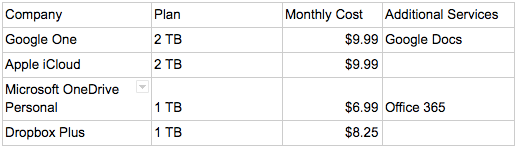
As Frederic Lardinois pointed out in his post, 2 terabytes of storage now costs $9.99 a month. Consider that without joining Google One, that was the same price for 1 terabyte of storage. By signing up for Google One, you could double your storage without paying one penny more, and let’s face it this was a ton of storage before the change.

Let’s compare that with some of the other players out there. Each one is a little different, but the storage costs tell a story.

Google One’s shift to 2 TB for $9.99 a month puts it in line with Apple’s pricing, which surprisingly had given you the most storage bang for your buck out of these four companies before Google One came along. Who would have thought that Apple was giving its users the best price on anything? Of course, you get access to Office 365, including Word and PowerPoint, with your terabyte of Microsoft OneDrive storage, which is going to add a fair bit of value for many users over and above the pure storage being offered.

Regardless, if you consider Apple and Google’s pricing, the price of a terabyte of cloud storage has dropped to $5.00 a month. That’s pretty darn cheap and it shows just how commoditized online storage has become and how much scale you require to make money.

Alan Pelz-Sharpe, principal analyst at Deep Analysis, who has been watching this space for years says that consumer cloud storage pricing has always been a race to the bottom. “You can only make a margin with mass scale. That’s why firms who are not Microsoft, Amazon or Google are pushing hard for business and enterprise customers. Google One just brings that message home,” he said.

If you get enough scale, as Dropbox has with an estimated 500 million users, if you can get a percentage to pay $8.25 a month for a terabyte of storage, it can add up to real money. When Dropbox filed its S-1 to before it went public earlier this year, it reported more than $1 billion in consumer revenue. It would be difficult if not impossible for a startup launching today to compete with the existing players, but the ones out there continue to compete with one another, driving the cost down even further.

Today’s announcement is just another step in that downward price pressure of consumer cloud storage, and when you get double the storage from one day to the next for the exact same price, it shows just how true that it is.


Read Full Article

DoorDash raises another $250M, nearly triples valuation to $4B


Food delivery startup DoorDash announced this afternoon that it has raised $250 million, just five months since the company announced a $535 million round.

Why raise more money so soon? CEO Tony Xu told Axios that he wasn’t actively looking for additional investment, but was open to investor interest because it could help the company expand more quickly. (Maybe he’ll have more to say about those plans at Disrupt SF next month.)

The new funding was led by Coatue Management and DST Global. It sounds like the terms were pretty appealing too, with the valuation growing from $1.4 billion to $4 billion.

In a blog post, the company said it’s had a good 2018, with deliveries increasing 250 percent year-over-year, restaurant chains like Chipotle and IHOP signing up and last week’s launch of the DashPass subscription service, where you can pay $9.99 per month to get unlimited free deliveries.

“As we grow, we will stay true to our values and our mission of connecting people with possibility  —  and, trust us, we’re just getting started,” DoorDash wrote.


Read Full Article

Google Search Adds More Featured Snippets


If you have ever searched for something on Google, which we’d guess is everyone reading this, then you’ll have seen Google’s featured snippets. These being the little snippets Google places front and center in an attempt to provide the best answer to your query.

In January, Google published “A reintroduction to Google’s featured snippets” in an effort to remind everyone what they’re for. And since then Google has made a number of improvements to the way Search, and featured snippets in particular, operates.

The latest update is now rolling out, and it adds more featured snippets to Google Search…

Featured Snippets Galore

Google’s new format for featured snippets adds more options based on context. So now, rather than one featured snippet that tries to answer your search query and fails, Google will provide multiple featured snippets based on the different connotations of your search.

In The Keyword blog post, Google gives the example of “Quartz Vs Granite”. The main featured snippet offers a geologist’s perspective on the differences. However, if you’re looking to remodel your kitchen that might not be what you’re looking for.

So, now, underneath the main featured snippet, Google offer alternatives. In the “Quartz Vs Granite” example Google offers options for Cost, Benefits, Weight, and Durability. Click on one of these and you’ll get a new featured snippet with a link to the source.

This isn’t the biggest change in the world, but it’s Google trying to offer more options to make Search even more essential than it is already. The only problem being it pushes other sites, which haven’t nabbed the featured snippets, further down in the results.

Is Google Fallible?

Google’s featured snippets are a useful tool which most of us take for granted. Sure, they don’t always provide the best answer to our searches, but even Google is fallible on occasion. And perhaps this article will provide the featured snippet for “Is Google fallible?”

If you feel like you spend half your waking life Googling stuff, here are eight Google Search tips to keep handy at all times. But never forget that there are plenty of solid alternatives to Google Search, some of which are actually pretty good.

Image Credit: Frankieleon/Flickr

Read the full article: Google Search Adds More Featured Snippets


Read Full Article

How to Safely Install Fortnite on Android: A Quick Sideloading Guide


fortnite-battle-royale-mobile

The world’s most popular 100-player PVP battle royale is coming to Android at long last. That’s right: you can finally play Fortnite on your Android device. Time to rejoice, grab your mats, and get ready to ride the storm.

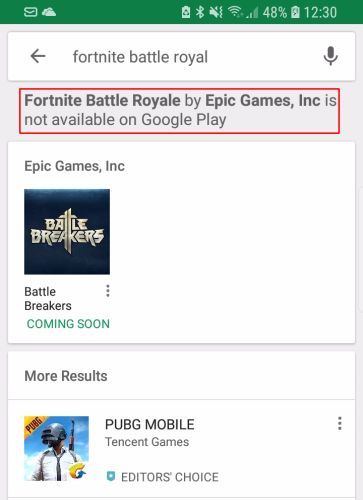
That is until you realize that Fortnite isn’t available on the official Google Play Store. Fortnite developer, Epic Games, wants you to use a specialized launcher, but that means turning off third-party download restrictions and sideloading the app—and this can come with risks.

Here’s how to safely install Fortnite on Android, and what precautions you should take.

Why Isn’t Fortnite on the Google Play Store?

Epic Games recently confirmed that their insanely popular Fortnite battle royale would finally make its way onto Android devices.

However, at the same time, Epic Games also confirmed rumors that Fortnite would use an individual launcher downloaded straight from the developer, rather than the long-established and potentially more secure Google Play Store.

The decision appears to boil down to two main reasons:

  1. Epic Games doesn’t want Google to take their customary 30 percent cut for using the Google Play Store.
  2. Epic Games founder, Tim Sweeney, believes “competition among services gives consumers lots of great choices and enables the best to succeed based on merit.” Sweeney also said that the same choice would have been made if the option was available to iOS devices.

The first point is massive, especially when you consider the phenomenal revenue Fortnite already rakes in on Windows and macOS. Want an idea of how much? Fortnite players spent $318 million in May 2018 alone and allegedly over $1 billion in total on in-app purchases.

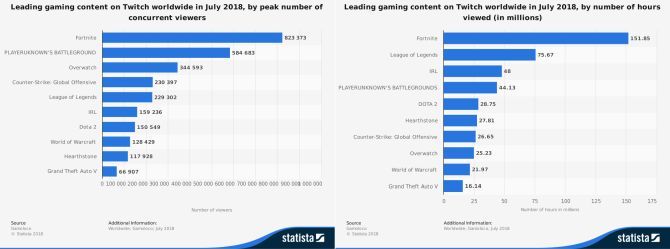
statista twitch streaming figures

It stands to reason, as battle royale games are currently the most popular by far, and free-to-play Fortnite is the most popular within the genre.

In July 2018, Fortnite had over 820,000 concurrent viewers on video game streaming platform Twitch, streaming over 151 million hours of content. Remember, that’s just for July 2018. Over the same period, direct competitor PlayerUnknown’s Battlegrounds (PUBG) brought in over 580,000 concurrent viewers, for a total of 44.1 million hours of streaming content.

Mind-blowing figures, but it illustrates just how popular Fortnite is as well as why Epic Games decision to cut Google out of the loop is financially imperative.

How to Install the Fortnite Launcher on Android

At the time of writing, the Android version of Fornite is in beta testing. If you already have an Epic Games account, there is a strong chance you will have beta access. Check out the video below for a short tutorial on how to install the Fortnite launcher on your Android device. I’m using a Samsung Galaxy S8, but your experience may vary.

  1. On your Android device, head to the Fortnite homepage. Select the Epic Games link to begin the download, then hit Open when it finishes.
  2. When the “install unknown apps” warning appears, hit Settings. Then toggle Allow from this source and head back to the Fortnite Installer.
  3. Press Install. Wait for the installation to complete, then press Open.
  4. Let the Epic Games launcher initialize.
  5. Select Continue to accept the “Game Storage Required” prompt, then Allow the Fortnite Launcher access to your media and storage.
  6. The download and installation process launches automatically. Let it complete; then you can launch the Fortnite for Android beta.
  7. Remember to turn off installation access for unknown sources. Head to Settings > Lock Screen and Security > Install unknown apps > Chrome > Allow from this source.

The menu structure and names may vary depending on your Android device.

What Devices are Compatible with Fortnite on Android?

Epic Games are running an exclusive beta period deal for Samsung devices. So those readers with a Samsung Galaxy S7, S7 Edge, S8, S8+, S9, S9+, Note 8, Note 9, Tab S3, or Tab S4 have immediate access, as well as a flashy exclusive outfit to strut your stuff in, too.

Other compatible Android devices include:

  • Google: Pixel | Pixel XL | Pixel 2 | Pixel 2 XL
  • Asus: ROG Phone | Zenfone 4 Pro | 5Z | V
  • Essential: PH-1
  • Huawei: Honor 10 | Honor Play | Mate 10 | Pro | Mate RS | Nova 3 | P20 | Pro | G5 | G6 | G7 ThinQ | V10 | V20 | V30 | V30+
  • Nokia: 8
  • OnePlus: 5 | 5T | 6
  • Razer: Phone
  • Xiaomi: Blackshark| Mi 5 | 5S | 5S Plus | 6 | 6 Plus | Mi 8 | 8 Explorer | 8SE | Mi Mix | Mi Mix 2 | Mi Mix 2S | Mi Note 2
  • ZTE: Axon 7 | 7s | Axon M | Nubia | Z17 | Z17s | Nubia Z11

When the full version launches, Epic Games will announce more compatible devices.

Security Considerations for Fortnite on Android

For many, the first thought to Epic Games’ Google Play Service refusal was security. Despite the potential for an admittedly massive 30 percent cut on Fortnite’s earnings, Google has drastically improved the Google Play Store in recent years.

And while malware, fraud, phishing, and security issues won’t ever disappear, the introduction of Google Play Protect has ramped up protection for the billions of Android users.

In fact, Google reports that it “took down more than 700,000 apps that violated the Google Play policies, 70 percent more than the apps taken down in 2016. Not only did we remove more bad apps, we were able to identify and action against them earlier. In fact, 99 percent of apps with abusive contents were identified and rejected before anyone could install them.”

However, the malware variants that did get through are savage, consisting of banking trojans, botnet malware, malicious crypto-mining apps, and other fraudulent and credential stealing campaigns.

The Fortnite for Android beta launcher is hosted solely on the Epic Games site and is the only place you will find the official download. Once you install the Fortnite launcher and app, it automatically updates to deliver both game and security patches without the Google Play Store.

Nonetheless, as with other popular games, there are always malicious imitators waiting in the sidelines. Fortnite will not be the exception to that rule. On the other hand, it hasn’t made a difference for other popular games that do use the Google Play Store.

Furthermore, Google isn’t going to allow Fortnite imitators take Epic Games place on the Google Play Store.

So, is there a risk? Yes, of course. A potential user could click through to a site mocked up to mimic the Epic Games site, download a malicious APK, and install malware on their device.

Is there more of a risk than with other games? On this, I’m not so sure. You only have to complete an internet search for “FIFA 18 APK” and scroll down a little to find some more nefarious looking installation folders.

So long as Epic Games continues their vocal approach to their Fortnite on Android launcher, the overwhelming majority of users should remain safe.

That’s not to say there won’t be a sudden explosion in Fortnite-related Android malware. Malicious Fortnite for Android links were found alongside videos on YouTube as early as June—so pay attention to what you are downloading, and where you’re downloading it from.

Read the full article: How to Safely Install Fortnite on Android: A Quick Sideloading Guide


Read Full Article

Autonomous retail startup Inokyo’s first store feels like stealing


Inokyo wants to be the indie Amazon Go. It’s just launched its prototype cashierless autonomous retail store. Cameras track what you grab from shelves, and with a single QR scan of its app on your way in and out of the store, you’re charged for what you got.

Inokyo‘s first store is now open on Mountain View’s Castro Street selling an array of bougie kombuchas, snacks, protein powders, and bath products. It’s sparse and a bit confusing, but offers a glimpse of what might be a commonplace shopping experience five years from now. You can get a glimpse yourself in our demo video below:

“Cashierless stores will have the same level of impact on retail as self-driving cars will have on transportation” Inokyo co-founder Tony Francis tells me. “This is the future of retail. It’s inevitable that stores will become increasingly autonomous.”

Inokyo (rhymes with Tokyo) is now accepting signups for beta customers who want early access to its Mountain View store. The goal is to collect enough data to dictate the future product array and business model. Inokyo is deciding whether it wants to sell its technology as a service to other retail stores, run its own stores, or work with brands to improve their product’s positioning based on in-store sensor data on custom behavior.

We knew that building this technology in a lab somewhere wouldn’t yield a successful product” says Francis. “Our hypothesis here is that whoever ships first, learns in the real world, and iterates the fastest on this technology will be the ones to make these stores ubiquitous.” Inokyo might never rise into a retail giant ready to compete with Amazon and Whole Foods. But its tech could even the playing field, equipping smaller businesses with the tools to keep tech giants from having a monopoly on autonomous shopping experiences.

It’s About What Cashiers Do Instead

Amazon isn’t as ahead as we assumed” Francis remarks. He and his co-founder Rameez Remsudeen took a trip to Seattle to see the Amazon Go store that first traded cashiers for cameras in the US. Still, they realized “This experience can be magical”. The two had met at Carnegie Mellon through machine learning classes before they went on to apply that knowledge at Instaram and Uber. The two decided that if they jumped into autonomous retail soon enough, they could still have a say in shaping its direction.

Next week, Inokyo will graduate from Y Combinator’s accelerator that provided its initial seed funding. In six weeks during the program, they found a retail space on Mountain View’s main drag, studied customer behaviors in traditional stores, built an initial product line, and developed the technology to track what user are taking off the shelves.

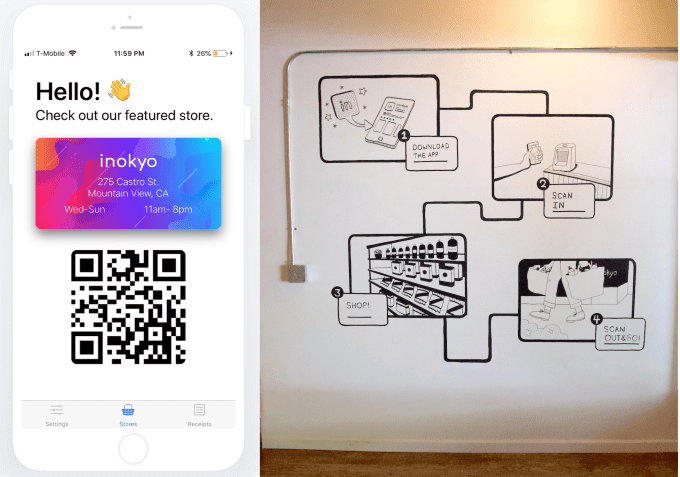
Here’s how the Inokyo store works. You download its app and connect a payment method, and you get a QR code that you wave in front of a little sensor as you stroll into the shop. Overhead cameras will scan your body shape and clothing without facial recognition in order to track you as you move around the store. Meanwhile, on-shelf cameras track when products are picked up or put back. Combined, knowing who’s where and what’s grabbed lets it assign the items to your cart. You scan again on your way out, and later you get a receipt detailing the charges.

Originally, Inokyo actually didn’t make you scan on the way out, but it got the feedback that customers were scared they were actually stealing. The scan-out is more about peace of mind than engineering necessity. There is a subversive pleasure to feeling like “well, if Inokyo didn’t catch all the stuff I chose, that’s not my problem.” And if you’re overcharged, there’s an in-app support button for getting a refund.

Inokyo co-founders (from left): Tony Francis and Rameez Remsudeen

Inokyo was accurate in what it charged me despite me doing a few switcharoos with products I nabbed. But there were only about three people in the room with at the time. The real test for these kinds of systems are when a rush of customers floods in and that cameras have to differentiate between multiple similar-looking people. Inokyo will likely need to be over 99 percent accurate to be more of a help than a headache. An autonomous store that constantly over- or undercharges would be more trouble than it’s worth, and patrons would just go to the nearest classic shop.

Just because autonomous retail stores will be cashier-less doesn’t mean they’ll have no staff. To maximize cost-cutting, they could just trust that people won’t loot it. However, Inokyo plans to have someone minding the shop to make sure people scan in the first place and to answer questions about the process. But theirs also an opportunity in reassigning labor from being cashiers to concierges that can recommend the best products or find what’s the right fit for the customer. These stores will be judged by the convenience of the holistic experience, not just the tech. At the very least, a single employee might be able to handle restocking, customer support, and store maintenance once freed from cashier duties.

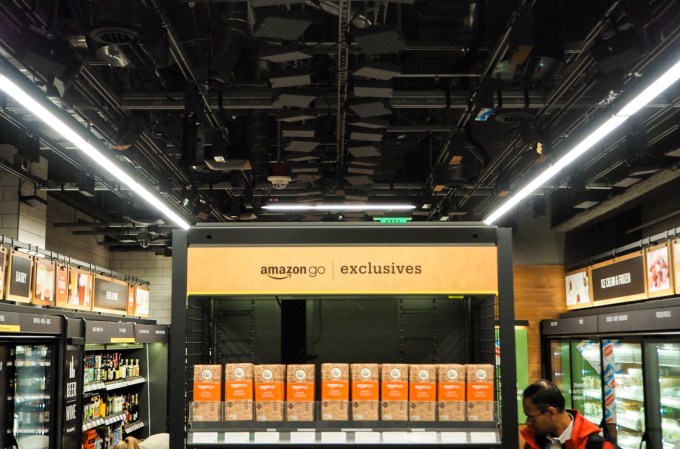
The Amazon Go autonomous retail store in Seattle is equipped with tons of overhead cameras.

While Amazon Go uses cameras in a similar way to Inokyo, it also relies on weight sensors to track items. There are plenty of other companies chasing the cashierless dream. China’s BingoBox has nearly $100 million in funding and has over 300 stores, though they use less sophisticated RFID tags. Fellow Y Combinator startup Standard Cognition has raised $5 million to equip old school stores with autonomous camera-tech. AiFi does the same, but touts that its cameras can detect abnormal behavior that might signal someone is a shoplifter.

The store of the future seems like more and more of a sure thing. The race’s winner will be determined by who builds the most accurate tracking software, easy-to-install hardware, and pleasant overall shopping flow. If this modular technology can cut costs and lines without alienating customers, we could see our local brick-and-mortars adapt quickly. The bigger question than if or even when this future arrives is what it will mean for the millions of workers who make their living running the checkout lane.


Read Full Article

The 7 Best Sites to Track a Website’s Traffic


Have you ever wondered how popular a certain website really is?

Unfortunately, most sites don’t publish their stats for public viewing so accurate numbers are hard to come by. At best, you can look for a website’s “advertising page” which may include marketing materials, demographic information, and yes, monthly traffic data.

But when that’s not available, your only option is to rely on a website traffic estimator.

Since these are never 100 percent accurate, we only recommend using them to compare traffic of sites in relative terms—and even then, you should only compare readings from the same tool.
1. SimilarWeb

SimilarWeb is my estimator of choice when I want to see what kind of traffic a website gets.

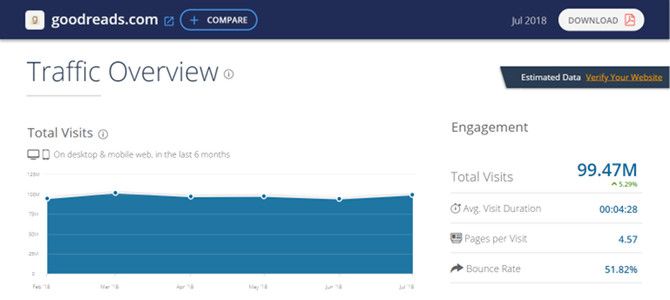
The real value of SimilarWeb is its Top Website Rankings page where you can the top ranking sites according to category and country (limited to the top 50 for free users), but it also lets you search for a specific domain and see that particular site’s stats.

When you look up a site, you get three points of data right away: global rank, country rank, and category rank. These are awesome for seeing competitive health at a glance. But if you scroll down, you can see the engagement stats: monthly traffic, average visit duration, pages per visit, and bounce rate.

Keep scrolling and you’ll see a bunch of other details, such as traffic source breakdown, top referring sites, social media traffic, audience demographics, and more. All of it’s available for free, solidifying this as the best estimator tool.
2. Quantcast

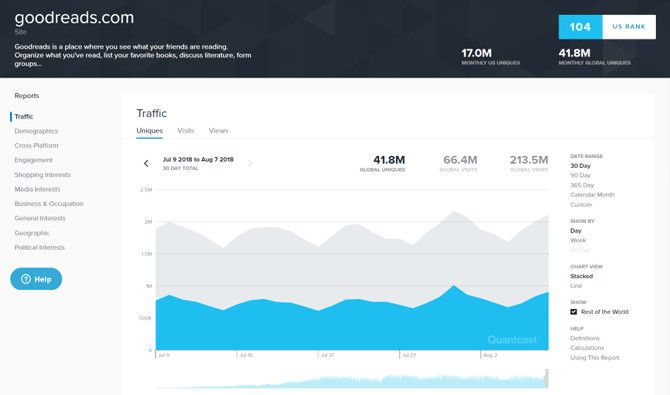
Quantcast is probably the most accurate traffic estimator tool currently available, but it comes with two important caveats: first, its accuracy is still spotty from site to site, and second, its data set is severely limited when compared to sites like SimilarWeb or Alexa.

This is due to how Quantcast works: a website must set up Quantcast’s data collection feed on the site itself, which allows Quantcast to start collecting data and estimating traffic. Quantcast cannot accurately estimate traffic for sites that don’t participate. Sadly, you won’t find stats for most lesser-known websites on Quantcast.

That being said, when a site is being tracked, Quantcast offers a lot of amazing data to pore over. The demographic breakdown is especially insightful, which includes visitor ethnicity, shopping interests, media interests, occupations, and political affiliations.
3. Ahrefs

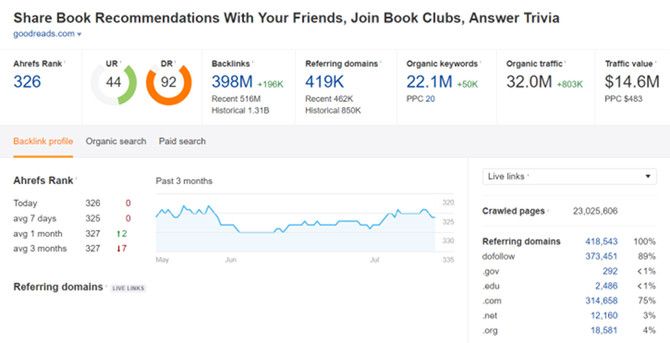
Ahrefs is a powerful search engine optimization tool for webmasters, and is mainly used for mining all kinds of search traffic-related data—both for your own sites and for competitors’ sites.

Not only can you see accurate measures of a site’s monthly search traffic, but you can see detailed breakdowns of where that traffic is coming from and what kinds of keywords are bringing the traffic. You can also see backlink information, such as which other sites are linking to the site, how often they’re linking, and how that data changes over time.

Unfortunately, while Ahrefs is the most powerful tool in this list, that power comes at a price. There’s no free plan, but you can try a seven-day no-restrictions trial for $7. After that, it costs at least $99 per month for the lowest plan. It’s expensive, but the data is good.
4. SEMRush

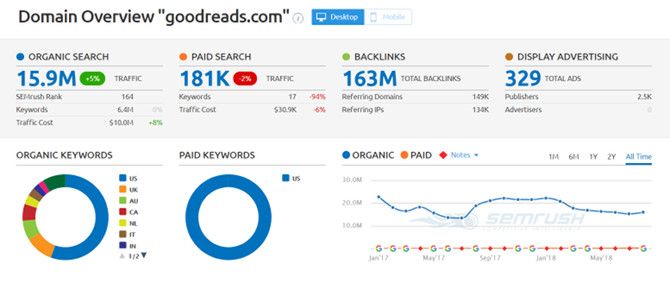
SEMRush is primarily a search engine optimization tool, meaning you’d use it as a website owner to help find and target keywords that bring you more search engine traffic. However, as a regular web surfer, you can use it to see what kind of search traffic a site gets.

Just to be clear, SEMRush won’t give you absolute traffic numbers—if that’s what you’re looking for, turn to SimilarWeb or Quantcast. SEMRush is best when you only care about search traffic and you want to compare search traffic patterns between sites. For that, SEMRush tends to be the most accurate.

SEMRush shows you top keywords for a given site, but on top of that, you can see actual numbers and search engine positions for those keywords. You can also filter the stats by country, allowing you to see search patterns on a regional basis.

Note that SEMRush is a freemium tool. As a free user, you get 10 free searches per day and only get access to a basic overview. You’ll need a paid plan to unlock higher limits and more data, and they start at $100 per month.
5. Alexa

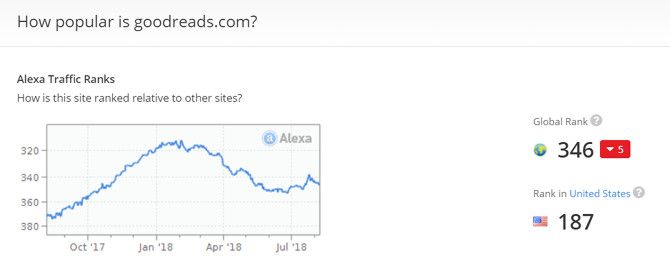
Alexa is probably the first tool that popped into mind when you went looking for a website traffic estimation. Unfortunately, Alexa has dumbed down its free option so much over the years that it’s almost useless now.

Search for any website and you’ll see its Global Alexa Rank and Country Alexa Rank, plus a simple chart showing its rise and fall in ranking over the past year. You’ll also see limited demographics and keywords information. It’s quite stingy, but suffices if you just want to compare two sites and see which one is more popular.

If you want to see more than the limited data you get as a free Alexa user, you’ll need to upgrade to the Insight plan—and that costs $79 per month. You can sign up for a seven-day free trial, but you’ll have to enter your credit card details and make sure you cancel before the free trial ends.
6. SitePrice

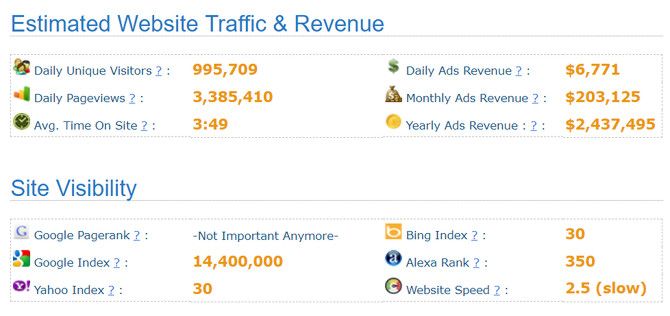
SitePrice is actually a website value calculator and not a traffic estimator, but it does include traffic estimates in its value calculations. When you look up a site, just scroll down to see the estimated traffic and revenue stats, including daily pageviews, daily unique visitors, and daily ad revenues.

You’ll notice that these values are way off from what you’d find on, say, SimilarWeb or Quantcast. That’s because SitePrice pulls its data from several sources (including SimilarWeb and Quantcast) and averages them to get a more “accurate” reading. It’s up to you whether you trust it more or less.

Other nifty stats include search engine visibility, backlink counts, domain age, and top competitors. Also, remember that this tool is just an estimator so don’t take its website valuations at face value.
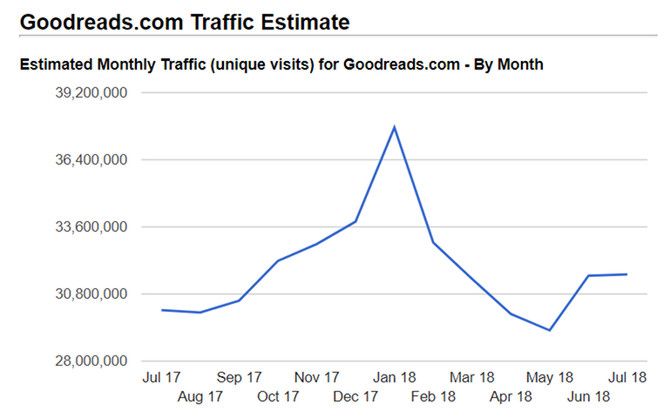
7. Traffic Estimate

Traffic Estimate may not be the best-looking estimator tool, but it serves its purpose in a pinch. The estimation graph shows you a website’s traffic patterns over the past year, and you get a numerical traffic value for the past 30 days. It’s pretty simplistic—perhaps too much.

Scroll down and you’ll see data on which keywords are targeted by the site. This is helpful to explore which other sites are the main competitors for this site. There isn’t much beyond that. For best results, use Traffic Estimate as a supplementary tool in conjunction with the others on this list.

How Popular Are Your Favorite Websites?

You’ll notice that two oft-recommended tools are missing from this list: Alexa and Compete.

If you want to see traffic estimates for websites using Alexa, you’ll need to sign up for the Advanced plan which costs $149 per month, and that’s way too expensive when you can get similar estimates elsewhere for free. As for Compete, it was shut down at the end of 2016.

Now that you know how to estimate a website’s traffic, why not check out our roundup of the best websites on the internet and see how popular they are?

Image Credit: Rawpixel/Depositphotos

Read the full article: The 7 Best Sites to Track a Website’s Traffic


Read Full Article

China is the fastest growing smart speaker market


No surprise that smart speaker sales are on the rise. That certainly comports with recent numbers from NPD. The latest report from Canalys, however, pulls the camera back a bit to give a better picture of the global market. Seems that while smart speaker sales continue to be hot here in the States, they’re positively on fire in China.

Global shipments increased by 187 percent year-over-year for a total of 16.8 million units. China accounted for 52-percent of the total growth worldwide, with Alibaba and Xiaomi accounting for 17.7 and 12.2 percent, respectively. The growth is large, in part, due to the fact that the category effectively didn’t exists a year ago.

Canalys’ Hattie He notes that a confluence of different elements have potentially put the country on track overtake the U.S.

“Alibaba and Xiaomi have both relied on aggressive price cuts to create demand,” He adds. “Both companies have the financial backing to spend on marketing and hardware subsidies in a bid to quickly build their user bases. Although the real level of user demand for speaker products is currently unproven, China is on its way to overtake the US in the near term. The challenge remains for local vendors to increase user stickiness and generate revenue from the growing installed base of smart speaker users.”

Also interesting is the fact that Google has maintained its top spot ahead of Amazon, with explosive growth year over year. Google’s up 449 percent to Amazon’s -14 — putting the two companies in first and second place, respectively. Of course, Amazon got a significant headset in the market, so Google has some ground to make up. Apple, meanwhile, failed to crack the top four.


Read Full Article

Facebook cracks down on opioid dealers after years of neglect


Facebook’s role in the opioid crisis could become another scandal following yesterday’s release of harrowing new statistics from the Center for Disease Control. It estimated there were nearly 30,000 synthetic opioid overdose deaths in the US in 2017, up from roughly 20,000 the year before. When recreational drugs like Xanax and OxyContin are adulterated with the more powerful synthetic opioid Fentanyl, the misdosage can prove fatal. Xanax, OxyContin, and other pain killers are often bought online, with dealers promoting themselves on social media including Facebook.

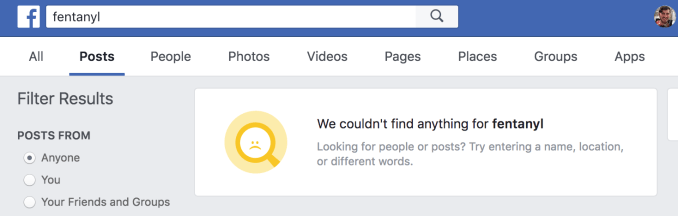
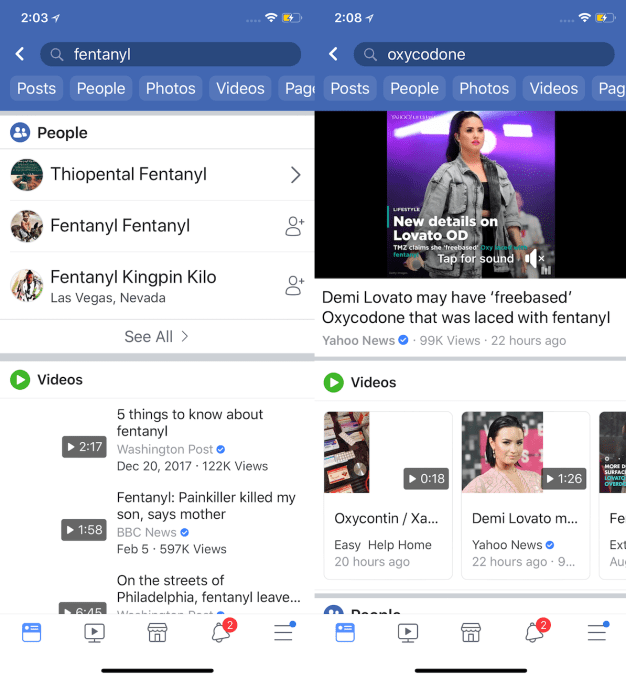
Hours after the new stats were reported by the New York Times and others, a source spotted that Facebook’s internal search engine stopped returning posts, Pages, and Groups for searches of “OxyContin”, “Xanax”, “Fentanyl”, and other opioids, as well as other drugs like “LSD”. Only videos, often news reports deploring opiate abuse, and user profiles whose names match the searches are now returned. This makes it significantly harder for potential buyers or addicts to connect with dealers through Facebook.

However, some dealers have taken to putting drug titles into their Facebook profile names, allowing accounts like “Fentanyl Kingpin Kilo” to continue showing up in search results. It’s not exactly clear when the search changes occurred.

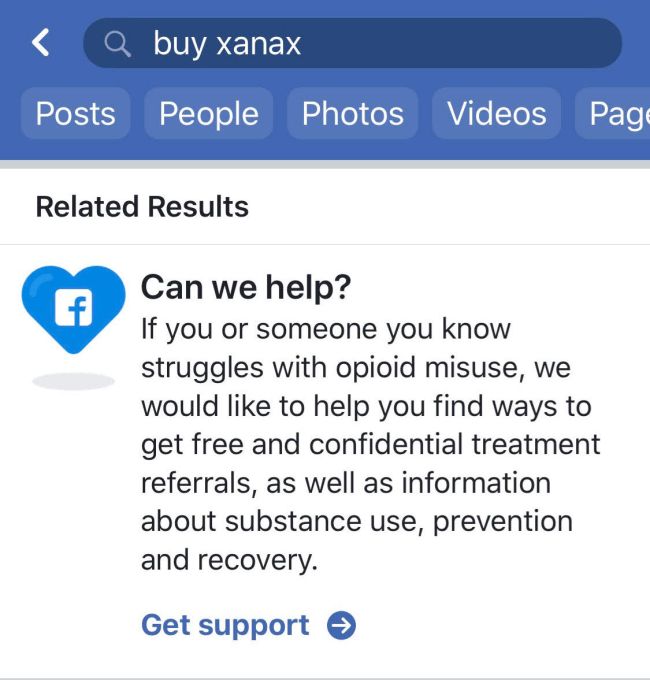
On some search result pages for queries like “Buy Xanax”, Facebook is now showing a “Can we help?” box that says “If you or someone you know struggles with opioid misuse, we would like to help you find ways to get free and confidential treatment referrals, as well as information about substance use, prevention and recovery.” A “Get support” button opens the site of The Substance Abuse and Mental Health Services Administration, a branch of the US department of health and human services that provides addiction resources. Facebook had promised back in June that this feature was coming.

Facebook search results for many drug names now only surface people and video news reports, and no longer show posts, Pages, or Groups which often offered access to dealers

When asked, Facebook confirmed that it’s recently made it harder to find content that facilitates the sale of opioids on the social network. Facebook tells me it’s constantly updating its approach to thwart bad actors who look for new ways to bypass its safeguards. The company confirms it’s now removing content violating its drug policies, it’s blocked hundreds of terms associated with drug sales from showing results other than links to news about drug abuse awareness. It’s also removed thousands of terms from being suggested as searches in its typeahead.

Prior to recent changes, buyers could easily search for drugs and find posts from dealers with phone numbers to contact

Regarding the “Can we help?” box, Facebook tells me this resource will be available on Instagram in the coming weeks, and it provided this statement:

“We recently launched the “Get Help Feature” in our Facebook search function that directs people looking for help or attempting to purchase illegal substances to the SAMHSA national helpline. When people search for help with opioid misuse or attempt to buy opioids, they will be prompted with content at the top of the search results page that will ask them if they would like help finding free and confidential treatment referrals. This will then direct them to the SAMHSA National Helpline. We’ve partnered with the Substance Abuse & Mental Health Services Administration to identify these search terms and will continue to review and update to ensure we are showing this information at the most relevant times.”

Facebook’s new drug abuse resource feature

The new actions follow Facebook shutting down some hashtags like “#Fentanyl” on Instagram back in April that could let buyers connect with dealers. That only came after activists like Glassbreakers’ Eileen Carey aggressively criticized the company demanding change. In some cases, when users would report Facebook Groups or Pages’ posts as violating its policy prohibiting the sale of regulated goods like drugs, the posts would be removed but Facebook would leave up the Pages. This mirrors some of the problems it’s had with Infowars around determining the threshold of posts inciting violence or harassing other users necessary to trigger a Page or profile suspension or deletion.

Facebook in some cases deleted posts selling drugs but not the Pages or Groups carrying them

Before all these changes, users could find tons of vendors illegally selling opioids through posts, photos, and Pages on Facebook and Instagram. Facebook also introduced a new ads policy last week requiring addiction treatment centers that want to market to potential patients be certified first to ensure they’re not actually dealers preying on addicts.

Much of the recent criticism facing Facebook has focused on it failing to prevent election interference, privacy scandals, and the spread of fake news, plus how hours of browsing its feeds can impact well-being. But its negligence regarding illegal opioid sales has likely contributed to some of the 72,000 drug overdose deaths in America last year. It serves as another example of how Facebook’s fixation on the positive benefits of social networking blinded it to the harsh realities of how its service can be misused.

Last year, Facebook CEO Mark Zuckerberg said that learning of the depths of the opioid crisis was the “biggest surprise” from his listening tour visiting states across the U.S, and that it was “really saddening to see.” The fact that he called this a “surprise” when some of the drugs causing the crisis were changing hands via his website is something Facebook hasn’t fully atoned for, nor done enough to stop. The new changes should be the start of a long road to recovery for Facebook itself.


Read Full Article

Facebook cracks down on opioid dealers after years of neglect


Facebook’s role in the opioid crisis could become another scandal following yesterday’s release of harrowing new statistics from the Center for Disease Control. It estimated there were nearly 30,000 synthetic opioid overdose deaths in the US in 2017, up from roughly 20,000 the year before. When recreational drugs like Xanax and OxyContin are adulterated with the more powerful synthetic opioid Fentanyl, the misdosage can prove fatal. Xanax, OxyContin, and other pain killers are often bought online, with dealers promoting themselves on social media including Facebook.

Hours after the new stats were reported by the New York Times and others, a source spotted that Facebook’s internal search engine stopped returning posts, Pages, and Groups for searches of “OxyContin”, “Xanax”, “Fentanyl”, and other opioids, as well as other drugs like “LSD”. Only videos, often news reports deploring opiate abuse, and user profiles whose names match the searches are now returned. This makes it significantly harder for potential buyers or addicts to connect with dealers through Facebook.

However, some dealers have taken to putting drug titles into their Facebook profile names, allowing accounts like “Fentanyl Kingpin Kilo” to continue showing up in search results. It’s not exactly clear when the search changes occurred.

On some search result pages for queries like “Buy Xanax”, Facebook is now showing a “Can we help?” box that says “If you or someone you know struggles with opioid misuse, we would like to help you find ways to get free and confidential treatment referrals, as well as information about substance use, prevention and recovery.” A “Get support” button opens the site of The Substance Abuse and Mental Health Services Administration, a branch of the US department of health and human services that provides addiction resources. Facebook had promised back in June that this feature was coming.

Facebook search results for many drug names now only surface people and video news reports, and no longer show posts, Pages, or Groups which often offered access to dealers

When asked, Facebook confirmed that it’s recently made it harder to find content that facilitates the sale of opioids on the social network. Facebook tells me it’s constantly updating its approach to thwart bad actors who look for new ways to bypass its safeguards. The company confirms it’s now removing content violating its drug policies, it’s blocked hundreds of terms associated with drug sales from showing results other than links to news about drug abuse awareness. It’s also removed thousands of terms from being suggested as searches in its typeahead.

Prior to recent changes, buyers could easily search for drugs and find posts from dealers with phone numbers to contact

Regarding the “Can we help?” box, Facebook tells me this resource will be available on Instagram in the coming weeks, and it provided this statement:

“We recently launched the “Get Help Feature” in our Facebook search function that directs people looking for help or attempting to purchase illegal substances to the SAMHSA national helpline. When people search for help with opioid misuse or attempt to buy opioids, they will be prompted with content at the top of the search results page that will ask them if they would like help finding free and confidential treatment referrals. This will then direct them to the SAMHSA National Helpline. We’ve partnered with the Substance Abuse & Mental Health Services Administration to identify these search terms and will continue to review and update to ensure we are showing this information at the most relevant times.”

Facebook’s new drug abuse resource feature

The new actions follow Facebook shutting down some hashtags like “#Fentanyl” on Instagram back in April that could let buyers connect with dealers. That only came after activists like Glassbreakers’ Eileen Carey aggressively criticized the company demanding change. In some cases, when users would report Facebook Groups or Pages’ posts as violating its policy prohibiting the sale of regulated goods like drugs, the posts would be removed but Facebook would leave up the Pages. This mirrors some of the problems it’s had with Infowars around determining the threshold of posts inciting violence or harassing other users necessary to trigger a Page or profile suspension or deletion.

Facebook in some cases deleted posts selling drugs but not the Pages or Groups carrying them

Before all these changes, users could find tons of vendors illegally selling opioids through posts, photos, and Pages on Facebook and Instagram. Facebook also introduced a new ads policy last week requiring addiction treatment centers that want to market to potential patients be certified first to ensure they’re not actually dealers preying on addicts.

Much of the recent criticism facing Facebook has focused on it failing to prevent election interference, privacy scandals, and the spread of fake news, plus how hours of browsing its feeds can impact well-being. But its negligence regarding illegal opioid sales has likely contributed to some of the 72,000 drug overdose deaths in America last year. It serves as another example of how Facebook’s fixation on the positive benefits of social networking blinded it to the harsh realities of how its service can be misused.

Last year, Facebook CEO Mark Zuckerberg said that learning of the depths of the opioid crisis was the “biggest surprise” from his listening tour visiting states across the U.S, and that it was “really saddening to see.” The fact that he called this a “surprise” when some of the drugs causing the crisis were changing hands via his website is something Facebook hasn’t fully atoned for, nor done enough to stop. The new changes should be the start of a long road to recovery for Facebook itself.


Read Full Article

Tomu is a fingernail-sized computer that is easy to swallow


I’m a huge fan of single board computers, especially if they’re small enough to swallow. That’s why I like the Tomu. This teeny-tiny ARM processor essentially interfaces with your computer via the USB port and contains two LEDs and two buttons. Once it’s plugged in the little computer can simulate a hard drive or mouse, send MIDI data, and even blink quickly.

The Tomu runs the Silicon Labs Happy Gecko EFM32HG309 and can also act as a Universal 2nd Factor security token. It is completely open source and all the code is on their GitHub.

I bought one for $30 and messed with it for a few hours. The programs are very simple and you can load in various tools including a clever little mouse mover – maybe to simulate mouse usage for an app – and a little app that blinks the lights quickly. Otherwise you can use it to turn your USB hub into an on-off switch for your computer. It’s definitely not a fully-fledged computer – there are limited I/O options, obviously – but it’s a cute little tool for those who want to do a little open source computing.

One problem? It’s really, really small. I’d do more work on mine but I already lost it while I was clearing off a desk so I could see it better. So it goes.


Read Full Article

What Is Foreshadow? How This Intel CPU Vulnerability Might Affect You


The Spectre and Meltdown security vulnerabilities continue to haunt Intel, AMD, and other microprocessor manufacturers. After the initial revelations and ill-fated patches, Intel hoped their deep-rooted issues would remain dormant.

Unfortunately that’s not the case, and consumers, businesses, and CPU manufacturers face yet another microprocessor vulnerability. Foreshadow is its name, and here’s what it means for your computer.

What Is the Foreshadow Vulnerability?

Foreshadow, alternatively known as the L1 Terminal Fault (L1TF), is the latest exploit to hit Intel Core CPUs. The Foreshadow announcement brings the total number of speculative execution vulnerabilities for Intel CPUs to three, on top of the previous two Spectre and Meltdown vulnerabilities.

There are three aspects to Foreshadow. The first one specifically targets Intel’s Security Guard Extensions (SGX), a feature in Intel 7th generation chips that, ironically, is designed to protect code from unauthorized modification. The other two affect nearly all other Intel CPU generations.

Foreshadow is the result of the independent collaborative security research of two teams: imec-DistriNet at KU Leuven, and a combined team from the University of Michigan, the University of Adelaide, and CSIRO’s Data61.

“What our attack does is it uses techniques that are very similar to the Meltdown attacks from six months ago,” explains Professor Thomas Wenisch from the University of Michigan. “But we discovered we could specifically target a lock box within Intel’s processors. It would let you leak any data you want out of these secure enclaves.”

The main issue is clear: Foreshadow lets an attack access secret information held in the computer’s memory. Intel’s technical manuals state that areas of memory can be marked as off-limits, but the opposite is true. A machine running malicious code, or a guest virtual machine on a cloud server, can access areas of memory they shouldn’t be able to, thereby exposing sensitive data.

“We are not aware of reports that any of these methods have been used in real-world exploits,” reads a blog post on Intel’s website. “But this further underscores the need for everyone to adhere to security best practices.” The blog continues, elaborating on how future processors would not suffer the same vulnerabilities.

The Three Aspects of Foreshadow

There are three separate vulnerabilities in Foreshadow, and each has its own CVE code:

  • CVE-2018-3615: The Software Guard Extensions (SGX) vulnerability. A system using SGX “may allow unauthorized disclosure of information residing in the L1 data cache.”
  • CVE-2018-3620: Affects operating systems and system management modes (SMM). Systems that use “speculative execution and address translations may allow unauthorized disclosure of information residing in the L1 data cache.”
  • CVE-2018-3646: Affects virtual machine and hypervisors. Specifically, the vulnerability “may allow unauthorized disclosure of information residing in the L1 data cache to an attacker with local user access with guest OS privilege.”

The Intel CVE descriptions page also features a complete list of Intel-based platforms potentially affected by the Foreshadow vulnerabilities. Double-check the list for your CPU model.

Is My Intel Computer Vulnerable to Foreshadow?

First things first: so long as you keep your system completely up to date, you are safe. The research teams that made the initial discovery of Foreshadow separately disclosed details of the vulnerability to Intel back in January. As such, Intel has had a long time to develop and release a patch.

Furthermore, the researchers and Intel are keen to stress that attacks of this nature are extremely rare in the wild. The expertise and cost required to perform this attack outside make it difficult conceive as a payload. Regular malware attacks and phishing techniques are much easier to use. As such, they also come with an almost guaranteed return on investment.

“Intel has worked with operating system vendors, equipment manufacturers, and other ecosystem partners to develop platform firmware and software updates that can help protect systems from these methods.”

Furthermore, most users aren’t even using the Intel SGX feature, so you wouldn’t store your sensitive data there anyway. Also, “Foreshadow does not leave traces in typical log files” so you wouldn’t necessarily realize an attacked accessed the data, let alone an attacker skilled enough to implement such an attack “can probably alter the log buffer” to erase traces.

How Does Foreshadow Affect Virtual Machines?

You may be using a virtual machine (VM) on your computer to emulate another operating system. VMs are handy for trying out new Linux distributions or booting up an old Windows version to use a specific program.

VMs see a huge amount of use in cloud server environments, such as Microsoft Azure or Amazon AWS. Running concurrent VMs lets a provider offer an expanded service using the same physical hardware. However, it is incredibly important that the virtual machines within the cloud server environment remain isolated from one another.

And that’s exactly what Foreshadow does. It breaks through the aforementioned isolation, allowing a virtual machine to read data from other virtual machines.

Will Intel’s “Chipocalypse” Ever End?

Intel, AMD, and other microprocessor manufacturers affected by Spectre, Meltdown, and now Foreshadow, have an incredibly tough time on their hands. CPU development has taken advantage of speculative execution for decades—thankfully—and it makes our system that much faster for it.

But the crux of the biscuit is that speculative execution is now vulnerable and as such CPU manufacturers are heading back to the drawing board to ensure that future CPU generations do not suffer the same issues.

The saving grace for consumers like you and I is that, for the most part, we’re too small fry to be worth the catch. That is, vigilance against regular malware, against phishing and banking fraud, and other common attacks will keep you safe. Just remember to keep your system up to date, and the CPU patches will install as they arrive.

Image Credit: ifeelstock/Depositphotos

Read the full article: What Is Foreshadow? How This Intel CPU Vulnerability Might Affect You


Read Full Article