YouTube CEO Susan Wojcicki on Friday promised the company would do a better job with communicating to creators about its experiments and tests. Today, YouTube is making good on that commitment with an update about a new feature it’s testing out: an Explore tab, aimed at offering viewing a more diverse set of video recommendations.
The news was announced via the Creator Insider channel – the same channel Wojcicki highlighted in her recent update as the “unofficial” resource operated by YouTube employees. The channel today offers weekly updates, responses to creator feedback, and behind-the-scenes info on product launches.
According to the announcement, the new Explore feature is currently in testing with just 1 percent of iPhone YouTube app viewers, so there’s a good chance you won’t see the option in your own app.
However, if you do happen to be in the test group, then you’ll notice the bottom navigation bar of the app looks different. Instead of the tabs Home, Trending, Subscriptions, Inbox and Library you have today, you’ll instead see Home, Explore, Subscriptions, Activity and Library.
The idea behind Explore is to offer YouTube viewers a wider variety of what-to-watch suggestions than they receive today. Currently, personalized video recommendations are very much influenced by past viewing activity and other behavior, which can then create a sort of homogenous selection of recommended content.
“Explore is designed to help you be exposed to different kinds of topics, videos or channels that you might not otherwise encounter, but they’re still personalized,” said Tom Leung, Director of Product Management, in a YouTube video.
That is, the videos are still based on viewing activity.
For example, he explains, a viewer who was watching videos about telescopes might be recommended videos about high-end cameras.
“It’s just going to give you a little more variety,” says Leung.
The tab will also feature a “Trending” section at the top of the screen, which directs users to the same sort of content that the Trending tab in the current version of the YouTube app today features.
The hope, however, with the new Explore tab is to offer creators the ability to reach more viewers, even if their content doesn’t “trend.”
Whether or not that theory proves true, remains to be seen. YouTube will review the data from the experiment before making a decision to roll out the Explore tab to more users.
Early feedback from YouTube creators in the comments section of the video seems cautiously optimistic, with many expressing hopes that the new tab would provide exposure to smaller creators rather than just the well-known names.
Calling the tab “Explore” makes sense in light of the increased threat from Instagram, whose own Explore section features personalized video suggestions, and has launched a YouTube rival with IGTV. YouTube has responded by offering its stars big, five to six-figure checks to post their best stuff on YouTube, according to Business Insider. (YouTube downplayed the report, saying it has “always invested in creators’ success.)
But an experiment involving YouTube’s own Explore section makes it clear that the company is interested taking on Instagram head-on when it comes to offering a home for discovering new video content through algorithmic recommendations.
If successful, YouTube’s Explore tab would connect viewers to more creator channels they’ll like and subscribe to, as well as increase their time spent in app. That, in turn, could potentially decrease viewers’ time in apps like IGTV, Facebook, Instagram and elsewhere.
You can use these Airbnb-like alternatives for renting cars, office space, boats, and much more.
Airbnb for Cars
ZipCar requires a monthly membership fee. Car2Go’s selection is limited. And standard car rental services are often inconvenient.
With peer-to-peer sharing sites that operate like Airbnb, you only pay for the car rental when you need it, and they also have a wide variety of car types and makes.
Two of the larger sites—GetAround and Turo—cover insurace, and GetAround provides 24/7 roadside assistance. Turo provides roadside assistance only with select trips.
GetAround listings include information on etiquette (Is the car pet-friendly for example?), and of course the typical Airbnb type features that you’ll find in the car.
Where is it available? Get Around is available in only six US cities: San Francisco, Berkley, Chicago, Oakland, Portland, and Washington D.C.
What are the rental options? You can rent cars for as little as $5 per hour. The longer you rent a car, the cheaper the hourly price is.
What types of cars are available? You can rent SUVs, coupes, sedans, minivans, convertibles, hatchbacks, pickup trucks, and cargo vans. GetAround also offers electric cars including Teslas.
How does search work? The primary search function on GetAround relies on location. You can search for cars available in your location and then filter results by price range, car make, car category, car class, and, transmission.
What are the limitations? While you can rent by the hour or the day, some cars have a minimum number of hours for a rental (e.g. two or four hours), but there are cars available to rent for just one hour if that’s all you need.
Turo listings are accompanied by info about the cars’ features and extras. You can also see info on the car owner’s response rate.
It’s also worth noting that Turo will check your auto insurance score before granting you access to the site.
Where is it available? Turo is available in far more places than GetAround, serving 5,500 cities and 300+ airports across the US, Canada, Germany, and the UK.
What are the rental options? Turo rentals start at $10 per hour and up. The longer you rent the car, the cheaper the per hour rate becomes. For an added $10 fee, Turo car owners can bring the car to you.
What types of cars are available? You can rent sedans, SUVs, minivans, trucks, and vans.
How does search work? You can search cars by location, after which you can use a filter to narrow results by price range, features, vehicle type, make, year, number of seats, categories (elite, upscale, fuel sippers etc.), colors, and transmission.
What are the limitations? Some cars have a mileage limitation. If you exceed that mileage, you’ll be charged per mile at a rate determined by the car owner.
Airbnb for Boats
Airbnb itself does have listings for houseboats, but if you want a wider selection, you might want to check out boat-specific sites.
These sites aren’t just for swanky yachts. You can also use them to rent jet skis, kayaks, and of course, houseboats.
BoatSetter listings include features for each boat, reviews, and how many people are viewing the vessel. Features include capacity, boat rules, response rate, and response time.
And if you have no boating experience—not to worry. BoatSetter rentals can also come with a captain who will manage the sailing, while you enjoy your day out on the water.
Where is it available? BoatSetter is available in 2,100+ cities worldwide.
What are the rental options? You can rent boats for half a day (which can run about four hours), for a full day, or for several days.
How does search work? When searching for a boat on BoatSetter, you’ll start by entering your location, party size, and trip date. You can filter your search results by specific activities: fishing, sailing, water sports, cruising, and celebrating.
You can also filter by power vs. sail. And that’s not all—you can narrow search results by price, size, features, and categories (jet ski, schooner, catamaran etc.).
GetMyBoat also offers the option of booking your rental with a captain.
Where is it available? GetMyBoat is available in 184 countries worldwide.
What are the rental options? You can rent a vessel per hour or per day. In addition to a rental fee, you’ll also have to pay a service fee.
How does search work? Search begins with location, and then you can filter your search results by minimum and maximum prices, minimum and maximum capacity, availability of a captain, listing type (e.g. pontoon, jet ski, day sailer etc.), features, and if you’re knowledgeable, you can even narrow your results by make and model.
Airbnb for Office Space
Coworking spaces are quite common across the United States, and beyond. Some companies offer office space nationwide, but you should also look into your own local options. Coworking search engines like Coworker can take the hard work out of it.
There are popular options like WeWork which is available across the US and in over 20 other countries worldwide, but you have to pay a hefty monthly fee. Instead, why not find a desk in an office space that you can use whenever you need to, without having to pay a membership fee?
LiquidSpace is a membership free option for finding working space to rent for your ad-hoc use.
Where is it available? LiquidSpace is available in 1,150 cities in the United States, Canada, and Australia.
What are the rental options? You can rent spaces by the hour or by the day. If you rent for a full day, the hourly price goes down. (Some locations are available only by the day.)
How does search work? As with most of these sites, a search begins with location. You can then filter your search results by dates and times, neighborhood, space type (desk, office, suite), price range, capacity, environment, and amenities.
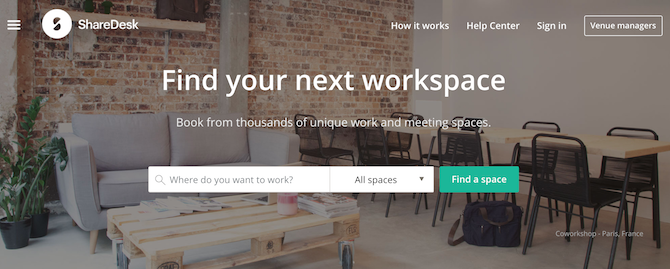
ShareDesk allows you to rent just a desk in a working hub or a private office. They also offer options for meeting rooms,
Listings include features and amenities, but there are no reviews on the listings.
Where is it available? ShareDesk is available at over 4,500 locations in 4,500 venues in 440 cities across 70 countries. Some cities (like New York for example) have far more options than other cities (like Washington DC).
What are the rental options? You can rent a desk in a public working space or hub, conference space, and in some locations, can find rentals suitable for executive level meetings.
How does search work? You begin a search by location and office type (meeting spaces or working spaces). You can then filter your search results by term (hourly, daily, or monthly), price range, dates, and venue category (shared, hub, pro, and exec.)
Croissant is another option for working spaces, but does include a membership fee, albeit at a much cheaper rate than WeWork. And PivotDesk also makes it easy to find office space, but the rentals are only available on a monthly basis.
Airbnb for Parking and Storage
There are other Airbnb like sites popping up for all kinds of services. If you’re looking for an Airbnb for parking, there are a few sites that are beginning to fill that space.
Pavemint is available as an iOS app to help you find parking spaces in the Los Angeles area.
Parqex is available as an iOS and Android app, and features parking listings in several US cities including Chicago, Los Angeles, San Francisco, Miami, and Washington D.C.
If you’re looking for storage space, rather than pay around $100 a month for a small space, you can look for peer-to-peer options using sites like Neighbor and Spacer (which also includes parking spaces).
Other Peer-to-Peer Rental Services
There are plenty more peer-to-peer rentals worth considering. Sites like Zilok are a rental marketplace for just about anything you might be looking for including computers, cameras, and gaming consoles. To rent an item through Zilok, you’ll have to pay a security deposit you’ll get back once the item is returned to its owner.
If you’re looking for a “rental” for your furry friend while you go out of town, Rover makes it easy to find welcoming homes for your dogs.
Meet the Travel Backpack 45L. It’s Peak Design’s latest creation and the company just launched a Kickstarter campaign to bring it to life. This product marks the eighth Kickstarter campaign for Peak Design — all of which have been wildly successful.
Peak Design turned to Kickstarter in 2014 to launch the first generation of its Capture camera clip. Over 5,200 people pledged support to bring that product to life. Since then, Peak Design used Kickstarter to launch several camera straps and mounts and, most notably, the Everyday Backpack, Tote and Sling, which saw pledges from 26,000 people for over $6 million. Peak Design collected over $15 million in pledges through its seven previous Kickstarter campaigns and is now the most active crowdfunded company — miss you, Pebble.
Crowdfunding is deeply lodged into the Peak Design’s ethos, the company tells me. For one, Peak Design feels crowdfunding helps with the costs associated with bringing new products to market. The company offers pre-sale discounts through Kickstarter campaigns, which covers the costs of the product and lets the company use the extra to develop the next product. Second, Peak Design says it leverages the two-way communication Kickstarter provides to tweak product design, clean up messaging and ensure a high-level customer experience.
The $299 Travel Backpack 45L is the company’s largest bag to date and is designed with a traveler in mind. The bag is constructed from 400D weather nylon and the inside is coated to provide additional water resistance. The bag has compression and expansion straps to let it grow or shrink as needed. A bevy of lockable zippers and access points seem to be positioned in a smart way around the bag.
TechCrunch loves Peak Design’s Everyday Backpack. Several of us use it as our everyday bag. Both sizes can handle a 15-inch MacBook Pro and they have the right mix of storage and access. I trust this new bag was designed with a similar level of competency.
Along with the backpack, Peak Design also released a series of packing cubes, each designed to address a different travel need. These are sold separately from the Travel Backpack and start at $29.95. There are six different types: standard packing cubes, a toiletry bag, an electronic bag, a camera bag, a shoe pouch, and a rain cover that’s made out of 200D rip-stop nylon.
What’s Peak Design Founder and CEO Peter Dering’s favorite part of the new bag?
“The entire back panel,” he says. “Not only does it beautifully conceal all the straps, it’s also got a beautiful grab handle that, for some reason I don’t understand, just makes you feel like a badass when you use it. It kind of feels like when Neo grabs that bag of guns in the Matrix, only my bag is full of drones, mirrorless cameras, and underwear. We’re all in agreement that any character Keanu Reeves plays is an aspirational character, right?”
I guess he’s right.
The $299 Travel Backpack 45L and packing cubes are available for pre-order on Kickstarter now and the company expects them to be in major retailers by the holiday season.
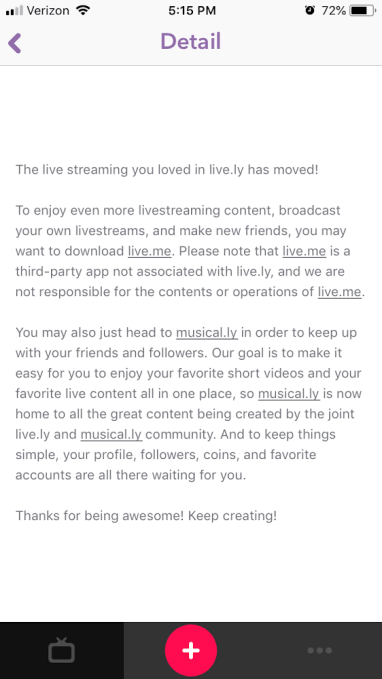
Musical.ly has begun redirecting users of its Live.ly app, which it decided to kill off last month, to a competing app called LiveMe. Existing Live.ly users are being pointed to LiveMe through an in-app message, it says. While it’s a fairly common industry practice for companies to direct users to similar apps or services when a product of theirs is being sunsetted, in this case, Musical.ly’s decision to close down Live.ly and send users to LiveMe was actually a contractually obligated part of Musical.ly’s nearly $1 billion acquisition by Chinese technology company Bytedance last year.
A clause in Bytedance’s agreement to acquire Musical.ly stated that, if the deal went through, Musical.ly would have to close Live.ly within six months, according to a source with knowledge of the deal.
The agreement also said that Live.ly would have to point users to LiveMe for at least 30 days following its closure, we learned, when verifying the information.
The issue at hand was a competing investment – right around the time of the Musical.ly acquisition, Bytedance had also put $50 million into the live-streaming app LiveMe. Apparently, it didn’t want to operate two rival properties.
Clearly, this request was not a deal-breaker for Musical.ly – in fact, it’s integrating Live.ly’s feature set into its own app. That means it will still be something of a competitor to LiveMe, though now no longer a direct one. Musical.ly’s main app, after all, is not known today for its live streaming, but rather for lip syncing videos that are recorded and edited using the app’s included visual effects and editing tools.
In addition, Live.ly had not been able to attract the viewership numbers that Musical.ly had. The company said, when confirming Live.ly’s closure last month, the majority of live stream views were taking place in Musical.ly itself, not in its spinoff.
That said, Live.ly had a fair number of users. Though nowhere near as big as Musical.ly’s 200+ million registered users or 60 million actives, its live stream app had 26 million installs, around 70 percent in the U.S., according to Sensor Tower’s data.
But LiveMe is bigger – it has more than 60 million users and has paid out over $30 million to its broadcasters through its direct virtual gifting program, the company claims.
LiveMe is also not the only app operated by the company. Other LiveMe portfolio apps include the social short video app Cheez, and mobile gaming and esports live streaming app Fluxr. To date, it has raised a total of $110 million.
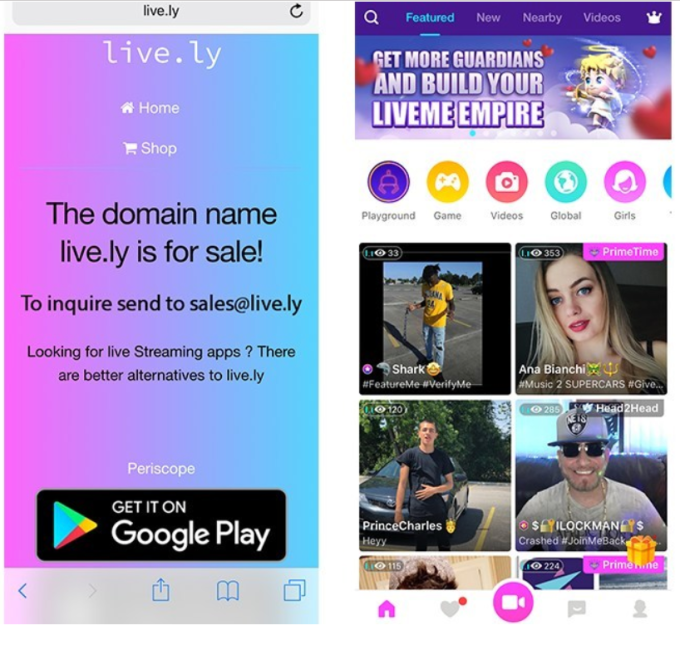
Live.ly isn’t only redirecting users to LiveMe, however. In its own announcement about the news today, it shows a screenshot that’s pointing Live.ly users to Twitter’s Periscope, for instance. The message also notes that the Live.ly domain name is for sale, and provides an email for sales inquiries.
Musical.ly hasn’t yet responded to a request for comment.
Musical.ly has begun redirecting users of its Live.ly app, which it decided to kill off last month, to a competing app called LiveMe. Existing Live.ly users are being pointed to LiveMe through an in-app message, it says. While it’s a fairly common industry practice for companies to direct users to similar apps or services when a product of theirs is being sunsetted, in this case, Musical.ly’s decision to close down Live.ly and send users to LiveMe was actually a contractually obligated part of Musical.ly’s nearly $1 billion acquisition by Chinese technology company Bytedance last year.
A clause in Bytedance’s agreement to acquire Musical.ly stated that, if the deal went through, Musical.ly would have to close Live.ly within six months, according to a source with knowledge of the deal.
The agreement also said that Live.ly would have to point users to LiveMe for at least 30 days following its closure, we learned, when verifying the information.
The issue at hand was a competing investment – right around the time of the Musical.ly acquisition, Bytedance had also put $50 million into the live-streaming app LiveMe. Apparently, it didn’t want to operate two rival properties.
Clearly, this request was not a deal-breaker for Musical.ly – in fact, it’s integrating Live.ly’s feature set into its own app. That means it will still be something of a competitor to LiveMe, though now no longer a direct one. Musical.ly’s main app, after all, is not known today for its live streaming, but rather for lip syncing videos that are recorded and edited using the app’s included visual effects and editing tools.
In addition, Live.ly had not been able to attract the viewership numbers that Musical.ly had. The company said, when confirming Live.ly’s closure last month, the majority of live stream views were taking place in Musical.ly itself, not in its spinoff.
That said, Live.ly had a fair number of users. Though nowhere near as big as Musical.ly’s 200+ million registered users or 60 million actives, its live stream app had 26 million installs, around 70 percent in the U.S., according to Sensor Tower’s data.
But LiveMe is bigger – it has more than 60 million users and has paid out over $30 million to its broadcasters through its direct virtual gifting program, the company claims.
LiveMe is also not the only app operated by the company. Other LiveMe portfolio apps include the social short video app Cheez, and mobile gaming and esports live streaming app Fluxr. To date, it has raised a total of $110 million.
Live.ly isn’t only redirecting users to LiveMe, however. In its own announcement about the news today, it shows a screenshot that’s pointing Live.ly users to Twitter’s Periscope, for instance. The message also notes that the Live.ly domain name is for sale, and provides an email for sales inquiries.
Musical.ly hasn’t yet responded to a request for comment.
Sonos today took the next step in its initial public offering price, setting a range for the shares it intends to sell that will help calibrate the final amount of money – and valuation — that it will have when it begins its trading debut.
This isn’t the final, final step in the IPO process as this is usually done to test the waters and figure out the exact appetite for the company’s shares when it goes public. Sonos is offering 5,555,555 (a wonderful palindrome of a number) shares, where it will raise as much as $105 million if it prices on the upper end of its range and sells them at $19 per share. The official range is between $17 and $19, but this can go up and down throughout the process — with a drop-off signaling a lack of interest or skepticism, and an increased range a sign of heavy demand. Companies will sometimes lowball their range, though we won’t find out for a little bit where everything lands.
Insiders are also selling 8,333,333 million shares in this initial public offering. Including that, the IPO could end up raising around $250 at the middle of that $17 to $19 range that it’s estimating including the shares sold by existing stockholders. The proceeds from those shares sold by stockholders aren’t going to end up in Sonos’ hands, so the company itself is only going to net around that $105 million at the top end of its range. There’s also an over-allotment, typically called a greenshoe, that consists of shares sold by Sonos and existing stockholders. That could add a total of $15 million and $22.5 million respectively at a price of $18 in the middle of that range.
The company is offering some preliminary estimates for its second quarter, saying it generated between $206.4 million and $208.4 million in revenue with a net loss of between $29 million and $27.1 million (this is probably because the final accounting isn’t finished up as we’re just about entering the front end for earnings season for major companies). The company said it sold between 880,000 and 890,000 products as an estimated range in the second quarter this year, up from 796,000 products in the second quarter last year.
Sonos is nicely positioned as a third-party option in an ecosystem that’s getting increasingly crowded by proprietary speakers from the larger companies that own voice assistants like the Echo, HomePod, and Google Home. But Sonos has been around for a considerable amount of time and has clearly built up a significant following to ensure that it could find itself operating as an independent public company. In its fiscal 2017 year, Sonos said it brought in nearly $1 billion in revenue, an increase of 10% year-over-year. The initial filing indicated that the company had sold a total of 19 million products in 6.9 million households, with customers listening to 70 hours of content each month.
This is basically the next step in the process as the company continues its march toward making its debut, and we’ll get more details soon enough as to whether or not investors are interested in a publicly-traded company that’s known for its speakers.
Sonos today took the next step in its initial public offering price, setting a range for the shares it intends to sell that will help calibrate the final amount of money – and valuation — that it will have when it begins its trading debut.
This isn’t the final, final step in the IPO process as this is usually done to test the waters and figure out the exact appetite for the company’s shares when it goes public. Sonos is offering 5,555,555 (a wonderful palindrome of a number) shares, where it will raise as much as $105 million if it prices on the upper end of its range and sells them at $19 per share. The official range is between $17 and $19, but this can go up and down throughout the process — with a drop-off signaling a lack of interest or skepticism, and an increased range a sign of heavy demand. Companies will sometimes lowball their range, though we won’t find out for a little bit where everything lands.
Insiders are also selling 8,333,333 million shares in this initial public offering. Including that, the IPO could end up raising around $250 at the middle of that $17 to $19 range that it’s estimating including the shares sold by existing stockholders. The proceeds from those shares sold by stockholders aren’t going to end up in Sonos’ hands, so the company itself is only going to net around that $105 million at the top end of its range. There’s also an over-allotment, typically called a greenshoe, that consists of shares sold by Sonos and existing stockholders. That could add a total of $15 million and $22.5 million respectively at a price of $18 in the middle of that range.
The company is offering some preliminary estimates for its second quarter, saying it generated between $206.4 million and $208.4 million in revenue with a net loss of between $29 million and $27.1 million (this is probably because the final accounting isn’t finished up as we’re just about entering the front end for earnings season for major companies). The company said it sold between 880,000 and 890,000 products as an estimated range in the second quarter this year, up from 796,000 products in the second quarter last year.
Sonos is nicely positioned as a third-party option in an ecosystem that’s getting increasingly crowded by proprietary speakers from the larger companies that own voice assistants like the Echo, HomePod, and Google Home. But Sonos has been around for a considerable amount of time and has clearly built up a significant following to ensure that it could find itself operating as an independent public company. In its fiscal 2017 year, Sonos said it brought in nearly $1 billion in revenue, an increase of 10% year-over-year. The initial filing indicated that the company had sold a total of 19 million products in 6.9 million households, with customers listening to 70 hours of content each month.
This is basically the next step in the process as the company continues its march toward making its debut, and we’ll get more details soon enough as to whether or not investors are interested in a publicly-traded company that’s known for its speakers.
It’s one thing to run machine learning models in the cloud, where you have plenty of resources. On mobile devices, you’re dealing with very finite compute resources, so if you want to run your models directly on the devices, they have to be highly optimized. Add to that that Apple and Google are taking somewhat different approaches and use different frameworks and you can see why this is all a bit of a nightmare for mobile developers.
Boston-based Fritz, which is opening its service to all developers today, wants to make all of this far easier. It’s an end-to-end solution for adding machine learning models to mobile apps — and have them run natively on the device.
The company argues that as Apple and Google are both pushing their own frameworks, developers are left to work with what’s at best suboptimal tooling. Fritz then wants to build better tools to simplify life for developers.
“What we want the developers to do is build a model and then we take care of the rest,” the company’s CEO and co-founder Jameson Toole told me.
Fritz is agnostic as to the runtime that the models are actually using. Developers can bring their Core ML, TensorFlow Mobile and TensorFlow Lite models to Fritz and the SDK will monitor their performance and help developers push updated models to their apps without having to release a new version.
In addition, Fritz also offers a number of standard models for use cases like image labeling and object detection that the company has already optimized to work offline and at high enough frame rates to support live video.
Among the apps that starting using Fritz during its private beta are PlantVillage, which uses on-device machine learning to detect evidence of crop diseases and gives farmers in East Africa advice for how to treat them; MDAcne, for detecting cases of acne; and the more lighthearted InstaSaber, which turns a piece of rolled-up paper into a virtual lightsaber.
All of Fritz’s functionality is available for free. Over time, Toole told me, the team plans to add to the platform a number of premium services, including more collaboration tooling for teams and more automation features for managing and tweaking models. It’ll also launch more machine learning features, including style transfer and image segmentation.
In addition to its core service, Fritz also offers a number of tutorials and other resources for teaching developers about machine learning, as well as Alchemy, a tool for analyzing and benchmarking a custom model’s performance on mobile.
Toole also is open to going beyond smartphones and supporting other edge devices for IoT use cases, for example. Right now, the team is squarely focused on mobile, though.
Let’s be real — the latest batch of Samsung ads are more about the company’s perception of Apple than its own devices. But hey, that tact has worked for the company in the past, so who can blame ‘em? They do, however, offer at least one key bit of insight into the company’s on-going plans.
In a spot titled “Dongle” that takes aim at the easiest possible joke in the smartphone world, Samsung takes Apple to task for the iPhone for its lack of headphone jack. A conversation ensues between a customer and Genius Bar employee, the term “double dongle” is coined and the former grimaces like someone just explained the plot of Human Centipede to him for the first time.
Again, the ad’s less about what Samsung has, than what Apple doesn’t, but it does appear to reaffirm the company’s commitment to the headphone jack. Granted, we’ve seen companies do about-faces on the issue before. The most notable instance is probably Google, who called Apple out one year and dropped the jack the next.
But releasing such an openly mocking ad a month or so before dropping the headphone jack would not, as the kids say, be a great look for the company. The inclusion of the port has been a selling point for Samsung ever since Apple dropped it way back in 2016 for the iPhone 6. It’s an easy win for Samsung. All the company has to do is literally nothing.
And from the leaks we’ve seen of the Note 9, it appears that the 3.5mm will once again be returning.
Of course, what felt like an act of aggression to some two year back has become increasingly common amongst the competition. I’ve talked to a number of manufacturers who’ve retained the jack over the past two years, and nearly all have acknowledged that it’s simply a matter of time before they go that route as well.
It’s tough to say how much of the decision to keep the jack around is Samsung simply giving customers what they want, and how much is the company simply trying to distance itself from Apple. I suspect the truth lies somewhere in the middle. Samsung can continue to use its (admittedly pretty nice) wired AKG headphones as a selling point, while making all the “double dongle” jokes its hefty ad budget can support.
Startup founders don’t usually pitch their ideas by admitting that they’re solving a “boring” problem, but it seems to work for RevenueCat‘s Jacob Eiting.
In fact, Eiting alternately described his startup (which is part of the current class at accelerator Y Combinator) as handling “boring work” and solving a “boring problem.” RevenueCat helps developers manage their in-app subscriptions, which Eiting said “is just boring — developers don’t want to do it.”
And yet it can be crucial for their business. After all, Eiting and his co-founder Miguel Carranza both worked at brain training app Elevate (where Eiting was CTO and Carranza was director of engineering), and he said shifting Elevate’s business model from one-off purchases to recurring subscriptions “saved the company.”
Eiting left Elevate more than a year ago, ultimately deciding to build a startup around “this weird skill I have.” RevenueCat offers an API that developers can use to support in-app subscriptions on iOS and Android, which means they don’t have to worry about all the nuances, bugs and updates in how each platform handles subscriptions.
Eiting said this is the kind of thing that “holds a lot of companies back — maybe not forever, but it’s usually at a time when a company shouldn’t be worrying about this.”
The API also allows developers to bring all the data about their subscription business together in one place, across platforms. Ultimately, he wants to turn RevenueCat into a broader “revenue management platform,” allowing developers to try out strategies like offering different prices to different customer segments.
More broadly, Eiting suggested that subscriptions offer a way out of the current “race to the bottom in how software is sold” — particularly in mobile app stores, where many of us expect everything to be free or dirt cheap. Obviously, that’s not a great situation for someone hoping to make money by selling software, but Eiting pointed out that it can be bad for the consumer too, because it means the developer has less financial incentive to support and update the app.
“Someone who pays for your 99-cent app once, they think they own your time,” he said. “You want to be helpful, you don’t want to let down a paid user, but your incentives aren’t really aligned.”
Subscriptions, even if they’re just for 99 cents a month, can re-align those incentives — Eiting has described this as a system of app patronage: “You want this thing to stay working, you need to pony up some money to developers.”
He also acknowledged that as more apps shift to this model, there’s a risk of subscription fatigue, which could lead to “maybe not a harsh backlash, but there might be a secondary correction.”
But in Eiting’s view, that’s less a problem for individual developers, more for the mobile platforms, which should be building better tools for consumers to manage all their subscriptions in one place.
Apple Business Chat, Apple’s new platform for allowing companies and brands to communicate with customers over iMessage, is expanding. In addition to Dish becoming the first TV provider to support Business Chat, Apple says it has also added four other brands, Aramak, Four Seasons, Harry & David, and American Express, in addition to five new technology platforms businesses can integrate with.
The platforms that now support Apple Business Chat include Cisco, eGain, Kipsu, Lithium and Quiq. They allow the brands to develop their Business Chat systems with a variety of features, integrate them with their own apps and services, track activity through reporting, and more.
The new brand partners represent a variety of use cases for Business Chat, from real-time ordering to shopping to general customer service.
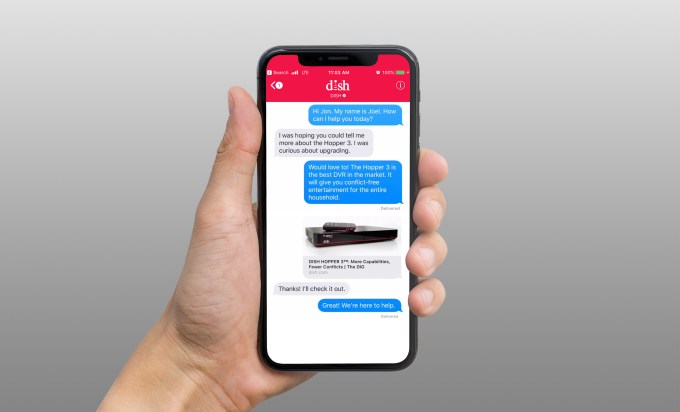
As noted last week, Dish will now allows its pay TV customers to reach a live agent with their questions over iMessage, make account changes, schedule an appointment, and even order pay-per-view.
DISH on Apple Business Chat (PRNewsfoto/DISH Network Corporation)
Meanwhile, the Four Seasons will allow guests to search for any Four Season property and engage with “Four Seasons Chat,” a multi-lingual service that will connect guests with the hotel’s team for any need.
Harry & David will help customers shop over Business Chat, by allowing them to ask questions about products and services and get help from a gift concierge. When customers are ready to buy, they can check out with Apple Pay – as they can with 1-800-Flowers, an existing Business Chat partner.
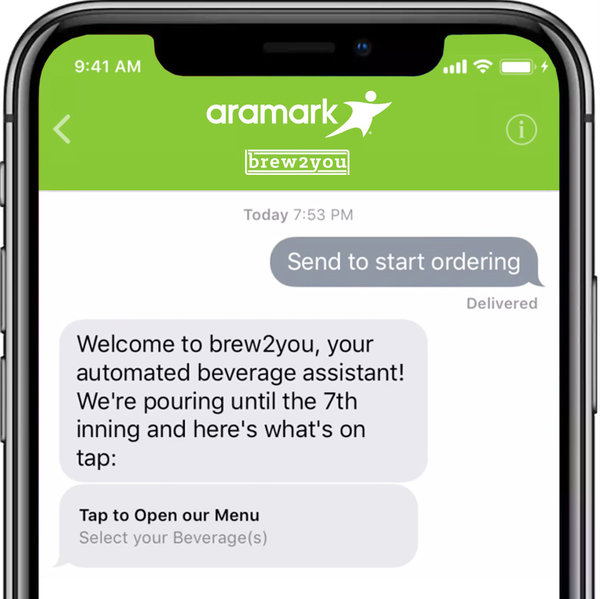
Aramak is piloting a 10-game “Brew2You” program at Citizens Bank Park, the home of the Philadelphia Phillies. Fans will be able to scan a QR code on their seat back in three sections to order beer or water over iMessage, and have it delivered right to their seat.
And American Express is piloting a program for card members to allow them to get their account information, including their balance, payment due dates, and points balance over Business Chat. They’ll also be able to ask for a card replacement, dispute a charge, or get information about card benefit.
In addition to the five new brand partners, Business Chat also powered the official concierge service for the Cannes Lions festival in June, with LivePerson, notes Apple.
Launched into beta in March with the release of iOS 11.3, Business Chat offers companies an alternative to using social media platforms, like Facebook and Twitter, to reach their customers.
It arrives at a time when messaging is becoming an important means of addressing the needs of consumers, including the millennial audience, analysts claim.
According to Gartner, support requests over consumer messaging apps will exceed those coming in from social media by 2019. And Nielsen says that 56% of consumers prefer messaging to calling, with 67% expecting to message more over the next two years.
Research from Sapio says that 63% of consumers cite satisfaction when reaching out to brands via messaging to resolve their issues. And digital natives (aka millennials) turn to direct messaging to first reach out to brands 40% of the time.
To some extent, businesses may prefer Apple’s Business Chat system, as it allows them to get closer to their customers – their chats live right in the same Messages app, alongside conversations the customer has with friends and family. Plus, they can brand their service as they like – like as Four Seasons is doing, for example – and keep their customers’ data in-house, instead of making it available to a third-party like Facebook.
Plus, Business Chat can benefit from integrations with other macOS and iOS apps and features, including Spotlight Search, Siri, Apple Maps, and Safari, and can be added to brands’ websites and apps.
However, it’s not likely that businesses will drop social media-based customer service and support for Business Chat, so it becomes another platform for them to manage and support.
An incredible library of games and other software is available to your Raspberry Pi. You probably know that it makes a great base for emulating other platforms, but did you know it could run retro PC software?
Before Windows, there was MS-DOS. This old disk operating system from Microsoft can be emulated on the Raspberry Pi in a couple of different ways. Which method you choose depends on the outcome you’re looking for.
Here’s how to install old PC games on a Raspberry Pi!
Running DOS Software on Raspberry Pi
Microsoft’s first PC-based operating system, MS-DOS was released in 1981 and discontinued in 2000. During this time, over 2000 games were released for what was then a largely office-based computer system.
Furthermore, Windows 95 and 98 could run DOS software. Often you would leave the desktop operating system to run MS-DOS games and applications.
The process is straightforward:
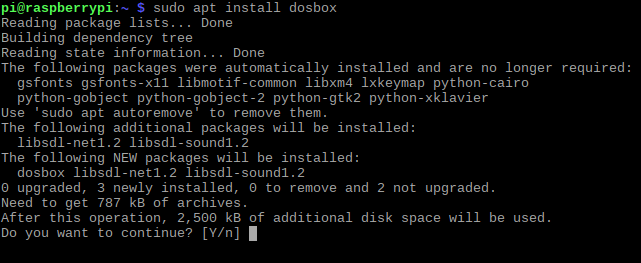
Install DOSBox
Configure DOSBox
Find MS-DOS games
Install MS-DOS games
Enjoy!
For the best results, make sure you’re using a Raspberry Pi 2 or later, with an 8GB or higher SD card. Classic PC games typically need a keyboard and mouse to play, although some controllers and joysticks are supported.
Configuring is a bit trickier. You’ll need a directory to run DOSBox and the software from:
mkdir dos
Next, edit the DOSBox configuration file in nano:
sudo nano .dosbox/dosbox-0.74.conf
Find the fullscreen configuration, and change it to true:
fullscreen=true
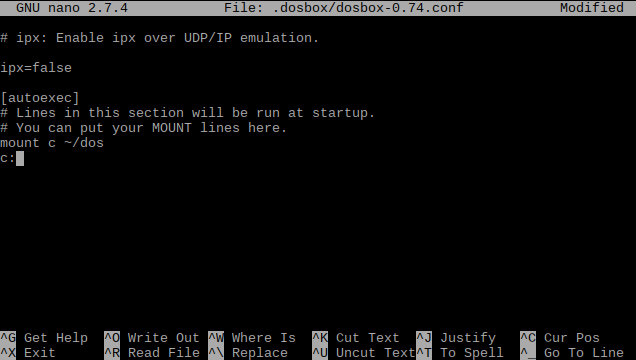
Next, scroll to the end of the file and add your mount instruction under the [autoexec] heading.
This will ensure that when DOSBox runs, it uses the dos directory as the C: drive.
mount c ~/dos
c:
Save and exit the text editor with Ctrl + X, and hit Y to confirm.
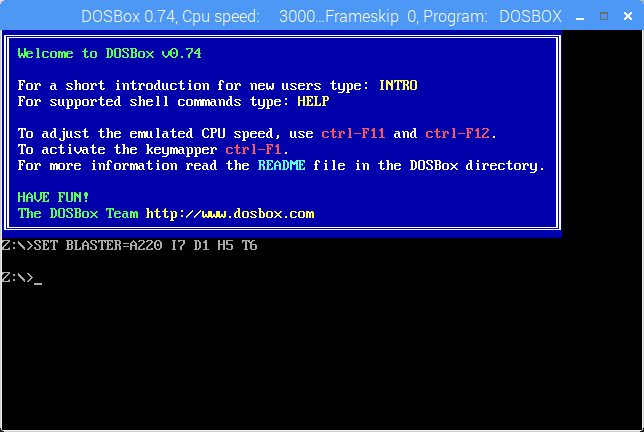
You should now be able to run DOSBox from the Games menu on your Raspberry Pi!
Step 3: Find MS-DOS Games for Raspberry Pi
Where can you find suitable games? Well, thrift stores and eBay are a good place to start. Old games will typically be available on CD-ROM or floppy disk, however, so you’ll need to make sure you have the right type of disk drive connected to your Raspberry Pi.
If this isn’t possible, then you will need to rely on disk images found online. We can’t link you to these as there are copyright considerations. Such ROM files can be found in ZIP format, unpacked, and installed within DOSBox just as they might be on a genuine MS-DOS PC.
To avoid breaching copyright and breaking the law, restrict your use of game ROMs to titles you already own.
You really shouldn’t need to break copyright law to get hold of old games, however, as so many have been made open source. A big selection of such games can be found at the Internet Archive. Here, you’ll find everything from genuine games to cover discs full of shareware titles.
In short, you should be able to find something to play very easily. But what do you do once the games have been downloaded? How can you load them into DOSBox?
Step 4: Install MS-DOS Games on Raspberry Pi
To run DOS games on your Raspberry Pi, you need DOSBox to be aware of the game. The best way to do this is create a new directory for your games within the dos directory:
mkdir dos/games
You can then use the mv (move) command to copy any games from Downloads into this new folder:
mv Downloads/[GAME_TITLE] dos/games/
You’re now ready to start installing and playing games.
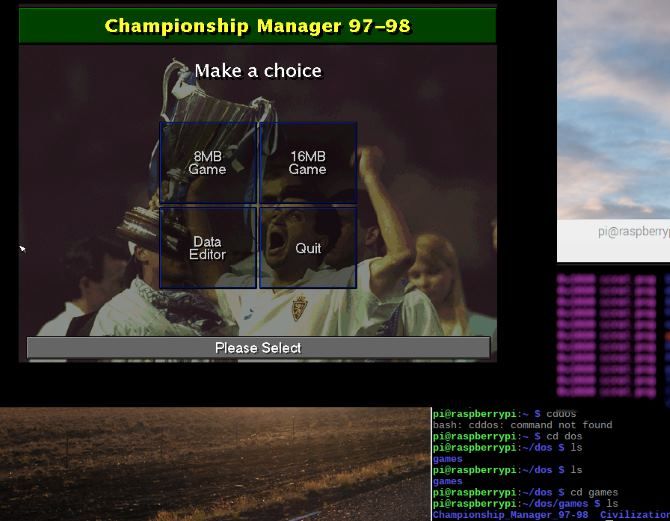
Launch DOSBox, and use the command line to navigate into the /games/ directory. Remember, you’re in an environment emulating MS-DOS, so different commands are needed. While cd still changes directory, the contents are listed with dir (you can use dir /p to display the contents list a page at a time). Type help to get more assistance.
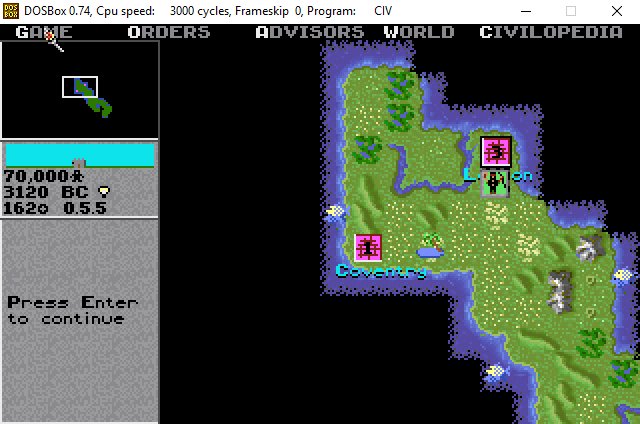
Once you have copied games into the games directory, open a specific directory, then find the install.bat file and run it. Sometimes, this may be named after the game in question. For instance, in this example, I used cm2.bat to begin installation of Championship Manager 97-98.
Wait while the game installs. Once done, you can usually run the game using the shortened form of its title. Often, this is the same as the BAT file, but without the suffix.
For example, to run Championship Manager 2, I simply entered cm2. This will differ from game to game, however, so check the documentation. If all else fails, run the appropriately names EXE file to launch the game.
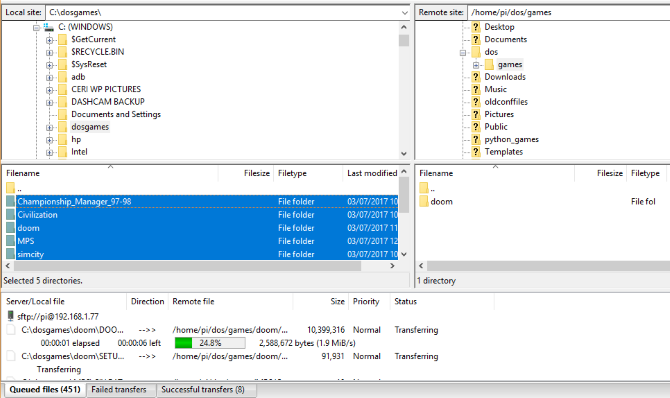
Note that you can also copy games to your Raspberry Pi from your PC. If you have SSH enabled on the Pi, the SFTP function of your preferred FTP software (we like Filezilla) will let you copy game files to the Pi. You should probably save them directly to the /games/ directory to save time.
When you’re done with DOSBox, simply exit the environment with a single command:
exit
Classic PC Games on Raspberry Pi Made Easy!
It can be a little time-consuming to set up a DOS environment on your Raspberry Pi, but once you’re up and running, you have a massive library of games and software at your disposal.
This isn’t the only way to play classic PC games on your Raspberry Pi, however. Some titles have been ported to Linux and altered to run on the Raspberry Pi without emulators.
A UK government backed drone innovation project that’s exploring how unmanned aerial vehicles could benefit cities — including for use-cases such as medical delivery, traffic incident response, fire response and construction and regeneration — has reported early learnings from the first phase of the project.
Five city regions are being used as drone test-beds as part of Nesta’s Flying High Challenge — namely London, the West Midlands, Southampton, Preston and Bradford.
While five socially beneficial use-cases for drone technology have been analyzed as part of the project so far, including considering technical, social and economic implications of the tech.
The project has been ongoing since December.
Nesta, the innovation-focused charity behind the project and the report, wants the UK to become a global leader in shaping drone systems that place people’s needs first, and writes in the report that: “Cities must shape the future of drones: Drones must not shape the future of cities.”
In the report it outlines some of the challenges facing urban implementations of drone technology and also makes some policy recommendations.
It also says that socially beneficial use-cases have come out as an early winner over of cities to the potential of the tech — over and above “commercial or speculative” applications such as drone delivery or for carrying people in flying taxis.
The five use-cases explored thus far via the project are:
Medical delivery within London — a drone delivery network for carrying urgent medical products between NHS facilities, which would routinely carry products such as pathology samples, blood products and equipment over relatively short distances between hospitals in a network
Traffic incident response in the West Midlands — responding to traffic incidents in the West Midlands to support the emergency services prior to their arrival and while they are on-site, allowing them to allocate the right resources and respond more effectively
Fire response in Bradford — emergency response drones for West Yorkshire Fire and Rescue service. Drones would provide high-quality information to support emergency call handlers and fire ground commanders, arriving on the scene faster than is currently possible and helping staff plan an appropriate response for the seriousness of the incident
Construction and regeneration in Preston — drone services supporting construction work for urban projects. This would involve routine use of drones prior to and during construction, in order to survey sites and gather real-time information on the progress of works
Medical delivery across the Solent — linking Southampton across the Solent to the Isle of Wight using a delivery drone. Drones could carry light payloads of up to a few kilos over distances of around 20 miles, with medical deliveries of products being a key benefit
Flagging up technical and regulatory challenges to scaling the use of drones beyond a few interesting experiments, Nest writes: “In complex environments, flight beyond the operator’s visual line of sight, autonomy and precision flight are key, as is the development of an unmanned traffic management (UTM) system to safely manage airspace. In isolation these are close to being solved — but making these work at large scale in a complex urban environment is not.”
“While there is demand for all of the use cases that were investigated, the economics of the different use cases vary: Some bring clear cost savings; others bring broader social benefits. Alongside technological development, regulation needs to evolve to allow these use cases to operate. And infrastructure like communications networks and UTM systems will need to be built,” it adds.
The report also emphasizes the importance of public confidence, writing that: “Cities are excited about the possibilities that drones can bring, particularly in terms of critical public services, but are also wary of tech-led buzz that can gloss over concerns of privacy, safety and nuisance. Cities want to seize the opportunity behind drones but do it in a way that responds to what their citizens demand.”
And the charity makes an urgent call for the public to be brought into discussions about the future of drones.
“So far the general public has played very little role,” it warns. “There is support for the use of drones for public benefit such as for the emergency services. In the first instance, the focus on drone development should be on publicly beneficial use cases.”
Giving the combined (and intertwined) complexity of regulatory, technical and infrastructure challenges standing in the way of developing viable drone service implementations, Nesta is also recommending the creation of testbeds in which drone services can be developed with the “facilities and regulatory approvals to support them”.
“Regulation will also need to change: Routine granting of permission must be possible, blanket prohibitions in some types of airspace must be relaxed, and an automated system of permissions — linked to an unmanned traffic management system — needs to be put in place for all but the most challenging uses. And we will need a learning system to share progress on regulation and governance of the technology, within the UK and beyond, for instance with Eurocontrol,” it adds.
“Finally, the UK will need to invest in infrastructure, whether this is done by the public or private sector, to develop the communications and UTM infrastructure required for widespread drone operation.”
In conclusion Nesta argues there is “clear evidence that drones are an opportunity for the UK” — pointing to the “hundreds” of companies already operating in the sector; and to UK universities with research strengths in the area; as well as suggesting public authorities could save money or provide “new and better services thanks to drones”.
At the same time it warns that UK policy responses to drones are lagging those of “leading countries” — suggesting the country could squander the chance to properly develop some early promise.
“The US, EU, China, Switzerland and Singapore in particular have taken bigger steps towards reforming regulations, creating testbeds and supporting businesses with innovative ideas. The prize, if we get this right, is that we shape this new technology for good — and that Britain gets its share of the economic spoils.”
The UK government has set out a package of measures it’s hoping will futureproof domestic networks and boost international competitiveness by supporting a nationwide rollout of full fiber broadband and 5G mobile technology.
The Future Telecoms Infrastructure Review, published today, follows the announcement of a market review last year as part of the government’s Industrial Strategy as it seeks to chart a technology-enabled course for growth and competitiveness.
Yet, at the same time, the UK seriously lags several European competitors on the fiber broadband front — so the strategy is also intended to try to reboot current poor performance.
The government says its telecoms plan emphasizes greater consumer choice and initiatives to promote quicker rollout — and an eventual full switch over — from copper to fiber.
It wants full fibre broadband to reach 15 million premises (up from the ’10M over the next decade’ set out in the Conservative party manifesto) by 2025, and also 5G mobile network coverage to reach the majority of the population.
By 2033, it wants full fiber broadband coverage to reach across all of the UK.
Currently the UK only has 4% full fiber connections, which compares dismally to 71% in Spain and 89% in Portugal. While France has around 28% — which the government notes is “increasing quickly”.
Included in the government’s strategy is public investment in full fiber for rural areas; and new legislation to guarantee full fiber connections in new build developments; as well as a series of regulatory reforms intended to drive investment and competition — which it says will be tailored to different local market conditions.
It’s also planning for an industry-led switch over from copper to full fiber — to avoid businesses being saddled with the expense and burden of running copper and fiber networks in parallel.
There’s no fixed timing for this, as the government says it will depend on the pace of fiber rollouts and take-up, but it suggests it’s “realistic to assume that switchover could happen in the majority of the country by 2030”.
To boost competition to drive commercial fiber rollouts, the government is proposing regulatory reform to allow for “unrestricted access” to BT Openreach ducts and poles — i.e. the company’s own physical infrastructure where fiber can be laid — for both residential and business broadband use, including for essential mobile infrastructure.
It also wants to open up other avenues for laying broadband fiber, saying other existing infrastructure (including pipes and sewers) owned by other utilities such as power, gas and water, should be “easy to access, and available for both fixed and mobile use”.
And it says it will shortly publish consultations on the proposed legislative changes to streamline wayleaves and mandate fiber connections in new builds.
Another key recommendation in the review, given that the expense of digs to lay fiber remains one of the biggest barriers to broadband upgrades, is for a new nationwide framework aimed at reducing the costs, time and disruption caused by street-works by standardising the approach across the country.
With its planned regulatory tweaks, the government reckons that market competition will be able to deliver full fiber networks across the majority of the UK (~80%) — leaving around ~20% which it’s expecting will require “bespoke solutions to ensure rollout of networks”. And for around half of that fifth it also expects taxpayer funding will be needed to deliver a fiber/5G upgrade.
It estimates that nationwide availability of ‘full fiber’ is likely to require additional (public) funding of around £3BN to £5BN to support commercial investment in the final ~10% of areas that would otherwise be overlooked — stressing that these “often rural areas must not be forced to wait until the rest of the country has connectivity before they can access gigabit-capable networks”.
So it’s planning to pursue an “outside-in” strategy, allowing network competition to serves commercially viable areas while laying down government support investment in parallel on what it describes as “the most difficult to reach areas”.
“We have already identified around £200M within the existing Superfast broadband programme that can further the delivery of full fibre networks immediately,” it notes on that.
Although it’s not clear at this stage how the government intends to fund the full proposals for a taxpayer-funded broadband bill running to multiple billions.
On the mobile connectivity front, it’s proposing increased access to spectrum for “innovative 5G services”, and says it will allow mobile network operators to make far greater use of government buildings to boost coverage across the UK.
“We should consider whether more flexible, shared spectrum models can maintain network competition between MNOs while also increasing access to spectrum to support new investment models, spurring innovation in industrial internet of things, wireless automation and robotics, and improving rural coverage,” it writes on that.
Over the longer term it says is expecting to see a more converged telecoms sector — so it’s leaving itself some ‘last mile’ wiggle room on the ‘full fiber’ push, for example by pointing out that: “Fixed fibre networks and 5G are complementary technologies, and 5G will require dense fibre networks. In some places, 5G may provide a more cost-effective way of providing ultra-fast connectivity to homes and businesses.”
“We want everyone in the UK to benefit from world-class connectivity no matter where they live, work or travel,” said the new Secretary of State for digital, culture, media and sport, Jeremy Wright, commenting on the review in a statement, and dubbing it a “radical new blueprint for the future of telecommunications in this country”.
“[The strategy] will increase competition and investment in full fiber broadband, create more commercial opportunities and make it easier and cheaper to roll out infrastructure for 5G,” he added.
The UK’s incumbent telco, BT, which owns and operates the country’s largest broadband network, has long pursued the opposite strategy to the one the government is here pursuing: i.e. by seeking to eke out its own ex-monopoly copper infrastructure, such as by applying technologies that speed up fiber to the cabinet technology, instead of making the major financial commitment to invest in substantially expanding full fiber to the home coverage (and thereby futureproof national network infrastructure).
For years competitors (and, indeed, frustrated consumers) have also accused the company of foot-dragging on providing access to its network — thereby undermining other commercial players’ ability to fund and build out next-gen network coverage.
Last year BT agreed with telecoms watchdog Ofcom to legally separate its network division Openreach — around a decade after a functional separation has been imposed by the regulator. Albeit, it’s still not the full structural separation some have called for.
“It is too early to determine whether legal separation will be sufficient to deliver positive changes on investment in full fibre infrastructure,” writes the government in its review, adding that it will “closely monitor legal separation, including Ofcom’s reports on the effectiveness of the new arrangements”.
“The Government will consider all additional measures if BT Group fails to deliver its commitments and regulatory obligations, and if Openreach does not deliver on its purpose of investing in ways that respond to the needs of its downstream customers,” it adds.
One aspect of the strategy the government is not trumpeting quite so loudly in its PR around the announcement is an intent to promote what it describes as “stable and long-term regulation” as part of its strategy to drive increased competition and unlock business investments.
On this it writes that the overarching strategic priority to “promote efficient competition and investment in world-class digital networks” should be “prioritised over interventions to further reduce retail prices in the near term, recognising these longer-term benefits”.
In the review it suggests moving to longer, five year review periods, for instance — saying this “could provide greater regulatory stability and promote investment”. It also writes that it wants Ofcom to publish guidance that “clearly sets out the approach and information it will use in determining a ‘fair bet’ return”.
It’s therefore possible that UK consumers could end up paying twice over to help fund national fiber broadband infrastructure upgrades; i.e. not just via direct subsidies to fund rural rollouts but also, potentially, via higher broadband prices too. Albeit, the government says that in its view “the interests of consumers are safeguarded as fiber markets become more competitive”.
Though in less commercially attractive areas, where there could be a greater risk of price inflation, the government’s small print does include the recognition that regulatory interventions — such as price controls — may indeed be required. Though of course any such controls would only come in after consumers had been being stung…
“For areas where there is actual or prospective effective competition between networks, Government would not anticipate the need for regulation,” it writes. “For other areas, we would expect the regulatory model for to evolve over time as networks are established. If market power emerges, regulated access (including price controls) may be needed to address competition concerns. These detailed regulatory decisions will be for Ofcom to take.”