11 April 2018

Zuckerberg’s boring testimony is a big win for Facebook


Mark Zuckerberg ran his apology scripts, trotted out his lists of policy fixes and generally dulled the Senate into submission. And that constitutes success for Facebook.

Zuckerberg testified before the joint Senate judiciary and commerce committee today, capitalizing on the lack of knowledge of the politicians and their surface-level questions. Half the time, Zuckerberg got to simply paraphrase blog posts and statements he’d already released. Much of the other half, he merely explained how basic Facebook functionality works.

The senators hadn’t done their homework, but he had. All that training with D.C. image consultants paid off.
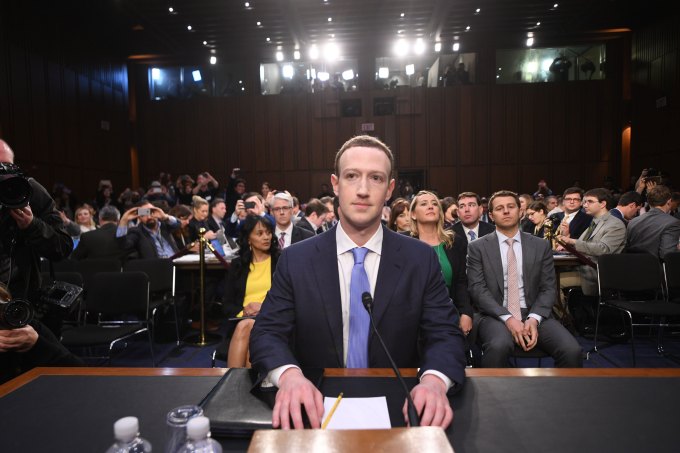
Facebook CEO Mark Zuckerberg arrives to testify before a joint hearing of the US Senate Commerce, Science and Transportation Committee and Senate Judiciary Committee on Capitol Hill, April 10, 2018 in Washington, DC. (Photo: JIM WATSON/AFP/Getty Images)

Sidestepping any gotcha questions or meme-worthy sound bites, Zuckerberg’s repetitive answers gave the impression that there’s little left to uncover, whether or not that’s true. He made a convincing argument that Facebook is atoning for its sins, is cognizant of its responsibility and has a concrete plan in place to improve data privacy.

With just five minutes per senator, and them each with a queue of questions to get through, few focused on the tougher queries, and even fewer had time for follow-ups to dig for real answers.

Did Facebook cover up the Cambridge Analytica scandal or decide against adding privacy protections earlier to protect its developer platform? Is it a breach of trust for Zuckerberg and other executives to have deleted their Facebook messages out of recipients’ inboxes? How has Facebook used a lack of data portability to inhibit the rise of competitors? Why doesn’t Instagram let users export their data the way they can from Facebook?

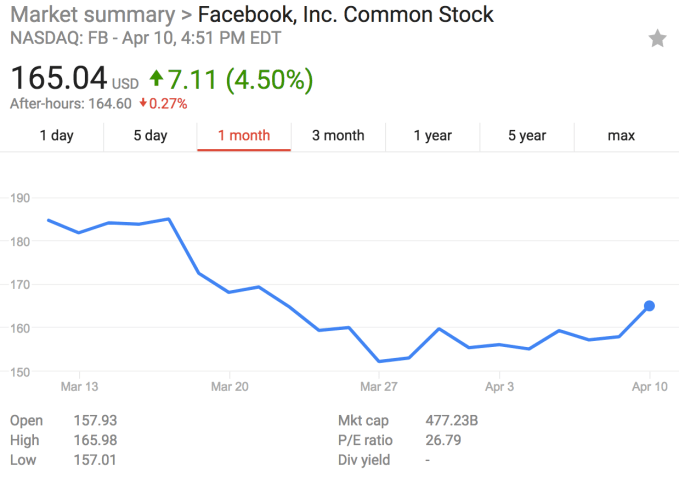
The public didn’t get answers to any of those questions today. Just Mark’s steady voice regurgitating Facebook’s talking points. Investors rewarded Facebook for its monotony with a 4.5 percent share price boost.
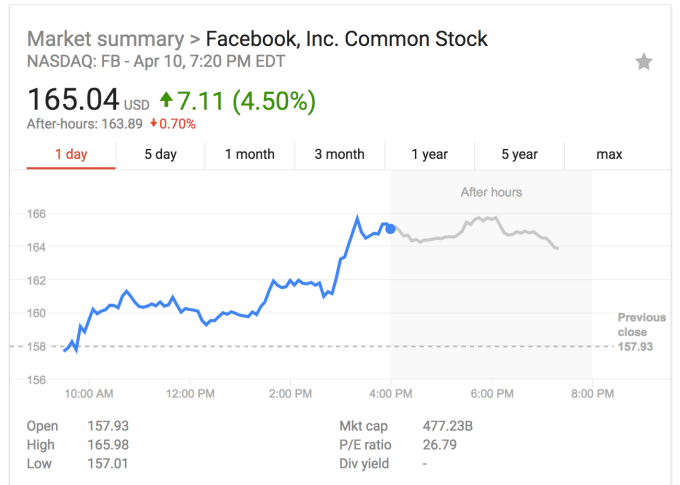
That’s not to say today’s hearing wasn’t effective. It’s just that the impact was felt before Zuckerberg waded through a hundred photographers to take his seat in the Senate office.

Facebook knew this day was coming, and worked to build Zuckerberg a fortress of facts he could point to no matter what he got asked:

  • Was Facebook asleep at the wheel during the 2016 election? Yesterday it revealed it had deleted the accounts of Russian GRU intelligence operatives in June 2016.
  • How will Facebook prevent this from happening again? Last week it announced plans to require identity and location verification for any political advertiser or popular Facebook Page, and significantly restricted its developer platform.
  • Is Facebook taking this seriously? Zuckerberg wrote in his prepared testimony for today that Facebook is doubling its security and content moderation team from 10,000 to 20,000, and that “protecting our community is more important than maximizing our profits.”
  • Is Facebook sorry? “We didn’t take a broad enough view of what our responsibility is and that was a huge mistake. That was my mistake,” Zuckerberg has said, over and over.

Facebook may never have made such sweeping changes and apologies had it not had today and tomorrow’s testimony on the horizon. But this defensive strategy also led to few meaningful disclosures, to the detriment of the understanding of the public and the Senate — and to the benefit of Facebook.
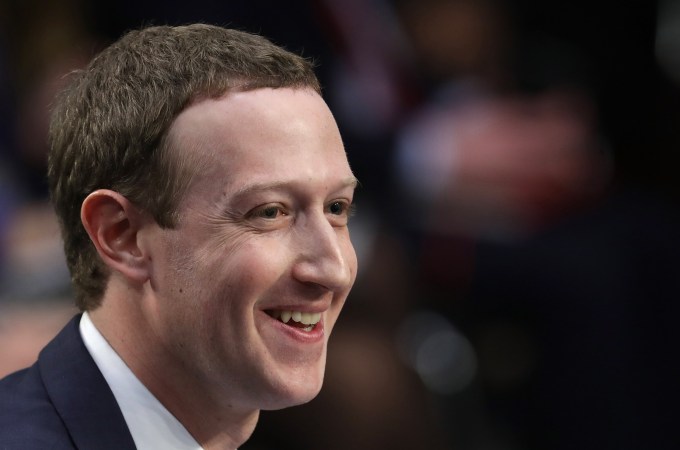
WASHINGTON, DC – APRIL 10: Facebook co-founder, Chairman and CEO Mark Zuckerberg testifies before a combined Senate Judiciary and Commerce committee hearing in the Hart Senate Office Building on Capitol Hill April 10, 2018 in Washington, DC. Zuckerberg, 33, was called to testify after it was reported that 87 million Facebook users had their personal information harvested by Cambridge Analytica, a British political consulting firm linked to the Trump campaign. (Photo by Chip Somodevilla/Getty Images)

We did learn that Facebook is working with Special Counsel Robert Mueller on his investigation into election interference. We learned that Zuckerberg thinks it was a mistake not to suspend the advertising account of Cambridge Analytica when Facebook learned it had bought user data from Dr. Aleksandr Kogan. And we learned that the senate will “haul in” Cambridge Analytica for a future hearing about data privacy.

None of those are earth-shaking.

Perhaps the only fireworks during the testimony came when Senator Ted Cruz laid into Zuckerberg over the Gizmodo report citing that Facebook’s trending topics curators suppressed conservative news trends. Cruz badgered Zuckerberg about whether he believes Facebook is politically neutral, whether Facebook has ever taken down Pages from liberal groups like Planned Parenthood or MoveOn.org, if he knows the political leanings of Facebook’s content moderators and whether Facebook fired Oculus co-founder Palmer Luckey over his [radical conservative] political views.

Zuckerberg maintained that he and Facebook are neutral, but that last question was the only one of the day that seemed to visibly perturb him. “That is a specific personnel matter than seems like it would be inappropriate…” Zuckerberg said before Cruz interrupted, pushing the CEO to exasperatedly respond, “Well then I can confirm that it was not because of a political view.” It should be noted that Cruz has received numerous campaign donations from Luckey.

This was the only time Zuckerberg seemed flapped, because he knows the stakes of the public perception of Facebook’s political leanings. Zuckerberg, many Facebook employees and Facebook’s home state of California are all known to lean left. But if the company itself is seen that way, conservative users could flee, shattering Facebook’s network effect. Yet again, Zuckerberg nimbly avoided getting cornered here, and was aided by the bell signaling the end of Cruz’s time. He never noticeably raised his voice, lashed back at the senators or got off message.

By the conclusion of the five hours of questioning, the senators themselves were admitting they hadn’t watched the day’s full testimony. Viewers at home had likely returned to their lives. Even the press corps’ eyes were glazing over. But Zuckerberg was prepared for the marathon. He maintained pace through the finish line. And he made it clear why marathons aren’t TV spectator sports.

The question is no longer what revelations would come from Mr. Zuckerberg going to Washington. Tomorrow’s testimony is likely to go similarly. It’s whether Facebook can coherently execute on the data privacy promises it made leading up to today. This will be a “never-ending battle” as Zuckerberg said, dragging out over many years. And again, that’s in Facebook’s interest. Because in the meantime, everyone’s going back to scrolling their feeds.


Read Full Article

Zuckerberg tells Congress Facebook is not listening to you through your phone


Facebook CEO Mark Zuckerberg officially shot down the conspiracy theory that the social network has some way of keeping tabs on its users by tapping into the mics on people’s smartphones. During Zuckerberg’s testimony before the Senate this afternoon, Senator Gary Peters had asked the CEO if the social network is mining audio from mobile devices – something his constituents have been asking him about, he said.

Zuckerberg denied this sort of audio data collection was taking place.

The fact that so many people believe that Facebook is “listening” to their private conversations is representative of how mistrustful users have grown of the company and its data privacy practices, the Senator noted.

“I think it’s safe to say very simply that Facebook is losing the trust of an awful lot of Americans as a result of this incident,” said Peters, tying his constituents’ questions about mobile data mining to their outrage over the Cambridge Analytica scandal.

Questions about Facebook’s mobile data collection practices aren’t anything new, however.

In fact, Facebook went on record back in 2016 to state – full stop – that it does not use your phone’s microphone to inform ads or News Feed stories.

Despite this, it’s something that keeps coming up, time and again. The Wall St. Journal even ran an explainer video about the conspiracy last month. And yet none of the reporting seems to quash the rumor.

People simply refuse to believe it’s not happening. They’ll tell you of very specific times when something they swear they only uttered aloud quickly appeared in their Facebook News Feed.

Perhaps their inability to believe Facebook on the matter is more of an indication of how precise – and downright creepy – Facebook’s ad targeting capabilities have become over the years.

Peters took the opportunity today to ask Zuckerberg this question straight on today, during Zuckerberg’s testimony.

“Something that I’ve been hearing a lot from folks who have been coming up to me and talking about a kind of experience they’ve had where they’re having a conversation with friends – not on the phone, just talking. And then they see ads popping up fairly quickly on their Facebook,” Peters explained. “So I’ve heard constituents fear that Facebook is mining audio from their mobile devices for the purposes of ad targeting – which I think speaks to the lack of trust that we’re seeing here.”

He then asked Zuckerberg to state if this is something Facebook did.

“Yes or no: does Facebook use audio obtained from mobile devices to enrich personal information about its users?,” Peters asked.

Zuckerberg responded simply: “no.”

The CEO then added that his answer meant “no” in terms of the conspiracy theory that keeps getting passed around, but noted that the social network does allow users to record videos, which have an audio component. That was a bit of an unnecessary clarification, though, given that the question was about surreptitious recording, not something users were explicitly recording media to share.

“Hopefully that will dispel a lot of what I’ve been hearing,” Peters said, after hearing Zuckerberg’s response.

We wouldn’t be too sure.

There have been a number of lengthy explanations of the technical limitations regarding a project of this scale, which have also pointed out how easy it would be to detect this practice, if it were true. But there are still those people out there who believe things to be true because they feel true.

And at the end of the day, the fact that this conspiracy refuses to die says something about how Facebook users view the company: as a stalker that creeps on their privacy, and then can’t be believed when it tells you, “no, trust me, we don’t do that.”


Read Full Article

Zuckerberg tells Congress Facebook is not listening to you through your phone


Facebook CEO Mark Zuckerberg officially shot down the conspiracy theory that the social network has some way of keeping tabs on its users by tapping into the mics on people’s smartphones. During Zuckerberg’s testimony before the Senate this afternoon, Senator Gary Peters asked the CEO if the social network is mining audio from mobile devices – something his constituents have been asking him about, he said.

The fact that so many people believe that Facebook is “listening” to their private conversations is representative of how mistrustful users have grown of the company and its data privacy practices, the Senator noted.

“I think it’s safe to say very simply that Facebook is losing the trust of an awful lot of Americans as a result of this incident,” said Peters, tying his constituents’ questions about mobile data mining to their outrage over the Cambridge Analytica scandal.

But questions about Facebook’s mobile data collection practices aren’t anything new.

In fact, Facebook went on record back in 2016 to state – full stop – that it does not use your phone’s microphone to inform ads or News Feed stories.

Despite this, it’s something that keeps coming up, time and again. The Wall St. Journal even ran an explainer video about the conspiracy last month, and yet none of the reporting seems to quash the rumor.

People simply refuse to believe it’s not happening. They’ll tell you of very specific times when something they swear they only uttered aloud quickly appeared in their Facebook News Feed. Perhaps their inability to believe Facebook on the matter is more of an indication of how precise – and downright creepy – Facebook’s ad targeting capabilities have become over the years.

Peters took the opportunity today to ask Zuckerberg this question straight on today, during Zuckerberg’s testimony.

“Something that I’ve been hearing a lot from folks who have been coming up to me and talking about a kind of experience they’ve had where they’re having a conversation with friends – not on the phone, just talking. And then they see ads popping up fairly quickly on their Facebook,” Peters explained. “So I’ve heard constituents fear that Facebook is mining audio from their mobile devices for the purposes of ad targeting – which I think speaks to the lack of trust that we’re seeing here.”

He then asked Zuckerberg to state if this is something Facebook did.

“Yes or no: does Facebook use audio obtained from mobile devices to enrich personal information about its users?,” Peters asked.

Zuckerberg responded simply: “no.”

The CEO then added that his answer meant “no” in terms of the conspiracy theory that keeps getting passed around, but noted that the social network does allow users to record videos, which have an audio component. That was a bit of an unnecessary clarification, however, given that the question was about surreptitious recording, not something users were explicitly recording media to share.

“Hopefully that will dispel a lot of what I’ve been hearing,” Peters said, after hearing Zuckerberg’s response.

We wouldn’t be too sure.

There have been a number of lengthy explanations of the technical limitations regarding a project of this scale, which have also pointed out how easy it would be to detect this practice, if it were true. But there are still those people out there who believe things to be true because they feel true.

And at the end of the day, the fact that this conspiracy refuses to die says something about how Facebook users view the company: as a stalker that creeps on their privacy, and then can’t be believed when it tells you, “no, trust me, we don’t do that.”


Read Full Article

Cambridge Analytica may have accessed some Facebook users’ messages


The app permissions that led to 87 million Facebook users’ data being harvested and sold to Cambridge Analytica may have also allowed access to those users’ inboxes, the company confirmed today. This wasn’t achieved by any underhanded means, exactly, but people might not have realized that they were granting permission to read and record their private messages as well as more public data like location and interests.

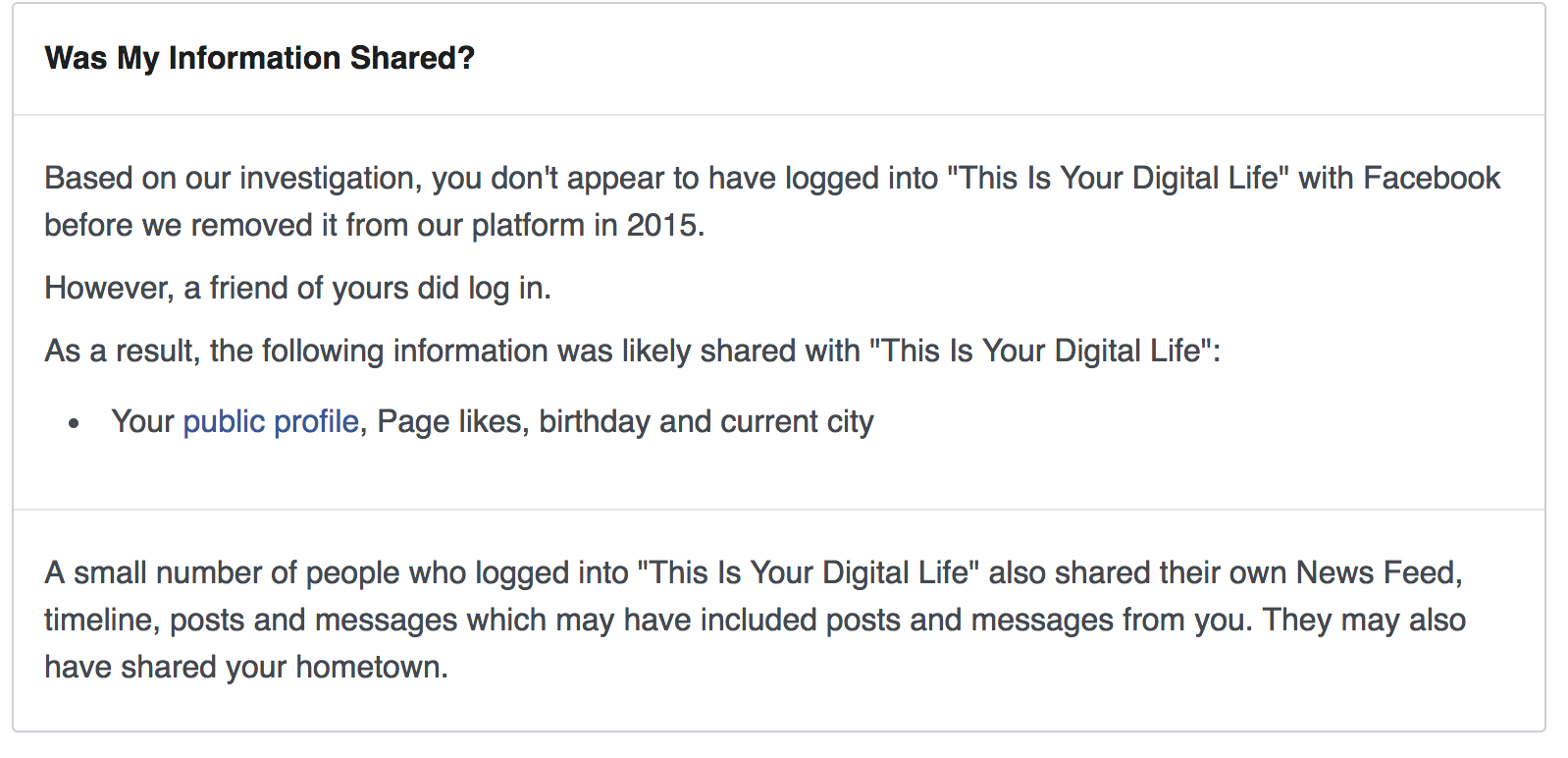
That messages may have been collected by CA was revealed first by Facebook itself as part of its warning issued to the 87 million users in question. “A small number of people who logged into ‘This Is Your Digital Life’ also shared their own News Feed, timeline, posts and messages which may have included posts and messages from you,” reads the warning.

Access to messages had not been previously disclosed. And of course if someone affected had chatted with you, then your messages would also have been collected.

The permission used to do this was called “read_mailbox,” though it would have been put in more everyday terms when a user was agreeing to it. The dialog box would have said something along the lines of, “This app will be able to access your wall posts, friend list, contacts, messages…” in bullet points.

This Is Your Digital Life, the app created by researcher Aleksandr Kogan which served as the harvester for all this data, requested “read_mailbox” privileges for some period and, as Facebook tells Wired, a total of 1,500 people granted that permission.

It’s unclear why the number is so low if hundreds of thousands agreed to the terms, but the app may only have requested messaging access for a brief period — stopping, perhaps, upon finding that people balked at granting it.

Still, even if only 1,500 people had their messages collected directly, the number of people whose messages were indirectly collected could be orders of magnitude higher. After all, look at your inbox, if you have one — there are likely dozens of conversations, perhaps with hundreds of people. So that 1,500 could balloon to 150,000 real fast.

I’ve asked Facebook for clarification on how the 1,500 number was determined and what the number of secondary affected users is.


Read Full Article

Mark Zuckerberg: “We do not sell data to advertisers”


While many of us in the tech world are familiar with Facebook’s business model, there is a common misconception among people that Facebook collects information about you and then sells that information to advertisers.

Zuckerberg wants everyone (especially the U.S. Senate) to know that’s not the case, and has laid forth the most simple example to explain it.

During his testimony, the Facebook CEO clarified to Senator John Cornyn that Facebook does not sell data.

There is a very common misconception that we sell data to advertisers, and we do not sell data to advertisers. What we allow is for advertisers to tell us who they want to reach and then we do the placement. So, if an advertiser comes to us and says, ‘Alright, I’m a ski shop and I want to sell skis to women,’ then we might have some sense because people shared skiing related content or said they were interested in that. They shared whether they’re a woman. And then we can show the ads to the right people without that data ever changing hands and going to the advertiser. That’s a very fundamental part of how our model works and something that is often misunderstood.

While, again, this may seem straightforward to many of us, Zuckerberg found himself having to explain more than once that Facebook does not sell data during his Senate testimony.


Read Full Article

HBO Rickrolls Reddit Over Westworld Spoilers


HBO, home of some amazing TV shows, may have just killed the Rickroll. This is because the showrunners for Westworld, Jonathan Nolan and Lisa Joy, have Rickrolled Reddit. And they pulled their publicity stunt off in spectacular style.

What Is Rickrolling?

If you’re very young or simply new to the internet, you may not be aware of Rickrolling. It’s a simple concept where you’re invited to click a link, and instead of opening the site or story you were expecting, you hear “Never Gonna Give You Up” by Rick Astley.

Rickrolling has been around since May 2007, when the music video for “Never Gonna Give You Up” was touted as the trailer for Grand Theft Auto IV. Rickrolling then became a thing across the internet, and out of touch brands continue to use it to this day.

Which brings us onto HBO, Nolan and Joy, and their Rickrolling of Reddit.

The Day HBO Rickrolled Reddit

Ahead of the second season of Westworld, Jonathan Nolan and Lisa Joy took part in a Reddit AMA. During this AMA the showrunners announced that they were willing to post a video showing the entire plot of Season 2 in an attempt to reduce the impact of spoilers.

Redditors lapped it up, upvoting the suggestion to ensure Nolan and Joy followed through. However, while some Westworld fans were keen to see spoilers, others expressed their disagreement with the plan. Regardless, the votes racked up and the video was uploaded.

As you can see, this video starts out delivering what it promised, with Jeffrey Wright, who plays Bernard, describing how Westworld Season 2 opens. And then, just as you think it’s legit, Evan Rachel Wood, who plays Dolores, sings “Never Gonna Give You Up”.

After a brief message informing Reddit they just got pwned, the rest of the video shows a dog sitting at a piano as the Westworld theme plays out. It closes with a tribute to Bento, better known to Reddit et al as Keyboard Cat.

Spoiling for a Fight

Is this important in the big scheme of things? No, of course not. However, the internet is responsible for spoiling lots of big shows, including Game of Thrones, so this suggests HBO is at least a little concerned about the same thing happening to Westworld.


Read Full Article

Palmer Luckey, political martyr?


In the middle of testimony over Facebook’s privacy scandal, Sen. Ted Cruz of Texas took a moment to grill Mark Zuckerberg over his company’s political loyalties.

In the course of a testy exchange between Sen. Cruz and Zuckerberg, the senator brought up the dismissal of Palmer Luckey, the controversial founder of virtual reality tech development pioneer, Oculus.

It was part of Cruz’s broader questioning about whether or not Facebook is biased in the ways it moderates the posts and accounts of members — and in its staffing policies.

Here’s the exchange:

Cruz: Do you know the political orientation of those 15 to 20,000 people engaged in content review?

Zuckerberg: No senator, we do not generally ask people about their political orientation when they’re joining the company.

Cruz: So, as CEO Have you ever made hiring or firing decisions based on political positions or what candidates they supported?

Zuckerberg: No.

Cruz: Why was Palmer Luckey fired?

Zuckerberg: That is a specific personnel matter that seems like it would be inappropriate to speak to here.

Cruz: You just made a specific representation that you didn’t make decisions based on political views, is that accurate?

Zuckerberg: I can commit that it was not because of a political view.

Luckey left Facebook last March, after reports surfaced that he was a member of a pro-Trump troll farm called Nimble America.

Luckey’s departure follows a lengthy period of absence from public view brought about by a Daily Beast piece revealing his involvement and funding of a pro-Trump troll group called Nimble America. News of his support came during a time when very few figures in Silicon Valley were publicly showing support for candidate Trump, the most notable being Peter Thiel, an early investor in Facebook who started the VC firm Founders Fund, which backed Oculus, as well.

Though Luckey initially denied funding the group, he ultimately took to social media to apologize in the midst of an upheaval that had many developers threatening to leave the platform. His last public statement (on Facebook, of course) was a mixture of regret and defense, reading, in part, “I am deeply sorry that my actions are negatively impacting the perception of Oculus and its partners. The recent news stories about me do not accurately represent my views… my actions were my own and do not represent Oculus. I’m sorry for the impact my actions are having on the community.”


Read Full Article

Facebook share price climbs as Zuckerberg gets grilled by the Senate


Shareholders seemed to have incredibly low expectations of Facebook CEO Mark Zuckerberg’s ability to handle a Senate testimony, because Facebook stock climbed 4.5 percent Tuesday with the bulk of the gains coming during his televised testimony.

Though the markets closed nearly an hour ago, Zuckerberg is still being peppered by Senators in an hours-long testimony session where the group is aiming to hear more from the company’s CEO and founder about data protection in the wake of the Cambridge Analytica controversy.

While there have been tough questions from several senators, rhetoric regarding government regulation of internet companies like Facebook was not overly pronounced in opening statements, though several Senators did directly address it in their questioning.

While Zuckerberg’s apology tour of the Capitol building seems to have largely been devoted to rehashing the major changes they’ve announced in recent days and weeks, he did reveal that the number of Facebook accounts with ties to Russian Intelligence could be in the “tens of thousands,” an admission that greatly exceeds the several hundred that Facebook had previously disclosed.

Facebook’s gains Tuesday brought the company’s share price to close above $165, a number it has not closed above in nearly three weeks. Facebook is still far below the $185 share price it was above before Cambridge Analytica reports were shared from a number of publications in mid-March.


Read Full Article

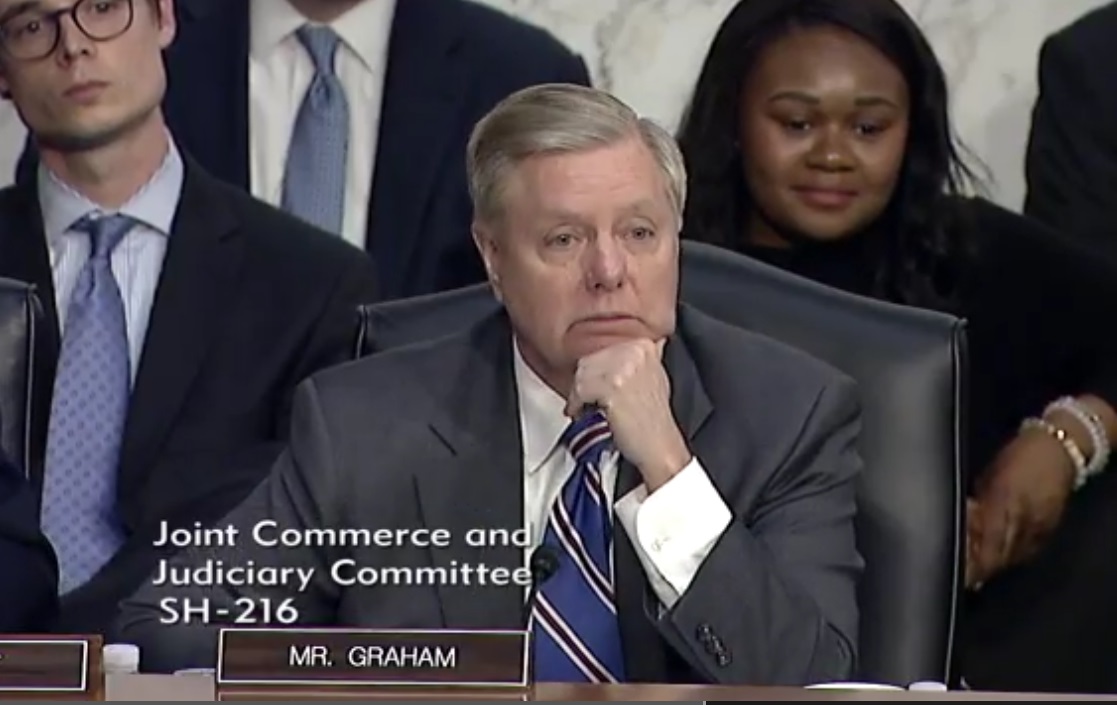
‘You don’t think you have a monopoly?’ Read Sen. Graham’s delightful grilling of Zuckerberg


Today’s testimony by Mark Zuckerberg in front of a Senate joint committee was often boring or redundant with previous statements. But there was an exchange near the two hour mark that was pleasantly refreshing: Senator Lindsey Graham (R-SC) doggedly pursuing a common-sense answer from Zuckerberg on the question of whether it had any real competition.

Graham doesn’t let Zuckerberg employ his spin on the admittedly complex question of what Facebook’s competitors are. Demanding a simpler answer by employing a folksy car-buying metaphor, he makes it clear that at least from one perspective, Facebook is more or less without a real competitor — with the possible exception of Instagram, which it of course opted to buy for a fortune rather than allow it to exist as a credible rival.

The Senator also makes it clear that he doesn’t think Facebook should be allowed to self-regulate — but his invitation to Zuckerberg to collaborate on rules sure sounds like he wants the company to have a say in how it should or should not be bound by law.

I’ve transcribed the exchange below:

Graham: Who’s your biggest competitor?
Zuckerberg: Senator, we have a lot of competitors.
Graham: Who’s your biggest?
Zuckerberg: Mmm… I think the categories of… do you want just one? I’m not sure i can give one. But can I give a bunch?
Graham: Mmhm.
Zuckerberg: So there are three categories I would focus on. One are [sic] the other tech platforms, so Google, Apple, Amazon, Microsoft, we overlap with them in different ways.
Graham: Do they do, do they provide the same service that you provide?
Zuckerberg: Um, in different ways, different parts of it yes.
Graham: Let me put it this way. If I buy a Ford and it doesn’t work well and I don’t like it, I can buy a Chevy. If I’m upset with Facebook, what’s the equivalent product that i can go sign up for?
Zuckerberg: Ah well, the second category that i was going to talk about was…
Graham: I’m not talking about categories. I’m talking about is there real competition you face. Because car companies face a lot of competition. If they make a defective car, it gets out in the world, people stop buying that car, they buy another one. Is there an alternative to Facebook in the private sector?
Zuckerberg: Yes Senator, the average American uses 8 different apps…
Graham: OK.
Zuckerberg: …to communicate with their friends and stay in touch with people, ranging from text to email.
Graham: OK, which is the same service that provide.
Zuckerberg: Well, we provide a number of different services.
Graham: Is twitter the same as what you do?
Zuckerberg: It overlaps with a portion of what we do.
Graham: You don’t think you have a monopoly?
Zuckerberg: (long pause) Ah, it certainly doesn’t feel like that to me! (laughter)
Graham: OK, so it doesn’t. So, Instagram. You bought Instagram. Why did you buy Instagram?
Zuckerberg: Because they were very talented app developers who were making good use of our platform and understood our values.
Graham: It was a good business decision. My point is that one way to regulate a company is through competition, through government regulation. Here’s the question that all of us got to answer. What do we tell our constituents, given what’s happened here, why we should let you self-regulate? What would you tell people in South Carolina, that given all the things we’ve just discovered here, it’s a good idea for us to rely on you to regulate your own business practices?
Zuckerberg: Well Senator, my position is not that there should be no regulation. I think the internet is increasing in…
Graham: Mmkay. You’d embrace regulation?
Zuckerberg: i think the real question as the internet becomes more important in people’s lives, is what is the right regulation, not whether there should be regulation.
Graham: But you as a company welcome regulation?
Zuckerberg: I think if it’s the right regulation then yes.
Graham: Do you think the Europeans have it right?
Zuckerberg: Ah, I think that they get… things right.
Graham: Have you ever submitted… (laughter) That’s true. So would you work with us in terms of what regulations you think are necessary in your industry?
Zuckerberg: Absolutely.
Graham: OK, would you submit to us and propose regulations?
Zuckerberg: Yes and I’ll have my team follow up with you so that way we can have this discussion across the different categories where I think this discussion needs to happen.
Graham: Looking forward to it.

While it’s admittedly not the toughest questioning, it does baldly address the simple idea that Graham and others consider Facebook effectively a monopoly and intend to craft regulations or legislation to remedy what they perceive as a regulatory gap.


Read Full Article

Zuckerberg urges privacy carve outs to compete with China


Facebook’s founder said last month that the company is open to being regulated. But today he got asked by the US senate what sort of legislative changes he would (and wouldn’t) like to see as a fix for the problems that the Cambridge Analytica data scandal has revealed.

Zuckerberg’s response on this — and on another question about his view on European privacy regulations — showed in the greatest detail yet how he’s hoping data handling and privacy rules evolve in the US, including a direct call for regulatory carve outs to — as he couched it — avoid the US falling behind Chinese competitors.

Laying out “a few principles” that he said he believes would be “useful to discuss and potentially codify into law”, Zuckerberg first advocated for having “a simple and practical set of ways that you explain what you’re doing with data”, revealing an appetite to offload the problem of tricky privacy disclosures via a handy universal standard that can apply to all players.

“It’s hard to say that people fully understand something when it’s only written out in a long legal document,” he added. “This stuff needs to be implemented in a way where people can actually understand it.”

He then talked up the notion of “giving people complete control” over the content they share — claiming this is “the most important principle for Facebook”.

“Every piece of content that you share on Facebook, you own and you have complete control over who sees it and how you share it — and you can remove it at any time,” he said, without mentioning how far from that principle the company has been at earlier times in its history.

“I think that that control is something that’s important — and I think should apply to every service,” he continued, making a not-so-subtle plea for no other platforms to be able to leak data like Facebook’s platform historically has (and thus to close any competitive loopholes that might open up as a result of Facebook tightening the screw on developer access to data now in the face of a major scandal).

His final and most controversial point in response to the legislative changes question was about what he dubbed “enabling innovation”.

“Some of these use cases that are very sensitive, like face recognition for example,” he said carefully. “And I think that there’s a balance that’s extremely important to strike here where you obtain special consent for sensitive features like facial recognition. But don’t — but that we still need to make it so that American companies can innovate in those areas.

“Or else we’re going to fall behind Chinese competitors and others around the world who have different regimes for different, new features like that.”

Zuckerberg did not say which Chinese competitors he was thinking of specifically. But earlier this week ecommerce giant Alibaba announced another major investment in a facial recognition software business, leading a $600M Series C round in Hong Kong-based SenseTime — as one possible rival example.

A little later in the session, Zuckerberg was also directly asked whether European privacy regulations should be applied in the US. And here again he showed more of his hand — once again refusing to confirm if Facebook will implement “the exact same regulation” for North American users, as some consumer groups have been calling for it to.

“Regardless of whether we implement the exact same regulation — I would guess it would be somewhat different because we have somewhat different sensibilities in the US, as do other countries — we’re committed to rolling out the controls and the affirmative consent, and the special controls around sensitive types of technologies like face recognition that are required in GDPR, we’re doing that around the world,” he reiterated.

“So I think it’s certainly worth discussing whether we should have something similar in the US but what I would like to say today is that we’re going to go forward and implement that [the same controls and affirmative consent] regardless of what the regulatory outcome is.”

Given that’s now the third refusal by Facebook to confirm GDPR will apply universally, it looks pretty clear that users in North American will get some degree of second tier privacy vs international users — unless or until US lawmakers forcibly raise standards on the company and the industry as a whole.

That is perhaps to be expected. But it’s still a tricky PR message for Facebook to be having to deliver in the midst of a major data scandal — hence Zuckerberg’s attempt to reframe it as a matter of domestic vs foreign “sensibilities”.

Whether North American Facebook users buy into his repackaging of coach class privacy standards vs the rest of the world as just a little local flavor remains to be seen.


Read Full Article

Zuckerberg admits it was a mistake not to ban Cambridge Analytica’s ads


Facebook didn’t ban Cambridge Analytica when it found out in 2015 that it had received user data from Dr. Aleksandr Kogan, and Zuckerberg called that a mistake during his testimony before the Senate. Cambridge Analytica has since been banned.

Zuckerberg explained that “I want to correct one thing that I said earlier in response to a question from Senator Leahy. He had asked why we didn’t ban Cambridge Analytica at the time when we learned of them in 2015. And I answered that what my understanding was was that they were not on the platform, were not an app developer or advertiser. When I went back and met with my team afterwards, they let me know that Cambridge Analytica acutally did start as an advertiser later in 2015, so we could have in theory banned them back then and made a mistake by not doing so.”

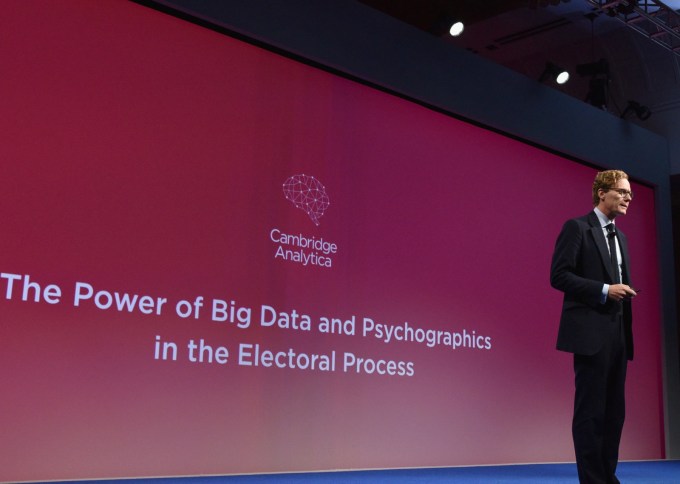
NEW YORK, NY – SEPTEMBER 19: CEO of Cambridge Analytica Alexander Nix speaks at the 2016 Concordia Summit – Day 1 at Grand Hyatt New York on September 19, 2016 in New York City. (Photo by Bryan Bedder/Getty Images for Concordia Summit)

When the Guardian informed Facebook about Kogan sharing user data to Cambridge Analytica, Facebook banned Kogan, and required Cambridge Analytica to formally certify that it had deleted all the improperly attained user data. Cambridge Analytica did so, Zuckerberg confirmed in his prepared testimony for today. But Facebook then stopped short of blocking Cambridge Analytica from buying ads on its platform. The company went on to work with the Trump campaign to help it optimize political messaging and ad targeting.

Had Facebook banned Cambridge Analytica at the time, it wouldn’t have been able to buy ads directly on behalf of political campaigns it worked with. However, the company might still have been able to help these campaigns to optimize their ads, so a 2015 ban wouldn’t have necessarily prevented second-hand use of improperly attained data.


Read Full Article

Zuckerberg admits it was a mistake not to ban Cambridge Analytica’s ads


Facebook didn’t ban Cambridge Analytica when it found out in 2015 that it had received user data from Dr. Aleksandr Kogan, and Zuckerberg called that a mistake during his testimony before the Senate. Cambridge Analytica has since been banned.

Zuckerberg explained that “I want to correct one thing that I said earlier in response to question from Senator Leahy. He had asked why we didn’t ban Cambridge Analytica at the time when we learned of them in 2015. And I answered that what my understanding was was that they were not on the platform, were not an app developer or advertiser. When I went back and met with my team afterwards, they let me know that Cambridge Analytica acutally did start as an advertisers later in 2015, so we could have in theory banned them back then and made a mistake by not doing so.”

When the Guardian informed Facebook about Kogan sharing user data to Cambridge Analytica, Facebook banned Kogan, and required Cambridge Analytica to formally certify that it had deleted all the improperly attained user data. Cambridge Analytica did so, Zuckerberg confirmed in his prepared testimony for today. But Facebook then stopped short of blocking Cambridge Analytica from buying ads on its platform. The company went on to work with the Trump campaign to help it optimize political messaging and ad targeting.

Had Facebook banned Cambridge Analytica at the time, it wouldn’t have been able to buy ads directly on behalf of political campaigns it worked with. However, the company might still have been able to help these campaigns to optimize their ads, so a 2015 ban wouldn’t have necessarily prevented second-hand use of improperly attained data.


Read Full Article

‘Tens of thousands’ of Facebook accounts may be related to Russian intelligence


Facebook has previously officially noted that 470 accounts associated with Russia’s Internet Research Agency have been banned related to the 2016 election, plus 270 more in Russia just last week. But in today’s testimony Mark Zuckerberg also mentioned a much higher estimate of “tens of thousands,” though the confidence in this number would be also be much lower.

“In the IRA specifically, the ones we’ve pegged back to the IRA, we can identify 470 in the American elections, and the 270 that we went after in Russia last week,” he began in response to Senator Feinstein (D-), who had asked about the numbers of accounts associated with this type of coordinated disinformation campaign.

But then he continued:

“There are many others that our systems catch which are more difficult to attribute specifically to Russian intelligence, but the number would be in the tens of thousands of fake accounts…”

The tens of thousands number must be taken with a grain of salt, since clearly Facebook has not been able to definitively attribute more than the stated 740 or so to the IRA and Russian intel. But it is still significant; this is clearly different from the 30,000-odd accounts banned in relation to France’s election. That was a specific number and also not mentioned in connection with Russia specifically, as this estimate was.

It seems clear that Facebook is being conservative in its enumeration of Russian-linked accounts, and that very well may be the responsible thing to do. But Zuckerberg’s remarks today establish a ceiling in the tens of thousands in addition to the floor of several hundred. That’s worth keeping in mind.


Read Full Article

Mark Zuckerberg: “There will always be a version of Facebook that is free”


Today during Mark Zuckerberg’s testimony before the Senate, the Facebook CEO reiterated that “there will always be a version of Facebook that is free.”

In the midst of the Cambridge Analytica scandal, in which the user data of up to 87 million people was sold by a third-party developer to Trump Campaign-linked firm Cambridge Analytica, there has been talk of Facebook potentially adding a subscription layer.

The scandal has brought to light the heart of a problem that many have been well aware of: if you’re not buying a product, you are the product.

Last week, when asked if there might be a way for users to opt out of being targeted for ads, Sandberg responded saying they’d have to pay for it.

“We have different forms of opt-out,” Sandberg replied. “We don’t have an opt-out at the highest level. That would be a paid product.”

Our own Josh Constine made an argument that ad-free subscriptions could save Facebook. And while there’s no word on an ad-free subscription, Zuckerberg did at least leave room for it in the future, noting that there will always be a version of Facebook that is free.

“How do you sustain a business model in which users don’t pay for your service?” Senator Orrin Hatch asked Zuckerberg.

“Senator, we run ads.”


Read Full Article

Zuckerberg confirms Facebook has been interviewed by Mueller’s special counsel


Special Counsel Robert Mueller’s investigation into interference in to 2016 election interference has interviewed at least one employee of Facebook, CEO Mark Zuckerberg confirmed today during his testimony before the Senate. Zuckerberg confirmed that he himself had not been interviewed, then declined to elaborate, citing the confidentiality of the investigation.

Senator Leahy asked “I assume Facebook has been served with subpoenas from the special counsel’s office?” Zuckerberg replied “yes”. Leahy then asked if Zuckerberg or anyone at Facebook had been contacted by the special counsel, and Zuckerberg responded “Yes”. When asked if he specifically had been interviewed, the CEO replied “I have not”. Leahy followed up, asking “Others have?” Zuckerberg responded “I believe so.”

Zuckerberg then got cagey, explaining that “I want to be careful here because our work with the special counsel is confidential and I want to make sure that in an open session I’m not revealing something that’s confidential.”

You can watch this part of the testimony below:

Wired reported in January that at least one Facebook staffer employee had been interviewed by Mueller, and that they were associated with the Trump campaign. Facebook provided assistance to both the Trump and Clinton campaigns in using Facebook’s tools.

Now, given information that’s come to light about the Trump campaign working with Cambridge Analytica to optimize its campaigns, and about how Cambridge Analytica attained that data improperly from a Facebook app built by researcher Dr. Aleksandr Kogan, Mueller’s investigation may have been interested to know if the Facebook staffer was aware of the improperly-attained data. Alternatively, Mueller may have simply been interested in whether the Facebook staffer knew of any Russian connection to the campaign.

You can follow TechCrunch’s coverage of the Zuckerberg testimony here:


Read Full Article

How ad-free subscriptions could save Facebook


At the core of Facebook’s “well-being” problem is that its business is directly coupled with total time spent on its apps. The more hours you pass on the social network, the more ads you see and click, the more money it earns. That puts its plan to make using Facebook healthier at odds with its finances, restricting how far it’s willing to go to protect us from the harms of over use.

[Update 4/10/18: The potential for ad-free subscription access to Facebook is especially relevant given recent scrutiny of Facebook’s data collection practices in the wake of the Cambridge Analytica scandal. When asked by CNBC if Facebook could let users opt-out of their data being usedt target them with ads, Facebook COO Sheryl Sandberg said “We don’t have an opt-out at the highest level. That would be a paid product.”

The Senate asked Facebook CEO Mark Zuckerberg during his testimony in front of the joint commerce and judiciary committee about whether Facebook has considered letting users pay to opt out of seeing ads. But Zuckerberg merely explained that Facebook does not “offer an option today for people to pay to not show ads”. He followed up, saying “there will always be a version of Facebook that is free”, though that does not prohibit it from offering a paid subscription option too.]

Why Facebook Sticks With Ads

The advertising-supported model comes with some big benefits, though. Zuckerberg has repeatedly said that “We will always keep Facebook a free service for everyone.” Ads lets Facebook remain free for those who don’t want to pay, and more importantly, for those around the world who couldn’t afford to pay.

Ads pay for Facebook to keep the lights on, research and develop new technologies, and profit handsomely in a way that attracts top talent and further investment. More affluent users with more buying power in markets like the US, UK, and Canada command higher ad prices, effectively subsidizing the social network for those in developing nations where ad rates are lower.

The issue is that the ad model rewards Facebook for maximizing how long we spend using it, often through passive content consumption via endless News Feed scrolling. Yet studies show that it’s this kind of zombie browsing that hurts us. Spending just 10 minutes passively consuming Facebook can make us feel worse.

We fall into envy spirals. The study’s author write “Continually exposing oneself to positive information about others should elicit envy, an emotion linked to lower well-being,” the authors wrote. A 2011 study concluded “people may think they are more alone in their emotional difficulties than they really are” after browsing everyone’s manicured life highlights on Facebook.

This research has clearly had an impact on Zuckerberg, who explicitly announced on the Q3 2017 earnings call that “Protecting our community is more important than maximizing our profits . . . Time spent is not a goal by itself. We want the time people spend on Facebook to encourage meaningful social interactions . . . when people are spending so much time passively consuming public content that it starts taking away from the time people are connecting with each other, that’s not good.”

To that end, Zuckerberg has announced a slew of changes to Facebook, though they’ve been relatively minor. Facebook is showing fewer news articles, public posts, and viral videos while prioritizing what leads people to comment and interact with each other. The result was a 50 million hours per day reduction in how long people spend on Facebook. That might sound big, but it’s actually only a 5 percent decrease.

Making truly forceful changes could have a much more significant impact on time spent, and potentially ad revenue. That creates resistance to confronting people with how long they spend on its apps, reducing spammy reengagement notifications, or creating more powerful ‘do not disturb’ options.

And so, we have a company that wants to make us feel better but earns money off making us feel worse, and that promises to stay free despite the negative incentives inherent in ad-based business models.

That’s why I think Facebook should introduce an ad-free subscription option in addition to its existing ad-supported free service.

Combining Profit With Data Privacy

By charging a monthly fee to remove ads, Facebook coud decouple its business from time spent, allowing it to keep revenue stable even while making changes that enhance well-being while decreasing how long we spend on its apps. It’s not a totally foreign idea for Facebook, as WhatsApp used to charge a $1 per year subscription in some countries.

For users who can afford the fee and want to pay, they’ll get a more purposeful experience on Facebook where they only see what they want in the News Feed. This would allow people to reclain the time they see viewing ads, and spend it having meaningful interactions with their friends and communities — thereby fulfilling Facebook’s mission.

For users who can’t afford the fee or don’t want to pay, their Facebook experience remains largely the same. But as the percentage of total users monetized by ads decreases, Facebook gains more flexibility in how it builds its apps to be more respectful of our mental health.

Facebook could charge a similar rate to what it currently earns from users via ads (and the tiny amount it still gets from game payments). In the U.S., Facebook earned $84.14 per user, while earning an average worldwide of $20.21. Charging $1.65 per month, or even $7 per month to remove ads from Facebook could feel very reasonable to some users. The rate would increase yearly to stay in-line with ad revenue or follow its current growth trajectory.

Facebook could charge a higher premium and offer additional features, though that would open it up to criticism of making non-subscribers second-class citizens with less functionality. Syncing subscription prices without bonus options to revenue per non-subscriber would let Facebook continue to concentrate on developing features for everyone.

Facebook might only get 4 percent of people to pay, but that would still be 88 million people. And if it did add bonus features that significantly improved the service for hardcore users without making non-subscribers feel betrayed or slighted, that number could grow over time. I imagine advanced manual News Feed curation controls and filters could be a popular offering.

One risk is that Facebook benefits from having a giant unified user base all accessible to advertisers who crave scale. The ability to hit a huge percentage of a demographic with promotions in a short time, such as for a new movie release, attracts advertisers to Facebook. That appeal could decrease if a portion of users subscribe and never see ads.

But Zuckerberg has already committed to some short-term loss of profits in his quest to promote well-being. In the long-run, letting users pay if they want could keep them loyal while letting Facebook configure its News Feed algorithm for what enriches everyone. Building safeguards against overuse today could save Facebook from a stronger backlash in the future. Facebook should always be free, but letting some people pay could give Facebook the freedom to make itself a healthier part of our lives.

[Update 4/10/18: This article was originally published on February 17th 2018, but that link doesn’t work for all readers after TechCrunch’s redesign. We’ve republished it here.]


Read Full Article

How to Declutter Your Data With No Regrets (But Keep What You Need)


One effective way to worry less about your data is to have less of it to worry about. To get there, you’ll need to redefine the word “important” to mean “impossible to get your hands on in future for free”.

With that definition as our guide, let’s explore the kind of data you can consider reducing from your digital life. Also, let’s see how you can access the relevant information once again if you need it in future.

Dump Bookmarks and Search as You Go

my-bookmarks-safari

Nothing gets deleted from the internet, ever. The upside of that? You can find anything you need with a web search.

With that kind of power at your fingertips, you can afford to ditch most of your bookmarks. Of course, you might want to keep bookmarks that link to pages you visit often and those that contain indispensable information.

The trick is to stop treating every bookmark as important and keep your Bookmarks folder super lean, if not empty. With this approach, if you ever need to organize your saved links in any way, it will be as good as effortless.

Once you delete your bookmarks, you’ll need to sharpen your search skills. Learn some smart search tricks to bring up near-instant and accurate matches for any online resource. You might feel surprised how often serendipity steps in to bring you the right information at the right time.

What do you do if your search turns up a dead page?

Hop over to the Wayback Machine section of the Internet Archive to find the original content of that page. You can also dig up other types of free content from that archive. As a last resort, you can also turn to online communities to find the information you need.

Tip: Did you know you can view deleted Reddit comments on ReSavr?

Instead of bookmarking pages in future, why not follow or look up subreddits and other aggregator resources for topics you’re interested in. For example, if you like discovering useful web services or well-made websites, you can join the subreddit /r/InternetIsBeautiful/.

Trash Photos and Let Others Bring the Nostalgia

throwback-thursday-instagram

The best (and worst) of your photos are one friend, colleague, or family member away. Those photos turn up in social networks and chat groups anyway, often due to internet phenomena like Throwback Thursday and Flashback Friday.

That leaves you free to declutter your data by pruning your digital albums, especially if you have enough photos in print to reminisce over.

How to decide which photos to delete? Start by finding the duplicates and similars with a duplicate file finder app. Once you delete them, you’ll notice the blurry photos, the ugly ones, and those of generic subjects like trees, mountains, and water.

Unless these photos showcase your mad photography skills or evoke strong memories, you probably won’t miss them if they’re gone. Then again, you might, so be careful about deleting dodgy photos.

I didn’t go through any of that step-by-step deletion though.

Instead, I deleted photo albums en masse and ended up with one folder of photos I took on a solo trip. I saved them because I’m the only one who has them. As a sucker for nostalgia, I appreciate that my focus is now less on the past and more on the present.

Delete Media and Start Streaming Content

netflix-home

If you enjoy good internet speeds in your area, consider streaming music and movies. It will help you part with some of your downloaded content. Streaming will also help you cut the cord forever.

Yes, you’ll need to consider the price of streaming services and the money you have already spent on downloaded media. Your preference for ownership of data will also be a deciding factor, and it might prove that streaming isn’t a good option for you. But don’t dismiss it outright. Give streaming a fair trial, or switch to it for certain types of content.

If you decide streaming is perfect for you after all, the most obvious choices available to you are Spotify for music and Netflix for movies. Of course, there are plenty of other services that can help you declutter your data. Find the right one for you and start deleting.

Ditch “Someday” Data and Crowdsource It

tip-of-my-tongue-reddit

From contacts you never call to free ebooks you never get around to reading, what data have you saved because you “might need it someday”? Delete it. You probably won’t need it, and if you do, help is one step away.

Send one message to your Twitter followers, Facebook friends, chat contacts, or your Slack team, and you’ll have the information you need. You can also get answers from communities and Q&A sites like:

Ready to Hit the Delete Button?

So, what else can you get rid of? We have more ideas for decluttering your data! You can delete:

Before you start decluttering your digital data, take a step back.

It would be a nightmare to lose passwords, browser settings, tax returns, contracts, and so on. (There’s data you can classify as important!)

Be sure to isolate those bits of information from the rest of your data to avoid accidental deletion and back them up in multiple places. Put the whole backup process on autopilot if you can.

Of course, going on a data deletion spree is not the right approach for everyone. But you’re discerning enough to figure out if it’s the right one for you and how far you should take it.

Now, ready to set free some of your data and never bother about it again? It’ll take time to go through all of it, but when you get to the other side it’ll feel liberating. You’ll be familiar with this feeling if you have given away physical possessions in bulk anytime. Bring it back by Kondoing your digital life.


Read Full Article

How Facebook has reacted since the data misuse scandal broke


Facebook founder Mark Zuckerberg will be questioned by US lawmakers today about the “use and abuse of data” — following weeks of breaking news about a data misuse scandal dating back to 2014.

The Guardian published its first story linking Cambridge Analytica and Facebook user data in December 2015. The newspaper reported that the Ted Cruz campaign had paid UK academics to gather psychological profiles about the US electorate using “a massive pool of mainly unwitting US Facebook users built with an online survey”.

Post-publication, Facebook released just a few words to the newspaper — claiming it was “carefully investigating this situation”.

Yet more than a year passed with Facebook seemingly doing nothing to limit third party access to user data nor to offer more transparent signposting on how its platform could be — and was being — used for political campaigns.

Through 2015 Facebook had actually been ramping up its internal focus on elections as a revenue generating opportunity — growing the headcount of staff working directly with politicians to encourage them to use its platform and tools for campaigning. So it can hardly claim it wasn’t aware of the value of user data for political targeting.

Yet in November 2016 Zuckerberg publicly rubbished the idea that fake news spread via Facebook could influence political views — calling it a “pretty crazy idea”. This at the same time as Facebook the company was embedding its own staff with political campaigns to help them spread election messages.

Another company was also involved in the political ad targeting business. In 2016 Cambridge Analytica signed a contract with the Trump campaign. According to former employee Chris Wylie — who last month supplied documentary evidence to the UK parliament — it licensed Facebook users data for this purpose.

The data was acquired and processed by Cambridge University professor Aleksandr Kogan whose personality quiz app, running on Facebook’s platform in 2014, was able to harvest personal data on tens of millions of users (a subset of which Kogan turned into psychological profiles for CA to use for targeting political messaging at US voters).

Cambridge Analytica has claimed it only licensed data on no more than 30M Facebook users — and has also claimed it didn’t actually use any of the data for the Trump campaign.

But this month Facebook confirmed that data on as many as 87M users was pulled via Kogan’s app.

What’s curious is that since March 17, 2018 — when the Guardian and New York Times published fresh revelations about the Cambridge Analytica scandal, estimating that around 50M Facebook users could have been affected — Facebook has released a steady stream of statements and updates, including committing to a raft of changes to tighten app permissions and privacy controls on its platform.

The timing of this deluge is not accidental. Facebook itself admits that many of the changes it’s announced since mid March were already in train — long planned compliance measures to respond to an incoming update to the European Union’s data protection framework, the GDPR.

If GDPR has a silver lining for Facebook — and a privacy regime which finally has teeth that can bite is not something you’d imagine the company would welcome — it’s that it can spin steps it’s having to make to comply with EU regulations as an alacritous and fine-grained response to a US political data scandal and try to generate  the impression it’s hyper sensitive to (now highly politicized) data privacy concerns.

Reader, the truth is far less glamorous. GDPR has been in the works for years and — like the Guardian’s original Cambridge Analytica scoop — its final text also arrived in December 2015.

On the GDPR prep front, in 2016 — during Facebook’s Cambridge Analytica ‘quiet period’ — the company itself told us it had assembled “the largest cross functional team” in the history of its family of companies to support compliance.

Facebook and Zuckerberg really has EU regulators to thank for forcing it to do so much of the groundwork now underpinning its response to this its largest ever data scandal.

Below is a quick timeline of how Facebook has reacted since mid March — when the story morphed into a major public scandal…

March 16, 2018: Just before the Guardian and New York Times publish fresh revelations about the Cambridge Analytica scandal, Facebook quietly drops the news that it has finally suspended CA/SCL. Why it didn’t do this years earlier remains a key question

March 17: In an update on the CA suspension Facebook makes a big show of rejecting the notion that any user data was ‘breached’. “People knowingly provided their information, no systems were infiltrated, and no passwords or sensitive pieces of information were stolen or hacked,” it writes

March 19: Facebook says it has hired digital forensics firm Stroz Friedberg to perform an audit on the political consulting and marketing firm Cambridge Analytica. It subsequently confirms its investigators have left the company’s UK offices at the request of the national data watchdog which is running its own investigation into use of data analytics for political purposes. The UK’s information commissioner publicly warns the company its staff could compromise her investigation

March 21: Zuckerberg announces further measures relating to the scandal — including a historical audit, saying apps and developers that do not agree to a “thorough audit” will be banned, and committing to tell all users whose data was misused. “We will investigate all apps that had access to large amounts of information before we changed our platform to dramatically reduce data access in 2014, and we will conduct a full audit of any app with suspicious activity. We will ban any developer from our platform that does not agree to a thorough audit. And if we find developers that misused personally identifiable information, we will ban them and tell everyone affected by those apps. That includes people whose data Kogan misused here as well,” he writes on Facebook.

He also says developers’ access to user data will be removed if people haven’t used the app in three months. And says Facebook will also reduce the data users give to an app when they sign in — to just “your name, profile photo, and email address”.

Facebook will also require developers to not only get approval but also “sign a contract in order to ask anyone for access to their posts or other private data”, he says.

Another change he announces in the post: Facebook will start showing users a tool at the top of the News Feed “to make sure you understand which apps you’ve allowed to access your data” and with “an easy way to revoke those apps’ permissions to your data”.

He concedes that while Facebook already had a tool to do this in its privacy settings people may not have seen or known that it existed.

These sorts of changes are very likely related to GDPR compliance.

Another change the company announces on this day is that it will expand its bug bounty program to enable people to report misuse of data.

It confirms that some of the changes it’s announced were already in the works as a result of the EU’s GDPR privacy framework — but adds: “This week’s events have accelerated our efforts”

March 25: Facebook apologizes for the data scandal with a full page ad in newspapers in the US and UK

March 28: Facebook announces changes to privacy settings to make them easier to find and use. It also says terms of services changes aimed at improving transparency are on the way — also all likely to be related to GDPR compliance

March 29: Facebook says it will close down a 2013 feature called Partner Categories — ending the background linking of its user data holdings with third party data held by major data brokers. Also very likely related to GDPR compliance

At the same time, in an update on parallel measures it’s taking to fight election interference, Facebook says it will launch a public archive in the summer showing “all ads that ran with a political label”. It specifies this will show the ad creative itself; how much money was spent on each ad; the number of impressions it received; and the demographic information about the audience reached. Ads will be displayed in the archive for four years after they ran

April 1: Facebook confirms to us that it is working on a certification tool that requires marketers using its Custom Audience ad targeting platform to guarantee email addresses were rightfully attained and users consented to their data being used them for marketing purposes — apparently attempting to tighten up its ad targeting system (again, GDPR is the likely driver for that)

April 3: Facebook releases the bulk app deletion tool Zuckerberg trailed as coming in the wake of the scandal — though this still doesn’t give users a select all option, but it makes the process a lot less tedious than it was.

It also announces culling a swathe of IRA Russian troll farm pages and accounts on Facebook and Instagram. It adds that it will be updating its help center tool “in the next few weeks” to enable people to check whether they liked or followed one of these pages. It’s not clear whether it will also proactively push notifications to affected users

April 4: Facebook outs a rewrite of its T&Cs — again, likely a compliance measure to try to meet GDPR’s transparency requirements — making it clearer to users what information it collects and why. It doesn’t say why it took almost 15 years to come up with a plain English explainer of the user data it collects

April 4: Buried in an update on a range of measures to reduce data access on its platform — such as deleting Messenger users’ call and SMS metadata after a year, rather than retaining it — Facebook reveals it has disabled a search and account recovery tool after “malicious actors” abused the feature — warning that “most” Facebook users will have had their public info scraped by unknown entities.

The company also reveals a breakdown of the top ten countries affected by the Cambridge Analytica data leakage, and subsequently reveals 2.7M of the affected users are EU citizens

April 6: Facebook says it will require admins of popular pages and advertisers buying political or “issue” ads on “debated topics of national legislative importance” like education or abortion to verify their identity and location — in an effort to fight disinformation on its platform. Those that refuse, are found to be fraudulent or are trying to influence foreign elections will have their Pages prevented from posting to the News Feed or their ads blocked

April 9: Facebook says it will begin informing users if their data was passed to Cambridge Analytica from today by dropping a notification into the News Feed.

It also offers a tool where people can do a manual check

April 9: Facebook also announces an initiative aimed at helping social science researchers gauge the product’s impact on elections and political events.

The initiative is funded by the Laura and John Arnold Foundation, Democracy Fund, the William and Flora Hewlett Foundation, the John S. and James L. Knight Foundation, the Charles Koch Foundation, the Omidyar Network, and the Alfred P. Sloan Foundation.

Facebook says the researchers will be given access to “privacy-protected datasets” — though it does not detail how people’s data will be robustly anonymized — and says it will not have any right or review or approval on research findings prior to publication.

Zuckerberg claims the election research commission will be “independent” of Facebook and will define the research agenda, soliciting research on the effects of social media on elections and democracy

April 10: Per its earlier announcement, Facebook begins blocking apps from accessing user data 90 days after non-use. It also rolls out the earlier trailed updates to its bug bounty program


Read Full Article