21 April 2013

Google Now for Google's Homepage in Testing


It looks like Google Now won't be limited to Android, iOS and Chrome, it will also be added to Google's homepage. Some code from a page that's tested by Google offers more information about this feature.


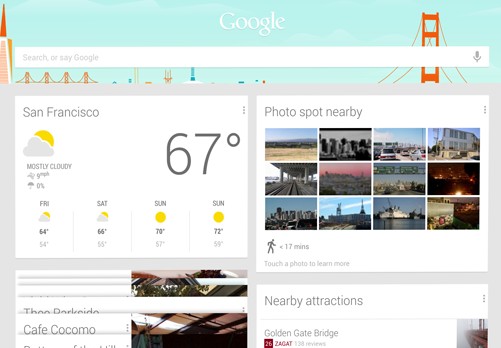
"Get started with Google Now. Just the right information at just the right time." That's how Google introduces the new feature. "Google Now uses your Home location to show relevant information like weather, traffic conditions, and nearby places," explains Google. You can edit the home location, work location and the current location. Another feature lets you track your favorite stocks.


It's not clear how Google Now for desktop will look, but this screenshot reveals a possible implementation (it also includes some Chrome features):


Here's the Google Search app interface for Android tablets (Nexus 10 gallery):


As I mentioned here, Google Now could replace some of iGoogle's functionality. Here's an early version of iGoogle from 2005:


{ Thanks, Florian. }


Add Google+ Comments to Any Web Page


Until Google launches an API for the Google+ Comments feature, you can use the code from Blogger. Browsing the Net found a way to embed Google+ Comments on any website or blog. Here's the code you could use:


<script src="https://apis.google.com/js/plusone.js">
</script>
<div class="g-comments"
data-href="[URL]"
data-width="642"
data-first_party_property="BLOGGER"
data-view_type="FILTERED_POSTMOD">
</div>


Replace [URL] with the address of your page. It's interesting to see what happens if you enter the URL of a different page: from what I've noticed, Google shows some Google+ posts that link to that page.


{ Thanks, Jerzy. }


Google Now Is Not Google Voice Search


Here's something I don't understand: why do so many people confuse Google Now with Google Voice Search? There are a lot of articles that compare Google Now with Siri or claim that Google Now is a voice assistant.


Google Now is a feature of the Google Search app for Android that shows information about what's happening right now or in the near future: weather, calendar events, reservations, travel information. Try this: disable Google Now in Google's search app and you can still use voice search. After all, Google Voice Search has been available before Google Now. Google Search for iOS includes Voice Search, but it doesn't have Google Now yet.


One of the explanations why many people confuse Google Now with Google Voice Search is that Google Now and the improved Voice Search have been announced at the same time, when Jelly Bean was released. Google Now is shorter and sounds better than Google Voice Search.


Even the Wikipedia article for Google Now is inaccurate: "Google Now is an intelligent personal assistant available for Google's Android operating system. An extension of Android's native Google Search application, Google Now uses a natural language user interface to answer questions, make recommendations, and perform actions by delegating requests to a set of web services. Along with answering user-initiated queries, Google Now passively delivers information to the user that it predicts they will want, based on their search habits."


How Do I Download An Entire Website For Offline Reading?


Download the entirety of a website – or individual web pages – to your hard drive. Whether you want to do some work offline so you can really block time-wasting websites or do some research on the road, downloading web content locally means you don’t need to stop when your connection does.


It’s increasingly rare, but still occasionally true: sometimes you just don’t have Internet access. Whether you’re on a plane or your grandparent’s place in the country, life occasionally brings all of us to places WiFi and 4G can’t reach. With a little preparation, however, you can have the data you need on your hard drive, waiting for you.


There are three distinct ways to read offline: downloading an entire website, downloading recent blog posts or news stories, and downloading the content from a specific page or article. I’m going to touch on all three below, but feel free to skip to the section you’re actually interested in.


Downloading Entire Websites


This is the hardcore option: downloading the entirety of a single website for offline reading. Obviously how long this takes will vary depending on the web site in questions – Wikipedia could take days to finish, and will take up a lot of your hard drive when it does. If you just want an offline copy of something simple, however, like the ultimate Final Fantasy 7 database or a simple site outlining a few recipes you were thinking of trying, downloading an entire website might be right for you.


The software I recommend for downloading an entire site is HTTrack, which Tina wrote about back in 2008. Don’t worry: the software hasn’t changed much and her article is still solid.


This open source program can be a little hard to use at first – especially if you’re not a Windows user. But if you’re looking to make a complete offline version of your favorite website – not an individual web page, an entire web site – it’s one of the simplest options out there. Tweak the settings if you run into problems and you should be fine. Only the Windows version comes with a dedicated GUI – Linux users will need to use a browser-based version of HTTrack instead. Don’t worry: items will be added to the menu so it’s easy enough to get started.


Mac users can install the software using MacPorts, but many might be better off checking out Sitesucker, a free Mac app that functions similarly but is easy to install and has it’s own GUI.


Downloading The Latest News


Are you mostly interested in keeping up with the news? Downloading an entire site then is probably an overkill: you don’t need to keep a copy of the headlines from 2005 on your computer. Happily there are dedicated tools for reading the news offline.


I showed you how to download entire newspapers or blogs using Calibre – it saves everything to the eBook format of your choice. This is a great way to condense the latest news into a format you can easily read offline, but be warned: paid subscriptions are required for some sites to work properly.


You can also use NewsToEbook to download the latest news directly. It even supports Google Reader (though of course that ends in July when Google pulls the plug on Reader).


Downloading Individual Web Pages


This is the simpler option: downloading the entirety – or only the content from – an individual page. If you’re doing some research, or simply want to do some offline reading, there are tools out there allowing you to clip any particular page and read it later.


My favorite is probably Evernote, a service that aims to become your personal on-and-offline repository of knowledge. You can use the service to “clip” articles from your favorite websites, which you can then read anytime using the desktop or mobile client.


Check out the unofficial Evernote manual to learn more. It’s written by our very own Mark O’Neil, and like all our manuals it’s free of charge.


Another simple way to save individual articles for reading later is Pocket, the ultimate digital bookmarking service. Apps for mobile devices sync articles you’ve saved for later, meaning you can read them anytime you want. There’s even a Mac version of Pocket for you computer (sorry, Windows and Linux users: not yet).


Want an entirely mobile solution? Offline Pages Pro for iOS and Read Web Offline for Android both allow you to save any URL directly to your mobile device, allowing you to read them anytime.


Conclusion


Of course, this list is only the beginning: there are other ways to do this. Most browsers offer a “Save As” function, for example, and you can always print any page on the web as a PDF for reading later.


Beyond that, I’m sure readers will point out plenty of other ways to save entire sites or individual pages for offline reading in the comments below. Unless, of course, they’re reading this comment offline – then they can’t leave comments. Oh well.


The post How Do I Download An Entire Website For Offline Reading? appeared first on MakeUseOf.


How Do I Download An Entire Website For Offline Reading?


Download the entirety of a website – or individual web pages – to your hard drive. Whether you want to do some work offline so you can really block time-wasting websites or do some research on the road, downloading web content locally means you don’t need to stop when your connection does.


It’s increasingly rare, but still occasionally true: sometimes you just don’t have Internet access. Whether you’re on a plane or your grandparent’s place in the country, life occasionally brings all of us to places WiFi and 4G can’t reach. With a little preparation, however, you can have the data you need on your hard drive, waiting for you.


There are three distinct ways to read offline: downloading an entire website, downloading recent blog posts or news stories, and downloading the content from a specific page or article. I’m going to touch on all three below, but feel free to skip to the section you’re actually interested in.


Downloading Entire Websites


This is the hardcore option: downloading the entirety of a single website for offline reading. Obviously how long this takes will vary depending on the web site in questions – Wikipedia could take days to finish, and will take up a lot of your hard drive when it does. If you just want an offline copy of something simple, however, like the ultimate Final Fantasy 7 database or a simple site outlining a few recipes you were thinking of trying, downloading an entire website might be right for you.


The software I recommend for downloading an entire site is HTTrack, which Tina wrote about back in 2008. Don’t worry: the software hasn’t changed much and her article is still solid.


This open source program can be a little hard to use at first – especially if you’re not a Windows user. But if you’re looking to make a complete offline version of your favorite website – not an individual web page, an entire web site – it’s one of the simplest options out there. Tweak the settings if you run into problems and you should be fine. Only the Windows version comes with a dedicated GUI – Linux users will need to use a browser-based version of HTTrack instead. Don’t worry: items will be added to the menu so it’s easy enough to get started.


Mac users can install the software using MacPorts, but many might be better off checking out Sitesucker, a free Mac app that functions similarly but is easy to install and has it’s own GUI.


Downloading The Latest News


Are you mostly interested in keeping up with the news? Downloading an entire site then is probably an overkill: you don’t need to keep a copy of the headlines from 2005 on your computer. Happily there are dedicated tools for reading the news offline.


I showed you how to download entire newspapers or blogs using Calibre – it saves everything to the eBook format of your choice. This is a great way to condense the latest news into a format you can easily read offline, but be warned: paid subscriptions are required for some sites to work properly.


You can also use NewsToEbook to download the latest news directly. It even supports Google Reader (though of course that ends in July when Google pulls the plug on Reader).


Downloading Individual Web Pages


This is the simpler option: downloading the entirety – or only the content from – an individual page. If you’re doing some research, or simply want to do some offline reading, there are tools out there allowing you to clip any particular page and read it later.


My favorite is probably Evernote, a service that aims to become your personal on-and-offline repository of knowledge. You can use the service to “clip” articles from your favorite websites, which you can then read anytime using the desktop or mobile client.


Check out the unofficial Evernote manual to learn more. It’s written by our very own Mark O’Neil, and like all our manuals it’s free of charge.


Another simple way to save individual articles for reading later is Pocket, the ultimate digital bookmarking service. Apps for mobile devices sync articles you’ve saved for later, meaning you can read them anytime you want. There’s even a Mac version of Pocket for you computer (sorry, Windows and Linux users: not yet).


Want an entirely mobile solution? Offline Pages Pro for iOS and Read Web Offline for Android both allow you to save any URL directly to your mobile device, allowing you to read them anytime.


Conclusion


Of course, this list is only the beginning: there are other ways to do this. Most browsers offer a “Save As” function, for example, and you can always print any page on the web as a PDF for reading later.


Beyond that, I’m sure readers will point out plenty of other ways to save entire sites or individual pages for offline reading in the comments below. Unless, of course, they’re reading this comment offline – then they can’t leave comments. Oh well.


The post How Do I Download An Entire Website For Offline Reading? appeared first on MakeUseOf.


How Do I Download An Entire Website For Offline Reading?


Download the entirety of a website – or individual web pages – to your hard drive. Whether you want to do some work offline so you can really block time-wasting websites or do some research on the road, downloading web content locally means you don’t need to stop when your connection does.


It’s increasingly rare, but still occasionally true: sometimes you just don’t have Internet access. Whether you’re on a plane or your grandparent’s place in the country, life occasionally brings all of us to places WiFi and 4G can’t reach. With a little preparation, however, you can have the data you need on your hard drive, waiting for you.


There are three distinct ways to read offline: downloading an entire website, downloading recent blog posts or news stories, and downloading the content from a specific page or article. I’m going to touch on all three below, but feel free to skip to the section you’re actually interested in.


Downloading Entire Websites


This is the hardcore option: downloading the entirety of a single website for offline reading. Obviously how long this takes will vary depending on the web site in questions – Wikipedia could take days to finish, and will take up a lot of your hard drive when it does. If you just want an offline copy of something simple, however, like the ultimate Final Fantasy 7 database or a simple site outlining a few recipes you were thinking of trying, downloading an entire website might be right for you.


The software I recommend for downloading an entire site is HTTrack, which Tina wrote about back in 2008. Don’t worry: the software hasn’t changed much and her article is still solid.


This open source program can be a little hard to use at first – especially if you’re not a Windows user. But if you’re looking to make a complete offline version of your favorite website – not an individual web page, an entire web site – it’s one of the simplest options out there. Tweak the settings if you run into problems and you should be fine. Only the Windows version comes with a dedicated GUI – Linux users will need to use a browser-based version of HTTrack instead. Don’t worry: items will be added to the menu so it’s easy enough to get started.


Mac users can install the software using MacPorts, but many might be better off checking out Sitesucker, a free Mac app that functions similarly but is easy to install and has it’s own GUI.


Downloading The Latest News


Are you mostly interested in keeping up with the news? Downloading an entire site then is probably an overkill: you don’t need to keep a copy of the headlines from 2005 on your computer. Happily there are dedicated tools for reading the news offline.


I showed you how to download entire newspapers or blogs using Calibre – it saves everything to the eBook format of your choice. This is a great way to condense the latest news into a format you can easily read offline, but be warned: paid subscriptions are required for some sites to work properly.


You can also use NewsToEbook to download the latest news directly. It even supports Google Reader (though of course that ends in July when Google pulls the plug on Reader).


Downloading Individual Web Pages


This is the simpler option: downloading the entirety – or only the content from – an individual page. If you’re doing some research, or simply want to do some offline reading, there are tools out there allowing you to clip any particular page and read it later.


My favorite is probably Evernote, a service that aims to become your personal on-and-offline repository of knowledge. You can use the service to “clip” articles from your favorite websites, which you can then read anytime using the desktop or mobile client.


Check out the unofficial Evernote manual to learn more. It’s written by our very own Mark O’Neil, and like all our manuals it’s free of charge.


Another simple way to save individual articles for reading later is Pocket, the ultimate digital bookmarking service. Apps for mobile devices sync articles you’ve saved for later, meaning you can read them anytime you want. There’s even a Mac version of Pocket for you computer (sorry, Windows and Linux users: not yet).


Want an entirely mobile solution? Offline Pages Pro for iOS and Read Web Offline for Android both allow you to save any URL directly to your mobile device, allowing you to read them anytime.


Conclusion


Of course, this list is only the beginning: there are other ways to do this. Most browsers offer a “Save As” function, for example, and you can always print any page on the web as a PDF for reading later.


Beyond that, I’m sure readers will point out plenty of other ways to save entire sites or individual pages for offline reading in the comments below. Unless, of course, they’re reading this comment offline – then they can’t leave comments. Oh well.


The post How Do I Download An Entire Website For Offline Reading? appeared first on MakeUseOf.


20 April 2013

Why You Don’t Have To Use PayPal For Online Transactions: 5 PayPal Alternatives


Online shopping and online purchases have grown into something so important in many of our lives that it’s strange, at least for me, to think of a world where it doesn’t exist. PayPal is one service that really pioneered that world, especially in terms of purchasing without needing a credit card, debit card, or gift card. But are there any viable alternatives if you don’t like PayPal?


There are many reasons why you might not like PayPal. For one thing, it’s such a big service that it’s prime meat for hack attempts and scam attempts. Similarly, ever since PayPal grew into an enormous international service, people have been experiencing a decline in service quality. And who can forget the PayPal account freezing horror stories? PayPal is not the be-all end-all of online transaction services.


But even so, PayPal is convenient, widely accepted, and established. There are many PayPal competitors out there, but none of them have the same ubiquity or prominence. By switching away from PayPal, you may be gaining in some respects but you’ll also be losing out in other ways. If that’s okay with you, then keep reading!


WePay


Overview: The first time I heard about WePay was when I stumbled across GoFundMe, one of many services that help with online fundraising. They trusted WePay enough to make it their default money handler over PayPal for US users. As it turns out, WePay is used by over 250,000 merchants and they’ve processed over 1.5 million transactions. WePay accepts Visa, MasterCard, Discover, and more.


What’s Good: WePay has an extremely fast setup process that’ll have you ready to go in less than a minute. There are no contracts or tricky fees: 2.9% + $0.30 for credit card payments and 1.0% + $0.30 for bank payments. In terms of security, they’re sharp: first-class security credentials that they test every day for vulnerabilities. And, most importantly, WePay has excellent customer service (rated 9 out of 10 by its users).


But on top of the usual transaction features, WePay has a few more things to offer. You can embed an HTML WePay button right onto your website which you can use to collect payments. WePay also has a page builder which you can use to create a fully functional online store without any technical expertise.


Check out Angela’s WePay review if you haven’t already.


Overall: B+


Skrill


Overview: Formerly known as MoneyBookers, Skrill is a money service that stretches internationally when it comes to reach. With more than 10 million users in over 200 countries with support for more than 40 currencies, you can be sure that Skrill is a force to be reckoned with. In terms of sheer size, Skrill may be the closest to PayPal.


What’s Good: The international support is definitely a thumbs up. Skrill allows you to deposit and withdraw money instantly all while keeping your information secure. For personal users, Skrill’s fees sit at 1% for sending money (caps at $0.50) and no fees for receiving money. For merchants, there are a few processing fees per transaction but they are competitive with other similar services (standard rate is 2.90% + $0.29).


For US users, deposites and withdrawals are free. For international users, deposits and withdrawals are mostly free but may incur processing fees depending on the method. When you want to take your funds out, you can opt for a physical check, a direct deposit into your bank account, or a MasterCard debit card that you can use in tandem with an ATM.


Overall: B+


Dwolla


Overview: Dwolla is similar to PayPal in that it’s an online peer-to-peer transaction service, but unlike PayPal, Dwolla requires both sender and receiver to have a Dwolla account; if you receive money and don’t have an account, you’ll need to create one to access it. It’s a small inconvenience, but otherwise pretty similar to PayPal’s system.


What’s Good: The first thing that sticks out to me about Dwolla is the transaction fee. Most services will charge a percentage-based fee, but Dwolla has one simple rule: a $0.25 fee per transaction unless the transaction is less than $10, then the fee is waived. Transactions take a few days to process, though you can subscribe to an Instant Transaction feature for $3 a month.


Dwolla is available as a mobile app for iPhones and Androids, too, which makes it extremely easy to check your account and transfer money no matter where you are.


Overall: B+


Google Wallet


Overview: A few years ago, Google combined their Checkout service with their Wallet service. Both services were meant to track your payment information and to facilitate e-commerce transactions. If you’re a customer, Google Wallet may be exactly what you need; if you’re a seller, there’s a Business version for accepting payments.


What’s Good: On any site that accepts Google Wallet, you can use your Wallet account to make payments. The Wallet account tracks all of your credit cards, debit cards, and gift cards in one convenient location, so purchasing items online becomes easy. All of your data is secure, obviously. If you’re a seller, Google does not charge any transaction fees for accepting Wallet payments.


For in-store purchases, Google Wallet can transform your phone into your wallet. If you have a device with the Wallet app and NFC capabilities, you can simply tap your device on the store’s NFC reader and pay instantly without hassle.


Overall: B


Payza


Overview: Formerly known as AlertPay, Payza has grown into something of a force over the past decade. It’s a great PayPal alternative for both personal users (transfer money, purchase items) and business users (process payments, send invoices). And if you need an international solution, Payza is global with offices all around the world.


What’s Good: Payza is supported in over 190 countries and over 20 different currencies. Money transfers can be performed through wire transfers, bank transfers, money orders, or credit cards. Payza money can be withdrawn through wire transfers, bank transfers, physical checks, or prepaid Payza cards. Payza has a simple fee structure that you should be aware of before committing to the service.


Overall: B-


Conclusion


So for quick reference, here are the most viable alternatives to PayPal that I’ve found in order of rating:


  • WePay

  • Skrill

  • Dwolla

  • Google Wallet

  • Payza


All of these services are great and they’re all used by many people, which means that none of these are horrible choices when it comes to finding an alternative to PayPal. However, it ought to be reiterated that there really isn’t a perfect PayPal alternative; no matter which one you choose, you’ll always be missing out on something.


Have you switched away from PayPal? If so, what are you using now? Are there any other services that could work as a PayPal alternative? Please share your thoughts with us in the comments.


The post Why You Don’t Have To Use PayPal For Online Transactions: 5 PayPal Alternatives appeared first on MakeUseOf.


Anonymous Animals in Google Drive


Google found a funny way to show the anonymous persons who open a document in Google Drive. Instead of only using different colors for each person, Google Drive associates each person with an animal, so you'll see things like "anonymous anteater", "anonymous moose", "anonymous chupacabra", "anonymous axolotl", "anonymous kraken", "anonymous gopher", "anonymous jackalope". Google also uses special icons for each animal.


For the moment, this only works for PDF files, photos, videos and other files that can't be edited using Google's apps.


To test this feature, I'll link to Nexus 4's PDF manual.


{ Thanks, Yu-Hsuan Lin. }


19 April 2013

Blogger Comments Powered By Google+


I don't know if you've notice, but this blog's comments look different. That's because I've switched to the new Google+ Comments feature for Blogger.


The upgraded commenting system preserves the existing comments, but the future comments require a Google+ account. That means, visitors can no longer post comments anonymously, using an OpenID account or using a Google account that hasn't been upgraded to Google+. When posting a comment, visitors can also share it on Google+. The new commenting system doesn't just show the comments posted on Blogger, it also shows all the Google+ messages that link to the post and their comments.


Just like Disqus, Google+ Comments shows by default the best comments and there's an option to show the most recent comments. It's not clear how Google determines the top comments, but the number of +1s could be one of the signals. You can also restrict the comments to the people from your Google+ circles.


Bloggers will notice some other changes: the comment management feature from Blogger is no longer available and you can only manage comments for each post. That's a significant downside, especially if you receive a lot of comments. When one of your posts receive new comments, you'll see a notification in the Google bar and you'll get an email notification. I haven't found a way to disable these notifications, not even from the Google+ settings page.


How to enable Google+ Comments if you have a Blogger blog? "Google+ Comments is available for Blogger users who have created a Google+ profile and connected it with their blog. If you haven't upgraded your Blogger profile to a Google+ profile and would like to, you can start the process by clicking the Google+ tab on the Blogger dashboard. Once your blogs are linked to a Google+ profile, a new 'Use Google+ Comments' setting will be displayed on the Google+ tab of your blog," explains Google. If your blog has a heavily modified template, you may need to reset widgets or use the code from this page.


There are additional limitations: Google+ Comments is not available for private blogs and for blogs with adult content. This means that the old commenting system will continue to be available as long as Blogger supports these kinds of blogs. You can always disable Google+ Comments and go back to the legacy Blogger commenting system.


It's important to point out that Google+ Comments are embedded as an iframe (the URL starts with https://plusone.google.com/_/widget/render/comments) and the comments are no longer included inside the Blogger page. Google manages to index content from iframes, but the change could affect your Google rankings.


Another interesting thing: it's the first time when the official Google Blog has comments.


Some early thoughts:


* Blogger is now more relevant, it's less likely that it will be discontinued in the next few years


* Blogger finally has a modern commenting system


* Google+ Comments will be available for other blogging platforms


* "sign in with Google+" will make Google+ even more popular as an identity service.


Why Use 5 Different Websites? TripWhat Includes Everything You Need To Plan Your Next Trip


Last summer, I went on a 3-months-long trip across Canada. Such trips are a once in a lifetime experience, no matter where you take them, and no matter what you end up doing while travelling. That said, one of the greatest challenges of any trip is finding the most interesting attractions, the best places to eat, and fun local events. When you find yourself in a different city every day or every week, the process of scouting several different apps in search of the best places to go to becomes a bit tedious.


TripWhat is a Web and iPhone app made by the same people behind the excellent Sortable, the money-saving Geekaphone, and the effective CPUBoss. After helping us choose everything from smartphones, tablets and cameras, to CPUs and cars, it’s time to find the best things to do, eat, and see in almost every city in North America.


TripWhat aggregates information and reviews from multiple websites such as Facebook, Google Maps, Last.fm, SeatGeek, UrbanSpoon, Wikipedia, WikiVoyage, and Yelp, making it super easy to explore any city, find the things you want to do, and get on with the fun.


Start Exploring


Starting with TripWhat is as easy as entering the name of the city you want to explore. If you’re not even sure about that, you’ll find some popular choices in the top toolbar, as well as in the “More” dropdown menu on the far right.


tripwhat-1


With information currently available only for North America, TripWhat can help you explore almost any city in the United States or Canada, and find places, activities, entertainment, restaurants, and even trip ideas. Once you choose a city, TripWhat will present a map of that city, with pins representing all kinds of interest points. As you zoom in on a specific area, you’ll discover three types of pins: blue for sights, green for restaurants, and red for events and entertainment.


tripwhat-2


Alongside this map, you’ll find a visual list of the same attractions you see on the map. Each attraction comes with one image or more, a link to the place’s official website and social networks, an address, and for restaurants, a star rating from Urbanspoon. As soon as you place your mouse cursor over one of these tiles, the corresponding pin on the map will start jumping and waving, making it easy to match tile to pin.


tripwhat


Clicking on a tile reveals more info about the place, depending on the type of place you’re looking at. This can include a quick summary, additional photos, opening hours, contact information, etc. If you need more information, finding your way to the official website is easy.


tripwhat-4


Finding Specific Places


TripWhat’s interface is nice enough, but it does tend to get a little bit confusing at times, as there are several ways to reach each section, and it’s not always clear which section you’re looking at. In general, you can focus your search on sights, restaurants, events, and trip ideas. Some sections also include several subsections, and this is where it gets a little confusing, especially when you filter the results and then want to go back to their unfiltered form.


To keep it simple, I suggest using the icons on the right to navigate through a city’s attractions. The restaurants tab offers the best eats in town, complete with all the information you’re going to need. Click on the star rating to view more Urbanspoon reviews about the place.


tripwhat-5


In the events tab, you can filter the results according to time of event, making it easy to find an event for tonight, for tomorrow, for the upcoming weekend, etc. Here too, you can find all the necessary information in every tile, with quick links to Wikipedia pages and Facebook pages, venue addresses, and more.


tripwhat-6


In trip suggestions, you can sometimes find themed mini travel guides such as “top sights to see”, “best pizza in town”, “best family-friendly sights”, etc. These are just collections of places, already marked on the map, which you can use for inspiration when planning your trip.


Theoretically, TripWhat makes it possible to share your finds using the “Link” button on the top right corner of the map. Unfortunately, this link is often dead, so I wouldn’t send it along without checking it first.


There’s More


For this review, I was only looking at TripWhat’s Web app. The service also comes as an iPhone app, which includes the option to save your favorite activities and places to your trips, thus creating your very own mini travel guide which you can always refer back to. The app could be even more useful while on the road. Don’t worry, Android users, TripWhat will soon be available for you as well.


TripWhat doesn’t offer any information you won’t find on other websites, but if you’re trying to make plans and don’t know where to start, it’s going to be a huge help. Just enter the name of the city, and you’re good to go. The hardest part of the process is going to be choosing which fun thing to do!


Planning a road trip? You’re going to want to plan more than what you do on your stops. Check out these informative websites for planning a road trip, and other tools to help you prepare for the journey. Have fun!


How do you find the best things to do on your trips? Share in the comments.


The post Why Use 5 Different Websites? TripWhat Includes Everything You Need To Plan Your Next Trip appeared first on MakeUseOf.